


Highlights
What are the main findings?
- Three adolescents with mild intellectual developmental disorder demonstrated improved knee stability and functional outcomes, with no reinjuries recorded during 36–52 months of follow-up, after ACL reconstruction with LET followed by individually adapted postoperative rehabilitation.
- Rehabilitation retained conventional adolescent ACL recovery goals, while communication, task presentation, supervision and management of temporary difficulties with participation were adapted to individual needs.
What are the implications of the main findings?
- In these three cases, structured postoperative ACL rehabilitation was completed using individualized adaptations in communication, demonstration and supervision.
- Caregiver involvement and access to physiotherapy were present throughout the rehabilitation pathway within the residential care settings.
Abstract
Background: Rehabilitation after anterior cruciate ligament (ACL) reconstruction in adolescents needs to account for skeletal maturity, functional recovery, and activity demands. In adolescents with intellectual developmental disorder (IDD), limitations in intellectual and adaptive functioning may also influence communication and motor learning. Evidence describing ACL reconstruction and postoperative rehabilitation in this population is limited. Methods: This retrospective three-case report included three male adolescents aged 12–14 years with mild IDD, coexisting anxiety disorder, and persistent symptomatic ACL instability after unsuccessful conservative treatment. All underwent partial transphyseal all-inside ACL reconstruction combined with lateral extra-articular tenodesis (LET). Postoperative rehabilitation retained usual adolescent ACL rehabilitation goals, while instruction, supervision, and session management were adapted to individual cognitive and behavioral needs. Rehabilitation was supported by caregivers and physiotherapy staff within the patients’ respective residential care settings. Results: Follow-up was at 36, 52, and 43 months. Lysholm scores improved from 67 to 100, 55 to 100 and 69 to 96, while IKDC scores improved from 65.5 to 100, 54.0 to 100 and 67.8 to 94.2. Tegner activity level remained 5 in all patients. Instrumented side-to-side anterior knee laxity measured with the KT-1000 at manual maximum force decreased from 10 to 1 mm, 7 to 1 mm, and 7 to 0 mm in Cases 1, 2, and 3, respectively, while pivot-shift grades improved to 0 in all cases. No reinjuries were recorded, and no clinically evident growth disturbance was identified during follow-up. Conclusions: In these three adolescents with mild IDD, improved knee stability and functional outcomes were observed during 36–52 months of follow-up after ACL reconstruction with LET followed by adapted rehabilitation. Rehabilitation goals were retained, while communication, delivery, and supervision were adjusted to the individual patient. The relative contribution of surgery, LET, rehabilitation adaptations, and caregiver support cannot be determined from this descriptive three-case report.
1. Introduction
Anterior cruciate ligament (ACL) injury in children and adolescents requires management that accounts for skeletal maturity, functional instability, activity demands and developmental stage [1,2]. Rehabilitation after ACL reconstruction should similarly be individualized and guided by clinical and functional recovery rather than postoperative time alone [1,2,3,4]. Particular attention is required in younger patients because recovery must support restoration of knee function while also facilitating safe progression toward age-appropriate physical activity.
For adolescents with intellectual developmental disorder (IDD), postoperative rehabilitation may involve additional challenges related to communication, understanding of instructions, motor learning, and sustained participation. IDD is characterized by limitations in intellectual functioning and adaptive behavior arising during the developmental period [5,6]. In healthcare settings, people with intellectual disabilities may require accessible communication, repeated explanation, procedural adjustments and support from caregivers to facilitate participation in care [7,8,9,10,11]. These considerations may become particularly relevant during rehabilitation, where patients are required to understand and repeatedly perform progressively more complex motor tasks over an extended period.
Evidence from exercise and physical-activity interventions indicates that individuals with intellectual disabilities can improve motor performance when programs are appropriately structured and supported [12,13]. In addition, participation in physical activity among children and adolescents with intellectual disabilities is influenced by interpersonal and environmental factors, including caregiver and family support and access to appropriately adapted opportunities [14,15,16,17]. These considerations may also be relevant during rehabilitation, where sustained participation over time depends not only on physical capacity but also on the way support is provided.
Although the literature on pediatric and adolescent ACL reconstruction and rehabilitation has expanded considerably, evidence describing postoperative ACL rehabilitation in adolescents with IDD remains limited. To our knowledge, detailed reports describing how conventional adolescent ACL rehabilitation goals can be delivered through adapted communication, demonstration, supervision and environmental support in this population are scarce. Importantly, the present report does not aim to introduce a novel surgical technique; the ACL reconstruction and lateral extra-articular tenodesis procedures followed previously described surgical principles [18].
Accordingly, the primary purpose of this report is to describe how established postoperative ACL rehabilitation goals were delivered and individually adapted in three adolescents with mild IDD following ACL reconstruction. Particular emphasis is placed on the practical adaptations used to support understanding, participation and continuity of rehabilitation, including simplified communication, direct demonstration, repetition, caregiver involvement, environmental modification and flexible management of temporary difficulties with participation. Clinical and functional outcomes during longer-term follow-up are reported descriptively to provide the clinical context in which these rehabilitation strategies were applied.
2. Materials and Methods
2.1. Study Design, Clinical Setting, and Case Ascertainment
This retrospective descriptive three-case report was based on the clinical, surgical, rehabilitation, and follow-up records of three male adolescents with mild IDD who underwent ACL reconstruction because of persistent symptomatic knee instability after unsuccessful conservative rehabilitation. The report was designed primarily to describe the practical delivery and individual adaptation of postoperative rehabilitation in this patient group.
All treatment decisions were made as part of routine clinical care, and no additional diagnostic, surgical, or rehabilitation interventions were introduced for research purposes. The cases were identified from patients treated at the Sports Trauma and Orthopaedics Department, Saint Luke’s Hospital, Thessaloniki, Greece.
Medical records of all patients who underwent ACL reconstruction at the study center between January 2020 and December 2022 were retrospectively reviewed. A total of 212 ACL reconstruction cases were identified during this period. These records were screened to identify patients with a previously established diagnosis of IDD. Three cases met this criterion, and all three satisfied the predefined eligibility criteria for inclusion in the present report. No eligible surgical cases were excluded or lost to follow-up. The three patients included in the present report underwent surgery between October 2020 and February 2022. The final follow-up data cut-off for all patients was February 2025. Thus, all clinical care and outcome assessments included in the present report had been completed before the retrospective study protocol was subsequently submitted for institutional review.
Eligibility for inclusion in the present report required: (1) adolescence at the time of ACL reconstruction; (2) a previously established diagnosis of mild IDD; (3) symptomatic ACL instability persisting despite an initial period of conservative rehabilitation; (4) subsequent ACL reconstruction followed by postoperative rehabilitation within a residential-care setting; and (5) availability of longitudinal clinical and rehabilitation follow-up data.
Clinical, surgical, rehabilitation, and follow-up records were retrospectively reviewed. Given the descriptive design and small sample size, no inferential statistical analysis was performed. Instead, data are presented at the individual-patient level.
The retrospective study protocol was approved by the Ethics and Deontology Committee of St. Luke’s Hospital, Thessaloniki, Greece (registration number E.E./10-03-2025), after completion of the clinical follow-up period. The study was conducted in accordance with the principles of the Declaration of Helsinki [19]. Prior to preparation of this report, written informed consent for the use and publication of anonymized clinical information was obtained from the legal guardians of all three adolescents. Permission for use of the relevant anonymized clinical information was also obtained from the respective residential care facilities. The adolescents themselves received information adapted to their level of understanding and provided assent where possible.
This three-case report has been reported in accordance with the PROCESS 2023 guidelines for surgical case series [20].
2.2. Patient Characteristics and Functional Profile
At the time of surgical intervention, Cases 1, 2, and 3 were 12, 14, and 13 years old, corresponding to Tanner stages II, III, and III, respectively. Their heights were 152 cm, 166 cm, and 157 cm, and body masses were 42 kg, 52 kg, and 47 kg, corresponding to body mass index (BMI) values of 18.18, 18.87, and 19.07 kg/m2.
All three adolescents had a previously established diagnosis of mild IDD and a coexisting anxiety disorder, for which none was receiving pharmacological treatment. The severity classification reflected the patients’ pre-existing clinical diagnoses and adaptive-functioning profiles and was not based on IQ score alone, consistent with contemporary approaches to the classification of intellectual disability [5,6]. Their cognitive and communication characteristics, as well as their individual support needs, differed and were therefore considered individually when rehabilitation was delivered.
Case 1 had Fragile X syndrome and a Leiter-3 fluid IQ score of 67. He had adequate verbal fluency, although echolalia and rapid speech became more apparent under stress, and his literacy skills were approximately at an elementary-school level. He understood simple instructions but had difficulty with complex sequencing and abstract therapeutic goals. He was largely independent in personal care but required moderate support for time management and healthcare-related activities. During rehabilitation, hyperactivity, low frustration tolerance, and sensory aversion to the postoperative brace and cryotherapy equipment limited sustained participation in repetitive tasks. Management therefore included shorter task segments, repeated redirection, gradual familiarization with equipment, and close care supervision.
Case 2 had non-syndromic mild IDD and a WISC-V full-scale IQ score of 62, assessed at 12 years of age. He was fully verbal, with mild dyslalia, and had basic functional literacy. He readily understood concrete single-step instructions but had difficulty with multistep or conditional directions. He was independent in basic activities of daily living but required mild support for more complex tasks and structured scheduling. Anxiety increased during unfamiliar assessments or changes in routine. Postoperatively, marked fear of movement led him to interpret normal stretching sensations as possible graft damage and resulted in resistance during passive range-of-motion exercises. Management therefore emphasized visual support, consistency of routine, repeated reassurance and caregiver involvement.
Case 3 had Down syndrome (Trisomy 21) and a Stanford–Binet Fifth Edition IQ score of 55. He communicated mainly through short phrases supplemented by gestures and had emerging reading skills but no functional writing ability. He followed simple direct instructions more successfully when paired with visual demonstration, whereas complex or abstract explanations could lead to disengagement. He required partial assistance with more complex daily activities and substantial caregiver support for treatment scheduling and supervised exercise. Rehabilitation was additionally influenced by joint hypermobility, reduced proprioceptive control, and difficulty consistently following crutch-safety instructions during the early postoperative phase. Multistep exercises were therefore divided into simpler components, demonstrated visually and reinforced through structured caregiver-supported routines.
All three adolescents lived in residential care facilities for individuals with intellectual disabilities: Two of them resided in the same residential care facility, whereas the third lived in a different residential care setting. All three received structured caregiver support and access to physiotherapy within their respective residential environments.
Rehabilitation was delivered within their respective care environments with support from residential caregivers and physiotherapy staff. Their individual cognitive, communication, behavioral, and functional characteristics informed the adaptations used during rehabilitation and are summarized in Table 1.
Table 1.
Cognitive, communication, adaptive-functioning and rehabilitation-relevant characteristics of the three adolescents.
ACL injury involved the right knee in Cases 1 and 3 and the left knee in Case 2. The mechanism of injury was a bicycle accident in Case 1 and outdoor recreational activity in Cases 2 and 3. Preoperative magnetic resonance imaging (MRI) evaluation showed an isolated ACL rupture without concomitant meniscal injury in all three patients. All patients were skeletally immature with open physes at the time of surgery, as assessed by Tanner staging together with radiographic bone-age assessment and MRI evaluation of physeal status. Preoperative clinical assessment included instrumented anterior laxity measurement and pivot-shift testing, with the corresponding postoperative assessments repeated during follow-up. All pre- and postoperative clinical assessments were performed by the treating orthopedic surgeon and co-author of the present report (N.K.).
The interval from injury to surgery was 4 months for Case 1, 6 months for Case 2, and 3 months for Case 3.
2.3. Initial Conservative Treatment and Indication for Reconstruction
Prior to surgical intervention, all three patients underwent a conservative rehabilitation treatment lasting approximately 3–6 months. The initial phase of physical therapy focused on mitigating pain and knee effusion, while normalizing gait patterns. Subsequently, the therapeutic program shifted toward targeted strengthening and proprioceptive exercise to facilitate a progressive return to daily activities.
Despite conservative rehabilitation, symptomatic instability persisted, characterized by recurrent episodes of joint giving-way. ACL reconstruction was indicated because clinically relevant mechanical instability remained unresolved by the conservative protocol. Preoperative preparation was then initiated, focusing on restoring full knee range of motion, achieving straight-leg-raise competency, and instructing the patients in crutch ambulation.
2.4. Surgical Treatment
All operative procedures were performed by the same senior orthopedic surgeon and co-author of the present report (N.K.), who specializes in knee sports injuries.
The surgical procedure was identical to the previously published technique described by Koukoulias et al. [18]. It consisted of a partial transphyseal all-inside ACL reconstruction using a partial-thickness quadriceps tendon (QT) autograft. Graft diameter was 8.0 mm in Cases 1 and 2 and 8.5 mm in Case 3. Adjustable cortical-button fixation was used on both the femoral and tibial sides. ACL reconstruction was combined with Modified Lemaire lateral extra-articular tenodesis (LET) using common femoral fixation for the ACL and LET grafts in all three patients [18].
Concomitant LET was selected because the patients were considered to be at increased risk of ACL graft failure in the context of young age, skeletal immaturity, and clinically evident rotational instability. Preoperative pivot–shift grades were 2, 1, and 2 in Cases 1, 2, and 3, respectively.
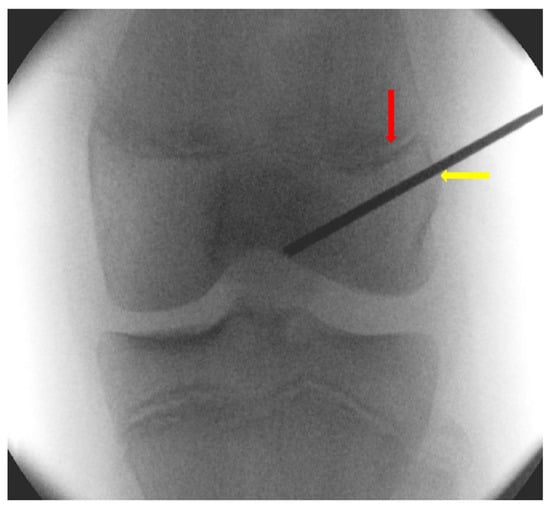
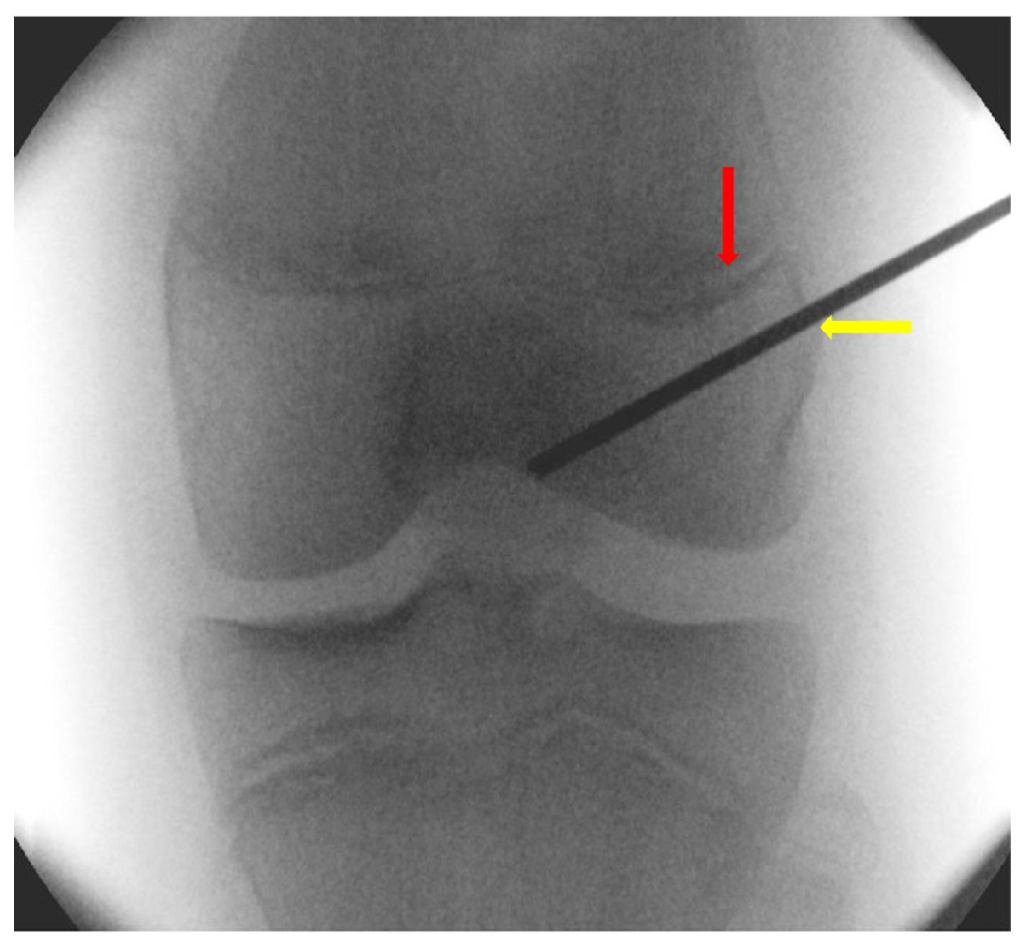
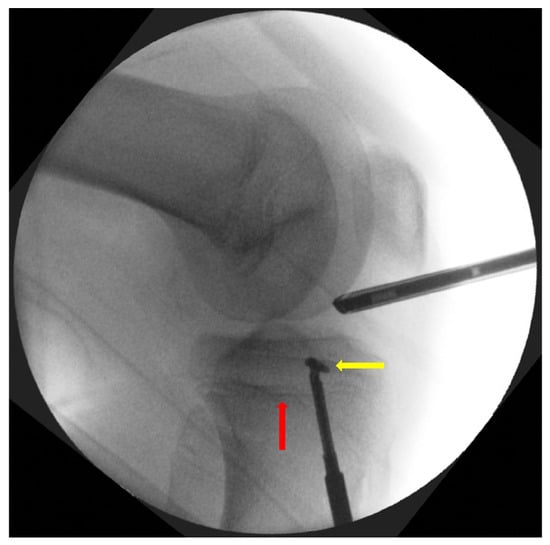
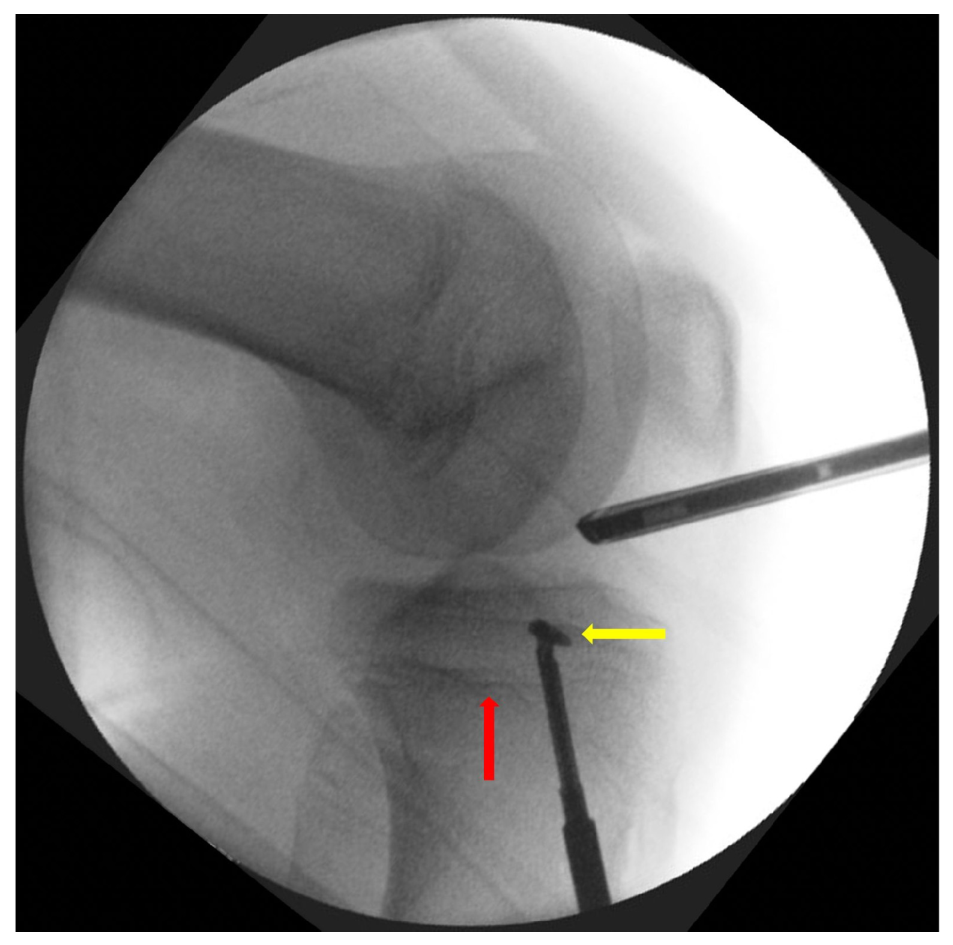
Particular attention was given to physeal preservation. The femoral socket was fully epiphyseal and was drilled using an outside-in technique under fluoroscopic control. The tip of the femoral guide was positioned at the femoral ACL footprint, while the drill sleeve was positioned at the modified Lemaire point (Figure 1). On the tibial side, fluoroscopic guidance and reverse reaming were used to minimize physeal injury (Figure 2). The technique was specifically designed to avoid damage to the physes.
Figure 1.
Intraoperative fluoroscopic view of the femoral side during ACL reconstruction. The yellow arrow indicates the femoral guide trajectory, while the red arrow indicates the distal femoral physis. Fluoroscopic guidance was used to position the femoral socket while preserving the physis.
Figure 2.
Intraoperative fluoroscopic view of the tibial side during ACL reconstruction. The yellow arrow indicates the reverse drill, while the red arrow indicates the proximal tibial physis. Fluoroscopic guidance was used during tibial socket preparation to minimize physeal injury.
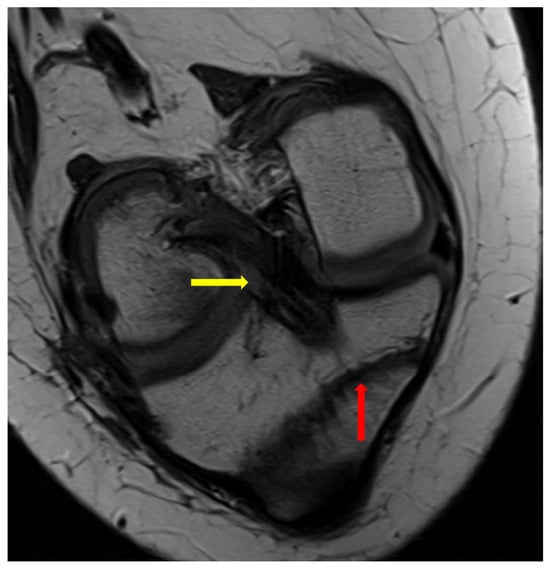
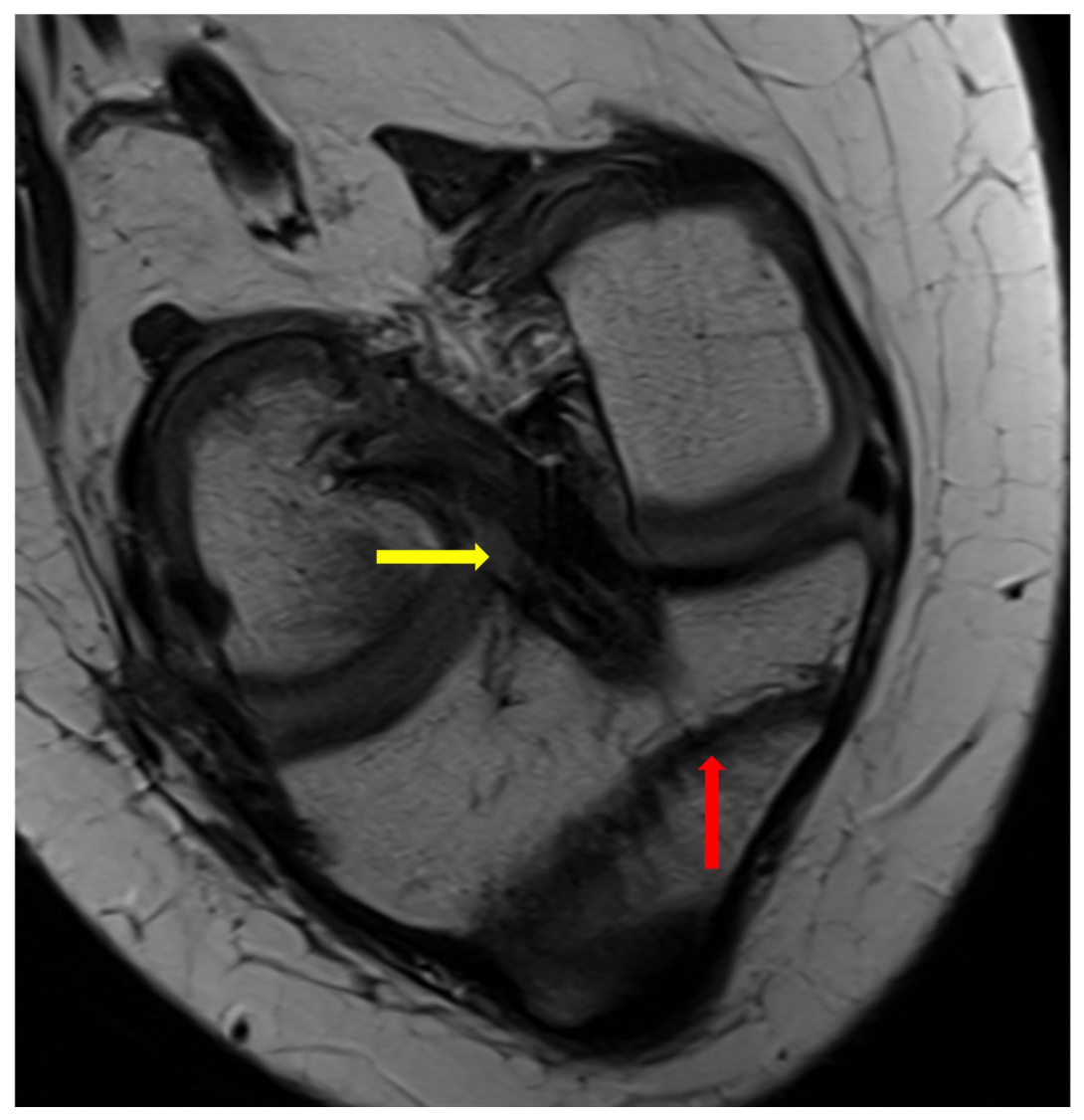
Postoperative follow-up included serial clinical assessment for growth-related complications, including limb-length discrepancy and angular deformity. Clinical assessment included observation of gait for pelvic drop, compensatory knee flexion or toe-walking, together with the Galeazzi (Allis) test for clinical evaluation of limb-length discrepancy. No clinically evident growth disturbance was identified during follow-up. Additional serial radiographic imaging was not routinely obtained in the absence of clinical findings suggesting physeal disturbance. Postoperative MRI was obtained at approximately 9 months in all three patients and demonstrated graft incorporation without MRI evidence of physeal injury. Figure 3 presents the postoperative MRI of Case 3 as a representative example.
Figure 3.
Representative postoperative sagittal MRI of Case 3, obtained 9 months after ACL reconstruction. The yellow arrow indicates the ACL graft, while the red arrow indicates the proximal tibial physis. The image demonstrates graft incorporation without MRI evidence of physeal injury.
2.5. Adapted Postoperative Rehabilitation
The physical goals of postoperative rehabilitation were consistent with conventional adolescent ACL rehabilitation, whereas the mode of delivery was adapted to the cognitive, communication and behavioral needs of each patient. Supervised rehabilitation was scheduled three times per week, with sessions lasting approximately 2 h. Rehabilitation was delivered by physiotherapy personnel within the patient’s respective residential care settings, with caregivers reinforcing instructions and routines between supervised sessions and accompanying the adolescents to clinical follow-up.
Progression was based primarily on clinical and functional performance rather than predetermined postoperative time. The domains considered were those ordinarily used during ACL rehabilitation, including pain and effusion, range of motion, quadriceps control, gait quality, knee stability, movement quality and successful performance of progressively more demanding functional tasks. Formal numerical progression thresholds were not prospectively documented and were therefore not retrospectively assigned. The rehabilitation strategies described here represent an individualized clinical approach used in these three patients and should not be interpreted as a validated or standardized rehabilitation protocol.
Early rehabilitation focused on pain and effusion control, restoration of knee extension and progressive flexion, quadriceps activation, weight acceptance and gait recovery. Subsequent rehabilitation emphasized progressive strengthening, stationary cycling, neuromuscular control and functional tasks, progressing from bilateral squatting to unilateral exercises such as single-leg lunges. Later rehabilitation incorporated progressively more demanding single-leg tasks, running preparation and functional performance exercises.
The principal adaptations concerned how these conventional rehabilitation tasks were communicated, demonstrated and supervised. Instructions were brief and concrete, complex exercises were divided into simpler components, and direct visual demonstration was used routinely. Repetition was provided when required, and understanding was assessed primarily through successful task performance rather than verbal confirmation alone. Exercise selection was also adapted to the equipment available within each residential setting, and progression was deliberately gradual when additional time was required to achieve safe and consistent task performance.
Adaptations were further individualized according to each patient’s functional profile. In Case 1, shorter task segments, repeated redirection, gradual familiarisation with the postoperative brace and cryotherapy equipment, and close caregiver supervision were used to address hyperactivity, limited sustained attention and sensory aversion. In Case 2, visual support, consistency of routine, repeated reassurance, and caregiver involvement were emphasized because of marked fear of movement and concern that normal stretching sensations represented graft damage. In Case 3, multistep exercises were divided into simpler visually demonstrated components, with structured positive reinforcement and close caregiver supervision, particularly during activities requiring adherence to crutch-safety instructions.
2.6. Management of Temporary Difficulties with Participation
Temporary interruptions or difficulty sustaining participation were regarded as part of the rehabilitation process rather than as treatment failure. When participation became insufficient, the task was first paused and reintroduced using a simplified verbal explanation and renewed visual demonstration. If necessary, the adolescent was given a short period in a quieter, reduced-stimulation environment under supervision before the task was attempted again. If adequate participation could not be restored, the session was discontinued and rescheduled rather than forcing completion.
The frequency of repeated explanations, temporary pauses, incomplete sessions and rescheduled sessions was not prospectively quantified. Similarly, formal attendance rates and total supervised rehabilitation exposure were not recorded as research outcomes. Accordingly, adherence is not presented as a quantitatively measured outcome in this report.
2.7. Rehabilitation Progression and Return to Activity
Progression through rehabilitation was guided by clinical and functional assessment rather than strictly by postoperative time (Table 2). The approximately 2-month milestone for discontinuation of crutches reflected the observed time at which satisfactory gait, weight acceptance, and functional control had been restored in these patients; it was not used as a predetermined minimum postoperative restriction. Similarly, running was introduced at approximately 6 months when clinical assessment demonstrated adequate recovery and tolerance of single-leg functional loading. These time points therefore represent observed milestones within this three-case report rather than fixed progression thresholds.
Table 2.
Structure and practical adaptation of postoperative rehabilitation.
Return to recreational football was deliberately delayed until 18 months after ACL reconstruction as a protective, case-specific clinical decision. In the treating team’s clinical experience, additional time was required in these patients to achieve safe and consistent performance of progressively more demanding functional tasks. However, no systematically recorded comparative progression data were available to establish that rehabilitation was objectively slower than in other adolescents undergoing ACL reconstruction.
Clearance was based on a stable clinical examination, absence of pain and effusion, full knee range of motion, satisfactory postoperative MRI findings, functional strength assessment using body-weight tasks including single-leg squats and single-leg Romanian deadlifts, and hop testing. At the return-to-activity assessment, hop testing demonstrated a side-to-side difference of <10% in all three patients.
2.8. Outcome Assessment
Clinical outcomes included activity level, patient-reported knee function, mechanical knee stability, and adverse events. Activity level was assessed using the Tegner Activity Scale [21], while subjective knee function was evaluated using both the Lysholm Knee Score [21] and the International Knee Documentation Committee (IKDC) Subjective Knee Evaluation Form [22,23]. The preoperative Tegner value represented the pre-injury activity level. Adverse events and complications assessed during follow-up included surgical and wound-related complications, graft failure or reinjury, clinically relevant loss of range of motion, thromboembolic events, growth-related disturbance, contralateral ACL injury, and rehabilitation-related adverse events.
Because of the patients’ cognitive and communication characteristics, the questionnaires were completed by the adolescents with caregiver assistance. The caregiver’s role was to ensure that each question was understood and to confirm that the recorded response reflected the patient’s intended answer; responses were not independently substituted by the caregiver as proxy responses. The same supported administration approach was used for both preoperative and postoperative assessments.
The IKDC Subjective Knee Evaluation Form has demonstrated validity and internal consistency in children and adolescents aged 6–18 years [23]. However, the psychometric properties of the IKDC and Lysholm instruments have not been specifically established in adolescents with IDD, and these patient-reported outcomes were therefore interpreted with appropriate caution.
Anterior knee laxity was assessed using a KT-1000 knee arthrometer with the knee positioned at approximately 20–30° of flexion [24]. Measurements were obtained bilaterally under progressive anterior loading, including manual maximum force. Four measurements were obtained for each knee; the first trial was used for familiarisation and excluded from analysis. The mean of the subsequent three measurements was used to calculate the side-to-side difference, defined as anterior translation of the reconstructed knee minus that of the contralateral knee. The side-to-side values reported in this manuscript correspond to measurements obtained at manual maximum force.
Rotational stability was assessed using the pivot-shift test [25]. Preoperative and postoperative KT-1000 and pivot-shift assessments were performed by the same examiner, with patients awake during both assessments, thereby maintaining comparable clinical conditions. Preoperative measurements were obtained before ACL reconstruction, whereas postoperative Lysholm, IKDC, KT-1000, and pivot-shift assessments were recorded at the final follow-up: 36 months for Case 1, 52 months for Case 2, and 43 months for Case 3.
Intermediate clinical follow-up data were available for functional milestones, including discontinuation of crutches, initiation of running, and return to recreational football, as reported in Table 3. However, standardized intermediate Lysholm, IKDC, and KT-1000 outcome measurements were not systematically recorded; these outcomes were available preoperatively and at final follow-up.
Table 3.
Individual clinical and rehabilitation timelines of the three cases.
3. Results
3.1. Clinical and Surgical Course
The initial clinical presentation across the entire cohort was characterized by isolated ACL disruptions without associated meniscal injury. Despite completing the initial conservative physical therapy regimen, all three individuals experienced persistent, symptomatic instability with recurrent giving-way episodes, establishing the indication for operative intervention. Combined ACL reconstruction and concomitant LET were performed between 3 and 6 months post-injury. The intraoperative and immediate postoperative phases proceeded without incident. No perioperative complications or reinjuries were recorded during follow-up.
3.2. Individual Clinical and Rehabilitation Timelines
The individual clinical and rehabilitation trajectories are presented in Table 3, including injury-to-surgery interval, operative timing, patient-specific rehabilitation barriers and adaptations, major functional milestones and final follow-up. Although the overall rehabilitation framework was similar across the three patients, the mode of delivery and management of participation difficulties was adapted according to each patient’s cognitive, behavioral and sensory profile.
3.3. Rehabilitation Participation and Longitudinal Outcomes
All three patients remained engaged in the rehabilitation pathway through final functional progression, although formal attendance, exercise-completion and adherence metrics were not prospectively recorded. Temporary difficulties with participation were managed using the staged approach described above.
Longitudinal clinical evaluation showed improvement in functional scores and knee stability measures for all three individuals (Table 4). The pre-injury Tegner activity level of 5 was maintained at final follow-up in all three patients. Subjective functional scores increased in all three patients; Lysholm scores climbed from 67 to 100 for Case 1, 55 to 100 for Case 2, and 69 to 96 for Case 3, while subjective IKDC metrics also increased from 65.5, 54.0, and 67.8 to final values of 100, 100, and 94.2, respectively. Instrumented laxity testing showed improvement in KT-1000 side-to-side anterior knee laxity at manual maximum force, decreasing from 10 to 1 mm in Case 1, 7 to 1 mm in Case 2, and 7 to 0 mm in Case 3. Pivot-shift grade improved to 0 in all three patients. At return-to-activity assessment, hop-test side-to-side difference was <10% in all three patients. Finally, no reinjuries or contralateral ACL injuries were recorded during follow-up, and no clinically evident growth disturbance was identified on serial clinical assessment.
Table 4.
Clinical characteristics, surgical treatment and outcomes of the three patients.
4. Discussion
This three-case report describes three adolescents with mild intellectual developmental disorder (IDD) who underwent anterior cruciate ligament reconstruction (ACLR) combined with lateral extra-articular tenodesis (LET) after persistent symptomatic instability despite conservative rehabilitation. During 36–52 months of follow-up, all three patients showed improved knee stability and functional scores, with no recorded reinjury. The main clinical challenge extended beyond the surgical procedure itself and concerned the delivery of rehabilitation in a way that preserved the usual physical goals of adolescent ACL recovery while adapting communication, supervision and session management to individual needs.
Management of pediatric ACL injury requires individualized consideration of skeletal maturity, activity level and functional instability [1,2]. Current recommendations also emphasize developmental maturity throughout rehabilitation and return-to-activity decision-making [1,2]. In the present cases, reconstruction was undertaken only after an initial period of conservative rehabilitation failed to resolve symptomatic instability. This choice aligns with established personalized care, where persistent functional instability, rather than imaging findings alone, indicates the need for surgery [1,2].
Outcomes after ACL reconstruction in skeletally immature patients are generally favorable, although reinjury remains an important concern [26,27]. A systematic review of 53 studies involving 1691 procedures reported an 89% return-to-sport rate, with graft re-tear occurring in approximately 9% of patients [26]. A separate review of transphyseal ACL reconstruction reported graft failure of approximately 11% and a similar clinically relevant risk of contralateral ACL injury [27]. In the present report, all three patients also underwent LET. Combined ACLR and LET has been increasingly investigated in younger patients considered at increased risk of graft failure or rotational instability [28,29,30]. Recent pooled evidence suggests that LET may reduce graft re-rupture compared with isolated ACLR in pediatric and skeletally immature populations, although heterogeneity and the predominantly observational nature of the available evidence remain important limitations [28,29,30]. The absence of reinjury in our patients is encouraging. However, the independent contribution of LET cannot be determined from this small three-case report.
Postoperative rehabilitation also represents an important component of functional recovery. While the rehabilitation approach used in these cases maintained the core goals of adolescent ACL rehabilitation, focusing on restoration of range of motion, strength, neuromuscular control, and functional capacity [2]—the procedural delivery required modifications. The principal adaptations concerned how exercises were explained, presented, and supervised. Instructions were brief, exercises were demonstrated and repeated when needed, and successful task performance was used as a practical indication of understanding. These adaptations are consistent with literature describing the importance of accessible communication and reasonable adjustments in healthcare for people with intellectual disabilities [7,8,9,10,11]. Communication support and caregiver involvement have both been identified as factors that may facilitate participation in care, particularly when information exchange is otherwise difficult [7,8,9,10,11].
This adapted communication strategy reflects documented evidence regarding how people with intellectual disabilities can improve motor performance through structured exercise [12]. A systematic review and meta-analysis reported improvements in composite, gross, and fine motor skills following exercise training [12], while more recent evidence in children and adolescents with intellectual and developmental disabilities similarly supports improvements in fundamental motor skills after structured physical-activity interventions [13]. These studies were not conducted in postoperative ACL rehabilitation and should not be directly extrapolated to this setting. They do, however, support the broader principle that intellectual disability does not preclude motor improvement when exercise is appropriately structured [12,13].
Caregiver and environmental support appeared to be particularly relevant in the present cases. Physical activity participation among children and adolescents with intellectual disability is influenced by interacting individual, interpersonal and environmental factors [14,15,16,17,31]. Caregiver support and access to adapted programs have been identified as important facilitators of participation [14,15,16,17]. All three adolescents in this report lived in residential care settings with ongoing access to staff and physiotherapy, while caregivers supported rehabilitation and accompanied them to clinical follow-up.
Although formal adherence metrics were not prospectively recorded, all three patients remained engaged in the rehabilitation pathway and achieved the planned functional milestones. In the treating team’s clinical experience, additional time was required during some phases to achieve safe and consistent task performance. However, comparative progression data were not systematically recorded. This pattern is consistent with sustained participation in rehabilitation, but it should not be interpreted as a quantitative measure of adherence. Structured caregiver and physiotherapy support was available throughout the rehabilitation pathway within the residential settings. This level of support also limits generalizability, since similar rehabilitation progression cannot be assumed in settings where daily supervision or regular physiotherapy is unavailable.
Even within a dedicated care setting and structured rehabilitation environment, temporary difficulties with participation occurred. These difficulties were managed using an adaptive staged approach that included renewed explanation and demonstration, a short period in a quieter supervised environment when needed, and rescheduling of the session if adequate participation could not be restored. The broader intellectual-disability literature supports individualized communication and environmental adjustment [7,8,9,10,11], but we did not identify evidence evaluating this specific approach after ACL reconstruction. This workflow, therefore, represents an empirical description of the clinical approach used in this cohort, rather than a validated behavioral protocol.
Return-to-activity decisions also require cautious interpretation. Considerable variability exists in the criteria used after ACL reconstruction [3,4,32,33]. A scoping review of return-to-running criteria found that fewer than one in five studies used clinical, strength or performance criteria in addition to time [32], while more recent work continues to report substantial variation in return-to-sport testing and clearance thresholds [4,33]. In the present report, we did not establish strict numerical thresholds beforehand. Running was introduced at approximately 6 months after clinical assessment. However, recreational football was deliberately withheld for 18 months. This extended timeline reflects our protective, case-specific approach, not a standard return-to-football recommendation for adolescents with IDD.
The absence of reinjury should also be interpreted cautiously. Recreational football was withheld until 18 months after reconstruction, and subsequent sport exposure was not prospectively quantified. Therefore, the absence of graft or contralateral ACL injury cannot be interpreted as evidence that LET, the adapted rehabilitation approach, or delayed return to sport independently reduced reinjury risk.
From a functional perspective, all three patients demonstrated improvement in Lysholm and IKDC scores, together with reduced anterior laxity and normalization of pivot-shift testing. Tegner activity level remained at 5 in all three cases, indicating maintenance of the recorded pre-injury activity level. In adolescents with intellectual disability, continued participation in physical activity is influenced not only by physical capacity but also by access to adapted programs, social relationships and caregiver support [14,15,16,17,31]. Structured physical-activity interventions have been associated with improvements in motor performance and increased physical-activity participation in children and adolescents with intellectual disabilities [12,13,34]. However, participation should not automatically be equated with broader social inclusion. A systematic review reported that physical-activity and sport programs may require substantial support and infrastructure, while evidence for transfer to wider community inclusion remains limited [35]. This is relevant to the present cohort, whose football participation occurred within the residential care environment.
4.1. Clinical Implications
In these three cases, adolescents with mild IDD completed structured postoperative ACL rehabilitation in which treatment delivery was adapted to their individual communication, cognitive and behavioral needs. The physical goals of rehabilitation were retained, while the principal modifications concerned communication, task presentation and supervision.
Practical strategies included concise verbal instructions, direct demonstration, repetition when necessary, and assessment of understanding through performance. Access to physiotherapy within the residential care setting and active caregiver involvement were present between clinical reviews and formed part of the rehabilitation pathway. When temporary difficulties with participation occurred, we avoided categorizing the patient as non-adherent or abandoning the rehabilitation plan; instead, we adapted the session.
Existing healthcare literature supports individualized communication, reasonable adjustments and caregiver involvement for people with intellectual disabilities [7,8,9,10,11,14,15,16,17]. The present cases describe the application of these principles to postoperative musculoskeletal care. This approach should be regarded as a description of clinical practice rather than a validated rehabilitation protocol.
4.2. Limitations
This study has several limitations. Its retrospective design and small sample size do not allow conclusions regarding the effectiveness of the adapted rehabilitation approach compared with conventional rehabilitation. All three patients were male, had mild IDD, and lived in residential care settings with structured caregiver and physiotherapy support, which limits generalizabilty to adolescents with different levels of disability or less structured support. In addition, all preoperative and postoperative clinical assessments were performed by the treating orthopedic surgeon rather than by an independent assessor, introducing the possibility of examiner-related assessment bias. Furthermore, skeletal maturity at final follow-up was not assessed using dedicated radiographic or MRI evaluation. Therefore, although serial clinical assessment did not identify limb-length discrepancy or angular deformity, subclinical or radiographically detectable growth disturbance cannot be excluded.
Detailed quantitative rehabilitation outcomes were also limited. Although range of motion, clinical stability, body-weight functional strength tasks and hop testing were used to guide progression, and hop testing at the return-to-activity assessment demonstrated a side-to-side difference of <10% in all three patients, exact individual hop distances and serial quantitative hop-test data were not systematically recorded. Prospectively standardized measurements of quadriceps and hamstring strength, balance or proprioceptive performance, psychological readiness, and post-clearance sport exposure were not systematically recorded.
Because rehabilitation was delivered as routine clinical care, detailed session-level data and formal quantitative progression thresholds were not prospectively recorded. Adherence was assessed clinically rather than with a validated instrument, and the exact frequency of preoperative giving-way episodes was unavailable.
Furthermore, the psychometric properties of the IKDC and Lysholm scores have not been established specifically in adolescents with IDD. In addition, the absence of a comparison group prevents the observed outcomes from being attributed separately to ACL reconstruction, LET, rehabilitation adaptations, caregiver involvement, or the residential care environment.
Coexisting anxiety may also have influenced participation during clinical assessment and the patients’ subjective responses to the Lysholm and IKDC questionnaires. Although the same supported administration approach was used before and after surgery, the potential effect of anxiety on patient-reported outcomes could not be quantified and should be considered when interpreting these scores.
5. Conclusions
In these three adolescents with mild IDD and persistent symptomatic instability after unsuccessful conservative treatment, ACL reconstruction combined with LET and followed by adapted rehabilitation was associated with improved knee stability and functional outcomes, with no recorded reinjuries during 36–52 months of follow-up.
The experience from these cases indicates that rehabilitation could be delivered while retaining conventional physical goals and adapting communication, demonstration, supervision, and caregiver support to individual needs. Because surgery, LET, delayed return to sport, rehabilitation adaptations, and caregiver support were all part of the same clinical pathway, the contribution of any individual component cannot be determined. These findings are descriptive and should be interpreted in the context of this small retrospective three-case report. Future prospective studies with larger samples and systematic documentation of rehabilitation exposure, functional progression, adherence, and participation are needed to clarify which adaptations are most useful in this population.
Author Contributions
Conceptualization, E.I.G., and N.K.; methodology, E.I.G. and N.K.; clinical management, D.K. and N.K.; surgical treatment, N.K.; data curation, N.K.; resources, D.K. and N.K.; investigation, E.I.G. and N.K.; writing—original draft preparation, E.I.G. and N.K.; writing—review and editing, E.I.G. and N.K.; supervision, N.K.; project administration, N.K. All authors have read and agreed to the published version of the manuscript.
Funding
This research received no external funding.
Institutional Review Board Statement
The study was conducted in accordance with the Declaration of Helsinki and approved by the Ethics and Deontology Committee of St. Luke’s Hospital, Thessaloniki, Greece (registration number E.E./10-03-2025).
Informed Consent Statement
Written informed consent for the use and publication of anonymized clinical information was obtained from the legal guardians of all three patients. The adolescents received information adapted to their level of understanding and provided assent where possible. Permission for use of the relevant anonymized clinical information was also obtained from the residential care facilities.
Data Availability Statement
The clinical data presented in this three-case report are contained within the article. Additional patient-level information is not publicly available because of privacy and confidentiality considerations.
Acknowledgments
During the preparation of this manuscript, the authors used a generative AI-assisted tool (OpenAI, GPT-5.6 Sol) to reformat the bibliography to the preferred style guide and refine academic clarity. This tool was not used to generate original scientific content, data, or interpretations, nor to influence the study design or conclusions. The authors have reviewed and edited the output and take full responsibility for the content of this publication.
Conflicts of Interest
The authors declare no conflicts of interest.
Abbreviations
The following abbreviations are used in this manuscript:
| ACL | Anterior cruciate ligament |
| ACLR | Anterior cruciate ligament reconstruction |
| AI | Artificial intelligence |
| BMI | Body mass index |
| IDD | Intellectual developmental disorder |
| IKDC | International Knee Documentation Committee |
| LEAPs | Lateral extra-articular procedures |
| LET | Lateral extra-articular tenodesis |
| MRI | Magnetic resonance imaging |
| QT | Quadriceps tendon |
References
- Ardern, C.L.; Ekås, G.R.; Grindem, H.; Moksnes, H.; Anderson, A.F.; Chotel, F.; Cohen, M.; Forssblad, M.; Ganley, T.J.; Feller, J.A.; et al. 2018 International Olympic Committee consensus statement on prevention, diagnosis and management of paediatric anterior cruciate ligament injuries. Knee Surg. Sports Traumatol. Arthrosc. 2018, 26, 989–1010. [Google Scholar] [CrossRef] [Scilit] [PubMed]
- van Melick, N.; Dietvorst, M.; van Oort, M.I.A.M.; Claessens, R.L.A.; Janssen, R.P.A.; Bogie, R.; the Adolescent ACL Rehabilitation Group; Claussen, W.; Greenberg, E.M.; Grindem, H.; et al. Anterior Cruciate Ligament Rehabilitation for the 10- to 18-Year-Old Adolescent Athlete: Practice Guidelines Based on International Delphi Consensus. Orthop. J. Sports Med. 2023, 11, 23259671231172454. [Google Scholar] [CrossRef] [Scilit] [PubMed]
- Romanchuk, N.J.; Livock, H.; Lukas, K.J.; Del Bel, M.J.; Benoit, D.L.; Carsen, S. Criteria Used to Determine Unrestricted Return to Activity After ACL Reconstruction in Pediatric and Adolescent Patients: A Systematic Review. Orthop. J. Sports Med. 2023, 11, 23259671231154540. [Google Scholar] [CrossRef] [Scilit] [PubMed]
- Lorange, J.P.; Senécal, L.; Moisan, P.; Nault, M.L. Return to Sport After Pediatric Anterior Cruciate Ligament Reconstruction: A Systematic Review of the Criteria. Am. J. Sports Med. 2024, 52, 1641–1651. [Google Scholar] [CrossRef] [Scilit] [PubMed]
- Tassé, M.J.; Luckasson, R.; Schalock, R.L. The Relation Between Intellectual Functioning and Adaptive Behavior in the Diagnosis of Intellectual Disability. Intellect. Dev. Disabil. 2016, 54, 381–390. [Google Scholar] [CrossRef] [Scilit] [PubMed]
- Schalock, R.L.; Luckasson, R.; Tassé, M.J. An Overview of Intellectual Disability: Definition, Diagnosis, Classification, and Systems of Supports, 12th ed. Am. J. Intellect. Dev. Disabil. 2021, 126, 439–442. [Google Scholar] [CrossRef] [Scilit] [PubMed]
- Ong, N.; Long, J.C.; Weise, J.; Walton, M. Responding to Safe Care: Healthcare Staff Experiences Caring for a Child with Intellectual Disability in Hospital. Implications for Practice and Training. J. Appl. Res. Intellect. Disabil. 2022, 35, 675–690. [Google Scholar] [CrossRef] [Scilit] [PubMed]
- Chinn, D. Review of Interventions to Enhance the Health Communication of People With Intellectual Disabilities: A Communicative Health Literacy Perspective. J. Appl. Res. Intellect. Disabil. 2017, 30, 345–359. [Google Scholar] [CrossRef] [Scilit] [PubMed]
- Doherty, A.J.; Atherton, H.; Boland, P.; Hastings, R.; Hives, L.; Hood, K.; James-Jenkinson, L.; Leavey, R.; Randell, E.; Reed, J.; et al. Barriers and facilitators to primary health care for people with intellectual disabilities and/or autism: An integrative review. BJGP Open 2020, 4, bjgpopen20X101030. [Google Scholar] [CrossRef] [Scilit] [PubMed]
- Moloney, M.; Hennessy, T.; Doody, O. Reasonable Adjustments for People with Intellectual Disability in Acute Care: A Scoping Review of the Evidence. BMJ Open 2021, 11, e039647. [Google Scholar] [CrossRef] [Scilit] [PubMed]
- Chinn, D.; Bruun, A.; Worrall, D.; Buell, S.; La, J. Communicative Dilemmas for Practitioners in Service Encounters With People With Intellectual Disabilities: Insights From a Systematic Review of Conversation Analytic Research. J. Appl. Res. Intellect. Disabil. 2026, 39, e70239. [Google Scholar] [CrossRef] [Scilit] [PubMed]
- Zarei, H.; Norasteh, A.A.; Dehghani, N.; Lieberman, L.J.; Ertel, M.W.; Brian, A. Effects of Exercise Training Programs on Motor Skills of Individuals with Intellectual Disabilities: A Systematic Review and Meta-Analysis. Disabil. Rehabil. 2024, 46, 6001–6010. [Google Scholar] [CrossRef] [Scilit] [PubMed]
- Tan, X.; Zhang, L.; Wang, D.; Wu, X. Effects of physical activity on fundamental motor skills and body composition in children and adolescents with intellectual and developmental disabilities: A systematic review and meta-analysis. PeerJ 2026, 14, e20946. [Google Scholar] [CrossRef] [Scilit] [PubMed]
- Yu, S.; Wang, T.; Zhong, T.; Qian, Y.; Qi, J. Barriers and Facilitators of Physical Activity Participation among Children and Adolescents with Intellectual Disabilities: A Scoping Review. Healthcare 2022, 10, 233. [Google Scholar] [CrossRef] [Scilit] [PubMed]
- Vancampfort, D.; Van Damme, T.; Firth, J.; Stubbs, B.; Schuch, F.; Suetani, S.; Arkesteyn, A.; Van Biesen, D. Physical activity correlates in children and adolescents, adults, and older adults with an intellectual disability: A systematic review. Disabil. Rehabil. 2022, 44, 4189–4200. [Google Scholar] [CrossRef] [Scilit] [PubMed]
- Hao, Y.; Razman, R. Family factors associated with physical activity in children with intellectual disability: A systematic review. J. Intellect. Disabil. 2025, 29, 194–213. [Google Scholar] [CrossRef] [Scilit] [PubMed]
- McGarty, A.M.; Melville, C.A. Parental perceptions of facilitators and barriers to physical activity for children with intellectual disabilities: A mixed methods systematic review. Res. Dev. Disabil. 2018, 73, 40–57. [Google Scholar] [CrossRef] [Scilit] [PubMed]
- Koukoulias, N.E.; Dimitriadis, T.; Vasiliadis, A.V.; Germanou, E.; Boutovinos, A.-P. ACL Reconstruction and Modified Lemaire Tenodesis Utilizing Common Suspensory Femoral Fixation. Arthrosc. Tech. 2022, 11, e2185–e2193. [Google Scholar] [CrossRef] [Scilit] [PubMed]
- World Medical Association. World Medical Association Declaration of Helsinki: Ethical Principles for Medical Research Involving Human Participants. JAMA 2025, 333, 71–74. [Google Scholar] [CrossRef] [Scilit] [PubMed]
- Mathew, G.; Sohrabi, C.; Franchi, T.; Nicola, M.; Kerwan, A.; Agha, R.; PROCESS Group. Preferred Reporting Of Case Series in Surgery (PROCESS) 2023 guidelines. Int. J. Surg. 2023, 109, 3760–3769. [Google Scholar] [CrossRef] [Scilit] [PubMed]
- Tegner, Y.; Lysholm, J. Rating systems in the evaluation of knee ligament injuries. Clin. Orthop. Relat. Res. 1985, 198, 43–49. [Google Scholar] [CrossRef] [Scilit]
- Irrgang, J.J.; Anderson, A.F.; Boland, A.L.; Harner, C.D.; Kurosaka, M.; Neyret, P.; Richmond, J.C.; Shelborne, K.D. Development and validation of the International Knee Documentation Committee Subjective Knee Form. Am. J. Sports Med. 2001, 29, 600–613. [Google Scholar] [CrossRef] [Scilit] [PubMed]
- Schmitt, L.C.; Paterno, M.V.; Huang, S. Validity and internal consistency of the International Knee Documentation Committee Subjective Knee Evaluation Form in children and adolescents. Am. J. Sports Med. 2010, 38, 2443–2447. [Google Scholar] [CrossRef] [Scilit] [PubMed]
- van Eck, C.F.; Loopik, M.; van den Bekerom, M.P.J.; Fu, F.H.; Kerkhoffs, G.M.M.J. Methods to diagnose acute anterior cruciate ligament rupture: A meta-analysis of instrumented knee laxity tests. Knee Surg. Sports Traumatol. Arthrosc. 2013, 21, 1989–1997. [Google Scholar] [CrossRef] [Scilit] [PubMed]
- Ayeni, O.R.; Chahal, M.; Tran, M.N.; Sprague, S. Pivot shift as an outcome measure for ACL reconstruction: A systematic review. Knee Surg. Sports Traumatol. Arthrosc. 2012, 20, 767–777. [Google Scholar] [CrossRef] [Scilit] [PubMed]
- Migliorini, F.; Cocconi, F.; Schäfer, L.; Memminger, M.K.; Giorgino, R.; Maffulli, N. Anterior cruciate ligament reconstruction in skeletally immature patients is effective: A systematic review. Knee Surg. Sports Traumatol. Arthrosc. 2024, 32, 418–431. [Google Scholar] [CrossRef] [Scilit] [PubMed]
- Petersen, W.; Bierke, S.; Stöhr, A.; Stoffels, T.; Häner, M. A systematic review of transphyseal ACL reconstruction in children and adolescents: Comparing the transtibial and independent femoral tunnel drilling techniques. J. Exp. Orthop. 2023, 10, 7. [Google Scholar] [CrossRef] [Scilit] [PubMed]
- Carrozzo, A.; Monaco, E.; Saithna, A.; Annibaldi, A.; Guy, S.; Ferreira, A.; Vieira, T.D.; Ferretti, A.; Sonnery-Cottet, B. Clinical Outcomes of Combined Anterior Cruciate Ligament Reconstruction and Lateral Extra-articular Tenodesis Procedures in Skeletally Immature Patients: A Systematic Review From the SANTI Study Group. J. Pediatr. Orthop. 2023, 43, 24–30. [Google Scholar] [CrossRef] [Scilit] [PubMed]
- Kotipalli, S.; Haidl, T.; Vivekanantha, P.; de Sa, D.; Kay, J. Lateral Extra-articular Tenodesis With Anterior Cruciate Ligament Reconstruction in Pediatric and Skeletally Immature Patients: A Systematic Review and Meta-analysis. Am. J. Sports Med. 2026, 54, 1747–1756. [Google Scholar] [CrossRef] [Scilit] [PubMed]
- Kienberger, S.; Kratochwil, L.; Gotterbarm, T.; Deichsel, A.; Winkler, P.W. Lateral extra-articular procedures reduce anterior cruciate ligament graft failure in patients younger than 21 years undergoing primary anterior cruciate ligament reconstruction: A systematic review. J. ISAKOS 2026, 19, 101139. [Google Scholar] [CrossRef] [Scilit] [PubMed]
- Maenhout, L.; Melville, C.A. Unravelling the link between physical activity and peer social connectedness in young people with intellectual disabilities: A systematic review of quantitative studies. J. Intellect. Disabil. Res. 2024, 68, 95–112. [Google Scholar] [CrossRef] [Scilit] [PubMed]
- Rambaud, A.J.M.; Ardern, C.L.; Thoreux, P.; Regnaux, J.P.; Edouard, P. Criteria for return to running after anterior cruciate ligament reconstruction: A scoping review. Br. J. Sports Med. 2018, 52, 1437–1444. [Google Scholar] [CrossRef] [Scilit] [PubMed]
- Kodama, E.; Tartibi, S.; Brophy, R.H.; Smith, M.V.; Matava, M.J.; Knapik, D.M. Return to Sport Following Anterior Cruciate Ligament Reconstruction: A Scoping Review of Criteria Determining Return to Sport Readiness. Curr. Rev. Musculoskelet. Med. 2025, 18, 1–5. [Google Scholar] [CrossRef] [Scilit] [PubMed]
- McGarty, A.M.; Downs, S.J.; Melville, C.A.; Harris, L. A systematic review and meta-analysis of interventions to increase physical activity in children and adolescents with intellectual disabilities. J. Intellect. Disabil. Res. 2018, 62, 312–329. [Google Scholar] [CrossRef] [Scilit] [PubMed]
- Thomson, A.; Bridges, S.; Corrins, B.; Pham, J.; White, C.; Buchanan, A. The impact of physical activity and sport programs on community participation for people with intellectual disability: A systematic review. J. Intellect. Dev. Disabil. 2021, 46, 261–271. [Google Scholar] [CrossRef] [Scilit] [PubMed]

Disclaimer/Publisher’s Note: The statements, opinions and data contained in all publications are solely those of the individual author(s) and contributor(s) and not of MDPI and/or the editor(s). MDPI and/or the editor(s) disclaim responsibility for any injury to people or property resulting from any ideas, methods, instructions or products referred to in the content. |
© 2026 by the authors. Licensee MDPI, Basel, Switzerland. This article is an open access article distributed under the terms and conditions of the Creative Commons Attribution (CC BY) license.