


Highlights
What are the main findings?
- The TRUST digital intervention was feasible and acceptable, with good participant engagement. Mothers and adolescents reported increases in knowledge, confidence, and motivation across the learning topics.
- Early and active involvement of the target population during the module development phase may increase the intervention feasibility, engagement, and adherence.
- Greater trust, better general parent–adolescent communication, and greater parental support were associated with more SRH communication among adolescents. Better general communication was also associated with greater perceived trustworthiness among both mothers and adolescents.
What are the implications of the main findings?
- Parent-adolescent sexual and reproductive (SRH) health communication refers to verbal discussion between adolescents and their parents or caregivers about topics related to sexual and reproductive health, including relationships, sexual behavior, contraception, pregnancy prevention, sexually transmitted infections, and use of SRH services.
- Digital interventions delivered around well-adolescent visits may provide a practical approach to strengthening mother–adolescent communication skills and supporting conversations about SRH, and encourage alone time with the provider during well-adolescent visits.
- Digital interventions that strengthen general communication and supportive parenting may help foster trust and facilitate SRH communication; larger controlled studies are needed to determine efficacy and sustainability.
Abstract
Background/Objectives: Effective parent–adolescent communication about sexual and reproductive health (SRH) is associated with healthier adolescent behaviors, but these conversations can be challenging. Well-adolescent visits (WAVs) offer an opportunity to support communication. This study evaluated the feasibility of a digital, module-based intervention for mother–adolescent dyads before WAVs and explored factors associated with changes in SRH communication and trust. Methods: A single-arm pre–post feasibility study enrolled adolescents aged 11–17 years and their mothers. Participants completed baseline and one-month post-WAV follow-up surveys, as well as four digital modules addressing general communication, SRH/relationship communication, parental monitoring, and WAV preparation. Descriptive statistics and generalized estimating equation models were used to examine changes and associations in communication-related outcomes. Results: 32 mother–adolescent dyads participated, comprising 38 adolescents and 32 mothers; 6 mothers enrolled with 2 adolescents. The study completion rate is 87.5% for mothers and 86.8% for adolescents. Participants completed an average of three modules. Adolescents most frequently viewed and rated the SRH/relationship communication module as helpful (68%), while mothers most often completed (66%) and valued the general communication and WAV preparation modules. Both groups reported improvements in knowledge, confidence, and motivation. Among adolescents, improvements in trust in their mothers (β = 0.64, p = 0.01), parent-adolescent general communication (β = 0.25, p = 0.001), and parental support (β = 1.59, p = 0.002) were associated with greater SRH communication with their mothers. Better general communication was also associated with higher perceived trustworthiness among mothers and adolescents. Conclusions: This digital, module-based intervention was feasible and acceptable. Larger controlled studies are needed to evaluate efficacy and sustainability and inform integration into routine clinical care.
1. Introduction
Adolescence is a critical developmental period for establishing healthy behaviors and preparing for adulthood. During this transition, parents continue to play an important role in supporting their adolescents’ physical, mental, and social well-being while fostering greater independence. Parent–adolescent communication about sexual and reproductive health (SRH) is a key component of adolescent health. Higher-quality and more frequent SRH communication has been associated with delayed sexual initiation, increased condom and contraceptive use [1,2], and greater adolescent self-efficacy in seeking sexual health information and services [3]. These findings underscore the importance of ongoing parent–adolescent SRH communication in supporting healthy decision-making and engagement in care.
Multiple factors, including general communication quality, parental monitoring, parental support, parental knowledge, confidence, and motivation, shape the effectiveness of SRH communication [4,5,6,7]. Evidence suggests that parent-based interventions that enhance communication skills, self-efficacy, and engagement can improve both communication outcomes and adolescent sexual health behaviors [8]. Recent research further highlights that the quality and frequency of communication are beneficial only when parents feel confident and informed [4]. Despite evidence that multiple factors influence the effectiveness of SRH communication between parents and adolescents, significant gaps remain in understanding how these factors—particularly parental knowledge, motivation, and communication quality; parental monitoring; and parental support—influence SRH communication.
Another important element in adolescents’ health is the parent-adolescent relationship. Ford (2023) [9] studied more than 15,000 adolescents and found that a trusting parent–adolescent relationship was associated with better self-reported general health in early adulthood. In addition, studies have shown that adolescents who trust their parents are more likely to engage in health-protective behaviors, including avoiding substance use, practicing safer sexual behaviors, being physically active, and reducing engagement in other high-risk behaviors [8,10,11]. This finding emphasizes the importance of establishing and maintaining a trusting, positive relationship between parents and adolescents for health and well-being.
Clear and bidirectional communication, awareness of adolescents’ activities, and consistent emotional support are related to stronger trust perceptions within the parent–adolescent dyad [12,13]. A recent scoping review (2026) that included 67 studies from sub-Saharan Africa found that technology-based interventions showed considerable potential to improve SRH knowledge, HIV testing, and contraceptive use [14]. Similarly, a 2024 review of 23 studies suggested that technology-based interventions showed promise for promoting sexual health knowledge and safer sexual practices [15]. However, important gaps in digital interventions associated with WAVs remain in understanding broader factors, such as individual factors related to parental support, knowledge, confidence, and motivation for communication, that influence perceived trust from both adolescent and parental perspectives.
We designed the Technology-based Resources to Increase Uptake of Sexual Health Services for Adolescents (TRUST) intervention based on Social Cognitive Theory (SCT) and adolescent development theory. The SCT-informed intervention components increase adolescents’ and parents’ knowledge, communication skills, self-efficacy, and confidence to support adolescent-provider alone time and to increase SRH communication between mothers and adolescents through interactive education and skill-building activities. Adolescent development theory guided the intervention’s focus on promoting age-appropriate autonomy while strengthening mother-adolescent trust, communication, and supportive parenting. The intervention emphasizes the role of relational processes and parental capacity in shaping adolescent health, improving open communication between parents and adolescents regarding SRH, and strengthening parent–adolescent trust. The TRUST intervention is designed to target key mechanisms, including communication skills, knowledge, confidence, and motivation. The purpose of this feasibility study is to understand users’ experiences with accessing and engaging with the TRUST intervention, and to explore factors associated with pre- and post–intervention changes in SRH communication and trust.
2. Materials and Methods
This single-arm feasibility study with exploratory pre-post analyses utilizes mixed methods to evaluate a digital-based intervention on (1) user experiences with four learning modules; (2) changes in knowledge, confidence, and motivation on four learning topics; (3) factors associated with changes in adolescents’ SRH communication with their mothers; and (4) factors associated with changes in trustworthiness among mothers and adolescents, defined as adolescents’ trust in their mothers and mothers’ trust in their adolescents.
2.1. Study Design and Setting
The TRUST study employed a one-arm design with pretest and posttest measures to evaluate the feasibility and impact of the TRUST intervention on increasing provider and adolescent-alone time during well-adolescent visits (WAVs) and on improving mother-adolescent SRH communication and trust.
All study procedures were conducted at pediatric clinical partners in the San Francisco Bay Area, California. The study was approved by the Institutional Review Board (IRB #20-32013) of the University of California, San Francisco, and the clinical trial is registered on ClinicalTrials.gov (NCT07064070; https://clinicaltrials.gov/study/NCT07064070; registered on 14 July 2023). The detailed study information and preliminary outcomes have been published elsewhere [16,17]. This paper differs from our previously published work by focusing on participants’ experiences with the intervention and examining factors associated with changes in parent–adolescent communication, and trust. Rather than evaluating intervention outcomes alone, this study provides insights into participants’ perceptions of the intervention and the potential factors that may contribute to improvements in these outcomes.
2.2. Study Procedure
Adolescents were eligible if they were 11–17 years of age, were English-speaking, had access to the internet, and had a well-adolescent visit scheduled within the next 6 months. Based on our experience at the participating clinics, most adolescents communicate in English, even when their parents prefer another language. Therefore, the intervention was offered only to English-speaking adolescents. Mothers were eligible if they had an enrolled adolescent, spoke English, Cantonese, Mandarin, or Spanish, and had internet access. More than one adolescent could enroll per family if they met the eligibility criteria. Participants were recruited primarily from three primary care clinics in the San Francisco Bay Area, California. Clinic-based research champions assisted with identifying eligible adolescents and sharing study information. Eligible participants received an email invitation describing the study and could respond via phone, email, text, or an online screening form. Follow-up contact was conducted by trained research assistants to confirm eligibility and provide additional details. Recruitment for the study was conducted from April 2024 to July 2025.
Written informed consent was obtained from mothers, and written assent was obtained from adolescents prior to study participation. Following completion of the consent and assent process, adolescents and their mothers independently completed the baseline surveys before accessing the intervention learning modules and attending the scheduled WAV. Participants were given access to the TRUST intervention modules and were asked to complete them before the visit. Follow-up (post-test) surveys were conducted via an online platform 1 month after the well-adolescent visit (WAV).
The TRUST intervention is an interactive, digital-based program designed to promote adolescent–provider alone time and enhance mother–adolescent communication. It consists of four modules: General Communication, SRH/relationship communication, Parental Monitoring, and Preparation for the WAV (“Check-up and Check-in”). The modules were culturally and developmentally tailored with input from a youth advisory board and were available in English, Chinese, and Spanish. Each module includes brief educational content, self-assessments, and interactive skill-building activities. Participants completed the modules online at their own pace. Additional details regarding the development and content of the intervention have been reported elsewhere [17].
Participants completed questionnaires before and after each intervention module to assess their knowledge, confidence, and motivation related to the module content. The post-intervention assessment also included open-ended questions to gather participants’ feedback on their experiences with the learning modules. Participants also completed questionnaires on parent-adolescent communication, parent-adolescent sexual risk communication (adolescent-only), parental monitoring, parenting support, and trustworthiness before and after the intervention. System usability was measured after the intervention. Module access and usage data were collected through the learning platform. An access and usage rate of 70% or higher was determined a priori as the benchmark for good participant engagement with the digital learning modules. Participants were compensated for their time and study participation, receiving $20 upon completing the baseline assessment, $20 upon completing the well-adolescent visit, and $30 upon completing the follow-up assessment.
2.3. Measures
Feasibility: It is calculated as the proportion of study participants who complete the intervention and the post-test assessment.
Parent-Adolescent Communication Scale (PACS): The 20-item PACS assessed the quality of communication between adolescents and their mothers, including open communication and communication problems. Items were rated on a 5-point Likert scale, with higher scores indicating better communication. Mothers and adolescents both completed this survey. The PACS demonstrates good internal consistency [18,19]. Cronbach’s alpha is 0.89 in this study.
Parent-adolescent sexual risk communication scale (PTSRC-III): Only adolescents completed this survey. This 8-item scale assessed adolescents’ reports of sexual health communication with their mothers across key topics (e.g., birth control, STIs, HIV). Items were rated on a 5-point scale, with higher scores indicating more extensive communication; the total score ranged from 8 to 40. Appropriate reliability and validity have been reported [20]. Cronbach’s alpha is 0.94 in this study.
Parental monitoring: A 9-item, validated survey was used to assess parental monitoring, including knowledge of adolescents’ activities, peers, and routines. Both mothers and adolescents completed this survey. Items were rated on a 5-point Likert scale, with higher scores indicating greater monitoring [21]. Cronbach’s alpha is 0.80 in this study.
Parental support: Both mothers and adolescents reported supportive behaviors (such as “how often do you let your child know you care about them?” “how often do you help your child do something important to them?” and “ how often do you listen to your child carefully”) using a 3-item scale (4-point Likert scale: never, not often, often, always). Higher values indicate more supportive parenting behaviors. Reliability and validity have been reported as adequate [22]. Cronbach’s alpha is 0.82 in this study.
Measures of trustworthiness: A three-item survey was used to measure trust between adolescents and mothers (e.g., trust, honesty, and keeping promises). Sample items include “I can trust my mother when we talk about important topics” and “my mother keeps her promises to me”. It was rated on a 5-point Likert scale, with higher scores indicating greater perceived trustworthiness, and the total score ranged from 3 to 15. The reliability and validity of these items are supported by previous research [23]. Mothers and adolescents completed this survey. Cronbach’s alpha is 0.82 in this study.
The System Usability Scale (SUS): The 10-item SUS measures perceived usability of a system or intervention. Each item is rated on a 5-point Likert scale from 1 (strongly disagree) to 5 (strongly agree) and includes both positively and negatively worded statements to minimize response bias. For scoring, responses to positively worded items are adjusted by subtracting 1 from the item score, whereas responses to negatively worded items are reverse-scored by subtracting the item score from 5. Scores are calculated by converting item responses to a 0–100 scale, with higher scores indicating greater perceived usability. The SUS has good internal consistency (Cronbach’s α > 0.85) and good validity across diverse settings and populations [24,25]. Mothers and adolescents completed this survey at posttest. Cronbach’s alpha is 0.79 in this study.
Self-perceived Knowledge, confidence, and motivation across four learning modules: The research team has developed 3 items to measure knowledge, confidence, and motivation to respect the learning model in general communication, SRH communication, parental monitoring, and well-adolescent visits, and these items have been reviewed by other experts for their relevance to the modules. Three items developed by the research team measured participants’ perceived knowledge of the topic (e.g., “I know a lot about communicating clearly with my adolescent/parent”), confidence (e.g., “I can communicate clearly and respectfully with my adolescent/parent”), and motivation (e.g., “I am motivated to communicate clearly and respectfully with my adolescent/parent”). Study participants, including mothers and adolescents, responded to these questions before accessing the intervention modules and again after completing the module. Responses were rated on a 10-point numeric rating scale (1–10) without verbal anchors, with higher scores indicating greater perceived knowledge, confidence, and motivation. Cronbach’s alpha is 0.70 in this study.
Open-ended text feedback: User feedback was assessed using two research team–developed open-ended text questions that asked participants how the TRUST intervention helped them prepare for the well-visit and which module they found most helpful.
2.4. Analysis
Descriptive statistics were used to summarize participant characteristics and study variables. Changes in parent–child communication, parental monitoring, parental support, and participants’ knowledge, confidence, and motivation across the four intervention topics, as well as SRH communication and parent–child trust, were examined using generalized estimating equations (GEEs). Separate GEEs were used to examine associations between changes in mother–child communication, parental monitoring, parental support, and participants’ knowledge, confidence, and motivation, with SRH communication and mother–child trust as dependent variables.
GEEs were selected to account for correlations among repeated measurements collected from the same participants at baseline and post-intervention, as well as clustering of responses within mother–adolescent dyads. Separate models were fitted for each continuous outcome using an identity link function, a Gaussian distribution, and an exchangeable working correlation structure. Each equation included time (baseline vs. post-intervention) as the primary fixed effect and adjusted for the mother–adolescent dyad. Because the primary objective of this feasibility study was to estimate preliminary intervention effects, additional covariates were not included to minimize the risk of model overfitting, given the small sample size.
GEEs use all available observations and provide valid population-average estimates when data are missing completely at random or missing at random. Robust (sandwich) standard errors were used to obtain valid statistical inferences even if the working correlation structure was mis-specified. Model assumptions, including the appropriateness of the outcome distribution and link function, were evaluated before analysis.
Given the exploratory nature of this feasibility study and its relatively small sample size, the analyses focused on 95% confidence intervals rather than formal hypothesis testing. Two-sided p-values are reported for descriptive purposes and should be interpreted cautiously. Accordingly, the findings should be considered preliminary and are intended to inform the design and analysis of future studies with larger samples. All analyses were performed using Stata version 19.0 (StataCorp LLC, College Station, TX, USA).
Responses to the open-ended questions were analyzed using descriptive qualitative content analysis [26]. The qualitative findings complemented the quantitative results by providing additional context on participants’ experiences with the intervention. All responses were reviewed repeatedly to gain familiarity with the data. Meaningful words, phrases, and statements related to participants’ experiences with the digital learning modules were identified and assigned descriptive codes. Similar codes were then grouped into broader categories to summarize the aspects of the intervention that participants perceived as most helpful. The research team reviewed the codes and categories and reached consensus on the final themes. Representative participant quotations were selected to illustrate each theme while preserving participants’ anonymity.
2.5. Sample Characteristics
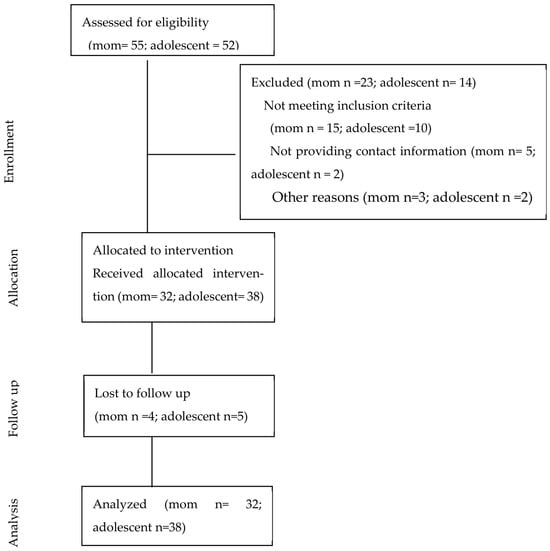
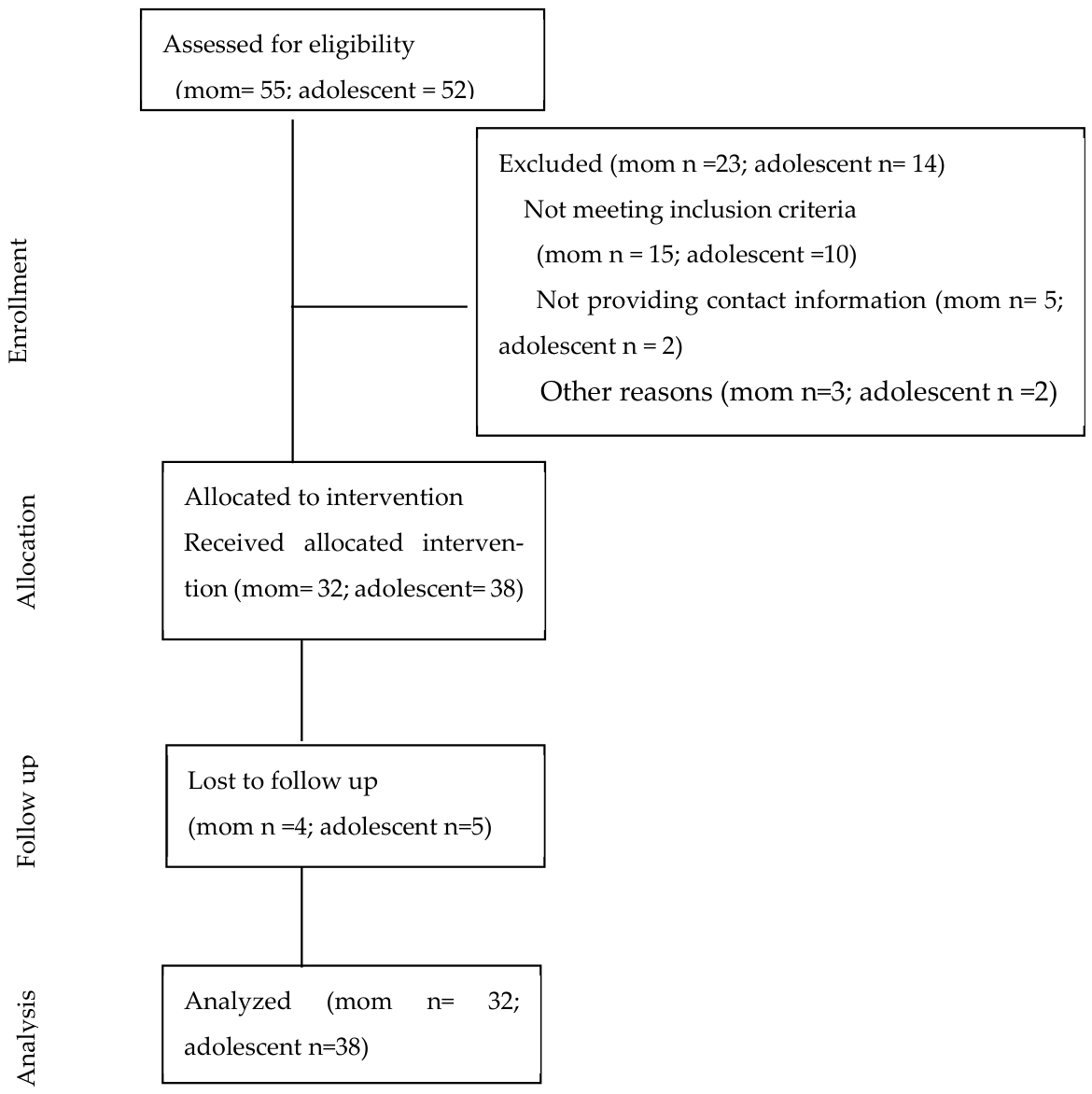
A total of 32 adolescent–mother dyads were enrolled, including 38 adolescents and 32 mothers, with 6 mothers having two adolescents each participating in the study (see Figure 1 for the study flowchart). The mean age of adolescents was 14.53 years (SD = 1.81), and the mean age of mothers was 49.06 years (SD = 7.83). Among participating mothers, 31.3% held a master’s degree or higher, and 43.75% reported an annual household income exceeding $140,001 (see Table 1). In terms of racial and ethnic identification, 40% of families identified as non-Hispanic White, 21.8% as Hispanic, and 37.5% as Asian.
Figure 1.
TRUST study flowchart.
Table 1.
Sample characteristics at baseline.
3. Results
The study completion rate was 87.5 for mothers and 86.8% for adolescents (see Figure 1). There is no difference at baseline between participants who completed the study and those who were lost to follow-up.
3.1. User Experiences with Four Learning Modules
3.1.1. Survey and Module User Data
Completion rates were high: 86% of adolescents and 87% of mothers completed both the pre- and post-intervention assessments, and all participants completed the intervention (Figure 1). On average, both mothers and adolescents completed three intervention modules. Among adolescents, the sexual health and relationships module (n = 26/38, 68.4%) was the most frequently viewed and was perceived as the most helpful. At the same time, the general communication module and the preparation for the WAV module (“check-up/check-in”) (n = 21/32, 65.6%) were most completed and most frequently identified as helpful by mothers. The average score on the system usability scale is 64.90 (SD = 14.3) for mothers and 65.53 (SD = 11.33) for adolescents. No differences were observed in individual items or average scores between mothers and adolescents in the system usability survey (Table 2).
Table 2.
Descriptive data on variables.
3.1.2. Qualitative Data
In response to the open-ended question about how the TRUST intervention helped mothers and adolescents, participants described positive experiences with the program, reflecting its acceptability, relevance, and practical value. A total of 25 mothers and 31 adolescents responded to the open-ended questions. Two major themes emerged: (1) initiating discussions between mothers and adolescents to prepare for the well-adolescent visit (WAV), and (2) the importance of general communication strategies for strengthening relationships and supporting everyday interactions.
Initiating Discussion and Preparing for a Well-Adolescent Visit
Many mothers and adolescents reported that the TRUST modules increased their readiness for the WAV by providing information that prompted conversations before the appointment and helped them identify questions or concerns to discuss with their primary healthcare provider. Participants described themselves as feeling better prepared, more confident, and more comfortable engaging in discussions with both peers and healthcare providers. Several adolescents also noted that the intervention increased their awareness of the value of confidential one-on-one time with their provider and empowered them to advocate for this opportunity during the visit.
For example, Mom 798 stated, “It helped me initiate a conversation with my adolescent before the appointment. We discussed what he could and should discuss with his doctor. And after the appt, we talked about things he felt comfortable sharing.” Similarly, Adolescent 71 noted, “The TRUST intervention helped prepare me for my visit with my provider. It advocated and encouraged me to advocate for alone time with my physician. I find the alone time very interesting and very helpful, especially after TRUST emphasized the importance of these moments.”
General Communication Skills Are Critical
Participants also consistently highlighted the value of the general communication skills presented in the modules. Mothers and adolescents described how the communication strategies served as practical reminders and provided new techniques for improving everyday conversations, addressing difficult topics, and navigating disagreements more effectively. Several participants indicated that the modules encouraged more intentional, open, and respectful communication, which they believed strengthened their relationships beyond discussions about sexual and reproductive health.
For instance, Mom 78 shared, “General communication—good reminder for how to engage with my daughters.” Similarly, Adolescent 21 stated, “I thought communication was the most helpful because my mother and I tend to ignore the problems and move on without addressing the issue.” Adolescent 22 added, “General Communication because there are times when I am unable to communicate well, and this helped.”
3.2. Changes in Self-Perceived Knowledge, Confidence, and Motivation Across Four Learning Topics
Both mothers and adolescents reported increases in these domains across the four learning modules (mean scores ranging from 6.44 to 8.75 in adolescents and 7.62 to 8.90 in mothers) (Table 2). The number of modules completed was not associated with these outcomes, except among adolescents, where greater module completion across all models was associated with increased confidence (β = 0.61, 95% CI = 0.24–0.97, p = 0.002).
3.3. Factors Associated with Changes in Adolescents’ SRH Communication with Their Mothers
Among adolescents, improvements in trust in their mothers (β = 0.64, 95% CI = 0.001, 1.28, p = 0.01), parent-adolescent general communication (β = 0.25, 95% CI = 0.14, 0.46, p = 0.001), and parental support (β = 1.59, 95% CI = 0.77, 3.27, p = 0.002) were also associated with greater SRH communication with their mothers (Table 3).
Table 3.
GEE model for communication on SRH in adolescents.
3.4. Factors Associated with Changes in Trustworthiness Among Mothers and Adolescents
GEE models revealed that increases in parent-adolescent general communication scores were positively associated with higher perceived trustworthiness for mothers (β = 0.13, 95% CI = 0.08, 0.18, p = 0.001) and adolescents (β = 0.12, 95% CI = 0.05, 0.18, p = 0.001) (Table 4).
Table 4.
GEE model for communication about trustworthiness among mothers and adolescents.
4. Discussion
This study examined users’ experiences and acceptability, as well as the factors associated with improvements in parent–adolescent trust and SRH communication following the intervention. As an exploratory pilot study, these findings suggest that the TRUST intervention is feasible, acceptable, and has the potential to enhance parent–adolescent communication and support confidential adolescent healthcare. Participants generally reported positive experiences with the intervention, indicating that the technology-based learning modules were well received and may be a practical approach to delivering education to adolescents and mothers. The observed associations between improvements in communication, trust, parental support, and SRH communication are consistent with the intervention’s theoretical framework; however, the single-arm design and small sample size preclude causal conclusions.
Understanding users’ experience and engagement is essential to ensure that interventions are delivered as intended and that participants remain engaged throughout the program. Our findings suggest that the TRUST modules are acceptable and feasible, with a good level of participant engagement, positive user experience, and good retention. On average, participants accessed 3 of the 4 modules, representing about 75% of the intervention content. This level of engagement compares favorably with adherence reported in digital behavioral interventions for adolescents. A recent systematic review of 116 digital lifestyle intervention studies involving 46,029 adolescents found an average intervention completion rate of 66.9% and average adherence to intervention components of 55.2% [27]. These findings provide preliminary support for the feasibility and acceptability of delivering the TRUST intervention to adolescents and their mothers. Our positive findings likely reflect the early and active involvement of the target population during the module development phase [17]. Our study findings are consistent with prior research suggesting that engaging target end users in the intervention development improves accessibility, satisfaction, and overall engagement [28,29].
Our study demonstrated an increase in participants’ knowledge, confidence, and motivation across the four learning topics. These increases may reflect the ability of the digital learning modules to deliver content in a flexible, self-paced format, enabling participants to build understanding and potentially fostering greater confidence and motivation to apply the knowledge. As digital technologies and access to smartphones, tablets, and computers continue to expand, there is an increasing need to develop evidence-based interventions that incorporate input from intended users from the earliest stages of development. Early user engagement may enhance intervention acceptability, usability, and fidelity while promoting participation. The good levels of feasibility, acceptability, and participant retention observed in this study suggest that the TRUST digital learning modules have good potential for dissemination and implementation in larger populations. Because active engagement with an intervention is an important determinant of health behavior change, these findings support further evaluation of the TRUST program in a larger, adequately powered trial to determine its effectiveness in improving parent–adolescent communication and sexual and reproductive health outcomes.
Increasing trust between mothers and adolescents is essential for adolescents’ well-being [30]. Adolescence is a critical yet vulnerable developmental period, in which both parents and the adolescent work to build a healthy relationship while navigating increasing independence. Our findings suggest that effective communication is associated with increasing mother-adolescent trust and adolescents’ perception of more positive SRH communication. In a study in China among 3349 adolescents, they found that positive parent-adolescent communication is associated with increased adolescents’ trust in their parents [13]. Similar findings have been reported in Australia, where higher levels of adolescent trust were positively associated with better communication within parent–adolescent relationships [31]. Together, these findings suggest the importance of enhancing the quality of communication to strengthen parent–adolescent trust.
Effective parent–adolescent communication is fundamental to building trust and promoting sexual and reproductive health (SRH) communication. Our findings are consistent with previous research showing that better general parent–adolescent communication is associated with more frequent and higher-quality SRH communication [32]. Furthermore, a systematic review and meta-analysis found that parents who were open to communication were 3.39 times more likely (95% CI: 2.48, 4.62) to discuss SRH with their adolescents than those who were less open [33]. Together, these findings suggest the importance of fostering open communication to strengthen parent–adolescent trust and support effective SRH communication.
In addition to communication and trust, our study found that parental support behaviors, such as active listening and expressing care, are associated with greater engagement in SRH communication. Prior studies found that responsive and supportive parenting behaviors are linked to improved adolescent emotional well-being, healthier behaviors, and more informed sexual decision-making [34,35]. Supportive parents, characterized by warmth and open communication, may provide a safe environment in which adolescents feel comfortable discussing sensitive topics, including sexual and reproductive health. These findings further suggest that fostering supportive parent-adolescent relationships with open communication may be important for improving effective SRH communication.
Despite the positive findings, this study has several limitations that should be considered when interpreting the findings. Self-reported measures may introduce recall and social desirability bias; without a comparator, non-randomization, and possible model overfitting, a small sample may limit generalizability; and an uncontrolled, one-arm pre- and post-design precludes causal inferences regarding the relationships among communication, trust, and parental support. Because some mothers participated with more than one adolescent, the mother–adolescent dyads were not fully independent, potentially introducing clustering at the family level. The high confidence score in the adolescent and mother’s reports of parental support may limit the ability to measure change due to a ceiling effect. In addition, the short follow-up period may not capture the sustainability of the observed improvements over time. Future research should include more diverse samples, longer follow-up periods, and objective measures of communication and behavior.
5. Conclusions
In conclusion, this pilot study supports the feasibility and acceptability of TRUST. Participants showed higher post-intervention scores, descriptively, for mother-adolescent communication, trust, and SRH communication. These preliminary findings help generate hypotheses about the potential relationships among communication, trust, and parental support in fostering parent–adolescent SRH communication. Given the single-arm pilot design, these findings should be interpreted with caution and cannot be attributed solely to the intervention. Future studies using larger, more diverse samples and rigorous controlled designs are needed to evaluate the intervention’s effectiveness and further examine the mechanisms underlying changes in parent–adolescent SRH communication.
Author Contributions
Conceptualization, J.-L.C., K.A.K. and M.R.-F.; Methodology, J.-L.C., K.A.K. and M.R.-F.; Software, J.-L.C.; Validation, J.-L.C.; Formal Analysis, J.-L.C. and T.J.H.; Writing—Original Draft Preparation, J.-L.C.; Writing—Review and Editing, J.-L.C., K.A.K. and M.R.-F.; Project Administration, C.-X.L. and L.X.; Funding Acquisition, J.-L.C. and K.A.K. All authors have read and agreed to the published version of the manuscript.
Funding
This research was funded by the Centers for Disease Control and Prevention (CDC), grant number 3 U48 DP006374-02S1.
Institutional Review Board Statement
The study was conducted in accordance with the Declaration of Helsinki and was approved by the Institutional Review Board of the University of California, San Francisco (20-32013, 21 June 2023 approval). The clinical trial is registered on ClinicalTrials.gov (NCT07064070; https://clinicaltrials.gov/study/NCT07064070; registered 14 July 2023).
Informed Consent Statement
Informed consent was obtained from all subjects involved in the study. For minors, parental permission was obtained, and for adolescents, consent was obtained.
Data Availability Statement
The original contributions presented in this study are included in the article. Further inquiries can be directed to the corresponding author.
Acknowledgments
We thank all the study participants, clinical sites, and Scalable Care for technical support. During the preparation of this manuscript/study, the author(s) used Grammarly Premium and Institutional ChatGPT 5.6 Sol. for grammar checking and to improve the flow of the text. The authors have reviewed and edited the output and take full responsibility for the content of this publication.
Conflicts of Interest
The authors declare no conflicts of interest. The funders had no role in the design of the study, the collection, analysis, or interpretation of data, the writing of the manuscript, or the decision to publish the results.
References
- Flores, D.; Barroso, J. 21st Century Parent-Child Sex Communication in the United States: A Process Review. J. Sex. Res. 2017, 54, 532–548. [Google Scholar] [CrossRef] [Scilit] [PubMed]
- Hurst, J.L.; Widman, L.; Maheux, A.J.; Evans-Paulson, R.; Brasileiro, J.; Lipsey, N. Parent-child communication and adolescent sexual decision making: An application of family communication patterns theory. J. Fam. Psychol. 2022, 36, 449–457. [Google Scholar] [CrossRef] [Scilit] [PubMed]
- Bibby, E.S.; Choukas-Bradley, S.; Widman, L.; Turpyn, C.; Prinstein, M.J.; Telzer, E.H. A longitudinal assessment of adolescents’ sexual communication with parents, best friends, and dating partners. Dev. Psychol. 2023, 59, 1300–1314. [Google Scholar] [CrossRef] [Scilit] [PubMed]
- Javidi, H.; Verlenden, J.V.; Chen, X.; Walsh-Buhi, E.R. Parent-Teen Sexual Health Communication and Teens’ Health Information and Service Seeking. JAMA Netw. Open 2025, 8, e2541712. [Google Scholar] [CrossRef] [Scilit] [PubMed]
- Jiang, B.; Zheng, Y.; Chen, Y.; Chen, Y.; Li, Q.; Zhu, C.; Wang, N.; Han, B.; Zhai, H.; Lin, D.; et al. Age and gender-specific distribution of metabolic syndrome components in East China: Role of hypertriglyceridemia in the SPECT-China study. Lipids Health Dis. 2018, 17, 92. [Google Scholar] [CrossRef] [Scilit] [PubMed]
- Sidamo, N.B.; Kerbo, A.A.; Wado, Y.D.; Koyira, M.M.; Gidebo, K.D. Factors associated with perceived social support among adolescents in Gamo Zone, Southern Ethiopia: A community-based cross-sectional study. Front. Psychiatry 2024, 15, 1429886. [Google Scholar] [CrossRef] [Scilit] [PubMed]
- Widman, L.; Choukas-Bradley, S.; Noar, S.M.; Nesi, J.; Garrett, K. Parent-Adolescent Sexual Communication and Adolescent Safer Sex Behavior: A Meta-Analysis. JAMA Pediatr. 2016, 170, 52–61. [Google Scholar] [CrossRef] [Scilit] [PubMed]
- Gutu, B.; Mahimbo, A.; Percival, N.; Demant, D. Effect of Parent-Based Sexual Health Education on Parent-Adolescent Communication and Adolescent Sexual Behavior: A Systematic Review and Meta-Analysis. Perspect. Sex. Reprod. Health 2025, 57, 374–422. [Google Scholar] [CrossRef] [Scilit] [PubMed]
- Ford, C.A.; Pool, A.C.; Kahn, N.F.; Jaccard, J.; Halpern, C.T. Associations Between Mother-Adolescent and Father-Adolescent Relationships and Young Adult Health. JAMA Netw. Open 2023, 6, e233944. [Google Scholar] [CrossRef] [Scilit] [PubMed]
- Michael, S.L.; Barnes, S.P.; Wilkins, N.J. Scoping Review of Family and Community Engagement Strategies Used in School-Based Interventions to Promote Healthy Behaviors. J. Sch. Health 2023, 93, 828–841. [Google Scholar] [CrossRef] [Scilit] [PubMed]
- van Hoorn, J.; McCormick, E.M.; Rogers, C.R.; Ivory, S.L.; Telzer, E.H. Differential effects of parent and peer presence on neural correlates of risk taking in adolescence. Soc. Cogn. Affect. Neurosci. 2018, 13, 945–955. [Google Scholar] [CrossRef] [Scilit] [PubMed]
- Simonen, J.; Kataja, K.; Pirskanen, H.; Holmila, M.; Tigerstedt, C. Trusting and misleading. Parents’ and children’s communication and negotiation about alcohol as described by teenagers. Addict. Res. Theory 2017, 25, 342–348. [Google Scholar] [CrossRef] [Scilit]
- Ying, L.; Ma, F.; Huang, H.; Guo, X.; Chen, C.; Xu, F. Parental Monitoring, Parent-Adolescent Communication, and Adolescents’ Trust in Their Parents in China. PLoS ONE 2015, 10, e0134730. [Google Scholar] [CrossRef] [Scilit] [PubMed]
- Esan, B.T.; Ngwai, Y.B.; Akyala, A.I.; Esan, O.A.; Olugbemi, M.K.; Aremu, S.O. A scoping review of digital interventions for improving adolescent sexual and reproductive health outcomes in Sub-Saharan Africa. Discov. Public Health 2026, 23, 1373. [Google Scholar] [CrossRef] [Scilit]
- Borji-Navan, S.; Maleki, N.; Keramat, A. Efficacy of Digital Health Interventions Used for Adolescent’s Sexual Health: An Umbrella Review. Health Sci. Rep. 2024, 7, e70212. [Google Scholar] [CrossRef] [Scilit] [PubMed]
- Chen, J.L.; Raymond-Flesch, M.; Hoffmann, T.J.; Lin, C.X.; Xu, L.; Koester, K.A. Evaluating the Preliminary Efficacy of the TRUST Intervention on Alone-Time and Communication During Well-Adolescent Visits: Quasi-Experimental Study. JMIR Pediatr. Parent. 2025, 8, e71433. [Google Scholar] [CrossRef] [Scilit] [PubMed]
- Richards, A.; Raymond-Flesch, M.; Hughes, S.D.; Zhou, Y.; Koester, K.A. Lessons Learned with a Triad of Stakeholder Advisory Boards: Working with Adolescents, Mothers, and Clinicians to Design the TRUST Study. Children 2023, 10, 483. [Google Scholar] [CrossRef] [Scilit] [PubMed]
- White, F. Parent-Adolescent Communication and Adolescent Decision-Making. J. Fam. Stud. 1996, 2, 41–56. [Google Scholar] [CrossRef] [Scilit]
- Zapf, H.; Boettcher, J.; Haukeland, Y.; Orm, S.; Coslar, S.; Wiegand-Grefe, S.; Fjermestad, K. A Systematic Review of Parent–Child Communication Measures: Instruments and Their Psychometric Properties. Clin. Child Fam. Psychol. Rev. 2023, 26, 121–142. [Google Scholar] [CrossRef] [Scilit] [PubMed]
- Hutchinson, M.K. The Parent-Teen Sexual Risk Communication Scale (PTSRC-III): Instrument development and psychometrics. Nurs. Res. 2007, 56, 1–8. [Google Scholar] [CrossRef] [Scilit] [PubMed]
- Stattin, H.; Kerr, M. Parental monitoring: A reinterpretation. Child Dev. 2000, 71, 1072–1085. [Google Scholar] [CrossRef] [Scilit] [PubMed]
- Scull, T.M.; Malik, C.V.; Keefe, E.M.; Schoemann, A. Evaluating the Short-term Impact of Media Aware Parent, a Web-based Program for Parents with the Goal of Adolescent Sexual Health Promotion. J. Youth Adolesc. 2019, 48, 1686–1706. [Google Scholar] [CrossRef] [Scilit] [PubMed]
- Guilamo-Ramos, V.; Jaccard, J.; Dittus, P.; Bouris, A. Parental expertise, trustworthiness, and accessibility: Parent-adolescent communication and adolescent risk behavior. J. Marriage Fam. 2006, 68, 1229–1246. [Google Scholar] [CrossRef] [Scilit]
- Khan, Q.; Hickie, I.B.; Loblay, V.; Ekambareshwar, M.; Zahed, I.U.M.; Naderbagi, A.; Song, Y.J.; LaMonica, H.M. Psychometric evaluation of the System Usability Scale in the context of a childrearing app co-designed for low- and middle-income countries. Digit. Health 2025, 11, 20552076251335413. [Google Scholar] [CrossRef] [Scilit] [PubMed]
- Mol, M.; van Schaik, A.; Dozeman, E.; Ruwaard, J.; Vis, C.; Ebert, D.D.; Etzelmueller, A.; Mathiasen, K.; Moles, B.; Mora, T.; et al. Dimensionality of the system usability scale among professionals using internet-based interventions for depression: A confirmatory factor analysis. BMC Psychiatry 2020, 20, 218. [Google Scholar] [CrossRef] [Scilit] [PubMed]
- Elo, S.; Kyngas, H. The qualitative content analysis process. J. Adv. Nurs. 2008, 62, 107–115. [Google Scholar] [CrossRef] [Scilit] [PubMed]
- Boumparis, N.; Studhalter, O.; de Riedmatten, P.; Yucel, I.D.; Koutra, K.; Champion, K.; Molina-Barcelo, A.; de Pablo-Pardo, T.; Kondylakis, H.; Schaub, M.P.; et al. Factors Influencing Adherence to Digital Lifestyle Interventions for Adolescents: Systematic Review and Meta-Analysis of Attrition. Interact. J. Med. Res. 2026, 15, e84822. [Google Scholar] [CrossRef] [Scilit] [PubMed]
- Thabrew, H.; Fleming, T.; Hetrick, S.; Merry, S. Co-design of eHealth Interventions with Children and Young People. Front. Psychiatry 2018, 9, 481. [Google Scholar] [CrossRef] [Scilit] [PubMed]
- McGovern, Ó.; Glennon, S.; Walsh, I.; Gallagher, P.; McCashin, D. The use of co-design with young people for digital mental health support development: A systematic review. Internet Interv. 2025, 41, 100835. [Google Scholar] [CrossRef] [Scilit] [PubMed]
- Arslan, I.B.; Boele, S.; Dietvorst, E.; Lucassen, N.; Keijsers, L. Within-family associations of parent-adolescent relationship quality and adolescent affective well-being. J. Adolesc. 2024, 96, 803–819. [Google Scholar] [CrossRef] [Scilit] [PubMed]
- Clarke, A.; Meredith, P.J.; Rose, T.A. Exploring mentalization, trust, communication quality, and alienation in adolescents. PLoS ONE 2020, 15, e0234662. [Google Scholar] [CrossRef] [Scilit] [PubMed]
- Bikila, T.S.; Dida, N.; Bulto, G.A.; Debelo, B.T.; Temesgen, K. Adolescents’ Communication on Sexual and Reproductive Health Matters with Their Parents and Associated Factors among Secondary and Preparatory School Students in Ambo Town, Oromia, Ethiopia. Int. J. Reprod. Med. 2021, 2021, 6697837. [Google Scholar] [CrossRef] [Scilit] [PubMed]
- Mekie, M.; Addisu, D.; Melkie, A.; Taklual, W. Parent-adolescent communication on sexual and reproductive health issues and its associated factors in Ethiopia: A systematic review and meta-analysis. Ital. J. Pediatr. 2020, 46, 162. [Google Scholar] [CrossRef] [Scilit] [PubMed]
- Qualitza, A.; Thai, C.L.; Llamas, J.D. Supporting Adolescents: Perceived Parental Support Associated with Decreased Adolescent Loneliness and Emotion Suppression in a National Sample. Children 2025, 12, 1108. [Google Scholar] [CrossRef] [Scilit] [PubMed]
- Ratliff, E.L.; Morris, A.S.; Cui, L.; Jespersen, J.E.; Silk, J.S.; Criss, M.M. Supportive parent-adolescent relationships as a foundation for adolescent emotion regulation and adjustment. Front. Psychol. 2023, 14, 1193449. [Google Scholar] [CrossRef] [Scilit] [PubMed]

Disclaimer/Publisher’s Note: The statements, opinions and data contained in all publications are solely those of the individual author(s) and contributor(s) and not of MDPI and/or the editor(s). MDPI and/or the editor(s) disclaim responsibility for any injury to people or property resulting from any ideas, methods, instructions or products referred to in the content. |
© 2026 by the authors. Licensee MDPI, Basel, Switzerland. This article is an open access article distributed under the terms and conditions of the Creative Commons Attribution (CC BY) license.