


Highlights
What are the main findings?
- •
- The newly proposed Bara-Cordeiro (BC) Scale is a concise, digitally administered screening tool completed by parents, intended to detect autism spectrum disorder (ASD) symptomatology in children between 24 months and 10 years of age. Aligned with DSM-5 criteria, the instrument evaluates both social communication deficits and restricted/repetitive behavioral patterns.
- •
- The BC Scale exhibited strong internal consistency and a preliminary two-factor structure. Furthermore, it demonstrated excellent discriminative capability (AUC = 0.933), achieving a sensitivity of 94.2% alongside a specificity of 50.0% in distinguishing children with ASD within the evaluated sample.
What is the implication of the main finding?
- •
- By encompassing a wider developmental window (24 months to 10 years; observed range 30–130 months), this tool could aid in recognizing ASD symptoms in children who might have been overlooked during early toddler screening protocols.
- •
- The instrument’s accessible, digital format may streamline ASD screening within pediatric settings, facilitating earlier referrals for specialized diagnostic assessments and helping to mitigate delays in clinical identification.
Abstract
Background/Objectives: Autism spectrum disorder (ASD) is defined by early-onset deficits in social communication combined with restricted and repetitive behaviors. In Brazil, late ASD identification remains a pressing issue, underscoring the demand for practical screening tools tailored to the local reality. This study aimed to introduce the parent-reported Bara-Cordeiro (BC) Scale for children aged 24 months to 10 years and evaluate its preliminary psychometric properties. Methods: Based on DSM-5 criteria, the 31-item questionnaire was digitally administered to a clinical sample comprising 78 children aged 30–130 months (52 diagnosed with ASD and 26 non-ASD clinical controls). We assessed construct validity, internal consistency, and classification accuracy using exploratory factor analysis (EFA) and receiver operating characteristic (ROC) curves. Results: EFA supported an initial two-factor model (Social Communication and Behavioral Patterns), and the instrument showed robust internal reliability (Cronbach’s alpha > 0.88 for both domains). The overall scale displayed strong discriminative ability, yielding an area under the curve (AUC) of 0.933. Prioritizing sensitivity, the preliminary screening threshold (≥12 points) provided 94.2% sensitivity (95% CI: 84.1–98.8%) and 50.0% specificity (95% CI: 29.9–70.1%). Conclusions: These preliminary findings suggest that the BC Scale is a viable screening option in Brazil. Its digital administration may assist in capturing children missed during early developmental screening, thereby promoting timely referrals for comprehensive evaluation.
1. Introduction
Autism spectrum disorder (ASD) is a complex neurodevelopmental condition defined by enduring deficits by persistent difficulties in social communication and social interaction with restricted and repetitive patterns of behavior, interests, or activities [1]. According to the fifth edition of the Diagnostic and Statistical Manual of Mental Disorders (DSM-5), symptoms are present from the early development period and cause clinically significant impairment in social, academic, occupational, or other important areas of functioning [1]. According to data from the U.S. Centers for Disease Control and Prevention (CDC), the prevalence of ASD was approximately 1 in 31 children aged 8 years across participating U.S. monitoring sites in 2022 [2]. In Brazil, recent population-based data from the 2022 Demographic Census indicate that approximately 1.2% (1 in 83 individuals) have a reported ASD diagnosis, reflecting informed diagnoses rather than clinical prevalence estimates [3].
In the absence of a confirmatory biological marker, ASD diagnosis remains clinical and relies on developmental history, behavioral observation, and standardized assessment instruments [4]. Screening tools play an important role in identifying children who may require a comprehensive evaluation. According to the American Academy of Neurology, ASD’s diagnosis should be based on two levels of investigation [5]. The first aims to identify any type of atypical development as a risk factor, whereas the second involves a more detailed investigation of the diagnostic role and differentiation between different developmental disorders [5]. Several instruments have been developed for ASD screening and assessment, including the following instruments for Level 1: the Modified Checklist for Autism in Toddlers (M-CHAT) [6], Children’s Social Behavior Questionnaire [7], Child Behavior Checklist (CBCL), and Teacher’s Report Form (TRF) [8,9,10]. Level 2 includes the Autism Diagnostic Observation Schedule-Generic, Gilliam Autism Rating Scale [11], Social Communication Questionnaire [12], and Social Responsiveness Scale [13].
Despite the availability of established instruments, an important gap remains between the timing of the ASD screening and the age at which children are actually diagnosed in Brazil [14]. Recent bibliometric mappings of early childhood autism research underscore the critical need to bridge interdisciplinary approaches and primary care to improve early identification [15]. The M-CHAT, one of the most widely used ASD-specific screening instruments, was designed for toddlers aged 16–30 months [6]. However, evidence indicates that ASD diagnosis in Brazil and other low- to upper-middle-income countries occurs substantially later, often when children are already approaching or attending school age [16,17]. Consequently, a large cohort of children inevitably passes the narrow age window beyond the developmental period targeted by toddler-specific screening instruments before their difficulties are formally recognized. This creates a pragmatic need for accessible screening tools capable of identifying ASD-related symptoms across a broader pediatric age range, particularly among children who were not identified during early developmental surveillance.
Digital and web-based approaches may further increase the accessibility and efficiency of developmental and behavioral screening [18]. Such approaches can facilitate remote administration, standardized scoring, and data collection while potentially reducing administrative burden and data entry errors [18]. In Brazil, the Mini-TEA Scale has been recently developed as an ASD screening instrument for children aged 2–12 years, further demonstrating the need for locally developed screening approaches that address a broader developmental range [19]. Nevertheless, additional instruments developed specifically within the Brazilian clinical and sociocultural context may contribute to expanding screening options and facilitating referral for comprehensive diagnostic assessment.
In this context, the present study aimed to develop the Bara-Cordeiro (BC) Scale and provide preliminary evidence of its psychometric properties as a parent-reported screening instrument for ASD symptoms in Brazilian children aged 24 months to 10 years. The scale was developed based on DSM-5 ASD criteria and administered through a standard online questionnaire format. To ensure methodological clarity, the distinction between this initial psychometric validation and subsequent software implementation of a dedicated web-based application is maintained throughout this report. We evaluated its reliability, construct validity, and discriminative performance. The BC Scale was designed as an accessible screening instrument for use in the Brazilian clinical context, with the potential to support the timely identification of children with suspected ASD and their referral for comprehensive diagnostic evaluation.
2. Materials and Methods
2.1. Study Setting and Ethical Procedures
This preliminary psychometric study was conducted at the Instituto de Pesquisa Pelé Pequeno Príncipe, Curitiba, Brazil, using electronic data collection. The research protocol received formal approval from the Ethics Committee of Faculdades Pequeno Príncipe (CAAE: 36193220.2.0000.5580; approval date: 4 September 2020) and was conducted in accordance with the Declaration of Helsinki, Resolution 466/12 of the Brazilian National Health Council (Conselho Nacional de Saúde [CNS]), and applicable ethical principles regarding privacy and confidentiality. The reporting of this diagnostic accuracy study was guided by the STARD 2015 statement [20].
Participation was voluntary, and no financial compensation was provided. Personal information was coded to protect participants’ privacy and confidentiality. Data were collected remotely during the COVID-19 pandemic, when social distancing measures limited in-person research activities.
2.2. Participants
The study sample was stratified into two distinct clinical cohorts: (1) children with an ASD diagnosis (ASD group) and (2) children without an ASD diagnosis (non-ASD comparison group). The latter was intentionally defined as a heterogeneous clinical comparison group rather than a strictly neurotypical control group, thereby providing a more clinically relevant assessment of the scale’s discriminative performance.
Parents or legal guardians of children previously assessed within the Neuroscience Research Program were invited to participate. Families (n = 110) were initially contacted by telephone, informed about the study, and invited to participate. Of these, 32 families were excluded due to declining participation, not meeting inclusion criteria, or failing to complete the questionnaire, resulting in a final sample of 78 participants. Observed ages ranged from 30 to 130 months (2.5 to 10.8 years); thus, no child younger than 30 months was included. The sample comprised 17 children younger than 6 years and 61 children aged 6 years and older. Those who agreed to participate received the informed consent form and a link to the online questionnaire by email. The clinical status of participants in both groups was established through a comprehensive multidisciplinary assessment protocol conducted at the Instituto de Pesquisa Pelé Pequeno Príncipe between 29 September 2020 and 26 July 2023. ASD diagnoses, as well as the exclusion of ASD in the comparison group, were established according to DSM-5 criteria [1], based on clinical history, multidisciplinary evaluation, and standardized instruments, including the ADOS-2 (administered to 29 participants in the ASD Group) and CARS (administered to 30 participants, 15 from ASD Group and 15 in the non-ASD Group), when clinically indicated. Subsequent recruitment and electronic administration of the BC Scale to the caregivers took place between October 2020 and June 2023. The mean interval between the formal clinical assessment and administration of the BC Scale was 0.41 years (approximately 5 months). As an inherent consequence of this clinical sampling design, caregivers were already aware of their child’s diagnostic status when answering the questionnaire. Sociodemographic information, including socioeconomic status and caregiver educational level, was also collected.
2.2.1. Inclusion Criteria
- ASD Group: Legal guardians of children of both sexes, aged 24 months to 10 years (i.e., from 24 months up to before their 11th birthday, or 131 months), who underwent comprehensive multidisciplinary assessment and met DSM-5 diagnostic criteria for ASD.
- Non-ASD Comparison Group: Legal guardians of children of both sexes, aged 24 months to 10 years, who underwent comprehensive multidisciplinary assessment and did not meet DSM-5 diagnostic criteria for ASD.
2.2.2. Exclusion Criteria
- Children diagnosed with specific genetic syndromes, such as Fragile X, or neurological conditions such as epilepsy that could substantially influence the behavioral phenotype.
- Parents or legal guardians who were unable to read Brazilian Portuguese.
- Participants without access to the electronic data- collection procedure.
2.3. Bara-Cordeiro Scale
The Bara-Cordeiro (BC) Scale was developed as a parent-reported screening instrument for ASD symptoms based on the DSM-5 diagnostic criteria. The initial item pool was developed by the authors to operationalize Criteria A and B of the DSM-5, resulting in a preliminary set of 42 items. This initial version was submitted to an expert panel comprising two pediatric neurologists and one neuropsychologist for content validation. The Content Validity Index (CVI) was calculated based on the proportion of experts rating each item as relevant or highly relevant. Given the three-member panel, perfect agreement among all three experts (CVI = 1.0) was required to retain an item without revisions. The expert panel also assessed face validity and estimated item comprehensibility to ensure theoretical suitability for caregivers with varying educational levels, prior to field administration. Based on their evaluation, four items were excluded due to potential comprehension difficulties for caregivers, yielding a 38-item test version. Following the preliminary psychometric analyses described in this study, seven additional items (five from the SC item pool and two from the BP item pool) were removed. The specific statistical criteria for these eliminations were corrected item–total correlations falling below the 0.30 threshold and substantial cross-loadings that compromised dimensional clarity during the exploratory factor analysis. This process resulted in the final 31-item instrument.
The final 31-item Portuguese version of the BC Scale, along with complete response anchors and scoring instructions, is provided in Supplementary Material S1 to ensure full reproducibility. The official scale was developed, applied, and validated in Brazilian Portuguese. To facilitate international accessibility and assist the review process, an informational English translation of the 31 items is provided alongside the original version in Supplementary Material S1. It is important to note that this English version is provided for reference purposes only and has not yet undergone formal cross-cultural or independent psychometric validation.
The items are organized into two theoretically defined dimensions:
- Social Communication (SC): Items addressing difficulties in socioemotional reciprocity, nonverbal communicative behaviors, and the development and maintenance of relationships, corresponding to DSM-5 Criterion A.
- Behavioral Patterns (BP): Items addressing restricted and repetitive patterns of behavior, interests, or activities, as well as sensory hyper- or hyporeactivity, corresponding to DSM-5 Criterion B.
The scale is completed by a parent or legal guardian using a three-point Likert-type response format. For BP items, responses are scored directly from 0 (“I do not observe”) to 2 (“I always observe”). SC items are reverse-scored, ranging from 0 (“I always observe”) to 2 (“I do not observe”). Higher scores indicate a greater presence of ASD-related symptoms and, consequently, a higher likelihood of a positive ASD screening result.
For the preliminary psychometric evaluation reported in this study, the BC Scale was administered electronically using Google Forms, allowing for remote completion by parents or legal guardians. Following data collection and scale refinement, a dedicated web-based version of the BC Scale was subsequently developed to facilitate its potential future clinical use. The application was designed for use on mobile and desktop devices, with electronic data recording and automated scoring. The distinction between the psychometric validation (conducted via Google Forms) and subsequent software implementation is maintained throughout this report.
2.4. Statistical Analyses
Data were analyzed using SPSS for Windows, version 23.0 (IBM Corp., Armonk, NY, USA). Descriptive statistics, including means, standard deviations, frequencies, and percentages, were used to characterize the sample. Categorical variables (e.g., sex) were compared using Pearson’s chi-square test, whereas continuous variables with non-normal distributions (e.g., age and intellectual performance) were compared using the Mann–Whitney U test.
Internal consistency was assessed using Cronbach’s alpha, McDonald’s omega, and corrected item–total correlations. Items were considered for exclusion when they showed corrected item–total correlations below 0.30 or substantial cross-loadings in the exploratory factor analysis, and when their removal improved the reliability of the corresponding dimension.
Preliminary construct validity was examined using exploratory factor analysis (EFA). The EFA was conducted jointly across all items utilizing a Pearson correlation matrix, with principal axis factoring (PAF) and Promax oblique rotation. The suitability of the data for factor analysis was assessed using the Kaiser–Meyer–Olkin (KMO) measure and Bartlett’s test of sphericity. Factor retention was determined a priori using theoretical alignment with the two core DSM-5 diagnostic criteria for ASD, circumventing the known tendency of Kaiser’s criterion (eigenvalues > 1.0) to over-extract factors in clinical scales.
The discriminative performance of the BC Scale was evaluated using receiver operating characteristic (ROC) curve analysis. The area under the curve (AUC) was calculated for the overall scale and its dimensions, and candidate cut-off points were identified using the Youden Index. For the overall scale, the final screening threshold was selected to prioritize sensitivity, consistent with the purpose of a Level 1 screening instrument. Because the cut-off scores were derived and evaluated using the same sample, the reported diagnostic accuracy estimates and predictive values (PPV and NPV) reflect development-sample performance and should be interpreted as preliminary. AUC values were interpreted as follows: <0.70, low accuracy; 0.70–0.90, moderate accuracy; and ≥0.90, high accuracy [21]. Sensitivity, specificity, positive predictive value (PPV), and negative predictive value (NPV) were calculated with their respective 95% confidence intervals.
Test–retest reliability was evaluated in a subsample of 30 participants over a 7–12-day interval using intraclass correlation coefficients (ICCs; two-way mixed-effects model, absolute agreement).
3. Results
Prior to the primary analyses, the dataset was screened for missing values and potential violations of statistical assumptions. Because data were collected using a computerized web-based system with required fields, no missing data were identified in the final analyzed sample. The normality of scale scores was assessed using the Shapiro–Wilk test, which indicated significant deviations from a normal distribution (p < 0.001). Accordingly, statistical procedures appropriate for non-normally distributed data were applied in subsequent analyses.
The final sample comprised 78 participants, including 52 children in the ASD group and 26 children in the non-ASD comparison group. As shown in Table 1, no significant differences were observed between the groups in age (U = 721.5; p = 0.619), sex (χ2 = 0.029; p = 0.865), or intellectual performance (U = 717.0; p = 0.664). According to the Brazilian Economic Classification Criteria (Critério de Classificação Econômica Brasil), the sample predominantly comprised participants from socioeconomic classes C and D. Regarding caregiver educational attainment, 60% had completed high school, 30% had incomplete higher education, 6% had completed elementary education, and 4% had completed higher education. Children in the overall sample had a mean age of 7.67 years (SD = 2.73). The ASD group had a mean age of 7.65 years (SD = 2.87), and 67.3% were male. Cognitive functioning assessments yielded a mean Full-Scale IQ of 83.62 (SD = 14.79) among 61 children assessed using the WISC-IV (aged 6 years and older) and a mean IQ of 82.76 (SD = 21.34) among 17 children younger than 6 years assessed using the SON-R 2½-7a. When weighted by sample size for each diagnostic group across both instruments, the combined mean IQ was 83.06 for the ASD group and 84.19 for the non-ASD group (overall sample weighted mean = 83.44). Differences in the standard deviations of IQ scores should be interpreted in the context of the distinct psychometric properties of the WISC-IV and SON-R instruments used across these age groups.
Table 1.
Demographic and clinical characteristics of Autism Spectrum Disorder (ASD) and Non-ASD Comparison groups.
Within the ASD group, 38.46% of participants were classified as support level 1, 36.54% as support level 2, and 25.00% as support level 3. Male participants had a mean BP score of 8.37 (SD = 6.96) and a mean SC score of 14.43 (SD = 7.67), whereas female participants had a mean BP score of 6.74 (SD = 6.93) and a mean SC score of 16.59 (SD = 10.43). The distribution of clinical comorbidities in the ASD and non-ASD comparison groups is presented in Table 1. The participants’ observed ages ranged from 30 to 130 months (2.5 to 10.8 years). Due to the limited sample size within specific developmental bands across the broad inclusion range (30 to 130 months), age-stratified statistical comparisons of the BC Scale performance were not conducted. This constraint highlights the necessity of future invariance testing across pediatric subgroups.
The BC Scale demonstrated significant differences between the ASD and non-ASD comparison groups for both the Social Communication (SC) and Behavioral Patterns (BP) dimensions (p < 0.001). Across the overall sample (n = 78), the mean SC score was 15.15 (SD = 8.68), and the mean BP score was 7.83 (SD = 6.95). These findings provide preliminary evidence of the scale’s ability to differentiate ASD-related symptom profiles from those observed in the non-ASD comparison group.
3.1. Content and Face Validity Analyses
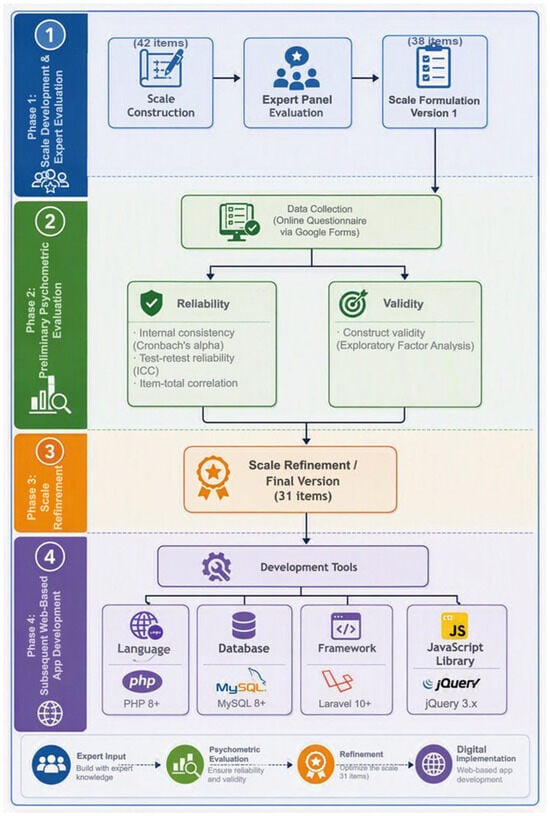
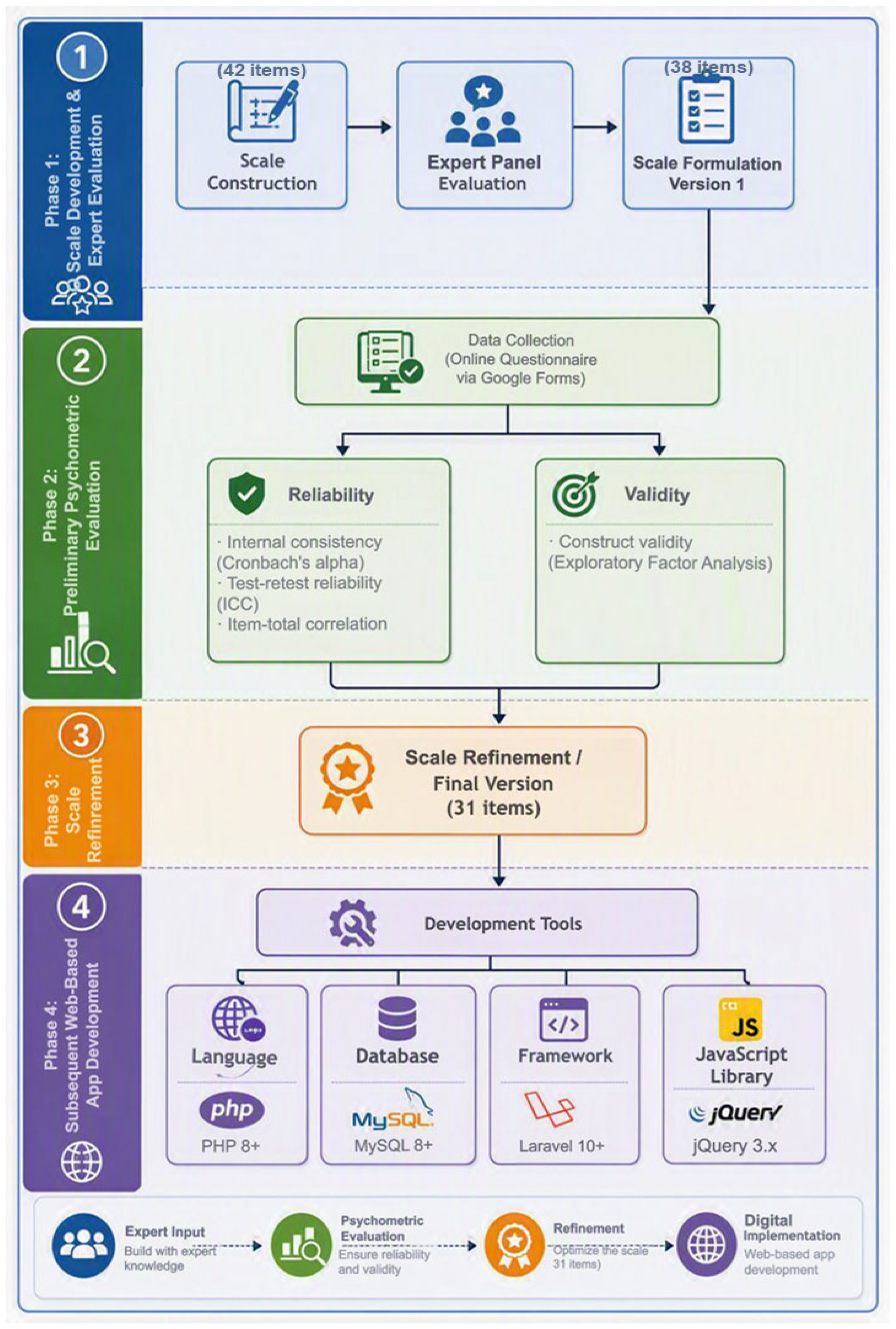
The initial BC Scale was evaluated by three experts, including two pediatric neurologists and one neuropsychologist. The instrument initially comprised 42 items and was subsequently refined to 38 items, with further psychometric refinement resulting in the final 31-item version. Content validity analysis indicated perfect agreement among the experts regarding item relevance, yielding a Content Validity Index (CVI) of 1.0 for the retained items. The overall scale development and validation is summarized in Figure 1.
Figure 1.
A flowchart of the BC Scale development, preliminary psychometric evaluation, refinement, and web implementation process. Legend: A flowchart of the scale construction process, including expert evaluation, psychometric validation, and web-based implementation. Colors indicate the four stages of scale development: Blue, Scale Development and Expert Evaluation (Phase1); Green, Preliminary Psychometric Evaluation (Phase 2); Orange, Scale Refinement (Phase 3); and Purple, Web-Based Platform Development (Phase 4).
3.2. Exploratory Factor Analysis and Reliability Testing
The initial suitability of the data for factor analysis was supported by the Kaiser–Meyer–Olkin (KMO) value of 0.709. Bartlett’s test of sphericity was statistically significant (p < 0.001), indicating adequate inter-correlations for exploratory factor analysis.
An Exploratory Factor Analysis (EFA) was conducted jointly across 31 items using Principal Axis Factoring (PAF) and Promax rotation to evaluate the underlying structure of the scale. A two-factor solution was extracted to map onto DSM-5 theoretical dimensions. The first factor (SC dimension) accounted for 25.75% (initial eigenvalue = 8.54) of the total standardized variance (based on the extraction sums of squared loadings), while the second factor (BP dimension) explained 16.52% (initial eigenvalue = 5.61), cumulatively accounting for 42.27% of the total variance (see Supplementary Material S2 for complete factor loadings, cross-loadings, and communalities). The empirical distribution closely aligned with the theoretical construct, with 18 items loading primarily on the first factor and 13 items on the second factor. Minor cross-loadings observed in a few specific items reflect the preliminary nature of testing these clinical constructs in a sample of 78 participants. The factor correlation matrix indicated a low correlation between the SC and BP factors (r = 0.167), supporting the conceptual distinctness of the two dimensions. Furthermore, the observed Pearson correlation between the final computed total scores of the SC and BP subscales was similarly weak (r = 0.175, p > 0.05), corroborating the relative independence of these two clinical domains. Variance percentages are expressed relative to the total standardized variance of the 31 items (sum of communalities = 13.11; Supplementary Material S2).
Internal consistency analysis yielded an initial Cronbach’s α of 0.847 for the SC dimension. Following the removal of five items based on the item retention criteria, Cronbach’s α increased to 0.913, with a McDonald’s ω of 0.917. For the BP dimension, the initial Cronbach’s α was 0.886. Following the removal of two items, the final dimension showed a Cronbach’s α of 0.898 and a McDonald’s ω of 0.902. The overall scale (31 items) yielded a Cronbach’s α of 0.791. This lower total reliability relative to the subscales is mathematically expected in multidimensional instruments, particularly when the underlying dimensions (SC and BP) exhibit low inter-factor correlation (r = 0.167), reflecting the distinctness of the core ASD criteria rather than a unidimensional construct.
3.3. Test–Retest Reliability
Test–retest reliability was assessed in a subsample of 30 participants over a 7–12-day interval. The BC Scale demonstrated an overall intraclass correlation coefficient (ICC) of 0.887 [95% CI: 0.776–0.945]. The SC and BP dimensions showed ICCs of 0.920 [95% CI: 0.814–0.971] and 0.790 [95% CI: 0.605–0.894], respectively, indicating good preliminary temporal stability.
3.4. Preliminary Classification Model Performance Analysis
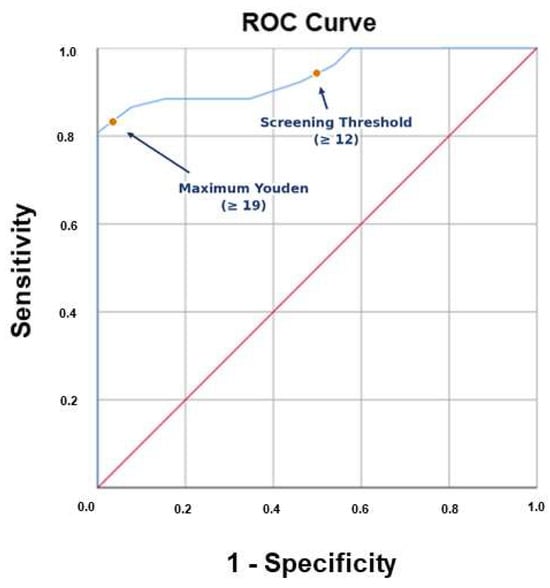
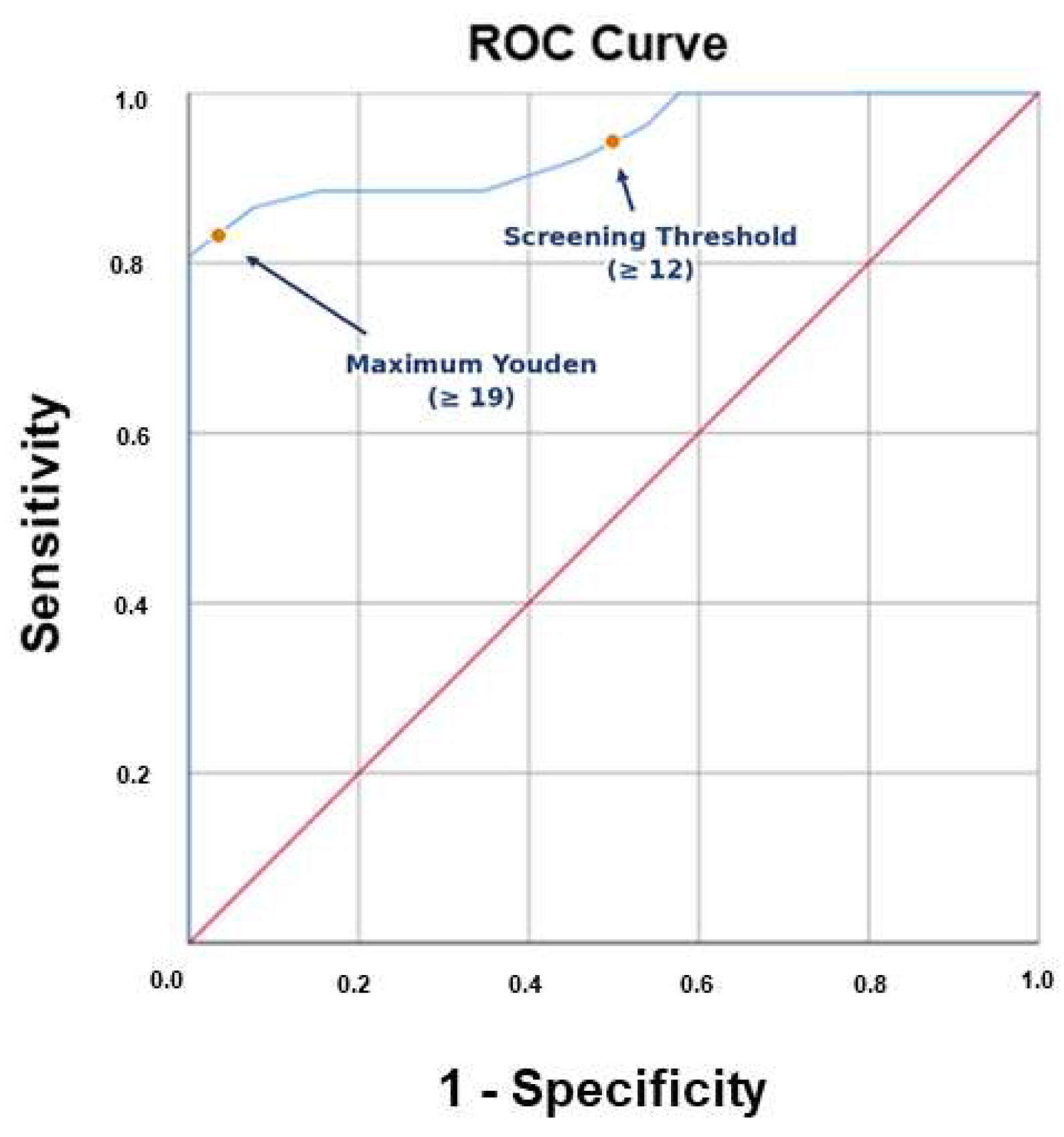
Receiver operating characteristic (ROC) analysis demonstrated an Area Under the Curve (AUC) of 0.933 (p < 0.01; 95% CI = 0.880–0.986) for the overall BC Scale score (Figure 2), indicating robust preliminary diagnostic accuracy. While the optimal statistical cut-off determined by the maximum Youden Index was 18.5 (≥19 points; Sensitivity = 82.7%; Specificity = 96.2%; J = 0.789), the preliminary clinical screening cut-off was set at 11.5 (≥12 points) to prioritize high sensitivity (94.2%). This threshold ensures the scale’s utility in correctly identifying children who require comprehensive diagnostic evaluation, despite a moderate specificity (50.0%). Based on this clinical cut-off, the classification matrix for the overall BC Scale yielded 49 True Positives, 13 False Positives, 13 True Negatives, and 3 False Negatives. This resulted in a positive predictive value (PPV) of 79.0%, a negative predictive value (NPV) of 81.3%, and a Youden’s Index of 0.442 at this specific screening threshold.
Figure 2.
AUC for the overall score of the BC Scale. Legend: A graphical representation of the discriminative performance for the overall score on the BC Scale. The red line corresponds to the chance diagonal (equality between True Positive Rate and False Positive Rate), whereas the blue line represents the classifier’s ROC curve (AUC = 0.933). Markers on the curve identify the preliminary clinical screening threshold (≥12 points), selected to prioritize sensitivity, and the optimal statistical cut-off determined by the maximum Youden Index (≥19 points).
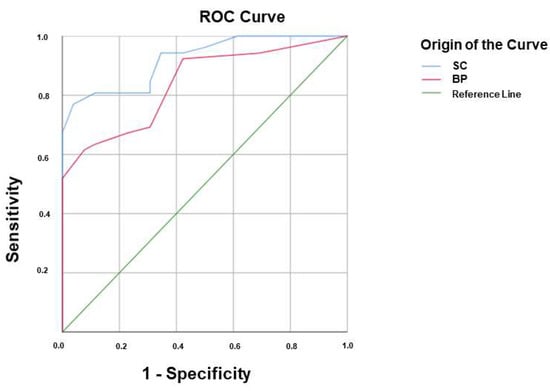
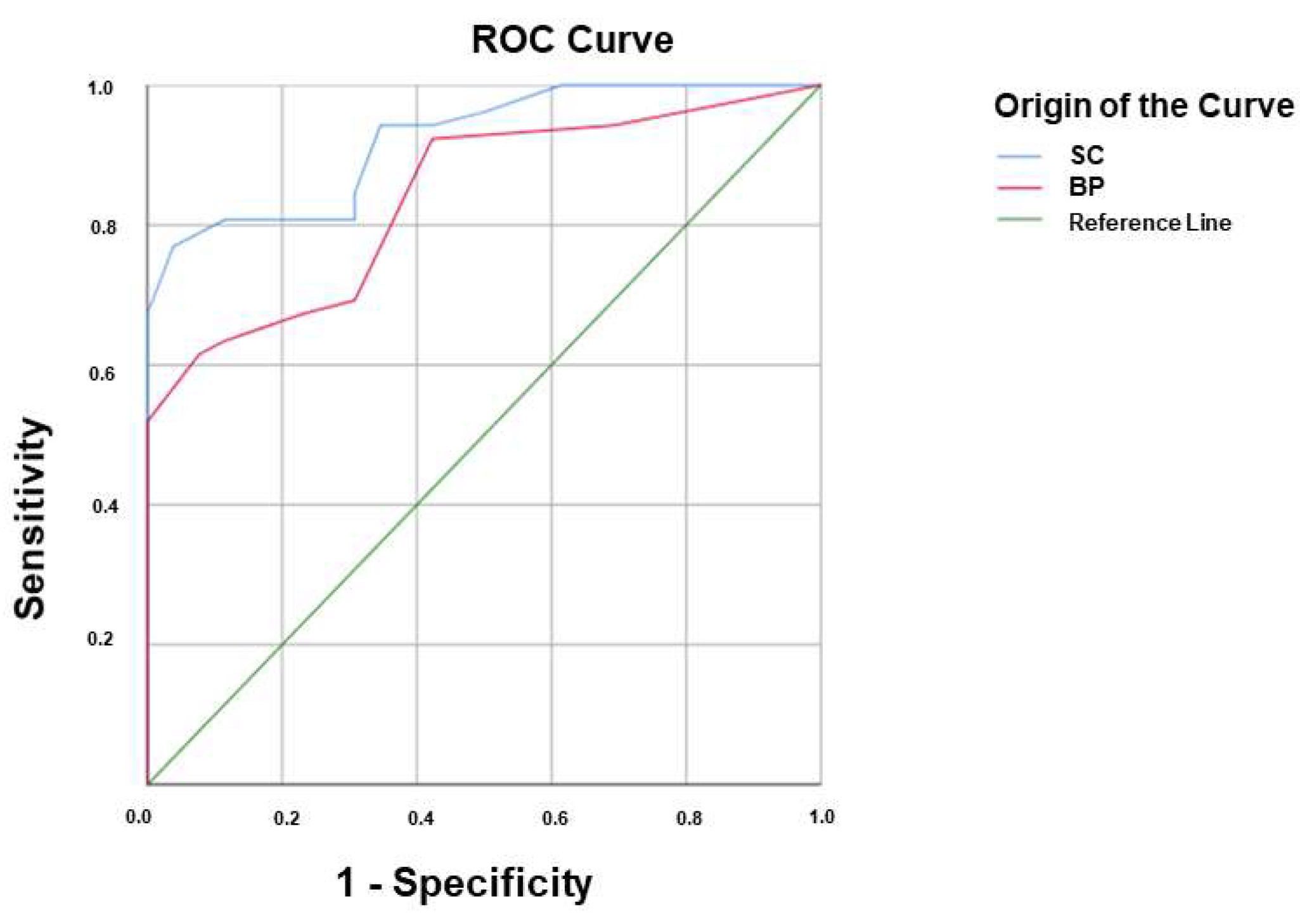
For the SC and BP dimensions, the AUC values were 0.853 (p < 0.01; 95% CI: 0.769–0.938) and 0.826 (p < 0.01; 95% CI: 0.737–0.914), respectively (Figure 3).
Figure 3.
AUC for the SC and BP dimensions. Legend: A graphical representation of how well the model for the values of the Social Communication (SC) and Behavioral Patterns (BPs) dimensions is calculated against possible limits. In this representation, the green line corresponds to the equality between the True Positive Rate and False Positive Rate, the blue line represents the ROC curve of the SC dimension with a value of 0.853, and the red line represents the ROC curve of the BP dimension with a value of 0.826.
The corresponding optimal cut-off scores, determined via Youden Index optimization, were 9.5 (≥10 points) for SC (J = 0.557; sensitivity: 86.5%; specificity: 69.2%) and 7.5 (≥8 points) for BP (J = 0.615; sensitivity: 61.5%; specificity: 100.0%). While the BP dimension exhibited perfect specificity, its lower sensitivity indicates that its isolated use would fail to identify a substantial proportion of children with ASD. Therefore, rather than functioning as a standalone screening measure, the BP dimension acts as a highly specific marker: notably, none of the 26 non-ASD participants screened positive at the selected BP cut-off, yielding a 95% confidence interval for specificity of 86.8–100.0%. Complete diagnostic accuracy indices and predictive values are detailed in Table 2. As noted, this discriminative performance reflects comparisons between participants with ASD and the heterogeneous non-ASD comparison group, representing a pragmatic real-world clinical evaluation.
Table 2.
A summary of the preliminary psychometric properties of the Bara-Cordeiro (BC) Scale.
4. Discussion
The present study provides preliminary psychometric evidence supporting the BC Scale as a parent-reported screening instrument for ASD symptoms in Brazilian children. Overall, the findings indicate high internal consistency, good temporal stability, and promising discriminative performance (AUC = 0.933; sensitivity = 94.2%) between children with ASD and those in a heterogeneous non-ASD clinical comparison group. Importantly, the scale was designed to cover a broader pediatric age range than commonly used toddler-specific screening instruments, potentially extending screening opportunities to children who were not identified during the early developmental period.
The BC Scale complements existing ASD screening approaches by addressing a broader developmental age range. The M-CHAT-R/F is specifically designed for toddlers aged 16–30 months and plays an important role in early ASD screening [6]. More recently, the Mini-TEA Scale was developed in Brazil for children aged 2–12 years, reflecting ongoing efforts to expand culturally appropriate ASD screening options within the Brazilian context [19]. Additionally, while parent-reported instruments like the original Autism-Spectrum Quotient–Children’s Version (AQ-Child) provide valuable assessment for school-aged children (4–11 years) [22], its 50-item structure can be extensive for rapid screening. Brief versions, such as the AQ-10 Child [23], are available in a European Portuguese translation [23] that has not been validated in Brazil, and these tools remain restricted to children aged 4 years and older. The BC Scale aims to bridge these developmental gaps by offering a brief (31-item), strictly DSM-5-aligned, and digitally native alternative designed to span from early childhood (24 months) to 10 years, although its performance below 30 months of age has not yet been examined. Rather than replacing established instruments, the BC Scale may provide an additional screening option aligned directly with DSM-5 criteria, particularly for children who present to clinical services beyond the age range targeted by toddler-specific screening tools.
Regarding the factor structure, exploratory factor analysis (EFA) yielded a two-factor solution corresponding to the theoretically proposed Social Communication (SC) and Behavioral Patterns (BP) dimensions. The final SC dimension comprised 18 reverse-scored items, whereas the BP dimension comprised 13 directly scored items. As all SC items were reverse-scored and all BP items were directly scored, it is important to acknowledge that item direction is confounded with the proposed dimensions. Although the combination of positively and negatively worded items may introduce methodological effects known as method variance [24], reverse-scored items were included to reduce response tendencies such as acquiescence [24]. Although the empirical distribution closely mirrored the theoretical construct, minor cross-loadings were observed. Notably, Item 21 (original Q26, addressing hand flapping and complex motor mannerisms) presented cross-loadings on both the SC (0.321) and BP (0.325) dimensions. The retention of this item in the BP dimension was deemed clinically essential, as it captures a core DSM-5 B1 criterion. In young children or those with communication delays, motor stereotypies proximal to the face frequently co-occur with nonverbal communication deficits (Criterion A2), which empirically explains this cross-loading in our sample. The observed internal consistency of both dimensions provides preliminary support for the coherence of the resulting scale structure. Nevertheless, given the preliminary nature of the present study, the factor structure should be further examined and confirmed via Confirmatory Factor Analysis (CFA) in larger and independent samples.
The descriptive differences in SC and BP scores between male and female participants may be relevant in light of evidence suggesting sex-related variation in the clinical presentation of ASD [25,26]. Restricted and repetitive behaviors may be less apparent in some females with ASD, whereas social difficulties may present differently or may be partially masked by compensatory behaviors, a phenomenon often described as camouflaging. Given the sample size and the descriptive nature of these findings, no conclusions regarding sex-specific performance of the BC Scale can be drawn from the present study. However, future studies with larger samples should examine whether the scale captures potential sex-related differences in ASD presentation and whether its screening performance varies across sexes.
A further practical aspect of the BC Scale is its electronic administration. The psychometric data reported in the present study were collected through an online questionnaire, demonstrating the feasibility of remote administration. Following data collection and refinement of the scale, a dedicated web-based application was subsequently developed to support its potential future clinical use. Digital administration may facilitate standardized data collection and reduce the burden associated with manual data entry. However, the clinical usability and psychometric equivalence of the dedicated platform have not yet been established and require specific evaluation, as further addressed in the limitations and future directions of this study.
From a clinical perspective, an accessible parent-reported screening instrument covering a broader pediatric age range may be particularly relevant in settings where ASD identification frequently occurs beyond the early screening window. The BC Scale may assist pediatricians, pediatric neurologists, psychologists, and other healthcare professionals in identifying children who may warrant further assessment. Importantly, the BC Scale is intended as a screening rather than a diagnostic instrument, and a positive screening result should prompt referral for comprehensive clinical evaluation. Overall, the present findings provide preliminary support for the potential clinical utility of the BC Scale in the Brazilian context, while further validation in larger and more diverse samples is warranted.
Limitations
Several methodological constraints must be carefully weighed when interpreting the findings of this preliminary study. First, the data sourced exclusively from a clinical referral sample at a single specialized clinical center and the relatively small sample size limit the precision and generalizability of the psychometric estimates. Crucially, caregivers were aware of their child’s clinical diagnosis at the time of questionnaire completion (mean interval from formal assessment to scale administration = approximately 5 months), introducing a substantial risk of respondent and recall biases. Although the initial findings regarding internal consistency and discriminative performance are promising, replication in larger and independent samples, particularly in blinded, unselected screening populations, is needed to provide more precise estimates and enable confirmatory analyses of the proposed factor structure. Furthermore, item selection, cut-off optimization, and diagnostic accuracy assessment were conducted using the same sample, which may create potential optimism in the performance estimates. The limited sample size also precluded the use of internal validation techniques, such as bootstrapping for AUC and optimal cut-off derivation. Consequently, these metrics represent development-sample performance, and independent validation is strictly required before routine clinical use.
Second, the broad inclusion criteria (observed range, 30–130 months) introduce considerable developmental heterogeneity, as the phenotypic expression of ASD evolves dramatically throughout childhood. The present sample did not allow for age-stratified analyses or assessment of measurement invariance across developmental stages. Therefore, we cannot assert that the scale’s diagnostic performance is equivalent across all pediatric subgroups. Future studies with larger samples should examine the performance and measurement properties of the BC Scale across narrower age groups.
Third, the youngest age group was relatively underrepresented (17 children younger than 6 years) and no child younger than 30 months was included, precluding conclusions regarding the scale’s performance among toddlers. Additional studies with greater representation of younger children are needed to evaluate its applicability across the full intended age range.
Fourth, the non-ASD comparison group was intentionally heterogeneous and included children with other neurodevelopmental conditions as well as neurotypical participants. Although this composition reflects a clinically relevant differential-screening context, the relatively small number of participants within individual diagnostic subgroups precluded disorder-specific analyses.
Fifth, ASD classification was based on comprehensive multidisciplinary clinical assessment supported by standardized instruments, including the ADOS-2 and CARS when clinically indicated; however, the ADI-R was not systematically administered. Future validation studies incorporating multiple standardized diagnostic measures may further strengthen evaluation of the scale’s discriminative performance.
Sixth, although a dedicated web-based application was developed following data collection and scale refinement, the psychometric data reported in this study were obtained using a standard online questionnaire format. Therefore, the psychometric equivalence and clinical usability of the dedicated computerized platform should be evaluated in future real-world clinical settings.
Seventh, artificially high prevalence of ASD inherent to this specialized referral sample mathematically inflates the reported PPV and NPV reflect this specific clinical setting and should not be generalized to routine, unselected screening populations where ASD prevalence is much lower. Furthermore, future studies should compare the BC Scale’s performance against established instruments validated for similar age groups, such as the AQ-Child, to further establish its concurrent validity.
Finally, while item-level analyses led to the exclusion of seven items, minor conceptual redundancies may persist among retained items. Specific examples identified include the overlapping content between Items 6 and 13 (describing object functions), Items 10 and 17 (using gestures combined with vocalizations to tease or warn), and Items 19 and 30 (rigid routines during play/leisure). Future item response theory (IRT) analyses in larger samples are required to further streamline the instrument and address these residual redundancies.
5. Conclusions
This study provides encouraging preliminary psychometric evidence for the BC Scale as an accessible, parent-reported ASD screening tool for the Brazilian context. Although designed for children aged 24 months to 10 years, it was evaluated in a sample aged 30 to 130 months. The scale demonstrated promising reliability and discriminative performance, while its electronic administration may facilitate its use in clinical settings. By covering a broader pediatric age range, the BC Scale may complement existing screening approaches and extend screening opportunities to children who were not identified during the early developmental period. It must be emphasized that the BC Scale is strictly a screening mechanism intended to expedite referrals for exhaustive multidisciplinary evaluation, not a standalone diagnostic instrument. Given its preliminary nature, independent validation in larger, multicenter samples is strictly required to confirm the current performance estimates. Overall, the BC Scale represents a promising screening approach developed within the Brazilian context to address ASD identification across a broader pediatric age range.
Supplementary Materials
The following supporting information can be downloaded at: https://www.mdpi.com/article/10.3390/children13121635/s1, S1: Bara-Cordeiro (BC) Scale–Items, Response Anchors, and Scoring Instructions; S2: Exploratory Factor Analysis of the Bara-Cordeiro (BC) Scale; S3: STARD 2015 flow diagram of participant recruitment and inclusion; S4: STARD 2015 Checklist for reporting diagnostic accuracy studies applied to the Bara-Cordeiro (BC) Scale psychometric evaluation.
Author Contributions
Conceptualization, T.S.B. and M.L.C.; methodology, T.S.B., M.M. and M.L.C.; software, T.S.B. and J.A.P.S.; validation, T.S.B., M.M. and M.L.C.; formal analysis, T.S.B.; investigation, T.S.B. and M.L.C.; resources, M.L.C.; data curation, T.S.B.; writing—original draft preparation, T.S.B. and M.L.C.; writing—review and editing, T.S.B., M.M., J.A.P.S. and M.L.C.; visualization, T.S.B.; supervision, M.L.C.; project administration, M.L.C. and T.S.B. All authors have read and agreed to the published version of the manuscript.
Funding
This study was financed in part by the Coordenação de Aperfeiçoamento de Pessoal de Nível Superior, Brazil (CAPES)—Finance Code 001. This study also received partial financial support from a project approved by Conselho Estadual dos Direitos da Criança e do Adolescente (CEDCA), funded through tax incentive programs, via Fundo Estadual para Infância e Adolescência (FIA-PR) from Paraná, Brazil.
Institutional Review Board Statement
The study was conducted in accordance with the Declaration of Helsinki and Resolution 466/12 of the Brazilian National Health Council (Conselho Nacional de Saúde [CNS]) and was approved by the Ethics Committee of Faculdades Pequeno Príncipe (CAAE: 36193220.2.0000.5580; approval date: 4 September 2020).
Informed Consent Statement
Informed consent was obtained from all subjects involved in the study.
Data Availability Statement
The data presented in this study are available from the corresponding author upon reasonable request. The data are not publicly available due to privacy and ethical restrictions intended to protect participant confidentiality and comply with applicable data protection requirements.
Acknowledgments
The authors thank the participants and their families for their participation and the clinical teams involved in the study. The authors are grateful to Rosilda Terezinha Chimaleski for her assistance in scheduling participating families. The authors also gratefully acknowledge the institutional support of the Instituto de Pesquisa Pelé Pequeno Príncipe and the Associação Hospitalar de Proteção à Infância Dr. Raul Carneiro. During the preparation of this manuscript, the first author used ChatGPT for English-language editing and refinement and for assistance in preparing the graphical abstract. The authors reviewed and edited the output and take full responsibility for the content of this publication.
Conflicts of Interest
The authors declare no conflicts of interest.
Abbreviations
The following abbreviations are used in this manuscript:
| AD | Anxiety Disorder |
| ADHD | Attention-Deficit/Hyperactivity Disorder |
| ADI-R | Autism Diagnostic Interview-Revised |
| ADOS-2 | Autism Diagnostic Observation Schedule, Second Edition |
| ASD | Autism Spectrum Disorder |
| AUC | Area Under the Curve |
| BC | Bara-Cordeiro |
| BD | Bipolar Disorder |
| BP | Behavioral Patterns |
| CARS | Childhood Autism Rating Scale |
| CBCL | Child Behavior Checklist |
| CDC | Centers for Disease Control and Prevention |
| CI | Confidence Interval |
| CNS | Brazilian National Health Council (Conselho Nacional de Saúde) |
| CVI | Content Validity Index |
| DD | Depressive Disorder |
| DSM-5 | Diagnostic and Statistical Manual of Mental Disorders, Fifth Edition |
| EFA | Exploratory Factor Analysis |
| GDD | Global Developmental Delay |
| ICC | Intraclass Correlation Coefficient |
| IDD | Intellectual Developmental Disorder |
| IQ | Intelligence Quotient |
| KMO | Kaiser–Meyer–Olkin |
| M-CHAT | Modified Checklist for Autism in Toddlers |
| M-CHAT-R/F | Modified Checklist for Autism in Toddlers, Revised with Follow-Up |
| NPV | Negative Predictive Value |
| PAF | Principal Axis Factoring |
| PPV | Positive Predictive Value |
| ROC | Receiver Operating Characteristic |
| SC | Social Communication |
| SD | Standard Deviation |
| SLD | Specific Learning Disorder |
| SON-R | Snijders-Oomen Nonverbal Intelligence Test |
| SPSS | Statistical Package for the Social Sciences |
| TD | Typical Development |
| TRF | Teacher’s Report Form |
| WISC-IV | Wechsler Intelligence Scale for Children, Fourth Edition |
References
- American Psychatric Association. Diagnostic and Statistical Manual of Mental Disorders, 5th ed.; American Psychatric Association: Washington, DC, USA, 2013. [Google Scholar]
- Shaw, A.K.; Williams, S.; Patrick, E.M.; Valencia-Prado, M.; Durkin, M.S.; Howerton, E.M.; Ladd-Acosta, C.M.; Pas, E.T.; Bakian, A.V.; Bartholomew, P.; et al. Prevalence and Early Identification of Autism Spectrum Disorder Among Children Aged 4 and 8 Years—Autism and Developmental Disabilities Monitoring Network, 16 Sites, United States, 2022. Morb. Mortal. Wkly. Rep. 2025, 74, 1–22. [Google Scholar] [CrossRef] [Scilit]
- IBGE. Censo Demográfico 2022: População e Domicílios; Instituto Brasileiro de Geografia e Estatística (IBGE): Rio de Janeiro, Brazil, 2023; Volume 75.
- Ruggeri, B.; Sarkans, U.; Schumann, G.; Persico, A.M. Biomarkers in Autism Spectrum Disorder: The Old and the New. Psychopharmacology 2014, 231, 1201–1216. [Google Scholar] [CrossRef] [Scilit]
- Filipek, P.A.; Accardo, P.J.; Ashwal, S.; Baranek, G.T.; Cook, E.H.; Dawson, G.; Gordon, B.; Gravel, J.S.; Johnson, C.P.; Kallen, R.J.; et al. Practice Parameter: Screening and Diagnosis of Autism. Report of the Quality Standards Subcommittee of the American Academy of Neurology and the Child Neurology Society. Neurology 2000, 55, 468–479. [Google Scholar] [CrossRef] [Scilit]
- Robins, D.L.; Casagrande, K.; Barton, M.; Chen, C.-M.A.; Dumont-Mathieu, T.; Fein, D. Validation of the Modified Checklist for Autism in Toddlers, Revised with Follow-up (M-CHAT-R/F). Pediatrics 2014, 133, 37–45. [Google Scholar] [CrossRef] [Scilit]
- Luteijn, E.; Luteijn, F.; Jackson, S.; Volkmar, F.; Minderaa, R. The Children’s Social Behavior Questionnaire for Milder Variants of PDD Problems: Evaluation of the Psychometric Characteristics. J. Autism Dev. Disord. 2000, 30, 317–330. [Google Scholar] [CrossRef] [Scilit]
- Achenbach, T. Manual for the Teacher’s Report Form and 1991 Profile; University of Vermont, Department of Psychiatry: Burlington, VT, USA, 1991. [Google Scholar]
- Achenbach, T. Manual for the Child Behavior Checklist/4-18 and 1991 Profile; University of Vermont, Department of Psychiatry: Burlington, VT, USA, 1991. [Google Scholar]
- Achenbach, T.M.; Rescorla, L.A. Multicultural Supplement to the Manual for the ASEBA Preschool Forms & Profiles; University of Vermont, Research Center for Children, Youth, and Families: Burlington, VT, USA, 2010. [Google Scholar]
- Gilliam, J.E. Gilliam Autism Rating Scale; Pro-Ed: Austin, TX, USA, 1995. [Google Scholar]
- Rutter, M.; Bailey, A.; Lord, C. The Social Communication Questionnaire; Western Psychological Services: Los Angeles, CA, USA, 2003. [Google Scholar]
- Constantino, J.; Gruber, J. Social Responsiveness Scale (SRS) Manual; Western Psychological Services: Los Angeles, CA, USA, 2005. [Google Scholar]
- Sallum, B.T.; Ehlke, M.; Haddad, O.; Gabriela, M.; De Figueiredo, C.; Bara, T.S.; Furlin, V.; Cordeiro, M.L. Delayed Diagnosis and Missed Opportunities for Early Autism Identification in Brazil: An Exploratory Scoping Review. Children 2026, 13, 1082. [Google Scholar] [CrossRef] [Scilit]
- Uras, M.C.; Sata, M.; Kaya, A.; Ziapour, A.; Yıldırım, M. A Bibliometric Study on Early Childhood Autism Research. Psihologija 2026, 59, 111–128. [Google Scholar] [CrossRef] [Scilit]
- Ribeiro, S.H.B.; de Paula, C.S.; Bordini, D.; Mari, J.J.; Caetano, S.C. Barriers to Early Identification of Autism in Brazil. Rev. Bras. Psiquiatr. 2017, 39, 352–354. [Google Scholar] [CrossRef] [Scilit]
- van ’t Hof, M.; Tisseur, C.; van Berckelear-Onnes, I.; van Nieuwenhuyzen, A.; Daniels, A.M.; Deen, M.; Hoek, H.W.; Ester, W.A. Age at Autism Spectrum Disorder Diagnosis: A Systematic Review and Meta-Analysis from 2012 to 2019. Autism 2021, 25, 862–873. [Google Scholar] [CrossRef] [Scilit]
- Baker, J.; Kohlhoff, J.; Onobrakpor, S. The Acceptability and Effectiveness of Web-Based Developmental Surveillance Programs: Rapid Review Corresponding Author. JMIR mHealth uHealth 2020, 8, e16085. [Google Scholar] [CrossRef] [Scilit]
- Forcelini, C.M.; Ampese, R.; de Melo, H.Y.; Pasin, C.P.N.; Pádua, J.R.D.; de Moura, I.D.; Spanholo, C.B.; Hoffmann, F.E.; Diniz, J.B.; Capponi, L.C.Z.; et al. Psychometric Characteristics of the Mini-TEA Scale: A Screening Instrument for Autism Spectrum Disorder in Children. J. Pediatr. 2025, 101, 101419. [Google Scholar] [CrossRef] [Scilit]
- Bossuyt, P.M.; Reitsma, J.B.; Bruns, D.E.; Gatsonis, C.A.; Paul, P.; Irwig, L.; Lijmer, J.G.; Moher, D.; Rennie, D.; De, H.C.W.; et al. STARD 2015: An Updated List of Essential Items for Reporting Diagnostic Accuracy Studies. BMJ 2015, 277, h5527. [Google Scholar] [CrossRef] [Scilit]
- Swets, J.A. Signal Detection Theory and ROC Analysis in Psychology and Diagnostics; Psychology Press: Burlington, VT, USA, 1996; Volume 5. [Google Scholar]
- Auyeung, B.; Baron-Cohen, S.; Wheelwright, S.; Allison, C. The Autism Spectrum Quotient: Children’s Version (AQ-Child). J. Autism Dev. Disord. 2008, 38, 1230–1240. [Google Scholar] [CrossRef] [Scilit]
- Allison, C.; Auyeung, B.; Baron-Cohen, S. Toward Brief “Red Flags” for Autism Screening: The Short Autism Spectrum Quotient and the Short Quantitative Checklist in 1000 Cases and 3000 Controls. J. Am. Acad. Child Adolesc. Psychiatry 2012, 51, 202–212.e7. [Google Scholar] [CrossRef] [Scilit]
- Spector, P.E.; Van Katwyk, P.T.; Brannick, M.T.; Chen, P.Y. When Two Factors Don’t Reflect Two Constructs: How Item Characteristics Can Produce Artifactual Factors. J. Manag. 1997, 23, 659–677. [Google Scholar] [CrossRef]
- Postorino, V.; Fatta, L.M.; De Peppo, L.; Giovagnoli, G.; Armando, M.; Vicari, S.; Mazzone, L. Longitudinal Comparison between Male and Female Preschool Children with Autism Spectrum Disorder. J. Autism Dev. Disord. 2015, 45, 2046–2055. [Google Scholar] [CrossRef] [Scilit]
- Andersson, G.W.; Gillberg, C.; Miniscalco, C. Research in Developmental Disabilities Pre-School Children with Suspected Autism Spectrum Disorders: Do Girls and Boys Have the Same Profiles? Res. Dev. Disabil. 2013, 34, 413–422. [Google Scholar] [CrossRef] [Scilit]

Disclaimer/Publisher’s Note: The statements, opinions and data contained in all publications are solely those of the individual author(s) and contributor(s) and not of MDPI and/or the editor(s). MDPI and/or the editor(s) disclaim responsibility for any injury to people or property resulting from any ideas, methods, instructions or products referred to in the content. |
© 2026 by the authors. Licensee MDPI, Basel, Switzerland. This article is an open access article distributed under the terms and conditions of the Creative Commons Attribution (CC BY) license.