


Abstract
The use of one-step products and their applications in sensory applications has gained much importance. Herein, Schiff’s base fluorescent turn-on sensor, namely FBTS, was synthesised via a condensation reaction between 6-fluorobenzo[d]thiazol-2-amine and 2-hydroxybenzaldehyde. The probe FBTS exhibits an intense “turn-on” blue fluorescence upon binding to Al3+ ions in a dimethyl sulfoxide–water (DMSO–H2O (8:2, v/v)) medium. From photoluminescence (PL) titrations, the detection limit (LOD) for Al3+ is estimated to be 0.14 microM, and the Benesi–Hildebrand plot-based association constant (Ka) of 5.4 × 10⁴ M−1 confirm a strong association between FBTS and Al3+. Negligible interference is observed in the presence of other metal ions. From the pH effect studies, the optimal pH range for Al3+ detection is 7–9. The recyclable reversibility of FBTS + Al3+ complex has been demonstrated via the sodium salt of ethylenediaminetetraacetic acid (Na2-EDTA) chelation. A Job’s plot and interrogations, such as high-resolution mass spectrometry (HR-MS), 1H-nuclear magnetic resonance (NMR) titration, and density functional theory (DFT), verified the 1:1 stoichiometry of binding between FBTS and Al3+. Based on multiple analyses, the binding mode and mechanism have been detailed. In addition, the practical application of FBTS for detecting Al3+ is demonstrated using the strip paper method, fish analysis, spiked real sample analysis, and cellular imaging.
1. Introduction
The detection of metal ions has become increasingly important due to their adverse effects on humans [1]. In particular, aluminium (Al3+) is found in both the environment and biological systems [2]. Aluminium is widely used in the pharmaceutical, metal, paint, and water purification industries [3]. Its excessive exposure has been increasingly associated with harmful human diseases [4]. Aluminium easily accumulates in living organisms due to its strong affinity for oxygen-containing biomolecules, causing severe conditions such as chronic diseases [5], kidney failure [6], Alzheimer’s disease [7], bone disorders, hypoparathyroidism [8], lung diseases like pulmonary fibrosis, and pneumoconiosis [9,10]. These disorders may lead to neurodegenerative diseases like Alzheimer’s disease, Parkinsonism, and encephalopathy [11,12]. Thus, developing the methods/tactics for rapid, selective, and sensitive detection of Al3+ has become essential. Additionally, aluminium contamination of water occurs primarily through industrial discharges, posing significant environmental problems [13,14]. As a result, the detection of aluminium in organic–aqueous media has become highly desirable.
Several techniques have been developed for the detection of Al3+ ions, including atomic absorption spectroscopy (AAS) [15], electrochemical methods [16,17], inductively coupled plasma mass spectrometry (ICP-MS) [18], and fluorescence techniques [19,20]. However, some of these techniques have several issues, including high instrumental costs, the need for trained operators, complex sample preparation, and large infrastructure requirements. In addition, many tactics also possess drawbacks, including complex synthesis, low detection limits, limited applicability, and a lack of selective metal sensing. To avoid these issues, Schiff’s base fluorimetric organic probes [21,22], nanomaterial-based fluorescent sensors [23], biochemical sensors [24], and metal–organic frameworks [25] have been proposed for detecting metal ions. Among these, Schiff’s base fluorimetric organic probes [26,27] have gained considerable importance due to their cost-effectiveness, ease of synthesis and use, high selectivity, and sensitivity towards metal ions in both organic and aqueous media [28,29,30]. Thus, the development of one-pot-synthesised probes for environmental monitoring becomes crucial, enabling the synthesis of a Schiff base [31,32,33,34,35,36,37,38,39]. The FBTS [40,41], a Schiff’s base, exhibits reversibility and recyclability with aluminium. Additionally, the combined spectroscopic, pH effect, and reversibility studies demonstrate that FBTS distinguishes itself from several other conventional systems that require complex instruments or harsh experimental conditions and have limited applicability as probes. The straightforward synthesis procedure, low cost, and selective detection of aluminium at nanomolar levels in marine and environmental applications such as spiked water, Radix Hedysari extract, and Nelumbinis Stamen extract are key characteristics of FBTS. Hence, we use FBTS for the detection of aluminium with practical applications, including cell imaging, the paper strip method, and fish piece analysis.
In this study, we have synthesised the Schiff’s base fluorimetric organic probe FBTS via a pot reaction between 6-fluorobenzo[d]thiazol-2-amine and 2-hydroxybenzaldehyde, which is employed in the detection of metal ions. FBTS indicated selective detection of aluminium under a UV lamp (λex = 365 nm) among other metal ions in an organic–aqueous medium. Additionally, the absorbance and fluorescence investigations showed that FBTS selectively detects aluminium in a dimethyl sulfoxide–water (DMSO–H2O (8:2, v/v)) medium. The Job’s plot, FTIR spectroscopy, 1H titration, and mass spectrometry demonstrated the binding mode of FBTS and Al3+. The photoluminescence quantum yield (PLQY) study has shown a folded enhancement. The reusability and pH-dependent sensory responses were defined by pH effect and reversibility analyses with Na2-EDTA. Additionally, applications such as the paper strip method, cell imaging, and fish piece analysis demonstrated the effectiveness of FBTS in real-time aluminium detection.
2. Materials and Methods
2.1. Synthesis of FBTS
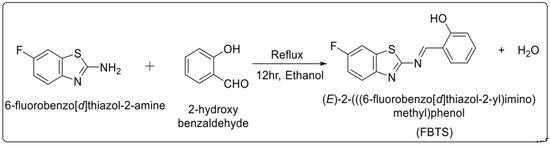
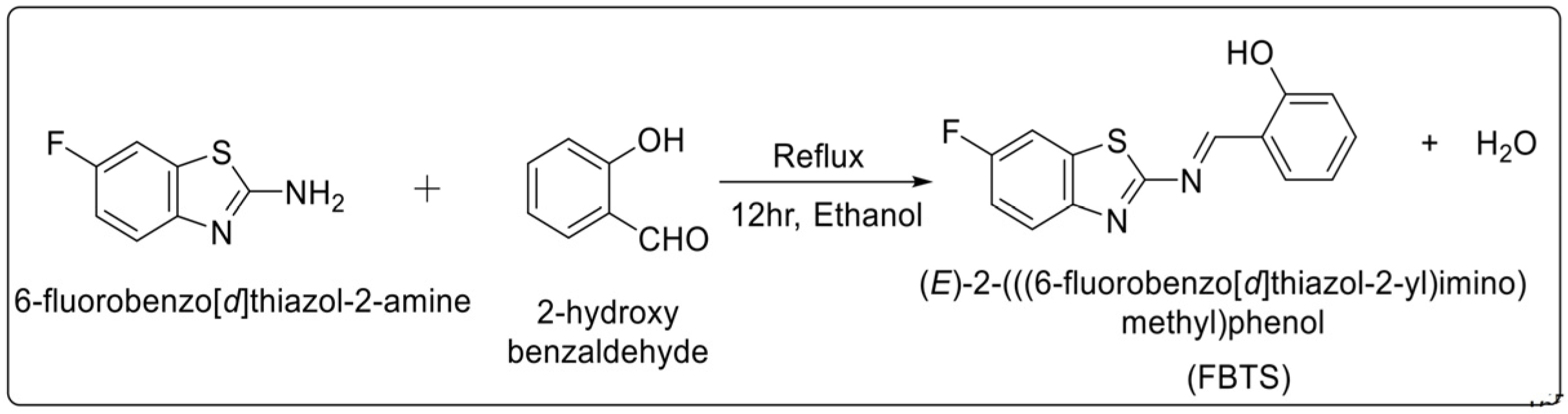
The probe FBTS, namely 2-(((6-fluorobenzo[d]thiazol-2-yl)imino)methyl)phenol, a Schiff’s base, was synthesised via reflux of 6-fluorobenzo[d]thiazol-2-amine (168.19 mg, 1.0 equiv.) and 2-hydroxybenzaldehyde (122.12 mg, 1.0 equiv.) in 10 mL ethanol for 12 h. Thin layer chromatography used to monitor the reaction after the completion of the reaction. On cooling the reaction mixture, the crude product was obtained. Upon recrystallization with 5 mL of cold ethanol, a yellowish, pure product was obtained (242.347 mg, 89% yield); yellow solid, FTIR (νmax, cm−1): 3064, 1601, 1562, 1506, 1446, 1404, 1367, 1310, 1283, 1244, 1201, 1155, 1114, 1044, 987, 919, 900; 1H NMR (500 MHz, CDCl3) δ 7.01 (1 H, t, J = 7.5), 7.07 (1 H, d, J = 7.6), 7.24 (1 H, td, J = 2.6, 8.9), 7.45–7.58 (3H, m), 7.92 (1 H, dd, J = 4.8, 8.9), 9.24 (1 H, s), 12.16 (1 H, s); 13C{1H} NMR (126 MHz, CDCl3) δ 107.96, 108.17, 115.26, 115.46, 117.73, 118.30, 119.87, 124.04, 124.11, 134.11, 135.54, 135.56, 135.63, 148.05, 148.07, 159.37, 161.34, 162.00, 167.38, 168.61, 168.63.; ESI-MS m/z calcd for C14H9FN2OS [M + H]+: 273.04; found: 273.0472.
2.2. Solvent Selection for Sensory Investigation [27,39]
Initially, 100 µL of FBTS from a 1 mM (mM = millimole; 10−3 M) stock on dilution with 1800 µL of dimethyl sulfoxide (DMSO)/dimethyl formamide (DMF)/ethanol (EtOH)/acetonitrile (ACN)/tetrahydrofuran (THF)/Milli-Q water and then mixed with 100 µL of cations from a 10 mM stock (final volume = 2 mL). Before measuring the UV-Vis/PL spectra, the solution was shaken well. Based on sensor selectivity, PLQY values, single- and dual-analyte studies, and ΦF values, the best solvent for sensor studies was determined to be DMSO–H2O (8:2).
Interference studies of the Al3+ sensor.
Single-analyte studies solvent mixing ratio: 100 µL of FBTS (from 1 mM stock) + 1890 µL of the DMSO–H2O (8:2) solvent + 10 µL of cations (from 10 mM stock).
2.3. DFT Optimisation [42,43]
The ground-state molecular entities of FBTS and FBTS + Al3+ were optimised using density functional theory (DFT) implemented with the Gaussian16 programme package [42]. B3LYP (Becke-parameter, Lee–Yang–Parr), a hybrid GGA functional, was utilised with effective core potential (ECP), including the LANL2DZ (Los Alamos National Laboratory 2 Double-Zeta) basis set for metal (Al) atom and 6–31+G(d,p) for carbon (C), hydrogen (H), nitrogen (N), oxygen (O), fluorine (F), and sulphur (S) atoms [43]. The band gaps (Egs) of FBTS and FBTS + Al3+ were calculated and tabulated using the frontier molecular orbital (FMO) analysis. All DFT calculations were executed at the gas phase.
2.4. Cell Imaging [27,39]
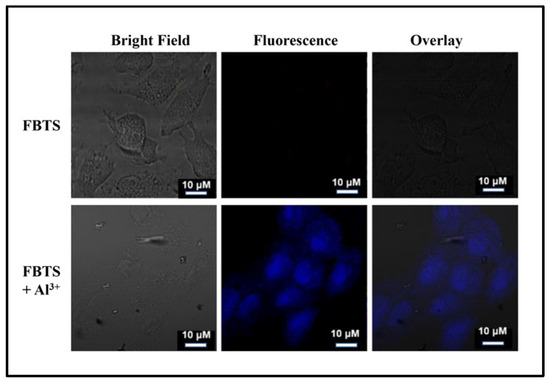
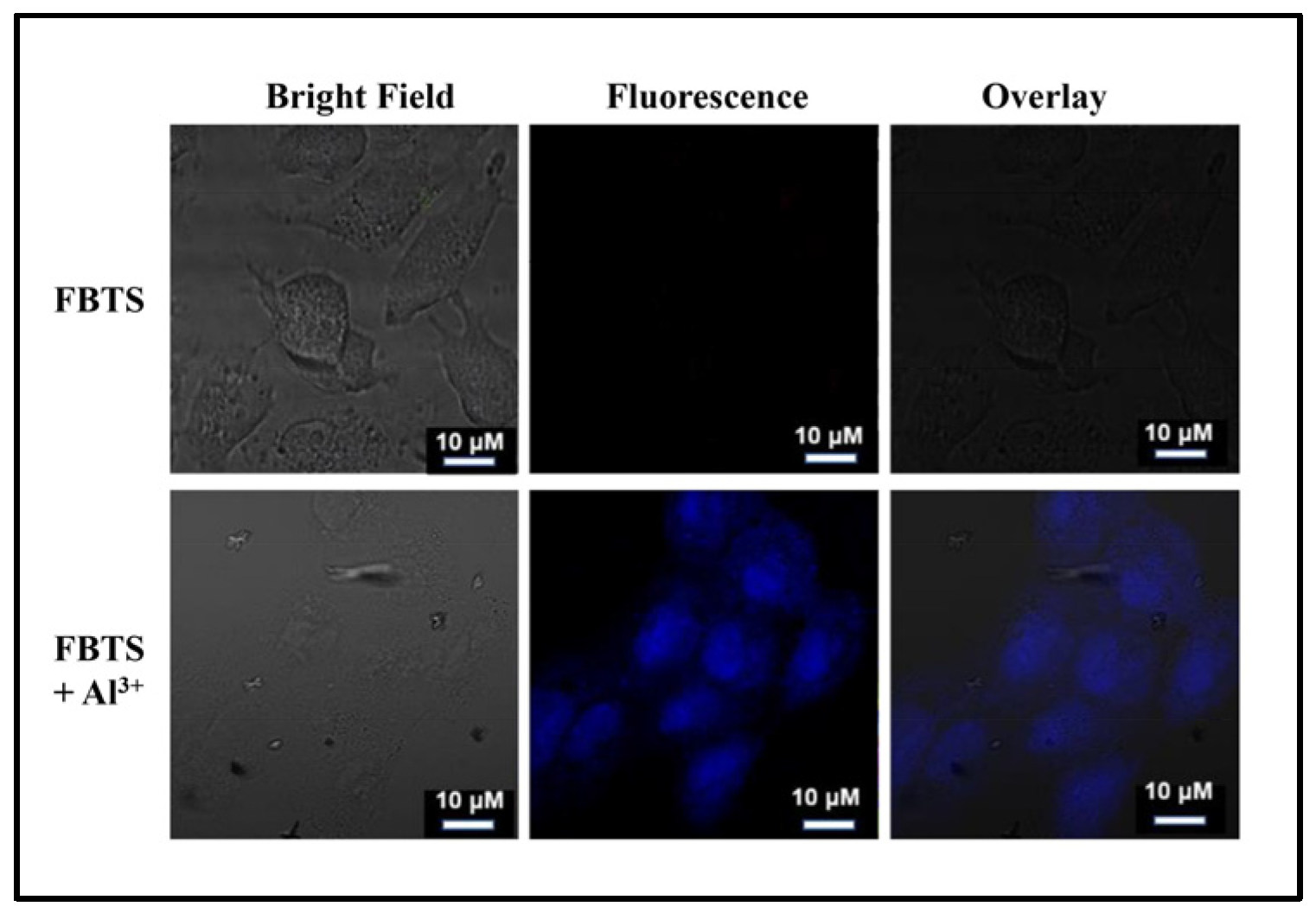
For Al3+ imaging, the Bioresource Collection Research Centre in Taiwan (ROC) provided the A549 cancer cells. Cellular imaging was performed as described in an earlier report [38]. A total of 5 µL of FBTS from a 10 mM stock solution in DMSO was spiked and incubated in minimum essential medium Eagle (MEMα, 12561056; Thermo Fisher, MA, USA) at 37 °C for 20 min. Then, 2 µL of Al3+ ions (from a 100 mM stock solution) were added and maintained at 37 °C for 30 min. The PBS medium was used to replace the cell culture medium. Using a Zeiss LSM-900 confocal microscope, the bright-field and emissive images of FBTS (control) and FBTS + Al3+ were recorded between 400 and 480 nm, with excitation wavelengths ranging from 350 to 450 nm.
2.5. Preparation of Real Samples [39]
The Hedysari extract and Nelumbinis Stamen extract were prepared according to recent literature studies [44,45]. Approximately 1.0 g of powdered herbal material (20 mesh, 20 openings per linear inch) was transferred into a 50 mL centrifuge tube with 20 mL of methanol. The mixture in the tube was subjected to ultrasonic extraction (300 W, 40 kHz) for 30 min. After this, the mixture was centrifuged for 10 min to collect the supernatant. The residue was re-extracted with an additional 20 mL of methanol. The combined supernatants and extract were reduced in volume. After diluting with methanol in a 25 mL volumetric flask, it was mixed thoroughly. The abovementioned prepared solution was filtered through a 0.45 µm PTFE syringe filter. The obtained filtrate was subsequently used for analysis.
2.6. Procedure for Spiked Real Water and Real Sample Analysis [39]
The laboratory tap water, Mithi River water, and real samples, such as the Radix Hedysari extract and the Nelumbinis Stamen extract, were employed for recovery studies. The real samples of Al3+ ions were prepared in laboratory tap water, Mithi River water, the Radix Hedysari extract, and the Nelumbinis Stamen extract at a concentration of 10 mM. For spiked recovery of Al3+ ion, diverse concentrations (5 µL, 10 µL, and 15 µL (for Al3+)) were spiked into 100 µL FBTS (from 1 mM stock solution) and diluted with DMSO–H2O (8:2, v/v) to a final volume of 2 mL cuvette. The final concentration was 50 µM. The recovery PL percentage for each spiked sample concentration was measured three times consecutively, and the RSD values were tabulated.
3. Results and Discussion
3.1. Synthesis and Characterisation
FBTS was prepared via one pot using 6-fluorobenzo[d]thiazol-2-amine and 2-hydroxybenzaldehyde in ethanol as a solvent, as shown in Scheme 1. 1H NMR, 13C{1H} NMR, HR mass spectroscopy, and FTIR spectroscopy, respectively (see in Figures S1–S4, Supporting Information), elucidated the structure of FBTS as compared with the literature [40,41].
Scheme 1.
Synthesis of FBTS; reflux 6-fluorobenzo[d]thiazol-2-amine and 2-hydroxybenzaldehyde in ethanol for 12 h.
3.2. Selection of Solvent for Sensory Investigation Studies [27]
Before elucidating the selectivity of FBTS, a suitable solvent for the sensory investigation was selected by calculating PLQY in different solvents. For PLQY measurement, 9,10-diphenylanthracene in DMSO (ΦF = 70%) was used as a reference standard. The FBTS exhibits absorbance at 373 nm and photoluminescence maxima at 488 nm, with respective PLQY values of 2.123%, 2.131%, 2.114%, 2.13%, 2.2%, and 1.25% in DMSO, DMF, ethanol, acetonitrile, tetrahydrofuran, and water, respectively. It shows that FBTS possesses a high PLQY value in the DMSO solvent and exhibits a good sensing response towards Al3+ (see Table S1, Supporting Information). In the presence of Al3+, the PLQY of FBTS in different solvents, such as DMSO, DMF, ethanol, acetonitrile, tetrahydrofuran, and water, is found to be varied and attains the maximum value in the DMSO medium, with a maximum intensity of 1413 at 488 nm. The ability of water to dissolve ions and of DMSO to enhance the solubility of FBTS: we used an 8:2 ratio of DMSO–H2O as the solvent medium for the sensory investigation. Next, the PLQY value of FBTS is lower than that in DMSO. However, the PLQY value of FBTS + Al3+ in DMSO: H2O is higher than that of all other solvents, including DMSO, and DMSO–H2O delivered the best sensor response to Al3+. As the water ratio increases, FBTS precipitation occurs. Thus, other solvents, such as water and tetrahydrofuran, affected the sensing performance and PLQY of FBTS. Therefore, we have chosen DMSO–H2O (8:2) as the solvent for sensory interrogations in other studies, including cell imaging, fish piece analysis, and the paper strip method. Also, it has been verified that there is no aggregation-induced emission (AIE) upon increasing the water ratio from 0 to 99%.
3.3. Absorbance and Fluorescence Response Towards a Metal Ion
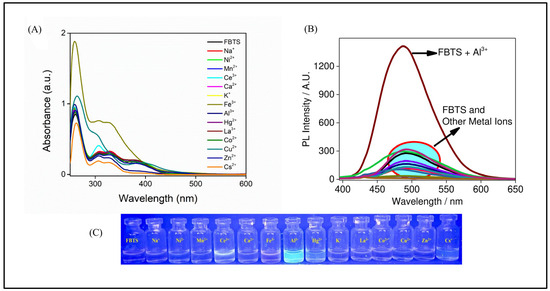
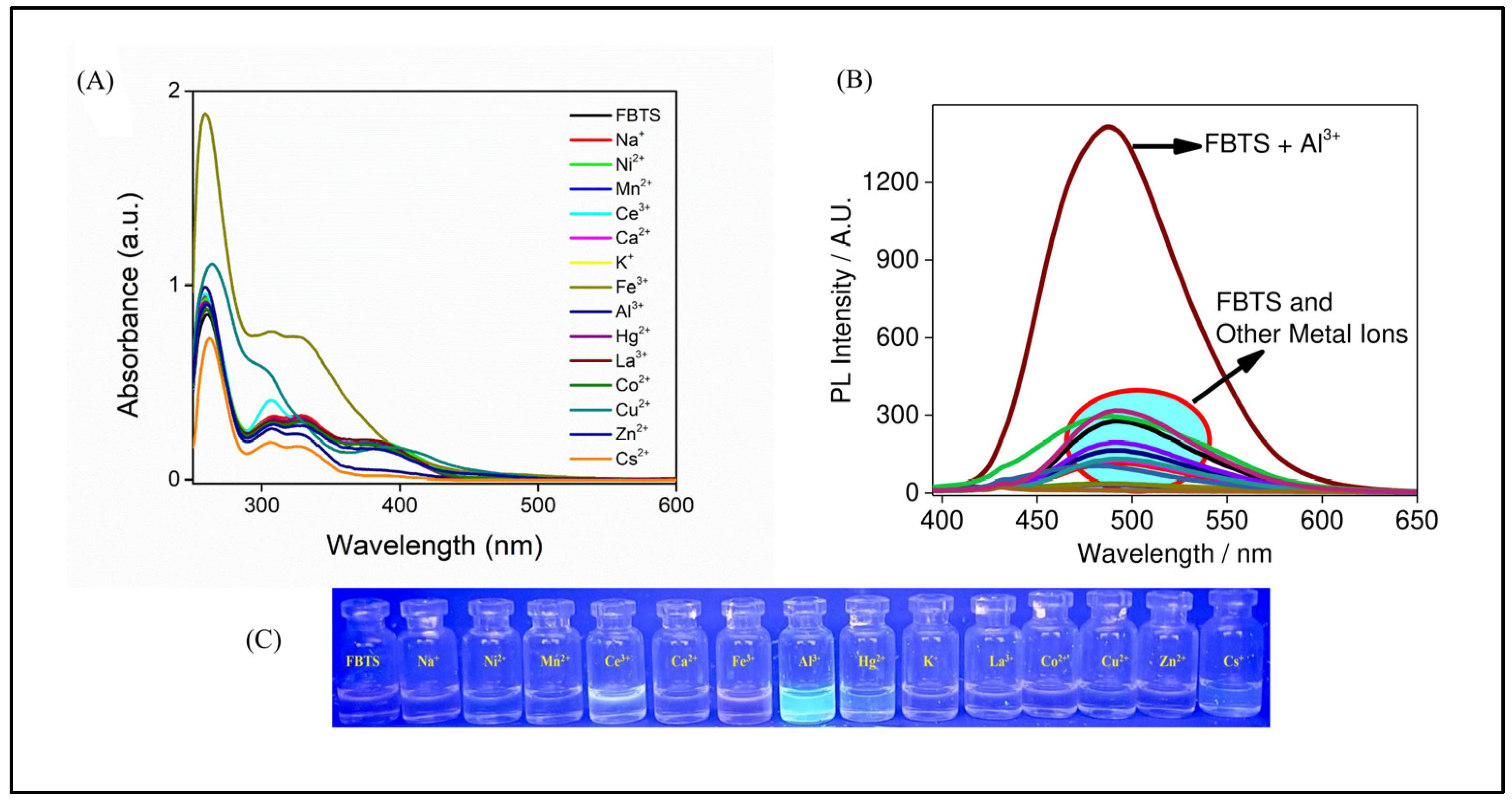
To check the absorption band for the excitation wavelength (see Figure 1A), 100 μL of FBTS from a 1 mM stock solution with 40 μL of different metal ions (Na+, Ni2+, Mn2+, Ce3+, Ca2+, K+, Fe3+, Al3+, Hg2+, La3+, Co2+, Cu2+, Zn2+, and Cs+) from their respective 10 mM stock solutions are tested in the DMSO–H2O (8:2, v/v) medium in a 2 mL cuvette using a UV spectrophotometer. New absorption bands are observed at 317 nm, 328 nm, and 373 nm for FBTS + Al3+.
Figure 1.
(A) Absorbance profiles of diverse cations towards FBTS receptor (5 × 10⁻⁵ M) in DMSO–H2O (8:2, v/v) solution. (B) Fluorescence responses of diverse cations (Na+, Ni2+, Mn2+, Ce3+, Ca2+, K+, Fe3+, Al3+, Hg2+, La3+, Co2+, Cu2+, Zn2+, and Cs+) at (λex = 383 nm) towards FBTS (5 × 10⁻⁵ M) in DMSO–H2O (8:2, v/v) solution. (C) FBTS (50 µM in DMSO) to metal ions (150 µM in Milli-Q water) in DMSO–H2O (8:2, v/v) medium; fluorimetric selectivity under UV lamp (λex = 365 nm).
Based on absorption studies (Figure 1A), a photoluminescence study was performed to assess the selectivity and sensitivity of ions towards FBTS (Figure 1B). Each absorption wavelength is used to determine the fluorescence intensity maxima. The fluorescence response was performed by taking 100 μL of FBTS from 1 mM stock solution with 40 μL of different metal ions (Na+, Ni2+, Mn2+, Ce3+, Ca2+, K+, Fe3+, Al3+, Hg2+, La3+, Co2+, Cu2+, Zn2+, and Cs+) from their respective 10 mM stock solutions are tested in DMSO–H2O (8:2, v/v) medium in 2 mL cuvette upon excitation at λex = 383 nm. No effect on the emission spectrum is observed with different metal ions; however, FBTS shows a substantial enhancement in fluorescence intensity with Al3+, as shown in Figure 1B. Therefore, it is concluded that FBTS had high selectivity and sensitivity towards Al3+ ions.
3.4. Interference Effect
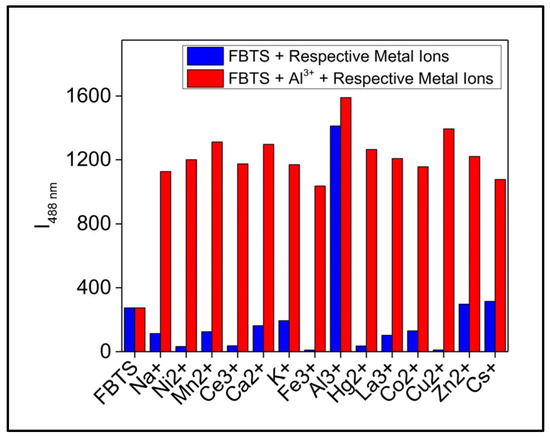
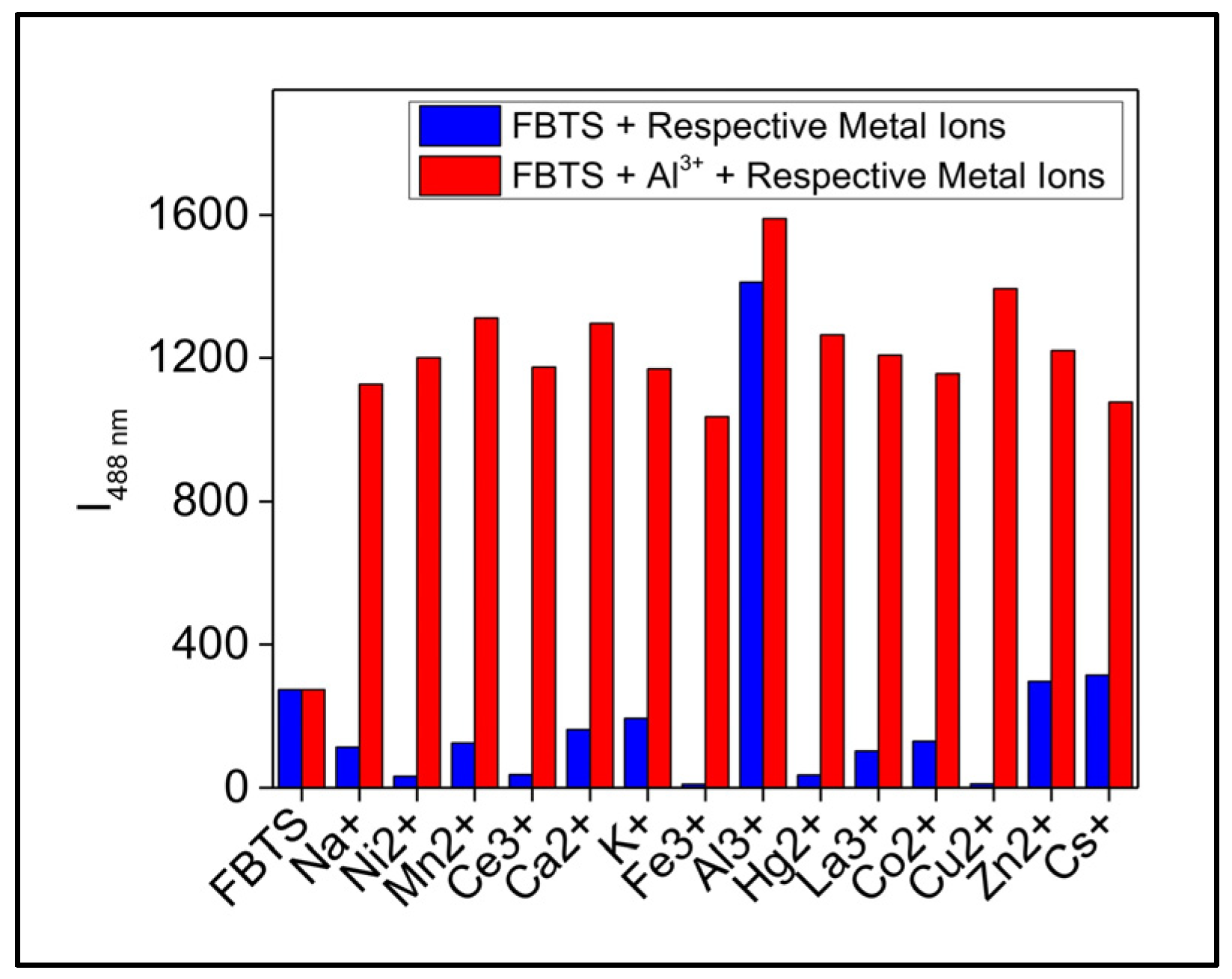
An interference experiment was executed to investigate the selectivity of Al3+ over other respective metal ions (Figure 2), following the procedure outlined in Materials and Methods. For this purpose, FBTS (5 × 10⁻⁵ M) with respective metal ions (2 × 10⁻⁴ M) and FBTS (5 × 10⁻⁵ M) on addition with Al3+ ion (2 × 10⁻⁴ M) were treated with other respective metal ions (2 × 10⁻⁴ M) in DMSO–H2O (8:2, v/v), which resulted in an eight-fold enhancement of PL at 488 nm (see Table S1, Supporting Information). It is observed that neither other metal ions significantly enhanced the emission of FBTS nor quenched the system of FBTS + Al3+, which might be due to chelation-enhanced fluorescence. Consequently, FBTS proved to be a highly selective sensor for Al3+ despite the presence of multiple interfering metal ions.
Figure 2.
Relative fluorescence of FBTS (5 × 10⁻⁵ M) and respective metal ions (2 × 10⁻⁴ M) (blue bars) and fluorescence intensity of FBTS (5 × 10⁻⁵ M) with respective metal ions ion (2 × 10⁻⁴ M) and Al3+ ion (2 × 10⁻⁴ M) (red bars) in DMSO–H2O (8:2, v/v). (λex = 383 nm and λem = 488 nm).
3.5. The Fluorescence Titration Experiments and the Detection Limit
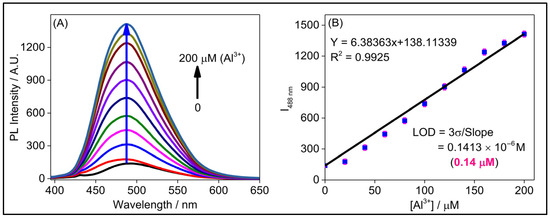
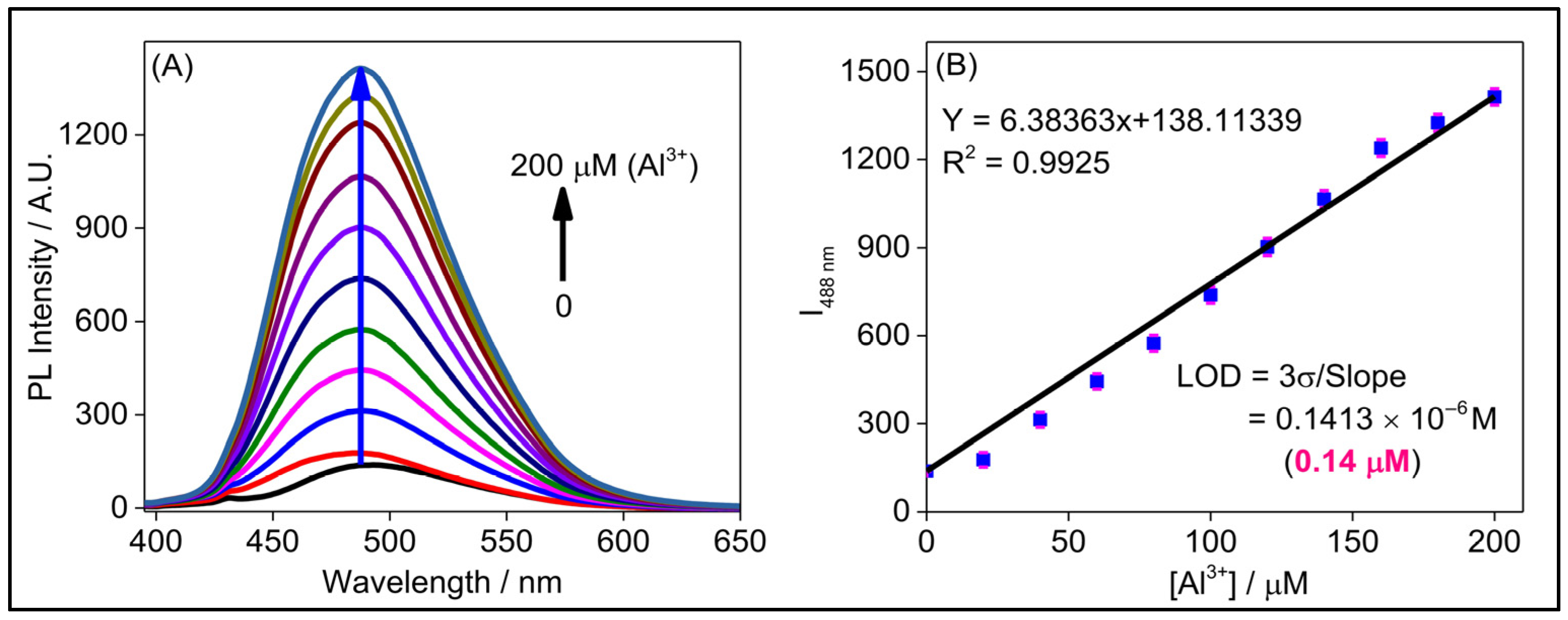
To elucidate the detection limit of the FBTS probe towards aluminium ions, the fluorescence titration experiment of FBTS (5 × 10⁻⁵ M) was conducted with increasing concentrations of Al3+ (0 to 2 × 10⁻⁴ M) in DMSO–H2O (8:2, v/v) at excitation of (λex = 383 nm), as shown in (Figure 3A). The free FBTS exhibits no emission band. The experiment demonstrates a gradual increase at 488 nm upon incremental addition of Al3+. These experiments show that FBTS and Al3+ have a strong coordinating ability. Based on this titration experiment, the linear range is found between 0 and 400 µM (Y = 6.38363x + 138.11339; R2 = 0.9925 (n = 5)), as shown in Figure 3B. The detection limit (LOD) is appraised from 3σ/slope (Equation (1)), where ‘σ’ is known as the standard deviation obtained from 10 consecutive measurements of the probe at 488 nm. From the linear plot (Figure 3B), the LOD of Al3+ by FBTS was calculated to be 0.14 µM. The calculated detection limit is lower than the WHO value for drinking water [46], demonstrating that FBTS is highly sensitive to Al3+ and can detect trace amounts. In a recent study, a simple benzo[d]thiazole probe was evaluated for the selective detection of Al3+ [47]. The detection limit was 12 pM. It was observed that the substitution of fluorine at the 6th position of the benzo[d]thiazole ring of the imine reduces the detection limit for aluminium ion selectivity, due to the fluorine atom’s electronegativity, which pulls the electron cloud towards fluorine; consecutively, the benzo[d]thiazole-based Schiff’s base deactivates and strongly binds to aluminium, resulting in increased selectivity for aluminium ions, as well as for photoluminescence properties.
Figure 3.
(A) Fluorescence intensity of FBTS (5 × 10⁻⁵ M) in DMSO–H2O (8:2, v/v) with increasing concentration of Al3+ ion (0.0 to 2.0 × 10⁻⁴ M, λem = 488 nm). (B) Limit of detection (LOD) of FBTS (5 × 10⁻⁵ M) in DMSO–H2O (8:2, v/v) with increasing concentration of Al3+ ion (0 to 2 × 10⁻⁴ M, (λem = 488 nm; n = 5).
3.6. Stoichiometry and Association Constant
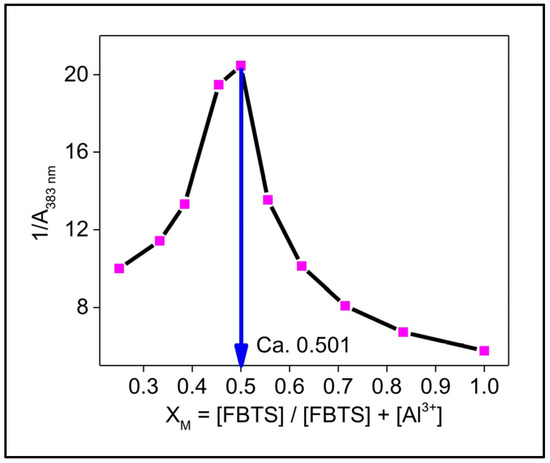
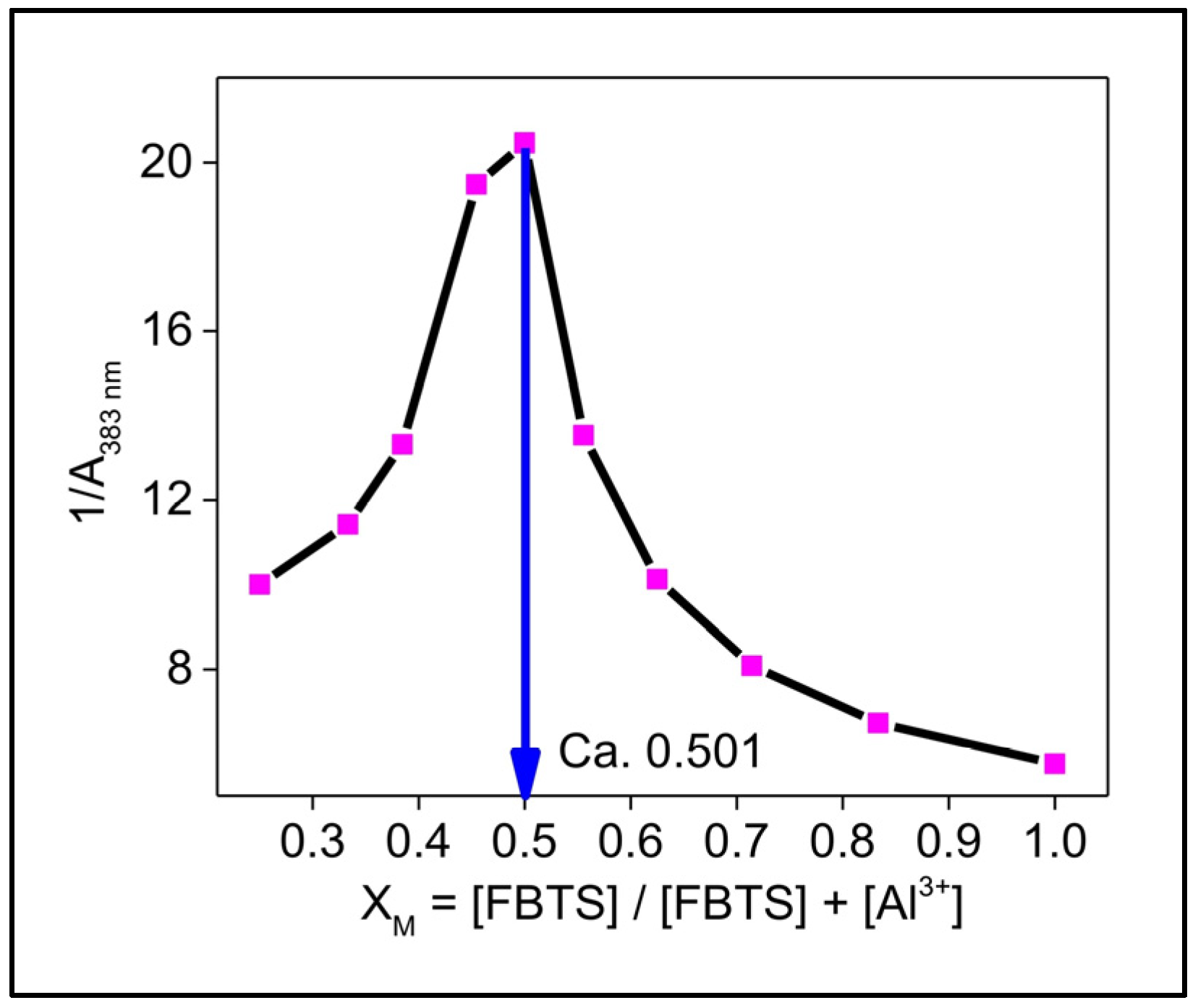
The UV-visible titration of FBTS (100 µM in DMSO) with Al3+ ions (0–400 µM) was performed (see Figure S5A,B, Supporting Information). During the UV-visible titration, a new peak is observed at 383 nm. Based on the UV-visible titration, the binding stoichiometry between FBTS and Al3+ is investigated through the Job’s plots between XM vs. XM*A383 (for Al3+), where XM is the mole fraction derived from XM = [FBTS]/[FBTS] + [Al3+]. The Job’s plot of FBTS with Al3+ shows that it passes through ca. 0.501 (Figure 4). Based on this study, it is concluded that the binding between FBTS and Al3+ follows 1:1 stoichiometry. This means that one FBTS ligand binds to one Al3+ ion to form a complex. Also, the HR mass spectroscopy data at m/z = 403.0527 confirmed the 1:1 binding stoichiometry by matching to [FBTS + Al(OH)2]+ + 2HCl−1 (see Figure S6, Supporting Information). Additionally, in the FTIR spectrum of FBTS, the peak at 1600–1580 cm−1 shifts to 1603 cm−1 for FBTS + Al3+, thereby attesting to the imine coordination to Al3+ ions. Similarly, the peaks in the 1288–1201 cm−1 region of FBTS shifted to 1212 cm−1, indicating O-donor participation in the complex. The peaks at 1000–600 cm−1 are blue-shifted upon complexation with Al3+ ions (see Figures S4, S7 and S8 in the Supporting Information). The broad band at 3000–3500 cm−1 confirms the presence of Al-OH in the complex.
Figure 4.
Job’s plot of FBTS and Al3+ in DMSO–H2O (8:2, v/v) solution.
After investigating the stoichiometry of FBTS + Al3+ in a 1:1 ratio, the association constant (Ka) is analysed using the Benesi–Hildebrand analysis (see Figure S9, Supporting Information). The Benesi–Hildebrand plot is plotted between 1/[Al3+] vs. 1/I0 − I. The association constant (Ka) is derived to be Ka = 5.4 × 10⁴ M−1 by using the intercept/slope method, and Equation (1). Fmax is the intensity of FBTS in the presence of Al3+ at saturation, Fmin is the intensity of FBTS, and F is the intensity of any intermediate Al3+ concentration, as given in Equation (1). This study has revealed that FBTS has a strong binding affinity towards Al3+.
3.7. Time Effect, pH Effect, and Reversibility
To investigate the response of the FBTS sensor for detecting aluminium ions, time-dependent monitoring of FBTS + Al3+ was recorded over 10 min durations with 1 min intervals at excitation of (λex = 383 nm), as shown in Figure S10, Supporting Information. This reveals that FBTS increases fluorescence intensity upon exposure to Al3+ ions within minutes. This study confirms that FBTS shows a rapid response towards Al3+ ions. Also, the effect of pH on FBTS and the (FBTS + Al3+) complex has been investigated to assess the practical applicability of FBTS across different pH conditions (1–14) (see Figure S11, Supporting Information). FBTS alone shows a very low response, with a pH increase from 1 to 4; however, over a pH range of 5 to 14, a minor enhancement in intensity is observed. In contrast, FBTS + Al3+ shows no response over a pH range of 1–3. The (FBTS + Al3+) complex exhibits a marked increase in fluorescence intensity in response to Al3+ over a pH range from 5 to 14. Thus, the optimal pH range for FBTS in detecting Al3+ is 6–14. It indicates that FBTS shows a strong response to Al3+ at basic pH. Additionally, the reversibility behaviour of FBTS (1 × 10⁻⁵ M) with Al3+ (1 × 10⁻³ M) in a DMSO–H2O (8:2, v/v) medium was examined, which was reversed by Na2-EDTA (2 × 10⁻³ M). The complex has disappeared after the addition of Na2-EDTA (see Figure S12 in the Supporting Information). The repeat, rise, and fall of fluorescence intensity demonstrate that its reversibility is due to the formation of a complex. FBTS demonstrates five reversible cycles for Al3+ (see Figure S13 in the Supporting Information). This observation highlights the reusability of FBTS for Al3+ in various applications, including bioimaging and sensing in marine environments.
3.8. 1H NMR Titrations
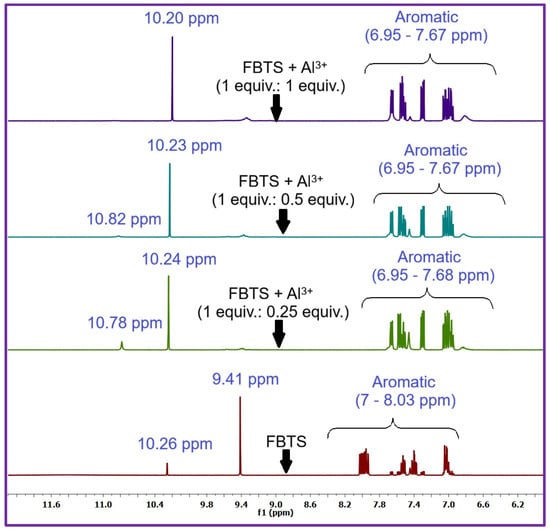
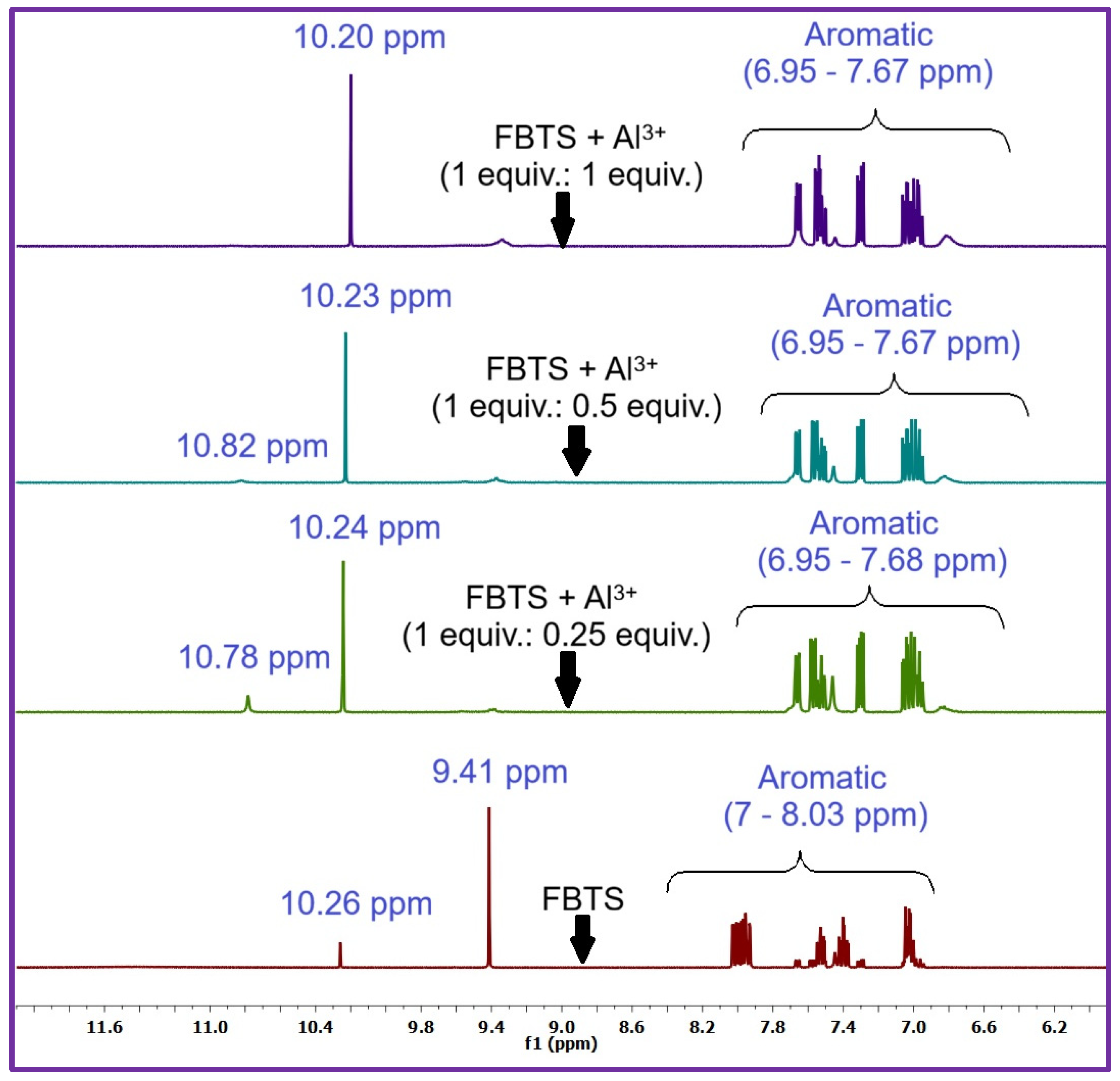
1H NMR titrations were investigated to find the binding mode of FBTS with Al3+, as shown in Figure 5. Initially, 10 mM of FBTS in DMSO-d6 was titrated with 2.5 mM, 5 mM, and 10 mM of AlCl3 in D2O. During the addition of 0.25 equivalent of Al3+ ions, the phenolic -OH proton is shifted from 10.26 ppm to 10.78 ppm. Likewise, the initial -CH=N proton peak at 9.21 ppm is shifted to 10.24 ppm. The aromatic protons of FBTS at 7–8.03 ppm are also shifted to 6.95–7.68 ppm after 0.25 equivalent addition of Al3+ ions onwards, which confirms the involvement of aromatic π-elctrons in the sensor response. Upon increasing the equivalents of Al3+ from 0.5 to 1, the phenolic -OH completely disappeared, suggesting its strong coordination with the Al3+ ion and feasible 1:1 stoichiometry. The low-field shifting of -CH=N proton and up-field shifting of aromatic proton environment, along with the disappearance of phenolic -OH, confirms the complex formation of FBTS with Al3+ ions. These observations confirm that the phenolic -OH peak and the imine group actively participated in the formation of a 1:1 complex between FBTS and Al3+. Based on this observation, the mechanism of interaction between the FBTS and Al3+ will be proposed later.
Figure 5.
1H NMR titrations of FBTS (1 equivalent in DMSO-d6) with Al3+ ions (0.25, 0.5, and 1 equivalents in D2O).
3.9. DFT Calculation
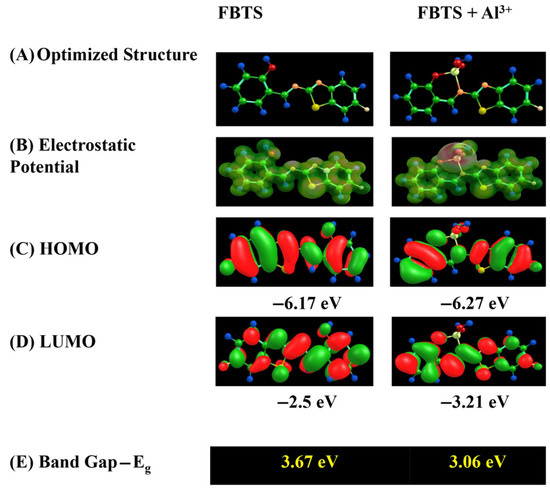
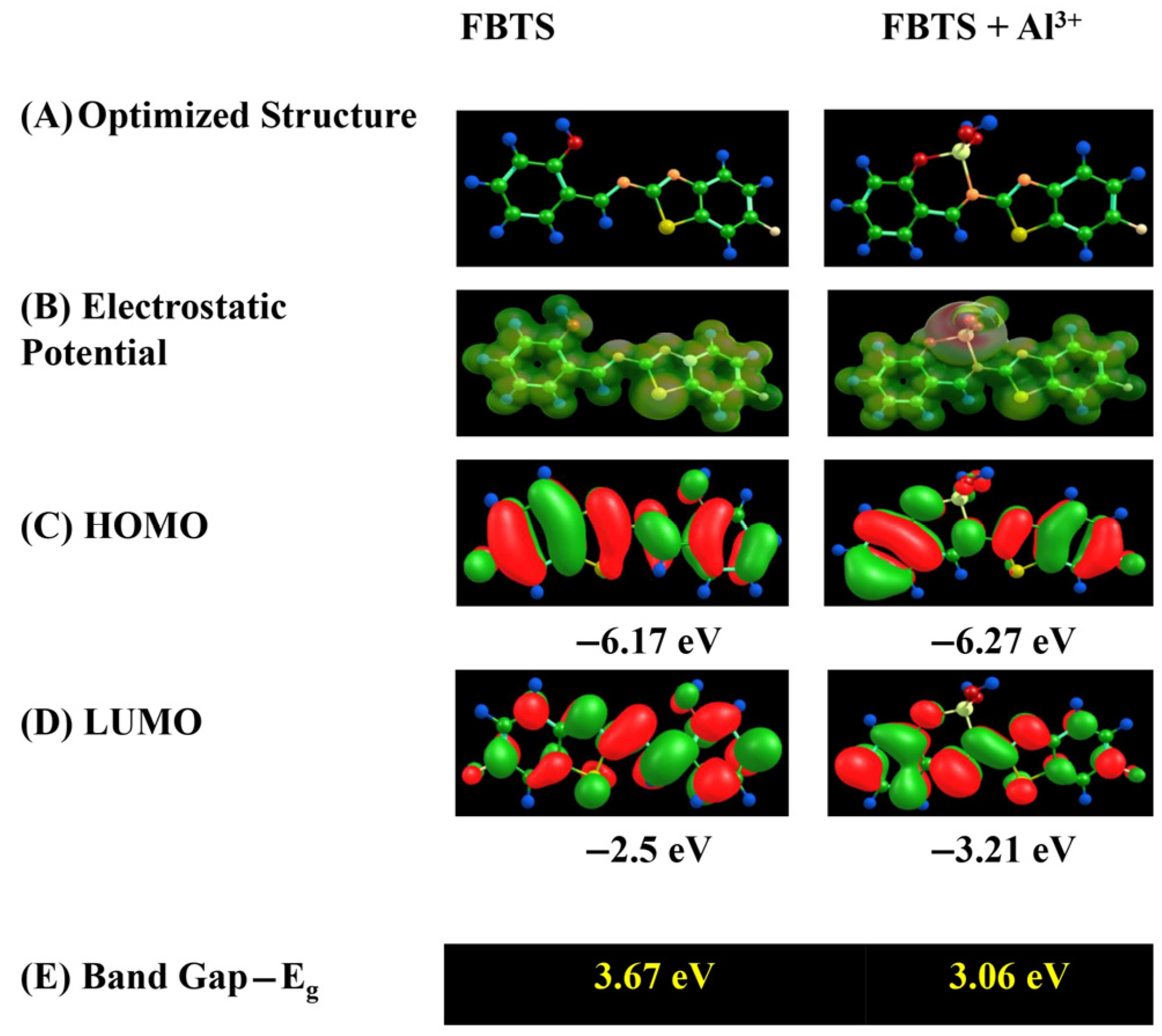
Based on the experimental results, the DFT calculations were performed to optimise the molecular orbital geometries of FBTS and FBTS + Al3+ using Gaussian 16. The electron cloud of FBTS is located over the H-C=N imine group, and the electrostatic potential map of FBTS showed the phenolic hydroxy group of FBTS. In the FBTS + Al3+ complex, the electron cloud is located on the coordinated phenolic hydroxyl group and the coordinated nitrogen of the imine (see Figure 6). HOMO and LUMO of FBTS are distributed across the structure by using the B3LYP/6311G++(d,p) basis set under the gas phase. In contrast, the aromatic ring with phenolic –OH and 6-fluorobenzothiazole of FBTS attached to Al3+ holds the HOMO and LUMO of FBTS + Al3+, which is generated by the formation of a complex between FBTS and Al3+. HOMO and LUMO of FBTS + Al3+ are calculated to be −6.27 eV and −3.21 eV, respectively, and the estimated band gap (Eg) is 3.06 eV, which shows the significant fluorescence emission. All HOMOs (HOMO, HOMO − 1, and HOMO − 2) and LUMOs (LUMO, LUMO + 1, and LUMO + 2) of FBTS and FBTS + Al3+ in the gas phase are shown in Figures S14 and S15, Supporting Information. Photophysical properties such as λex (nm), λem (nm), HOMO (eV), LUMO (eV), band gap (eV), and ΦF (%) of FBTS and FBTS + Al3+, as well as of FBTS + Al3+ + Na2-EDTA, are summarised in Table S2, Supporting Information. In the gas phase, the band gap (Eg) of FBTS and FBTS + Al3+ is 3.67 eV and 3.06 eV, respectively.
Figure 6.
The optimised structure, electrostatic potential, HOMOs, LUMOs, and band gap (Eg) of FBTS and FBTS + Al3+ using the B3LYP/6-311G++(d,p) basis set under the gas phase.
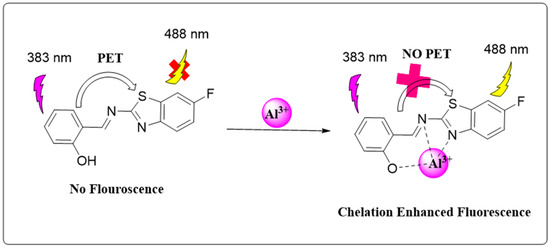
During Al3+ sensing by FBTS, close values of HOMO, HOMO + 1, and HOMO + 2 have been observed, which enable electron transport from HOMO − 2 to LUMO and from HOMO − 1 to LUMO, and they facilitate PET (see Figures S14 and S15, Supporting Information). However, during the complexation of FBTS with Al3+, the HOMO, HOMO + 1, and HOMO + 2 values are widely separated, which inhibits the PET mechanism. Additionally, chelation-enhanced fluorescence may occur, thereby enhancing PL.
3.10. Mechanism
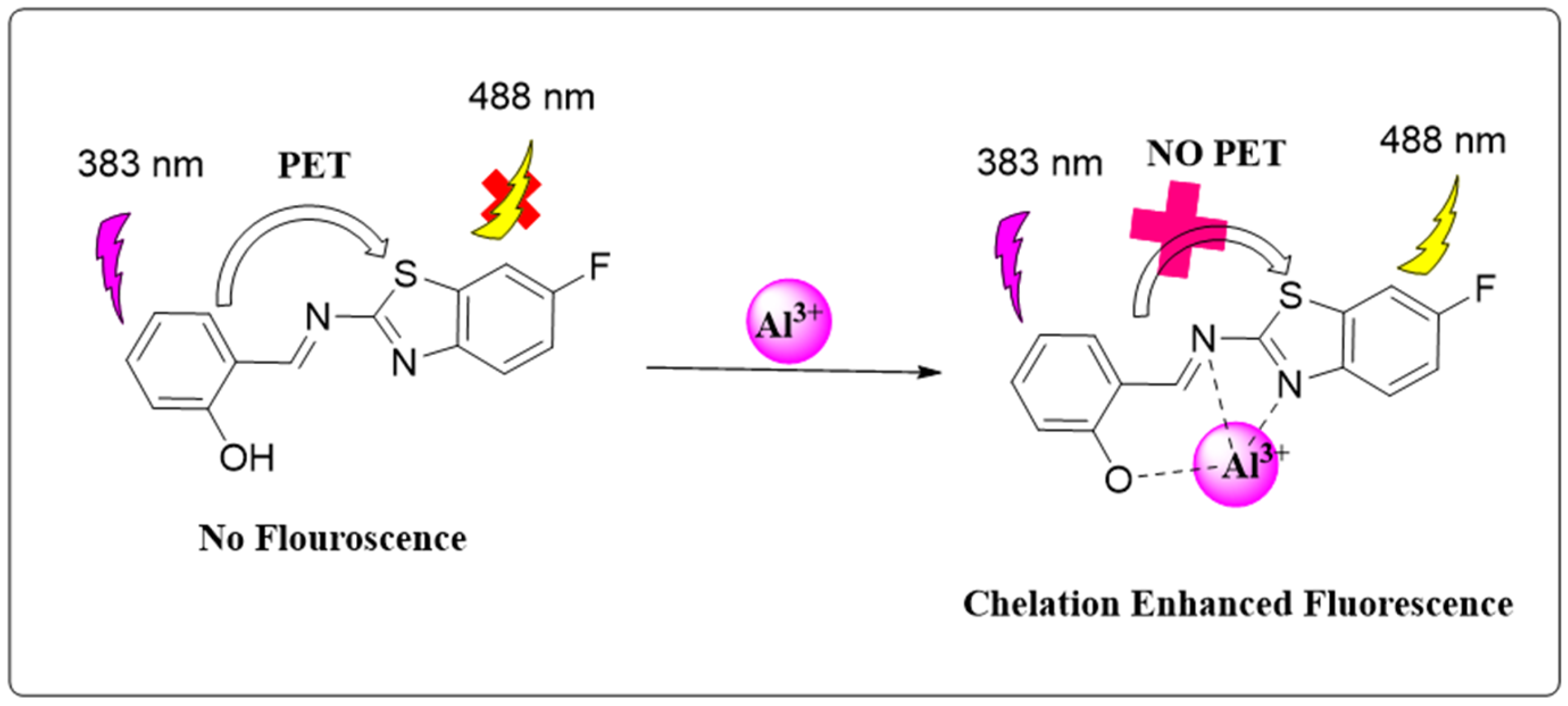
Based on the Job’s plot between FBTS with Al3+, HR mass, FTIR spectra, 1H NMR titrations, DFT investigations, and recent literature studies of the fluorimetric sensor for Al3+ [38,47,48], the proposed binding mechanism for the FBTS and FBTS + Al3+ complex has been predicted in Scheme 2. The photoinduced electron transfer exists between the phenol ring, imine group, and 6-fluorobenzo[d]thiazole; the fluorescence intensity was quenched by restriction of photoinduced electron transfer (PET), which occurred when the lone pair of the Schiff’s base nitrogen, nitrogen of 6-fluorobenzo[d]thiazole ring, and hydroxy group of phenolic –OH coordinated with Al3+ at λex = 383 nm, resulting in chelation enhanced fluorescence and forming a 1:1 complex between FBTS with Al3+.
Scheme 2.
The proposed binding mechanism for the FBTS and FBTS + Al3+.
3.11. Cellular Imaging, Test Strips, Fish Pieces, and Spiked Real Sample Analysis
To assess the practical application of FBTS, various applications were performed, including cellular imaging [27,30], the paper strip method [32], fish piece analysis, and spike recovery from real water and from real samples, such as the Radix Hedysari extract and the Nelumbinis Stamen extract [37].
To assess the low toxicity of FBTS, an SRB (sulforhodamine B) assay was performed (see Figure S16 in the Supporting Information). FBTS (0, 20 µM, 40 µM, 60 µM, 80 µM, and 100 µM) was incubated with A549 cells. After 24 h, the A549 cell lines showed cell viability greater than 80% at concentrations up to 80 µM. Therefore, the approval of cell imaging studies of FBTS and FBTS + Al3+ is warranted. As described in Materials and Methods, no emission is observed after treating A549 cells with FBTS. Upon incubation with aluminium ions, a bright blue colour is observed, as shown in Figure 7 It has been demonstrated that FBTS also has practical in vitro imaging capabilities.
Figure 7.
Cellular imaging of FBTS and FBTS + Al3+ in A549 cell lines; Scale bar: 0–10 µm.
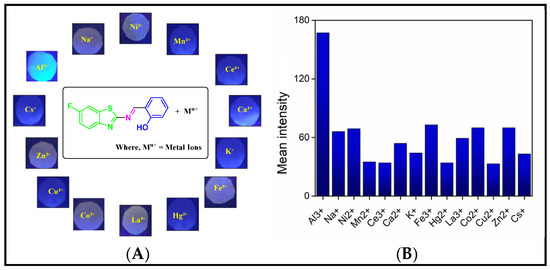
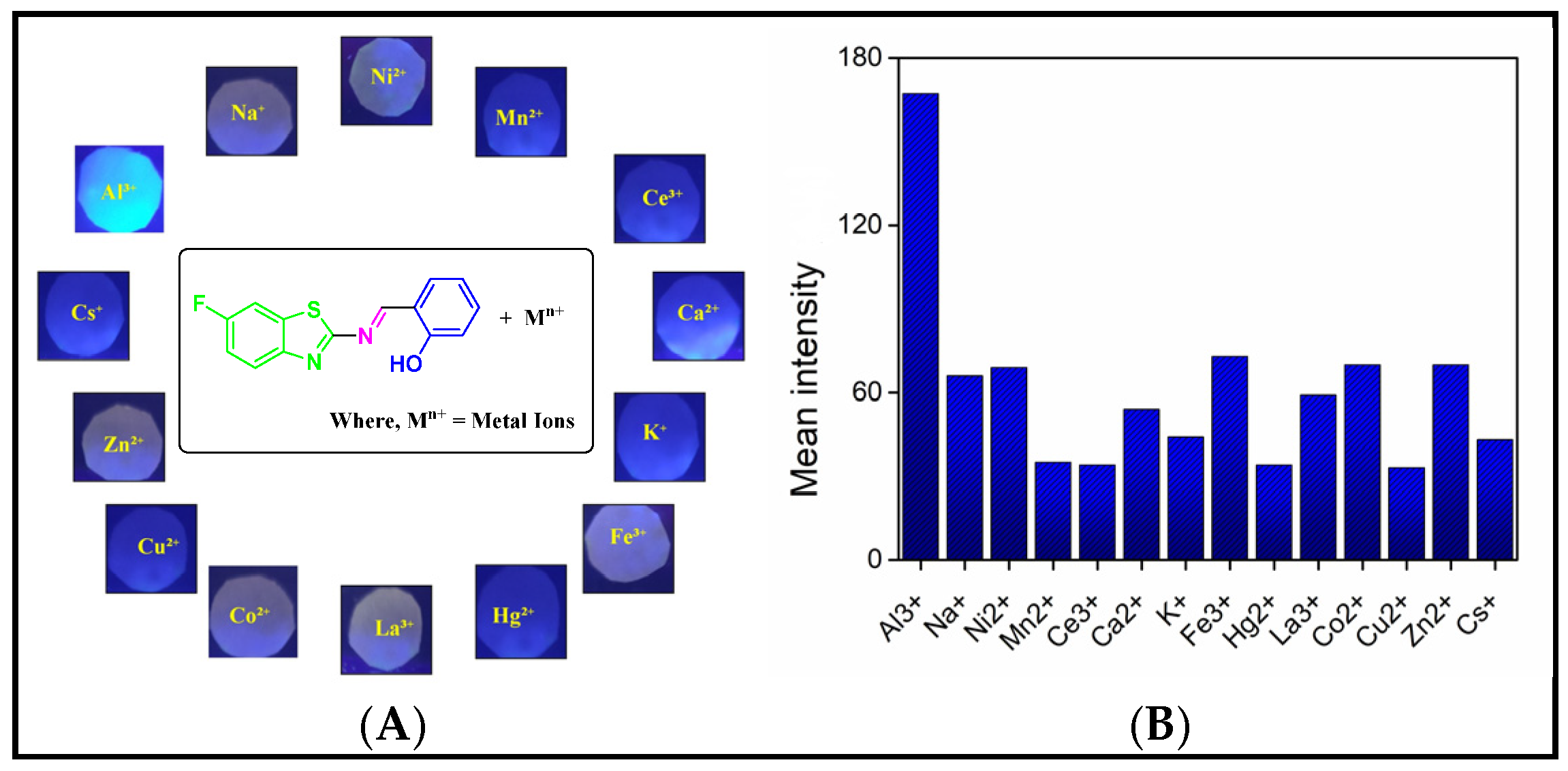
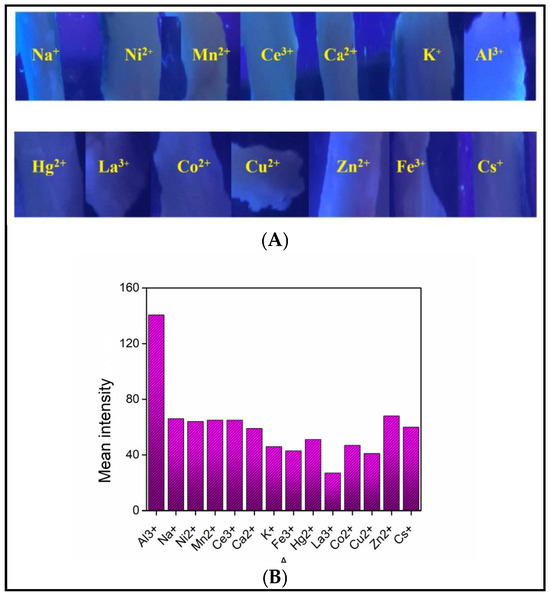
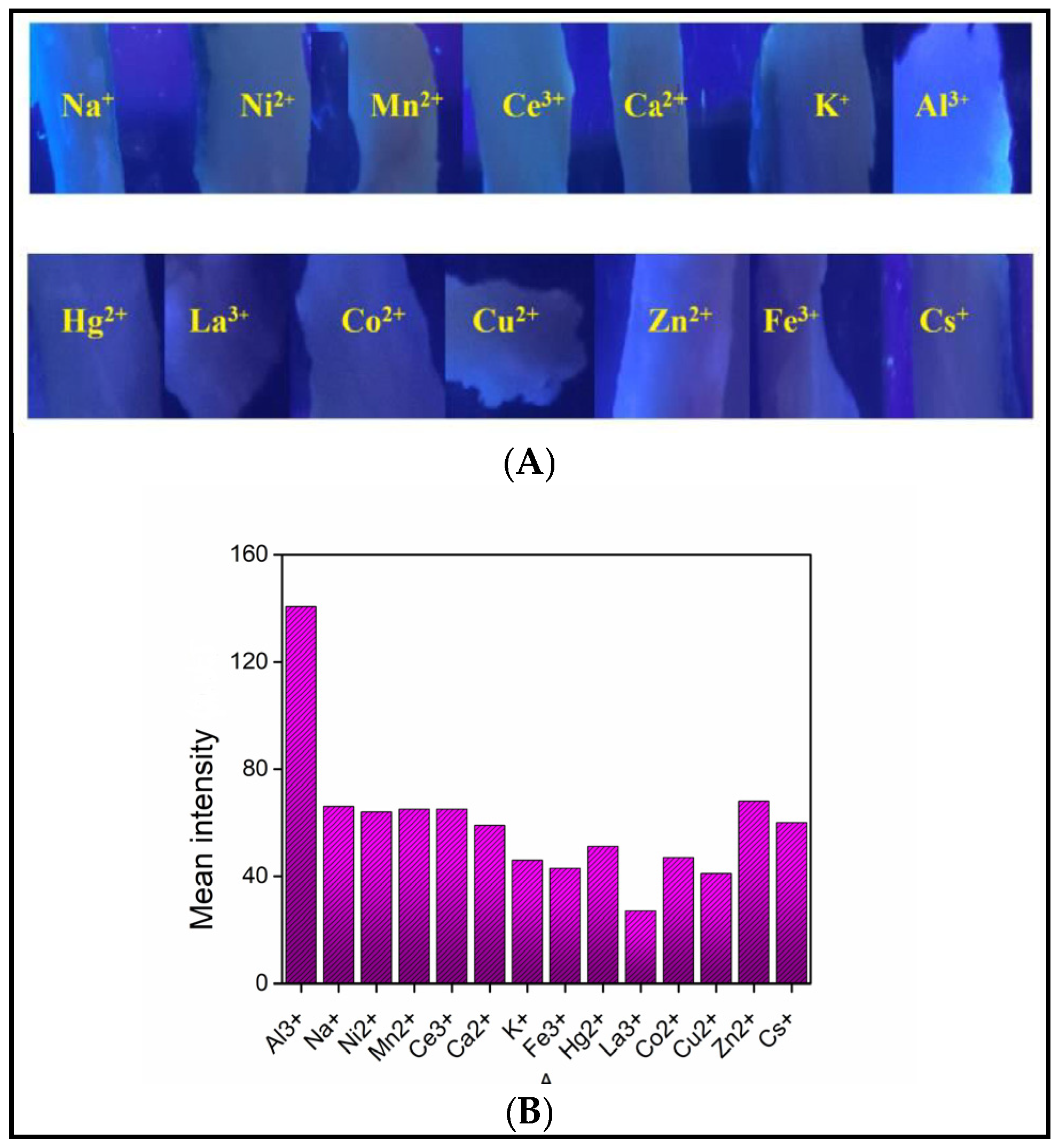
To evaluate the practical application of FBTS, based on recent reports [37], a paper-strip experiment was conducted following the procedure shown in Figure 8A. It is seen that aluminium ions show a bright blue colour, whereas other metal ions (Na+, Ni2+, Mn2+, Ce3+, Ca2+, K+, Fe3+, Hg2+, La3+, Co2+, Cu2+, Zn2+, and Cs+) showed no significant colour change under a UV lamp (λex = 365 nm). This result demonstrates that the FBTS probe provides a simple, low-cost, and portable platform for distinguishing aluminium metal ions on a paper strip.
Figure 8.
(A). Photographic image of a paper strip loaded with 50 µM FBTS after the addition of different metal ions (Mn+) (0.2 mM) under a UV lamp (λex = 365 nm). (B). Histogram of fluorescence intensity of paper strip method.
Next, by using ImageJ (Fiji, windows x86-64bit, version-Java 1.8.0_345), the photographic data was digitised, and the mean intensity histogram was plotted against the respective metal ions. As shown in Figure 8B, except for Al3+ ions, none of the cations displayed high intensity. Thus, the high selectivity of FBTS to Al3+ in test strips was confirmed.
To further demonstrate the detection of aluminium ions in marine samples, fish were purchased from the Bhoiwada Fish Market in Naigaon, Mumbai, India. The samples were then cut into small pieces, and the experiment was conducted according to the procedures outlined in the literature. After incubating different cations (Na+, Ni2+, Mn2+, Ce3+, Ca2+, K+, Fe3+, Al3+, Hg2+, La3+, Co2+, Cu2+, Zn2+, and Cs+) with different pieces of fishes, the results were checked under UV lamp (λex = 365 nm). It was observed that the fish piece with aluminium cations exhibited a bright blue colour under a UV lamp (λex = 365 nm) in Figure 9A, indicating the sensing abilities of FBTS towards aluminium in fish or marine samples. As shown in Figure 9B, except for Al3+ ions, none of the cations displayed high intensity in online application-based histograms. Thus, the high selectivity of FBTS to Al3+ in fish pieces was established.
Figure 9.
(A). Photographic image of fish pieces loaded with 50 µM FBTS after the addition of different metal ions (Mn+) (0.5 mM) under a UV lamp (λex = 365 nm). (B). Histogram of fluorescence intensity of fish pieces analysis.
Furthermore, to evaluate the practical application of FBTS in real water and real samples for the detection of aluminium, following the procedures outlined in the literature, spiked real water and sample analyses were conducted. Tap water and Mithi River water, as well as prepared real samples of the Radix Hedysari extract and the Nelumbinis Stamen extract, were used for Al3+ recovery studies. To confirm reproducibility, the recovery data and relative standard deviations (RSD) were tabulated from three consecutive fluorescence recordings, yielding satisfactory recoveries from 12 data points (Table 1). The real sample recoveries ranged from 105.5 to 128.9%, with RSDs < 3.5%. These observations confirmed that the matrices exist in real water samples (tap water, Mithi River water, the Radix Hedysari extract, and the Nelumbinis Stamen extract) and that they did not significantly interfere with the detection of Al3+.
Table 1.
Recovery data and RSD values of probe-based Al3+ detection in real water and herbal extract samples via three parallel measurements.
Table 2 presents the distinctiveness and comparative assessment of methods for the detection of Al3+ ions, based on the available literature, including nanomaterials [49], organic fluorophores [47,48,49,50,51,52,53,54,55,56,57,58,59], covalent organic frameworks [60], and metal–organic frameworks [61]. The FBTS exhibits reliability in terms of sensitivity, analytical performance, limit of detection, and applications compared with existing fluorimetric sensing platforms.
Table 2.
Comparative and reliability account for the Al3+ ions sensor.
4. Conclusions
In summary, the FBTS probe is effective against multiple analytes, as demonstrated by fluorescence interference studies. FBTS—a fluorimetric sensor that is easy to synthesise via a two-component system of 2-hydroxybenzaldehyde and 6-fluorobenzo[d]thiazol-2-amine— is applied to detect Al3+ selectively. PLQY values demonstrate that DMSO–H2O (8:2, v/v) is the effective solvent for the sensory investigation. The linear range for Al3+ is 0–400 µM, determined by PL interrogations, with a limit of detection of 0.14 µM. The binding mode of FBTS with Al3+ is 1:1, as determined by Job’s plot, UV-visible titration, HR-MS analysis, 1H NMR titrations, and FTIR spectral analysis. A Benesi–Hildebrand plot is also generated to determine the association constant, Ka = 5.4 × 10⁴ M−1, indicating effective coordination between FBTS and Al3+. This sensor is effective over pH 7–9 and exhibits a reversible response to Na2-EDTA in organic–aqueous conditions. DFT optimisations validate the binding mode and mechanism. The applicability of FBTS for sensing has been demonstrated using the paper strip method, cell imaging, and fish piece analysis. Next, the real-time detection capability is demonstrated through analyses of tap water and water from the Mithi River in Mumbai, India, as well as of Radix Hedysari extract and Nelumbinis Stamen extract. The present study provides important insights for the future design of novel similar sensor strategies.
Supplementary Materials
The following supporting information can be downloaded at: https://www.mdpi.com/article/10.3390/chemosensors14040082/s1, Figure S1: 1H NMR of FBTS; Figure S2: 13C{1H}NMR of FBTS; Figure S3: HR-MS of FBTS; Figure S4: FTIR of FBTS; Table S1: Relative photoluminescence quantum yield (PLQY; ΦF) values and fold of PL enhancement of FBTS (50 µM) in the presence of 200 µM of Al3+ ions in diverse solvents; Figure S5: (A,B) UV-visible titration of FBTS (50 µM in DMSO) with Al3+ ions (0–200 µM); Figure S6: HR-MS of FBTS-Al3+ complex; Figure S7: FTIR of AlCl3; Figure S8: FTIR of FBTS-Al3+; Figure S9: Benesi–Hilderband plot of 1/(F − F0) vs. 1/[Al3+ × 103 M−1] for the determination of the association constant (Ka); Figure S10: Response time of fluorescence of FBTS (5 × 10⁻⁵ M) with Al3+ ion (2 × 10⁻⁴ M) in DMSO–H2O (8:2, v/v). Figure S11: Fluorescence intensity variation in terms of pH for FBTS (blue) and FBTS + Al3+ (red); Figure S12: Fluorescence spectra showing reversibility of FBTS + Al3+ in the presence of EDTA in DMSO–H2O (8:2, v/v) solution; Figure S13: Reversibility study displaying the number of cycles of fluorescence intensity of FBTS with alternate addition of Al3+ and EDTA in the DMSO–H2O (8:2, v/v) solution; Figure S14: HOMOs (HOMO, HOMO + 1, and HOMO + 2) and LUMOs (LUMO, LUMO − 1, and LUMO2) of FBTS under the gas phase; Figure S15: HOMOs (HOMO, HOMO + 1, and HOMO + 2), and LUMOs (LUMO, LUMO − 1, and LUMO2) of FBTS + Al3+ complex under the gas phase; Table S2: Photophysical properties of FBTS in the presence of Al3+ and EDTA; Figure S16: Cell viability percentile of FBTS demonstrated through the SRB assay in the MDA-MB-231 cell lines after 24 h (n = 8).
Author Contributions
S.K.: original draft-writing, conceptualization, methodology, data curation, formal analysis, review, and editing; R.K.: Formal analysis, Data curation, review, and editing; W.T.L.: formal analysis, review and editing; M.S.: conceptualization, formal analysis, data curation, review, and editing; B.A.: DFT analysis, review, and editing; N.S.: supervision, review, and editing; M.C.L.: supervision, DFT analysis, review, and editing; S.W.: formal analysis, review, and editing; G.C.: supervision, project administration, methodology, funding acquisition, review, and editing. All authors have read and agreed to the published version of the manuscript.
Funding
This research received no external funding.
Institutional Review Board Statement
Not applicable.
Informed Consent Statement
Not applicable.
Data Availability Statement
All data supporting the findings of this study are available within the paper and its Supplementary Materials, which are published online.
Acknowledgments
The authors thank the Chhatrapati Shahu Maharaj National Research Fellowship, India (SARTHI/ADHICHATRAVRUTTI/CSMNRF-2022/2022-23/2341) for financial support.
Conflicts of Interest
The authors declare that they have no known competing financial interests or personal relationships that could have influenced the work reported in this paper.
References
- Albu, C.; Chira, A.; Radu, G.-L.; Eremia, S.A.V. Advances in Cost-Effective Chemosensors for Sustainable Monitoring in Food Safety and Processing. Chemosensors 2025, 13, 113. [Google Scholar] [CrossRef] [Scilit]
- Ringgit, G.; Siddiquee, S.; Saallah, S.; Mohamad Lal, M.T. Nanomaterial Sensing Advantages: Electrochemical Behavior, Optimization and Performance of F-MWCNTs/CS/PB/AuE towards Aluminum Ions (Al3+) in Drinking Water. Crystals 2023, 13, 497. [Google Scholar] [CrossRef] [Scilit]
- Apiratikul, N.; Bunrit, P.; Jommaroeng, S.; Boonsri, P.; Songsrirote, K. Synthesis and Application of Schiff Base as a Dual-Mode Chemosensor for Optical Determination of Aluminium Ion Content in Water Samples. Sens. Int. 2024, 6, 100313. [Google Scholar] [CrossRef] [Scilit]
- Azadbakht, R.; Chidan, N.; Menati, S.; Koolivand, M. A New Azo-Schiff Base Dual-Mode Chemosensor: Colorimetric Detection of Cobalt Ions and Fluorometric Detection of Aluminum Ions in Aqueous Ethanol Solution. J. Fluoresc. 2022, 33, 527–538. [Google Scholar] [CrossRef] [Scilit]
- Heena; Silswal, A.; Sharma, D.; Koner, A.L.; Om, H.; Rana, R. A Highly Efficient, Selective, Reversible and Ultra-Sensitive Fluorescence “Turn-ON” Chemosensor for Aluminium Ions by a Novel Schiff Base. Spectrochim. Acta A 2024, 320, 124575. [Google Scholar] [CrossRef] [Scilit]
- Goyal, H.; Annan, I.; Ahluwalia, D.; Bag, A.; Gupta, R. Discriminative “Turn-On” Detection of Al3+ and Ga3+ Ions as Well as Aspartic Acid by Two Fluorescent Chemosensors. Sensors 2023, 23, 1798. [Google Scholar] [CrossRef] [Scilit]
- Pang, Y.; Meng, D.; Liu, J.; Duan, S.; Fan, J.; Gao, L.; Long, X. Schiff Base Compounds as Fluorescent Probes for the Highly Sensitive and Selective Detection of Al3+ Ions. Molecules 2023, 28, 3090. [Google Scholar] [CrossRef] [Scilit]
- Shellaiah, M.; Chen, H.-C.; Awasthi, K.; Aazaad, B.; Sun, K.W.; Ohta, N.; Lin, M.-C. An AIE Active Anthracene-Based Schiff Base Probe for “Turn-On” Detection of Cu2+ Ions: Demonstrations with Nanostructural Investigations, DFT, Cellular Imaging, and Real Water Analysis. J. Mol. Struct. 2024, 1301, 137347. [Google Scholar] [CrossRef] [Scilit]
- Martínez, C.S.; Piagette, J.T.; Escobar, A.G.; Martín, Á.; Palacios, R.; Peçanha, F.M.; Vassallo, D.V.; Exley, C.; Alonso, M.J.; Miguel, M.; et al. Aluminum exposure at human dietary levels promotes vascular dysfunction and increases blood pressure in rats: A concerted action of NAD(P)H oxidase and COX-2. Toxicology 2017, 390, 10–21. [Google Scholar] [CrossRef] [Scilit]
- Wei, W.; Huang, J.; Gao, W.; Lu, X.; Shi, X. Carbon Dots Fluorescence-Based Colorimetric Sensor for Sensitive Detection of Aluminum Ions with a Smartphone. Chemosensors 2021, 9, 25. [Google Scholar] [CrossRef] [Scilit]
- Perl, D.P.; Gajdusek, D.C.; Garruto, R.M.; Yanagihara, R.T.; Gibbs, C.J. Intraneuronal aluminum accumulation in amyotrophic lateral sclerosis and Parkinsonism-dementia of Guam. Science 1982, 217, 1053. [Google Scholar] [CrossRef] [Scilit]
- Perl, D.P.; Brody, A.R. Alzheimer’s disease: X-ray spectrometric evidence of aluminum accumulation in neurofibrillary tangle-bearing neurons. Science 1980, 208, 297–299. [Google Scholar] [CrossRef] [Scilit]
- Alamdari, H. Aluminium Production Process: Challenges and Opportunities. Metals 2017, 7, 133. [Google Scholar] [CrossRef] [Scilit]
- Capriello, T.; Di Meglio, G.; De Maio, A.; Scudiero, R.; Bianchi, A.R.; Trifuoggi, M.; Toscanesi, M.; Giarra, A.; Ferrandino, I. Aluminium Exposure Leads to Neurodegeneration and Alters the Expression of Marker Genes Involved in Parkinsonism in Zebrafish Brain. Chemosphere 2022, 307, 135752. [Google Scholar] [CrossRef] [Scilit] [PubMed]
- Aceto, M.; Abollino, O.; Bruzzoniti, M.C.; Mentasti, E.; Sarzanini, C.; Malandrino, M. Determination of Metals in Wine with Atomic Spectroscopy (Flame-AAS, GF-AAS and ICP-AES); A Review. Food Addit. Contam. 2002, 19, 126–133. [Google Scholar] [CrossRef] [Scilit] [PubMed]
- March, G.; Nguyen, T.; Piro, B. Modified Electrodes Used for Electrochemical Detection of Metal Ions in Environmental Analysis. Biosensors 2015, 5, 241–275. [Google Scholar] [CrossRef] [Scilit] [PubMed]
- Nascimento, L.L.B.S.; Mageste, A.B.; Rezende, S.d.S.; de Lemos, L.R.; Ferreira, G.M.D.; Ferreira, G.M.D. Polymeric Film-Based Colorimetric Chemosensors for Ion Detection. Chem. Eng. J. 2025, 512, 161753. [Google Scholar] [CrossRef] [Scilit]
- Rauf, M.F.; Lin, Z.; Rauf, M.K.; Lin, J.-M. Innovative Microfluidic Technologies for Rapid Heavy Metal Ion Detection. Chemosensors 2025, 13, 149. [Google Scholar] [CrossRef] [Scilit]
- Aslam, S.; Kousar, I.; Rani, S.; Altaf, W.; Bristy, S.; Skouta, R. Detection of Selected Heavy Metal Ions Using Organic Chromofluorescent Chemosensors. Molecules 2025, 30, 1450. [Google Scholar] [CrossRef] [Scilit]
- Khan, J. Synthesis and Applications of Fluorescent Chemosensors: A Review. J. Fluoresc. 2023, 34, 2485–2494. [Google Scholar] [CrossRef] [Scilit]
- Berrones-Reyes, J.C.; Muñoz-Flores, B.M.; Treto-Suárez, M.A.; Hidalgo-Rosa, Y.; Schott, E.; Páez-Hernández, D.; Gurubasavaraj, P.M.; Zarate, X.; Jiménez-Pérez, V.M. Schiff Bases and Multidentate Organic Compounds as Fluorescent Sensors of Al3+: Photophysical, Fluorescent Bioimaging and the Mechanisms. Eur. J. Org. Chem. 2022, 2022, e202200588. [Google Scholar] [CrossRef] [Scilit]
- Abdel Aziz, A.A.; Abdel-Aziz, A.M. Asymmetric Schiff Base-Based Colorimetric and Fluorescent Sensor for Al3+ Detection in Real Samples and Live-Cell Bioimaging. RSC Adv. 2025, 15, 16999–17014. [Google Scholar] [CrossRef] [Scilit] [PubMed]
- Tamil Selvan, G.; Babu, L.; Enoch, I.M.V.; Srinivasadesikan, V.; Mariselvam, R.; Kumar, A.R.; Li, X.; Tang, P.J.; Mosae Selvakumar, P.; Zhang, Z. Surface-Modified Gold Nanoparticles: A Novel Chemical Probe for Precise Fluorescent Detection of Aluminium (Al3+) Ions; Investigating DFT Insights and Molecular Logic Gate Behaviour. J. Mol. Liq. 2024, 397, 124039. [Google Scholar] [CrossRef] [Scilit]
- Hijji, Y.M.; Rajan, R.; Shraim, A.M. 3-Aminopyridine Salicylidene: A Sensitive and Selective Chemosensor for the Detection of Cu(II), Al(III), and Fe(III) with Application to Real Samples. Int. J. Mol. Sci. 2022, 23, 13113. [Google Scholar] [CrossRef] [Scilit]
- El-Fattah, W.A.; Al-Farraj, E.S.; Hamadi, N.B.; Alharbi, A.; Shahat, A. Functionalized MOF as a Sensitive Spectroscopic Probe for Hg2+, Co2+, and Al3+ Ions Detection in Aqueous Media. ACS Omega 2022, 7, 17483–17491. [Google Scholar] [CrossRef] [Scilit]
- Samanta, S.; Nath, B.; Baruah, J.B. Hydrolytically Stable Schiff Base as Highly Sensitive Aluminium Sensor. Inorg. Chem. Commun. 2012, 22, 98–100. [Google Scholar] [CrossRef] [Scilit]
- Kadam, S.; Shellaiah, M.; Li, W.T.; Badani, P.; Awasthi, K.; Ohta, N.; Chaturbhuj, G. A Carbohydrazide-Based Schiff Base Derivative for Colorimetric and Fluorometric Detection of Cu2+, Co2+, and OH− Ions: Validation through DFT, Test Strips, Cellular Imaging, and Real Water Analysis. J. Photochem. Photobiol. A Chem. 2025, 475, 117013. [Google Scholar] [CrossRef] [Scilit]
- Kathiravan, A.; Sundaravel, K.; Jaccob, M.; Dhinagaran, G.; Rameshkumar, A.; Arul Ananth, D.; Sivasudha, T. Pyrene Schiff Base: Photophysics, Aggregation Induced Emission, and Antimicrobial Properties. J. Phys. Chem. B 2014, 118, 13573–13581. [Google Scholar] [CrossRef] [Scilit]
- Shellaiah, M.; Wu, Y.-H.; Singh, A.; Raju, M.V.R.; Lin, H.-C. Novel Pyrene- and Anthracene-Based Schiff Base Derivatives as Cu2+ and Fe3+ Fluorescence Turn-On Sensors and for Aggregation Induced Emissions. J. Mater. Chem. A 2013, 1, 1310–1318. [Google Scholar] [CrossRef] [Scilit]
- Shellaiah, M.; Thirumalaivasan, N.; Aazaad, B.; Awasthi, K.; Sun, K.W.; Wu, S.-P.; Lin, M.-C.; Ohta, N. An AIEE Active Anthracene-Based Nanoprobe for Zn2+ and Tyrosine Detection Validated by Bioimaging Studies. Chemosensors 2022, 10, 381. [Google Scholar] [CrossRef] [Scilit]
- Shellaiah, M.; Rajan, Y.C.; Balu, P.; Murugan, A. A Pyrene Based Schiff Base Probe for Selective Fluorescence Turn-On Detection of Hg2+ Ions with Live Cell application. N. J. Chem. 2015, 39, 2523–2531. [Google Scholar] [CrossRef] [Scilit]
- Shellaiah, M.; Sun, K.-W.; Anandan, K.; Murugan, A.; Venkatachalam, V.; Bhushan, M.; Sivakumar, M.; Manikandan, E.; Kaliaperumal, K.; Li, W.-T. Luminescent Pyrene-Derivatives for Hg2+ and Explosive Detection. Chemosensors 2025, 13, 145. [Google Scholar] [CrossRef] [Scilit]
- Zheng, H.-W.; Kang, Y.; Wu, M.; Liang, Q.-F.; Zheng, J.-Q.; Zheng, X.-J.; Jin, L.-P. ESIPT-AIE Active Schiff Base Based on 2-(2′-hydroxyphenyl)benzo-thiazole Applied as Multi-Functional Fluorescent Chemosensors. Dalton Trans. 2021, 50, 3916–3922. [Google Scholar] [CrossRef] [Scilit] [PubMed]
- Sun, H.; Jiang, Y.; Nie, J.; Wei, J.; Miao, B.; Zhao, Y.; Zhang, L.; Ni, Z. Multifunctional AIE-ESIPT Dual Mechanism Tetraphenylethene-Based Schiff Base for Inkless Rewritable Paper and A Colorimetric/Fluorescent Dual-Channel Zn2+ Sensor. Mater. Chem. Front. 2021, 5, 347–354. [Google Scholar] [CrossRef] [Scilit]
- Han, T.; Gu, X.; Lam, J.W.Y.; Leung, A.C.S.; Kwok, R.T.K.; Han, T.; Tong, B.; Shi, J.; Dong, Y.; Tang, B.Z. Diaminomaleonitrile-Based Schiff Bases: Aggregation-Enhanced Emission, Red Fluorescence, Mechanochromism and Bioimaging Applications. J. Mater. Chem. C 2016, 4, 10430–10434. [Google Scholar] [CrossRef] [Scilit]
- Zhang, M.; Gong, L.; Sun, C.; Li, W.; Chang, Z.; Qi, D. A New Fluorescent-Colorimetric Chemosensor Based on a Schiff Base for Detecting Cr3+, Cu2+, Fe3+, and Al3+ ions. Spectrochim. Acta A Mol. Biomol. Spectrosc. 2019, 214, 7–13. [Google Scholar] [CrossRef] [Scilit]
- Wang, M.M.; Lu, L.X.; Song, W.W.; Wang, X.Y.; Sun, T.M.; Zhu, J.L.; Wang, J. AIE-active Schiff base compounds as fluorescent probe for the highly sensitive and selective detection of Al3+ ions. J. Lumin. 2021, 233, 117911. [Google Scholar] [CrossRef] [Scilit]
- Peng, H.N.; Han, Y.J.; Lin, N.; Liu, H.H. Two pyridine-derived Schiff-bases as turn-on fluorescent sensor for detection of aluminium ion. Opt. Mater. 2019, 95, 109210. [Google Scholar] [CrossRef] [Scilit]
- Shellaiah, M.; Sun, K.W.; Aazaad, B.; Awasthi, K.; Lin, M.C.; Ohta, N.; Li, W.T. A Perylene Derivative for Multi-Hazard Detection in Environmental Monitoring: Demonstration via DFT, Cellular Imaging, and Real-Time Applications. J. Hazard. Mater. Adv. 2025, 19, 100863. [Google Scholar] [CrossRef] [Scilit]
- Alizadeh, R.; Yousuf, I.; Afzal, M.; Srivastav, S.; Srikrishna, S.; Arjmand, F. Enantiomeric Fluoro-Substituted Benzothiazole Schiff Base-Valine Cu(II)/Zn(II) Complexes as Chemotherapeutic Agents: DNA Binding Profile, Cleavage Activity, MTT Assay and Cell Imaging Studies. J. Photochem. Photobiol. B Biol. 2015, 143, 61–73. [Google Scholar] [CrossRef] [Scilit]
- Kumar, S.; Basappa Chidananda, V.K.; Hosakere Doddarevanna, R.; Hamse Kameshwar, V.; Kaur, M.; Jasinski, J.P. 2-((E)-(6-Fluorobenzo[d]Thiazol-2-Ylimino) Methyl)-4-Chlorophenol; Synthesis, Characterization, Crystal Structure, Hirshfeld Surface Analysis and BSA Binding Studies. J. Mol. Struct. 2017, 1142, 293–303. [Google Scholar] [CrossRef] [Scilit]
- Frisch, M.J.; Trucks, G.W.; Schlegel, H.B.; Scuseria, G.E.; Robb, M.A.; Cheeseman, J.R.; Scalmani, G.; Barone, V.; Petersson, G.A.; Nakatsuji, H.; et al. Gaussian 16 Rev. C.01; Gaussian, Inc.: Wallingford, CT, USA, 2016. [Google Scholar]
- Becke, A.D. Density-functional exchange-energy approximation with correct asymptotic behavior. Phys. Rev. A 1988, 38, 3098–3100. [Google Scholar] [CrossRef] [Scilit] [PubMed]
- Wang, M.; Hu, W.-J.; Wang, Q.-H.; Yang, B.-Y.; Kuang, H.-X. Extraction, purification, structural characteristics, biological activities, and application of the polysaccharides from Nelumbo nucifera Gaertn. (lotus): A review. Inter. J. Biol. Macromol. 2023, 226, 562–579. [Google Scholar] [CrossRef] [Scilit] [PubMed]
- Huang, C.; Mao, H.; Wan, W.; Ren, C.; Ji, X.; Yue, B.; Zhang, X.; Wu, Q. Extraction, content determination, component analysis, and pharmacological action of Hedysari flavonoids: A review of research progress. Front. Pharmacol. 2025, 16, 1517832. [Google Scholar] [CrossRef] [Scilit] [PubMed]
- Hespanhol, I.; Prost, A.M.E. Who Guidelines and National Standards for Reuse and Water Quality. Water Res. 1994, 28, 119–124. [Google Scholar] [CrossRef] [Scilit]
- Kachwal, V.; Krishna; Fageria, L.; Chaudhary, J.; Roy, R.K.; Chowdhury, R.; Laskar, I.R. Exploring the Hidden Potential of a Benzothiazole-Based Schiff-Base Exhibiting AIE and ESIPT and Its Activity in PH Sensing, Intracellular Imaging and Ultrasensitive & Selective Detection of Aluminium (Al3+). Analyst 2018, 143, 3741–3748. [Google Scholar]
- Mu, Y.; Zhang, C.; Gao, Z.; Zhang, X.; Lu, Q.; Yao, J.; Xing, S. A Highly Selective Colorimetric, Absorption and Fluorescence Probe for Al3+ Detection Based on a New Schiff Base Compound. Synth. Met. 2020, 262, 11633. [Google Scholar] [CrossRef] [Scilit]
- Huang, P.; Li, J.; Liu, X.; Wu, F. Colorimetric Determination of Aluminum(III) Based on the Aggregation of Schiff Base-Functionalized Gold Nanoparticles. Microchim. Acta 2015, 183, 863–869. [Google Scholar] [CrossRef] [Scilit]
- Berrones-Reyes, J.; Muñoz-Flores, B.M.; Gómez-Treviño, A.; Treto-Suárez, M.A.; Páez-Hernández, D.; Schott, E.; Zarate, X.; Jiménez-Pérez, V.M. Novel Fluorescent Schiff Bases as Al3+ Sensors with High Selectivity and Sensitivity, and Their Bioimaging Applications. Mater. Chem. Phys. 2019, 233, 89–101. [Google Scholar] [CrossRef] [Scilit]
- Iniya, M.; Jeyanthi, D.; Krishnaveni, K.; Chellappa, D. A Bifunctional Chromogenic and Fluorogenic Probe for F− and Al3+ Based on Azo-Benzimidazole Conjugate. J. Lumin. 2015, 157, 383–389. [Google Scholar] [CrossRef] [Scilit]
- Jeyanthi, D.; Iniya, M.; Krishnaveni, K.; Chellappa, D. A Ratiometric Fluorescent Sensor for Selective Recognition of Al3+ Ions Based on a Simple Benzimidazole Platform. RSC Adv. 2013, 3, 20984–20989. [Google Scholar] [CrossRef] [Scilit]
- Neupane, L.N.; Mehta, P.K.; Oh, S.; Park, S.-H.; Lee, K.-H. Ratiometric Red-Emission Fluorescence Detection of Al3+ in Pure Aqueous Solution and Live Cells by a Fluorescent Peptidyl Probe Using Aggregation-Induced Emission. Analyst 2018, 143, 5285–5294. [Google Scholar] [CrossRef] [Scilit] [PubMed]
- Zhang, Y.; Wang, G. A Novel Ethylene Linkage-Based Covalent Organic Framework for Turn-on Fluorescence Sensing for Al3+ with Excellent Selectivity and Sensitivity. Int. J. Biol. Macromol. 2024, 262, 130195. [Google Scholar] [CrossRef] [Scilit] [PubMed]
- Chen, M.; Wu, K.-Y.; Pan, W.-L.; Huang, N.-H.; Li, R.-T.; Chen, J.-X. Selective and Recyclable Tandem Sensing of PO43− and Al3+ by a Water-Stable Terbium-Based Metal–Organic Framework. Spectrochim. Acta A Mol. Biomol. Spectrosc. 2021, 247, 119084. [Google Scholar] [CrossRef] [Scilit] [PubMed]
- Gu, Y.; Qin, W.; Xu, H.; Liu, Y. A Simple Chromone-Derived Fluorescent “Turn–On” Probe for Accurate Detection of Al3+ Ions: Applications in Food Analysis, Test Strips and Bioimaging. Spectrochim. Acta A Mol. Biomol. Spectrosc. 2024, 329, 125583. [Google Scholar] [CrossRef] [Scilit]
- Bari, S.; Mridha, D.; Ghosh, S.; Ghosh, P.; Roychowdhury, T.; Roy, P. Imaging of Al3+ in Plant Roots by the Interaction with a Bisphenol A-Based Chemosensor. N. J. Chem. 2023, 47, 5056–5066. [Google Scholar] [CrossRef] [Scilit]
- Erdemir, S.; Kocyigit, O.; Malkondu, S. Fluorogenic Recognition of Zn2+, Al3+ and F− Ions by a New Multi-Analyte Chemosensor Based Bisphenol A-Quinoline. J. Fluoresc. 2015, 25, 719–727. [Google Scholar] [CrossRef] [Scilit]
- Jeong, H.Y.; Lee, S.Y.; Han, J.; Lim, M.H.; Kim, C. Thiophene and Diethylaminophenol-Based “Turn-On” Fluorescence Chemosensor for Detection of Al3+ and F− in a Near-Perfect Aqueous Solution. Tetrahedron 2017, 73, 2690–2697. [Google Scholar] [CrossRef] [Scilit]
- Hu, Y.; Lu, L.; Wu, Y.; Li, Y.; Wang, F.; Chen, X.; Fu, H.; She, Y. Bifunctional Ratiometric Fluorescent Membrane Containing Pyrene-Based Probe for Visual Monitoring and Efficient Removal of Al3+. Sens. Actuators B Chem. 2024, 413, 135860. [Google Scholar] [CrossRef] [Scilit]
- Kaur, B.; Gupta, A.; Kaur, N. A Simple Schiff Base as a Multi Responsive and Sequential Sensor towards Al3+, F− and Cu2+ Ions. J. Photochem. Photobiol. A Chem. 2020, 389, 112140. [Google Scholar] [CrossRef] [Scilit]

Disclaimer/Publisher’s Note: The statements, opinions and data contained in all publications are solely those of the individual author(s) and contributor(s) and not of MDPI and/or the editor(s). MDPI and/or the editor(s) disclaim responsibility for any injury to people or property resulting from any ideas, methods, instructions or products referred to in the content. |
© 2026 by the authors. Licensee MDPI, Basel, Switzerland. This article is an open access article distributed under the terms and conditions of the Creative Commons Attribution (CC BY) license.