


Abstract
Background: Parents of children with cleft lip and/or palate (CL/P) face years of staged treatment, yet evidence on their mental health from Arab countries is scarce and fathers are rarely studied. We estimated the prevalence of anxiety and depressive symptoms among mothers and fathers of children with CL/P in Jordan and examined factors associated with these symptoms and with perceived personal and family growth. Methods: We conducted a cross-sectional survey of parents of children with CL/P followed at Jordan University Hospital, a tertiary referral centre in Amman, Jordan, 1 February to 15 April 2026. One parent per child, identified from hospital contact records, completed an Arabic electronic questionnaire comprising the Generalised Anxiety Disorder-7 (GAD-7), the eight-item Patient Health Questionnaire (PHQ-8), exploratory study-specific items on cleft-related stress, resilience, coping and perceived growth, and single items on trust in the medical team, counselling and telehealth use. Multiple linear regression examined factors associated with anxiety, depressive symptoms and perceived growth. Results: Of 350 parents contacted, 106 (51 mothers, 55 fathers) were analysed (response rate 30.3%). Among participating parents, 54.7% (95% CI 45.2–63.9) screened positive for moderate-to-severe anxiety symptoms (GAD-7 ≥ 10) and 42.5% (95% CI 33.5–52.0) for moderate-to-severe depressive symptoms (PHQ-8 ≥ 10); 13.2% reported ever having sought counselling for child-related stress. Mothers scored higher than fathers on anxiety (mean 11.75 vs. 8.02; d = 0.61) and depressive symptoms (10.84 vs. 5.98; d = 0.77). In adjusted models, higher cleft-related stress (anxiety β = 0.48; depression β = 0.55; both p < 0.001) and being a mother (father β = −0.24 and −0.31) were associated with higher symptom scores (R2 = 0.35 and 0.48); an unexpected positive association with trust in the medical team (β = 0.21 and 0.17) was imprecise and, for depressive symptoms, not robust to heteroscedasticity-consistent standard errors (p = 0.057). Parents rated the diagnosis, first surgery, daily care and future concerns as stressful (means 3.49–3.70 on a 1–5 scale). Mean perceived growth was 3.88 on a 1–5 scale and was associated with coping (β = 0.48, p < 0.001). Conclusions: Screening-positive anxiety and depressive symptoms were common among participating parents of children with CL/P at this tertiary centre, particularly mothers, and few reported having sought counselling. Cleft-related stress was the factor most strongly associated with symptoms. Routine psychosocial screening of both parents within multidisciplinary cleft care warrants evaluation.
Keywords:
cleft lip; cleft palate; parents; fathers; anxiety; depression; posttraumatic growth; psychosocial care; Jordan 1. Background
Cleft lip and/or palate (CL/P) is among the most common congenital anomalies, affecting approximately 1 in 700 live births, with marked geographic and ethnic variation [1,2]. Its aetiology is multifactorial, involving genetic susceptibility and environmental exposures such as maternal smoking and folate status [2,3]. Beyond its visible features, CL/P can affect feeding, hearing, speech and dental development, and most children require staged surgical and multidisciplinary care that extends from infancy into adolescence [1,4].
For parents, the diagnosis and the long treatment pathway that follows are frequent sources of distress. Parents describe shock and uncertainty at diagnosis, feeding difficulties in infancy, repeated surgical episodes and ongoing worry about speech, appearance and social acceptance [5,6]. Elevated psychological distress has been reported in parents of children with oral clefts, often more markedly in mothers than in fathers [7,8,9]. A systematic review of 29 studies found that most reported higher anxiety and depression in caregivers of children with CL/P than in comparison groups [10], and a recent systematic review has synthesised parents’ emotional reactions and adaptation after the diagnosis [11]. In a large UK cohort, anxiety in the clinical-concern range affected about one in six mothers both before primary surgery and when the child was five years old [12], and in China 43.5% of caregivers had depressive symptoms [13]. Self-blame and causal attributions about the cleft [14], as well as stigma and negative social reactions [15,16], may add to this burden.
Parental experiences are not uniformly negative. Coping strategies and social support are associated with better parental adjustment [9,17,18], and some parents report positive changes, such as closer family relationships, greater personal strength or a renewed appreciation of life, alongside distress [19,20]. Understanding both sides of this experience is relevant to cleft teams, which increasingly regard psychosocial care as part of comprehensive treatment [21].
Most of this evidence comes from Europe, North America and East Asia. Family structure, the involvement of extended family, beliefs about congenital conditions and access to mental health services differ in Arab countries, and these factors may shape how parents experience a child’s cleft. A recent narrative review of psychosocial research in low- and middle-income countries identified the Middle East and North Africa as one of the least-studied regions, with only nine studies from Egypt, Iran, Jordan and Syria [22]. Most of the regional evidence is qualitative: parents in Iran and Egypt described feeding difficulties, financial strain, guilt, social pressure and fear of bullying [23,24], and Jordanian parents described emotional strain, caregiving and healthcare challenges and societal stigma [25]; the social and religious attitudes of Jordanian parents towards clefts have also been described [26]. A recent survey of parents in Saudi Arabia, Jordan, Egypt and Pakistan examined knowledge and barriers to care but did not measure psychological outcomes [27]. To our knowledge, the mental health of parents of children with CL/P has not been quantified with validated screening instruments in Jordan. Fathers also remain under-represented in paediatric psychosocial research [28], so little is known about how their distress compares with that of mothers in the same clinical setting.
This study therefore aimed (1) to estimate the prevalence of anxiety and depressive symptoms among mothers and fathers of children with CL/P attending a tertiary cleft service in Jordan; (2) to compare symptom levels between mothers and fathers; (3) to examine the associations of cleft-related stress, resilience, trust in the medical team and clinical characteristics with anxiety and depressive symptoms; and (4) to describe perceived personal and family growth and its correlates. We expected mothers to report higher symptom levels than fathers and cleft-related stress to be positively associated with both outcomes. These were the primary questions; all other analyses, including the models of perceived growth and the sensitivity analyses, were exploratory.
2. Methods
2.1. Study Design and Setting
This cross-sectional survey was conducted among parents of children with CL/P receiving care at Jordan University Hospital (JUH), Amman, Jordan, a tertiary referral and teaching hospital that provides multidisciplinary cleft care. Data were collected from 1 February to 15 April 2026. The study is reported in accordance with the Strengthening the Reporting of Observational Studies in Epidemiology (STROBE) statement [29].
2.2. Participants and Recruitment
Eligible participants were parents or primary caregivers aged 18 years or older of a child with cleft lip, cleft palate, or cleft lip and palate followed at JUH. Parents who were unable to complete an Arabic questionnaire or to provide informed consent were excluded. Families were identified from hospital records. For each child, the parent whose telephone number was registered in the hospital record was contacted by a trained member of the research team, given information about the study and invited to participate; only this parent was invited, the other parent was not contacted, and the contacted parent could not nominate another respondent. This parent was therefore the only respondent for that child—the mothers and fathers in the sample represent different families rather than parent pairs. Each caller was assigned a numeric identifier that was recorded with the response; no names were requested, and the data were de-identified before analysis. Consenting parents received a link to a self-administered electronic questionnaire (Google Forms), and electronic informed consent was obtained before the questionnaire was completed. The sampling frame was the complete list of parents of children with CL/P provided by the JUH information technology department, and every parent on this list was contacted (total population sampling). Participants were informed that they could attend the psychiatry clinic at JUH if they experienced psychological distress.
Of the 350 parents contacted, 107 completed the questionnaire. The remaining 243 contacted parents (69.4%) did not complete the questionnaire; reasons for non-participation were not recorded. One response was excluded due to the respondent not being a parent, leaving 106 parents for analysis (response rate 30.3%). There were no missing data for the analysed variables because all items were mandatory.
2.3. Measures
Background characteristics. The questionnaire recorded the respondent’s role (mother, father or other guardian), the child’s age band (0–6 months, 7–12 months, 13–24 months, 2–5 years, >5 years), cleft type (cleft lip only, cleft palate only, cleft lip and palate), timing of diagnosis (prenatal or postnatal) and the number of surgeries completed (0, 1, 2, ≥3).
Anxiety and depressive symptoms. Anxiety symptoms over the previous two weeks were measured with the Generalised Anxiety Disorder-7 (GAD-7; range 0–21) [30] and depressive symptoms with the eight-item Patient Health Questionnaire (PHQ-8; range 0–24), which omits the item on self-harm [31]. Items are scored 0–3. Scores ≥ 10 on either scale were classified as screening-positive for moderate-to-severe symptoms, using the thresholds established for the original English instruments; GAD-7 ≥ 15 and PHQ-8 ≥ 15 and ≥20 were used to describe more severe symptoms [30,31]. The Arabic versions of the GAD-7 and PHQ-9 adapted and validated by Sawaya et al. were used without modification [32]. The PHQ-8 was obtained by administering items 1–8 of this Arabic PHQ-9 and omitting item 9 (thoughts of death or self-harm), following the standard PHQ-8 approach (Kroenke, 2009) [31]. The Arabic PHQ-8 has therefore not been validated as a separate instrument: its validity evidence derives from the Arabic PHQ-9 and from evidence in the original English version that the PHQ-8 and PHQ-9 perform similarly. The criterion validity of these Arabic versions has not been examined in parents of children with CL/P; Arabic validation studies have reported good internal consistency but more limited agreement with clinical diagnosis, particularly for the GAD-7 [32], and further evidence for the Arabic PHQ comes from a Saudi study of the PHQ-9 and the anxiety module of the original PHQ [33].
Cleft-related stress. Five study-specific items, informed by the Impact on Family Scale [34,35] and the cleft stigma and family-adjustment literature [16,17], asked about stress related to treatment costs, avoiding public places because of the child’s appearance or condition, the burden of medical appointments, feeling blamed by family or community for the child’s condition, and fear that the child would experience social isolation or bullying. Items were rated from 1 (strongly disagree) to 5 (strongly agree) and averaged. The score was intended as an exploratory index of cleft-specific burden that combines distinct stressors, rather than as a measure of a single latent construct; item-level results are reported in Supplementary Table S1.
Stage-specific stress. Four single items asked how stressful parents found the initial diagnosis, the period around the first surgery or main treatment, daily care (feeding, speech, appointments and hospital visits) and anticipated future experiences (school, adolescence and social acceptance), each rated from 1 (not at all stressful) to 5 (extremely stressful). All four ratings were collected at the same time: ratings of the diagnosis and first-surgery periods were retrospective (for most parents, several years earlier), the daily care rating referred to the present, and the future rating was anticipatory. They therefore describe different temporal perspectives rather than repeated measurements of stress over the course of treatment.
Resilience. Three items were adapted from the Brief Resilience Scale [36]: two positively worded items (recovering quickly after stressful events related to the child’s condition; adapting well to caregiving challenges) and one negatively worded item (taking a long time to feel normal after a hospital visit), rated 1–5. Before reverse coding, responses to the negatively worded item correlated positively with the two positively worded items (r = 0.25 and 0.22); after it was reverse coded as intended (6 − score), its corrected item–total correlation was −0.26 and Cronbach’s α for the three items was 0.24. These data cannot show how respondents interpreted the item, but it did not function as part of the same scale. After this was observed, and not as a prespecified decision, the primary resilience score was defined as the mean of the two positively worded items, which is a narrower, modified measure; the three-item score was retained as a sensitivity analysis. The Arabic wording of all items is given in Supplementary File S1. These items do not constitute the validated six-item scale and were analysed as an exploratory measure.
Coping. Three study-specific items informed by the transactional model of stress and coping [37] assessed seeking medical information or advice, religious or spiritual practice, and talking with peers or online parent support groups, each rated for frequency of use from 1 (never) to 5 (always). The coping score is the mean of the three ratings and reflects the average frequency with which parents used these strategies. It does not indicate how many different strategies a parent used, because the same mean can result from frequent use of one strategy or moderate use of all three. To describe the breadth of coping, we also counted the strategies each parent reported using often or always (rating 4 or 5); item-level results are reported in Supplementary Table S1.
Perceived personal and family growth. Four benefit-finding items informed by the posttraumatic growth literature [19,38] assessed whether the experience had brought the family closer, revealed personal strength, increased appreciation of life and given new meaning in helping others (1–5, averaged). These items are not the Posttraumatic Growth Inventory; the score reflects perceived benefits reported at a single time point, is referred to as perceived growth, and cannot establish actual change over time.
Other items. Single items recorded whether the parent had ever sought psychological counselling because of stress related to the child’s condition, trust in the child’s medical team (1 = no trust to 5 = full trust) and use of telehealth services or online support groups (not used; used and somewhat helpful; used and very helpful). Four items written for fathers (pressure to hide distress, active role in care decisions, comfort discussing concerns with a partner, and the provider role) were presented to all respondents but were summarised descriptively for fathers only. Because these items address distinct aspects of the father’s role, they are reported individually rather than as a composite score.
2.4. Translation
The study-specific items were developed in English and translated into Arabic using a forward–backward procedure; the validated Arabic GAD-7 and PHQ-9 items were not re-translated. Two bilingual members of the research team independently translated them into Arabic; the two versions were reconciled and reviewed by five bilingual researchers for clinical relevance, cultural appropriateness and clarity. A bilingual team member who had not taken part in the forward translation back-translated the reconciled version into English, and discrepancies with the original were resolved before the Arabic version was finalised. The complete questionnaire was piloted with parents of children with CL/P before data collection to check readability and clarity (piloted on 15 parents); pilot responses were not included in the analysis. The complete questionnaire as administered, with section instructions, reference periods, response options, the Arabic and English wording of every item, and the scoring rules, is provided in Supplementary File S1.
2.5. Sample Size
The study protocol specified a target of 150 participants, based on a power calculation for a medium effect size with α = 0.05 and 80% power; the specific test on which this calculation was based was not recorded in the protocol. With the 106 parents analysed and α = 0.05, the study had 80% power to detect a mother–father difference of d ≥ 0.55, a model-level effect of f2 ≥ 0.14 for regression models with six predictors, and an effect of f2 ≥ 0.08 for an individual predictor. Precision was nevertheless limited: the 95% CIs for the main prevalence estimates spanned about 19 percentage points, and those for individual regression coefficients were wide (for example, −5.11 to −0.92 GAD-7 points for parent role).
2.6. Statistical Analysis
Categorical variables are presented as frequencies and percentages and continuous variables as means and standard deviations (SDs). Prevalence estimates are reported with Wilson 95% confidence intervals (CIs). Internal consistency was assessed with Cronbach’s α. Normality was examined with histograms and the Shapiro–Wilk test. Mothers and fathers were compared with independent-samples t-tests (mean differences with 95% CI, and Cohen’s d), with Mann–Whitney U tests as a sensitivity analysis because GAD-7 and PHQ-8 scores were not normally distributed, and with χ2 or Fisher’s exact tests for categorical outcomes. Child characteristics were compared descriptively between mothers and fathers as differences in percentage points. Differences by cleft type were tested with one-way analysis of variance (η2), and differences between the four stage-specific stress ratings with the Friedman test. Bivariate associations were examined with Pearson correlation coefficients.
Multiple linear regression was used to examine factors associated with GAD-7 and PHQ-8 scores. The protocol specified regression of anxiety and depressive symptoms on cleft-related stress adjusted for resilience. Parent role (father vs. mother), the child’s age band and the number of surgeries were added as structural and clinical characteristics that could relate to both stress and symptoms, and trust in the medical team was added as an aspect of care experience. These covariates were selected after an initial examination of the data rather than prespecified, so the adjustment set is data-informed and the models are exploratory. The child’s age band (1–5) and the number of surgeries (1–3, with 3 denoting ≥ 3) were entered as ordinal terms, and a sensitivity analysis entered both as categorical variables. A third, exploratory model examined the associations of perceived growth with symptom levels (GAD-7, PHQ-8), coping and telehealth use: four conceptual variables were entered as five parameters, because telehealth use required two indicators. Resilience was not included in this model; its addition was examined in a sensitivity analysis. Multicollinearity was assessed with variance inflation factors (VIFs) and heteroscedasticity with the Breusch–Pagan test; heteroscedasticity-consistent (HC3) 95% CIs and p values were calculated for all models and are reported in Supplementary Table S3, whereas the tables in the main text report conventional ordinary least squares estimates. Sensitivity analyses, which were defined after the data had been examined and were not prespecified, (i) replaced the two-item resilience score with the three-item score, (ii) added cleft type to the symptom models, (iii) entered the child’s age band and the number of surgeries as categorical variables, (iv) added resilience to the growth model and (v)—as an exploratory analysis of the internal structure of the growth measure—related the “family closer” item to the remaining three growth items. Apart from the primary questions stated in the Background Section, the analyses were exploratory; no correction for multiple testing was applied; p < 0.05 (two-sided) was used as a descriptive threshold, and nominal p values should not be read as confirmatory evidence. All analyses were performed in R version 4.3.3 (R Foundation for Statistical Computing, Vienna, Austria) and independently cross-checked in Python version 3.15.1 (statsmodels).
3. Results
3.1. Participant Characteristics
The 106 respondents comprised 51 mothers (48.1%) and 55 fathers (51.9%); no other guardians participated (Table 1). Almost half of the children were older than five years (45.3%), cleft lip and palate was the most common cleft type (41.5%) and most clefts had been diagnosed after birth (85.8%). All children had undergone at least one surgery and 39.6% had undergone three or more. Fourteen parents (13.2%) had ever sought psychological counselling, and 25.5% had used telehealth services or online support groups. Because one parent responded per child, mothers and fathers represent different families. Compared with mothers, fathers more often responded for children with cleft lip only (40.0% vs. 25.5%) and less often for children who had undergone three or more surgeries (34.5% vs. 45.1%), and fewer fathers had used telehealth or online support (14.5% vs. 37.3%) (Supplementary Table S2).
Table 1.
Characteristics of participating parents and their children (N = 106).
3.2. Symptom Levels and Prevalence
Mean GAD-7 and PHQ-8 scores were 9.81 (SD 6.37) and 8.32 (SD 6.72), respectively (Table 2). Overall, 58 parents (54.7%; 95% CI 45.2–63.9) reported moderate-to-severe anxiety and 45 (42.5%; 95% CI 33.5–52.0) moderate-to-severe depressive symptoms; 26.4% had GAD-7 scores ≥ 15, 21.7% had PHQ-8 scores ≥ 15 and 6.6% had PHQ-8 scores ≥ 20 (Table 3). Internal consistency was good for the GAD-7, PHQ-8, cleft-related stress, coping and perceived growth scales and for the two-item resilience score, but poor for the three-item resilience score (α = 0.24) (Table 2). Thirty-two parents (30.2%) reported using none of the three coping strategies often or always, 29 (27.4%) used one, 21 (19.8%) two and 24 (22.6%) all three; religious or spiritual practice was most often reported as used often or always (57.5%) and peer or online support least often (30.2%).
Table 2.
Descriptive statistics and internal consistency of study measures (N = 106).
Table 3.
Prevalence of anxiety and depressive symptoms, overall and by parent role.
3.3. Differences Between Mothers and Fathers
Mothers reported higher anxiety (11.75 vs. 8.02; t(104) = 3.13, p = 0.002; d = 0.61) and depressive symptoms (10.84 vs. 5.98; t(104) = 3.97, p < 0.001; d = 0.77) than fathers, whereas no difference in cleft-related stress was detected (2.42 vs. 2.21; p = 0.378) (Table 4). The mean differences were 3.73 GAD-7 points (95% CI 1.37 to 6.08) and 4.86 PHQ-8 points (95% CI 2.43 to 7.29). Mann–Whitney tests gave the same conclusions. Moderate-to-severe anxiety was more frequent among mothers than fathers (66.7% vs. 43.6%; p = 0.017), as were moderate-to-severe depressive symptoms (58.8% vs. 27.3%; p = 0.001) (Table 3). Among fathers, 21.8% agreed that they felt pressure to hide or minimise their distress (mean 2.20) and 70.9% that they played an active role in care decisions and clinic visits (mean 4.05) (Supplementary Table S1). Neither anxiety (F(2,103) = 0.04, p = 0.960, η2 < 0.01) nor depressive symptoms (F(2,103) = 0.78, p = 0.461, η2 = 0.01) differed by cleft type.
Table 4.
Comparison of anxiety, depressive symptoms and cleft-related stress between mothers and fathers.
3.4. Stage-Specific Stress
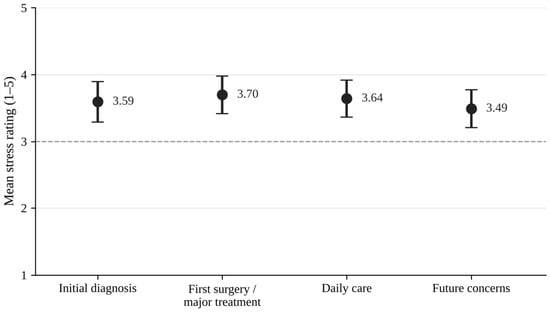
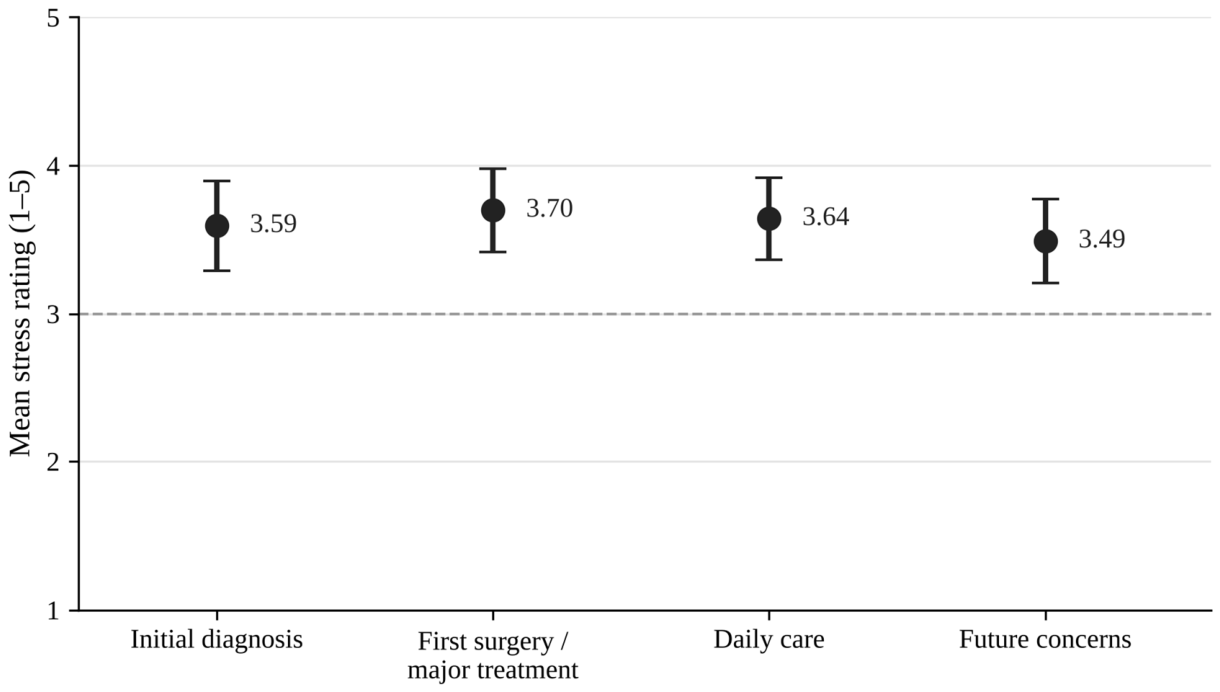
Mean stress ratings were 3.59 for the initial diagnosis, 3.70 for the first surgery or main treatment, 3.64 for daily care and 3.49 for future concerns (Figure 1). Between 37.7% and 48.1% of parents gave the highest rating for each aspect (Supplementary Table S4). No statistically significant difference between the four ratings was detected (Friedman χ2(3) = 2.84, p = 0.417). This result does not show that stress was equivalent across aspects of care.
Figure 1.
Parent-rated stress in relation to four aspects of the child’s cleft care, reported at a single time point (N = 106). Points show mean ratings (1 = not at all stressful, 5 = extremely stressful) and error bars show 95% confidence intervals; the dashed line marks the scale midpoint. Diagnosis and first-surgery ratings were retrospective and future ratings were anticipatory; the ratings are not longitudinal observations. No statistically significant difference between ratings was detected (Friedman χ2(3) = 2.84, p = 0.417).
3.5. Bivariate Associations
Anxiety and depressive symptoms were strongly correlated (r = 0.77) and both were moderately correlated with cleft-related stress (r = 0.49 and 0.57) and with coping (r = 0.46 and 0.51) (Table 5). Trust in the medical team showed small positive correlations with anxiety (r = 0.22) and depressive symptoms (r = 0.24). No meaningful correlation of resilience with either outcome was observed (r = 0.07 and 0.16). Perceived growth was correlated with resilience (r = 0.59), coping (r = 0.50), trust (r = 0.33) and depressive symptoms (r = 0.32).
Table 5.
Pearson correlations among the main study variables (N = 106).
3.6. Factors Associated with Anxiety and Depressive Symptoms
The anxiety model explained 34.5% of the variance (adjusted R2 = 0.306; F(6,99) = 8.71, p < 0.001) and the depression model 47.9% (adjusted R2 = 0.447; F(6,99) = 15.17, p < 0.001) (Table 6). In both models, higher cleft-related stress (β = 0.48 and 0.55, both p < 0.001) and being a mother (father vs. mother β = −0.24, p = 0.005, and β = −0.31, p < 0.001) were associated with higher scores after adjustment for the other variables in the models; because parental socioeconomic circumstances, caregiving load and previous mental health were not measured, these are sample-specific adjusted associations. Higher trust in the medical team was also associated with higher anxiety (β = 0.21, p = 0.021) and depressive symptoms (β = 0.17, p = 0.039). With HC3 standard errors, the corresponding p values were 0.033 and 0.057 (Supplementary Table S3), so the association with depressive symptoms in particular is imprecise. The estimates for resilience, the child’s age band and the number of surgeries were imprecise and compatible both with no association and with modest associations in either direction; for example, the coefficient for the number of surgeries in the depression model was −1.17 (95% CI −2.37 to 0.03). VIFs ranged from 1.04 to 1.19 and there was no evidence of heteroscedasticity (Breusch–Pagan p = 0.76 and 0.72).
Table 6.
Multiple linear regression of factors associated with anxiety (GAD-7) and depressive symptoms (PHQ-8) (N = 106).
3.7. Perceived Growth
Mean perceived growth was 3.88 (SD 1.11) on a 1–5 scale. In the regression model (R2 = 0.278, adjusted R2 = 0.242; F(5,100) = 7.72, p < 0.001), higher coping scores were associated with higher perceived growth (β = 0.48, p < 0.001), whereas the estimates for anxiety, depressive symptoms and telehealth use were imprecise (Table 7). Because the Breusch–Pagan test indicated heteroscedasticity (p = 0.006), HC3 robust estimates are reported in Supplementary Table S3; the coping coefficient was 0.38 (HC3 95% CI 0.21 to 0.55; p < 0.001).
Table 7.
Multiple linear regression of factors associated with perceived personal and family growth (N = 106).
3.8. Sensitivity Analyses
With the three-item resilience score, the resilience coefficient was β = −0.17 in the anxiety model (p = 0.049; HC3 p = 0.066) and β = −0.03 in the depression model (p = 0.712); because the three-item score had poor reliability, this borderline result does not support a conclusion about resilience. Adding cleft type did not materially change any estimate, and cleft type itself was not significant. Entering the child’s age band and the number of surgeries as categorical variables did not materially change the estimates for parent role, cleft-related stress or trust (Supplementary Table S3). Adding resilience to the growth model increased the explained variance (R2 = 0.45), and both resilience (β = 0.46, p < 0.001) and coping (β = 0.28, p = 0.004) were associated with perceived growth. With HC3 standard errors, the association between trust and depressive symptoms was attenuated (p = 0.057), whereas the other associations were unchanged. In an exploratory analysis of the growth measure’s internal structure, the “family closer” item was strongly associated with the remaining three growth items (β = 0.61; R2 = 0.579). Because this analysis changes the outcome and relates indicators of the same construct, it does not identify family closeness as an independent explanatory factor or validate the primary model. The positive coefficient for depressive symptoms in this specification (β = 0.33) differed from the primary model, in which coping was the main correlate, and is not interpreted as evidence that distress promotes growth.
4. Discussion
In this study of parents of children with CL/P in Jordan, more than half of participating parents screened positive for moderate-to-severe anxiety symptoms and over two-fifths for moderate-to-severe depressive symptoms, and about one in eight reported ever having sought counselling for child-related stress. Mothers reported substantially higher symptom levels compared to fathers, and cleft-related stress was the factor most strongly associated with both anxiety and depressive symptoms. Many parents also reported perceived benefits, which were associated with coping.
The proportions of participating parents above the moderate thresholds are high in absolute terms. Population estimates from other countries using these instruments [39] are cited for context only: without a comparison group, the excess burden attributable to CL/P cannot be estimated, and the low response rate may have biased the estimates in either direction. They are consistent with reports of elevated distress among parents of children with oral clefts [7,8,9] and broadly comparable with the burden described among parents of children with other chronic or developmental conditions [40]. Our prevalence of moderate-to-severe depressive symptoms (42.5%) is close to the 43.5% reported among caregivers in China [13], whereas a large UK cohort using the Hospital Anxiety and Depression Scale found lower rates, with anxiety in the clinical-concern range in 16–17% of mothers and 8–11% of fathers and depression in about 4–5% [12]. Differences in instruments and thresholds, timing in the treatment pathway and health-system context, including access to coordinated psychosocial care, may explain part of this gap [10,22]. Severe depressive symptoms (PHQ-8 ≥ 20) were reported by 6.6%. Whether low-intensity psychosocial support within cleft services would meet the needs of most parents cannot be determined from screening scores; this is a possibility for evaluation, and any screening programme would require clinical assessment and referral pathways.
The difference between mothers and fathers was moderate to large, and remained after adjustment for cleft-related stress and the measured clinical characteristics. Because mothers and fathers came from different families and parental age, socioeconomic circumstances, caregiving load and previous mental health were not measured, this adjusted difference is a sample-specific association that may reflect residual confounding rather than an effect of parental role. Mothers commonly carry most of the day-to-day care, including feeding and attendance at appointments, and greater maternal distress has been reported in other cleft cohorts [7,8,9]. Differences in symptom reporting may also contribute: mothers may report emotional symptoms more readily [41], but our data cannot establish whether differences in reporting or concealment of distress contributed; the single father-role items do not measure under-reporting. In the UK cohort, fathers and partners reported anxiety below population norms when the child was five, and a prior mental health condition was their most consistent risk factor [12]; in an Egyptian qualitative study, parents’ gender roles shaped their concerns [24]. An important strength of this study is the near-equal participation of fathers, who are often under-represented in paediatric psychosocial research [28]. That 27.3% of fathers had moderate-to-severe depressive symptoms indicates that screening and support should include both parents.
Cleft-related stress, which captured financial strain, avoidance of public places, the burden of appointments, perceived blame and fear of bullying, was the strongest correlate of both outcomes. At the item level, feeling blamed by family or community and fear of social isolation or bullying showed the strongest correlations with symptoms (Supplementary Table S1). The same burdens were prominent in qualitative studies from Iran, Egypt and Jordan [23,24,25], and in a multinational survey that included Jordanian parents, 70.3% travelled for appointments and 37.4% had missed appointments because of work [27]. Parenting stress was likewise the strongest direct correlate of caregiver depression in China [13], and surgery may relieve some family burdens while creating new ones [42]. These are potentially modifiable targets: financial counselling, coordinated scheduling, anticipatory guidance and peer support could be offered within cleft services. Parents also rated the diagnosis, the first surgery, daily care and future concerns as stressful. Because these ratings were collected at one time and combine recalled current and anticipated experiences, they cannot show how stress changes during treatment, but they suggest that parents’ concerns extend beyond surgical milestones [5,6]. Ratings of earlier stages may have been influenced by recall, and ratings of the future by anticipation.
The positive association between trust in the medical team and symptoms was unexpected. It is exploratory and should be interpreted cautiously: trust was measured with a single item, most parents (84%) rated it 4 or 5, and the association with depressive symptoms was attenuated with robust standard errors. In a cross-sectional design the direction cannot be determined; parents with more symptoms may have more frequent contact with the team and come to rely on it more. Distressed parents may also seek more reassurance from the team, or the single item may capture reliance on the team as well as confidence in it. The finding does not suggest that trust is harmful, but it indicates that high trust in the surgical team does not by itself mean that parents are coping well.
Most parents reported perceived personal and family growth alongside distress, consistent with the posttraumatic growth literature in parents of ill children and of children with clefts [19,20,38]. Perceived growth was associated mainly with more frequent use of coping strategies—seeking information, religious or spiritual practice and peer support—rather than with lower symptom levels, consistent with the view that perceived benefits and distress can co-exist [38]. The cross-sectional design cannot show whether coping fosters perceived growth or whether parents who perceive benefits engage more in coping, and resilience was also strongly correlated with perceived growth (r = 0.59). Resilience, measured with a short adapted scale, showed no clear association with symptoms in the primary models, and given its measurement problems no conclusion can be drawn about its role.
Of the 62 parents who screened positive for moderate-to-severe anxiety or depressive symptoms, 13 (21.0%) reported ever having sought counselling for child-related stress. Because counselling was recorded as lifetime use, symptoms referred to the previous two weeks and other mental healthcare was not recorded, this does not quantify current unmet need, but it suggests that many distressed parents had not received child-related psychological support. Stigma, limited awareness of available services and the absence of routine referral pathways may contribute. Telehealth use was recorded only as use and perceived helpfulness, without intensity, modality or clinical outcomes, so its null associations cannot show a lack of benefit. Integrating brief, validated screening of both parents into multidisciplinary cleft clinics, with clear referral routes, is consistent with recommendations to make psychosocial care part of comprehensive cleft treatment [21,43], and its feasibility and effectiveness in this setting should be evaluated. Recent reviews likewise recommend early psychological screening of caregivers and coordinated psychosocial programmes, particularly in low- and middle-income settings [10,22].
Strengths and Limitations
Strengths of this study include the near-equal participation of mothers and fathers, the use of established screening instruments for the primary outcomes, a real-world tertiary cleft population, and transparent reporting of measurement problems and sensitivity analyses. Several limitations should be considered. First, the cross-sectional design precludes causal inference, and all associations should be interpreted as associations only. Second, the study was conducted at a single centre, and only 30.3% of contacted parents responded; parents with more or less distress may have been more likely to participate, so prevalence estimates may be biased. Third, the sample was smaller than the 150 participants planned in the protocol, which limited power for small effects and subgroup analyses. Fourth, all measures were self-reported, and the screening instruments do not establish clinical diagnoses. Fifth, cleft-related stress, resilience, coping and perceived growth were assessed with study-specific or adapted items rather than full validated scales; trust, counselling and telehealth use were single items, and the resilience items had psychometric problems. Sixth, parental sociodemographic characteristics (age, education, income, employment and number of children), the child’s syndromic status, perceived social support and parents’ previous mental health history were not recorded and could confound the associations observed. Seventh, the responding parent was determined by the telephone number registered with the hospital, which may not identify the parent most involved in daily care; mothers and fathers therefore represent different families, and the mother–father comparison may be affected by selection and residual confounding. The father-specific items were also presented to mothers. Eighth, no correction was made for multiple comparisons. Ninth, although validated Arabic versions of the GAD-7 and PHQ-9 were used and the PHQ-8 was derived from the latter, their criterion validity has not been examined in parents of children with CL/P, and the standard thresholds may not classify respondents exactly as in the original validation samples. Finally, the prevalence estimates describe participating parents at a single tertiary centre and should not be generalised to all parents of children with CL/P in Jordan.
5. Conclusions
Screening-positive anxiety and depressive symptoms were common among participating mothers and fathers of children with CL/P at a tertiary cleft service in Jordan, particularly among mothers, and few reported having sought counselling for child-related stress. Cleft-related stress was the factor most strongly associated with symptoms, and parents reported stress in relation to several aspects of cleft care. Many parents also reported perceived benefits, which were associated with coping. These findings support evaluating routine psychosocial screening and support for both parents within multidisciplinary cleft care, and longitudinal multicentre studies using validated measures are needed to clarify how parental adjustment changes over the course of treatment.
Supplementary Materials
The following supporting information can be downloaded at: https://www.mdpi.com/article/10.3390/healthcare14234100/s1, File S1: Questionnaire as administered: sections, instructions, reference periods, response options and items; Table S1: Item-level results for study-specific items (N = 106); Table S2: Child and service characteristics by responding parent; Table S3: Conventional and HC3 robust estimates for the main models, and sensitivity analyses; Table S4: Distribution of stage-specific stress ratings (N = 106).
Author Contributions
B.S. Conceptualisation, Methodology, Writing—Review and Editing, Supervision, Project Administration; I.T. Investigation, Data Curation, Writing—Original Draft, Writing—Review and Editing; B.H. Investigation, Data Curation, Writing—Original Draft, Writing—Review and Editing; M.A.-H. Methodology, Validation, Formal Analysis, Writing—Review and Editing, Visualisation, Supervision, Project Administration; O.A. Investigation, Data Curation, Writing—Original Draft, Writing—Review and Editing; Y.A. Investigation, Data Curation, Writing—Original Draft, Writing—Review and Editing; K.H. Investigation, Data Curation, Writing—Original Draft, Writing—Review and Editing; J.N. Investigation, Data Curation, Writing—Original Draft, Writing—Review and Editing; O.S. Investigation, Data Curation, Writing—Original Draft, Writing—Review and Editing. All authors have read and agreed to the published version of the manuscript.
Funding
This research received no external funding.
Institutional Review Board Statement
The study protocol was approved by the Institutional Review Board of Jordan University Hospital (reference no. 10/2026/1980; approval date 20 January 2026) and was conducted in accordance with the Declaration of Helsinki.
Informed Consent Statement
Electronic informed consent was obtained from all participants before participation.
Data Availability Statement
The de-identified dataset analysed during the current study is available from the corresponding author on reasonable request, subject to institutional approval. The full questionnaire (Supplementary File S1) is provided as Supplementary Materials.
Acknowledgments
The authors thank the parents who took part in this study. Use of AI-Assisted Technologies: During the preparation of this work, the authors used Claude (Anthropic), https://claude.ai/, an AI assistant, to support the verification of the statistical analyses and the drafting and editing of the manuscript text, and Grammarly to improve language and grammar. The authors reviewed and edited all content, verified all analyses against the original data, and take full responsibility for the content of the publication.
Conflicts of Interest
The authors declare that they have no competing interests.
Abbreviations
| CI | Confidence interval |
| CL/P | Cleft lip and/or palate |
| GAD-7 | Generalised Anxiety Disorder-7 |
| HC3 | Heteroscedasticity-consistent standard errors (type 3) |
| IRB | Institutional Review Board |
| JUH | Jordan University Hospital |
| PHQ-8 | Patient Health Questionnaire-8 |
| SD | Standard deviation |
| STROBE | Strengthening the Reporting of Observational Studies in Epidemiology |
| VIF | Variance inflation factor |
References
- Mossey, P.A.; Little, J.; Munger, R.G.; Dixon, M.J.; Shaw, W.C. Cleft Lip and Palate. Lancet 2009, 374, 1773–1785. [Google Scholar] [CrossRef] [Scilit] [PubMed]
- Dixon, M.J.; Marazita, M.L.; Beaty, T.H.; Murray, J.C. Cleft Lip and Palate: Understanding Genetic and Environmental Influences. Nat. Rev. Genet. 2011, 12, 167–178. [Google Scholar] [CrossRef] [Scilit] [PubMed]
- Wehby, G.L.; Murray, J.C. Folic Acid and Orofacial Clefts: A Review of the Evidence. Oral Dis. 2010, 16, 11–19. [Google Scholar] [CrossRef] [Scilit] [PubMed]
- Nagarajan, R.; Savitha, V.H.; Subramaniyan, B. Communication Disorders in Individuals with Cleft Lip and Palate: An Overview. Indian J. Plast. Surg. Off. Publ. Assoc. Plast. Surg. India 2009, 42, S137–S143. [Google Scholar] [CrossRef] [Scilit] [PubMed]
- Nelson, P.; Glenny, A.-M.; Kirk, S.; Caress, A.-L. Parents’ Experiences of Caring for a Child with a Cleft Lip and/or Palate: A Review of the Literature. Child Care Health Dev. 2012, 38, 6–20. [Google Scholar] [CrossRef] [Scilit] [PubMed]
- Young, J.L.; O’Riordan, M.; Goldstein, J.A.; Robin, N.H. What Information Do Parents of Newborns with Cleft Lip, Palate, or Both Want to Know? Cleft Palate-Craniofacial J. Off. Publ. Am. Cleft Palate-Craniofacial Assoc. 2001, 38, 55–58. [Google Scholar] [CrossRef] [Scilit] [PubMed]
- Nidey, N.; Moreno Uribe, L.M.; Marazita, M.M.; Wehby, G.L. Psychosocial Well-Being of Parents of Children with Oral Clefts. Child Care Health Dev. 2016, 42, 42–50. [Google Scholar] [CrossRef] [Scilit] [PubMed]
- Grollemund, B.; Dissaux, C.; Gavelle, P.; Martínez, C.P.; Mullaert, J.; Alfaiate, T.; Guedeney, A. CLIP team (Cleft Lip & palate Infant Parent) The Impact of Having a Baby with Cleft Lip and Palate on Parents and on Parent-Baby Relationship: The First French Prospective Multicentre Study. BMC Pediatr. 2020, 20, 230. [Google Scholar] [CrossRef] [Scilit] [PubMed]
- Stock, N.M.; Costa, B.; White, P.; Rumsey, N. Risk and Protective Factors for Psychological Distress in Families Following a Diagnosis of Cleft Lip and/or Palate. Cleft Palate-Craniofacial J. Off. Publ. Am. Cleft Palate-Craniofacial Assoc. 2020, 57, 88–98. [Google Scholar] [CrossRef] [Scilit] [PubMed]
- Namdar, P.; Pourasghar, M.; Lal Alizadeh, F.; Shiva, A. Anxiety, Depression, and Quality of Life in Caregivers of Children with Cleft Lip and Palate: A Systematic Review. Iran. J. Psychiatry Behav. Sci. 2022, 16, e113591. [Google Scholar] [CrossRef] [Scilit]
- Massucheto, A.M.; Priolo Filho, S.R.; Gonçalves, F.M.; Bubna, D.P.; Ferraz, A.X.; Schroder, Â.G.D.; Taveira, K.V.M.; De Araujo, C.M.; Tonocchi, R.D.C. Emotional Reactions and Adaptation of Parents of Children Diagnosed With Cleft Lip/Palate: A Systematic Review. Cleft Palate Craniofacial J. 2026, 63, 10556656261446306. [Google Scholar] [CrossRef] [Scilit] [PubMed]
- Stock, N.M.; Blaso, D.; White, P.; Shepherd, L.; Costa, B.; Edme, K.; Aspland, R.; Hotton, M. Longitudinal Psychological Well-Being in Caregivers of Young Children with Cleft Lip and/or Palate. J. Pediatr. Psychol. 2025, 50, 831–842. [Google Scholar] [CrossRef] [Scilit] [PubMed]
- Yang, J.; Li, X.; Gao, Y.; Wang, W.; Wang, J.; Wang, Y.; Gong, C.; Wang, R.; Yuan, L. The Influential Factors of Depression among Caregivers of Children with Cleft Lip and/or Palate: A Path Analysis Based on Diathesis-Stress Theoretical Model. BMC Psychiatry 2024, 24, 911. [Google Scholar] [CrossRef] [Scilit] [PubMed]
- Nelson, J.; O’Leary, C.; Weinman, J. Causal Attributions in Parents of Babies with a Cleft Lip and/or Palate and Their Association with Psychological Well-Being. Cleft Palate-Craniofacial J. Off. Publ. Am. Cleft Palate-Craniofacial Assoc. 2009, 46, 425–434. [Google Scholar] [CrossRef] [Scilit] [PubMed]
- Kimotho, S.G.; Macharia, F.N. Social Stigma and Cultural Beliefs Associated with Cleft Lip and/or Palate: Parental Perceptions of Their Experience in Kenya. Humanit. Soc. Sci. Commun. 2020, 7, 181. [Google Scholar] [CrossRef] [Scilit]
- Zhang, Y.; Zhang, X.; Jiang, J.; Xie, W.; Xiang, D. Factors Associated With Perception of Stigma Among Parents of Children With Cleft Lip and Palate: Cross-Sectional Study. JMIR Form. Res. 2024, 8, e53353. [Google Scholar] [CrossRef] [Scilit] [PubMed]
- Baker, S.R.; Owens, J.; Stern, M.; Willmot, D. Coping Strategies and Social Support in the Family Impact of Cleft Lip and Palate and Parents’ Adjustment and Psychological Distress. Cleft Palate-Craniofacial J. Off. Publ. Am. Cleft Palate-Craniofacial Assoc. 2009, 46, 229–236. [Google Scholar] [CrossRef] [Scilit] [PubMed]
- Berger, Z.E.; Dalton, L.J. Coping with a Cleft: Psychosocial Adjustment of Adolescents with a Cleft Lip and Palate and Their Parents. Cleft Palate-Craniofacial J. Off. Publ. Am. Cleft Palate-Craniofacial Assoc. 2009, 46, 435–443. [Google Scholar] [CrossRef] [Scilit] [PubMed]
- Picoraro, J.A.; Womer, J.W.; Kazak, A.E.; Feudtner, C. Posttraumatic Growth in Parents and Pediatric Patients. J. Palliat. Med. 2014, 17, 209–218. [Google Scholar] [CrossRef] [Scilit] [PubMed]
- He, M.; Shi, B.; Zheng, Q.; Gong, C.; Huang, H. Posttraumatic Growth and Its Correlates Among Parents of Children With Cleft Lip and/or Palate. Cleft Palate-Craniofacial J. Off. Publ. Am. Cleft Palate-Craniofacial Assoc. 2024, 61, 110–118. [Google Scholar] [CrossRef] [Scilit] [PubMed]
- Crerand, C.E.; Conrad, A.L.; Albert, M.; Bellucci, C.C.; Heppner, C.E.; Sheikh, F.; Woodard, S.; Kapp-Simon, K.A. The Americleft Psychosocial Outcomes Project: A Multicenter Approach to Advancing Psychosocial Outcomes for Youth With Cleft Lip and Palate. Clin. Pract. Pediatr. Psychol. 2017, 5, 65–76. [Google Scholar] [CrossRef] [Scilit] [PubMed]
- Stock, N.M.; Costa, B.; Zarola, A.; Auslander, A.; Brewster, H.; Swift, P.; Imam, L.; Hamdan, U.; Davies, G.; Horne, S.; et al. The Psychosocial Impact of Cleft Lip and/or Palate on Caregivers and Individuals in Low- and Middle-Income Countries: A Narrative Review. Cleft Palate Craniofacial J. 2026, 63, 1804–1828. [Google Scholar] [CrossRef] [Scilit] [PubMed]
- Alinezhad, D.; Mohammadi, F.; Kharazifared, M.J.; Gholami, M.; Sarmadi, S.; Razeghi, S. Parents’ Views and Experiences of Raising Babies Born with Cleft Lip and Palate: A Qualitative Study. BMC Pediatr. 2025, 25, 33. [Google Scholar] [CrossRef] [Scilit] [PubMed]
- Morsi, A.O.; Yehia, A.M.; Badran, A.S.; Khattab, N.M.A. Challenges and Concerns Faced by Parents of a Group of Egyptian Children with Cleft Lip/Palate: A Qualitative Study. BMC Oral Health 2023, 23, 1011. [Google Scholar] [CrossRef] [Scilit] [PubMed]
- Al-Awad, A.; Obeidat, H.; Al-Oran, H.; Almahadeen, R.; Abu-Qamar, M.Z. The Lived Experience of Jordanian Parents Who Have a Child with Congenital Orofacial Clefts: Descriptive Qualitative Phenomenological Study. J. Pediatr. Nurs. 2025, 85, 763–772. [Google Scholar] [CrossRef] [Scilit]
- Alfwaress, F.; Alomari, M. Social and Religious Attitudes of Jordanian Parents toward Children Born with Orofacial Clefts. Int. J. Pediatr. Otorhinolaryngol. 2020, 137, 110222. [Google Scholar] [CrossRef] [Scilit] [PubMed]
- Rabah, S.M.; Sabbagh, H.J.; AlZabin, A.; Almajed, E.; Albrahim, R.; Aldawish, R.; Alyahiwi, L.; Alshabnan, R.; Helal, N.M.; Khan, M.A.; et al. Parental Knowledge and Barriers to Cleft Lip and Palate Care: A Cross-Cultural Study from the Middle East and South Asia. Front. Public Health 2026, 13, 1691553. [Google Scholar] [CrossRef] [Scilit] [PubMed]
- Phares, V.; Lopez, E.; Fields, S.; Kamboukos, D.; Duhig, A.M. Are Fathers Involved in Pediatric Psychology Research and Treatment? J. Pediatr. Psychol. 2005, 30, 631–643. [Google Scholar] [CrossRef] [Scilit] [PubMed]
- von Elm, E.; Altman, D.G.; Egger, M.; Pocock, S.J.; Gøtzsche, P.C.; Vandenbroucke, J.P. STROBE Initiative The Strengthening the Reporting of Observational Studies in Epidemiology (STROBE) Statement: Guidelines for Reporting Observational Studies. Lancet Lond. Engl. 2007, 370, 1453–1457. [Google Scholar] [CrossRef] [Scilit] [PubMed]
- Spitzer, R.L.; Kroenke, K.; Williams, J.B.W.; Löwe, B. A Brief Measure for Assessing Generalized Anxiety Disorder: The GAD-7. Arch. Intern. Med. 2006, 166, 1092. [Google Scholar] [CrossRef] [Scilit] [PubMed]
- Kroenke, K.; Strine, T.W.; Spitzer, R.L.; Williams, J.B.W.; Berry, J.T.; Mokdad, A.H. The PHQ-8 as a Measure of Current Depression in the General Population. J. Affect. Disord. 2009, 114, 163–173. [Google Scholar] [CrossRef] [Scilit] [PubMed]
- Sawaya, H.; Atoui, M.; Hamadeh, A.; Zeinoun, P.; Nahas, Z. Adaptation and Initial Validation of the Patient Health Questionnaire-9 (PHQ-9) and the Generalized Anxiety Disorder-7 Questionnaire (GAD-7) in an Arabic Speaking Lebanese Psychiatric Outpatient Sample. Psychiatry Res. 2016, 239, 245–252. [Google Scholar] [CrossRef] [Scilit] [PubMed]
- AlHadi, A.N.; AlAteeq, D.A.; Al-Sharif, E.; Bawazeer, H.M.; Alanazi, H.; AlShomrani, A.T.; Shuqdar, R.M.; AlOwaybil, R. An Arabic Translation, Reliability, and Validation of Patient Health Questionnaire in a Saudi Sample. Ann. Gen. Psychiatry 2017, 16, 32. [Google Scholar] [CrossRef] [Scilit] [PubMed]
- Stein, R.E.; Riessman, C.K. The Development of an Impact-on-Family Scale: Preliminary Findings. Med. Care 1980, 18, 465–472. [Google Scholar] [CrossRef] [Scilit] [PubMed]
- Stein, R.E.; Jessop, D.J. The Impact on Family Scale Revisited: Further Psychometric Data. J. Dev. Behav. Pediatr. 2003, 24, 9–16. [Google Scholar] [CrossRef] [Scilit]
- Smith, B.W.; Dalen, J.; Wiggins, K.; Tooley, E.; Christopher, P.; Bernard, J. The Brief Resilience Scale: Assessing the Ability to Bounce Back. Int. J. Behav. Med. 2008, 15, 194–200. [Google Scholar] [CrossRef] [Scilit] [PubMed]
- Folkman, S. Stress: Appraisal and Coping. In Encyclopedia of Behavioral Medicine; Springer: Cham, Switzerland, 2020; pp. 2177–2179. ISBN 978-3-030-39903-0. [Google Scholar]
- Tedeschi, R.G.; Calhoun, L.G. The Posttraumatic Growth Inventory: Measuring the Positive Legacy of Trauma. J. Trauma. Stress 1996, 9, 455–471. [Google Scholar] [CrossRef] [Scilit] [PubMed]
- Terlizzi, E.P.; Zablotsky, B. Symptoms of Anxiety and Depression among Adults: United States, 2019 and 2022. In National Health Statistics Reports [Internet]; National Center for Health Statistics (US): Hyattsville, MD, USA, 2024. [Google Scholar]
- Scherer, N.; Verhey, I.; Kuper, H. Depression and Anxiety in Parents of Children with Intellectual and Developmental Disabilities: A Systematic Review and Meta-Analysis. PLoS ONE 2019, 14, e0219888. [Google Scholar] [CrossRef] [Scilit] [PubMed]
- Najman, J.M.; Williams, G.M.; Nikles, J.; Spence, S.; Bor, W.; O’Callaghan, M.; Le Brocque, R.; Andersen, M.J.; Shuttlewood, G.J. Bias Influencing Maternal Reports of Child Behaviour and Emotional State. Soc. Psychiatry Psychiatr. Epidemiol. 2001, 36, 186–194. [Google Scholar] [CrossRef] [Scilit] [PubMed]
- Ferguson, J.; De Boos, D.; Shepherd, L. Impact of Surgery on Quality of Life in Families of Children With a Cleft Lip and/or Palate: A Systematic Review. Cleft Palate Craniofacial J. 2026, 63, 1018–1031. [Google Scholar] [CrossRef] [Scilit] [PubMed]
- Wissow, L.S.; Brown, J.; Fothergill, K.E.; Gadomski, A.; Hacker, K.; Salmon, P.; Zelkowitz, R. Universal Mental Health Screening in Pediatric Primary Care: A Systematic Review. J. Am. Acad. Child Adolesc. Psychiatry 2013, 52, 1134–1147.e23. [Google Scholar] [CrossRef] [Scilit] [PubMed]

Disclaimer/Publisher’s Note: The statements, opinions and data contained in all publications are solely those of the individual author(s) and contributor(s) and not of MDPI and/or the editor(s). MDPI and/or the editor(s) disclaim responsibility for any injury to people or property resulting from any ideas, methods, instructions or products referred to in the content. |
© 2026 by the authors. Licensee MDPI, Basel, Switzerland. This article is an open access article distributed under the terms and conditions of the Creative Commons Attribution (CC BY) license.