


Abstract
Background/Objectives: Migration is an important social determinant of mental health, but its impact on the course and treatment response of major depressive disorder (MDD) is insufficiently understood, particularly in migrant populations with high cultural and linguistic similarity to the host country. We compared clinical characteristics, treatment patterns and correlates of treatment resistance between Turkish immigrants from Bulgaria and non-immigrant patients with MDD. Methods: In this retrospective cohort study, records of patients hospitalised with MDD at a university-affiliated tertiary care psychiatry clinic between 2016 and 2025 were reviewed; 250 patients were included (84 immigrants, 166 non-immigrants). Because treatment resistance was highly prevalent, prevalence ratios (PRs) were estimated using modified Poisson regression with robust standard errors, adjusted for age, sex, follow-up duration, psychiatric comorbidity and occupational status. Sensitivity analyses varied the definition of immigrant status and the composition of the reference group. Results: Immigrants were older at index hospitalisation (median 49.5 vs. 43.5 years), whereas other sociodemographic characteristics were similar. Treatment resistance (96.4% vs. 80.7%) and medication changes within six months after discharge (58.3% vs. 36.7%) were more frequent among immigrants. Immigrant status remained independently associated with treatment resistance after adjustment (adjusted PR 1.20, 95% CI 1.10–1.31), consistently across all sensitivity analyses. Psychiatric comorbidity and being unemployed or retired were also independently associated with treatment resistance. No differences emerged across immigrant generations. Conclusions: Immigrant status was associated with a higher prevalence of treatment resistance despite cultural and linguistic proximity to the host population. Acculturation and trauma were not measured, so this remains an association; it nonetheless supports attention to migration background in patients who do not respond to treatment.
1. Introduction
Migration is not only a physical change in location, but also causes individuals to face many social, cultural, economic, behavioural and communicational obstacles, and is considered one of the fundamental social determinants shaping mental health [1]. Whether migration is voluntary or involuntary is an important factor that determines its effects: while voluntary migrants generally seek better educational, social or professional opportunities, involuntary migration due to war, oppression or political threats has more negative effects on mental health [2]. A recent meta-analysis of 269 studies confirmed that forced migration is associated with a higher prevalence of depression, anxiety and post-traumatic stress disorder, even after accounting for methodological differences between studies [3]. Migrants have accordingly been reported to experience major depressive disorder (MDD) more often than native populations [4,5], although findings are inconsistent and some studies describe a lower risk [6,7]. This inconsistency supports the view that the effects of migration are shaped by contextual variables such as migrant generation, country of origin, reason for migration, socioeconomic status, discrimination and social support [8,9]. Far less is known about the course of MDD once it has developed. Migration may affect not only who becomes depressed but also how depression presents and responds to treatment: somatic presentation and differences in help-seeking may delay recognition [8], symptom profiles at presentation may differ [10] and adherence to antidepressant treatment has been reported to be lower among migrants [11,12]. Each of these pathways could increase the likelihood of treatment-resistant depression (TRD), an outcome associated with greater disability, higher relapse rates and substantially increased health care costs [13], yet whether migrant status is associated with TRD has rarely been examined directly.
Research on migration and mental health has largely focused on groups experiencing significant cultural dissonance, in which the consequences of migration are difficult to separate from those of ethnic and linguistic minority status. Co-ethnic migration, in which migrants share language, religion and ethnic origin with the host population, offers a different vantage point. The migration of Turks from Bulgaria to Türkiye is one such context. This ethnic Turkish minority had lived in Bulgaria since the Ottoman period and has migrated to Türkiye in successive waves since the late nineteenth century, most recently in 1989, when the assimilation policies of the Bulgarian Communist Party brought approximately 350,000 people to Türkiye [14,15]. Cultural proximity to the host society has therefore coexisted with migration that was, for much of this population, forced rather than chosen, and studying this population allows migration to be examined where cultural adaptation difficulties and ethnic discrimination are less prominent than in most migrant groups. Comparative studies on migrants from Bulgaria to Türkiye are nonetheless scarce. We therefore compared the clinical characteristics, hospitalisation history and treatment resistance of MDD between Turkish immigrants from Bulgaria and non-immigrant patients hospitalised in the same clinic, and examined whether these characteristics differ across immigrant generations. We hypothesised that immigrant patients would show a higher prevalence of TRD than non-immigrants, despite their cultural and linguistic proximity to the host population.
2. Materials and Methods
2.1. Study Population and Participant Selection
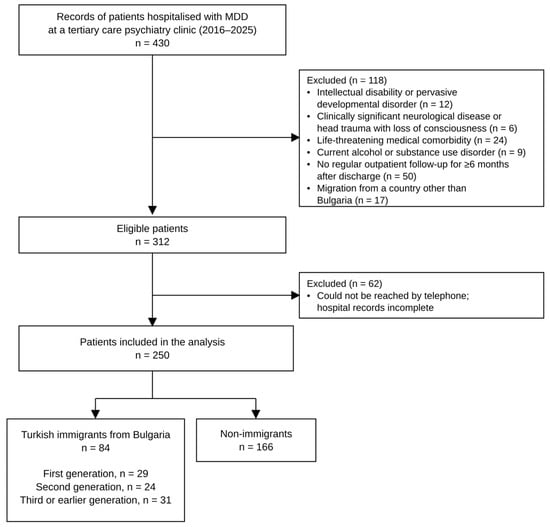
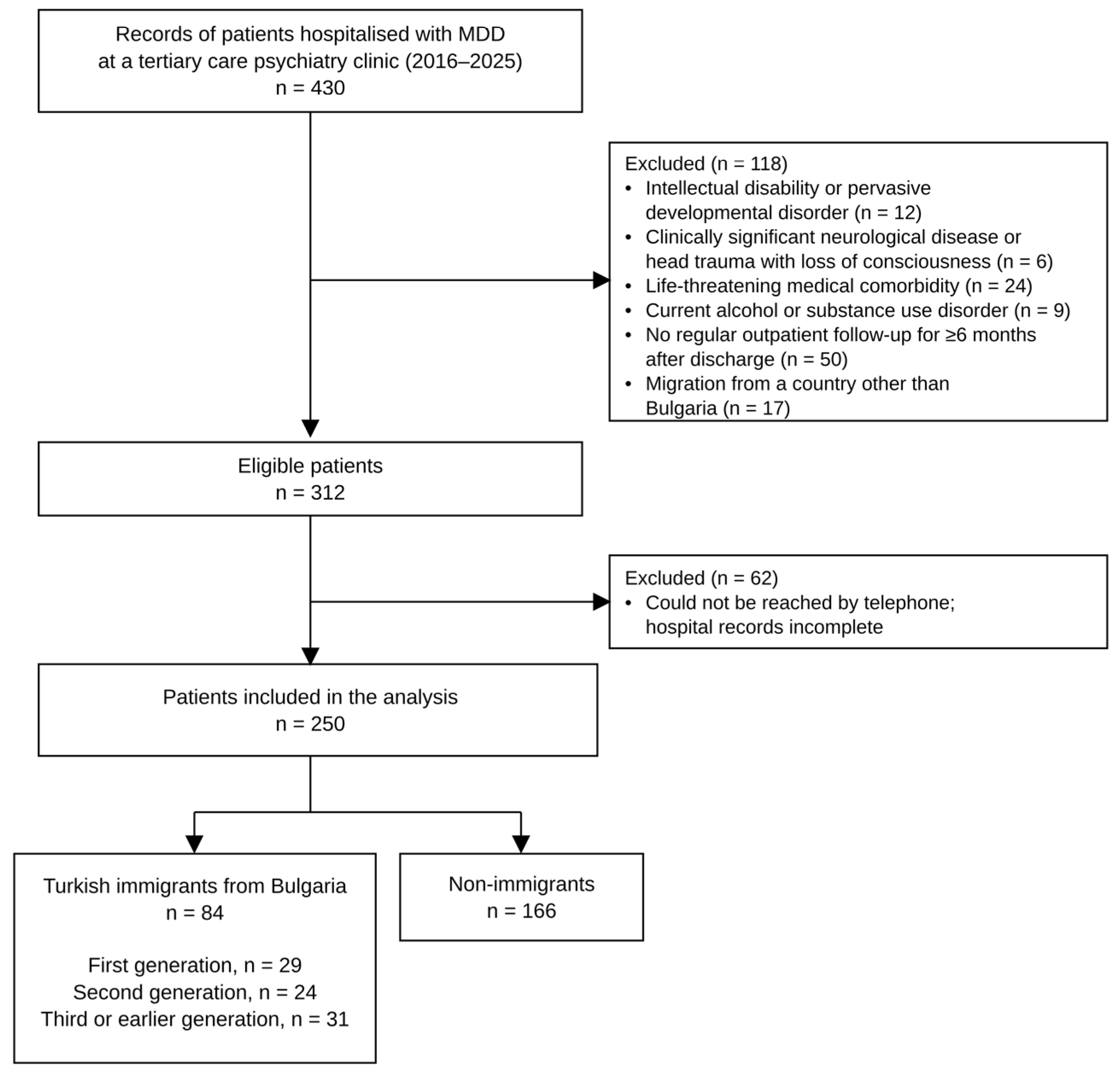
The authors assert that all procedures contributing to this work comply with the ethical standards of the relevant national and institutional committees on human experimentation and with the Helsinki Declaration of 1975, as revised in 2013. All procedures involving human subjects/patients were approved by the Clinical Research Ethics Committee of Bursa Uludağ University Faculty of Medicine (approval number 638-9/10, dated 20 May 2025). In this retrospective cohort study, we systematically reviewed the medical records of patients hospitalised with a diagnosis of major depressive disorder (MDD) at a university-affiliated tertiary care psychiatry clinic between January 2016 and May 2025. A total of 430 patient records were retrieved from the hospital information management system and assessed for eligibility. The predefined exclusion criteria were age under 18 years; intellectual disability or pervasive developmental disorder; clinically significant neurological disease or a history of head trauma with loss of consciousness; life-threatening medical comorbidities; current alcohol or substance use disorders; lack of regular outpatient follow-up for at least six months after discharge; and migration from a country other than Bulgaria. Based on these criteria, 118 patients were excluded. A further 62 patients were excluded because they could not be reached by telephone; in these patients the discharge summary of the index hospitalisation was missing or incompletely documented, so neither migration status nor the clinical variables required for the analysis could be established. Consequently, 250 patients were included in the final analysis (Figure 1).
Figure 1.
Flow diagram of patient selection. MDD, major depressive disorder.
2.2. Data Collection
Patient data were retrospectively reviewed using the hospital information management system (MIA-Med). All clinical data, including the ascertainment of treatment resistance, were extracted from the records before any patient was contacted. The telephone call was used to establish migration status only; no clinical information was obtained by telephone for any patient included in the analysis, and the classification of treatment resistance was not revisited after migration status became known. In patients whose records were too incomplete to yield the clinical variables required for the analysis, the call would also have served to complete the missing information, but none of these patients could be reached and all were excluded (Section 2.1). Because information on migration status was not available in the medical records, patients who met the inclusion and exclusion criteria were contacted by telephone through the hospital lines between June and December 2025. During the call, patients were informed of the purpose of the study, that participation was voluntary, and that the information would be used for research purposes only; verbal informed consent was obtained before any question on migration status was asked, and only patients who agreed were included. This procedure was approved by the Clinical Research Ethics Committee of Bursa Uludağ University Faculty of Medicine. Written informed consent was not required because no intervention was involved and all other data were derived from existing records. All data were anonymised before analysis. Sociodemographic characteristics, inpatient treatment duration, applied treatments, history of suicide attempts, ECT history, previous treatment processes, and post-discharge treatment changes were recorded. Sex was recorded as documented in the hospital information system. Immigrant status was defined as a family history of migration from Bulgaria to Türkiye, whether the patient had migrated personally, at least one parent had migrated, or migration had occurred in an earlier generation; patients reporting no such history formed the reference group, and the generation in which migration had occurred was recorded separately. Generations were combined into a single exposure group because the study question concerns migration background as a social determinant that may persist beyond the generation that migrated, rather than the acute experience of migration alone; this grouping was then tested in sensitivity analyses restricting the immigrant group to individual generations.
Medication changes within the 6-month period after discharge included dose escalation of antidepressants during the 6-month follow-up, addition of a new antidepressant, changes in mood stabilisers, and addition of an antipsychotic to augment antidepressant treatment. This outcome counts all medication changes, irrespective of the reason for them.
During preparation of this revision, 22 records were identified in which the recorded age at first psychiatric hospitalisation exceeded the age at index hospitalisation and was therefore impossible. In six of these the original clinical records were retrieved and showed that the index admission had in fact been the patient’s first psychiatric hospitalisation; the recorded value, which exceeded the age at index admission by between three and ten years, was corrected accordingly. In the remaining 16 the recorded value exceeded the age at index admission by exactly one year in every case, a pattern consistent with a date-entry or rounding artefact; these values were set equal to the age at index hospitalisation without verification against the source record, and are therefore assigned rather than verified. A sensitivity analysis treating these 16 values as missing is reported in Section 3.5.
2.3. Definition of Treatment Resistance
For the purpose of this study, treatment resistance was defined as a major depressive episode that did not respond to at least two antidepressants from different classes, prescribed at adequate doses and for sufficient durations, as evidenced by medical records. Treatment resistance was assessed as of the end of the index hospitalisation, on the basis of antidepressant trials documented up to that point. Medication changes during the six months after discharge were recorded separately as a secondary outcome and did not contribute to the ascertainment of treatment resistance.
Antidepressant trials were identified from the complete treatment record available for each patient up to the end of the index hospitalisation. This comprised the treatment history obtained from the patient and, where available, from relatives at admission; prescription and medication-supply records; and the discharge summary of the index hospitalisation, in which this history was consolidated. A trial was considered adequate if the agent had been taken continuously for at least four weeks at a daily dose within the usual dose range recommended for that agent in the CANMAT 2023 guideline for the management of major depressive disorder [16]. The four-week minimum corresponds to the criterion applied by the Antidepressant Treatment History Form [17] and lies within the four- to six-week range given in the practice guideline from which our definition of treatment resistance is taken [18]. A trial was considered to have failed when the clinician had documented an inadequate response and the antidepressant had been switched, augmented, or discontinued for this reason; trials discontinued because of adverse effects, patient preference, or nonadherence were not counted as failures. Records were divided among four investigators, each applying the same predefined criteria for an adequate antidepressant trial and for documented non-response; cases in which the documentation was ambiguous were discussed jointly and resolved by consensus, with the senior author consulted where agreement could not be reached. Formal inter-rater agreement was not calculated. Continuity of use during each trial was verified against prescription and medication-supply records rather than inferred from the prescription alone. Because the assessment relied on clinical documentation rather than prospective symptom rating scales, the judgement of whether the patient had responded was the treating clinician’s as recorded in the file, and no standardised severity threshold was applied.
2.4. Statistical Analysis
The distribution of continuous variables was assessed with the Shapiro–Wilk test. Because continuous variables were not normally distributed, they are presented as median (interquartile range, IQR) and were compared with the Mann–Whitney U test (two groups) or the Kruskal–Wallis test (three immigrant generations). Categorical variables are presented as n (%) and were compared with Pearson’s chi-square test, or Fisher’s exact test when any expected cell count was below 5. For 3 × 2 comparisons across immigrant generations, exact p values were estimated by Monte Carlo simulation with 10,000 permutations. No a priori sample size calculation was performed; all eligible patients treated during the study period were included. Missing data were not imputed; all analyses were performed on available cases, percentages were calculated using the number of patients with available data as the denominator, and the number of patients contributing to each model is reported.
The primary outcome was treatment-resistant depression (TRD). Because TRD was highly prevalent in this inpatient sample (86.0%), odds ratios (ORs) would substantially overstate relative risk. The association between immigrant status and TRD was therefore quantified primarily as prevalence ratios (PRs) estimated with modified Poisson regression using robust (sandwich) standard errors [19]. Prevalence ratios are reported with 95% confidence intervals (CIs). A log-binomial model, which estimates prevalence ratios directly, was attempted first but failed to converge: the Hessian matrix was singular and an increasing number of cases became invalid at each iteration because the fitted probabilities fell outside the admissible range, so no parameter estimates could be obtained. Modified Poisson regression with robust standard errors is the recommended alternative in this situation [19]. Because only three immigrants did not meet criteria for treatment resistance, the stability of the adjusted estimate was examined on the original sample by a nonparametric bootstrap with 2000 resamples, from which a percentile 95% confidence interval was derived, and by leave-one-out influence analysis; the number of resamples failing to converge was recorded. The adjusted model was also refitted after excluding these three patients, but because this alters the sample with respect to both the exposure and the outcome, it is reported as a descriptive check and not as evidence that the estimates are stable.
Covariates were selected a priori on the basis of clinical relevance and potential confounding, rather than by stepwise selection: age at index hospitalisation (per 10 years), sex, duration of follow-up at the clinic (per year), included as a marker of the length of documented clinical contact, psychiatric comorbidity, and occupational status (employed [reference], unemployed, retired). Because only 35 patients did not have TRD, the number of covariates was deliberately limited. Because the modified Poisson model uses a log link and can therefore yield predicted values above 1, calibration of this model was not formally assessed. To describe the discriminatory ability of the covariate set, a binary logistic regression with the identical covariates was fitted for this purpose only, and the area under the receiver operating characteristic curve (AUC) was calculated from its predicted probabilities. All effect estimates reported here are from the modified Poisson models.
Sensitivity analyses were performed (i) restricting the immigrant group to first- and second-generation immigrants, (ii) to first-generation immigrants only, and (iii) to third-or-earlier-generation immigrants only; (iv) excluding patients with a history of internal migration from the reference group; (v) excluding patients whose psychiatric comorbidity was alcohol use disorder or dementia; with additional adjustment for (vi) psychotic features and (vii) years of education; (viii) omitting follow-up duration from the model, because treatment resistance was determined at the end of the index hospitalisation while much of the recorded follow-up occurred after that point; and (ix) with additional adjustment for the time from first psychiatric hospitalisation to index hospitalisation and for the number of previous hospitalisations; and (x) treating as missing the 16 values of age at first psychiatric hospitalisation that were assigned rather than verified against the source record. The interval used in (ix) measures the documented psychiatric course preceding the index admission and not the time since illness onset, which was not recorded. The secondary outcomes (medication change within 6 months after discharge and mood stabiliser use) were analysed with the same adjusted modified Poisson models. Age at first psychiatric hospitalisation was compared between groups using linear regression adjusted for age at index hospitalisation. All tests were two-sided, and p < 0.05 was considered statistically significant. Analyses were performed using IBM SPSS Statistics for Windows, version 20.0 (IBM Corp., Armonk, NY, USA). The analysis plan, including the choice of modified Poisson regression, the a priori covariate set and the sensitivity analyses, was developed with the assistance of Claude (Opus 5, Anthropic; claude.ai, San Francisco, CA, USA), used in September 2026. All analyses reported here were independently re-run and verified by the authors in SPSS. We used the STROBE reporting guideline to draft this manuscript, and the STROBE reporting checklist when editing.
3. Results
3.1. Study Population
After application of the eligibility criteria and exclusion of 17 patients who had migrated from countries other than Bulgaria, 250 patients were included in the analysis: 84 (33.6%) Turkish immigrants from Bulgaria and 166 non-immigrants. Among immigrants, migration had been experienced personally by 29 (34.5%), by at least one parent in 24 (28.6%), and by earlier generations in 31 (36.9%). Of the 28 first-generation immigrants with available data, 20 had migrated in the post-1989 period.
3.2. Sociodemographic and Clinical Characteristics
Immigrants were older at index hospitalisation than non-immigrants (median 49.5 [IQR 40.0–58.2] vs. 43.5 [33.0–55.0] years, p = 0.005) and at first psychiatric hospitalisation (43.0 [33.0–53.2] vs. 38.0 [28.0–51.0] years, p = 0.044). However, after adjustment for age at index hospitalisation, immigrant status was not associated with age at first hospitalisation (β = −0.73 years, 95% CI −2.92 to 1.45, p = 0.508). The groups did not differ in sex, education, marital status, occupational status (p = 0.761), family psychiatric history, medical or psychiatric comorbidity, or lifetime suicide attempts. A history of internal migration was markedly less frequent among immigrants (7.1% vs. 39.5%, p < 0.001) (Table 1).
Table 1.
Sociodemographic and clinical characteristics of immigrants and non-immigrants.
3.3. Treatment Characteristics
TRD was more frequent among immigrants (96.4% vs. 80.7%, p < 0.001), as were medication changes within 6 months after discharge (58.3% vs. 36.7%, p = 0.001) and mood stabiliser use (21.4% vs. 11.4%, p = 0.036). Antipsychotic augmentation, combined or atypical antidepressant use, ECT, and maintenance ECT did not differ between groups (Table 2).
Table 2.
Treatment characteristics and outcomes of immigrants and non-immigrants.
3.4. Psychiatric Comorbidity
Patients with psychiatric comorbidity were younger at index hospitalisation (39.0 vs. 50.0 years, p < 0.001) and at first hospitalisation (34.0 vs. 44.0 years, p < 0.001), had more hospitalisations (p = 0.001) and more total hospitalisation days (p = 0.010), and more frequently met criteria for TRD (92.1% vs. 82.6%, p = 0.038). Psychotic features were less frequent among patients with psychiatric comorbidity (11.2% vs. 25.6%, p = 0.007) (Table 3).
Table 3.
Characteristics of patients according to psychiatric comorbidity.
3.5. Immigrant Status and Treatment-Resistant Depression
Treatment resistance was present in 96.4% of immigrants and 80.7% of non-immigrants, an unadjusted absolute difference of 15.7 percentage points (crude PR 1.19, 95% CI 1.10–1.30). After adjustment for age, sex, follow-up duration, psychiatric comorbidity and occupational status, immigrant status remained associated with a higher prevalence of treatment resistance (adjusted PR 1.20, 95% CI 1.10–1.31, p < 0.001). The adjusted prevalence ratio is a relative measure and should not be read as an adjusted absolute difference. Psychiatric comorbidity (adjusted PR 1.17, 95% CI 1.05–1.29), unemployment (PR 1.23, 95% CI 1.05–1.45) and retirement (PR 1.25, 95% CI 1.07–1.46) compared with employment, and longer follow-up (PR 1.01 per year, 95% CI 1.00–1.02) were also independently associated with TRD, whereas age and sex were not. The covariate set showed acceptable discrimination (AUC = 0.79, 95% CI 0.70–0.87), calculated from an auxiliary binary logistic regression with the identical covariates (Table 4). The association was consistent across all sensitivity analyses, with adjusted PRs ranging from 1.17 to 1.23 (Supplementary Table S1). Omitting follow-up duration from the model gave an adjusted prevalence ratio of 1.21 (95% CI 1.11–1.32), and additional adjustment for the time from first psychiatric hospitalisation to index hospitalisation and the number of previous hospitalisations gave the same estimate (adjusted PR 1.21, 95% CI 1.11–1.32). When the three immigrants without treatment resistance were excluded, so that treatment resistance was universal within the immigrant group, the model still converged and gave an adjusted prevalence ratio of 1.25 (95% CI 1.15–1.35); because this exclusion alters the sample with respect to both the exposure and the outcome, this estimate is descriptive and does not by itself establish the stability of the original model. On the original sample, the bootstrap percentile 95% confidence interval for the adjusted prevalence ratio was 1.10–1.32, with no convergence failures among the 2000 resamples, and leave-one-out analysis gave adjusted prevalence ratios between 1.19 and 1.22, the largest deviation from the full-sample estimate being 0.02. When the 16 assigned values of age at first psychiatric hospitalisation were treated as missing, the adjusted prevalence ratio was unchanged (1.21, 95% CI 1.10–1.33; n = 233), although the unadjusted difference between the groups in age at first psychiatric hospitalisation was then no longer significant (p = 0.178), consistent with the absence of an association after adjustment for age at index hospitalisation.
Table 4.
Association of immigrant status and other covariates with treatment-resistant depression (n = 248).
3.6. Secondary Treatment Outcomes
Immigrant status remained associated with medication change within 6 months after discharge after adjustment (adjusted PR 1.71, 95% CI 1.32–2.22, p < 0.001). The higher frequency of mood stabiliser use among immigrants (crude PR 1.85, 95% CI 1.03–3.33) was attenuated and no longer statistically significant after adjustment (adjusted PR 1.69, 95% CI 0.94–3.02, p = 0.077) (Table 5).
Table 5.
Association of immigrant status with secondary treatment outcomes.
3.7. Immigrant Generation
No statistically significant differences were observed across immigrant generations (Supplementary Table S2). TRD was nearly universal in all three generations (96.6%, 95.8%, and 96.8%). Medication changes within 6 months were numerically more frequent in later generations (44.8%, 54.2%, and 74.2%), although this trend did not reach statistical significance (p = 0.069).
4. Discussion
This study examined the effects of immigration status on clinical outcomes by comparing the course and treatment response of MDD between Turkish immigrants from Bulgaria and non-immigrants. Our findings show that immigrants were older at hospitalisation and had significantly higher rates of treatment resistance than non-immigrants. Immigrant patients also underwent treatment changes more frequently within 6 months after discharge. The association between immigrant status and treatment resistance persisted after adjustment for age, sex, duration of follow-up, psychiatric comorbidity, and occupational status (adjusted prevalence ratio 1.20, 95% CI 1.10–1.31). Psychiatric comorbidity and being unemployed or retired rather than employed were also independently associated with treatment resistance, whereas no differences were found across immigrant generations. These results suggest that immigrant individuals may face additional difficulties during the treatment process.
4.1. Migration and Treatment Response
Treatment resistance complicates MDD management and contributes to increased morbidity, mortality and economic burden [20]. Its definition remains contested; the most widely accepted is a major depressive episode that does not respond to at least two antidepressants from different classes at adequate doses and duration, and this definition was used in our study [18,21].
Studies have reported treatment resistance in approximately 30% of patients with MDD [13], whereas in our sample the rates were 96.4% among immigrants and 80.7% among non-immigrants. Three features of the study account for this difference. First, the setting: all patients had been admitted to the inpatient psychiatry unit of a tertiary university hospital. Admission in this setting follows failure of outpatient management, so the cohort lies by selection at the severe end of the clinical spectrum; patients whose depression is managed successfully in outpatient care are not represented at all. Second, the cohort was already heavily pretreated at the point of inclusion: 55.2% had been hospitalised before the index admission, the median number of hospitalisations was 2 (IQR 1–3) with a median of 40 inpatient days (IQR 20–76), 56.8% had received antipsychotic augmentation and 17.2% had received electroconvulsive therapy. Third, the operational definition is decisive: we required failure of two adequate antidepressant trials, whereas population-wide studies requiring three or more treatment steps report much lower figures—approximately 8% of depressive episodes in a Swedish registry cohort [22]. A recent comparison of nine definitions applied to the same electronic health record cohorts found that the proportion classified as treatment-resistant ranged from 1% to 27% according to the definition alone [23]. Our estimates should therefore be read as applying to a selected tertiary inpatient population under a two-failure definition, and are not comparable with population-based prevalence figures. The higher prevalence of treatment resistance among immigrants suggests that MDD may run a more difficult course in the context of migration. Long-term stressors related to the immigration process, as mentioned above, and structural and cultural barriers to accessing mental health services may contribute to this. Although our sample shares language and ethnic origin with the host population, stigma surrounding mental illness and the tendency to express psychological distress through physical complaints are not necessarily removed by cultural proximity, and may still delay recognition and adequate treatment [8]; this remains a hypothesis that our data cannot test. Saraga et al. also indicated that depressive symptoms were more severe and chronic in immigrants than in the control group [10].
Although antidepressant initiation rates among immigrants are similar to or higher than in native populations, maintaining treatment appears more difficult. A large-scale study in Korea showed that medication adherence in the first year was lower in immigrants who had just started antidepressant treatment than in native individuals [11]. Other studies have identified immigrant status as a risk factor for low adherence [12], which may in turn reduce treatment effectiveness and contribute to recurrent episodes and ultimately to treatment resistance. Adherence was not objectively assessed in our study, so this remains a hypothesis. The use of mood stabilisers was also more frequent among immigrant patients in unadjusted comparisons, although this difference was no longer statistically significant after adjustment. Mood-stabilising medications (lithium, lamotrigine, valproate, and carbamazepine in the patient population included in our study) are among the augmentation options for MDD and are frequently used in treatment-resistant depression [24]. This pattern is directionally consistent with the higher treatment resistance observed in immigrant patients, but should be regarded as preliminary.
In our study, migrant patients underwent significantly more treatment modifications during the first six months of outpatient follow-up after discharge, and this association persisted after adjustment (adjusted prevalence ratio 1.71, 95% CI 1.32–2.22). Frequent treatment adjustment is commonly regarded in the literature as an indicator of suboptimal clinical response and has been used as a proxy marker of TRD [25]. However, we did not record the reason for each change, and a medication change may equally follow an adverse effect, a tolerability problem or routine treatment optimisation rather than insufficient response. This outcome should therefore be read as a measure of how often treatment was altered rather than as a direct indicator of treatment failure.
Immigrant patients had a longer recorded follow-up at the clinic than non-immigrants. Because treatment resistance was determined at the end of the index hospitalisation, this difference cannot in itself have generated the observed association, since much of the recorded follow-up occurred after the point at which the outcome was established. Follow-up duration was nonetheless retained as a covariate as a marker of the length of documented clinical contact, and omitting it left the estimate essentially unchanged (adjusted prevalence ratio 1.21, 95% CI 1.11–1.32).
4.2. Age at Presentation and Accumulated Stressors
Immigrant patients in our study were older at hospitalisation than non-immigrants, and their age at first psychiatric hospitalisation was also higher in unadjusted comparisons. However, after adjustment for age at index hospitalisation, immigrant status was no longer associated with age at first hospitalisation. This suggests that the difference reflects the older age structure of the immigrant group rather than a later onset of illness or a delay in seeking care, and it should not be interpreted as evidence of delayed help-seeking. The age difference is itself plausibly a consequence of the historical pattern of migration from Bulgaria, which occurred in discrete waves rather than continuously.
Numerous studies have highlighted the complex interplay between migration duration, sociocultural adaptation, and mental health. Longitudinal studies have shown that as migrants spend longer periods in their host countries, they become increasingly vulnerable to mental health deterioration, particularly anxiety and depressive disorders [26]. This is often attributed to systemic barriers such as a lack of culturally appropriate mental health services, language barriers, experiences of discrimination, lack of trust, and inadequate insurance coverage due to unequal social programmes and employment opportunities [27,28]. Lindert et al. and Klokgieters et al. examined the relationship between migration and ageing and focused on accumulated stressors [9,29]. The persistence of post-migration psychosocial challenges over many years may deplete an individual’s psychological resources and increase the clinical severity of MDD in later life. In a population such as ours, where language and cultural barriers are limited, such accumulated disadvantage is one of the mechanisms that could plausibly contribute to the higher treatment resistance we observed, although our data do not allow this to be tested directly.
4.3. Clinical Predictors of Treatment Resistance
Immigrant status, occupational status and psychiatric comorbidity were independently associated with treatment resistance in this cohort. We did not measure acculturation, discrimination or traumatic exposure. The cultural and linguistic proximity of this population to the host society is therefore a contextual feature of the setting rather than a variable we were able to assess, and the associations reported here should be read as associations rather than as evidence of a causal pathway through migration-related stress.
Patients with comorbid psychiatric disorders exhibited earlier age at first hospitalisation and experienced more frequent and prolonged inpatient admissions, suggesting a more chronic and severe course of MDD in this subgroup. Treatment resistance was also more frequent in this group, and psychiatric comorbidity remained independently associated with treatment resistance in multivariable analysis. Previous research has demonstrated that individuals with MDD and multiple psychiatric diagnoses are at significantly higher risk of developing treatment resistance [30] and comorbid TRD patients have been shown to require approximately three times more inpatient days and greater overall use of mental health services than their non-comorbid counterparts [22]. Psychotic features, by contrast, were less frequent among patients with psychiatric comorbidity in our sample. This may reflect the composition of the comorbid group, in which anxiety and conversion disorders predominated, rather than a lower severity of illness. These findings are consistent with previous work linking diagnostic complexity to poorer outcomes and support the need for intensified therapeutic interventions in this subgroup.
Compared with employed patients, those who were unemployed or retired were more likely to meet criteria for treatment resistance. Unemployment has been associated with poorer treatment outcomes in depression, irrespective of treatment modality [31] through pathways including financial strain, loss of daily structure, and reduced social contact. However, the direction of this relationship cannot be established in a retrospective design, and reverse causation is at least as plausible: chronic and treatment-resistant depression may itself lead to loss of employment or early retirement. The higher rate among retired patients may also partly reflect age, although age was not independently associated with treatment resistance in our models.
Overall, these findings highlight the importance of integrating sociocultural, occupational, and clinical variables into personalised and culturally competent treatment planning, particularly for migrant populations and individuals with psychiatric comorbidities.
4.4. Effect of Immigrant Generation on the Course of MDD
In our study, no significant difference was found in terms of clinical variables such as the course of MDD and treatment response among immigrant generations grouped according to whether the individual, their parents, or an older generation had immigrated. First-generation immigrants have been hypothesised to face higher psychiatric risks due to acute acculturative stress, discrimination, and socioeconomic instability [8,9]. In contrast, other studies have shown that mental health problems, especially MDD and anxiety disorders, are more prominent among second-generation immigrants. This is thought to be because second-generation individuals often experience both conflicts of belonging and the impact of their parents’ migration trauma passed down through generations [32,33]. Our findings support neither pattern: treatment resistance was almost universal in all three generations. Treatment changes within 6 months were numerically more frequent in later generations (44.8%, 54.2%, and 74.2%), but this trend did not reach statistical significance and should be interpreted with caution given the small size of the generational subgroups. Combining individuals who migrated themselves with those whose families migrated several generations earlier is open to question, since these groups differ in their direct exposure to migration. We grouped them because the study question concerns migration background rather than the acute experience of migration, and because treatment resistance did not differ across the three generations. Restricting the immigrant group to single generations gave adjusted prevalence ratios of 1.18 (95% CI 1.06–1.33) for first-generation immigrants, 1.19 (1.08–1.31) for first- and second-generation immigrants combined, and 1.23 (1.10–1.37) for third-or-earlier-generation immigrants, all consistent with the main estimate. The exposure as defined is nonetheless heterogeneous, and the estimate should be read as an average across generations rather than as the effect of personal migration.
In our study, considering that the migrating group migrated to a country with high cultural and linguistic similarity and ethnic origins, cultural adaptation was probably facilitated; this is an assumption about the setting rather than something we measured, since no index of acculturation was available. However, factors such as intergenerational transmission of trauma, discrimination, and social exclusion can continue to affect migration for generations [29,34]. The persistence of high treatment resistance across generations in our sample is consistent with this possibility, although our design cannot establish such a mechanism.
4.5. Limitations
Several limitations of the present study should be acknowledged. First, the study was retrospective and was conducted at a single tertiary centre in patients who required hospitalisation, so the findings describe this clinical population rather than depression in the community or the Bulgarian Turkish population as a whole, and the design does not permit causal conclusions about the relationship between migration background and treatment resistance. Treatment resistance was determined from medical records rather than from prospective symptom rating scales, and adherence was not measured prospectively; continuity of medication use during each trial was checked against prescription and medication-supply records rather than assumed from the prescription alone, but residual nonadherence that these records cannot capture may still have been misclassified as treatment resistance in some patients. Treatment resistance was ascertained by four investigators applying common predefined criteria, but formal inter-rater agreement was not assessed, and some variability in the interpretation of ambiguous documentation cannot be excluded. Because all clinical data were extracted before any patient was contacted, the investigators were unaware of migration status at the time of record abstraction, so any such variability would not be expected to differ systematically between immigrants and non-immigrants. Furthermore, the absence of detailed data on key determinants—such as pre-migration psychiatric status, specific motives for migration, traumatic exposures, and levels of social support—precluded a more comprehensive analysis. Standardised measures of depression severity are not used in routine care at the study centre and were therefore unavailable, and the number of previous depressive episodes was not recorded; the time from first psychiatric hospitalisation to index hospitalisation and the number of previous hospitalisations were available and were examined as additional covariates without materially changing the estimate; neither of these measures the time since illness onset, so duration of illness itself could not be controlled for. The absence of a baseline severity measure is the more consequential of these gaps, since an unmeasured difference in presenting severity between the groups could account for part of the association we report. Characteristics of previous treatment, such as antipsychotic augmentation or electroconvulsive therapy, were recorded but were deliberately not used as covariates, because they are markers of treatment resistance itself rather than antecedent confounders and adjusting for them would have conditioned on a consequence of the outcome.
Second, immigrant status was ascertained by telephone interview, and 62 patients who could not be reached were excluded; because the hospital records of these patients were also incomplete, their clinical characteristics could not be compared with those of the patients included, and we cannot determine whether the two groups differed. Patients whose records are poorly documented and who cannot be reached by telephone may differ in ways related both to migration background and to treatment course, so the direction of any resulting selection bias is unknown. In addition, patients whose migration had occurred three or more generations earlier were classified as immigrants together with those who had migrated themselves, and some patients in the reference group may also have had distant migration histories that were not captured. Both forms of misclassification are non-differential with respect to the outcome in expectation and would therefore most plausibly attenuate the observed association, although differential misclassification cannot be excluded in a retrospective design, and the direction of any resulting bias is uncertain.
Third, only 35 patients did not meet criteria for treatment-resistant depression, which limited the number of covariates that could be included in the multivariable models. Finally, the immigrant generational subgroups were small, which limited the power to detect intergenerational differences; treatment resistance was absent in only one patient in each of the three generations, so there was almost no variation in the outcome within these subgroups. Consequently, our findings regarding generational status should be interpreted as preliminary and warrant further validation through larger, multi-centre prospective studies.
5. Conclusions
Our study is one of the few that examines the mental health of individuals who have migrated to a country with a similar ethnic and cultural background, a setting in which ethnic and cultural differences between migrants and the host population are reduced. Even in this setting, treatment resistance was more prevalent among immigrants. Because acculturation, discrimination and traumatic exposure were not measured, we cannot identify the pathways underlying this association, and our findings should be interpreted as an association rather than a causal effect of migration. Nonetheless, they suggest that migration background merits attention in the assessment of patients whose depression does not respond to treatment, and support the development of accessible, culturally informed service models.
Supplementary Materials
The following supporting information can be downloaded at: https://www.mdpi.com/article/10.3390/healthcare14234099/s1, Table S1: Sensitivity analyses for the association between immigrant status and treatment-resistant depression; Table S2: Clinical characteristics across immigrant generations.
Author Contributions
Conceptualisation, R.A.G. and S.S.E.; methodology, R.A.G., A.F.T. and A.M.; formal analysis, A.M. and A.F.T.; investigation, A.F.T., A.M., A.B. and R.A.G.; data curation, A.F.T., A.M., A.B. and R.A.G.; writing—original draft preparation, R.A.G., A.M. and S.S.E.; writing—review and editing, R.A.G., A.F.T., A.M., A.B. and S.S.E.; supervision, S.S.E. All authors have read and agreed to the published version of the manuscript.
Funding
This research received no external funding.
Institutional Review Board Statement
The study was conducted in accordance with the Declaration of Helsinki, and approved by the Clinical Research Ethics Committee of Bursa Uludağ University Faculty of Medicine (protocol code 638-9/10, 20 May 2025).
Informed Consent Statement
Verbal informed consent was obtained from all patients by telephone before information on migration status was collected. This procedure was approved by the Clinical Research Ethics Committee of Bursa Uludağ University Faculty of Medicine. Written informed consent was not required because no intervention was involved and clinical data were obtained from existing hospital records.
Data Availability Statement
The data presented in this study are available on request from the corresponding author. The data are not publicly available because they contain information that could compromise the privacy of research participants.
Acknowledgments
During the preparation of this manuscript, the authors used Claude (Opus 5, Anthropic; claude.ai) for the purposes of developing the statistical analysis plan, preparing Figure 1 and language editing. All statistical analyses were independently re-run and verified by the authors using IBM SPSS Statistics. The authors have reviewed and edited the output and take full responsibility for the content of this publication.
Conflicts of Interest
The authors declare no conflicts of interest.
References
- Davies, A.A.; Basten, A.; Frattini, C. Migration: A social determinant of the health of migrants. Eurohealth 2010, 16, 10–12. [Google Scholar]
- Sangalang, C.C.; Becerra, D.; Mitchell, F.M.; Lechuga-Peña, S.; Lopez, K.; Kim, I. Trauma, post-migration stress, and mental health: A comparative analysis of refugees and immigrants in the United States. J. Immigr. Minor. Health 2019, 21, 909–919. [Google Scholar] [CrossRef] [Scilit] [PubMed]
- Carroll, H.A.; Kvietok, A.; Pauschardt, J.; Freier, L.F.; Bird, M. Prevalence of common mental health disorders in forcibly displaced populations versus labor migrants by migration phase: A meta-analysis. J. Affect. Disord. 2023, 321, 279–289. [Google Scholar] [CrossRef] [Scilit] [PubMed]
- Chen, W.; Hall, B.J.; Ling, L.; Renzaho, A.M.N. Pre-migration and post-migration factors associated with mental health in humanitarian migrants in Australia and the moderation effect of post-migration stressors: Findings from the first wave data of the BNLA cohort study. Lancet Psychiatry 2017, 4, 218–229. [Google Scholar] [CrossRef] [Scilit] [PubMed]
- Bas-Sarmiento, P.; Saucedo-Moreno, M.; Fernández-Gutiérrez, M.; Poza-Méndez, M. Mental health in immigrants versus native population: A systematic review of the literature. Arch. Psychiatr. Nurs. 2017, 31, 111–121. [Google Scholar] [CrossRef] [Scilit] [PubMed]
- Janssen, M.M.; Verhulst, F.C.; Bengi-Arslan, L.; Erol, N.; Salter, C.J.; Crijnen, A.A.M. Comparison of self-reported emotional and behavioral problems in Turkish immigrant, Dutch and Turkish adolescents. Soc. Psychiatry Psychiatr. Epidemiol. 2004, 39, 133–140. [Google Scholar] [CrossRef] [Scilit] [PubMed]
- Levecque, K.; Lodewyckx, I.; Bracke, P. Psychological distress, depression and generalised anxiety in Turkish and Moroccan immigrants in Belgium. Soc. Psychiatry Psychiatr. Epidemiol. 2009, 44, 188–197. [Google Scholar] [CrossRef] [Scilit] [PubMed]
- Bhugra, D. Migration and mental health. Acta Psychiatr. Scand. 2004, 109, 243–258. [Google Scholar] [CrossRef] [Scilit] [PubMed]
- Lindert, J.; von Ehrenstein, O.S.; Priebe, S.; Mielck, A.; Brähler, E. Depression and anxiety in labour migrants and refugees: A systematic review and meta-analysis. Soc. Sci. Med. 2009, 69, 246–257. [Google Scholar] [CrossRef] [Scilit] [PubMed]
- Saraga, M.; Gholam-Rezaee, M.; Preisig, M. Symptoms, comorbidity, and clinical course of depression in immigrants: Putting psychopathology in context. J. Affect. Disord. 2013, 151, 795–799. [Google Scholar] [CrossRef] [Scilit] [PubMed]
- Jang, S.; Cho, H.; Kang, C.; Jang, S. Antidepressant adherence and its predictors in immigrants with depression: A population-based study. Medicine 2020, 99, e23308. [Google Scholar] [CrossRef] [Scilit] [PubMed]
- Sacha, M.; Sandahl, H.; Harck, L.; Carlsson, J. Treatment adherence to psychotropic drugs among non-Western migrants: A systematic review. Nord. J. Psychiatry 2022, 76, 250–262. [Google Scholar] [CrossRef] [Scilit] [PubMed]
- Pilon, D.; Szukis, H.; Joshi, K.; Singer, D.; Sheehan, J.J.; Wu, J.W.; Lefebvre, P.; Greenberg, P. US integrated delivery networks perspective on economic burden of patients with treatment-resistant depression: A retrospective matched-cohort study. Pharmacoecon. Open 2020, 4, 119–131. [Google Scholar] [CrossRef] [Scilit] [PubMed]
- Kirişçi, K. Post Second World War immigration from Balkan countries to Turkey. New Perspect. Turk. 1995, 12, 61–77. [Google Scholar] [CrossRef] [Scilit]
- Dişbudak, C.; Purkis, S. Forced migrants or voluntary exiles: Ethnic Turks of Bulgaria in Turkey. J. Int. Migr. Integr. 2016, 17, 371–388. [Google Scholar] [CrossRef] [Scilit]
- Lam, R.W.; Kennedy, S.H.; Adams, C.; Bhat, V.; Blier, P.; Cabrera, C.; Blier, P.; Blumberger, D.M.; Brietzke, E.; Chakrabarty, T.; et al. Canadian Network for Mood and Anxiety Treatments (CANMAT) 2023 Update on Clinical Guidelines for Management of Major Depressive Disorder in Adults. Can. J. Psychiatry 2024, 69, 641–687. [Google Scholar] [CrossRef] [Scilit] [PubMed]
- Sackeim, H.A.; Aaronson, S.T.; Bunker, M.T.; Conway, C.R.; Demitrack, M.A.; George, M.S.; Prudic, J.; Thase, M.E.; Rush, A.J. The assessment of resistance to antidepressant treatment: Rationale for the Antidepressant Treatment History Form: Short Form (ATHF-SF). J. Psychiatr. Res. 2019, 113, 125–136. [Google Scholar] [CrossRef] [Scilit] [PubMed]
- American Psychiatric Association. Practice Guideline for the Treatment of Patients with Major Depressive Disorder, 3rd ed.; American Psychiatric Association: Arlington, VA, USA, 2010. [Google Scholar]
- Zou, G. A modified Poisson regression approach to prospective studies with binary data. Am. J. Epidemiol. 2004, 159, 702–706. [Google Scholar] [CrossRef] [Scilit] [PubMed]
- Mrazek, D.A.; Hornberger, J.C.; Altar, C.A.; Degtiar, I. A review of the clinical, economic, and societal burden of treatment-resistant depression: 1996–2013. Psychiatr. Serv. 2014, 65, 977–987. [Google Scholar] [CrossRef] [Scilit] [PubMed]
- Kubitz, N.; Mehra, M.; Potluri, R.C.; Garg, N.; Cossrow, N. Characterization of treatment-resistant depression episodes in a cohort of patients from a US commercial claims database. PLoS ONE 2013, 8, e76882. [Google Scholar] [CrossRef] [Scilit] [PubMed]
- Lundberg, J.; Cars, T.; Lööv, S.Å.; Söderling, J.; Sundström, J.; Tiihonen, J.; Leval, A.; Gannedahl, A.; Björkholm, C.; Själin, M.; et al. Association of treatment-resistant depression with patient outcomes and health care resource utilization in a population-wide study. JAMA Psychiatry 2023, 80, 167–175. [Google Scholar] [CrossRef] [Scilit] [PubMed]
- Iveson, M.H.; Ball, E.L.; Lo, C.W.H.; Falis, M.; Lewis, C.M.; Whalley, H.C. Treatment resistant depression in electronic health records: Definitions matter. BMC Psychiatry 2026, 26, 453. [Google Scholar] [CrossRef] [Scilit] [PubMed]
- Nuñez, N.A.; Joseph, B.; Pahwa, M.; Kumar, R.; Resendez, M.G.; Prokop, L.J.; Veldic, M.; Seshadri, A.; Biernacka, J.M.; Frye, M.A.; et al. Augmentation strategies for treatment-resistant major depression: A systematic review and network meta-analysis. J. Affect. Disord. 2022, 302, 385–400. [Google Scholar] [CrossRef] [Scilit] [PubMed]
- Rush, A.J.; Trivedi, M.H.; Wisniewski, S.R.; Nierenberg, A.A.; Stewart, J.W.; Warden, D.; Niederehe, G.; Thase, M.E.; Lavori, P.W.; Lebowitz, B.D.; et al. Acute and longer-term outcomes in depressed outpatients requiring one or several treatment steps: A STAR*D report. Am. J. Psychiatry 2006, 163, 1905–1917. [Google Scholar] [CrossRef] [PubMed]
- Fan, S.; Piret, E.M. Accessing mental health care: A population-level exploration of the impact of immigration duration in the United States, 2019–2023. PLoS Ment. Health 2025, 2, e0000339. [Google Scholar] [CrossRef] [Scilit] [PubMed]
- Saechao, F.; Sharrock, S.; Reicherter, D.; Livingston, J.D.; Aylward, A.; Whisnant, J.; Koopman, C.; Kohli, S. Stressors and barriers to using mental health services among diverse groups of first-generation immigrants to the United States. Community Ment. Health J. 2012, 48, 98–106. [Google Scholar] [CrossRef] [Scilit] [PubMed]
- Galvan, T.; Lomeli-Garcia, M.; La Barrie, D.L.; Rodriguez, V.J.; Moreno, O. Beyond demographics: Attitudinal barriers to the mental health service use of immigrants in the US. Curr. Opin. Psychol. 2022, 47, 101437. [Google Scholar] [CrossRef] [Scilit] [PubMed]
- Klokgieters, S.S.; van Tilburg, T.G.; Deeg, D.J.H.; Huisman, M. The linkage between aging, migration, and resilience: Resilience in the life of older Turkish and Moroccan immigrants. J. Gerontol. B Psychol. Sci. Soc. Sci. 2020, 75, 1113–1123. [Google Scholar] [CrossRef] [Scilit] [PubMed]
- Huang, S.S.; Chen, H.H.; Wang, J.; Chen, W.J.; Chen, H.C.; Kuo, P.H. Investigation of early and lifetime clinical features and comorbidities for the risk of developing treatment-resistant depression in a 13-year nationwide cohort study. BMC Psychiatry 2020, 20, 541. [Google Scholar] [CrossRef] [Scilit] [PubMed]
- Buckman, J.E.J.; Saunders, R.; Stott, J.; Cohen, Z.D.; Arundell, L.L.; Eley, T.C.; Hollon, S.D.; Kendrick, T.; Ambler, G.; Watkins, E.; et al. Socioeconomic indicators of treatment prognosis for adults with depression: A systematic review and individual patient data meta-analysis. JAMA Psychiatry 2022, 79, 406–416. [Google Scholar] [PubMed]
- Alcántara, C.; Estevez, C.D.; Alegría, M. Latino and Asian immigrant adult health: Paradoxes and explanations. In The Oxford Handbook of Acculturation and Health; Schwartz, S.J., Unger, J.B., Eds.; Oxford University Press: New York, NY, USA, 2017; pp. 197–220. [Google Scholar]
- Salas-Wright, C.P.; Kagotho, N.; Vaughn, M.G. Mood, anxiety, and personality disorders among first- and second-generation immigrants to the United States. Psychiatry Res. 2014, 220, 1028–1036. [Google Scholar] [CrossRef] [Scilit] [PubMed]
- Sam, D.L.; Berry, J.W. Acculturation: When individuals and groups of different cultural backgrounds meet. Perspect. Psychol. Sci. 2010, 5, 472–481. [Google Scholar] [PubMed]

Disclaimer/Publisher’s Note: The statements, opinions and data contained in all publications are solely those of the individual author(s) and contributor(s) and not of MDPI and/or the editor(s). MDPI and/or the editor(s) disclaim responsibility for any injury to people or property resulting from any ideas, methods, instructions or products referred to in the content. |
© 2026 by the authors. Licensee MDPI, Basel, Switzerland. This article is an open access article distributed under the terms and conditions of the Creative Commons Attribution (CC BY) license.