


Abstract
Background: Atrial fibrillation (AF) is a significant cause of ischemic stroke and cardiovascular morbidity, but many people with AF go undiagnosed. Early identification opportunities are available in community pharmacies through opportunistic screening. This systematic review assessed the screening yield, feasibility, diagnostic confirmation, and subsequent clinical management of community pharmacy-based AF screening in adults. Methods: Pubmed, Embase, Scopus, Web of Science, CINAHL, PsycINFO, CENTRAL and Google Scholar were searched systematically up to 11 September 2026. Studies reporting patient-level outcomes of AF screening conducted in community pharmacies were eligible. The methodological quality was evaluated with the Joanna Briggs Institute Critical Appraisal Checklist for Studies Reporting Prevalence Data. Substantial clinical and methodological heterogeneity precluded meta-analysis; therefore, a structured narrative synthesis was conducted. This review is registered with PROSPERO (CRD420261508452). Results: Twelve studies were included. Most of the screening was done by handheld single-lead electrocardiography and automatic blood-pressure monitors with AF detection algorithms. Seven studies reported newly identified AF following clinical assessment, expert ECG interpretation, or screening-based detection, with reported yields ranging from 0.8% to 3.6%. There were five studies reporting screening positivity rates of 1.8–9.1%, but in these studies the diagnosis of AF was suspected or detected by the device. There were marked differences in the referral system, and diagnostic follow-up was often inadequate. There were several studies that reported the initiation of anticoagulation or other treatment after the diagnosis of AF was made, but few reported long-term clinical outcomes. Methodological appraisal identified six high-quality and six moderate-quality studies, with no studies classified as low quality. Conclusions: AF screening among community pharmacists is viable and could help to identify previously undiagnosed AF at an earlier stage. There is, however, insufficient clinical effectiveness reporting due to poor diagnostic confirmation and follow-up. A system of standardized referral pathways is required, and there is a need for good comparative studies of long-term outcomes.
1. Introduction
AF is the most common sustained cardiac arrhythmia and a significant public health problem in the world [1]. In 2019, there were an estimated 59.7 million people globally with AF or atrial flutter (AF/AFL), with the number of people with AF/AFL increasing rapidly due to population aging, improved survival from cardiovascular disease, and the growing prevalence of risk factors for AF/AFL [2]. AF has a significant level of morbidity, mortality, health service use, and diminished quality of life. AF is associated with a five-fold increased risk of ischemic stroke and is implicated in approximately one-fifth of strokes [3].
A significant problem in minimizing the burden of complications associated with AF is that it may be undiagnosed [4]. Symptoms of AF can be either absent or mild, or paroxysmal, meaning that the patient may not notice the arrhythmia during a typical health care visit. Thus, the arrhythmia could be the first clinical sign of stroke or another thromboembolic event [5]. Early diagnosis of AF offers a chance for cardiovascular risk factor evaluation and commencement of evidence-based management, including oral anticoagulation if appropriate [6]. Thus, the ability to identify previously unknown AF, before a thromboembolic event, is a key element of stroke prevention strategies [7].
At present, European guidelines suggest that people aged 65 years or above should have a routine heart rhythm assessment when they interact with the healthcare system [3,8]. Electrocardiogram (ECG) population screening for a prolonged period, via a noninvasive approach, is also recommended for people aged 75 years or older or for those aged 65 years or over who have other thromboembolic risk factors [9]. There are several options for initial screening for AF, such as pulse palpation, automated blood-pressure monitors with AF detection algorithms, handheld single-lead electrocardiography, and digital rhythm-monitoring technologies that can be handheld or smartphone-based [10]. However, a positive screening result or abnormal ECG finding alone may be insufficient to establish a definitive diagnosis of AF [11]. An electrocardiographic recording should be reviewed by an appropriately qualified clinician in order to make a definitive diagnosis, which is therefore a crucial part of a screening pathway [12].
The community pharmacy setting could be a potentially valuable context for opportunistic AF screening [13]. They offer easily-accessed, low-threshold contact with adults who are unlikely to routinely visit other health care services, and they often engage older people and those with hypertension, diabetes, cardiovascular disease, and other AF risk factors [14]. Short forms of rhythm assessment can also be included within the current pharmacy service, such as a blood-pressure check, drug review, cardiovascular risk assessment, and health promotion [15]. Efficacy of pharmacist-led AF screening by pulse assessment, AF-capable blood-pressure (BP) monitors and portable single-lead electrocardiographic (ECG) devices has been proven in several countries [16,17,18,19]. However, there are many differences between the studies in terms of eligibility criteria, screening techniques, definitions of positive, diagnostic-confirmation techniques, referral pathways, and reporting of new diagnosed AF.
Previous reviews have focussed upon the screening for AF in mixed healthcare and community settings, or on interventions carried out by pharmacists for AF management. But there has not been a thorough synthesis of evidence specifically on community pharmacies identifying previously undiagnosed AF. Furthermore, the effectiveness of various methods of screening in pharmacies, and the proportion of those who screen positive that will then be diagnosed, referred to medical care and act on that diagnosis, are still unclear. This systematic review was therefore designed to: identify, critically appraise and collate evidence of community pharmacy screening for undiagnosed AF in adults. The review focused on the populations screened, screening and confirmatory methods, frequency of suspected and newly diagnosed AF, referral and follow up pathways and appropriate clinical actions.
2. Methodology
2.1. Protocol Registration and Reporting
The protocol for this systematic review has been registered in advance in the International Prospective Register of Systematic Reviews (PROSPERO) (CRD420261508452). The review was carried out using the methodological recommendations of the Cochrane Handbook for Systematic Reviews of Interventions and JBI Manual for Evidence Synthesis. The systematic review was reported in accordance with the Preferred Reporting Items for Systematic Reviews and Meta-Analyses (PRISMA) 2020 guidelines, with reference to the PRISMA-S extension for reporting the search of the literature. The completed PRISMA 2020 checklist is provided in Supplementary Table S1.
2.2. Eligibility Criteria
2.2.1. Population
Eligible were studies with adults (18 years or older) who were screened for previously undiagnosed AF in a community pharmacy. Studies conducted on specific groups such as older people and those with hypertension, diabetes, cardiovascular disease or other risk factors for AF were also included.
Participants were required to have no previous diagnosis of AF at the time of screening. Studies including participants with both previously diagnosed and undiagnosed AF were eligible only when outcomes for those without a prior AF diagnosis could be extracted separately. Participants with previously diagnosed AF were excluded from the analysis of newly diagnosed AF.
There were no restrictions by gender, ethnic group, socio-economic status, cardiovascular risk or country.
2.2.2. Screening Intervention
Eligible studies were those that tested, started or organized an AF-screening activity in a community pharmacy. The screening methods included manual pulse palpation, automated blood-pressure monitors using AF detection algorithms, handheld or smartphone-based electrocardiography, single-lead or multi-lead electrocardiography, photoplethysmography, wearable devices, and other technologies used in the detection of rhythms.
There were no restrictions on the type of screening approach, including opportunistic, systematic, invitation-based, campaign-based and age- or risk-targeted screening. Screening could be done in a community pharmacy by a pharmacist, by a member of the staff of a pharmacist or by a trained person such as a researcher, nurse, physician or other trained person.
When only pharmacists’ knowledge, attitudes, awareness or willingness to screen was evaluated, the studies were excluded.
2.2.3. Comparator
There was no need to have a comparator, as both non-comparative and comparative screening studies were acceptable. For those who had a comparator, usual care, no organized screening, another screening method or screening in another health care setting were eligible.
2.2.4. Setting
Studies conducted in community or retail pharmacies were eligible. Pharmacy-led screening campaigns conducted in community settings were also considered when screening was organized through a community pharmacy service and relevant outcomes could be extracted separately. Studies conducted exclusively in hospitals, general practices, or other healthcare settings without a community pharmacy component were excluded.
2.2.5. Outcomes
At least one patient-level AF-screening outcome was required for studies to report. The main outcome was total number or percentage of those screened who had newly diagnosed AF.
Secondary outcomes were suspected AF screening or positive AF screening result, referral for confirmatory assessment, completion of confirmatory assessment, confirmatory assessment result, initiating anticoagulation or other AF treatment, number of patients needed to screen, diagnostic performance of screening method, screening feasibility and acceptability, economic outcomes, and adverse and/or unintended outcomes—false-positive results and unnecessary referral.
When findings relevant to AF could not be separated from other findings in the studies, those reporting only on an irregular pulse or unspecified arrhythmia were excluded.
Newly diagnosed AF was defined as AF identified in participants without a previous diagnosis and supported by clinical assessment or expert ECG interpretation. Positive screening results without sufficient diagnostic verification were classified separately as suspected or device-detected AF and were not considered clinically confirmed diagnoses.
2.2.6. Study Designs
Any study design that provided a cross-sectional screening study, prospective or retrospective cohort study, diagnostic study, quasi-experimental study, non-randomized intervention study, randomized trial or pilot or feasibility study presenting original patient-level results was eligible.
No case reports, case series (less than 10 patients), editorials, commentaries, protocols (without results), narrative reviews, systematic reviews, or studies lacking original patient-level data were included. Case series with fewer than 10 participants were excluded because their small sample sizes were considered insufficient for meaningful interpretation of screening yield. If it was not possible to assess the eligibility, methodological quality, and/or outcomes of the abstract, it was not included.
2.3. Information Sources and Search Strategy
PubMed, Embase, Scopus, Web of Science Core Collection, CINAHL, PsycINFO, Cochrane Central Register of Controlled Trials (CENTRAL), and Google Scholar were used to conduct a comprehensive search of the literature. The final search of the literature was completed on 11 September 2026. No subsequent search updates were performed. No publication-year restrictions were applied, and only English-language publications were eligible.
A combination of controlled vocabulary (such as Emtree terms and Medical Subject Headings) was used in the search strategy, as well as free-text terms for atrial fibrillation, community pharmacy, pharmacist, screening, detection, case finding, and previously undiagnosed AF. Boolean operators, truncation and database-specific field tags were used when appropriate.
A PubMed search strategy was designed as follows:
(“Atrial Fibrillation”[Mesh] OR “atrial fibrillation”[tiab]) AND (“Pharmacies”[Mesh] OR “Pharmacists”[Mesh] OR “community pharmacy”[tiab] OR “community pharmacies”[tiab] OR “retail pharmacy”[tiab] OR “pharmacy-based”[tiab] OR “pharmacist-led”[tiab]) AND (“Mass Screening”[Mesh] OR screen*[tiab] OR detect*[tiab] OR “case finding”[tiab] OR opportunistic[tiab] OR undiagnos*[tiab]).
Search strategy was tailored to the indexing, field codes, and syntax of each source. The complete search strategies for each database, including the search terms, Boolean operators, field codes, applied filters, and individual search dates, are provided in Supplementary Table S2. The reference lists of included studies and relevant review articles were hand searched, and forward citation searching was performed in Scopus, Web of Science and Google Scholar to locate other publications that may be eligible. Records identified through citation searching were assessed using the same predefined eligibility criteria and study selection procedures applied to records retrieved from the electronic databases.
2.4. Management of Records
All the retrieved references were then exported to software for managing references and merged into a single database. Record duplication was determined by combinations of title, author, publication year, DOI, PMID and journal information and thereafter verified manually.
Studies that reported the same screening program or shared the same sample of participants were combined together and considered as one study. The most comprehensive outcome report was selected, and the additional information on methods and/or follow-up was taken from related publications. However, participants could not be counted more than one time in the synthesis.
2.5. Study Selection
Two stages were used to select the studies. All records after deduplication were screened for eligibility by two reviewers independently using the predefined eligibility criteria. The full text of all of the records deemed potentially eligible by either reviewer was assessed.
All full-text articles were assessed independently by the same reviewers and divided into four categories: included, excluded, awaiting clarification, and linked to another publication from the same study. Disagreements were settled by discussions, and if they were not resolved, they were referred to a third reviewer. Reasons for excluding reports during full-text assessment were documented. A PRISMA 2020 flow diagram was used to present the identification, screening, eligibility and inclusion process.
2.6. Data Extraction
A standardized data-extraction form was designed and tested. Data were extracted by one reviewer, and a second reviewer double-checked them with the original publications. Information extracted consisted of the author, year of publication, country where the study was conducted, study design, sample size, characteristics and eligibility criteria for participants, setting where pharmacists worked, method used to recruit participants, method used to screen participants, method used to confirm the diagnosis, findings of AF for the participants suspected to have AF and confirmed to have AF, the outcome of the referral and follow-up, subsequent clinical actions, and main conclusions of the study. Any potential disagreements were addressed by discussion or with a third reviewer. Particular attention was given to distinguishing suspected or device-detected AF from newly confirmed AF. The extracted outcome data were checked against the original publications, including the number of participants screened, positive screening results, newly confirmed AF cases, completion of diagnostic assessment, and initiation of anticoagulation or other treatment. Any differences between the extracted data and the original reports were reviewed and resolved through discussion between the reviewers. When disagreements could not be resolved, a third reviewer was consulted. Where outcome data were not reported, they were not imputed; only those calculated by the reviewers were used if the numerator and denominator were clearly reported and identified as such.
2.7. Quality Assessment
All of the included studies were evaluated for methodological quality with the JBI Critical Appraisal Checklist for Studies Reporting Prevalence Data [20]. The JBI Critical Appraisal Checklist for Studies Reporting Prevalence Data was selected because the primary outcome of this review was the proportion of screened participants with newly detected AF. Although the included studies used different observational and feasibility designs, they all reported screening outcomes as proportions of participants assessed. Therefore, this checklist provided a consistent approach to evaluating methodological aspects relevant to screening yield, including sampling methods, sample size, participant characteristics, measurement validity, and statistical analysis. However, we acknowledge that a prevalence-focused checklist may not fully address design-specific sources of bias, particularly incomplete diagnostic confirmation, missing follow-up data, and outcome misclassification. These limitations were considered when interpreting the findings.
Certain checklist domains, particularly those relating to sampling frame, sampling strategy, and response rate, may be difficult to satisfy in opportunistic community pharmacy screening studies because of their pragmatic recruitment approaches. Therefore, these domains were interpreted in the context of the study design, and the overall quality scores were considered alongside individual methodological limitations.
Each domain was rated on the checklist with responses from the researcher collected for nine items: appropriateness of the sample frame, sampling of participants, sample size adequacy, description of participants and setting, coverage of the identified sample, validity of AF identification, reliability and standardization of measurement, appropriateness of statistical analysis, and adequacy of the response rate.
Each study was independently reviewed by two people. All “yes” responses earned one point, while the “no” and “unclear” responses earned no points, with a maximum of nine points possible. For descriptive purposes, studies were grouped according to their total scores as high (7–9), moderate (4–6), or low (0–3). These categories were defined specifically for this review and do not represent validated JBI quality classifications. Therefore, the scores were interpreted alongside the individual appraisal domains rather than being considered definitive measures of overall methodological quality. Conflicts were settled by discussion or with the help of a third reader. Studies were not excluded based on their methodological quality assessment scores.
2.8. Data Synthesis
Differences in eligibility criteria among the participants made it impossible to conduct meaningful meta-analysis, as did differences in age thresholds, risk factors, screening technologies, screening positivity thresholds, procedures for diagnostic confirmation, referral pathways, and follow-up reporting. Pooling newly detected AF rates was considered; however, differences in participant selection, diagnostic confirmation methods, and definitions of newly detected AF limited the clinical comparability of these outcomes. Subgroup meta-analysis by screening technology or diagnostic approach was also considered unsuitable because of the small number of studies within comparable groups and differences in outcome reporting. Therefore, a structured narrative synthesis was used to present confirmed or clinically evaluated AF separately from suspected or device-detected AF, with referral, treatment, and follow-up outcomes summarized descriptively. Absolute frequencies and proportions are reported for the study characteristics and findings, including suspected AF, which are reported separately from clinically confirmed AF. The remaining clinical actions, including referral, diagnostic confirmation, treatment initiation, feasibility, and others, were summarized descriptively. Pooled summary estimate was not calculated, but if a clear numerator and denominator were present, then the proportions were recalculated to maintain consistency.
2.9. Ethical Considerations
Ethical approval is not required, as the review is based on data from previously published or publicly available studies and there is no direct contact with human subjects.
3. Results
3.1. Study Selection
The electronic database searches identified 1250 records, of which 300 duplicates were removed, leaving 950 records for title and abstract screening. An additional 24 records were identified through citation searching and were assessed separately, as shown in Figure 1. After removing 300 duplicates, 950 records were screened by title and abstract, of which 850 were excluded. A total of 100 reports were sought for retrieval, but five could not be retrieved, leaving 95 reports for full-text assessment. Of the 24 reports identified through citation searching, three could not be retrieved, and 21 were assessed for eligibility.
Figure 1.
PRISMA 2020 flow diagram of the study selection process. Source: Page MJ, et al. [21].
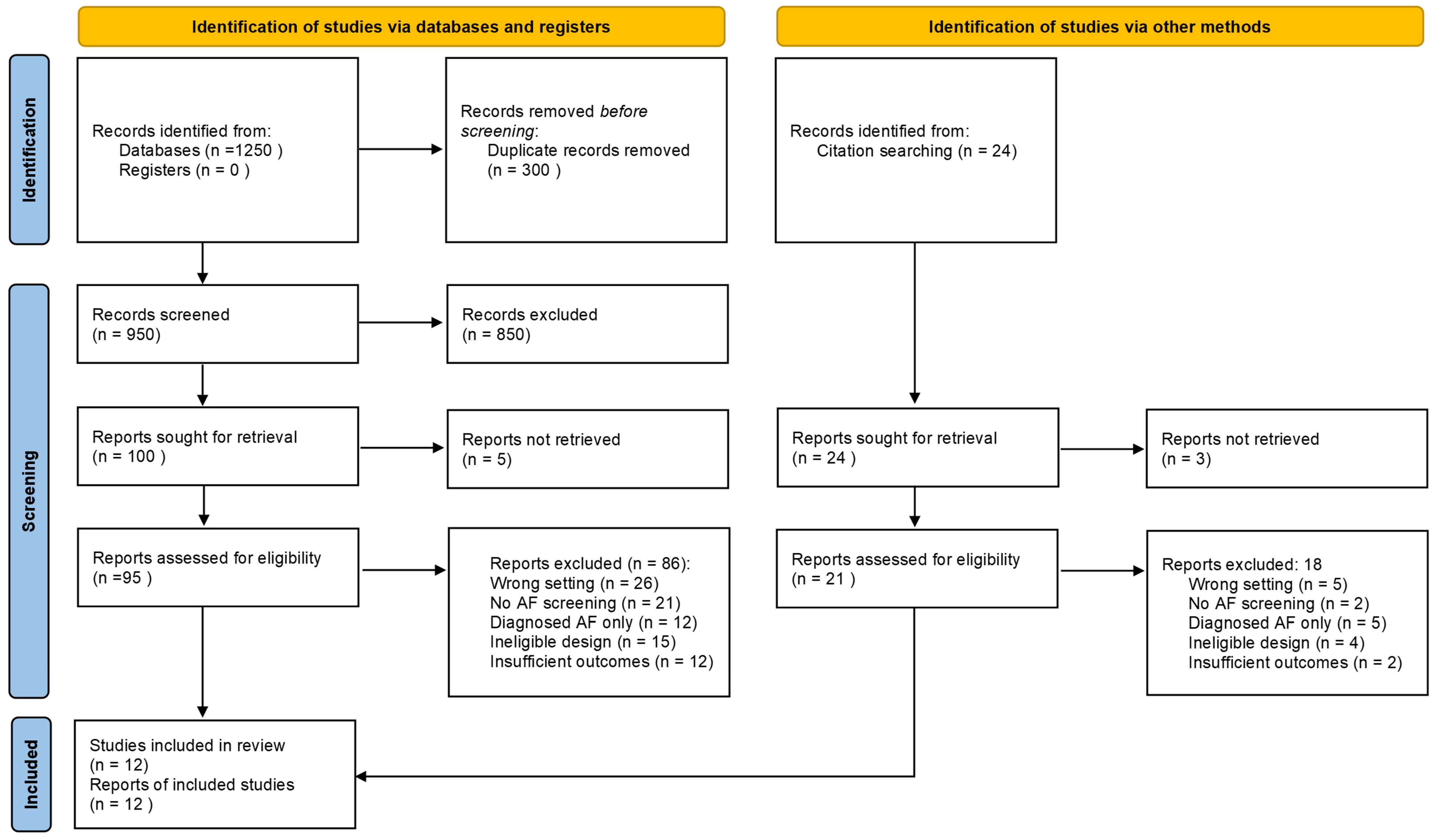
Overall, 116 full-text reports were assessed, of which 104 were excluded. The reasons for exclusion were incorrect study setting (n = 31), absence of AF screening (n = 23), inclusion of patients with previously diagnosed AF only (n = 17), ineligible study design (n = 19), and insufficient or non-extractable relevant outcomes (n = 14). The last category included studies that did not report separately extractable data on newly detected AF. Finally, 12 studies met the eligibility criteria and were included in the systematic review, with nine identified through database and register searches and three through citation searching. The complete study selection process is presented in Figure 1.
3.2. Characteristics of the Included Studies
The 12 included studies were published between 2014 and 2026 and involved a total of 23,702 individuals. The number of subjects in each sample varied from 63 to 7107. These studies took place in 10 different countries: Australia, Canada, France, Germany, Italy, Poland, Slovakia, Spain, the United Kingdom, and the United States. Two studies each were conducted in Spain and the United States, while one study was conducted in each of the remaining eight countries.
Observational research was the main type of evidence provided. The study designs consisted of cross-sectional studies, prospective cohort studies, community pharmacy service evaluations, feasibility studies, and retrospective studies of pharmacy screening campaigns. In one study, a quasi-experimental multicenter cross-sectional design was used. There were no randomized controlled trials.
Some studies included in this analysis had different eligibility criteria. Several studies only considered older adults (≥65 years), while others considered older adults (≥50 or ≥55 years) or individuals based on the presence of cardiovascular/metabolic risk factors. Adults ≥ 18 years old were included in one study. Most included studies excluded participants with previously diagnosed AF. However, some studies also reported outcomes involving participants with known AF or previously unrecognized recurrent AF. For the present review, only separately identifiable cases of previously undiagnosed AF were considered when reporting newly diagnosed AF, while other AF-related findings were reported separately.
Screening was conducted by pharmacists, student pharmacists, pharmacy staff, or other trained personnel, depending on the study. However, the specific personnel involved were not consistently reported across studies, limiting a detailed comparison of screening delivery roles.
A single-lead electrocardiogram with a handheld or smartphone device was the primary screening device used in eight studies for AF screening. Four studies employed automatic blood-pressure monitoring devices with an AF detection algorithm. In one of these studies, a two-step approach was taken by first measuring BP with the blood-pressure monitor and then evaluating the patient with a single-lead ECG. Screening was conducted primarily in an opportunistic manner, and it targeted adults at participating community pharmacies.
Methods of confirmation of abnormal screening results varied among studies. These included cardiology review of single-lead ECG recordings, general practitioner (GP) review, standard 12-lead ECG and Holter monitoring. Several studies reported only suspected or device-detected AF and did not report on the results of confirmatory testing. Referral and follow-up also ranged from structured pathways from the pharmacy to primary care to verbal advice for the participants to set up an independent medical consultation.
The characteristics of the studies included and the main observations are summarized in Table 1.
Table 1.
Characteristics and key findings of the included studies.
3.3. AF Screening Outcomes and Subsequent Clinical Actions
Seven studies involving 15,363 participants reported newly identified AF following clinical assessment, expert ECG interpretation, or screening-based detection. The reported detection rates ranged from 0.8% to 3.6%, although the methods of diagnosis and verification varied across studies. Twigg et al. reported 0.8% (five cases) of 594 participants [22] and García Agudo et al. reported 0.8% (six cases) of 784 participants [27]. Zaprutko et al. found seven new cases in 525 patients (1.33%) [18], and Olindo et al. found 53 new cases of AF in 4208 patients (1.26%) [19]. In 1000 patients, Lowres et al. identified 10 previously undiagnosed AF cases among 1000 participants (1.0%), along with five additional cases of previously unrecognized recurrent AF, giving a combined yield of 15/1000 (1.5%) [16]. Of the 1145 participants, Sandhu et al. detected 27 cases—a detection yield of 2.4%—[17] and Zink et al. detected 256 cases in 7107 participants—a detection yield of 3.6% [24]. Although the automated ECG findings underwent expert validation, the number of expert-confirmed AF cases specifically among the 256 participants without a previously reported AF diagnosis could not be separately established from the reported findings. Therefore, the 3.6% figure was interpreted as newly screen-detected AF rather than a definitive clinically confirmed AF yield.
Five studies involving 8339 participants reported suspected or device-detected AF without definitive diagnostic confirmation. Bacchini et al. found that 54 participants were screen-positive without a previous AF diagnosis in 3071 participants (1.8%) [23]. Three possible cases were reported among 63 participants (4.7%) by Bleske et al., [25] and 41 of 452 participants (9.1%) were reported as screen-positive by González Valdivieso et al. [14]. In the SAFE study, there were 12/650 (1.8%) AF devices read on patients, although the outcome of their previous AF diagnosis and subsequent diagnosis were not provided. Suspected AF was seen in 156 of 4103 participants (3.8%) by Stanko et al. [28] These findings were not confirmed according to the definition of AF but rather were considered positive screening results.
Zaprutko et al. followed up with the participants with documented AF on the cardiologist’s referral and recommended that they see their general practitioner, but they did not report follow-up results for diagnosis or treatment [18]. Bacchini et al. and González Valdivieso et al. referred screen-positive participants for medical evaluation without recording the outcome of the evaluation [14,23].
Referral and follow-up outcomes varied across the included studies. Although several studies reported referral for further clinical assessment, completion of diagnostic confirmation and subsequent treatment initiation were not consistently documented. Some studies reported initiation of anticoagulation or other treatment following AF detection, whereas others provided only screening or referral outcomes. Missing information was considered not reported rather than indicating that no events occurred. Available details on referral, diagnostic confirmation, treatment, and follow-up are summarized in Table 1.
3.4. Methodological Quality Assessment
The included studies were evaluated for methodological quality using the nine-item Joanna Briggs Institute Critical Appraisal Checklist for Studies Reporting Prevalence Data. Quality scores ranged from 4 to 7 out of 9. Six studies were classified as high quality and six as moderate quality, with no studies classified as low quality. The detailed methodological quality assessment of the included studies is presented in Table 2.
All studies included in the analysis were clearly described with regard to the study population and the study setting (community pharmacies), and the majority of the included participants were analyzed, screening procedures were standardized and generally appropriate statistical analyses were performed. None, however, adopted a sampling process based on probability. Opportunistic, consecutive or volunteer sampling of community pharmacy visitors was the main method for the recruitment of participants.
Another methodological weakness was the lack or lack of clarity of reporting participation rates. Few studies provided details on the overall number of potentially eligible visitors to a pharmacy approached or refused.
Table 2.
JBI methodological quality assessment of the included studies.
4. Discussion
4.1. Principal Findings and Interpretation
To assess the contribution of community pharmacies to the screening of adults with previously undiagnosed atrial fibrillation (AF), a systematic review of the literature was conducted that included 12 studies from 10 countries with a total of 23,702 participants. The results indicate that community pharmacy screening can be used to identify patients with potentially unsuspected AF and can also be used to refer patients for additional clinical evaluation. Across seven studies reporting newly identified AF through clinical assessment, expert ECG interpretation, or screening-based detection, the reported yields ranged from 0.8% to 3.6%. Five studies also reported a suspected or device-detected AF, but there was no definitive confirmation; screening rates were from 1.8% to 9.1%. While these results suggest that pharmacies may be a good place to screen, the populations screened, how it is done, and what happens to the results make it difficult to compare the yields of screening results across studies.
One significant finding was that the detection of potential AF did not always lead to a diagnosis and actual treatment. There were a few studies that showed the feasibility of brief rhythm assessment in the context of usual drug use, but little follow-up patient management was reported. This distinction is of clinical relevance as the potential advantage of screening relies on the completion of the entire care pathway, from confirmatory assessment to the evaluation of the risk of thromboembolism and appropriate decision-making about treatment. Thus, the available evidence supports the feasibility of case finding for AF in a pharmacy more than the effectiveness of case finding to enhance long-term cardiovascular outcomes.
4.2. Screening Strategies and Differences in Diagnostic Yield
The most common screening methods were handheld single-lead electrocardiography (ECG), and several studies used automated blood-pressure monitors with AF detection algorithms. Both technologies provided possibilities for adding rhythm assessment to pharmacy service without the need for the traditional ECGs in the first screening contact. The differences in detection rates reported, however, indicate that screening yield could have been affected by other factors than device selection.
Zink et al. [24] identified 256 newly screen-detected AF cases among 7107 participants (3.6%), with ECG findings undergoing expert validation, while the rates of detection in Twigg et al. and García Agudo et al. were about 0.8% [22,27]. The differences could be due to different recruitment methods, different baseline AF risk, different screening procedures, and the different ways in which AF is defined. There were several studies that primarily focused on older adults (65 years and older) and others that focused on younger adults who had cardiovascular and/or metabolic risk factors. The detection rates observed should thus be viewed as an indicator of performance of the various study populations and not as a measure of the relative efficacy of the respective screening technologies.
This distinction was particularly important in studies using automated blood-pressure monitors, where positive screening results were not always followed by definitive ECG confirmation. González Valdivieso et al. included participants without previously known AF and reported screening-positive results rather than clinically confirmed new diagnoses. Positive screening results were found in 9.1% of the participants in González Valdivieso et al. versus 1.8% in Bacchini et al. and 3.8% in Stanko et al. [14,23,28]. But no studies can confirm these findings to the satisfaction of the ECG. Their results are therefore not necessarily the proportion of people who were newly diagnosed with AF but, rather, the proportion of people who were identified for further investigation. This difference underscores the importance of interpreting results from devices and stresses the need to examine screening sensitivity, diagnostic confirmation, and clinical detection results individually.
The results also point to the need for common outcome measures. For example, AF was diagnosed in 15 (10 previously undiagnosed and five with unrecognized recurrent AF) participants by Lowres et al. [16]. Both groups could be considered for additional clinical workup, but recurrent AF in a diagnosed patient should not be treated as a first AF event. Likewise, when reporting on actionable AF, studies may contain patients with clinical situations other than newly diagnosed disease. These differences need to be preserved to calculate the contribution of community pharmacy screening to the identification of previously undiagnosed AF.
There is no evidence to conclude that any specific screening technology or recruitment strategy is better. Rather, it recommends that the usefulness of a screening program should be judged in terms of the other factors of the target population, the reliability of diagnostic interpretation, and the availability of follow-up clinical assessment.
4.3. Referral Pathways and Clinical Implications
Another consistent result of this review has been the spectrum of diagnostic confirmation and referral after a positive screening test result. Most of the studies reported a process for participants to be referred to medical practitioners, but follow-up was not always complete. A few screening programs included direct communication with primary-care physicians or expert interpretation of ECGs, while others included clinical reassessment or documentation of clinical reassessment but not always as part of a systematic process. These differences restrict the capacity of evaluating the rate of diagnosis and appropriate management based on pharmacy screening.
García Agudo et al. identified 36 possible AF cases among 784 screened participants, of whom 34 were referred for confirmatory assessment. AF was confirmed in six patients (6/34, 17.6% of those referred), and treatment was initiated in five [27]. In the same way, Twigg et al. found that all nine people with positive screening results were referred, with follow-up results only being available for seven [22]. Five of these patients went on to be diagnosed with AF and prescribed AF medications. These results confirm that screening in the pharmacy can be connected to the clinical assessment and treatment and also highlight the large gap between positive screening and actual diagnoses.
Other studies highlighted substantial gaps in continuity of care. The SAFE project identified 44 people with abnormal results who were referred for a physical assessment and for 10, pharmacist follow-up was documented. Bacchini et al., González Valdivieso et al., and Stanko et al., also identified those that needed additional evaluation but did not include full details on diagnostic outcomes [14,23,28]. Many positive screening results did not have a clear clinical implication, however. The lack of follow-up may be due to reporting problems, poor access to data from outside health care providers, or true gaps in the system of referrals; however, these cannot be differentiated due to the lack of data available.
Many of the potential clinical benefits of AF screening are closely linked to the prevention of thromboembolic complications by early detection and management. Both studies reported low rates of initiation of oral anticoagulation, with Lowres et al. reporting nine of 15 patients with newly identified or previously unrecognized recurrent AF treated with oral anticoagulation [16] and Sandhu et al. reporting five of 29 patients classified as having actionable AF treated with oral anticoagulation [17]. These results suggest that screening at the pharmacy can play a role in identifying those who then get treatment. However, treatment initiation alone cannot prove the effectiveness of screening in preventing stroke, as the studies failed to consistently evaluate long-term use of anticoagulants, compliance with treatment, bleeding side effects, or stroke outcomes.
These results collectively indicate that there is a role for the community pharmacist that is not limited to initial rhythm assessment. Pharmacists can also provide patient education, relay abnormal findings, and arrange medical referrals and provide encouragement to complete a diagnostic evaluation. But screening programs must have well-defined roles and effective communication between community pharmacy and other health professionals. Increased screening activity can create more referrals if not backed up by the corresponding improvement in diagnosis or clinical care, without these arrangements.
Beyond AF detection, appropriate clinical management should include stroke risk assessment, anticoagulation when indicated, and evaluation of associated cardiovascular conditions. Rehabilitation may also benefit selected patients with established AF and functional limitations. Mehani et al. (2024) investigated combined high-intensity interval training and inspiratory muscle training in patients with permanent AF and chronic heart failure, highlighting the potential role of rehabilitation in improving functional capacity and cardiovascular outcomes [29]. Although this evidence does not directly relate to pharmacy-based screening, it emphasizes the importance of comprehensive care following AF diagnosis.
4.4. Methodological Quality and Gaps in the Evidence
We found several limitations affecting confidence in our findings through methodological quality assessment. Based on the review-specific JBI quality-scoring thresholds, six studies were classified as high quality and six as moderate quality, while none were classified as low quality. While most of the studies effectively described their populations, settings, and screening procedures, certain problems were noted in participant sampling, reporting of participation rate, and diagnostic confirmation.
All included studies used non-probability sampling methods. Most of the participants were recruited using consecutive or opportunistic recruitment or from volunteers attending the participating pharmacies. All the above methods represent practical considerations of community pharmacy screening, but they also lead to the potential for selection bias. The people visiting pharmacies and agreeing to take part in the study may be different from the broader population in terms of age, cardiovascular risk, health awareness and health-seeking behaviors. Observed detection rates, therefore, do not necessarily reflect the prevalence of the condition in the population and cannot be used to interpret the data as prevalence estimates.
Reporting of recruitment denominators and participation rates was limited and inconsistent across the included studies. Few studies provided sufficient information on the number of eligible pharmacy visitors approached, the proportion declining participation, or the overall screening participation rate. This limits assessment of potential selection bias and the representativeness of the screened populations. Five studies also failed to collect and/or report clinical ECG confirmation of a positive screening result, adding to the uncertainty around the accuracy of AF screening detection results.
The validity of the evidence was limited by differences in study design. All the literature included was observational investigations, feasibility studies, and service evaluations, and there were no randomized controlled trials. These designs provide useful information on implementation and screening yield but have limited evidence on the effectiveness of community pharmacy screening compared to usual care. More importantly, the eligibility requirements, screening methods, confirmation tests and the period of follow-up differed and thus could not be meaningfully pooled quantitatively.
Based on the available evidence, the practical potential of AF screening performed in the pharmacy setting is supported, but not enough evidence exists to directly compare the clinical effectiveness of AF screening performed in the pharmacy setting with other screening modalities. To address these uncertainties, some of these issues require more rigorous study designs, consistent definitions of diagnosis, and standardized reporting of patient outcomes.
4.5. Strengths and Limitations of the Review
There are a number of strengths to this systematic review. It has a focus on screening in community pharmacies, offering a context-specific evidence evaluation that is relevant to the practice of the community pharmacy. Studies from 10 countries were included, which allowed for consideration of screening programs in different healthcare settings. In addition to reviewing screening rates, the review also explored the process of diagnosis following a positive screen, as well as referral to services and subsequent clinical interventions.
Another advantage was the separate presentation of suspected AF and device-detected AF in comparison to newly detected AF after clinical evaluation. This separation decreased the odds of all positive screening results being accepted as actual diagnoses. The standardized JBI appraisal checklist also helped the identification of common methodological limitations present in the included studies.
However, there are some drawbacks to consider. The significant differences in variables measured among the studies, screening methods used, definitions of outcomes, and methods of follow-up made meta-analysis and comparisons of study results difficult. Restricting the review to English-language publications may have introduced language bias, as relevant studies published in other languages may have been missed. In addition, the evidence included was from a limited sample of countries and may therefore not be as relevant to other health systems with varying pharmacy services, professional scope and referral systems.
Additional limitations were found because of the reliance on published information related to the study level. Diagnostic and follow-up outcomes were not reconstructed for those who did not complete them and were difficult to differentiate for participants who did not complete clinical assessment and those for whom outcomes were not available to investigators. Finally, the numerical quality categories that were applied to this review were at review-specific thresholds; they should be read in conjunction with the individual appraisal domains and should not be used as official classifications from the JBI.
4.6. Implications for Pharmacy Practice and Future Research
The results have implications for the development of community pharmacy-based cardiovascular prevention services. Decades-long associations between older adults and those using the health care system for cardiovascular and metabolic treatment provide opportunities for AF screening. Portable ECG machines and blood-pressure monitors that can detect AF could help this to happen, especially if screening is integrated into existing pharmacy services. The focus for implementation should be on the screening pathway being complete and not the number of people screened.
Future pharmacy programs should have uniform guidelines for what types of participants should be included, what screening methods should be used, how positive results are interpreted, how to refer to diagnosis, and required follow-up documentation. Better linking with primary care services could better facilitate continuity of care and ensure that people with suspected AF receive the right clinical assessment for diagnosis. Staff training, service acceptability, workflow, reimbursement and resources needed to sustain screening activities in routine practice should also be explored.
There is a need for further research that will focus on controlled and sufficiently powered studies that compare the effectiveness of pharmacy-based screening to usual care and/or alternative screening methods. Standardization of the number of participants approached, screened, testing positive, referred, diagnosed with AF, and who started treatment would facilitate comparison between studies. Costs should be reviewed, including costs for screening equipment, pharmacist time and further investigations for confirmation, and follow-up care, and the implications of a false positive and incomplete follow-up should be considered.
Long-term studies are also required to verify if the clinical outcomes and outcomes of detection of AF via pharmacies improve over time. Outcomes must go beyond screening yield to treatment initiation and persistence, incidence of stroke, bleeding events, hospitalization, and patient-reported outcomes. All of this would contribute to determining if community pharmacy screening offers substantial benefits over existing methods of detection and which service models are best suited to delivering timely, appropriate diagnostic and clinical benefit.
Overall, these results indicate that community pharmacies could provide a practical environment for the detection of potential and undiagnosed AF. Screening yield is not complete, however, as a measure of program success. The major challenge is to ensure that positive findings translate to valid diagnostic confirmation, proper clinical management and clinically meaningful patient outcomes.
5. Conclusions
The findings from this systematic review suggest that screening for previously undiagnosed atrial fibrillation (AF) is a viable strategy to be implemented within a community pharmacy setting, especially for older people and people with cardiovascular risk factors. In the 12 studies included in this study, the detection rate of newly identified AF following clinical evaluation or expert ECG interpretation ranged from 0.8% to 3.6%, whereas the studies without definite diagnostic confirmation showed varying proportions of suspected AF. Handheld electrocardiographic devices and automated blood-pressure monitors were used to conduct screening in community pharmacies, but this process led to variations in screening procedures, diagnostic work-up and referral patterns that affected the interpretation of screening results. The lack of follow-up and variable reporting of treatment outcomes further restricted the assessment of clinical effectiveness. Although the available evidence supports the feasibility of community pharmacy-based AF screening, it does not establish that screening improves long-term clinical outcomes, including stroke prevention, hospitalization, or mortality, compared with usual care. The completed PRISMA 2020 checklist is provided in Supplementary Table S1. This is mainly due to the observational nature of the included studies, the absence of randomized controlled trials, and limited reporting of long-term outcomes. The benefits of screening in the community will rely on timely diagnostic confirmation and appropriate management thereafter but may include the identification of AF earlier and improving access to medical evaluation. Routine screening and referral systems, comprehensive study designs that can compare AF screening effectiveness, and long-term clinical outcomes research should be emphasized in future research to confirm the effectiveness, cost-effectiveness, and sustainability of AF screening in community pharmacies as a component of cardiovascular prevention services.
Supplementary Materials
The following supporting information can be downloaded at: https://www.mdpi.com/article/10.3390/healthcare14234101/s1, Table S1: PRISMA 2020 checklist for systematic reviews; Table S2: Detailed search strategies for electronic databases.
Author Contributions
Conceptualization, M.Z.I. and S.A.A.-Q.; methodology, M.Z.I. and S.A.A.-Q.; validation, M.Z.I. and S.A.A.-Q.; formal analysis, M.Z.I. and S.A.A.-Q.; investigation, M.Z.I. and S.A.A.-Q.; data curation, M.Z.I. and S.A.A.-Q.; writing—original draft preparation, M.Z.I.; writing—review and editing, M.Z.I. and S.A.A.-Q.; supervision, S.A.A.-Q.; project administration, M.Z.I.; funding acquisition, M.Z.I. All authors have read and agreed to the published version of the manuscript.
Funding
The authors extend their appreciation to the Deanship of Research and Graduate Studies at King Khalid University for funding this work through the Large Research Groups Program under grant number RGP2/127/47.
Institutional Review Board Statement
Not applicable. This study is a systematic review based exclusively on previously published studies and did not involve the recruitment of human participants, collection of identifiable personal information, or generation of new primary data. Therefore, institutional ethical approval was not required.
Informed Consent Statement
Not applicable. This study is a systematic review based exclusively on the previously published literature and did not involve direct participation of human subjects or collection of individual patient data. Therefore, informed consent was not required.
Data Availability Statement
No new data were created or analyzed in this study. Data sharing is not applicable to this article.
Acknowledgments
King Khalid University’s Deanship of Scientific Research generously supported this study, and the authors are very grateful.
Conflicts of Interest
The authors declare no conflicts of interest.
References
- Lippi, G.; Sanchis-Gomar, F.; Cervellin, G. Global epidemiology of atrial fibrillation: An increasing epidemic and public health challenge. Int. J. Stroke Off. J. Int. Stroke Soc. 2021, 16, 217–221. [Google Scholar] [CrossRef] [Scilit] [PubMed]
- Li, X.; Liu, Z.; Jiang, X.; Xia, R.; Li, Y.; Pan, X.; Yao, Y.; Fan, X. Global, regional, and national burdens of atrial fibrillation/flutter from 1990 to 2019: An age-period-cohort analysis using the Global Burden of Disease 2019 study. J. Glob. Health 2023, 13, 04154. [Google Scholar] [CrossRef] [Scilit] [PubMed]
- Van Gelder, I.C.; Rienstra, M.; Bunting, K.V.; Casado-Arroyo, R.; Caso, V.; Crijns, H.J.G.M.; De Potter, T.J.R.; Dwight, J.; Guasti, L.; Hanke, T.; et al. ESC Scientific Document Group 2024 ESC Guidelines for the management of atrial fibrillation developed in collaboration with the European Association for Cardio-Thoracic Surgery (EACTS). Eur. Heart J. 2024, 45, 3314–3414. [Google Scholar] [CrossRef] [Scilit] [PubMed]
- Turakhia, M.P.; Shafrin, J.; Bognar, K.; Goldman, D.P.; Mendys, P.M.; Abdulsattar, Y.; Wiederkehr, D.; Trocio, J. Economic Burden of Undiagnosed Nonvalvular Atrial Fibrillation in the United States. Am. J. Cardiol. 2015, 116, 733–739. [Google Scholar] [CrossRef] [Scilit] [PubMed]
- Gahungu, N.; Trueick, R.; Coopes, M.; Gabbay, E. Paroxysmal atrial fibrillation. BMJ 2021, 375, e058568. [Google Scholar] [CrossRef] [Scilit] [PubMed]
- Boriani, G.; Vitolo, M.; Lane, D.A.; Potpara, T.S.; Lip, G.Y. Beyond the 2020 guidelines on atrial fibrillation of the European society of cardiology. Eur. J. Intern. Med. 2021, 86, 1–11. [Google Scholar] [CrossRef] [Scilit] [PubMed]
- Askarinejad, A.; Lane, D.A.; Sadeghipour, P.; Haghjoo, M.; Lip, G.Y.H. Stroke prevention in atrial fibrillation: A narrative review of current evidence and emerging strategies. Eur. J. Clin. Investig. 2025, 55, e70082. [Google Scholar] [CrossRef] [Scilit] [PubMed]
- Steffel, J.; Collins, R.; Antz, M.; Cornu, P.; Desteghe, L.; Haeusler, K.G.; Oldgren, J.; Reinecke, H.; Roldan-Schilling, V.; Rowell, N.; et al. 2021 European Heart Rhythm Association Practical Guide on the Use of Non-Vitamin K Antagonist Oral Anticoagulants in Patients with Atrial Fibrillation. Europace 2021, 23, 1612–1676. [Google Scholar] [CrossRef] [Scilit] [PubMed]
- Rubiera, M.; Aires, A.; Antonenko, K.; Lémeret, S.; Nolte, C.H.; Putaala, J.; Schnabel, R.B.; Tuladhar, A.M.; Werring, D.J.; Zeraatkar, D.; et al. European Stroke Organisation (ESO) guideline on screening for subclinical atrial fibrillation after stroke or transient ischaemic attack of undetermined origin. Eur. Stroke J. 2022, 7, VI. [Google Scholar] [CrossRef] [Scilit] [PubMed]
- Freedman, B.; Hindricks, G.; Banerjee, A.; Baranchuk, A.; Ching, C.K.; Du, X.; Fitzsimons, D.; Healey, J.S.; Ikeda, T.; Lobban, T.C.A.; et al. World heart federation roadmap on atrial fibrillation–a 2020 update. Glob. Heart 2021, 16, 41. [Google Scholar] [CrossRef] [Scilit] [PubMed]
- Banerjee, D.; Dey, S.; Pal, A. Atrial fibrillation detector from ECG on wearable edge devices using spiking neural networks. In 2024 International Joint Conference on Neural Networks (IJCNN); IEEE: New York, NY, USA, 2024; pp. 1–8. [Google Scholar]
- Siontis, K.C.; Yao, X.; Pirruccello, J.P.; Philippakis, A.A.; Noseworthy, P.A. How will machine learning inform the clinical care of atrial fibrillation? Circ. Res. 2020, 127, 155–169. [Google Scholar] [CrossRef] [Scilit] [PubMed]
- Sakamoto, T.; Tateishi, Y.; Kurobe, M.; Yahata, H.; Miyakoda, M.; Kodama, Y.; Tsujino, A.; Maemura, K.; Ohyama, K.; Ikeda, S. Pharmacy-Based Atrial Fibrillation Screening Model Coordinated by a Regional Stroke and Cardiovascular Disease Support Center: The Catch AF Project. Circ. Rep. 2026, 8, 1131–1140. [Google Scholar] [CrossRef] [Scilit] [PubMed]
- Valdivieso, M.G.; Orozco-Beltrán, D.; López-Pineda, A.; Gil-Guillén, V.F.; Quesada, J.A.; Carratalá-Munuera, C.; Nouni-García, R. Early Detection of Atrial Fibrillation in Community Pharmacies-CRIFAFARMA Study. J. Cardiovasc. Pharmacol. Ther. 2022, 27, 10742484221078973. [Google Scholar] [CrossRef] [Scilit] [PubMed]
- Chan, N.Y.; Orchard, J.; Agbayani, M.J.; Boddington, D.; Chao, T.F.; Johar, S.; John, B.; Joung, B.; Krishinan, S.; Krittayaphong, R.; et al. 2021 Asia Pacific Heart Rhythm Society (APHRS) practice guidance on atrial fibrillation screening. J. Arrhythmia 2021, 38, 31–49. [Google Scholar] [CrossRef] [Scilit] [PubMed]
- Lowres, N.; Neubeck, L.; Salkeld, G.; Krass, I.; McLachlan, A.J.; Redfern, J.; Bennett, A.A.; Briffa, T.; Bauman, A.; Martinez, C.; et al. Feasibility and cost-effectiveness of stroke prevention through community screening for atrial fibrillation using iPhone ECG in pharmacies: The SEARCH-AF study. Thromb. Haemost. 2014, 111, 1167–1176. [Google Scholar] [CrossRef] [Scilit] [PubMed]
- Sandhu, R.K.; Dolovich, L.; Deif, B.; Barake, W.; Agarwal, G.; Grinvalds, A.; Lim, T.; Quinn, F.R.; Gladstone, D.; Conen, D.; et al. High prevalence of modifiable stroke risk factors identified in a pharmacy-based screening programme. Open Heart 2016, 3, e000515. [Google Scholar] [CrossRef] [Scilit] [PubMed]
- Zaprutko, T.; Zaprutko, J.; Baszko, A.; Sawicka, D.; Szałek, A.; Dymecka, M.; Telec, W.; Kopciuch, D.; Ratajczak, P.; Michalak, M.; et al. Feasibility of Atrial Fibrillation Screening With Mobile Health Technologies at Pharmacies. J. Cardiovasc. Pharmacol. Ther. 2020, 25, 142–151. [Google Scholar] [CrossRef] [Scilit] [PubMed]
- Olindo, S.; Renou, P.; Martial, F.; Heyvang, N.; Milan, L.; Ledure, S.; Rouanet, F. Pharmacy-based opportunistic atrial fibrillation screening at a community level: A real-life study. Healthcare 2022, 10, 90. [Google Scholar] [CrossRef] [Scilit] [PubMed]
- Munn, Z.; Moola, S.; Lisy, K.; Riitano, D.; Tufanaru, C. Chapter 5: Systematic reviews of prevalence and incidence. In JBI Manual for Evidence Synthesis; Aroma-taris, E., Munn, Z., Eds.; JBI: North Adelaide, Australia, 2020. [Google Scholar]
- Page, M.J.; McKenzie, J.E.; Bossuyt, P.M.; Boutron, I.; Hoffmann, T.C.; Mulrow, C.D.; Shamseer, L.; Tetzlaff, J.M.; Akl, E.A.; Brennan, S.E.; et al. The PRISMA 2020 statement: An updated guideline for reporting systematic reviews. BMJ 2021, 372, n71. [Google Scholar] [CrossRef] [Scilit] [PubMed] [PubMed Central]
- Twigg, M.J.; Thornley, T.; Scobie, N. Identification of patients with atrial fibrillation in UK community pharmacy: An evaluation of a new service. Int. J. Clin. Pharm. 2016, 38, 784–787. [Google Scholar] [CrossRef] [Scilit] [PubMed]
- Bacchini, M.; Bonometti, S.; Del Zotti, F.; Lechi, A.; Realdon, F.; Fava, C.; Minuz, P. Opportunistic Screening for Atrial Fibrillation in the Pharmacies: A Population-Based Cross-Sectional Study. High Blood Press. Cardiovasc. Prev. 2019, 26, 339–344. [Google Scholar] [CrossRef] [Scilit] [PubMed]
- Zink, M.D.; Mischke, K.G.; Keszei, A.P.; Rummey, C.; Freedman, B.; Neumann, G.; Tolksdorf, A.; Frank, F.; Wienströer, J.; Kuth, N.; et al. Screen-detected atrial fibrillation predicts mortality in elderly subjects. Europace 2021, 23, 29–38. [Google Scholar] [CrossRef] [Scilit] [PubMed]
- Bleske, B.E.; Raley, R.E.; Hunter, T.S.; Anderson, J.R. Curricular-driven screening for atrial fibrillation at community pharmacies. J. Am. Pharm. Assoc. 2022, 62, 541–545.e1. [Google Scholar] [CrossRef] [Scilit] [PubMed]
- Little, J.; Bonham, A.; Bluml, B. Solutions For Atrial Fibrillation Edvocacy (SAFE): Improving Awareness And Access To Afib Screening For Detection And Referral For Treatment. Inov. Pharm. 2023, 14, 14. [Google Scholar] [CrossRef] [Scilit] [PubMed]
- Agudo, Ó.G.; González, R.F.; Gil, M.G.; Cotino, E.G.; Montejano, M.V.; Ferrando, Á.P.; Crespo, I.R.; Igual, S.G. Screening for undiagnosed atrial fibrillation in community pharmacies using mobile electrocardiogram technology: A quasi-experimental cross-sectional study (PREVENIM ICTUS). BMC Prim. Care 2026, 27, 76. [Google Scholar] [CrossRef] [Scilit] [PubMed]
- Stanko, P.; Macekova, Z.; Zufkova, V.; Snopkova, M.; Klimas, J.; Fazekas, T. Blood Pressure Monitors in Screening of Atrial Fibrillation by Community Pharmacists: Data from a Nationwide Awareness Campaign. Bratisl. Med. J. 2026, 127, 3023–3033. [Google Scholar] [CrossRef] [Scilit]
- Mehani, S.H.M.; Helmy, Z.M.; Adel, W.; Mohamed, M.I. Revealing the role of high-intensity interval training combined with inspiratory muscle training on atrial fibrillation associated with chronic heart failure: Is there a shift towards anti-remodelling adaptation? Eur. J. Prev. Cardiol. 2024, 31, 1420–1424. [Google Scholar] [CrossRef] [Scilit] [PubMed]

Disclaimer/Publisher’s Note: The statements, opinions and data contained in all publications are solely those of the individual author(s) and contributor(s) and not of MDPI and/or the editor(s). MDPI and/or the editor(s) disclaim responsibility for any injury to people or property resulting from any ideas, methods, instructions or products referred to in the content. |
© 2026 by the authors. Licensee MDPI, Basel, Switzerland. This article is an open access article distributed under the terms and conditions of the Creative Commons Attribution (CC BY) license.