


Abstract
Background: Burnout and work engagement among healthcare workers are shaped by the interplay between occupational demands and available resources, particularly during periods of sustained organizational strain. Objectives: This cross-sectional study examined associations among burnout, work engagement, occupational pressure, and perceived support among healthcare professionals and other hospital staff in Romania during the third wave of the COVID-19 pandemic. Methods: A total of 1657 participants provided questionnaire data. We assessed burnout and work engagement using the Burnout Assessment Tool (BAT) and Utrecht Work Engagement Scale (UWES), respectively, along with context-specific measures of occupational pressure and perceived support. Exploratory factor analysis supported an overall occupational-pressure score and two support dimensions, termed institutional and interpersonal support. Results: In adjusted multiple linear regression models, occupational pressure was positively associated with burnout (B = 0.217, 95% CI [0.184, 0.250]) and negatively associated with work engagement (B = −0.127, 95% CI [−0.189, −0.066]). Institutional support was associated with lower burnout (B = −0.104, 95% CI [−0.140, −0.067]) and higher work engagement (B = 0.220, 95% CI [0.161, 0.279]); interpersonal support showed similar associations. K-means cluster analysis identified two contrasting profiles: a lower-strain/higher-resources profile and a higher-strain/lower-resources profile, both with high bootstrap stability. Conclusions: These findings indicate that occupational pressure and multiple sources of perceived support are associated with burnout and work engagement, and that demands and resources should be considered jointly when examining occupational well-being among hospital personnel.
1. Introduction
Burnout is an occupational phenomenon associated with prolonged exposure to work-related stressors and has been documented across a wide range of occupations [1,2,3]. Its potential consequences extend beyond individual well-being to absenteeism, impaired work functioning, and adverse physical and mental health outcomes [1,4,5]. The World Health Organization recognizes burnout in ICD-11 as an occupational phenomenon rather than a medical condition [6].
Healthcare professionals are particularly exposed to demanding work environments. Before and during the COVID-19 pandemic, high workload, emotional demands, organizational constraints, and sustained exposure to patient suffering were associated with burnout and other indicators of occupational strain among physicians, nurses, and other healthcare personnel [1,4,5,7,8,9,10,11,12,13]. The pandemic intensified these demands while disrupting established work routines and organizational resources [7,14].
The Job Demands–Resources (JD-R) model provides a widely used framework for understanding occupational well-being [15,16,17,18,19,20]. In this framework, job demands are aspects of work that require sustained effort and are therefore associated with physiological or psychological costs, whereas job resources can support goal attainment, reduce the impact of demands, and foster motivation and work engagement [15,16,17,18,19,21]. Longitudinal evidence broadly supports the relevance of the JD-R framework across occupational settings, while also indicating that relationships between job characteristics and employee well-being may be reciprocal and context-dependent [20].
The Romanian healthcare system provides a relevant context for examining these relationships. Workforce constraints, resource limitations, and organizational pressures have been documented in the Romanian health sector [22,23], and studies conducted both before and during the COVID-19 pandemic have reported substantial burnout among Romanian physicians, nurses, and medical residents [23,24,25,26,27]. However, less is known about how context-specific occupational pressures and different sources of perceived support jointly relate to both burnout and work engagement, or whether these indicators co-occur in distinct empirical profiles among hospital personnel. Although the data were collected during the COVID-19 pandemic, their relevance lies primarily in examining demand–resource relationships under conditions of sustained organizational strain rather than in estimating the current prevalence of burnout among Romanian healthcare workers.
Accordingly, the present study examined associations between occupational pressure and perceived support, burnout, and work engagement among Romanian healthcare professionals and other hospital staff during the third wave of the COVID-19 pandemic. We also examined whether the joint configuration of burnout, work engagement, occupational pressure, and perceived support revealed distinct empirical profiles. Guided by the JD-R framework, the study combined variable-centered regression analyses with an exploratory person-centered cluster analysis to characterize both average associations and multivariate patterns within the sample.
2. Materials and Methods
2.1. Participants and Procedure
This cross-sectional study was conducted between February and May, during the third wave of the COVID-19 pandemic in Romania. The study included healthcare professionals and other hospital staff working in public hospitals in one Romanian county and involved in caring for COVID-19 and non-COVID-19 patients. A total of 1657 participants provided questionnaire data. Questionnaires were administered in paper-and-pencil format and distributed to hospital staff through the head nurses of the participating departments. The exact number of staff members who received a questionnaire was not recorded; consequently, a response rate could not be calculated. Participation was voluntary; no additional exclusion criteria were applied. The recruitment procedure included several hospitals and professional categories, including physicians, resident physicians, nurses, nursing assistants, and other clinical, technical, and administrative staff.
2.2. Measures
2.2.1. Burnout and Work Engagement
Burnout was assessed using the 33-item Burnout Assessment Tool (BAT) [28,29]. The BAT comprises four core dimensions—exhaustion (8 items), mental distance (5 items), cognitive impairment (5 items), and emotional impairment (5 items)—and two secondary symptom dimensions, psychological distress and psychosomatic complaints (5 items each). Items are rated on a five-point scale ranging from 1 (never) to 5 (always). In the present study, burnout was operationalized as the mean of the 23 core items, with higher scores indicating higher levels of burnout. The secondary symptom dimensions were not included in the primary burnout score and were not included in the current analyses. Internal consistency was α = 0.899 for exhaustion, α = 0.689 for mental distance, α = 0.821 for cognitive impairment, α = 0.847 for emotional impairment, and α = 0.925 for the overall core burnout score.
Work engagement was assessed using the 17-item Utrecht Work Engagement Scale (UWES) [30], comprising vigor, dedication, and absorption. Items are rated on a seven-point frequency scale ranging from 0 (never) to 6 (every day). The overall work-engagement score was calculated as the mean of the 17 items, with higher scores indicating greater work engagement. Internal consistency was α = 0.803 for vigor, α = 0.823 for dedication, α = 0.722 for absorption, and α = 0.905 for the total score.
2.2.2. Occupational Pressure and Perceived Support
Context-specific items were developed to assess occupational demands and resources relevant to healthcare work during the COVID-19 pandemic. Their development was informed by the Job Demands–Resources framework [19,20] and by input from healthcare professionals and hospital management representatives. The complete wording of the items is provided in the Appendix A.
Occupational pressure was assessed using seven items rated from 1 (very low pressure) to 5 (very high pressure). The items addressed daily professional demands, organizational and management demands, working conditions, adequacy of work resources, work–life and family balance, malpractice risk, and legislative and professional requirements associated with the pandemic.
Perceived support was assessed using seven items rated from 1 (very low support) to 5 (very high support). Participants evaluated support received from colleagues, direct supervisors, institutional management, professional organizations and institutions, family, friends, and the church. Because the pressure and support items were developed specifically for this study, their dimensionality was examined empirically before composite scores were constructed, as described in Section 2.4.
2.2.3. Additional Variables
The questionnaire included four self-evaluation items rated from 0 (minimum) to 100 (maximum), assessing perceived professional performance, professional dedication and involvement, job satisfaction, and satisfaction with the employing institution. These items were part of the questionnaire but were not included in the analyses.
Sociodemographic and occupational information included age, gender, marital status, educational level, monthly net income, occupational category, employing hospital and department, years of experience in the current occupation, and years of experience at the current workplace. COVID-19-related items assessed current occupational exposure to patients with diagnosed or suspected COVID-19, occupational exposure during the previous 12 months, previous COVID-19 diagnosis, suspected previous infection without diagnosis, and vaccination status.
Age, gender, occupational category, hospital, years of occupational experience, and current occupational exposure to COVID-19 were included as covariates in the adjusted regression models. The remaining variables were used to characterize the sample and are reported descriptively where relevant.
2.3. Ethical Considerations
Participation was voluntary, and participant data were handled confidentially and stored without direct personal identifiers. The study protocol was reviewed and approved by the Ethics Committees of the participating institutions (approval reference no. 22011/14 September 2020). Completion and return of the questionnaire constituted informed consent to participate in the study and to the processing of the data for research purposes.
2.4. Statistical Analysis
Scale scores were calculated as item means, with scores computed only when all items contributing to the respective scale were available. No item-level imputation or prorating was performed. Because the context-specific pressure and support items were rated on five-point ordinal scales, their dimensionality was examined using exploratory factor analysis based on polychoric correlation matrices. Factor retention was evaluated using parallel analysis together with the strength and interpretability of the loading patterns and solution parsimony. Factors were extracted using minimum residual estimation, with oblimin rotation for multidimensional solutions. Based on the overall pattern of evidence, a single occupational-pressure score and two support scores—representing institutional and interpersonal support—were retained for subsequent analyses.
Descriptive statistics and Pearson correlations were calculated for burnout, work engagement, occupational pressure, institutional support, and interpersonal support. Sample characteristics were summarized using means and standard deviations or medians and interquartile ranges for continuous variables, as appropriate, and frequencies and percentages for categorical variables.
Associations of occupational pressure and support with burnout and work engagement were examined using separate multiple linear regression models. For each outcome, Model 1 included occupational pressure, institutional support, and interpersonal support. Model 2 additionally adjusted for age, gender, occupational category, hospital, years of occupational experience, and current occupational exposure to COVID-19. Unstandardized regression coefficients are reported with 95% confidence intervals and p-values. HC3 heteroskedasticity-robust standard errors were used, and model fit was summarized using R2 and adjusted R2. Regression diagnostics included visual inspection of residual and influence diagnostics, assessment of multicollinearity, and tests of heteroskedasticity. Analyses were based on complete cases for the variables included in each model.
To examine whether participants formed distinct profiles across the focal study variables, k-means clustering was conducted using burnout, work engagement, occupational pressure, institutional support, and interpersonal support. Participants with complete data on all five variables were included in this analysis (N = 1211). Variables were standardized before clustering, and Euclidean distance was used. Candidate solutions containing two to six clusters were evaluated using average silhouette width and multiple internal validity criteria. The final number of clusters was selected based on the combined evidence from these indices and solution parsimony. The retained k-means solution was estimated using 100 random starts. Cluster robustness was subsequently assessed using 500 bootstrap resamples, with mean Jaccard similarity used to quantify the stability of each recovered profile. Analyses were conducted in R version 4.6.1 (R Core Team, 2026) [29].
3. Results
3.1. Sample Characteristics
The study included 1657 participants. Participants ranged in age from 19 to 67 years, with a mean age of 42.6 years (SD = 10.0) and a median age of 44 years. Nurses constituted the largest occupational group, and most participants were employed at the County Emergency Hospital. Median experience in the current occupation was 12 years (IQR = 4–23). Full demographic and occupational characteristics are presented in Table 1; additional sociodemographic, occupational, and COVID-19-related characteristics are reported in Table A1.
Table 1.
Demographic and occupational characteristics of the study sample.
Because scale scores were calculated only when all constituent items were available, the number of observations varied across the focal measures. Complete scores were available for 1395 participants for burnout, 1501 for work engagement, 1497 for occupational pressure, 1494 for institutional support, and 1604 for interpersonal support.
3.2. Structure of the Occupational Pressure and Support Measures
Sampling adequacy was satisfactory for both sets of items. For occupational pressure, the Kaiser–Meyer–Olkin (KMO) measure was 0.884, and Bartlett’s test of sphericity was significant, χ2(21) = 5550.94, p < 0.001. Similarly, for perceived support, the KMO was 0.779, and Bartlett’s test was significant, χ2(21) = 5567.32, p < 0.001.
Parallel analysis indicated three factors for the occupational-pressure items. Although the three-factor solution showed better overall fit, the additional factors were not consistently well defined, with one factor primarily associated with malpractice pressure and showing a near-zero uniqueness estimate. In contrast, the one-factor solution showed substantial loadings for all seven items, ranging from 0.61 to 0.83, and accounted for 55% of the variance. The resulting occupational-pressure score showed good internal consistency (Cronbach’s α = 0.863). Given the strength of the general factor, the conceptual coherence of the items as indicators of overall occupational pressure, solution parsimony, and the limited interpretability of additional factors, we retained a single pressure score for subsequent analyses.
Parallel analysis also indicated three factors for the support items. Although the three-factor solution showed better fit, it included cross-loadings, near-zero uniqueness estimates, and factors defined by relatively few indicators. A two-factor oblique solution was retained because it provided a broader, interpretable distinction between institutional and interpersonal sources of support. Support from the direct supervisor, institutional management, professional institutions, and the church loaded primarily on the institutional-support factor, whereas support from colleagues, family, and friends loaded primarily on the interpersonal-support factor. The two factors accounted for 63% of the variance and were moderately correlated (r = 0.40). Internal consistency was α = 0.753 for institutional support and α = 0.730 for interpersonal support.
Accordingly, occupational pressure, institutional support, and interpersonal support were used as the context-specific variables in the subsequent analyses. Given the exploratory nature of these study-specific measures and the limitations of the retained factor solutions, the resulting scores were treated as descriptive composites rather than established latent dimensions. Comparisons of the alternative factor solutions, including model fit statistics and loading matrices, are presented in the Appendix A.
3.3. Descriptive Statistics and Bivariate Correlations
Descriptive statistics and zero-order correlations among the focal study variables are presented in Table 2. Burnout was negatively associated with work engagement and positively associated with occupational pressure. Higher burnout was also associated with lower institutional support and lower interpersonal support (Table 2). Work engagement was negatively associated with occupational pressure and positively associated with institutional support and interpersonal support. Institutional and interpersonal support were positively correlated. Associations between occupational pressure and institutional support and interpersonal support were small.
Table 2.
Descriptive statistics and correlations among burnout, work engagement, occupational pressure, and support.
3.4. Associations of Occupational Pressure and Support with Burnout and Work Engagement
Regression results are presented in Table 3. Across both models, greater occupational pressure was associated with higher burnout and lower work engagement, whereas greater institutional and interpersonal support were associated with lower burnout and higher work engagement. These associations remained similar after adjustment for age, gender, occupational category, hospital, occupational experience, and current occupational exposure to COVID-19. The adjusted models explained 25.4% of the variance in burnout and 16.9% of the variance in work engagement. Full estimates for the adjustment variables are reported in the Appendix A. Because Models 1 and 2 were based on different complete-case samples, differences in R2 were not interpreted as incremental variance explained.
Table 3.
Associations of occupational pressure and support with burnout and work engagement.
The adjusted regression models included 1013 participants for burnout and 1058 for work engagement, corresponding to 61.1% and 63.9% of the original sample, respectively. Comparisons between included and excluded participants indicated differences primarily in hospital affiliation (standardized differences of 1.22 and 1.16, respectively) and occupational category (0.28 and 0.32). Participants from the County Emergency Hospital were disproportionately represented among those excluded, accounting for approximately 92% of excluded cases in both models. Differences in available burnout, work engagement, occupational pressure, and support scores were comparatively small (absolute standardized differences ≤ 0.14).
3.5. Burnout–Engagement Profiles
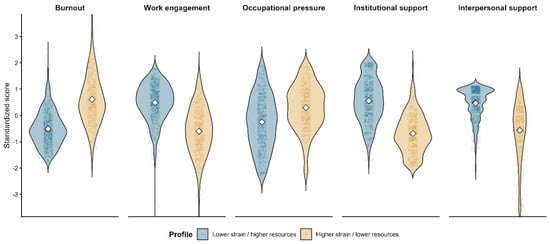
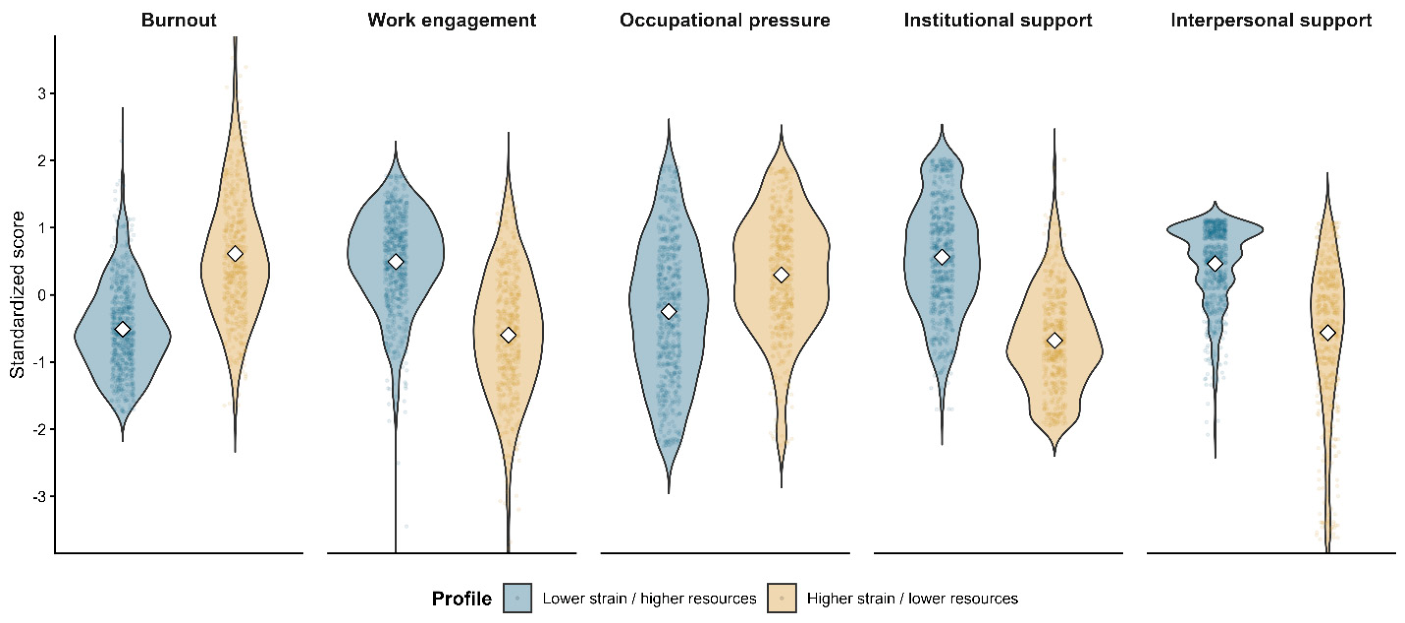
The cluster analysis included 1211 participants with complete data on all five focal variables, representing 73.1% of the original sample. The two-cluster solution showed the highest average silhouette score (0.241), compared to the three- (0.190), four (0.193), five- (0.195), and six-cluster (0.180) solutions. The additional internal validity indices were mixed, with equal numbers of indices favoring two- and five-cluster solutions. Bootstrap resampling (500 iterations) indicated high stability of the two-cluster solution, with mean Jaccard similarities of 0.966 and 0.957. An additional stability analysis of the five-cluster solution yielded lower and more variable coefficients (0.840–0.918). Considering silhouette width, parsimony, and interpretability, the two-cluster solution was retained (see Appendix A). The first profile, lower strain/higher resources, included 54.7% of participants and was characterized by lower burnout and occupational pressure together with higher work engagement and support. The second profile, higher strain/lower resources, included 45.3% of participants and showed the opposite pattern. Detailed raw-score characteristics are reported in Appendix A, and the standardized profiles are shown in Figure 1.
Figure 1.
Standardized profiles of burnout, work engagement, occupational pressure, institutional support, and interpersonal support across the two k-means clusters.
Violin plots show the distribution of standardized scores; individual points represent participants, and diamonds indicate cluster means. The blue profile represents the lower-strain/higher-resources cluster, and the gold profile represents the higher-strain/lower-resources cluster. The y-axis is restricted to −3.5 to 3.5 standardized units for visualization; cluster estimation and summary statistics were based on participants with complete data on all five clustering variables (N = 1211).
4. Discussion
The present study examined the relationships among burnout, work engagement, occupational pressure, and perceived support in a large sample of healthcare professionals and other hospital staff working during the COVID-19 pandemic in Romania. The findings showed a coherent pattern consistent with the Job Demands–Resources (JD-R) framework [15,16,17,18,19,20]: greater occupational pressure was associated with higher burnout and lower work engagement, whereas greater perceived support was associated with lower burnout and higher work engagement. These associations remained evident after adjustment for demographic and occupational characteristics and current occupational exposure to COVID-19. In addition, the person-centered analysis identified two distinct and highly stable profiles characterized by contrasting configurations of occupational demands, resources, burnout, and engagement. Taken together, the results suggest that occupational pressure and available support were closely related to employee well-being during a particularly demanding period for the healthcare system.
The characteristics of the sample should be considered when interpreting these findings. The study included 1657 participants from several public hospitals and a range of occupational groups, providing substantial heterogeneity in professional roles and workplace settings. Nevertheless, nurses constituted the largest occupational group, women represented more than four-fifths of participants with available gender data, and approximately 62% of the sample was employed at the County Emergency Hospital. Consequently, the findings primarily reflect a workforce in which nursing personnel and employees of a large emergency hospital were strongly represented. Although the inclusion of hospital and occupational category as covariates reduces the possibility that the main regression associations simply reflect differences between these groups, the uneven composition of the sample remains relevant to the generalizability of the findings.
An important contribution of the present study concerns the empirical organization of the context-specific occupational pressure and support measures. Although parallel analysis suggested a more complex structure for the seven pressure items, all items loaded substantially on a common factor, and the one-factor solution accounted for 55% of the variance and showed good internal consistency. This supports the use of an overall occupational-pressure construct capturing the common burden associated with professional, organizational, working-condition, work–life, malpractice, resource, and pandemic-related requirements. In contrast, perceived support was represented by two interpretable dimensions. Institutional support comprised support associated primarily with supervisory, managerial, professional–institutional, and church sources, whereas interpersonal support reflected support from colleagues, family, and friends. The moderate correlation between these dimensions suggests that they represent related but distinguishable resources. Because the institutional-support factor encompassed heterogeneous organized sources, including church support, it should not be interpreted as representing exclusively organizational or workplace-based support.
The bivariate findings showed a coherent demand–resource pattern: greater occupational pressure was associated with greater burnout and lower work engagement, whereas both institutional and interpersonal support were associated with more favorable occupational well-being. These findings are broadly compatible with the JD-R model [15,16,17,18,19,20], according to which demanding aspects of work are associated with strain, whereas job and social resources are associated with motivation and engagement. Importantly, these concurrent associations do not establish the direction of the relationships.
The multivariable analyses reinforced this overall pattern. After adjustment for age, gender, occupational category, hospital, occupational experience, and current occupational exposure to COVID-19, occupational pressure remained associated with higher burnout and lower work engagement, whereas institutional and interpersonal support remained associated with lower burnout and higher engagement. Thus, the context-specific demand and resource indicators contributed information beyond the measured demographic and occupational characteristics. Several alternative explanations should nevertheless be considered. Because all focal variables were assessed concurrently and by self-report, the observed associations may partly reflect differences in how participants perceived and evaluated their work environment. Employees experiencing greater burnout may perceive occupational demands as more burdensome and available support as less adequate, whereas highly engaged employees may evaluate the same organizational environment more favorably. In addition, unmeasured differences in staffing, leadership, workload organization, job design, or departmental context may contribute to both perceived demands and resources and employee well-being [8,30]. The observed associations should therefore not be interpreted as establishing a directional causal pathway.
The adjusted model accounted for 25.4% of the variance in burnout and 16.9% of the variance in work engagement. The difference in explanatory power suggests that the variables examined in this study captured a meaningful, but incomplete, portion of individual differences in these outcomes. In particular, work engagement is likely to reflect additional factors not represented by the present pressure and support measures, including characteristics of job design, autonomy, opportunities for development, recognition, meaningfulness of work, leadership, and individual resources. The findings therefore support the relevance of occupational demands and support without implying that these factors provide a comprehensive explanation of burnout or engagement.
The distinction between institutional and interpersonal support may also be relevant for understanding the resource side of the JD-R framework. Both forms of support were independently associated with burnout and engagement, while institutional support showed a somewhat stronger zero-order relationship with both outcomes. Direct comparisons of coefficient magnitude were not formally tested, and the institutional-support factor should not be equated exclusively with workplace or managerial support because it also included professional–institutional and church sources. Previous longitudinal evidence has emphasized the importance of job resources at organizational, leadership, and group levels for work engagement [31,32]. Interpersonal support nevertheless remained independently associated with both outcomes, suggesting that support from colleagues and personal networks may represent an additional resource rather than merely substituting for organized sources of support.
The cluster analysis complements these variable-centered findings by demonstrating that occupational pressure, support, burnout, and engagement also co-occurred in distinct configurations at the individual level. Two profiles were retained. The lower strain/higher resources profile, comprising 54.7% of participants, was characterized by comparatively lower burnout and occupational pressure together with higher work engagement and both forms of support. In contrast, the higher strain/lower resources profile, comprising 45.3% of participants, showed higher burnout and occupational pressure alongside lower engagement and support. The profiles demonstrated high bootstrap stability, with mean Jaccard similarities above 0.95. The convergence between these profiles and the regression findings is notable: across both analytical approaches, greater demands clustered with less favorable occupational well-being, whereas greater resources clustered with greater engagement and lower burnout.
At the same time, the two-profile solution should not be interpreted as establishing two discrete or clinically meaningful categories of healthcare workers. K-means clustering partitions continuous multivariate data, and the resulting groups are therefore best understood as empirical profiles within this sample. Moreover, although the two-cluster solution had the highest average silhouette width, the additional internal validity indices provided mixed evidence, with equal numbers favoring two- and five-cluster solutions. The two-profile solution was retained on the combined basis of silhouette width, parsimony, and interpretability. Replication in independent healthcare samples would therefore be valuable before these profiles are treated as generalizable subgroups.
From an occupational-health perspective, the findings suggest that organizational as well as individual-level factors may warrant consideration in future intervention research. Because occupational pressure was independently associated with higher burnout and lower engagement, potentially modifiable aspects of workload, working conditions, resource adequacy, role demands, communication, and work–life compatibility represent plausible targets for further study. The independent associations observed for institutional and interpersonal support likewise suggest that both organized sources of support and supportive relationships within healthcare teams merit investigation. These implications are hypothesis-generating: the present cross-sectional study did not test whether modifying any of these factors changes burnout or work engagement.
Interpersonal support was associated with both lower burnout and higher engagement even when institutional support, occupational pressure, and the measured covariates were taken into account. This pattern suggests that peer and team relationships may be relevant alongside other occupational resources. Future longitudinal and intervention studies could examine whether strategies aimed at team cohesion, collegial support, or accessible occupational-health resources are followed by changes in burnout or engagement. The present findings alone do not establish the effectiveness of such interventions.
Limitations
Several limitations should be considered. First, the cross-sectional design prevents conclusions about temporal or causal relationships. Although occupational pressure may contribute to burnout and diminished engagement, reverse or reciprocal relationships are also possible. Second, all focal variables were based on self-report, raising the possibility of shared-method variance, perceptual effects, and response biases. Third, the pressure and support measures were developed specifically for this study. Their empirical structure and internal consistency were examined in the present sample, but further validation in independent samples is needed. Although dimensionality was examined empirically, the retained one-factor pressure and two-factor support solutions differed from the number of factors suggested by parallel analysis. These structures should therefore be regarded as exploratory and require replication and confirmatory evaluation in independent samples. Fourth, voluntary participation and convenience sampling may have introduced selection and nonresponse bias. The exact number of questionnaires distributed was not recorded, so a response rate could not be calculated; participants may have differed systematically from non-participants in burnout, work engagement, perceived occupational pressure, or perceived support, which may have affected the representativeness of the sample.
The cluster analysis also has limitations. Although bootstrap resampling indicated high stability of the two-cluster solution, this provides evidence of internal robustness rather than external validation. The relatively modest average silhouette width (0.241) further suggests limited separation between the identified profiles. Consequently, these profiles should be interpreted as descriptive patterns within the present sample rather than as distinct underlying subgroups of healthcare workers. Whether similar profiles would emerge in other healthcare settings or populations remains to be established through independent replication.
Because the analyses were based on available complete cases, 36–39% of participants were excluded from the adjusted regression models and 26.9% from the cluster analysis. Missingness was unevenly distributed across hospitals, with substantially higher proportions of incomplete data at the County Emergency Hospital. Although differences in available burnout, work engagement, occupational pressure, and support scores between participants included in and excluded from the regression analyses were relatively small, the unequal institutional representation may introduce selection bias and limit the generalizability of the findings. The identified profiles may similarly be influenced by the composition of the complete-case sample. These findings should therefore be interpreted with caution, particularly when generalizing across healthcare settings.
5. Conclusions
In this sample of Romanian hospital personnel assessed during the third wave of the COVID-19 pandemic, greater occupational pressure was associated with higher burnout and lower work engagement, whereas greater institutional and interpersonal support was independently associated with lower burnout and higher engagement. The person-centered analysis identified two stable empirical profiles characterized by contrasting configurations of occupational pressure, support, burnout, and engagement. These profiles should be understood as sample-derived patterns rather than clinically defined categories.
Taken together, the findings support the importance of considering occupational demands and resources jointly when examining employee well-being in healthcare settings. Given the cross-sectional design, complete-case analyses, and context-specific pressure and support measures, longitudinal studies and replication in independent healthcare samples are needed to determine the temporal nature and generalizability of these associations and to evaluate whether changes in occupational demands or resources lead to subsequent changes in burnout or work engagement.
Author Contributions
Conceptualization, M.D.B., A.T.B., C.M. and C.B.; methodology, M.D.B., A.T.B., C.M., B.I.V. and M.C.; software, B.I.V., M.C., C.M.S. and A.M.G.; validation, M.D.B., A.T.B., C.M., B.I.V., M.C., D.I.G., C.M.S., A.M.G. and C.B.; formal analysis, M.D.B., B.I.V., M.C., A.M.G. and C.B.; investigation, A.T.B., C.M., D.I.G., C.M.S. and C.B.; resources, M.D.B., A.T.B., C.M. and C.B.; data curation, M.D.B., B.I.V., M.C., D.I.G. and C.B.; writing—original draft preparation, M.D.B., A.T.B., C.M., M.C., C.B.; writing—review and editing, M.D.B., B.I.V., M.C., C.M.S. and C.B.; visualization, M.D.B., A.T.B., C.M., B.I.V., M.C., D.I.G., C.M.S., A.M.G. and C.B.; supervision, C.B.; project administration, M.D.B. and C.B. All authors have read and agreed to the published version of the manuscript.
Funding
This research received no external funding.
Institutional Review Board Statement
The study was approved on 14 September 2020 by the Ethics Committee of the “Dr. Gheorghe Preda” Clinical Psychiatric Hospital in Sibiu, Romania (protocol code: no. 22011).
Informed Consent Statement
By completing the questionnaire, participants provided informed consent to participate in the study and to the anonymous and confidential processing of their data for research purposes.
Data Availability Statement
The study was registered on the Open Science Framework (OSF) as a Replication Recipe. The registration includes the finalized materials, procedures, and analysis plan and is available under DOI:10.17605/OSF.IO/HQ8TB (https://osf.io/4kmxv (accessed on 30 September 2026)).
Conflicts of Interest
The authors declare no conflicts of interest.
Appendix A
Table A1.
Demographic, Occupational, and COVID-19-Related Characteristics of the Study Sample.
Table A2.
Full Adjusted Regression Models for Burnout and Work Engagement.
References
- de Beer, L.T.; Schaufeli, W.B.; De Witte, H.; Hakanen, J.J.; Shimazu, A.; Glaser, J.; Seubert, C.; Bosak, J.; Sinval, J.; Rudnev, M. Measurement Invariance of the Burnout Assessment Tool (BAT) Across Seven Cross-National Representative Samples. Int. J. Environ. Res. Public Health 2020, 17, 5604. [Google Scholar] [CrossRef] [Scilit] [PubMed]
- Leiter, M.P.; Schaufeli, W.B. Consistency of the Burnout Construct across Occupations. Anxiety Stress Coping 1996, 9, 229–243. [Google Scholar] [CrossRef] [Scilit]
- Schaufeli, W.B.; Leiter, M.P.; Maslach, C. Burnout: 35 Years of Research and Practice. Career Dev. Int. 2009, 14, 204–220. [Google Scholar] [CrossRef] [Scilit]
- (PDF) Burnout and Health (a Review). Available online: https://www.researchgate.net/publication/305985727_Burnout_and_Health_a_Review (accessed on 30 October 2026).
- Salvagioni, D.A.J.; Melanda, F.N.; Mesas, A.E.; González, A.D.; Gabani, F.L.; De Andrade, S.M. Physical, Psychological and Occupational Consequences of Job Burnout: A Systematic Review of Prospective Studies. PLoS ONE 2017, 12, e0185781. [Google Scholar] [CrossRef] [Scilit] [PubMed]
- Burn-out an “Occupational Phenomenon”: International Classification of Diseases. Available online: https://www.who.int/news/item/28-05-2019-burn-out-an-occupational-phenomenon-international-classification-of-diseases (accessed on 30 October 2026).
- Morgantini, L.A.; Naha, U.; Wang, H.; Francavilla, S.; Acar, Ö.; Flores, J.M.; Crivellaro, S.; Moreira, D.; Abern, M.; Eklund, M.; et al. Factors Contributing to Healthcare Professional Burnout during the COVID-19 Pandemic: A Rapid Turnaround Global Survey. PLoS ONE 2020, 15, e0238217. [Google Scholar] [CrossRef] [Scilit] [PubMed]
- What Covid-19 Has Done to Our Well-Being, in 12 Charts. Available online: https://hbr.org/2021/02/what-covid-19-has-done-to-our-well-being-in-12-charts (accessed on 30 October 2026).
- Molina-Praena, J.; Ramirez-Baena, L.; Gómez-Urquiza, J.L.; Cañadas, G.R.; De la Fuente, E.I.; Cañadas-De la Fuente, G.A. Levels of Burnout and Risk Factors in Medical Area Nurses: A Meta-Analytic Study. Int. J. Environ. Res. Public Health 2018, 15, 2800. [Google Scholar] [CrossRef] [Scilit] [PubMed]
- Pérez-Fuentes, M.D.C.; Jurado, M.D.M.M.; Martínez, Á.M.; Linares, J.J.G. New Burnout Evaluation Model Based on the Brief Burnout Questionnaire: Psychometric Properties for Nursing. Int. J. Environ. Res. Public Health 2018, 15, 2718. [Google Scholar] [CrossRef] [Scilit] [PubMed]
- Pérez-Fuentes, M.d.C.; Molero Jurado, M.d.M.; Martos Martínez, Á.; Gázquez Linares, J.J. Burnout and Engagement: Personality Profiles in Nursing Professionals. J. Clin. Med. 2019, 8, 286. [Google Scholar] [CrossRef] [Scilit] [PubMed]
- Bria, M.; Raţiu, L.; Băban, A.; Dumitraşcu, D.L. Sndromul epuizării profesionale la personalul medical. Clujul Med. 2011, 84, 15. [Google Scholar]
- Oprinca-Muja, L.A.; Mohor, C.I.; Oprinca, G.C.; Cardoș, R.; Domnariu, C.D.; Cristian, A.N.; Băcilă, C.; Fleacă, S.R.; Cristian, A.; Morar, S. Burnout Syndrome in Forensic Medicine and Its Association with Vicarious Trauma, Posttraumatic Stress Syndrome and Occupational Stress. Int. J. Leg. Med. 2025, 139, 1223–1237. [Google Scholar] [CrossRef] [Scilit] [PubMed]
- Crisan, R.M.; Bacila, C.I.; Neamtu, B.; Cristian, A.N.; Topîrcean, E.; Popescu, A.; Morar, S. Psychological Autopsy and Forensic Considerations in Completed Suicide of the SARS-CoV-2 Infected Patients. A Case Series and Literature Review. Appl. Sci. 2021, 11, 11547. [Google Scholar] [CrossRef] [Scilit]
- Bakker, A.B.; Demerouti, E.; Verbeke, W. Using the Job Demands-Resources Model to Predict Burnout and Performance. Hum. Resour. Manag. 2004, 43, 83–104. [Google Scholar] [CrossRef] [Scilit]
- Bakker, A.B.; Demerouti, E. The Job Demands-Resources Model: State of the Art. J. Manag. Psychol. 2007, 22, 309–328. [Google Scholar] [CrossRef] [Scilit]
- Van Den Broeck, A.; Vansteenkiste, M.; De Witte, H.; Lens, W. Explaining the Relationships between Job Characteristics, Burnout, and Engagement: The Role of Basic Psychological Need Satisfaction. Work Stress 2008, 22, 277–294. [Google Scholar] [CrossRef] [Scilit]
- Bakker, A.B.; Demerouti, E. Job Demands-Resources Theory. In Wellbeing: A Complete Reference Guide; John Wiley & Sons: Chichester, UK, 2014; pp. 1–28. [Google Scholar] [CrossRef] [Scilit]
- Bakker, A.B.; Demerouti, E. Job Demands-Resources Theory: Taking Stock and Looking Forward. J. Occup. Health Psychol. 2017, 22, 273–285. [Google Scholar] [CrossRef] [Scilit] [PubMed]
- Lesener, T.; Gusy, B.; Wolter, C. The Job Demands-Resources Model: A Meta-Analytic Review of Longitudinal Studies. Work Stress 2019, 33, 76–103. [Google Scholar] [CrossRef] [Scilit]
- Cornea, M.; Vintilă, B.I.; Bucuța, M.; Ștef, L.; Anghel, C.E.; Grama, A.M.; Lomnasan, A.; Stetiu, A.A.; Boicean, A.; Sava, M.; et al. Efficacy of Transcranial Direct Current Stimulation and Photobiomodulation in Improving Cognitive Abilities for Alzheimer’s Disease: A Systematic Review. J. Clin. Med. 2025, 14, 1766. [Google Scholar] [CrossRef] [Scilit] [PubMed]
- Ungureanu, M.I.; Brînzac, M.G.; Forray, A.; Paina, L.; Avram, L.; Crişan, D.A.; Donca, V. The Geriatric Workforce in Romania: The Need to Improve Data and Management. Eur. J. Public Health 2020, 30, IV28–IV31. [Google Scholar] [CrossRef] [Scilit] [PubMed]
- Cotel, A.; Golu, F.; Stoian, A.P.; Dimitriu, M.; Socea, B.; Cirstoveanu, C.; Davitoiu, A.M.; Alexe, F.J.; Oprea, B. Predictors of Burnout in Healthcare Workers during the COVID-19 Pandemic. Healthcare 2021, 9, 304. [Google Scholar] [CrossRef] [Scilit] [PubMed]
- Dimitriu, M.C.T.; Pantea-Stoian, A.; Smaranda, A.C.; Nica, A.A.; Carap, A.C.; Constantin, V.D.; Davitoiu, A.M.; Cirstoveanu, C.; Bacalbasa, N.; Bratu, O.G.; et al. Burnout Syndrome in Romanian Medical Residents in Time of the COVID-19 Pandemic. Med. Hypotheses 2020, 144, 109972. [Google Scholar] [CrossRef] [Scilit] [PubMed]
- Popa, F.; Arafat, R.; Purcǎrea, V.L.; Lalǎ, A.; Popa-Velea, O.; Bobirnac, G. Occupational Burnout Levels in Emergency Medicine–a Stage 2 Nationwide Study and Analysis. J. Med. Life 2010, 3, 449. [Google Scholar] [PubMed]
- Papazian, L.; Hraiech, S.; Loundou, A.; Herridge, M.S.; Boyer, L. High-Level Burnout in Physicians and Nurses Working in Adult ICUs: A Systematic Review and Meta-Analysis. Intensive Care Med. 2023, 49, 387–400. [Google Scholar] [CrossRef] [Scilit] [PubMed]
- Băcilă, C.I.; Cornea, M.; Vintilă, B.I.; Lomnasan, A.; Boicean, A.G.; Grama, A.M.; Matei, C.; Neamtu, B. Impact and Predictive Modeling of Risk Factors for Involuntary Psychiatric Admissions before and during COVID-19: Insights from a Romanian Tertiary Hospital. Front. Public Health 2025, 13, 1624219. [Google Scholar] [CrossRef] [Scilit] [PubMed]
- Charrad, M.; Ghazzali, N.; Boiteau, V.; Niknafs, A. NbClust: An R Package for Determining the Relevant Number of Clusters in a Data Set. J. Stat. Softw. 2014, 61, 1–36. [Google Scholar] [CrossRef] [Scilit]
- R Core Team. R: A Language and Environment for Statistical Computing; R Core Team: Vienna, Austria, 2026. [Google Scholar] [CrossRef] [Scilit]
- Barello, S.; Caruso, R.; Palamenghi, L.; Nania, T.; Dellafiore, F.; Bonetti, L.; Silenzi, A.; Marotta, C.; Graffigna, G. Factors Associated with Emotional Exhaustion in Healthcare Professionals Involved in the COVID-19 Pandemic: An Application of the Job Demands-Resources Model. Int. Arch. Occup. Environ. Health 2021, 94, 1751–1761. [Google Scholar] [CrossRef] [Scilit] [PubMed]
- Lesener, T.; Gusy, B.; Jochmann, A.; Wolter, C. The Drivers of Work Engagement: A Meta-Analytic Review of Longitudinal Evidence. Work Stress 2020, 34, 259–278. [Google Scholar] [CrossRef] [Scilit]
- Conservation of Resources Theory: Its Implication for Stress, Health, and Resilience. Available online: https://psycnet.apa.org/record/2010-25086-007 (accessed on 30 October 2026).

Disclaimer/Publisher’s Note: The statements, opinions and data contained in all publications are solely those of the individual author(s) and contributor(s) and not of MDPI and/or the editor(s). MDPI and/or the editor(s) disclaim responsibility for any injury to people or property resulting from any ideas, methods, instructions or products referred to in the content. |
© 2026 by the authors. Licensee MDPI, Basel, Switzerland. This article is an open access article distributed under the terms and conditions of the Creative Commons Attribution (CC BY) license.