


Highlights
What are the main findings?
- •
- In older adults with physical frailty, a 12-week AI-assisted exergame based on Vivifrail was associated with improved physical performance, grip strength, and Interleukin-6 compared with usual exercise.
- •
- The VIVIFUN showed high usability and accurate pose detection, but adherence was low.
What are the implications of the main findings?
- •
- Tablet-based AI exergaming is a feasible way to deliver multicomponent exercise at home to older adults with physical frailty.
- •
- Better adherence strategies and a cluster-randomized trial are needed before wider implementation.
Abstract
Background: Thailand’s rapidly aging population is increasing the burden of physical decline among older adults. This pilot study developed a Vivifrail-based exergame and evaluated its effects on physical performance and frailty-related outcomes in older adults. Methods: VIVIFUN, an AI-assisted exergame based on Vivifrail Program B/B+, was evaluated in a 12-week, two-community quasi-experimental trial among adults aged ≥60 years with Short Physical Performance Battery (SPPB) scores of 4–6. Physical performance, inflammatory biomarkers, adherence, player experience, and usability were assessed. Results: Of 563 older adults screened, 14.9% met the SPPB 4–6 criterion, and 60 enrolled. Attrition was 33.3% in the exergame group and 0% in the control group. In the primary intention-to-treat analysis, assignment to VIVIFUN was associated with greater improvement in SPPB (p = 0.003), SARC-F (p < 0.001), and handgrip strength (p = 0.022), and with a decrease in serum interleukin-6 (IL-6) (24.84 to 17.17 pg/mL vs. 25.54 to 27.65 pg/mL in controls; p < 0.001). Complete-case analysis yielded consistent results; a FRAIL Scale difference (p = 0.012) was observed only in this analysis. Adherence was low, with 10% of completers performing >75% of the prescribed program. VIVIFUN showed high enjoyment and usability, with vision-based (skeleton and point-to-point) detection F1-scores of 0.99–1.00 and audio-based ball-squeeze detection of 0.82. Conclusions: In this pilot study, VIVIFUN was associated with improvements in physical performance, sarcopenia risk, and handgrip strength and a reduction in IL-6 among frail Thai older adults, with high usability and enjoyment. Further refinement of adherence strategies and AI detection robustness is needed before wider implementation.
1. Introduction
The global population is aging rapidly, with a steady increase in the proportion of older adults in both developed and developing countries [1]. Thailand is undergoing a rapid demographic transition toward a fully aged society, resulting in a growing burden of age-related health conditions [2]. Aging is associated with physiological decline across multiple body systems, including reduced cardiovascular and respiratory function, decreased muscle mass and bone density, impaired balance, and slower movement [3,4,5]. These changes contribute to geriatric syndromes and increase the risk of physical frailty [6].
Physical frailty is characterized by reduced physical performance, muscle weakness, and decreased functional reserve, which increases the likelihood of falls, disability, hospitalization, and mortality [7]. In Thailand, community-based studies indicated that the prevalence of frailty among older adults ranges from 13% to 22%, depending on specific demographics and the measurement tool used [8], posing significant challenges to healthcare systems and long-term care. Although frailty is not a disease, it can be prevented or delayed through appropriate interventions. Evidence suggests that exercise, particularly multicomponent exercise programs, is one of the most effective strategies for improving muscle strength, balance, mobility, and physical performance while reducing fall risk [9,10]. The World Health Organization (WHO) Healthy Ageing initiative and the Integrated Care for Older People (ICOPE) framework emphasize regular physical activity tailored to individual functional capacity [11,12].
The Vivifrail program is a recommended multicomponent exercise intervention that stratifies participants into four exercise levels (A–D) according to the Short Physical Performance Battery (SPPB) score, combining aerobic, resistance, balance, and flexibility training over a 12-week cycle [13]. Evidence supporting Vivifrail includes a multicenter randomized controlled trial in Spain demonstrating improved SPPB scores compared with usual care among frail and pre-frail community-dwelling older adults [13], and a trial in nursing-home residents reporting improved functional capacity following tailored Vivifrail-based training [14]. Studies in Mexico and Indonesia have also reported improvements in functional capacity and reductions in fall risk [15,16].
However, despite its proven effectiveness, adherence to home-based exercise remains challenging because many older adults have difficulty understanding and following paper-based exercise instructions without continuous supervision. Recent advances in artificial intelligence (AI), particularly motion-tracking technology, provide an opportunity to address these challenges by enabling interactive exercise with real-time guidance and feedback. At the same time, digital health technologies such as exergaming have gained increasing attention for promoting physical activity. By combining exercise with interactive gaming elements, exergames can enhance enjoyment, motivation, and engagement while supporting correct exercise performance. Previous studies have demonstrated that exergaming, such as Nintendo Wii, Kinect-based systems, and virtual-reality training, can improve physical performance, balance, cognitive function, and quality of life in older adults [17,18,19], and dedicated frailty-focused exergames such as FRED have shown improvements in frailty status among institutionalized older adults [20]. Nevertheless, most exergames use commercial consoles or depth sensors, focusing on balance or aerobics, and have generally been evaluated in healthy, pre-frail, or institutionalized older adults under supervision [17,18,19,20,21]. Systematic studies of exergames in frail older adults revealed a limited number of trials, with few specifically addressing community-dwelling frail older adults [21]. Vivifrail, a multicomponent exergame relying on camera-based AI motion identification on a standard tablet, has not been studied in Thailand. The Vivifrail Program B/B+, designed for individuals with SPPB scores of 4 to 6, was directly adapted into game tasks by VIVIFUN. AI pose estimation based on the built-in tablet camera accurately identified correct and incorrect movements, counted repetitions, and delivered real-time feedback without additional hardware.
Therefore, this pilot study aimed to (1) develop VIVIFUN, an AI-assisted tablet-based exergame based on the Vivifrail multicomponent exercise program (Program B/B+) for older adults with physical frailty, and evaluate the performance of its motion-detection system; (2) explore, in a two-community quasi-experimental trial, the effects of 12 weeks of VIVIFUN compared with usual self-directed exercise on physical performance (SPPB, primary outcome), frailty status, sarcopenia risk, handgrip strength, and inflammatory and hormonal biomarkers; and (3) describe program adherence, player experience, and usability. The findings are intended to inform the refinement of VIVIFUN and the design and sample size of a subsequent large-scale cluster-randomized trial.
2. Materials and Methods
The study protocol was approved by the Human Research Ethics Committee, Faculty of Medicine, Chiang Mai University (approval number 207/2567, dated 24 May 2024), and the trial was registered with the Thai Clinical Trials Registry (TCTR20240911004). All participants provided written informed consent before enrollment. The study was conducted in accordance with the Declaration of Helsinki. The study was reported in accordance with the CONSORT guidelines [22], and the completed CONSORT checklist is provided in the Supplementary Materials (File S1).
2.1. Exergame Design and Development
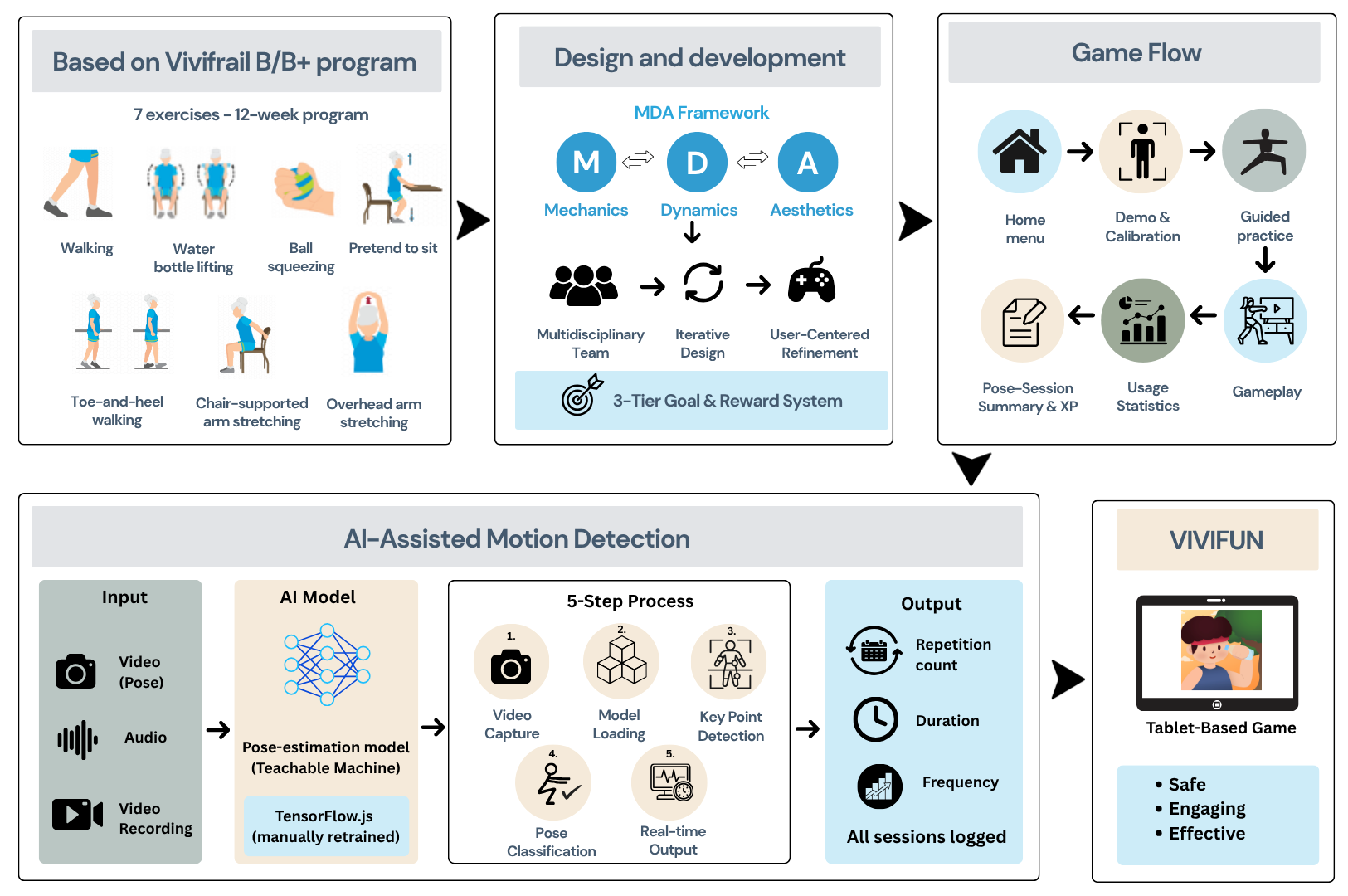
VIVIFUN was based on the Vivifrail Program B/B+, designed for physically frail older adults with SPPB scores of 4–6. The 12-week program comprises seven exercises: walking, water-bottle lifting, ball squeezing, pretend to sit, toe-and-heel walking, chair-supported arm stretching, and overhead arm stretching. The “+” designation indicates participants within this frailty range who also meet fall-risk criteria.
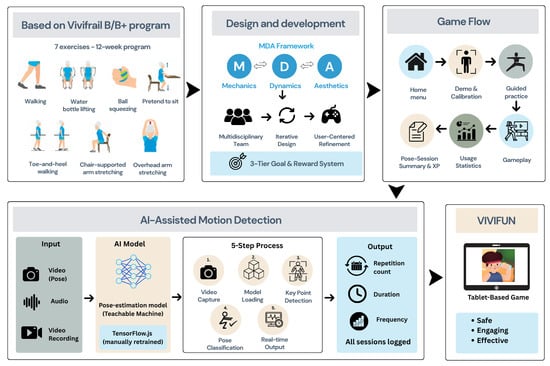
An overview of the VIVIFUN exergame development process is shown in Figure 1. The exergame was developed using the Mechanics-Dynamics-Aesthetics (MDA) framework [23] and an iterative, user-centered process involving a multidisciplinary team of physicians, physiotherapists, game designers, and software engineers. The MDA framework mapped each Vivifrail exercise (mechanics) to in-game feedback, scoring, and progression (dynamics) to promote competence and enjoyment (aesthetics), as summarized in Table 1. User-centered development began with interviews with six older adults to inform persona development and theme selection, followed by three iterative cycles: (1) a technical prototype to test camera-based motion detection, (2) a gameplay prototype to refine difficulty with the target population, and (3) usability testing to refine the final prototype. The game was developed in Unity (version 2025) as a 2D Android game and deployed on Xiaomi Pad (6 and 7) tablets (Xiaomi Corporation, Beijing, China), selected for Android compatibility and camera-based motion detection. The tablet-based game incorporated older adult–appropriate visual design, exercise demonstrations, pose calibration, guided gameplay, progress summaries, and a tiered goal-and-reward system to support engagement throughout the 12-week program. Exercise recognition used Teachable Machine pose-estimation models to classify movements as idle, correct, or incorrect, with iterative retraining for misclassified movements [24]. Teachable Machine was selected for its ability to train custom pose-classification models using clinician-recorded examples of correct and incorrect movements, with minimal coding and support for on-device deployment. The system analyzed Common Objects in Context (COCO)-standard body key points through video capture, key-point detection, pose classification, and real-time feedback, using three modalities—skeleton-based pose, audio, and video detection—and automatically logged repetitions, duration, and frequency across the seven exercises.
Figure 1.
Overview of the VIVIFUN exergame design, development, and AI-assisted motion detection system.
Table 1.
Design of the seven VIVIFUN exercises, in-game concept, and motion-detection method.
Before using the exergame in a trial, 10 adults aged ≥60 years from the Family Medicine outpatient clinic at Maharaj Nakorn Chiang Mai Hospital participated in iterative usability testing under the supervision of a physiotherapist. Testing focused on following instructions and performing exercises correctly, with findings used qualitatively to refine the game until it was considered reliable, safe, and appropriate. Changes made as a result of pilot testing included enlarging on-screen text and buttons, adding pose-calibration prompts, slowing exercise demonstrations, incorporating voice instructions alongside visual demonstrations, and improving motion-detection accuracy. Key qualitative feedback from pilot participants included positive comments on the game characters and audio, but difficulties positioning the tablet camera. These participants were excluded from the statistical efficacy analysis.
2.2. Participants
Participants were recruited through a community frailty-screening program conducted in collaboration with local health-promoting hospitals and village health volunteers in Nong Faek Subdistrict, Suthep Subdistrict, and Chiang Mai Municipality, Chiang Mai Province. These communities were selected based on existing collaboration with the Department of Family Medicine and geographic separation to minimize intervention contamination. Sample size was calculated for comparison of two independent means using 4uStudies, based on an anticipated shift in mean SPPB score from the frail range to the pre-frail range (μ1 = 6, μ2 = 7, common SD = 1, allocation ratio 1:1, α = 0.01, β = 0.20) The 1-point difference is a clinically significant change in SPPB among older adults [25] and indicates the threshold between Vivifrail frail (SPPB 4–6) and pre-frail (SPPB 7–9) [13]. A common SD of 1 point was assumed because eligibility was restricted to SPPB scores of 4–6, which bounds the baseline SD at ≤1 point [26], and a conservative two-sided α of 0.01 was used to limit type I error across multiple outcomes [27]. This calculation yielded a required sample of 24 participants per group; this was increased by approximately 20% to allow for dropout and non-compliance, for a final target of 30 participants per group.
2.3. Eligibility Criteria
Inclusion criteria were (1) age ≥ 60 years, (2) able to communicate in Thai and to learn and use the tablet-based exergame, (3) self-mobility, and (4) physically frail with an SPPB score of 4–6. Exclusion criteria were (1) being bedbound or unable to care for oneself and (2) having a cardiac disease within the preceding 3 months, other serious medical illness, or cognitive impairment. Cognitive impairment was assessed through interviews with participants, focusing on memory problems and tablet use. Participants unable to understand exercise instructions or use the exergame were excluded. Exergame usability was confirmed during orientation. Before enrollment, all participants underwent pre-exercise safety screening, including assessment of medical history, current symptoms, mobility, and fall risk.
2.4. Community Efficacy Trial
This study used a two-community, quasi-experimental (non-randomized, cluster-allocated) design to avoid treatment contamination between neighbors and acquaintances. The participants who met the SPPB 4–6 eligibility criterion were invited to enroll. The study was divided into 2 groups, including the following:
Community 1 (Nong Faek) was the control group and continued usual, self-directed exercise (e.g., walking, jogging, cycling, aerobic dance, stretching, or strength exercises) for 12 weeks without a multicomponent protocol. Control participants received no exercise prescription, instruction, or equipment from the research team; thus, their physical activity reflected usual care and was not standardized. The type, frequency, and duration of activity were recorded daily for description.
Community 2 (Suthep sub-district and Chiang Mai Municipality) received the VIVIFUN exergame on a tablet for 12 weeks, 30–45 min daily from Monday to Friday, along with the required equipment, including a sound-emitting ball, water bottles, and individual orientation. The game delivered seven standardized Vivifrail Program B/B+ exercises, with prescribed repetitions and progression following the 12-week schedule, and logged repetitions, duration, and frequency. Participants were instructed to maintain usual activities and not initiate other structured exercise programs during the study.
The collected outcomes included demographic and health data, the primary outcome, and secondary outcomes. Participants in both groups provided baseline and post-intervention measurements.
2.5. Outcome Measurement
The primary outcome was the SPPB, which represents the main domain of physical frailty targeted by the intervention. Secondary outcomes included SARC-F, the FRAIL Scale, handgrip strength, and serum biomarkers (IL-6, CRP, and DHEAs). Player experience of needs satisfaction (PENS) and system usability scale (SUS) were assessed only in the exergaming group post-intervention. Outcomes were assessed by trained research assistants at baseline and 12 weeks using standardized protocols, with the same team assessing each participant. Based on the nature of the intervention and the community-based allocation (one community per study arm), participants, intervention staff, outcome assessors, and data analysts were not blinded to group allocation. Serum biomarkers were analyzed using coded samples by laboratory personnel blinded to group allocation.
- •
- Physical performance was assessed using the SPPB [28], which evaluates balance, 4-m gait speed, and five-repetition chair stands, with total scores ranging from 0–12. Scores of 4–6 were used to define physical frailty and trial eligibility.
- •
- Frailty was assessed using the 5-item FRAIL Scale [29], scored 0–5 (0 = robust, 1–2 = pre-frail, and 3–5 = frail). Sarcopenia risk was assessed using SARC-F, with a score ≥ 4 indicating risk [30]. Handgrip strength was measured using a hand dynamometer (Performance Health, Downers Grove, IL, USA), with <28 kg for men and <18 kg for women considered abnormal [31]. Serum IL-6 was analyzed using an enzyme-linked immunosorbent assay (Sino Biological, Inc., Beijing, China), while CRP and DHEAs were analyzed by the clinical laboratory of Maharaj Nakorn Chiang Mai Hospital (Abbott Laboratories, Abbott Park, IL, USA).
- •
- PENS was assessed by the 21-item PENS scale [32], rated on a 1–7 scale. SUS was used, an adapted 11-item SUS [33], including one additional item on recommendation intention. The 10 standard SUS items were rated on a 7-point scale and rescaled to the conventional 0–100 SUS range (positively worded items: response − 1; negatively worded items: 7 − response; sum × 100/60), allowing the standard interpretation bands to be applied; the recommendation item was analyzed separately. The Thai versions of the PENS and SUS used in this study were those previously applied with Thai players in serious-game research [34]. To our knowledge, neither instrument has been formally validated in Thai older adults.
2.6. Statistical Analysis
Data were analyzed using STATA version 16.1. The normality of continuous variables was assessed using the Shapiro–Wilk test. Descriptive statistics (frequencies, means, and percentages for categorical variables, means ± SD for normally distributed variables, and medians for non-normally distributed variables) summarized general characteristics and usability and player-experience results. Baseline comparability was assessed among all enrolled participants using the Mann–Whitney U test and chi-square test for continuous and categorical variables. Statistical significance was set at p < 0.05. Attrition rates were compared using Fisher’s exact test, and baseline characteristics of exergame completers and non-completers were examined to assess the potential pattern of missing follow-up data.
The primary outcomes followed the intention-to-treat (ITT) approach: a linear mixed-effects model (fixed effects for group, time, and their interaction, with a random intercept for participant), including all 60 participants according to their originally assigned groups, regardless of intervention adherence or withdrawal. The linear mixed-effects model was fitted using maximum likelihood and all available observations, including baseline data from participants who withdrew; no imputation was performed. The analysis assumed missing at random (MAR), whereby dropout depends on observed variables rather than unobserved outcomes. Because dropout occurred only in the exergame group, baseline characteristics were compared between completers and non-completers to assess the plausibility of this assumption. A complete-case analysis, including participants with available 12-week follow-up data, was conducted as a sensitivity analysis to assess the potential impact of attrition. ANCOVA was conducted among participants with the post-intervention value as the dependent variable, group as the independent variable, and the baseline value as a covariate, restricted to participants with complete follow-up data. An adherence-based per-protocol analysis was not feasible because only two participants completed more than 75% of the prescribed program. Statistical significance was set at p < 0.05, and 95% confidence intervals were reported.
3. Results
3.1. The VIVIFUN Exergame and AI Motion-Detection Performance
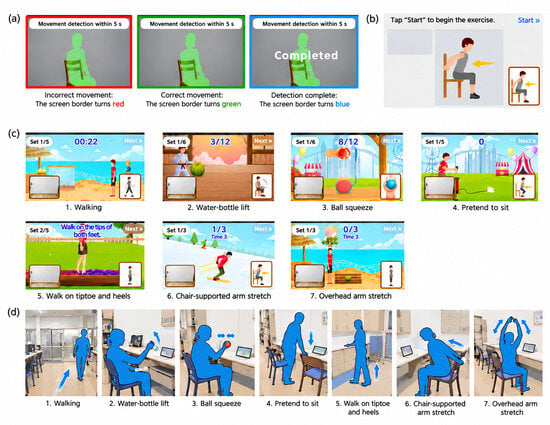
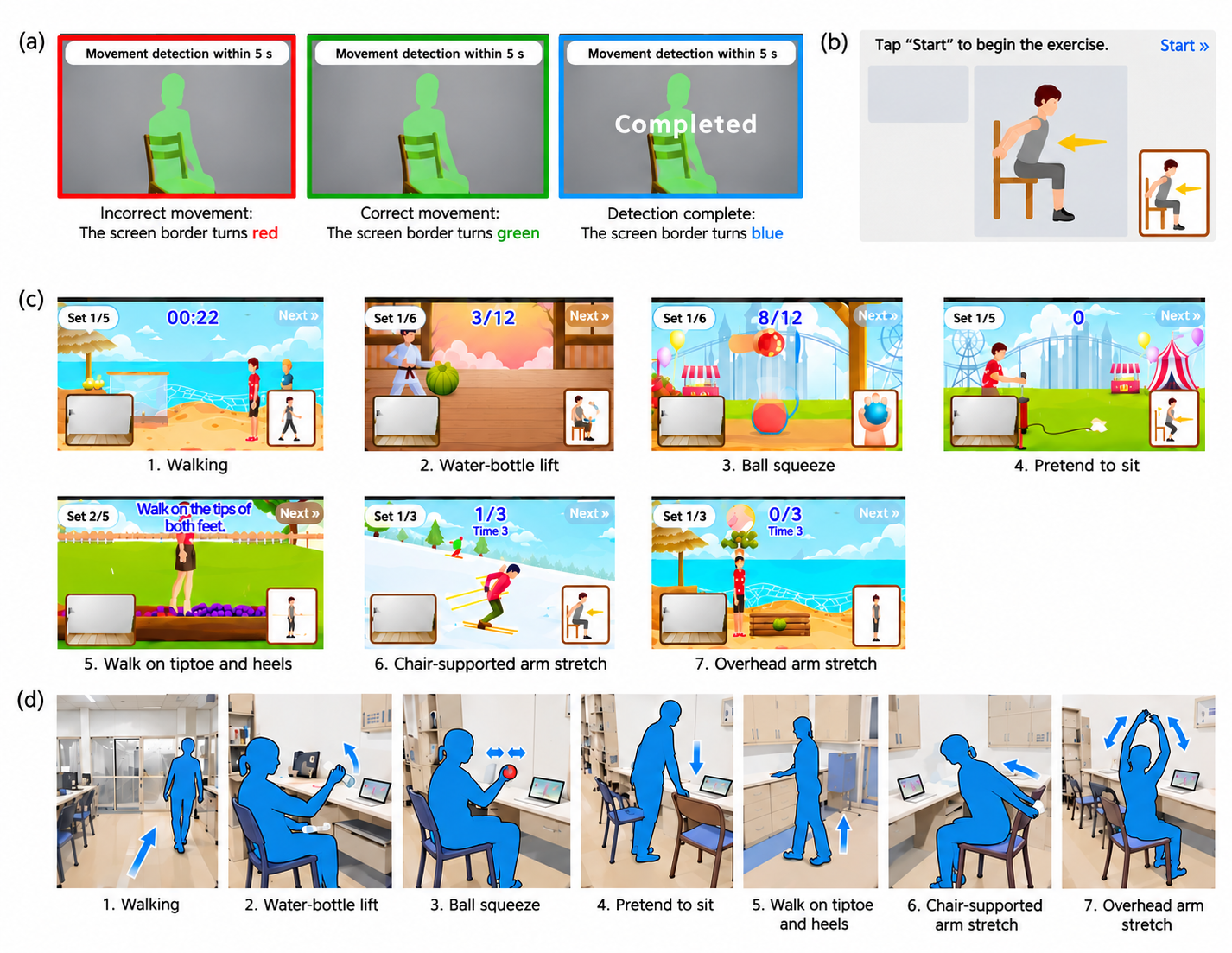
The design of these seven exercises, including the in-game concept and motion-detection method, is summarized in Table 1. The final VIVIFUN exergame is delivered on a tablet device. Figure 2 illustrates selected components of the VIVIFUN game flow and user interface, including pose detection, exercise tutorials, and gameplay.
Figure 2.
VIVIFUN game flow, user interface and illustrations of participant interaction: (a) Pose detection screen for verifying correct posture before each exercise; (b) exercise tutorial screen for demonstrating the exercise movement; (c) gameplay screen featuring seven exercise games with an on-screen character providing guidance throughout the session; and (d) illustrations of participants performing exercises using the tablet-based exergame.
The evaluation of the AI motion-detection system demonstrated high accuracy for vision-based detection. Across the four exercises detected with the skeleton-based pose-estimation model (water-bottle lift, pretend to sit, chair-supported arm stretch, and overhead arm stretch) and walking, which was detected by point-to-point motion tracking (Table 1), the scores of accuracy, precision, recall, and F1-score were all in the range of 0.99–1.00, with confidence levels of 99–100%, indicating that vision-based detection performed reliably and consistently. In contrast, audio-based detection of the ball-squeeze exercise presented an accuracy of 0.69, precision of 0.72, recall of 0.95, and F1-score of 0.82, with a confidence level of approximately 0.76–0.82. However, recall was high, reflecting a few missed detections, reducing overall reliability relative to the skeleton-based exercises and indicating the influence of background noise and microphone sensitivity (Table 2).
Table 2.
Accuracy of AI motion (pose) and audio detection by exercise.
3.2. Community Frailty Screening
In a screening of 563 community-dwelling older adults across the study areas, the majority were women (76.38%) and aged 60–69 years (44.41%). The body mass index (BMI) was most commonly in the normal range (39.29%). Most participants reported no falls in the previous year (74.15%), did not smoke (85.48%), and used fewer than five medications (84.89%). Diabetes was the predominant comorbidity (66.07%), followed by dyslipidemia (44.05%) and hypertension (24.51%). On frailty screening, most participants were classified as pre-frail by the FRAIL Scale (score 1–2, 52.84%) and as moderately pre-frail by SPPB (score 7–9, 25.85%); only 84 participants (14.97%) met the SPPB 4–6 criterion defining the target frail population for this study. SARC-F identified 24.24% of participants as at risk for sarcopenia (Supplementary Data, Table S1).
3.3. Trial Enrollment and Retention
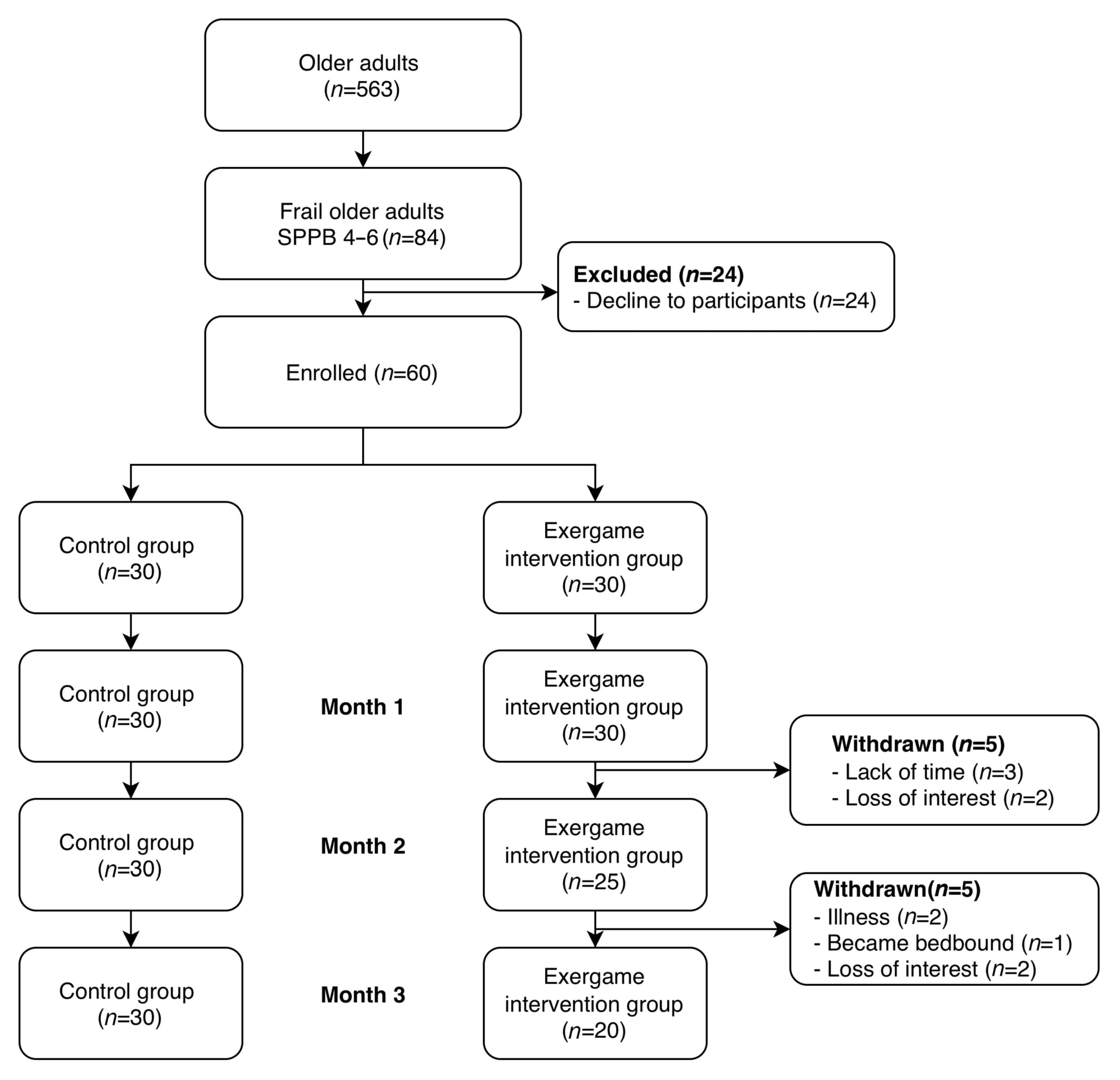
Among the 84 individuals who met the SPPB 4–6 frailty criterion, 60 exhibited interest and subsequently enrolled after providing written informed consent (ethics approval no. 207/2567): 30 participants were from Nong Faek sub-district (control group), and 30 were from Suthep sub-district/Chiang Mai Municipality (exergame group).
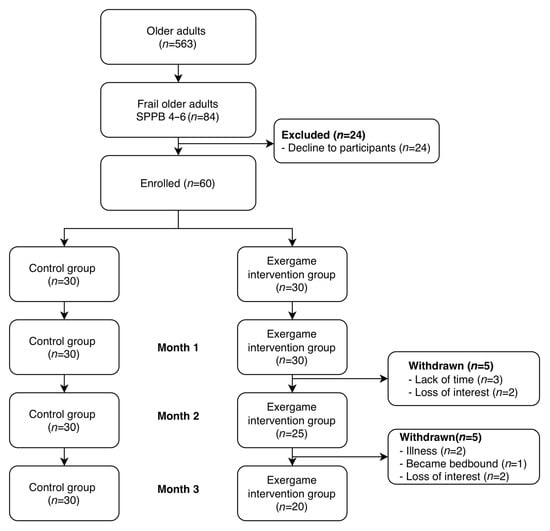
Over the 12-week follow-up period, all 30 control participants completed the study. The exergame group had 20 of 30 (66.7%) participants (33.3% attrition) for the 12-week analysis after 5 participants withdrew after the first month due to lack of time and interest, and a further 5 withdrew after the second month due to acute illness and lack of interest (Figure 3).
Figure 3.
Diagram of experimental group allocation and follow-up in participants over a 12-week period.
Over the 12-week period, 30 control-group participants were interviewed and reported engaging in physical activity regularly, typically performing an average of 3–5 self-selected activities; walking was most common (86.7%), followed by arm stretching, leg stretching, and cycling. The average session duration ranged from 10 to 30 min, performed 5–7 days per week. In comparison, the 20 exergame-group participants with post-intervention data engaged in the structured seven-exercise VIVIFUN program for 30–45 min per session, 5 days per week, as prescribed.
3.4. Baseline Comparability Between Groups
At baseline, the results among all originally allocated participants showed no significant differences in terms of age, sex, SPPB, SARC-F, handgrip strength, and biomarkers at enrollment between all originally allocated participants (all p > 0.05) (Table 3). However, the absence of statistically significant differences does not establish equivalence between two non-randomly allocated communities, and unmeasured differences between them cannot be excluded.
Table 3.
Baseline comparability of physicalperformance and biomarker variables among all originally allocated participants, prior to any attrition.
Additionally, health data, including BMI, fall history in the previous year, presence of comorbidity, smoking status, or number of medications, did not differ significantly between the control and exergame groups. Regarding the presence of specific comorbidities, dyslipidemia was significantly more common in the exergame group (p < 0.001). Other comorbidities relevant to exercise capacity, such as knee osteoarthritis and lumbar disc disease, did not differ significantly between the groups (Table S2).
At the end of the 12-week intervention, 10 participants in the exergame group had withdrawn, whereas no participants withdrew from the control group. This attrition rate differed significantly between groups (control 0/30, 0%; exergame 10/30, 33.3%; Fisher’s exact p < 0.001). Baseline characteristics of exergame-group completers (n = 20) and non-completers (n = 10) were statistically similar for age, SPPB, SARC-F, handgrip strength, and all three biomarkers; however, non-completers had significantly lower baseline FRAIL Scale scores than completers (p = 0.029), indicating that participants who withdrew may have been marginally less frail at enrollment. This raises the possibility that follow-up data were not missing completely at random, a consideration addressed in the primary intention-to-treat and the complete-case sensitivity analyses reported below (Table 4).
Table 4.
Comparison of baseline characteristics between exergame-group completers (n = 20) and non-completers (n = 10).
3.5. Physical Performance and Biomarker Outcomes
In the primary intention-to-treat (ITT) analysis, a linear mixed-effects model including all 60 participants demonstrated significantly greater improvement in the exergame group for SPPB (group × time effect) (p = 0.003), SARC-F (p < 0.001), handgrip strength (p = 0.022), and a greater reduction in serum IL-6 (p < 0.001), which decreased in the exergame group and slightly increased in the control group. No significant ITT effects were observed for the FRAIL Scale, CRP, or DHEAs. The secondary baseline-adjusted ANCOVA, restricted to participants with post-intervention 12-week follow-up, yielded results consistent with the ITT analysis. For the FRAIL Scale, ANCOVA showed a significant between-group difference (adjusted difference, p = 0.012), which was not observed in the ITT analysis (Table 5). Given the lower baseline FRAIL scores among exergame non-completers (Table 4), the complete-case FRAIL result may be affected by attrition-related selection bias; therefore, the null ITT result was considered the more robust estimate for the FRAIL Scale. Because adherence was low, these between-group differences reflect assignment to the exergame program rather than a defined exercise dose.
Table 5.
Between-group comparison of physical performance and biomarker outcomes over 12 weeks: intention-to-treat (mixed-effects model, primary analysis) and baseline-adjusted complete-case analysis (ANCOVA, secondary sensitivity analysis).
3.6. Player Experience and Usability
Among the 20 exergame group participants post-intervention, PENS scores were highest for autonomy (6.98 ± 0.07) and competence (6.92 ± 0.24), indicating that participants experienced a strong sense of control and confidence over their in-game actions. Relatedness scored lowest at 5.10 ± 0.62, consistent with VIVIFUN’s single-player design, which offered limited opportunity for social interaction with co-players. The evaluation of immersion/presence (6.00 ± 1.23) and enjoyment (5.96 ± 0.17) were both rated favorably. The overall grand mean across all domains was 6.49 ± 0.32, indicating a “very good” player experience (Table 6). Autonomy and competence scores clustered at or near the scale maximum (ceiling effect), which accounts for their small SDs.
Table 6.
Player experience of needs satisfaction (PENS) scores by domain (n = 20).
System usability was rated highly, with a mean SUS score of 88.83 ± 10.50, classifying it in the “excellent, very easy to use” category (Table 7). The mean likelihood-to-recommend score of 2.47 ± 2.47 similarly indicated a strong tendency for participants to recommend the exergame to others.
Table 7.
System usability scale (SUS) and likelihood-to-recommend scores (n = 20).
3.7. Program Adherence
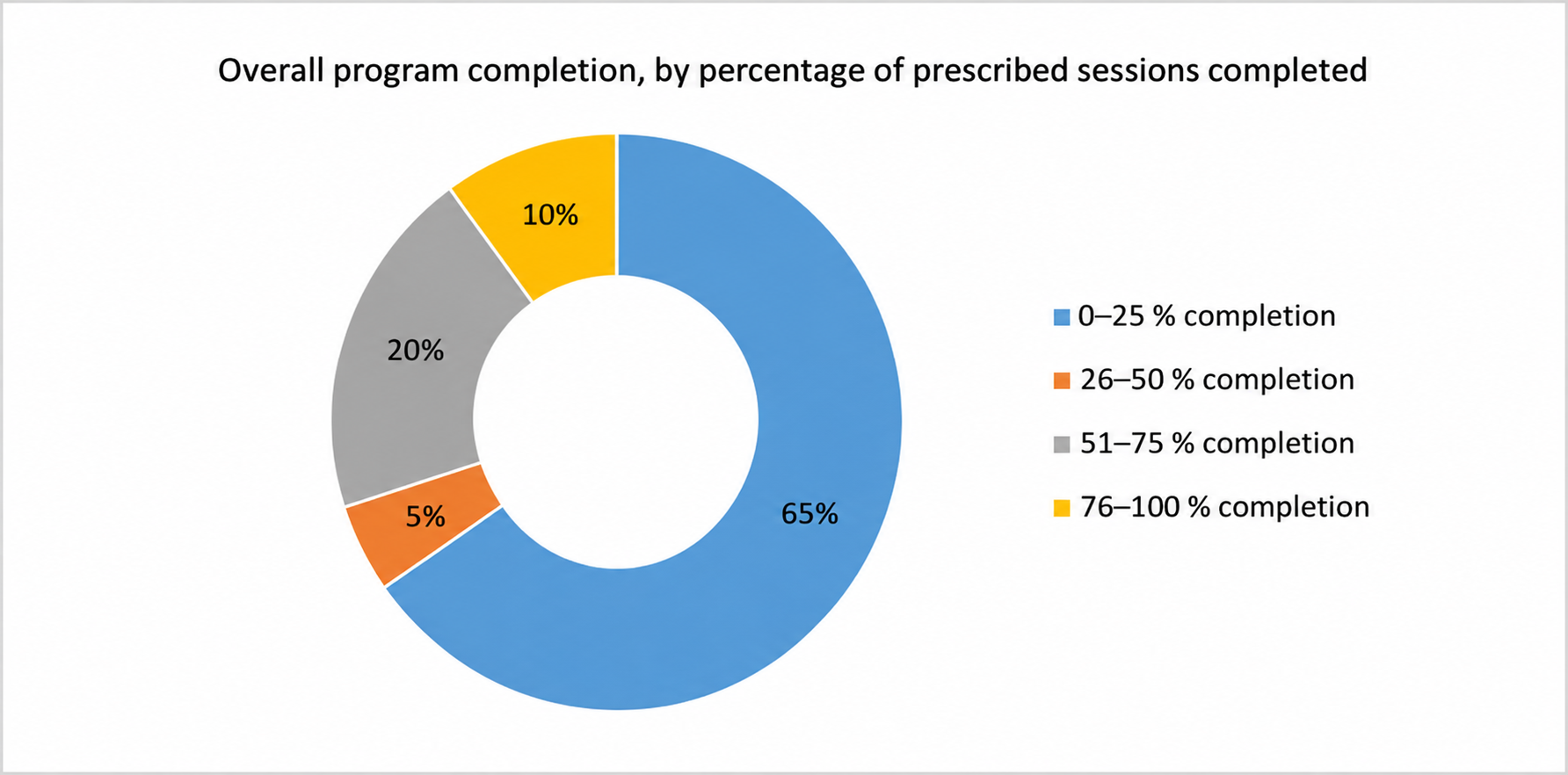
Adherence to the 12-week VIVIFUN program was limited, with only 2 out of 20 completers (10.0%) achieving over 75% completion of the prescribed program. Conversely, 13 out of 20 (65.0%) completed less than 25% (Figure 4). The primary barriers reported included an inability to complete the prescribed number of exercise days and, on days when exercise was attempted, an inability to complete all 7 exercises. These challenges were attributed to time constraints, physical condition, limited understanding of technique, and fluctuating motivation.
Figure 4.
Proportion of exergame-group completers (n = 20) by percentage of the prescribed 12-week VIVIFUN program completed, as recorded automatically by the game. Control participants are not included because their activity was self-directed.
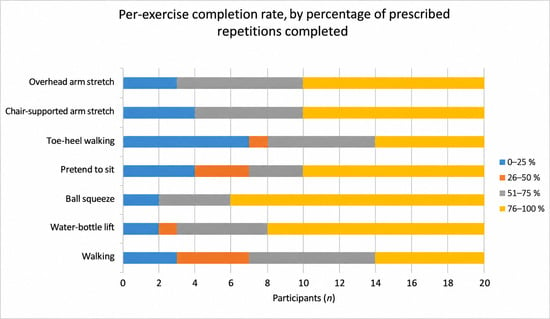
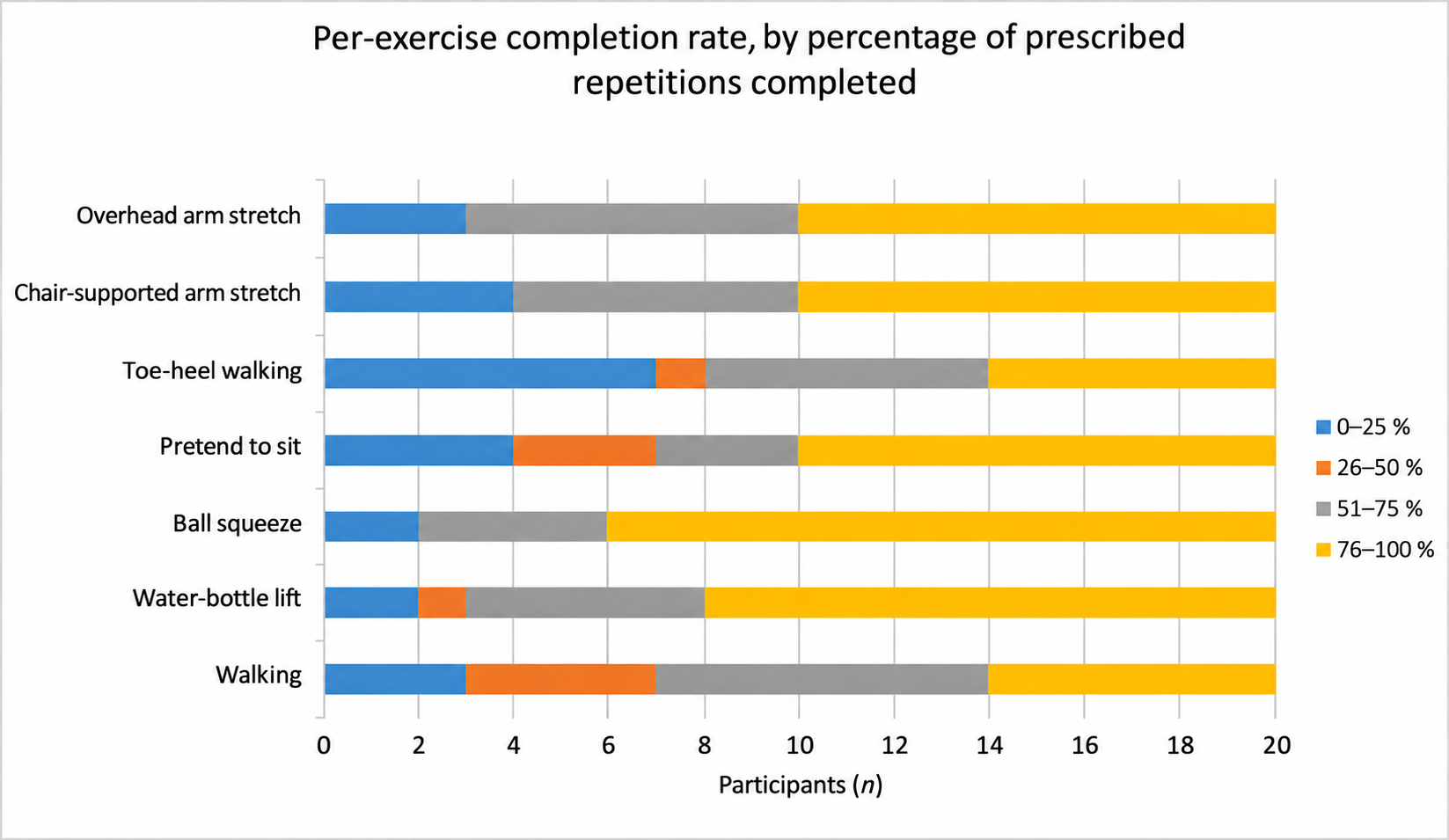
The rates of completion varied across exercises displayed in Figure 5. The ball-squeeze and arm-raise exercises had the greatest share of participants completing more than 75% of the assigned repetitions (70.0% and 60.0%, respectively); toe-heel walking had the least (30.0% completing ≥ 76% and 35.0% completing ≤ 25%).
Figure 5.
Proportion of exergame-group completers (n = 20) by percentage of assigned repetitions completed for each VIVIFUN exercise.
4. Discussion
The implementation of Vivifrail in Thailand poses a well-documented challenge: while the program can be practiced at home, sustaining long-term adherence is difficult, and many older adults still need guidance and support. Although international trials support its efficacy—such as significant improvement in functional capacity and fall risk following a 12-week program in Mexican women with dynapenia [15], and reduced fall risk and fear of falling following a 4-week intervention among frail Indonesian nursing-home residents [16]—data from Thailand, especially on long-term outcomes, remain limited. To address this adherence gap, this study developed VIVIFUN, an exergame developed on the worldwide validated Vivifrail multicomponent exercise program, focusing on community-dwelling Thai older adults with physical frailty.
The VIVIFUN game consists of 7 exercise movements, based on the Vivifrail program for frail older adults. The fundamental mechanism relies on posture detection technology using a virtual human skeleton to evaluate and record exercise data. The AI-driven motion detection system achieved remarkable results for skeleton-tracked movement (F1-score 0.99–1.00); however, it showed noteworthy limitations for two movement types. Initially, the skeleton model was unable to reliably track the ankle and foot movements required for accurate walking and toe-heel walking detection, likely due to the resolution limits of standard tablet-camera pose estimation for distal lower-limb keypoints. This was addressed by shifting to point-to-point displacement tracking, using visual cues to guide participants along a specified path. While this approach is effective, it does not directly capture ankle kinematics. Secondly, the ball squeeze exercise was not reliably detected through skeleton tracking because the ball itself occluded the hand keypoints. Substituting audio detection, triggered by a sound-emitting ball, yielded a moderate F1-score of 0.82, but with a relatively high false-positive rate due to background noise and microphone variability. These findings emphasize two key challenges for AI-assisted exergames designed for real-world implementation: sensitivity to environmental conditions, such as lighting, camera angle, and participant positioning, and their limited ability to differentiate between kinematically similar movements, including normal walking versus toe or heel walking.
These findings were consistent with previous reports in other pose-estimation-based exercise-recognition systems. For instance, a convolutional neural network ensemble trained on more gym exercises had an F1-score of 0.916 [35], while lightweight, browser-deployable models are comparable to marker-based and depth-camera (Kinect) systems for exergame movement tracking under controlled conditions [36]. Consequently, VIVIFUN’s near-perfect performance on its four skeleton-tracked exercises and point-to-point-tracked walking may be due to its small, clinically defined, and visually distinct movement set rather than model capacity. Lower-limb and audio-based detection were insufficient, indicating that camera positioning and viewing angle might significantly affect pose-estimation accuracy in exercise detection [37]. Future development should therefore prioritize optimized camera placement and improved ankle and foot tracking, potentially through supplementary wearable sensors, while incorporating noise-robust audio models or vision-based alternatives for movements that are challenging to detect using skeleton-based tracking.
Over 12 weeks, the primary intention-to-treat analysis showed that participants assigned to the exergame demonstrated significantly greater improvement than those continuing usual exercise in physical performance (SPPB), sarcopenia risk (SARC-F), handgrip strength, and the inflammatory biomarker IL-6; these four findings were also confirmed in a secondary, baseline-adjusted complete-case analysis. However, given the non-randomized design, the inclusion of only one community per study arm, and the differential attrition between groups, these findings should be interpreted as pilot and not as definitive evidence of a causal treatment effect. Additionally, participants reported high levels of player enjoyment (PENS) and system usability (SUS) among competitors. The observed SPPB improvement (ITT effect of approximately +1.8 points) exceeds the 1-point substantial meaningful change reported for older adults [25] and is relevant to fall-risk stratification [38]. However, this finding should be interpreted with caution. The assumed SD for sample size calculation was 1 SPPB point, whereas the observed follow-up SDs were higher (2.12 and 2.27 in the control and exergame groups, respectively). This greater variability, combined with the wide confidence interval and small sample size, may have limited statistical power. Therefore, the clinical significance of the observed improvement requires confirmation in an adequately powered trial.
The effectiveness of VIVIFUN compared to conventional exercise cannot be directly determined, as the comparison was conducted with usual self-directed activity rather than structured or supervised exercise. The ITT improvement in SPPB was similar in magnitude to that observed for conventional Vivifrail [13]. Previous studies have shown that exergaming produces effects on frailty, balance, and functional mobility comparable to those of conventional exercise [18,19,21]. In contrast to a supervised multicomponent program in Thai older adults [39], VIVIFUN did not significantly improve frailty status, and differences in populations, intervention duration, comparators, and study designs limit these indirect comparisons. In terms of delivery, VIVIFUN offers real-time movement feedback, automated exercise logging, and game-based engagement without continuous instructor supervision or additional sensors; however, it lacks professional posture correction and individualized resistance progression, depends on digital literacy, and was associated with lower adherence than conventional Vivifrail (79% in the first month and 68% thereafter [13]), although adherence definitions differed. VIVIFUN should therefore be considered a complementary delivery approach rather than a replacement for conventional exercise, pending head-to-head randomized trials.
The reduction in IL-6 observed in the exergame group, whereas not observed in the control group, is consistent with a Thai randomized controlled trial of a supervised multicomponent exercise program that similarly reported reductions in these inflammatory markers along with improved physical performance [39], as well as a systematic review finding connecting structured, aerobic and multicomponent exercise interventions to reduced systemic inflammation such as CRP, IL-6 and TNF-α in older adults [40,41]. CRP showed a greater numerical decrease in the exergame group than in the control group; however, the effect was not statistically significant in either the primary ITT analysis (p = 0.067) or the complete-case analysis (p = 0.130). Given the substantial biological and measurement variability of CRP, its right-skewed distribution, and the modest sample size, this finding should be considered exploratory and interpreted cautiously. Larger, adequately powered trials are needed to confirm whether VIVIFUN has a meaningful effect on CRP. DHEAs did not exhibit significant changes in either analysis, which contrasts with a Korean study reporting improved anabolic-hormone profiles after combined exercise training [42]. This discrepancy may be related to the shorter duration, smaller completer sample, or population differences.
A notable finding was that between-group differences favoring the exergame group in SPPB, SARC-F, handgrip strength, and IL-6 were observed despite low adherence: only 10% of completers completed more than 75% of the prescribed 12-week program, and one-third of the exergame group withdrew before follow-up. However, between-group differences favoring the exergame group were observed in SPPB, SARC-F, handgrip strength, and IL-6 levels. Because of the lack of an assessment of the relationship between actual exercise exposure and outcomes, along with missing follow-up data for participants who withdrew, these findings should not be interpreted as evidence that partial engagement is sufficient to produce benefits. The observed differences may also reflect community-level differences, regression to the mean, or the additional contact and attention received by the exergame group. Future studies should examine dose-response relationships using the exercise logs automatically recorded by the system and improve adherence and retention before broader implementation. Reported reasons for non-completion or withdrawal include insufficient time, acute illness, physical limitations (such as knee pain or existing musculoskeletal comorbidities), unfamiliarity with tablet technology, and declining motivation—reflecting commonly reported barriers to sustained engagement in home- and community-based exercise. Although player experience and usability ratings were high among completers, they may overestimate acceptability across all participants. Follow-up feedback identified technical issues, including failed audio detection during ball squeezing, temporary screen blackout during walking, and one frozen home screen requiring a restart. Other challenges included initial confusion and repeated confirmation prompts, difficulty performing toe-heel walking due to musculoskeletal limitations, and reliance on caregiver assistance. Although withdrawals were attributed mainly to time constraints, loss of interest, and illness, the 30–45 min sessions, repeated setup, and technical and physical challenges may have contributed to non-completion. Future versions should incorporate shorter or split sessions, simpler setup and navigation, more noise-robust detection, and alternative exercises for participants with physical limitations.
Beyond the outcomes measured, VIVIFUN may offer practical benefits for frailty management in Thai community and clinical settings, although these were not evaluated in this study and should be regarded as hypothetical. Clinically, it may complement rather than replace physiotherapy and exercise rehabilitation: clinicians could use SPPB scores to prescribe the appropriate Vivifrail level and provide initial supervised instruction, followed by home-based practice in which automated exercise logs support adherence monitoring and follow-up. In Thailand, such a hybrid model, combining periodic professional assessment with exergame-guided exercise and support from village health volunteers, may extend rehabilitation access in communities with limited physiotherapy services, consistent with the WHO ICOPE framework [12]. Whether this approach reduces injury risk compared with unsupervised training, or provides psychosocial benefits such as reduced social isolation, remains unknown. Group-based sessions also raise safety considerations, as frail older adults exercising together may be at increased risk of falls or acute medical events, underscoring the need for on-site supervision by trained village health volunteers. Implementation research is needed to assess feasibility, safety, cost, and clinical workload before routine adoption.
Limitation
Several methodological considerations should be considered when interpreting these findings. First, the trial used a quasi-experimental, community-cluster design rather than individual randomization to minimize potential contamination between neighboring participants receiving different interventions. However, non-randomized community allocation may have introduced selection bias, as reflected by the significant baseline imbalance in dyslipidemia prevalence between groups, which may have influenced the observed outcomes. Moreover, each study arm comprised only one community, making it impossible to distinguish the intervention effect from community-level characteristics, such as socioeconomic status, healthcare access, community activities, and local health-volunteer support. Between-community variance could not be estimated, and analyses at the participant level may have yielded overly precise estimates because community-level variation could not be accounted for. Consequently, the observed between-group differences cannot be confidently attributed to VIVIFUN, and their generalizability to other communities remains uncertain. Future cluster-randomized trials involving multiple communities per arm are needed to account for community-level effects and strengthen causal inference.
Second, attrition differed significantly between groups (0% in the control group vs. 33.3% in the exergame group, Fisher’s exact p < 0.001), and exergame non-completers had lower baseline FRAIL Scale scores than completers (p = 0.029), suggesting that dropout may not have been entirely random. To address potential attrition bias, the primary analysis followed the ITT principle using a linear mixed-effects model including all originally allocated participants, with a baseline-adjusted complete-case ANCOVA conducted as a sensitivity analysis. Results were consistent between the two approaches for SPPB, SARC-F, handgrip strength, and IL-6. The FRAIL Scale showed a significant effect only in the complete-case analysis; given the baseline imbalance between completers and non-completers, this finding may reflect attrition-related selection bias, and the null ITT result was therefore considered more reliable. CRP was not statistically significant in either analysis and should be considered exploratory.
Third, adherence was low, and the absence of a dose-response analysis limits inference about the amount of exercise required to achieve benefit. Given poor adherence (only 10% of completers completed >75% of the prescribed program) and 33.3% attrition, the exercise dose received was substantially below that prescribed. Thus, the efficacy of VIVIFUN under adequate adherence remains uncertain, and the findings should be interpreted with caution. In addition, self-reported exercise behavior in the control group may have been subject to recall and social-desirability bias. Player-experience and usability ratings were obtained only from completers, and PENS autonomy and competence showed ceiling effects; these ratings therefore discriminate poorly between participants, may reflect positive response bias, and may overestimate acceptability among all enrolled participants. Musculoskeletal comorbidities, such as knee osteoarthritis, were not systematically assessed and may have influenced physical performance and exercise adherence, potentially confounding the observed effects. Outcome assessors were not blinded to group allocation, which may have introduced detection bias. Cognitive status was assessed by interview rather than a validated screening instrument, such as the Thai Mental State Examination or Montreal Cognitive Assessment; therefore, participants with undiagnosed mild cognitive impairment may have been included, which could have affected their ability to use the exergame and their adherence. Finally, the sample size was small, and the assumed SD used in the sample-size calculation was smaller than that observed.
The generalizability of the findings is also limited by the selective study population. Eligibility criteria requiring independent mobility, Thai communication skills, the ability to learn tablet use, and the absence of serious illness or apparent cognitive impairment may have excluded frail older adults with greater functional or cognitive limitations and those with limited digital literacy, who may have substantial needs for accessible exercise interventions. Furthermore, only 60 of 84 eligible individuals (71.4%) participated, potentially introducing self-selection bias if volunteers were more motivated or technologically confident than non-participants. Recruitment from only two communities in Chiang Mai Province further limits generalizability to other regions and healthcare settings. Finally, because eligibility was restricted to participants with SPPB scores of 4–6, corresponding to Vivifrail Program B/B+, the findings should not be generalized to pre-frail or robust older adults or other Vivifrail exercise levels.
5. Conclusions
In this pilot two-community study, VIVIFUN, a tablet-based exergame developed from the evidence-based Vivifrail program, was associated with greater improvements in physical performance, sarcopenia risk, and handgrip strength and a reduction in IL-6 compared with usual self-directed exercise over 12 weeks among community-dwelling Thai older adults with physical frailty. Participants who completed the program reported high usability and enjoyment. However, these findings should be interpreted cautiously given the non-randomized design, the single community per arm, one-third attrition in the exergame group, and low adherence. AI motion detection performed reliably for most exercises, although ankle/foot tracking and audio-based detection require further refinement. Before a large-scale trial, strategies to improve retention and adherence, such as shorter or more flexible sessions, technical support for tablet use, and regular follow-up, should be evaluated. These findings can inform the design and sample size of a sufficiently powered cluster-randomized trial with longer follow-up.
Supplementary Materials
The following supporting information can be downloaded at https://www.mdpi.com/article/10.3390/healthcare14234089/s1. Table S1: Demographic characteristics of the community frailty-screening cohort; Table S2: Comparison of health data baseline between the control group and the exergame intervention group; File S1: CONSORT 2025 checklist of information to include when reporting a randomised trial*.
Author Contributions
Conceptualization, A.P., S.G., N.C., and P.L.; data curation, A.P., Y.C., and P.L.; formal analysis, A.P. and S.G.; investigation, N.C.; methodology, A.P., Y.C., S.G., and P.L.; software, K.K., K.S., N.W., and S.G.; validation, K.K., K.S., N.W., and S.G.; writing—original draft preparation, A.P.; writing—review and editing, A.P., Y.C., S.G., and P.L. All authors have read and agreed to the published version of the manuscript.
Funding
This research was funded by the Strategic Fund (SF), National Research Council of Thailand (NRCT), 2024, grant no. N84A670244.
Institutional Review Board Statement
The study was conducted in accordance with the Declaration of Helsinki and was approved by the Human Research Ethics Committee, Faculty of Medicine, Chiang Mai University (approval number 207/2567, dated 24 May 2024).
Informed Consent Statement
Informed consent was obtained from all subjects involved in the study.
Data Availability Statement
The de-identified individual participant data supporting the findings of this study are available from the corresponding author (peerasak.lerttrakarn@cmu.ac.th) upon reasonable request from qualified researchers, starting from the date of publication. Requests should include a brief proposal describing the intended use; data will be shared after approval by the Human Research Ethics Committee, Faculty of Medicine, Chiang Mai University, and execution of a data-use agreement. Due to the inclusion of individual-level health and clinical data from human participants, the dataset cannot be made publicly available to protect participant privacy and confidentiality and in accordance with the ethical requirements of the study. Requests for access to de-identified data will be considered on a case-by-case basis.
Conflicts of Interest
The authors declare no conflicts of interest.
References
- The World Health Organization. Ageing and Health [Internet]. 2018. Available online: https://www.who.int/news-room/fact-sheets/detail/ageing-and-health (accessed on 5 August 2026).
- Statistics Elderly. Department of Older Persons 2559 [Internet]. Available online: https://www.dop.go.th/en (accessed on 5 August 2026).
- Ferrari, A.U.; Radaelli, A.; Centola, M. Invited review: Aging and the cardiovascular system. J. Appl. Physiol. 2003, 95, 2591–2597. [Google Scholar] [CrossRef] [Scilit] [PubMed]
- Sharma, G.; Goodwin, J. Effect of aging on respiratory system physiology and immunology. Clin. Interv. Aging 2006, 1, 253–260. [Google Scholar] [CrossRef] [Scilit] [PubMed]
- Wang, J.; Li, Y.; Yang, G.Y.; Jin, K. Age-Related Dysfunction in Balance: A Comprehensive Review of Causes, Consequences, and Interventions. Aging Dis. 2024, 16, 714–737. [Google Scholar] [CrossRef] [Scilit] [PubMed]
- Inouye, S.K.; Studenski, S.; Tinetti, M.E.; Kuchel, G.A. Geriatric syndromes: Clinical, research, and policy implications of a core geriatric concept. J. Am. Geriatr. Soc. 2007, 55, 780–791. [Google Scholar] [CrossRef] [Scilit] [PubMed]
- Chen, X.; Mao, G.; Leng, S.X. Frailty syndrome: An overview. Clin. Interv. Aging 2014, 9, 433–441. [Google Scholar] [CrossRef] [Scilit] [PubMed]
- Manorangsan, S.; Chaiparinya, P.; Mongkolsomlit, S.; Boonyong, S. Prevalence and associated factors of pre-frailty and frailty among Thai community-dwelling older adults aged 65 years and above. J. Assoc. Med. Sci. 2025, 58, 298–306. [Google Scholar]
- Sadaqa, M.; Debes, W.A.; Németh, Z.; Bera-Baka, Z.; Vachtler-Szepesi, M.; Nácziné Földes, L.; Premusz, V.; Hock, M. Multicomponent Exercise Intervention for Preventing Falls and Improving Physical Functioning in Older Nursing Home Residents: A Single-Blinded Pilot Randomised Controlled Trial. J. Clin. Med. 2024, 13, 1577. [Google Scholar] [CrossRef] [Scilit] [PubMed]
- Cadore, E.L.; Casas-Herrero, A.; Zambom-Ferraresi, F.; Idoate, F.; Millor, N.; Gómez, M.; Rodriguez-Mañas, L.; Izquierdo, M. Multicomponent exercises including muscle power training enhance muscle mass, power output, and functional outcomes in institutionalized frail nonagenarians. Age 2014, 36, 773–785. [Google Scholar] [CrossRef] [Scilit] [PubMed]
- The World Health Organization. WHO Clinical Consortium on Healthy Ageing 2021: Report of Consortium Meeting Held Virtually, 5–6 November 2021; World Health Organization: Geneva, Switzerland, 2022.
- The World Health Organization. Integrated Care for Older People (ICOPE): Guidance for Person-Centred Assessment and Pathways in Primary Care; World Health Organization: Geneva, Switzerland, 2019.
- Casas-Herrero, Á.; Sáez de Asteasu, M.L.; Antón-Rodrigo, I.; Sánchez-Sánchez, J.L.; Montero-Odasso, M.; Marín-Epelde, I.; Ramón-Espinoza, F.; Zambom-Ferraresi, F.; Petidier-Torregrosa, R.; Elexpuru-Estomba, J.; et al. Effects of Vivifrail multicomponent intervention on functional capacity: A multicentre, randomized controlled trial. J. Cachexia Sarcopenia Muscle 2022, 13, 884–893. [Google Scholar] [CrossRef] [Scilit] [PubMed]
- Courel-Ibáñez, J.; Buendía-Romero, Á.; Pallarés, J.G.; García-Conesa, S.; Martínez-Cava, A.; Izquierdo, M. Impact of tailored multicomponent exercise for preventing weakness and falls on nursing home residents’ functional capacity. J. Am. Med. Dir. Assoc. 2022, 23, 98–104.e3. [Google Scholar] [CrossRef] [Scilit] [PubMed]
- Romero-García, M.; López-Rodríguez, G.; Henao-Morán, S.; González-Unzaga, M.; Galván, M. Effect of a Multicomponent Exercise Program (VIVIFRAIL) on Functional Capacity in Elderly Ambulatory: A Non-Randomized Clinical Trial in Mexican Women with Dynapenia. J. Nutr. Health Aging 2021, 25, 148–154. [Google Scholar] [CrossRef] [Scilit] [PubMed]
- Hartantri, W.; Andriana, M.; Andriati, A.; Satyawati, R.; Mikami, Y.; Melaniani, S. Impact of multicomponent exercise (Vivifrail©) to reduce risk of falls and fear of falling in nursing home residents with frailty syndrome: Randomized controlled trial. Health Sport Rehabil. 2025, 11, 56–69. [Google Scholar] [CrossRef] [Scilit]
- Jorgensen, M.G.; Laessoe, U.; Hendriksen, C.; Nielsen, O.B.; Aagaard, P. Efficacy of Nintendo Wii training on mechanical leg muscle function and postural balance in community-dwelling older adults: A randomized controlled trial. J. Gerontol. A Biol. Sci. Med. Sci. 2013, 68, 845–852. [Google Scholar] [CrossRef] [Scilit] [PubMed]
- Donath, L.; Rössler, R.; Faude, O. Effects of Virtual Reality Training (Exergaming) Compared to Alternative Exercise Training and Passive Control on Standing Balance and Functional Mobility in Healthy Community-Dwelling Seniors: A Meta-Analytical Review. Sports Med. 2016, 46, 1293–1309. [Google Scholar] [CrossRef] [Scilit] [PubMed]
- Liao, Y.Y.; Chen, I.H.; Wang, R.Y. Effects of Kinect-based exergaming on frailty status and physical performance in prefrail and frail elderly: A randomized controlled trial. Sci. Rep. 2019, 9, 9353. [Google Scholar] [CrossRef] [Scilit] [PubMed]
- Mugueta-Aguinaga, I.; Garcia-Zapirain, B. Frailty Level Monitoring and Analysis after a Pilot Six-Week Randomized Controlled Clinical Trial Using the FRED Exergame Including Biofeedback Supervision in an Elderly Day Care Centre. Int. J. Environ. Res. Public Health 2019, 16, 729. [Google Scholar] [CrossRef] [Scilit] [PubMed]
- Zheng, L.; Li, G.; Wang, X.; Yin, H.; Jia, Y.; Leng, M.; Li, H.; Chen, L. Effect of exergames on physical outcomes in frail elderly: A systematic review. Aging Clin. Exp. Res. 2020, 32, 2187–2200. [Google Scholar] [CrossRef] [Scilit] [PubMed]
- Hopewell, S.; Chan, A.W.; Collins, G.S.; Hróbjartsson, A.; Moher, D.; Schulz, K.F.; Tunn, R.; Aggarwal, R.; Berkwits, M.; Berlin, J.A.; et al. CONSORT 2025 statement: Updated guideline for reporting randomised trials. BMJ 2025, 388, e081123. [Google Scholar] [CrossRef] [Scilit]
- Hunicke, R.; LeBlanc, M.; Zubek, R. MDA: A formal approach to game design and game research. In Proceedings of the AAAI Workshop on Challenges in Game AI, San Jose, CA, USA, 25–26 July 2004. [Google Scholar]
- Riccio, R. Real-Time Fitness Exercise Classification and Counting from Video Frames. arXiv 2024, arXiv:2411.11548. [Google Scholar]
- Perera, S.; Mody, S.H.; Woodman, R.C.; Studenski, S.A. Meaningful change and responsiveness in common physical performance measures in older adults. J. Am. Geriatr. Soc. 2006, 54, 743–749. [Google Scholar] [CrossRef] [Scilit] [PubMed]
- Bhatia, R.; Davis, C. A better bound on the variance. Am. Math. Mon. 2000, 107, 353–357. [Google Scholar] [CrossRef]
- Bender, R.; Lange, S. Adjusting for multiple testing—When and how? J. Clin. Epidemiol. 2001, 54, 343–349. [Google Scholar] [CrossRef] [Scilit] [PubMed]
- Rocco, L.L.G.; Fernandes, T.G. Validity of the short physical performance battery for screening for frailty syndrome among older people in the Brazilian Amazon region. A cross-sectional study. Sao Paulo Med. J. 2020, 138, 537–544. [Google Scholar] [CrossRef] [Scilit] [PubMed]
- T. Sriwong, W.; Mahavisessin, W.; Srinonprasert, V.; Siriussawakul, A.; Aekplakorn, W.; Limpawattana, P.; Suraarunsumrit, P.; Ramlee, R.; Wongviriyawong, T. Validity and reliability of the Thai version of the simple frailty questionnaire (T-FRAIL) with modifications to improve its diagnostic properties in the preoperative setting. BMC Geriatr. 2022, 22, 161. [Google Scholar] [CrossRef] [Scilit] [PubMed]
- Malmstrom, T.K.; Morley, J.E. SARC-F: A simple questionnaire to rapidly diagnose sarcopenia. J. Am. Med. Dir. Assoc. 2013, 14, 531–532. [Google Scholar] [CrossRef] [Scilit] [PubMed]
- Roberts, H.C.; Denison, H.J.; Martin, H.J.; Patel, H.P.; Syddall, H.; Cooper, C.; Sayer, A.A. A review of the measurement of grip strength in clinical and epidemiological studies: Towards a standardised approach. Age Ageing 2011, 40, 423–429. [Google Scholar] [CrossRef] [Scilit] [PubMed]
- Ijaz, K.; Ahmadpour, N.; Wang, Y.; Calvo, R. Player Experience of Needs Satisfaction (PENS) in an Immersive Virtual Reality Exercise Platform Describes Motivation and Enjoyment. Int. J. Hum.-Comput. Interact. 2020, 36, 1195–1204. [Google Scholar] [CrossRef] [Scilit]
- Thalmann, M.; Ringli, L.; Adcock, M.; Swinnen, N.; de Jong, J.; Dumoulin, C.; Guimarães, V.; De Bruin, E.D. Usability Study of a Multicomponent Exergame Training for Older Adults with Mobility Limitations. Int. J. Environ. Res. Public Health 2021, 18, 13422. [Google Scholar] [CrossRef] [Scilit] [PubMed]
- Grudpan, S. The M-SG Framework: A Framework for Multiplayer Cooperative Serious Game Development. Doctoral Dissertation, Universität Bremen, Bremen, Germany, 2023. Available online: https://media.suub.uni-bremen.de/handle/elib/7465 (accessed on 19 October 2026).
- Bang, G.S.; Park, S.B. Workout Classification Using a Convolutional Neural Network in Ensemble Learning. Sensors 2024, 24, 3133. [Google Scholar] [CrossRef] [Scilit] [PubMed]
- Vonstad, E.K.; Su, X.; Vereijken, B.; Bach, K.; Nilsen, J.H. Comparison of a Deep Learning-Based Pose Estimation System to Marker-Based and Kinect Systems in Exergaming for Balance Training. Sensors 2020, 20, 6940. [Google Scholar] [CrossRef] [Scilit] [PubMed]
- Oliosi, E.; Ferreira, S.; Giordano, A.P.; Viveiros, G.; Parraca, J.; Pereira, P.; Guede-Fernández, F.; Azevedo, S. Evaluation of Smartphone Camera Positioning on Artificial Intelligence Pose Estimation Accuracy for Exercise Detection: Observational Study. JMIR Mhealth Uhealth 2026, 14, e82412. [Google Scholar] [CrossRef] [Scilit] [PubMed]
- Welch, S.A.; Ward, R.E.; Beauchamp, M.K.; Leveille, S.G.; Travison, T.; Bean, J.F. The Short Physical Performance Battery (SPPB): A Quick and Useful Tool for Fall Risk Stratification Among Older Primary Care Patients. J. Am. Med. Dir. Assoc. 2021, 22, 1646–1651. [Google Scholar] [CrossRef] [Scilit] [PubMed]
- Sadjapong, U.; Yodkeeree, S.; Sungkarat, S.; Siviroj, P. Multicomponent Exercise Program Reduces Frailty and Inflammatory Biomarkers and Improves Physical Performance in Community-Dwelling Older Adults: A Randomized Controlled Trial. Int. J. Environ. Res. Public Health 2020, 17, 3760. [Google Scholar] [CrossRef] [Scilit] [PubMed]
- Prommaban, A.; Moonkayaow, S.; Phinyo, P.; Siviroj, P.; Sirikul, W.; Lerttrakarnnon, P. The Effect of Exercise Program Interventions on Frailty, Clinical Outcomes, and Biomarkers in Older Adults: A Systematic Review. J. Clin. Med. 2024, 13, 6570. [Google Scholar] [CrossRef] [Scilit] [PubMed]
- Zheng, G.; Qiu, P.; Xia, R.; Lin, H.; Ye, B.; Tao, J.; Chen, L. Effect of Aerobic Exercise on Inflammatory Markers in Healthy Middle-Aged and Older Adults: A Systematic Review and Meta-Analysis of Randomized Controlled Trials. Front. Aging Neurosci. 2019, 11, 98. [Google Scholar] [CrossRef] [Scilit] [PubMed]
- Ha, M.S.; Son, W.M. Combined exercise is a modality for improving insulin resistance and aging-related hormone biomarkers in elderly Korean women. Exp. Gerontol. 2018, 114, 13–18. [Google Scholar] [CrossRef] [Scilit] [PubMed]

Disclaimer/Publisher’s Note: The statements, opinions and data contained in all publications are solely those of the individual author(s) and contributor(s) and not of MDPI and/or the editor(s). MDPI and/or the editor(s) disclaim responsibility for any injury to people or property resulting from any ideas, methods, instructions or products referred to in the content. |
© 2026 by the authors. Licensee MDPI, Basel, Switzerland. This article is an open access article distributed under the terms and conditions of the Creative Commons Attribution (CC BY) license.