


Abstract
Background Administrative claims provide extensive longitudinal information on dental procedures but do not directly describe clinically interpretable care pathways. We developed a claims-based ordinal framework of dental treatment complexity and used it to characterize longitudinal treatment patterns and factors associated with transition to high-complexity care in France. Methods We conducted a retrospective longitudinal cohort study using the Échantillon du Système National des Données de Santé (ESND), a random 2% sample of people represented in the French National Health Data System. Beneficiaries with at least one selected dental procedure coded using the French Common Classification of Medical Procedures between 2016 and 2025 were eligible. Forty-nine procedure codes were clinically grouped, based on investigator consensus, into an ordinal treatment-complexity gradient: prevention (N0), restorative care (N1), endodontic care (N2), fixed prosthodontics (N3), extractions or oral surgery (N4), and removable prosthodontics or implant treatment (N5). Procedures were summarized within consecutive patient-specific 12-month blocks. The primary outcome was first attainment of N4 or N5 among patients whose initial level was N0–N3. Kaplan–Meier methods and multivariable Cox models were used to examine time to high-complexity care. Results Among the 1,078,231 patients initially classified at N0–N3, 212,929 (19.75%) had a subsequent recorded N4 or N5 procedure during the available observation period. In the time-to-event analysis (n = 752,855), 212,914 patients (28.3%) attained N4 or N5. Socioeconomic disadvantage was associated with faster attainment of N4/N5 (adjusted hazard ratio [aHR], 1.49; 95% confidence interval [CI], 1.47–1.52). Age showed a strong gradient: compared with adults aged 18–34 years, the aHR was 3.77 (95% CI, 3.71–3.83) among those aged ≥65 years. Women also had a higher adjusted rate than men (aHR, 1.13; 95% CI, 1.12–1.14). Conclusions Claims-based dental procedures can be organized into longitudinal treatment-complexity states at population scale. Transitions to extractional, surgical, or advanced rehabilitative care were observed in a substantial proportion of patients and occurred faster among socioeconomically disadvantaged and older patients. Because the gradient measures treatment intensity rather than disease severity or quality of care, clinical validation and sensitivity analyses are required before it is used as a general indicator of oral-health deterioration.
1. Introduction
Oral diseases affect billions of people worldwide and remain among the most prevalent non-communicable conditions [1,2,3]. Their burden is unequally distributed: people experiencing social and economic disadvantage have a higher prevalence and severity of oral disease and encounter more barriers to preventive and restorative care [1,2,3]. These inequalities are observed throughout the life course and may persist even in health systems offering broad population coverage, because the extent to which oral healthcare is included within pooled health-coverage mechanisms varies considerably across health systems [3,4].
Most population-based evaluations of dental care rely on cross-sectional indicators such as dental attendance, expenditure, receipt of individual procedures, or tooth loss. Although informative, these measures do not capture how care evolves within individuals.
Longitudinal studies have documented variation in dental-attendance patterns over time and associations between sustained routine attendance, subsequent tooth loss, and oral-health outcomes [5,6,7,8].
Dental management itself frequently comprises a sequence of preventive, restorative, endodontic, surgical, and rehabilitative procedures delivered over several years. Studying these sequences may therefore reveal patterns that are not visible when procedures are considered separately.
Administrative health databases are well suited to longitudinal research because they contain standardized records for large populations over extended periods [9,10]. French health-insurance data have previously been used to investigate dental-care utilization and specific reimbursed dental procedures, including preventive care, restorative treatment, and tooth extraction [11,12]. Dental claims databases have similarly been used to investigate patterns of service use, provider practices, treatment outcomes, and patient determinants of care, although their validity depends on the accuracy and clinical interpretability of procedure coding [13,14].
In France, the Système National des Données de Santé (SNDS) links reimbursed healthcare, hospital, beneficiary, and—where relevant—medication data. Its random 2% sample, the Échantillon du Système National des Données de Santé (ESND), makes it possible to study care over long periods while retaining population-level coverage. Nevertheless, claims contain billing events rather than direct clinical states. Meaningful trajectory analysis therefore requires a transparent method for transforming individual procedures into clinically interpretable longitudinal states.
We developed a clinically informed ordinal gradient of dental treatment complexity based on routinely reimbursed procedures. The gradient was designed as an analytic representation of treatment intensity and was not intended to measure disease severity, appropriateness, or quality of care. Our objectives were to: (1) reconstruct longitudinal dental treatment trajectories in the ESND; (2) describe initial, maximum, and changing treatment-complexity levels; and (3) identify sociodemographic factors associated with the time to first attainment of high-complexity care.
2. Materials and Methods
2.1. Study Design and Data Source
This retrospective longitudinal cohort study used pseudonymized ESND data covering 2016–2025. The ESND is the current 2% representative sample of the SNDS and succeeds the former Échantillon Généraliste des Bénéficiaires (EGB), which was used in earlier French health-claims studies [15]. The SNDS contains individual-level reimbursement records, beneficiary characteristics, hospital discharge diagnoses and procedures, and reimbursed medicines. Access was provided through the secure SNDS portal managed by the French National Health Insurance Fund (Caisse nationale de l’Assurance Maladie [CNAM]). User access credentials were issued on 27 January 2026. The analytic dataset was constructed progressively between February and August 2026. Reporting was guided by the STROBE statement and its RECORD extension for studies conducted using routinely collected health data [16,17].
2.2. Regulatory Framework and Data Access
The University of Tours was the data controller for this study, while the CNAM was the controller of the central SNDS. Access to the ESND was approved by the French Health Data Hub (Plateforme des données de santé) on 11 July 2025 under decision ESND-041 for the study “Analyse du recours aux soins bucco-dentaires en France: une approche basée sur l’Échantillon du Système National des Données de Santé (ESND).” The study was conducted under the CNIL ESND reference framework (deliberation no. 2022-124) and the applicable French and European data-protection framework. A data-access agreement between the University of Tours and the CNAM governed access to the pseudonymized data. Data were accessed and processed exclusively within the secure authorized SNDS environment. This study involved secondary analysis of routinely collected pseudonymized data, with no direct contact with participants.
2.3. Study Population
The source population comprised beneficiaries with at least one dental procedure included in the final 49-code analytic nomenclature during the study period. Among 1,349,476 beneficiaries meeting this criterion, 18,354 had no interpretable treatment level in their initial observation block and were excluded from trajectory analyses, leaving 1,331,122 patients with an identifiable initial treatment level. Dental procedures recorded in the outpatient claims table were linked to beneficiary data using the pseudonymized beneficiary identifier and the technical reimbursement keys used within the SNDS. Each beneficiary entered the cohort at their first recorded eligible care period.
Procedures were required to have a valid date and to be uniquely attributable to a beneficiary. Patients initially classified at N5 were retained in descriptive analyses but excluded from analyses of any upward transition because no higher level was defined.
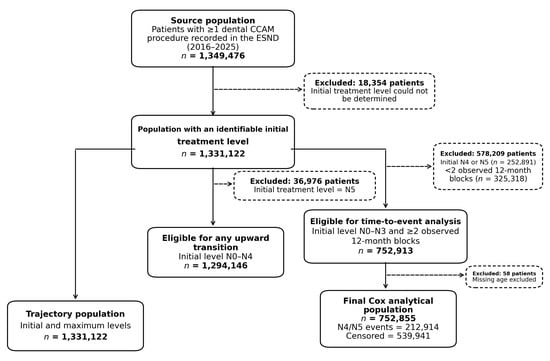
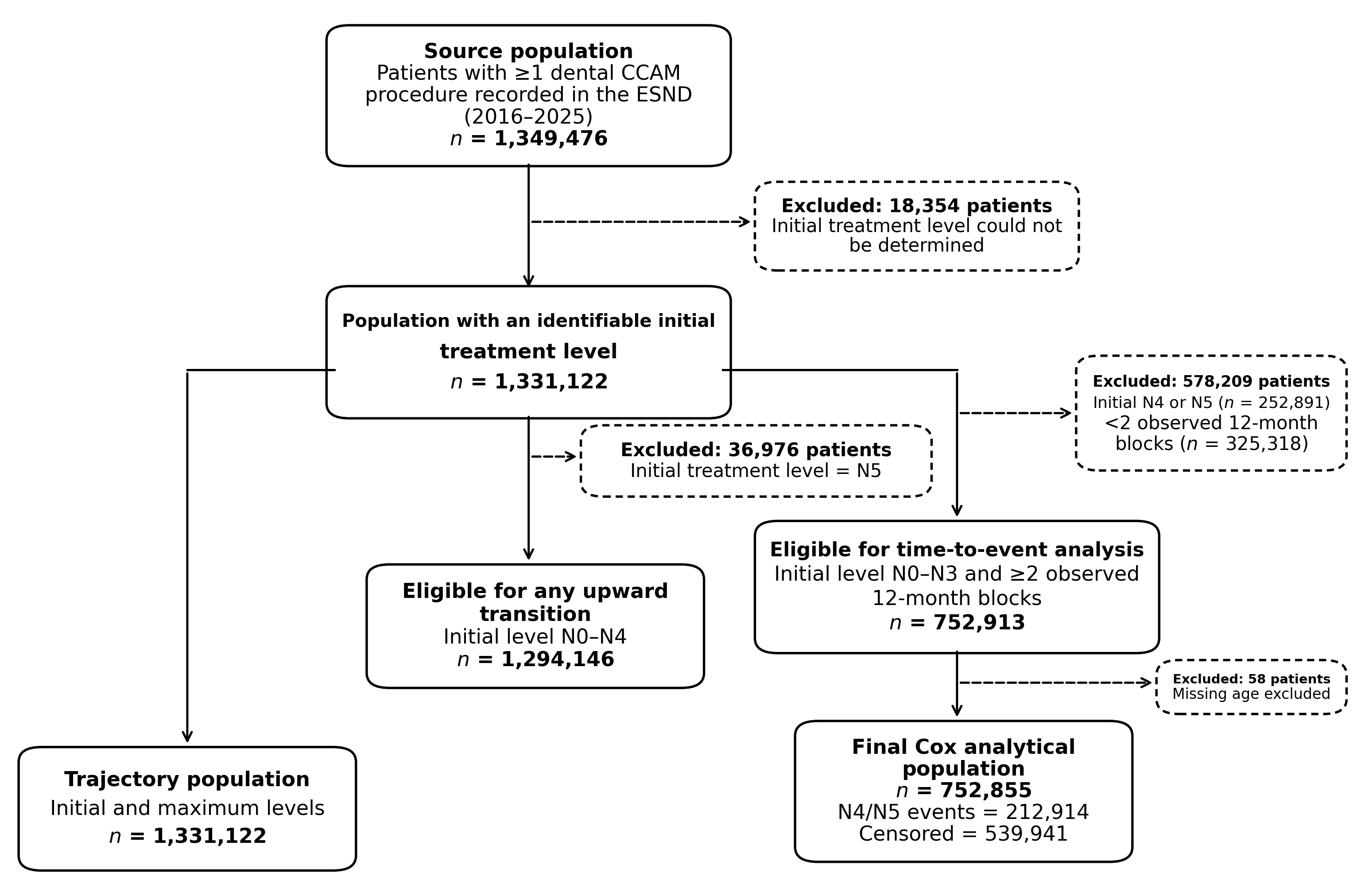
For time-to-event analyses, patients were required to have an initial treatment-complexity level between N0 and N3 and at least two 12-month blocks containing an observed dental treatment state. Thus, inclusion in the time-to-event population required subsequent observed dental care after the initial block but did not require continuous insurance eligibility throughout follow-up or any additional minimum follow-up duration. A total of 752,913 patients met these eligibility criteria. Of these, 58 patients with missing age data were excluded from the multivariable analysis, resulting in a final Cox analytical population of 752,855 patients. The successive exclusions and corresponding analytical populations are detailed in Figure 1.
Figure 1.
Study flow diagram. Selection of the source population, trajectory population, population eligible for any upward transition, and time-to-event population. The time-to-event analysis was restricted to patients initially classified at N0–N3 with at least two observed 12-month blocks; patients with missing age were subsequently excluded from the multivariable Cox model. CCAM, Classification commune des actes médicaux (French classification of medical procedures); ESND, Échantillon du Système national des données de santé (French National Health Data System sample); N0–N5, treatment complexity levels defined in the Methods; n, number of patients. Dashed arrows indicate exclusions.
2.4. Identification and Clinical Grouping of Dental Procedures
Dental procedures were identified using codes beginning HB or LB in the Classification Commune des Actes Médicaux (CCAM). To identify high-volume procedures while accommodating changes in coding over time, the 50 most frequent codes were obtained separately for each calendar year. These procedures accounted for 93.06–95.79% of all HB/LB procedure records annually. After annual lists were merged and duplicates removed, 69 distinct codes underwent clinical review. Of the 69 distinct CCAM codes initially identified, 20 were excluded because they did not correspond to the dental treatment approaches investigated in this study and therefore fell outside the scope of the N0–N5 classification. The remaining 49 codes were retained for the longitudinal analyses.
The retained codes were grouped according to therapeutic purpose: prevention, direct and indirect restorative care, endodontic treatment, fixed prosthodontics, extractions and oral surgery, removable prosthodontics, and implant treatment. Coding variants representing the same therapeutic purpose were grouped to reduce sensitivity to nomenclature changes during the study period. The complete CCAM code list and classification rules are provided in Supplementary Table S1.
2.5. Dental Treatment-Complexity Gradient
The treatment-complexity gradient was developed as a clinically informed, analytically ordered framework of observed reimbursed dental procedures. The classification was developed through clinical review by three investigators (C.M., M.H.D., and F.D.) with expertise in general dentistry, restorative dentistry, pediatric and preventive dentistry, and public health. An initial classification was proposed based on therapeutic purpose, invasiveness, and treatment complexity, then reviewed and adjusted collectively by the three investigators. Final assignment of procedures to treatment-complexity categories was reached by consensus.
This study-specific classification was developed as an operational framework for describing longitudinal patterns of dental treatment recorded in administrative claims data. It was not intended to represent a validated clinical severity scale or to establish the appropriateness of individual treatments.
The detailed procedure classification included clinically related subcategories within major treatment levels where relevant (Supplementary Table S1). For the main longitudinal analyses, these subcategories were collapsed into six analytically ordered treatment-complexity levels: N0, prevention and biofilm control; N1, restorative treatment; N2, endodontic treatment; N3, fixed prosthodontic rehabilitation; N4, dental extraction or oral surgery; and N5, removable prosthodontics or implant treatment (Table 1). N0 represented observed preventive and biofilm-control procedures and did not imply absence of oral disease.
Table 1.
Claims-based dental treatment-complexity gradient used in the main analyses.
The ordering reflects the highest complexity of treatment observed within each analytical period and is designed for longitudinal analysis of claims data. It should not be interpreted as a universal clinical hierarchy or as a measure of underlying disease severity, tooth-level prognosis, quality of care, or treatment appropriateness. The distinction between N3 and N4 reflects the preservation of natural dentition versus tooth extraction and the resulting loss of a natural tooth, rather than a strict hierarchy of procedural technical difficulty. N5 represents prosthetic rehabilitation involving tooth replacement, providing the rationale for grouping N4 and N5 as a combined endpoint related to tooth loss and rehabilitation. Accordingly, an upward transition indicates subsequent receipt of a higher analytically ordered treatment category and may reflect disease progression or delayed care, but may also represent planned multistage treatment or successful rehabilitation.
2.6. Data Cleaning and Construction of Longitudinal States
Dates of care were available at the day level in the ESND extract. Data cleaning and same-day aggregation of procedures were therefore performed using the recorded date of care. Records sharing the same beneficiary identifier, date of care, and CCAM code were reduced to one occurrence. Coding variants representing components of the same endodontic or fixed-prosthodontic treatment sequence were consolidated to avoid counting related claims as independent treatment episodes. Incomplete sequences were excluded from calculation of the maximum treatment level. Extraction codes were converted into estimated numbers of extracted teeth and aggregated within the same day according to predefined extraction-counting rules.
For each beneficiary, follow-up was divided into consecutive, non-overlapping 12-month blocks, starting from the date of the first eligible dental procedure. Each block was assigned the highest treatment-complexity level recorded during that period. The first block defined the initial treatment level, and the highest level observed across all blocks defined the maximum level. A transition to a higher level was defined as the first subsequent block with a level above the initial level. For example, if preventive (N0), restorative (N1), and endodontic (N2) procedures were recorded within the same 12-month observation block, the block was classified as N2, corresponding to the highest treatment-complexity level observed during that period. Empty blocks were distinguished from observed blocks but were not included as therapeutic states.
2.7. Outcomes
The prespecified primary outcome for this manuscript was first subsequent attainment of high-complexity care, defined as N4 or N5, among patients initially classified as N0–N3. N4 included extractions and oral-surgical procedures, while N5 included removable prosthodontics and implant treatment. Secondary outcomes were: (1) any transition to a level above the initial level among patients initially classified at N0–N4; (2) maximum level during follow-up; (3) difference between maximum and initial levels; and (4) transitions between consecutive observed blocks.
2.8. Covariates
Baseline variables included sex, age at index care period date, health-insurance scheme, and socioeconomic disadvantage. Age was categorized as <18, 18–34, 35–49, 50–64, and ≥65 years for the primary model. Socioeconomic disadvantage at baseline was defined by recorded entitlement to the Couverture maladie universelle complémentaire, Aide au paiement d’une complémentaire santé, or Complémentaire santé solidaire. This measure captures eligibility for specific means-tested coverage schemes and should not be interpreted as a comprehensive individual socioeconomic measure.
2.9. Statistical Analysis
Categorical variables were summarized as counts and percentages and continuous variables as means with standard deviations and medians with interquartile ranges, as appropriate. Initial and maximum levels were cross-tabulated, and row percentages were used to describe the distribution of maximum levels within each initial level.
For the primary time-to-event analysis, follow-up time was expressed in successive 12-month blocks from the initial treatment block. Event times were therefore analyzed on this grouped annual time scale. The event was the first subsequent block in which N4 or N5 was observed, and patients without an event were censored at their last observed follow-up block. N4 and N5 were combined for this time-to-event endpoint to capture the first transition toward either of the two highest treatment-complexity categories. This composite outcome was intended as an operational measure of treatment trajectories and does not imply clinical equivalence between surgical procedures and prosthetic rehabilitation, which were retained as distinct categories in the descriptive analyses. A multivariable Cox proportional-hazards model included sex, age category, health-insurance scheme, and baseline socioeconomic disadvantage and was stratified by initial treatment level (N0–N3). Tied event times, which were expected because follow-up time was measured in 12-month blocks, were handled using the Efron approximation. The proportional-hazards assumption was assessed using weighted Schoenfeld-residual tests, both for individual covariates and globally. Because statistically significant departures from proportionality were detected, and event times were grouped into annual intervals, robustness was further evaluated using a discrete-time survival model with a complementary log-log link and a flexible interval-specific baseline hazard.
Patients with missing values for covariates included in the model were excluded from the corresponding multivariable analysis. Results are reported as adjusted hazard ratios (aHRs) with 95% confidence intervals (CIs). Two-sided p values below 0.05 were considered statistically significant. The regression analyses were considered exploratory, and no formal adjustment for multiple comparisons was applied; findings were interpreted primarily according to effect sizes, confidence intervals, and their clinical relevance rather than statistical significance alone. Analyses were performed using SAS Enterprise Guide, version 8.3 (SAS Institute, Cary, NC, USA).
3. Results
3.1. Cohort Selection and Characteristics
The source cohort included 1,349,476 beneficiaries with at least one eligible dental procedure. An initial level could be assigned to 1,331,122 (98.6%), who formed the principal trajectory population. After excluding 36,976 patients initially classified at N5, 1,294,146 were eligible for an upward transition. A total of 752,913 patients initially classified at N0–N3 had at least two observed 12-month blocks and were eligible for the time-to-event analysis. Among patients initially classified at N0–N3, 325,318 were excluded from the time-to-event analysis because they had fewer than two 12-month blocks containing an observed dental treatment state. Fifty-eight patients with missing age data were excluded from the multivariable model, resulting in a final Cox analytical population of 752,855 patients (Figure 1).
The source population included 707,107 women (52.4%) and 642,268 men (47.6%); sex was unknown for 101 patients (<0.1%). Mean age was 39.6 years (standard deviation, 22.1), and median age was 38 years (interquartile range, 21–57). Socioeconomic disadvantage was recorded in 149,281 patients (11.1%) at baseline and in 183,668 (13.6%) at least once during follow-up (Table 2).
Table 2.
Characteristics of the source cohort (N = 1,349,476).
3.2. Initial and Maximum Treatment-Complexity Levels
At baseline, N1 was the most frequent initial level (490,115; 36.82%), followed by N0 (464,771; 34.92%), N4 (215,915; 16.22%), N3 (117,318; 8.81%), N5 (36,976; 2.78%), and N2 (6027; 0.45%).
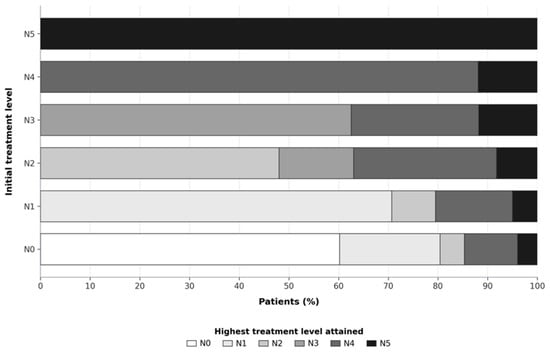
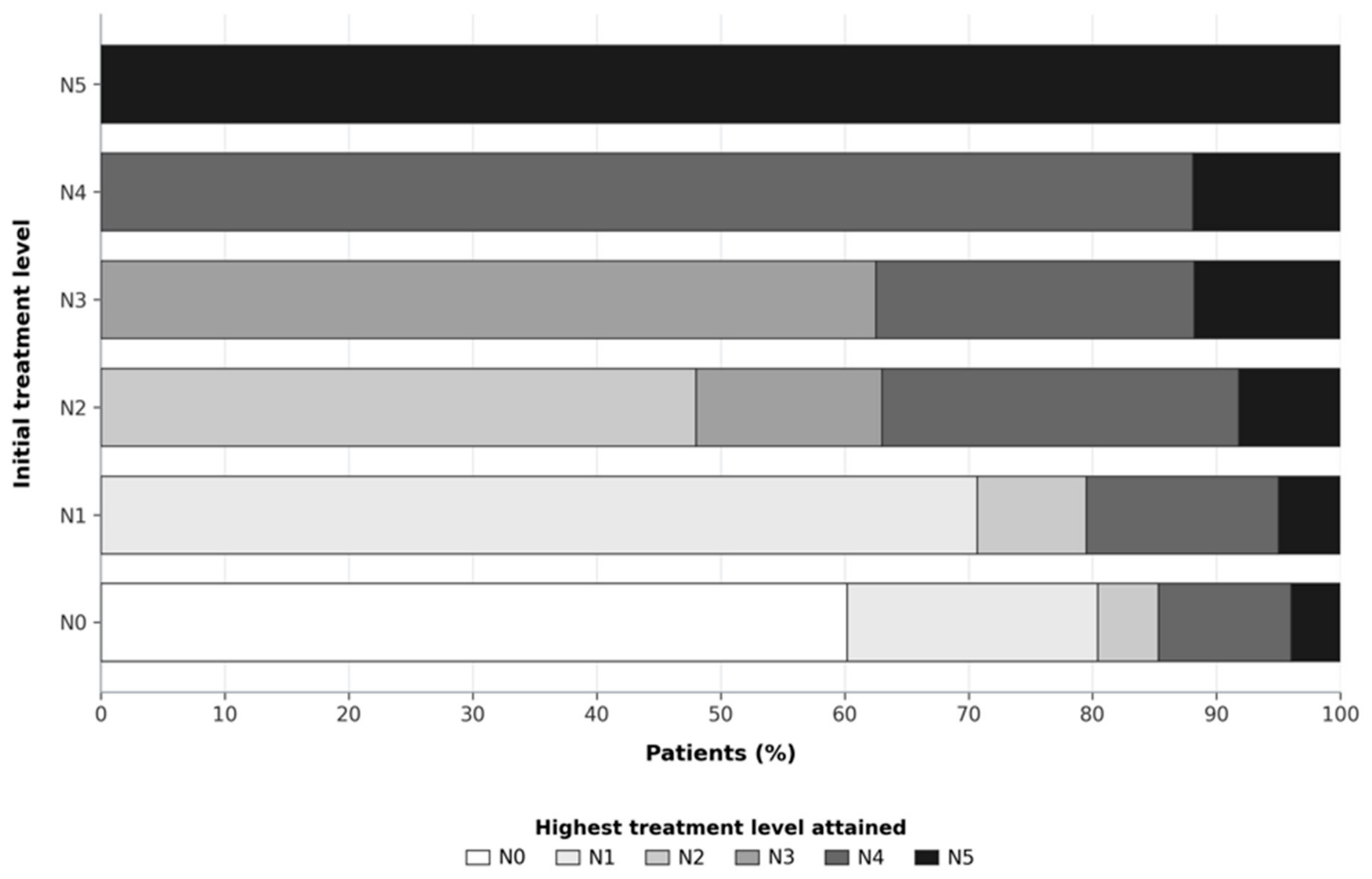
Across the complete observation period, the most frequent maximum level was N1 (441,035; 33.13%), followed by N4 (348,589; 26.19%), N0 (280,733; 21.09%), N3 (138,769; 10.42%), N5 (117,231; 8.81%), and N2 (4765; 0.36%). Maximum levels differed substantially according to initial level (Table 3 and Figure 2). Figure 2 illustrates the shift in the distribution of treatment-complexity levels between the initial and maximum observed states, particularly the increased proportions of patients classified at N4 and N5. Among patients initially classified at N0, 60.40% remained at a maximum of N0, whereas 14.48% reached N4 or N5. Corresponding proportions reaching N4 or N5 were 20.38% for initial N1, 36.78% for initial N2, and 37.13% for initial N3.
Table 3.
Maximum treatment-complexity level according to initial level (N = 1,331,122).
Figure 2.
Distribution of the maximum treatment-complexity level according to the initial level. Percentages are calculated within initial-level groups, and each bar represents 100% of patients in the corresponding group.
3.3. Upward Transitions
Among the 1,294,146 patients initially classified at N0–N4, 398,789 (30.81%; 95% CI: 30.73–30.89%) reached a level above their initial level. The proportion varied from 11.75% among those initially at N4 to 51.85% among those initially at N2. Across the full trajectory population, 932,333 patients (70.04%) had no difference between initial and maximum levels; 151,398 (11.37%) increased by one level, 57,246 (4.30%) by two, 99,052 (7.44%) by three, 73,791 (5.54%) by four, and 17,302 (1.30%) by five levels.
Among the 1,078,231 patients initially classified at N0–N3, 212,929 (19.75%; 95% CI: 19.67–19.82%) had a subsequent recorded N4 or N5 procedure during the available observation period, including 54,884 (5.09%) who reached N5. The proportion attaining N4/N5 rose across initial levels from 14.48% at N0 to 37.13% at N3.
Two complementary longitudinal outcomes were considered. General therapeutic progression was defined as the first attainment of any treatment level higher than the initial level. High-complexity progression was defined, among patients initially classified as N0–N3, as the first subsequent attainment of N4 or N5.
3.4. Factors Associated with Time to High-Complexity Care
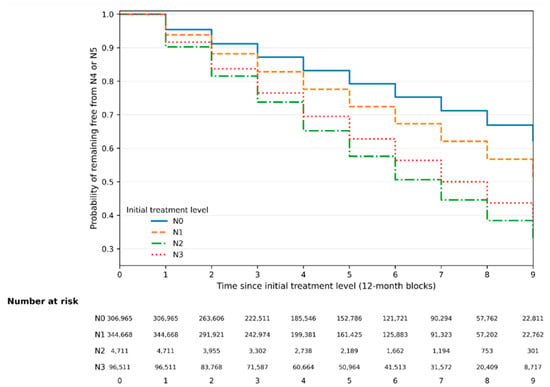
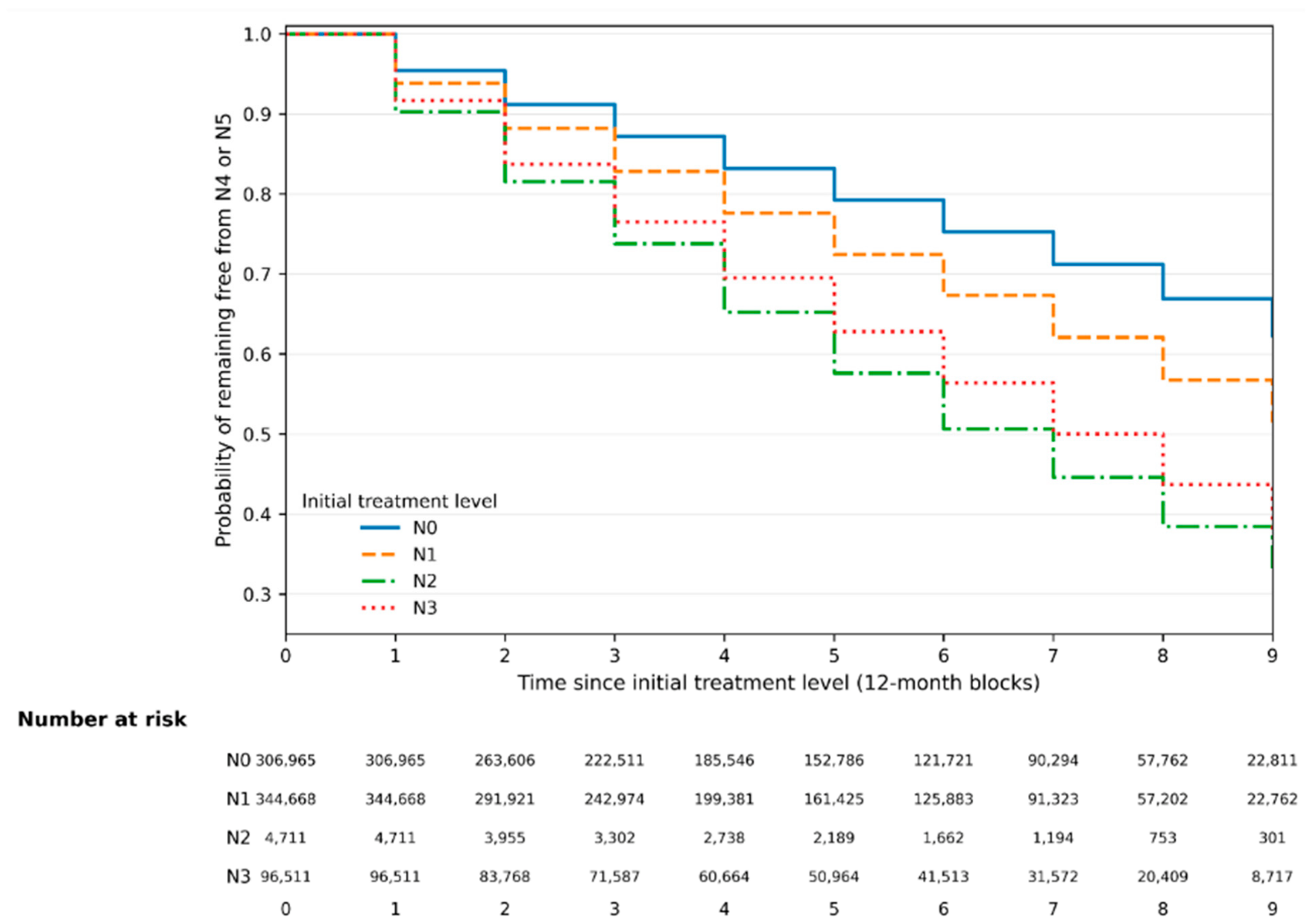
Among the 752,855 patients included in the time-to-event analysis, 212,914 (28.3%) attained N4 or N5 during follow-up, while 539,941 (71.7%) were censored. Kaplan–Meier curves differed significantly according to initial treatment level (log-rank χ2 = 14,161.54, df = 3, p < 0.0001; Figure 3).
Figure 3.
Kaplan–Meier curves for time to first attainment of high-complexity dental care (N4 or N5), according to initial treatment level (N0–N3). Numbers at risk are shown below the plot. Curves differed significantly across initial treatment levels (log-rank χ2 = 14,161.54, df = 3, p < 0.0001).
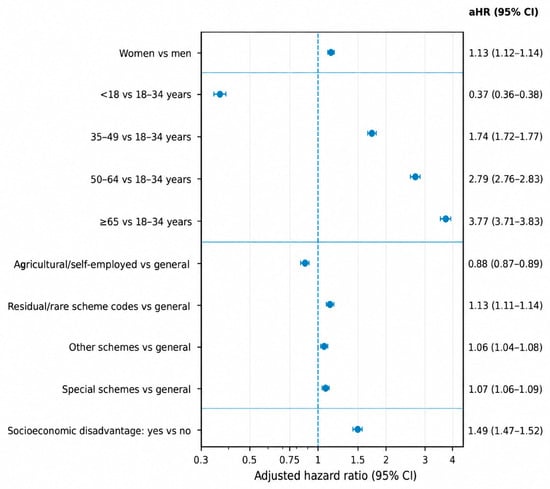
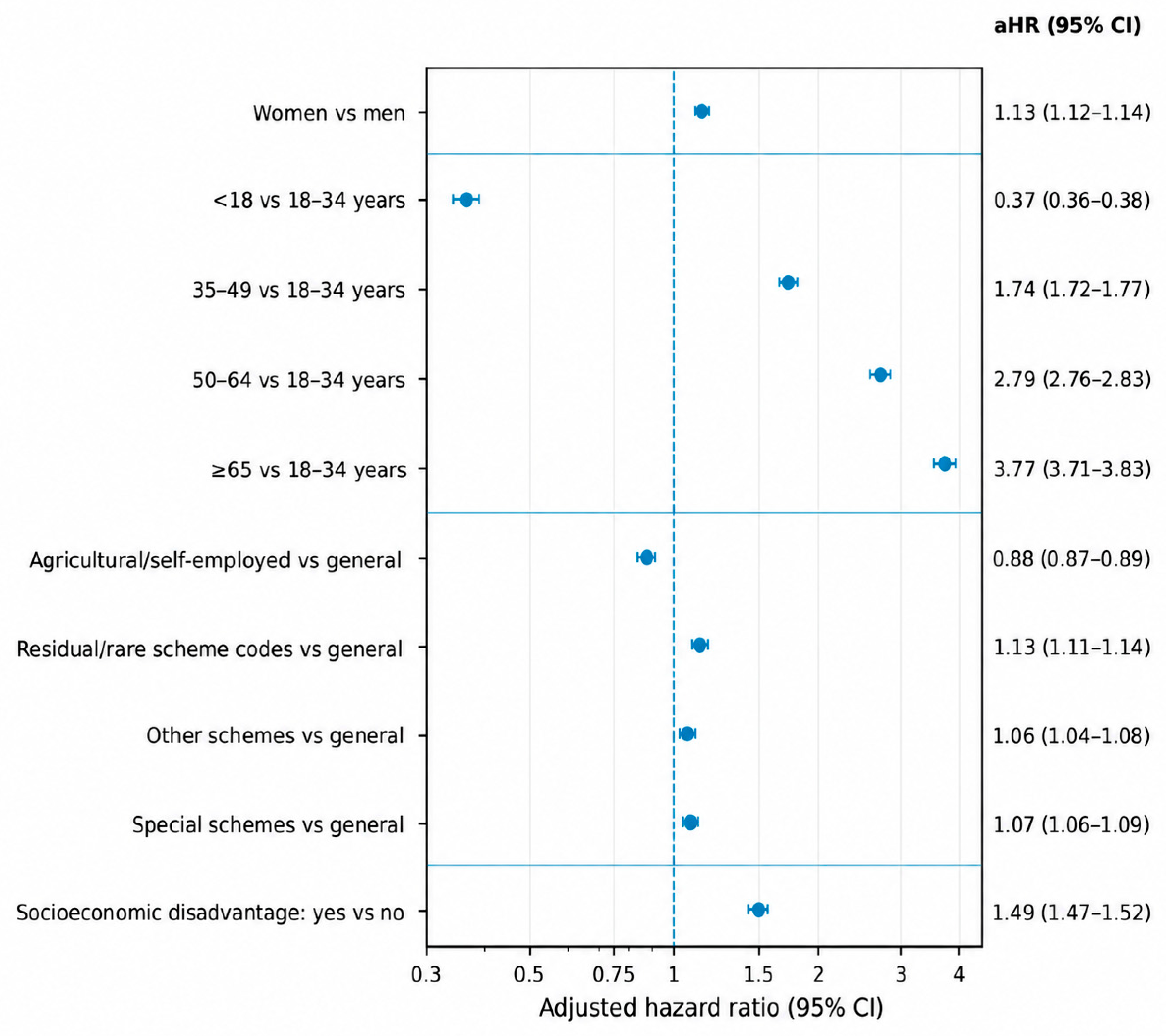
In the multivariable Cox model stratified by initial treatment level, women had a higher hazard of attaining N4 or N5 than men (aHR, 1.13; 95% CI, 1.12–1.14) (Table 4 and Figure 4). Increasing age was strongly associated with earlier attainment of high-complexity care: compared with patients aged 18–34 years, aHRs were 1.74 (95% CI, 1.72–1.77) for those aged 35–49 years, 2.79 (95% CI, 2.76–2.83) for those aged 50–64 years, and 3.77 (95% CI, 3.71–3.83) for those aged ≥65 years. Patients aged <18 years had a lower hazard (aHR, 0.37; 95% CI, 0.36–0.38).
Table 4.
Factors associated with time to first attainment of N4 or N5.
Figure 4.
Factors associated with time to first attainment of N4 or N5. Adjusted hazard ratios (aHRs) and 95% confidence intervals were estimated using a multivariable Cox proportional-hazards model stratified by initial treatment level (N0–N3). The model included sex, age category, health-insurance scheme, and socioeconomic disadvantage. CI, confidence interval; aHR, adjusted hazard ratio.
Socioeconomic disadvantage was independently associated with earlier attainment of N4 or N5 (aHR, 1.49; 95% CI, 1.47–1.52). Compared with the general insurance scheme, agricultural or self-employed schemes were associated with a lower hazard (aHR, 0.88; 95% CI, 0.87–0.89), whereas residual or rare scheme codes (aHR, 1.13; 95% CI, 1.11–1.14), other schemes (aHR, 1.06; 95% CI, 1.04–1.08), and special schemes (aHR, 1.07; 95% CI, 1.06–1.09) were associated with slightly higher hazards.
Weighted Schoenfeld-residual tests indicated evidence of non-proportional hazards globally (χ2 = 586.5, p < 0.0001), with statistically significant departures for sex, several age categories, socioeconomic disadvantage, and one health-insurance scheme category. However, correlations between the weighted Schoenfeld residuals and time were small in absolute magnitude (|r| ≤ 0.021). Given the large sample size and grouped annual event times, robustness was further assessed using a discrete-time survival model with a complementary log-log link. Effect estimates from this sensitivity analysis closely matched those from the stratified Cox model (Supplementary Table S2). The discrete-time sensitivity analysis included 752,855 patients, contributing 3,448,051 person-period observations and 212,914 N4/N5 events.
4. Discussion
4.1. Principal Findings
In this large French claims-based cohort, we transformed reimbursed dental procedures into patient-specific longitudinal states using a clinically informed treatment-complexity gradient. Approximately one-third of patients eligible for an upward transition reached a treatment level above their initial level, and one in five patients initially receiving preventive, restorative, endodontic, or fixed-prosthodontic care subsequently received extractional, surgical, removable-prosthodontic, or implant care. Older age and baseline socioeconomic disadvantage were the factors most strongly associated with faster attainment of high-complexity care.
The principal contribution of this study is methodological as well as descriptive. Claims databases are commonly used to count visits, procedures, or costs, but isolated indicators provide only a partial account of care. By assigning a reproducible state to each annual observation block, the present framework captures within-person changes while remaining scalable to more than one million beneficiaries. The resulting trajectories provide an intermediate representation between raw billing events and clinically rich dental records.
International longitudinal studies have examined dental-attendance trajectories and their associations with subsequent oral-health outcomes [5,7,8], while research using administrative dental databases has highlighted both the potential and methodological limitations of routinely collected claims data [13,14]. Our study builds on these complementary approaches by reconstructing longitudinal patterns of reimbursed dental procedures rather than attendance alone. However, direct comparisons remain limited by differences in study populations, healthcare systems, coding practices, and outcome definitions. The N0–N5 classification is therefore presented as a study-specific operational framework rather than a directly comparable or externally validated clinical hierarchy.
From a public-health perspective, the observation that approximately one in five patients initially classified at N0–N3 subsequently received N4 or N5 procedures highlights the importance of examining dental-care pathways beyond isolated service-use indicators. Although these transitions cannot be equated with disease progression or preventable tooth loss, their frequency supports further investigation of opportunities for earlier preventive and conservative care, continuity of dental follow-up, and equitable access to rehabilitation. Distinguishing extractional procedures from subsequent prosthetic rehabilitation in future analyses could help identify care pathways relevant to oral-health planning and the evaluation of dental-coverage policies.
4.2. Interpretation of Treatment-Complexity Patterns
Most patients had the same initial and maximum level, yet substantial movement toward higher levels was observed. Transitions were particularly frequent among patients initially classified at N2 or N3. This may reflect the place of endodontic and fixed-prosthodontic treatment within multistage care, subsequent failure of a treated tooth, treatment of other teeth, or accumulated treatment need. The claims do not identify which tooth was treated consistently across every procedure and do not establish why a later intervention occurred. Accordingly, the trajectories should be interpreted as patterns of care delivered to a person, not as tooth-specific clinical pathways.
The high-complexity endpoint deliberately combines procedures with different clinical meanings. Extraction and oral surgery may represent irreversible tissue loss or definitive management of a diseased tooth. In contrast, removable prosthodontics and implant treatment are rehabilitative interventions that may follow tooth loss and can indicate access to restorative options. A transition to N5 is therefore not intrinsically adverse. Future analyses should disaggregate N4, removable prosthodontics, and implant treatment and should examine sequences such as extraction followed by rehabilitation.
4.3. Socioeconomic Disadvantage
The 49% higher adjusted rate of attaining N4/N5 among beneficiaries with means-tested supplementary coverage is consistent with the well-established social gradient in oral health [1,2,3,18,19,20]. Several mechanisms may contribute. Socioeconomically disadvantaged patients may experience greater cumulative disease burden, delayed presentation, financial barriers to earlier restorative treatment, competing health and social priorities, and less regular continuity of dental care [18,19]. In France, financial barriers to dental care have been associated not only with low income and lack of complementary insurance but also with the level of prosthetic fees [21]. However, the association cannot be interpreted as a causal effect of disadvantage. The available indicator identifies eligibility for selected coverage schemes and does not directly measure income, education, occupation, area deprivation, dental health behaviours, or baseline clinical need. Furthermore, socioeconomic disadvantage was assessed using health insurance-based indicators, which do not capture the full range of individual and contextual determinants of healthcare access, including migration-related circumstances.
The association between socioeconomic disadvantage and N4/N5 attainment should be interpreted cautiously because the composite endpoint encompasses two distinct treatment categories: extraction and prosthetic rehabilitation. These interventions may reflect different underlying mechanisms, including unmet treatment needs and differences in access to rehabilitative care. The observed association cannot determine the relative contribution of each component, and separate analyses of extraction and prosthetic rehabilitation would be needed to clarify these mechanisms.
The French setting is particularly informative because broad statutory health coverage does not necessarily eliminate financial, geographic, or organizational barriers to dental care. Dental treatments are financed through a combination of statutory health insurance and complementary coverage, with reimbursement conditions and potential out-of-pocket costs varying according to the type of procedure. Previous national studies have shown persistent socioeconomic differences in dental-service utilization, with income, complementary insurance, and deprivation influencing access to care [20]. Financial barriers may be particularly relevant for prosthetic rehabilitation, for which treatment costs and reimbursement arrangements can influence the therapeutic options available to patients [21].
The 100% Santé reform, progressively implemented from 2019, aimed to improve financial accessibility by introducing selected dental prosthetic treatments without out-of-pocket costs for eligible beneficiaries with appropriate complementary coverage [22,23]. This reform may have influenced the utilization of prosthetic treatments during our observation period, particularly among socioeconomically disadvantaged populations. Consequently, transitions toward higher treatment-complexity categories, especially N5, may partly reflect changes in financial accessibility and treatment availability rather than changes in underlying clinical needs alone. These considerations are important when interpreting longitudinal treatment trajectories within the French healthcare system.
Coverage rules, out-of-pocket costs, availability of dental professionals, geographic accessibility, and the distribution of treatment need may still shape the care received [12,18,19,20,22]. The 100% Santé reform, introduced from 2019 to reduce out-of-pocket expenditure for selected dental prosthetic treatments, has altered the financial environment in which dental care is delivered in France [22,23]. The observed association remained after adjustment for age, sex, and health-insurance scheme, but residual confounding is likely. Previous French population-based research has similarly demonstrated marked socioeconomic differences in prosthetic treatment, with lower income and lack of complementary insurance associated with lower use of fixed prostheses and lower educational attainment associated with greater use of removable prostheses [24]. Analyses incorporating area-level deprivation, geographic accessibility, and policy periods could help identify potentially modifiable pathways.
Across Europe, substantial differences in dental healthcare coverage, reimbursement policies, and patient cost-sharing influence access to dental services, particularly for restorative and prosthetic treatments [25]. Socioeconomic inequalities in dental care utilization persist across European countries and are influenced, in part, by the extent of public coverage and financial protection [26]. Despite variations in national healthcare systems, unmet dental healthcare needs remain an important concern, particularly among socioeconomically disadvantaged populations [27]. These differences highlight the importance of considering healthcare financing and accessibility when interpreting dental treatment trajectories and suggest that the association between socioeconomic disadvantage and higher treatment complexity observed in our study may be influenced by broader structural determinants of dental care utilization.
4.4. Age and Sex
The strong age gradient is consistent with longitudinal evidence showing substantial age-related changes in dental attendance and accumulation of tooth loss across the life course [5,7,8]. Nevertheless, age may also capture cohort effects and differences in observation before 2016. Because the index procedure was the first observed procedure during the study window rather than necessarily the first procedure in a patient’s life, initial states are left-truncated representations of longer dental histories.
Women had a modestly higher adjusted rate of reaching N4/N5. Because the analysis captures recorded treatment rather than underlying treatment need, this association may partly reflect sex differences in patterns of dental-service utilization.
4.5. Strengths and Limitations
The principal strengths are the very large representative random 2% claims sample, ten years of longitudinal data, standardized procedure coding, and a prespecified clinical framework applied consistently across beneficiaries. The annual top-code approach retained more than 93% of identified HB/LB procedure volume each year and accommodated coding changes. Patient-specific time blocks reduced distortion from closely spaced procedures and enabled comparison of trajectories with different calendar entry dates.
Several limitations are important. First, the gradient is based on investigator consensus and has not yet undergone external clinical validation. Validation studies of dental claims have shown that the accuracy of administrative coding may vary substantially across diagnoses and procedures, reinforcing the need for procedure-specific validation before claims-derived constructs are interpreted as clinical states [14]. Its ordering is analytically useful but cannot establish a universal hierarchy across all clinical contexts. The clinical interpretation of certain procedures may also differ across age groups, particularly between pediatric and adult populations. Because inclusion required at least one eligible dental procedure, the study population represents beneficiaries with recorded dental-care utilization rather than the entire insured population. In particular, N0 identifies patients whose initial recorded treatment was preventive and should not be interpreted as indicating the absence of oral disease or treatment needs.
Second, claims indicate reimbursed care rather than underlying clinical need. They do not capture detailed clinical findings, patient preferences, shared treatment decisions, or care delivered outside the observable reimbursement system; moreover, inaccuracies or variations in procedure coding, including potential overcoding or undercoding, cannot be entirely excluded. Previous French claims-based dental studies have demonstrated their value for identifying population differences in patterns of preventive treatment and extraction, but such differences cannot by themselves establish the underlying clinical indication or disease severity [11]. Patients with no dental claim were absent, so findings apply to dental-care users rather than the entire French population.
Third, selecting high-frequency codes may omit uncommon but clinically important procedures and may exclude patients whose care consisted only of rare codes.
Fourth, the index care period is influenced by the study window, and previous dental history is not observed. Patients may therefore enter at an advanced level for reasons unrelated to new onset during follow-up.
Fifth, summarizing each 12-month block by its maximum level discards within-block order and may combine unrelated treatments on different teeth. It also yields grouped event times. Empty blocks and censoring at the last observed dental block may produce informative observation, because the absence of a recorded event may reflect no treatment, loss of observable eligibility, or absence of dental attendance. Moreover, because the time-to-event population required at least two blocks containing observed dental care, these analyses were conditional on repeat dental attendance. Patients with no subsequent recorded dental care after their initial block were therefore not represented in the survival analysis, which may introduce selection related to patterns of dental-service use [28]. Formal testing also indicated departures from the proportional-hazards assumption for several covariates. Although correlations with time were small in magnitude, Cox estimates should therefore be interpreted as average hazard ratios over follow-up rather than strictly time-invariant effects. Reassuringly, a discrete-time survival model tailored to the grouped annual event-time structure yielded closely similar effect estimates.
Sixth, follow-up length differed across calendar entry dates, and changes in reimbursement policy or the COVID-19 pandemic may have influenced recorded care. In particular, the 100% Santé reform altered reimbursement for selected prosthetic treatments during the study period and has been associated with measurable changes in dental-care utilization in French administrative data [23]. As our analyses were not designed to evaluate the impact of this reform, we cannot distinguish changes related to reimbursement policies from underlying longitudinal treatment patterns. Furthermore, the overlap between reform implementation and the COVID-19 pandemic complicates simple pre-/post-reform comparisons. Future analyses incorporating calendar periods and policy-specific analytical designs could help clarify these effects.
Finally, the very large sample produces narrow confidence intervals and small p values even for associations of limited magnitude. Clinical and public-health interpretation should emphasize effect sizes, absolute risks, and the distinct meanings of N4 and N5 rather than statistical significance alone.
4.6. Implications
Subject to validation, this framework could support monitoring of dental-care pathways, identification of groups more likely to receive extractional or advanced rehabilitative treatment, and evaluation of changes following prevention or reimbursement policies. Its greatest value may lie in separating preventive and conservative pathways from later extraction and rehabilitation sequences. Linking claims trajectories to clinical dental data would allow assessment of construct and predictive validity. Future work should also incorporate geographic access, dentist density, policy periods, and competing risks such as death.
From a public health perspective, longitudinal monitoring of dental treatment patterns may provide useful indicators for assessing healthcare utilization and identifying population-level inequalities in access to different types of dental care. Such information could support the planning of preventive and restorative services, help identify populations requiring greater attention, and contribute to the evaluation of oral healthcare policies. The application of this framework to other administrative datasets, together with further clinical validation, could also help assess its relevance across different healthcare settings.
5. Conclusions
A clinically informed ordinal framework made it possible to reconstruct longitudinal dental treatment-complexity patterns from French administrative claims at population scale. Most patients remained at their initial maximum level, while 30.81% experienced an upward transition during follow-up. Among patients initially classified at N0–N3, 19.75% subsequently reached N4 or N5, with higher adjusted hazards observed among older and socioeconomically disadvantaged beneficiaries. The gradient should be regarded as a measure of observed treatment intensity rather than oral-disease severity or quality of care. External validation and analyses separating extraction from rehabilitation are required before broader implementation.
Supplementary Materials
The following supporting information can be downloaded at https://www.mdpi.com/article/10.3390/healthcare14234084/s1: Table S1: Final analytic classification of CCAM dental procedures and assignment to the treatment-complexity gradient; Table S2: Comparison of Cox and discrete-time survival estimates for first attainment of N4 or N5.
Author Contributions
Conceptualization, C.M., M.H.D. and F.D.; methodology, C.M., M.H.D. and F.D.; validation, C.M., C.J., H.B., M.H.D. and F.D.; formal analysis, C.M.; investigation, C.M.; data curation, C.M.; writing—original draft preparation, C.M.; writing—review and editing, C.M., C.J., H.B., M.H.D. and F.D.; visualization, C.M.; supervision, M.H.D. and F.D.; project administration, C.M. and F.D. All authors have read and agreed to the published version of the manuscript.
Funding
This research received no external funding.
Institutional Review Board Statement
Ethical review and approval were waived for this study in accordance with French national regulations (Public Health Code, Decree No. 2016-1871, and CNIL Deliberation No. 2022-124), as the research involved retrospective analysis of pseudonymized administrative health data without direct patient contact. All procedures complied with the CNIL-approved research framework and HDS security standards, and only aggregate, non-identifying results were published.
Informed Consent Statement
Informed consent was waived for this study in accordance with the French Public Health Code, Decree No. 2016-1871, and the applicable regulatory framework, as it involved the secondary use of routinely collected pseudonymized SNDS/ESND data without direct contact with participants. In compliance with Article 14 of the General Data Protection Regulation (GDPR), information regarding the study and the processing of personal data was made publicly available on the website of the EES Research Unit (Éducation, Éthique, Santé, University of Tours).
Data Availability Statement
The individual-level data used in this study are not publicly available and cannot be shared by the authors because access is governed by the French SNDS regulatory framework. Access may be obtained from the competent French authorities following the required regulatory and data-access approvals.
Acknowledgments
During the preparation of this manuscript, the authors used ChatGPT (OpenAI; https://chatgpt.com/) for language editing and assistance with manuscript wording and organization. The authors reviewed and edited all outputs and take full responsibility for the content of the publication.
Conflicts of Interest
The authors declare no conflicts of interest.
Abbreviations
The following abbreviations are used in this manuscript:
| Abbreviation | Definition |
| SNDS | Système National des Données de Santé |
| ESND | Échantillon du Système National des Données de Santé |
| EGB | Échantillon Généraliste des Bénéficiaires |
| CNAM | Caisse Nationale de l’Assurance Maladie |
| CNIL | Commission Nationale de l’Informatique et des Libertés |
| CCAM | Classification Commune des Actes Médicaux |
| HR | Hazard ratio |
| aHR | Adjusted hazard ratio |
| CI | Confidence interval |
| N0–N5, study-specific dental treatment-complexity levels | N0: prevention; N1: restorative dentistry; N2: endodontics; N3: fixed prosthodontics; N4: extraction/oral surgery; N5: removable prosthodontics and implant dentistry |
| STROBE | Strengthening the Reporting of Observational Studies in Epidemiology |
| RECORD | REporting of studies Conducted using Observational Routinely collected health Data |
| GDPR | General Data Protection Regulation |
| CMU-C | Couverture maladie universelle complémentaire |
| ACS | Aide au paiement d’une complémentaire santé |
| C2S/CSS | Complémentaire santé solidaire |
References
- Peres, M.A.; Macpherson, L.M.D.; Weyant, R.J.; Daly, B.; Venturelli, R.; Mathur, M.R.; Listl, S.; Celeste, R.K.; Guarnizo-Herreño, C.C.; Kearns, C.; et al. Oral Diseases: A Global Public Health Challenge. Lancet 2019, 394, 249–260. [Google Scholar] [CrossRef] [Scilit] [PubMed]
- Watt, R.G.; Daly, B.; Allison, P.; Macpherson, L.M.D.; Venturelli, R.; Listl, S.; Weyant, R.J.; Mathur, M.R.; Guarnizo-Herreño, C.C.; Celeste, R.K.; et al. Ending the Neglect of Global Oral Health: Time for Radical Action. Lancet 2019, 394, 261–272. [Google Scholar] [CrossRef] [Scilit] [PubMed]
- World Health Organization. Global Oral Health Status Report: Towards Universal Health Coverage for Oral Health by 2030; World Health Organization: Geneva, Switzerland, 2022. [Google Scholar]
- Moussa, C.; Mégly, M.; Glomet, J.; Daou, M.H.; Clement, C.; Denis, F. Structural Embedding of Oral Health Within Pooled Universal Coverage Mechanisms: Where Are We in 2026? Healthcare 2026, 14, 1104. [Google Scholar] [CrossRef] [Scilit] [PubMed]
- Thomson, W.M.; Williams, S.M.; Broadbent, J.M.; Poulton, R.; Locker, D. Long-Term Dental Visiting Patterns and Adult Oral Health. J. Dent. Res. 2010, 89, 307–311. [Google Scholar] [CrossRef] [Scilit] [PubMed]
- Listl, S.; Moeller, J.; Manski, R. A Multi-Country Comparison of Reasons for Dental Non-Attendance. Eur. J. Oral Sci. 2014, 122, 62–69. [Google Scholar] [CrossRef] [Scilit] [PubMed]
- Åstrøm, A.N.; Ekback, G.; Ordell, S.; Nasir, E. Long-Term Routine Dental Attendance: Influence on Tooth Loss and Oral Health-Related Quality of Life in Swedish Older Adults. Community Dent. Oral Epidemiol. 2014, 42, 460–469. [Google Scholar] [CrossRef] [Scilit] [PubMed]
- Kaur, G.; King, T.; Karahalios, A.; Singh, A. Longitudinal Trajectories of Dental Attendance in Australian Adults. J. Dent. Res. 2025, 104, 604–610. [Google Scholar] [CrossRef] [Scilit] [PubMed]
- Tuppin, P.; Rudant, J.; Constantinou, P.; Gastaldi-Ménager, C.; Rachas, A.; de Roquefeuil, L.; Maura, G.; Caillol, H.; Tajahmady, A.; Coste, J.; et al. Value of a National Administrative Database to Guide Public Decisions: From the Système National d’information Interrégimes de l’Assurance Maladie (SNIIRAM) to the Système National Des Données de Santé (SNDS) in France. Rev. Epidemiol. Sante Publique 2017, 65, S149–S167. [Google Scholar] [CrossRef] [Scilit] [PubMed]
- Bezin, J.; Duong, M.; Lassalle, R.; Droz, C.; Pariente, A.; Blin, P.; Moore, N. The National Healthcare System Claims Databases in France, SNIIRAM and EGB: Powerful Tools for Pharmacoepidemiology. Pharmacoepidemiol. Drug Saf. 2017, 26, 954–962. [Google Scholar] [CrossRef] [Scilit] [PubMed]
- Denis, F.; Goueslard, K.; Siu-Paredes, F.; Amador, G.; Rusch, E.; Bertaud, V.; Quantin, C. Oral Health Treatment Habits of People with Schizophrenia in France: A Retrospective Cohort Study. PLoS ONE 2020, 15, e0229946. [Google Scholar] [CrossRef] [Scilit] [PubMed]
- Denis, F.; Fontagalland, C.d.; Meymandi-Nejad, B.; Amador, G.; Brochen, Z.; Tubert-Jeannin, S.; Rusch, E. Consommation de soins dentaires préventifs en région Centre-Val de Loire: Une étude rétrospective. Santé Publique 2020, 32, 87–95. [Google Scholar] [CrossRef] [Scilit] [PubMed]
- Leake, J.L.; Werneck, R.I. The Use of Administrative Databases to Assess Oral Health Care. J. Public Health Dent. 2005, 65, 21–35. [Google Scholar] [CrossRef] [Scilit] [PubMed]
- Ono, S.; Ishimaru, M.; Ida, Y.; Yamana, H.; Ono, Y.; Hoshi, K.; Yasunaga, H. Validity of Diagnoses and Procedures in Japanese Dental Claims Data. BMC Health Serv. Res. 2021, 21, 1116. [Google Scholar] [CrossRef] [Scilit] [PubMed]
- Mise à Disposition de L’échantillon des Données du SNDS: La CNIL Met à Jour le Référentiel (ex-EGB). Available online: https://www.cnil.fr/fr/mise-disposition-de-lechantillon-des-donnees-du-snds-la-cnil-met-jour-le-referentiel-ex-egb (accessed on 8 September 2026).
- von Elm, E.; Altman, D.G.; Egger, M.; Pocock, S.J.; Gøtzsche, P.C.; Vandenbroucke, J.P.; STROBE Initiative. The Strengthening the Reporting of Observational Studies in Epidemiology (STROBE) Statement: Guidelines for Reporting Observational Studies. J. Clin. Epidemiol. 2008, 61, 344–349. [Google Scholar] [CrossRef] [Scilit] [PubMed]
- Benchimol, E.I.; Smeeth, L.; Guttmann, A.; Harron, K.; Moher, D.; Petersen, I.; Sørensen, H.T.; von Elm, E.; Langan, S.M.; RECORD Working Committee. The REporting of Studies Conducted Using Observational Routinely-Collected Health Data (RECORD) Statement. PLoS Med. 2015, 12, e1001885. [Google Scholar] [CrossRef] [Scilit] [PubMed]
- Lupi-Pegurier, L.; Clerc-Urmes, I.; Abu-Zaineh, M.; Paraponaris, A.; Ventelou, B. Density of Dental Practitioners and Access to Dental Care for the Elderly: A Multilevel Analysis with a View on Socio-Economic Inequality. Health Policy 2011, 103, 160–167. [Google Scholar] [CrossRef] [Scilit] [PubMed]
- Pegon-Machat, E.; Jourdan, D.; Tubert-Jeannin, S. Oral health inequalities: Determinants of access to prevention and care in France. Sante Publique 2018, 30, 243–251. [Google Scholar] [CrossRef] [Scilit] [PubMed]
- Bas, A.-C.; Azogui-Lévy, S. Socio-Economic Determinants of Dental Service Expenditure: Findings from a French National Survey. Int. J. Environ. Res. Public Health 2022, 19, 1310. [Google Scholar] [CrossRef] [Scilit] [PubMed]
- Bas, A.-C.; Dourgnon, P.; Azogui-Levy, S.; Wittwer, J. Impact of Fees on Access to Dental Care: Evidence from France. Eur. J. Public Health 2020, 30, 1066–1071. [Google Scholar] [CrossRef] [Scilit] [PubMed]
- Bas, A.-C. Access to oral care in the «100% Santé» reform: Context and perspectives. Sante Publique 2023, 35, 119–124. [Google Scholar] [CrossRef] [Scilit] [PubMed]
- Tubert-Jeannin, S.; Bénézet, L.; Mulliez, A.; Listl, S. The French 100% Santé Reform: Impacts on Dental Care Utilization. J. Dent. Res. 2026, 105, 460–467. [Google Scholar] [CrossRef] [Scilit] [PubMed]
- Fauroux, M.-A.; Germa, A.; Tramini, P.; Nabet, C. Prosthetic Treatment in the Adult French Population: Prevalence and Relation with Demographic, Socioeconomic and Medical Characteristics. Rev. Epidemiol. Sante Publique 2019, 67, 223–231. [Google Scholar] [CrossRef] [Scilit] [PubMed]
- Winkelmann, J.; Gómez Rossi, J.; Schwendicke, F.; Dimova, A.; Atanasova, E.; Habicht, T.; Kasekamp, K.; Gandré, C.; Or, Z.; McAuliffe, Ú.; et al. Exploring Variation of Coverage and Access to Dental Care for Adults in 11 European Countries: A Vignette Approach. BMC Oral Health 2022, 22, 65. [Google Scholar] [CrossRef] [Scilit] [PubMed]
- Palència, L.; Espelt, A.; Cornejo-Ovalle, M.; Borrell, C. Socioeconomic Inequalities in the Use of Dental Care Services in Europe: What Is the Role of Public Coverage? Community Dent. Oral Epidemiol. 2014, 42, 97–105. [Google Scholar] [CrossRef] [Scilit] [PubMed]
- OECD; Commission, E. Health at a Glance: Europe 2024: State of Health in the EU Cycle. In Health at a Glance: Europe 2024; OECD: Paris, France, 2024. [Google Scholar] [CrossRef] [Scilit]
- Wong, J.J.; Urquhart, O.; Carrasco-Labra, A.; Schisterman, E.F.; Glick, M. Addressing Selection and Confounding Biases in Dental Claims Data: A Causal Inference Framework for Periodontal-Systemic Disease Research. J. Dent. Res. 2026, 105, 51–58. [Google Scholar] [CrossRef] [Scilit] [PubMed]

Disclaimer/Publisher’s Note: The statements, opinions and data contained in all publications are solely those of the individual author(s) and contributor(s) and not of MDPI and/or the editor(s). MDPI and/or the editor(s) disclaim responsibility for any injury to people or property resulting from any ideas, methods, instructions or products referred to in the content. |
© 2026 by the authors. Licensee MDPI, Basel, Switzerland. This article is an open access article distributed under the terms and conditions of the Creative Commons Attribution (CC BY) license.