


Highlights
What are the main findings?
- Health literacy was positively associated with gynaecological cancer awareness. Together with age, education, and employment, it explained 14.8% of the variance in awareness scores.
- Health literacy was also associated with regular gynaecological check-ups. Among women aged 30–65, health literacy was also associated with Pap smear uptake. However, this association became insignificant when knowledge of early detection methods and KETEM was considered.
What are the implications of the main findings?
- Counselling that considers women’s health literacy and provides specific information about screening methods and services may encourage awareness and regular check-ups. This possibility should be investigated in intervention studies.
- Knowledge of early detection methods and employment were found to be associated with uptake of the Pap smear test. Therefore, screening programmes may need to address these factors alongside general health literacy.
Abstract
Objective: This study aimed to examine the relationship between women’s health literacy, awareness of gynaecological cancer, and the uptake of regular gynaecological check-ups and Pap smears in Türkiye. Method: This cross-sectional study included 637 married women aged 20–65 who attended family health centres in Muş, Türkiye. Data were collected using a personal information form and two scales: the Gynaecological Cancer Awareness Scale (GCAS) and the Health Literacy Scale (HLS). These data were analysed using hierarchical linear and logistic regression. Pap smear uptake was analysed among women aged 30–65 years (n = 446), who were the target group of the national screening programme. Findings: Overall, 37.0% of women attended regular check-ups and 45.1% of those aged 30–65 had ever had a Pap smear. Health literacy increased the explained variance in awareness from 4.9% to 14.8% (β = 0.324; p < 0.001). Each standard deviation increase in health literacy was associated with higher odds of attending regular check-ups (adjusted odds ratio (aOR) = 1.27; 95% confidence interval (CI): 1.06–1.53). Health literacy was also associated with Pap smear uptake (adjusted odds ratio (aOR) = 1.33; 95% confidence interval (CI): 1.07–1.65), but not after adjusting for knowledge of early detection methods and of KETEM (aOR = 1.14; 95% CI: 0.91–1.44). Conclusions: Health literacy was associated with awareness and regular check-ups, and its association with Pap smear uptake appeared to operate partly through screening knowledge. However, because the design was cross-sectional, these associations do not establish causality.
1. Introduction
Gynaecological cancers are malignancies that develop in the female reproductive organs, including the cervix, ovaries, uterus, vulva and vagina. They constitute a significant burden of disease and mortality in women [1]. According to GLOBOCAN 2022 data, there were approximately 9.66 million new cancer cases reported in women worldwide, with cervical cancer being the most common gynaecological cancer globally [2]. In Türkiye, the most recent GLOBOCAN estimates show that cancer of the corpus uteri is the most common gynaecological cancer, with 6693 new cases. This is followed by ovarian cancer, with 3918 new cases, and cervical cancer, with 2577 new cases. Ovarian cancer causes the largest number of deaths among these cancers, with 2682 deaths [3]. The burden of gynaecological cancers is expected to increase in the coming years due to demographic shifts, increased life expectancy and lifestyle-related risk factors [1].
The main risk factors vary depending on the cancer site. For example, persistent infection with high-risk human papillomavirus (HPV) types causes almost all cervical cancers, and smoking, long-term use of oral contraceptives, having many children and being immunosuppressed increase this risk further [4]. Endometrial cancer is closely linked to obesity, diabetes, exposure to unopposed oestrogen, nulliparity, early menarche, late menopause and Lynch syndrome [5]. The risk of ovarian cancer increases with age, nulliparity, endometriosis, and a family history of breast or ovarian cancer. This risk is particularly high in carriers of pathogenic BRCA1 or BRCA2 variants. Conversely, pregnancy, breastfeeding, and oral contraceptive use are protective factors [6]. As several of these factors can be modified or detected early, women’s awareness of them is an important part of prevention.
Early diagnosis and appropriate screening practices, as well as prevention, play an important role in reducing the disease burden associated with gynaecological cancers [7]. These concepts are related, but not interchangeable. Early diagnosis involves promptly recognising symptoms such as abnormal vaginal bleeding and making a timely referral. Screening involves systematically testing asymptomatic women in a defined target population, while routine gynaecological examinations are clinical visits that may or may not include a screening test. Population-based screening is recommended only for cervical cancer among gynaecological cancers [4]. For cancers for which effective screening methods are available, regular screening can contribute to better treatment outcomes by enabling the detection of precancerous lesions and early-stage disease [8,9]. In Türkiye, cervical cancer screening has been offered free of charge to women aged 30–65 since 2004. In 2014, HPV-DNA testing replaced the Pap smear as the primary screening test. This is repeated every five years and samples are taken by family physicians and in Cancer Early Diagnosis, Screening and Training Centres (KETEM) [10]. However, the mere existence of early diagnosis and screening services is insufficient. Women’s knowledge of risk factors, possible symptoms and available screening methods, as well as their utilisation of health services, are also important components of early diagnostic behaviour [11]. In this context, early detection behaviours include undergoing gynaecological examinations, having age- and risk-factor-appropriate screening tests at recommended intervals, and seeking medical attention at a healthcare facility without delay when unusual gynaecological symptoms arise [12].
Awareness of gynaecological cancers is an important component of preventive healthcare, involving women recognising cancer risk factors, symptoms, prevention methods and opportunities for early diagnosis. Previous studies have indicated that women’s awareness of gynaecological cancers is associated with various factors, such as socio-economic characteristics, educational level, perception of health, and receiving education about gynaecological cancers [13,14,15]. Insufficient awareness may result in symptoms being recognised too late and preventive health services being used inadequately. Conversely, higher levels of awareness have been associated with regular health check-ups and screening behaviours [14,15].
Women’s access to health information and their ability to understand, evaluate and use this information when making health-related decisions are largely associated with health literacy. Health literacy is defined as the capacity of individuals to obtain, understand, evaluate and use health-related information [16]. It can be influenced by factors such as age, education, income, and other sociodemographic characteristics, and it may play a significant role in how individuals utilise preventive health services [17]. Low health literacy has been associated with difficulty understanding health information, insufficient use of preventive services, and lower participation in cancer screenings [18]. Conversely, evidence shows that higher health literacy is positively associated with women’s knowledge of cancer symptoms and risk factors, as well as participation in screening and early diagnosis practices [17,19,20].
Screening behaviour also depends on factors beyond individual knowledge. Studies from Türkiye have identified embarrassment, the belief that cervical cancer cannot be treated, concern that the test may cause infection, and the need for a husband’s permission as barriers to Pap smear testing [21]. Gender norms and patriarchal family structures that limit women’s decision-making autonomy regarding their own health, religious and cultural beliefs surrounding gynaecological examinations, socio-economic disadvantage, and difficulties accessing services may also influence whether women undergo screening. Therefore, health literacy should be considered alongside these sociocultural and structural factors.
These relationships suggest that health literacy encompasses more than just the comprehension of health information; it may be a significant factor throughout the entire process, from accessing health information to transforming it into awareness and preventive health behaviours. Several studies from Türkiye have reported positive associations between health literacy and awareness of gynaecological cancers [17,19,22,23,24], while others have linked health literacy with knowledge of, or attitudes towards, the Pap smear test [25,26]. However, most of these studies examined awareness or screening separately and relied on bivariate comparisons. They also failed to take into account that cervical screening in Türkiye targets women aged 30–65 years. The present study builds on this work in several ways. It examines awareness, regular gynaecological check-ups, and Pap smear uptake in the same sample; estimates the additional contribution of health literacy after sociodemographic variables are controlled; restricts the Pap smear analysis to the age group eligible for screening; and examines whether knowledge of screening methods and of KETEM accounts for part of the association between health literacy and screening behaviour.
In this context, this study aimed to examine the relationship between women’s health literacy levels and their awareness of gynecological cancer, regular gynecological check-ups, and Pap smear uptake. The findings of this study are expected to con-tribute to initiatives aimed at improving women’s health literacy and awareness of gynecological cancer, as well as to the development of early diagnosis and screening services.
2. Materials and Methods
2.1. Study Design
This study employed a cross-sectional, analytical (correlational) design.
2.2. Setting and Participants
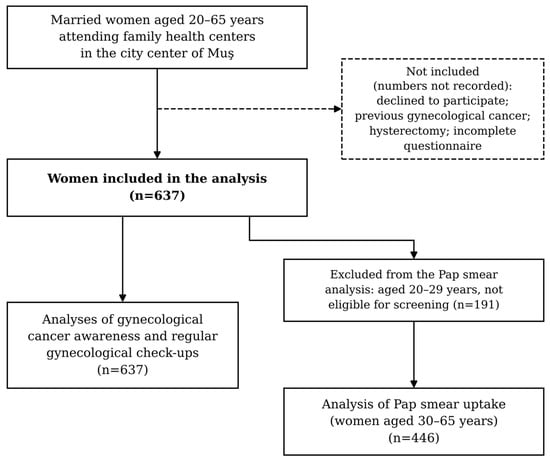
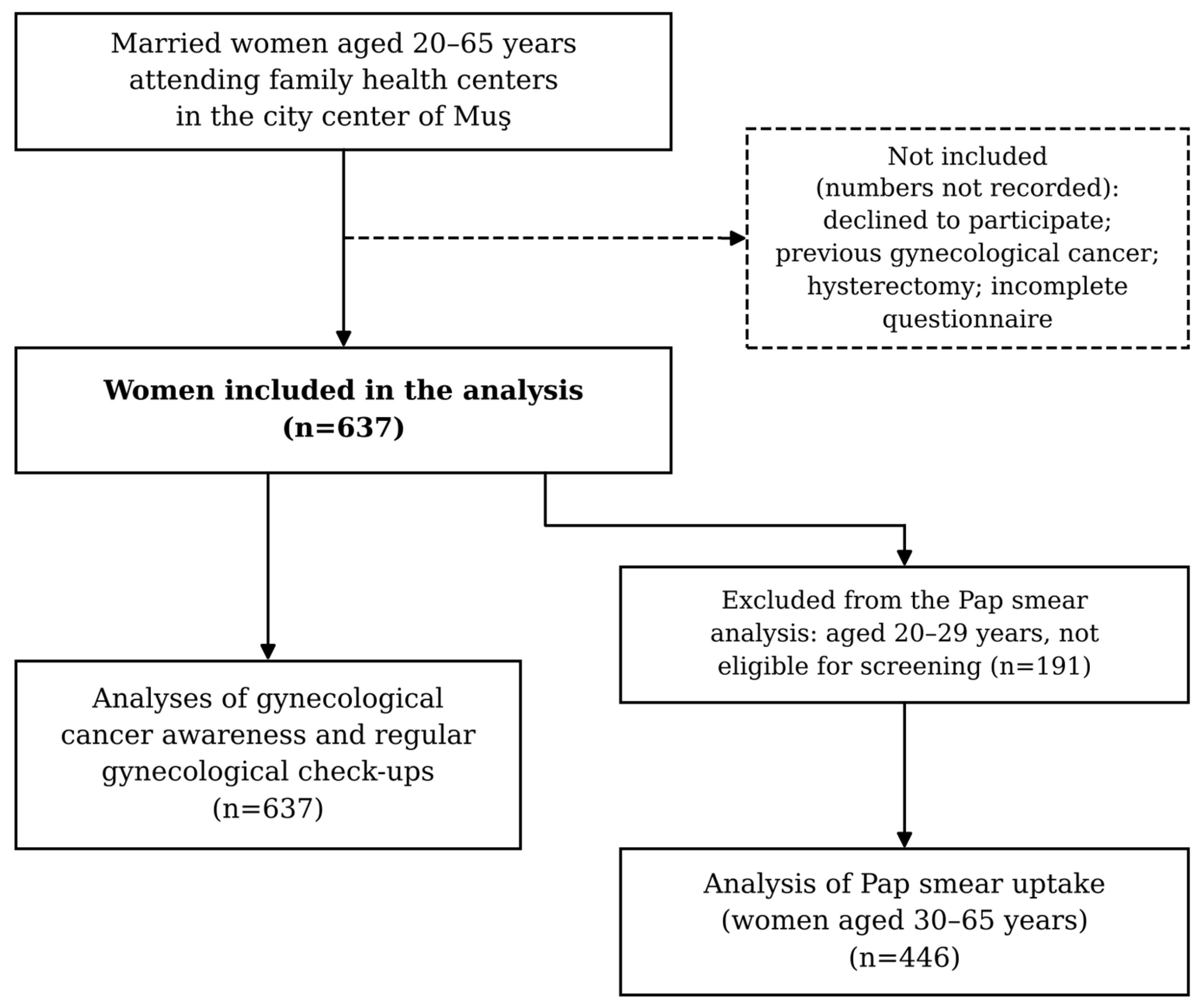
The study was conducted between January and June 2025 in family health centres in the city centre of Muş, which is located in the Eastern Anatolia Region of Türkiye. The study population consisted of married women aged 20–65 who attended the centres during the study period. The minimum required sample size was calculated to be 384, using the formula for estimating a proportion in an unknown population (n = t2pq/d2), with a 95% confidence level (t = 1.96), a margin of error of 0.05, and p = q = 0.50. As this calculation is not based on regression analysis, a sensitivity power analysis was also carried out on the final sample (Section 2.5). Probability sampling was not used. Instead, all women who met the inclusion criteria and agreed to participate during the data collection period were included. During data collection, the number of women who were approached, the number who declined to participate, and the number who were excluded for each reason were not recorded. The analysis included the 637 women who met the inclusion criteria and completed all questionnaires. Figure 1 shows the flow of participants through the study. The study was reported in accordance with the STROBE guideline for observational studies [27]. (Supplementary Table S1).
Figure 1.
Flow of participants through the study.
The inclusion criteria were: being literate; being a married woman aged 20–65; being able to communicate in Turkish; and volunteering to participate. Women with hearing, speech or cognitive impairments that prevented face-to-face interviews were considered to have communication problems and were not included. The exclusion criteria were a previous diagnosis of gynaecological cancer, a history of hysterectomy of any type, withdrawal from the study, and an incomplete questionnaire (defined as one or more unanswered items on either scale). The study was limited to married women for two reasons. Firstly, the GCAS was developed in married women, and its developers recommended separate studies for unmarried women [28]. Secondly, sexual activity outside marriage is rarely disclosed in Türkiye, and questions about gynaecological examinations and Pap smear testing are culturally sensitive for unmarried women. Furthermore, cervical screening is intended for women who are or have been sexually active. This restriction limits the generalisability of the findings, as discussed in Section 4.5.
2.3. Data Collection Instruments
Data were collected using the Personal Information Form, Gynaecological Cancer Awareness Scale and Health Literacy Scale.
2.3.1. Personal Information Form
The form was prepared by the researchers based on the literature [13,14,15,17] and consisted of 26 questions. The questions covered sociodemographic characteristics (age, education, longest place of residence, employment, family type, perceived income, and smoking status); obstetric and gynaecological history (age at marriage and at first birth, number of pregnancies and children, contraceptive method used, age at menarche, menstrual status, and characteristics of menstrual and vaginal discharge); family history of gynaecological cancer; and early detection and screening (frequency of regular check-ups, Pap smears, knowledge of the HPV vaccine, and methods of early diagnosis and KETEM). The study variables were defined as follows: ‘Do you have regular gynaecological check-ups?’ was the question used to assess regular gynaecological check-ups. (Yes/No), followed by a question on frequency (once a month, every three months, every six months, once a year, or less often than once a year). This question did not distinguish between preventive visits and visits prompted by symptoms. Pap smear uptake was assessed using the question, ‘Have you ever had a Pap smear test?’ (yes/no), which therefore refers to lifetime uptake rather than testing within the recommended interval. HPV-DNA testing was not asked about separately. Knowledge of early detection methods was assessed by asking, “Which of the methods for the early diagnosis of gynaecological cancers are you familiar with?” and offering the following options: Pap smear (vaginal smear), biopsy, manual examination of the vulva, ultrasonography, and other. Women who reported being familiar with at least one method were classified as being familiar with early detection methods. Knowledge of the KETEM (Cancer Early Diagnosis, Screening and Training Centre) was assessed with the question, ‘Do you have information about the KETEM?’ (Yes/No). All items were self-reported and the form was not a validated instrument.
2.3.2. Gynecological Cancer Awareness Scale (GCAS)
The scale was developed by Dal and Ertem in 2017 to assess women’s awareness of gynaecological cancers. The scale consists of 41 items and four subdimensions: Awareness of Early Diagnosis and Knowledge of Gynaecological Cancers (items 1, 2, 12 and 13); Awareness of Gynaecological Cancer Risks (items 3–11); Awareness of Prevention of Gynaecological Cancers (items 14–19); and Awareness of Routine Screening and Perception of Serious Illness in Gynaecological Cancers (items 20–41). The five-point Likert scale was developed for use with married women and can be administered to women aged 20–65. The total score that can be obtained from the scale ranges from 41 to 205; higher scores indicate greater awareness of gynaecological cancer. In the study in which the scale was developed, Cronbach’s alpha was reported as 0.944 [28]. Items 12 and 13 (the importance of early diagnosis and HPV testing), item 14 (having a cervical smear) and item 19 (having regular gynaecological examinations) overlap with the knowledge and behaviour variables of this study. Therefore, sensitivity analyses were repeated with a total score excluding these four items.
2.3.3. Health Literacy Scale (HLS)
The scale is based on the European Health Literacy Survey Questionnaire (HLS-EU-Q47), which was developed by Sørensen et al. in 2013 as a 47-item instrument [29]. Toçi et al. later adapted it into a 25-item version [30]. Aras and Temel carried out a Turkish validity and reliability study of the 25-item version in 2017 [31]. This version consists of four subdimensions: access to information (items 1–5); understanding (items 6–12); appraisal (items 13–20); and application (items 21–25). Items are scored on a five-point Likert scale from 1 to 5 and there are no reverse-coded items. The total score ranges from 25 to 125, with higher scores indicating a higher level of health literacy. In the Turkish validity and reliability study, the Cronbach’s alpha coefficient of the scale was reported as 0.92 [31]. The HLS measures general health literacy, rather than being specific to cancer.
2.4. Data Collection
Data were collected through face-to-face interviews with women visiting family health centres in the city centre between January and June 2025, after they had been informed about the study. The interviews took an average of 10–15 min.
2.5. Data Analysis
A statistical analysis of the data was performed using the SPSS (Statistical Package for the Social Sciences) software, version 27.0 (IBM Corp., Armonk, NY, USA). The descriptive characteristics of the data were determined using the number (n), percentage (%), mean (M) and standard deviation (SD) values. The normal distribution of the continuous variables was examined based on the skewness and kurtosis coefficients. The normal distribution was indicated by the coefficients falling within the range of −2 to +2 [32]. Following evaluation, it was determined that the variables conformed to a normal distribution and parametric tests were used in the analyses.
Group comparisons were made using an independent samples t-test for two groups and a one-way analysis of variance (ANOVA) for more than two groups. Levene’s test was used to check for homogeneity of variances. When variances were unequal, Welch’s t-test or Tamhane’s T2 post hoc test was used; otherwise, Tukey’s HSD test was used. As 16 comparisons were made, the p-values were also adjusted with the Holm method [33]. Effect sizes were expressed as Cohen’s d and eta squared (η2) and interpreted as small (d ≥ 0.2; η2 ≥ 0.01), medium (d ≥ 0.5; η2 ≥ 0.06) or large (d ≥ 0.8; η2 ≥ 0.14) [34].
Covariates were selected a priori based on previous studies showing an association between age, education and employment, and health literacy, cancer awareness, and screening use [13,14,15,17,35]. Gynecological cancer awareness was analysed using two-step hierarchical linear regression, with the sociodemographic variables entered in the first step and the HLS total score in the second. Regular gynaecological check-ups (0 = no, 1 = yes) and Pap smear uptake (0 = no, 1 = yes) were analysed using three-step hierarchical logistic regression. Step 1 included age (continuous variable, in years), education (dummy variables for primary school or below, and for high school, with university education as the reference category), and employment status (1 = employed, 0 = not employed). Step 2 added the HLS total score. Step 3 included knowledge of early detection methods and knowledge of KETEM (1 = yes, 0 = no). As these two knowledge variables may lie on the pathway between health literacy and behaviour, comparing Steps 2 and 3 shows how much of the association between health literacy and behaviour remains once they are taken into account. The indirect association through the two knowledge variables was estimated using Karlson–Holm–Breen (KHB) decomposition [36], with a bootstrap 95% confidence interval based on 2000 resamples. The analysis of Pap smear uptake was limited to women aged 30–65 years (n = 446), as this is the age group covered by Türkiye’s national cervical cancer screening programme [10]. As women aged 20–29 are not invited for screening, having not had a Pap smear does not reflect their screening behaviour. Logistic regression results are reported as adjusted odds ratios (aOR) with 95% confidence intervals (CI). An aOR shows how the odds of the outcome change for a one-unit increase in a continuous predictor or when comparing one category with its reference category, while holding the other variables in the model constant. To make the health literacy estimates easier to interpret, the HLS score was divided by its standard deviation (16.96 points), meaning that the aOR refers to a one-standard-deviation increase. Model fit was assessed using the omnibus chi-squared (χ2) test, Nagelkerke R2, and for the final models, the Hosmer–Lemeshow test. The change in chi-squared (χ2) between steps was also used to test each block. Multicollinearity was assessed using variance inflation factors, and the linearity of the logit for continuous predictors was examined using the Box–Tidwell method.
Sensitivity analyses were also performed. In these analyses, perceived income, the number of children, family history of gynaecological cancer, and place of residence were added as covariates; the GCAS items that overlapped with the study variables were excluded; and regular check-ups were redefined based on the reported frequency. A sensitivity power analysis showed that, with α = 0.05 and 80% power, the linear model could detect an increase in R2 of approximately 0.011 for a single added predictor. Simulations based on the observed data (2000 replications) showed that the logistic models had 80% power to detect odds ratios of approximately 1.30 (regular check-ups) and 1.40 (Pap smear uptake) per standard deviation of health literacy. The KHB decomposition and power analysis were performed in Python 3.13 (statsmodels 0.15), while all other analyses were performed in SPSS 27.0, with statistical significance set at p < 0.05.
2.6. Ethical Considerations
Ethical approval for this study was obtained from the Scientific Research and Publication Ethics Committee at Mus Alparslan University (decision no. 17/10/2024-163422). The necessary permissions were obtained from the institution where the research was conducted, and informed consent was obtained from all participants prior to commencement of the study. Participation was voluntary, and participants could withdraw from the study at any time. Their data were kept confidential. The study was conducted in accordance with the principles of the Declaration of Helsinki.
3. Results
A total of 637 women took part in this study. Of these, 52.3% were aged 20–35, 38.3% were university graduates and 69.9% were unemployed. Of the women, 48.8% stated that their income equalled their expenses. While 63.3% of respondents reported being aware of the early diagnosis and screening methods for gynaecological cancers, 60.8% were aware of KETEM. Overall, 37.0% of women attended gynaecological check-ups regularly, and 45.1% of the 446 women aged 30–65 had undergone a Pap smear test.
3.1. Descriptive Statistics and Internal Consistency of the Scales
Table 1 shows the descriptive statistics and internal consistency coefficients for the scales and their sub-dimensions. The mean total GCAS score was 147.68 (±18.88), and the mean total HLS score was 107.54 (±16.96). Cronbach’s alpha was 0.927 for the GCAS (ranging from 0.701 to 0.938 for its subdimensions) and 0.953 for the HLS (ranging from 0.821 to 0.898 for its subdimensions). As the skewness and kurtosis values of both total scores were within ±2 [32], parametric tests were used. There was a moderate positive correlation between the GCAS and HLS total scores (r = 0.316; p < 0.001).
Table 1.
Descriptive Statistics and Internal Consistency Coefficients of the Scales.
3.2. Scale Scores by Sociodemographic Characteristics, Early Diagnosis Knowledge, and Behaviors
GCAS scores differed by age group (F = 4.976, p = 0.007, η2 = 0.015): women aged 36–50 scored higher than those aged 20–35, while those aged over 50 did not differ from either group. HLS scores also differed by age group (F = 4.752, p = 0.009, η2 = 0.015), with women over 50 scoring lower than the younger groups. GCAS scores also differed by education level (F = 3.206; p = 0.041; η2 = 0.010), with university graduates scoring higher than women with primary education or below. HLS scores were lower in women with primary education or below than in those who had completed high school or university (F = 19.608; p < 0.001; η2 = 0.058). Apart from the difference in HLS scores by education level, these differences had small effect sizes and were not significant after Holm adjustment (Table 2).
Table 2.
Comparison of Scale Scores by Sociodemographic Characteristics and Early Detection Knowledge and Behaviors.
Employed women had higher GCAS scores than women who were not employed (152.97 ± 19.65 vs. 145.40 ± 18.09; t = 4.719; p < 0.001; d = 0.407), whereas HLS scores did not differ by employment status (p = 0.062). GCAS scores did not differ by income level (p = 0.544). However, HLS scores differed by income level (F = 4.749, p = 0.009, η2 = 0.015), being lower in women whose income was less than their expenses than in those whose income equalled their expenses. This small difference was not significant after Holm adjustment. Women who knew about early detection methods and those who knew about KETEM had higher GCAS and HLS scores than those who did not (p < 0.001 for all comparisons; d = 0.43–0.53). Both scores were also higher in women who attended regular check-ups (p = 0.003 for both scales; d = 0.24–0.25). Among women aged 30–65 years, those who had undergone a Pap smear test had higher GCAS (p < 0.001; d = 0.431) and HLS (p = 0.010; d = 0.247) scores. However, the difference in HLS scores was small and not significant after Holm adjustment (Table 2).
3.3. Factors Associated with Gynecological Cancer Awareness
A hierarchical linear regression analysis was conducted to identify factors independently associated with gynaecological cancer awareness. Model 1, which included age, educational attainment and employment status, was statistically significant and explained 4.9% of the variance in the total GCAS score (R2 = 0.049; F = 8.226; p < 0.001). The addition of health literacy to Model 2 increased the explained total variance to 14.8% (R2 = 0.148; F = 21.905; p < 0.001). Health literacy was the variable with the largest standardized coefficient in the final model (B = 0.360; SE = 0.042; β = 0.324; p < 0.001). When the other variables were held constant, each one-point increase in HLS score was associated with a 0.36-point increase in GCAS score. Age (B = 0.289; β = 0.142; p < 0.001) and employment status (B = 6.426; β = 0.156; p = 0.001) were also independently associated with higher gynaecological cancer awareness. However, the final model revealed no significant association between education level and awareness (p > 0.05) (Table 3). The health literacy coefficient changed little in the sensitivity analyses: β was 0.284 when knowledge of early detection methods and of KETEM were added; 0.328 when perceived income, number of children, family history of gynaecological cancer, and place of residence were added; and 0.316 when the GCAS items that overlapped with the study variables were excluded from the outcome. The VIF values (1.06–1.90) and the Durbin–Watson statistic (2.04) provided no evidence of multicollinearity or autocorrelation of the residuals.
Table 3.
Hierarchical Linear Regression Analysis of Factors Associated with Gynecological Cancer Awareness.
3.4. The Relationship Between Health Literacy and Regular Gynecological Check-Ups
Initially, there was no significant association between sociodemographic variables and regular gynaecological check-ups (χ2(4) = 3.215; p = 0.522; Nagelkerke R2 = 0.007). However, adding health literacy improved the model (Δχ2(1) = 12.383; p < 0.001; Nagelkerke R2 = 0.033), with each standard deviation increase in the HLS score being associated with a 37% higher odds ratio for regular check-ups (aOR = 1.37; 95% CI: 1.14–1.64). In the third step, when knowledge of early detection methods and of KETEM was added, the model improved further (Δχ2(2) = 11.799; p = 0.003; Nagelkerke R2 = 0.057). Health literacy remained significant, although its aOR decreased to 1.27 (95% CI: 1.06–1.53; p = 0.011). According to the KHB decomposition, approximately 24% of the association between health literacy and the outcome was accounted for by the two knowledge variables (indirect aOR = 1.08; 95% bootstrap CI = 1.03–1.15). After adjusting for age, education and employment, health literacy was associated with both knowledge variables (knowledge of early detection methods: aOR = 1.54 per SD; 95% CI: 1.27–1.85; knowledge of KETEM: aOR = 1.66; 95% CI: 1.38–1.99). In the final model, the following were associated with regular check-ups: primary education or below (aOR = 2.01; 95% CI: 1.22–3.29); knowledge of early detection methods (aOR = 1.50; 95% CI: 1.00–2.23); and knowledge of KETEM (aOR = 1.53; 95% CI: 1.04–2.25) (Table 4). As 80 women provided answers about check-up frequency that did not align with their yes/no responses, and five women who reported regular check-ups did not specify a frequency, the analysis was repeated after these 85 women were excluded. The outcome regarding health literacy remained consistent (aOR = 1.35; 95% CI: 1.10–1.66; n = 552). The result was also similar when additional covariates were included (aOR = 1.25; 95% CI: 1.04–1.50) and when regular check-ups were defined as having had at least one check-up a year (aOR = 1.25; 95% CI: 1.05–1.50). In the final model, VIF values ranged from 1.13 to 2.00; the Box–Tidwell terms for age and HLS score were not significant (p = 0.198 and p = 0.792, respectively), and the Hosmer–Lemeshow test indicated an acceptable fit (p = 0.161).
Table 4.
Hierarchical Logistic Regression Analysis of Factors Associated with Regular Gynecological Check-Ups.
3.5. The Relationship Between Health Literacy and Pap Smear Test Uptake Behavior
Pap smear uptake was analysed among 446 women aged 30–65 years (see Table 5). In the first step, the sociodemographic variables were found to be associated with uptake (χ2(4) = 29.957; p < 0.001; Nagelkerke R2 = 0.087). Including health literacy in the model further improved its fit (Δχ2(1) = 6.783; p = 0.009; Nagelkerke R2 = 0.106), with each one-unit increase in the HLS score being associated with higher odds of having had a Pap smear (adjusted odds ratio (aOR) = 1.33; 95% confidence interval (CI): 1.07–1.65). In the third step, adding the two knowledge variables improved the model further (Δχ2(2) = 29.943; p < 0.001; Nagelkerke R2 = 0.186), and the aOR for health literacy decreased to 1.14 (95% CI: 0.91–1.44; p = 0.256). Around 56% of the association between health literacy and the outcome was accounted for by the knowledge variables (indirect aOR = 1.18; 95% bootstrap CI: 1.09–1.32). In this age group, health literacy was also associated with both knowledge variables (knowledge of early detection methods: adjusted odds ratio (aOR) = 1.78 per standard deviation (SD); 95% confidence interval (CI): 1.41–2.26; knowledge of KETEM: aOR = 1.78; 95% CI: 1.41–2.24). In the final model, knowledge of early detection methods (adjusted odds ratio (aOR): 3.49; 95% confidence interval (CI): 2.06–5.92) and employment status (aOR: 1.95; 95% CI: 1.15–3.32) were associated with Pap smear uptake, while the association with age was borderline (aOR: 1.03; 95% CI: 1.00–1.06; p = 0.049). Similar results were obtained for health literacy when the additional covariates were included (aOR = 1.12; 95% CI: 0.88–1.42). In the final model, VIF values ranged from 1.20 to 2.23. The Hosmer–Lemeshow test indicated an acceptable fit (p = 0.383) and although both age and the HLS score were close to the threshold (p = 0.052 and p = 0.053), the Box–Tidwell terms did not reach significance.
Table 5.
Hierarchical Logistic Regression Analysis of Factors Associated with Pap Smear Uptake Among Women Aged 30–65 Years.
4. Discussion
4.1. Health Literacy and Gynecological Cancer Awareness
This study examined the relationship between health literacy and awareness of gynaecological cancer, regular gynaecological check-ups, and uptake of Pap smears in 637 women. Health literacy was positively associated with awareness and including it in the sociodemographic model increased the explained variance from 4.9% to 14.8%. Of the variables in the model, health literacy had the largest standardised coefficient. However, this comparison refers only to the variables we measured. The correlation between the two scales was moderate (r = 0.316), and a model that explains approximately 15% of the variance leaves most of the variation in awareness unexplained. Earlier studies from Türkiye have also found positive associations between health literacy and gynaecological cancer awareness (17, 19, 22–24). These studies were conducted with different groups, including university employees [23] and women of reproductive age [17], and employed various analytical approaches. Due to differences in samples, settings and measures, a direct comparison of effect sizes is difficult, but the direction of the association has been consistent. The association changed little in our data when knowledge variables or additional covariates were added, or when GCAS items overlapping with the study variables were excluded.
4.2. Health Literacy and Regular Gynecological Check-Ups
Health literacy was also associated with regular gynaecological check-ups. The association was modest (aOR = 1.27 per SD) and remained after adjusting for knowledge of early detection methods and KETEM, which accounted for approximately a quarter of it. Similarly, Kıran et al. found that health literacy was the factor most closely associated with cancer screening perception in Turkish women, although their model explained only about 10% of the variance [35]. Together, these findings suggest that, while health literacy contributes to preventive gynaecological care, it explains only a small part of it. Knowledge of early detection methods and of KETEM was independently associated with check-ups. This is consistent with national findings that link health literacy with knowledge of cervical cancer screening methods [25]. However, as the check-up question did not distinguish between preventive visits and visits prompted by symptoms, some of this association may reflect care-seeking for symptoms rather than prevention.
The higher odds of regular check-ups among women with a primary education or less were unexpected. This group had the lowest health literacy scores (see Table 2), and the association became stronger when health literacy and knowledge were taken into account (Table 4). This suggests that the difference is not solely due to health literacy. The crude rate of regular check-ups was already slightly higher in this group than among university graduates (40.2% versus 33.6%), so this finding cannot be attributed solely to statistical adjustment. Several explanations are possible. Women with less education may have more frequent contact with primary care for reasons not measured here, such as pregnancy follow-up, family planning, or chronic conditions, which may increase the likelihood of a gynaecological examination. Reporting may also differ by education level, since women with more education may interpret ‘regular’ more strictly. Additionally, KETEM centres carry out community-based breast, cervical and colorectal cancer screening, and health literacy has been described as one of the factors that determine women’s participation in screening [37]. Free, community-based services may make check-ups more accessible to women with less education, which would be consistent with the Italian finding that women with the lowest level of education were more likely to use organised screening programmes [38]. As we did not measure KETEM service use or the reasons for check-ups, these explanations should be regarded as hypotheses.
4.3. Pap Smear Uptake and the Role of Screening Knowledge
Among women aged 30–65, health literacy was associated with Pap smear uptake when only sociodemographic variables were considered, but this association disappeared when knowledge of early detection methods and KETEM was taken into account. These knowledge variables accounted for more than half of the association, and health literacy itself was associated with both of them. This pattern is consistent with a pathway in which health literacy helps women acquire specific knowledge about screening, which is then related to having a Pap smear. However, cross-sectional data cannot establish such a sequence, and the direction could also be reversed if contact with screening services increased both knowledge and health literacy. The non-significant aOR in the final model should not be interpreted as evidence that health literacy is unrelated to Pap smear uptake. Its confidence interval (0.91–1.44) is compatible with a modest positive association, and the analysis only had 80% power for associations of about 1.40 per SD. Among the variables in the model, knowledge of early detection methods had the largest odds ratio for Pap smear uptake (aOR = 3.49), which is consistent with studies emphasising screening-specific knowledge [39]. Results from Türkiye are mixed. Tiraki and Yılmaz found no significant relationship between health literacy and having a Pap smear [40], whereas Kiracılar and Koçak reported that women with higher health literacy knew more about the test and were more likely to have it, and Tosun Güleroğlu found more positive attitudes and behaviours towards the test among women with higher health literacy. Differences in the age groups studied, whether screening-eligible women were analysed separately, and whether knowledge was taken into account may explain part of this inconsistency. As the question referred to lifetime Pap smear use, our findings relate to whether women have ever been screened, rather than whether they are up to date with screening. Women who were only screened using HPV-DNA testing may not have reported having had a Pap smear.
4.4. Other Factors Associated with Screening Behavior
Employed women were more likely to have had a Pap smear. Employment may provide better access to health information, social networks, and workplace health services [41], but these mechanisms were not measured. Age was only weakly associated with uptake within the eligible age group. Other unmeasured factors are also likely to influence screening. Studies from Türkiye have identified cultural and gender-related barriers to Pap smear testing, including embarrassment, the belief that cervical cancer cannot be treated, concern that the test may cause infection, and the need for a husband’s permission [21]. Fear of gynaecological examinations and privacy concerns have also been reported in other populations [42]. Reviews also point to socioeconomic conditions, access to services and distance from them, recommendations from health professionals, and previous screening experiences [43,44]. In our sensitivity analyses, perceived income, number of children, family history of gynaecological cancer and place of residence did not affect the results. However, variables such as health insurance, a provider’s recommendation and previous screening experiences were not collected.
4.5. Limitations
This study has several limitations. Firstly, the cross-sectional design does not permit causal inferences and the potential mediating role of knowledge could not be examined in a temporal sequence. Secondly, the sample comprised married, literate women attending family health centres in one province of Eastern Anatolia, and was not representative of the wider population. As unmarried women, women who cannot read, and women who do not use primary care are more likely to have lower health literacy and to have less contact with screening services, their exclusion from the study may have narrowed the range of health literacy and limited the generalisability of the findings. Thirdly, the outcome and knowledge variables were measured using single, self-reported, yes/no items from an unvalidated form. Regular check-ups were not defined by a specific timeframe, and it was not possible to distinguish between preventive and symptom-driven visits. Furthermore, 80 women provided answers regarding check-up frequency that did not align with their yes/no response. Pap smear uptake was based on lifetime use and not verified with medical records; self-reporting may overestimate screening due to social desirability. Since the national programme now uses HPV-DNA testing as the primary test, women who were screened only with this test may not have reported having a Pap smear. Fourth, possible confounders such as health insurance, chronic diseases, a provider’s recommendation, previous screening experiences, and psychosocial barriers were not measured. Fifth, the HLS measures general health literacy; a cancer-specific measure might reveal different associations with screening. In addition, as the numbers of women who were approached, declined, or were excluded were not recorded, the participation rate and possible non-response bias could not be assessed. Finally, the Pap smear analysis included only 446 women, which limited its power to detect small associations.
4.6. Implications and Future Directions
Although these findings were not tested directly in this study, they have possible implications for nursing practice. Primary care counselling could take women’s health literacy into account and provide clear, specific information about screening methods, the national screening programme and KETEM, as this specific knowledge was closely associated with Pap smear uptake in our data. Accessible and reliable information sources could help women and nurses to find information more easily, potentially reducing inequalities in access to cancer information between groups with different levels of health literacy. For instance, the Beacon Wiki maps oncological information resources across the European Union and can be utilised by citizens and health professionals alike [45]. Similar tools, adapted to the Turkish context, could supplement nurse-led education and counselling. Future research should employ longitudinal or interventional designs and probability-based samples that include unmarried women and those with limited literacy. Validated, cancer-specific health literacy measures and analyses of health literacy subdimensions, as well as objective screening records, would help to clarify these associations. The mediating role of screening knowledge, and the influence of psychosocial and structural barriers, should also be tested directly.
5. Conclusions
Among married women attending primary care in eastern Türkiye, health literacy was found to be positively associated with awareness of gynaecological cancer and with regular gynaecological check-ups. It was also associated with Pap smear uptake among women aged 30–65 years. However, more than half of this association was accounted for by knowledge of early detection methods and of KETEM. Once these variables were controlled, the association was no longer significant. Knowledge of early detection methods and employment were the variables most clearly associated with Pap smear uptake. As the study was cross-sectional, these findings demonstrate associations rather than effects. They suggest that nursing counselling that considers women’s health literacy and provides specific information about screening methods and services could be effective in intervention studies.
Supplementary Materials
The following supporting information can be downloaded at: https://www.mdpi.com/article/10.3390/healthcare14234074/s1, Table S1: STROBE Statement: Checklist for Cross-Sectional Studies. References [46,47] are cited in the Supplementary Materials.
Author Contributions
Conceptualisation: A.A. and L.E.T.; Methodology: A.A. and L.E.T.; Fomal analysis: A.A. and L.E.T.; Investigation: A.A. and L.E.T.; Original draft preparation: A.A. and L.E.T.; Review and editing: A.A. and L.E.T.; Supervision: A.A. and L.E.T. All authors have read and agreed to the published version of the manuscript.
Funding
No external funding was received for this research.
Institutional Review Board Statement
The study was conducted in accordance with the Declaration of Helsinki and received ethical approval from the Scientific Research and Publication Ethics Committee of Muş Alparslan University (decision no. 17/10/2024-163422). Administrative permission was granted by the Muş Provincial Directorate of Health (25 December 2024, E-35465298-605-263513798).
Informed Consent Statement
Informed consent was obtained from all subjects involved in the study.
Data Availability Statement
The data analyzed in this study are available from the corresponding author upon reasonable request.
Acknowledgments
The authors declare that an artificial intelligence-powered tool called Paperpal (Prime subscription, web-based version, https://paperpal.com/, accessed on 12 November 2026) was utilized during the language editing process of this article. All outputs generated by the tool were reviewed and verified by the authors. Full responsibility for the scientific content, accuracy, and integrity of the article rests with the authors.
Conflicts of Interest
The authors declare no conflicts of interest.
Abbreviations
The following abbreviations are used in this manuscript.
| GLOBOCAN | Global Cancer Incidence, Mortality and Prevalence |
| GCAS | Gynecological Cancer Awareness Scale |
| HLS | Health Literacy Scale |
| KETEM | Cancer Early Diagnosis, Screening, and Training Center |
| STROBE | Strengthening the Reporting of Observational Studies in Epidemiology |
| VIF | Variance inflation factor |
| aOR | Adjusted odds ratio |
| CI | Confidence interval |
| HPV | Human papillomavirus |
| KHB | Karlson–Holm–Breen |
| SD | Standard deviation |
References
- Ruzindana, K.; Anorlu, R.I. Global disparities in gynecologic cancer outcomes: A call for action. Int. J. Gynaecol. Obstet. 2025, 171, 210–220. [Google Scholar] [CrossRef] [Scilit]
- Bray, F.; Laversanne, M.; Sung, H.; Ferlay, J.; Siegel, R.L.; Soerjomataram, I.; Jemal, A. Global cancer statistics 2022: GLOBOCAN estimates of incidence and mortality worldwide for 36 cancers in 185 countries. CA A Cancer J. Clin. 2024, 74, 229–263. [Google Scholar] [CrossRef] [Scilit]
- International Agency for Research on Cancer. Global Cancer Observatory: Cancer Today. Türkiye Fact Sheet (GLOBOCAN 2024 Estimates). 2026. Available online: https://gco.iarc.who.int/media/globocan/factsheets/populations/792-turkiye-fact-sheet.pdf (accessed on 12 November 2026).
- Cohen, P.A.; Jhingran, A.; Oaknin, A.; Denny, L. Cervical cancer. Lancet 2019, 393, 169–182. [Google Scholar] [CrossRef] [Scilit]
- Crosbie, E.J.; Kitson, S.J.; McAlpine, J.N.; Mukhopadhyay, A.; Powell, M.E.; Singh, N. Endometrial cancer. Lancet 2022, 399, 1412–1428. [Google Scholar] [CrossRef] [Scilit]
- Webb, P.M.; Jordan, S.J. Global epidemiology of epithelial ovarian cancer. Nat. Rev. Clin. Oncol. 2024, 21, 389–400. [Google Scholar] [CrossRef] [Scilit]
- Tilyavova, S.A.; Lutfullayeva, D.X.; Xayrullayeva, D.M. Gynecological oncology in women: Early diagnosis and treatment methods. J. Mod. Educ. Achiev. 2025, 2, 48–53. [Google Scholar]
- Dikmen, R.; Aydın, E.İ.; Şahin, S. Jinekolojik kanserlerde navigasyonun önemi ve hemşirenin navigatör rolü. Türkiye Sağlık Araştırmaları Derg. 2024, 5, 50–60. [Google Scholar]
- Kumar, K.V.N.; Bindhu, D.G.; Likhitha, K.; Charani, M.S.; Priya, N.D.; Gowthami, Y. Cancer literacy in women: A KAP exploration of breast and gynecological cancers accompanied by cross-sectional based online survey in Tirupathi district. Asian Pac. J. Environ. Cancer 2024, 7, 3–10. [Google Scholar] [CrossRef] [Scilit]
- Gultekin, M.; Zayifoglu Karaca, M.; Kucukyildiz, I.; Dundar, S.; Boztas, G.; Turan, H.S.; Hacikamiloglu, E.; Murtuza, K.; Keskinkilic, B.; Sencan, I. Initial results of population based cervical cancer screening program using HPV testing in one million Turkish women. Int. J. Cancer 2018, 142, 1952–1958. [Google Scholar] [CrossRef] [Scilit]
- Baik, D.; Kim, B.-W.; Ha, Y.; Oh, J.-K.; Niyonzima, N.; Mpamani, C.; Asasira, J.; Origa, M.; Orem, J.; Ki, M.; et al. Awareness, knowledge, and attitude toward cervical cancer screening and prevention in Uganda. Public Health 2025, 238, 310–316. [Google Scholar] [CrossRef] [Scilit]
- Işik, R.A.; Dönmez, A.A.; Terzioğlu, F. Healthy lifestyle behaviors and gynecological cancer awareness in women academicians: A descriptive and correlational study. Arch. Gynecol. Obstet. 2025, 311, 1379–1393. [Google Scholar] [CrossRef] [Scilit]
- Ersin, F.; Kahraman, S.; Havlioğlu, S. Women’s awareness of gynecological cancers and affecting. Eur. Health Sci. J. 2024, 2, 28–34. [Google Scholar] [CrossRef]
- Baltacı, N.; Atilla, R.; Gürel, R. Gynecological Cancer Prevention Knowledge Levels and Associated Factors in Reproductive Women. J. Acad. Res. Nurs. 2023, 9, 179–187. [Google Scholar] [CrossRef] [Scilit]
- TORUN, A.; Bekar, M. The Relationship Between High School Female Students’ Health Perceptions and Their Knowledge Levels on Protection from Gynecological Cancers: Descriptive Research. Turk. Klin. J. Health Sci. 2024, 9, 74–83. [Google Scholar] [CrossRef] [Scilit]
- Naik, B.N.; Verma, M.; Rao, R.; Nirala, S.K.; Pandey, S.; Jha, S.; Ramalingam, A.; Singh, B. Level of health literacy on cervical cancer and its correlates among women of reproductive age group in an Eastern state of India. Clin. Epidemiol. Glob. Health 2025, 34, 102091. [Google Scholar] [CrossRef] [Scilit]
- Duman, F.N.; Ozdemir, A.; Golbasi, Z. Determining the relationship between gynecologic cancer awareness and health literacy among women of reproductive age: A descriptive study. Arch. Gynecol. Obstet. 2024, 310, 3067–3076. [Google Scholar] [CrossRef] [Scilit]
- Aksoy, F.; Yanık, H.G.B.; Erbil, N. Relationship between health literacy and knowledge about gynaecological cancer prevention of women. Int. J. Nurs. Pract. 2025, 31, e70000. [Google Scholar] [CrossRef] [Scilit]
- Uslu-Sahan, F.; Mert-Karadas, M.; Yıldız, T.; Koc, G. Effect of health literacy on the awareness of gynecological cancer among women in Turkey. Indian J. Gynecol. Oncol. 2023, 21, 15. [Google Scholar] [CrossRef] [Scilit]
- Panahi, R.; Namdar, P.; Siboni, F.S.; Fallah, S.; Anbari, M.; Dehghankar, L.; Yekefallah, L.; Shafaei, M. Association between health literacy and adopting preventive behaviors of breast cancer in Iran. J. Educ. Health Promot. 2020, 9, 241. [Google Scholar] [CrossRef] [Scilit]
- Çankaya, S.; Yüksel, G. Barriers to Women’s Pap Smear Testing and Related Risk Factors in Turkey. Clin. Exp. Health Sci. 2020, 10, 203–209. [Google Scholar] [CrossRef] [Scilit]
- Başaran, F.; Duru, P. Shining a light on women’s health: The relationship between gynecological cancer awareness and health literacy. Arch. Health Sci. Res. 2024, 11, 42–48. [Google Scholar] [CrossRef] [Scilit]
- Coşkun, S. Effect of health responsibility and health literacy on gynecological cancer awareness of university working women. Turk. J. Public Health 2023, 21, 209–222. [Google Scholar] [CrossRef] [Scilit]
- Köse, S.; Karakurt, P. Kadınların Jinekolojik Kanserler ile İlgili Farkındalık Düzeyinin Artmasında Sağlık Okuryazarlığının Etkisi Üzerine Bir Araştırma. Mersin Univ. Tıp Fak. Lokman Hekim Tıp Tarihi ve Folk. Tıp Derg. 2023, 13, 196–206. [Google Scholar] [CrossRef] [Scilit]
- Kiracilar, E.; Koçak, D.Y. The Effects of Health Literacy on Early Diagnosis Behaviors of Breast and Cervical Cancer in Women Aged 18–65. J. Contemp. Med. 2023, 13, 410–417. [Google Scholar] [CrossRef] [Scilit]
- Tosun Güleroğlu, F. The effect of women’s health literacy status on their attitudes and behaviors towards the Pap smear test: A series in Turkey. J. Health Lit. 2023, 8, 63–73. [Google Scholar] [CrossRef]
- Vandenbroucke, J.P.; von Elm, E.; Altman, D.G.; Gøtzsche, P.C.; Mulrow, C.D.; Pocock, S.J.; Poole, C.; Schlesselman, J.J.; Egger, M. Strengthening the Reporting of Observational Studies in Epidemiology (STROBE): Explanation and Elaboration. PLoS Med. 2007, 4, e297. [Google Scholar] [CrossRef] [Scilit]
- Dal, N.A.; Ertem, G. Jinekolojik kanserler farkındalık ölçeği geliştirme çalışması. İnsan VE Toplum Bilim. Araştırmaları Derg. 2017, 6, 2351–2367. [Google Scholar]
- Sørensen, K.; Van den Broucke, S.; Pelikan, J.M.; Fullam, J.; Doyle, G.; Slonska, Z.; Kondilis, B.; Stoffels, V.; Osborne, R.H.; Brand, H. Measuring health literacy in populations: Illuminating the design and development process of the European Health Literacy Survey Questionnaire (HLS-EU-Q). BMC Public Health 2013, 13, 948. [Google Scholar] [CrossRef] [Scilit]
- Toçi, E.; Burazeri, G.; Sørensen, K.; Jerliu, N.; Ramadani, N.; Roshi, E.; Brand, H. Health literacy and socioeconomic characteristics among older people in transitional Kosovo. Br. J. Med. Med. Res. 2013, 3, 1646–1658. [Google Scholar] [CrossRef] [Scilit]
- Aras, Z.; Bayık, A.T. Evaluation of Validity and Reliability of the Turkish Version of Health Literacy Scale. Florence Nightingale Hemşire. Derg. 2017, 25, 85–94. [Google Scholar] [CrossRef] [Scilit]
- George, D.; Mallery, P. IBM SPSS Statistics 29 Step by Step: A Simple Guide and Reference; Routledge: Abingdon, UK, 2024. [Google Scholar]
- Holm, S. A simple sequentially rejective multiple test procedure. Scand. J. Stat. 1979, 6, 65–70. [Google Scholar]
- Cohen, J. Statistical Power Analysis for the Behavioral Sciences, 2nd ed.; Lawrence Erlbaum Associates: Hillsdale, NJ, USA, 1988. [Google Scholar]
- Kıran, Ş.; Sevim, F.; Ürek, D.; Şenol, O. Factors affecting cancer screening perception in Turkish women: The role of health literacy. Health Promot. Int. 2024, 39, daae053. [Google Scholar] [CrossRef] [Scilit]
- Karlson, K.B.; Holm, A.; Breen, R. Comparing regression coefficients between same-sample nested models using logit and probit: A new method. Sociol. Methodol. 2012, 42, 286–313. [Google Scholar] [CrossRef] [Scilit]
- Çelikkalp, Ü.; Yalçın Irmak, A. Cancer screening behaviors and health literacy levels of women aged 30 and over in the northwest Turkey. Eur. J. Gynaecol. Oncol. 2024, 45, 96–105. [Google Scholar] [CrossRef] [Scilit]
- Damiani, G.; Federico, B.; Basso, D.; Ronconi, A.; Bianchi, C.B.N.A.; Anzellotti, G.M.; Nasi, G.; Sassi, F.; Ricciardi, W. Socioeconomic disparities in the uptake of breast and cervical cancer screening in Italy: A cross-sectional study. BMC Public Health 2012, 12, 99. [Google Scholar] [CrossRef] [Scilit]
- Gelassa, F.R.; Nagari, S.L.; Jebena, D.E.; Belgafo, D.; Teso, D.; Teshome, D. Knowledge and practice of cervical cancer screening and its associated factors among women attending maternal health services at public health institutions in Assosa Zone, Benishangul-Gumuz, Northwest Ethiopia, 2022: A cross-sectional study. BMJ Open 2023, 13, e068860. [Google Scholar] [CrossRef] [Scilit]
- Tiraki, Z.; Yılmaz, M. Cervical cancer knowledge, self-efficacy, and health literacy levels of married women. J. Cancer Educ. 2018, 33, 1270–1278. [Google Scholar] [CrossRef] [Scilit]
- Mtengezo, J.T.; Lee, H.; Cooley, M.; Shi, L.; Makin, M. Cervical cancer screening status among women living with HIV/AIDS in Malawi: A cross-sectional study. Int. J. Stud. Nurs. 2022, 7, 16–32. [Google Scholar] [CrossRef] [Scilit]
- Ghebrendrias, S.; Pfeil, S.; Crouthamel, B.; Chalmiers, M.; Kully, G.; Mody, S. An examination of misconceptions and their impact on cervical cancer prevention practices among Sub-Saharan African and Middle Eastern refugees. Health Equity 2021, 5, 382–389. [Google Scholar] [CrossRef] [Scilit]
- Al-Ani, A.; Hammouri, M.; Sultan, H.; Al-Huneidy, L.; Mansour, A.; Al-Hussaini, M. Factors affecting cervical screening using the health belief model during the last decade: A systematic review and meta-analysis. Psycho-Oncol. 2024, 33, e6275. [Google Scholar] [CrossRef] [Scilit]
- Maleki, A.; Ahadinezhad, B.; Alizadeh, A.; Khosravizadeh, O. Barriers and facilitators of Pap smear test uptake in Asia: A systematic review. BMC Public Health 2025, 25, 1961. [Google Scholar] [CrossRef] [Scilit]
- Coppini, V.; Ferraris, G.; Ferrari, M.V.; Monzani, D.; Dahò, M.; Fragale, E.; Grasso, R.; Pietrobon, R.; Machiavelli, A.; Teixeira, L.; et al. The Beacon Wiki: Mapping oncological information across the European Union. BMC Med. Inform. Decis. Mak. 2025, 25, 193. [Google Scholar] [CrossRef] [Scilit]
- von Elm, E.; Altman, D.G.; Egger, M.; Pocock, S.J.; Gøtzsche, P.C.; Vandenbroucke, J.P. The Strengthening the Reporting of Observational Studies in Epidemiology (STROBE) Statement: Guidelines for Reporting Observational Studies. Ann. Intern. Med. 2007, 147, 573–577. [Google Scholar] [CrossRef] [Scilit]
- STROBE. STROBE Statement: Strengthening the Reporting of Observational Studies in Epidemiology. Available online: https://www.strobe-statement.org/ (accessed on 12 November 2026).

Disclaimer/Publisher’s Note: The statements, opinions and data contained in all publications are solely those of the individual author(s) and contributor(s) and not of MDPI and/or the editor(s). MDPI and/or the editor(s) disclaim responsibility for any injury to people or property resulting from any ideas, methods, instructions or products referred to in the content. |
© 2026 by the authors. Licensee MDPI, Basel, Switzerland. This article is an open access article distributed under the terms and conditions of the Creative Commons Attribution (CC BY) license.