


Abstract
Background/Objectives: Menopause-related symptoms are common, but the proportion of symptomatic women who seek professional healthcare remains uncertain and appears to vary across populations and healthcare settings. This review aimed to estimate the prevalence of professional healthcare-seeking for menopause-related symptoms and to examine associated factors, barriers, consulted professionals, and subsequent care pathways. Methods: A systematic review and meta-analysis were conducted according to PRISMA 2020. MEDLINE, Embase, Scopus, and Web of Science were searched without date restrictions. Eligible studies included symptomatic peri- or postmenopausal women and reported professional healthcare-seeking specifically for menopause-related symptoms. Risk of bias was assessed using the JBI checklist for prevalence studies. Random-effects generalized linear mixed models were used within recruitment strata containing at least three studies. Results: Thirty-five reports representing 34 independent studies were included, of which 18 contributed to the primary prevalence analysis. Study-level prevalence ranged from 20.3% to 81.2%. Estimates were 30.2% and 34.0% in the two community/population-based studies and 24.1% and 26.3% in the two occupational studies. Pooled prevalence was 50.8% (95% CI 40.4–61.0%; 95% prediction interval 17.4–83.5%; I2 = 99.4%) across ten online/panel/convenience studies and 43.2% (95% CI 26.1–62.0%; 95% prediction interval 4.7–92.2%; I2 = 96.2%) across four clinical studies; given the extreme heterogeneity, neither value should be interpreted as a single representative prevalence. Greater symptom burden was associated with consultation, whereas normalization of symptoms, stigma, limited perceived need for care, and practical or access-related barriers were recurrently reported obstacles. Conclusions: Reported professional healthcare-seeking for menopause-related symptoms varies widely between studies. Recruitment setting is one potential source of this variation, alongside country, symptom definition, and recall period. More representative studies using standardized definitions of symptoms and healthcare-seeking are needed to improve population-level estimates and guide timely, patient-centered menopause care.
1. Introduction
Menopause is a universal stage of reproductive ageing that marks the end of the reproductive years, with natural menopause occurring most commonly between 45 and 55 years of age [1]. The menopausal transition may extend over several years and can be accompanied by a broad range of vasomotor, psychological, sleep-related, musculoskeletal, sexual, and genitourinary symptoms [1,2,3]. The type, severity, and duration of these symptoms vary considerably between women and across populations, and symptoms may adversely affect physical, emotional, social, and occupational well-being and quality of life [1,2,3]. The prevalence of individual menopause-related symptoms also varies substantially according to geographical, socioeconomic, and individual characteristics [3,4]. As women spend an increasing proportion of their lives in midlife and beyond, appropriate recognition and management of menopause-related symptoms represents an important component of women’s health and healthy ageing [1,2].
The presence of menopause-related symptoms, however, does not necessarily lead to professional healthcare use. Decisions to seek care may depend on symptom severity and perceived need for treatment but may also be shaped by knowledge and beliefs about menopause, sociocultural expectations, stigma, accessibility of healthcare, and previous experiences with healthcare professionals [5,6,7,8]. Longitudinal and population-based studies have shown that healthcare-seeking varies according to symptom experience and individual characteristics [5,6], while more recent evidence highlights the role of perceived symptom burden and the quality of interactions with healthcare professionals [7]. Barriers may occur before consultation, through normalization or acceptance of symptoms, but may also arise within healthcare encounters themselves, including experiences of inadequate support or dissatisfaction with care [7,8]. Professional healthcare-seeking should therefore be considered a distinct outcome rather than inferred from the presence, prevalence, or severity of menopause-related symptoms alone.
Existing studies demonstrate substantial variation in the proportion of symptomatic women who seek professional healthcare. In the Australian Melbourne Women’s Midlife Health Project, a community-based cohort followed for nine years across the menopausal transition, 86% of the 387 women who completed follow-up consulted a doctor or other health professional about menopausal problems [5]. In the population-based Menopause Epidemiology Study in the United States, 60% of 3135 peri- and postmenopausal women reported having sought healthcare for menopausal symptoms [6]. Other studies have examined healthcare-seeking in online or convenience samples and have described substantial variation in women’s experiences of professional consultation [7]. Direct comparison between such estimates is difficult because studies differ in their populations, recruitment and sampling methods, definitions of menopausal status and symptoms, definitions of healthcare-seeking, symptomatic denominators, and recall periods. These methodological differences are particularly relevant because community or population-based samples may not represent the same healthcare-seeking population as online, occupational, convenience, or healthcare-based samples.
Although menopause research has extensively characterized symptom prevalence, symptom burden, quality of life, and treatment, professional healthcare-seeking has been less consistently synthesized as a distinct outcome. A recent global systematic review and meta-analysis demonstrated substantial variation in the prevalence of individual menopausal symptoms across populations [4], while a systematic review of barriers to menopause-related discussion identified multiple individual, sociocultural, workplace, and healthcare-related barriers [8]. However, these questions differ from estimating the proportion of symptomatic peri- and postmenopausal women who seek professional healthcare for menopause-related symptoms. The available healthcare-seeking evidence is distributed across studies using heterogeneous populations, recruitment settings, outcome definitions, denominators, and recall periods.
The present systematic review and meta-analysis therefore aimed to estimate the prevalence of professional healthcare-seeking for menopause-related symptoms among symptomatic peri- and postmenopausal women. Secondary objectives were to examine variation according to recruitment setting and sampling frame and to synthesize evidence on the healthcare professionals and services consulted, factors associated with healthcare-seeking, barriers and facilitators, delays to consultation, and subsequent care pathways.
2. Materials and Methods
2.1. Protocol and Reporting
This systematic review and meta-analysis were conducted and reported in accordance with the Preferred Reporting Items for Systematic Reviews and Meta-Analyses (PRISMA) 2020 statement [9]. Because the review synthesized evidence primarily from observational studies, the Meta-analysis of Observational Studies in Epidemiology (MOOSE) reporting recommendations were also considered [10]. For outcomes that were not amenable to quantitative pooling, reporting was additionally informed, where applicable, by the Synthesis Without Meta-analysis (SWiM) guideline [11]. The review was prospectively registered in the International Prospective Register of Systematic Reviews (PROSPERO; CRD420261510543) on 18 September 2026, and the full protocol was finalized before the database searches began. The review was conducted in accordance with the registered protocol. Analyses that were not prespecified are identified as post hoc in Supplementary Table S3.
2.2. Eligibility Criteria
An overview of the characteristics of the included studies is provided in Table 1. Eligible studies included adult women aged ≥18 years described as perimenopausal, menopausal, or postmenopausal according to study-defined criteria, menstrual history, recognized reproductive ageing criteria such as STRAW or STRAW+10, clinical diagnosis, or an explicit author definition. For the primary prevalence outcome, participants were required to experience at least one symptom attributed to the menopausal transition or menopause. Eligible symptoms were those attributed by the original study to the menopausal transition or postmenopause, whether assessed with a menopause symptom instrument (for example, the Menopause Rating Scale, the Kupperman Menopausal Index, or the Menopause Quick 6) or with a study-specific list: vasomotor symptoms (hot flushes, night sweats), psychological symptoms (low mood, anxiety, irritability), sleep disturbance, somatic symptoms (joint and muscle pain, fatigue), urogenital symptoms (vaginal dryness, dyspareunia, urinary complaints), and sexual symptoms (reduced desire). Studies of broader midlife populations were eligible when data for symptomatic perimenopausal or postmenopausal women could be extracted separately. Where premenopausal women could not be separated, a study was retained only if the analysed denominator was restricted to women reporting menopausal symptoms; such studies are marked in Table 2 and were excluded in a sensitivity analysis. Studies in which the only available denominator was a general midlife sample that included premenopausal women were excluded. The requirement for a symptomatic denominator applied to the primary prevalence outcome; studies of perimenopausal or postmenopausal women without a symptom-based eligibility criterion contributed to secondary outcomes only. Natural menopause constituted the primary population, while surgical or medically induced menopause was eligible when reported separately or when its inclusion could be addressed in subgroup or sensitivity analyses.
Table 1.
Key characteristics of included studies relevant to professional healthcare-seeking.
Table 2.
Prevalence of professional healthcare-seeking for menopause-related symptoms among symptomatic women.
Eligible designs included cross-sectional surveys, population-based or community cohorts, longitudinal cohorts, and quantitative components of mixed-methods studies. Studies contributing to the primary prevalence synthesis were required to report, or permit calculation of, both the number of symptomatic eligible women who sought professional healthcare for menopause-related symptoms and the corresponding symptomatic denominator. Population-based, community, occupational, online, primary-care, outpatient, and mixed recruitment settings were eligible.
Studies were excluded if they included only premenopausal women, women without menopause-related symptoms, or mixed populations from which eligible data could not be extracted separately. Samples composed entirely of women recruited because they were already attending a specialist menopause clinic, actively seeking menopause-related treatment, or selected according to previous healthcare-seeking or treatment uptake were excluded because the outcome was determined by the recruitment process. Studies reporting only symptom prevalence, information-seeking, treatment preferences, self-medication, or treatment use without evidence of professional consultation for menopause-related symptoms were not eligible for the primary outcome. Healthcare utilization unrelated to menopause was also excluded. Only English-language publications were included, with no restriction on publication date.
2.3. Information Sources and Search Strategy
A systematic literature search was conducted in MEDLINE via PubMed, Embase, Scopus, and Web of Science Core Collection. The databases were first searched between 18 and 23 September 2026, after registration of the protocol, and the searches were updated on 1 October 2026. Title and abstract screening began on 23 September 2026, and records identified by the update were screened in the same way. The search strategy combined controlled vocabulary and free-text terms relating to menopause, perimenopause, and postmenopause with terms relating to professional healthcare-seeking, consultation, healthcare utilization, and access to care. No publication-date restrictions were applied, and searches were restricted to English-language publications. The complete database-specific search strategies are provided in the Supplementary Table S1. Conference abstracts indexed in the searched databases were eligible. The poster by Williams et al. [44] was retrieved through Web of Science as a meeting abstract published in Menopause.
2.4. Study Selection and Data Extraction
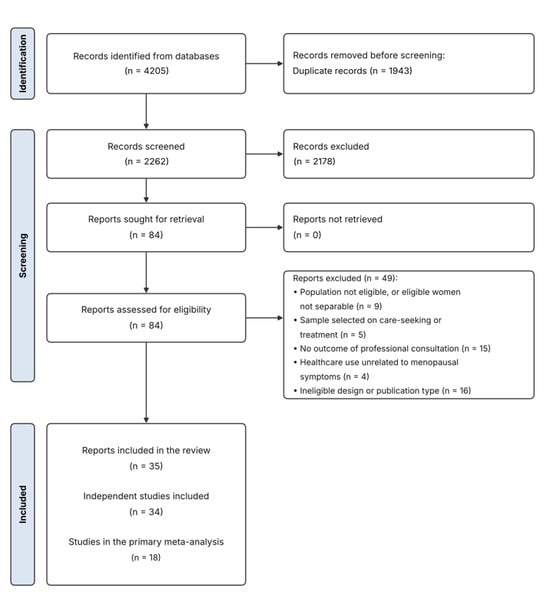
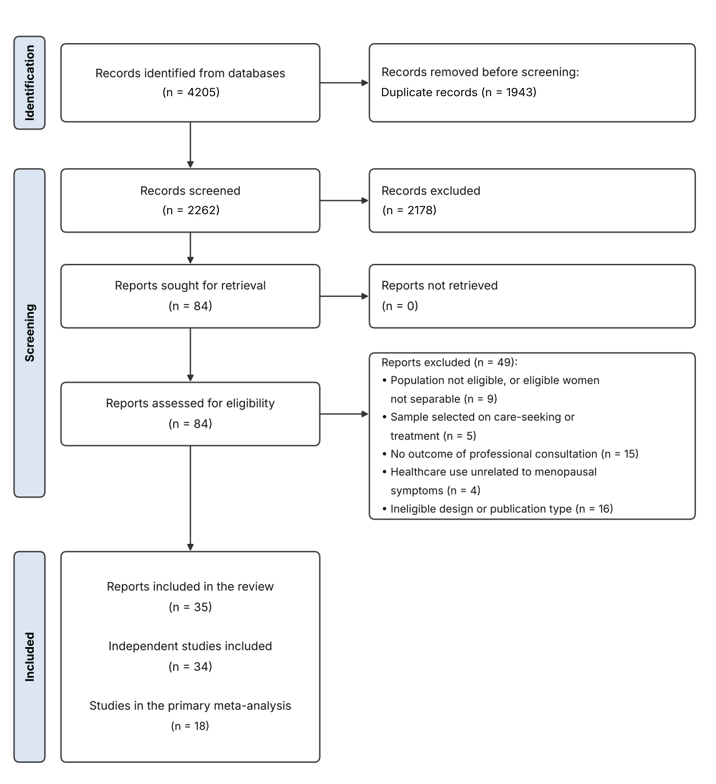
The study selection process is illustrated in the PRISMA flow diagram (Figure 1). The records exported from each database were combined into a single library, and records retrieved from more than one database were identified and removed as duplicates. The deduplicated library was imported into Rayyan, where remaining duplicates were identified with the duplicate-detection function and removed after manual checking. Two reviewers independently screened titles and abstracts and then assessed the full texts of potentially eligible reports against the eligibility criteria; disagreements at either stage were resolved through discussion and consensus. Reports arising from the same underlying study were linked to prevent double counting. When overlapping publications reported data from the same participants, the most complete or methodologically appropriate report was selected for the relevant outcome, while companion reports could contribute supplementary information. Only one estimate from each independent sample contributed to a given meta-analysis.
Figure 1.
PRISMA 2020 flow diagram of study selection.
Data were extracted using a standardized extraction form by one reviewer and independently checked for accuracy and completeness by a second reviewer. Discrepancies were resolved through discussion and consensus. Extracted variables included study and report identifiers, publication year, country and geographical region, study design, recruitment period, sampling method and setting, participant characteristics, menopausal stage and definition, natural or induced menopause, symptom definition and severity, total and symptomatic sample sizes, operational definition of professional healthcare-seeking, recall period, numerator and denominator of prevalence estimates, healthcare professionals and services consulted, associated factors, barriers and facilitators, healthcare pathways, and variables relevant to risk-of-bias assessment. For associated factors, predictor definitions, reference categories, crude and adjusted estimates, 95% confidence intervals, and adjustment variables were extracted when available.
When both all-participant and symptomatic denominators were available, the symptomatic denominator was designated as primary. Professional categories were not summed unless explicitly mutually exclusive. Estimates were classed as reconstructed when the numerator was not printed in the source report and was calculated from a reported percentage and its denominator. Reconstructed estimates were retained, are marked in Table 2 and Figure 2, and were excluded in a sensitivity analysis; the source and derivation of every numerator and denominator are given in Supplementary Table S6.
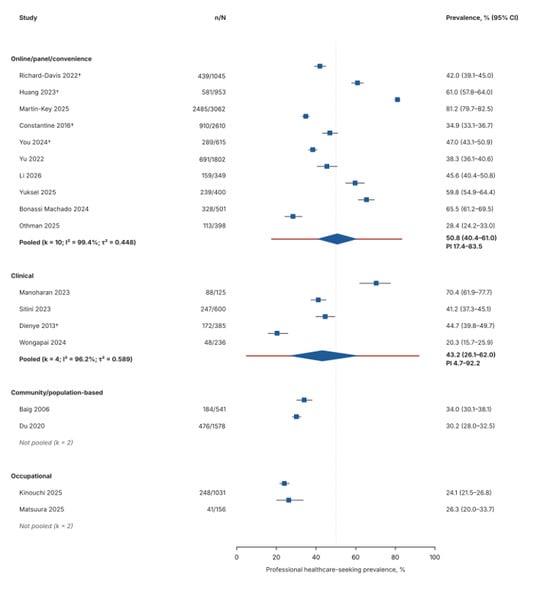
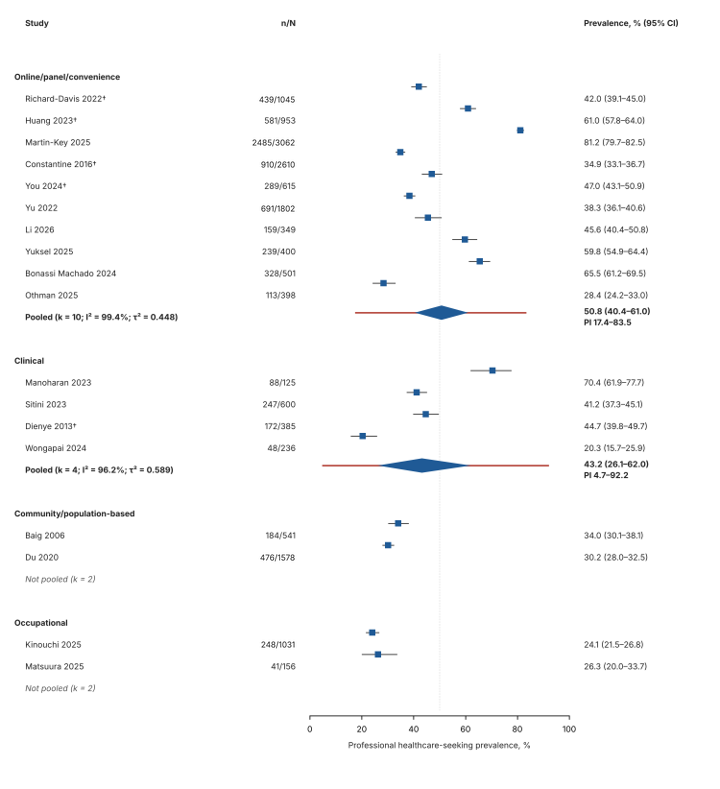
Figure 2.
Forest plot of professional healthcare-seeking prevalence among symptomatic peri- and postmenopausal women, stratified by recruitment setting. Squares are study estimates with Wilson 95% confidence intervals; diamonds are pooled estimates with 95% confidence intervals; the red line is the 95% prediction interval. Study weights are not shown because the generalized linear mixed model does not assign inverse-variance weights. † Reconstructed estimate. k, number of studies; PI, prediction interval.
2.5. Outcomes
The primary outcome was the prevalence of professional healthcare-seeking specifically for menopause-related symptoms among symptomatic peri- and postmenopausal women. Professional healthcare-seeking was defined as consultation, attendance, contact, or discussion with a regulated healthcare professional specifically because of symptoms attributed to perimenopause or menopause. Eligible professionals included general practitioners or family physicians, gynecologists, other physicians, nurses, midwives, psychologists, physiotherapists, and other regulated healthcare professionals.
The numerator was the number of symptomatic eligible participants who sought professional healthcare for menopause-related symptoms, and the denominator was the total number of symptomatic eligible participants in the relevant study sample. Information-seeking alone, informal support, self-medication, over-the-counter or complementary product use without professional consultation, routine healthcare unrelated to menopause, and treatment use without explicit evidence of menopause-related professional consultation did not satisfy the primary outcome definition. Measures worded in terms of treatment were accepted only when the item required contact with a professional, such as a visit to a hospital or clinic or the consultation of a physician or health worker. Measures of any treatment that could include self-purchased or non-prescription products were not counted as healthcare-seeking and are reported separately in Supplementary Table S4. Recall periods, including current or most recent symptom episodes, the previous 12 months, and lifetime or “ever” healthcare-seeking, were retained and considered when assessing comparability between studies.
Secondary outcomes included factors associated with professional healthcare-seeking, delayed help-seeking, or non-seeking; time between symptom onset and professional consultation; type of regulated healthcare professional or service consulted; referral, treatment, repeated consultations, and satisfaction following help-seeking; and reported reasons, barriers, and facilitators related to seeking or not seeking professional care.
2.6. Risk of Bias Assessment
Risk of bias was assessed using the Joanna Briggs Institute (JBI) Critical Appraisal Checklist for Studies Reporting Prevalence Data [45]. Two reviewers independently assessed each included study, with disagreements resolved through discussion and consensus. Assessment focused on the adequacy and representativeness of the sampling frame, sampling and recruitment methods, sample size, description and coverage of the study population, validity and consistency of outcome measurement, appropriateness of statistical analysis, and adequacy of response rates. Particular attention was given to self-selection, non-response, the definition of the symptomatic denominator, and the validity of the healthcare-seeking measure. Checklist items were rated as Yes, No, or Unclear. An item was rated Yes when the published report showed that the criterion was met, No when the report showed that the criterion was not met, and Unclear when the report did not provide enough information to judge the criterion. Risk-of-bias judgments were considered at the item level and incorporated into the interpretation and sensitivity analyses. No numerical JBI score or overall risk-of-bias category was assigned.
2.7. Statistical Analysis
For the primary outcome, study-specific prevalence was calculated as the number of symptomatic eligible women reporting professional healthcare-seeking divided by the corresponding symptomatic denominator and was presented with a 95% confidence interval. Quantitative pooling was undertaken within a recruitment stratum when at least three independent studies reported the proportion of symptomatic women who had contact with a healthcare professional for menopause-related symptoms. Recruitment stratum was the primary comparability criterion. Studies within a stratum still differed in the symptom domain of the denominator, the wording of the outcome, and the recall period; these characteristics are reported for each study in Table 2 and were examined in sensitivity analyses rather than used to prevent pooling.
Prevalence estimates were pooled using a random-effects binomial-normal generalized linear mixed model (GLMM) with a logit link, fitted by maximum likelihood in R version 4.5.3 (R Foundation for Statistical Computing, Vienna, Austria) with the meta package, version 8.5.0 (function metaprop, method = “GLMM”). Summary estimates were back-transformed to the prevalence scale. Confidence intervals for pooled estimates were Wald-type intervals; intervals with the Hartung-Knapp adjustment were reported as a sensitivity analysis. Between-study variance (τ2) was estimated by maximum likelihood, and I2 was derived from Cochran’s Q. Prediction intervals were based on the t distribution with k − 1 degrees of freedom and were not reported for syntheses of three studies, in which between-study variance is too imprecisely estimated for a prediction interval to be informative. Study-level confidence intervals are Wilson intervals. I2 was interpreted cautiously because variability in prevalence may reflect genuine differences in populations, recruitment procedures, outcome definitions, and other methodological characteristics.
Studies were grouped into four recruitment strata. Online/panel/convenience studies were web-based questionnaire surveys completed either by self-selected volunteers reached through social media, websites, or mailing lists, or by members of commercial online research panels, that is, pre-registered pools of people who have agreed to receive survey invitations and who were in some studies sampled to quotas matching national age and regional distributions. Clinical studies recruited women attending primary-care, outpatient, or hospital services for any reason. Community/population-based studies recruited residents of defined geographical areas through household, registry, or probability-based sampling. Occupational studies recruited employees of defined workplaces or professions. These strata were not combined in the primary analysis when their selection mechanisms differed materially. Meta-analysis was performed only within strata containing at least three sufficiently comparable independent studies; strata with fewer than three studies were summarized using individual study estimates. A pooled estimate combining heterogeneous recruitment settings was not considered a primary estimate.
For multinational studies reporting both country-specific and overall results, a single aggregate estimate per independent study was used in the primary meta-analysis to avoid disproportionate weighting of individual studies. Country-specific estimates were retained for secondary descriptive analyses. Similarly, overlapping reports from the same study were not simultaneously entered as independent observations in the same meta-analysis.
Potential sources of heterogeneity included recruitment setting and sampling method, operational definition of healthcare-seeking, recall period, menopausal stage, menopause type, geographical region, symptom type or severity threshold, response rate, and risk of bias. Meta-regression was not undertaken when the number of independent studies was insufficient for reliable covariate-level analysis.
Sensitivity analyses specified in the protocol excluded studies with substantial self-selection, reconstructed estimates, and samples in which premenopausal women or women with surgical or medically induced menopause could not be separated. Substantial self-selection was defined as recruitment that explicitly included menopause-specific organizations, foundations, or support groups, through which women already engaged with menopause care are likely to be over-represented; self-selected samples recruited through general social media, websites, or mailing lists did not meet this definition. Sensitivity analyses by recall period (lifetime; previous 12 months) and by symptom domain of the denominator (any menopausal symptom; vasomotor symptoms) were post hoc, as was an analysis restricted to the studies that sampled from commercial online research panels, which excluded all self-selected samples. A sensitivity meta-analysis was undertaken only when at least three studies remained; planned analyses that could not be performed are listed in Supplementary Table S3.
Associated factors were synthesized separately from prevalence estimates. Multivariable-adjusted estimates were prioritized, and adjusted and unadjusted estimates were not combined. Odds ratios, risk ratios, and prevalence ratios were not pooled together. Quantitative pooling was considered only when at least three studies evaluated sufficiently comparable predictors, reference categories, outcomes, and effect measures; otherwise, findings were synthesized narratively and in structured tables. Barriers and facilitators were synthesized without meta-analysis. Each barrier or facilitator was extracted as worded in the source report, together with its numerator and denominator, by one reviewer and checked by a second reviewer. Two reviewers then grouped the items according to the patient-centered access framework of Levesque et al. [46], which distinguishes the ability to perceive a need for care, to seek care, to reach care, to pay for care, and to engage with care, alongside the corresponding characteristics of services; disagreements were resolved by discussion. Within each group, findings were summarized as the study-specific proportions reported, without vote counting or pooling, because the items, response formats, and denominators differed across studies. Study-level data are tabulated in Supplementary Table S4.
Formal assessment of small-study effects or funnel-plot asymmetry was considered only for a sufficiently homogeneous synthesis containing at least ten independent studies. Formal asymmetry testing was therefore not applied to smaller or methodologically heterogeneous syntheses. Potential selective reporting was considered in the interpretation of the evidence.
2.8. Certainty of Evidence Assessment
Confidence in the principal bodies of evidence was assessed using a structured domain-based approach informed by GRADE principles but adapted for prevalence evidence. The assessment considered risk of bias, directness of the population and outcome definition, consistency across studies and settings, precision, potential reporting bias, representativeness of the sampling frame, response and non-response, and robustness of findings in sensitivity analyses. Particular consideration was given to differences between probability-based population samples and online, occupational, convenience, or healthcare-attending samples. Confidence judgments were made separately for the principal bodies of evidence defined by recruitment setting and sampling frame and were supported by narrative justification rather than a numerical quality score. Certainty in each body of evidence was classified as high, moderate, low, or very low. Certainty assessments were performed independently by two reviewers, with disagreements resolved through discussion and consensus. These judgments represented review-specific narrative assessments of confidence in the prevalence evidence and were not intended as formal GRADE certainty ratings.
3. Results
3.1. Study Selection
The database searches identified 4205 records. After removal of 1943 duplicates (1922 when the database exports were combined and 21 identified in Rayyan), 2262 records underwent title and abstract screening, of which 2178 were excluded. Eighty-four reports were sought and assessed for eligibility in full text, and 49 were excluded; the reasons for exclusion are given in Figure 1, and the excluded reports are listed individually in Supplementary Table S7. A total of 35 reports met the eligibility criteria, representing 34 independent studies. Two reports, Williams et al. 2006 [44] and Williams et al. 2007 [6], originated from the same Menopause Epidemiology Study cohort and were therefore considered a single independent study in the synthesis. The study-selection process is shown in Figure 1.
3.2. Characteristics of Included Studies
The 34 independent studies were conducted in Asia, Europe, North America, Africa, the Middle East, and Australia. Twelve were online surveys, of which seven drew respondents from commercial online research panels, and five recruited self-selected volunteers through social media or websites. Eleven recruited from the community or general population, seven recruited women attending primary-care, outpatient, or hospital services, three recruited employees of defined workplaces, and one used mixed hospital and community recruitment (Table 1). Two were longitudinal cohort studies, and the remainder were cross-sectional. Definitions of menopausal status, symptom eligibility, professional healthcare-seeking, and recall period varied across studies.
Eighteen of the 34 included studies provided an extractable numerator of symptomatic women who sought professional healthcare specifically for menopause-related symptoms, along with a corresponding symptomatic denominator, and were therefore eligible for the primary prevalence analysis. These included ten online, panel, or convenience samples; four clinical samples; two community- or population-based samples; and two occupational samples. The reason each of the remaining 16 studies was not entered in the primary analysis is given in Supplementary Table S6.
For multinational studies, aggregate study-level estimates were used rather than country-specific estimates to preserve independence. Constantine et al. [22], Martin-Key et al. [17], and Yu et al. [25] therefore each contributed one estimate to the primary analysis. Yuksel et al. [33] and Bonassi Machado et al. [35] report the Canadian and Brazilian samples of the same international survey; the two samples are distinct and were entered as separate studies. Martin-Key et al. 2023 [39] and Martin-Key et al. 2025 [17] were conducted by the same research group. The 2023 survey recruited in the United Kingdom between January and March 2023, and the 2025 survey recruited between December 2023 and February 2024. Because participation of the same women in both surveys could not be excluded, only the 2025 study was entered in the primary analysis.
The characteristics of all included studies are presented in Table 1.
Study-level prevalence estimates for these 18 studies are presented in Table 2.
3.3. Risk of Bias
Risk of bias was assessed at the item level using the nine-item Joanna Briggs Institute Critical Appraisal Checklist for Studies Reporting Prevalence Data. Limitations were most frequently identified in the appropriateness of the sampling frame (not met in 23 of the 34 studies) and in participant sampling (not met in 16 and unclear in 4). The response rate was adequate in 11 studies, not adequate in 3, and could not be judged in 20 because it was not reported. Sample-size adequacy was not met in 3 studies and was unclear in 7. In contrast, study and setting descriptions, coverage of the analyzed sample, outcome measurement, and statistical analysis were generally adequate. No numerical JBI score or overall risk-of-bias category was assigned. The complete study-level assessment is presented in Supplementary Table S2.
3.4. Certainty of Evidence
Certainty in the prevalence evidence was low or very low in all recruitment strata. Certainty was low for the online/panel/convenience evidence because of recurrent sampling and response-rate limitations, substantial between-study heterogeneity, and self-selected recruitment. Certainty was very low for the clinical/outpatient evidence because of the small number of studies, substantial heterogeneity, a wide confidence interval, and the restricted representativeness of healthcare-attending samples. Certainty was low for the community/population-based evidence: only two studies were available, no pooled estimate could be calculated, one of the two studies did not meet the criteria for sampling frame and participant sampling, and both were conducted in single urban settings. Certainty was also low for the occupational evidence, which rested on two studies of employed women in Japan, one of which had limitations in sampling frame and participant sampling. The complete domain-based assessment is presented in Supplementary Table S5.
3.5. Prevalence of Professional Healthcare-Seeking
Professional healthcare-seeking prevalence varied widely across the 18 studies eligible for the primary outcome, from 20.3% to 81.2%. In accordance with the prespecified synthesis strategy, quantitative pooling was conducted within recruitment strata containing at least three independent studies. No overall pooled estimate across all recruitment settings was calculated, and no formal comparison between strata was performed.
Ten online, panel, or convenience studies were included in the largest quantitative synthesis. The random-effects binomial-normal generalized linear mixed model yielded a pooled professional healthcare-seeking prevalence of 50.8% (95% CI 40.4–61.0%). Between-study variance was τ2 = 0.448 and I2 was 99.4%. The 95% prediction interval ranged from 17.4% to 83.5%.
Four clinical studies were analyzed separately. The pooled prevalence was 43.2% (95% CI 26.1–62.0%), with τ2 = 0.589 and I2 = 96.2%; the 95% prediction interval ranged from 4.7% to 92.2%. With only four studies, between-study variance is poorly estimated; this value is therefore presented as a descriptive summary.
The community or population-based stratum contained two eligible studies and was therefore not pooled. Professional healthcare-seeking prevalence was 34.0% in Baig et al. [21] and 30.2% in Du et al. [18]. The occupational stratum also contained two studies and was not pooled; prevalence was 24.1% in Kinouchi et al. [13] and 26.3% in Matsuura et al. [27].
Study-specific estimates and the pooled estimates for the online/panel/convenience and clinical/outpatient strata are presented in Figure 2.
Corresponding numerators, symptomatic denominators, prevalence estimates, and 95% confidence intervals are provided in Table 2.
3.6. Sensitivity Analysis
Sensitivity analyses were performed in the online/panel/convenience stratum (Supplementary Table S3). Excluding Martin-Key et al. 2025 [17], which recruited through paid social-media advertisements, Reddit, and menopause foundations and support groups and is described by its authors as a self-selected sample, reduced the pooled prevalence from 50.8% to 46.7% (95% CI 38.8–54.8%; k = 9). Restricting the analysis to the six studies that sampled from commercial online research panels, and thereby excluding all four self-selected samples, gave 47.5% (95% CI 38.5–56.6%; k = 6). Excluding the four reconstructed estimates gave 53.9% (95% CI 38.4–68.7%; k = 6), and restricting the analysis to studies of perimenopausal and postmenopausal women only gave 51.1% (95% CI 37.0–65.0%; k = 7). By symptom domain, pooled prevalence was 51.2% (95% CI 33.3–68.8%; k = 5) in studies with a denominator of any menopausal symptom and 51.3% (95% CI 39.9–62.6%; k = 4) in studies of women with vasomotor symptoms. By recall period, it was 51.2% (95% CI 31.6–70.4%; k = 4) for lifetime consultation and 57.5% (95% CI 48.5–66.0%; k = 3) for consultation in the previous 12 months. With the Hartung-Knapp adjustment, the confidence interval of the primary estimate was 38.9–62.5%. Heterogeneity remained very high in every analysis (I2 ≥ 95%). In the clinical stratum, the pooled prevalence of 43.2% changed to 44.0% (95% CI 21.9–68.7%; k = 3) after excluding Sitini et al. [16], in which the 10% of participants with surgical or medically induced menopause could not be separated from women with natural menopause, to 42.8% (95% CI 21.1–67.6%; k = 3) after excluding the reconstructed estimate, and to 34.7% (95% CI 23.1–48.4%; k = 3) after excluding the study in which premenopausal women could not be separated. Analyses by type of menopause could not be performed because no study reported healthcare-seeking separately for surgical or medically induced menopause, and analyses by symptom domain or recall period were not possible in the clinical stratum because fewer than three studies shared the same symptom domain or recall period. Funnel-plot asymmetry was not assessed because no synthesis was sufficiently homogeneous.
3.7. Healthcare Professionals and Services Consulted
Twenty-four of the 34 independent studies reported at least one type of healthcare professional or service consulted for menopause-related symptoms. Reporting formats differed across studies, with some recording a single provider or first point of contact and others allowing multiple responses.
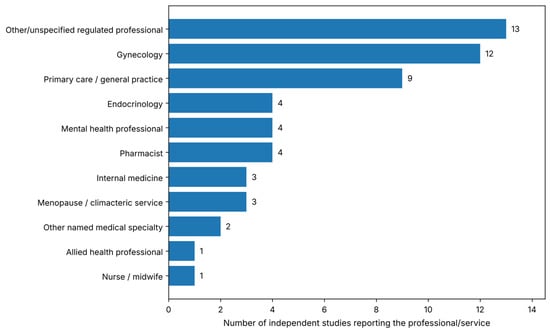
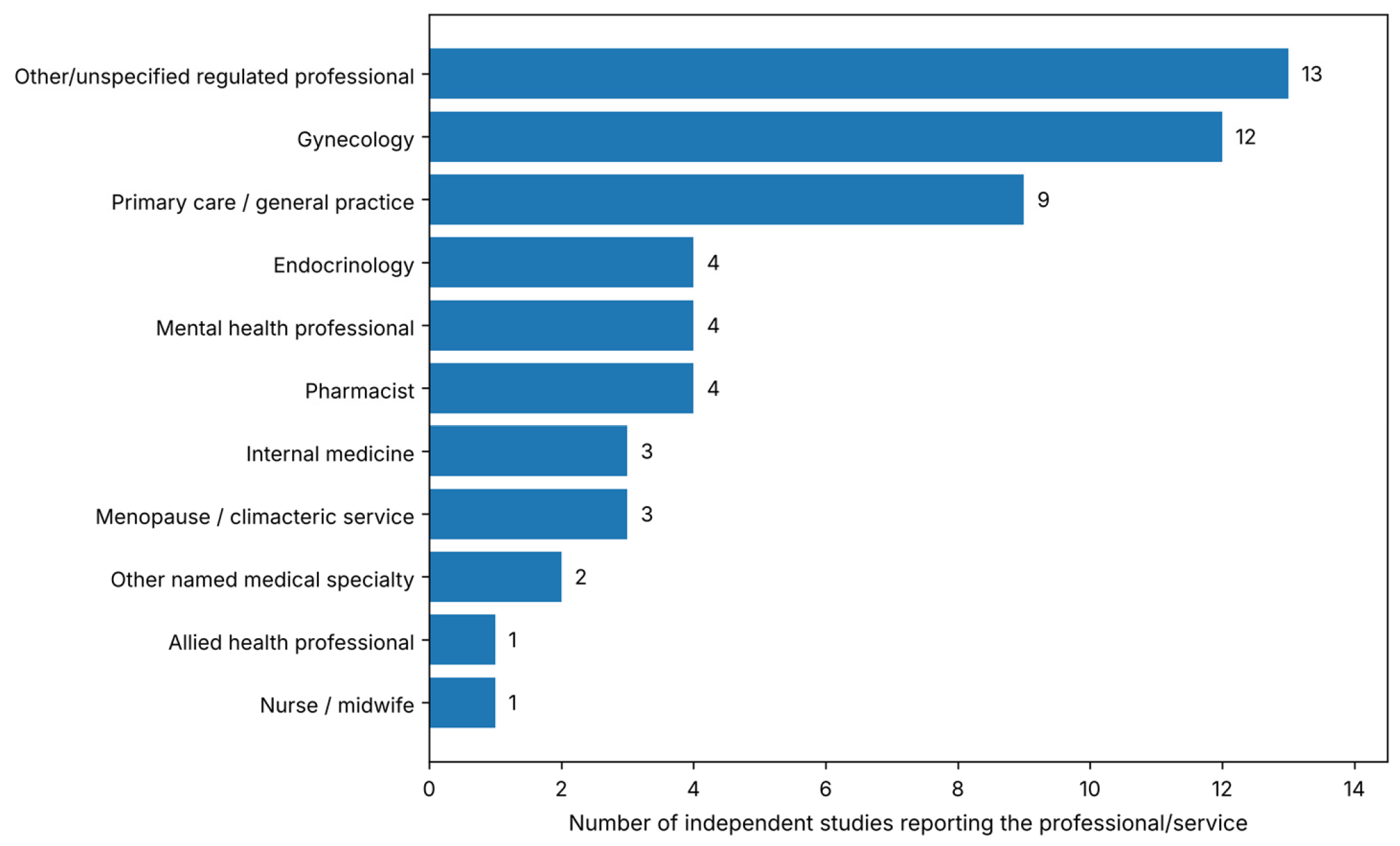
Gynecology was reported as a professional or service category in 12 independent studies and primary care or general practice in nine. Mental health professionals, endocrinology, and pharmacists were each reported in four studies; internal medicine in three; menopause or climacteric services in three; and other named medical specialties in two. Nursing or midwifery and allied health categories were each reported in one study. Thirteen studies also used broader or unspecified regulated healthcare-professional categories.
Because provider definitions, denominators, and multiple-response structures differed between studies, provider-specific proportions were not pooled. The distribution of professional and service categories across the evidence base is presented in Figure 3.
Figure 3.
Evidence map of healthcare professionals and services consulted for menopause-related symptoms.
3.8. Factors Associated with Professional Healthcare-Seeking
Four studies provided usable analyses of factors associated with professional healthcare-seeking, yielding 32 extracted associations. These were synthesized descriptively because the investigated predictors, reference categories, outcome definitions, effect estimates, and adjustment sets differed across studies.
Greater symptom burden or severity was positively associated with healthcare-seeking in multiple analyses. In Manoharan et al. [15], MQ6 score (aOR 1.26 per point, 95% CI 1.04–1.47) and the number of medical conditions (aOR 1.34 per additional condition, 95% CI 1.11–1.76) were positively associated with consultation. Menopausal stage was also associated with consultation in that study: perimenopausal women, defined by menstrual changes, had higher odds of consultation than premenopausal women (aOR 4.84, 95% CI 1.39–16.83).
In Du et al. [18], women reporting more than three symptoms had higher odds of healthcare-seeking than those reporting zero to three symptoms (aOR 2.12, 95% CI 1.49–3.02). Compared with the normal Kupperman Menopausal Index category, the adjusted odds were higher among women with moderate symptoms (aOR 3.04, 95% CI 1.21–7.63) and severe symptoms (aOR 4.65, 95% CI 2.39–9.07). Perimenopausal status was also associated with higher odds of healthcare-seeking compared with premenopausal status (aOR 1.62, 95% CI 1.17–2.26).
You et al. [24] reported positive associations with an irregular menstrual cycle, regular medical check-ups, hot flushes or sweating, muscle or joint pain, and preference for obtaining menopause information from hospitals or the internet. The largest reported point estimate was observed for undergoing medical check-ups at least twice annually (aOR 4.04).
Wang et al. [29] reported higher healthcare utilization among women with Guangzhou registered residence (aOR 3.16, 95% CI 2.01–3.96), travel time of ≤30 min to the nearest perimenopausal health clinic (aOR 2.84, 95% CI 1.78–3.26), and high social support (aOR 3.02, 95% CI 1.81–3.22). Lower odds were reported when the husband or partner was responsible for healthcare-utilization decisions (aOR 0.36, 95% CI 0.13–0.81) and among women reporting self-stigma toward perimenopausal health problems (aOR 0.28, 95% CI 0.08–0.56). Several of the confidence intervals reported by Wang et al. are not symmetric around the point estimate on the logarithmic scale, which suggests reporting errors; these estimates are reproduced as published and should be interpreted with caution. Table 3 presents all 32 extracted associations. Table 3 lists the associations reported by the included studies between individual factors and professional healthcare-seeking. Each row gives one factor, expressed as the category of interest versus its reference category, and the odds of seeking professional care in that category relative to the reference; an odds ratio above 1 indicates that care-seeking was more frequent in the category of interest.
Table 3.
Factors associated with professional healthcare-seeking for menopause-related symptoms.
3.9. Barriers and Facilitators
Reported barriers were heterogeneous and were synthesized descriptively according to the access framework of Levesque et al. [46].
Ability to perceive a need for care. Normalization or tolerability of symptoms was the most frequently reported barrier. In Sitini et al. [16], 246 of 353 participants (69.7%) considered symptoms normal for age. In Wongapai et al. [28], 88 of 117 (75.2%) considered symptoms part of getting older, while 93 of 180 participants (51.7%) in Sundararajan et al. [38] considered symptoms normal with age. Among 115 non-consulting participants in Matsuura et al. [27], 106 (92.2%) reported that they could tolerate their symptoms and 41 (35.7%) preferred to wait for symptoms to resolve naturally. Low perceived need for treatment was also reported [14,37,38], as was lack of awareness of available treatments [34].
Ability to seek care. Stigma, embarrassment, and privacy concerns were reported in several studies. In Wongapai et al. [28], 39 of 117 participants (33.3%) reported embarrassment, 73 (62.4%) regarded their symptoms as a private matter, and 54 (46.2%) believed that other people did not want to hear about them. In Wang et al. [29], self-stigma toward perimenopausal health problems was reported by 602 of 1136 participants (53.0%), low social support by 387 (34.1%), and husband or partner control over healthcare-utilization decisions by 340 (29.9%). Preference for traditional medicine [16], reluctance to consult a gynecologist [27], and fear of gynecologic examination [35] were also described.
Ability to reach care. Practical barriers included lack of time [27,34], travel distance [29], and difficulties scheduling appointments and limited access to specialized services [34]. In Matsuura et al. [27], 38 of 115 non-consulting participants (33.0%) reported being too busy at work to seek consultation. In Wang et al. [29], 644 of 1136 participants (56.7%) reported travel time exceeding 30 min to the nearest perimenopausal health clinic.
Ability to pay for care. Financial constraints were reported in three studies: lack of money by 29 of 353 participants (8.2%) in Sitini et al. [16], expense by 11 of 180 (6.1%) in Sundararajan et al. [38], and cost of treatment in Li et al. [30].
Ability to engage with care. Barriers at this level included uncertainty that consultation would improve symptoms, reported by 11 of 115 non-consulting participants (9.6%) in Matsuura et al. [27], and the belief that a doctor could offer nothing other than hormone therapy, reported by 33% of non-consulters in Currie et al. [37]. Perceived inadequate clinician support or menopause-related knowledge, and concerns regarding hormone-related cancer risk or conflicting advice, were described in Li et al. [30].
Study-specific barrier and facilitator findings are presented in Supplementary Table S4.
3.10. Delays and Care Pathways
Quantitative information on delay between symptom onset and professional consultation was limited. Guthrie et al. [5] reported a median time to professional consultation of 3 years, with a range of 0–9 years. No pooled analysis of consultation delay was performed.
Several studies reported treatment or subsequent outcomes after healthcare contact. In Manoharan et al. [15], 58 of 88 participants (65.9%) reported treatment after or around consultation. In Wongapai et al. [28], 39 of 48 healthcare-seeking participants (81.3%) reported treatment, 23 of 48 (47.9%) reported hormone replacement therapy, and 33 of 48 (68.8%) reported improvement after care or treatment.
Sitini et al. [16] reported improvement after care or treatment in 99 of 247 participants (40.1%), persistent symptoms in 134 (54.3%), and being told that symptoms were normal in 14 (5.7%). Matsuura et al. [27] reported hormone therapy in 11 of 156 participants (7.1%) and improvement after care or treatment in 24 (15.4%).
Other studies reported treatment use in the whole symptomatic sample rather than among women who had consulted. Yu et al. [25] reported that 765 of 1802 participants (42.5%) had ever used any treatment for vasomotor symptoms, most often non-prescription products, and that 173 (9.6%) had received hormone therapy. Constantine et al. [22] reported that 1401 of 2610 women (53.7%) had sought some intervention, and Li et al. [30] reported that 182 of 349 (52.1%) had tried any treatment. In these three studies, the proportion using any treatment exceeded the proportion who had consulted a professional, because treatment included self-purchased products. Yuksel et al. [33] reported current treatment in 134 of 400 participants (33.5%), and Metintas et al. [26] reported hormone therapy in 28 of 428 participants (6.5%). Williams et al. [6] reported that 866 of the 1862 women who had ever sought care (46.5%) had done so within the previous 12 months.
Because the definitions and denominators for treatment, hormone therapy, symptom improvement, and subsequent healthcare use differed across studies, these outcomes were not quantitatively pooled. The study-specific findings are presented in Supplementary Table S4.
4. Discussion
This systematic review and meta-analysis synthesizes the published evidence on professional healthcare-seeking for menopause-related symptoms among symptomatic peri- and postmenopausal women. Healthcare-seeking varied widely, with study-level estimates ranging from 20.3% to 81.2%. Pooled estimates were approximately 51% in online/panel/convenience studies and 43% in clinical studies, the latter based on only four studies, and the estimates in the community/population-based and occupational strata, which were not pooled because fewer than three eligible studies were available, ranged from 24.1% to 34.0%. Importantly, the very high between-study heterogeneity within the pooled strata indicates that professional healthcare-seeking cannot be adequately represented by a single prevalence estimate across populations and settings. The evidence further suggests that healthcare-seeking is associated with symptom burden and severity, healthcare accessibility and engagement, and social and interpersonal factors, while normalization of symptoms, stigma, practical constraints, and perceived lack of need for treatment were recurrently reported barriers to professional consultation.
Recruitment setting may contribute to this variation, although the available data do not establish that it does. Online and convenience samples yielded widely varying estimates, from 28.4% to 81.2%, and included the highest prevalence observed in the review, whereas the two community/population-based studies reported 30.2% and 34.0%. Du et al. [18], for example, found that 30% of symptomatic women sought healthcare in a community sample in China. Higher levels were reported in several online samples [12,14,17], but the lowest online estimates, 28.4% in Othman et al. [34] and 34.9% in Constantine et al. [22], were close to the community estimates. Earlier population-based evidence from the United States likewise showed that healthcare use for menopausal symptoms was common but not universal [6]. Whether the variation between studies reflects recruitment, geography, or the definition of symptoms and consultation cannot be determined from the available studies. Women who participate in menopause-focused online surveys may have greater symptom awareness, stronger interest in menopause, greater symptom burden, or previous engagement with healthcare and therefore may not represent the wider population. Conversely, community-based studies may capture women who normalize symptoms or do not perceive them as warranting medical attention. The sensitivity analysis in the present review is compatible with this interpretation: excluding Martin-Key et al. 2025 [17], a self-selected sample recruited partly through menopause foundations and support groups, reduced the pooled estimate from 50.8% to 46.7%, and the estimate restricted to commercial online panels was 47.5%, although heterogeneity remained very high in both analyses.
This finding has implications for interpretation of the existing menopause literature. Estimates obtained from self-selected online respondents, members of commercial online panels, women already attending a health service, employees of a single profession, and residents sampled from the community should not be assumed to measure the same underlying healthcare-seeking probability. A recent systematic review of disparities in menopausal care similarly concluded that access and management differ across population groups and healthcare contexts, including according to healthcare access and provider characteristics [47]. The present review suggests that recruitment setting is one potential source of variation in reported healthcare-seeking prevalence. This should be regarded as a hypothesis: no formal comparison between strata was made, the confidence intervals of the two pooled strata overlap, and recruitment setting is confounded with country, symptom definition and severity, outcome wording, and recall period. Future prevalence studies should therefore describe sampling frames, response rates, symptom eligibility, recall periods, and healthcare-seeking definitions in sufficient detail to allow meaningful comparisons.
A consistent finding across the included studies was the relationship between symptom burden and professional consultation. In Manoharan et al. [15], increasing symptom score and comorbidity burden were associated with greater odds of consultation, while Du et al. [18] reported progressively greater healthcare-seeking with increasing symptom severity. You et al. [24] similarly identified hot flushes or sweating and musculoskeletal symptoms among factors associated with seeking care. These findings are consistent with the UK survey by Huang et al. [14], in which symptom severity was the most frequently reported trigger for professional help-seeking. Collectively, these results suggest that consultation is not simply determined by the presence of menopausal symptoms, but by the extent to which symptoms become sufficiently severe, disruptive, or difficult to manage without professional assistance.
However, symptom severity alone does not explain healthcare-seeking. In one study, Wang et al. [29], shorter travel time and greater social support were associated with higher healthcare utilization, whereas self-stigma and partner control over healthcare decisions were associated with lower utilization. These findings come from a single study in which several reported confidence intervals were internally inconsistent, and they should be regarded as tentative. Similar inequalities in access to menopause care have been identified in broader reviews, suggesting that healthcare-seeking operates within a wider structural context rather than representing an exclusively individual choice [47]. Accordingly, low consultation rates should not automatically be interpreted as indicating low need for professional support.
Normalization of symptoms emerged as one of the most recurrent barriers across geographically and methodologically diverse studies. Women frequently described menopause-related symptoms as a normal consequence of ageing, something that should be tolerated, or something insufficiently serious to justify medical consultation [16,27,28,34,37,38]. This pattern is consistent with the recent systematic review by Thavabalan et al. [8], which identified a perceived obligation to endure symptoms as an important barrier to discussing and managing menopause. That review also highlighted poor-quality healthcare interactions, societal judgement, inadequate information, and lack of support as interconnected barriers rather than isolated problems. The present quantitative and descriptive findings therefore reinforce qualitative evidence that normalization may function as a substantial pre-consultation barrier even among women experiencing clinically meaningful symptoms.
Stigma and embarrassment represented a related but distinct barrier. Wongapai et al. [28] reported embarrassment and perceptions that genitourinary symptoms were private, while Wang et al. [29] found an inverse association between self-stigma and healthcare utilization. Other included studies described reluctance to discuss symptoms, fear of gynecological examination, and concerns regarding how symptoms would be perceived by others [30,35,38]. These findings are particularly relevant to symptoms involving sexual or genitourinary health, for which disclosure may depend not only on symptom severity but also on comfort with the healthcare professional and expectations regarding the consultation. Qualitative evidence from the Women Living Better survey similarly showed that validation, shared understanding, and shared decision-making contributed to satisfactory consultations, whereas feeling dismissed or unsupported contributed to negative healthcare experiences [7]. Thus, improving access alone may be insufficient if women do not perceive healthcare encounters as safe, useful, or responsive to their concerns.
The healthcare professionals consulted also varied substantially. Gynecology and primary care/general practice were the most frequently reported professional categories, but several studies also identified mental-health professionals, endocrinologists, pharmacists, internal-medicine services, and menopause-specific services. Because studies used different denominators and often permitted multiple responses, provider-specific proportions could not be pooled. Nevertheless, the distribution suggests that menopause-related care is dispersed across multiple parts of the healthcare system rather than being confined to a single specialty. Contemporary clinical guidance similarly emphasizes individualized assessment and management across the spectrum of menopausal symptoms and comorbid health concerns [48]. Improving menopause care may therefore require both adequate competence in first-contact services and clear referral pathways for women requiring more specialized management. Nursing or midwifery care was reported in only one included study, which suggests that nurses are rarely identified as a point of contact for menopause-related symptoms. Nurse-led menopause services have been associated with improvements in symptoms and quality of life [49], and expanding nurse-led and primary-care provision may be one way to improve access, particularly where specialist services are limited.
The findings concerning care after consultation are also noteworthy. Several studies reported treatment following professional contact, but treatment rates and types varied substantially [15,16,25,26,27,28,33]. Importantly, consultation should not be equated with receipt of treatment, and treatment uptake should not be used as a proxy for healthcare-seeking. Some women may seek assessment or reassurance without requiring pharmacological treatment, while others may receive lifestyle advice, non-hormonal therapy, menopausal hormone therapy, or referral depending on symptoms, preferences, clinical history, and contraindications. Current clinical recommendations emphasize individualized assessment and shared decision-making rather than a uniform treatment pathway [48]. This distinction supports the decision in the present review to define professional healthcare-seeking independently from treatment use.
Evidence regarding delays to consultation was comparatively sparse. Guthrie et al. [5] reported a median interval of 3 years before professional consultation, while a study by our own group [43] reported a shorter median delay among Romanian care-seekers. The small number of studies and substantial differences in populations and definitions precluded quantitative synthesis. Nevertheless, the available evidence indicates that professional consultation may occur considerably after symptoms begin. The coexistence of normalization, self-management, uncertainty regarding available treatment, competing work or family demands, and previous negative healthcare experiences provides plausible explanations for such delay [8,27,28,34,37,38]. Greater attention to consultation delay represents an important direction for future research because prevalence of “ever seeking care” does not capture how long women live with symptoms before accessing professional support.
An important strength of this review is the explicit separation of professional healthcare-seeking from related but conceptually different outcomes such as information-seeking, self-management, treatment use, and healthcare utilization unrelated to menopause. Previous studies have used these concepts inconsistently, contributing to difficulties in comparing estimates. By requiring a symptomatic denominator and a menopause-related professional consultation for the primary prevalence outcome, the present review provides a more specific estimate of healthcare-seeking behavior. In addition, recruitment setting was incorporated directly into the synthesis rather than combining methodologically heterogeneous populations into a single pooled estimate. This approach avoids presenting a single estimate for samples selected through different mechanisms; it does not show that prevalence differs between settings, because no formal comparison between strata was made and the confidence intervals of the two pooled strata overlap.
The review also has several limitations. First, the included studies were highly heterogeneous in their definitions of menopausal stage, symptom eligibility, professional healthcare-seeking, and recall period. Although stratification reduced some of this heterogeneity, I2 remained very high in both pooled analyses. The pooled estimates should therefore be interpreted as summaries of heterogeneous bodies of evidence rather than as universally applicable prevalence values. Second, many studies used convenience, online, occupational, or healthcare-based recruitment, limiting representativeness. The risk-of-bias assessment particularly identified limitations in sampling frames, participant sampling, sample-size adequacy, and response rates. In seven of the 18 studies in the primary analysis, women who were premenopausal or whose menopausal stage was not classified could not be removed from the symptomatic denominator, and the regression models summarized in Table 3 included premenopausal women or did not classify menopausal stage. Third, five prevalence estimates were reconstructed from reported percentages. The recruitment strata contained few studies, so between-study variance and prediction intervals are imprecise; the clinical estimate, based on four studies, is a descriptive summary only. Fourth, only English-language studies were included, introducing the possibility of language bias and potentially underrepresenting evidence from settings in which healthcare-seeking patterns may differ substantially. In addition, CINAHL, PsycINFO, and grey-literature sources were not searched, so relevant nursing, psychological, or unpublished studies may have been missed. Fifth, geographical coverage was uneven, and several regions were represented by only one or a small number of studies. Finally, the predominance of cross-sectional evidence limits conclusions regarding temporal relationships between symptom burden, barriers, and subsequent healthcare-seeking.
These limitations also highlight priorities for future research. Population-based prospective studies using standardized definitions of menopausal stage, symptomatic eligibility, healthcare-seeking, and recall periods are needed. Studies should distinguish professional consultation from information-seeking and treatment use and should report both the number of symptomatic women seeking care and the corresponding symptomatic denominator. Reporting should also identify the type of professional consulted, time from symptom onset to consultation, reasons for seeking or not seeking care, referrals, treatments offered, and patient-reported experience of the consultation. Greater inclusion of socioeconomically and culturally diverse populations is particularly important given evidence that access to menopause care is not distributed equally [47].
From a clinical and public-health perspective, the findings suggest that increasing awareness of menopause alone is unlikely to be sufficient. Interventions should address both individual and healthcare-system barriers. Women need accessible, evidence-based information about when symptoms may warrant professional assessment and what forms of management are available, while healthcare professionals require appropriate knowledge and communication skills to provide validating, individualized, and evidence-based care. Recent clinical frameworks emphasize individualized assessment, treatment choice, and shared decision-making in menopause management [48]. At the same time, interventions should avoid medicalizing all menopause experiences: many women have mild symptoms that do not require clinical treatment. The objective should instead be to ensure that women who experience bothersome or disruptive symptoms are able to obtain appropriate care without avoidable informational, cultural, interpersonal, or structural barriers.
5. Conclusions
Professional healthcare-seeking for menopause-related symptoms varies substantially across populations and recruitment settings. Greater symptom burden was generally associated with a higher likelihood of consultation, whereas normalization of symptoms, stigma, limited perceived need for care, and practical or access-related barriers were the most frequently reported obstacles to help-seeking. The marked heterogeneity between studies limits the interpretation of a single overall prevalence estimate and highlights the need for more representative studies using standardized definitions of symptoms, healthcare-seeking, and recall periods. Improving access to timely, informed, and patient-centered menopause care should remain a clinical and public-health priority.
Supplementary Materials
The following supporting information can be downloaded at: https://www.mdpi.com/article/10.3390/healthcare14234075/s1, Table S1. Full electronic search strategies; Table S2. JBI risk-of-bias assessment of included independent studies; Table S3. Primary meta-analysis and sensitivity analyses of professional healthcare-seeking prevalence; Table S4. Reported barriers, facilitators, delays, and care pathways related to professional healthcare-seeking for menopause-related symptoms; Table S5. Certainty assessment of the evidence for professional healthcare-seeking prevalence; Table S6. Eligibility of each included study for the primary analysis and derivation of numerators and denominators; Table S7. Reports excluded at full-text assessment, with reasons; Dataset S1. Study-level data used in the meta-analysis; Code S1. R code for the primary and sensitivity analyses.
Author Contributions
Conceptualization, A.P. and F.C.; methodology, A.P., F.C., C.C.P. and C.S.; formal analysis, A.P., F.C. and A.M.; investigation, A.P., D.C.I., V.B., R.L. and A.M.; data curation, A.P., A.M. and R.L.; writing—original draft preparation, A.P. and F.C.; writing—review and editing, F.C., C.C.P., R.L., V.B., D.C.I., C.S., A.M., R.N.F. and R.F.; visualization, A.M. and R.N.F.; supervision, F.C., C.C.P. and R.F.; project administration, F.C. All authors have read and agreed to the published version of the manuscript.
Funding
This research received no external funding.
Institutional Review Board Statement
Ethical approval was not required, as this systematic review and meta-analysis was based exclusively on previously published data. .
Informed Consent Statement
Not applicable.
Data Availability Statement
This study is a systematic review and meta-analysis of published reports; no new primary data were generated. The study-level data extracted from the included studies and used in all analyses, together with the analysis code, are provided in the Supplementary Materials (Dataset S1 and Code S1).
Acknowledgments
The publication costs of the present article were covered by the University of Medicine and Pharmacy "Victor Babes" Timisoara.
Conflicts of Interest
A.P., F.C., and R.F. are authors of one of the studies included in this review [43]. The authors declare no other conflicts of interest.
References
- World Health Organization. Menopause. Available online: https://www.who.int/news-room/fact-sheets/detail/menopause (accessed on 1 October 2026).
- Davis, S.R.; Pinkerton, J.A.; Santoro, N.; Simoncini, T. Menopause—Biology, consequences, supportive care, and therapeutic options. Cell 2023, 186, 4038–4058. [Google Scholar] [CrossRef] [Scilit] [PubMed]
- Monteleone, P.; Mascagni, G.; Giannini, A.; Genazzani, A.R.; Simoncini, T. Symptoms of menopause—Global prevalence, physiology and implications. Nat. Rev. Endocrinol. 2018, 14, 199–215. [Google Scholar] [CrossRef] [Scilit] [PubMed]
- Fang, Y.; Liu, F.; Zhang, X.; Chen, L.; Liu, Y.; Yang, L.; Zheng, X.; Liu, J.; Li, K.; Li, Z. Mapping global prevalence of menopausal symptoms among middle-aged women: A systematic review and meta-analysis. BMC Public Health 2024, 24, 1767. [Google Scholar] [CrossRef] [Scilit] [PubMed]
- Guthrie, J.R.; Dennerstein, L.; Taffe, J.R.; Donnelly, V. Health care-seeking for menopausal problems. Climacteric 2003, 6, 112–117. [Google Scholar] [CrossRef] [Scilit]
- Williams, R.E.; Kalilani, L.; DiBenedetti, D.B.; Zhou, X.; Fehnel, S.E.; Clark, R.V. Healthcare seeking and treatment for menopausal symptoms in the United States. Maturitas 2007, 58, 348–358. [Google Scholar] [CrossRef] [Scilit] [PubMed]
- Richardson, M.K.; Coslov, N.; Woods, N.F. Seeking health care for perimenopausal symptoms: Observations from the Women Living Better Survey. J. Women’s Health (Larchmt.) 2023, 32, 434–444. [Google Scholar] [CrossRef] [Scilit] [PubMed]
- Thavabalan, K.; Ovenell, A.; Pierce, P.; Sutaria, A.; Parkhouse, A.; Baydemir, N.; Lally, T. Barriers to the safe discussion of the experience and management of menopausal symptoms: A systematic literature review. Maturitas 2025, 201, 108683. [Google Scholar] [CrossRef] [Scilit] [PubMed]
- Page, M.J.; McKenzie, J.E.; Bossuyt, P.M.; Boutron, I.; Hoffmann, T.C.; Mulrow, C.D.; Shamseer, L.; Tetzlaff, J.M.; Akl, E.A.; Brennan, S.E.; et al. The PRISMA 2020 statement: An updated guideline for reporting systematic reviews. BMJ 2021, 372, n71. [Google Scholar] [CrossRef] [Scilit] [PubMed]
- Stroup, D.F.; Berlin, J.A.; Morton, S.C.; Olkin, I.; Williamson, G.D.; Rennie, D.; Moher, D.; Becker, B.J.; Sipe, T.A.; Thacker, S.B. Meta-analysis of observational studies in epidemiology: A proposal for reporting. JAMA 2000, 283, 2008–2012. [Google Scholar] [CrossRef] [Scilit] [PubMed]
- Campbell, M.; McKenzie, J.E.; Sowden, A.; Katikireddi, S.V.; Brennan, S.E.; Ellis, S.; Hartmann-Boyce, J.; Ryan, R.; Shepperd, S.; Thomas, J.; et al. Synthesis without meta-analysis (SWiM) in systematic reviews: Reporting guideline. BMJ 2020, 368, l6890. [Google Scholar] [CrossRef] [Scilit] [PubMed]
- Richard-Davis, G.; Singer, A.; King, D.D.; Mattle, L. Understanding attitudes, beliefs, and behaviors surrounding menopause transition: Results from three surveys. Patient Relat. Outcome Meas. 2022, 13, 273–286. [Google Scholar] [CrossRef] [Scilit] [PubMed]
- Kinouchi, R.; Iwasa, T.; Ishikawa, H.; Uemura, H.; Takahashi, T.; Mochizuki, Y.; Koga, K.; Tateishi, S.; Fujino, Y.; Horie, S.; et al. Treatment-seeking behaviors among Japanese working women with menopausal symptoms. J. Obstet. Gynaecol. Res. 2025, 51, e70120. [Google Scholar] [CrossRef] [Scilit] [PubMed]
- Huang, D.R.; Goodship, A.; Webber, I.; Alaa, A.; Sasco, E.R.; Hayhoe, B.; El-Osta, A. Experience and severity of menopause symptoms and effects on health-seeking behaviours: A cross-sectional online survey of community dwelling adults in the United Kingdom. BMC Women’s Health 2023, 23, 373. [Google Scholar] [CrossRef] [Scilit] [PubMed]
- Manoharan, A.; Zainal, M.M.H.M.; Chin, B.H.; Ming, K.W.; Asmuee, Z.; Salamon, N.; Jerampang, P.; Hussin, R.; Kamaludin, N.H.; Sreeramareddy, C.T. Health-seeking behaviors and treatments received for menopause symptoms: A questionnaire survey among midlife women attending primary healthcare clinics in Malaysia. J. Menopausal Med. 2023, 29, 119–126. [Google Scholar] [CrossRef] [Scilit] [PubMed]
- Sitini, B.; Ntihinyurwa, P.; Ntirushwa, D.; Mafende, L.; Small, M.; Rulisa, S. Prevalence, impact and management of postmenopausal symptoms among postmenopausal women in Rwanda. Climacteric 2023, 26, 613–618. [Google Scholar] [CrossRef] [Scilit] [PubMed]
- Martin-Key, N.A.; Funnell, E.L.; Bahn, S. Treatment provision and management for the menopause: A multinational survey study. Front. Glob. Women’s Health 2025, 6, 1638428. [Google Scholar] [CrossRef] [Scilit] [PubMed]
- Du, L.; Xu, B.; Huang, C.; Zhu, L.; He, N. Menopausal symptoms and perimenopausal healthcare-seeking behavior in women aged 40–60 years: A community-based cross-sectional survey in Shanghai, China. Int. J. Environ. Res. Public Health 2020, 17, 2640. [Google Scholar] [CrossRef] [Scilit] [PubMed]
- Aljunaid, M.A.; Alruwaili, L.N.; Alhajuj, H.Y.; Musslem, M.T.; Jamal, H.H. Knowledge, awareness, attitudes and practices toward perimenopausal symptoms among Saudi females. Healthcare 2024, 12, 677. [Google Scholar] [CrossRef] [Scilit] [PubMed]
- Dienye, P.O.; Judah, F.; Ndukwu, G. Frequency of symptoms and health seeking behaviours of menopausal women in an out-patient clinic in Port Harcourt, Nigeria. Glob. J. Health Sci. 2013, 5, 39–47. [Google Scholar] [CrossRef] [Scilit] [PubMed]
- Baig, L.A.; Karim, S.A. Age at menopause, and knowledge of and attitudes to menopause, of women in Karachi, Pakistan. J. Br. Menopause Soc. 2006, 12, 71–74. [Google Scholar] [CrossRef] [Scilit] [PubMed]
- Constantine, G.D.; Graham, S.; Clerinx, C.; Bernick, B.A.; Krassan, M.; Mirkin, S.; Currie, H. Behaviours and attitudes influencing treatment decisions for menopausal symptoms in five European countries. Post Reprod. Health 2016, 22, 112–122. [Google Scholar] [CrossRef] [Scilit] [PubMed]
- Sahin, N.H.; Bal, M.D.; Boğa, N.M.; Gökdemirel, S.; Taşpınar, A. Women’s perception of the menopause and hormone treatment: Barriers against hormone therapy. Climacteric 2011, 14, 152–156. [Google Scholar] [CrossRef] [Scilit] [PubMed]
- You, Y.; Lin, L.; Yu, Q. Exploring menopausal symptoms, attitudes, and behaviors among menopausal women in China: An online research perspective. Menopause 2024, 31, 1006–1013. [Google Scholar] [CrossRef] [Scilit] [PubMed]
- Yu, Q.; Chae, H.D.; Hsiao, S.M.; Xie, J.; Blogg, M.; Sumarsono, B.; Kim, S. Prevalence, severity, and associated factors in women in East Asia with moderate-to-severe vasomotor symptoms associated with menopause. Menopause 2022, 29, 553–563. [Google Scholar] [CrossRef] [Scilit] [PubMed]
- Metintas, S.; Arıkan, I.; Kalyoncu, C.; Ozalp, S. Menopause Rating Scale as a screening tool in rural Turkey. Rural. Remote Health 2010, 10, 1230. [Google Scholar] [CrossRef] [Scilit]
- Matsuura, Y.; Yasui, T. Coping with menopausal symptoms among Japanese teachers: Associations with symptom severity and knowledge. J. Med. Investig. 2025, 72, 85–92. [Google Scholar] [CrossRef] [Scilit] [PubMed]
- Wongapai, P.; Jirasawas, T.; Vichinsartvichai, P. Thai postmenopausal woman’s view in genitourinary syndrome of menopause. Post Reprod. Health 2024, 30, 157–165. [Google Scholar] [CrossRef] [Scilit] [PubMed]
- Wang, Y.; Liu, Y.; Xiong, R. Constrains for seeking perimenopausal healthcare services among women aged 40–60 years in Guangzhou, China: A cross-sectional study. Front. Public Health 2025, 13, 1662308. [Google Scholar] [CrossRef] [Scilit] [PubMed]
- Li, F.G.; Street, D.J.; Deans, R.; De Abreu Lourenco, R.; Abbott, J.; Church, J. Women’s experiences with diagnosis and management of vaginal symptoms of menopause: A mixed-methods study. BMC Women’s Health 2026, 26, 257. [Google Scholar] [CrossRef] [Scilit] [PubMed]
- Hvas, L.; Thorsen, H.; Søndergaard, K. Discussing menopause in general practice. Maturitas 2003, 46, 139–146. [Google Scholar] [CrossRef] [Scilit] [PubMed]
- Moral, E.; Delgado, J.L.; Carmona, F.; Caballero, B.; Guillán, C.; González, P.M.; Suárez-Almarza, J.; Velasco-Ortega, S.; Nieto, C. Writing Group of the GENISSE Study. Genitourinary syndrome of menopause. Prevalence and quality of life in Spanish postmenopausal women. The GENISSE study. Climacteric 2018, 21, 167–173. [Google Scholar] [CrossRef] [Scilit] [PubMed]
- Yuksel, N.; Todorova, L.; Scrine, L.; Rea, C.; Bouchard, C. Prevalence and impact of vasomotor symptoms due to menopause among women in Canada: A subgroup analysis from an international cross-sectional survey of Women with Vasomotor Symptoms Associated with Menopause (WARM Study). Menopause 2025, 32, 38–44. [Google Scholar] [CrossRef] [Scilit] [PubMed]
- Othman, S.S.; Alafif, R.A. Navigating menopause: Symptom severity and barriers to medical consultation among middle-aged women in Saudi Arabia. Clin. Exp. Obstet. Gynecol. 2025, 52, 39837. [Google Scholar] [CrossRef] [Scilit]
- Bonassi Machado, R.; Soler, R.; Freire, M.; Wender, M.C.O.; Pompei, L.M. Prevalence and impact of vasomotor symptoms associated with menopause among women in Brazil: Subgroup analysis from an international cross-sectional survey. Maturitas 2024, 189, 108114. [Google Scholar] [CrossRef] [Scilit] [PubMed]
- Gohar, M.M.; Barua, K.; Mahajan, H.; Srivastava, S.; Kumari, S.; Setya, S. An epidemiological cross sectional study to estimate the prevalence of the postmenopausal symptoms and assess the health seeking behaviour amongst the post-menopausal women aged 46–60 years in the rural area of District Gautam Buddha Nagar, Uttar Pradesh. Indian. J. Community Health 2025, 37, 943–949. [Google Scholar] [CrossRef] [Scilit]
- Currie, H.; Moger, S.J. Menopause—Understanding the impact on women and their partners. Post Reprod. Health 2019, 25, 183–190. [Google Scholar] [CrossRef] [Scilit] [PubMed]
- Sundararajan, M.; Srinivasan, V. Prevalence of menopausal symptoms and health-seeking behavior of school teachers with menopausal symptoms in Kumbakonam, South India. Int. J. Community Med. Public Health 2023, 10, 1224–1231. [Google Scholar] [CrossRef] [Scilit]
- Martin-Key, N.A.; Funnell, E.L.; Spadaro, B.; Bahn, S. Perceptions of healthcare provision throughout the menopause in the UK: A mixed-methods study. npj Women’s Health 2023, 1, 2. [Google Scholar] [CrossRef] [Scilit]
- Avis, N.E.; Crawford, S.L.; McKinlay, S.M. Psychosocial, behavioral, and health factors related to menopause symptomatology. Women’s Health 1997, 3, 103–120. [Google Scholar] [PubMed]
- Wasti, S.; Robinson, S.C.; Akhtar, Y.; Khan, S.; Badaruddin, N. Characteristics of menopause in three socioeconomic urban groups in Karachi, Pakistan. Maturitas 1993, 16, 61–69. [Google Scholar] [CrossRef] [Scilit] [PubMed]
- Aladhab, R.; Alabbood, M. Perception of menopausal symptoms among menopause women in Basra Southern Iraq: A cross-sectional study. Curr. Women’s Health Rev. 2021, 17, 260–266. [Google Scholar] [CrossRef] [Scilit]
- Pescaru, A.; Crișan, F.; Lala, R.I.; Ilie, A.C.; Wellmann, N.; Marițescu, A.; Faur, A.M.; Popa, D.I.; Folescu, R. Menopausal symptom burden, quality of life, healthcare-seeking behavior, and treatment satisfaction: A cross-sectional study of Romanian women. Healthcare 2026, 14, 2693. [Google Scholar] [CrossRef] [Scilit] [PubMed]
- Williams, R.E.; DiBenedetti, D.B.; Zhou, X.; Fehnel, S.E.; Clark, R.V. Healthcare seeking behavior among peri- and post-menopausal women: Results from the US population-based MEPI study. In Proceedings of the 17th Annual Meeting of The North American Menopause Society, Nashville, TN, USA, 11–14 October 2006. [Google Scholar]
- Munn, Z.; Moola, S.; Lisy, K.; Riitano, D.; Tufanaru, C. Methodological guidance for systematic reviews of observational epidemiological studies reporting prevalence and cumulative incidence data. Int. J. Evid. Based Healthc. 2015, 13, 147–153. [Google Scholar] [CrossRef] [Scilit] [PubMed]
- Levesque, J.-F.; Harris, M.F.; Russell, G. Patient-centred access to health care: Conceptualising access at the interface of health systems and populations. Int. J. Equity Health 2013, 12, 18. [Google Scholar] [CrossRef] [Scilit] [PubMed]
- Zahn, K.; Pittman, A.; Conklin, J.; Knittel, A.; Neal-Perry, G. Disparities in menopausal care in the United States: A systematic review. Maturitas 2024, 186, 108021. [Google Scholar] [CrossRef] [Scilit] [PubMed]
- Davis, S.R.; Taylor, S.; Hemachandra, C.; Magraith, K.; Ebeling, P.R.; Jane, F.; Islam, R.M. The 2023 Practitioner’s Toolkit for Managing Menopause. Climacteric 2023, 26, 517–536. [Google Scholar] [CrossRef] [Scilit] [PubMed]
- Keye, C. The effect of an advanced nurse practitioner led menopause clinic on quality of life and menopausal symptoms. Women’s Health (Lond.) 2025, 21, 17455057251324573. [Google Scholar] [CrossRef] [Scilit] [PubMed]

Disclaimer/Publisher’s Note: The statements, opinions and data contained in all publications are solely those of the individual author(s) and contributor(s) and not of MDPI and/or the editor(s). MDPI and/or the editor(s) disclaim responsibility for any injury to people or property resulting from any ideas, methods, instructions or products referred to in the content. |
© 2026 by the authors. Licensee MDPI, Basel, Switzerland. This article is an open access article distributed under the terms and conditions of the Creative Commons Attribution (CC BY) license.