


Abstract
Background/Objectives: Socioeconomic deprivation is widely associated with poorer healthcare outcomes and increased healthcare utilisation. However, deprivation’s influence on outcomes after elective total joint arthroplasty (TJA) remains unclear. This study examined whether deprivation, measured by the Scottish Index of Multiple Deprivation (SIMD 2020), was associated with increased healthcare utilisation or 1-year complication rates after TJA. Methods: A single-centre retrospective cohort study was conducted over a 2-year period. Postcodes were categorised into SIMD 2020 quintiles (1 = most deprived and 5 = least deprived). Baseline co-variables included age, sex, BMI, the Clinical Frailty Scale (CFS), ASA, the Charlson comorbidity index (CCI), operation type, health board and main anaesthetic type. Outcomes included 1-year mortality, infection and repeat operation, as well as length of stay, time to mobilisation, GP onward referral, and days until clinic discharge. Univariate descriptive analyses were performed, with multivariate modelling employing linear regression (with log-transformed outcomes for skewed continuous outcomes) and logistic regression for binary outcomes. Results: In total, 1976 procedures were included in this study. No statistically significant differences were observed across the deprivation quintiles for any primary or secondary outcome. Conclusions: No association was identified between socioeconomic deprivation and healthcare utilisation or medium-term major complication rates following elective lower-limb arthroplasty within a standardised NTC pathway. These findings are consistent with equitable healthcare utilisation across deprivation quintiles.
1. Introduction
Socioeconomic deprivation is an established determinant of poorer population health outcomes and increased healthcare system burden [1]. Public Health Scotland states that ‘health inequalities in Scotland by area deprivation remain substantial and persistent’, reporting an 11.1-year gap in male life expectancy between the most and least deprived quintiles [2].
NHS (National Health Service) Fife’s National Treatment Centre (NTC) is a government-funded centre aiming to improve surgical capacity, treatment/diagnostic accessibility, and cross-regional health-board collaboration across the Scottish region [3]. Arthroplasty services place an economic burden on the government in a state-funded healthcare system, with total hip replacement (THR) costing around £10,333 and total knee replacement (TKR) costing around £8495 [4] per patient—based on financial year 2023/4. Multidisciplinary team (MDT) care is considered essential to optimise recovery from total joint replacement, and socioeconomic factors that may lead to increased use of the MDT could have important implications for service planning [5]. Socioeconomic deprivation may affect postoperative outcomes through differences in social support and recovery environments. Patients living in more affluent circumstances may benefit from greater caregiver availability, more suitable home environments, and fewer financial or occupational pressures, all of which could potentially influence healthcare utilisation.
The Scottish Index of Multiple Deprivation (SIMD) is the Scottish Government’s official tool for quantifying socioeconomic deprivation nationwide [6]. It combines seven different aspects of deprivation into a single index—income, employment, education, housing, health, crime and geographical access [7]—with the last release ranking postcodes in 2020 across 6976 ranked data regions. Despite the strengths of SIMD for measuring deprivation, we identified no previous arthroplasty studies using modern SIMD data to evaluate the impact of socioeconomic deprivation on healthcare utilisation. A review of the available literature identified four systematic reviews concerning deprivation and arthroplasty outcomes [8,9,10,11], with most studies originating in North America. These studies mainly observed patient-reported outcome measures (PROMs) and often used alternative deprivation indices, such as the English Index of Multiple Deprivation (IMD), Area Deprivation Index (ADI), Carstairs Index, and the Townsend index. Some studies use outdated SIMD 2006 data, and their outcomes relate to PROMs after surgery, as opposed to healthcare system utilisation. Evidence is currently limited in its generalisability to the Scottish population. These reviews also note inconsistencies between the articles with regard to resource utilisation, although most concur that PROMS concerning pain and function were worse in the deprived contingency, regardless of how this was classified.
Given the limited existing data, the impact of socioeconomic variation on elective arthroplasty remains uncertain. Examining whether socioeconomic deprivation influences healthcare utilisation is important in the Scottish NHS and NTC system, because if deprivation affects patient utilisation and overall burden on the health service, then further research may be indicated to aid with allocation of resources across different regions. This study aimed to determine whether socioeconomic deprivation, defined using SIMD, increased healthcare utilisation both peri-operatively and up to 1-year post-operatively. We hypothesised that higher deprivation would be associated with increased inpatient and outpatient resource usage.
2. Materials and Methods
This was a single-centre, retrospective observational cohort study of all patients who underwent elective unilateral primary total hip or knee arthroplasty over a two-year period (1 January 2023 to 31 December 2024) at the NTC for Orthopaedic Surgery in Fife, Scotland. Lubinus Total Hip System (Waldemar LINK GmbH & Co. KG, Hamburg, Germany) and ATTUNE Total Knee System (DePuy Synthes, Warsaw, IN, USA) were the implants used. Ethical review and approval were sought but deemed not required for this study due to its retrospective design and use of anonymised clinical data collected as part of routine NHS governance. Information governance was observed throughout this study with the use of clinical data in line with local protocols.
Pre-operative and peri-operative data were obtained from NHS FIFE’s ARISE Database, which prospectively records clinical information for all patients undergoing lower limb TJA as part of national clinical governance for Public Health Scotland. The ARISE data contained patients’ date/time of first mobilisation, admission, and discharge, as well as age, ASA, BMI, and sex variables. Electronic notes were individually reviewed and followed up for 1 year with regard to date of clinic discharge and major complication events (mortality, infection, and repeat operation on same joint). A single researcher checked discharge letter instructions and the date of orthopaedic clinic discharge and calculated the CCI (Charlson comorbidity index). Valid postcodes were input into the Scottish Government’s SIMD calculator (2020) to obtain deprivation quintiles, permitting each patient to be assigned SIMD 1-5 (with SIMD quintile 1 = most deprived 20% of the population).
Only patients who underwent unilateral primary total joint arthroplasty of the hip or knee were included. Bilateral, revision, and unicompartmental procedures were excluded. For primary outcomes, independent variables included age, sex, BMI (Body Mass Index), frailty (measured by CFS), co-morbidity (measured by CCI), ASA (American Society of Anaesthesiologists), operation type, referring healthcare board, and main anaesthetic type. Patients were treated from two health boards. The NHS Fife cohort comprised all patients listed from Fife postcodes, representing a broad, unselected population, whereas the NHS Lothian patients were external referrals to the NTC and were therefore a curated, pre-selected group.
The primary outcomes observed were as follows: length of stay (LOS)—capped at 30 days to limit extreme influence from outliers; time to mobilisation—in hours post-operation; days until orthopaedic clinic discharge—capped at 365 days, creating a uniform duration of follow-up for all included patients; requirement for onward GP action or investigation in discharge letter—excluding a routine removal of clips/sutures at day 10–14 by practice nurse.
The secondary outcomes observed were major complications within one year: infection, repeat operation; mortality; and rates of acute kidney injury (AKI) and rates of hyponatremia and severe anaemia. Infection was defined as superficial if the patient was recorded in clinical notes as having an infection, being prescribed oral antibiotics as treatment, and being managed as an outpatient (being discharged from clinic or emergency department). Deep infection was defined as requiring readmission for intravenous antibiotic therapy and/or reoperation for the indication of prosthetic joint infection within 1 year of primary TJA. Re-operation was defined as any operation performed on the same joint, within 1 year of initial primary TJA, regardless of indication. Complication events were identified through a review of electronic clinical notes, operation notes, outpatient correspondence, referral letters, and admission and discharge documentation. Where available, documentation of presentations to other NHS health boards was captured.
All statistical analyses were performed using the most up-to-date R programme version 4.5.3 (2026). Baseline associations between SIMD quintile and categorical variables—sex, CCI, CFS, ASA, anaesthetic type, and major post-operative complications—were assessed using tables and confirmed using chi-square tests. BMI and age were non-normally distributed, as confirmed by Shapiro–Wilk testing, and they were compared across SIMD quintiles via the Kruskal–Wallis test. Where appropriate, Spearman rank correlations were calculated to assess the relationship between SIMD and CFS and ASA and age.
Continuous post-operative outcomes (LOS, mobilisation time, and days until clinic discharge) were all highly right-skewed and therefore log-transformed. Multivariate linear regression models with heteroskedasticity-robust HC3 standard errors were fitted. These adjusted for age, sex, BMI, CCI, CFS, ASA, operation type, main anaesthetic type, and health board. Other relevant intra-op variables (post-op regional anaesthesia and dexamethasone dosing) could not be adjusted for due to high missingness of data.
For binary outcomes (GP action or onward referral required, AKI, and infection), multivariable logistic regression models were employed. For GP action or required onward referral, the same independent variables were adjusted for as in the continuous outcomes. However, given that most of the binary outcomes had low event counts, parsimonious models were used to reduce the risk of model overfitting and maximise sample retention by preferentially including clinically relevant covariates with minimal missing data. Statistical significance was defined as p < 0.05. R Packages used included the following: Ggplot2, dplyr, lmtest, sandwich, zoo, gridExtra, rstatix, stats, tools, scales, and grid. R version 4.5.3 (R Foundation for Statistical Computing, Vienna, Austria) was used for analysis.
Missing Data:
Missing data was handled using complete-case analysis. The extent of missingness per variable is presented in Table 1. Given the substantial missing data for dexamethasone dosing and post-operative analgesia, these variables only had univariate analyses performed and were excluded from multivariate modelling. No imputation was performed.
Table 1.
Summary table of missingness.
3. Results
Cohort summary:
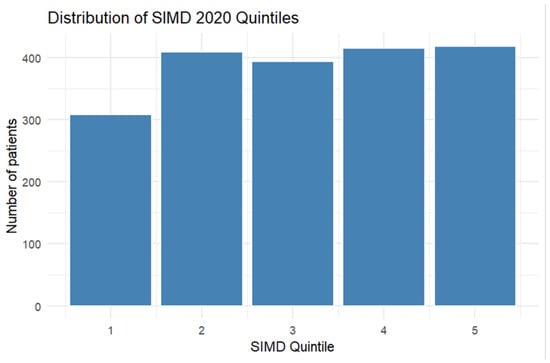
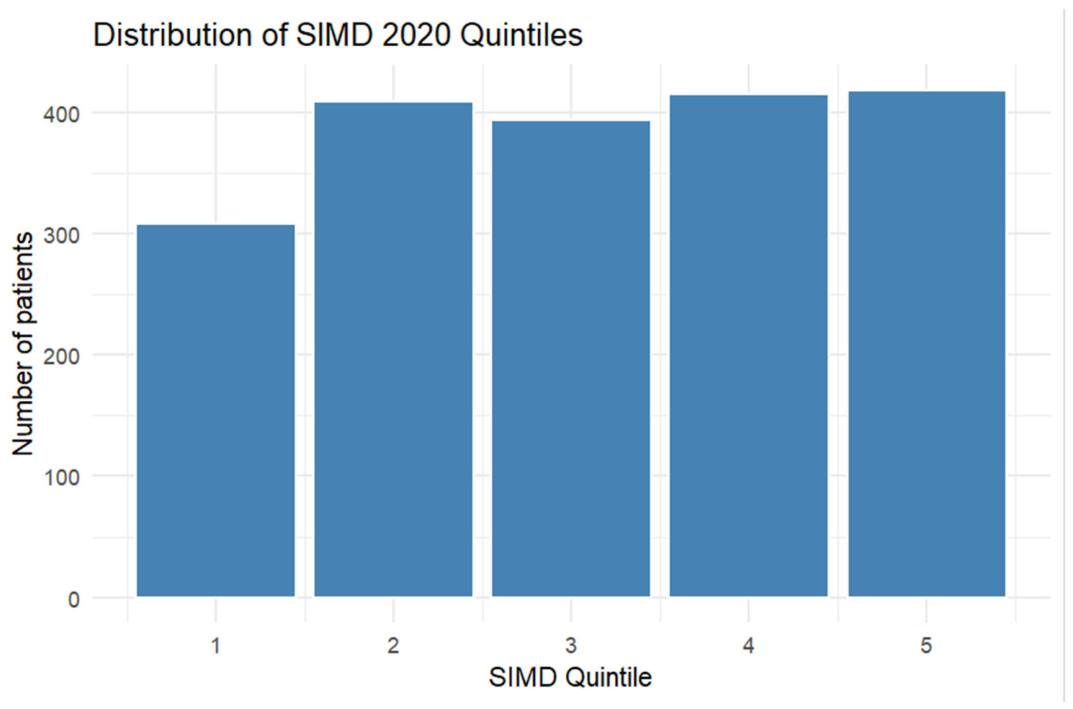
A total of 1976 primary arthroplasty procedures were included. Valid SIMD postcodes were available for 1944 patients (98.4%). Patients were broadly similarly spread across the quintiles (308–418 per group; Figure 1). Baseline characteristics with covariates were generally similar across SIMD quintiles. There were no meaningful differences in sex, CCI, binary frailty classification, main anaesthetic type, dexamethasone dose, post-operative analgesia, and operation type (Table 2).
Figure 1.
Distribution of SIMD 2020 quintiles for the cohort.
Table 2.
Univariate analysis of deprivation vs. covariates.
Health board distributions differed significantly across SIMD quintiles (p = 0.0019), with less deprivation among the Lothian cohort compared to those from Fife. Statistical significance of patients deemed ‘high risk’ at the start-of-day brief was present across quintiles, increasing with deprivation (chi-square p = 0.024).
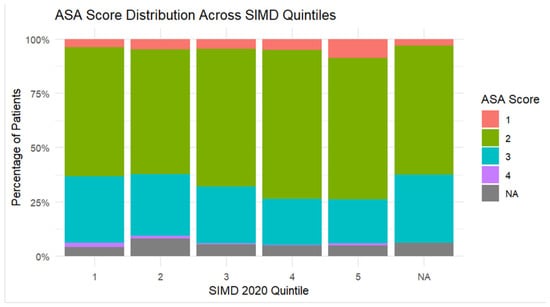
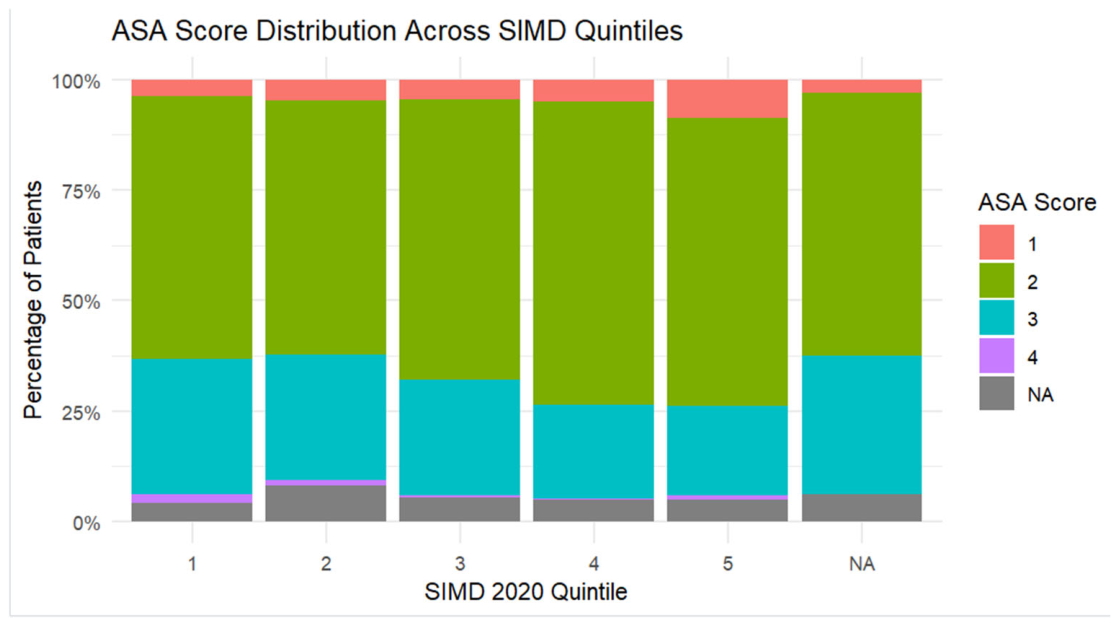
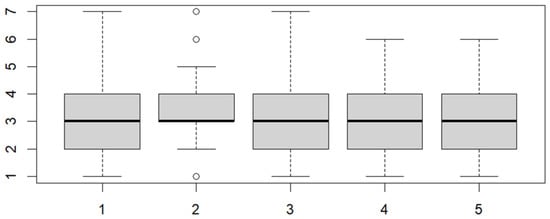
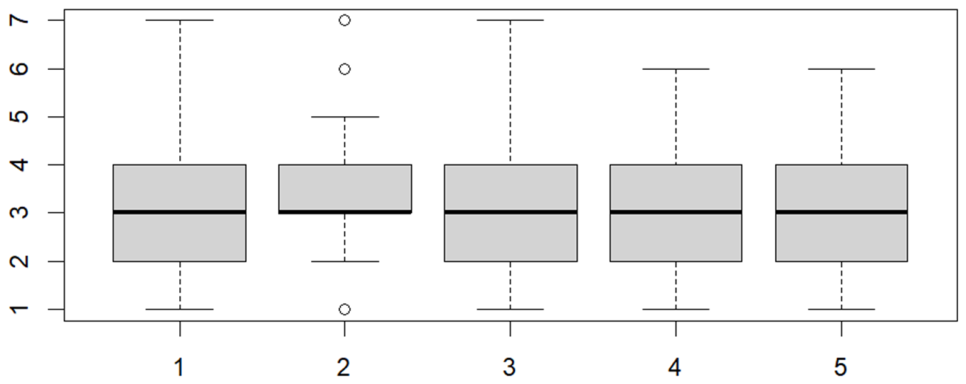
Frailty (measured ordinally by CFS 1-7), ASA grade, BMI, and age differed statistically across quintiles, although effect sizes were small. Frailty and ASA (Figure 2) showed a very weak inverse correlation with SIMD (Spearman correlation P(rho) −0.11 for both), as shown in Figure 3.
Figure 2.
ASA distribution across SIMD 2020 quintiles.
Figure 3.
CFS distribution across SIMD 2020 quintiles.
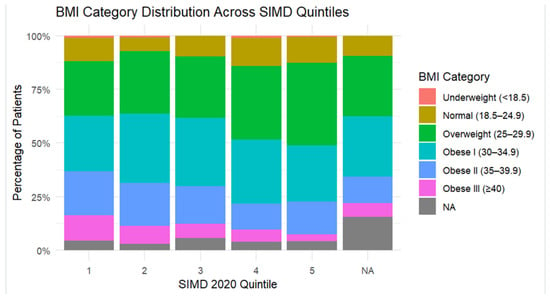
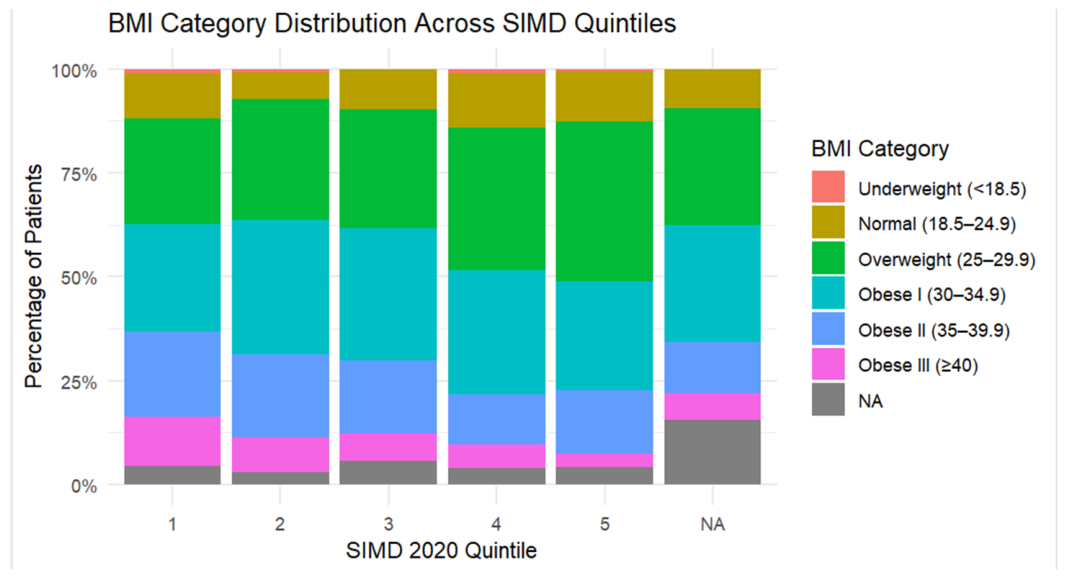
BMI (Figure 4) demonstrated a clear deprivation gradient. In linear regression analysis, each quintile increase in SIMD was associated with a 0.64 kg/m2 lower BMI (β = −0.638, p = <0.001).
Figure 4.
BMI distribution across SIMD 2020 quintiles.
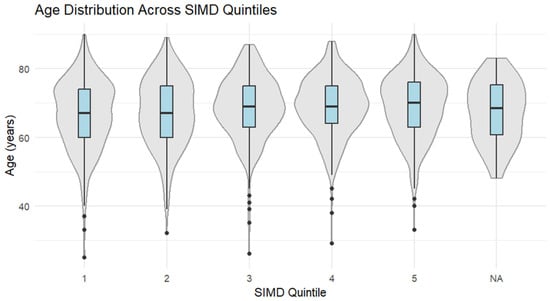
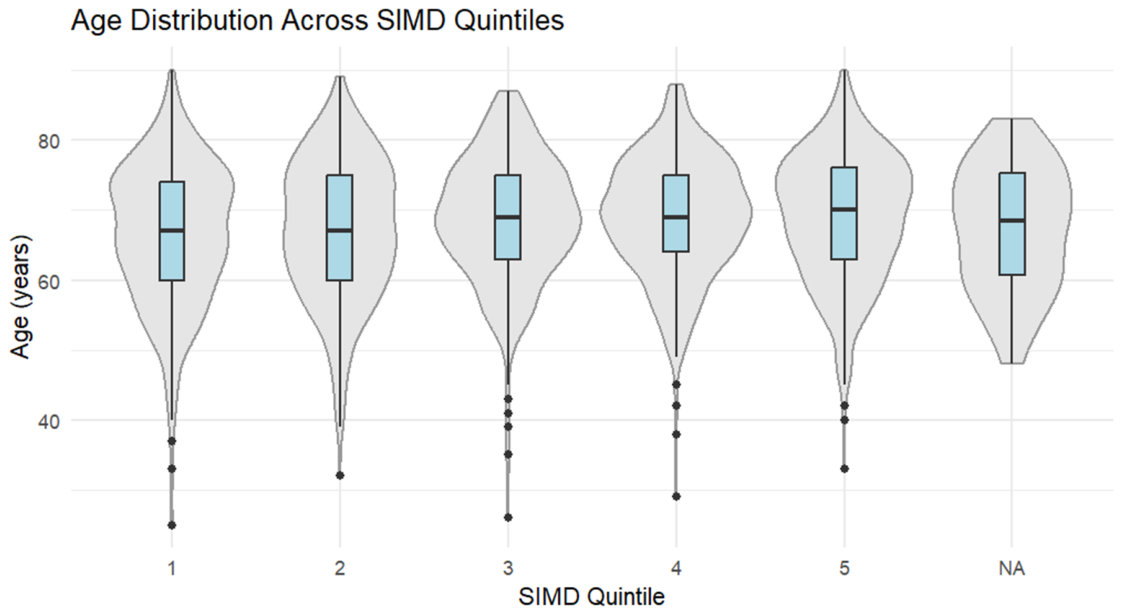
Age differed statistically across quintiles—Kruskal–Wallis p = 0.0002 (Figure 5). Post hoc Dunn testing revealed that this difference was mainly driven by the differences between the SIMD 1 and SIMD 4 and 5 quintiles, with p values of 0.024 and 0.015, respectively.
Figure 5.
Age vs. SIMD 2020 quintiles (including SIMD not recorded).
In summary, statistical differences in age, ASA, and frailty are present due to the large sample size, but they are unlikely to be clinically significant due to weak correlations and small effects, while BMI has a clear correlation with increasing deprivation.
Primary Outcomes:
Length of Stay (LOS):
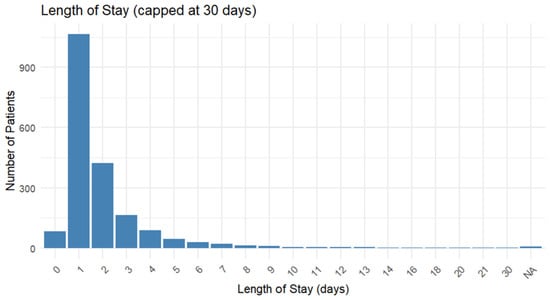
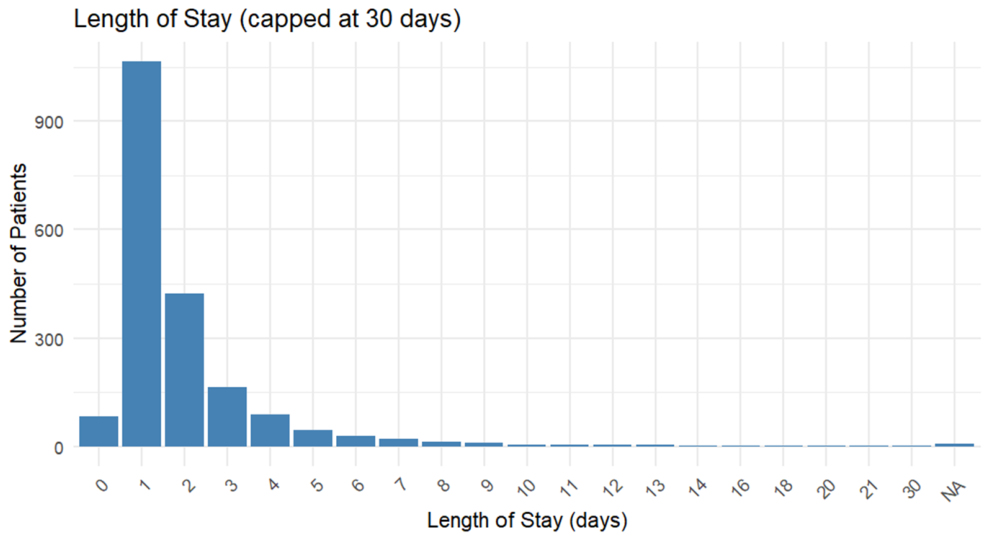
Median LOS was 1 day (Figure 6). This was the same across all quintiles. In multivariable linear regression (log-transformed LOS model), SIMD quintile was not associated with increased LOS (β = −0.0142, 95% CI −0.0297 to 0.0013, p = 0.072). Significant predictors in the model were female sex, older age, higher CCI, increasing frailty score, greater ASA grade, and a combined spinal–general anaesthetic (Table A1).
Figure 6.
Length of stay across cohort.
Time to Mobilise:
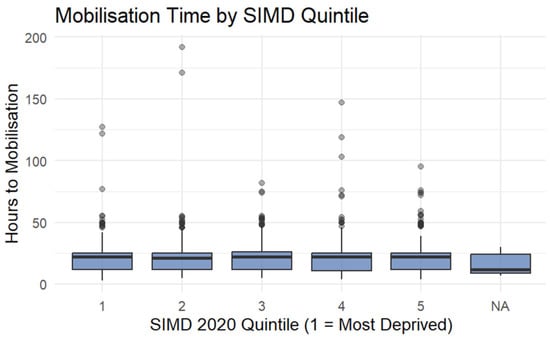
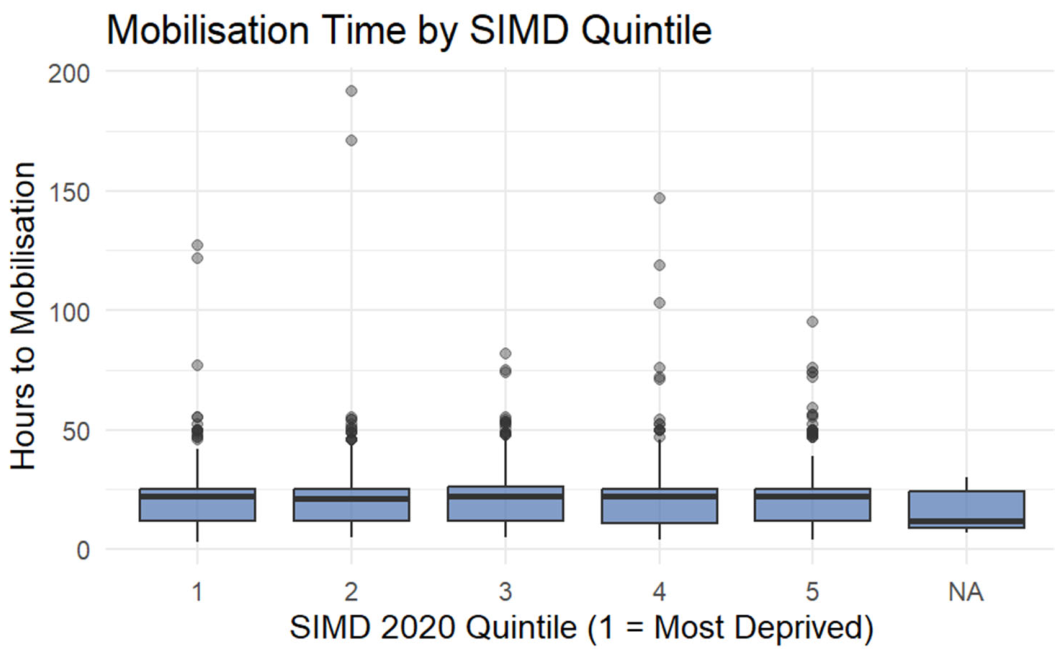
SIMD was not associated with longer mobilisation times (Figure 7) (β = 0.0058, 95% CI −0.0135 to 0.0248, p = 0.569). Variables associated with delays were female sex, higher CCI score, higher ASA grade, patients who underwent a combined spinal–general anaesthetic, and those who underwent spinal anaesthetic alone (Table A2).
Figure 7.
Mobilisation time in hours across SIMD 2020 quintiles.
GP Follow-Up Requirements:
Unadjusted analyses highlighted no association between SIMD and GP follow-up (p = 0.328) (Table 3). In multivariable logistic regression analysis, SIMD quintile remained non-significant (OR 0.97, 95% CI 0.87–1.07, p = 0.512). The only statistically significant predictive factor associated with increasing GP action/requirements was healthcare board, with Lothian patients requiring less healthcare service utilisation than Fife patients (OR 0.57, 95% CI 0.32–0.96, p = 0.044) (Table A3).
Table 3.
Deprivation vs. discharge paperwork primary care referral/action per quintile.
Time to Orthopaedic Clinic Discharge:
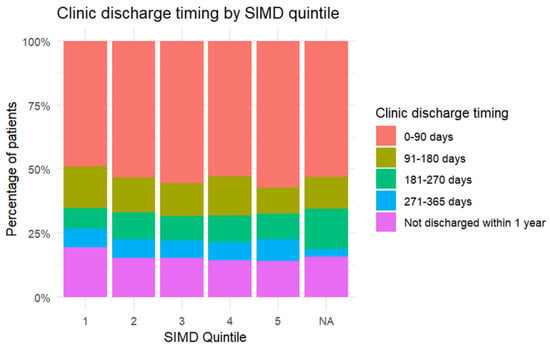
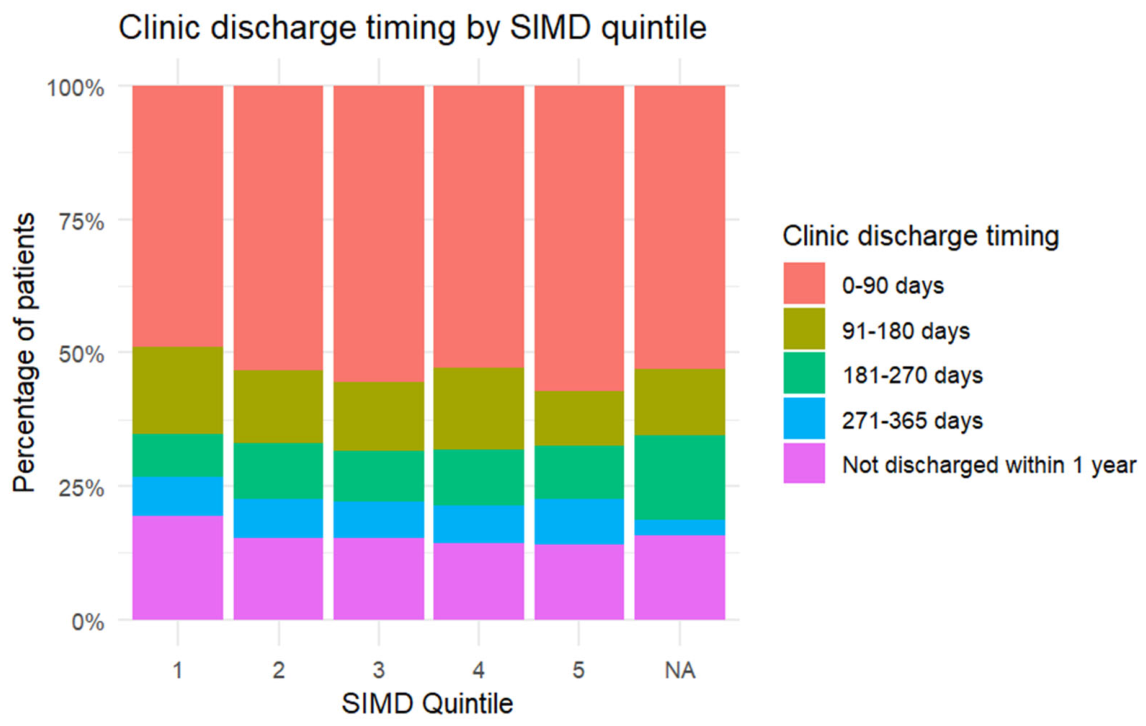
SIMD was not associated with differing time to clinic discharge (Figure 8, Table 4) in multivariate linear regression analysis (β = −0.0170, 95% CI −0.0464 to 0.0124, p = 0.266). The only two significant variables predictive of increased time to clinic discharge were undergoing a TKA and being referred from the Fife health board region (Table A4).
Figure 8.
Successful orthopaedic clinic discharge time (days post-op) by SIMD quintile.
Table 4.
Table of successful clinic discharge time (days post-op, capped at 365) by SIMD quintile.
Secondary Outcomes:
Acute Kidney Injury:
There were 27 recorded AKI events (Table 5). SIMD was not associated with AKI on univariate analysis (p = 0.486). In multivariable logistic regression analysis, SIMD quintile remained non-significant (OR 0.84, 95% CI 0.63–1.11, p = 0.227). Age and CCI were also non-significant in multivariate logistic regression (Table A5).
Table 5.
AKI rates across SIMD quintiles.
Mortality:
Nineteen deaths occurred within 1 year post-op (Table 6). Mortality was not associated with deprivation quintile on univariate analysis (p = 0.298). Given the low event rate, a parsimonious adjusted model was used. There was no association with SIMD quintile (OR 1.20, 95% CI 0.85–1.72, p = 0.3), but both CCI and frailty score were significant predictors of mortality (Table A6).
Table 6.
Mortality across SIMD quintiles.
Re-Operation:
There were 55 re-operations within one year of the primary procedure (Table 7), but no evidence of association with deprivation on univariate analysis was observed (p = 0.828). Given the lower event rate, a parsimonious adjusted model was used. On multivariate logistic regression analysis, SIMD was not associated with re-operation rates (OR 1.00, 95% CI 0.82–1.22, p = 0.999). The only association was operation type, with TKRs undergoing more re-operation than THRs (OR 1.91, 95% CI 1.09–3.41, p = 0.025) (Table A7).
Table 7.
Re-operation rate (same joint within 1 year) across SIMD quintiles.
Infection:
There were 61 infections—16 deep and 45 superficial—within one year of primary procedure (Table 8). SIMD was not associated with infection rates on univariate analysis (p = 0.548). In adjusted multivariate modelling, SIMD quintile remained non-significant with infection risk (OR 1.01, 95% CI 0.83–1.24, p = 0.884). Increasing BMI, older age, lower CCI, and male sex were associated with increased infection risk (Table A8).
Table 8.
Infection rate (within 1 year) across SIMD quintiles.
Post-Operative Day 1 Haemoglobin and sodium:
SIMD was not associated with post-operative anaemia (Hb < 90 g/L; p = 0.57) or hyponatraemia (p = 0.61). There were 16 patients with an Hb < 90 g/L and 301 patients with hyponatraemia Na+ <135 mmol/L, as shown in Table 9 and Table 10.
Table 9.
Day 1 post-op haemoglobin across SIMD quintiles.
Table 10.
Rates of hyponatremia across SIMD quintiles.
4. Discussion
Key Findings:
In this large cohort study of nearly 2000 elective total hip and knee patients, socioeconomic deprivation, measured via SIMD 2020, was not associated with any indicator of increased healthcare utilisation or any major post-operative complication at 1 year. The key finding of this study was the absence of a statistically significant association between socioeconomic deprivation and healthcare utilisation. This remained consistent across all adjusted models and primary and secondary outcomes. Adjusted multivariate models indicated that female sex and undergoing a combined spinal–general anaesthetic were associated with increased LOS and mobilisation time. A higher frailty score was associated with increased LOS. Greater CCI was associated with longer LOS and mobilisation times. Those who received a spinal anaesthetic over a general anaesthetic took longer to mobilise, but there was no significant difference in their overall LOS. Higher ASA grades were associated with prolonged LOS and time to mobilise. Being from the Fife health board was the only significant predictor of increased GP action and onward referral, although deprivation quintile was not significant. Patients from the Lothian health board, and those who had undergone THA, were discharged from the orthopaedic clinic sooner than Fife locals and those who had undergone TKA.
Comparison to Pre-Existing Literature:
This study’s findings differ significantly from the current literature regarding healthcare utilisation and length of stay, particularly studies from the USA. These discrepancies likely reflect fundamental differences in healthcare systems, patient pathways, funding models, and distribution of population deprivation. These differences in structure between North American and UK-based healthcare systems introduce the possibility of confounding or unmeasured factors that influence TJA utilisation, equity of access, and post-operative recovery. For UK-based clinicians, a direct comparison with international studies should be made cautiously, as system-level differences may partly explain results.
Bains et al. [12] found an increase in total complications, including revision at 90 days and MUA at 1 year; however, this was not replicated in the results from this study. Dubin et al. [13] found that raised ADI (increasing deprivation) was associated with an increase in the rate of total complications at 90 days, although they did not examine longer-term consequences. Two separate studies by Gordon et al. [14,15] found that the 10% most deprived classified by ADI had an increased rate of medical complications, day-of-surgery costs, and 90-day expenditures, as well as 2-year PJI rates, none of which are replicated in this study.
Again, these studies’ findings disagree with Rahman et al. [16], who found that patients who were in the more deprived half of the population had increased odds of non-home discharge, prolonged LOS, and early PJI. Grits et al. [17] discovered the greatest odds of non-home discharge and LOS > 3 days in the 20% most deprived ADI group, and Kholpas [18] noted prolonged LOS associated with deprivation, with the highest OR (2.27) observed in the most deprived 10%. This study did not observe those findings.
The two studies that used SIMD examined PROMS, SF-36, and the Oxford knee score [19,20]. Another Scottish study used the Carstairs index, not SIMD, and again examined PROMS via the Oxford hip score. They did find that deprivation increased 90-day mortality and dislocation—which again was not replicated in this study [21]. There were two other British studies that looked at English IMD and examined PROMS rather than healthcare utilisation [22,23].
In summary, the existing literature—predominantly from North America—reports that socioeconomic deprivation is associated with increased surgical and medical complications, greater resource requirements, and prolonged LOS. In contrast to the existing evidence base, statistically significant associations between deprivation and healthcare utilisation and major complications were not seen in this Scottish population within an NHS system. This divergence may reflect differences in the healthcare system and population and the standardised organisation of perioperative care pathways in an NTC, which may help reduce variation in outcomes, particularly in the more deprived cohort. Therefore, the findings of this study may be more applicable to the Scottish or UK publicly funded healthcare system.
Strengths:
This study has many strengths, including its large sample size, high level of data completeness (98.4% of patients had postcodes recorded), and comprehensive follow-up period, allowing assessment of healthcare utilisation and outcomes up to 1 year. This study had an even spread of patients across the five quintiles. This study used real-world clinical data, with the most up-to-date national deprivation scoring system, and operative data gathered prospectively as part of a Public Health Scotland initiative. The recorded SIMD is accurate, as it is recorded as part of Public Health Scotland guidance on the day of operation. This study was adjusted for several important confounding variables using multivariable regression analysis. Another strength is that data collection and analysis were performed by one researcher. CCI scores had to be gathered manually, and having one person gather these reduced bias and miscalculation across the cohort.
Limitations:
There are several limitations that are acknowledged. This study was conducted as a single-centre study and may not fully reflect any variations even within a Scottish or UK-wide population. Of course, any retrospective study risks introducing selection bias and potential for unmeasured confounding variables. The population was predominantly Caucasian, potentially limiting applicability to more ethnically diverse settings. Some variables had substantial missing data, although most variables were well-recorded with <5% data missing. Dexamethasone dosing was recorded in only 42% of cases, and post-operative anaesthesia was not recorded in 36.7% of cases; these variables, which may have had an effect, could not be included in statistical analyses. Although the cohort was large, some complications, such as mortality, re-operation, and AKI, were rare events. The low event rate limited the number of variables that could be included in multivariate analysis, resulting in fewer clinical covariates than other analyses in order to reduce the risk of model overfitting. Consequently, these analyses may be underpowered in drawing reliable conclusions, and these model outcomes should be interpreted cautiously.
One consideration is the potential floor effect that the standardised perioperative pathways may have on length of stay outcomes. As all SIMD Quintiles achieved a median LOS of 1 day, this may reflect institutional early-discharge targets rather than truly reflect postoperative recovery, potentially masking subtle differences across deprivation groups. Patients from different deprivation quintiles may have reached the minimum criteria for safe discharge while still differing in pain levels, rehabilitation needs, and functional recovery at the time of discharge.
The lack of PROMS measured in this study does not permit the assessment of patient satisfaction, where much of the existing evidence has focused, which means that this study cannot be easily compared directly to the existing literature. Although our results show similar healthcare utilisation, this does not imply that patients had equivalent physical recovery. Our findings should not be conflated with equitable postoperative function or patient satisfaction; rather, they reflect equity in use of healthcare resources post-operatively. There is also the possibility of underreporting complications. Although efforts were made to gather complications recorded in different hospitals by reading clinical notes, with these complications recognised in other hospitals/in other emergency departments/clinics recorded, this can only be seen as reliable where patients presented to nearby NHS hospitals. Patients who moved away from Scotland or had private healthcare for follow-up could have had infection/re-operation issues that were not recorded. Mortality should be fully reliable; however, it is automatically recorded on the clinical portal once a death certificate has been completed.
Regarding deprivation itself, the postcode for SIMD was taken as a snapshot at the time of surgery, not considering whether people had recently moved in or out of areas immediately before or after operation, which could affect the deprivation analysis, although this is a minimal concern. Furthermore, there is potential for referral bias, as patients from NHS Lothian were externally referred. Within this pre-selected cohort, patients from more socioeconomically deprived backgrounds may have faced barriers to referral prior to entry into the NTC study population.
Other weaknesses are that some variables that could aid with understanding healthcare utilisation of services were not recorded. For example, pre-operative high-risk anaesthetic/pre-assessment appointments, number of clinic visits before discharge to orthopaedic services, re-admission rates, engagement with out-of-hours services post-operatively, and place of discharge—whether home, residential care, or downstream bed—were not accounted for. These could deepen our understanding further regarding the effects deprivation has on healthcare burden and utilisation of services.
Implications for practice:
The key message is that no statistically significant association was found between socioeconomic deprivation and healthcare utilisation in this cohort, which was managed in a national arthroplasty centre. These findings suggest that other independent variables (such as sex, frailty, and co-morbidity) were more strongly associated with increased healthcare utilisation within this cohort than socioeconomic deprivation. Further work is required to determine how these factors should inform service planning and resource allocation.
Secondly, although the findings are consistent with equitable healthcare utilisation across deprivation quintiles within the Scottish NHS, caution is required when interpreting these results, as the absence of statistically significant differences does not necessarily indicate that deprivation has no effect but rather that no association was identified within the present cohort. Pre-operative optimisation of modifiable risk factors and appropriate risk stratification may aid in improving outcomes and reduce healthcare utilisation. One potential explanation for these findings is the standardisation of TJA pathways within the NTC. Accessibility to a multidisciplinary team that manages arthroplasty patients on a daily basis and provides support throughout the peri-operative and post-operative periods may help reduce variations in healthcare utilisation across the socioeconomic quintiles. The extent of this effect cannot be determined from the present study.
Female sex was associated with increased LOS and mobilisation time. This could be attributed to a variety of factors. Potential explanations include differing baseline muscle mass and strength, unequal frailty burden, and sex-related differences in pain perception and analgesic requirements, all of which could influence early postoperative recovery. Further research is required to better understand these observed sex differences.
Future Research:
Future research should include a prospective study incorporating PROMS across deprivation groups to assess patient-specific subjective recovery. Repeating or adding multiple centres to validate findings would be of use, potentially adding more detail—number of clinic visits required, post-op access to acute or out-of-hours services, peri-operative requirements for admission to critical care, and place of discharge—to strengthen or disprove this study. Finally, a study examining the effects of deprivation regarding accessibility to surgery analysis would be of use for evaluating the limiting factors that affect patients from accessing arthroplasty care.
5. Conclusions
In a large cohort study from a Scottish NTC, socioeconomic deprivation was not statistically associated with increased utilisation of healthcare services nor increased major complication rates at 1 year following elective lower-limb TJA. These findings are consistent with the hypothesis that standardised perioperative pathways within the National Treatment Centre may reduce variations in healthcare utilisation across deprivation quintiles. However, further research is required to determine the extent to which the NHS and NTC healthcare models contribute to the observed outcomes.
Author Contributions
Conceptualization, J.H., A.A. and P.W.; methodology, J.H.; software, J.H.; validation, J.H. formal analysis, J.H.; investigation, J.H.; resources, J.H.; data curation, J.H.; writing—original draft preparation, J.H.; writing—review and editing, P.W., A.A.; visualisation, J.H.; supervision, P.W., A.A.; project administration, A.A. and P.W. All authors have read and agreed to the published version of the manuscript.
Funding
This research received no external funding.
Institutional Review Board Statement
Ethical review and approval were waived for this study due to its retrospective design and use of anonymized clinical data collected as part of routine NHS governance.
Informed Consent Statement
Patient consent was waived due to the retrospective nature of this study.
Data Availability Statement
The data supporting the findings of this study are available from the corresponding author upon reasonable request. Data cannot be publicly shared due to NHS Scotland governance and patient confidentiality restrictions.
Acknowledgments
The authors would like to thank the NHS Fife ARISE team for their assistance with data access and clinical information retrieval, as well as the members of the NHS Fife National Treatment Centre team for their routine recording of operative data, ensuring accuracy and completeness. Without their diligence, this analysis would not have been possible.
Conflicts of Interest
The authors declare no conflicts of interest.
Abbreviations
The following abbreviations are used in this manuscript:
| THA | Total hip replacement |
| TKA | Total knee replacement |
| NHS | National Health Service |
| SIMD | Scottish Index of Multiple Deprivation |
| NTC | National Treatment Centre |
| ARISE | Arthroplasty rehabilitation initial screening evaluation |
| CFS | Clinical Frailty Scale |
| ASA | American Society of Anaesthesiologists |
| BMI | Body mass index |
| CCI | Charlson comorbidity index |
| MDT | Multi-disciplinary team |
| LOS | Length of stay |
| PROMS | Patient-reported outcome measures |
| Hb | Haemoglobin |
| AKI | Acute kidney injury |
Appendix A
Table A1.
Length of stay (LOS) multivariate modelling.
Table A2.
Mobilisation time multivariate modelling.
Table A3.
GP action multivariable model.
Table A4.
Clinic discharge multivariate model.
Table A5.
AKI multivariable model.
Table A6.
Mortality multivariable model.
Table A7.
Re-operation multivariable model.
Table A8.
Infection multivariable model.
Table A9.
Correlation of SIMD quintile vs. BMI, ASA, and CFS.
References
- Grant, I.; Chalmers, N.; Fletcher, E.; Lakha, F.; McCartney, G.; Stockton, D.; Wyper, G.M.A. Prepandemic inequalities in the burden of disease in Scotland due to multiple deprivation: A retrospective study. BMJ Public Health 2023, 1, e000191. [Google Scholar] [CrossRef] [Scilit] [PubMed]
- Public Health Scotland. Long-Term Monitoring of Health Inequalities in Scotland by Area Deprivation; Public Health Scotland: Edinburgh, Scotland, 2023. [Google Scholar]
- NHS Inform. National Treatment Centres; NHS Inform: Glasgow, Scotland, 2024. [Google Scholar]
- UK Parliament. Written Questions, Answers and Statements; UK Parliament: Westminster, London, 2024.
- Khan, F.; Ng, L.; Gonzalez, S.; Hale, T.; Turner-Stokes, L. Multidisciplinary rehabilitation programmes following joint replacement at the hip and knee in chronic arthropathy. Cochrane Database Syst. Rev. 2008, 2008, CD004957. [Google Scholar] [CrossRef] [Scilit] [PubMed]
- Public Health Scotland. Scottish Index of Multiple Deprivation (SIMD); Public Health Scotland: Edinburgh, Scotland, 2020. [Google Scholar]
- Scottish Government. Scottish Index of Multiple Deprivation: Data and Resources; Scottish Government: Edinburgh, Scotland, 2020.
- Karimi, A.; Burkhart, R.J.; Hecht, C.J., 2nd; Acuña, A.J.; Kamath, A.F. Is Social Deprivation Associated with Usage, Adverse Events, and Patient-Reported Outcome Measures in Total Joint Arthroplasty? A Systematic Review. Clin. Orthop. Relat. Res. 2023, 481, 239–250. [Google Scholar] [CrossRef] [Scilit] [PubMed]
- Ryan-Ndegwa, S.; Zamani, R.; Akrami, M. Assessing demographic access to hip replacement surgery in the United Kingdom: A systematic review. Int. J. Equity Health 2021, 20, 224. [Google Scholar] [CrossRef] [Scilit] [PubMed]
- Furyes, A.; Elmenawi, K.A.; Hackett, L.; Deren, M.E.; Piuzzi, N.S. Is neighbourhood socioeconomic deprivation associated with outcomes following primary THA and TKA? A systematic review utilising the Area Deprivation Index. Clin. Orthop. Relat. Res. 2026, 484, 2125–2143. [Google Scholar] [CrossRef] [Scilit] [PubMed]
- Lungu, E.; Vendittoli, P.-A.; Desmeules, F. Preoperative determinants of patient-reported pain and physical function levels following total knee arthroplasty: A systematic review. Open Orthop. J. 2016, 10, 213–231. [Google Scholar] [CrossRef] [Scilit] [PubMed]
- Bains, S.S.; Dubin, J.A.; Hameed, D.; Douglas, S.; Gilmor, R.; Salib, C.G.; Nace, J.; Mont, M.; Delanois, R.E. Neighborhood socioeconomic disadvantages associated with increased rates of revisions, readmissions, and complications after total joint arthroplasty. Eur. J. Orthop. Surg. Traumatol. 2024, 34, 2331–2338. [Google Scholar] [CrossRef] [Scilit] [PubMed]
- Dubin, J.A.; Bains, S.S.; Hameed, D.; Monárrez, R.; Gilmor, R.; Chen, Z.; Nace, J.; Delanois, R.E. The utility of the Area Deprivation Index in assessing complications after total joint arthroplasty. JBJS Open Access 2024, 9, e23.00115. [Google Scholar] [CrossRef] [Scilit] [PubMed]
- Gordon, A.M.; Ng, M.K.; Elali, F.; Piuzzi, N.S.; Mont, M.A. Impact of socioeconomic status on complications and healthcare utilisation after total knee arthroplasty using the Area Deprivation Index. J. Arthroplast. 2024, 39, 2166–2172. [Google Scholar] [CrossRef] [Scilit] [PubMed]
- Gordon, A.M.; Nian, P.P.; Baidya, J.; Mont, M.A. Higher Area Deprivation Index is associated with increased medical complications and emergency department utilisation after total hip arthroplasty. J. Arthroplast. 2025, 40, 1154–1160. [Google Scholar] [CrossRef] [Scilit] [PubMed]
- Rahman, T.M.; Shaw, J.H.; Mehaidli, A.; Hennekes, M.; Hansen, L.; Castle, J.P.; Kulkarni, M.; Silverton, C.D. Impact of social determinants of health on outcomes and complications after total knee arthroplasty: Analysis of neighbourhood deprivation indices. J. Bone Jt. Surg. Am. 2024, 106, 288–303. [Google Scholar]
- Grits, D.; Emara, A.K.; Klika, A.K.; Murray, T.G.; McLaughlin, J.P.; Piuzzi, N.S. Neighborhood socioeconomic disadvantage associated with increased healthcare utilisation after total hip arthroplasty. J. Arthroplast. 2022, 37, 1980–1986.e2. [Google Scholar] [CrossRef] [Scilit] [PubMed]
- Khlopas, A.; Grits, D.; Sax, O.C.; Chen, Z.; Orr, M.N.; Klika, A.K.; Mont, M.A.; Piuzzi, N.S. Neighborhood socioeconomic disadvantages associated with prolonged length of stay, non-home discharges, and 90-day readmissions after total knee arthroplasty. J. Arthroplast. 2022, 37, S37–S43.e1. [Google Scholar] [CrossRef] [Scilit] [PubMed]
- Clement, N.D.; Jenkins, P.J.; MacDonald, D.; Nie, Y.X.; Patton, J.T.; Breusch, S.J.; Howie, C.R.; Biant, L.C. Socioeconomic status affects the Oxford Knee Score and SF-12 following total knee replacement. Bone Jt. J. 2013, 95-B, 52–58. [Google Scholar] [CrossRef] [Scilit] [PubMed]
- Jenkins, P.J.; Perry, P.R.W.; Yew, N.C.; Ballantyne, J.A. Deprivation influences the functional outcome from total hip arthroplasty. The Surgeon 2009, 7, 351–356. [Google Scholar] [CrossRef] [Scilit] [PubMed]
- Clement, N.D.; Muzammil, A.; MacDonald, D.; Howie, C.R.; Biant, L.C. Socioeconomic status affects the early outcome of total hip replacement. Bone Jt. J. 2010, 93-B, 464–469. [Google Scholar] [CrossRef] [Scilit] [PubMed]
- Neuburger, J.; Hutchings, A.; Black, N.; van der Meulen, J.H. Socioeconomic differences in patient-reported outcomes after hip or knee replacement in the English NHS. J. Public Health 2013, 35, 115–124. [Google Scholar] [CrossRef] [Scilit] [PubMed]
- Judge, A.; Arden, N.K.; Cooper, C.; Javaid, M.K.; Carr, A.J.; Field, R.E.; Dieppe, P.A. Predictors of outcomes of total knee replacement surgery. Rheumatology 2012, 51, 1804–1813. [Google Scholar] [CrossRef] [Scilit] [PubMed]

Disclaimer/Publisher’s Note: The statements, opinions and data contained in all publications are solely those of the individual author(s) and contributor(s) and not of MDPI and/or the editor(s). MDPI and/or the editor(s) disclaim responsibility for any injury to people or property resulting from any ideas, methods, instructions or products referred to in the content. |
© 2026 by the authors. Licensee MDPI, Basel, Switzerland. This article is an open access article distributed under the terms and conditions of the Creative Commons Attribution (CC BY) license.