


Abstract
Background/Objectives: Employment disruption surrounding cancer can affect financial security and survivorship, but periodic surveys cannot establish the ordering of cancer onset and employment change between interviews. We estimated employment transitions surrounding first-reported cancer across six aging cohorts. Methods: Adults aged 50–69 years who were working at the preceding wave entered stacked cohort- and wave-specific risk sets. First-reported cancer was compared with contemporaneous clean controls using multiply imputed, inverse-probability-of-censoring-weighted modified Poisson models standardized to each cohort’s cancer-case covariate distribution. Known deaths before the scheduled next wave were excluded from the employment-outcome target and observation-weight model. HRS, ELSA, and SHARE formed the primary evidence set. Results: Among 2333 eligible cancer events, 1471 had observed next-wave work status: 206 were followed by death, 226 occurred at an administratively terminal wave, and 430 had other attrition. In the primary cohorts, first-reported cancer was associated with 7.4 additional next-wave nonemployment events per 100 cases (95% CI, 1.7–13.1) and a risk ratio of 1.23 (95% CI, 1.06–1.42). Among cancer cases with observed outcomes, 56.0% worked continuously, 23.5% were nonworking at both the index and next waves, 15.8% exited between waves, and 4.8% returned to work. A post hoc analysis restricted to participants employed at the index wave yielded a pooled difference of 2.0 points (95% CI, −3.7 to 7.8). The SHARE-only country-adjusted difference was 7.7 points (95% CI, 3.2–12.1). Conclusions: First-reported cancer marked elevated next-wave nonemployment among adults working at the preceding wave, but the result combines persistent nonwork and later exit and does not identify a diagnosis-date or causal effect. The findings support repeated, preference-sensitive assessment of work status and concerns.
1. Introduction
Advances in cancer detection and treatment have increased the number of people living for years after a cancer diagnosis, making participation in everyday social and economic roles an important dimension of survivorship. Paid work can provide income, health insurance in some settings, social connection, identity, and a sense of continuity, while work disruption may compound treatment-related symptoms and financial strain. Recent survivorship guidance therefore places social and occupational consequences alongside surveillance, symptom management, and psychosocial care [1,2]. At the population level, cancer is associated with unemployment, sickness absence, reduced productivity, and premature labor-force withdrawal [3,4]. These consequences may be especially consequential in mid-to-late working life, when workers can face accumulated morbidity, fewer opportunities to change jobs, and proximity to statutory or customary retirement ages. For survivorship teams, identifying a vulnerable transition before sustained labor-force withdrawal may create an opportunity for earlier occupational and social support.
The cancer-and-work literature establishes that employment trajectories are shaped by clinical, personal, occupational, and institutional factors. Recent systematic reviews have identified substantial variation in return-to-work outcomes and in the definitions, follow-up windows, and determinants used across studies [5,6,7]. Contemporary cohort evidence also shows that labor-market consequences extend beyond an initial return to work: working-age survivors may experience job loss, later sickness absence, disability pension, or unemployment [8,9]. Earlier longitudinal studies similarly documented unemployment, retirement, and heterogeneous employment pathways after cancer [10,11,12,13,14,15]. Accordingly, the unresolved question is not whether cancer can disrupt work, but how much short-term employment exit follows a newly reported cancer event among people who were working beforehand, whether this association appears across different national settings, and how much of the excess is attributable to retirement rather than other forms of exit.
Three features of existing evidence define the unresolved question. First, clinical, insurance, claims, and single-country samples provide valuable disease detail but rarely apply one employment-transition framework across different labor and welfare contexts. Second, unemployment, absence, disability, retirement, reduced hours, and failure to return to work are noninterchangeable outcomes measured at different stages of treatment and recovery [5,6,7,16]. Third, periodic aging surveys observe cancer reports and work states only at interviews. They can verify employment at the preceding wave and subsequent status, but they cannot order cancer onset and work change within the intervening interval. A multicohort analysis should therefore estimate transitions surrounding first report, separate retirement from other observed nonwork, and make the observation and transport boundaries explicit.
International longitudinal aging studies repeatedly measure physician-reported conditions, paid work, retirement, demographic characteristics, and functional status. Their common structure permits event-specific risk sets anchored to a first survey transition from no reported cancer to reported cancer, with employment verified at the preceding wave and reassessed at the index and next available waves. This design identifies employment trajectories around the first report and aligns controls to the same cohort and survey wave; it does not identify a diagnosis-date effect. Absolute risk standardization then expresses the adjusted association in the measured covariate distribution of each cohort’s cancer cases.
We examined adults aged 50–69 years who were working at the survey wave preceding a first-reported cancer event. The primary objective was to estimate the association between first-reported cancer and nonemployment at the next available adjacent wave, compared with same-cohort and same-wave clean controls. Secondary objectives were to describe index-to-next-wave employment trajectories and to decompose the observed exit into states with and without reported retirement. Because cancer onset and index-wave employment change were both interval-censored, all aims were associational and did not attribute the transition to a precisely dated diagnosis.
2. Materials and Methods
2.1. Study Design and Reporting
We conducted a multicohort longitudinal stacked risk-set study using six international studies of aging. Each eligible survey wave contributed a risk set of people aged 50–69 years who had been working at the preceding available wave. Cancer and comparator records were analyzed within cohort before synthesis. A dated internal protocol (26 October 2026) fixed the primary estimand, cohort roles, adjustment set, missing-data procedures, and analysis gates before adjusted association models were examined; it was not a public preregistration. Feasibility counts and missingness diagnostics had been inspected before that freeze. The study follows STROBE [17].
2.2. Data Sources and Analytic Roles
We used harmonized longitudinal files from HRS (United States), ELSA (England), SHARE (multiple European countries), CHARLS (China), MHAS (Mexico), and KLoSA (South Korea) [18,19,20,21,22,23]. Across cancer cases with observed outcomes, index waves ranged from 2002 to 2019 in HRS, 2004–2017 in ELSA, 2006–2017 in SHARE, 2013–2018 in CHARLS, 2012–2015 in MHAS, and 2012–2018 in KLoSA. Median index-to-outcome intervals were two years except in MHAS, where the median was three years; observed intervals varied by cohort and extended to five years in SHARE (Supplementary Table S7).
HRS, ELSA, and SHARE were designated in the internal protocol as the primary evidence set before adjusted modeling because they offered the strongest event support, longitudinal coverage, and construct comparability. CHARLS, MHAS, and KLoSA were retained as contextual cohorts rather than confirmatory replications; their estimates were interpreted individually with full uncertainty. Participant-level records were never pooled across cohorts for modeling or imputation. SEER data were not used.
2.3. Target Population and Time Zero
At each possible index wave, participants were eligible if they were aged 50–69 years, had a preceding wave in the cohort’s analytic sequence, and were recorded as working for pay at that preceding wave. Cancer cases additionally transitioned from no reported cancer at the preceding wave to reported cancer at the index wave; only the first eligible transition was retained. The index wave was therefore the first survey report, not the date of clinical diagnosis. Cancer onset and any work change between the preceding and index waves were both interval-censored, so their within-interval order could not be determined. ‘Adjacent’ denotes consecutive available analytic waves, not a fixed calendar interval.
Records at a cohort’s final survey wave were retained for flow reporting but classified as administratively terminal and excluded from next-wave models. Participants known to have died before the expected next wave were retained in flow accounting but excluded from the primary employment-outcome target and from the follow-up-observation model because post-death employment is undefined. Other losses before a scheduled next wave remained eligible for inverse-probability-of-censoring weighting. Death was also represented separately in competing-state descriptions and in death-or-nonemployment composite sensitivities.
2.4. First-Reported Cancer and Comparator Risk Sets
The exposure was first-reported cancer, defined as an adjacent-wave transition from 0 to 1 on the harmonized indicator of ever having received a physician diagnosis of cancer or malignant tumor. Reports were interval-censored between interviews, and site, stage, treatment, recurrence, and diagnosis date were not harmonized. We therefore use ‘first-reported cancer’ and avoid diagnosis-date or causal terminology.
Clean controls came from the same cohort and index wave as cancer cases and were working at the preceding wave, free of reported cancer at both waves, and free of newly reported stroke or heart disease at the index wave. This primary definition isolated a cancer-versus-no-new-major-event contrast but allowed cancer cases to have concurrent newly reported conditions. A reviewer-requested post hoc sensitivity therefore used cancer-free controls without excluding new stroke or heart disease. The matched risk-set analysis retained the original control definition. Active-disease comparators were retained only as supplementary contextual boundaries, not tests of cancer specificity.
2.5. Employment Outcomes and Labor-Force States
The primary outcome was nonemployment at the next adjacent survey wave among records with observed work status. We use ‘nonemployment’ rather than ‘job loss’ because the surveys did not consistently distinguish dismissal, sickness absence, disability, homemaking, informal work, or other reasons for not working. The outcome therefore represents a survey-observed work-state transition, not necessarily involuntary labor-force exit.
For observed outcomes, we described four trajectories from the index to the next wave: continuous work (working at both), persistent nonwork (nonworking at both), delayed exit (working at index and nonworking next), and return to work (nonworking at index and working next). Next-wave states were also classified as working, nonworking with reported retirement, nonworking without reported retirement, death, administrative termination, or other attrition. Retirement was mapped from cohort-specific indicators or labor-force categories; retired and nonretired contrasts were estimated separately but were not directly compared statistically.
2.6. Baseline Covariates and Cross-Cohort Harmonization
Covariates were selected before outcome modeling and measured at the preceding wave or earlier, except age, which was measured at the index wave and cannot be altered by the cancer report. The common adjustment set comprised age, sex, education, marital or partner status, baseline retirement status, hypertension, diabetes, prior stroke, arthritis, activities-of-daily-living limitations, economic position represented by cohort-specific wealth quintiles, and categorical survey wave. Age was represented by a restricted cubic spline with cohort-specific knots at the 10th, 50th, and 90th percentiles. No index-wave or post-index health, treatment, employment, or income measure was used for primary adjustment.
Before analysis, variable lineage, coding, timing, and question wording were reviewed within each cohort (Supplementary Table S1). Cancer was a harmonized physician-diagnosis report; work referred to current work or a recent reference period; retirement came from cohort-specific indicators or labor-force categories. Sickness absence, disability, informal work, and partial retirement were not uniformly distinguishable. The common set therefore prioritized available constructs rather than assuming exact semantic equivalence across welfare and labor-market settings.
2.7. Missing Covariates, Missing Follow-Up, and Survey Weights
Missing baseline covariates were imputed separately within a cohort using 30 chained-equation datasets with predictive mean matching [24,25,26]. Exposure, outcome, identifiers, fully observed waves, and weights were not imputed. Diagnostics required support preservation, stable traces, and successful masked-value recovery before association modeling (Supplementary Table S2).
We addressed missing next-wave work status using stabilized inverse probability-of-censoring weights [27,28] (Supplementary Table S3). The observation model included records with a scheduled next wave that were not known to have died before that wave. The numerator included event group and wave; the denominator additionally included measured baseline demographic, health, functional, and socioeconomic variables with missing indicators. Observation probabilities were bounded to 0.02–0.98 and weights truncated at cohort-specific 1st and 99th percentiles. Thus, the weighting addresses ordinary loss to follow-up among participants that were not known to have died before the scheduled assessment; it does not impute employment after death. This approach assumes that, conditional on modeled variables, follow-up observation is independent of the potential work outcome, with positivity and correctly specified observation models. It cannot remove selection from unmeasured cancer severity, treatment, symptoms, workplace factors, or reasons for attrition.
The primary analysis targeted a sample-conditional, cancer-case-standardized association in each cohort rather than a national population effect. It represents adults aged 50–69 years who were working at the preceding wave, were not known to have died before the scheduled next wave, and were standardized to the weighted covariate distribution of cancer cases with observed employment outcomes. Event-wave sampling weights were not equivalent across all cohorts; verified HRS and ELSA weights were used only in sensitivity analyses. Generalization beyond this target population requires additional assumptions.
2.8. Cohort-Specific Association Models and Standardization
Within each cohort and imputed dataset, we fitted a modified Poisson regression with a log link for next-wave nonemployment [29]. Models included the cancer indicator, the common baseline adjustment set, and categorical survey-wave fixed effects. Stabilized, truncated follow-up weights were applied, and empirical sandwich variances were clustered by participant to account for repeated eligibility as a control across waves.
For each fitted model, we predicted risk for every outcome-observed cancer case under the fitted cancer indicator and under the fitted clean-control indicator while retaining measured covariates. Weighted averages over the cohort-specific cancer-case covariate distribution produced standardized risks, their absolute difference, and their ratio [30]. These are adjusted associational contrasts; the intervention-like prediction notation does not establish exchangeability for unmeasured cancer severity, treatment, occupation, or workplace conditions. Estimates were combined across 30 imputations using Rubin’s rules.
2.9. Evidence Synthesis and Exit-State Decomposition
Cohort-specific risk differences and log risk ratios were synthesized by restricted maximum-likelihood random-effects meta-analysis with modified Hartung-Knapp confidence intervals [31,32]. The primary synthesis contained HRS, ELSA, and SHARE. CHARLS, MHAS, and KLoSA were displayed as contextual estimates, and any six-cohort summary remained secondary. With only three primary cohorts, I-squared and between-cohort variance were treated as imprecise descriptive statistics, not evidence that effects were homogeneous (Supplementary Table S5).
For outcome composition, weighted multinomial logistic models classified observed next-wave status as working, retired exit, or nonretired exit. Models used the same broad adjustment strategy, participant-clustered empirical variance, 30 imputations, and standardization to the inverse-probability-weighted cancer-case distribution. State-specific standardized risk differences quantified how much of the total employment exit was recorded with or without retirement. These contrasts characterize outcome composition, distinct from the estimation of competing causal mechanisms.
2.10. Sensitivity and Scope Analyses
Prespecified sensitivities examined age restrictions, complete cases, no censoring weights, alternative truncation, participant bootstrap, 1:5 risk-set matching [33], a complete-case death-or-nonemployment composite, and available HRS and ELSA survey weights (Supplementary Table S4). In the participant bootstrap, participants were resampled with replacement within cohort; each replicate used one randomly selected completed imputation, retained the previously estimated IPCW, and combined cohorts using the frozen inverse-variance weights. Imputation, censoring weights, between-cohort variance, and Hartung–Knapp uncertainty were not re-estimated. After peer review, we added SHARE-only country adjustment, a cancer-free broad-control definition, a multiply imputed death-or-nonemployment composite, and an analysis restricted to participants employed at the index wave. These analyses were explicitly post hoc and did not replace the primary estimand (Supplementary Table S12).
A first-reported stroke and a broader heart-disease-or-stroke event were retained in the supplement as contextual boundaries only. Their definitions and event support differed across cohorts, so they were not used to claim cancer specificity, equivalence, or comparative severity.
2.11. Ethics, Software, and Reproducibility
This study used deidentified secondary data distributed under each parent cohort’s access and data-use requirements. Ethical review for the present secondary analysis was waived under Article 32(2) of Guo Wei Ke Jiao Fa No. 4 of 2023; the parent cohorts obtained ethics approval and informed consent under their own protocols. Analyses used Python 3.12.14, pandas 3.0.1, NumPy 2.3.5, SciPy 1.18.1, and statsmodels 0.14.5. Versioned scripts and aggregate outputs are available from the corresponding author upon reasonable request, subject to cohort data-use restrictions; participant-level data cannot be redistributed.
3. Results
3.1. Cohort Assembly and Outcome Support
The six source files contained 843,416 person–wave observations. Age, adjacency, and preceding-wave work criteria yielded 170,653 eligible working risk-set rows; 157,861 rows entered the locked cancer, stroke, or control risk sets, and 137,885 had a scheduled next wave (Supplementary Figure S1). Table 1 reports concise cancer-versus-control baseline characteristics, missingness, and unique-participant counts; full covariate distributions appear in Supplementary Table S8.
Table 1.
Baseline characteristics of cancer and clean-control risk sets by cohort.
We identified 2333 first eligible cancer events: 838 in HRS, 274 in ELSA, 796 in SHARE, 225 in CHARLS, 104 in MHAS, and 96 in KLoSA. Next-wave work was observed for 1471 events; 226 were administratively terminal, 206 were followed by death before the expected next wave, and 430 had other attrition. Cohort-by-exposure dispositions are reported in Supplementary Table S9. Observed cancer outcomes numbered 631, 203, 396, 121, 52, and 68, respectively.
Among the 1471 cancer events with observed outcomes, 824 (56.0%) represented continuous work, 345 (23.5%) persistent nonwork from the index wave, 232 (15.8%) delayed exit between the index and next waves, and 70 (4.8%) return to work. Cohort-specific patterns and the corresponding control trajectories appear in Supplementary Table S10.
Cancer cases with and without observed next-wave work differed in some measured characteristics. The largest continuous-variable differences were age in ELSA (absolute standardized difference 0.33) and MHAS (0.26), with smaller functional and socioeconomic differences in several cohorts. In CHARLS, an apparent stroke-category imbalance was driven by 62.5% missingness among cases without observed follow-up; stroke prevalence among nonmissing records differed by less than 0.1 percentage points. Supplementary Table S11 separates measured values from missingness.
The primary HRS/ELSA/SHARE association models contained 75,933 cancer and clean-control records; the corresponding total across all six cohorts was 109,751. All revised observation and association models converged; maximum truncated weights ranged from 1.08 to 1.28 and effective-sample-size fractions from 0.988 to 1.000. All 180 imputation-specific association models passed numerical checks. These diagnostics establish model support but do not verify the untestable conditional-observation assumption.
3.2. Primary Association and Contextual Estimates
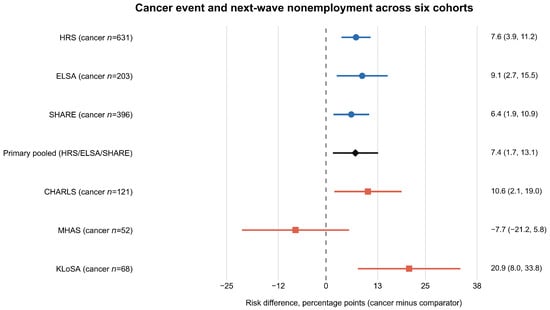
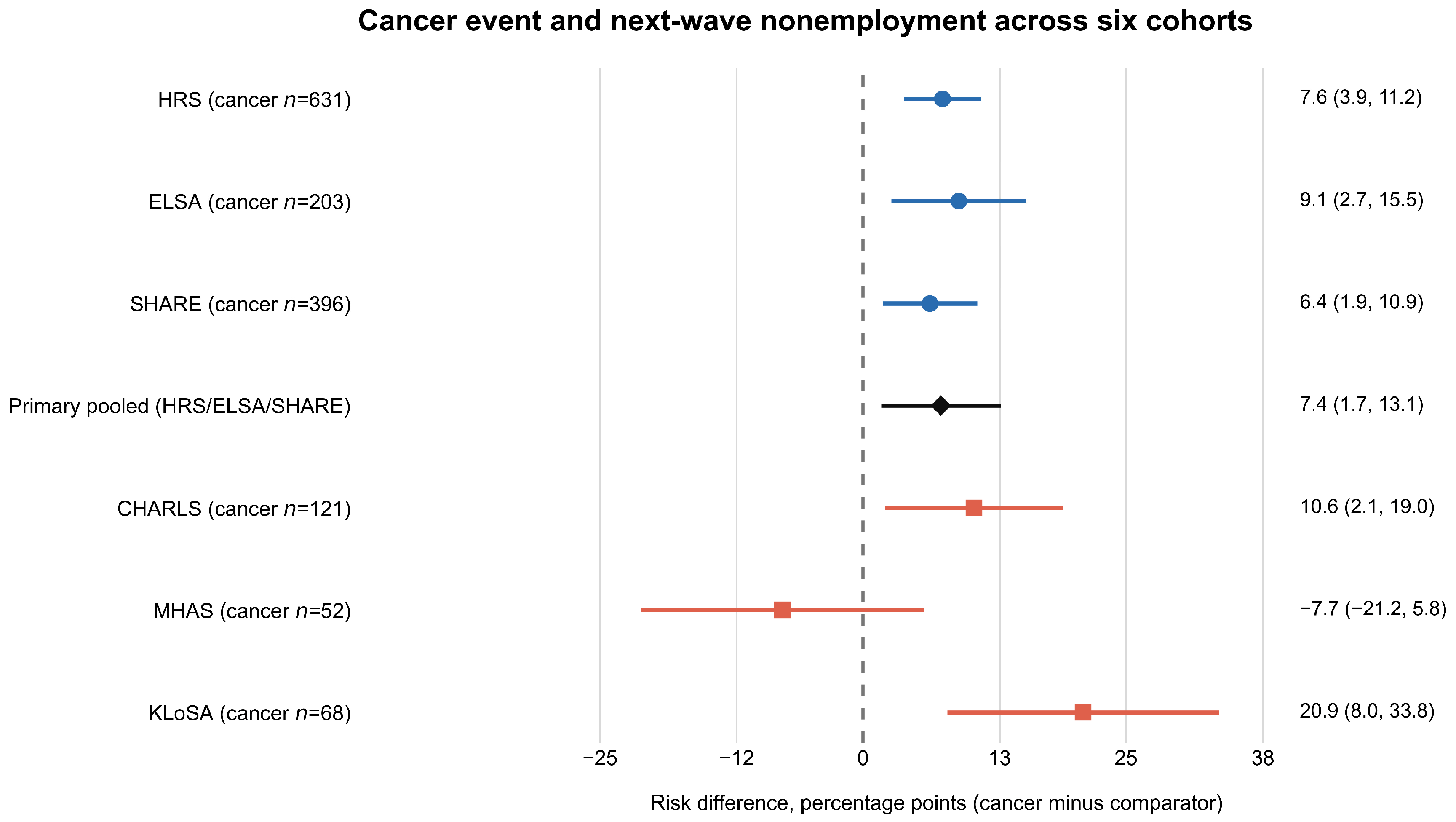
In each primary cohort, the cancer-standardized risk of next-wave nonemployment exceeded the corresponding clean-control risk (Table 2; Figure 1). In HRS, the standardized risks were 36.4% under cancer and 28.8% under clean control, for a risk difference of 7.6 percentage points (95% CI, 3.9–11.2) and a risk ratio of 1.26 (95% CI, 1.14–1.40). In ELSA, the risks were 42.1% and 33.0%, respectively, yielding a difference of 9.1 points (95% CI, 2.7–15.5) and a risk ratio of 1.28 (95% CI, 1.09–1.49). In SHARE, the corresponding risks were 42.1% and 35.8%, with a difference of 6.4 points (95% CI, 1.9–10.9) and a risk ratio of 1.18 (95% CI, 1.06–1.31).
Table 2.
Cohort-specific standardized risks and adjusted cancer-versus-clean-control associations.
Figure 1.
Cohort-specific adjusted risk differences in next-wave nonemployment after first-reported cancer. Points and horizontal lines show risk differences (percentage points) and 95% confidence intervals comparing cancer cases with clean controls. Blue circles denote the primary cohorts, orange squares denote contextual cohorts, and the black diamond denotes the restricted maximum-likelihood pooled estimate for HRS, ELSA, and SHARE. The vertical dashed line indicates no difference.
After aligning death handling with the employment estimand, the HRS/ELSA/SHARE synthesis produced a pooled risk difference of 7.4 percentage points (95% CI, 1.7–13.1) and a pooled risk ratio of 1.23 (95% CI, 1.06–1.42). The corrected risk difference differed from the frozen estimate by −0.1 percentage points. I-squared was 0%, but with only three cohorts, this estimate is imprecise and does not establish absence of heterogeneity. Cohort estimates and unadjusted risks are shown in Table 2, Figure 1, and Supplementary Table S6.
Contextual estimates varied. CHARLS produced a risk difference of 10.6 points (95% CI, 2.1–19.0), KLoSA 20.9 points (95% CI, 8.0–33.8), and MHAS −7.7 points (95% CI, −21.2 to 5.8) from 52 cancer events with observed outcomes. These cohorts describe transport boundaries and do not constitute confirmatory replication.
3.3. Retired and Nonretired Employment Exit
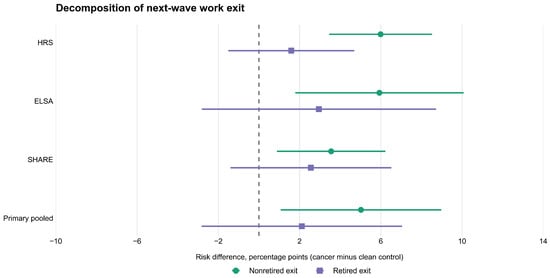
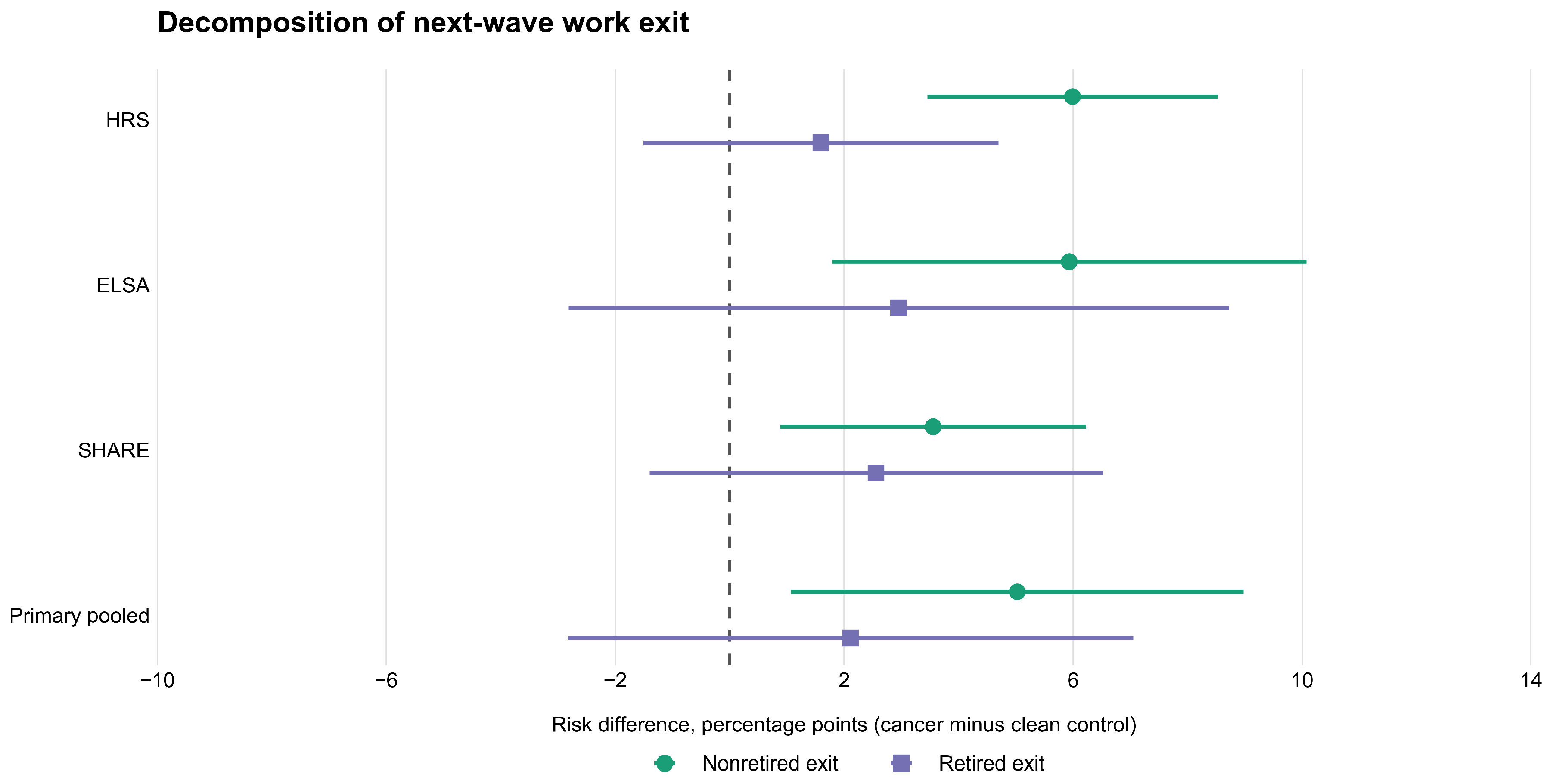
State decomposition showed a pooled nonretired-exit risk difference of 5.0 points (95% CI, 1.1–9.0) in the primary cohorts (Figure 2). Cohort-specific estimates were 6.0 points in HRS, 5.9 in ELSA, and 3.6 in SHARE. This estimate describes exit without recorded retirement; it does not identify involuntary job loss, disability, or sickness absence.
Figure 2.
Retired and nonretired components of next-wave employment exit in the primary cohorts. Points and horizontal lines show adjusted risk differences (percentage points) and 95% confidence intervals comparing cancer cases with clean controls. Green circles denote nonretired exit and purple squares denote retired exit; the pooled rows synthesize HRS, ELSA, and SHARE. The vertical dashed line indicates no difference.
The pooled retired-exit risk difference was 2.1 points (95% CI, −2.8 to 7.0), with cohort-specific estimates of 1.6, 3.0, and 2.6 points in HRS, ELSA, and SHARE. The retired and nonretired point estimates were not directly contrasted; their different confidence intervals do not establish a statistical difference between components.
Contextual state estimates varied across CHARLS, MHAS, and KLoSA and are presented without a uniformity claim. The available retirement indicators cannot distinguish voluntary, health-related, constrained, or policy-mediated exits.
3.4. Robustness, Mortality, and Sampling-Design Analyses
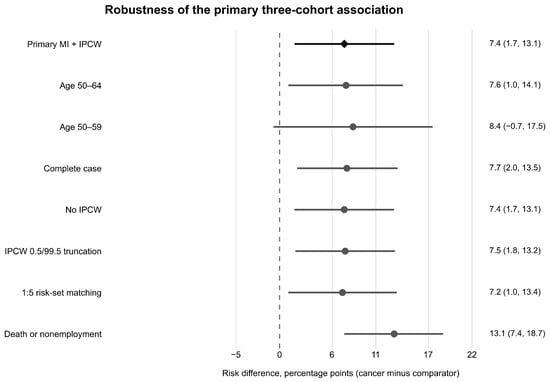
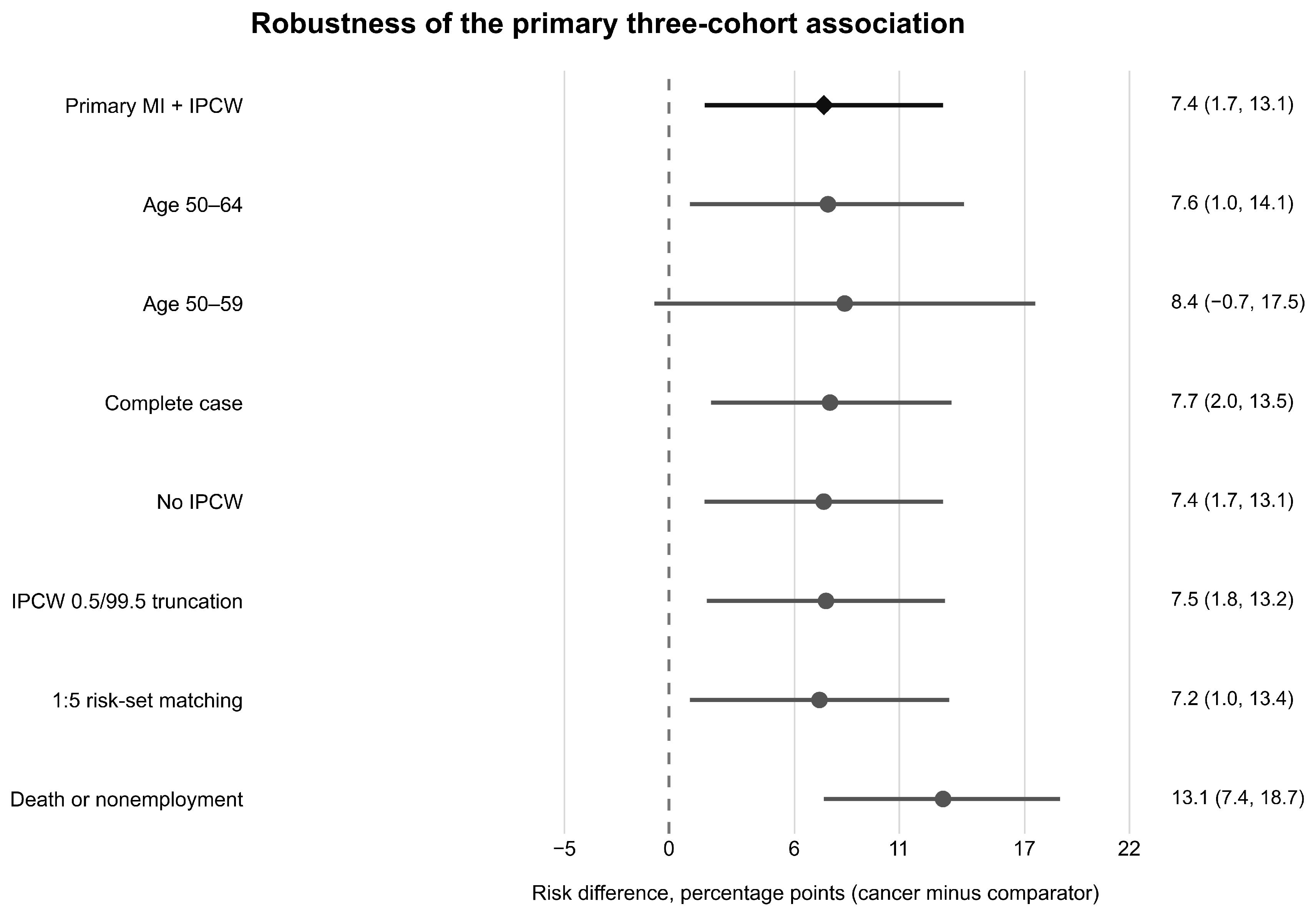
The corrected primary pooled risk difference was 7.4 points (95% CI, 1.7–13.1). The corresponding estimates were 7.6 points (95% CI, 1.0–14.1) at ages 50–64 and 8.4 points (95% CI, −0.7 to 17.5) at ages 50–59. Complete-case, no-IPCW, and alternative-truncation estimates were 7.7, 7.4, and 7.5 points, respectively (Table 3; Figure 3). These analyses address specified design and missing-data boundaries rather than serving as repeated tests of significance.
Table 3.
Prespecified and reviewer-requested sensitivity analyses in the primary evidence set.
Figure 3.
Prespecified robustness and interpretation-boundary analyses for the primary three-cohort association. Points and horizontal lines show pooled adjusted risk differences (percentage points) and 95% confidence intervals across HRS, ELSA, and SHARE. The black diamond denotes the primary estimate and gray circles denote sensitivity analyses; the vertical dashed line indicates no difference. MI, multiple imputation; IPCW, inverse probability-of-censoring weighting.
The participant bootstrap median was 7.5 points (2.5th–97.5th percentiles, 5.1–9.9), and the matched estimate was 7.2 points (95% CI, 1.0–13.4). The bootstrap range is an internal resampling-stability interval, not a replacement inferential confidence interval: it sampled participants and one completed imputation per replicate while retaining the original IPCW and frozen cohort-synthesis weights, without re-estimating imputation, censoring weights, between-cohort variance, or Hartung–Knapp uncertainty. These omissions explain why it is narrower than the primary meta-analytic confidence interval.
The prespecified complete-case death-or-nonemployment composite was 13.1 points (95% CI, 7.4–18.7). In ELSA, 203 cancer records had observed employment outcomes and five had a known death before the scheduled next wave, giving 208 composite-observed records. Complete-case restrictions retained 186 observed employment outcomes and four deaths, giving 190 records; 17 observed outcomes and one death were excluded for incomplete covariates. The multiply imputed composite yielded 12.9 points (95% CI, 7.3–18.5). SHARE-only country adjustment yielded 7.7 points (95% CI, 3.2–12.1), and the broad-control pooled estimate was 7.2 points (95% CI, 1.5–12.9). In the post hoc index-employed analysis, the pooled difference was 2.0 points (95% CI, −3.7 to 7.8). These analyses are interpretation-boundary sensitivities (Table 3; Supplementary Table S12).
4. Discussion
First-reported cancer was associated with elevated next-wave nonemployment in the HRS/ELSA/SHARE primary evidence set, corresponding to 7.4 additional events per 100 cancer cases after excluding known deaths from the employment-outcome target and observation model. The strongest interpretation is an employment transition surrounding first report among adults working at the preceding wave: cancer onset and index-wave work change were interval-censored, and 23.5% of observed cancer cases were already nonworking at the index wave and remained so at the next wave. Restriction to participants still employed at the index wave reduced the pooled difference to 2.0 points with an interval spanning zero. This pattern shows that the primary estimand combines persistent nonwork and later exit; it does not support a diagnosis-date or causal interpretation.
The study adds a harmonized, case-standardized transition estimate to established evidence on cancer and work [3,4,5,6,7,8,9,10,11,12,13,14,15]. Its contribution is not a precise diagnosis-to-exit sequence. Rather, it aligns adults who were working at a preceding wave, identifies a first cancer report at the next wave, and follows employment through the subsequent wave while describing whether nonwork was already apparent at first report. Same-wave controls reduce distortion from survey period and secular labor-market change, while the absolute risk difference remains conditional on measured covariates and the cohort-specific cancer-case distribution.
Separating labor-force states remains clinically useful near retirement age, but the state labels require restraint. Nonretired nonwork may include sickness absence, disability, unemployment, homemaking, informal work, or another transition; reported retirement may be voluntary, constrained, health-related, or financially shaped. The 5.0-point nonretired and 2.1-point retired estimates were not directly contrasted. They therefore describe outcome composition rather than prove that one mechanism predominated.
Cross-cohort variation is part of the result. The primary cohort estimates were positive, but three cohorts cannot establish homogeneity, and the contextual estimates ranged from negative and imprecise in MHAS to positive in CHARLS and KLoSA. Differences in labor-market formality, employment protection, sickness and disability benefits, customary retirement, family support, survey timing, and work definitions may all contribute. The analysis supports a common measurement framework, not a universal effect magnitude.
The observational findings support assessment, not proof of intervention effectiveness. Clinicians and nurses can ask about current work status, intended retirement, work ability, symptom-related barriers, job demands, leave, financial concerns, and the survivor’s preferred outcome during survivorship follow-up. Rehabilitation, occupational-health, social-work, benefits, or vocational referral can then be considered when indicated. Trials and reviews [34,35,36,37,38,39] provide the separate evidence base for intervention effectiveness; digitally supported follow-up is a plausible delivery route that requires prospective evaluation.
Design strengths include verification of work at the preceding wave, same-cohort and same-wave controls, a frozen adjustment set, cancer-case standardization, explicit retirement-state decomposition, multiple imputation, censoring weights aligned to the non-decedent employment target, participant-clustered variance, and sensitivity analyses with distinct purposes. The dated internal protocol and primary/contextual hierarchy preceded adjusted estimation, although they were not publicly preregistered. Reviewer-requested post-freeze changes were recorded separately, and independent scripts reconciled counts, models, tables, and figures.
The estimand applies to adults aged 50–69 years who were working at the preceding survey wave, were not known to have died before the scheduled next wave, and had next-wave work status observed or reweighted under the conditional-observation model. Survey intervals varied and reached five years in SHARE. Site, stage, treatment, recurrence, symptoms, job demands, accommodations, informal work, and detailed exit reasons were unavailable across cohorts. Measured differences between cases with and without observed outcomes, including age and functional or socioeconomic indicators in some cohorts, show that selection remained plausible (Supplementary Table S11). IPCW addresses only measured predictors among the non-decedent target under its assumptions. Residual confounding and cross-setting classification differences preclude causal, policy-effect, or nationally representative interpretation.
Future work should link surveys with cancer registries, treatment records, employers, and social-insurance data to resolve diagnosis timing, cancer severity, job demands, accommodations, and distinct work states. Prospective studies should test repeated work assessment and coordinated referral using outcomes that include hours, work ability, absence, financial toxicity, and concordance with patient preference. Cross-national analyses should retain country-specific estimates and directly measure relevant policy features rather than treating context as unexplained noise.
5. Conclusions
Among adults aged 50–69 years who were working at the preceding survey wave and were not known to have died before the scheduled follow-up, first-reported cancer was associated with 7.4 additional next-wave nonemployment events per 100 cases in HRS, ELSA, and SHARE. Employment trajectories and the index-employed sensitivity showed that the primary contrast combines persistent nonwork and later exit, so the result concerns transitions surrounding first report rather than a diagnosis-date effect. Repeated, preference-sensitive assessment of work status and concerns is clinically relevant, while intervention effectiveness and cross-country transport require separate evidence.
Supplementary Materials
The following supporting information can be downloaded at https://www.mdpi.com/article/10.3390/healthcare14234056/s1: Supplementary File S1 contains Figure S1 (analytic flow); Tables S1–S7 (harmonization, missingness, weighting, prespecified sensitivities, heterogeneity, crude estimates, and follow-up intervals); Table S8 (detailed baseline characteristics); Table S9 (follow-up disposition); Table S10 (employment trajectories); Table S11 (observed-versus-unobserved cancer-case comparison); and Table S12 (reviewer-requested post hoc sensitivities).
Author Contributions
Conceptualization, Z.L., T.C. and Q.W.; methodology, Z.L., T.C., P.L. and Q.W.; software, Z.L.; validation, T.C., P.L. and K.L.; formal analysis, Z.L. and T.C.; investigation, T.C. and P.L.; data curation, Z.L., T.C. and K.L.; writing—original draft preparation, Z.L. and T.C.; writing—review and editing, Z.L., T.C., P.L., K.L. and Q.W.; visualization, Z.L. and K.L.; supervision, Q.W.; project administration, T.C. and Q.W.; funding acquisition, Q.W. All authors have read and agreed to the published version of the manuscript.
Funding
This research was funded by: (1) the project “Difficulties and Transformation Mechanisms of Internet+ Transitional Care Services for Older Patients in Shanghai Based on the SERVQUAL Theory” (Project No. 22692109900); (2) the Shanghai Tenth People’s Hospital Specialized Nursing Talent Program (Class A, 2021), Department of Gastrointestinal Surgery (Qian Wu; Project No. SYZKHLRC-A05); and (3) the Shanghai “Medical Park Rising Star (Yiyuan Xinxing)” Young Medical Talent Training Funding Program (Nursing Track; Project No. YJXHS-002). The funders had no role in the study design; data collection, analysis, or interpretation; manuscript preparation; or the decision to submit the results.
Institutional Review Board Statement
Ethical review and approval were waived for this study under Article 32(2) of the Measures for Ethical Review of Life Science and Medical Research Involving Human Subjects (National Health Commission, Ministry of Education, Ministry of Science and Technology, and National Administration of Traditional Chinese Medicine; Guo Wei Ke Jiao Fa No. 4 of 2023), because this study was a secondary analysis of deidentified data obtained from existing international aging cohorts, involved no new participant recruitment, intervention, or direct contact, and the investigators received no direct identifiers. The parent cohort studies obtained ethics approval under their respective protocols. The study was conducted in accordance with the Declaration of Helsinki and the applicable data-use requirements of each cohort.
Informed Consent Statement
Informed consent for the present secondary analysis was not required under Article 32(2) of Guo Wei Ke Jiao Fa No. 4 of 2023 because only deidentified existing data were used. The parent cohort studies obtained informed consent from participants under their respective protocols. No participants were contacted and no new data were collected.
Data Availability Statement
Participant-level data were obtained from the Health and Retirement Study (HRS), English Longitudinal Study of Ageing (ELSA), Survey of Health, Ageing and Retirement in Europe (SHARE), China Health and Retirement Longitudinal Study (CHARLS), Mexican Health and Aging Study (MHAS), and Korean Longitudinal Study of Aging (KLoSA). These third-party data are not owned by the authors and cannot be redistributed by them, including in participant-level derivative form. Eligible researchers may obtain the data directly from the respective official providers subject to registration, approval, and applicable data-use conditions. Versioned analytic code, the dated internal protocol, and aggregate result tables supporting this article have been supplied to the journal for confidential editorial records. Additional non-disclosive aggregate outputs are available from the corresponding author upon reasonable request and subject to provider requirements.
Acknowledgments
The authors acknowledge the investigators, field teams, data-harmonization teams, and participants of HRS, ELSA, SHARE, CHARLS, MHAS, and KLoSA, whose work and data made this study possible. During the preparation of this manuscript, the authors used OpenAI Codex version GPT-6 Solsolely for English-language polishing. All other aspects of the research and manuscript preparation were completed by the authors, who reviewed and approved the final text and take full responsibility for the content of this publication.
Conflicts of Interest
The authors declare no conflicts of interest.
References
- Tevaarwerk, A.; Denlinger, C.S.; Sanft, T.; Ansbaugh, S.M.; Armenian, S.; Baker, K.S.; Broderick, G.; Day, A.; Demark-Wahnefried, W.; Dickinson, K.; et al. Survivorship, Version 1.2021. J. Natl. Compr. Cancer Netw. 2021, 19, 676–685. [Google Scholar] [CrossRef] [Scilit] [PubMed]
- Vaz-Luis, I.; Masiero, M.; Cavaletti, G.; Cervantes, A.; Chlebowski, R.T.; Curigliano, G.; Felip, E.; Ferreira, A.R.; Ganz, P.A.; Hegarty, J.; et al. ESMO Expert Consensus Statements on Cancer Survivorship: Promoting high-quality survivorship care and research in Europe. Ann. Oncol. 2022, 33, 1119–1133. [Google Scholar] [CrossRef] [Scilit] [PubMed]
- Allman, G.; Morrell, L.; Meheus, F.; Ilbawi, A.; Soerjomataram, I.; MacKay, C.; Reid, F.; Euripides, M. Systematic Review and Meta-Analysis of Labor and Productivity Outcomes Caused by Cancer. JCO Glob. Oncol. 2026, 12, e2600130. [Google Scholar] [CrossRef] [Scilit] [PubMed]
- de Boer, A.G.E.M.; Taskila, T.; Ojajärvi, A.; van Dijk, F.J.H.; Verbeek, J.H.A.M. Cancer survivors and unemployment: A meta-analysis and meta-regression. JAMA 2009, 301, 753–762. [Google Scholar] [CrossRef] [Scilit] [PubMed]
- Franco, M.; Buscema, F.; Catalano, A.; Dansero, L.; Milani, L.; Gilcrease, G.W.; Ricceri, F. Risk factors for return to work in workers who experienced cancer: A systematic review with meta-analysis. Oncol. Rev. 2026, 20, 1759182. [Google Scholar] [CrossRef] [Scilit] [PubMed]
- Liu, J.; Xiao, J.; Ou, S.; Chen, J.; Tang, S. Facilitators and barriers associated with returning to work for cancer survivors: A systematic review. Asia-Pac. J. Oncol. Nurs. 2025, 12, 100734. [Google Scholar] [CrossRef] [Scilit] [PubMed]
- Schellack, S.; Breidenbach, C.; Rick, O.; Kowalski, C. Predictive factors for return to work among cancer survivors in Europe: A systematic review. Crit. Rev. Oncol. Hematol. 2024, 200, 104422. [Google Scholar] [CrossRef] [Scilit] [PubMed]
- Yamamoto, R.; Nakao, Y.M.; Yoshida, S.; Yuno, M.; Becker, C.B.; Nakayama, T.; Kawakami, K. Job Loss after Cancer Diagnosis among Working-Age Cancer Survivors. Cancer Epidemiol. Biomark. Prev. 2026, 35, 284–291. [Google Scholar] [CrossRef] [Scilit] [PubMed]
- Hiyoshi, A.; Alexanderson, K.; Tinghög, P.; Cao, Y.; Fall, K.; Montgomery, S. Future sick leave, disability pension, and unemployment among patients with cancer after returning to work: Swedish register-based matched prospective cohort study. Cancer 2025, 131, e35580. [Google Scholar] [CrossRef] [Scilit] [PubMed]
- Bradley, C.J.; Owsley, K.M. Retirement behavior of cancer survivors: Role of health insurance. J. Cancer Surviv. 2024, 18, 499–508. [Google Scholar] [CrossRef] [Scilit] [PubMed]
- Candon, D. The effects of cancer on older workers in the English labour market. Econ. Hum. Biol. 2015, 18, 74–84. [Google Scholar] [CrossRef] [Scilit] [PubMed]
- Carlsen, K.; Harling, H.; Pedersen, J.; Christensen, K.B.; Osler, M. The transition between work, sickness absence and pension in a cohort of Danish colorectal cancer survivors. BMJ Open 2013, 3, e002259. [Google Scholar] [CrossRef] [Scilit] [PubMed]
- Torp, S.; Nielsen, R.A.; Fossa, S.D.; Gudbergsson, S.B.; Dahl, A.A. Change in employment status of 5-year cancer survivors. Eur. J. Public Health 2013, 23, 116–122. [Google Scholar] [CrossRef] [Scilit] [PubMed]
- Tamminga, S.J.; Jansen, L.P.; Frings-Dresen, M.H.W.; de Boer, A.G.E.M. Long-term employment status and quality of life after cancer: A longitudinal prospective cohort study from diagnosis up to and including 5 years post diagnosis. Work 2020, 66, 901–907. [Google Scholar] [CrossRef] [Scilit] [PubMed]
- Short, P.F.; Vasey, J.J.; Tunceli, K. Employment pathways in a large cohort of adult cancer survivors. Cancer 2005, 103, 1292–1301. [Google Scholar] [CrossRef] [Scilit] [PubMed]
- Blinder, V.S.; Sampathkumar, Y.; Williams, C.P.; Bennett, A.V.; de Moor, J.S. A taxonomy of work-related outcomes in cancer survivors to advance systematic assessments in research and practice. J. Natl. Cancer Inst. 2026, djag232. [Google Scholar] [CrossRef] [Scilit] [PubMed]
- von Elm, E.; Altman, D.G.; Egger, M.; Pocock, S.J.; Gøtzsche, P.C.; Vandenbroucke, J.P. The Strengthening the Reporting of Observational Studies in Epidemiology (STROBE) Statement: Guidelines for Reporting Observational Studies. PLoS Med. 2007, 4, e296. [Google Scholar] [CrossRef] [Scilit] [PubMed]
- Sonnega, A.; Faul, J.D.; Ofstedal, M.B.; Langa, K.M.; Phillips, J.W.; Weir, D.R. Cohort Profile: The Health and Retirement Study (HRS). Int. J. Epidemiol. 2014, 43, 576–585. [Google Scholar] [CrossRef] [Scilit] [PubMed]
- Steptoe, A.; Breeze, E.; Banks, J.; Nazroo, J. Cohort Profile: The English Longitudinal Study of Ageing. Int. J. Epidemiol. 2013, 42, 1640–1648. [Google Scholar] [CrossRef] [Scilit] [PubMed]
- Börsch-Supan, A.; Brandt, M.; Hunkler, C.; Kneip, T.; Korbmacher, J.; Malter, F.; Schaan, B.; Stuck, S.; Zuber, S. Data Resource Profile: The Survey of Health, Ageing and Retirement in Europe (SHARE). Int. J. Epidemiol. 2013, 42, 992–1001. [Google Scholar] [CrossRef] [Scilit] [PubMed]
- Zhao, Y.; Hu, Y.; Smith, J.P.; Strauss, J.; Yang, G. Cohort Profile: The China Health and Retirement Longitudinal Study (CHARLS). Int. J. Epidemiol. 2014, 43, 61–68. [Google Scholar] [CrossRef] [Scilit] [PubMed]
- Wong, R.; Michaels-Obregon, A.; Palloni, A. Cohort Profile: The Mexican Health and Aging Study (MHAS). Int. J. Epidemiol. 2017, 46, e2. [Google Scholar] [CrossRef] [Scilit] [PubMed]
- Lee, J. KLoSA—Korean Longitudinal Study of Aging. Korean J. Fam. Med. 2020, 41, 1–2. [Google Scholar] [CrossRef] [Scilit] [PubMed]
- White, I.R.; Royston, P.; Wood, A.M. Multiple imputation using chained equations: Issues and guidance for practice. Stat. Med. 2011, 30, 377–399. [Google Scholar] [CrossRef] [Scilit] [PubMed]
- Rubin, D.B. Multiple Imputation for Nonresponse in Surveys; Wiley: Hoboken, NJ, USA, 1987. [Google Scholar] [CrossRef] [Scilit]
- van Buuren, S.; Groothuis-Oudshoorn, K. Mice: Multivariate Imputation by Chained Equations in R. J. Stat. Softw. 2011, 45, 1–67. [Google Scholar] [CrossRef] [Scilit]
- Seaman, S.R.; White, I.R. Review of inverse probability weighting for dealing with missing data. Stat. Methods Med. Res. 2013, 22, 278–295. [Google Scholar] [CrossRef] [Scilit] [PubMed]
- Robins, J.M.; Hernán, M.Á.; Brumback, B. Marginal Structural Models and Causal Inference in Epidemiology. Epidemiology 2000, 11, 550–560. [Google Scholar] [CrossRef] [Scilit] [PubMed]
- Zou, G. A Modified Poisson Regression Approach to Prospective Studies with Binary Data. Am. J. Epidemiol. 2004, 159, 702–706. [Google Scholar] [CrossRef] [Scilit] [PubMed]
- Muller, C.J.; MacLehose, R.F. Estimating predicted probabilities from logistic regression: Different methods correspond to different target populations. Int. J. Epidemiol. 2014, 43, 962–970. [Google Scholar] [CrossRef] [Scilit] [PubMed]
- IntHout, J.; Ioannidis, J.P.; Borm, G.F. The Hartung-Knapp-Sidik-Jonkman method for random effects meta-analysis is straightforward and considerably outperforms the standard DerSimonian-Laird method. BMC Med. Res. Methodol. 2014, 14, 25. [Google Scholar] [CrossRef] [Scilit] [PubMed]
- Jackson, D.; Law, M.; Rücker, G.; Schwarzer, G. The Hartung-Knapp modification for random-effects meta-analysis: A useful refinement but are there any residual concerns? Stat. Med. 2017, 36, 3923–3934. [Google Scholar] [CrossRef] [Scilit] [PubMed]
- Austin, P.C. An Introduction to Propensity Score Methods for Reducing the Effects of Confounding in Observational Studies. Multivar. Behav. Res. 2011, 46, 399–424. [Google Scholar] [CrossRef] [Scilit] [PubMed]
- de Boer, A.G.; Tamminga, S.J.; Boschman, J.S.; Hoving, J.L. Non-medical interventions to enhance return to work for people with cancer. Cochrane Database Syst. Rev. 2024, 2024, CD007569. [Google Scholar] [CrossRef] [Scilit] [PubMed]
- Chen, Y.; Ju, Y.; Lin, J.; Han, Y.; Wang, X.; Luo, X.; Wang, P.P.; Zhu, Y. Non-Pharmacological Interventions for Return to Work and Multidimensional Health-Related Quality of Life in Adults with Cancer: A Systematic Review and Meta-Analysis of Randomised Trials. Healthcare 2026, 14, 3128. [Google Scholar] [CrossRef] [Scilit] [PubMed]
- Paltrinieri, S.; Braglia, L.; Bravi, F.; Fugazzaro, S.; Costi, S. A multidisciplinary intervention to support return to work of individuals with breast cancer: A prospective feasibility study. Support. Care Cancer 2026, 34, 979. [Google Scholar] [CrossRef] [Scilit] [PubMed]
- Kang, D.; Bae, K.R.; Ahn, Y.; Kim, N.; Nam, S.J.; Lee, J.E.; Lee, S.K.; Shim, Y.M.; Sinn, D.H.; Oh, S.Y.; et al. Effectiveness of Self-Assessment, TAilored Information, and Lifestyle Management for Cancer Patients’ Returning to Work (START): A Multi-center, Randomized Controlled Trial. Cancer Res. Treat. 2023, 55, 419–428. [Google Scholar] [CrossRef] [Scilit] [PubMed]
- van Egmond, M.P.; Duijts, S.F.A.; Jonker, M.A.; van der Beek, A.J.; Anema, J.R. Effectiveness of a tailored return to work program for cancer survivors with job loss: Results of a randomized controlled trial. Acta Oncol. 2016, 55, 1210–1219. [Google Scholar] [CrossRef] [Scilit] [PubMed]
- Guo, Y.J.; Tang, J.; Li, J.M.; Zhu, L.L.; Xu, J.S. Exploration of interventions to enhance return-to-work for cancer patients: A scoping review. Clin. Rehabil. 2021, 35, 1674–1693. [Google Scholar] [CrossRef] [Scilit] [PubMed]

Disclaimer/Publisher’s Note: The statements, opinions and data contained in all publications are solely those of the individual author(s) and contributor(s) and not of MDPI and/or the editor(s). MDPI and/or the editor(s) disclaim responsibility for any injury to people or property resulting from any ideas, methods, instructions or products referred to in the content. |
© 2026 by the authors. Licensee MDPI, Basel, Switzerland. This article is an open access article distributed under the terms and conditions of the Creative Commons Attribution (CC BY) license.