


Highlights
What are the main findings?
- Comprehension varied substantially across the 14 dental terms, with lower correct-response rates for investigator-defined technical/specialized terms than for routine/common terms.
- Previous dental attendance was positively associated with comprehension in both unadjusted and adjusted analyses; age, gender, and educational level showed no statistically significant associations with total scores.
What are the implications of the main findings?
- Dental professionals should use clear, patient-centered language and explain unfamiliar terminology when discussing diagnoses, procedures, and treatment options.
- Visual aids and teach-back are potential strategies to support patient understanding, but their effectiveness and effects on clinical outcomes require prospective evaluation.
Abstract
Background/Objectives: To assess comprehension of 14 dental terms and associated factors among Arabic-speaking adults attending a university dental center in Saudi Arabia. Methods: This single-center cross-sectional study used convenience sampling at Prince Sattam Bin Abdulaziz University dental clinics. Comprehension was assessed using open-ended responses scored against prespecified criteria. Analyses included nonparametric tests, Spearman correlations, exact item-level tests with Holm correction, and exploratory multivariable linear regression with HC3 robust standard errors. Results: Among 154 participants, 64.9% were aged 18–25 years. The mean comprehension score was 6.52 ± 2.89 (range, 0–13) out of 14. Correct-response rates were higher for investigator-defined routine/common terms than for technical/specialized terms (71.2% vs. 22.0%; p < 0.001). Comprehension was positively correlated with previous dental attendance (ρ = 0.274, p < 0.001), but not significantly with age-group rank (ρ = 0.146, p = 0.071). In the adjusted analysis, previous dental attendance was associated with higher comprehension scores (joint p = 0.004), whereas age, gender, and educational level were not significantly associated with scores. After Holm correction, only the associations between dental attendance and comprehension of pulp extirpation and X-ray remained significant. Conclusions: Comprehension varied considerably across the selected terms and was associated with previous dental attendance. These findings from a predominantly young, single-center university-clinic sample may not generalize to other populations or settings. Understanding isolated terms may not reflect comprehension during clinical discussions. Clinicians should explain unfamiliar terminology and verify patients’ understanding; whether such strategies improve comprehension or patient-centered outcomes requires prospective evaluation.
1. Introduction
Effective communication between healthcare providers and patients is a cornerstone of high-quality care, supporting trust and informed decision-making [1,2]. In dental practice, clinicians may assume that patients understand common healthcare terminology; however, this assumption is frequently inaccurate. Technical terms may lead to misunderstandings, confusion, and difficulties in understanding treatment options [3,4]. Furthermore, patients may hesitate to disclose their lack of comprehension [5]. Such communication barriers may undermine patient-centered care and complicate clinical decision-making [6,7].
Several studies have examined patients’ comprehension of terminology commonly used in oral medicine [8,9], orthodontics [10], maxillofacial surgery [11], cardiology [12], orthopedics [13], and breast clinics [14]. Collectively, these studies suggest that clinicians often overestimate patients’ understanding of common medical and dental terminology. Accordingly, healthcare providers should select terminology carefully and tailor their communication to the patient’s level of understanding [13].
As healthcare shifts from a paternalistic model toward patient-centered communication, the use of accessible language is essential to supporting patient understanding and informed consent [15,16,17]. An important distinction exists between oral health literacy, which encompasses the ability to obtain and understand oral health information, and comprehension of specific clinical terminology. Although validated Arabic-language instruments are available to assess oral health literacy in Saudi and other Arab populations [18,19], they assess broader oral health literacy domains or functional dental literacy, rather than patients’ understanding of the meanings conveyed by individual clinical terms. This distinction is supported by findings from Egyptian dental patients, in whom reading-based dental literacy scores were not significantly associated with knowledge of dental terminology [20]. In Saudi Arabia, terminology comprehension has been investigated in limited contexts, including oral medicine terminology among a single university cohort [9] and communication barriers in student-run dental clinics [21]. However, patients’ understanding of general dental terminology in routine clinical settings remains unexplored. Accordingly, this study aimed to assess patients’ comprehension of 14 selected dental terms at Prince Sattam Bin Abdulaziz University dental clinics and to examine its associations with age group, gender, educational attainment, and previous dental visits. The primary objective was to describe patients’ comprehension of these terms. The secondary objective was exploratory to examine four characteristic-specific null hypotheses: that comprehension scores were not associated with age group, gender, educational attainment, or previous dental-visit category.
2. Materials and Methods
2.1. Study Design and Ethical Considerations
This single-center, cross-sectional questionnaire study was conducted at the dental clinics of Prince Sattam Bin Abdulaziz University, Al-Kharj, Saudi Arabia, between October and December 2024. Reporting followed the Strengthening the Reporting of Observational Studies in Epidemiology (STROBE) guidelines.
The study was approved by the Research Ethics Committee of Prince Sattam Bin Abdulaziz University (IRB approval no. SCBR/336-2024; 9 September 2024). All participants provided written informed consent before participation. Participation was voluntary, and confidentiality was maintained throughout the study.
2.2. Participants and Sample Size
Patients attending the university dental clinics were invited to participate while waiting for their appointments. Participants were recruited using convenience sampling and were therefore not randomly selected.
Eligible participants were Arabic-speaking adults aged 18 years or older. Dental students, faculty members, and individuals involved in the questionnaire’s face- or content-validity assessments were excluded.
The sample-size assessment was based on the primary outcome, the mean total dental terminology comprehension score (range, 0–14). The anticipated variability was derived from AlDehlawi et al. [9]. Combining the published sex-specific sample sizes, means, and standard deviations yielded an overall standard deviation of 2.89 points on an 11-item scale. This value was rescaled to the 14-item questionnaire by multiplying by 14/11, yielding an estimated standard deviation of 3.68 points. This rescaling assumed comparable variability in percentage-correct scores across the two questionnaires. That assumption could not be verified from the published aggregate data; differences in item difficulty and inter-item correlations may affect score variability. The rescaled SD was therefore used as an approximation for the precision-based sample size calculation.
Using a two-sided 95% confidence level and a desired confidence-interval half-width of 0.50 points, the normal-approximation formula, n = (Z0.975 × σ/ε)2, yielded an initial requirement of 208 evaluable participants. Iterative refinement using Student’s t distribution, n = (t0.975,n−1 × σ/ε)2, increased this estimate to 211. At this sample size, t0.975,210 = 1.9713, giving an estimated confidence-interval half-width of 0.4994 points. Allowing for 10% incomplete or unusable questionnaires, the corresponding recruitment target was 235 participants. The precision achieved in the final sample was subsequently assessed using the observed standard deviation and a two-sided t-based 95% confidence interval. This calculation was intended to guide estimation of the primary mean score and was not designed to establish statistical power for secondary analyses.
2.3. Questionnaire Development and Evaluation
The self-administered questionnaire comprised 19 items divided into two sections: (1) demographic and background characteristics, including age, gender, educational attainment, previous dental visits, and first language; and (2) open-ended questions assessing participants’ understanding of 14 dental terms: veneers, crowns, gum infection, filling, post, bridge, denture, space maintainer, pulp extirpation, silver cap, X-ray, dental implant, broken file, and scaling.
The terms were selected based on the authors’ clinical observations and informal consultation with dental staff. They encompassed expressions relating to dental conditions, investigations, restorations, procedures, and a procedural complication. The selected terms included both everyday expressions, such as “gum infection” and “silver cap”, and more procedure-specific expressions, such as “pulp extirpation” and “broken file”.
For an exploratory comparison, the terms were assigned to two groups based on the research team’s clinical judgment of expected patient familiarity: routine/common and technical/specialized. The composition of both groups is provided in Supplementary Table S1.
The questionnaire was originally developed in Arabic, which was the language administered to all participants. An English version was subsequently prepared for research documentation and manuscript reporting and was not used for data collection. Three native Arabic translators and one bilingual expert independently translated the original Arabic questionnaire into English, after which a consensus English version was developed. Two blinded bilingual translators then independently back-translated the English version into Arabic. The back-translations were compared with the original questionnaire to identify discrepancies and assess conceptual equivalence between the two language versions.
Questionnaire evaluation involved sequential qualitative and quantitative assessments. Initially, a qualitative pilot involving two lay patients and two dental experts assessed wording clarity, comprehensibility, perceived relevance, and the technical functionality of the Google Forms survey. Feedback informed subsequent revisions. The revised questionnaire was then evaluated by five content-validity experts. Content validity was quantified using the scale-level content validity index based on the average method (S-CVI/Ave), calculated as the mean of the item-level content validity indices, yielding a value of 0.92. These assessments addressed questionnaire clarity and content relevance but did not establish the frequency of terminology use or independently validate the exploratory term classifications.
The final Arabic questionnaire and the item-specific intended meanings and scoring criteria are provided in Supplementary File S1 and Supplementary Table S2, respectively.
2.4. Data Collection and Response Assessment
Data were collected electronically using Google Forms on clinic-provided devices in the waiting area under supervision. Participants were instructed not to search online or seek assistance from others while completing the questionnaire, which required approximately 5–7 min. Two trained undergraduate dental students conducted recruitment and survey administration in a research capacity and were not involved in participants’ clinical care. Participants were informed that participation was voluntary and that their decision to participate or their responses would not affect their treatment. The Google Forms “Limit to 1 response” setting was activated to minimize duplicate submissions and required Google account sign-in; however, respondents’ email addresses were not collected.
Responses to the 14 open-ended questions were independently assessed by two dentally trained reviewers who were blinded to participants’ demographic characteristics. Classification was based on the intended clinical meaning of each term and the prespecified item-specific scoring criteria developed during questionnaire preparation.
Responses were evaluated for conceptual accuracy rather than exact agreement with formal clinical definitions. Alternative lay expressions and nontechnical wording were accepted when they conveyed the essential intended meaning; omission of nonessential terminology did not, by itself, warrant an incorrect classification. Responses that omitted an essential component or otherwise failed to convey the intended concept were classified as incorrect. No partial credit was awarded because the study aimed to establish whether the essential meaning was conveyed, rather than to quantify degrees of partial understanding, for which no predefined or validated weighting system was available. Blank responses and explicit statements indicating lack of knowledge were classified as “don’t know/no answer”. Disagreements were discussed and resolved through consensus with a third senior investigator.
2.5. Outcome Scoring and Reliability Assessment
Three response categories were retained for descriptive reporting: correct, incorrect, and “don’t know/no answer”. For calculation of the total comprehension score, responses were scored dichotomously: correct answers received 1 point, whereas incorrect and “don’t know/no answer” responses received 0 points. Scores were summed across the 14 terms, producing a total score ranging from 0 to 14, with higher scores indicating greater comprehension. The item-specific criteria and examples of acceptable and insufficient responses are detailed in Supplementary Table S2.
Internal consistency of the 14-item total comprehension score was assessed using the final study sample. Unstandardized Cronbach’s alpha was calculated from the item variances and the variance of the summed score. Given the dichotomous item scoring, this coefficient was numerically equivalent to the Kuder–Richardson Formula 20 (KR-20). It was interpreted as a descriptive measure of score consistency rather than evidence of unidimensionality or established construct validity, because the items represented different dental terms and clinical concepts.
Preliminary test–retest reliability assessment was conducted in a separate group of 10 participants who completed the questionnaire twice, with a 2-week interval between administrations. Agreement between the two administrations was assessed using a two-way mixed-effects intraclass correlation coefficient (ICC), with absolute agreement and single measurements (ICC [3,1]).
2.6. Statistical Analysis
Data were analysed using Stata Statistical Software, version 19 (StataCorp LLC, College Station, TX, USA). Participant characteristics and item-level responses were summarized as frequencies and percentages. Total comprehension scores were described using means and standard deviations, medians and interquartile ranges, and minimum–maximum values.
Age was recorded in four categories (18–25, 26–35, 36–55, and >55 years). For categorical score comparisons and multivariable analysis, the 36–55 and >55-year categories were combined because only one participant was older than 55 years, resulting in three age groups (18–25, 26–35, and ≥36 years; n = 22 in the pooled ≥36-year group). Education was dichotomized as university-level attainment (university or postgraduate education) versus no university-level attainment (secondary education or no formal education) to avoid estimating a separate effect for the single participant with postgraduate education. Original categories were retained in supplementary descriptive tables and item-level analyses.
The Shapiro–Wilk test was used to assess the distribution of total scores. Between-group comparisons were performed using the Mann–Whitney U test for two groups and the Kruskal–Wallis test for three or more groups. Pairwise comparisons between dental-visit categories were conducted using Mann–Whitney U tests, with Holm adjustment across the three pairwise comparisons. Effect sizes were reported as Cliff’s δ for two-group comparisons (female minus male) and epsilon-squared (ε2) for Kruskal–Wallis tests, calculated as ε2 = max[0, (H − k + 1)/(n − k)], where H is the Kruskal–Wallis statistic, n is the total sample size, and k is the number of groups.
Spearman’s rank correlation was used to assess monotonic associations between total comprehension scores and the ordinal categories of age and previous dental visits. Age was coded using the original four ordered categories (1–4), and dental visits using three ordered categories (1–3). These analyses therefore assessed associations with ordinal categories rather than continuous age or exact visit counts. The age correlation retained all four original age categories, whereas categorical age comparisons used the three pooled groups described above.
An exploratory within-participant comparison examined comprehension of two investigator-defined groups of terms. The routine/common group comprised crown, gum infection, filling, denture, X-ray, dental implant, and scaling; the technical/specialized group comprised veneer, post, bridge, space maintainer, pulp extirpation, silver cap, and broken file. For each group, the percentage correct was calculated as the mean number of correctly defined terms divided by seven and multiplied by 100. The two within-participant scores were compared using a two-sided Wilcoxon signed-rank test. Zero differences were excluded, tied absolute differences received average ranks, and the p-value was calculated using an asymptotic approximation without continuity correction.
Item-level associations between response accuracy and four participant characteristics (age, gender, education, and previous dental visits) were examined in 56 exploratory comparisons (14 terms × four characteristics). Responses were dichotomized as correct or non-correct, with incorrect, “don’t know,” and unanswered responses classified as non-correct. Two-sided Fisher’s exact tests were used for 2 × 2 tables, and Fisher–Freeman–Halton tests were used for larger contingency tables. For the latter, p-values were estimated using 199,999 Monte Carlo draws with fixed random seeds. Holm adjustment was applied across all 56 comparisons to control the family-wise error rate.
An exploratory multivariable ordinary least-squares regression model was fitted to estimate adjusted mean differences in total comprehension scores according to age group, gender, university-level education, and previous dental visits. All prespecified predictors were entered simultaneously, without stepwise selection. Heteroskedasticity-consistent HC3 standard errors were used to calculate 95% Wald confidence intervals and p-values. Age and dental-visit categories were assessed using joint robust Wald tests, whereas gender and education were assessed using single-coefficient tests. Model diagnostics included examination of residuals, fitted values, leverage, and influential observations. Sensitivity analyses repeated the age correlation and adjusted regression after excluding the sole participant aged >55 years; the full-sample analyses were retained as primary.
Inter-rater agreement for the independent classification of open-ended responses was assessed using Cohen’s kappa before resolution of disagreements by consensus.
All tests were two-sided, with statistical significance set at p < 0.05. Holm adjustment was applied to the two prespecified families of comparisons: the three pairwise dental-visit comparisons and the 56 item-level comparisons. Other score-level analyses were not adjusted for multiplicity and were interpreted as exploratory.
3. Results
3.1. Participant Characteristics and Overall Comprehension
A total of 154 participants were approached, and all agreed to participate and were included in the final analysis (response rate, 100%). Arabic was the first language of all participants. The mean total comprehension score was 6.52 out of 14 (SD = 2.89; 95% CI, 6.06–6.98), with an achieved confidence interval half-width of 0.46 points. The median score was 6.5 (Q1–Q3, 5–8), and scores ranged from 0 to 13 (Table 1). The sample comprised 75 males and 79 females. A total of 100 participants (64.9%) were aged 18–25 years, while only one participant was older than 55 years. One participant had postgraduate education. The full distribution of participant characteristics is presented in Table 1, with the original category details provided in Supplementary Table S3.
Table 1.
Participant characteristics and total dental terminology comprehension scores in the sample (N = 154).
3.2. Questionnaire Validity and Reliability
The questionnaire demonstrated good content validity, with a scale-level content validity index based on the average method (S-CVI/Ave) of 0.92. Internal consistency was acceptable (Cronbach’s α = 0.779; equivalent KR-20 coefficient = 0.779). Preliminary test–retest reliability was good (ICC = 0.88; 95% CI, [0.76–0.91]). Inter-rater agreement for classifying open-ended responses was good (Cohen’s κ = 0.85; 95% CI, [0.80–0.89]).
3.3. Associations with Total Comprehension Score
Total comprehension scores differed significantly according to the number of previous dental visits (Kruskal–Wallis H = 12.883, p = 0.002, ε2 = 0.0721). Median scores increased across the three groups: 4.5 among participants with no previous dental visits, 6 among those reporting 2–5 visits, and 7 among those reporting more than five visits. Holm-adjusted pairwise comparisons showed significantly higher scores among participants with 2–5 previous visits (p = 0.020) and more than five visits (p = 0.003) than among first-time visitors. The difference between the two groups with previous dental visits was not statistically significant (p = 0.062).
No statistically significant differences in total comprehension scores were observed by gender (p = 0.338), age group (p = 0.166), or university education (p = 0.400). The age-group comparison used three pooled categories; the oldest pooled category comprised 22 participants (21 aged 36–55 years and one aged >55 years). Thus, the results do not permit a meaningful separate assessment of the oldest age group.
Consistent with the categorical comparison, total comprehension score was positively correlated with the ordered number of previous dental visits (Spearman’s ρ = 0.274, p < 0.001). The correlation with ordered age-group rank was not statistically significant in the full sample (ρ = 0.146, p = 0.071). The age correlation used the four original ordered age categories, whereas the categorical comparison used three pooled groups.
In a sensitivity analysis excluding the single participant older than 55 years, the correlation between age-group rank and comprehension score increased slightly and reached nominal statistical significance (ρ = 0.168, p = 0.038). This finding indicates that the age-related result was sensitive to the inclusion of this single participant and should be interpreted cautiously.
3.4. Item-Level Comprehension
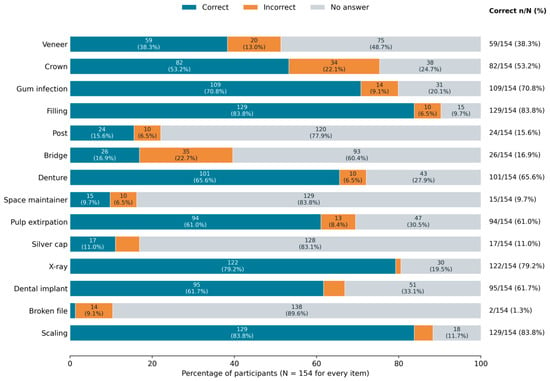
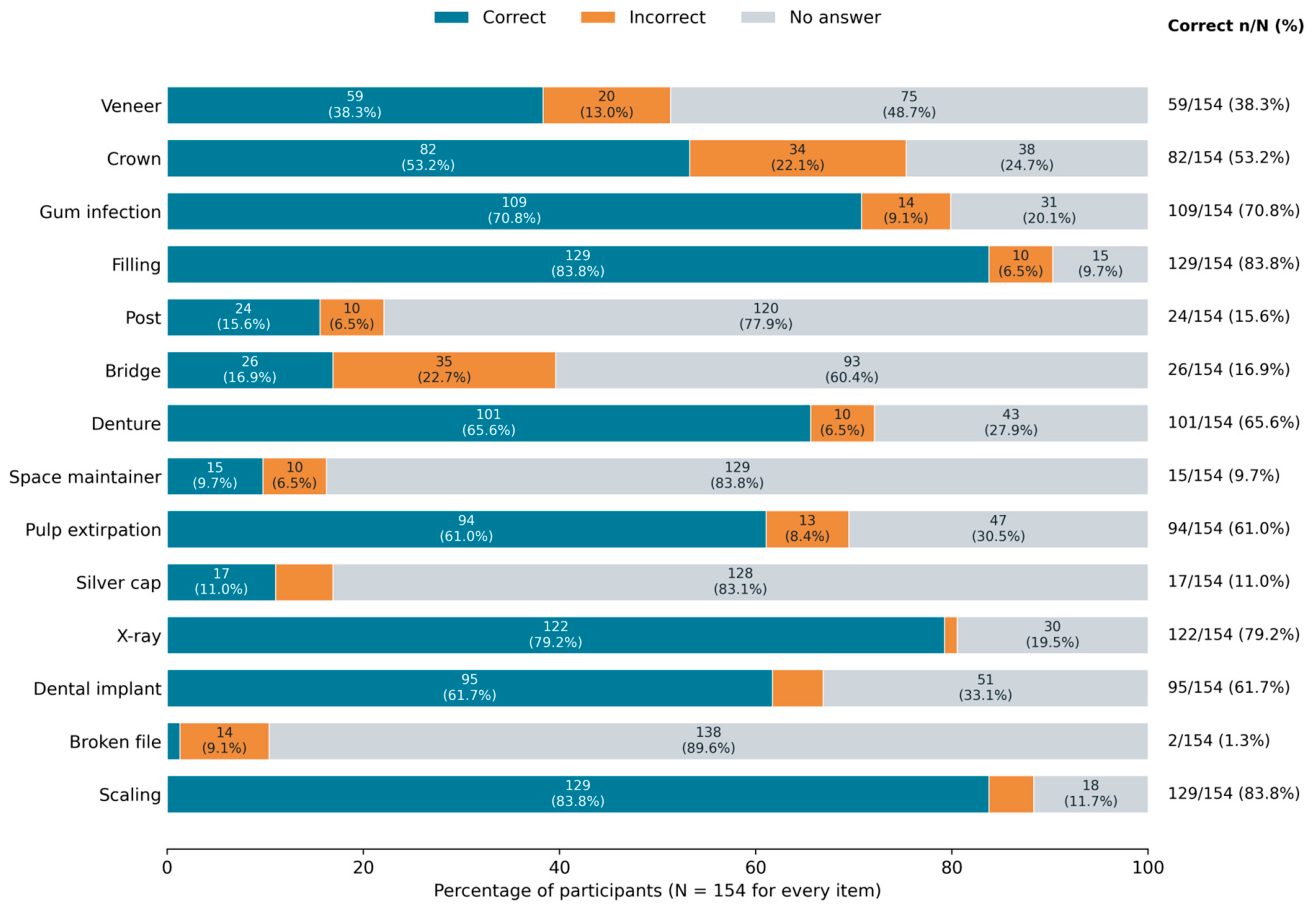
The proportion of correct responses varied substantially across the 14 dental terms (Figure 1; Supplementary Table S4). The highest comprehension rates were observed for filling and scaling (both 83.8%), X-ray (79.2%), and gum infection (70.8%). Intermediate rates were observed for denture (65.6%), pulp extirpation (61.0%), dental implant (61.7%), and crown (53.2%). Correct responses were less frequent for veneer (38.3%), bridge (16.9%), post (15.6%), silver cap (11.0%), space maintainer (9.7%), and broken file (1.3%).
Figure 1.
Responses to each dental terminology item in the corrected sample (N = 154 for every item). Blue: correct; orange: incorrect; grey: don’t know/no answer. Segment labels show counts and percentages; the right-hand column shows n/N (%) for every item. All exact counts and percentages, including small segments, are reported in Supplementary Table S4.
Item-level comparisons examined associations between correct responses and participant characteristics. After Holm adjustment for the 56 item-by-characteristic comparisons, only the associations between previous dental visits and comprehension of pulp extirpation (adjusted p = 0.025) and X-ray (adjusted p = 0.004) remained statistically significant. Participants with more previous dental visits were more likely to answer these items correctly. Other nominal item-level associations did not remain statistically significant after adjustment (Table 2). Complete results, including raw and adjusted p-values and sparse-cell diagnostics, are provided in Supplementary Table S5.
Table 2.
Item-level associations remaining significant after Holm adjustment across 56 exact comparisons (N = 154).
3.5. Correlations with Total Comprehension Score
Comprehension scores were positively correlated with dental-visit frequency (ρ = 0.274, p < 0.001; Table 3). No statistically significant correlation was observed with age-group rank (ρ = 0.146, p = 0.071). Similarly, the comparison across the three pooled age groups was not statistically significant (Kruskal–Wallis p = 0.166; Table 1). These analyses assessed age differently: the correlation examined the trend across four ordered age bands, whereas the Kruskal–Wallis test compared the three pooled groups.
Table 3.
Spearman correlations of ordered participant characteristics with total comprehension score (N = 154).
In an exploratory sensitivity analysis excluding the single participant aged >55 years, the age correlation increased slightly (ρ = 0.168, p = 0.038), compared with the full-sample estimate (ρ = 0.146, p = 0.071). The change in statistical significance following the exclusion of one participant indicates that the age-related finding was sensitive to this observation and should be interpreted cautiously. Neither analysis supports meaningful conclusions about participants aged >55 years.
3.6. Exploratory Comparison of Common and Technical Terms
In an exploratory within-participant comparison, comprehension was higher for terms assigned to the routine/common group than for those assigned to the technical/specialized group. The mean score was 4.98 ± 1.87 out of 7 (71.2%) for routine/common terms, compared with 1.54 ± 1.46 (22.0%) for technical/specialized terms. This difference was statistically significant (Wilcoxon signed-rank test: W = 0, p < 0.001; 140 nonzero differences and 14 ties).
“Don’t know” or blank responses were particularly frequent for broken file (89.6%), space maintainer (83.8%), silver cap (83.1%), and post (77.9%) (Figure 1; Supplementary Table S4). These responses were distinguished from incorrect interpretations in the scoring system. However, the response data do not establish why participants left these items unanswered or selected “don’t know”.
3.7. Exploratory Adjusted Analysis
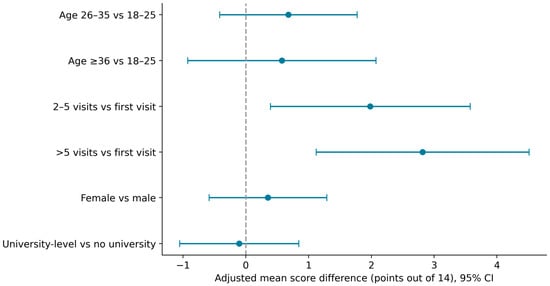
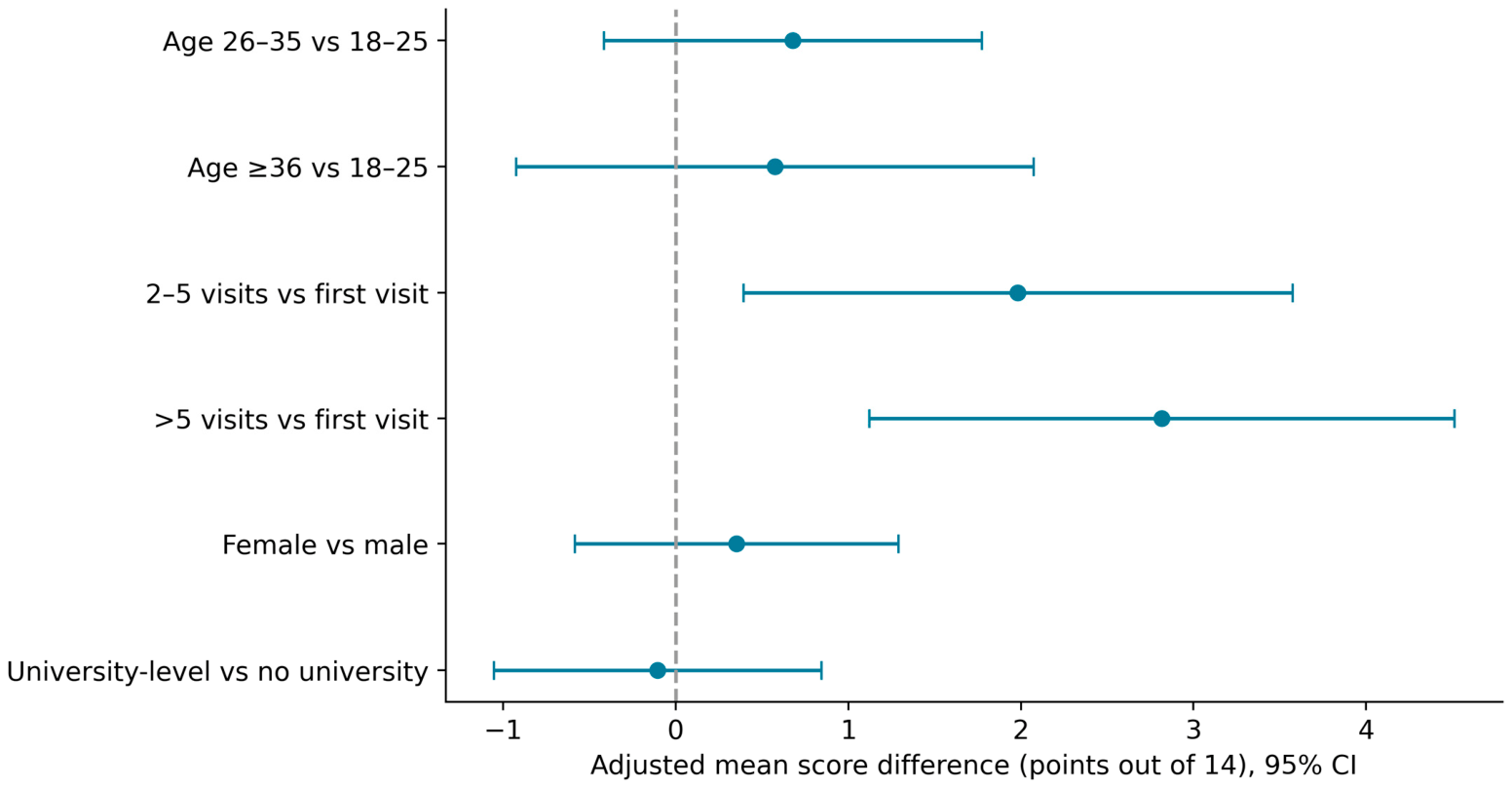
An exploratory multivariable linear regression model was used to examine associations between participant characteristics and total comprehension score (Table 4; Figure 2). Compared with first-time visitors, participants reporting 2–5 previous dental visits had an adjusted mean score 1.98 points higher (95% CI, 0.39–3.57; p = 0.015), while those reporting more than five visits had an adjusted mean score 2.82 points higher (95% CI, 1.12–4.51; p = 0.001). The joint robust Wald test indicated an overall association between dental-visit frequency and comprehension score (p = 0.004). Age (p = 0.440), gender (p = 0.463), and education (p = 0.828) were not significantly associated with the outcome in the adjusted model.
Table 4.
Exploratory multivariable associations with total comprehension score (N = 154).
Figure 2.
Adjusted mean score differences and 95% HC3 robust confidence intervals from the exploratory multivariable model (N = 154). The vertical line marks no difference. Predictors were entered simultaneously; intervals are not multiplicity-adjusted. See Table 4 for reference groups.
The model explained 12.8% of the variance in comprehension scores (R2 = 0.128; adjusted R2 = 0.092). Fitted values ranged from 4.04 to 7.88, within the possible score range of 0–14. Residual normality was not rejected (Shapiro–Wilk p = 0.772), and there was no evidence of heteroscedasticity (Breusch–Pagan p = 0.101). The maximum leverage was 0.102, and the maximum Cook’s distance was 0.060, with no single observation identified as disproportionately influential. HC3 robust standard errors were retained regardless of the heteroscedasticity test result. In a sensitivity analysis excluding the participant older than 55 years, the adjusted associations with dental-visit frequency remained similar (adjusted mean differences, 2.02 and 2.82 points for the 2–5 and more than five visit groups, respectively). Further model details are provided in Supplementary Table S6.
4. Discussion
In this predominantly young, university-clinic convenience sample, participants correctly defined an average of 6.52 ± 2.89 of the 14 assessed dental terms. Correct-response rates varied considerably across individual terms and were higher, on average, for the investigator-defined routine/common group than for the technical/specialized group. Regarding the characteristic-specific no-association hypotheses, the findings provided evidence against the null hypothesis for previous dental visits, but not for age, gender, or university-level education. The association with dental visits was statistically significant in the unadjusted and adjusted analyses, whereas the corresponding findings for the other characteristics were not. These non-significant results do not establish the absence of associations. Importantly, the study assessed definitions of isolated terms rather than overall oral health literacy or functional understanding during clinical discussions.
The higher mean comprehension score for the routine/common group suggests that participants were generally more familiar with some of the selected terms assigned to this group. However, this difference should be interpreted in the context of how the terms were selected and classified. The grouping was based on the research team’s clinical judgment of expected patient familiarity, rather than independently measured familiarity, linguistic complexity, or frequency of use in clinical practice. For example, gum infection and silver cap are both expressed in relatively accessible language but were assigned to different groups. Moreover, pulp extirpation, despite its technical/specialized classification, was correctly defined by 61.0% of participants, exceeding the rate for crown (53.2%). The observed difference therefore describes the two selected sets of terms and cannot be attributed specifically to technical wording or clinical exposure. These findings are consistent with previous reports of variation in patients’ understanding of medical and dental terminology [8,22], but they do not establish a general hierarchy of difficulty across dental terminology.
The item-level findings provide a more specific account of which terms were understood more or less frequently within this sample. Terms such as filling, scaling, X-ray, and gum infection had relatively high correct-response rates, whereas broken file, space maintainer, silver cap, post, and bridge were less frequently defined correctly. The high proportions of “don’t know” or blank responses for some terms also distinguish stated uncertainty or non-response from an incorrect interpretation. This distinction is relevant when considering patient communication: an unfamiliar term may require explanation, whereas an incorrect interpretation may require clarification of a misconception. Nevertheless, the questionnaire did not establish why participants did not answer particular items or whether their responses reflected unfamiliarity, uncertainty, or other factors.
The association between previous dental visits and total comprehension score was consistent across the unadjusted and adjusted analyses. The unadjusted rank correlation was modest (ρ = 0.274), while the adjusted mean differences, relative to first-time visitors, were 1.98 points for participants reporting 2–5 visits and 2.82 points for those reporting more than five visits on the 14-point scale. These estimates represent average between-group differences of approximately two and three correct definitions, respectively, rather than improvements attributable to additional attendance. Although the associations were statistically significant, their practical importance remains uncertain because no validated minimally important difference was established and the study did not assess functional understanding or clinical outcomes. Furthermore, the full model explained 12.8% of the observed score variation; this represents the explanatory performance of the model as a whole, not the contribution of dental-visit history alone. The findings therefore suggest that previous dental visits are associated with comprehension, but do not establish that repeated attendance improves understanding.
Several explanations may account for the observed association with dental-visit history. Previous visits may represent accumulated opportunities to encounter dental terminology, but they may also reflect differences in access to care, previous disease burden, treatment experience, or socioeconomic circumstances. Patients with greater baseline knowledge may also differ in their patterns of dental attendance. These possibilities were not directly examined and should be regarded as potential explanations rather than demonstrated mechanisms. The association is broadly consistent with previous research on patient understanding of dental and medical terminology [10,22], although differences in study populations and settings may limit direct comparisons.
The findings have potential relevance to patient-centered communication and dental education. Terms that were less frequently understood may warrant particular attention when clinicians explain diagnoses and procedures. Plain-language explanations, visual aids, and teach-back are potential approaches discussed in the broader communication literature [17,23,24]. Similarly, the item-level findings may inform educational activities that train dental students to recognize unfamiliar terminology and check patients’ understanding. However, this study did not evaluate communication interventions or measure informed-consent quality, anxiety, adherence, satisfaction, shared decision-making, or treatment outcomes. Any benefits of these approaches for such outcomes therefore remain potential implications supported by the broader literature, rather than effects demonstrated by the present findings [25,26].
Overall, this study provides a term-specific account of dental terminology comprehension among Arabic-speaking patients attending a university dental clinic in Saudi Arabia. By examining open-ended definitions of individual terms, it offers information that is distinct from assessments based on general oral health literacy or word recognition. Its findings should nevertheless be interpreted in relation to the selected terminology, the questionnaire, and the characteristics of the sampled population, rather than assumed to represent all dental patients or Arabic-speaking populations.
Limitations and Future Research
This study has several limitations. First, convenience sampling at a single university dental center may have introduced selection bias and limits the generalizability of the findings to other clinical settings and populations. The sample was predominantly young, with 64.9% of participants aged 18–25 years, only one participant older than 55 years, and one with postgraduate education. The single participant aged over 55 years precludes meaningful separate analysis of this age subgroup. Although this participant was pooled with those aged 36–55 years for the main categorical analysis, this approach does not overcome the limited representation of older adults. Furthermore, the age-correlation sensitivity analysis excluding this participant changed the result from non-significant to nominally significant (ρ = 0.168, p = 0.038, compared with ρ = 0.146, p = 0.071 in the full sample), indicating that age-related inference was sensitive to a single observation. The limited representation of some educational categories also constrains interpretation of the corresponding findings. Although the confidence interval for the overall mean achieved the prespecified precision target, this does not establish adequate statistical power for secondary comparisons or subgroup analyses.
Second, the cross-sectional design prevents conclusions about the temporal or causal relationship between previous dental visits and comprehension. The study did not collect socioeconomic information, a validated oral health literacy measure, or detailed disease and treatment histories. These factors may be associated with both dental attendance and terminology comprehension and could therefore confound the observed association. Adjustment for age group, gender, and university-level education does not eliminate the possibility of residual or unmeasured confounding. In addition, age was recorded in broad categories rather than as exact age, and the number of previous visits was categorized rather than recorded as an exact count. The non-significant findings for age, gender, and education should also be interpreted in light of the sample size, limited representation of some categories, and uncertainty around the adjusted estimates; they should not be taken as evidence of equivalence or true absence of associations.
Third, measurement and response biases cannot be excluded. The questionnaire assessed definitions of isolated terms and did not measure functional understanding during actual treatment discussions, where explanations, visual aids, and opportunities for clarification may influence comprehension. The questionnaire was not a validated measure of overall oral health literacy, and no threshold for adequate comprehension was established. The 14 terms were selected through clinical observations and informal consultation with dental staff rather than a systematic frequency-based process. No structured clinician ratings of term-use frequency or independent patient-familiarity assessments were obtained. Consequently, the selected terms may not represent the full range or frequency of patient-facing dental terminology, and the routine/common and technical/specialized groupings remain exploratory rather than independently validated. In addition, student-led recruitment in a clinical setting may have introduced perceived expectations or socially desirable responses, despite assurances that participation and responses would not affect treatment. Although participants were supervised during questionnaire completion and instructed not to seek external assistance, unaided responding could not be verified. Written responses may have also been influenced by guessing, expressive ability, or effort. Although two reviewers independently classified the responses using prespecified criteria, some degree of response-classification error remains possible, particularly for ambiguous or partially correct answers. The decision not to award partial credit may also have resulted in some responses demonstrating partial understanding being classified as incorrect, potentially underestimating the degree of comprehension in the sample. Nevertheless, inter-rater agreement was good, although this does not entirely exclude classification subjectivity. The small test–retest sample of 10 participants also limits the strength of conclusions about temporal reproducibility. Finally, the precision achieved for the overall mean should not be interpreted as evidence that the study was adequately powered for all secondary or exploratory analyses.
Future studies should use multicenter probability sampling with explicit sampling frames across university and private dental practices, include other Arabic-speaking regions, and ensure adequate representation of older adults and less frequently represented educational groups. Collecting socioeconomic characteristics, access-to-care information, detailed disease and treatment histories, exact age, and more detailed dental attendance data, alongside validated and linguistically appropriate oral health literacy measures, would allow more comprehensive assessment of potential confounding. Longitudinal studies measuring baseline comprehension and subsequent attendance, disease, treatment, and communication experiences could clarify temporal relationships. Randomized studies could evaluate whether plain-language explanations, visual aids, or teach-back improve comprehension and patient-centered outcomes. Mixed-methods research incorporating cognitive interviews and qualitative assessment could compare isolated-term definitions with understanding during clinical discussions. Future questionnaire development should also incorporate structured clinician ratings of terminology-use frequency across different settings, patient assessments of familiarity, and independent validation of any proposed terminology groupings.
5. Conclusions
In this predominantly young, single-center university-clinic sample, comprehension varied across the 14 dental terms assessed and was higher for the investigator-defined routine/common terms than for the technical/specialized terms. Greater numbers of previous dental visits were associated with higher comprehension scores, whereas no statistically significant associations were detected with age, gender, or university-level education. These findings should be interpreted in the context of the study’s cross-sectional design, convenience sampling, and exploratory classification of dental terms. Importantly, the ability to define individual terms does not necessarily reflect patients’ understanding during actual clinical discussions. The findings highlight the importance of explaining dental terminology in accessible language and checking patients’ understanding during consultations. However, this study did not evaluate whether such communication practices improve informed-consent quality, reduce anxiety, increase adherence, or affect clinical outcomes. Further multicenter research using representative samples and validated assessment approaches is needed to establish the broader relevance of these findings and to evaluate whether communication interventions improve patients’ understanding.
Supplementary Materials
The following supporting information can be downloaded at: https://www.mdpi.com/article/10.3390/healthcare14234055/s1, Supplementary File S1, the original questionnaire; Supplementary Table S1, term inventory and exploratory grouping; Supplementary Table S2, item-specific intended meanings and scoring criteria; Supplementary Table S3, descriptives using original categories; Supplementary Table S4, item-level response counts and percentages; Supplementary Table S5, all 56 exploratory item-by-characteristic comparisons; Supplementary Table S6, model diagnostics and sensitivity analysis.
Author Contributions
Conceptualization, L.S.A. and B.A.; methodology, L.S.A. and B.A.; validation, L.S.A., B.A., M.A., R.A.A. and S.T.A.; formal analysis, L.S.A., B.A. and M.A.; investigation, R.A.A. and S.T.A.; data curation, R.A.A. and S.T.A.; writing—original draft preparation, L.S.A., B.A., M.A., R.A.A. and S.T.A.; writing—review and editing, L.S.A., B.A., M.A., R.A.A. and S.T.A.; supervision, L.S.A. and B.A. All authors have read and agreed to the published version of the manuscript.
Funding
This research received no external funding.
Institutional Review Board Statement
The study was conducted in accordance with the Declaration of Helsinki and approved by the Standing Committee of Bioethics Research of Prince Sattam Bin Abdulaziz University (protocol SCBR-336/2024; 9 September 2024).
Informed Consent Statement
Informed consent was obtained from all subjects involved in the study.
Data Availability Statement
The data presented in this study are available on request from the corresponding author due to privacy and ethical restrictions.
Conflicts of Interest
The authors declare no conflicts of interest.
Abbreviations
CI, confidence interval; HC3, heteroskedasticity-consistent covariance estimator, type 3; ICC, intraclass correlation coefficient; S-CVI/Ave, scale-level content validity index, average method; SD, standard deviation; STROBE, Strengthening the Reporting of Observational Studies in Epidemiology.
References
- Kumar, M.P.; Nagate, R.R.; Alqahtani, S.M.; Sarma, S.N.G.; Supraja, S. Role of jargon in the patient–doctor communication in the dental healthcare sector—A systematic review and meta-analysis. J. Educ. Health Promot. 2023, 12, 198. [Google Scholar] [CrossRef] [Scilit]
- Scambler, S.; Delgado, M.; Asimakopoulou, K. Defining patient-centred care in dentistry? A systematic review of the dental literature. BR. Dent. J. 2016, 221, 477–484. [Google Scholar] [CrossRef] [Scilit]
- Ho, J.C.Y.; Chai, H.H.; Luo, B.W.; Lo, E.C.M.; Huang, M.Z.; Chu, C.H. An overview of dentist–patient communication in quality dental care. Dent. J. 2025, 13, 31. [Google Scholar] [CrossRef] [Scilit]
- Lerner, E.B.; Jehle, D.V.; Janicke, D.M.; Moscati, R.M. Medical communication: Do our patients understand? Am. J. Emerg. Med. 2000, 18, 764–766. [Google Scholar] [CrossRef] [Scilit]
- Gotlieb, R.; Praska, C.; Hendrickson, M.A.; Marmet, J.; Charpentier, V.; Hause, E.; Allen, K.A.; Lunos, S.; Pitt, M.B. Accuracy in Patient Understanding of Common Medical Phrases. JAMA Netw. Open 2022, 5, e2242972. [Google Scholar] [CrossRef] [Scilit]
- Haji Seyed Javadi, S.K. From Patient Experience to Dental Service Return Visits: A Narrative Review of Strategies for Improving Dental Care Services. J. Patient Exp. 2025, 12, 23743735251406349. [Google Scholar] [CrossRef] [Scilit]
- Hamad, A.A.; Mustaffa, D.B.; Alnajjar, A.Z.; Amro, R.; Deameh, M.G.; Amin, B.; Alkhawaldeh, I.M. Decolonizing medical education: A systematic review of educational language barriers in countries using foreign languages for instruction. BMC Med. Educ. 2025, 25, 701. [Google Scholar] [CrossRef] [Scilit]
- Hayes, E.; Dua, R.; Yeung, E.; Fan, K. Patient understanding of commonly used oral medicine terminology. Br. Dent. J. 2018, 223, 842–845. [Google Scholar] [CrossRef] [Scilit]
- AlDehlawi, H.; Jazzar, A.; Al-Turki, G.; Alhamed, S.; Akeel, S.; Mullah, Y.; Alshakweer, F.; Farag, A.M. Enhancing Communication in Dental Clinics through Understanding Oral Medicine Terminology. Open Dent. J. 2024, 18, e18742106302370. [Google Scholar] [CrossRef] [Scilit]
- Benning, A.; Madadian, M.A.; Seehra, J.; Fan, K. Patients understanding of terminology commonly used during combined orthodontic-orthognathic treatment. Surgeon 2021, 19, e193–e198. [Google Scholar] [CrossRef] [Scilit]
- Dua, R.; Vassiliou, L.; Fan, K. Common maxillofacial terminology: Do our patients understand what we say? Surgeon 2015, 13, 1–4. [Google Scholar] [CrossRef] [Scilit]
- Ghisi, G.L.M.; Dos Santos, R.Z.; Britto, R.R.; Bonin, C.D.B.; Servio, T.C.; Schmidt, L.F.; Benetti, M.; Grace, S.L. Validation of a Scale to Assess Patients’ Comprehension of Frequently Used Cardiology Terminology: The Cardiac TERM Scale in Brazilian Portuguese. Rehabil. Nurs. 2019, 44, 87–95. [Google Scholar] [CrossRef] [Scilit]
- Cosic, F.; Kimmel, L.; Edwards, E. Patient Comprehension of Common Orthopedic Terminology. Health Lit. Res. Pract. 2019, 3, e187–e193. [Google Scholar] [CrossRef] [Scilit]
- O’Connell, R.L.; Hartridge-Lambert, S.K.; Din, N.; St John, E.R.; Hitchins, C.; Johnson, T. Patients’ understanding of medical terminology used in the breast clinic. Breast 2013, 22, 836–838. [Google Scholar] [CrossRef] [Scilit]
- Jameson, L.M.; Al-Tarawneh, S.K. Informed consent from a historical, societal, ethical, legal, and practical perspective. J. Prosthodont. 2022, 31, 464–471. [Google Scholar] [CrossRef] [Scilit]
- Felgner, S.; Handrock, J.-F.; Schroll, C.C.; Schütte, F.; Henschke, C. Decision-making regarding dental treatments–What factors matter from patients’ perspective? A systematic review. BMC Oral. Health 2025, 26, 289. [Google Scholar] [CrossRef] [Scilit]
- Howard, T.; Jacobson, K.L.; Kripalani, S. Doctor talk: Physicians’ use of clear verbal communication. J. Health Commun. 2013, 18, 991–1001. [Google Scholar] [CrossRef] [Scilit]
- Alzeer, M.E.; AlJameel, A.H.; Rosing, K.; Øzhayat, E.B. Validation of an Arabic version of the short form of the health literacy in dentistry scale: A cross-sectional study. BMC Oral. Health 2024, 24, 638. [Google Scholar] [CrossRef] [Scilit]
- Tadakamadla, S.K.; Quadri, M.F.A.; Pakpour, A.H.; Zailai, A.M.; Sayed, M.E.; Mashyakhy, M.; Inamdar, A.S.; Tadakamadla, J. Reliability and validity of Arabic rapid estimate of adult literacy in dentistry (AREALD-30) in Saudi Arabia. BMC Oral. Health 2014, 14, 120. [Google Scholar] [CrossRef] [Scilit]
- Badran, A.; Keraa, K.; Farghaly, M.M. The impact of oral health literacy on dental anxiety and utilization of oral health services among dental patients: A cross sectional study. BMC Oral. Health 2023, 23, 146. [Google Scholar] [CrossRef] [Scilit]
- Khanagar, S.B.; Alanazi, S.; Alotaibi, R.; Alenazi, H.; Altalhi, L. Assessment of Language Barriers Between Dental Students and Patients in Riyadh, Saudi Arabia—A Mixed Methods Study. Dent. J. 2026, 14, 115. [Google Scholar] [CrossRef] [Scilit]
- Hamilton, A.; Lamey, P.; Ulhaq, A.; Besi, E. Commonly used terminology in oral surgery and oral medicine: The patient’s perspective. Br. Dent. J. 2021, 230, 823–830. [Google Scholar] [CrossRef] [Scilit]
- Momin, P.; Mahmood, S. A quality improvement project to assess the use of visual aids to improve understanding and motivation in periodontal patients. BDJ Open 2020, 6, 15. [Google Scholar] [CrossRef] [Scilit]
- Glaser, J.; Nouri, S.; Fernandez, A.; Sudore, R.L.; Schillinger, D.; Klein-Fedyshin, M.; Schenker, Y. Interventions to improve patient comprehension in informed consent for medical and surgical procedures: An updated systematic review. Med. Decis. Mak. 2020, 40, 119–143. [Google Scholar] [CrossRef] [Scilit]
- Tseng, W.; Pleasants, E.; Ivey, S.L.; Sokal-Gutierrez, K.; Kumar, J.; Hoeft, K.S.; Horowitz, A.M.; Ramos-Gomez, F.; Sodhi, M.; Liu, J. Barriers and facilitators to promoting oral health literacy and patient communication among dental providers in California. Int. J. Environ. Res. Public Health 2021, 18, 216. [Google Scholar] [CrossRef] [Scilit]
- Altaş, Z.M.; Sezerol, M.A.; Halaç, Ş.; Aslan, M.N. The relationship between oral and dental health literacy and health-seeking behaviors: A multicenter community-based study. BMC Public Health 2025, 25, 3650. [Google Scholar] [CrossRef] [Scilit]

Disclaimer/Publisher’s Note: The statements, opinions and data contained in all publications are solely those of the individual author(s) and contributor(s) and not of MDPI and/or the editor(s). MDPI and/or the editor(s) disclaim responsibility for any injury to people or property resulting from any ideas, methods, instructions or products referred to in the content. |
© 2026 by the authors. Licensee MDPI, Basel, Switzerland. This article is an open access article distributed under the terms and conditions of the Creative Commons Attribution (CC BY) license.