


Abstract
Background: Wound management imposes a significant clinical and economic burden on health care systems, especially regarding chronic wounds. Community pharmacies, given their accessibility and pharmacist clinical expertise with support of pharmacy technicians, are positioned to facilitate early wound assessment, patient education, and the selection of suitable topical therapies. Nevertheless, the specific role of pharmacies in wound care remains inadequately defined and underutilised. Objectives: This study aimed to evaluate pharmacists’ and pharmacy technicians’ knowledge, competencies, and perceptions regarding their role in wound management, with particular emphasis on wound therapy and antiseptic practices. Methods: A cross-sectional study was conducted among 838 pharmacists and pharmacy technicians employed in community pharmacies, hospital settings, and other pharmaceutical services. An interdisciplinary team, including specialists in clinical pharmacy, public health, and medical professionals such as nurses, obstetricians, and physicians, developed the research tool. Independent pharmacy experts then evaluated its substantive accuracy, assessing whether the tool’s content aligned with the research objectives. Results: A majority of respondents indicated active involvement in wound care counselling, with 47% providing advice several times per week and 24% daily. Most pharmacists (94%) agreed that pharmacies should provide wound care support. However, only 14% reported regular use of standardised wound management algorithms, while 68% did not use them at all. The most pronounced knowledge gaps were observed in wound lavage (lavasepsis), with nearly half of the respondents indicating insufficient knowledge. Pharmacists perceived themselves as highly effective in managing minor wounds, such as burns and abrasions, but less effective in complex cases, including infected or chronic wounds. Workplace setting was found to significantly influence practice patterns and perceived competencies (p < 0.05). Conclusions: Developing pharmacists’ wound management competencies should focus on structured education and continuing professional development, access to practical wound management tools, and appropriate organisational conditions for delivering pharmaceutical care services.
1. Introduction
Wound care imposes a substantial clinical and economic burden on health care systems. Acute and chronic wounds are associated with increased risks of infection, prolonged treatment durations, and significant resource use, encompassing both direct treatment costs and indirect effects such as functional impairment and diminished quality of life [1,2,3,4]. Chronic wounds result from prolonged impaired healing and often require long-term, individualised treatment strategies. Effective management relies on early recognition and systematic assessment of wound characteristics, tissue condition, moisture or exudate levels, surrounding skin, and signs of infection. Because chronic wound infections may present with subtle or atypical symptoms, regular comprehensive evaluations are essential for appropriate therapeutic decisions [1,5,6].
Early recognition of wound infection is crucial for effective management, including selecting appropriate local antiseptic treatments and referring patients for further assessment when necessary [6].
Pharmacists, as accessible health care professionals, can facilitate early identification of wound-related issues, provide guidance on selecting dressings and antiseptics, and refer patients for appropriate diagnostic procedures [6,7,8]. Contemporary care models further underscore pharmacists’ potential to monitor treatment outcomes and educate patients. However, despite the growing recognition of expanded pharmaceutical services, the specific contribution of pharmacists to wound management remains inadequately defined and underutilised.
A major barrier is the absence of consistently implemented standards of practice and restricted access to targeted educational programmes [9]. Consequently, most available data are descriptive and do not permit evaluation of the relationships between professional factors and pharmacists’ actual clinical practices [10]. This limitation impedes the development of effective, evidence-based interventions. Addressing this gap is especially important due to the growing burden of wound management on health care systems and the necessity to optimise resource utilisation.
Poland represents as important yet under-researched context for assessing pharmacists’ competencies in wound care. The dynamic growth of pharmaceutical services, the expanding role of community pharmacies, and the limited number of relevant studies underscore the need for further research among Polish pharmacists [11].
Studies in Poland show public interest in developing pharmaceutical services and support for pharmacists’ involvement in patient care. Continued improvement of professional competencies, appropriate organisational conditions, and stronger integration with other healthcare team members are essential for further development [12,13,14].
It should be emphasized that the development of pharmaceutical services provided in community pharmacies may represent one of the strategies for reducing the burden on primary and urgent healthcare services. Poland has a relatively well-developed network of community pharmacies and a substantial pharmacist workforce. Earlier data indicated approximately 36 community pharmacies and 77 pharmacists per 100,000 inhabitants in Poland [15,16], figures broadly comparable with those reported in other European countries.
Studies conducted in Poland have demonstrated a positive perception of pharmacists as healthcare professionals and a considerable willingness among patients to use pharmacist-led consultations.
Community pharmacies may also serve as an accessible first point of contact for patients seeking advice regarding minor injuries, skin conditions, and wounds. However, data describing the actual frequency and nature of wound-related consultations in community pharmacies remain limited, particularly in continental European countries, including Poland. Evidence from other healthcare systems suggests that such problems account for a meaningful proportion of consultations managed by community pharmacists.
For example, in a study conducted across community pharmacies in South-East England, 432 urgent care consultations were recorded over a two-week period. More than half involved symptom-based consultations, while skin-related conditions accounted for a substantial proportion of presenting complaints. Importantly, the authors estimated that almost half of all consultations could potentially have prevented patients from seeking care elsewhere within the National Health Service [17].
These findings suggest that community pharmacies may play an important role in the initial assessment of minor health problems, provision of self-care advice, and identification of patients requiring referral to another healthcare professional. At the same time, the lack of comparable data on the frequency and characteristics of wound-related consultations in Polish community pharmacies represents an important evidence gap and provides a clear rationale for further research in this area.
2. Objectives
The aim of this study was to characterise factors associated with pharmacists’ self-reported competence in wound management and to assess their combined contribution to explaining variation in these competencies.
Research Hypothesis
Pharmacists’ self-reported competence in wound management is significantly associated with respondents’ sociodemographic and professional characteristics, experience in wound management, self-reported knowledge, perceptions of pharmacists’ role in caring for patients with wounds, and organisational conditions in the pharmacy.
3. Materials and Methods
3.1. Study Design
This cross-sectional study included total of 838 pharmacists and pharmacy technicians working in community pharmacies, hospitals, and other pharmaceutical services. Eligible participants were licensed, professionally active pharmacists. To ensure only the target population participated, respondents confirmed their status as pharmacists or pharmacy students in Poland at the start of the survey. Those who did not meet these criteria were excluded. Internal case controls included workplace, years of professional practice, and place of graduation.
Before completing the questionnaire, participants were informed about the study objectives, the voluntary nature of participation, and the confidentiality of the data collected. A total of 1000 individuals were invited to participate. Of these, 980 accessed the questionnaire and initiated the survey, and 960 completed it. Following eligibility screening and data-quality assessment, 122 of the 960 completed questionnaires were excluded because of eligibility or consent issues, inconsistent or duplicate responses, or other problems preventing reliable analysis. Consequently, 838 respondents were included in the final study sample.
The final inclusion rate was 83.8% (838/1000 invited individuals); the questionnaire completion rate was 96.0% (960/1000 invited individuals).
The survey was conducted from November to December 2025.
3.2. Research Instrument
A custom questionnaire was used, consisting of 48 questions on professional experience, wound care scope, knowledge level, training needs, and demographic information such as sex, age, professional status, academic degree, years of practice, and workplace.
An interdisciplinary team of specialists in clinical pharmacy and public health, together with nurses experienced in surgical nursing and the care of chronic and hard-to-heal wounds; midwives experienced in the care and treatment of perineal wounds after childbirth, caesarean section wounds, and other postpartum wounds; and physicians experienced in the management of ischaemic wounds, lower-limb ulcers, and diabetic foot syndrome, developed the research instrument. Content validity was assessed by independent experts who had not participated in the development of the instrument.
A pilot study assessed the survey’s clarity and wording. Based on feedback, some questions were slightly revised to improve understanding. These changes did not affect the tool’s structure or scope.
Most items were rated on a 5-point Likert scale. For questions on frequency of behaviours or situations, the scale was: 1—I definitely disagree (never), 2—I rather disagree (seldom), 3—I have no opinion, 4—I rather agree (sometimes), and 5—I definitely agree (often).
The scale used to assess pharmacists’ knowledge and competencies in wound care demonstrated high internal reliability (Cronbach’s alpha = 0.884). The consistency of the analyzed items allows for the scale’s use to further assess pharmacists’ knowledge and competencies and identify factors associated with their preparedness to provide wound care advice.
3.3. Method: An Online Survey Comprising Both Closed and Open-Ended Questions
Promotion of the study: The campaign website “Rany pod kontrolą” (“Wounds under Control”), websites of the Polish Pharmaceutical Chamber and regional pharmaceutical chambers, industry magazines and portals, social media platforms such as Facebook and Instagram pharmacist groups, email distributions by pharmaceutical chambers, mailings to members of the Professional Trade Union of Pharmacist Employees (ZZPF) and the Polish Pharmacy Practice Research Network (PPPRN), as well as direct mailings to pharmacies.
3.4. Statistical Analysis
Descriptive statistics were presented in tables, displaying the frequency and percentage of responses to questionnaire items. Graphical representations consisted of vertical bar charts and box plots.
The association between two variables was evaluated using Spearman’s rank correlation coefficient.
The Spearman’s test included the following components:
N—sample size
R—correlation coefficient
T(N-2)—t-test statistic with n1 + n2—2 degrees of freedom
p level (p)—statistical significance
The non-parametric Mann–Whitney U test was used to assess differences in a single variable between two populations (groups).
The numbered fields in the result sheet, essential for interpretation, represent the following:
- [1]
- The p-value of the Mann–Whitney test for small sample sizes (less than 20);
- [2]
- The Mann–Whitney test statistic when both groups have sample sizes greater than 20;
- [3]
- The significance level calculated for the test statistic in [2];
- [4]
- The test statistic is adjusted for tied ranks, when both groups have sample sizes greater than 20;
- [5]
- The significance level calculated for the adjusted test statistic in [4];
- [6]
- The sample size of group “a”;
- [7]
- The sample size of group “b”.
The non-parametric Chi-square test was used to compare multiple independent samples (groups).
The test included the following components:
N—sample size;
H—test statistic;
df ( )—degrees of freedom;
p level (p)—significance.
All calculations and figures were generated using Statistica 10.0 and Microsoft Excel.
Multiple regression analysis was performed to identify factors associated with pharmacists’ self-reported competence in wound management. The dependent variable was the self-reported level of competence in wound management. Explanatory variables included respondents’ sociodemographic and professional characteristics, wound management experience, self-reported knowledge, perceptions of pharmacists’ role in caring for patients with wounds, and organisational conditions in the pharmacy.
The regression analysis included 833 respondents. Sample size adequacy was assessed using the heuristic minimum of 50 + 8k observations, where k denotes the number of predictors. With 22 predictors in the model, the corresponding minimum was 226 observations; the analysed sample exceeded this threshold.
The model yielded a multiple correlation coefficient of R = 0.877 and a coefficient of determination of R2 = 0.769, indicating that the included variables collectively accounted for 76.9% of the variance in pharmacists’ self-reported wound management competence. The adjusted R2 was 0.763, and the standard error of the estimate was 0.279.
The overall regression model was statistically significant (F = 122.706; p < 0.001), indicating that the explanatory variables were jointly associated with variation in respondents’ self-reported competence.
3.5. Ethical Approval
The study protocol, including recruitment, information/consent procedures, research instruments, and data-protection measures, was reviewed and approved by the Bioethical Committee at Poznan University of Medical Sciences (NO 761/25), 29 October 2025).
4. Results
4.1. Characteristics of the Sample
Seventy percent of respondents hold a master’s degree in pharmacy. Pharmacy technicians represent 17% of the sample, pharmacy specialists 9%, and doctors of pharmacy 3%.
A majority of respondents (87%) reported a specialisation in pharmacy. Five percent of respondents indicated a specialisation in hospital pharmacy, and another five percent in clinical pharmacy. The smallest proportion specialised in pharmacology (3%).
Fifty-nine percent of respondents are employed in chain community pharmacies, while 35% are employed in independent community pharmacies. 17% have worked for 6 to 10 years, 19% for 1 to 5 years, and 2% for less than one year (see Table 1).
Table 1.
Sociodemographic and professional characteristics of respondents.
4.2. Factors Associated with Self-Reported Competence
Regression analysis identified statistically significant associations between several predictors and pharmacists’ self-reported competence in wound management. The number of significant predictors should be verified against the final regression output and Table 2.
Table 2.
Declared Level of Competence in Wound Management.
The presence of a dedicated room for providing pharmaceutical care services in the pharmacy had the largest reported standardised regression coefficient (β = 0.253; p < 0.001). The positive coefficient indicates an association between the availability of such a room and higher self-reported competence.
Participation in wound management training was the second strongest reported predictor in terms of the standardised coefficient (β = 0.205; p < 0.001). This association underscores the potential relevance of continuing professional development and specialised education in wound care.
No statistically significant associations were found between self-reported competence and the principal sociodemographic or professional characteristics examined: age (p = 0.187), sex (p = 0.746), education (p = 0.637), pharmaceutical specialisation (p = 0.708), years of pharmacy experience (p = 0.580), workplace type (p = 0.283), or size of the locality in which respondents worked (p = 0.420).
The types of wounds most frequently presented by patients at pharmacies were also not significantly associated with pharmacists’ self-reported competence (p = 0.230; Table 2).
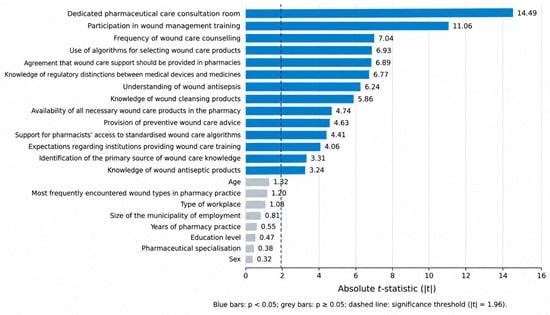
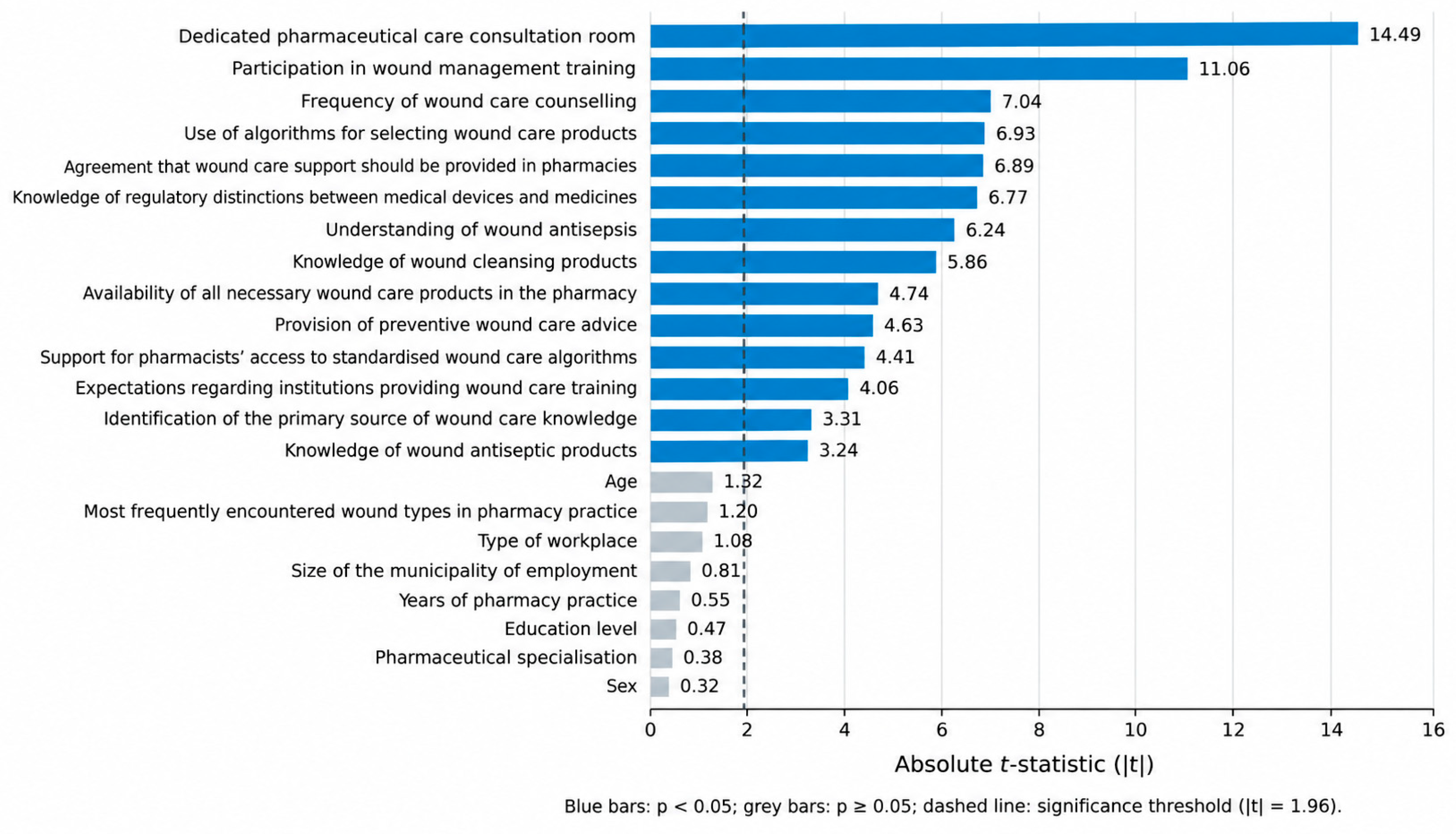
The ranking of predictors by the absolute values of their t-statistics (Figure 1) highlighted the dedicated pharmaceutical care room, participation in wound management training, and frequency of providing wound care advice as variables with relatively large test statistics. This ranking reflects statistical evidence against individual null hypotheses and should not be interpreted as a direct ranking of effect sizes.
Figure 1.
Ranking of predictors of self-reported wound management competence by absolute t-statistics from the multiple regression model. Predictors are ordered by descending absolute t-statistics. The vertical reference line indicates the approximate two-sided significance threshold at p = 0.05. Absolute t-statistics do not measure the magnitude or direction of standardised regression coefficients (β).
Other predictors with comparatively large absolute t-statistics included the use of wound care product selection algorithms, support for providing wound care advice in pharmacies, self-reported knowledge of product regulatory categories, familiarity with wound antisepsis, and knowledge of wound cleansing products.
Additional statistically significant variables addressed organisational resources and product availability in pharmacies, wound prevention, standardised procedures, and wound care education.
Taken together, these findings suggest that self-reported competence in wound management is associated with three broad domains: knowledge and training, practical application of knowledge, and organisational conditions supporting pharmaceutical care.
5. Discussion
In recent years, there has been growing interest in the potential role of community pharmacies in wound prevention and management.
Pharmacists and pharmacy technicians may contribute to this area, within the scope of their respective professional competencies, through activities such as patient education, support in the selection and appropriate use of medicinal products and medical devices, and identification of situations requiring referral to a physician or another healthcare professional. A scoping review examining the role of community pharmacy in wound care identified a broad range of potential activities that pharmacists may undertake in this field [18].
At the European Union level, minimum requirements for pharmacist education and training have been established; however, wound care has not been defined as a mandatory, standalone area of education. The detailed scope of pharmacists’ professional competencies and the organisation of services delivered in community pharmacies remain largely subject to national regulation. Consequently, the extent of pharmacists’ involvement in wound care may vary across European countries [19].
In Poland, pharmacist education is based on the national educational standard for programmes preparing graduates to practise as pharmacists. Current regulations require graduates to be prepared, among other competencies, to provide pharmaceutical advice, deliver pharmaceutical care, provide information on the use of medicinal products and medical devices, and educate patients. These competencies may also be applicable to wound-related counselling. However, wound care has not been identified in the educational standard as a separate field of competence or as an independent subject within the pharmacy curriculum. This highlights the need for a detailed analysis of pharmacy curricula and individual course syllabi to determine whether, and to what extent, wound-related topics are incorporated into undergraduate pharmacy education in Poland [20].
The regulatory framework governing pharmacy technicians should also be considered when discussing the potential development of wound-related services in community pharmacies. In Poland, pharmacy technicians are included among the healthcare professions regulated under the Act of 17 August 2023 on Certain Healthcare Professions, which introduced a formal framework for their professional practice, including requirements concerning professional registration and the performance of professional activities. This development strengthens the formal recognition of pharmacy technicians as members of the healthcare workforce and provides an important regulatory basis for considering their supporting role within community pharmacy teams. In the context of wound care, appropriately trained pharmacy technicians could support pharmacists in activities falling within their professional scope, thereby contributing to a team-based model of patient counselling and wound-related support.
Continuing professional development may therefore play an important role in complementing the competencies of both pharmacists and pharmacy technicians in this area. In Poland, wound care is included in postgraduate and continuing education activities addressed to pharmacy professionals. These educational programmes cover, among other topics, principles of wound management, the use of antiseptic agents, the selection of substances and products used in wound care, and the role of community pharmacy personnel in supporting patients with wounds.
From a service-development perspective, wound care in community pharmacies should therefore be considered not only in terms of the individual competencies of pharmacists, but also within the broader context of the pharmacy team. Clearly defined professional responsibilities, appropriate training, referral pathways, and collaboration between pharmacists and pharmacy technicians may facilitate the safe and structured development of wound-related counselling and support in community pharmacy practice.
Wound management presents significant clinical and economic challenges [1,14]. Chronic wounds require prolonged treatment, increase the risk of complications, and place a considerable burden on health care systems. Pharmacists, as accessible health care professionals and often the first point of contact for wound issues, can play a valuable role in wound counselling if properly prepared and supported by standardised procedures. However, pharmacists’ activities are not always guided by formal algorithms, adequate training, or clear referral criteria. Variations in workplace settings and weak links between knowledge, practice, education, and seniority highlight the importance of organisational factors such as work structure, access to clinical tools, and opportunities for professional development. The findings indicate that pharmacists lack sufficient systemic preparation to provide consistent, evidence-based wound counselling.
An important element of these organisational conditions is the availability of appropriate space for individual patient consultations. Although regulations have been introduced that enable pharmacists to provide pharmaceutical care services, including medication reviews, there remains a lack of up-to-date nationwide data on the number of pharmacies in Poland that have a dedicated room or designated area for consultations and pharmaceutical care services. In the present study, only 25% of pharmacists reported having a dedicated room at their workplace for the provision of pharmaceutical care services (Table A2). This finding may indicate limited availability of premises suitable for individual patient consultations; however, it should be emphasised that it relates only to the study population and should not be interpreted as representing the proportion of all pharmacies in Poland equipped with such facilities.
Current regulations provide for a pharmaceutical care room as part of the core premises of a pharmacy when pharmaceutical care is delivered, although an administrative and training room may also serve this function. Consequently, the provision of pharmaceutical care requires not only appropriate professional competencies among pharmacists but also organisational and infrastructural conditions that enable direct and individualised interaction with patients. The absence of such conditions may constitute an additional barrier to the full use of pharmacists’ competencies and to the provision of consistent, accessible, and evidence-based counselling.
In a team-based model of wound-related care, pharmacy technicians may also have a supporting role, provided that their activities remain within their professional scope of practice. Appropriately trained pharmacy technicians could contribute to the initial identification of the patient’s needs, collection of relevant information, recognition of basic characteristics of the wound, and identification of potential warning signs requiring escalation to the pharmacist. Such preliminary assessment should, however, be clearly distinguished from clinical decision-making. The pharmacist, whose education and professional competencies include pharmaceutical consultation, assessment of medication- and medical device-related needs, and autonomous decision-making within pharmaceutical care, should remain responsible for the final assessment, selection of the appropriate course of action, counselling, and, where necessary, referral to another healthcare professional.
This division of responsibilities may allow the competencies of the entire pharmacy team to be used more effectively while maintaining a clear clinical governance structure. Pharmacy technicians could therefore support patient triage and information gathering, whereas the pharmacist would retain responsibility for professional judgement and decisions requiring clinical assessment. Such an approach may be particularly relevant in community pharmacies with high patient volumes, where appropriately structured teamwork could improve accessibility to wound-related advice without compromising patient safety.
Given that wound-related services may, in some cases, require an appropriate level of patient privacy as well as the possibility for the patient to assume a lying position, the availability of suitably adapted consultation space warrants particular attention. This parameter may be associated with the feasibility of providing wound assessment and dressing services in community pharmacies. Access to an appropriately equipped and private consultation area may therefore represent one of the factors influencing the capacity of the pharmacy team to provide such services safely and effectively.
Our studies align with the international trend in social pharmacy, where pharmacists are increasingly assuming primary health care responsibilities [9,10,11,12]. Reviews of wound management in community pharmacies indicate that pharmacists may assess basic wound characteristics, select dressings, provide education, monitor healing, and identify when medical or nursing consultation is needed [18]. However, evidence on the safety and clinical outcomes of these services remain limited, and existing models vary in scope and organisation [18].
Our analysis shows that while pharmacists are involved in wound care, their activities are limited in scope. Approximately 47% of respond-ents reported providing advice several times per week, while 24% did so daily, under-scoring their critical role at the initial point of contact (Table A3). This finding aligns with the conclusions of Cheung at al. both of which highlight the growing significance of pharmacists within health care systems [18]. Our results indicate that having official authorisation to perform specific tasks does not guarantee consistent implementation in practice.
A comparable Australian cross-sectional study evaluated the knowledge of pharmacists and other community pharmacy staff [18]. The study assessed understanding of healing principles, wound recognition, patient referrals, and dressing selection, minimising self-assessment bias. Notably, gaps in knowledge about dressing properties and use were similar to those found in our study. In Australia, prior training and experience correlated with higher knowledge scores, whereas in our analysis, education and seniority showed weak associations (Table A1).
The findings suggest that formal education and length of professional experience alone are not sufficient predictors of pharmacists’ competencies in wound management. The weak association between these variables may indicate that competencies in this area develop not only as a function of increasing years of professional practice, but also through factors such as the specific nature of the pharmacist’s work, the frequency of contact with patients requiring wound care, access to relevant training, and opportunities to apply acquired knowledge in practice. Professional seniority therefore does not necessarily translate into a proportional increase in wound care experience, particularly when the pharmacist’s routine responsibilities do not involve regular management of wounds.
The workplace setting may also influence pharmacists’ reported practices and perceived competencies. Practical competence may therefore be considered not only as an individual characteristic of the pharmacist, but also as an outcome shaped by the organisational environment in which professional duties are performed. The availability of appropriate wound care products and dressings, opportunities to consult with other healthcare professionals, access to training, established procedures, and suitable premises may either facilitate or constrain pharmacists’ involvement in wound management. Of particular importance may also be the ability to ensure adequate patient privacy and appropriate conditions for wound assessment and dressing procedures (Table A4, Table A5, Table A6, Table A7 and Table A8).
In practical terms, these findings suggest that simply increasing the level of formal education or accumulating additional years of professional experience may be insufficient to ensure a consistent level of competence in wound management among pharmacists.
A study of community pharmacists in Saudi Arabia identified similar barriers, including insufficient formal preparation for wound management and a need for certified training and practical experience [21]. While these findings support the importance of professional education, they do not directly confirm the results observed in Poland.
An exploratory study in South Africa also found varying levels of pharmacists’ knowledge and interest in ongoing training [21]. Its comparative value is limited by a small sample size and low response rate. A qualitative study on pharmacist-nurse collaboration in diabetic foot ulcer care identified a lack of practical training, time constraints, unclear role definitions, and challenges in patient referrals [22]. As this study involved a small, purposively selected group, its findings should be viewed as descriptions of organisational barriers rather than measures of prevalence. Differences in health care systems further limit direct comparisons between the Saudi, South African, and Polish studies.
Deficiencies in wound cleansing and irrigation are significant. Proper cleansing enables wound bed assessment, removal of impurities, and creates an environment conducive to healing [6,10]. The choice of solution, technique, and antiseptic should be based on wound type, tissue condition, and infection risk [1,10]. Inadequate preparation may lead to inappropriate selection or overuse of antiseptics. As the study did not observe consultations or treatment outcomes, it cannot confirm whether these deficiencies resulted in clinical complications.
American data address different aspects of wound management and require careful interpretation. In a single-centre study at an independent community pharmacy in Nashville, patients rated pharmacist-provided wound management positively, citing accessibility, safety, and perceived effectiveness [23]. The study demonstrates the feasibility of offering this service in pharmacies but does not assess pharmacists’ overall knowledge or the use of clinical algorithms. The absence of a control group, the single-centre design, and reliance on patient opinions prevent determination of the clinical model’s efficacy [23].
Another American study found that pharmacists involved in comprehensive pharmacotherapy management at an outpatient wound treatment centre identified medication issues and provided education, but the programme did not significantly improve healing outcomes [7]. As the service was delivered by a specialist team led by a podiatrist, the findings support integrating pharmacists into interdisciplinary care but do not justify independent wound management in all pharmacies.
In the present study, respondents most frequently referred patients with chronic wounds (23%), infected or necrotic wounds (15%), and pressure ulcers (13%) to physicians or nurses. In contrast, referrals were least frequently reported for patients with diabetic foot ulcers or other diabetes-related wounds (8%) and for burns (7%).
The relatively low referral rates for diabetic ulcers and burns may also reflect the organisation of wound care services rather than pharmacists’ clinical decision-making alone. Unlike pharmacists, nurses are routinely involved in the direct assessment, care, and treatment of wounds as part of their professional practice, and access to specialist qualifications in wound care further strengthens their role in the management of patients with chronic and difficult-to-heal wounds. Consequently, patients with more complex wounds may be referred directly to nurses, physicians, or specialist wound care clinics before presenting to a community pharmacy, thereby reducing the number of such cases encountered by pharmacists.
Accordingly, less frequent referral by pharmacists should not necessarily be interpreted solely as evidence of greater confidence or competence in recognising and managing these conditions. It may also result from differences in patient pathways, patterns of access to healthcare professionals, and the broader organisation of wound care within the healthcare system.
Workplace differences may stem from workload, staffing levels, management support, product availability, and consultation conditions. Studies on minor ailment services suggest that pharmacies can assume some responsibilities from other health care facilities, with the scope of services and future actions clearly defined [11,13,24]. Nurses are often cited as key sources of knowledge, likely due to their greater procedural experience. This supports a complementary model where pharmacists promote self-care, assist with product selection, and identify warning signs, while referring complex cases to physicians, nurses, or wound care clinics. However, limited formal collaboration between professions may hinder the development of this model [11,12,22], despite public support for expanding pharmaceutical services in Poland.
A key strength of this study is its focus on an under-discussed issue in Poland, along with its simultaneous analysis of knowledge, reported practices, use of decision-making tools, and the role of the work environment. Including pharmacists from various pharmacy types allowed identification of organisational factors affecting counselling. These results may inform the development of training programmes and studies that objectively assess competencies.
These findings are practically significant for pharmacy accessibility and for patients’ ability to consult pharmacists before seeking other health services [11,12,13]. Given the substantial clinical and economic burden of wounds [2,4], well-trained pharmacists can help manage minor wounds, prevent improper product use, and identify when further diagnostics are needed. However, this study does not determine whether these activities reduce healing time, decrease the number of medical consultations, or lower costs. Without minimum consultation standards, inconsistencies in medical history collection, contraindication assessment, and patient referral decisions may persist.
Pharmaceutical education should include more exercises on wound assessment and cleansing, dressing selection, infection prevention, documentation, and recognition of alarming symptoms. Training programmes should incorporate case simulations, hands-on experience with available products, and self-assessment of skills. Integration reviews show that simulations improve knowledge and practical abilities in wound management [19]. Recent studies confirm ongoing knowledge gaps and varied practices among nurses [20,21]. Research among pharmacists links prior training to knowledge levels and highlights the need for ongoing practical education [8,14,15,16,17,18,19,20,21,25]. Postgraduate education should be accessible to all pharmacists, regardless of seniority or workplace, and delivered in an interdisciplinary format.
At the health policy level, it is important to define which services can be safely provided in pharmacies, the required qualifications, and patient referral criteria [10,11,12,21,22,23]. Service development must ensure privacy, record-keeping, data protection, communication with other providers, and a clear funding model. Based on our findings and current recommendations, guidelines for pharmacists should specify the scope of history-taking, wound types manageable in pharmacies, principles for wound cleansing and dressing selection, contraindications for self-management, alarming symptoms, referral criteria, record-keeping procedures, and follow-up timelines [1,5,6,10,18].
6. Conclusions
Pharmacists’ self-reported competence in wound management was associated primarily with knowledge and training, practical application of knowledge, and organisational conditions in the pharmacy. The availability of a dedicated room for pharmaceutical care consultations and participation in wound management training were particularly prominent associated factors in the reported regression analysis. Efforts to develop pharmacists’ wound management competencies should prioritise systematic education and continuing professional development, access to practical tools supporting wound management, and appropriate organisational conditions for delivering pharmaceutical care services.
7. Recommendations for Future Studies
- —
- It is recommended to develop and adapt standardised tools to assess pharmacists’ knowledge and competencies in wound management. Validating these tools will enable more reliable comparisons between professional groups and future studies.
- —
- Future studies should also examine the perspectives of physicians, nurses, obstetricians, and patients to provide a comprehensive assessment of pharmacists’ roles in wound management and identify areas for improvement in multidisciplinary cooperation.
- —
- Individual in-depth interviews or focus groups should be conducted to better understand pharmacists’ experiences, challenges, and barriers in counselling.
8. Limitations
The study’s limitations must be clearly acknowledged. Self-report data are subject to self-assessment errors and social desirability bias. Respondents may have overstated the frequency of appropriate actions, reported behaviours they consider professional, or failed to recognise their own shortcomings. Feeling knowledgeable does not necessarily equate to the ability to assess wounds or identify warning signs. Recall bias may also have influenced responses about consultation frequency, prior training, and conduct.
Using a convenience sample limits the representativeness of the findings. The study may have attracted participants with a particular interest in wound care or those who are more professionally active, introducing selection bias. Pharmacists less confident in their knowledge may have opted out, potentially inflating reported competency levels. The online survey format may have favoured those familiar with the distribution channels and excluded pharmacists with low digital engagement. Non-response errors, survey fatigue, and varying interpretations of questions, without the opportunity for researcher clarification, may also have affected the results.
Author Contributions
Conceptualization, J.J., K.P.-R., P.M.; methodology, J.J., K.P.-R., P.M.; formal analysis, J.J.; data curation, J.J.; writing—original draft preparation, M.E.-G., U.R., B.M.-R., P.L., M.Ł., J.D., M.T., T.B.; writing—review and editing, U.R., B.M.-R., P.L., M.Ł., J.D., M.T., T.B.; visualization, K.P.-R., M.E.-G., supervision, K.P.-R., J.J.; project administration, P.M. All authors have read and agreed to the published version of the manuscript.
Funding
This research received no external funding.
Institutional Review Board Statement
The study protocol, including recruitment, information/consent procedures, research instruments, and data-protection measures, was reviewed and approved by the Bioethical Committee at Poznan University of Medical Sciences (NO 761/25), 29 October 2025).
Informed Consent Statement
Informed consent was obtained from all subjects involved in the study.
Data Availability Statement
The source data used in this study are retained by the authors in accordance with applicable research record retention requirements. They are not publicly available, but can be made available by the corresponding author upon reasonable request.
Acknowledgments
The authors have reviewed and edited the output and take full responsibility for the content of this publication.
Conflicts of Interest
The authors declare no conflicts of interest.
Appendix A
Table A1.
Responses to selected general items by education group.
Table A2.
Correlation between education and responses to general items.
Table A3.
Responses to selected general items by seniority in a pharmacy.
Table A4.
Responses to selected items regarding wound management types and practices by workplace groups.
Table A5.
Wound management practices by workplace groups.
Table A6.
Comparison of responses concerning wound management effectiveness by workplace groups.
Table A7.
Comparison of responses concerning systemic and educational needs by workplace groups.
Table A8.
Correlation of age groups and responses concerning systemic and educational needs.
References
- Weller, C.D.; Team, V.; Sussman, G. First-line interactive wound dressing update. Wound Pract. Res. 2020, 28, 9–16. [Google Scholar]
- Sharma, A.; Shankar, R.; Yadav, A.K.; Pratap, A.; Ansari, M.A.; Srivastava, V. Burden of Chronic Nonhealing Wounds: An Overviewof the Worldwide Humanistic and Economic Burden to the HealthcareSystem. Int. J. Low. Extrem. Wounds 2024, 25, 371–378. [Google Scholar] [CrossRef] [Scilit]
- Popescu, V.; Cauni, V.; Petrutescu, M.S.; Rustin, M.M.; Bocai, R.; Turculet, C.R.; Doran, H.; Patrascu, T.; Lazar, A.M.; Cretoiu, D.; et al. Chronic wound management: From gauze to homologous cellular matrix. Biomedicines 2023, 11, 2457. [Google Scholar] [CrossRef] [Scilit]
- Díaz-Herrera, M.A.; González-Durán, M.; Rodríguez-Martínez, F.J.; Tujillo-Flores, G.; Tuset-Mateu, N.; Verdú-Soriano, J.; Gea-Caballero, V. The financial burden of chronic wounds in primary care: A real-world data analysis on cost and prevalence. Int. J. Nurs. Stud. Adv. 2025, 14, 100313. [Google Scholar] [CrossRef] [Scilit]
- Gould, L.J.; Alderden, J.; Aslam, R.; Barbul, A.; Bogie, K.M.; El Masry, M.; Graves, L.Y.; White-Chu, E.F.; Ahmed, A.; Boanca, K.; et al. WHS guidelines for the treatment of pressure ulcers—2023update. Wound Rep. Reg. 2024, 32, 6–33. [Google Scholar] [CrossRef] [Scilit]
- Dissemond, J.; Rembe, J.; Assenheimer, B.; Barysch-Bonderer, M.; Gerber, V.; Kottner, J.; Kurz, P.; Motzkus, M.; Panfil, E.; Probst, S.; et al. Systematics, diagnosis andtreatment of wound infections in chronic wounds: Aposition paper from WundDACH. JDDG J. derDeutschen Dermatol. Ges. 2025, 23, 565–574. [Google Scholar] [CrossRef] [Scilit]
- Rebolledo, J.A.; Rhodes, N.J.; Valdes, A.M.; Kulekowskis, A.; Kliethermes, M.A. Implementation of a clinical pharmacistdriven comprehensive medication management program in an outpatient wound healing center. J. Am. Pharm. Assoc. 2022, 62, 475–480.e3. [Google Scholar] [CrossRef] [Scilit]
- Alshammari, A. Wound care practices and training needs among community pharmacists in Saudi Arabia: A cross-sectional study. Wound Pract. Res. 2025, 33, 108–116. [Google Scholar] [CrossRef] [Scilit]
- Ayyash, M.; Jaber, K.; Moghli, M.A.; Mukattash, T.L.; Farha, R.A. Pharmacists’ knowledge and perceptions regarding wound management at the community pharmacies in Jordan. J. Appl. Pharm. Sci. 2021, 11, 36–42. [Google Scholar] [CrossRef] [Scilit]
- International Pharmaceutical Federation. Achieving UHC Through Strong PHC: The Role of Pharmacy; International Pharmaceutical Federation: The Hague, The Netherlands, 2025. [Google Scholar]
- Merks, P.; Kowalczuk, A.; Howell, A.; Białoszewski, A.; Strocka, J.; Krajewska, E.; Pinkas, J.; Ostrowski, J.; Staniszewska, A.; Neumann-Podczaska, A.; et al. Advancing Pharmaceutical Care in Community Pharmacies in Poland: A Blueprint for Enhanced Patient Care Quality. Healthcare 2024, 12, 2109. [Google Scholar] [CrossRef] [Scilit]
- Żuk, A.; Machuca, M. Pharmaceutical Care Services in Community Pharmacies: An Umbrella Review of Global Evidence with Insights from Polish and Spanish Practices. Integr. Pharm. Res. Pract. 2025, 14, 113–136. [Google Scholar] [CrossRef] [Scilit]
- Wrześniewska-Wal, I.; Sękowski, K.; Silczuk, A.; Jankowski, M.; Grudziąż-Sękowska, J. Public attitudes towards the implementation of pharmaceutical care services in community pharmacies—A 2025 nationwide cross-sectional survey among adults in Poland. Front. Pharmacol. 2025, 16, 1706996. [Google Scholar] [CrossRef] [Scilit]
- Phillips, C.J.; Humphreys, I.; Fletcher, J.; Harding, K.; Chamberlain, G.; Macey, S. Estimating the costs associated with the management of patients with chronic wounds using linked routine data. J. Wound Care 2016, 13, 1193–1197. [Google Scholar]
- Wiśniewski, M.; Religioni, U.; Merks, P. Community Pharmacies in Poland-The Journey from a Deregulated to a Strictly Regulated Market. Int. J. Environ. Res. Public Health 2020, 17, 8751. [Google Scholar] [CrossRef] [Scilit]
- Supreme Pharmaceutical Chamber. The Most Important Conclusions of the Report “Pharmacist in Poland. Nationwide Image Study 2019”. Available online: https://www.nia.org.pl/2019/09/16/najwazniejsze-wnioski-raportu-farmaceuta-w-polsce-ogolnopolskie-badanie-wizerunkowe-2019/ (accessed on 25 September 2026).
- Dodds, L.; Katusiime, B.; Shamim, A.; Fleming, G.; Thomas, T. An investigation into the number and nature of the urgent care consultations managed and referred by community pharmacists in SouthEast England. Prim. Health Care Res. Dev. 2020, 21, e5. [Google Scholar] [CrossRef] [Scilit]
- Dyrektywa 2005/36/WE Parlamentu Europejskiego i Rady z dnia 7 września 2005 r. w Sprawie Uznawania Kwalifikacji Zawodowych. Available online: https://sip.lex.pl/akty-prawne/dzienniki-UE/dyrektywa-2005-36-we-w-sprawie-uznawania-kwalifikacji-zawodowych-67555903 (accessed on 30 September 2026).
- Rozporządzenie Ministra Nauki i Szkolnictwa Wyższego z dnia 27 Kwietnia 2026 r. w Sprawie Standardu Kształcenia Przygotowującego do Wykonywania Zawodu Farmaceuty. Available online: https://isap.sejm.gov.pl/isap.nsf/DocDetails.xsp?id=WDU20260000602 (accessed on 30 September 2026).
- Truter, I.; Barry, J.; Cunningham, L.; de Lange, A.; Floors, T.; Fourie, D.; Gumbi, S.; Lategan, F.; Leselo, M.; Mazibuko, P.; et al. Role of South African Community Pharmacists in Wound Care: An Exploratory Study. Int. J. Environ. Res. Public Health 2026, 23, 470. [Google Scholar] [CrossRef] [Scilit]
- Greyling, C.; Truter, I.; Barry, J. Barriers and opportunities for collaboration between community pharmacists and nurses in the prevention and management of diabetic foot ulcers in South Africa. Int. J. Pharm. Pract. 2026, 34, 583–589. [Google Scholar] [CrossRef] [Scilit]
- Pinkovsky, V.; Poole, T.; Hagan, A. Evaluating patient perceived effectiveness, safety, and satisfaction with a pharmacist-led clinical wound care service. JAPhA Pract. Innov. 2026, 3, 100112. [Google Scholar] [CrossRef] [Scilit]
- Yong, F.R.; Hor, S.-Y. Bajorek: Australian community pharmacy service provision factors, stresses and strains: A qualitative study. Explor. Res. Clin. Soc. Pharm. 2023, 9, 100247. [Google Scholar] [CrossRef] [Scilit]
- Alzahrani, F.; Khairi, N.B.; Alattas, B.O. L Community pharmacists’ readiness for minor ailment services in Saudi Arabia: A cross-sectional study of perceptions, barriers, and facilitators. Int. J. Pharm. Pract. 2025, 33, 197–204. [Google Scholar] [CrossRef] [Scilit]
- Cheung, D.H.K.; Schneider, C.R.; Um, I.S. The role of community pharmacy in wound care: A scoping review. J. Wound Care 2023, 32, 728–737. [Google Scholar] [CrossRef] [Scilit]

Disclaimer/Publisher’s Note: The statements, opinions and data contained in all publications are solely those of the individual author(s) and contributor(s) and not of MDPI and/or the editor(s). MDPI and/or the editor(s) disclaim responsibility for any injury to people or property resulting from any ideas, methods, instructions or products referred to in the content. |
© 2026 by the authors. Licensee MDPI, Basel, Switzerland. This article is an open access article distributed under the terms and conditions of the Creative Commons Attribution (CC BY) license.