


Abstract
Background/Objectives: Cancer survivors frequently experience persistent distress after primary cancer treatment, which diminishes their quality of life (QoL). This multicenter pilot study evaluated the feasibility, acceptability, and preliminary QoL and psychological outcomes of a six-week metaverse-based modular group distress-management program compared with in-person delivery of the same program and usual-care psychoeducation. Methods: In a three-group, parallel, open-label pilot study across two university hospitals and the National Cancer Center in Republic of Korea, 36 female survivors of breast, cervical, or thyroid cancer who had completed primary treatment (Distress Thermometer ≥ 4) were allocated (1:1:1; four per group per center) to a metaverse (n = 12), in-person (n = 12), or single-session psychoeducation control (n = 12) group. The two active groups completed six weekly 60-min sessions integrating psychoeducation, strengths/meaning exploration, and smartwatch heart-rate biofeedback relaxation. Results: Study completion was 97.3% (36/37 cumulatively enrolled; one Session-2 withdrawal in the in-person group was replaced), with 100.0% (36/36) scale completeness among completers. Across 24 active-group respondents, overall satisfaction (5.46/6.00; 95.8% positive) and convenience (5.3/6.0) were high, whereas willingness to recommend (3.9/6.0), perceived usefulness (3.7/6.0), intention to use (3.3/6.0), and continued-use intention (3.1/6.0) were moderate. At Week 12, adjusted Functional Assessment of Cancer Therapy–General (FACT-G) scores improved significantly in the metaverse group compared with the control group (+15.03, 95% CI [5.58, 24.47]; p = 0.002; Holm p = 0.019) and did not differ significantly from in-person delivery (0.02, 95% CI [−8.70, 8.73]; p = 0.997; Holm p = 1.000), although the study was not powered to establish equivalence. No secondary symptom scale remained significant after Holm correction (all Holm p ≥ 0.730; unadjusted p < 0.05 signals were exploratory only). Conclusions: The metaverse-based modular program showed high feasibility and satisfaction, with preliminary 12-week QoL gains over usual care among female (predominantly breast) cancer survivors. However, moderate continued-use intentions suggest a need to improve multi-device usability before larger studies.
1. Introduction
Advances in early detection and multimodal oncology treatments have substantially increased long-term cancer survival; however, the completion of primary medical treatment rarely marks the end of a patient’s psychological burden. As cancer survivors transition from intensive hospital care back to daily life, many experience persistent psychological distress, including depressed mood, generalized anxiety, insomnia, posttraumatic stress symptoms, and chronic fatigue [1,2]. In particular, fear of cancer recurrence and uncertainty about future health persist throughout survivorship as enduring psychological stressors [3]. Left unaddressed, this distress can develop into long-term mental health problems, lower health-related quality of life (QoL), strain family relationships, and delay the return to work and social roles, placing a substantial burden on individuals and society. Structured, accessible psychological support and distress-management programs are therefore a clinical priority in cancer survivorship care [4].
To alleviate survivorship distress and prevent chronic mental health problems, distress-management programs need to address the cognitive, existential, and physiological dimensions of post-cancer adaptation. Persistent post-treatment distress is thought to be maintained by three interacting processes: maladaptive cognitive appraisals of somatic cues and recurrence risk, disruption of personal identity and life meaning after cancer, and chronic sympathetic hyperarousal [4]. A program that combines cognitive-behavioral coping strategies, meaning exploration informed by positive psychology and logotherapy, and slow-paced resonance breathing with real-time heart-rate biofeedback can target cognitive appraisal, existential adjustment, and autonomic regulation together. Group-based psychological interventions are well established in psycho-oncology; they combine structured coping-skills training with emotional validation and peer support among survivors with shared experiences. In practice, however, hospital-based in-person group programs remain out of reach for many distressed survivors because of geographic distance from specialized cancer centers, persistent fatigue, competing family or work responsibilities, and regional shortages of psycho-oncology specialists. Moreover, survivors with treatment-related appearance changes or heightened social vulnerability may be reluctant to attend in-person group sessions. Alternative delivery models that lower these barriers to psychological care are therefore needed [5,6].
Delivering structured group psychological support within an avatar-based metaverse environment may reduce these access barriers while preserving live therapist guidance and peer connectedness [7,8]. Interacting through customizable avatars in a shared three-dimensional virtual counseling space, survivors can join synchronous voice discussions, collaborative reflection, and guided relaxation from home while remaining visually anonymous. Consistent with online disinhibition and social-presence principles, this anonymity may reduce appearance-related self-consciousness and facilitate candid emotional disclosure [8]. To provide accessible, theory-informed psychological support for distressed cancer survivors, our multidisciplinary team developed a manualized, six-week modular group program for distress management and adapted it for synchronous metaverse delivery.
Because this program had not previously been delivered to cancer survivors in a metaverse environment, this study aimed to evaluate whether metaverse-based group delivery is feasible and acceptable—and to obtain preliminary estimates of 12-week QoL and psychological trajectories relative to in-person delivery of the same curriculum and usual-care psychoeducation—among adult survivors of breast, cervical, or thyroid cancer who had completed primary treatment. Accordingly, we conducted a multicenter, three-group parallel pilot study across two university hospitals and the National Cancer Center in Republic of Korea, comparing a metaverse group, an in-person group receiving the same six-session modular program, and a single-session usual-care psychoeducation control group. In line with methodological guidance for pilot and feasibility studies [9,10,11,12], the primary objective was to evaluate operational feasibility, clinical data completeness, and participant acceptability (including platform usability by domain). The secondary, exploratory objective was to estimate 12-week trajectories and variability in cancer-specific QoL (Functional Assessment of Cancer Therapy–General [FACT-G]), generic health status (EuroQol five-dimension questionnaire [EQ-5D]), and ten secondary psychological symptom measures across the three groups to inform future study planning. As exploratory hypotheses, we anticipated that the metaverse program would demonstrate acceptable feasibility and service satisfaction, yield larger preliminary 12-week QoL improvements than single-session usual-care psychoeducation, and show clinical trajectories similar in direction to those of in-person delivery of the same curriculum.
2. Materials and Methods
2.1. Study Design, Population, Recruitment, and Group Allocation
2.1.1. Study Design and Sample Size Determination
We conducted a three-group, parallel, open-label pilot study between 2024 and 2025 across two university hospitals and the National Cancer Center in Republic of Korea: Dankook University Hospital (Cheonan), Chonnam National University Hwasun Hospital (Hwasun), and the National Cancer Center (Goyang). Reporting followed the CONSORT standards adapted for pilot and feasibility studies [9,10]. Because this pilot study was designed to evaluate implementation feasibility and obtain preliminary parameter estimates rather than to test formal clinical efficacy or therapeutic equivalence, a confirmatory hypothesis-testing power calculation was not performed [9,12]. Instead, sample size was determined using precision-based and operational criteria for pilot studies [11,12]. Following Julious’s precision rule for parallel-group pilot studies [11]—which assumes approximately normally distributed continuous outcomes and shows that incremental gains in the precision of estimated group means and standard deviations (SDs) plateau beyond 12 participants (11 degrees of freedom) per group—we set the target analytic sample at 36 completers (12 per group; 33 pooled degrees of freedom across the three groups). Operationally, each synchronous group session was structured for four survivors to support active peer discussion and real-time facilitator monitoring within 60 min; conducting one four-person group per study condition at each of the three centers (4 × 3 groups × 3 centers) yielded the planned sample of 36 participants and allowed an anticipated ≥90% completion or data-completeness rate to be estimated with a two-sided 95% Wilson confidence interval (CI) half-width of approximately ±10%.
2.1.2. Study Population and Eligibility Criteria
Participants were adult cancer survivors aged 20–65 years who had a histologically confirmed diagnosis of breast, cervical, or thyroid cancer and had completed primary cancer treatment (curative surgery, cytotoxic chemotherapy, or radiotherapy). Ongoing routine outpatient follow-up or adjuvant endocrine therapy did not preclude participation. Additional inclusion criteria were clinically meaningful psychological distress, defined as a baseline Distress Thermometer (DT) score ≥ 4; ownership of, and the ability to operate, a smartphone, tablet computer, and smartwatch; and the ability to communicate verbally and in writing in Korean. Exclusion criteria were an acute major psychiatric disorder (including major depressive disorder with severe suicidal ideation, bipolar disorder, or psychotic disorder); current cancer recurrence, distant metastasis, or terminal-stage disease; a central nervous system disorder (such as epilepsy or brain metastasis); and inability to read or complete the study questionnaires.
2.1.3. Participant Recruitment, Group Allocation, and Ethical Approval
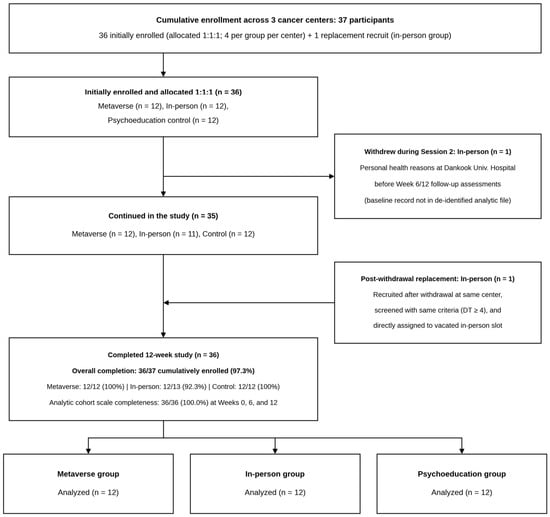
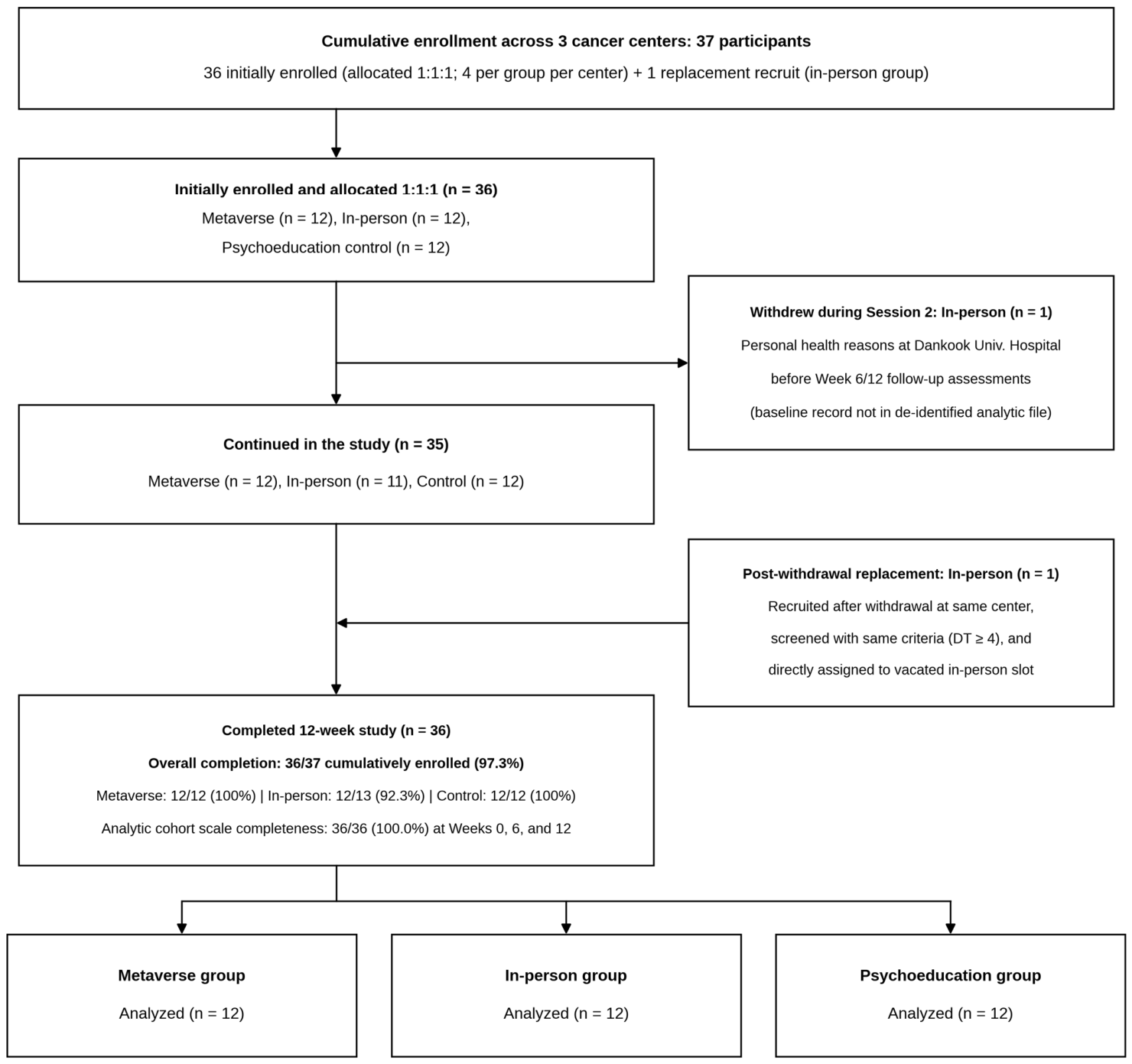
Eligible survivors were recruited from outpatient cancer survivorship clinics at the three participating centers and allocated in a 1:1:1 ratio within each participating institution to the metaverse group, the in-person group, or the usual-care psychoeducation control group (four participants per group per center). Because this was a pragmatic, open-label behavioral pilot study, participants and intervention facilitators were aware of group assignments after allocation. Across the three centers, 36 participants were initially enrolled and allocated (12 per group). During the second weekly session, one participant in the in-person group at Dankook University Hospital withdrew for personal health reasons before any post-baseline (Week 6 or Week 12) clinical assessment. After this withdrawal occurred, because the group intervention was designed around a cohesive four-member peer-support structure at each institution, one additional eligible survivor was recruited from the same institution’s outpatient survivorship clinic, screened using the same inclusion and exclusion criteria (including baseline DT ≥ 4), provided written informed consent, and was directly assigned—without re-allocation across groups—to fill the vacated in-person group slot. This resulted in a cumulative enrollment of 37 participants (metaverse: 12 enrolled, 12 completed; in-person: 13 cumulatively enrolled, 12 completed; psychoeducation control: 12 enrolled, 12 completed) and a final 12-week completer cohort of 36 participants (12 per group; Figure 1). The de-identified multicenter clinical database compiled for statistical analysis contained only the 36 completers; the baseline questionnaire record of the participant who withdrew during Session 2 was not retained in the final analytic file.
Figure 1.
Participant flow diagram showing enrollment, allocation (1:1:1 across two university hospitals and the National Cancer Center; four participants per group per center), six-week intervention delivery, and 12-week follow-up analysis. Thirty-seven participants were cumulatively enrolled: 36 initially enrolled participants, one of whom in the in-person group withdrew during Session 2 for health reasons before any Week 6 or Week 12 follow-up assessment (the baseline questionnaire record of this participant was not retained in the de-identified analytic file), and one replacement participant recruited after the withdrawal at the same institution, screened with the same eligibility criteria, and directly assigned to the vacated in-person group slot. This yielded 36 completers in the final analytic cohort (97.3% overall study completion [36/37]; 100.0% clinical scale completeness [36/36] across Weeks 0, 6, and 12).
The study protocol was reviewed and approved by the Institutional Review Board of Dankook University Hospital (DKUH IRB 2024-02-021; approved on 27 March 2024), and the study was conducted in accordance with the Declaration of Helsinki. All participants provided written informed consent before enrollment.
2.2. Intervention and Delivery Conditions
2.2.1. Modular Program Development and Structure
The group psychological support curriculum was developed as a structured, facilitator-led, manualized intervention designed to address the multidimensional distress experienced by adult cancer survivors. Multidisciplinary clinical teams from the Chungnam Regional Cancer Survivorship Center and the Chungcheongnam-do Mental Health Welfare Center collaborated to integrate evidence-based principles from cognitive-behavioral psychoeducation, positive psychology, meaning-centered psychotherapy, and physiological relaxation training into a standardized six-session manual. A2TEC Inc., LTD. (Daegu, Republic of Korea) and M3 solutions, Inc., LTD. (Daegu, Republic of Korea) developed and maintained the metaverse software and the wearable biofeedback integration.
The intervention comprised six weekly 60-min group sessions. To keep the structure consistent and replicable across delivery environments, each weekly session was organized into three sequential 20-min modules: Module 1 (Distress-Management Psychoeducation), which provided structured clinical information on survivorship-specific physical and emotional challenges and introduced practical cognitive-behavioral coping strategies; Module 2 (Strengths and Meaning Exploration), which drew on positive psychology and logotherapy principles to help survivors identify signature character strengths, clarify personal values, reconnect with relational resources, and re-establish life direction after cancer; and Module 3 (Guided Relaxation Training), which led participants through somatic awareness and autonomic down-regulation exercises incorporating slow-paced resonance breathing with real-time smartwatch heart-rate biofeedback. The session-by-session curriculum and planned time allocation are detailed in Table 1, following the Template for Intervention Description and Replication (TIDieR) framework [13].
Table 1.
Session Content and Planned Time Allocation in the Six-Week Modular Distress-Management Program.
2.2.2. Metaverse Delivery, In-Person Delivery, and Psychoeducation Control Conditions
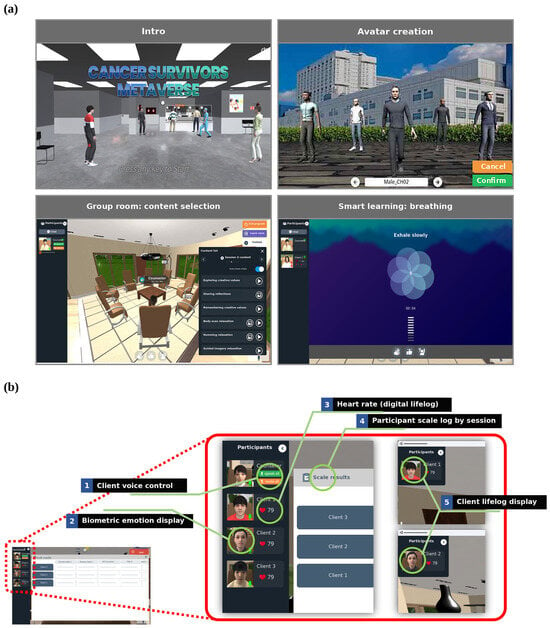
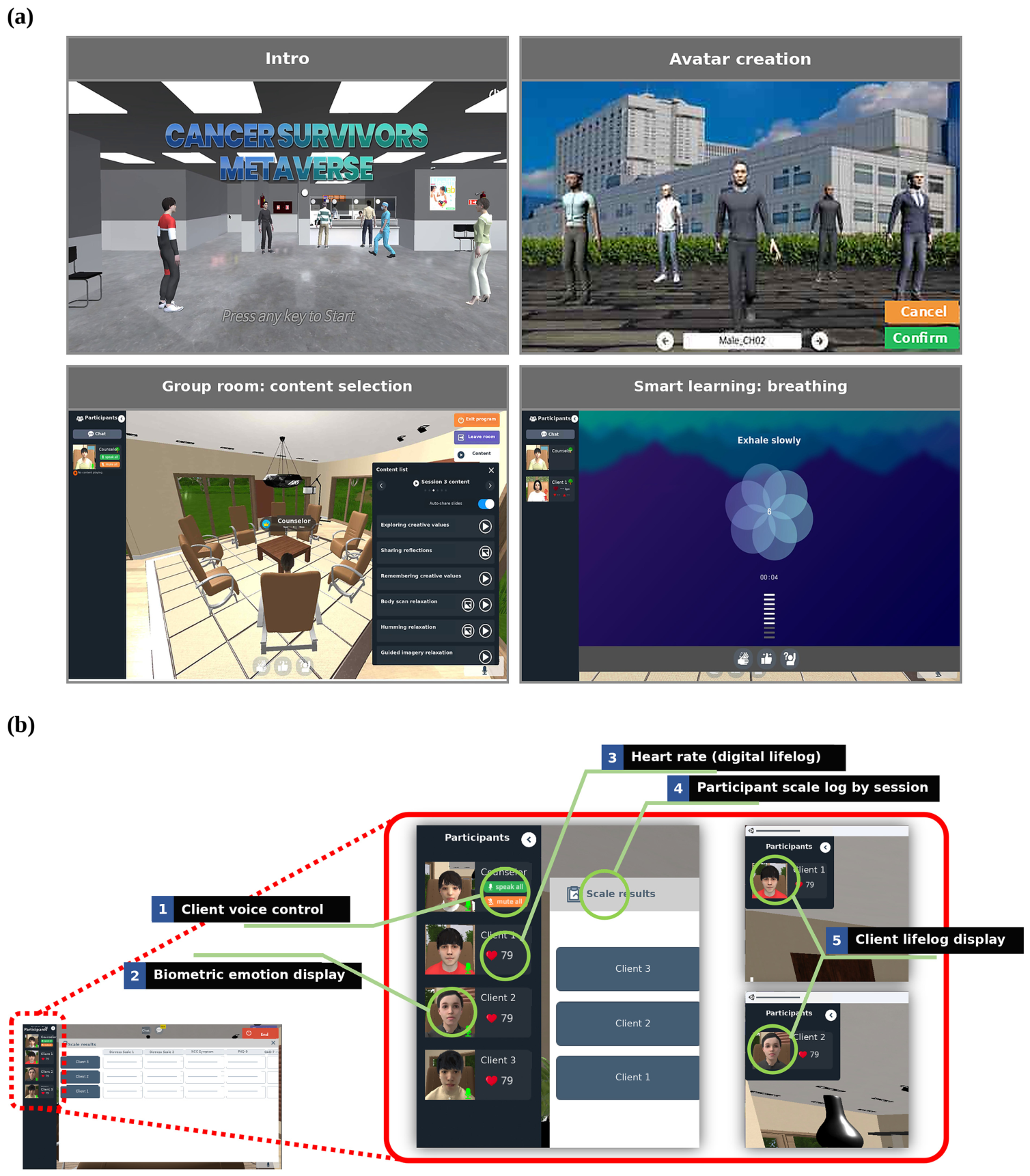
Participants allocated to the metaverse group completed the six-week modular program remotely, from home or another private location of their choice, using a study-configured tablet computer and a linked smartwatch. The custom tablet-based metaverse platform featured secure account login, customizable three-dimensional avatar creation, a virtual waiting lobby, and dedicated group counseling rooms. Within the virtual counseling room, participants interacted as avatars through real-time multiparty voice communication and text chat, viewed synchronized educational slides and digital worksheets shared by the facilitator, and completed guided reflection exercises together. The facilitator dashboard provided participant-level audio controls, facial-expression emotion indicators, real-time smartwatch heart-rate telemetry (digital lifelog), and session-by-session participant scale logs (Figure 2).
Figure 2.
Screenshots of the metaverse counseling platform. (a) Representative participant screens: platform entry (intro), three-dimensional avatar creation, virtual group counseling room with session content selection, and guided slow-paced breathing relaxation with a visual pacer. (b) Facilitator view during a group session: (1) participant-level voice control, (2) facial-expression emotion display, (3) real-time smartwatch heart-rate monitoring (digital lifelog), (4) session-by-session participant scale logs, and (5) the lifelog display mirrored on each participant’s screen.
To isolate the effect of the delivery environment while holding therapeutic content and facilitator contact constant, participants allocated to the in-person group attended six weekly 60-min group sessions in a dedicated counseling room at their respective hospital sites. Facilitators—oncology nurse specialists and licensed mental health professionals trained in the standardized intervention manual—delivered the same three-module curriculum, digital tablet worksheets, and smartwatch heart-rate feedback exercises used in the metaverse group.
Participants allocated to the usual-care psychoeducation control group (labeled “Psychoeducation” in tables and figures) attended a single hospital-based educational session after the baseline assessment. Led by each institution’s cancer survivorship education staff, this session provided standard informational pamphlets on survivorship covering post-treatment distress, sleep hygiene, cancer-related fatigue, nutrition, basic relaxation concepts, and fear of recurrence; it did not include the six-week facilitator-led group modules, strengths/meaning activities, or guided biofeedback practice.
2.3. Feasibility and Acceptability Outcomes
Consistent with the objectives of a pilot feasibility study [9,12], operational feasibility and participant acceptability were the primary evaluation domains, whereas longitudinal changes in QoL and psychological symptoms were analyzed as exploratory clinical outcomes. Assessments were conducted at three time points: baseline (Week 0), immediately after the intervention (Week 6), and six weeks after the intervention (Week 12 follow-up).
Operational feasibility was evaluated using three indicators: (1) attainment of the target analytic sample size (N = 36), (2) the overall 12-week study completion rate (36/37; 97.3%) and the early withdrawal proportion (1/37; 2.7%), calculated across all 37 cumulatively enrolled participants, and (3) the completeness of clinical data collection (36/36; 100.0%), defined as the proportion of the 36 completers in the final analytic cohort who provided complete scale totals across all 12 clinical instruments at Weeks 0, 6, and 12.
Participant acceptability and platform usability were evaluated after the intervention among participants in the two six-week active intervention groups (metaverse, n = 12; in-person, n = 12; total active-group sample = 24). Participants in the usual-care control group (n = 12), who attended only a single pamphlet-based educational session and neither took part in the six-week program nor used the digital devices, were not surveyed on program usability. In the archived multicenter study records, the 24 completed quantitative satisfaction and usability responses were retained only as aggregate summaries across all 24 respondents, without individual or group-identifying codes (metaverse vs. in-person). Overall service satisfaction was rated on a six-point Likert scale ranging from 1 (strongly disagree) to 6 (strongly agree), with scores of 4–6 classified descriptively as positive agreement. In addition, a six-domain usability profile assessed platform convenience, overall satisfaction, willingness to recommend, perceived usefulness, intention to use, and continued-use intention on a 1–6 scale. This profile was supplemented by open-ended written feedback (available from 14 active-group participants: 11 metaverse and 3 in-person) describing practical system, interface, and content issues.
2.4. Exploratory Clinical Measures
Cancer-specific QoL was evaluated using the Korean version of the FACT-G, which assesses physical well-being (six items), social/family well-being (six items), emotional well-being (six items), and functional well-being (seven items), with total scores ranging from 0 to 100 and higher scores indicating better QoL [14,15]. In accordance with the Korean psychometric validation of the FACT-G and subsequent oncology studies at the National Cancer Center Korea, two items from the original 27-item English version (GP2 and GS7) were excluded during validation, yielding 25 administered items [15]. Generic health status was assessed using the five-level version of the EQ-5D, scored by summing the five dimension levels (mobility, self-care, usual activities, pain/discomfort, and anxiety/depression; each scored 1–5) to yield a total range of 5–25, with lower scores indicating fewer health problems [16].
Ten secondary clinical measures were administered at Weeks 0, 6, and 12 to capture multidimensional psychological symptoms and positive adaptation: (1) the single-item DT (range, 0–10) [17]; (2) the count of endorsed stressors on the accompanying 24-item problem list (range, 0–24); (3) depressive symptom severity on the Patient Health Questionnaire-9 (PHQ-9; range, 0–27) [18]; (4) insomnia severity on the Insomnia Severity Index (ISI; range, 0–28) [19]; (5) state and (6) trait anxiety on the State–Trait Anxiety Inventory (STAI-State and STAI-Trait; range, 20–80 each) [20]; (7) perceived stress on the 10-item Perceived Stress Scale (PSS-10; range, 0–40) [21]; (8) cancer-related posttraumatic stress symptoms on the Posttraumatic Stress Disorder Checklist for DSM-5 (PCL-5; range, 0–80) [22]; (9) fear of cancer recurrence on the Fear of Cancer Recurrence Inventory–Short Form (FCRI-SF; range, 0–36) [23]; and (10) positive psychological change on the 25-item Posttraumatic Growth Inventory–Expanded (PTGI-X; scored on a 1–6 scale per item; total range, 25–150) [24]. Across all symptom scales, higher scores indicate greater symptom severity, whereas higher scores on the FACT-G and PTGI-X indicate better QoL and greater posttraumatic growth, respectively (Table S2).
2.5. Data Quality Control and Safety Monitoring
Before statistical modeling, scale totals were cross-checked against item-level questionnaire records, including verification of reverse-scored items on the FACT-G and PSS-10. For one participant with a single missing item in the seven-item FACT-G functional well-being subscale at baseline, the domain score was prorated according to standard FACT-G scoring guidelines by summing the six observed items and multiplying by 7/6 before computing the total score (Table S2). While all 37 cumulatively enrolled participants were accounted for in participant flow and study-completion analyses, longitudinal clinical analyses were conducted on the 36-participant completer cohort (n = 12 per group) without ad hoc imputation. A 37-participant intention-to-treat model could not be estimated for two reasons: the linear mixed-effects models (LMMs) analyzed repeated follow-up outcomes at Weeks 6 and 12 conditional on baseline values, and the in-person group participant who withdrew during Session 2 had no post-baseline assessments and no baseline questionnaire record in the de-identified multicenter analysis file.
Safety monitoring included routine clinical review of psychological assessment scores by study psychiatrists, protocol-based psychiatric evaluation whenever elevated depressive symptoms or self-harm ideation were detected, and active monitoring for intervention-related adverse events throughout the six-week delivery period.
2.6. Statistical Analysis
Baseline demographic and clinical characteristics were summarized using means and SDs for continuous variables and counts and percentages for categorical variables. Continuous clinical scales were summarized parametrically with means and SDs to provide preliminary location and variance estimates for future study planning [9,11,12], after inspecting observed score distributions and ranges across visits for floor or ceiling clustering (Table S1). For acceptability outcomes, because the bounded six-point overall satisfaction item showed marked ceiling skewness, it was summarized using both the mean (SD) and the non-parametric median and interquartile range (IQR), together with the proportion of respondents reporting positive satisfaction (scores 4–6) and its two-sided 95% CI, estimated using the Wilson score method [25].
Longitudinal differences in clinical outcomes were evaluated using LMMs fitted by restricted maximum likelihood (REML) to the post-baseline repeated measures (Weeks 6 and 12), including a participant-specific random intercept. Fixed effects comprised treatment group (metaverse, in-person, or psychoeducation control), categorical visit (Week 6 vs. Week 12), the group-by-visit interaction, the baseline value of the outcome, the baseline-outcome-by-visit interaction, baseline DT score, and study site (to account for stratified multicenter allocation; baseline DT was entered once in the DT model). Adjusted between-group differences (metaverse minus psychoeducation control, and metaverse minus in-person) at Weeks 6 and 12 were estimated from marginal means weighted equally across sites at the overall baseline covariate means, using Kenward–Roger degrees of freedom for two-sided inference and pointwise 95% CIs [26]. Model distributional assumptions were evaluated by inspecting standardized conditional residuals across all 12 LMMs for extreme outliers or skewness and by computing normal Q–Q plot correlation coefficients of normalized residuals in the longitudinal QoL models (Tables S3 and S4). Because unadjusted rank-based non-parametric tests at isolated visits (such as Kruskal–Wallis or Mann–Whitney tests) cannot simultaneously adjust for center-stratified allocation and baseline distress and outcome imbalances, covariate-adjusted REML LMMs with Kenward–Roger small-sample degrees-of-freedom adjustment were selected as the primary longitudinal framework. Because clinical evaluations in this pilot study (n = 12 per group) were exploratory and intended for signal detection and parameter estimation rather than confirmatory hypothesis testing, we report both unadjusted two-sided p-values (which correspond directly to the pointwise 95% CIs) and p-values adjusted for multiplicity using the Holm step-down procedure [27]. Holm adjustment was applied separately to two predefined contrast families: (1) the eight exploratory QoL contrasts (FACT-G and EQ-5D across two comparator groups and two follow-up visits) and (2) the 40 secondary clinical contrasts (ten symptom scales across two comparator groups and two visits).
To assess the robustness of the QoL findings to alternative longitudinal modeling assumptions, we conducted a constrained longitudinal data analysis (cLDA) as a sensitivity analysis [28]. The cLDA model included baseline (Week 0), Week 6, and Week 12 scores in the outcome vector while constraining the adjusted baseline group means to be equal across the three study groups; it was fitted by generalized least squares with REML, an unstructured 3 × 3 within-participant covariance matrix, and Satterthwaite degrees of freedom. Study site and baseline DT score were modeled with separate baseline effects and common follow-up effects, and Holm adjustment was applied across the eight QoL contrasts. All statistical analyses were performed in R version 4.4.2 (R Foundation for Statistical Computing, Vienna, Austria) using the lme4, lmerTest, emmeans, and nlme packages.
3. Results
3.1. Participant Characteristics
The final analytic cohort comprised 36 female cancer survivors distributed equally across the three groups (12 per group) and across the two university hospitals and the National Cancer Center (12 per institution; Table 2). The mean age was 50.28 years (SD = 7.70), and breast cancer was the most common diagnosis (n = 30, 83.3%), followed by thyroid cancer (n = 4, 11.1%) and cervical cancer (n = 2, 5.6%). All enrolled survivors had completed primary cancer treatment (surgery, chemotherapy, or radiotherapy), and some were undergoing routine outpatient follow-up or adjuvant endocrine therapy. Baseline clinical characteristics showed a notable imbalance in acute distress: mean baseline DT scores were substantially higher in the metaverse group (7.08, SD = 1.62) and the in-person group (7.17, SD = 1.34) than in the psychoeducation control group (5.17, SD = 1.34; Table 2). Baseline FACT-G total scores were also numerically lower in the metaverse group (45.00, SD = 21.29) than in the in-person (53.58, SD = 22.67) and psychoeducation control (52.81, SD = 12.67) groups. Accordingly, both baseline DT and the baseline value of each outcome were included as covariates in all longitudinal models, and cLDA sensitivity models were fitted to evaluate robustness to baseline differences.
Table 2.
Baseline Sociodemographic and Clinical Characteristics of the Analytic Cohort.
3.2. Operational Feasibility and Data Completeness
Cumulative enrollment across the two university hospitals and the National Cancer Center was 37 participants, comprising the 36 initially enrolled survivors and one replacement participant recruited into the in-person group at Dankook University Hospital after one in-person participant withdrew during the second weekly session for health reasons (Figure 1). Across all 37 cumulatively enrolled participants, the overall 12-week study completion rate was 97.3% (36/37; metaverse: 12/12 [100.0%]; in-person: 12/13 [92.3%]; psychoeducation control: 12/12 [100.0%]), and the early withdrawal rate was 2.7% (1/37). Within the 36-participant analytic completer cohort (12 per group), clinical data collection completeness was 100.0% (36/36; 95% CI [90.4%, 100.0%]) across all 12 clinical outcome measures at Weeks 0, 6, and 12, because the single Session-2 withdrawal occurred before any post-baseline assessment (Table 3).
Table 3.
Operational Feasibility, Data Completeness, and Participant Acceptability Outcomes.
3.3. Participant Acceptability
Twenty-four post-intervention acceptability and usability responses were collected from the two six-week active intervention groups (metaverse, n = 12; in-person, n = 12; the 12 single-session usual-care control participants were not surveyed on six-week program usability). Across these 24 active-group respondents, the mean overall service-satisfaction score was 5.46 (SD = 0.83) out of 6.00 (median = 6.0, IQR = 5.0–6.0), with 23 respondents (95.8%; 95% CI [79.8%, 99.3%]) giving positive satisfaction ratings of 4 to 6. On the six-domain usability profile (1–6 scale), respondents gave high ratings for convenience (5.3/6) and favorable ratings for overall usability satisfaction (4.8/6), but more modest ratings, clustering near or slightly below the scale midpoint of 3.5, for willingness to recommend (3.9/6), perceived usefulness (3.7/6), intention to use (3.3/6), and continued-use intention (3.1/6; Table 3). Written feedback from 14 active-group participants (11 metaverse, 3 in-person) identified three practical sources of friction underlying these lower continued-use ratings: (1) occasional synchronization delays between digital worksheets and smartwatch heart-rate pairing, microphone echo, or brief screen freezing during content sharing; (2) non-intuitive window navigation and small font size or low contrast on tablets; and (3) abstract phrasing in certain value-exploration exercises.
3.4. Exploratory Quality-of-Life Outcomes: Metaverse vs. In-Person and Control
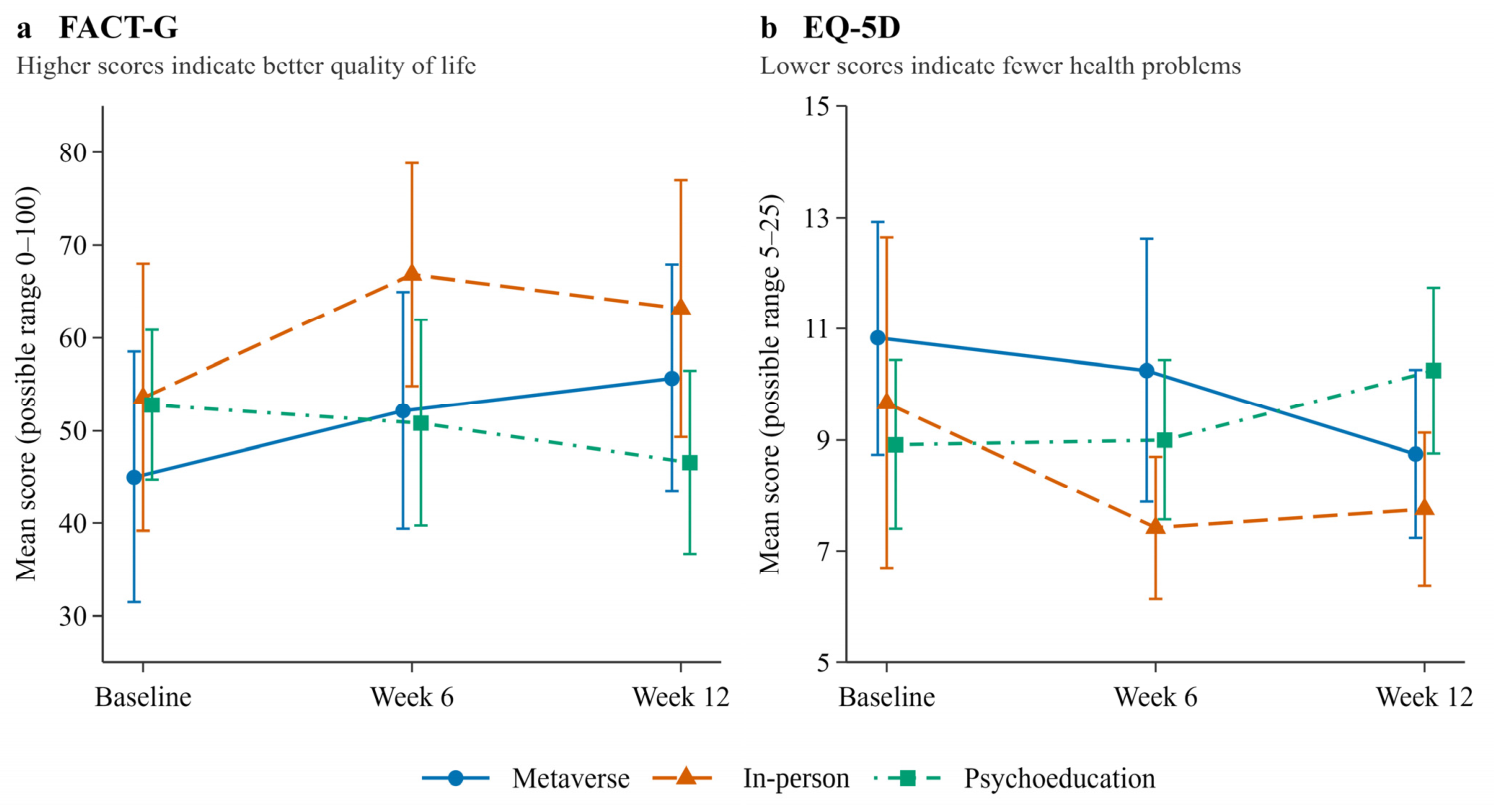
Observed trajectories and adjusted LMM comparisons for cancer-specific QoL (FACT-G) and generic health status (EQ-5D) across Weeks 0, 6, and 12 are presented in Table 4 and Figure 3. In the baseline- and site-adjusted LMM analysis at Week 12, the metaverse group showed a statistically significant improvement in FACT-G total score compared with the psychoeducation control group (adjusted mean difference = 15.03 points, 95% CI [5.58, 24.47]; unadjusted p = 0.002; Holm-adjusted p = 0.019). Between the metaverse and in-person groups at Week 12, adjusted FACT-G scores did not differ significantly (adjusted mean difference = 0.02 points, 95% CI [−8.70, 8.73]; unadjusted p = 0.997; Holm-adjusted p = 1.000). However, the 95% CI spanned −8.70 to +8.73 points, which encompasses the established 5- to 7-point minimal clinically important difference (MCID) for the FACT-G; this reflects the substantial imprecision of a small sample rather than formal therapeutic equivalence. For the EQ-5D, observed health-problem scores improved from baseline to Week 12 in both the metaverse and in-person groups but worsened in the psychoeducation control group. Although the in-person group showed a transient unadjusted advantage at Week 6 (2.34 points, 95% CI [0.52, 4.17]; unadjusted p = 0.013; Holm-adjusted p = 0.091), adjusted between-group differences at Week 12 were small and did not reach statistical significance after Holm adjustment (Table 4).
Table 4.
Exploratory Quality-of-Life Outcomes (FACT-G and EQ-5D) Across Assessment Weeks and Adjusted Linear Mixed-Effects Comparisons.
Figure 3.
Quality-of-life trajectories over 12 weeks by study group. (a) Functional Assessment of Cancer Therapy–General (FACT-G; higher scores indicate better quality of life). (b) EuroQol five-dimension questionnaire (EQ-5D; lower scores indicate fewer health problems). Points represent observed group means, and error bars indicate pointwise unadjusted 95% t confidence intervals (n = 12 per group at each visit). Adjusted between-group mixed-model contrasts are reported in Table 4 and cLDA sensitivity analyses in Table S3.
3.5. Secondary Exploratory Psychological Symptom Outcomes
Across the ten secondary psychological symptom measures (40 prespecified between-group contrasts across Weeks 6 and 12), no comparison remained statistically significant after Holm step-down multiplicity correction (all Holm-adjusted p ≥ 0.730; Table 5 and Supplementary Table S4). Table 5 summarizes the observed group trajectories and adjusted LMM estimates for the five secondary measures that showed nominal, unadjusted between-group differences (unadjusted p < 0.05) at Week 6 or Week 12. These are reported only as exploratory observations and preliminary variability estimates; complete descriptive statistics and mixed-model estimates for all ten secondary measures are provided in Supplementary Tables S1 and S4. In these unadjusted comparisons against the psychoeducation control group, nominal differences favoring the metaverse group were observed for acute distress (DT; difference = −2.43, p = 0.038, Holm p = 1.000) and endorsed stress-problem count (−3.93, p = 0.018, Holm p = 0.730) at Week 6; depressive symptoms (PHQ-9) at Week 6 (−3.66, p = 0.046, Holm p = 1.000) and Week 12 (−3.75, p = 0.041, Holm p = 1.000); and fear of cancer recurrence (FCRI-SF; −4.17, p = 0.040, Holm p = 1.000) and posttraumatic growth (PTGI-X; +17.04, p = 0.041, Holm p = 1.000) at Week 12. Notably, in the psychoeducation control group, observed mean DT scores increased from 5.17 (SD = 1.34) at baseline to 6.42 (SD = 2.81) at Week 6 and remained elevated at 5.92 (SD = 1.88) at Week 12, whereas observed DT means decreased in both active groups (Table 5). Between the metaverse and in-person groups, nine of the ten secondary measures showed no nominal unadjusted differences at either follow-up visit; only the Week-12 endorsed stress-problem count showed an unadjusted difference favoring the in-person group (+3.06, p = 0.038, Holm p = 1.000).
Table 5.
Secondary Psychological Outcomes Showing Nominal Between-Group Differences Across Assessment Weeks and Adjusted Mixed-Model Comparisons.
3.6. Sensitivity Analysis and Distributional Diagnostics
Across all 12 longitudinal clinical LMMs, every model converged without singular-fit warnings and standardized conditional residuals remained within −2.57 to +2.68 (FACT-G: −1.93 to +2.63; EQ-5D: −1.58 to +2.68), with normal Q–Q plot correlation coefficients in the longitudinal QoL models of r = 0.994 for the FACT-G and r = 0.962 for the EQ-5D, supporting the adequacy of Gaussian mixed-model inference (Tables S3 and S4). The cLDA sensitivity analysis, which modeled baseline, Week 6, and Week 12 scores jointly while constraining baseline group means to equality, yielded conclusions fully consistent with those of the primary LMM analysis across all eight QoL contrasts (Table S3). At Week 12, the cLDA-estimated FACT-G difference between the metaverse and psychoeducation control groups was 14.98 points (95% CI [6.02, 23.94]; unadjusted p = 0.002; Holm-adjusted p = 0.014), whereas the difference between the metaverse and in-person groups remained near zero at −0.33 points (95% CI [−8.47, 7.81]; unadjusted p = 0.935; Holm-adjusted p = 1.000). For the EQ-5D at Week 12, the cLDA contrast between metaverse and psychoeducation control showed a nominal difference favoring the metaverse group (−1.81 points, 95% CI [−3.49, −0.13]; unadjusted p = 0.035), although it was not significant after Holm correction (Holm-adjusted p = 0.212; Table S3).
4. Discussion
4.1. Principal Findings
This multicenter, three-group pilot study, conducted across two university hospitals and the National Cancer Center in Republic of Korea, evaluated the feasibility, acceptability, and preliminary clinical trajectories of a six-week modular group distress-management program designed to provide psychological support for cancer survivors in a metaverse environment. There were four main findings. First, operational feasibility was high (97.3% completion across 37 cumulatively enrolled survivors, with 100.0% [12/12] completion in the metaverse group and one Session-2 health-related withdrawal replaced in the in-person group), and clinical scale completeness among the 36 completers was 100.0% across the 12-week follow-up. Second, acceptability across the 24 active-group responses was mixed: overall service satisfaction (5.46/6.00; 95.8% positive) and convenience (5.3/6.0) were high, whereas willingness to recommend (3.9/6.0), perceived usefulness (3.7/6.0), intention to use (3.3/6.0), and continued-use intention (3.1/6.0) were moderate, pointing to specific multi-device and interface refinements needed for sustained use. Third, in both baseline-adjusted LMMs and cLDA sensitivity models, participants in the metaverse group showed a statistically significant improvement in cancer-specific QoL (FACT-G) at Week 12 compared with the usual-care psychoeducation control group, whereas none of the ten secondary psychological symptom measures remained statistically significant after Holm correction across 40 contrasts (the unadjusted p < 0.05 differences in distress, stress-problem count, depressive symptoms, fear of recurrence, and posttraumatic growth represent nominal exploratory signals only). Fourth, Week-12 FACT-G scores did not differ significantly between metaverse and in-person delivery of the same six-session modular curriculum (adjusted difference = 0.02 points; p = 0.997), although the wide 95% CI ([−8.70, 8.73]) reflects small-sample imprecision and does not establish formal therapeutic equivalence.
4.2. Modular Program Architecture, Delivery Environment, and Comparison of Metaverse vs. In-Person Groups
A key methodological feature of the present pilot study was its three-group design, which held the therapeutic curriculum, session duration (six weekly 60-min sessions), digital worksheet materials, and smartwatch heart-rate feedback constant between the metaverse and in-person groups while also including a usual-care psychoeducation control group. Prior digital psycho-oncology studies have often compared remote interventions only with waitlist or usual-care controls, which makes it difficult to judge how remote delivery compares with in-person group interaction [5,6]. By delivering the same manualized three-module sequence—20 min of distress-management psychoeducation, 20 min of positive psychology and meaning-centered exploration, and 20 min of paced-breathing relaxation with real-time heart-rate feedback—to both active groups, our study directly explored how an avatar-mediated virtual counseling environment compares with hospital-based group support.
At Week 12, the adjusted FACT-G difference between the metaverse and in-person groups was near zero (0.02 points; cLDA = −0.33 points), and nine of the ten secondary symptom measures showed no nominal differences between the two active delivery formats. With 12 participants per group, however, the 95% CI for the Week-12 FACT-G contrast ranged from −8.70 to +8.73 points, which spans the established 5- to 7-point MCID for the FACT-G [14,15]. Accordingly, this non-significant difference should not be interpreted as evidence of therapeutic equivalence or non-inferiority, which would require prospectively defined equivalence margins and a substantially larger sample. Rather, it provides preliminary parameter estimates consistent with recent meta-analytic findings on therapist-guided remote interventions [7]. At the same time, the three 20-min modules may interact differently with the metaverse and hospital delivery environments. Communicating through customizable avatars from home offers visual anonymity that can reduce appearance-related self-consciousness (for example, about alopecia or surgical changes) and facilitate candid emotional disclosure during Module 2 (strengths and meaning exploration) [8]. Conversely, didactic learning in Module 1 (psychoeducation) and somatic focus in Module 3 (guided relaxation) may benefit from the structured, distraction-free environment and immediate nonverbal cues of an in-person hospital room—a possibility consistent with the in-person group’s numerically higher unadjusted FACT-G mean at Week 6 (66.83 vs. 52.17) and lower Week-12 endorsed stress-problem count. In the metaverse group, integrating real-time smartwatch heart-rate telemetry during the five-minute resonance-breathing exercise (six breaths/min) helped bridge this physical distance by providing objective visual biofeedback on both the participants’ tablets and the facilitator dashboard. However, because all three modules were delivered as an integrated 60-min package without module-specific assessments, the relative contribution of each module cannot be isolated in the present study.
4.3. Clinical Interpretation of Quality-of-Life and Symptom Trajectories
The adjusted 12-week FACT-G difference favoring the metaverse group over the psychoeducation control group (+15.03 points, 95% CI [5.58, 24.47]; Holm-adjusted p = 0.019) exceeded the 5- to 7-point MCID benchmark typically cited for the FACT-G in oncology populations [14,15]. Nevertheless, the magnitude of this estimate should be interpreted with caution. Because of the small sample size (n = 12 per group), the 95% CI is wide (spanning 18.89 points), and its lower bound (5.58 points) lies near the lower end of the 5- to 7-point MCID range. Baseline clinical imbalances also need to be considered when interpreting the longitudinal trajectories. At baseline, participants in the metaverse (DT = 7.08 ± 1.62; FACT-G = 45.00 ± 21.29) and in-person (DT = 7.17 ± 1.34; FACT-G = 53.58 ± 22.67) groups had higher acute distress—and, in the metaverse group, lower initial QoL—than participants in the psychoeducation control group (DT = 5.17 ± 1.34; FACT-G = 52.81 ± 12.67). Although all eligible participants met the inclusion threshold of clinically meaningful distress (DT ≥4), lower baseline distress in the control group could in principle have limited the room for subsequent DT reduction. The observed trajectories indicate, however, that the between-group divergence was not simply an artifact of a floor effect in the control group: observed DT scores in the control group worsened from baseline (5.17 ± 1.34) to Week 6 (6.42 ± 2.81) and remained elevated at Week 12 (5.92 ± 1.88), and observed control-group FACT-G scores declined progressively from 52.81 at baseline to 50.83 at Week 6 and 46.58 at Week 12 (Table 4 and Table 5). Even so, although the baseline-adjusted LMMs and cLDA sensitivity models yielded highly consistent estimates (+15.03 and +14.98 points on the FACT-G), linear covariate adjustment in a small sample cannot fully rule out residual confounding or regression toward the mean among participants who were initially more distressed.
Comparing the responsiveness of the FACT-G and the EQ-5D also informs outcome selection for future survivorship studies. Whereas the FACT-G directly evaluates physical, social/family, emotional, and functional well-being domains tailored to cancer patients, the EQ-5D captures broad generic health dimensions (such as basic mobility and self-care) that often show ceiling effects in ambulatory post-treatment survivors [16]. For the ten secondary psychological instruments, none of the 40 between-group comparisons remained statistically significant after Holm step-down multiplicity adjustment (all Holm-adjusted p ≥ 0.730). Administering ten secondary symptom scales across two follow-up visits in a pilot cohort of 12 participants per group inevitably carries a severe multiplicity penalty and leaves low statistical power for individual symptom scales. Consequently, the unadjusted differences (p < 0.05) observed for acute distress (DT), endorsed stress-problem count, depressive symptoms (PHQ-9), fear of cancer recurrence (FCRI-SF), and posttraumatic growth (PTGI-X) should not be interpreted as confirmed treatment effects; rather, they serve only as exploratory, hypothesis-generating observations and empirical variance estimates to guide outcome prioritization in future studies [9,12].
4.4. Acceptability and Usability Profile
The acceptability evaluation across the 24 active-group responses showed a clear gap between high overall service satisfaction and modest ratings on several long-term technology-adoption domains. On the single-item service satisfaction measure, 95.8% (23/24) of respondents reported positive agreement (mean = 5.46/6.00), and convenience received the highest domain rating (5.3/6.0), together with favorable overall usability satisfaction (4.8/6.0). These ratings indicate that survivors valued the clinical group support and the logistical convenience of remote access. In contrast, scores for willingness to recommend the platform (3.9/6.0), perceived usefulness (3.7/6.0), intention to use (3.3/6.0), and continued-use intention (3.1/6.0) clustered near or slightly below the midpoint (3.5) of the six-point scale.
Written feedback from 14 active-group participants helps explain why intention to use (3.3/6.0) and continued-use intention (3.1/6.0) remained modest despite high satisfaction with the guided sessions. Taking part in this early-stage prototype required middle-aged survivors (mean age = 50.3 years) to simultaneously operate a study-configured tablet, navigate a three-dimensional avatar environment, complete digital worksheets, and synchronize a Bluetooth smartwatch for real-time heart-rate feedback [13]. Participants specifically noted occasional synchronization delays between worksheet entries and smartwatch heart-rate telemetry, intermittent microphone echo or brief screen freezing during slide sharing, non-intuitive pop-up navigation, small on-screen text or low contrast, and abstract terminology in certain meaning-centered exercises. Although facilitator support enabled participants to complete the six-week curriculum (97.3% study completion), these technical and interface demands likely dampened enthusiasm for continuing to use the multi-device platform independently after the study ended. In addition, because the archived usability dataset pooled the 24 active-group responses without group identifiers, we could not determine how much of the usability friction stemmed from the three-dimensional metaverse client and how much from the tablet worksheets and smartwatch hardware used in both active groups. The steps needed to address these documented prototype bottlenecks—automatic background wearable pairing, simplified navigation buttons, larger type for middle-aged survivors, concrete value examples, and group-stratified usability logging—provide a clear engineering roadmap for a larger definitive study.
4.5. Strengths and Limitations
Strengths of this study include its multicenter three-group parallel design across two university hospitals and the National Cancer Center in Republic of Korea, the inclusion of an active in-person comparator matched in curriculum and session duration, high 12-week completion, and longitudinal modeling combining Kenward–Roger LMMs and cLDA sensitivity analyses with explicit residual diagnostics and multiplicity control. Nevertheless, several important limitations should be considered when interpreting our findings. First, this exploratory pilot study (n = 12 per group) [11,12] was sized for feasibility assessment and preliminary variance estimation rather than formal equivalence, non-inferiority, or efficacy testing (as reflected in the wide 95% CI of [−8.70, 8.73] for the Week-12 FACT-G contrast), nor was it powered to detect small-to-moderate effects across 40 secondary symptom contrasts after Holm adjustment; moreover, administering 12 psychometric questionnaires at each visit imposed a considerable assessment burden, and small cell sizes limit sensitivity to subtle departures from normality despite acceptable model residual diagnostics. Second, after one participant in the in-person group withdrew during Session 2 for health reasons before any follow-up assessment, a replacement participant from the same institution was recruited, screened using the same eligibility criteria, and directly assigned without re-allocation to the vacated in-person group slot; furthermore, because the de-identified analytic dataset retained only the 36 completers without the withdrawn participant’s baseline questionnaire record, clinical analyses were restricted to the 36 completers. Post-withdrawal replacement and completer-only clinical modeling depart from strict intention-to-treat principles and may introduce selection bias. Third, baseline DT scores were higher in the metaverse (7.08) and in-person (7.17) groups than in the control group (5.17), and baseline FACT-G scores were numerically lower in the metaverse group (45.00 vs. 52.81); although baseline-adjusted LMM and cLDA models produced consistent results and control-group DT scores worsened over time, covariate adjustment in a small sample cannot fully exclude residual confounding or regression toward the mean. Fourth, whereas the metaverse and in-person groups received six weekly 60-min facilitator-led group sessions (360 min total), the usual-care control group attended only a single baseline educational session, and the design was open-label with self-reported outcomes. Consequently, differences favoring the intervention groups over the control group may reflect greater intervention intensity, longer total contact time, professional facilitator attention, peer social interaction, and expectancy effects rather than the metaverse platform or specific module content alone. Fifth, because all three 20-min modules (psychoeducation, strengths/meaning, and biofeedback relaxation) were delivered as an integrated package, their independent therapeutic contributions could not be separated; in addition, post-intervention usability ratings (n = 24) were pooled across the two active groups and could not be linked to group. Finally, requiring participants to own and operate a smartphone, tablet computer, and smartwatch likely preferentially selected younger (mean age = 50.3 years; metaverse group mean = 47.0 years) and more technologically confident survivors, and the analytic cohort consisted exclusively of female survivors—predominantly breast cancer survivors (83.3%), alongside cervical and thyroid cancer survivors. These factors limit generalizability to older or less digitally confident survivors, male cancer survivors, and survivors of other cancer types. Future definitive studies should use strict intention-to-treat tracking without post-allocation replacement, allocation stratified by baseline distress, an attention-matched control condition, a streamlined outcome battery, and group-stratified usability and adherence monitoring across broader survivor populations [9,10].
5. Conclusions
This multicenter, three-group pilot study, conducted across two university hospitals and the National Cancer Center, indicates that a structured, six-week modular group distress-management program—integrating cognitive-behavioral psychoeducation, strengths and meaning exploration, and smartwatch heart-rate biofeedback relaxation—is operationally feasible and yields high overall service satisfaction among female survivors of breast, cervical, or thyroid cancer. However, moderate scores for perceived usefulness and continued-use intention point to a need to improve multi-device usability. In exploratory longitudinal analyses at Week 12, preliminary estimates indicated improved cancer-specific QoL (FACT-G) in the metaverse group compared with usual-care psychoeducation and no statistically significant difference from in-person delivery of the same curriculum, whereas all secondary psychological symptom comparisons were non-significant after multiplicity correction. Because this pilot study (n = 12 per group) was not powered to establish clinical effectiveness or formal therapeutic equivalence, these clinical findings represent preliminary parameter estimates only; moreover, device-ownership requirements and an exclusively female, predominantly breast cancer cohort limit generalizability to older or less digitally confident populations, male survivors, and other cancer types. Addressing the identified usability barriers and making the methodological refinements outlined above will inform a larger, adequately powered study of metaverse-based group survivorship care.
Supplementary Materials
The following supporting information can be downloaded at: https://www.mdpi.com/article/10.3390/healthcare14234036/s1, Table S1: Observed clinical outcome scores by group and assessment week; Table S2: Outcome scoring definitions and data processing procedures; Table S3: Constrained longitudinal data analysis [Clda] sensitivity analysis compared with the main linear mixed-effects models for quality-of-life outcomes; Table S4: Complete adjusted linear mixed-effects model comparisons for all ten secondary psychological symptom outcomes at weeks 6 and 12.
Author Contributions
Conceptualization, I.L., U.S.C., J.-H.K. and J.J.L.; methodology, I.L., E.Y.L., E.-S.Y. and J.-H.K.; software, I.L.; validation, I.L., E.-S.Y., K.K. and J.-H.K.; formal analysis, I.L.; investigation, I.L., S.-Y.K., H.J.L., K.K. and J.J.L.; resources, S.-Y.K., H.J.L. and J.J.L.; data curation, I.L.; writing—original draft preparation, I.L. and E.Y.L.; writing—review and editing, I.L., E.Y.L., S.-Y.K., H.J.L., E.-S.Y., K.K., U.S.C., J.-H.K. and J.J.L.; visualization, I.L.; supervision, U.S.C. and J.J.L.; project administration, I.L. and J.J.L.; funding acquisition, J.J.L. All authors have read and agreed to the published version of the manuscript.
Funding
This research was supported by a grant from the Korean Cancer Survivors Healthcare R&D Project through the National Cancer Center, funded by the Ministry of Health & Welfare, Republic of Korea (grant number RS-2023-CC139779).
Institutional Review Board Statement
The study was conducted in accordance with the Declaration of Helsinki and approved by the Institutional Review Board of Dankook University Hospital (protocol code DKUH IRB 2024-02-021, approved on 27 March 2024).
Informed Consent Statement
Written informed consent was obtained from all participants involved in the study before enrollment.
Data Availability Statement
Aggregated clinical and feasibility data supporting the findings of this study are included within the article and its Supplementary Materials. Individual participant data are not publicly available due to institutional privacy regulations and participant consent protections.
Acknowledgments
We thank the National Cancer Survivorship Center for providing foundational distress-management educational materials, and A2TEC Inc., LTD. and M3 solutions, Inc., LTD. for their technical support in developing and operating the metaverse platform.
Conflicts of Interest
The authors declare no conflicts of interest. The funders had no role in the design of the study; in the collection, analyses, or interpretation of data; in the writing of the manuscript; or in the decision to publish the results.
References
- Doege, D.; Thong, M.S.-Y.; Koch-Gallenkamp, L.; Bertram, H.; Eberle, A.; Holleczek, B.; Pritzkuleit, R.; Waldeyer-Sauerland, M.; Waldmann, A.; Zeissig, S.R.; et al. Health-related quality of life in long-term disease-free breast cancer survivors versus female population controls in Germany. Breast Cancer Res. Treat. 2019, 175, 499–510. [Google Scholar] [CrossRef] [Scilit] [PubMed]
- Schmidt, M.E.; Wiskemann, J.; Steindorf, K. Quality of life, problems, and needs of disease-free breast cancer survivors 5 years after diagnosis. Qual. Life Res. 2018, 27, 2077–2086. [Google Scholar] [CrossRef] [Scilit] [PubMed]
- Luigjes-Huizer, Y.L.; Tauber, N.M.; Humphris, G.; Kasparian, N.A.; Lam, W.W.T.; Lebel, S.; Simard, S.; Smith, A.B.; Zachariae, R.; Afiyanti, Y.; et al. What is the prevalence of fear of cancer recurrence in cancer survivors and patients? A systematic review and individual participant data meta-analysis. Psycho-Oncology 2022, 31, 879–892. [Google Scholar] [CrossRef] [Scilit] [PubMed]
- Krueger, E.; Secinti, E.; Stewart, J.C.; Rand, K.L.; Mosher, C.E. Cognitive-behavioral and mindfulness-based interventions for distress in patients with advanced cancer: A meta-analysis. Psycho-Oncology 2024, 33, e6259. [Google Scholar] [CrossRef] [Scilit] [PubMed]
- Akdemir, A.; Smith, A.B.; Wu, V.S.; Rincones, O.; Russell, H.; Lyhne, J.D.; Kemp, E.; David, M.; Bamgboje-Ayodele, A. Guided versus non-guided digital psychological interventions for cancer patients: A systematic review and meta-analysis of engagement and efficacy. Psycho-Oncology 2024, 33, e6290. [Google Scholar] [CrossRef] [Scilit] [PubMed]
- Gentry, M.T.; Lapid, M.I.; Clark, M.M.; Rummans, T.A. Evidence for telehealth group-based treatment: A systematic review. J. Telemed. Telecare 2019, 25, 327–342. [Google Scholar] [CrossRef] [Scilit] [PubMed]
- Zandieh, S.; Abdollahzadeh, S.M.; Sadeghirad, B.; Wang, L.; McCabe, R.E.; Yao, L.; Inness, B.E.; Pathak, A.; Couban, R.J.; Crandon, H.; et al. Therapist-guided remote versus in-person cognitive behavioural therapy: A systematic review and meta-analysis of randomized controlled trials. CMAJ 2024, 196, E327–E340. [Google Scholar] [CrossRef] [Scilit] [PubMed]
- Dang, M.; Noreika, D.; Ryu, S.; Sima, A.; Ashton, H.; Ondris, B.; Coley, F.; Nestler, J.; Del Fabbro, E. Feasibility of Delivering an Avatar-Facilitated Life Review Intervention for Patients with Cancer. J. Palliat. Med. 2021, 24, 520–526. [Google Scholar] [CrossRef] [Scilit] [PubMed]
- Eldridge, S.M.; Chan, C.L.; Campbell, M.J.; Bond, C.M.; Hopewell, S.; Thabane, L.; Lancaster, G.A.; PAFS consensus group. CONSORT 2010 statement: Extension to randomised pilot and feasibility trials. BMJ 2016, 355, i5239. [Google Scholar] [CrossRef] [Scilit] [PubMed]
- Hopewell, S.; Chan, A.W.; Collins, G.S.; Hróbjartsson, A.; Moher, D.; Schulz, K.F.; Tunn, R.; Aggarwal, R.; Berkwits, M.; Berlin, J.A.; et al. CONSORT 2025 statement: Updated guideline for reporting randomised trials. BMJ 2025, 389, e081123. [Google Scholar] [CrossRef] [Scilit] [PubMed]
- Julious, S.A. Sample size of 12 per group rule of thumb for a pilot study. Pharm. Stat. 2005, 4, 287–291. [Google Scholar] [CrossRef] [Scilit]
- Leon, A.C.; Davis, L.L.; Kraemer, H.C. The role and interpretation of pilot studies in clinical research. J. Psychiatr. Res. 2011, 45, 626–629. [Google Scholar] [CrossRef] [Scilit] [PubMed]
- Hoffmann, T.C.; Glasziou, P.P.; Boutron, I.; Milne, R.; Perera, R.; Moher, D.; Altman, D.G.; Barbour, V.; Macdonald, H.; Johnston, M.; et al. Better reporting of interventions: Template for intervention description and replication (TIDieR) checklist and guide. BMJ 2014, 348, g1687. [Google Scholar] [CrossRef] [Scilit] [PubMed]
- Cella, D.F.; Tulsky, D.S.; Gray, G.; Sarafian, B.; Linn, E.; Bonomi, A.; Silberman, M.; Yellen, S.B.; Winicour, P.; Brannon, J.; et al. The Functional Assessment of Cancer Therapy scale: Development and validation of the general measure. J. Clin. Oncol. 1993, 11, 570–579. [Google Scholar] [CrossRef] [Scilit] [PubMed]
- Kim, H.; Yoo, H.-J.; Kim, Y.-J.; Han, O.-S.; Lee, K.-H.; Lee, J.-H.; Suh, C.; Kim, W.-K.; Kim, J.-C.; Ahn, S.-H.; et al. Development and validation of Korean Functional Assessment Cancer Therapy-General (FACT-G). Korean J. Clin. Psychol. 2003, 22, 215–229. (In Korean) [Google Scholar]
- Herdman, M.; Gudex, C.; Lloyd, A.; Janssen, M.F.; Kind, P.; Parkin, D.; Bonsel, G.; Badia, X. Development and preliminary testing of the new five-level version of EQ-5D (EQ-5D-5L). Qual. Life Res. 2011, 20, 1727–1736. [Google Scholar] [CrossRef] [Scilit] [PubMed]
- Roth, A.J.; Kornblith, A.B.; Batel-Copel, L.; Peabody, E.; Scher, H.I.; Holland, J.C. Rapid screening for psychologic distress in men with prostate carcinoma: A pilot study. Cancer 1998, 82, 1904–1908. [Google Scholar] [CrossRef] [Scilit]
- Kroenke, K.; Spitzer, R.L.; Williams, J.B.W. The PHQ-9: Validity of a brief depression severity measure. J. Gen. Intern. Med. 2001, 16, 606–613. [Google Scholar] [CrossRef] [Scilit] [PubMed]
- Bastien, C.H.; Vallières, A.; Morin, C.M. Validation of the Insomnia Severity Index as an outcome measure for insomnia research. Sleep Med. 2001, 2, 297–307. [Google Scholar] [CrossRef] [Scilit] [PubMed]
- Spielberger, C.D.; Gorsuch, R.L.; Lushene, R.; Vagg, P.R.; Jacobs, G.A. Manual for the State-Trait Anxiety Inventory: STAI (Form Y); Consulting Psychologists Press: Palo Alto, CA, USA, 1983. [Google Scholar]
- Cohen, S.; Williamson, G. Perceived stress in a probability sample of the United States. In The Social Psychology of Health; Spacapan, S., Oskamp, S., Eds.; Sage: Newbury Park, CA, USA, 1988; pp. 31–67. [Google Scholar]
- Blevins, C.A.; Weathers, F.W.; Davis, M.T.; Witte, T.K.; Domino, J.L. The Posttraumatic Stress Disorder Checklist for DSM-5 (PCL-5): Development and initial psychometric evaluation. J. Trauma. Stress 2015, 28, 489–498. [Google Scholar] [CrossRef] [Scilit] [PubMed]
- Simard, S.; Savard, J. Fear of Cancer Recurrence Inventory: Development and initial validation of a multidimensional measure of fear of cancer recurrence. Support. Care Cancer 2009, 17, 241–251. [Google Scholar] [CrossRef] [Scilit] [PubMed]
- Tedeschi, R.G.; Cann, A.; Taku, K.; Senol-Durak, E.; Calhoun, L.G. The Posttraumatic Growth Inventory: A revision integrating existential and spiritual change. J. Trauma. Stress 2017, 30, 11–18. [Google Scholar] [CrossRef] [Scilit] [PubMed]
- Wilson, E.B. Probable inference, the law of succession, and statistical inference. J. Am. Stat. Assoc. 1927, 22, 209–212. [Google Scholar] [CrossRef]
- Kenward, M.G.; Roger, J.H. Small sample inference for fixed effects from restricted maximum likelihood. Biometrics 1997, 53, 983–997. [Google Scholar] [CrossRef] [Scilit]
- Holm, S. A simple sequentially rejective multiple test procedure. Scand. J. Stat. 1979, 6, 65–70. [Google Scholar]
- Coffman, C.J.; Edelman, D.; Woolson, R.F. To condition or not condition? Analysing change in longitudinal randomised controlled trials. BMJ Open 2016, 6, e013096. [Google Scholar] [CrossRef] [Scilit] [PubMed]

Disclaimer/Publisher’s Note: The statements, opinions and data contained in all publications are solely those of the individual author(s) and contributor(s) and not of MDPI and/or the editor(s). MDPI and/or the editor(s) disclaim responsibility for any injury to people or property resulting from any ideas, methods, instructions or products referred to in the content. |
© 2026 by the authors. Licensee MDPI, Basel, Switzerland. This article is an open access article distributed under the terms and conditions of the Creative Commons Attribution (CC BY) license.