


Abstract
Background/Objectives: Understanding the trends and frequency of emergency department (ED) visits ending in death among patients with cancer can inform ED preparedness. This study aimed to describe nationwide trends and change points in these visits among adults with cancer in Korea and to identify associated patient and visit characteristics. Methods: Using a nationwide ED database, we identified 2,526,517 cancer-related ED visits by adults in 2015–2025. Visits ending in death were primarily defined as dead on arrival or death in the ED. Monthly trends were analyzed using segmented quasi-Poisson regression, and associated characteristics using multivariable logistic regression. Results: Of all cancer-related ED visits, 27,645 (1.09%) ended in death. Per 100 cancer deaths, these visits rose from 2.62 in 2015 to 4.11 in 2022 and fell to 2.39 in 2025. Change points were identified in July 2019 and February 2022, with annual percent changes of 1.70%, 18.79%, and −17.01% (p < 0.05). Compared with the reference groups, visits ending in death were less likely among women (adjusted odds ratio [aOR] 0.85, 95% confidence interval [CI] 0.83 to 0.87), and more likely among patients aged ≥80 years (aOR 2.32, 95% CI 2.01 to 2.68) and county residents (aOR 1.32, 95% CI 1.20 to 1.45). Conclusions: Relative to cancer deaths, ED visits ending in death among adults with cancer increased steeply from mid-2019 to early 2022 and then declined to below the 2015 level. Continued monitoring of these visits may serve as an indirect indicator of the conditions of care near the end of life for patients with cancer.
1. Introduction
Cancer-related emergency department (ED) visits have been reported to account for 2.8–5.4% of all ED visits in studies from France and the United States [1,2]. In Korea, estimates range from 3.1% to 5.5%, corresponding to more than 200,000 cancer-related ED visits each year [3,4]. Many of these visits occur close to death, and some end in death in the ED. A systematic review of 31 studies estimated that 45% of patients with cancer visit the ED in the last month of life [5]. A statewide analysis in the United States found that 0.7% of cancer-related ED visits ended in death in the ED, and that in 28.6% of these, the patient was dead or undergoing resuscitation on arrival [6].
Such deaths may place multiple burdens on the ED, including the need for clinicians to decide quickly whether to attempt resuscitation or other aggressive treatment, the considerable time and resources required to coordinate care for patients, and the need to provide patients and their families with privacy and compassionate support [7,8,9]. For patients dying of advanced cancer in particular, the ED is widely considered an inappropriate place of death because it is designed for the acute care of patients who can be resuscitated, and dying patients are therefore likely to receive futile treatment [10]. Nevertheless, many patients with cancer still die in the ED, and there is growing demand for EDs to coordinate end-of-life (EOL) care, as shown by the rising number of hospice and palliative care consultations initiated in the ED [11,12]. A previous Korean study found that patients with cancer who died in the ED between 2016 and 2019 were less likely to receive cardiopulmonary resuscitation (CPR) and had longer ED stays than those who died of other diseases, suggesting a need for palliative care in the ED [13]. During this period, the standardized rate of disease-related ED death declined, whereas the rate among patients with cancer increased slightly [13].
Understanding the overall trends and the characteristics of ED visits ending in death can inform ED preparedness for the care of dying patients and the development of related policies [1,14]. Korea may provide an informative setting for examining these deaths. Its population is aging rapidly [15], most deaths occur in hospitals [16], and community-based EOL care remains limited [17], making the ED a common point of contact near the end of life. These conditions are likely to be shared by many countries with aging populations [18]. In addition, Korea has experienced several major events over the past decade that provide context for these ED visits. The Act on Hospice and Palliative Care and Decisions on Life-Sustaining Treatment for Patients at the End of Life was implemented in 2017–2018 [19]. The COVID-19 pandemic substantially affected ED utilization from 2020 onward [20,21], and the nationwide mass resignation of trainee doctors in 2024 may have disrupted emergency care capacity [22,23]. Because a single national registry covers nearly all EDs in Korea, changes in ED visits ending in death can be examined consistently across these periods.
Few studies have examined long-term nationwide trends in ED deaths among patients with cancer, and little is known about how these deaths changed during EOL care policy reform and the COVID-19 pandemic. This descriptive study aimed to examine temporal trends and change points in ED visits ending in death among adults with cancer in Korea from 2015 to 2025 and to identify patient and visit characteristics associated with these visits. By describing these trends across periods of major events related to ED use, we aimed to provide baseline data for ED preparedness planning and for future studies of factors related to these visits.
2. Materials and Methods
2.1. Data Source and the Study Population
This retrospective observational study used the National Emergency Department Information System (NEDIS), a nationwide database that collects data on all ED visits to participating designated emergency medical institutions in Korea. The number of participating institutions increased from 403 in 2015 to 413 in 2025, representing 96–100% of designated institutions throughout the study period. NEDIS records sociodemographic information, characteristics of ED utilization, and in-hospital outcomes after admission, together with diagnostic codes per ED visit based on the Korean Standard Classification of Diseases (KCD). This study followed the Strengthening the Reporting of Observational Studies in Epidemiology (STROBE) reporting guidelines.
Of the 89,044,992 ED visits recorded in NEDIS between 1 January 2015, and 31 December 2025, 2,612,737 were cancer-related, defined as visits with a malignant neoplasm (KCD C00–C97) recorded as a principal or secondary diagnosis among the ED diagnoses. Visits with cancer recorded as a secondary diagnosis were also included because the condition that directly led to death may be recorded as the principal diagnosis [13]. After excluding visits for non-disease causes such as injury and poisoning (n = 40,778) and visits by patients younger than 19 years (n = 45,442), 2,526,517 visits were included in the analysis (Figure S1).
2.2. Outcome
The outcome was a cancer-related ED visit ending in death, identified from the ED disposition. The primary definition comprised visits in which the patient was dead on arrival (DOA) or died in the ED, combining all ED disposition codes for death. Because all death codes were combined, this definition was consistent across the study period, although the codes for the types of death were revised in 2016. The secondary definition, used in a sensitivity analysis, additionally included EOL discharge from the ED. EOL discharge comprised two disposition categories; discharge for terminal illness (e.g., home nursing care) and “hopeless discharge”, the latter denoting discharge, at the request or with the consent of the family, of a patient whose death is considered imminent. These two categories were combined because both indicate that a patient with terminal illness left the ED for EOL care elsewhere. Visits were aggregated by month, and the monthly number of visits ending in death per 100 cancer deaths was calculated using the national number of cancer deaths in each month from Statistics Korea as the denominator [24]. Annual national numbers of cancer deaths are shown in Table S1. This ratio was used as a population-level indicator that accounts for changes in the number of cancer deaths, and the age- and sex-standardized proportion of cancer-related ED visits ending in death was calculated as a complementary indicator that accounts for changes in ED use.
2.3. Variables
Sociodemographic characteristics were age (19–39, 40–59, 60–79, or ≥80 years), sex (male or female), insurance type (National Health Insurance, Medical Aid, or other/unknown), and area of residence (metropolitan city [including the Capital city], city, county [Gun], or unknown). Cancer site was grouped into eight categories according to KCD codes. Visit characteristics included the route of arrival (direct visit, transfer from another institution, outpatient referral, or other/unknown), mode of transport (emergency medical services [EMS], other transport, or unknown), the initial Korean Triage and Acuity Scale (KTAS) level (1–2, 3–5, or not available), and ED length of stay (<6, 6 to <24, or ≥24 h). Because the KTAS was introduced nationwide in January 2016, KTAS level was largely unavailable in 2015. Visit characteristics also included the level of the ED visited. The Ministry of Health and Welfare of Korea designates three ED levels according to staffing, facilities, and equipment: regional emergency medical centers (Level 1), local emergency medical centers (Level 2), and local emergency medical institutions (Level 3). For visits ending in DOA or death in the ED, the type of death by status on arrival (DOA, cardiac arrest on arrival, death after arriving alive, or other) and the receipt of cardiopulmonary resuscitation (CPR) were identified from ED disposition codes, and endotracheal intubation from ED procedure records. Because the disposition coding scheme differed in 2015, these three variables were assessed for 2016–2025.
2.4. Statistical Analysis
The unit of analysis was the ED visit, because NEDIS does not allow visits by the same patient to be linked. Categorical variables are presented as numbers and percentages, and continuous variables as medians with interquartile ranges. Characteristics of visits ending in death and of other cancer-related ED visits were compared using standardized mean differences (SMDs), with an absolute SMD > 0.10 considered to indicate a meaningful difference. Among deaths after arriving alive, trends in annual proportions of patients who received CPR or endotracheal intubation were assessed with the Cochran–Armitage test.
Multivariable logistic regression was used to estimate adjusted odds ratios (aORs) and 95% confidence intervals (CIs) for characteristics associated with visits ending in death, compared with other cancer-related ED visits. The model included sex, age, insurance type, area of residence, route of arrival, mode of transport, and ED level. Standard errors were clustered by hospital (477 hospitals) to account for correlation among visits to the same hospital. In a sensitivity analysis, the model was additionally adjusted for cancer site and calendar year.
Monthly counts of visits ending in death and of other cancer-related ED visits were smoothed with a generalized additive model. Change points in visits ending in death were estimated by segmented quasi-Poisson regression with the log of monthly national cancer deaths as an offset. The number of change points was selected using information criteria (Text S1). The annual percent change (APC) and its 95% CI were calculated for each segment. The annual number of visits ending in death per 100 cancer deaths and the proportion of cancer-related ED visits ending in death were calculated, the latter directly standardized to the age and sex distribution of cancer-related ED visits in 2015. In sensitivity analyses, we repeated the trend analyses for visits ending in death or EOL discharge, analyzed deaths separately by type of death for 2016–2025, added seasonal terms, and fixed the change points at the onset of the COVID-19 pandemic (February 2020) and the lifting of social distancing (April 2022) (Text S1).
Analyses were performed with SAS 9.4 (SAS Institute Inc., Cary, NC, USA) and R 4.5.3 (R Foundation for Statistical Computing, Vienna, Austria) using the segmented and mgcv packages. All tests were two-sided, and p < 0.05 was considered statistically significant. Claude (Claude Opus 5.5, Anthropic, San Francisco, CA, USA) was used to assist with language editing and with writing and checking the SAS and R code for the statistical analyses and figures. The authors reviewed and ran all code and verified all reported results against the underlying data.
3. Results
3.1. Characteristics of Cancer-Related ED Visits Ending in Death
Between January 2015 and December 2025, there were 2,526,517 cancer-related ED visits by adults. Of these, 27,645 visits (1.09%) ended in death and a further 3525 visits (0.14%) in EOL discharge from the ED (Table 1 and Table S2). Compared with other cancer-related ED visits, visits ending in death were more often triaged as KTAS 1–2 (69.2% vs. 9.5%; SMD, 1.660) and more often involved EMS transport (82.7% vs. 27.0%; SMD, 1.351). They were more often made by patients aged ≥80 years (26.9% vs. 14.3%; SMD, 0.398) and by men (66.1% vs. 58.0%; SMD, 0.168) (Table 1). Among visits ending in death or EOL discharge, hepatobiliary and pancreatic cancer was the most common site (28.2%), followed by lung and thoracic cancer (22.3%) and gastrointestinal cancer (20.8%) (Table 2). Annual distributions are presented in Table S3.
Table 1.
Characteristics of ED visits by adult patients with cancer according to visit outcome.
Table 2.
Cancer type among emergency department visits ending in deaths or end-of-life discharge, 2015–2025.
Of the 25,632 visits ending in death during 2016–2025, 3716 (14.5%) were DOA, 6892 (26.9%) were classified as cardiac arrest on arrival, and 14,663 (57.2%) as death after arriving alive. Among patients who died after arriving alive, CPR use decreased from 25.8% to 22.8%, and endotracheal intubation from 25.6% to 21.6% (p for trend <0.001 for both) (Figure S2).
3.2. Temporal Trends
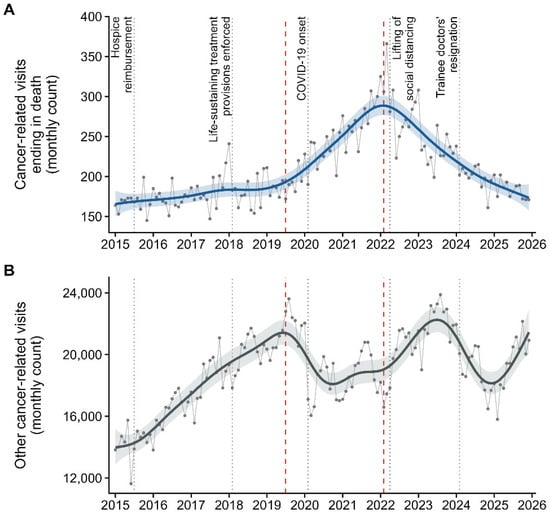
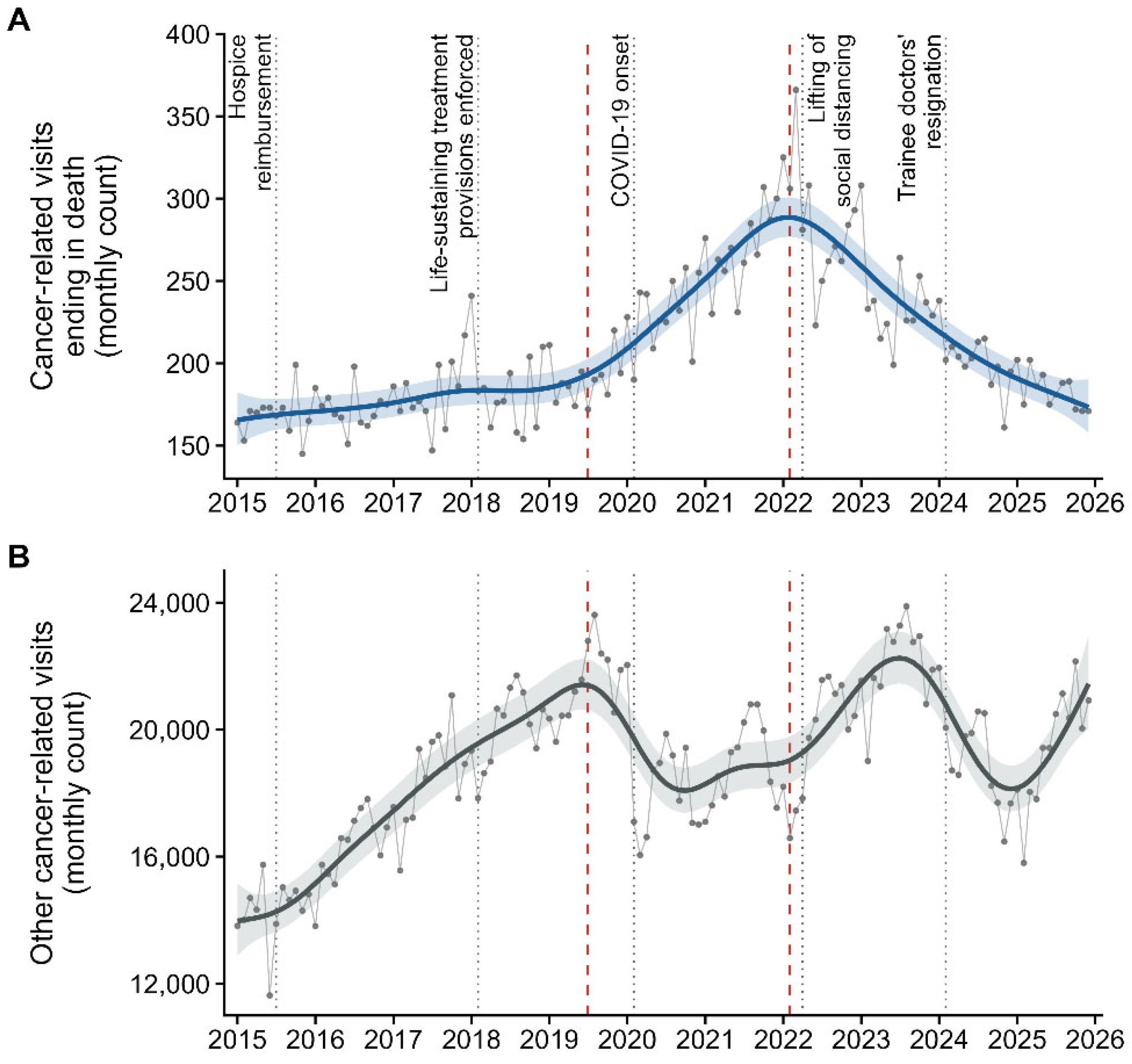
Monthly counts of visits ending in death rose slowly until mid-2019, climbed steeply to a peak in early 2022, and declined thereafter (Figure 1A). The annual count in 2025 was 9.5% higher than that in 2015. Other cancer-related ED visits, in contrast, fell sharply in 2020 and again in 2024 but were 36.0% higher in 2025 than in 2015 (Figure 1B).
Figure 1.
Generalized additive model smooths of monthly cancer-related ED visits by outcome, 2015–2025. (A) Visits ending in death. (B) All other cancer-related ED visits. Grey points and lines indicate observed monthly counts, and the solid line and shaded band indicate the fitted smooth and its 95% confidence intervals. Dotted vertical lines mark dates shown for context, including hospice reimbursement (July 2015), enforcement of the life-sustaining treatment provisions of the Act (February 2018), COVID-19 onset (February 2020), lifting of social distancing (April 2022), and trainee doctors walkout (February 2024). Red dashed lines mark the change points estimated for visits ending in death (July 2019 and February 2022). ED, emergency department; CI, confidence interval.
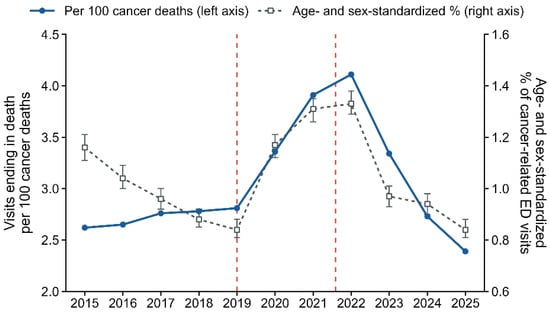
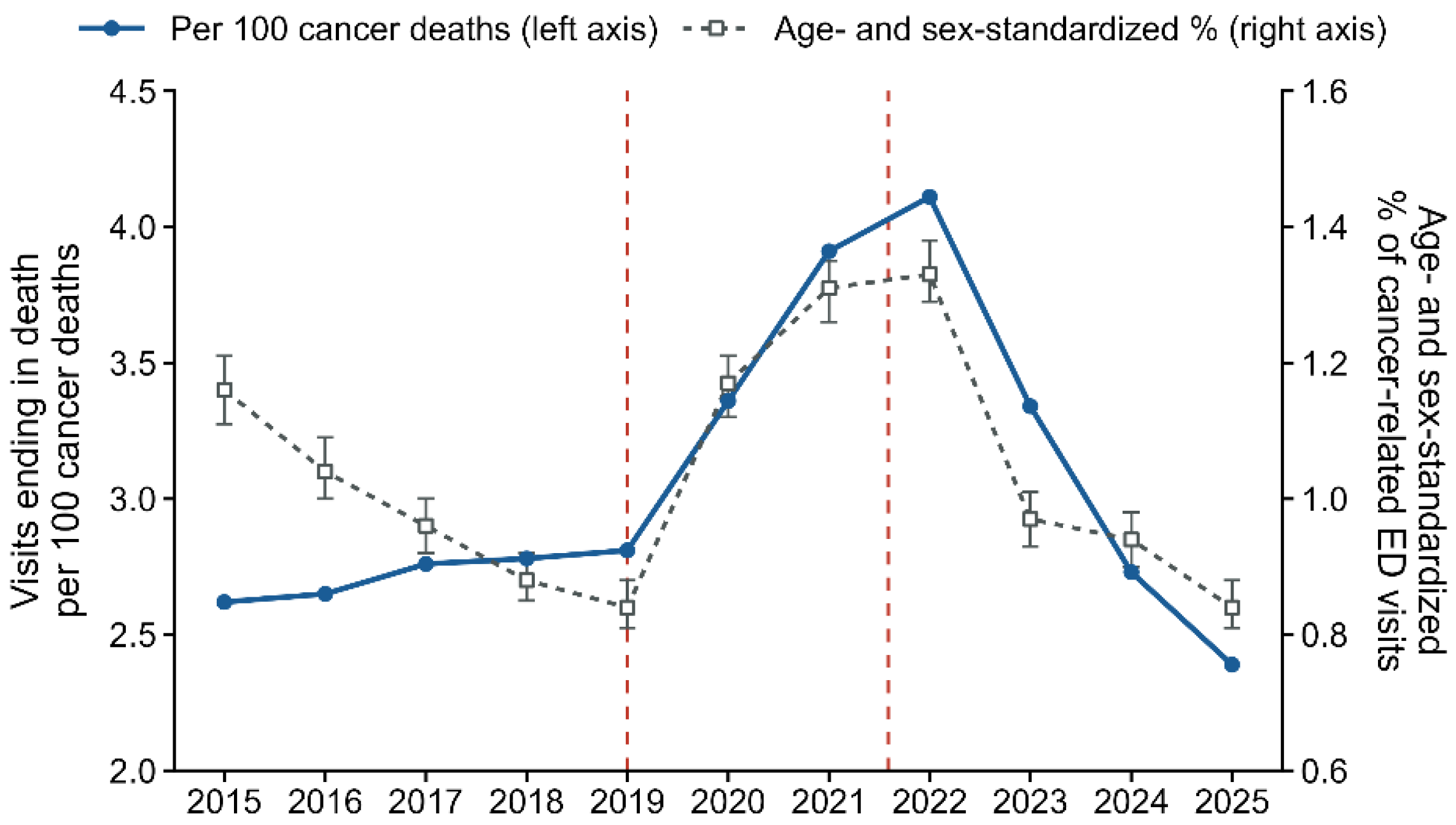
The number of visits ending in death per 100 cancer deaths rose from 2.62 in 2015 to 4.11 in 2022 and then fell to 2.39 in 2025 (Figure 2, Table S4). The same pattern was observed when EOL discharge was included (3.04 in 2015, 4.43 in 2022, and 2.64 in 2025). The age- and sex-standardized proportion of cancer-related ED visits ending in death fell from 1.16% in 2015 to 0.84% in 2019, rose to 1.33% in 2022, and returned to 0.84% in 2025. The two indicators diverged during 2015–2019 because all cancer-related ED visits increased by 49%, whereas visits ending in death increased by 13% and national cancer deaths by 6% (Tables S1 and S2).
Figure 2.
Annual trends in cancer-related emergency department (ED) visits ending in death, 2015–2025. The solid line with circles shows visits ending in death per 100 cancer deaths (left axis). The dashed line with squares shows the age- and sex-standardized proportion of cancer-related ED visits ending in death (right axis) with 95% confidence intervals. Red dashed vertical lines mark the change points estimated in Table 3 (July 2019 and February 2022).
3.3. Change Points and Annual Percent Change
Segmented quasi-Poisson regression of monthly counts identified two change points in visits ending in death per 100 cancer deaths: July 2019 (95% CI, March to November 2019) and February 2022 (95% CI, January to March 2022) (Table 3). The APC was 1.70% (95% CI, 0.26 to 3.16) from January 2015 to July 2019, 18.79% (95% CI, 16.44 to 21.17) from July 2019 to February 2022, and −17.01% (95% CI, −18.35 to −15.65) thereafter. When EOL discharge was included, the change points were October 2019 (95% CI, May 2019 to February 2020) and February 2022 (95% CI, December 2021 to March 2022). During 2016–2025, deaths in patients who were dead or in cardiac arrest on arrival and deaths after arriving alive both showed a marked increase followed by a decline, but the change points were earlier for the former (August 2019 and January 2021) than for the latter (November 2020 and January 2022) (Table S5). The change points were unchanged when seasonal terms were added, and a model with change points fixed at February 2020 and April 2022 showed a similar pattern (APCs, 3.42%, 18.51%, and −18.03%) but fitted the data less well (Table S6).
Table 3.
Estimated change points and annual percent change in cancer-related ED visits ending in death or EOL discharge per 100 cancer deaths, 2015–2025.
3.4. Characteristics Associated with ED Visits Ending in Death
In multivariable analysis, visits ending in death were associated with male sex (aOR for female vs. male 0.85, 95% CI 0.83–0.87) and older age (aOR for ≥80 vs. 19–39 years 2.32, 95% CI 2.01–2.68) (Table 4). The odds were also higher for residents of counties (aOR 1.32, 95% CI 1.20–1.45) and cities (aOR 1.15, 95% CI 1.04–1.26) than for those of metropolitan cities, and lower for visits transferred from another institution (aOR 0.59, 95% CI 0.52–0.66) or referred from outpatient clinics (aOR 0.78, 95% CI, 0.64–0.95) than for direct visits. The odds did not differ significantly by ED level after accounting for clustering by hospital. Additional adjustment for cancer site and calendar year changed the aORs little (Table S7).
Table 4.
Characteristics associated with cancer-related ED visits ending in death or EOL discharge.
4. Discussion
In this current nationwide study of 2.5 million cancer-related ED visits over 11 years, about 1 in 100 visits ended in DOA or death in the ED. Relative to national cancer deaths, these visits rose slowly until mid-2019, increased by about 19% per year to a peak in early 2022, and then decreased by about 17% per year. Visits ending in death were more likely among men, older patients, and residents of non-metropolitan areas. More than half of these deaths occurred after patients arrived alive, and among them CPR and endotracheal intubation were slightly less frequent in 2025 than in 2016.
The observed trends and change points may partly reflect changes in the availability of EDs and other care settings for patients with cancer during periods of major events affecting nationwide ED use. Compared with the modest increase from 2015 to 2019, the marked increase after mid-2019 largely overlapped with the COVID-19 pandemic. However, the first change point (July 2019) preceded the pandemic. A model with change points fixed at the onset of the pandemic fitted the data less well, and the APC before February 2020 (3.42%) in this model was higher than that before July 2019 in the main model (1.70%), suggesting that the increase had already begun in the second half of 2019 (Table S6). The factors underlying this early increase could not be identified in this study, but the increase continued throughout the pandemic period. During the pandemic, screening and isolation procedures limited access to EDs, and ED visits declined nationwide [25]. In contrast, the number of visits ending in death among patients with cancer continued to rise until early 2022, far exceeding the 2.7% growth in national cancer deaths over the same period. Moreover, these visits showed a declining trend after the second change point in February 2022, even though national cancer deaths increased by 10.6% from 2022 to 2025. Thus, neither the rise nor the subsequent decline can be explained by changes in the number of cancer deaths alone.
Among patients with cancer, those with advanced cancer near the end of life may have been particularly affected by changes in the availability of hospice and long-term care. During the pandemic, hospice units in public hospitals were reportedly closed or converted to COVID-19 care, and long-term care hospitals restricted admissions and visiting in Korea [26,27]. Some of these patients who would otherwise have died in these settings may therefore have been brought to the ED. The subsequent decline after February 2022 may have been partly related to the gradual resumption of inpatient hospice services in units that had been closed or repurposed [26]. Data from the Korean National Hospice Center also indicate that hospice use among patients with cancer began to increase again after the pandemic [19]. In addition, the decline may be related to the gradual expansion of hospice infrastructure after the Act was implemented in 2017–2018, with the number of hospice institutions increasing by 21% from 170 in 2019 to 206 in 2025 [19]. These changes may have shifted the place of death away from the ED for some patients with cancer near the end of life. However, because previous studies have reported inconsistent associations between hospice expansion and ED use near death, the contribution of hospice expansion may have been limited [28,29,30].
The increase in visits ending in death during the pandemic observed in this study contrasts with changes in place of death reported in other countries. During this period, home deaths from all causes increased in 23 of 32 countries, and home deaths from cancer increased in all 27 countries with available data [31]. Korea, however, had one of the lowest proportions of home deaths among these countries, which remained at 16.0% in 2020–2021 [31]. Although home deaths among patients with cancer have increased since home-based hospice care became covered by health insurance in 2020, the change has been modest [17]. In health systems with limited community-based EOL care, patients near death may turn to the ED when other places of care are difficult to access [32,33]. The higher likelihood of visits ending in death among residents of counties in this study may also be related to this context, as home hospice care and EOL care capacity remain limited in rural areas of Korea [19,34]. Rural residence has also been associated with more intensive acute care near death among patients with cancer in other countries [35]. However, factors other than EOL care capacity may also contribute to this finding. In rural areas, longer transport distances to the ED may increase the likelihood of death before arrival or in the ED before admission to a ward [36]. Patients in rural areas often receive cancer treatment at hospitals outside their area of residence [37] and may visit their local ED less often for problems that do not end in death, which would increase the proportion of local ED visits ending in death. The frequency of referral from long-term care hospitals may also differ across regions [38]. Because access to palliative care was not directly measured, these explanations could not be distinguished in this study.
Similarly, visits ending in death were more likely among older patients. The relationship between older age and ED use near death appears to vary across health systems. Residents of long-term care facilities may be transferred to the ED as death approaches because of difficulty recognizing the end of life, family distress, limited staffing, or the absence of advance care planning [38]. In contrast, where EOL care can be provided within these settings, residence in long-term care facilities and older age have been associated with less ED use near death [39,40]. One possible explanation is that in Korea, older patients with cancer who depend on family caregivers or lack adequate EOL care in their place of residence may be brought to the ED as death approaches. As the population ages, EDs may need to care for more dying patients.
These findings have implications for the care of patients whose death is expected and for the role of the ED. When patients with cancer near death present to the ED with various clinical conditions, the care provided should be consistent with their goals and preferences. Death in the ED has been associated with lower quality of EOL care as rated by bereaved family members [9]. However, 41% of patients with advanced cancer enrolled in a palliative care program [41] and approximately 20% of patients receiving hospice care have been reported to visit the ED for various needs [42,43]. The ED therefore remains a point of contact for these patients, and nationwide monitoring of these visits may help identify changes that warrant further investigation. Understanding their reasons for visiting the ED will require linking ED data with records of hospice use, life-sustaining treatment decisions, and causes of death. Because such linkage is not yet readily available, future studies could use the Korean National Health Insurance Service database to examine in detail ED visits by patients with hospice care claims and related factors, such as regional hospice capacity, and separate survey studies could explore the reasons for ED visits and unmet care needs among patients with or without hospice care claims.
This study has several limitations. First, NEDIS lacks information on cancer stage, comorbidities, treatment status, hospice enrollment, life-sustaining treatment decisions, and cause of death. Although we included only visits with cancer recorded as a principal or secondary diagnosis and excluded visits for non-disease causes such as injury and poisoning, we could not distinguish deaths directly caused by cancer progression from deaths due to other causes. This definition may therefore have included some deaths unrelated to cancer. Second, we captured DOA and deaths occurring in the ED but not deaths after admission, transfer, or discharge. Our indicators therefore reflect trends in deaths at the ED rather than overall ED use near the end of life. In addition, the number of visits ending in death per 100 cancer deaths is a population-level ratio and does not represent the probability that a patient with cancer dies in the ED. Third, although the number of participating institutions changed little, the ED disposition codes for death were revised in 2016. The primary definition combined all death codes and was therefore consistent across the study period, but because the codes for the types of death appeared to have been applied differently before the revision, analyses by type of death were restricted to 2016–2025. Moreover, because the ED disposition is recorded by clinical staff without external validation, some misclassification between types of death is possible. Fourth, this was an observational analysis and does not support causal inference. The estimated change points depend on the assumption that adjacent segments join continuously, and they should not be interpreted as estimates of the effect of any policy or event. Likewise, the associations in the multivariable analysis may reflect residual confounding by the unmeasured factors listed above, and insurance type was the only available proxy for socioeconomic circumstances. Finally, the generalizability of our findings may be limited by features specific to the Korean health system, including the predominance of hospital-based EOL care and a relatively limited role of primary care. Nevertheless, our findings may be relevant to health systems in which hospice care is not yet universally available.
5. Conclusions
Relative to cancer deaths, ED visits ending in death among adults with cancer in Korea increased steeply from mid-2019 to early 2022 and have since declined to below the 2015 level. These visits may serve as an indirect indicator of the conditions of care near the end of life, and their continued monitoring may help health systems assess EOL care capacity and prepare EDs for patients who die soon after arrival. In addition, survey and qualitative studies, including interviews with patients near the end of life and their families, are needed to understand in detail the needs that lead these patients to visit the ED.
Supplementary Materials
The following supporting information can be downloaded at: https://www.mdpi.com/article/10.3390/healthcare14234035/s1. Figure S1: Selection of the study population; Figure S2: Annual proportions of cardiopulmonary resuscitation and endotracheal intubation among cancer-related emergency department (ED) visits in which patients died after arriving alive, 2016–2025; Table S1: Annual number of national cancer deaths and annual percent change; Table S2: Annual distribution of cancer-related emergency department (ED) visits ending in death or end-of-life (EOL) discharge, 2015–2025; Table S3: Characteristics of cancer-related emergency department (ED) visits ending in death or end-of-life (EOL) discharge by year, 2015–2025; Table S4: Annual indicators of cancer-related emergency department (ED) visits ending in death or end-of-life (EOL) discharge; Table S5: Estimated change points and annual percent change in cancer-related ED visits ending in death per 100 cancer deaths by type of death, 2016–2025; Table S6: Sensitivity analyses of change points and annual percent change in cancer-related ED visits ending in death or EOL discharge per 100 cancer deaths, 2015–2025; Table S7: Characteristics associated with cancer-related ED visits ending in death or EOL discharge, additionally adjusted for cancer site and calendar year; Text S1: Details of the segmented regression analysis.
Author Contributions
Conceptualization, Y.A.K. and H.S.M.; methodology, H.K.S., Y.A.K. and H.S.M.; software, J.L. and H.S.M.; formal analysis, J.L. and H.S.M.; investigation, H.S.M.; data curation, H.K.S.; writing—original draft preparation, J.L. and H.S.M.; writing—review and editing, Y.A.K.; supervision, H.S.M.; project administration, H.S.M. All authors have read and agreed to the published version of the manuscript.
Funding
This research received no external funding.
Institutional Review Board Statement
Ethical review and approval were waived by the Institutional Review Board of Konkuk University (exemption no. KKUIRB-202608-E-299, 12 August 2026) in accordance with Article 15 (2) of the Bioethics and Safety Act and Article 13 of its Enforcement Rule, because the study analyzed anonymized secondary administrative data containing no personally identifiable information.
Informed Consent Statement
Patient consent was waived because the study used anonymized secondary administrative data and involved no direct contact with patients. For reference, this waiver is also supported by the following Korean legislation: Article 15 (2) of the Bioethics and Safety Act and Article 13 of its Enforcement Rule, which allow exemption from IRB review for research using existing data that poses minimal risk to participants; and Article 16 (3) of the Bioethics and Safety Act, which allows an IRB to waive written consent when obtaining consent is practically impossible and the risk to participants is minimal.
Data Availability Statement
Restrictions apply to the availability of these data. Data were obtained from the National Emergency Department Information System, maintained by the National Emergency Medical Center of Korea, and are available at https://www.e-gen.or.kr (accessed on 21 September 2026) with the permission of the National Emergency Medical Center.
Acknowledgments
During the preparation of this study, the authors used Claude (Claude Opus 5.5, Anthropic, San Francisco, CA, USA) for the purposes of assisting with writing and checking statistical analysis code and with language editing. The authors have reviewed and edited the output and take full responsibility for the content of this publication. Article Processing Charge was supported by Konkuk University in 2026.
Conflicts of Interest
The authors declare no conflicts of interest.
Abbreviations
APC: annual percent change; aOR: adjusted odds ratio; BIC: Bayesian information criterion; CI: confidence interval; CPR: cardiopulmonary resuscitation; DOA: dead on arrival; ED: emergency department; EMS: emergency medical services; EOL: end-of-life; IQR: interquartile range; KCD: Korean Standard Classification of Diseases; KTAS: Korean Triage and Acuity Scale; NEDIS: National Emergency Department Information System; NHI: National Health Insurance; SMD: standardized mean difference; STROBE: Strengthening the Reporting of Observational Studies in Epidemiology.
References
- Alishahi Tabriz, A.; Turner, K.; Hong, Y.R.; Gheytasvand, S.; Powers, B.D.; Elston Lafata, J. Trends and Characteristics of Potentially Preventable Emergency Department Visits Among Patients with Cancer in the US. JAMA Netw. Open 2023, 6, e2250423. [Google Scholar] [CrossRef] [Scilit]
- Peyrony, O.; Fontaine, J.P.; Beaune, S.; Khoury, A.; Truchot, J.; Balen, F.; Vally, R.; Schmitt, J.; Ben Hammouda, K.; Roussel, M.; et al. EPICANCER-Cancer Patients Presenting to the Emergency Departments in France: A Prospective Nationwide Study. J. Clin. Med. 2020, 9, 1505. [Google Scholar] [CrossRef] [Scilit]
- Min, H.S.; Chang, H.J.; Sung, H.K. Emergency Department Utilization of Adult Cancer Patient in Korea: A Nationwide Population-Based Study, 2017–2019. Cancer Res. Treat. 2022, 54, 680–689. [Google Scholar] [CrossRef] [Scilit]
- Lee, S.Y.; Ro, Y.S.; Shin, S.D.; Moon, S. Epidemiologic trends in cancer-related emergency department utilization in Korea from 2015 to 2019. Sci. Rep. 2021, 11, 21981. [Google Scholar] [CrossRef] [Scilit]
- Amado-Tineo, J.P.; Oscanoa-Espinoza, T.; Vasquez-Alva, R.; Huari-Pastrana, R.; Delgado-Guay, M.O. Emergency Department Use by Terminally Ill Patients: A Systematic Review. J. Pain Symptom Manag. 2021, 61, 531–543. [Google Scholar] [CrossRef] [Scilit]
- Leak, A.; Mayer, D.K.; Wyss, A.; Travers, D.; Waller, A. Why do cancer patients die in the emergency department? An analysis of 283 deaths in NC EDs. Am. J. Hosp. Palliat. Care 2013, 30, 178–182. [Google Scholar] [CrossRef] [Scilit]
- Prachanukool, T.; George, N.; Bowman, J.; Ito, K.; Ouchi, K. Best Practices in End of Life and Palliative Care in the Emergency Department. Clin. Geriatr. Med. 2023, 39, 575–597. [Google Scholar] [CrossRef] [Scilit]
- Huo, B.; Song, Y.; Chang, L.; Tan, B. Effects of early palliative care on patients with incurable cancer: A meta-analysis and systematic review. Eur. J. Cancer Care 2022, 31, e13620. [Google Scholar] [CrossRef] [Scilit]
- Wright, A.A.; Keating, N.L.; Ayanian, J.Z.; Chrischilles, E.A.; Kahn, K.L.; Ritchie, C.S.; Weeks, J.C.; Earle, C.C.; Landrum, M.B. Family Perspectives on Aggressive Cancer Care Near the End of Life. JAMA 2016, 315, 284–292. [Google Scholar] [CrossRef] [Scilit]
- Marck, C.H.; Weil, J.; Lane, H.; Weiland, T.J.; Philip, J.; Boughey, M.; Jelinek, G.A. Care of the dying cancer patient in the emergency department: Findings from a National survey of Australian emergency department clinicians. Intern. Med. J. 2014, 44, 362–368. [Google Scholar] [CrossRef] [Scilit]
- Fukushima, A.; Oyama, Y.; Horinouchi, M.; Koyanagi, M.; Mukoyama, M.; Kamogawa, M.; Yoshihara, S.; Sakuramoto, H. End-of-Life Care Provided to Patients and Families Who Die Shortly After Arriving at the Emergency Room: A Scoping Review. Cureus 2025, 17, e86705. [Google Scholar] [CrossRef] [Scilit]
- Gunaga, S.; Buchheister, A.; Neelam, H.; Al-Hage, A.; Welchans, M.; Swan, K.; Corcoran, J.; Banerjee, C.; Miller, J.B.; Mowbray, F.I. Emergency Department-Initiated Palliative Care Consultations for Patients with Cancer: Utilization Patterns, Clinical Characteristics, and Longitudinal Trends. J. Emerg. Med. 2026, 88, 58–70. [Google Scholar] [CrossRef] [Scilit]
- Lee, S.Y.; Ro, Y.S.; Shin, S.D.; Ko, E.; Kim, S.J. Epidemiology of patients who died in the emergency departments and need of end-of-life care in Korea from 2016 to 2019. Sci. Rep. 2023, 13, 686. [Google Scholar] [CrossRef] [Scilit]
- Majka, E.S.; Trueger, N.S. Emergency Department Visits Among Patients with Cancer in the US. JAMA Netw. Open 2023, 6, e2253797. [Google Scholar] [CrossRef] [Scilit]
- OECD. Working Better with Age: Korea, Ageing and Employment Policies; OECD Publishing: Paris, France, 2018. [Google Scholar]
- Pivodic, L.; Pardon, K.; Morin, L.; Addington-Hall, J.; Miccinesi, G.; Cardenas-Turanzas, M.; Onwuteaka-Philipsen, B.; Naylor, W.; Ruiz Ramos, M.; Van den Block, L.; et al. Place of death in the population dying from diseases indicative of palliative care need: A cross-national population-level study in 14 countries. J. Epidemiol. Community Health 2016, 70, 17–24. [Google Scholar] [CrossRef] [Scilit]
- Yun, I.; Jang, S.I.; Park, E.C.; Jang, S.Y. Changes in the Place of Death of Patients with Cancer After the Introduction of Insurance-Covered, Home-Based Hospice Care in Korea. JAMA Netw. Open 2023, 6, e2341422. [Google Scholar] [CrossRef] [Scilit]
- OECD. Time for Better Care at the End of Life; OECD Health Policy Studies; OECD Publishing: Paris, France, 2023. [Google Scholar]
- National Hospice Center. Service Provision Status by Institution. Available online: https://hospice.go.kr:8444/?menuno=17 (accessed on 13 August 2026).
- Lee, K.S.; Sung, H.K.; Choi, Y.Y.; Han, C.; Min, H.S. Impact of the Early COVID-19 Pandemic on Emergency Department Visits of Adult Cancer Patients with Fever or Respiratory Symptoms: A Korean Nationwide Population-Based Study, 2016–2020. J. Korean Med. Sci. 2024, 39, e187. [Google Scholar] [CrossRef] [Scilit]
- Pak, Y.-S.; Ro, Y.S.; Kim, S.-H.; Han, S.-H.; Ko, S.-k.; Kim, T.; Kwak, Y.H.; Heo, T.; Moon, S. Effects of Emergency Care-related Health Policies during the COVID-19 Pandemic in Korea: A Quasi-Experimental Study. J. Korean Med. Sci. 2021, 36, e121. [Google Scholar] [CrossRef] [Scilit]
- Choi, A.; Kim, B.J.; Lee, J.; Kim, S.; Bae, W. Impact of the South Korean government’s medical school expansion announcement on pediatric emergency department visits. BMC Emerg. Med. 2025, 25, 39. [Google Scholar] [CrossRef] [Scilit]
- Cho, Y.S.; Jang, J.Y.; Woo, J.W.; Park, D.J.; Park, C.Y. Effects of the medical professional shortage caused by a resident walkout on scene-to-door time: A retrospective cohort study at a trauma center. J. Trauma Inj. 2025, 38, 335–342. [Google Scholar] [CrossRef] [Scilit]
- Statistics Korea. Cause of Death Statistics. Available online: https://kosis.kr/statHtml/statHtml.do?sso=ok&returnurl=https%3A%2F%2Fkosis.kr%3A443%2FstatHtml%2FstatHtml.do%3Fconn_path%3DMT_ZTITLE%26list_id%3DF_27%26obj_var_id%3D%26seqNo%3D%26tblId%3DDT_1B34E09%26vw_cd%3DMT_ZTITLE%26itm_id%3D%26language%3Dkor%26lang_mode%3Dko%26orgId%3D101%26 (accessed on 22 September 2026).
- Kim, S.; Sung, H.K.; Lee, J.; Ko, E.; Kim, S.J. Trends in emergency department visits for emergency care-sensitive conditions before and during the COVID-19 pandemic: A nationwide study in Korea, 2019–2021. Clin. Exp. Emerg. Med. 2024, 11, 88–93. [Google Scholar] [CrossRef] [Scilit]
- Kim, C.G. Hospice and Palliative Care Response Policy During the Coronavirus Disease 2019 (COVID-19) Pandemic in South Korea. J. Hosp. Palliat. Care 2025, 28, 138–151. [Google Scholar] [CrossRef] [Scilit]
- Lee, J.H. “Well-dying” of Cancer Patients Pushed Aside by COVID-19: Severe Shortage of Hospice Facilities. Medical Today 18 March 2022. (In Korean) Available online: http://www.mdtoday.co.kr/news/articleView.html?idxno=429485 (accessed on 22 September 2026).
- Sutradhar, R.; Barbera, L.; Seow, H.Y. Palliative homecare is associated with reduced high- and low-acuity emergency department visits at the end of life: A population-based cohort study of cancer decedents. Palliat. Med. 2017, 31, 448–455. [Google Scholar] [CrossRef] [Scilit]
- Chiang, J.K.; Lee, Y.C.; Kao, Y.H. Trend analysis of end-of-life care between hospice and nonhospice groups of cancer patients in Taiwan for 2002–11. Medicine 2017, 96, e7825. [Google Scholar] [CrossRef] [Scilit]
- Anttonen, A.; Carpén, T.; Nåhls, N.S.; Kitti, P.; Miinalainen, S.; Leskelä, R.L.; Akrén, O.; Saarto, T. The association of the timing of outpatient palliative care clinic visit on the utilization of hospital services and decision making at the end of life in patients with cancer A retrospective cohort study. BMC Cancer 2025, 25, 1777. [Google Scholar] [CrossRef] [Scilit]
- Lopes, S.; Bruno de Sousa, A.; Delalibera, M.; Namukwaya, E.; Cohen, J.; Gomes, B. The rise of home death in the COVID-19 pandemic: A population-based study of death certificate data for adults from 32 countries, 2012–2021. eClinicalMedicine 2024, 68, 102399. [Google Scholar] [CrossRef] [Scilit]
- Rosenwax, L.K.; McNamara, B.A.; Murray, K.; McCabe, R.J.; Aoun, S.M.; Currow, D.C. Hospital and emergency department use in the last year of life: A baseline for future modifications to end-of-life care. Med. J. Aust. 2011, 194, 570–573. [Google Scholar] [CrossRef] [Scilit]
- Verhoef, M.J.; de Nijs, E.; Horeweg, N.; Fogteloo, J.; Heringhaus, C.; Jochems, A.; Fiocco, M.; van der Linden, Y. Palliative care needs of advanced cancer patients in the emergency department at the end of life: An observational cohort study. Support Care Cancer 2020, 28, 1097–1107. [Google Scholar] [CrossRef] [Scilit]
- Kim, W.; Kim, K.; Nam, E.J.; Kye, S.Y.; Park, J.; Choi, J.Y. Factors associated with the utilization of home hospice care at end-of-life in patients with cancer: A nationwide analysis. Int. J. Qual. Health Care 2025, 37, mzaf097. [Google Scholar] [CrossRef] [Scilit]
- Ho, T.H.; Barbera, L.; Saskin, R.; Lu, H.; Neville, B.A.; Earle, C.C. Trends in the aggressiveness of end-of-life cancer care in the universal health care system of Ontario, Canada. J. Clin. Oncol. 2011, 29, 1587–1591. [Google Scholar] [CrossRef] [Scilit]
- Park, S.Y.; Lim, D.; Kim, S.C.; Ryu, J.H.; Kim, Y.H.; Choi, B.; Kim, S.H. Disparities in Survival Outcomes of Out-of-Hospital Cardiac Arrest Patients between Urban and Rural Areas and the Identification of Modifiable Factors in an Area of South Korea. J. Clin. Med. 2022, 11, 4248. [Google Scholar] [CrossRef] [Scilit]
- Kim, W.; Han, K.T.; Kim, S. Do Patients Residing in Provincial Areas Transport and Spend More on Cancer Treatment in Korea? Int. J. Environ. Res. Public Health 2021, 18, 9247. [Google Scholar] [CrossRef] [Scilit]
- Kouyoumdjian, V.; Perceau-Chambard, E.; Sisoix, C.; Filbet, M.; Tricou, C. Physician’s perception leading to the transfer of a dying nursing home resident to an emergency department: A French qualitative study. Geriatr. Gerontol. Int. 2019, 19, 249–253. [Google Scholar] [CrossRef] [Scilit]
- Osborne, T.R.; Triandafilidis, Z.; Jeong, S.Y.; Szwec, S.; Leigh, L.; Goodwin, N. Emergency Department Use in the Last 90 Days of Life: A Retrospective Audit Regression Analysis. J. Palliat. Care 2026. online ahead of print. [Google Scholar] [CrossRef] [Scilit]
- Lindskog, M.; Schultz, T.; Strang, P. Acute healthcare utilization in end-of-life among Swedish brain tumor patients A population based register study. BMC Palliat. Care 2022, 21, 133. [Google Scholar] [CrossRef] [Scilit]
- Dumnui, N.; Nagaviroj, K.; Anothaisintawee, T. A study of the factors associated with emergency department visits in advanced cancer patients receiving palliative care. BMC Palliat. Care 2022, 21, 197. [Google Scholar] [CrossRef] [Scilit]
- Aldridge, M.D.; Epstein, A.J.; Brody, A.A.; Lee, E.J.; Cherlin, E.; Bradley, E.H. The Impact of Reported Hospice Preferred Practices on Hospital Utilization at the End of Life. Med. Care 2016, 54, 657–663. [Google Scholar] [CrossRef] [Scilit]
- Carpenter, K.P.; Bellolio, F.; Ingram, C.; Klassen, A.B.; McGuire, S.S.; Morgan, A.A.; Mullan, A.F.; Ginsburg, A.D. Characteristics of patients enrolled in hospice presenting to the emergency department. Am. J. Emerg. Med. 2025, 88, 218–224. [Google Scholar] [CrossRef] [Scilit]

Disclaimer/Publisher’s Note: The statements, opinions and data contained in all publications are solely those of the individual author(s) and contributor(s) and not of MDPI and/or the editor(s). MDPI and/or the editor(s) disclaim responsibility for any injury to people or property resulting from any ideas, methods, instructions or products referred to in the content. |
© 2026 by the authors. Licensee MDPI, Basel, Switzerland. This article is an open access article distributed under the terms and conditions of the Creative Commons Attribution (CC BY) license.