


Abstract
Background/Objectives: This study aimed to evaluate phase-associated heart rate (HR) variation and intraoperative physiological activation of a surgeon during laparoscopic nephrectomy by continuously monitoring HR across predefined surgical phases. The primary hypothesis was that HR would significantly increase during critical operative steps, reflecting phase-dependent autonomic and physiological activation. Methods: This prospective observational study was conducted at a tertiary academic center, between August 2023 and January 2026. A single urologic surgeon performed all procedures to ensure standardization. Fifty-six patients undergoing laparoscopic nephrectomy were initially enrolled; four were excluded due to ECG artifacts, yielding a final sample of 52 cases. The surgeon wore a Holter ECG monitor during surgery. Heart rate data were segmented by specific timepoints corresponding to key surgical stages. Results: The surgeon’s HR increased significantly across the procedure (p < 0.001), reaching a numerical peak during the interval between renal artery clamping and specimen removal (HR3: 106.69 ± 15.62 bpm) compared to baseline before operating room entry (HRbasal: 66.90 ± 11.34 bpm). Bonferroni-adjusted pairwise comparisons confirmed significant HR elevations across early consecutive phases up to interval between ureter identification and renal artery clamping (HR2: 101.96 ± 12.21 bpm; padj < 0.001), whereas the transition from HR2 to HR3 was not statistically significant (padj = 0.528), indicating a sustained high-activation plateau across both phases. While the overall unweighted mean HR across all six phases (HRbasal to HR4) showed no significant correlation with operative time (p = 0.126) or tumor size (p = 0.293), sensitivity analyses restricted to the five intraoperative phases (HR0 to HR4) revealed a modest positive association with operative time (p = 0.031) but not tumor size (p = 0.262). Conclusions: Continuous heart rate monitoring demonstrated distinct phase-associated heart rate variations during laparoscopic nephrectomy, characterized by a sustained plateau across the interval between ureter identification and renal artery clamping and the interval between renal artery clamping and specimen removal, with a numerical peak during the latter interval. While independent stress or workload measures are needed to confirm psychological stress, real-time heart rate monitoring may serve as a foundation for proposed future applications, such as exploring strategies to support surgical training, workflow optimization, and surgeon well-being.
1. Introduction
The operating room is a high-stakes environment where surgeons are exposed to multiple stressors, including time pressure, technical complexity, and the need for constant decision-making. Surgical performance is influenced not only by technical proficiency but also by the surgeon’s physiological and psychological state during the procedure, which can influence cognitive function, motor coordination, and ultimately, surgical performance. Elevated intraoperative stress has been associated with increased risk of errors, prolonged operative time, and surgeon fatigue, all of which may impact patient outcomes [1].
Operating room stress, particularly in complex surgeries, has been associated with changes in autonomic function, manifesting as elevated heart rate (HR), blood pressure, and cortisol levels [2]. Among these, heart rate is a readily measurable and non-invasive indicator of acute stress response mediated by sympathetic activation [3]. Acute stress, in particular, has been shown to impair critical cognitive functions including attention, memory retrieval, and decision-making. Research across disciplines has shown that stress reduces attentional capacity, which can either enhance or hinder performance depending on the alignment between the stressor and the task [4,5]. While stress may sharpen focus when the stressor is integral to the task, it often leads to distractibility and “tunnel vision” when the stress originates from unrelated factors [6]. Furthermore, elevated stress levels—especially those perceived as threats—negatively affect working memory and decision-making accuracy [7,8].
Laparoscopic surgery, while offering benefits such as reduced patient morbidity and shorter recovery times, presents unique challenges to the operating surgeon, including limited tactile feedback, reliance on two-dimensional visualization, and the need for precise instrument control within confined spaces [9]. The technique requires greater concentration and places greater mental stress on surgeons compared to open surgery [10]. These challenges can lead to increased cognitive load and stress, especially during critical phases such as vascular dissection.
While previous research has explored patient stress during surgery, relatively few studies have focused on quantifying the intraoperative stress levels of surgeons in real time [11,12,13,14,15]. Understanding how stress levels fluctuate during specific surgical phases can inform targeted interventions to mitigate stress and enhance performance by guiding training, workflow optimization, and surgeon well-being strategies.
In this study, we aimed to assess phase-associated intraoperative heart rate variations and physiological activation patterns of a single surgeon to identify potential contributors to intraoperative cardiac workload. Additionally, we investigated correlations between the surgeon’s HR and factors such as operative duration and tumor size to identify potential contributors to intraoperative cardiac workload.
2. Materials and Methods
2.1. Study Design and Participants
This prospective, exploratory, single-surgeon, repeated-measures investigation was conducted between August 2023 and January 2026 at a tertiary care center. Rather than generalizing to a broad population of surgeons, this study aimed to deeply characterize the physiological activation of a single individual across multiple procedures. All laparoscopic nephrectomies were performed by the same urologic surgeon to ensure strict procedural consistency. The study initially enrolled 56 patients; however, 4 patients were excluded due to significant artifacts in Holter ECG recordings, resulting in a final sample size of 52 patients. All surgical procedures analyzed in this study were consecutively performed transperitoneal laparoscopic radical nephrectomies for renal malignancies. Cases requiring conversion to open surgery were absent. Although intraoperative complications resulting in procedural sequence disruption served as a pre-specified exclusion criterion to maintain phase standardization, no procedures met this criterion or were excluded for intraoperative complications or difficult surgical dissection.
Inclusion criteria were:
- Undergoing laparoscopic nephrectomy during the study period
- Availability of complete Holter ECG recordings
- Provided informed consent for participation
Exclusion criteria were:
- ECG artifacts preventing reliable HR analysis
- Intraoperative complications that disrupted the predefined surgical sequence
- Lack of patient consent
2.2. Surgeon Monitoring and Heart Rate Measurement
The monitored subject was a 40-year-old male right-handed urologist with 9 years of post-residency experience. He is a non-smoker, consumes approximately 3 cups of coffee daily, and has no chronic medical conditions or regular medication use. A 3-lead Holter ECG device was attached to the surgeon approximately 30 min prior to the procedure. Following the attachment of the Holter monitor, the surgeon remained entirely in a standing posture: he walked approximately 50 m on level ground (avoiding stairs) into the operating theatre and waited in the operating room resting area during preparations. Throughout the entire surgical procedure, the surgeon remained standing statically at the operating table, with the table height ergonomically adjusted to his stature. Procedures were conducted under standardized general anesthesia in the lateral decubitus position, with the central operating room thermostat set to a standardized institutional target of 20 °C, although continuous ambient room temperature logging and individual microclimatic thermal load under sterile surgical gowns were not separately measured.
The surgeon’s heart rate (HR) was continuously monitored throughout the surgery using a Holter recorder (Telesmart-H, Medset Medizintechnik GmbH, Hamburg, Germany). The raw Holter recordings were exported and processed using specialized software (PADSY-Holter, version 7.6, Medset Medizintechnik GmbH, Hamburg, Germany). To ensure data integrity, a minimum valid recording proportion of 95% per analyzed interval was required for case inclusion. Artifacts, ectopic beats, and minor motion-induced noise comprised less than 3% to 5% of the total recording duration in retained cases and were manually filtered and interpolated by an experienced cardiologist. Isolated missing segments or brief periods of signal loss were handled via linear interpolation of adjacent valid R-R intervals provided they did not span critical phase transition timestamps. As initially noted, four cases were excluded strictly due to severe technical ECG artifacts (e.g., electrode detachment caused by excessive sweating or motion interference).
Heart rate data were segmented according to specific intraoperative time intervals, which were defined as follows:
- Holter attachment
- ➢
- HRbasal
- t0—Entry into the operating room
- ➢
- HR0 (initial patient positioning, sterile draping, creation of the pneumoperitoneum)
- t1—Trocar insertion
- ➢
- HR1 (mobilisation of the colon)
- t2—Ureter identification
- ➢
- HR2 (extensive hilar dissection, mobilization of the kidney, and isolation of the renal vessels)
- t3—Renal artery clamping
- ➢
- HR3 (complete mobilization and extraction of the kidney)
- t4—Specimen removal
- ➢
- HR4 (hemostasis check, irrigation, and fascial/skin closure)
- t5—End of the operation
‘Renal artery clamping’ specifically denotes definitive vascular control during radical nephrectomy, a phase carrying heightened technical risk due to the catastrophic consequences of potential vascular injury.
The mean heart rate was calculated for each interval (HRbasal, HR0, HR1, HR2, HR3, HR4) to evaluate phase-associated heart rate variations across different surgical stages. To ensure accurate timestamping, the internal clock of the Holter ECG device was strictly synchronized with the digital wall clock in the operating room prior to attachment. The exact moments of surgical milestones (t0 to t5) were verbally dictated by the operating surgeon and immediately recorded in real-time by a dedicated independent observer in the operating room.
2.3. Data Collection
Demographic and clinical data were recorded for each patient, including age, operative time (in minutes), and tumor size (in centimeters, based on preoperative imaging). Operative time (skin-to-skin) was defined in accordance with standard surgical records as the duration from the initial skin incision for Veress needle insertion/pneumoperitoneum creation to the completion of skin closure (t5). Because HR0 encompassed both pre-incision preparation (patient positioning and sterile draping) and the subsequent creation of pneumoperitoneum prior to trocar insertion (t1), operative time began within the latter portion of the HR0 interval and continued until t5. All procedures were conducted under standardized anesthetic and surgical conditions to minimize confounding factors.
2.4. Statistical Analysis
Descriptive statistics were expressed as both mean ± standard deviation (SD) and median with interquartile range (IQR: 25th–75th percentiles). Overall differences in the surgeon’s heart rate across the six surgical intervals were analyzed using the non-parametric Friedman test, with Kendall’s coefficient of concordance (W) calculated as a measure of effect size. Post hoc pairwise comparisons between phases (including baseline comparisons) were performed using the Wilcoxon signed-rank test, accompanied by mean paired differences with 95% confidence intervals (CI) and median paired differences with IQRs. To control the family-wise error rate across all 15 pairwise comparisons, Bonferroni multiplicity correction was applied. Associations between the surgeon’s primary procedure-level summary measure—defined as the unweighted mean HR across all six monitored phases (HRbasal to HR4)—and both operative time and tumor size were assessed using Pearson’s correlation coefficient (r with 95% CI), supplemented by Spearman’s rank correlation (rs) and Cook’s distance (D) to evaluate linearity and influential observations. To assess whether the inclusion of the preoperative baseline phase or differences in phase durations influenced these associations across the 52 procedures, sensitivity analyses were conducted using the unweighted intraoperative mean HR (HR0 to HR4) and the duration-weighted intraoperative mean HR. A descriptive comparison between the four excluded procedures and the included cases was conducted to evaluate potential selection bias, comparing available clinical parameters using Welch’s t-test for continuous variables. A two-sided adjusted p-value < 0.05 was considered statistically significant. All statistical analyses were performed using IBM SPSS Statistics for Windows, Version 26.0 (Armonk, NY, USA: IBM Corp.).
3. Results
A total of 52 laparoscopic nephrectomies performed by a single surgeon were included in the study. The mean age of patients was 62.77 (±12.66) years, and the average operative time was 155.10 (±54.46) minutes. The mean tumor size was 7.28 (±2.71) cm. A descriptive comparison between the excluded four patients and the final 52 included cases revealed no statistically significant differences in terms of mean age (60.50 ± 10.15 vs. 62.77 ± 12.66 years, p = 0.70), operative time (148.50 ± 42.10 vs. 155.10 ± 54.46 min, p = 0.78), or tumor size (6.85 ± 2.10 vs. 7.28 ± 2.71 cm, p = 0.72).
Across all 52 procedures, the surgeon’s procedure-level unweighted mean heart rate from Holter attachment to the end of the operation (HRbasal to HR4) was 90.49 ± 7.19 bpm (median: 89.75, IQR: 86.58–94.88 bpm; pooled SD across all 312 phase measurements: ±18.62 bpm), while the procedure-level unweighted mean across the five intraoperative phases (HR0 to HR4) was 95.21 ± 8.13 bpm (median: 94.80, IQR: 90.80–99.90 bpm).
Across the procedures, the mean (±SD) durations of the consecutive monitoring intervals were 23.50 ± 21.18 min for HRbasal, 25.73 ± 9.88 min for HR0, 33.38 ± 19.55 min for HR1, 30.31 ± 20.10 min for HR2, 62.92 ± 41.83 min for HR3, and 18.45 ± 6.12 min for HR4. Accordingly, the sum of all five intraoperative monitoring intervals (t0 to t5: 170.79 min) reflects total operating room presence—including approximately 15.69 min of pre-incision patient positioning and sterile draping during the first part of HR0—whereas mean skin-to-skin operative time (155.10 min) comprises the pneumoperitoneum creation phase during the latter part of HR0 (approximately 10.04 min) plus the four post-trocar intervals from t1 to t5 (145.06 min).
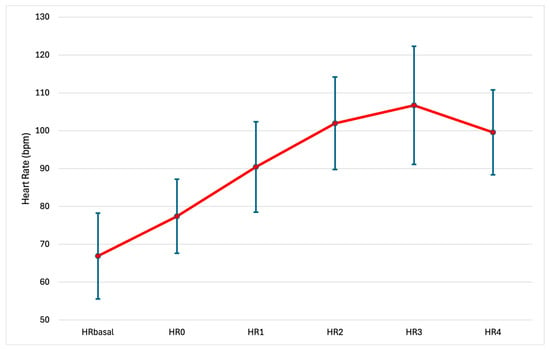
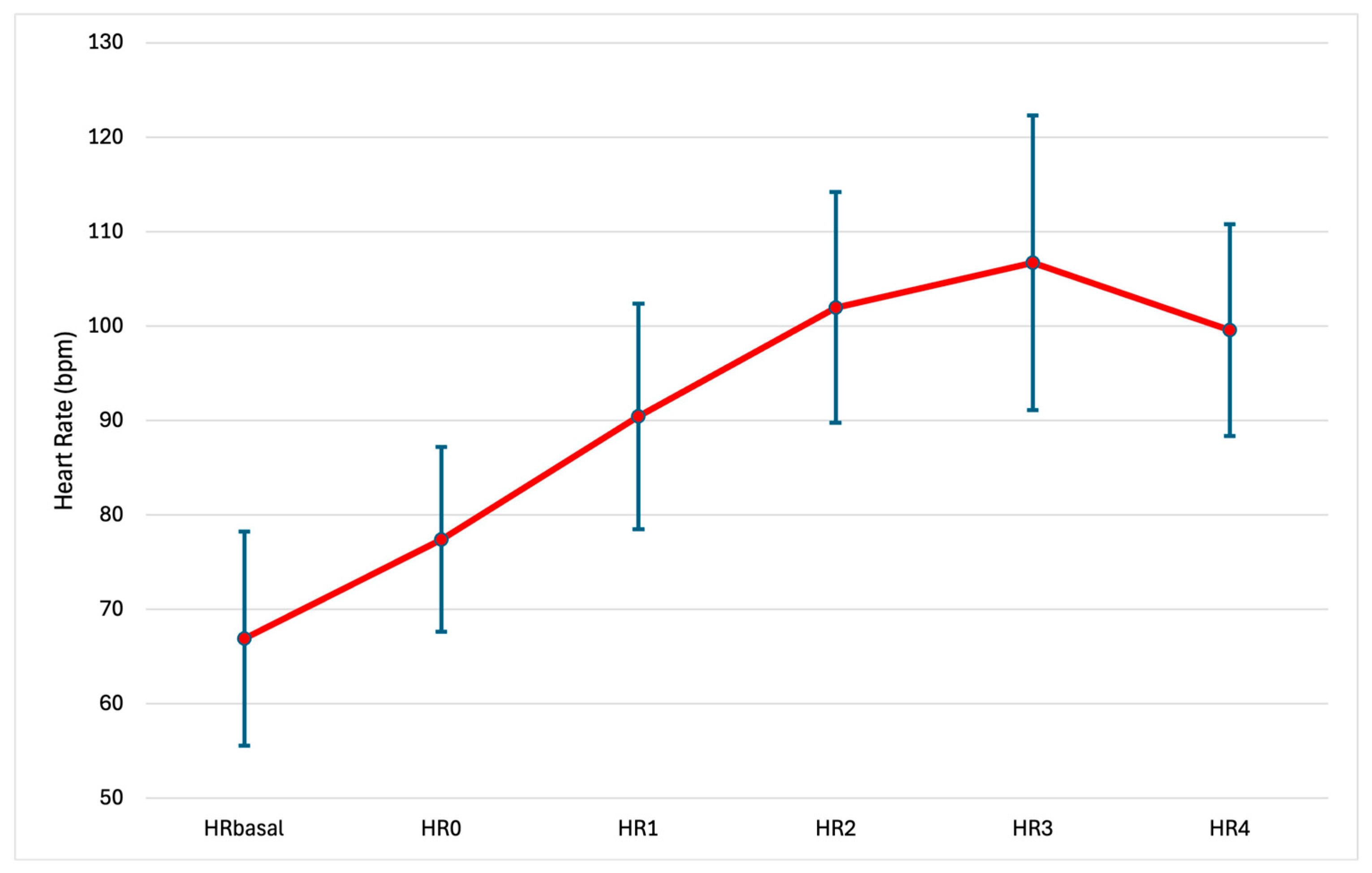
Table 1 summarizes the surgeon’s mean heart rate across different surgical phases. The basal heart rate (HRbasal) recorded from the time the Holter was attached until entering the operating room was 66.90 (±11.34) bpm. A progressive increase in heart rate was observed with each critical step, peaking during the interval between renal artery clamping and specimen removal (HR3: 106.69 ± 15.62 bpm). A slight decrease was noted during the interval between specimen removal and the end of the operation (HR4: 99.57 ± 11.22 bpm). The Friedman test demonstrated a highly significant difference in heart rate across the six phases (χ2 = 168.55, df = 5, p < 0.001, Kendall’s W = 0.648), indicating a strong and consistent phase-dependent physiological activation across surgical stages (Figure 1).
Table 1.
Mean Heart Rate of the Surgeon Across Different Surgical Phases During Laparoscopic Nephrectomy.
Figure 1.
Trend of surgeon’s mean heart rate throughout the surgical phases. (bpm: beats per minute. Blue bars represent standard deviation (±SD) for each timepoint).
Pairwise comparisons with Bonferroni multiplicity correction demonstrated highly significant increases in the surgeon’s heart rate from baseline (HRbasal) to the interval between operating room entry and trocar insertion (HR0) and all subsequent intraoperative intervals (padj < 0.001 for all). Heart rate also increased significantly from HR0 across all subsequent intervals (HR1, HR2, HR3, HR4; padj < 0.001 for all). Progressive physiological escalation continued with significant increases from the interval between trocar insertion and ureter identification (HR1) to the interval between ureter identification and renal artery clamping (HR2), the interval between renal artery clamping and specimen removal (HR3), and the interval between specimen removal and the end of the operation (HR4) (padj < 0.001 for all). Although heart rate reached its numerical peak during the interval between renal artery clamping and specimen removal (HR3: 106.69 ± 15.62 bpm) compared to the interval between ureter identification and renal artery clamping (HR2: 101.96 ± 12.21 bpm), this transition (unadjusted p = 0.035) did not remain statistically significant after Bonferroni correction (padj = 0.528), indicating a sustained high-activation plateau spanning across both intervals. Following this peak plateau, heart rate decreased significantly from HR3 to the interval between specimen removal and end of the operation (HR4: 99.57 ± 11.22 bpm; unadjusted p = 0.0006, padj = 0.009). However, no statistically significant difference was observed between HR2 and HR4 (padj = 1.000) (Table 2).
Table 2.
Pairwise Comparison of Surgeon’s Heart Rate Between Surgical Phases.
In the primary correlation analysis using the procedure-level unweighted mean HR across all six phases (HRbasal to HR4), no statistically significant association was observed with either operative time (r = 0.215, 95% CI: −0.061 to 0.461, p = 0.126; rs = 0.232, p = 0.099) or tumor size (r = −0.149, 95% CI: −0.405 to 0.130, p = 0.293; rs = −0.169, p = 0.231), with all Cook’s distance values below 1.0. However, in sensitivity analyses excluding the preoperative baseline phase, the unweighted intraoperative mean HR (HR0 to HR4) demonstrated a modest positive correlation with operative time (r = 0.299, 95% CI: 0.028 to 0.529, p = 0.031; rs = 0.320, p = 0.021), which was also observed using the duration-weighted intraoperative mean HR (r = 0.377, 95% CI: 0.116 to 0.589, p = 0.006; rs = 0.368, p = 0.007). Across all summary definitions, correlations with tumor size remained consistently non-significant (unweighted intraoperative mean: r = −0.158, 95% CI: −0.413 to 0.120, p = 0.262; duration-weighted intraoperative mean: r = −0.195, 95% CI: −0.444 to 0.083, p = 0.167). Together, these findings indicate that tumor dimensions did not linearly drive the surgeon’s heart rate, while total operative duration showed a modest positive association with intraoperative heart rate once the preoperative baseline phase was excluded.
4. Discussion
While previous research has established that the operating room environment induces significant autonomic activation in surgeons [10,11,12,13], relatively few studies have mapped real-time physiological trajectories across precisely defined procedural milestones in laparoscopic urology. Our findings contribute to this growing body of literature by demonstrating a clear, phase-dependent escalation in heart rate during laparoscopic nephrectomy. These results reflect the dynamic interplay between surgical task complexity and physiological activation and highlight the utility of real-time HR monitoring in identifying intervals of heightened physiological activation during surgery.
The elevated HR observed from baseline (HRbasal) to the final stages of the operation suggests that the surgeon experiences a rising physiological burden as the procedure becomes more technically demanding. In particular, HR reached a sustained high-activation plateau during the interval between ureter identification and renal artery clamping and achieved its numerical peak during the subsequent interval, without a statistically significant difference between these two phases after multiplicity correction. Such moments require high precision, rapid decision-making, and carry the potential for catastrophic complications—factors that naturally provoke a sympathetic response. These findings are in line with previous research indicating that surgeons experience measurable stress increases during challenging intraoperative tasks, such as vascular control or unanticipated bleeding [10,16,17].
Although the HR decreased after HR3, it remained elevated during HR4, indicating that the completion of the most technically critical steps does not immediately resolve physiological activation. This residual elevation may stem from sustained vigilance, concern about potential complications, or the physical toll of prolonged focus. Prior studies have suggested that the physiological effects of acute stress may persist even after the stressor is removed, particularly in high-performance environments like the operating room [18].
Another notable observation emerged from the correlation and sensitivity analyses regarding operative time and tumor size. When evaluated using the overall unweighted mean HR across all six phases, neither operative time nor tumor size showed a statistically significant association; however, excluding the preoperative baseline phase and accounting for interval durations revealed a modest positive correlation between intraoperative mean HR and operative time, whereas tumor size remained unrelated across all summary definitions. These findings suggest that while prolonged operative duration may modestly contribute to cumulative intraoperative cardiac load, macroscopic case characteristics such as tumor diameter alone do not linearly account for variations in the surgeon’s physiological activation, which may also be influenced by unmeasured patient-specific anatomical factors or adhesions.
Unlike studies that utilize heart rate variability (HRV), we focused on raw heart rate as our primary physiological measure. While HRV is a more nuanced marker of autonomic nervous system activity, it is highly susceptible to motion artifacts and is technically challenging to capture reliably during surgery [19]. In contrast, HR is simple, robust, and provides immediate feedback, making it well-suited for dynamic environments such as the operating room. Moreover, our study demonstrates that even basic physiological monitoring can reveal meaningful patterns when applied systematically and aligned with procedural milestones.
From a broader perspective, our findings contribute to the growing conversation around surgeon well-being, ergonomics, and intraoperative stress management. Repeated exposure to high-stress operating conditions without adequate mitigation strategies can contribute to burnout, decreased performance, and long-term health consequences for surgeons [1,2,20]. When combined with validated workload assessments in future studies, identifying which phases of surgery elicit the greatest physiological activation may support proposed applications—such as brief cognitive breaks, mindfulness training, or task redistribution within the team—aimed at supporting surgeon performance and well-being. Furthermore, integrating physiological monitoring into surgical training may help identify trainees who struggle under stress and tailor educational strategies accordingly.
Our study has several limitations that should be acknowledged. First, the study was limited to a single surgeon, which limits generalizability. Repeated procedures characterize this individual; they do not establish responses across surgeons, as individual differences in stress tolerance, experience level, fatigue, and baseline physiology can all influence heart rate responses. Furthermore, operations performed over approximately 29 months may differ by case order, cumulative fatigue, scheduling, or changing surgical experience, and within this study design, surgical phase is inseparable from elapsed operative time, meaning phase-associated heart rate variations cannot be fully uncoupled from procedure duration. Second, the emotional and cognitive dimensions of intraoperative workload were not assessed using subjective tools such as questionnaires, which could have complemented the physiological data. Heart rate is a multifactorial parameter influenced not only by surgical progression but also by variables we did not control, such as physical exertion, subtle postural shifts, hydration status, and habitual caffeine intake. Besides, external factors such as case start time, operating room noise, or communication with the surgical team were not controlled and could influence physiological activation independently of surgical demands. Furthermore, heart rate alone provides a unidimensional view of physiological activation. Including complementary measures such as cortisol, HRV, or validated subjective stress and workload scales would allow a more comprehensive evaluation of the intraoperative response.
Despite these limitations, our findings have practical implications. Our study is among the few real-world investigations to segment surgeon heart rate across precisely defined surgical timepoints, allowing for phase-specific analysis. The use of continuous Holter monitoring also ensured reliable and uninterrupted data capture. Additionally, by limiting the study to a single surgeon, we were able to minimize inter-individual variability and focus on intraoperative dynamics.
5. Conclusions
In conclusion, this study demonstrates clear phase-associated heart rate variation in the operating surgeon during laparoscopic nephrectomy, characterized by a progressive increase that reaches a high-activation plateau during the interval between ureter identification and renal artery clamping and achieves a numerical peak during the interval between renal artery clamping and specimen removal. Rather than serving as a standalone validated measure of psychological stress or isolating vascular dissection as the sole driver of cardiac elevation, continuous heart rate monitoring captures phase-dependent physiological activation across sequential operative steps. In this context, real-time physiological monitoring represents a promising tool for proposed future applications, including potential strategies in workflow optimization, ergonomic adjustments, surgical training, and surgeon well-being programs. Further research incorporating independent, validated stress and workload instruments across multiple surgeons is warranted to establish the relationship between these heart rate dynamics and subjective intraoperative demand.
Author Contributions
Conceptualization, E.S., H.A.Y. and İ.D.; methodology, E.S., H.A.Y. and İ.D.; software, E.S. and H.A.Y.; validation, E.S., H.A.Y. and İ.D.; formal analysis, H.A.Y.; investigation, E.S., H.A.Y. and İ.D.; resources, E.S., H.A.Y. and İ.D.; data curation, E.S. and H.A.Y.; writing—original draft preparation, E.S. and H.A.Y.; writing—review and editing, E.S., H.A.Y. and İ.D.; visualization, H.A.Y.; supervision, E.S.; project administration, E.S., H.A.Y. and İ.D. All authors have read and agreed to the published version of the manuscript.
Funding
This research received no external funding.
Institutional Review Board Statement
The study was conducted in accordance with the Declaration of Helsinki, and the study protocol—covering both physiological monitoring of the operating surgeon and prospective clinical data collection from participating patients—was approved by the Institutional Ethics Committee of Bolu Abant İzzet Baysal University (Decision no: 2020/162; date of approval: 25 August 2020).
Informed Consent Statement
Informed consent was obtained from all participating patients and the operating surgeon.
Data Availability Statement
The datasets generated and analysed during the current study are not publicly available due to ethical and privacy concerns but are available from the corresponding author upon reasonable request.
Conflicts of Interest
The authors declare no conflicts of interest.
Abbreviations
The following abbreviations are used in this manuscript:
| bpm | Beats per minute |
| CI | Confidence interval |
| ECG | Electrocardiogram |
| HR | Heart rate |
| HRV | Heart rate variability |
| IQR | Interquartile range |
| SD | Standard deviation |
References
- Wallace, J.E.; Lemaire, J.B.; Ghali, W.A. Physician wellness: A missing quality indicator. Lancet 2009, 374, 1714–1721. [Google Scholar] [CrossRef] [Scilit] [PubMed]
- Memon, A.G.; Naeem, Z.; Zaman, A.; Zahid, F. Occupational health related concerns among surgeons. Int. J. Health Sci. 2016, 10, 279–291. [Google Scholar] [CrossRef] [Scilit]
- Sammito, S.; Thielmann, B.; Seibt, R.; Klussmann, A.; Weippert, M.; Böckelmann, I. Guideline for the application of heart rate and heart rate variability in occupational medicine and occupational science. ASU Int. 2015, 2015, 6–9. [Google Scholar] [CrossRef] [Scilit]
- Chajut, E.; Algom, D. Selective attention improves under stress: Implications for theories of social cognition. J. Pers. Soc. Psychol. 2003, 85, 231–248. [Google Scholar] [CrossRef] [Scilit] [PubMed]
- Braunstein-Bercovitz, H. Does stress enhance or impair selective attention? The effects of stress and perceptual load on negative priming. Anxiety Stress Coping 2003, 16, 345–357. [Google Scholar] [CrossRef] [Scilit]
- MacLeod, C.; Rutherford, E.M. Anxiety and the selective processing of emotional information: Mediating roles of awareness, trait and state variables, and personal relevance of stimulus. Behav. Res. Ther. 1992, 30, 479–491. [Google Scholar] [CrossRef] [Scilit] [PubMed]
- Keinan, G. Decision making under stress: Scanning of alternatives under controllable and uncontrollable threats. J. Pers. Soc. Psychol. 1987, 52, 639–644. [Google Scholar] [CrossRef] [PubMed]
- Vedhara, K.; Hyde, J.; Gilchrist, I.D.; Tytherleigh, M.; Plummer, S. Acute stress, memory, attention and cortisol. Psychoneuroendocrinology 2000, 25, 535–549. [Google Scholar] [CrossRef] [Scilit] [PubMed]
- Wang, L.; Li, K.P.; Yin, S.; Yang, L.; Zhu, P.Y. Oncologic and perioperative outcomes of laparoscopic versus open radical nephrectomy for the treatment of renal tumor (>7 cm): A systematic review and pooled analysis of comparative outcomes. World J. Surg. Oncol. 2023, 21, 70. [Google Scholar] [CrossRef] [Scilit] [PubMed]
- Berguer, R.; Smith, W.D.; Chung, Y.H. Performing laparoscopic surgery is significantly more stressful for the surgeon than open surgery. Surg. Endosc. 2001, 15, 1204–1207. [Google Scholar] [CrossRef] [Scilit] [PubMed]
- Weenk, M.; Alken, A.P.B.; Engelen, L.J.L.P.G.; Bredie, S.J.H.; van de Belt, T.H.; van Goor, H. Stress measurement in surgeons and residents using a smart patch. Am. J. Surg. 2018, 216, 361–368. [Google Scholar] [CrossRef] [Scilit] [PubMed]
- Song, M.H.; Tokuda, Y.; Nakayama, T.; Sato, M.; Hattori, K. Intraoperative heart rate variability of a cardiac surgeon himself in coronary artery bypass grafting surgery. Interact. Cardiovasc. Thorac. Surg. 2009, 8, 639–641. [Google Scholar] [CrossRef] [Scilit] [PubMed]
- The, A.F.; Reijmerink, I.; van der Laan, M.; Cnossen, F. Heart rate variability as a measure of mental stress in surgery: A systematic review. Int. Arch. Occup. Environ. Health 2020, 93, 805–821. [Google Scholar] [CrossRef] [Scilit] [PubMed]
- Jones, K.I.; Amawi, F.; Bhalla, A.; Peacock, O.; Williams, J.P.; Lund, J.N. Assessing surgeon stress when operating using heart rate variability and the State Trait Anxiety Inventory: Will surgery be the death of us? Colorectal Dis. 2015, 17, 335–341. [Google Scholar] [CrossRef] [Scilit] [PubMed]
- Ducarme, G.; Bricou, A.; Chanelles, O.; Sifer, C.; Poncelet, C. Stress experienced by obstetrics and gynecology residents during planned laparoscopy: A prospective, multicentric, observational, blinded, and comparative study. Gynecol. Obstet. Investig. 2015, 80, 148–152. [Google Scholar] [CrossRef] [Scilit] [PubMed]
- Zheng, B.; Cassera, M.A.; Martinec, D.V.; Spaun, G.O.; Swanström, L.L. Measuring mental workload during the performance of advanced laparoscopic tasks. Surg. Endosc. 2010, 24, 45–50. [Google Scholar] [CrossRef] [Scilit] [PubMed]
- Wetzel, C.M.; Kneebone, R.L.; Woloshynowych, M.; Nestel, D.; Moorthy, K.; Kidd, J.; Darzi, A. The effects of stress on surgical performance. Am. J. Surg. 2006, 191, 5–10. [Google Scholar] [CrossRef] [Scilit] [PubMed]
- Degering, M.; Linz, R.; Puhlmann, L.M.C.; Singer, T.; Engert, V. Revisiting the stress recovery hypothesis: Differential associations of cortisol stress reactivity and recovery after acute psychosocial stress with markers of long-term stress and health. Brain Behav. Immun. Health 2023, 28, 100598. [Google Scholar] [CrossRef] [Scilit] [PubMed]
- Peltola, M.A. Role of editing of R-R intervals in the analysis of heart rate variability. Front. Physiol. 2012, 3, 148. [Google Scholar] [CrossRef] [Scilit] [PubMed]
- Shanafelt, T.D.; Boone, S.; Tan, L.; Dyrbye, L.N.; Sotile, W.; Satele, D.; West, C.P.; Sloan, J.; Oreskovich, M.R. Burnout and satisfaction with work-life balance among US physicians relative to the general US population. Arch. Intern. Med. 2012, 172, 1377–1385. [Google Scholar] [CrossRef] [Scilit] [PubMed]

Disclaimer/Publisher’s Note: The statements, opinions and data contained in all publications are solely those of the individual author(s) and contributor(s) and not of MDPI and/or the editor(s). MDPI and/or the editor(s) disclaim responsibility for any injury to people or property resulting from any ideas, methods, instructions or products referred to in the content. |
© 2026 by the authors. Licensee MDPI, Basel, Switzerland. This article is an open access article distributed under the terms and conditions of the Creative Commons Attribution (CC BY) license.