


Abstract
Background: Adolescent major depressive disorder (MDD) is associated with substantial functional impairment and represents a major public health concern. Although pharmacotherapy and psychotherapy are established treatments, a considerable proportion of adolescents experience inadequate treatment response, adverse effects, or poor adherence. Transcranial alternating current stimulation (tACS) is an emerging non-invasive neuromodulation approach with potential therapeutic benefits; however, its feasibility, safety, and preliminary clinical effects in adolescents with MDD remain insufficiently investigated. This study will evaluate the feasibility, safety, and preliminary clinical outcomes of adjunctive tACS treatment in adolescents with MDD. Methods: This randomized, double-blind, sham-controlled pilot trial will enroll 30 adolescents aged 12–18 years with MDD, who will be randomly assigned in a 1:1 ratio to receive active or sham stimulation. Participants will undergo a 4-week intervention phase consisting of 20 stimulation sessions, followed by a 12-week follow-up phase, resulting in a total study duration of 16 weeks. Feasibility outcomes will include recruitment performance, treatment completion, and participant retention throughout the study period. Safety will be evaluated through systematic monitoring and recording of adverse events and serious adverse events. Exploratory clinical outcomes will include CDRS-R-defined response and remission, as well as changes in depressive symptoms, anxiety, suicidality, sleep quality, Clinical Global Impression scores, rumination, and health-related quality of life. Exploratory assessments will examine cognitive, neurophysiological, and behavioral changes associated with tACS treatment. Discussion: This pilot trial will provide preliminary evidence regarding the feasibility, acceptability, and safety of adjunctive tACS treatment for adolescents with MDD. The findings will help estimate potential clinical effects and inform the design of a future adequately powered randomized controlled trial.
1. Introduction
Major Depressive Disorder (MDD) is one of the most prevalent mental health conditions globally, with incidence rates continuing to rise, particularly among adolescents [1]. Extensive research has established that MDD is a leading cause of disability in this age population, profoundly impairing emotional, cognitive, and behavioral functioning, while significantly increasing the risk of suicide and self-harm [2,3,4]. While a range of evidence-based treatments, including antidepressant pharmacotherapy and cognitive behavioral therapy, are available, a substantial proportion of patients fail to achieve a satisfactory clinical response [5,6,7,8,9]. A network meta-analysis indicates that antidepressant medications provide only modest overall benefits for adolescent MDD, with improvements over placebo being minimal [10]. Beyond efficacy concerns, the long-term management of adolescent MDD is often hindered by adverse treatment effects, poor tolerability, suboptimal adherence to prescribed regimens, and discontinuation symptoms, which together create substantial barriers to sustained therapy [11,12]. Electroconvulsive therapy (ECT) is an effective treatment for severe or treatment-refractory MDD; however, in adolescents, its use is often limited by adverse effects and poor tolerability and acceptability [13,14]. These limitations underscore the critical need for alternative interventions that deliver reliable antidepressant efficacy with improved safety and tolerability.
1.1. Advances in Non-Invasive Neuromodulation Techniques
Currently, with advances in understanding of brain neurobiological mechanisms, non-invasive neuromodulation techniques have garnered increasing attention in the academic community. Transcranial Electrical Stimulation (TES), as a non-invasive brain stimulation method, has been applied to treat various neuropsychiatric disorders, demonstrating particularly promising therapeutic effects in MDD interventions [15,16,17]. Transcranial alternating current stimulation (tACS), a variant of TES, delivers low-intensity, low-frequency alternating currents to targeted brain regions [18,19,20]. By modulating endogenous neural oscillations, tACS influences neuronal excitability and network-level activity, thereby offering a potential therapeutic approach [21,22]. Emerging evidence suggests that tACS may alleviate depressive symptoms by modulating emotion- and cognition-related circuits, adjusting oscillatory dynamics within specific brain networks, and consequently altering electrophysiological properties crucial to affect regulation [22,23,24]. Importantly, tACS is generally well tolerated, with reported adverse effects typically being mild and transient—most commonly including scalp tingling, itching, or slight discomfort—thereby supporting its potential as a safer and more acceptable option for prolonged or extended treatment [25,26,27,28]. As a non-invasive neuromodulation technique with low side effects, tACS may provide a safer treatment option for adolescent MDD, especially when pharmacotherapy and ECT have limited efficacy.
1.2. The Need for tACS in Adolescent MDD
Although tACS has shown promising results in the treatment of adult MDD, research in adolescent populations remains relatively scarce, highlighting the need to evaluate its feasibility, safety, and preliminary clinical effects in this group [27,29]. Adolescence is a critical period of brain development, during which emotional regulation, social interaction, and cognitive maturation may be particularly vulnerable to disruption by MDD. Therefore, exploring safe and effective treatment approaches for this population is of substantial importance. Existing research has predominantly focused on adults, with limited investigation into the feasibility and safety of tACS in adolescents with MDD. Therefore, this study aims to assess the feasibility, safety, and preliminary clinical effects of tACS as an adjunctive treatment for adolescents with MDD, while further exploring its potential effects on brain function, emotional regulation, and cognitive functioning.
1.3. Design and Intervention
This randomized, double-blind, sham-controlled pilot trial will compare the clinical effects of tACS versus sham stimulation in alleviating depressive symptoms over a 4-week intervention period. The study will enroll 30 adolescents, aged 12 to 18 years, who meet the diagnostic criteria for MDD. Two primary outcome domains have been prespecified: feasibility and safety. Feasibility endpoints include the recruitment rate, the proportion of participants completing all 20 treatment sessions, and the retention rate at Week 16. Safety will be evaluated according to the incidence, severity, and intervention relatedness of adverse events and serious adverse events. Preliminary clinical effects will be evaluated as exploratory outcomes. Preliminary clinical effects will be assessed using CDRS-R-defined response and remission rates. Exploratory clinical outcomes will include changes in depressive and anxiety symptoms, suicidal ideation, sleep quality, global clinical severity and improvement, rumination, and pediatric health-related quality of life. Neurocognitive performance and neuroimaging measures will be analyzed as exploratory outcomes to investigate potential cognitive and neural changes associated with tACS.
1.4. Aims
This study aims to evaluate the feasibility and safety of the trial procedures and to obtain preliminary estimates of potential clinical effects associated with adjunctive tACS.
2. Materials and Methods
2.1. Study Design, Ethics
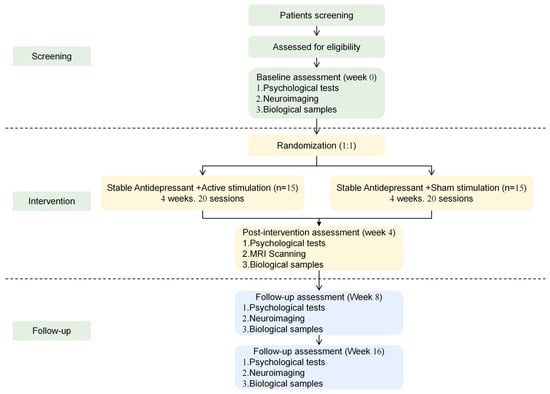
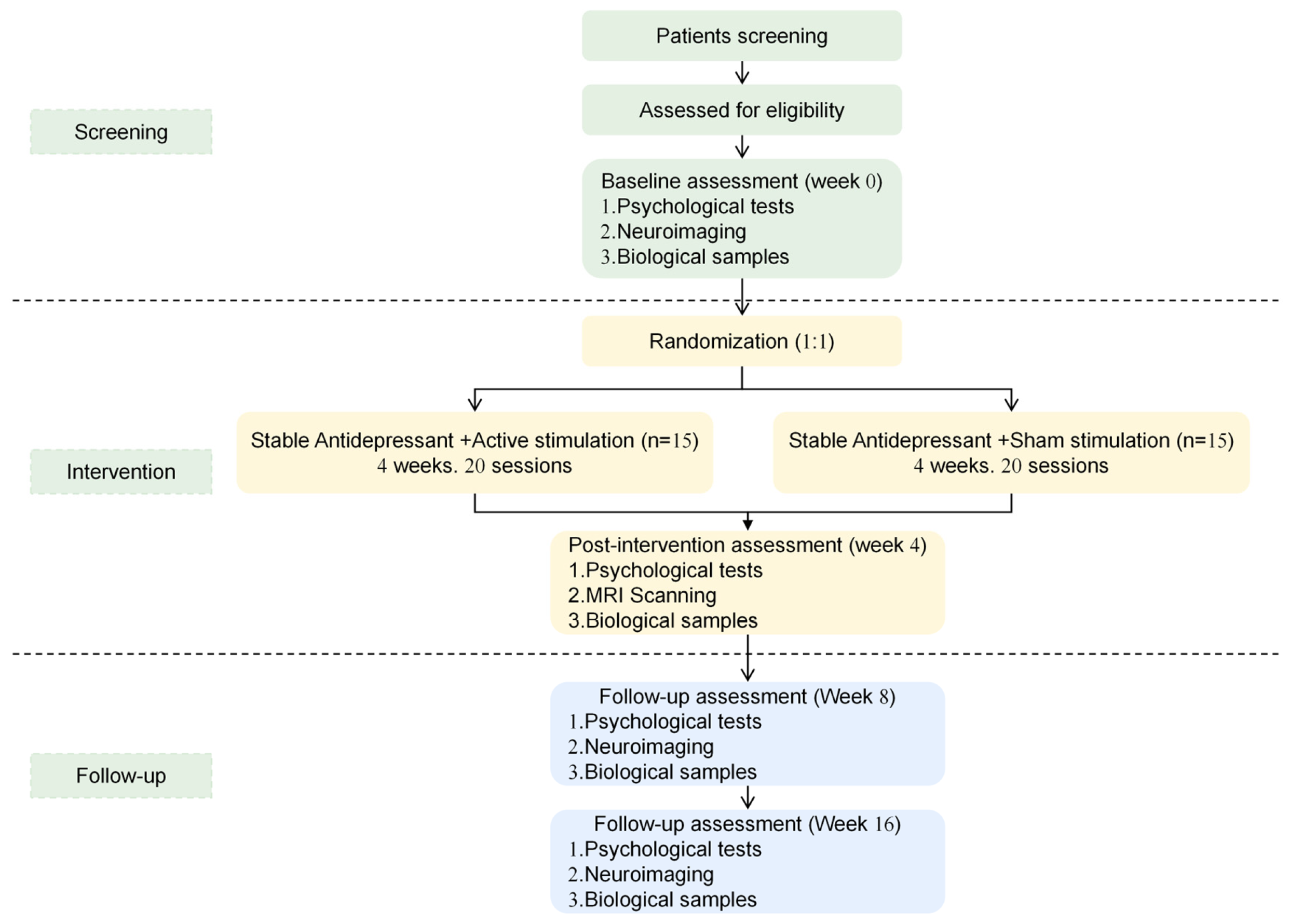
This study is a randomized, double-blind, sham-controlled pilot trial designed to generate preliminary estimates of clinical response and to inform the design and sample size planning for subsequent multicenter expansion and broader recruitment. This study will recruit 30 participants, who will be randomized in a 1:1 ratio to receive tACS or sham stimulation. Our study will not only assess preliminary clinical response but also provide pilot data to inform the design of subsequent studies, particularly in adolescent populations. The overall process of the study design is shown in Figure 1.
Figure 1.
Overview of the study design.
The trial will be conducted in accordance with the Declaration of Helsinki and has been approved by the Ethics Committee of the First Affiliated Hospital of Chongqing Medical University (Ethical Approval No. 2025-532-01). The trial is registered at ClinicalTrials.gov (Identifier: NCT07185451). The completed SPIRIT 2025 checklist is provided in Supplementary File S1.
2.2. Eligibility Criteria
The study will enroll patients with first-episode MDD. Inclusion criteria for participants are as follows: (1) age 12–18 years; (2) meet DSM-5 diagnostic criteria for a current depressive episode, as confirmed by the Schedule for Affective Disorders and Schizophrenia for School-Age Children—Present and Lifetime Version (K-SADS-PL) [30]; (3) Children’s Depression Rating Scale—Revised (CDRS-R) score ≥ 40 at baseline [31]; and (4) stable psychotropic medication treatment for at least 4 weeks prior to enrollment and willingness to continue the same regimen throughout the study.
Exclusion criteria for patients are (1) psychiatric comorbidities other than anxiety disorders; (2) depression with psychotic symptoms; (3) Young Mania Rating Scale (YMRS) score > 13 [32]; (4) history of neurological disorders (e.g., epilepsy, traumatic brain injury) or severe medical conditions (e.g., thyroid disease, systemic lupus erythematosus, diabetes, pulmonary/hepatic/renal impairment, major trauma); (5) previous receipt of ECT, transcranial magnetic stimulation (TMS), transcranial direct current stimulation (tDCS), tACS, or other neurostimulation treatments; (6) current use of antiepileptic drugs or high-dose benzodiazepines; (7) history of alcohol or substance abuse/dependence; (8) pregnant or breastfeeding females; (9) contraindications to Magnetic Resonance Imaging (MRI); and (10) current high suicide risk.
2.3. Participants
Recruitment will be conducted at the Department of Psychiatry, the First Affiliated Hospital of Chongqing Medical University, China. Participants will be assessed according to the inclusion and exclusion criteria set out above. Prior to enrollment, all participants and their legal guardians will receive detailed information regarding the study procedures, including the required clinical, neuroimaging, neurophysiological, cognitive, and behavioral assessments, as well as potential benefits and risks. For participants younger than 18 years, written permission will be obtained from their legal guardians, and assent will be obtained from the adolescent participants before enrollment. Participants aged 18 years will provide written informed consent independently. Participants who meet the eligibility criteria after screening will receive a 4-week intervention, with post-treatment follow-up assessments conducted at Weeks 8 and 16 to collect clinical, biological, cognitive, neurophysiological, behavioral, and neuroimaging outcomes. Follow-up visits will be scheduled in advance, and the sequence of assessments will be reasonably arranged according to the study protocol and participant tolerance to facilitate the completion of all study-related assessments. All assessments will be conducted by trained research personnel following standardized procedures. Baseline clinical characteristics and treatment history will also be collected, including age at onset, duration of the current depressive episode, total illness duration, and previous and current psychiatric treatments, to provide a comprehensive description of the enrolled participants. A detailed schedule of events is summarized in Table 1.
Table 1.
Outline of study visits.
2.4. Sample Size
Thirty participants are planned for enrollment, with 15 to be assigned to the active tACS group and 15 to the sham stimulation group. The enrollment target was determined a priori based on feasibility considerations, including anticipated recruitment capacity and the ability to complete the intervention and scheduled assessments within the study period. Because this study will primarily focus on the feasibility, acceptability, and safety of the trial procedures, the sample size was not based on a statistical hypothesis test of treatment effects. The resulting data, including recruitment rates, treatment and follow-up completion, missing data patterns, and the distribution of clinical outcome measures, will inform the design of a subsequent confirmatory trial.
2.5. Intervention
Both active and sham groups will undergo a 4-week intervention, comprising 20 treatment sessions, conducted on weekdays. The intervention will involve either tACS or sham stimulation. tACS will be administered by trained operators following standardized protocols using the Nexalin ADI device (Nexalin Technology, Inc., Houston, TX, USA). The device has been approved by the National Medical Products Administration for the treatment of moderate-to-severe depression and insomnia. During each session, a 4.45 × 9.53 cm electrode will be placed on the participant’s forehead, corresponding to the Fpz, Fp1, and Fp2 sites in the International 10–20 System [33]. Simultaneously, two 3.18 × 3.81 cm electrodes will be positioned on the mastoid regions. Participants in the active stimulation group will receive stimulation at a frequency of 77.5 Hz and a target peak current of 15 mA. The current will be distributed equally from the frontal region to the bilateral mastoid regions [34]. Under the stimulation parameters used in this study, the current density will not exceed 0.62 mA/cm2, calculated as 0.35 mA/cm2 at the frontal electrode (15 mA/[4.45 cm × 9.53 cm]) and 0.62 mA/cm2 at the bilateral mastoid electrodes, based on their combined surface area (15 mA/[3.18 cm × 3.81 cm × 2]) [35]. At the beginning of active stimulation, the current will be linearly ramped up from 0 to 15 mA over 180 s. After reaching the target intensity, stimulation will be maintained at 15 mA and 77.5 Hz for 40 min, followed by a 12 s linear ramp-down from 15 mA to 0 mA at the end of stimulation [27]. Participants in the sham stimulation group will undergo the same treatment procedure and session duration as the active stimulation group, with the device display showing the same stimulation parameters (77.5 Hz and 15 mA) and ramp-up and ramp-down sequences as the active condition; however, because the output current pathway is physically isolated, no electrical current or stimulation waveform will be delivered. All participants will complete 20 sessions over the course of 4 consecutive weeks, with one session per day scheduled Monday through Friday, and no sessions on weekends. Throughout the study period, participants’ medication type and dosage will remain unchanged in accordance with the requirement for stable background medication treatment in order to minimize potential confounding effects on treatment outcomes. Any clinically necessary medication changes (e.g., due to severe adverse reactions, symptom worsening, or increased suicide risk) will be documented, including the type of medication change, timing, and reason for adjustment. Such changes will be considered when interpreting clinical outcomes. Psychological interventions and other psychosocial interventions received during the study period will also be documented, including their type, frequency, and duration. These concomitant treatments will be considered when interpreting clinical outcomes and assessing potential confounding effects.
2.6. Randomization and Masking
The randomization process in this study will be implemented using a computer-generated random number sequence, maintained by an off-site statistician who is not involved in participant recruitment or assessment. The sequence will be calculated in permutable blocks of six. Prior to their first treatment, each participant will open a sealed, opaque envelope to obtain their unique identification number, which determines the device assignment. Two identical stimulation devices (active and sham) will be used, matching in size, color, appearance, weight, display interface, and treatment procedures. The sham device will display the same preset stimulation parameters as the active device, although its output current pathway is physically isolated and no electrical current or stimulation waveform will be delivered. Because active stimulation does not produce a perceptible stimulation sensation under the study conditions, neither patients nor operators will be able to distinguish between active and sham stimulation based on device appearance, displayed parameters, treatment procedures, or subjective sensation, thereby maintaining device-level blinding. Throughout the study, including both treatment and follow-up phases, study personnel (investigators, monitors, nurses, therapists, outcome assessors) and participants will remain blinded to group assignment. After completion of the Week 16 assessment and before unblinding, participants and outcome assessors will independently be asked to guess the treatment allocation by selecting “active stimulation,” “sham stimulation,” or “unsure.” Responses will be summarized descriptively by actual treatment allocation, separately for participants and outcome assessors [36,37]. The numbers and proportions of correct guesses, incorrect guesses, and “unsure” responses will be reported. Given the pilot sample size, these findings will be interpreted cautiously as exploratory indicators of blinding integrity rather than definitive evidence of successful blinding.
Unblinding will occur after completion of the Week 16 assessment or earlier, if warranted by an emergency. Emergency unblinding will only be performed when knowledge of treatment allocation is necessary for participant safety and will be documented accordingly [38].
2.7. Outcome Measures
2.7.1. Primary Outcomes
The primary outcomes will include recruitment feasibility, intervention adherence, retention rate, and safety outcomes. Pilot and feasibility trials are primarily intended to assess whether a subsequent definitive trial can be appropriately designed and conducted, rather than to provide confirmatory evidence of treatment efficacy.
Recruitment feasibility will be assessed by the number of participants enrolled during the 2-year recruitment period. The recruitment feasibility criterion for progression to a larger trial will be randomization of 30 participants within the planned 2-year recruitment period, with equal allocation to the active and sham stimulation groups. Recruitment progress and enrollment completion will be documented to determine whether the planned trial procedures could be practically implemented in adolescents with MDD and to inform the design of future adequately powered trials.
Intervention adherence will be assessed according to completion of the planned 20-session stimulation intervention during the 4-week treatment period. Adherence will be defined as completion of all scheduled stimulation sessions, and the proportion of participants completing the full treatment course will be calculated. This measure will provide information regarding the feasibility and acceptability of implementing the proposed stimulation protocol in the target population. Previous trials using the same stimulation regimen reported overall treatment completion rates of 86.4–95% [22,27]. Based on these findings and considering differences in study populations and implementation conditions, completion of all 20 stimulation sessions by at least 85% of randomized participants will serve as the study-specific treatment completion criterion for progression to a larger trial.
Retention will be defined as the proportion of enrolled participants who complete the Week 16 follow-up assessment. Retention is an important feasibility parameter in pilot trials because loss to follow-up may affect the practicality and design of subsequent larger-scale randomized controlled trials. The retention criterion will be completion of the Week 16 follow-up assessment by at least 80% of enrolled participants. Previous trials using the same stimulation regimen did not report Week 16 retention rates. This threshold was selected as a study-specific operational criterion, with reference to the anticipated attrition rate of 20% used in the sample size calculations of these trials [22,27].
Safety outcomes will be evaluated by monitoring adverse events (AEs) and serious adverse events (SAEs) from the first stimulation session until completion of the final follow-up assessment at Week 16. The occurrence, severity, outcome, and relationship of AEs and SAEs to the intervention will be recorded to characterize the safety and tolerability profile of adjunctive tACS treatment. Participants identified as having potentially high clinical risk, defined as severe psychological distress or suicidal ideation [39], as well as those who develop manic or psychotic symptoms or other clinical deterioration, will be evaluated by psychiatrists, who will determine appropriate management strategies, including further clinical assessment, temporary suspension of the intervention, or withdrawal from the study according to participant safety needs [39]. Safety monitoring will be conducted during each stimulation session and at scheduled follow-up visits throughout the study period. Treatment termination criteria will include withdrawal of informed consent or intolerance to the study intervention, defined as adverse reactions deemed unacceptable or intolerable [40]. The study intervention will also be discontinued in the event of severe worsening of depression, a clinically significant increase in suicidal ideation with imminent intent, or a suicide attempt [41,42].
2.7.2. Exploratory Clinical Outcomes
Clinical assessments will be conducted at baseline and scheduled follow-up visits by trained research personnel or completed by participants, depending on the type of instrument. Clinician-rated measures will be administered and rated by trained research personnel, whereas self-report measures will be completed independently by participants according to standardized instructions.
Validated Chinese-language versions of the assessment instruments will be used where available. Several measures, including the CDRS-R, BDI-II, SCARED, PSQI, and PedsQL 4.0, have demonstrated acceptable psychometric properties in Chinese children and/or adolescents [43,44,45,46,47]. The 22-item RRS has also been used in Chinese adolescent populations [48]. For the HAMA, C-SSRS, CGI-S, CGI-I, and YMRS, validation evidence specifically in Chinese adolescent populations remains relatively limited, although these instruments have been used in Chinese adolescent or clinical populations [49,50,51,52].
Exploratory clinical outcomes will be assessed using the CDRS-R and other standardized clinical rating scales to evaluate changes across multiple clinical dimensions associated with major depressive disorder, including depressive symptoms, anxiety symptoms, manic symptoms, suicidality, sleep quality, global clinical status, rumination, and health-related quality of life. These assessments will be used to estimate preliminary treatment-associated changes and effect sizes, rather than to provide confirmatory evidence of clinical efficacy.
Changes in depressive symptoms will be assessed using the CDRS-R as a key exploratory clinical outcome. The CDRS-R is a 17-item clinician-rated scale designed to assess depressive symptom severity in children and adolescents, with a total score ranging from 17 to 113; higher scores indicate greater depressive symptom severity [43]. The CDRS-R will be administered at baseline, after completion of the 4-week intervention, and during follow-up assessments through Week 16. Treatment response will be defined as a reduction of at least 50% in CDRS-R total score from baseline, while remission will be defined as a CDRS-R total score ≤ 28 [53,54]. Response and remission rates will be calculated at each post-baseline assessment point to provide preliminary estimates of potential treatment-associated changes and inform the design of future adequately powered trials.
Additional symptom-related outcomes will include depressive symptoms, anxiety symptoms, manic symptoms, and suicidality. Self-reported depressive symptoms will be assessed using the BDI-II, with each item scored from 0 to 3 and total scores ranging from 0 to 63; higher scores indicate greater depressive symptom severity [55,56]. Anxiety symptoms will be evaluated using both the HAMA and SCARED, providing clinician-rated and self-reported assessments of anxiety severity, respectively. The HAMA consists of 14 items scored from 0 to 4, yielding a total score ranging from 0 to 56; higher scores indicate greater anxiety severity [57]. The SCARED is a self-report measure of anxiety symptoms in children and adolescents, with total scores ranging from 0 to 82; higher scores indicate greater anxiety symptom severity [58]. Manic symptoms will be assessed using the clinician-rated YMRS, with higher scores indicating greater severity of manic symptoms [59]. Suicidality will be assessed using the C-SSRS, which evaluates suicidal ideation and suicidal behavior. The C-SSRS Suicidal Ideation Severity Score ranges from 0 to 5, with higher scores indicating more severe suicidal ideation [60]. Additional clinical outcomes will include sleep quality, overall clinical status, and health-related quality of life. Sleep quality will be evaluated using the PSQI, a 19-item self-report measure comprising seven component scores; the global score ranges from 0 to 21, with higher scores indicating poorer sleep quality [61]. Overall illness severity and clinical improvement will be assessed using the CGI-S and CGI-I, respectively. Both are clinician-rated 7-point scales; higher CGI-S scores indicate greater illness severity, whereas lower CGI-I scores indicate greater clinical improvement [62]. PedsQL 4.0 will be used to assess health-related quality of life across physical, emotional, social, and school functioning domains [63]. It consists of 23 items, with scores transformed to a 0–100 scale; higher scores indicate better health-related quality of life [64]. Rumination will be assessed using the RRS, which evaluates the tendency toward ruminative thinking in response to depressed mood. The RRS consists of 22 items rated from 1 to 4, yielding a total score ranging from 22 to 88; higher scores indicate greater levels of rumination [63]. The CTQ and CD-RISC will be administered at baseline to characterize childhood trauma and psychological resilience, respectively, rather than as longitudinal treatment outcomes.
For exploratory clinical outcomes assessed longitudinally, changes from baseline will be evaluated at prespecified post-baseline assessment points during the treatment and follow-up period through Week 16. The CGI-I will not be assessed at baseline because this scale requires comparison with the participant’s pretreatment clinical condition and is intended to evaluate change after treatment initiation.
2.7.3. Exploratory Neurobiological and Behavioral Outcomes
Exploratory data will be obtained from neuroimaging, computerized cognitive testing, and multimodal neurophysiological and behavioral assessments, including MRI, THINC-it, EEG, fNIRS, eye tracking, facial expression features, and acoustic feature analyses. These assessments are exploratory in nature and are designed to characterize potential neural, cognitive, and behavioral changes associated with adjunctive tACS rather than to provide confirmatory evidence of clinical efficacy.
MRI will be used to examine possible alterations in resting-state brain activity, functional communication between brain regions, and functional network organization following tACS. Cognitive functioning will be examined using the THINC-it, including performance in attention, processing speed, working memory, and executive functioning. Resting-state EEG, fNIRS, together with eye tracking, facial expression features, and acoustic features, will also be collected to characterize neurophysiological, behavioral, and affective changes. Changes in these measures and their possible associations with depressive symptoms, cognitive performance, and treatment-associated clinical changes will be explored. Given the pilot nature and limited sample size of this study, these analyses will focus on preliminary effect estimation and hypothesis generation rather than confirmatory biomarker validation.
These assessments are intended for hypothesis generation and preliminary characterization of potential neural, cognitive, and behavioral effects. They will not be treated as confirmatory indicators of the clinical efficacy of tACS.
2.8. Data Management and Analysis
To ensure the rigor of the study, it will adhere to the Declaration of Helsinki and the International Conference on Harmonisation Good Clinical Practice (ICH-GCP) guidelines. Investigators will undergo comprehensive training and certification, with their experience assessed to guarantee the smooth execution of the trial and minimize variability in study procedures. Investigators will generate and maintain comprehensive documentation (e.g., medical records, source documents, and standard operating procedures) to facilitate continuous monitoring of study procedures and ensure data integrity. Furthermore, monitors will review the data entered by investigators into case report forms to verify completeness, accuracy, and consistency.
An independent Data Monitoring Committee (DMC) will be established to oversee participant safety and trial conduct. The DMC will consist of experts with backgrounds in clinical medicine, adolescent psychiatry, neuromodulation, and biostatistics and will operate independently from the study implementation team. The DMC will oversee study progress, participant safety, and the overall risk–benefit balance throughout the trial. The DMC will periodically review accumulated safety data, including AEs, SAEs, changes in suicide risk assessed by the C-SSRS, emergence of manic or psychotic symptoms, participant withdrawals, and safety-related protocol deviations. In the event of serious or unexpected safety concerns, the DMC will initiate an unscheduled review. Based on safety evaluations, the DMC may recommend continuation of the trial, modification of study procedures, temporary suspension of recruitment or intervention, or early termination of the study. DMC members will declare potential conflicts of interest before study initiation and will not participate in participant recruitment, intervention delivery, outcome assessment, or daily study management.
Participant withdrawal and incomplete assessments will be documented throughout the study, and the extent, patterns, and reasons for missing data will be summarized. For repeated continuous outcomes, mixed-effects models will serve as the primary analytical approach under the assumption that data are missing at random. If missing data are considered likely to materially affect interpretation of the findings, sensitivity analyses will be conducted to assess the robustness of the results. Protocol deviations will be documented throughout the study, including deviations from eligibility criteria, intervention procedures, assessment schedules, and other predefined study procedures. Each protocol deviation will be recorded with details regarding the type of deviation, date of occurrence, reason, corrective actions taken, and potential impact on participant safety or study outcomes. The study team will review protocol deviations regularly, and their potential influence on study feasibility, safety evaluation, and outcome interpretation will be considered during data analysis.
Statistical analyses will be performed according to the intention-to-treat (ITT) principle, including all randomized participants in the groups to which they were originally assigned. Baseline demographic, clinical, and psychosocial characteristics will be summarized by treatment allocation to describe the study population. Continuous variables will be presented as means and standard deviations or medians and interquartile ranges, as appropriate, and categorical variables will be summarized using frequencies and percentages. Statistical analyses will be performed using IBM SPSS Statistics, version 27.0. Where appropriate, effect estimates and standardized effect sizes will be reported with their corresponding 95% confidence intervals (CIs). For exploratory analyses, two-sided tests will be used with a statistical significance threshold of p < 0.05. p values will be interpreted cautiously and will not be used alone to draw definitive conclusions regarding treatment efficacy.
The primary analyses will focus on recruitment feasibility, intervention adherence, retention rate, and safety outcomes, which will be analyzed descriptively. Recruitment feasibility will be summarized as the number of participants enrolled during the recruitment period. Intervention adherence and retention will be summarized as frequencies and proportions. Safety outcomes will be analyzed in the safety analysis set, which will include all participants who receive at least one session of active or sham stimulation. The numbers and proportions of participants experiencing at least one adverse event or serious adverse event will be summarized by treatment group [38].
In exploratory analyses, clinically meaningful improvement will be characterized using predefined CDRS-R response and remission criteria. The proportions of participants achieving response (≥50% reduction from baseline CDRS-R score) and remission (CDRS-R total score ≤ 28) will be estimated at each post-baseline assessment. Within the exploratory clinical analyses, the CDRS-R total score will be the prespecified measure used to estimate treatment effects, with the primary treatment contrast defined as the between-group difference in change from baseline to the end of treatment. Follow-up assessments will be analyzed as secondary exploratory time points. Baseline outcome values will be included as covariates in longitudinal models. These categorical outcomes will provide preliminary information regarding the potential clinical signal of tACS and will be interpreted cautiously given the pilot sample size. Repeatedly measured continuous exploratory clinical outcomes, including the CDRS-R, BDI-II, HAMA, SCARED, C-SSRS severity score, PSQI, PedsQL 4.0, and RRS, will be analyzed, where appropriate, using linear mixed-effects models (LMMs). The models will include treatment group, assessment time, and the treatment group-by-time interaction as fixed effects, with the corresponding baseline value included as a covariate. Measures with ordered response categories, such as clinician-rated global improvement, will be analyzed according to their ordinal characteristics. CGI-I will be evaluated only after treatment initiation because it reflects clinical change relative to the pretreatment state. Given the exploratory nature of these outcomes, no formal multiplicity adjustment will be applied to multiple exploratory clinical comparisons; interpretation will therefore emphasize effect estimates, 95% CIs, and patterns of change over time, with P values interpreted cautiously. MRI-derived functional measures will be examined using seed-based and/or whole-brain approaches to characterize potential intervention-related changes in depression-relevant functional networks and their associations with clinical improvement. Cognitive performance assessed by THINC-it and other neurophysiological measures, including EEG, fNIRS, eye-tracking parameters, facial expression features, and acoustic features, will be explored to identify potential correlates of treatment response. For high-dimensional exploratory neurobiological analyses involving multiple features or comparisons, including MRI, EEG, and fNIRS analyses, appropriate multiple-comparison procedures will be applied according to the characteristics of the data and analytical approach. Because these analyses involve multiple exploratory measures and are not intended to establish confirmatory biomarkers, findings will be interpreted as preliminary observations for generating future mechanistic hypotheses.
2.9. Patient and Public Involvement
No patients or members of the public will be involved in the design, conduct, reporting, or dissemination planning of this study.
3. Discussion
Adolescent MDD is often characterized by significant symptom heterogeneity, a fluctuating course, and an elevated risk of suicide [65,66]. While existing pharmacological and psychotherapeutic interventions provide established treatment frameworks, their efficacy remains limited for a subset of patients, and challenges related to long-term adherence and management of adverse reactions persist. As such, exploring non-invasive neuromodulation strategies with rapid onset, enhanced tolerability, and reproducibility represents a promising avenue for improving therapeutic interventions in this population.
This randomized, double-blind, sham-controlled trial will evaluate the feasibility, safety, and preliminary clinical effects of tACS in adolescent MDD. Given the limited evidence regarding tACS application in adolescent populations, the study will provide preliminary data on the practicality of implementing this intervention, the tolerability of the treatment protocol, and potential clinical changes associated with adjunctive tACS. The findings will inform the design of future adequately powered randomized controlled trials.
Current clinical evidence regarding tACS for depressive disorders has been primarily derived from adult populations, whereas evidence in adolescents with MDD remains limited. Adolescence represents a distinct developmental period characterized by ongoing maturation of neural circuits involved in emotional regulation, cognitive control, and stress response, which may influence symptom presentation, treatment response, and safety considerations. Therefore, before conducting large-scale confirmatory trials, it is necessary to first investigate whether this intervention can be feasibly and safely implemented in adolescent populations. The stimulation parameters used in this study (77.5 Hz and 15 mA) have recently been explored in adolescent populations with depression-related conditions. Preliminary studies have provided initial evidence regarding the feasibility and short-term tolerability of this stimulation approach in adolescents. One pilot study involving female adolescents aged 13–17 years with depression and nonsuicidal self-injury reported that all participants completed the treatment and follow-up, with only limited transient mild adverse effects observed [35]. Another recent randomized sham-controlled trial evaluated 77.5 Hz, 15 mA tACS in adolescents aged 12–18 years with MDD and nonsuicidal self-injury and suggested short-term feasibility and tolerability of this approach [36]. However, these studies were limited by small sample sizes, specific clinical populations, and relatively short follow-up periods. Therefore, the long-term safety and clinical effects of this stimulation protocol in adolescents with MDD remain to be further investigated.
In this context, a pilot study represents an appropriate preliminary step before conducting larger multicenter trials. The primary objective of this study is not to provide definitive evidence of clinical efficacy, but rather to evaluate whether the planned trial procedures can be successfully implemented in adolescents with MDD. Specifically, this study will assess participant recruitment, treatment completion, retention during follow-up, systematic safety monitoring, and completion of clinical, cognitive, and multimodal neurobiological assessments. In addition, exploratory analyses will provide preliminary estimates of clinical outcome variability and potential treatment-associated changes, which may inform future trial design, including sample size estimation, outcome selection, treatment duration, and safety monitoring strategies. Given the planned sample size, clinical response and remission outcomes will be interpreted as exploratory signals rather than confirmatory evidence of efficacy.
Adolescents may present unique challenges in evaluating neuromodulation interventions. Ongoing neurodevelopmental processes may contribute to variability in symptom profiles and treatment responses. Furthermore, clinical outcomes in this population may be influenced by developmental, psychosocial, and environmental factors, including sleep patterns, school-related stress, family circumstances, and changes in suicidal ideation. In addition, repeated treatment sessions and multimodal assessments require sustained participation from adolescents and their caregivers, which may affect adherence and retention. These considerations further highlight the importance of conducting feasibility- and safety-focused pilot studies before evaluating the efficacy of tACS in larger adolescent populations.
Several limitations of this pilot study should be acknowledged. First, the relatively small sample size and exploratory nature of this study may limit the precision of treatment effect estimates and the ability to draw definitive conclusions regarding the clinical efficacy of adjunctive tACS. Therefore, the findings will primarily provide preliminary information to inform the design of future adequately powered randomized controlled trials. Second, as this is a single-center study conducted in adolescents with MDD, the generalizability of the findings to other clinical settings, age groups, and populations with different demographic or clinical characteristics may be limited. In addition, the developmental characteristics of adolescents may contribute to variability in symptom presentation and treatment response. Third, although participants will be required to maintain stable background medication regimens during the study period, variations in medication types across participants and clinically necessary medication adjustments may introduce additional heterogeneity. Concomitant psychological or psychosocial interventions may also influence clinical outcomes and will be documented and considered during interpretation of the findings. Fourth, although a randomized, double-blind, sham-controlled design will be used to minimize bias, nonspecific effects, including placebo effects, treatment expectations, and participant–researcher interactions, cannot be completely excluded. In addition, repeated treatment sessions and multimodal assessments may impose additional burdens on participants and their caregivers, potentially affecting adherence and retention. Although efforts will be made to minimize such challenges through detailed explanations of study procedures to participants and their legal guardians before enrollment and advance scheduling of follow-up visits, unexpected circumstances during the study period may still influence participants’ ability to complete the protocol. Finally, given the limited sample size, exploratory neurobiological measures, including neuroimaging, neurophysiological, cognitive, and behavioral assessments, should be interpreted cautiously and considered hypothesis-generating rather than confirmatory.
Supplementary Materials
The following supporting information can be downloaded at https://www.mdpi.com/article/10.3390/healthcare14223972/s1. Reference [67] is cited in the supplementary materials.
Author Contributions
W.W. and X.L. (Xinyin Luo) contributed to the conceptualization and methodological design of the study and drafted the protocol manuscript. H.C., T.Q., X.L. (Xiao Li) and N.W. contributed to the development and refinement of study procedures, including the intervention workflow and safety monitoring plan. L.Z., X.J., Y.W. and D.X. contributed to the preparation of participant recruitment and assessment procedures and to the establishment of data collection and quality control workflows. T.W. contributed to the planning and standardization of the neuroimaging-related procedures. X.L. (Xuemei Li) and X.Z. contributed to study conceptualization, supervision, and project administration and critically reviewed and revised the manuscript. All authors have read and agreed to the published version of the manuscript.
Funding
This work was supported by the National Key R&D Program of China (2024YFC2707800) and the National Natural Science Foundation of China (82271565, 82501843).
Institutional Review Board Statement
All procedures involving human participants will be carried out in accordance with the ethical standards set by the institutional and national research committees, as well as the Declaration of Helsinki and its subsequent amendments. The study protocol was approved by the Ethics Committee of the First Affiliated Hospital of Chongqing Medical University (Approval No. 2025-532-01; 21 August 2025). It complies with all regulatory requirements and has been registered on ClinicalTrials.gov as of 15 September 2025 (Registration No. NCT07185451). Both the trial protocol and the statistical analysis plan are publicly accessible on ClinicalTrials.gov. Any modifications to the study protocol or any serious adverse events observed during the clinical trial must be promptly reported to the committee and thoroughly documented.
Informed Consent Statement
For participants younger than 18 years, written permission will be obtained from their legal guardians, and assent will be obtained from the adolescent participants prior to enrollment. Participants aged 18 years will provide written informed consent independently. This study will cover the examination costs associated with the research conducted by participants throughout the study period and will provide any necessary research equipment free of charge. Upon conclusion of the study, participants will be reimbursed for transportation expenses incurred as a result of their participation in the clinical trial. Furthermore, in the event of any injury or adverse effects during the trial, the researchers will be responsible for covering the associated medical expenses.
Data Availability Statement
Data sharing is not applicable to this article, as no datasets have been generated or analyzed during the current study. The findings will be disseminated through articles in peer-reviewed journals and presentations at relevant scientific conferences. All data included in study reports will be de-identified, and no information that could reveal the identity of individual participants will be disclosed.
Conflicts of Interest
The authors declare no conflicts of interest.
Abbreviations
The following abbreviations are used in this manuscript:
| MDD | Major Depressive Disorder |
| tACS | Transcranial Alternating Current Stimulation |
| CDRS-R | Children’s Depression Rating Scale—Revised |
| ECT | Electroconvulsive Therapy |
| TES | Transcranial Electrical Stimulation |
| K-SADS-PL | Schedule for Affective Disorders and Schizophrenia for School-Age Children—Present and Lifetime Version |
| YMRS | Young Mania Rating Scale |
| TMS | Transcranial Magnetic Stimulation |
| tDCS | Transcranial Direct Current Stimulation |
| BDI-II | Beck Depression Inventory-II |
| CTQ | Childhood Trauma Questionnaire |
| SCARED | Screen for Child Anxiety-Related Emotional Disorders |
| CGI-S | Clinical Global Impression—Severity Scale |
| CGI-I | Clinical Global Impression—Improvement Scale |
| C-SSRS | Columbia-Suicide Severity Rating Scale |
| PSQI | Pittsburgh Sleep Quality Index |
| PedsQL 4.0 | Pediatric Quality of Life Inventory Version 4.0 |
| RRS | Ruminative Responses Scale |
| HAMA | Hamilton Anxiety Rating Scale |
| MRI | Magnetic resonance imaging |
| EEG | Electroencephalography |
| fNIRS | Functional near-infrared spectroscopy |
| ICH-GCP | International Conference on Harmonisation Good Clinical Practice |
| AEs | Adverse events |
| SAEs | Serious adverse events |
| DMC | Data Monitoring Committee |
| ITT | Intention-to-treat |
| LMMs | Linear mixed-effects models |
| CIs | Confidence intervals |
References
- Yang, E.; Chen, F.; Yang, Y.; Zhang, Y.; Lin, H.; Zhang, Y.; Chu, M. Global trends in depressive disorder prevalence and DALYs among young populations: A comprehensive analysis from 1990 to 2021. BMC Psychiatry 2024, 24, 943. [Google Scholar] [CrossRef] [Scilit] [PubMed]
- World Health Organization. Mental Health of Adolescents. Available online: https://www.who.int/news-room/fact-sheets/detail/adolescent-mental-health (accessed on 15 November 2026).
- Dong, W.; Liu, Y.; Bai, R.; Zhang, L.; Zhou, M. The prevalence and associated disability burden of mental disorders in children and adolescents in China: A systematic analysis of data from the Global Burden of Disease Study. Lancet Reg. Health–West. Pac. 2025, 55, 101486. [Google Scholar] [CrossRef] [Scilit] [PubMed]
- Wang, Z.; Dou, Y.; Yang, X.; Guo, X.; Ma, X.; Zhou, B.; Zhang, W. Global, regional, and national burden of mental disorders among adolescents and young adults, 1990–2021: A systematic analysis for the Global Burden of Disease Study 2021. Transl. Psychiatry 2025, 15, 397. [Google Scholar] [CrossRef] [Scilit] [PubMed]
- Walkup, J.T. Antidepressant Efficacy for Depression in Children and Adolescents: Industry- and NIMH-Funded Studies. Am. J. Psychiatry 2017, 174, 430–437. [Google Scholar] [CrossRef] [Scilit] [PubMed]
- Cuijpers, P.; Karyotaki, E.; Ciharova, M.; Miguel, C.; Noma, H.; Stikkelbroek, Y.; Weisz, J.R.; Furukawa, T.A. The effects of psychological treatments of depression in children and adolescents on response, reliable change, and deterioration: A systematic review and meta-analysis. Eur. Child. Adolesc. Psychiatry 2023, 32, 177–192. [Google Scholar] [CrossRef] [Scilit] [PubMed]
- Cuijpers, P.; Karyotaki, E.; Eckshtain, D.; Ng, M.Y.; Corteselli, K.A.; Noma, H.; Quero, S.; Weisz, J.R. Psychotherapy for Depression Across Different Age Groups: A Systematic Review and Meta-analysis. JAMA Psychiatry 2020, 77, 694–702. [Google Scholar] [CrossRef] [Scilit] [PubMed]
- Miller, L.; Campo, J.V. Depression in Adolescents. N. Engl. J. Med. 2021, 385, 445–449. [Google Scholar] [CrossRef] [Scilit] [PubMed]
- Cipriani, A.; Zhou, X.; Del Giovane, C.; Hetrick, S.E.; Qin, B.; Whittington, C.; Coghill, D.; Zhang, Y.; Hazell, P.; Leucht, S.; et al. Comparative efficacy and tolerability of antidepressants for major depressive disorder in children and adolescents: A network meta-analysis. Lancet 2016, 388, 881–890. [Google Scholar] [CrossRef] [Scilit] [PubMed]
- Hetrick, S.E.; McKenzie, J.E.; Bailey, A.P.; Sharma, V.; Moller, C.I.; Badcock, P.B.; Cox, G.R.; Merry, S.N.; Meader, N. New generation antidepressants for depression in children and adolescents: A network meta-analysis. Cochrane Database Syst. Rev. 2021, 5, Cd013674. [Google Scholar] [CrossRef] [Scilit] [PubMed]
- Hammad, T.A.; Laughren, T.; Racoosin, J. Suicidality in Pediatric Patients Treated With Antidepressant Drugs. Arch. General. Psychiatry 2006, 63, 332–339. [Google Scholar] [CrossRef] [Scilit] [PubMed]
- Li, K.; Zhou, G.; Xiao, Y.; Gu, J.; Chen, Q.; Xie, S.; Wu, J. Risk of Suicidal Behaviors and Antidepressant Exposure Among Children and Adolescents: A Meta-Analysis of Observational Studies. Front. Psychiatry 2022, 13, 880496. [Google Scholar] [CrossRef] [Scilit] [PubMed]
- Hu, R.; Li, J.; Luo, H.; Guo, Y.; Tan, J.; Li, S.; Luo, Q. Effects of electroconvulsive therapy on cognitive function, depressive symptoms, and suicidal ideation in adolescents with major depressive disorder: A prospective observational study. J. Affect. Disord. 2025, 391, 120092. [Google Scholar] [CrossRef] [Scilit] [PubMed]
- Rask, O.; Nordenskjöld, A.; Johansson, B.A.; Movahed Rad, P. Electroconvulsive therapy in children and adolescents: Results from a population-based study utilising the Swedish National Quality Register. Eur. Child Adolesc. Psychiatry 2023, 32, 2649–2656. [Google Scholar] [CrossRef] [Scilit] [PubMed]
- Yang, C.; Jung, B.; Lee, S.H. Transcranial Electrical Stimulation: Clinical Implication and Practice for Treatment of Psychiatric Illness. Clin. Psychopharmacol. Neurosci. 2024, 22, 391–404. [Google Scholar] [CrossRef] [Scilit] [PubMed]
- Antal, A.; Luber, B.; Brem, A.K.; Bikson, M.; Brunoni, A.R.; Cohen Kadosh, R.; Dubljević, V.; Fecteau, S.; Ferreri, F.; Flöel, A.; et al. Non-invasive brain stimulation and neuroenhancement. Clin. Neurophysiol. Pract. 2022, 7, 146–165. [Google Scholar] [CrossRef] [Scilit] [PubMed]
- Pathak, H.; Suhas, S.; Sreeraj, V.S.; Shivakumar, V.; Arumugham, S.S.; Sivakumar, P.T.; Venkatasubramanian, G. Home-based Transcranial Electrical Stimulation (tES) for the Management of Psychiatric Disorders: A Scoping Review. Indian J. Psychol. Med. 2025, 48, 232–250. [Google Scholar] [CrossRef] [Scilit] [PubMed]
- Wischnewski, M.; Alekseichuk, I.; Opitz, A. Neurocognitive, physiological, and biophysical effects of transcranial alternating current stimulation. Trends Cogn. Sci. 2023, 27, 189–205. [Google Scholar] [CrossRef] [Scilit] [PubMed]
- Elyamany, O.; Leicht, G.; Herrmann, C.S.; Mulert, C. Transcranial alternating current stimulation (tACS): From basic mechanisms towards first applications in psychiatry. Eur. Arch. Psychiatry Clin. Neurosci. 2021, 271, 135–156. [Google Scholar] [CrossRef] [Scilit] [PubMed]
- Antal, A.; Alekseichuk, I.; Bikson, M.; Brockmöller, J.; Brunoni, A.R.; Chen, R.; Cohen, L.G.; Dowthwaite, G.; Ellrich, J.; Flöel, A.; et al. Low intensity transcranial electric stimulation: Safety, ethical, legal regulatory and application guidelines. Clin. Neurophysiol. 2017, 128, 1774–1809. [Google Scholar] [CrossRef] [Scilit] [PubMed]
- Johnson, L.; Alekseichuk, I.; Krieg, J.; Doyle, A.; Yu, Y.; Vitek, J.; Johnson, M.; Opitz, A. Dose-dependent effects of transcranial alternating current stimulation on spike timing in awake nonhuman primates. Sci. Adv. 2020, 6, eaaz2747. [Google Scholar] [CrossRef] [Scilit] [PubMed]
- Wang, H.; Wang, K.; Xue, Q.; Peng, M.; Yin, L.; Gu, X.; Leng, H.; Lu, J.; Liu, H.; Wang, D.; et al. Transcranial alternating current stimulation for treating depression: A randomized controlled trial. Brain 2022, 145, 83–91. [Google Scholar] [CrossRef] [Scilit] [PubMed]
- Li, D.; Liu, R.; Ye, F.; Li, R.; Li, X.; Liu, J.; Zhang, X.; Zhou, J.; Wang, G. Modulation of brain function and antidepressant effects by transcranial alternating current stimulation in patients with major depressive disorder: Evidence from ERP. J. Psychiatr. Res. 2024, 176, 1–8. [Google Scholar] [CrossRef] [Scilit] [PubMed]
- Wang, J.; Zhao, W.; Wang, H.; Leng, H.; Xue, Q.; Peng, M.; Min, B.; Jin, X.; Tan, L.; Gao, K.; et al. Brain-wide activation involved in 15 mA transcranial alternating current stimulation in patients with first-episode major depressive disorder. Gen. Psychiatry 2024, 37, e101338. [Google Scholar] [CrossRef] [Scilit] [PubMed]
- Song, P.; Yang, X.; Yang, N.; Dong, Y.; Wang, Y. Guideline for the clinical application of transcranial alternating current stimulation. Chin. Med. J. (Engl.) 2025, 138, 1016–1018. [Google Scholar] [CrossRef] [Scilit] [PubMed]
- Zheng, W.; Cai, D.-B.; Nie, S.; Chen, J.-H.; Huang, X.-B.; Goerigk, S.; Brunoni, A.R.; Zheng, W. Adjunctive transcranial alternating current stimulation for patients with major depressive disorder: A systematic review and meta-analysis. Front. Psychiatry 2023, 14, 1154354. [Google Scholar] [CrossRef] [Scilit] [PubMed]
- Zhou, J.; Li, D.; Ye, F.; Liu, R.; Feng, Y.; Feng, Z.; Li, R.; Li, X.; Liu, J.; Zhang, X.; et al. Effect of add-on transcranial alternating current stimulation (tACS) in major depressive disorder: A randomized controlled trial. Brain Stimul. 2024, 17, 760–768. [Google Scholar] [CrossRef] [Scilit] [PubMed]
- Gehrman, P.R.; Bartky, E.J.; Travers, C.; Lapidus, K. A Fully Remote Randomized Trial of Transcranial Alternating Current Stimulation for the Acute Treatment of Major Depressive Disorder. J. Clin. Psychiatry 2024, 85, 54263. [Google Scholar] [CrossRef] [Scilit] [PubMed]
- Schwippel, T.; Pupillo, F.; Feldman, Z.; Walker, C.; Townsend, L.; Rubinow, D.; Frohlich, F. Closed-Loop Transcranial Alternating Current Stimulation for the Treatment of Major Depressive Disorder: An Open-Label Pilot Study. Am. J. Psychiatry 2024, 181, 842–845. [Google Scholar] [CrossRef] [Scilit] [PubMed]
- Kaufman, J.; Birmaher, B.; Brent, D.; Rao, U.; Flynn, C.; Moreci, P.; Williamson, D.; Ryan, N. Schedule for Affective Disorders and Schizophrenia for School-Age Children-Present and Lifetime Version (K-SADS-PL): Initial reliability and validity data. J. Am. Acad. Child Adolesc. Psychiatry 1997, 36, 980–988. [Google Scholar] [CrossRef] [Scilit] [PubMed]
- Poznanski, E.O.; Mokros, H.B. Children’s Depression Rating Scale, Revised (CDRS-R) Manual; Western Psychological Services: Los Angeles, CA, USA, 1996. [Google Scholar]
- Young, R.C.; Biggs, J.T.; Ziegler, V.E.; Meyer, D.A. A Rating Scale for Mania: Reliability, Validity and Sensitivity. Br. J. Psychiatry 1978, 133, 429–435. [Google Scholar] [CrossRef] [Scilit] [PubMed]
- Homan, R.W.; Herman, J.; Purdy, P. Cerebral location of international 10–20 system electrode placement. Electroencephalogr. Clin. Neurophysiol. 1987, 66, 376–382. [Google Scholar] [CrossRef] [Scilit] [PubMed]
- Fu, Z.; Tian, J.; Kang, S.; Qin, Z.; Cao, Q.; Wang, Y.; Deng, J.; Yang, L. Efficacy and safety of transcranial alternating current stimulation in adults with attention deficit hyperactivity disorder: A double-blind randomized sham-controlled trial. Mol. Psychiatry 2026, 31, 2675–2684. [Google Scholar] [CrossRef] [Scilit] [PubMed]
- Hao, W.; Ding, X.; Ren, K.; Cui, C.; Zhang, Y.; He, J.; Guo, X.; Wang, Y.; Ju, H.; Lin, Y. High-gamma tACS may regulate brain network connectivity to alleviate symptoms in female adolescent non-suicidal self-injury: A preliminary TMS-EEG pilot study. BMC Psychiatry 2026, 26, 346. [Google Scholar] [CrossRef] [Scilit] [PubMed]
- Kang, T.; Zhao, X.; Huo, X.; Liu, X.; Wang, Y.; Wang, X.; Ding, X.; Wu, H. High-Intensity Transcranial Alternating Current Stimulation for Emotion Regulation and Attentional Bias in Adolescents With Nonsuicidal Self-Injury: A Randomized Clinical Trial. JAMA Netw. Open 2026, 9, e2617336. [Google Scholar] [CrossRef] [Scilit] [PubMed]
- Wu, Y.; Ning, C.; Shi, L.; Wang, J.; Ye, K.; Shen, Z.; Wang, Y.; Wang, D.; Guo, H.; Qiu, X.; et al. A multicenter randomized clinical trial of portable transcranial alternating current stimulation for major depressive disorder. npj Digit. Med. 2026, 9, 392. [Google Scholar] [CrossRef] [Scilit] [PubMed]
- Chen, H.; Xu, D.; Wang, W.; Luo, X.; Jiang, X.; Wan, N.; Wei, Y.; Wang, T.; Zhang, L.; Li, X.; et al. Feasibility, safety, and preliminary clinical efficacy of resting-state functional connectivity MRI-guided rTMS for adolescents with major depressive disorder: Protocol for a randomized, double-blind, three-arm, sham-controlled pilot trial. PLoS ONE 2026, 21, e0355676. [Google Scholar] [CrossRef] [Scilit] [PubMed]
- Peng, P.; Lin, S.; Liao, Y. Effectiveness and psychological mechanism of group-based IMPROVE therapy for treatment seeking college students with problematic internet use in China: Study protocol for a prospective, single-blind, randomised clinical trial. BMJ Open 2026, 16, e119535. [Google Scholar] [CrossRef] [Scilit] [PubMed]
- An, X.; Zhang, J.; Hou, X.; Yang, C. Efficacy and safety of 15 mA transcranial alternating current stimulation (tACS) in the therapy of treatment-resistant depression with increased inflammatory activity: Study protocol for a randomized, double-blind, sham-controlled trial. PLoS ONE 2026, 21, e0356611. [Google Scholar] [CrossRef] [Scilit] [PubMed]
- Blumberger, D.M.; McClintock, S.M.; Thorpe, K.E.; Tamminga, C.A.; Foley, K.; Husain, M.M.; Kaster, T.S.; Knyahnytska, Y.; Voineskos, D.; Bailey, K.J.; et al. Confirmatory efficacy and safety trial of magnetic seizure therapy versus right unilateral ultra-brief electroconvulsive therapy in depression (CREST–MST): A randomised, double-blind, non-inferiority trial in Canada and the USA. Lancet Psychiatry 2026, 13, 376–386. [Google Scholar] [CrossRef] [Scilit] [PubMed]
- Jelovac, A.; McCaffrey, C.; Terao, M.; Shanahan, E.; Whooley, E.; McDonagh, K.; McDonogh, S.; Loughran, O.; Shackleton, E.; Igoe, A.; et al. Serial Ketamine Infusions as Adjunctive Therapy to Inpatient Care for Depression: The KARMA-Dep 2 Randomized Clinical Trial. JAMA Psychiatry 2025, 82, 1216–1224. [Google Scholar] [CrossRef] [Scilit] [PubMed]
- Huang, Y.; Li, X.; Li, J.; Lei, T.; He, Y.; Wang, W.; Xu, X.; Li, Y.; Zhou, X. Reliability and Validity of the Chinese Version of the Children’s Depression Rating Scale-Revised (CDRS-R). Healthcare 2025, 13, 734. [Google Scholar] [CrossRef] [Scilit] [PubMed]
- Song, X.; Lu, C.; Yu, Y.; Wan, Y.; Ma, F.; Chen, L.; Wang, Y. Investigation of the Reliability and Validity of the Chinese Version of the Beck Depression Inventory-II in Middle School Students of Yi Ethnicity in Liangshan Prefecture, China. Sichuan Da Xue Xue Bao Yi Xue Ban 2024, 55, 1567–1572. [Google Scholar] [CrossRef] [Scilit] [PubMed]
- Su, L.; Wang, K.; Fan, F.; Su, Y.; Gao, X. Reliability and validity of the screen for child anxiety related emotional disorders (SCARED) in Chinese children. J. Anxiety Disord. 2008, 22, 612–621. [Google Scholar] [CrossRef] [Scilit] [PubMed]
- Guo, C. Assessing the Chinese version of Pittsburgh Sleep Quality Index in non-clinical adolescents. Curr. Psychol. 2023, 42, 24860–24870. [Google Scholar] [CrossRef] [Scilit]
- Wu, D.; Zhu, Y.; Qiu, Z.; Wang, J.; Zhang, Y.; Li, J. Psychometric properties of the Mandarin Chinese self-reported Pediatric Quality of Life Inventory™ Version 4.0 Generic Core Scales in school adolescents: Based on the Rasch and bifactor measurement methods. BMC Pediatr. 2026, 26, 635. [Google Scholar] [CrossRef] [Scilit] [PubMed]
- Yu, T.; Hu, J.; Zhao, J. How does childhood emotional abuse aggravate problematic mobile phone use among Chinese adolescents: Roles of rumination and depression symptoms. BMC Psychol. 2024, 12, 704. [Google Scholar] [CrossRef] [Scilit] [PubMed]
- Gu, J.; Shao, J.; Fu, X.; Ji, X.; Qiao, S.; Zhang, C.; Qiu, L.; Zhang, M.; Liu, X. Emotion regulation difficulties and experiential avoidance in adolescents with non-suicidal self-injury: A latent profile and moderation analysis. Front. Psychiatry 2026, 17, 1942199. [Google Scholar] [CrossRef] [Scilit] [PubMed]
- Qian, Y.; Ke, X.; Gao, F.; Chen, W.; Wu, W.; Li, Y.; Du, L.; Li, H.; Du, Y. Efficacy and Safety of Extended-Release Clonidine Hydrochloride for Attention Deficit Hyperactivity Disorder in Chinese Children and Adolescents: A Multicenter, Randomized, Double-Blind, Placebo-Controlled Trial. J. Child. Adolesc. Psychopharmacol. 2026, 36, 278–286. [Google Scholar] [CrossRef] [Scilit] [PubMed]
- Zhao, Z.; Zhou, T.; Liu, M.; Wang, N.; Li, Y.; Yang, C.; Qiu, Y.; Wang, J.; Wu, W.; Bai, Y.; et al. Clinical efficacy, safety and applicability of home-based bright light therapy in outpatient adolescents with major depressive disorder in China: Protocol for a randomised controlled trial. BMJ Open 2026, 16, e113503. [Google Scholar] [CrossRef] [Scilit] [PubMed]
- Liu, G.; An, X.; Wen, X.; Luo, H.; Wang, X.; Ren, H.; Zhong, X.; Gao, Y.; Yu, S.; Zhang, J.; et al. Symptom network analysis of depressive and somatic symptoms and suicide risk indicators in treatment-naïve adolescents with first-episode depression. BMC Psychiatry 2026, 26, 447. [Google Scholar] [CrossRef] [Scilit] [PubMed]
- Haley, C.L.; Kennard, B.D.; Morris, D.W.; Bernstein, I.H.; Carmody, T.; Emslie, G.J.; Mayes, T.L.; Rush, A.J. The Quick Inventory of Depressive Symptomatology, Adolescent Version (QIDS-A(17)): A Psychometric Evaluation. Neuropsychiatr. Dis. Treat. 2023, 19, 1085–1102. [Google Scholar] [CrossRef] [Scilit] [PubMed]
- Richardson, L.P.; Ludman, E.; McCauley, E.; Lindenbaum, J.; Larison, C.; Zhou, C.; Clarke, G.; Brent, D.; Katon, W. Collaborative care for adolescents with depression in primary care: A randomized clinical trial. JAMA 2014, 312, 809–816. [Google Scholar] [CrossRef] [Scilit] [PubMed]
- Upadhyay, S.; Agarwal, V.; Arya, A.; Kar, S.K. Safety and efficacy of early augmentation with Transcranial Direct Current Stimulation (tDCS) in adolescents with Major Depressive Disorder: A randomized controlled trial. Asian J. Psychiatry 2025, 103, 104349. [Google Scholar] [CrossRef] [Scilit] [PubMed]
- Gerber, M.; Cody, R.; Beck, J.; Brand, S.; Donath, L.; Eckert, A.; Hatzinger, M.; Imboden, C.; Kreppke, J.-N.; Lang, U.E.; et al. Cardiorespiratory fitness and cardiovascular risk among in-patients with depression compared to healthy controls. Front. Psychiatry 2023, 14, 1193004. [Google Scholar] [CrossRef] [Scilit] [PubMed]
- Luo, X.; Cui, Y.; Yan, Z.; Liu, W.; Zhou, B.; Li, G.; Liu, S. A novel deep learning model for objective quantification of generalized anxiety disorder severity using EEG functional connectivity. Front. Psychiatry 2026, 17, 1764932. [Google Scholar] [CrossRef] [Scilit] [PubMed]
- Valadez, E.A.; Conte, S.; Richards, J.E.; Feng, Y.; Liuzzi, L.; McSweeney, M.; Tan, E.; Buzzell, G.A.; Morales, S.; Winkler, A.M.; et al. Integrating Multimodal Neuroimaging of Error Monitoring to Estimate Future Anxiety in Adolescents. JAMA Netw. Open 2025, 8, e2539133. [Google Scholar] [CrossRef] [Scilit] [PubMed]
- Goulding, E.H.; Dopke, C.A.; Rossom, R.; Jonathan, G.; Mohr, D.; Kwasny, M.J. Effects of a Smartphone-Based Self-management Intervention for Individuals With Bipolar Disorder on Relapse, Symptom Burden, and Quality of Life: A Randomized Clinical Trial. JAMA Psychiatry 2023, 80, 109–118. [Google Scholar] [CrossRef] [Scilit] [PubMed]
- Graupensperger, S.; Hawrilenko, M.; Brown, M.; Baum, G.; Ward, E.J.; Chekroud, A. Crisis Outreach, Treatment Engagement, and Outcomes After Suicide Risk Screening in a Comprehensive Mental Health Platform. Psychiatr. Serv. 2026, 77, 5–12. [Google Scholar] [CrossRef] [Scilit] [PubMed]
- Carpi, M. The Pittsburgh Sleep Quality Index: A brief review. Occup. Med. 2025, 75, 14–15. [Google Scholar] [CrossRef] [Scilit] [PubMed]
- Bhagavan, C.; Bryson, A.; Carter, O.; Nielsen, G.; Berlowitz, D.; Issak, S.; Braat, S.; Zaloumis, S.; Attard, Z.; Eleftheriadis, D.; et al. Psilocybin-assisted physiotherapy for refractory motor functional neurological disorder: Protocol for a randomised dose-comparison pilot study. Acta Neuropsychiatr. 2025, 38, e3. [Google Scholar] [CrossRef] [Scilit] [PubMed]
- He, Y.; Gan, X.; Li, X.; Wang, T.; Li, J.; Lei, T.; Huang, Y.; Liu, R.; Chen, F.; Teng, T.; et al. Sequenced treatment alternatives to relieve adolescent depression (STAR-AD): A multicentre open-label randomized controlled trial protocol. BMC Psychiatry 2023, 23, 789. [Google Scholar] [CrossRef] [Scilit] [PubMed]
- Kwon, J.; Raghunandan, R.; Nghiem, S.H.; Howard, K.; Lancsar, E.; Huynh, E.; Howell, M.; Petrou, S.; Smith, S. Rasch analysis of the self-reported PedsQL™ 4.0 Generic Core Scales by Australian children. Health Qual. Life Outcomes 2025, 23, 120. [Google Scholar] [CrossRef] [Scilit] [PubMed]
- Wu, P.; Kong, L.; Zhou, Y.; Deng, C.; Wang, Z.; Shen, Y.; Wang, L.; Tuo, Z.; Liu, Y.; Wang, Y.; et al. Neurobiological subtypes of adolescent depression: A multimodal integration of morphometric similarity network and spatial transcriptomics. Mol. Psychiatry 2025, 30, 5448–5462. [Google Scholar] [CrossRef] [Scilit] [PubMed]
- Zhang, Y.; Liu, L.; Fan, H.; Zhang, X.; Xia, L.; Liu, H. Clinical correlates of new-onset and persistent suicidal ideation in adolescents with major depressive disorder. Front. Psychiatry 2025, 16, 1655037. [Google Scholar] [CrossRef] [Scilit] [PubMed]
- Chan, A.-W.; Boutron, I.; Hopewell, S.; Moher, D.; Schulz, K.F.; Collins, G.S.; Tunn, R.; Aggarwal, R.; Berkwits, M.; Hróbjartsson, A.; et al. SPIRIT 2025 statement: Updated guideline for protocols of randomised trials. BMJ 2025, 389, e081477. [Google Scholar] [CrossRef] [Scilit] [PubMed]

Disclaimer/Publisher’s Note: The statements, opinions and data contained in all publications are solely those of the individual author(s) and contributor(s) and not of MDPI and/or the editor(s). MDPI and/or the editor(s) disclaim responsibility for any injury to people or property resulting from any ideas, methods, instructions or products referred to in the content. |
© 2026 by the authors. Licensee MDPI, Basel, Switzerland. This article is an open access article distributed under the terms and conditions of the Creative Commons Attribution (CC BY) license.