


Abstract
Saudi Arabia has carried the largest global burden of Middle East respiratory syndrome coronavirus (MERS-CoV) and a substantial burden of severe acute respiratory syndrome coronavirus 2 (SARS-CoV-2), the cause of coronavirus disease 2019 (COVID-19). This narrative review, written from the perspectives of clinical immunology and cardiopulmonary rehabilitation, synthesises evidence on long-term sequelae (persisting for at least 3 months) and rehabilitation after MERS-CoV infection and COVID-19, with implications for Saudi Arabia. MERS-CoV survivors show reduced diffusing capacity for at least 12 months, radiographic lung fibrosis in about one-third of recovering patients at short-term follow-up, and high rates of chronic fatigue, depression and post-traumatic stress. A dedicated search of six databases and registries (355 records) found no study of a rehabilitation intervention after MERS-CoV infection. Because most MERS-CoV survivors with sequelae were critically ill, evidence on post-intensive care syndrome and acute respiratory distress syndrome is the closest basis for extrapolation; it shows persistent disability but uncertain benefit from generic post-discharge programmes. After COVID-19, randomised trials show that rehabilitation improves functional capacity, dyspnoea and quality of life, while post-exertional malaise, autonomic dysfunction and myocardial involvement require screening and symptom-titrated or cardiology-guided care. We propose a phenotype-directed rehabilitation pathway with explicit screening criteria, adapted to Saudi factors that include Vision 2030 reforms and virtual care, high metabolic comorbidity, a hot climate, women’s access to physical activity and occupational groups at risk of MERS-CoV, and a research agenda that includes MERS-CoV survivor registries and rehabilitation trials.
1. Introduction
Middle East respiratory syndrome coronavirus (MERS-CoV) was first isolated in 2012 from a man in Saudi Arabia who died of pneumonia and renal failure [1]. Between 2012 and May 2025, 2626 laboratory-confirmed human cases were reported to the World Health Organization, with 947 deaths (36.1%); a total of 2217 cases (84.4%) occurred in Saudi Arabia. Of all reported cases, 2180 (83%) were admitted to hospital, and 865 (39.7%) of those admitted required intensive care [2]. Dromedary camels are the reservoir [3], and cases continue to be reported: a total of 113 new infections were recorded between 2020 and May 2025, with 10 of them in 2025 alone [2]. The coronavirus disease 2019 (COVID-19) pandemic, caused by severe acute respiratory syndrome coronavirus 2 (SARS-CoV-2), then placed a second, far larger coronavirus burden on the Saudi health system.
Survival from a severe coronavirus infection is not the same as recovery. The experience of severe acute respiratory syndrome (SARS) in 2003 and of MERS-CoV since 2012 showed that lung function abnormalities, reduced functional capacity and psychological morbidity are common among survivors [4]. COVID-19 has since shown the same on a population scale, with post-COVID-19 condition affecting at least 10% of infections and involving more than 200 reported symptoms [5,6]. In this review, long-term sequelae are defined as symptoms or impairments that persist, or newly appear, at least 3 months after the acute infection, consistent with the World Health Organization definition of post-COVID-19 condition [6]; findings from shorter follow-up are identified as such. For Saudi Arabia, which has dealt with both viruses, the question is not only what long-term sequelae survivors experience but whether rehabilitation services are designed, and evidenced, to meet them.
The aims of this narrative review are to: (i) summarise the long-term cardiopulmonary, functional and psychological sequelae of MERS-CoV infection and COVID-19, using SARS as a bridging reference; (ii) synthesise evidence on rehabilitation after coronavirus infection and after critical illness; (iii) outline the immunological considerations that are relevant to rehabilitation; (iv) describe the Saudi evidence, service and health-system context, including outbreak preparedness; and (v) propose a post-viral cardiopulmonary rehabilitation pathway and research agenda for Saudi Arabia.
2. Methods
This is a narrative review. We used the Scale for the Assessment of Narrative Review Articles (SANRA), a quality assessment scale for narrative reviews, as a checklist for the quality of the review [7]. The review was carried out in four steps. First, an initial structured search was conducted in September 2026 using an AI-assisted semantic academic search platform (Undermind), which searches the titles and abstracts of the scholarly literature, supplemented by targeted searches of guideline and publisher websites and by citation tracking of key articles. Second, to make the search reproducible, we ran Boolean PubMed strategies for seven concept blocks on 7 November 2026: (S1) MERS-CoV and long-term pulmonary, cardiac, psychological, quality-of-life and functional outcomes (114 records); (S2) SARS and the same outcomes (89 records); (S3) systematic reviews of cardiopulmonary sequelae, exercise capacity, post-exertional malaise or dysautonomia after COVID-19 (405 records); (S4) randomised trials and systematic reviews of rehabilitation in post-COVID-19 condition (428 records); (S5) Saudi studies of persistent symptoms or rehabilitation after COVID-19 or MERS-CoV infection (369 records); (S6) randomised trials and systematic reviews of rehabilitation after critical illness or acute respiratory distress syndrome (325 records); and (S7) cohort studies, systematic reviews and consensus reports of long-term outcomes after critical illness (2284 records). The full strategies, including the cardiac and psychological terms, are given in Supplementary Table S1.
Third, records were screened by title and abstract against the scope of the review (adults; MERS-CoV, SARS, COVID-19 or critical illness; long-term sequelae or rehabilitation). The MERS-CoV block (S1) was screened in full. For the larger blocks, we prioritised systematic reviews and meta-analyses, randomised controlled trials, prospective cohorts with objective follow-up, and all Saudi studies of post-coronavirus sequelae or rehabilitation, and we checked that the principal reviews and trials cited in this article were retrieved by the corresponding strategy. Full texts of key sources were examined to verify reported findings, and retraction status was checked for major cohort studies; one retracted article was replaced by its republished version. Saudi health-system, epidemiological and physical activity sources were identified by targeted searches. Fourth, because the absence of rehabilitation evidence after MERS-CoV infection is a central finding of this review, we conducted a dedicated search (Section Dedicated Search for Rehabilitation After MERS-CoV Infection). All authors reviewed the selected literature and agreed on its interpretation. No formal risk-of-bias assessment or quantitative synthesis was undertaken.
Dedicated Search for Rehabilitation After MERS-CoV Infection
On 7 November 2026, we searched PubMed (Medical Subject Headings and title and abstract terms for MERS-CoV combined with terms for rehabilitation, physiotherapy, physical therapy, physical activity and exercise training, respiratory and inspiratory muscle training, mobilisation, occupational therapy, functional recovery and tele-rehabilitation), Europe PMC (including preprints), the Physiotherapy Evidence Database (PEDro), the Korean databases KoreaMed and KMbase (searching English and Korean titles), and ClinicalTrials.gov (all registrations with MERS-CoV as the condition). Search strings are given in Supplementary Table S1. Embase and the Cumulative Index to Nursing and Allied Health Literature (CINAHL), which require institutional subscriptions, and the Cochrane Central Register of Controlled Trials (CENTRAL) could not be searched; CENTRAL draws its records largely from MEDLINE, Embase and trial registries, which were partly covered by the PubMed and ClinicalTrials.gov searches. Because the literature is small, every record was screened. Studies of any design were eligible if they evaluated a rehabilitation intervention in people who had had MERS-CoV infection.
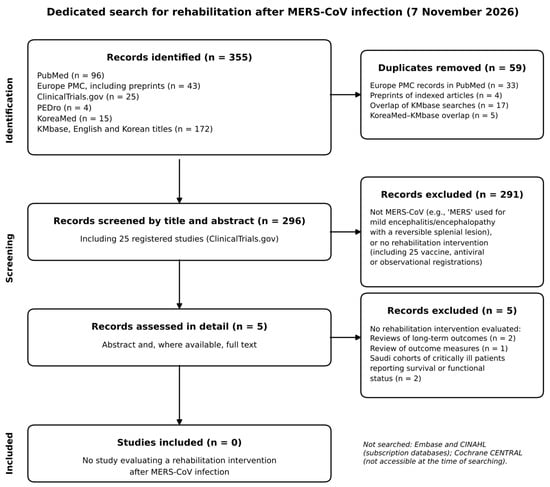
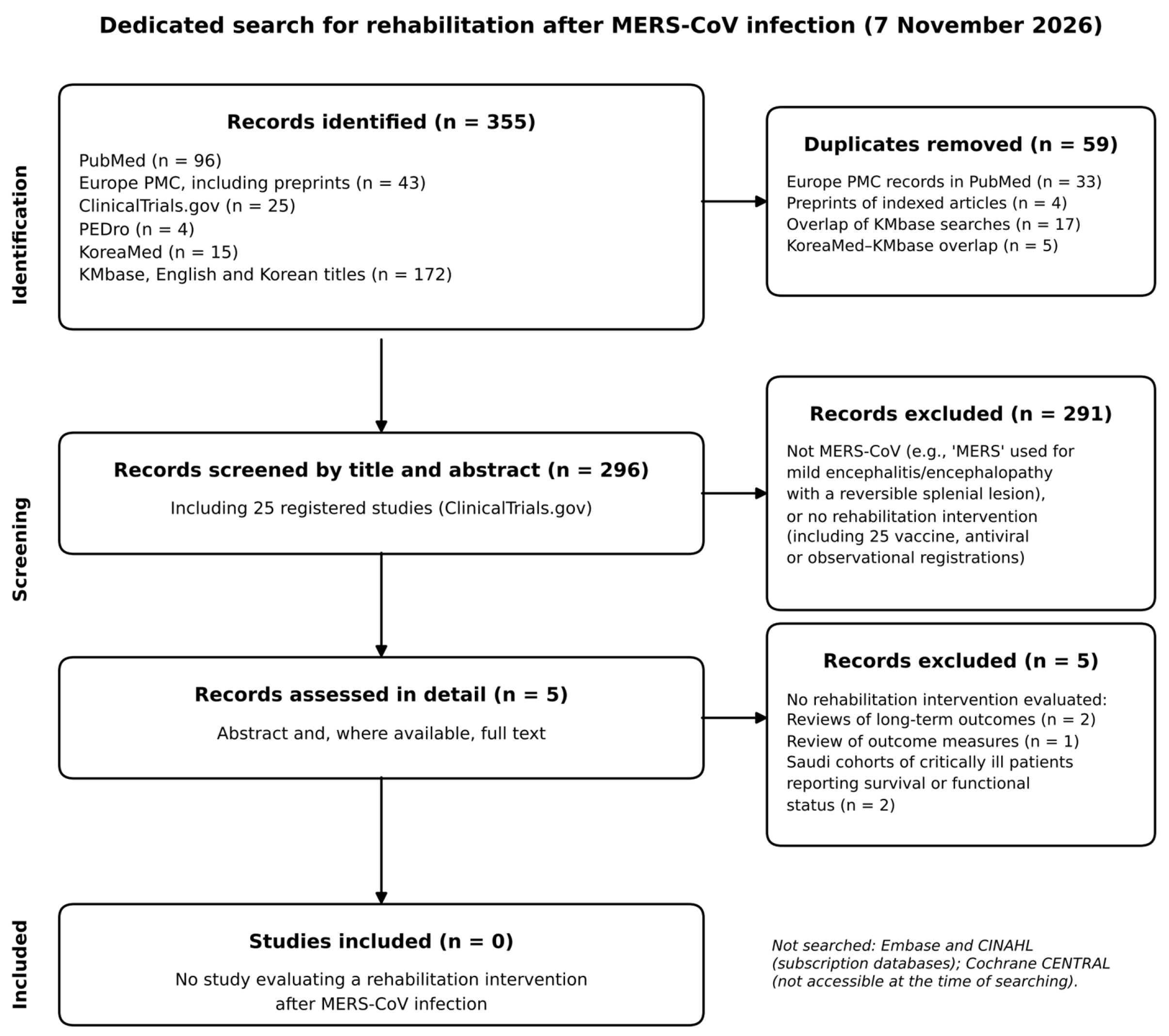
The searches identified 355 records (Figure 1). After removal of 59 duplicates, 296 records were screened, and 291 were excluded because they did not concern MERS-CoV (the abbreviation MERS is also used for mild encephalitis/encephalopathy with a reversible splenial lesion) or did not evaluate rehabilitation; all 25 registered studies concerned vaccines, antiviral or antibody therapies, or observational questions. Five records were assessed in detail: two reviews of long-term outcomes after coronavirus outbreaks [4,8], a review of the outcome measures used in coronavirus follow-up studies [9], and two Saudi cohorts of critically ill patients with MERS-CoV infection that reported long-term survival or functional status [10,11]. None evaluated a rehabilitation intervention (Supplementary Table S2).
Figure 1.
Flow diagram of the dedicated search for studies evaluating rehabilitation after MERS-CoV infection. Searches were run on 7 November 2026; search strings are given in Supplementary Table S1, and the five records assessed in detail are listed in Supplementary Table S2. Abbreviations: CENTRAL, Cochrane Central Register of Controlled Trials; CINAHL, Cumulative Index to Nursing and Allied Health Literature; PEDro, Physiotherapy Evidence Database.
3. Long-Term Sequelae After MERS-CoV Infection
MERS-CoV infection causes more severe acute illness than most other causes of severe acute respiratory infection. Among 330 critically ill patients with MERS-CoV infection in 14 Saudi intensive care units (ICUs), 85.2% required invasive mechanical ventilation, 5.8% extracorporeal membrane oxygenation and 48.8% renal replacement therapy, and MERS-CoV infection was independently associated with death compared with other causes of severe acute respiratory infection [12]. In a single Saudi ICU, 23 of 31 patients with MERS-CoV infection (74.2%) died [13]. The survivors of such illness are the population at greatest risk of long-term sequelae (Table 1).
Table 1.
Key studies of long-term outcomes after MERS-CoV infection.
3.1. Pulmonary Sequelae
In a Riyadh cohort of 36 patients recovering from MERS-CoV infection, follow-up chest radiographs obtained at a median of 43 days (range 32–230) were abnormal in 36%, and 33% showed radiographic features of lung fibrosis. Fibrosis was associated with more ICU days, older age, higher radiographic scores and higher peak lactate dehydrogenase [14]. These fibrosis data come from plain radiographs during relatively short-term follow-up, without computed tomography or lung function testing, and should not be read as a long-term prevalence of fibrosis. In a nationwide prospective cohort of 73 survivors of the 2015 Korean outbreak, pulmonary function one year after infection varied with the severity of pneumonia. Forced vital capacity was 88.7% of predicted after severe pneumonia versus 102.6% without pneumonia, and diffusing capacity for carbon monoxide (DLCO) was lower after severe pneumonia (78.3% vs about 89%). Radiological sequelae were present in 100% of those with severe pneumonia, 65.6% with mild pneumonia and 18.8% without pneumonia [15,16]. In this cohort, DLCO was impaired in 34% of survivors at 12 months [4]. A meta-analysis comparing SARS, MERS-CoV infection and COVID-19 found that reduced DLCO persisted 12 months after MERS-CoV infection, while other lung function parameters recovered [22].
3.2. Cardiac Involvement
MERS-CoV can cause acute myocarditis. The first reported case was published from Saudi Arabia in 2016: a previously healthy 60-year-old man presented with pneumonia, heart failure, raised troponin and severe global left ventricular dysfunction, and cardiovascular magnetic resonance findings met consensus criteria for acute myocarditis [21]. The report does not state the date of presentation. Beyond case reports, the long-term cardiac consequences of MERS-CoV infection have not been systematically studied, and we identified no study of cardiopulmonary exercise testing in MERS-CoV survivors.
3.3. Functional, Psychological and Quality-of-Life Outcomes
In a Saudi survey of 78 hospitalised MERS-CoV survivors about one year after diagnosis, quality of life (SF-36) did not differ from that of survivors of other severe acute respiratory infections. However, MERS-CoV survivors who had required intensive care scored lower for physical function, general health, vitality, emotional role and the physical component summary than those who had not [17]. Psychological morbidity is substantial. In Korean survivors, post-traumatic stress disorder affected 42.9% and depression 27.0% at 12 months [18]. Chronic fatigue affected 48.1% at 12 months and 32.7% at 18 months, and depression mediated the relationship between early fatigue and later post-traumatic stress symptoms [4,19]. Chronic fatigue syndrome at 12 months was associated with suicidality over two years of follow-up [20], and health-related quality of life during recovery was associated with depression and stigma [23]. Stigma during the outbreak independently predicted post-traumatic stress disorder [18]. Of 24 Saudi health care workers who survived critical MERS-CoV illness, 13 responded to follow-up a median of 580 days after discharge, and 2 reported functional limitations [11].
4. Lessons from SARS
Because data on MERS-CoV survivors are limited, the better-studied SARS cohorts provide a useful reference. Among 97 survivors in Hong Kong, 23.7% had DLCO below 80% of predicted at one year, and six-minute walk distance (6MWD) and health status remained below those of the normal population [24]. Impairments in lung function, functional capacity and health status were still evident at two-year follow-up [25]. Psychological morbidity was even more persistent: at a mean of 41 months, more than 40% of 233 survivors had an active psychiatric illness, 40.3% reported chronic fatigue and 27.1% met criteria for chronic fatigue syndrome [26]. Health care worker status and perceived stigma were independent risk factors [26]. These are both relevant to Saudi Arabia, where secondary, including health care-associated, MERS-CoV transmission has been prominent [2].
5. Long-Term Sequelae After COVID-19
In the largest cohort of hospital survivors, followed in Wuhan, diffusion impairment was present in 56% of those who had required high-flow oxygen or ventilation six months after symptom onset [27]. Longer follow-up shows that these abnormalities improve only partially. In 728 survivors with residual lung abnormalities at discharge, DLCO impairment fell from 49% at six months to 38% at three years and residual abnormalities on computed tomography from 46% to 36%; at three years, DLCO impairment and respiratory symptoms remained more common than in matched controls [28]. A 2026 meta-analysis of 152 studies (25,766 survivors) found that DLCO impairment declined only from 42% at six months to 35% at 36 months, whereas fibrotic changes persisted in 27–47% of those imaged without significant resolution [29]. Cardiovascular involvement is also important. Cardiovascular magnetic resonance showed cardiac involvement in 78% and ongoing myocardial inflammation in 60% of 100 recently recovered patients [30]. Studies using standardised imaging protocols have reported myocardial involvement in 26–60% of previously hospitalised patients [31], and in a 2024 prospective multicentre study of patients with moderate-to-severe COVID-19 and raised cardiac biomarkers, 42% had myocardial injury, and 26% met criteria for acute myocarditis about three months after discharge [32]. In more than 150,000 United States veterans, COVID-19 increased the risk of incident cardiovascular disease beyond the first 30 days, including among people who had not been hospitalised [33]. A meta-analysis led by Saudi investigators found that fatigue (41%), dyspnoea (31%) and sleep disorder (30%) persisted beyond 12 months, and effort intolerance affected 45% at 6–9 months [34]. At three years, a 2025 meta-analysis estimated that 20% of survivors still had at least one persistent symptom, most commonly dyspnoea (12%) and fatigue (11%) [35].
Two features of post-COVID-19 condition have direct implications for rehabilitation. First, post-exertional malaise, a delayed worsening of symptoms after physical or cognitive exertion, is associated with exertion-induced myopathy, metabolic disturbances and amyloid-containing deposits in skeletal muscle [36]. In a Dutch multicentre cohort followed for three years after hospitalisation, 36% of patients reported post-exertional malaise, which was associated with female sex, pre-existing pulmonary disease, physical inactivity before infection and ICU treatment, and with worsening fatigue and quality of life during the third year [37]. The interpretation of the muscle findings remains debated, because participants were deconditioned, the exercise challenge was maximal, and no post-COVID-19 comparison group without post-exertional malaise was included [38]. Second, autonomic dysfunction, including postural orthostatic tachycardia syndrome, can follow COVID-19 in previously healthy people. In one series, 85% had residual autonomic symptoms at 6–8 months, and 60% could not return to work [39]. Controlled and population-level studies have since supported this association: on formal autonomic testing, 79% of people with post-acute sequelae of COVID-19 met criteria for postural orthostatic tachycardia syndrome [40], and the incidence of this diagnosis rose markedly after the onset of the pandemic in a health-record cohort of more than 65 million adults [41].
Saudi Evidence
Saudi studies consistently report a substantial burden of persistent symptoms (Table 2). In a Riyadh cohort of hospitalised patients, 56.3% reported persistent symptoms at a median of 122 days after discharge, and 28.8% had not returned to their baseline health [42]. Community and national studies report persistent fatigue, breathlessness and myalgia across a wide range of acute severity [43,44,45,46]. In a four-year prospective Saudi cohort of 816 adults, 238 met the World Health Organization definition of long COVID; post-exertional malaise affected 45.8% of them, and female sex and diabetes mellitus were the strongest independent predictors [47]. A national virtual post-COVID-19 clinic programme, by contrast, found that 84.2% of 5913 respondents assessed at least four weeks after infection reported no persistent condition and that 6.5% needed referral, which shows how estimates depend on sampling and case definitions [48]. Saudi studies rely largely on self-report, without objective functional assessment or rehabilitation outcomes [49].
Table 2.
Saudi studies of persistent symptoms after COVID-19.
6. Immunological Considerations Relevant to Rehabilitation
Immunology is relevant to rehabilitation in three specific ways, and we limit this section to them. First, the severity of acute immunopathology determines who becomes a long-term rehabilitation patient. MERS-CoV and SARS-CoV-2 use different receptors, dipeptidyl peptidase 4 (DPP4) and angiotensin-converting enzyme 2 (ACE2), respectively [50,51], but both can drive excessive cytokine and chemokine responses that produce acute lung injury and acute respiratory distress syndrome [52], and in acute MERS-CoV infection plasma pro-inflammatory cytokines and virus-reactive CD8+ T-cell frequencies rise with disease severity [53]. This is why MERS-CoV survivors with long-term sequelae are largely post-intensive care patients. Second, immune markers are candidate, but untested, rehabilitation outcomes. MERS-CoV-specific T cells and antibodies can persist for years after severe illness [54,55,56], whereas in long COVID immune activation and depletion of naive T and B cells persist for at least eight months [57,58]. No study has linked these immune trajectories to functional recovery in either infection (Table 3).
Table 3.
Comparison of MERS-CoV and SARS-CoV-2 relevant to long-term recovery and rehabilitation.
Third, physical activity itself modulates the immune and autonomic systems, which is the most direct link between immunology and rehabilitation. Regular moderate physical activity has anti-inflammatory effects, mediated by reduced visceral fat, release of anti-inflammatory cytokines from contracting muscle and reduced Toll-like receptor expression on monocytes [62], and it enhances immune surveillance, with each bout mobilising cytotoxic T cells and natural killer cells into the circulation [63]. The earlier view that strenuous exercise causes clinically important immune suppression has not been supported by later evidence [64]. For autonomic dysfunction, cardiovascular deconditioning contributes to postural orthostatic tachycardia syndrome, and physical reconditioning that starts with recumbent exercise and progresses to upright activity is recommended early in management [65]. These data support carefully prescribed activity after viral infection, but they come largely from healthy and chronically ill populations. Whether the immunopathology shared by MERS-CoV and SARS-CoV-2 implies shared rehabilitation needs has not been tested. In our pathway (Section 8), rehabilitation needs are therefore defined by functional phenotype, not by the infecting virus or by immune profile.
8. A Phenotype-Directed Post-Viral Rehabilitation Pathway for Saudi Arabia
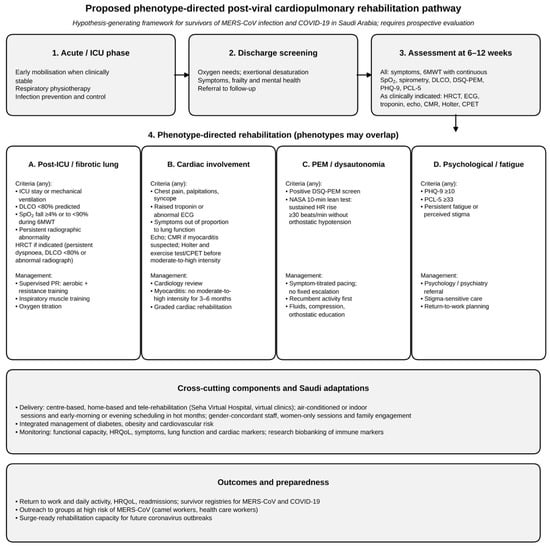
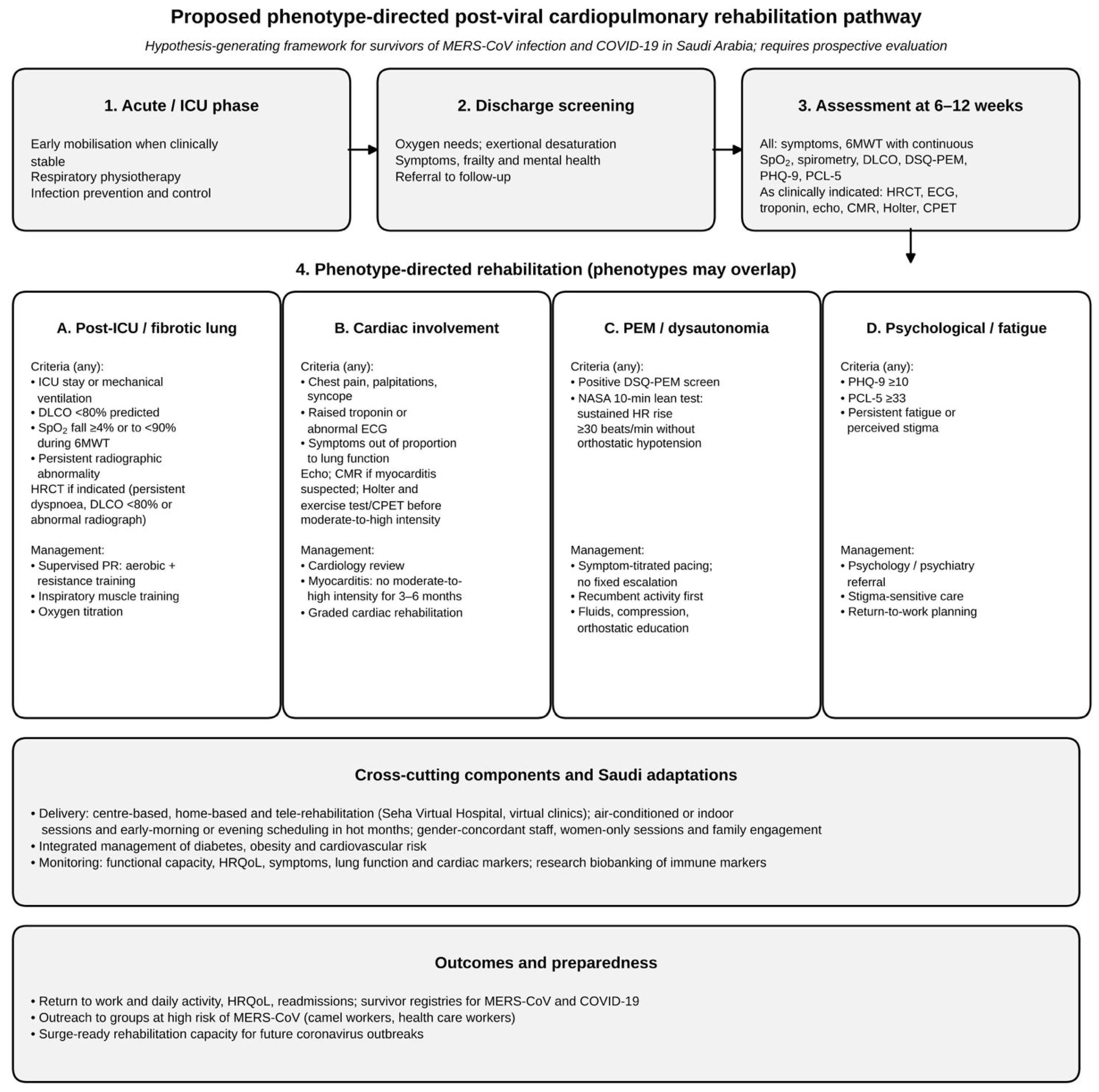
The evidence reviewed suggests that survivors of severe coronavirus infection are heterogeneous and that a single rehabilitation prescription is unlikely to fit all. We therefore propose a phenotype-directed pathway (Figure 2) that builds on international consensus [71,72], Saudi recommendations [79] and the evidence summarised above. Care begins with early mobilisation during acute illness, followed by screening at discharge and a structured assessment at 6–12 weeks. Core assessments for all survivors are symptoms, the six-minute walk test with continuous pulse oximetry [83], spirometry and DLCO, and brief validated questionnaires. Advanced investigations, namely high-resolution computed tomography (HRCT), echocardiography, cardiovascular magnetic resonance, ambulatory electrocardiography and CPET, are not routine; they should be performed according to clinical indications, as specified below. Survivors are then directed to four overlapping phenotypes using the following suggested criteria, which are drawn from the cited sources but have not been validated as a set in coronavirus survivors:
Figure 2.
Proposed phenotype-directed post-viral cardiopulmonary rehabilitation pathway for survivors of MERS-CoV infection and COVID-19 in Saudi Arabia. Core assessments apply to all survivors; advanced investigations (HRCT, echocardiography, CMR, ambulatory ECG and CPET) are performed according to clinical indications rather than routinely. Phenotype criteria are suggested thresholds drawn from the cited sources and require validation in coronavirus survivors. Abbreviations: 6MWT, six-minute walk test; CMR, cardiovascular magnetic resonance; CPET, cardiopulmonary exercise testing; DLCO, diffusing capacity for carbon monoxide; DSQ-PEM, DePaul Symptom Questionnaire–Post-Exertional Malaise; ECG, electrocardiogram; HR, heart rate; HRCT, high-resolution computed tomography; HRQoL, health-related quality of life; ICU, intensive care unit; PCL-5, PTSD Checklist for DSM-5; PEM, post-exertional malaise; PHQ-9, Patient Health Questionnaire-9; PR, pulmonary rehabilitation; PTSD, post-traumatic stress disorder; SpO2, peripheral oxygen saturation.
- (A)
- Post-ICU or fibrotic lung phenotype, typical of severe MERS-CoV infection [12,14]: prior ICU admission or mechanical ventilation, DLCO below 80% of predicted [24], a fall in SpO2 of 4% or more or to below 90% during the six-minute walk test, or a persistent radiographic abnormality. HRCT is indicated for persistent breathlessness, DLCO below 80% of predicted or an abnormal chest radiograph. Management: supervised pulmonary rehabilitation with aerobic and resistance training, inspiratory muscle training [74] and oxygen titration.
- (B)
- Cardiac phenotype: chest pain, palpitations, syncope or exertional symptoms out of proportion to lung function, with raised troponin or an abnormal electrocardiogram. These findings indicate echocardiography and, where myocardial involvement is suspected, cardiovascular magnetic resonance; ambulatory electrocardiography and exercise testing or CPET are used before return to moderate-to-high-intensity activity [76,77]. Management: cardiology evaluation, then graded cardiac rehabilitation once inflammation has resolved [78], given reports of myocarditis and increased long-term cardiovascular risk [21,30,33].
- (C)
- Post-exertional malaise or dysautonomia phenotype: a positive DePaul Symptom Questionnaire–Post-Exertional Malaise (DSQ-PEM) screen [84], or a sustained heart rate increase of 30 beats/min or more without orthostatic hypotension during the 10-min NASA lean test [85]. Management: symptom-titrated pacing, recumbent or semi-recumbent activity at the start, and orthostatic management rather than fixed escalation [36,39,65,77].
- (D)
- Psychological and fatigue phenotype: a Patient Health Questionnaire-9 (PHQ-9) score of 10 or more [86] or a PTSD Checklist for DSM-5 (PCL-5) score of 33 or more [87], with attention to chronic fatigue and stigma. Management: referral for post-traumatic stress, depression and anxiety, with stigma-sensitive care [18,19,26].
Cross-cutting elements include home-based and tele-rehabilitation [81,82,88], culturally congruent delivery with gender-concordant staff and family engagement, adaptations for climate and metabolic comorbidity (Section 9), and research biobanking so that immune markers can be linked to functional recovery [57]. The pathway is hypothesis generating and requires prospective evaluation.
9. The Saudi Arabian Context for Post-Viral Rehabilitation
9.1. Health-System Reform and Virtual Care
The health sector transformation under Vision 2030 is reorganising Saudi health care into regional health clusters, expanding the role of the private sector through public–private partnerships and emphasising prevention and digital health [89]. These reforms provide infrastructure that post-viral rehabilitation can use, building on the service context described in Section 7.6. Seha Virtual Hospital, established in 2022, has expanded its centres, workforce and specialised services, including cardiology and stroke care [90]; a national programme of virtual post-COVID-19 clinics assessed patients through the 937 Medical Consultation Call Centre [48]; and national tele-rehabilitation guidelines were published in 2021 [88]. Linking these platforms to rehabilitation services would allow for remote screening at discharge, tele-supervised programmes for people outside the main cities and structured follow-up of survivors.
9.2. Metabolic Comorbidity, Climate and Access to Physical Activity
Several local factors shape both the risk of persistent sequelae and the delivery of rehabilitation. Metabolic comorbidity is common: in the Saudi Health Interview Survey, 13.4% of Saudis aged 15 years or older had diabetes mellitus, more than half of them were undiagnosed, and 28.7% were obese [91,92]. Diabetes was the most common comorbidity among reported MERS-CoV cases [2] and, in a Saudi cohort, an independent predictor of long COVID [47], so rehabilitation programmes need integrated glycaemic and cardiovascular risk management. Physical inactivity is also widespread: a total of 34.5% of adults reported no weekly physical activity, and women were less likely than men to meet recommended levels [93,94]. Reported barriers include extreme weather, crowded traffic, cultural barriers and limited social support [94]. For much of the year, outdoor walking programmes are impractical; air-conditioned centre-based sessions, home-based programmes, early-morning or evening scheduling, and attention to hydration and heat tolerance are practical adaptations. For women, gender-concordant staff, women-only sessions and home- and tele-rehabilitation options are likely to be important for uptake.
9.3. Groups at High Risk of MERS-CoV Infection
Rehabilitation planning for MERS-CoV should also consider who is infected. Seroprevalence of MERS-CoV antibodies was 15 times higher in camel shepherds and 23 times higher in slaughterhouse workers than in the general population [95], and in national surveillance from 2012 to 2025, 14% of primary cases reported camel contact [96]. Health care-associated transmission accounted for a third of Saudi cases (737 of 2219) [96], and hospital outbreaks have repeatedly involved health care workers [97]. About 10% of critically ill patients with MERS-CoV infection in Saudi ICUs were health care workers [11], and in SARS survivors health care worker status was associated with long-term psychiatric morbidity [26]. Health care workers can be reached through occupational health services, whereas camel workers may live in rural areas and be difficult to follow up, which favours outreach and tele-rehabilitation.
9.4. Rehabilitation as Part of Outbreak Preparedness
Outbreak preparedness is included in this review because rehabilitation needs arise during outbreaks, not only after them, and because MERS-CoV remains a live threat in Saudi Arabia: new human cases continue, secondary transmission accounted for most 2025 cases, and case fatality remains high [2,98]. Health care workers were among those infected in earlier outbreaks [97,99], and SARS follow-up showed that they are at elevated risk of long-term psychiatric morbidity [26]. Rehabilitation planning should therefore form part of outbreak preparedness. This includes survivor registries that record objective functional outcomes, pre-agreed referral pathways from infectious disease and critical care services, and tele-rehabilitation capacity that can be scaled up rapidly while limiting exposure to infection.
10. Research Agenda
Table 4 summarises nine prioritised research questions arising from this review, together with the study designs suggested to address them.
Table 4.
Prioritised research agenda.
11. Strengths and Limitations
This review has three main strengths: an interdisciplinary author team spanning clinical immunology and rehabilitation sciences, full-text verification of key findings, and a dedicated, fully screened multi-database search for rehabilitation after MERS-CoV infection. Its limitations are those of a narrative review. The main search, although structured and reported with reproducible PubMed strategies, was not a systematic review with duplicate screening; Embase, CINAHL and Cochrane CENTRAL could not be searched; the main search was limited to English-language sources, although Korean titles were screened in the dedicated search; and no formal quality appraisal was performed. Evidence on MERS-CoV sequelae comes from small cohorts, much of it from the Korean outbreak, which may not fully represent Saudi patients, among whom comorbidities are very common [100]. Saudi post-COVID-19 studies are largely self-reported surveys with heterogeneous definitions. The phenotype criteria in our pathway are drawn from other populations and have not been validated in coronavirus survivors. A registered systematic or scoping review would be a useful next step.
12. Conclusions
Survivors of MERS-CoV infection and COVID-19 share a burden of persistent diffusion impairment, lung fibrosis, cardiac involvement, fatigue and psychological morbidity. Rehabilitation after COVID-19 is supported by randomised evidence, provided that post-exertional malaise, dysautonomia and myocardial involvement are identified and managed. For MERS-CoV infection, a disease that emerged in Saudi Arabia and continues to cause infections there, a dedicated multi-database search found no rehabilitation evidence; until such evidence exists, post-intensive care and ARDS research is the most relevant basis for practice. Saudi Arabia is uniquely placed to close this gap by building on its clinical immunology, critical care, rehabilitation and virtual care capacity. Priorities are to establish survivor registries with objective outcomes, to test phenotype-directed and tele-delivered rehabilitation adapted to local factors such as metabolic comorbidity, climate and women’s access to physical activity, and to make rehabilitation capacity a standard component of coronavirus preparedness.
Supplementary Materials
The following supporting information can be downloaded at https://www.mdpi.com/article/10.3390/healthcare14223970/s1, Table S1: Search strategies, dates and numbers of records; Table S2: Records assessed in detail in the dedicated search for rehabilitation after MERS-CoV infection.
Author Contributions
Conceptualisation: R.A. and A.A. Literature search and evidence synthesis: R.A. and A.A. Writing—original draft: A.A. (virology, immunopathology, epidemiology and preparedness sections), R.A. (rehabilitation sections). Writing—review and editing: R.A., A.A., and M.M.A. Visualisation: A.A. All authors have read and agreed to the published version of the manuscript.
Funding
This study was supported via funding from Prince Sattam bin Abdulaziz University, project number (PSAU/2026/R/1448).
Institutional Review Board Statement
Not applicable.
Informed Consent Statement
Not applicable.
Data Availability Statement
Data sharing is not applicable to this article, as no new data were created or analysed.
Acknowledgments
This study was supported via funding from Prince Sattam bin Abdulaziz University, project number (PSAU/2026/R/1448).
Conflicts of Interest
The authors declare no conflicts of interest.
Abbreviations
The following abbreviations are used in this manuscript:
| 6MWD | Six-minute walk distance |
| 6MWT | Six-minute walk test |
| ACE2 | Angiotensin-converting enzyme 2 |
| ARDS | Acute respiratory distress syndrome |
| CD26 | Cluster of differentiation 26 |
| CMR | Cardiovascular magnetic resonance |
| COVID-19 | Coronavirus disease 2019 |
| CPET | Cardiopulmonary exercise testing |
| CRP | C-reactive protein |
| CT | Computed tomography |
| DLCO | Diffusing capacity of the lung for carbon monoxide |
| DPP4 | Dipeptidyl peptidase 4 |
| DSQ-PEM | DePaul Symptom Questionnaire–Post-Exertional Malaise |
| ECG | Electrocardiogram |
| FVC | Forced vital capacity |
| HRCT | High-resolution computed tomography |
| HRQoL | Health-related quality of life |
| ICU | Intensive care unit |
| IL-6 | Interleukin-6 |
| IPC | Infection prevention and control |
| LDH | Lactate dehydrogenase |
| MERS | Middle East respiratory syndrome |
| MERS-CoV | Middle East respiratory syndrome coronavirus |
| PACS | Post-acute COVID-19 syndrome |
| PCL-5 | PTSD Checklist for DSM-5 |
| PCR | Polymerase chain reaction |
| PEDro | Physiotherapy Evidence Database |
| PEM | Post-exertional malaise |
| PFT | Pulmonary function test |
| PHQ-9 | Patient Health Questionnaire-9 |
| PICS | Post-intensive care syndrome |
| POTS | Postural orthostatic tachycardia syndrome |
| PPE | Personal protective equipment |
| PR | Pulmonary rehabilitation |
| PTSD | Post-traumatic stress disorder |
| RCT | Randomised controlled trial |
| SARS | Severe acute respiratory syndrome |
| SARS-CoV-2 | Severe acute respiratory syndrome coronavirus 2 |
| SARI | Severe acute respiratory infection |
| SANRA | Scale for the Assessment of Narrative Review Articles |
| SF-36 | Short Form-36 |
| SpO2 | Peripheral oxygen saturation |
| TMPRSS2 | Transmembrane serine protease 2 |
References
- Zaki, A.M.; van Boheemen, S.; Bestebroer, T.M.; Osterhaus, A.D.; Fouchier, R.A. Isolation of a novel coronavirus from a man with pneumonia in Saudi Arabia. N. Engl. J. Med. 2012, 367, 1814–1820. [Google Scholar] [CrossRef] [Scilit] [PubMed]
- Barry, M. Epidemiological characteristics of MERS-CoV human cases, 2012–2025. J. Epidemiol. Glob. Health 2025, 15, 103. [Google Scholar] [CrossRef] [Scilit] [PubMed]
- Azhar, E.I.; El-Kafrawy, S.A.; Farraj, S.A.; Hassan, A.M.; Al-Saeed, M.S.; Hashem, A.M.; Madani, T.A. Evidence for camel-to-human transmission of MERS coronavirus. N. Engl. J. Med. 2014, 370, 2499–2505. [Google Scholar] [CrossRef] [Scilit] [PubMed]
- Ahmed, H.; Patel, K.; Greenwood, D.C.; Halpin, S.; Lewthwaite, P.; Salawu, A.; Eyre, L.; Breen, A.; O’cOnnor, R.; Jones, A.; et al. Long-term clinical outcomes in survivors of severe acute respiratory syndrome and Middle East respiratory syndrome coronavirus outbreaks after hospitalisation or ICU admission: A systematic review and meta-analysis. J. Rehabil. Med. 2020, 52, jrm00063. [Google Scholar] [CrossRef] [Scilit] [PubMed]
- Davis, H.E.; McCorkell, L.; Vogel, J.M.; Topol, E.J. Long COVID: Major findings, mechanisms and recommendations. Nat. Rev. Microbiol. 2023, 21, 133–146. [Google Scholar] [CrossRef] [Scilit] [PubMed]
- Soriano, J.B.; Murthy, S.; Marshall, J.C.; Relan, P.; Diaz, J.V. A clinical case definition of post-COVID-19 condition by a Delphi consensus. Lancet Infect. Dis. 2022, 22, e102–e107. [Google Scholar] [CrossRef] [Scilit] [PubMed]
- Baethge, C.; Goldbeck-Wood, S.; Mertens, S. SANRA—A scale for the quality assessment of narrative review articles. Res. Integr. Peer Rev. 2019, 4, 5. [Google Scholar] [CrossRef] [Scilit] [PubMed]
- O′Sullivan, O. Long-term sequelae following previous coronavirus epidemics. Clin. Med. 2021, 21, e68–e70. [Google Scholar] [CrossRef] [Scilit] [PubMed]
- Patel, K.; Straudi, S.; Yee Sien, N.; Fayed, N.; Melvin, J.L.; Sivan, M. Applying the WHO ICF framework to the outcome measures used in the evaluation of long-term clinical outcomes in coronavirus outbreaks. Int. J. Environ. Res. Public Health 2020, 17, 6476. [Google Scholar] [CrossRef] [Scilit] [PubMed]
- Khalid, I.; Alraddadi, B.M.; Dairi, Y.; Khalid, T.J.; Kadri, M.; Alshukairi, A.N.; Qushmaq, I. Acute management and long-term survival among subjects with severe Middle East respiratory syndrome coronavirus pneumonia and ARDS. Respir. Care 2016, 61, 340–348. [Google Scholar] [CrossRef] [Scilit] [PubMed]
- Shalhoub, S.; Al-Hameed, F.; Mandourah, Y.; Balkhy, H.H.; Al-Omari, A.; Al Mekhlafi, G.A.; Kharaba, A.; Alraddadi, B.; Almotairi, A.; Al Khatib, K.; et al. Critically ill healthcare workers with the Middle East respiratory syndrome (MERS): A multicenter study. PLoS ONE 2018, 13, e0206831. [Google Scholar] [CrossRef] [Scilit] [PubMed]
- Arabi, Y.M.; Al-Omari, A.; Mandourah, Y.; Al-Hameed, F.; Sindi, A.A.; Alraddadi, B.; Shalhoub, S.; Almotairi, A.; Al Khatib, K.; Abdulmomen, A.; et al. Critically ill patients with the Middle East respiratory syndrome: A multicenter retrospective cohort study. Crit. Care Med. 2017, 45, 1683–1695. [Google Scholar] [CrossRef] [Scilit] [PubMed]
- Almekhlafi, G.A.; Albarrak, M.M.; Mandourah, Y.; Hassan, S.; Alwan, A.; Abudayah, A.; Altayyar, S.; Mustafa, M.; Aldaghestani, T.; Alghamedi, A.; et al. Presentation and outcome of Middle East respiratory syndrome in Saudi intensive care unit patients. Crit. Care 2016, 20, 123. [Google Scholar] [CrossRef] [Scilit] [PubMed]
- Das, K.M.; Lee, E.Y.; Singh, R.; Enani, M.A.; Al Dossari, K.; Van Gorkom, K.; Larsson, S.G.; Langer, R.D. Follow-up chest radiographic findings in patients with MERS-CoV after recovery. Indian. J. Radiol. Imaging 2017, 27, 342–349. [Google Scholar] [CrossRef] [Scilit] [PubMed]
- Park, W.B.; Jun, K.I.; Kim, G.; Choi, J.P.; Rhee, J.Y.; Cheon, S.; Lee, C.H.; Park, J.-S.; Kim, Y.; Joh, J.-S.; et al. Correlation between pneumonia severity and pulmonary complications in Middle East respiratory syndrome. J. Korean Med. Sci. 2018, 33, e169. [Google Scholar] [CrossRef] [Scilit] [PubMed]
- Jun, K.I.; Park, W.B.; Kim, G.; Choi, J.P.; Rhee, J.Y.; Cheon, S.; Park, J.-S.; Kim, Y.; Joh, J.; Chin, B.S.; et al. Long-term respiratory complication in patients with Middle East respiratory syndrome: 1-year follow-up after the 2015 outbreak in South Korea. Open Forum Infect. Dis. 2017, 4, S577. [Google Scholar] [CrossRef] [Scilit]
- Batawi, S.; Tarazan, N.; Al-Raddadi, R.; Al Qasim, E.; Sindi, A.A.; Al Johni, S.; Al-Hameed, F.M.; Arabi, Y.M.; Uyeki, T.M.; Alraddadi, B.M. Quality of life reported by survivors after hospitalization for Middle East respiratory syndrome (MERS). Health Qual. Life Outcomes 2019, 17, 101. [Google Scholar] [CrossRef] [Scilit] [PubMed]
- Park, H.Y.; Park, W.B.; Lee, S.H.; Kim, J.L.; Lee, J.J.; Lee, H.; Shin, H.-S. Posttraumatic stress disorder and depression of survivors 12 months after the outbreak of Middle East respiratory syndrome in South Korea. BMC Public Health 2020, 20, 605. [Google Scholar] [CrossRef] [Scilit] [PubMed]
- Lee, S.H.; Shin, H.S.; Park, H.Y.; Kim, J.L.; Lee, J.J.; Lee, H.; Won, S.-D.; Han, W. Depression as a mediator of chronic fatigue and post-traumatic stress symptoms in Middle East respiratory syndrome survivors. Psychiatry Investig. 2019, 16, 59–64. [Google Scholar] [CrossRef] [Scilit] [PubMed]
- Ahn, S.H.; Kim, J.L.; Kim, J.R.; Lee, S.H.; Yim, H.W.; Jeong, H.; Chae, J.-H.; Park, H.Y.; Lee, J.J.; Lee, H. Association between chronic fatigue syndrome and suicidality among survivors of Middle East respiratory syndrome over a 2-year follow-up period. J. Psychiatr. Res. 2021, 137, 1–6. [Google Scholar] [CrossRef] [Scilit] [PubMed]
- Alhogbani, T. Acute myocarditis associated with novel Middle East respiratory syndrome coronavirus. Ann. Saudi Med. 2016, 36, 78–80. [Google Scholar] [CrossRef] [Scilit] [PubMed]
- Huntley, C.C.; Patel, K.; Bil Bushra, S.S.; Mobeen, F.; Armitage, M.N.; Pye, A.; Knight, C.B.; Mostafa, A.; Kershaw, M.; Mughal, A.Z.; et al. Pulmonary function test and computed tomography features during follow-up after SARS, MERS and COVID-19: A systematic review and meta-analysis. ERJ Open Res. 2022, 8, 00056–02022. [Google Scholar] [CrossRef] [Scilit] [PubMed]
- Ahn, S.H.; Kim, J.L.; Lee, S.H.; Park, H.Y.; Lee, J.J.; Lee, H. Associations of health-related quality of life with depression and stigma in MERS-CoV survivors during the recovery period. Medicine 2022, 101, e29440. [Google Scholar] [CrossRef] [Scilit] [PubMed]
- Hui, D.S.; Wong, K.T.; Ko, F.W.; Tam, L.S.; Chan, D.P.; Woo, J.; Sung, J.J. The 1-year impact of severe acute respiratory syndrome on pulmonary function, exercise capacity, and quality of life in a cohort of survivors. Chest 2005, 128, 2247–2261. [Google Scholar] [CrossRef] [Scilit] [PubMed]
- Ngai, J.C.; Ko, F.W.; Ng, S.S.; To, K.W.; Tong, M.; Hui, D.S. The long-term impact of severe acute respiratory syndrome on pulmonary function, exercise capacity and health status. Respirology 2010, 15, 543–550. [Google Scholar] [CrossRef] [Scilit] [PubMed]
- Lam, M.H.; Wing, Y.K.; Yu, M.W.; Leung, C.M.; Ma, R.C.; Kong, A.P.; So, W.; Fong, S.Y.-Y.; Lam, S.-P. Mental morbidities and chronic fatigue in severe acute respiratory syndrome survivors: Long-term follow-up. Arch. Intern. Med. 2009, 169, 2142–2147. [Google Scholar] [CrossRef] [Scilit] [PubMed]
- Wu, X.; Liu, X.; Zhou, Y.; Yu, H.; Li, R.; Zhan, Q.; Ni, F.; Fang, S.; Lu, Y.; Ding, X.; et al. 3-month, 6-month, 9-month, and 12-month respiratory outcomes in patients following COVID-19-related hospitalisation: A prospective study. Lancet Respir. Med. 2021, 9, 747–754. [Google Scholar] [CrossRef] [Scilit]
- Han, X.; Chen, L.; Guo, L.; Wu, L.; Alwalid, O.; Liu, J.; Zheng, Y.; Chen, L.; Wu, W.; Li, H.; et al. Long-term radiological and pulmonary function abnormalities at 3 years after COVID-19 hospitalisation: A longitudinal cohort study. Eur. Respir. J. 2024, 64, 2301612. [Google Scholar] [CrossRef] [Scilit] [PubMed]
- Song, J.; Lee, J.H.; Park, H.; Jang, M.J.; Yoon, S.H. Long-term pulmonary function and radiologic abnormalities up to 3 years after COVID-19: A systematic review and meta-analysis. Korean J. Radiol. 2026, 27, 174–185. [Google Scholar] [CrossRef] [Scilit] [PubMed]
- Puntmann, V.O.; Carerj, M.L.; Wieters, I.; Fahim, M.; Arendt, C.; Hoffmann, J.; Shchendrygina, A.; Escher, F.; Vasa-Nicotera, M.; Zeiher, A.M.; et al. Outcomes of cardiovascular magnetic resonance imaging in patients recently recovered from coronavirus disease 2019 (COVID-19). JAMA Cardiol. 2020, 5, 1265–1273. [Google Scholar] [CrossRef] [Scilit] [PubMed]
- Ferreira, V.M.; Plein, S.; Wong, T.C.; Tao, Q.; Raisi-Estabragh, Z.; Jain, S.S.; Han, Y.; Ojha, V.; Bluemke, D.A.; Hanneman, K.; et al. Cardiovascular magnetic resonance for evaluation of cardiac involvement in COVID-19: Recommendations by the Society for Cardiovascular Magnetic Resonance. J. Cardiovasc. Magn. Reson. 2023, 25, 21. [Google Scholar] [CrossRef] [Scilit] [PubMed]
- Kato, S.; Kitai, T.; Utsunomiya, D.; Azuma, M.; Fukui, K.; Hagiwara, E.; Ogura, T.; Ishibashi, Y.; Okada, T.; Kitakata, H.; et al. Myocardial injury by COVID-19 infection assessed by cardiovascular magnetic resonance imaging—A prospective multicenter study. Circ. J. 2024, 88, 1450–1458. [Google Scholar] [CrossRef] [Scilit] [PubMed]
- Xie, Y.; Xu, E.; Bowe, B.; Al-Aly, Z. Long-term cardiovascular outcomes of COVID-19. Nat. Med. 2022, 28, 583–590. [Google Scholar] [CrossRef] [Scilit] [PubMed]
- Alkodaymi, M.S.; Omrani, O.A.; Fawzy, N.A.; Abou Shaar, B.; Almamlouk, R.; Riaz, M.; Obeidat, M.; Obeidat, Y.; Gerberi, D.; Taha, R.M.; et al. Prevalence of post-acute COVID-19 syndrome symptoms at different follow-up periods: A systematic review and meta-analysis. Clin. Microbiol. Infect. 2022, 28, 657–666. [Google Scholar] [CrossRef] [Scilit] [PubMed]
- Rahmati, M.; Udeh, R.; Kang, J.; Dolja-Gore, X.; McEvoy, M.; Kazemi, A.; Soysal, P.; Smith, L.; Kenna, T.; Fond, G.; et al. Long-term sequelae of COVID-19: A systematic review and meta-analysis of symptoms 3 years post-SARS-CoV-2 infection. J. Med. Virol. 2025, 97, e70429. [Google Scholar] [CrossRef] [Scilit] [PubMed]
- Appelman, B.; Charlton, B.T.; Goulding, R.P.; Kerkhoff, T.J.; Breedveld, E.A.; Noort, W.; Offringa, C.; Bloemers, F.W.; van Weeghel, M.; Schomakers, B.V.; et al. Muscle abnormalities worsen after post-exertional malaise in long COVID. Nat. Commun. 2024, 15, 17. [Google Scholar] [CrossRef] [Scilit] [PubMed]
- Berentschot, J.C.; Bek, L.M.; Drost, M.; van den Berg-Emons, R.J.G.; Braunstahl, G.J.; Ribbers, G.M.; Aerts, J.G.; Hellemons, M.E.; Heijenbrok-Kal, M.H.; Bindraban, S.; et al. Health outcomes up to 3 years and post-exertional malaise in patients after hospitalization for COVID-19: A multicentre prospective cohort study (CO-FLOW). Lancet Reg. Health Eur. 2025, 53, 101290. [Google Scholar] [CrossRef] [Scilit] [PubMed]
- Ranque, B.; Garner, P.; Allenbach, Y.; Hupin, D.; David, A.S.; Wade, D.; Sharpe, M.; Garcin, B.; Little, P.; Tinazzi, M.; et al. Muscle abnormalities in long COVID. Nat. Commun. 2025, 16, 1490. [Google Scholar] [CrossRef] [Scilit] [PubMed]
- Blitshteyn, S.; Whitelaw, S. Postural orthostatic tachycardia syndrome (POTS) and other autonomic disorders after COVID-19 infection: A case series of 20 patients. Immunol. Res. 2021, 69, 205–211. [Google Scholar] [CrossRef] [Scilit] [PubMed]
- Seeley, M.C.; Gallagher, C.; Ong, E.; Langdon, A.; Chieng, J.; Bailey, D.; Page, A.; Lim, H.S.; Lau, D.H. High incidence of autonomic dysfunction and postural orthostatic tachycardia syndrome in patients with long COVID: Implications for management and health care planning. Am. J. Med. 2025, 138, 354–361.e1. [Google Scholar] [CrossRef] [Scilit] [PubMed]
- Dulal, D.; Maraey, A.; Elsharnoby, H.; Chacko, P.; Grubb, B. Impact of COVID-19 pandemic on the incidence and prevalence of postural orthostatic tachycardia syndrome. Eur. Heart J. Qual. Care Clin. Outcomes 2025, 11, 698–704. [Google Scholar] [CrossRef] [Scilit] [PubMed]
- Tleyjeh, I.M.; Saddik, B.; Alswaidan, N.; AlAnazi, A.; Ramakrishnan, R.K.; Alhazmi, D.; Aloufi, A.; AlSumait, F.; Berbari, E.; Halwani, R. Prevalence and predictors of post-acute COVID-19 syndrome (PACS) after hospital discharge: A cohort study with 4 months median follow-up. PLoS ONE 2021, 16, e0260568. [Google Scholar] [CrossRef] [Scilit] [PubMed]
- Khodeir, M.M.; Shabana, H.A.; Rasheed, Z.; Alkhamiss, A.S.; Khodeir, M.; Alkhowailed, M.S.; Alharbi, S.; Alsoghair, M.; Alsagaby, S.A.; Al Abdulmonem, W. COVID-19: Post-recovery long-term symptoms among patients in Saudi Arabia. PLoS ONE 2021, 16, e0260259. [Google Scholar] [CrossRef] [Scilit] [PubMed]
- Garout, M.A.; Saleh, S.A.K.; Adly, H.M.; Abdulkhaliq, A.A.; Khafagy, A.A.; Abdeltawab, M.R.; Rabaan, A.A.; Rodriguez-Morales, A.J.; Al-Tawfiq, J.A.; Alandiyjany, M.N. Post-COVID-19 syndrome: Assessment of short- and long-term post-recovery symptoms in recovered cases in Saudi Arabia. Infection 2022, 50, 1431–1439. [Google Scholar] [CrossRef] [Scilit] [PubMed]
- Alradini, F.; Alamri, F.; Aljahany, M.; Almuzaini, Y.; Alsofayan, Y.; Khan, A.; Albogami, N.; Abdulrahim, M.; Almogbil, A.; Alahmari, A. Post-acute COVID-19 condition in Saudi Arabia: A national representative study. J. Infect. Public Health 2022, 15, 526–532. [Google Scholar] [CrossRef] [Scilit] [PubMed]
- Almalag, H.M.; Altuwaijri, N.; Alnaim, L.S.; Alassiri, D.; Alsolaimi, G.; Aldakhil, S.; Al Aloola, N.; Alsabhan, J.F.; Bawazeer, G.A.; Al Juffali, L.; et al. Prevalence and characteristics of long COVID among COVID-19 survivors in Saudi Arabia: A cross-sectional study. IJID Reg. 2025, 15, 100616. [Google Scholar] [CrossRef] [Scilit] [PubMed]
- Kamal, S.M.; Al Qahtani, M.S.; Al Aseeri, A.; Naghib, M.E.D.M.; Al Mazroua, A.M.M.; Alshamrani, A.M.M.; Al Mazroua, M.M.; AlHarbi, F.S.F. Long COVID-19: A four-year prospective cohort study of risk factors, recovery, and quality of life. BMC Infect. Dis. 2025, 25, 1082. [Google Scholar] [CrossRef] [Scilit] [PubMed]
- Alenezi, F.; Alsagheir, A.; Amer, S.; Alzubaidi, L.; Alhomod, A.S.; Alamaa, T. Virtual post-COVID-19 clinics in Saudi Arabia: Navigating the effect of the pandemic with a national project. Front. Public Health 2025, 13, 1460324. [Google Scholar] [CrossRef] [Scilit] [PubMed]
- Albelasi, A. Symptoms, mechanisms, and management of long COVID: Understanding its prevalence, characteristics, and healthcare challenges in Saudi Arabia. Front. Cell Infect. Microbiol. 2026, 16, 1747443. [Google Scholar] [CrossRef] [Scilit] [PubMed]
- Raj, V.S.; Mou, H.; Smits, S.L.; Dekkers, D.H.; Müller, M.A.; Dijkman, R.; Muth, D.; Demmers, J.A.; Zaki, A.; Fouchier, R.A.; et al. Dipeptidyl peptidase 4 is a functional receptor for the emerging human coronavirus-EMC. Nature 2013, 495, 251–254. [Google Scholar] [CrossRef] [Scilit] [PubMed]
- Hoffmann, M.; Kleine-Weber, H.; Schroeder, S.; Krüger, N.; Herrler, T.; Erichsen, S.; Schiergens, T.S.; Herrler, G.; Wu, N.-H.; Nitsche, A.; et al. SARS-CoV-2 cell entry depends on ACE2 and TMPRSS2 and is blocked by a clinically proven protease inhibitor. Cell 2020, 181, 271–280.e8. [Google Scholar] [CrossRef] [Scilit] [PubMed]
- Channappanavar, R.; Perlman, S. Pathogenic human coronavirus infections: Causes and consequences of cytokine storm and immunopathology. Semin. Immunopathol. 2017, 39, 529–539. [Google Scholar] [CrossRef] [Scilit] [PubMed]
- Shin, H.S.; Kim, Y.; Kim, G.; Lee, J.Y.; Jeong, I.; Joh, J.S.; Kim, H.; Chang, E.; Sim, S.Y.; Park, J.-S.; et al. Immune responses to Middle East respiratory syndrome coronavirus during the acute and convalescent phases of human infection. Clin. Infect. Dis. 2019, 68, 984–992. [Google Scholar] [CrossRef] [Scilit] [PubMed]
- Zhao, J.; Alshukairi, A.N.; Baharoon, S.A.; Ahmed, W.A.; Bokhari, A.A.; Nehdi, A.M.; Layqah, L.A.; Alghamdi, M.G.; Al Gethamy, M.M.; Dada, A.M.; et al. Recovery from the Middle East respiratory syndrome is associated with antibody and T cell responses. Sci. Immunol. 2017, 2, eaan5393. [Google Scholar] [CrossRef] [Scilit] [PubMed]
- Alshukairi, A.N.; Zhao, J.; Al-Mozaini, M.A.; Wang, Y.; Dada, A.; Baharoon, S.A.; Alfaraj, S.; Ahmed, W.A.; Enani, M.A.; Elzein, F.E.; et al. Longevity of Middle East respiratory syndrome coronavirus antibody responses in humans, Saudi Arabia. Emerg. Infect. Dis. 2021, 27, 1472–1476. [Google Scholar] [CrossRef] [Scilit] [PubMed]
- Alhabbab, R.Y.; Algaissi, A.; Mahmoud, A.B.; Alkayyal, A.A.; Al-Amri, S.; Alfaleh, M.A.; Basabrain, M.; Alsubki, R.A.; Almarshad, I.S.; Alhudaithi, A.M.; et al. MERS-CoV infection elicits long-lasting specific antibody, T and B cell immune responses in recovered individuals. Clin. Infect. Dis. 2022, 76, e308–e318. [Google Scholar] [CrossRef] [Scilit] [PubMed]
- Phetsouphanh, C.; Darley, D.R.; Wilson, D.B.; Howe, A.; Munier, C.M.L.; Patel, S.K.; Juno, J.A.; Burrell, L.M.; Kent, S.J.; Dore, G.J.; et al. Immunological dysfunction persists for 8 months following initial mild-to-moderate SARS-CoV-2 infection. Nat. Immunol. 2022, 23, 210–216. [Google Scholar] [CrossRef] [Scilit] [PubMed]
- Klein, J.; Wood, J.; Jaycox, J.R.; Dhodapkar, R.M.; Lu, P.; Gehlhausen, J.R.; Tabachnikova, A.; Greene, K.; Tabacof, L.; Malik, A.A.; et al. Distinguishing features of long COVID identified through immune profiling. Nature 2023, 623, 139–148. [Google Scholar] [CrossRef] [Scilit] [PubMed]
- Durstenfeld, M.S.; Sun, K.; Tahir, P.; Peluso, M.J.; Deeks, S.G.; Aras, M.A.; Grandis, D.J.; Long, C.S.; Beatty, A.; Hsue, P.Y. Use of cardiopulmonary exercise testing to evaluate long COVID-19 symptoms in adults: A systematic review and meta-analysis. JAMA Netw. Open 2022, 5, e2236057. [Google Scholar] [CrossRef] [Scilit] [PubMed]
- Pouliopoulou, D.V.; MacDermid, J.C.; Saunders, E.G.; Peters, S.; Brunton, L.; Miller, E.; Quinn, K.L.; Pereira, T.V.; Bobos, P. Rehabilitation interventions for physical capacity and quality of life in adults with post-COVID-19 condition: A systematic review and meta-analysis. JAMA Netw. Open 2023, 6, e2333838. [Google Scholar] [CrossRef] [Scilit] [PubMed]
- Chakraverty, S.; Chynkiamis, N.; Maru, N.; Megaritis, D.; Hume, E.; Cucato, G.; Wilhelm, E.N.; Vogiatzis, I. Rehabilitation in long COVID: A systematic review and meta-analysis. ERJ Open Res. 2026, 12, 00133–2026. [Google Scholar] [CrossRef] [Scilit] [PubMed]
- Gleeson, M.; Bishop, N.C.; Stensel, D.J.; Lindley, M.R.; Mastana, S.S.; Nimmo, M.A. The anti-inflammatory effects of exercise: Mechanisms and implications for the prevention and treatment of disease. Nat. Rev. Immunol. 2011, 11, 607–615. [Google Scholar] [CrossRef] [Scilit] [PubMed]
- Nieman, D.C.; Wentz, L.M. The compelling link between physical activity and the body′s defense system. J. Sport. Health Sci. 2019, 8, 201–217. [Google Scholar] [CrossRef] [Scilit] [PubMed]
- Campbell, J.P.; Turner, J.E. Debunking the myth of exercise-induced immune suppression: Redefining the impact of exercise on immunological health across the lifespan. Front. Immunol. 2018, 9, 648. [Google Scholar] [CrossRef] [Scilit] [PubMed]
- Fu, Q.; Levine, B.D. Exercise and non-pharmacological treatment of POTS. Auton. Neurosci. 2018, 215, 20–27. [Google Scholar] [CrossRef] [Scilit] [PubMed]
- Needham, D.M.; Davidson, J.; Cohen, H.; Hopkins, R.O.; Weinert, C.; Wunsch, H.; Zawistowski, C.; Bemis-Dougherty, A.; Berney, S.C.; Bienvenu, O.J.; et al. Improving long-term outcomes after discharge from intensive care unit: Report from a stakeholders′ conference. Crit. Care Med. 2012, 40, 502–509. [Google Scholar] [CrossRef] [Scilit] [PubMed]
- Herridge, M.S.; Tansey, C.M.; Matté, A.; Tomlinson, G.; Diaz-Granados, N.; Cooper, A.; Guest, C.B.; Mazer, C.D.; Mehta, S.; Stewart, T.E.; et al. Functional disability 5 years after acute respiratory distress syndrome. N. Engl. J. Med. 2011, 364, 1293–1304. [Google Scholar] [CrossRef] [Scilit] [PubMed]
- Laporte, L.R.; Chavez, A.V.F.G.; Ranzani, O.T.; Caldas, J.; Passos, R.D.H.; Ramos, J.G.R. Long-term outcomes for epidemic viral pneumonia survivors after discharge from the intensive care unit: A systematic review. Einstein 2024, 22, eRW0352. [Google Scholar] [CrossRef] [Scilit] [PubMed]
- Connolly, B.; Salisbury, L.; O′Neill, B.; Geneen, L.; Douiri, A.; Grocott, M.P.; Hart, N.; Walsh, T.S.; Blackwood, B. Exercise rehabilitation following intensive care unit discharge for recovery from critical illness. Cochrane Database Syst. Rev. 2015, 6, CD008632. [Google Scholar] [CrossRef] [Scilit] [PubMed]
- Walsh, T.S.; Salisbury, L.G.; Merriweather, J.L.; Boyd, J.A.; Griffith, D.M.; Huby, G.; Kean, S.; Mackenzie, S.J.; Krishan, A.; Lewis, S.C.; et al. Increased hospital-based physical rehabilitation and information provision after intensive care unit discharge: The RECOVER randomized clinical trial. JAMA Intern. Med. 2015, 175, 901–910. [Google Scholar] [CrossRef] [Scilit] [PubMed]
- Spruit, M.A.; Holland, A.E.; Singh, S.J.; Tonia, T.; Wilson, K.C.; Troosters, T. COVID-19: Interim guidance on rehabilitation in the hospital and post-hospital phase from a European Respiratory Society- and American Thoracic Society-coordinated international task force. Eur. Respir. J. 2020, 56, 2002197. [Google Scholar] [CrossRef] [Scilit] [PubMed]
- Barker-Davies, R.M.; O′Sullivan, O.; Senaratne, K.P.P.; Baker, P.; Cranley, M.; Dharm-Datta, S.; Ellis, H.; Goodall, D.; Gough, M.; Lewis, S.; et al. The Stanford Hall consensus statement for post-COVID-19 rehabilitation. Br. J. Sports Med. 2020, 54, 949–959. [Google Scholar] [CrossRef] [Scilit] [PubMed]
- Spruit, M.A.; Singh, S.J.; Garvey, C.; ZuWallack, R.; Nici, L.; Rochester, C.; Hill, K.; Holland, A.E.; Lareau, S.C.; Man, W.D.-C.; et al. An official American Thoracic Society/European Respiratory Society statement: Key concepts and advances in pulmonary rehabilitation. Am. J. Respir. Crit. Care Med. 2013, 188, e13–e64. [Google Scholar] [CrossRef] [Scilit] [PubMed]
- McNarry, M.A.; Berg, R.M.G.; Shelley, J.; Hudson, J.; Saynor, Z.L.; Duckers, J.; Lewis, K.; Davies, G.A.; Mackintosh, K.A. Inspiratory muscle training enhances recovery post-COVID-19: A randomised controlled trial. Eur. Respir. J. 2022, 60, 2103101. [Google Scholar] [CrossRef] [Scilit] [PubMed]
- Singh, I.; Joseph, P.; Heerdt, P.M.; Cullinan, M.; Lutchmansingh, D.D.; Gulati, M.; Possick, J.D.; Systrom, D.M.; Waxman, A.B. Persistent exertional intolerance after COVID-19: Insights from invasive cardiopulmonary exercise testing. Chest 2022, 161, 54–63. [Google Scholar] [CrossRef] [Scilit] [PubMed]
- Pelliccia, A.; Sharma, S.; Gati, S.; Bäck, M.; Börjesson, M.; Caselli, S.; Collet, J.-P.; Corrado, D.; Drezner, J.A.; Halle, M.; et al. 2020 ESC Guidelines on sports cardiology and exercise in patients with cardiovascular disease. Eur. Heart J. 2021, 42, 17–96. [Google Scholar] [CrossRef] [Scilit] [PubMed]
- Gluckman, T.J.; Bhave, N.M.; Allen, L.A.; Chung, E.H.; Spatz, E.S.; Ammirati, E.; Baggish, A.L.; Bozkurt, B.; Cornwell, W.K.; Harmon, K.G.; et al. 2022 ACC expert consensus decision pathway on cardiovascular sequelae of COVID-19 in adults: Myocarditis and other myocardial involvement, post-acute sequelae of SARS-CoV-2 infection, and return to play. J. Am. Coll. Cardiol. 2022, 79, 1717–1756. [Google Scholar] [CrossRef] [Scilit] [PubMed]
- Taylor, R.S.; Dalal, H.M.; McDonagh, S.T.J. The role of cardiac rehabilitation in improving cardiovascular outcomes. Nat. Rev. Cardiol. 2022, 19, 180–194. [Google Scholar] [CrossRef] [Scilit] [PubMed]
- Reddy, R.S.; Gautam, A.P.; Tedla, J.S.; Ferreira, A.S.; Reis, L.F.F.; Bairapareddy, K.C.; Kakaraparthi, V.N.; Gular, K. The aftermath of the COVID-19 crisis in Saudi Arabia: Respiratory rehabilitation recommendations by physical therapists. Healthcare 2021, 9, 1560. [Google Scholar] [CrossRef] [Scilit] [PubMed]
- Alsubaiei, M.E.; Cafarella, P.A.; Frith, P.A.; Effing, T.W.; McEvoy, R.D. Barriers for setting up a pulmonary rehabilitation program in the Eastern Province of Saudi Arabia. Ann. Thorac. Med. 2016, 11, 121–127. [Google Scholar] [CrossRef] [Scilit] [PubMed]
- Alahmadi, F.H. Optimizing pulmonary rehabilitation in Saudi Arabia: Current practices, challenges, and future directions. Medicina 2025, 61, 673. [Google Scholar] [CrossRef] [Scilit] [PubMed]
- Cox, N.S.; Dal Corso, S.; Hansen, H.; McDonald, C.F.; Hill, C.J.; Zanaboni, P.; A Alison, J.; O′Halloran, P.; Macdonald, H.; E Holland, A. Telerehabilitation for chronic respiratory disease. Cochrane Database Syst. Rev. 2021, 1, CD013040. [Google Scholar] [CrossRef] [Scilit] [PubMed]
- Holland, A.E.; Spruit, M.A.; Troosters, T.; Puhan, M.A.; Pepin, V.; Saey, D.; McCormack, M.C.; Carlin, B.W.; Sciurba, F.C.; Pitta, F.; et al. An official European Respiratory Society/American Thoracic Society technical standard: Field walking tests in chronic respiratory disease. Eur. Respir. J. 2014, 44, 1428–1446. [Google Scholar] [CrossRef] [Scilit] [PubMed]
- Cotler, J.; Holtzman, C.; Dudun, C.; Jason, L.A. A brief questionnaire to assess post-exertional malaise. Diagnostics 2018, 8, 66. [Google Scholar] [CrossRef] [Scilit] [PubMed]
- Lee, J.; Vernon, S.D.; Jeys, P.; Ali, W.; Campos, A.; Unutmaz, D.; Yellman, B.; Bateman, L. Hemodynamics during the 10-minute NASA Lean Test: Evidence of circulatory decompensation in a subset of ME/CFS patients. J. Transl. Med. 2020, 18, 314. [Google Scholar] [CrossRef] [Scilit] [PubMed]
- Kroenke, K.; Spitzer, R.L.; Williams, J.B. The PHQ-9: Validity of a brief depression severity measure. J. Gen. Intern. Med. 2001, 16, 606–613. [Google Scholar] [CrossRef] [Scilit] [PubMed]
- Blevins, C.A.; Weathers, F.W.; Davis, M.T.; Witte, T.K.; Domino, J.L. The Posttraumatic Stress Disorder Checklist for DSM-5 (PCL-5): Development and initial psychometric evaluation. J. Trauma. Stress. 2015, 28, 489–498. [Google Scholar] [CrossRef] [Scilit] [PubMed]
- Qureshi, A.Z.; Ullah, S.; Aldajani, A.A.; Basson, P.; AlHabter, A.M.; Ali, T.; Almubark, B.M.; AlAtwi, M.; AlIbrahim, F.; Alsuhaibani, A.; et al. Telerehabilitation guidelines in Saudi Arabia. Telemed. J. e-Health 2021, 27, 1087–1098. [Google Scholar] [CrossRef] [Scilit] [PubMed]
- Alasiri, A.A.; Mohammed, V. Healthcare transformation in Saudi Arabia: An overview since the launch of Vision 2030. Health Serv. Insights 2022, 15, 11786329221121214. [Google Scholar] [CrossRef] [Scilit] [PubMed]
- Alabdulaali, M.K.; Aldossary, M.S.; Alsubaie, M.S.; Zaatari, E.S.; Alhomod, A.S. Digital transformation in telemedicine health care: A retrospective analysis of Seha Virtual Hospital outcomes in the Kingdom of Saudi Arabia. Telemed. J. e-Health 2026, 32, 67–73. [Google Scholar] [CrossRef] [Scilit] [PubMed]
- El Bcheraoui, C.; Basulaiman, M.; Tuffaha, M.; Daoud, F.; Robinson, M.; Jaber, S.; Mikhitarian, S.; Memish, Z.A.; Al Saeedi, M.; AlMazroa, M.A.; et al. Status of the diabetes epidemic in the Kingdom of Saudi Arabia, 2013. Int. J. Public Health 2014, 59, 1011–1021. [Google Scholar] [CrossRef] [Scilit] [PubMed]
- Memish, Z.A.; El Bcheraoui, C.; Tuffaha, M.; Robinson, M.; Daoud, F.; Jaber, S.; Mikhitarian, S.; Al Saeedi, M.; AlMazroa, M.A.; Mokdad, A.H.; et al. Obesity and associated factors—Kingdom of Saudi Arabia, 2013. Prev. Chronic Dis. 2014, 11, E174. [Google Scholar] [CrossRef] [Scilit] [PubMed]
- El Bcheraoui, C.; Tuffaha, M.; Daoud, F.; Kravitz, H.; Al Mazroa, M.A.; Al Saeedi, M.; Memish, Z.A.; Basulaiman, M.; Al Rabeeah, A.A.; Mokdad, A.H. On your mark, get set, go: Levels of physical activity in the Kingdom of Saudi Arabia, 2013. J. Phys. Act. Health 2016, 13, 231–238. [Google Scholar] [CrossRef] [Scilit] [PubMed]
- Al-Hazzaa, H.M. Physical inactivity in Saudi Arabia revisited: A systematic review of inactivity prevalence and perceived barriers to active living. Int. J. Health Sci. 2018, 12, 50–64. [Google Scholar] [PubMed]
- Müller, M.A.; Meyer, B.; Corman, V.M.; Al-Masri, M.; Turkestani, A.; Ritz, D.; Sieberg, A.; Aldabbagh, S.; Bosch, B.-J.; Lattwein, E.; et al. Presence of Middle East respiratory syndrome coronavirus antibodies in Saudi Arabia: A nationwide, cross-sectional, serological study. Lancet Infect. Dis. 2015, 15, 559–564. [Google Scholar] [CrossRef] [Scilit] [PubMed]
- Alshahrani, A.M.; Okmi, E.A.; Mohammed, M.; Abdalla, O.; Aldoukhi, M.; Alshahrani, A.; Basheer, S.F.; Alhazir, N.; A Alsulaiman, S.; Banuqaytah, H.S.; et al. Epidemiology of MERS-CoV in Saudi Arabia, 2012–2025: A nationwide surveillance analysis. J. Travel. Med. 2026, taag094. [Google Scholar] [CrossRef] [Scilit] [PubMed]
- Assiri, A.; McGeer, A.; Perl, T.M.; Price, C.S.; Al Rabeeah, A.A.; Cummings, D.A.; Alabdullatif, Z.N.; Assad, M.; Almulhim, A.; Makhdoom, H.; et al. Hospital outbreak of Middle East respiratory syndrome coronavirus. N. Engl. J. Med. 2013, 369, 407–416. [Google Scholar] [CrossRef] [Scilit] [PubMed]
- Ebrahim, S.H.; Maher, A.D.; Kanagasabai, U.; Alfaraj, S.H.; Alzahrani, N.A.; Alqahtani, S.A.; Assiri, A.M.; Memish, Z.A. MERS-CoV confirmation among 6,873 suspected persons and relevant epidemiologic and clinical features, Saudi Arabia—2014 to 2019. eClinicalMedicine 2021, 41, 101191. [Google Scholar] [CrossRef] [Scilit] [PubMed]
- Alshukairi, A.N.; Khalid, I.; Ahmed, W.A.; Dada, A.M.; Bayumi, D.T.; Malic, L.S.; Althawadi, S.; Ignacio, K.; Alsalmi, H.S.; Al-Abdely, H.M.; et al. Antibody response and disease severity in healthcare worker MERS survivors. Emerg. Infect. Dis. 2016, 22, 1113–1115. [Google Scholar] [CrossRef] [Scilit] [PubMed]
- Assiri, A.; Al-Tawfiq, J.A.; Al-Rabeeah, A.A.; Al-Rabiah, F.A.; Al-Hajjar, S.; Al-Barrak, A.; Flemban, H.; Al-Nassir, W.N.; Balkhy, H.H.; Al-Hakeem, R.F.; et al. Epidemiological, demographic, and clinical characteristics of 47 cases of Middle East respiratory syndrome coronavirus disease from Saudi Arabia: A descriptive study. Lancet Infect. Dis. 2013, 13, 752–761. [Google Scholar] [CrossRef] [Scilit] [PubMed]

Disclaimer/Publisher’s Note: The statements, opinions and data contained in all publications are solely those of the individual author(s) and contributor(s) and not of MDPI and/or the editor(s). MDPI and/or the editor(s) disclaim responsibility for any injury to people or property resulting from any ideas, methods, instructions or products referred to in the content. |
© 2026 by the authors. Licensee MDPI, Basel, Switzerland. This article is an open access article distributed under the terms and conditions of the Creative Commons Attribution (CC BY) license.