


Abstract
Background/Objectives: Implantable loop recorders (ILRs) provide prolonged, remotely monitored rhythm surveillance, but restricted reimbursement limits access in several healthcare systems, including Poland. We evaluated the safety and diagnostic yield of ILR monitoring in a tertiary center without dedicated reimbursement. Methods: We retrospectively analyzed consecutive patients undergoing ILR implantation (March 2013–November 2023); all devices were remotely monitored. The primary endpoint was an arrhythmia-driven management change (a management change resulting from an ILR-documented arrhythmia), analyzed per patient and per implantation episode. Results: Fifty patients (median age 58.1 years; 52.0% female) underwent 51 implantations, mostly for unexplained syncope (82.4%). The median symptom-to-implantation interval was 36 (interquartile range [IQR] 9–102) months. Over a median of 1290 (IQR 507–1519) monitoring days, clinically relevant arrhythmias were detected in 35 patients (70.0%). An arrhythmia-driven management change occurred in 21 patients (42.0%, 95% confidence interval 29.4–55.8%; Kaplan–Meier estimate 26.1% at 12 months), and every underlying arrhythmia was first identified by remote monitoring. These changes comprised cardiac implantable electronic device implantation in 13 patients (26.0%), catheter ablation in 4 (8.0%) and pharmacotherapy modification in 8 (16.0%). There were no acute procedural complications; pocket infection required explantation of 2 devices, and one non-cardiac death occurred. Conclusions: In this selected cohort under restricted reimbursement, remotely monitored ILR surveillance had an acceptable safety profile and led to an arrhythmia-driven management change in more than two in five patients. These single-arm data cannot quantify the effects of reimbursement policy or remote monitoring but support prospective comparative and economic evaluation of broader ILR access.
1. Introduction
Electrocardiographic (ECG) monitoring remains the cornerstone of the diagnostic work-up for numerous cardiovascular conditions. Because clinically significant arrhythmias are often intermittent and short-lived, they frequently escape capture by standard 12-lead ECG or ambulatory Holter recordings. Implantable loop recorders (ILRs, also termed insertable cardiac monitors [ICMs]) are small subcutaneous devices that provide continuous rhythm surveillance for several years, depending on device generation, and, through remote monitoring, allow near-continuous transmission of automatically detected and patient-triggered episodes to the managing center.
ILRs are firmly anchored in contemporary guidelines. The 2018 European Society of Cardiology (ESC) syncope guidelines give a Class I recommendation to ILR implantation in the early evaluation of recurrent syncope of uncertain origin without high-risk features and in high-risk patients whose comprehensive evaluation was inconclusive [1], and the American College of Cardiology/American Heart Association/Heart Rhythm Society guideline supports insertable cardiac monitors in selected patients with suspected arrhythmic syncope (Class IIa) [2]. In cryptogenic ischemic stroke, the ESC and the European Stroke Organisation endorse prolonged cardiac monitoring, with ILRs specifically highlighted, to increase the detection of subclinical atrial fibrillation (AF) [3,4]; ILR use is also referenced in the ESC guidelines on ventricular arrhythmias [5] and supraventricular tachycardia [6].
Despite accumulating evidence, including evidence on diagnostic performance and cost-effectiveness [7,8,9], the absence of favorable reimbursement remains a barrier to wider ILR implementation in several healthcare systems. In Poland, ILRs were, for the entire implantation period of this study, not reimbursed by the National Health Fund (Narodowy Fundusz Zdrowia), the public payer; the national Agency for Health Technology Assessment and Tariff System (AOTMiT) formally evaluated ILR monitoring after cryptogenic stroke and after recurrent unexplained loss of consciousness and confirmed that, at the time of assessment, the service was not financed from public funds, while noting that ILRs were already publicly reimbursed in numerous European countries and in Australia [10]. Only subsequently, following the AOTMiT recommendation, did the Minister of Health introduce ILR monitoring (procedure codes 00.551/00.552) into the basket of guaranteed hospital services (regulation of 29 November 2023, effective 16 December 2023—after the last implantation in this cohort) for selected patients—those with cryptogenic stroke or recurrent syncope that remained unexplained after an exhaustive conventional work-up [11].
In practical terms, the absence of a payer tariff meant that there was no pathway for routine ILR implantation: devices could be implanted only in individual patients, financed from the hospital’s own budget, after conventional work-up had been exhausted and symptoms persisted or recurred; remote-monitoring services were provided by the manufacturers without charge. Patients who received an ILR therefore represent a selected subgroup; no registry of patients who were considered for but did not receive an ILR was maintained, so the denominator of eligible patients is unknown. Real-world data describing ILR performance under such access constraints are scarce, and the few available real-world series come from systems with established reimbursement [12,13,14]. The contribution of the present study is to document, in a consecutive, remotely monitored cohort followed for a median of more than three years, the diagnostic yield, the management changes, their time course and the safety profile of ILR monitoring in a tertiary center operating without dedicated reimbursement. We hypothesized that ILR monitoring in this setting would be safe and would yield a high rate of arrhythmia-driven management changes, in part because restricted access concentrates implantation in patients with a high pre-test probability of an arrhythmic diagnosis.
2. Materials and Methods
2.1. Study Design and Setting
This was a retrospective, single-center observational cohort study of consecutive patients who underwent ILR implantation between March 2013 and November 2023 at the 1st Chair and Department of Cardiology, Medical University of Warsaw—a tertiary cardiovascular referral center. Throughout the implantation period, ILRs were not reimbursed by the Polish public payer (reimbursement took effect on 16 December 2023, after the last implantation), and implantation was therefore restricted to selected patients in whom conventional evaluation had been inconclusive (Section 2.2). All consecutive patients who underwent ILR implantation at the center during this period were included; there were no exclusion criteria. Follow-up data were extracted from the institutional electronic health record and the manufacturers’ remote-monitoring platforms between January and May 2024, with an administrative end of follow-up on 23 May 2024. The study is reported in accordance with the Strengthening the Reporting of Observational Studies in Epidemiology (STROBE) recommendations for cohort studies (Table S1).
2.2. Population, Indications and Devices
Patients were referred for ILR implantation for unexplained (recurrent) syncope or presyncope, palpitations, cryptogenic ischemic stroke, or monitoring of suspected ventricular arrhythmia, in line with prevailing guideline indications. Selection was clinical rather than score-based: eligibility required (i) persistent or recurrent symptoms (or, after cryptogenic stroke, an unexplained embolic event) and (ii) an inconclusive conventional work-up—ambulatory Holter monitoring and echocardiography in all patients, with tilt-table testing and electrophysiological study performed where clinically indicated; exercise testing was not part of the routine pre-implantation work-up. No formal risk score was applied; where this report refers to a selected or high-risk population, it denotes this clinically selected, work-up-refractory group rather than a defined risk stratum. Indication categories were not mutually exclusive. Implantation was performed under local anesthesia by experienced operators. Six device models from three manufacturers were used across the study period: Reveal XT (n = 2, 2013–2014) and Reveal LINQ (n = 6, 2014–2016) (Medtronic, Minneapolis, MN, USA); BIOMONITOR 2 (n = 9, 2016–2019), BIOMONITOR III (n = 21, 2019–2022) and BIOMONITOR IIIm (n = 11, 2021–2023) (Biotronik SE & Co. KG, Berlin, Germany); and Confirm Rx (n = 2, 2018–2020) (Abbott, Abbott Park, IL, USA). Device models, implantation periods and the detection settings relevant to this analysis are listed in Table S2. All patients provided informed consent and were enrolled in remote monitoring. Baseline characteristics and comorbidities, including overweight/obesity, were taken from the diagnoses recorded in the medical documentation; body mass index was available for 38 of 50 patients.
2.3. Remote Monitoring and Follow-Up
All implanted devices were followed by remote monitoring, with automatically detected episodes (bradycardia/asystole, high ventricular rate, AF and sudden-rate-drop algorithms, depending on device generation) and patient-triggered episodes transmitted to the center. Four steps of the diagnostic pathway are distinguished in this report: (i) episode occurrence and device detection; (ii) transmission to the remote-monitoring platform (daily scheduled transmissions, with event-triggered transmissions where supported by the device); (iii) clinical review, in which transmitted alerts were reviewed and adjudicated by the electrophysiology team on the next working day; and (iv) therapeutic action, which followed the review according to the clinical situation (e.g., scheduled admission for pacemaker implantation). Of these steps, only the date of the therapeutic action was systematically recorded (from the hospital record); the dates of the index episode, its transmission and its review were not, so time-to-event analyses are dated at the management change (Section 2.5). Scheduled in-office follow-up visits continued in parallel throughout monitoring (median 1 visit per patient-year); for every finding, the source of first detection was verified against both the remote-monitoring logs and the documentation of in-office visits. The monitoring period was defined as the time from implantation to explantation or, for devices remaining in situ, to the last documented remote transmission or device check before the administrative end of follow-up. Devices were explanted after a diagnostic event prompting definitive management, at battery depletion or end of diagnostic need, or for infection. Deaths and adverse events were ascertained from the institutional record, from remote-monitoring logs and from information obtained at follow-up contacts; events occurring outside the center that were not reported to it may have been missed.
2.4. Outcome Definitions
Primary endpoint—arrhythmia-driven management change: a management change resulting from an ILR-documented arrhythmia (or conduction disturbance), comprising at least one of the following: (i) cardiac implantable electronic device (CIED) implantation; (ii) catheter ablation; (iii) oral anticoagulation (OAC) initiation; (iv) antiarrhythmic or rate-control treatment modification; or (v) discontinuation of unnecessary therapy. The following rule was applied uniformly: the endpoint required a positive arrhythmic diagnosis and a documented management change attributable to that diagnosis. Accordingly, (a) ILR recordings that excluded an arrhythmic cause of symptoms (symptomatic episode with sinus rhythm or sinus tachycardia) and thereby informed treatment of reflex or hypotensive syncope did not meet the endpoint, and the resulting changes were recorded separately as a secondary category, “management change after arrhythmia exclusion” (Section 3.5); (b) diagnostic procedures prompted by an ILR recording (e.g., electrophysiological study or cardiac magnetic resonance) that did not result in a therapeutic change did not meet the endpoint; and (c) interventions arising from indications unrelated to the ILR finding (e.g., anticoagulation for pulmonary embolism, patent foramen ovale closure after stroke work-up) were recorded but not attributed to the ILR. A broad definition combining the primary endpoint with this secondary category (“any ILR-informed management change”) and a narrower definition restricted to CIED implantation, catheter ablation and OAC initiation are reported as sensitivity analyses. Endpoint events were adjudicated by an experienced cardiologist not involved in the index implantation using the hospital record and the remote-monitoring logs; because adjudication required clinical and symptom data, no formal blinding was applied, and the adjudication of every implantation episode is listed in Table S3. For consistency, uniform thresholds were applied when classifying automatically detected episodes: a significant pause/asystole as an R-R interval of at least 3 s; AF as an episode of at least 30 s of the characteristic irregular rhythm; high ventricular rate as a tachycardia of at least 150 beats per minute (bpm) sustained for at least 30 s; and significant bradycardia as a ventricular rate below 40 bpm sustained for at least 30 s. These thresholds were applied post hoc at adjudication to harmonize episode classification across device generations. They did not and could not modify the detection settings programmed in individual devices: episodes that did not meet the programmed detection criteria of a given device were not stored and could not be adjudicated unless captured by patient activation. As a rule, devices were programmed with a tachycardia-detection zone at 220 − age bpm (with the number of intervals required for detection corresponding to approximately 30 s), a sudden-rate-drop criterion of 50% where available, a pause threshold of 3 s, a bradycardia zone of 40 bpm and the manufacturer-specific AF-detection algorithm with a programmable minimum episode duration (usually ≥6 min; Table S2). Two consequences follow. First, the programmed tachycardia zone (220 − age) exceeded 150 bpm in patients younger than 70 years, so tachycardias between 150 bpm and the programmed zone were not automatically stored in these patients. The ≥150 bpm classification threshold could therefore be applied only to episodes that the device had stored or the patient had triggered, and automatic detection of such tachycardias was less sensitive in younger than in older patients. Second, the minimum AF episode duration required by each manufacturer’s algorithm was equal to or longer than the 30-s classification threshold, so every automatically stored AF episode satisfied the threshold by construction, whereas shorter AF episodes could be identified only within other stored or patient-triggered recordings.
Secondary endpoints included any ILR-detected clinically relevant arrhythmia; CIED implantation; catheter ablation and any electrophysiological procedure; pharmacotherapy modification (arrhythmia-driven, and overall); management change after arrhythmia exclusion and any ILR-informed management change (defined above); time from implantation to the first arrhythmia-driven management change and to each type of intervention; procedural safety, death and early device removal; remote-monitoring workload; and the primary endpoint by indication.
2.5. Statistical Analysis
The analytic unit was the implantation episode (hereafter also “implant”; n = 51 in 50 patients; one patient received a second ILR after battery depletion of the first). Monitoring duration and time-to-event outcomes are summarized at the implantation-episode level (n = 51) so that every monitoring period is retained, whereas baseline characteristics and the frequencies of detected arrhythmias, management changes and interventions are reported per patient (n = 50). The patient who contributed two implantation episodes had no arrhythmia-driven management change in either episode (both are classified as management changes after arrhythmia exclusion; Table S3), so patient-level and episode-level counts of the primary endpoint coincide (21); results by indication are presented per implantation episode. Continuous variables were tested for normality with the Shapiro–Wilk test and reported as mean ± standard deviation (SD) or median with interquartile range (IQR), as appropriate; categorical variables were reported as counts and percentages with 95% confidence intervals (CIs) computed by the Wilson score method. Because several distributions were markedly right-skewed (notably the symptom-to-implantation interval and time-to-event outcomes), medians with IQR are emphasized; time-to-event medians are conditional (computed among episodes with the event) and are reported with the number of dated events. The event date of the primary endpoint is the date of the management change; because the dates of the index episode were not systematically recorded, the time to detection of the underlying arrhythmia could not be analyzed and is shorter than the reported times. The time to the first arrhythmia-driven management change was analyzed with the Kaplan–Meier method at the implantation-episode level with 95% CIs from the complementary log–log transformation of Greenwood’s variance; the Kaplan–Meier estimate is the cumulative incidence conditional on remaining under monitoring and is therefore not expected to equal the crude proportion of episodes with the endpoint, which counts events over the whole, variable monitoring period. Episodes without an arrhythmia-driven management change were censored at the end of the monitoring period (explantation, last documented transmission, death or administrative end of follow-up). One patient died 72 days after implantation of a non-cardiac cause with no transmissions after day 2 and was censored at the last transmission; explantation for device-pocket infection (n = 2) is a potentially informative censoring event. The event date was initially unavailable for one endpoint episode (episode 13 in Table S3) and was retrieved from the hospital record (pacemaker implantation at ILR explantation, day 1818); sensitivity analyses treated this episode as censored at the end of monitoring, as an event at the end of monitoring, and as interval-censored over the monitoring period (Turnbull non-parametric estimator). Additional sensitivity analyses comprised: a restriction to the first implantation episode per patient (n = 50); the narrow and broad endpoint definitions described above; a restriction to implants with syncope/presyncope as the sole indication; the exclusion of cryptogenic-stroke implants; and a restriction to implants with a single indication (Table S4). Missing data were not imputed; analyses used all available (complete-case) data, and the denominator of every summary is stated. The symptom-to-implantation interval was available for 43 of 51 implants, the monitoring period for all 51 (one of 2 days), and remote-monitoring episode logs for 34 of 51 implants; missingness was concentrated in the era before electronic health records and in the earliest and most recent device platforms and is therefore likely non-random, which may bias era-dependent estimates. Given the small sample and overlapping indications, subgroup analyses are descriptive and hypothesis-generating; overlapping indication subgroups are not independent and were not compared statistically, and no multivariable modeling was undertaken to avoid overfitting. Analyses were performed in Python 3.11 (NumPy, pandas, SciPy; figures with Matplotlib 3.11.2) and cross-checked in Statistica 13.1 (TIBCO Software Inc., Palo Alto, CA, USA); the analysis code is available from the corresponding author.
2.6. Ethics
The study was reported to the Bioethics Committee of the Medical University of Warsaw, which confirmed in its statement no. AKBE/313/2026 of 7 September 2026 that, as a retrospective, non-interventional analysis of routinely collected clinical data, the study does not constitute a medical experiment within the meaning of Article 21(1) of the Act of 5 December 1996 on the Professions of Physician and Dentist and therefore does not require the Committee’s opinion referred to in Article 29(1) of that Act. The study was conducted in accordance with the Declaration of Helsinki. Data were extracted from the institutional records and analyzed in pseudonymized form.
2.7. Use of Generative Artificial Intelligence
A generative artificial intelligence tool, Claude (Anthropic, San Francisco, CA, USA), was used during the preparation of this manuscript for statistical cross-checking, language editing and formatting. All output was reviewed and edited by the authors, who take full responsibility for the content of this publication.
3. Results
3.1. Population and Baseline Characteristics
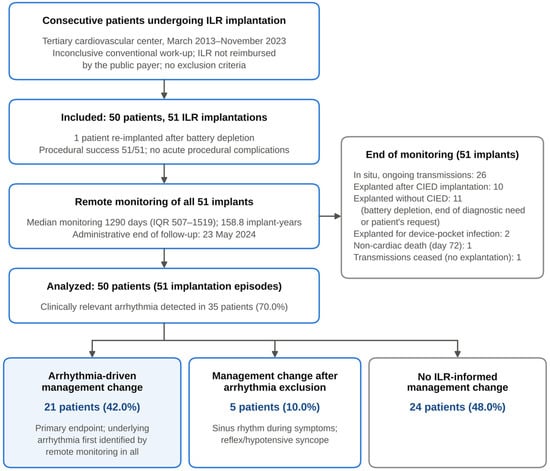
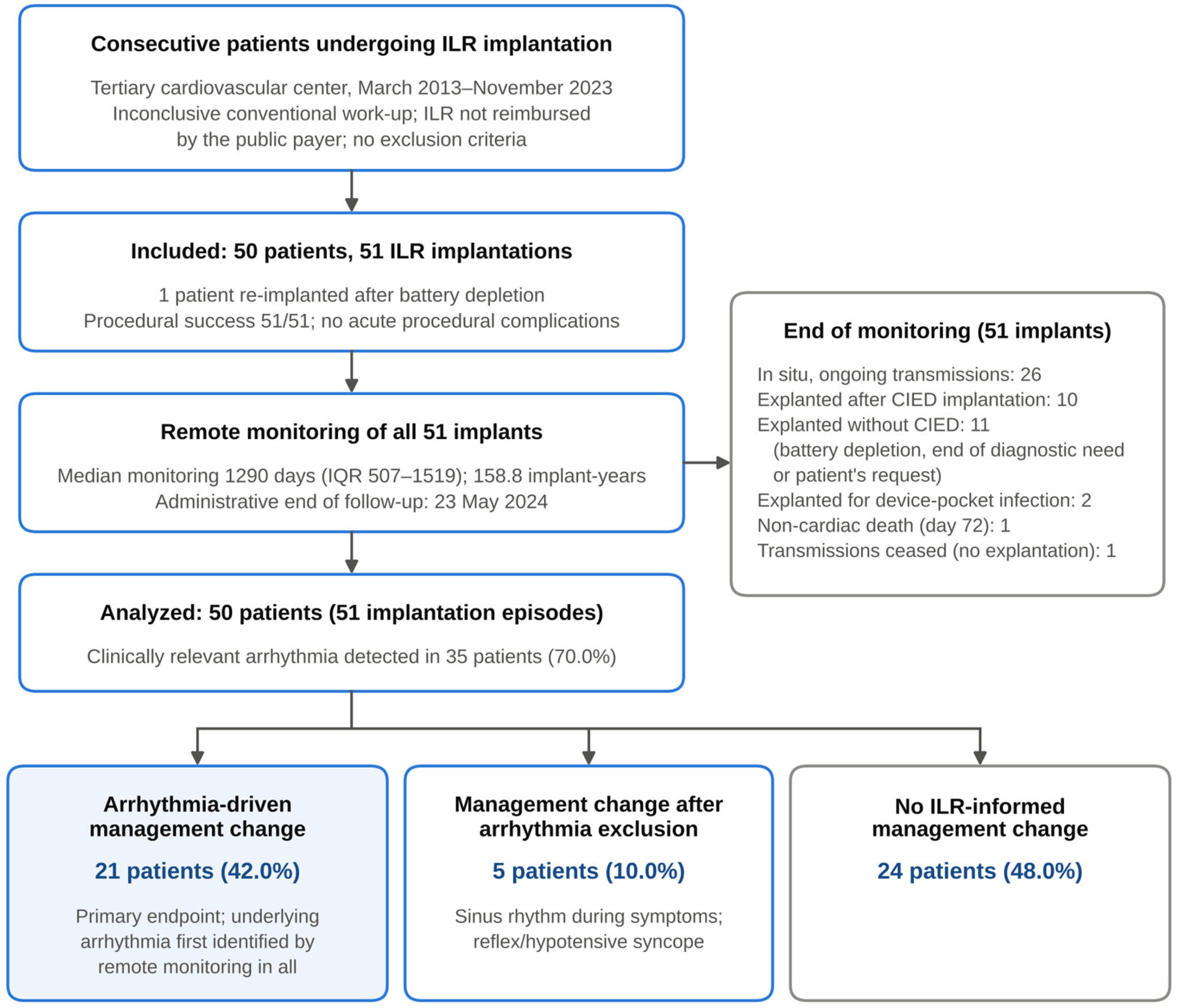
Fifty patients underwent 51 ILR implantations (Figure 1). The median age was 58.1 years (IQR 36.7–70.8), and 26 patients (52.0%) were female. Hypertension (52.0%) and overweight/obesity (50.0%) were the most frequent comorbidities, followed by thyroid disease (32.0%), dyslipidemia (28.0%), coronary artery disease (22.0%), prior stroke or transient ischemic attack (TIA; 20.0%), diabetes mellitus (14.0%), a prior history of AF/atrial flutter (12.0%) and peripheral artery disease (12.0%); smoking was recorded in nine patients (18.0%) and heart failure in two (4.0%). Baseline characteristics are presented in Table 1 and the distribution of device models in Table S2.
Figure 1.
Participant flow. All consecutive patients who underwent implantable loop recorder (ILR) implantation during the study period were included (no exclusion criteria). The side box gives the number of implants reaching each monitoring endpoint; the bottom row classifies the 50 patients by ILR outcome into mutually exclusive categories. CIED, cardiac implantable electronic device; IQR, interquartile range.
Table 1.
Baseline characteristics (n = 50 patients).
3.2. Indications and Pre-Implantation Diagnostic Delay
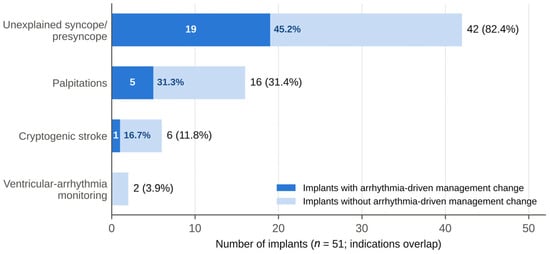
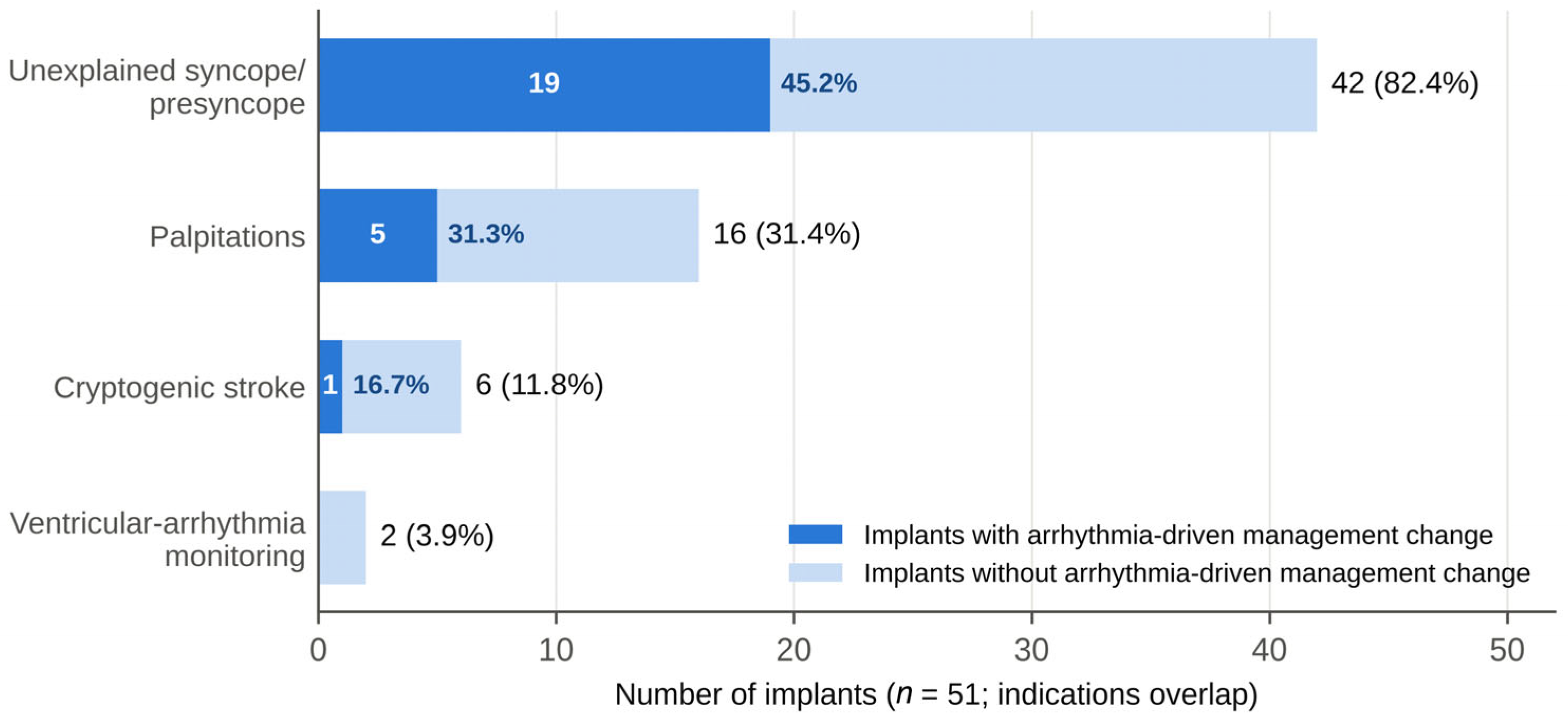
The leading indication was unexplained syncope or presyncope (42 implants; 82.4%), followed by palpitations (16; 31.4%), cryptogenic stroke (6; 11.8%) and ventricular arrhythmia monitoring (2; 3.9%) (Figure 2). Indications overlapped in 14 cases (27.5%). A history of stroke or TIA was present in 10 patients (20.0%), of whom 6 underwent implantation specifically for cryptogenic-stroke work-up; in the remainder, prior stroke/TIA was a comorbidity rather than the indication. The interval from first symptoms to ILR implantation was long and right-skewed (mean 80.9 ± 113.0 months; median 36, IQR 9–102 months; n = 43), documenting a prolonged diagnostic pathway before implantation; the share of this interval attributable to restricted device access, as opposed to the intermittent nature of symptoms and referral pathways, cannot be quantified from these data.
Figure 2.
Indications for implantable loop recorder (ILR) implantation (n = 51 implants; categories overlap). Dark segments (with the percentage of implants in the category) indicate the implants within each indication category with an arrhythmia-driven management change (primary endpoint).
3.3. Procedural Success and Safety
Implantation succeeded in all patients on the first attempt (100%), with no acute procedural complications (0 of 51; upper bound of the 95% confidence interval [CI], 7.0%). Device-pocket infection occurred in 2 of 51 implantations (3.9%, 95% CI 1.1–13.2%), both in BIOMONITOR III devices implanted in October 2020 and February 2022, at 610 and 285 days after implantation, respectively; infection was diagnosed clinically (pocket erythema with erosion and discharge); blood cultures were negative in both patients, and both devices were explanted without further sequelae. No other device-related adverse events were recorded. One patient implanted for syncope died of a non-cardiac cause (renal failure) 72 days after implantation, with no transmissions received after day 2; no other deaths were recorded during follow-up. The number of implants reaching each monitoring endpoint is given in Section 3.4 and Figure 1.
3.4. Monitoring Duration and Detected Arrhythmias
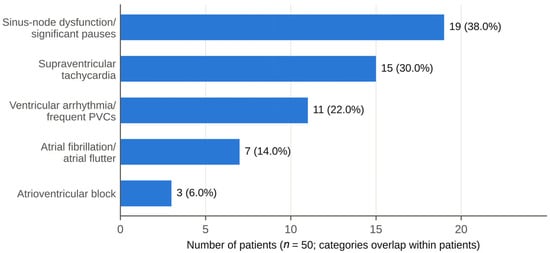
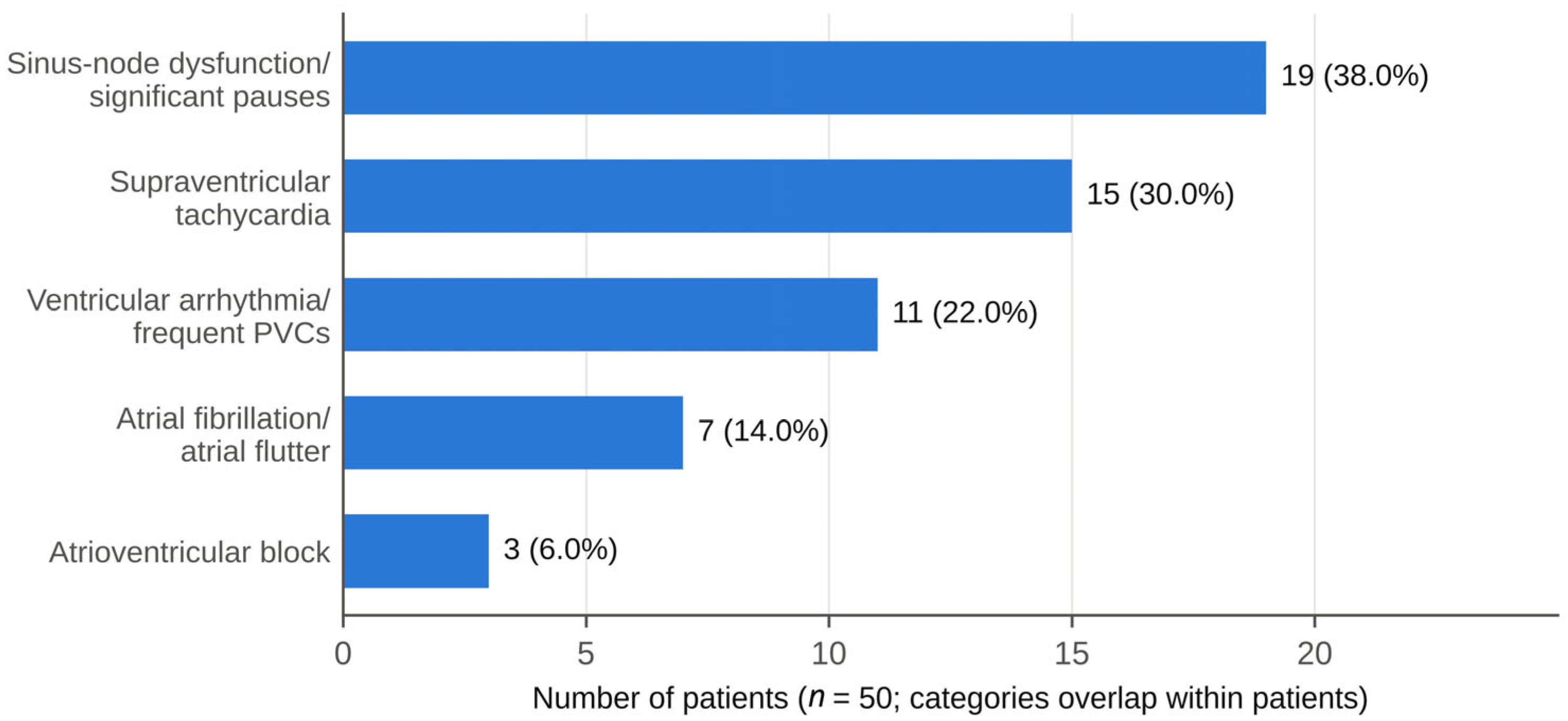
The median monitoring period was 1290 days (IQR 507–1519; mean 1137.0 ± 672.4; n = 51), corresponding to 158.8 implant-years. At the administrative end of follow-up (23 May 2024), 26 devices remained in situ with ongoing transmissions; 10 had been explanted after a diagnostic finding that led to CIED implantation; 11 had been explanted without CIED implantation at or after battery depletion, at the end of diagnostic need or at the patient’s request (n = 1); 2 had been removed for device-pocket infection; 1 patient had died; and in 1 implant (Reveal LINQ, 2015) transmissions ceased after 1400 days, consistent with battery end-of-life, without documented explantation (Table S5). A clinically relevant arrhythmia was detected in 35 patients (70.0%). The most frequent finding categories were sinus-node dysfunction/significant pauses (n = 19), supraventricular tachycardia (n = 15), ventricular arrhythmia/frequent premature ventricular complexes (n = 11), AF/atrial flutter (n = 7) and atrioventricular block (n = 3); categories overlapped within patients (Figure 3). AF or atrial flutter was a newly established diagnosis in five of the seven patients with this finding; the remaining two had a known history of AF/atrial flutter.
Figure 3.
ILR-detected clinically relevant arrhythmias by category (n = 50 patients; categories overlap within patients). ILR, implantable loop recorder; PVCs, premature ventricular complexes.
Remote-monitoring workload could be characterized only for the 34 implants (66.7%) whose platform episode logs were retrievable (implanted 2013–2022: BIOMONITOR III, n = 21; BIOMONITOR 2, n = 7; Reveal LINQ, n = 3; BIOMONITOR IIIm, n = 2; Reveal XT, n = 1; median monitoring 1412 days, IQR 1010–1644). The 17 implants without retrievable logs comprised the most recently implanted BIOMONITOR IIIm devices (n = 9; short follow-up) and 8 earlier implants (Medtronic n = 4, BIOMONITOR 2 n = 2, Abbott n = 2; implanted 2014–2020) whose episode logs could not be retrieved, with a shorter median monitoring period (526 days, IQR 293–1308); the workload estimates therefore describe the mid-period, longer-monitored implants and cannot be extrapolated to the entire cohort. In the 34 logged implants, 23,086 episodes were stored over 121.5 implant-years—190 stored episodes per implant-year overall, with a median of 58 (IQR 13–215) per implant-year across implants—including 1,038 patient-triggered recordings in 21 implants (8.5 per implant-year overall; median 0.7, IQR 0.0–9.0). These counts refer to episodes stored by the device and retrieved from the platform; the number of transmissions or alerts, in which several episodes may be bundled, and the staff time required for review were not recorded, so the counts should not be read as a direct measure of resource use. Episodes automatically classified as AF numbered 3,726 in 16 implants. Episode-level adjudication could be retrieved for 915 of these episodes in nine implants: 908 (99.2%), in eight implants in which AF was never confirmed, were false-positive detections (their causes were not systematically recorded), and 7 episodes in one implant were true AF (leading to OAC initiation). For the remaining 2,811 AF-classified episodes in seven implants (BIOMONITOR 2 and III, 2016–2020, including two implants in which AF was documented), episode-level adjudication was no longer retrievable, so a false-positive rate for the whole cohort cannot be given. Patients attended a median of 1 (IQR 1–2) scheduled in-office visit per year.
3.5. Arrhythmia-Driven Management Changes
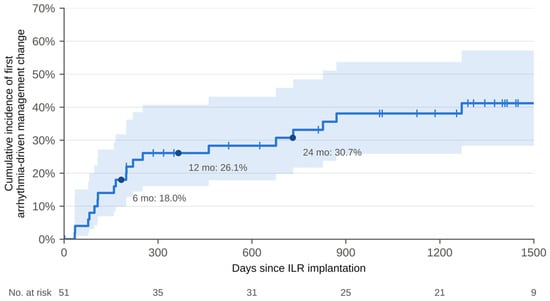
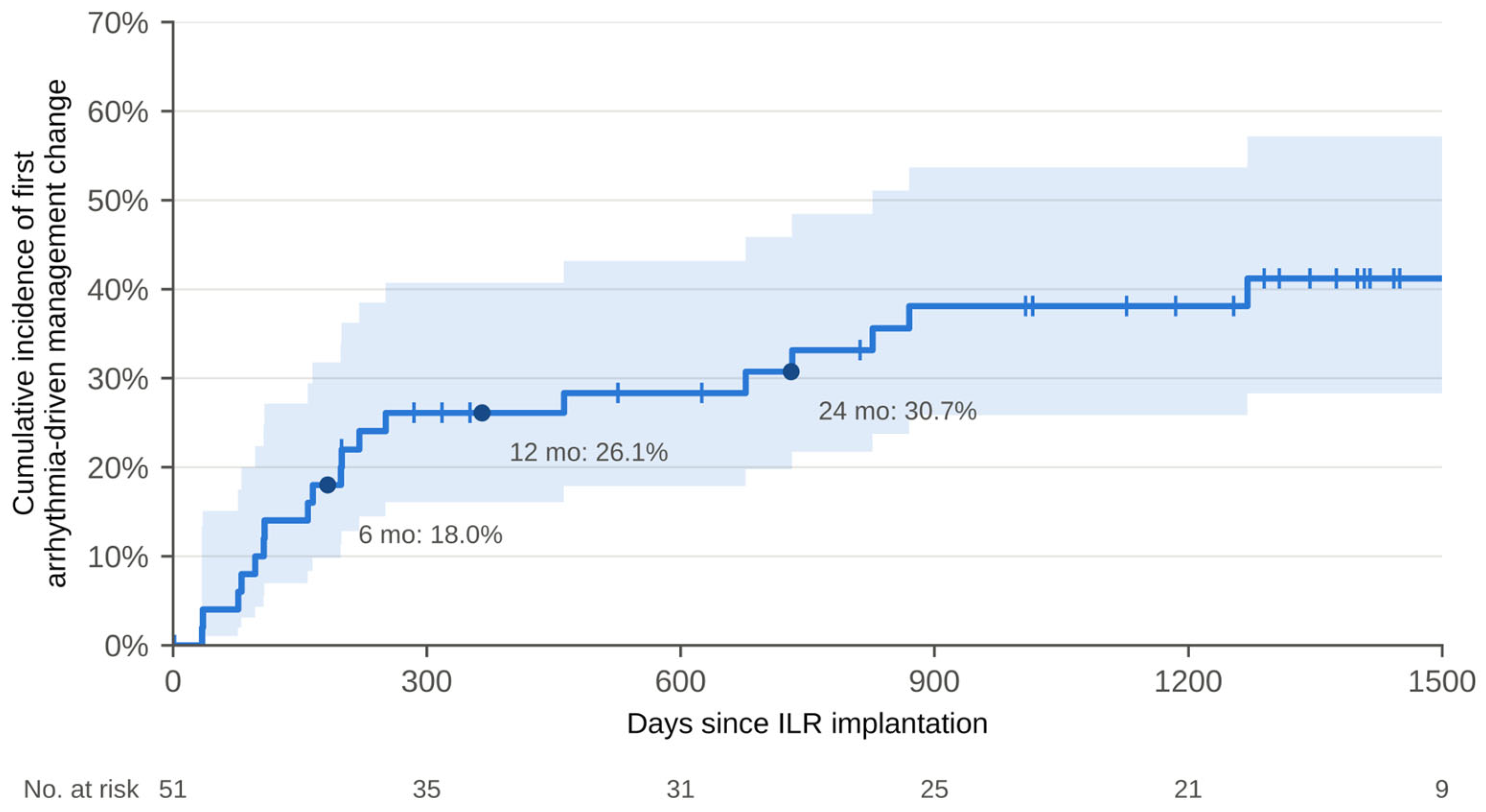
An arrhythmia-driven management change occurred in 21 patients (42.0%, 95% CI 29.4–55.8%), corresponding to 21 of 51 implantation episodes (41.2%, 95% CI 28.8–54.8%). In every case, the underlying arrhythmia was first identified from a remote-monitoring transmission—an automatically detected episode in 19 patients (90.5%) and a patient-triggered transmission in 2 (9.5%); none was first detected during a scheduled in-office interrogation. Among the 21 endpoint episodes, the median time from implantation to the first arrhythmia-driven management change was 199 days (IQR 107–732; n = 21; Figure 4). The Kaplan–Meier cumulative incidence of a first arrhythmia-driven management change was 18.0% (95% CI 9.8–31.7%) at 6 months, 26.1% (95% CI 16.1–40.7%) at 12 months and 30.7% (95% CI 19.8–45.8%) at 24 months; the estimates were essentially unchanged when the analysis was restricted to the first implantation per patient (18.4%, 26.6% and 31.4%) and under the alternative handling of the initially undated episode (Table S4). The arrhythmia-driven management changes comprised the following. A CIED was implanted in 13 patients (26.0%)—12 pacemakers and 1 cardiac resynchronization therapy defibrillator (CRT-D)—at a median of 211 days (IQR 81–870; n = 13) after ILR implantation. Catheter ablation was performed in four patients (8.0%; median 232 days, IQR 215–389; n = 4): focal atrial tachycardia (n = 1), atrial flutter (n = 1), atrioventricular nodal re-entrant tachycardia (n = 1), and paroxysmal AF ablation combined with pacemaker implantation in one patient with sinus-node dysfunction. Pharmacotherapy was modified in response to the documented arrhythmia in eight patients (16.0%; median 438 days, IQR 151–964; n = 8): antiarrhythmic or rate-control modification in six and OAC initiation for ILR-detected AF or atrial flutter in two (Table S3); a concurrent antihypertensive adjustment in one patient with sinus-node dysfunction who also received a pacemaker is not counted as an endpoint component.
Figure 4.
Cumulative incidence (1 − Kaplan–Meier estimate) of the first arrhythmia-driven management change over time since ILR implantation (51 implantation episodes, 21 events; shaded area: 95% confidence interval [CI] from the complementary log–log transformation; vertical ticks: censoring; and numbers at risk shown below the plot). Cumulative incidence was 18.0% (95% CI 9.8–31.7%) at 6 months, 26.1% (16.1–40.7%) at 12 months and 30.7% (19.8–45.8%) at 24 months. The time axis is truncated at 1500 days, when nine episodes remained at risk; the two later events (days 1665 and 1818) are not displayed. Sensitivity analyses (first implantation per patient; alternative handling of the initially undated event) are given in Table S4. ILR, implantable loop recorder; mo, months.
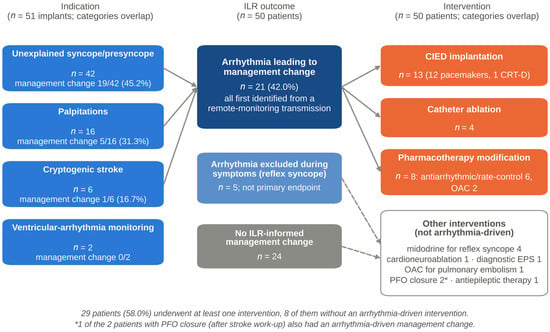
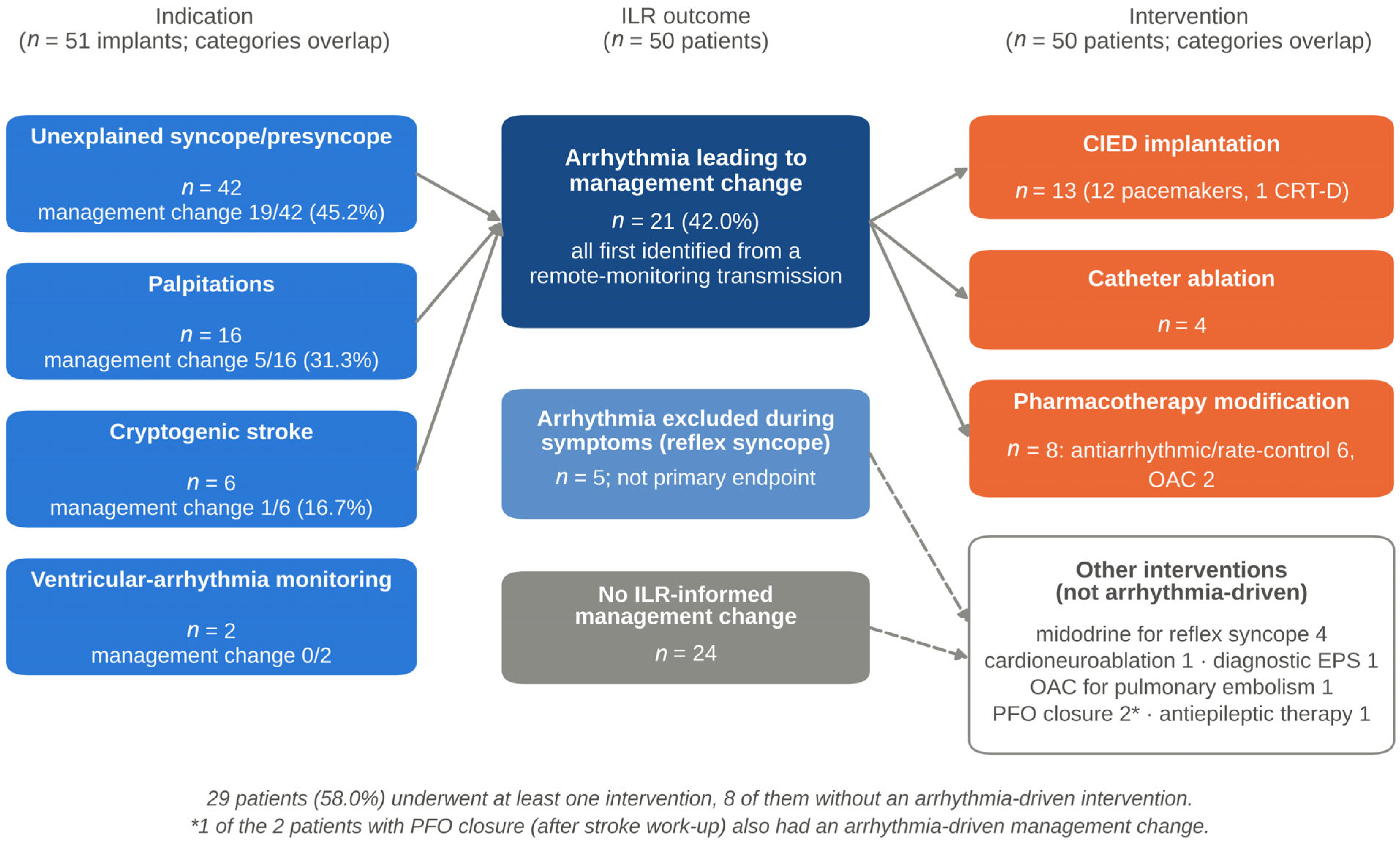
Two further groups of interventions occurred during follow-up but did not meet the primary endpoint (Table 2; Figure 5). First, in five patients investigated for syncope or presyncope, ILR recordings excluded an arrhythmic cause of symptomatic episodes (sinus rhythm or sinus tachycardia during symptoms); this negative symptom–rhythm correlation informed treatment of reflex/hypotensive syncope with midodrine, typically with concurrent reduction of beta-blocker or antihypertensive dosing, in four patients, in line with the 2018 ESC syncope guidelines [1], and cardioneuroablation in the re-implanted patient, in whom both devices documented sinus rhythm or sinus tachycardia during syncope. In one midodrine-treated patient, an isolated sinus arrest and a tachycardia–bradycardia episode were also recorded but were not considered treatment-determining. These five management changes after arrhythmia exclusion are counted in the broad definition (any ILR-informed management change), which was met by 26 patients (52.0%, 95% CI 38.5–65.2%), but not in the primary endpoint. Second, interventions unrelated to an ILR arrhythmic diagnosis occurred in three further patients (and in one patient who also met the primary endpoint): in one patient implanted after cryptogenic stroke, a device-registered wide-QRS tachycardia prompted an electrophysiological study and cardiac magnetic resonance, both of which were non-diagnostic and led to no therapeutic change (counted as an electrophysiological procedure but not as an arrhythmia-driven management change under the rule in Section 2.4), and OAC was later initiated for pulmonary embolism; patent foramen ovale closure was performed in two patients after stroke work-up (one of whom also had an arrhythmia-driven management change); and in one patient the final diagnosis was epilepsy, leading to antiepileptic treatment. In total, 29 patients (58.0%) underwent at least one intervention of any kind during follow-up—CIED implantation 13, any electrophysiological procedure 6 (12.0%), any pharmacotherapy modification 14 (28.0%; antiarrhythmic/rate-control 6, OAC 3, antihypertensive adjustment 5, midodrine 4, and antiepileptic 1; categories overlap) and patent foramen ovale closure 2—of whom 8 had no arrhythmia-driven intervention. The restrictive sensitivity definition (CIED implantation, catheter ablation or OAC initiation only) was met by 18 patients (36.0%, 95% CI 24.1–49.9%). Findings and interventions are summarized in Table 2, the pathway from indication to intervention in Figure 5, and the adjudication of every implantation episode in Table S3.
Table 2.
Monitoring, ILR findings, arrhythmia-driven management changes and all interventions (overall cohort; n = 50 patients).
Figure 5.
Diagnostic-to-therapeutic pathway from indication through ILR outcome to intervention (schematic). Indication counts are per implant (n = 51; categories overlap) and show the number of implants with an arrhythmia-driven management change within each category; the ventricular-arrhythmia-monitoring box has no outgoing arrow because neither of its two implants led to such a change. ILR-outcome and intervention counts are per patient (n = 50). Solid arrows link the 21 patients with an arrhythmia-driven management change to its components (categories overlap within patients); dashed arrows lead to interventions that arose from other indications or followed an ILR recording that excluded arrhythmia. Patent foramen ovale closure after stroke work-up was performed in two patients, one of whom also had an arrhythmia-driven management change (asterisk). CIED, cardiac implantable electronic device; CRT-D, cardiac resynchronization therapy defibrillator; EPS, electrophysiological study; ILR, implantable loop recorder; OAC, oral anticoagulation; and PFO, patent foramen ovale.
3.6. Arrhythmia-Driven Management Changes by Indication
The primary endpoint was met most often in the syncope subgroup, in which 19 of 42 implants (45.2%) led to an arrhythmia-driven management change, followed by palpitations (5/16; 31.3%) and cryptogenic stroke (1/6; 16.7%); no endpoint event was recorded in the 2 ventricular-arrhythmia-monitoring implants (Table 3). Because indications overlapped, subgroup counts sum to more than the 21 implantation episodes with the primary endpoint. Notably, no ILR-detected AF was observed among the six cryptogenic-stroke implants during available follow-up; the single arrhythmia-driven management change in this subgroup was antiarrhythmic modification for ventricular arrhythmia, and the single OAC initiation was prompted by pulmonary embolism, independently of the ILR. Given the very small subgroup, this observation should not be interpreted as evidence against AF detection after cryptogenic stroke. Given the small and overlapping subgroups, no formal between-group comparisons were performed, and subgroup estimates carry wide confidence intervals (Table 3).
Table 3.
Arrhythmia-driven management changes and interventions by indication (indications overlap).
3.7. Sensitivity Analyses
The sensitivity analyses are summarized in Table S4. Restricting the analysis to the first implantation per patient (n = 50) gave the same proportion (21 of 50, 42.0%) because neither episode of the re-implanted patient met the primary endpoint, and the Kaplan–Meier estimates were left essentially unchanged (26.6% at 12 and 31.4% at 24 months). Treating the initially undated endpoint episode as censored, as an event at the end of its monitoring period, or as interval-censored gave 12-month estimates of 26.1%, 26.1% and 27.1%, respectively. Under the restrictive definition (CIED, ablation or OAC only), the proportion was 18/50 (36.0%; Kaplan–Meier 20.1% at 12 months); under the broad definition it was 26/50 (52.0%; 28.2% at 12 months, 48.1% at 36 months). The primary endpoint was met in 15/30 (50.0%, 95% CI 33.2–66.8%) in implants with syncope/presyncope as the sole indication, 20/45 (44.4%) after exclusion of cryptogenic-stroke implants, and 17/37 (45.9%) in implants with a single indication.
4. Discussion
In this real-world, single-center cohort of selected patients monitored under restricted reimbursement, remotely followed ILR surveillance was associated with no acute procedural complications and detected a clinically relevant arrhythmia in 70.0% of patients. An arrhythmia-driven management change occurred in more than two in five patients (42.0%, 95% CI 29.4–55.8%): CIED implantation in 26.0%; catheter ablation in 8.0%; and pharmacotherapy modification, including anticoagulation initiation, in 16.0%. When ILR recordings that excluded an arrhythmic mechanism and thereby guided treatment of reflex syncope are included, ILR monitoring informed a management change in 52.0% of patients. The confidence intervals around these proportions are wide—roughly ±13 percentage points for the primary endpoint—and all estimates should be read with this imprecision in mind.
The proportion of patients with an arrhythmia-driven management change (42.0%, 95% CI 29.4–55.8%) is of the same order as the pooled diagnostic yield of 43.9% (95% CI 40.2–47.6%) from a meta-analysis of ILR use in unexplained syncope [15] and as the yields reported in large real-world insertable-cardiac-monitor cohorts and registries [12,13,14]; at the matched observation time, our 12-month Kaplan–Meier estimate (26.1%) is comparable with the diagnostic yield of the PICTURE registry (170 of 570 patients, approximately 30%, over a mean follow-up of 10 ± 6 months) [8]—a conservative comparison, because our events are dated at the management change rather than at detection. Such comparisons are indicative only: the meta-analysis and registries used diagnostic endpoints (symptom–rhythm correlation or any diagnostic arrhythmia) rather than our management-change endpoint, their follow-up was shorter, and their populations were defined by indication rather than by access conditions. A plausible explanation for a high yield under restricted access is that the absence of reimbursement acted as a de facto selection filter, concentrating ILR use in patients with a high pre-test probability of an arrhythmic diagnosis after inconclusive conventional work-up; our data are consistent with this hypothesis but cannot confirm it because the cohort contains only patients who received an ILR and no comparison group under different access conditions. The very long symptom-to-implantation interval (median 3 years) documents a prolonged diagnostic pathway, but it does not establish how much of the delay was caused by reimbursement restrictions: the intermittent and non-specific nature of the presenting symptoms, referral pathways, limited outpatient-clinic availability and repeated non-invasive testing before referral are likely contributors whose share cannot be quantified from these data.
Arrhythmia-driven management changes were most frequent in the syncope subgroup, in which almost half of the implantations led to one (19/42; 45.2%)—that is, ILR performed best in its guideline-anchored core indication. The high proportion of sinus-node dysfunction and significant pauses, together with the resulting pacemaker implantations, mirrors the mechanism most commonly identified in older syncope populations and underlines the therapeutic leverage of a definitive rhythm diagnosis. A further, distinct contribution of the ILR was the exclusion of an arrhythmic mechanism during symptomatic episodes in five patients, which guided treatment of reflex/hypotensive syncope with midodrine and concurrent beta-blocker or antihypertensive dose reduction in four, in line with the 2018 ESC syncope guidelines [1], and cardioneuroablation in one; we have deliberately kept this negative symptom–rhythm correlation outside the primary endpoint and reported it separately, so that the arrhythmic yield is not inflated, while acknowledging that an ILR-based work-up can lead to deprescribing as well as to treatment escalation. In the cryptogenic-stroke subgroup, by contrast, none of the six implants detected AF; this observation reflects the syncope-dominated referral pattern of our center and permits no inference about ILR-based AF detection after ischemic stroke, including cryptogenic stroke, which is well established in randomized and prospective studies [7,16,17,18] and reflected in current AF guidance [3].
A descriptive feature of this cohort is that every arrhythmia underlying a management change entered clinical decision-making as a transmitted alert, although scheduled in-office visits (median 1 per patient-year) continued in parallel and were reviewed as a potential source of first detection. Because all patients were remotely monitored, the study has no non-remote comparator: it cannot quantify any reduction in diagnostic delay attributable to remote monitoring or separate the contribution of remote surveillance from that of the implanted device. Next-working-day review is a property of the workflow, not a measured interval, because the dates of detection, transmission and review were not recorded; the expected reduction in episodes lost to memory overwriting between visits was not measured either. Moreover, 19 of the 21 underlying arrhythmias were detected automatically, which indicates that the patient did not activate the device, not that the episode was asymptomatic. Randomized trials of an early ILR strategy in unexplained syncope, remotely monitored in EaSyAS II, reported faster [19] and more frequent [20] diagnosis than conventional investigation, but they did not isolate the effect of remote monitoring either. We therefore regard the yield reported here as that of a combined strategy—device implantation plus structured remote follow-up—which access or reimbursement models funding implantation alone may not reproduce.
With respect to safety, there were no acute procedural complications (0 of 51; upper bound of the 95% CI, 7.0%), and device-pocket infection led to premature explantation in 2 of 51 implantations (3.9%, 95% CI 1.1–13.2%) at 285 and 610 days. This point estimate is numerically higher than the rates reported in several contemporary insertable-cardiac-monitor series [12,14], although the wide confidence interval precludes a formal comparison. Both infections occurred in injectable, current-generation devices (BIOMONITOR III) implanted in 2020 and 2022, so they cannot be attributed to older device designs; with only two events, no contributing factor can be identified, and the late onset of one (day 610) is consistent with a late-onset pocket infection rather than a periprocedural complication. One non-cardiac death occurred 72 days after implantation; because deaths outside the center could be identified only if they were reported to it, mortality may be under-ascertained.
The use of six device models from three manufacturers over a decade is a further source of heterogeneity. The models differ in detection algorithms and in their sensitivity and specificity for the arrhythmias of interest: AF detection relies on R-R irregularity with manufacturer-specific minimum episode durations and, in later generations, additional P-wave or morphology criteria that reduce false positives; bradycardia and pause detection is comparatively uniform, whereas tachycardia detection depends on the programmed zone and, as discussed in Section 2.4, was less sensitive in younger patients; and earlier devices lacked automatic daily transmission of some episode types, which affects both the completeness of stored episodes and the timeliness of alerts. The high proportion of false-positive AF detections among the adjudicable episodes (908 of 915, all in implants in which AF was never confirmed and almost all in BIOMONITOR III/IIIm devices) illustrates the limited specificity of automatic AF detection and the review burden it generates, although only about one quarter of the AF-classified episodes (915 of 3,726) could be adjudicated, so a cohort-wide false-positive rate cannot be given. Our post hoc harmonization of episode classification addresses only the adjudication stage; it cannot recover episodes that a given device never detected or stored. Given the sample size, we did not compare device generations or implantation periods beyond description, and the pooled yield should be understood as an average across platforms whose individual performance may differ.
From a health-system perspective, our data describe what a remotely monitored ILR strategy achieved in a selected population under restricted access; they do not, by themselves, demonstrate that broader reimbursement would be beneficial or cost-effective. We did not perform an economic evaluation or a comparative cost-effectiveness analysis, had no comparison group, and could not measure the clinical cost of diagnostic delay; the health-policy implications are therefore supportive rather than confirmatory. What can be said is that the observed concentration of management-changing findings in patients who reached implantation only after years of inconclusive evaluation is consistent with, but does not prove, the hypothesis that access barriers delay definitive diagnosis and treatment, and that it provides a rationale for prospective evaluation. The Polish health-technology assessment reviewed 15 clinical practice guidelines and estimated the eligible population at roughly 1591–3722 patients per year for cryptogenic stroke and several hundred per year for recurrent syncope [10]; the subsequent Ministry of Health regulation (effective 16 December 2023) defined explicit qualifying criteria: cryptogenic stroke after other diagnostic options have been exhausted, or recurrent syncope of undetermined cause after tilt-table testing; 48-h Holter ECG; exercise ECG testing; echocardiography; and, in patients younger than 75 years, electrophysiological study [11]. Part of our syncope cohort would not have met these criteria, because exercise testing was not part of our routine work-up, and tilt-table testing and electrophysiological study were performed only where clinically indicated (Section 2.2); the regulation thus requires a more extensive work-up than the clinical selection applied here. Whether reimbursed access under these criteria preserves the yield observed here while shortening diagnostic delay, and at what cost, are questions for prospective, multicenter studies with contemporaneous cost data.
4.1. Strengths
Strengths include the real-world, consecutive design; a long remote-monitoring follow-up (median > 3.5 years); an explicit, uniformly applied adjudication rule with episode-level reporting (Table S3) and multiple sensitivity analyses; verification of the source of first detection against both remote-monitoring logs and in-office documentation; and the explicit health-system framing that is relevant to systems with restricted ILR reimbursement.
4.2. Limitations
This study has several limitations:
- Retrospective, single-center design with a small sample size (50 patients, 51 implants). The primary-endpoint proportion carries a 95% confidence interval of 29.4–55.8%, subgroup estimates have intervals spanning 29–53 percentage points, and the Kaplan–Meier curve is based on 21 events, so the precision of all estimates is low; the sample precludes multivariable predictor modeling and any formal comparison between subgroups, device generations or implantation periods.
- Endpoint adjudication was performed by a single experienced cardiologist without independent duplicate review; inter-rater reproducibility was not assessed.
- The long inclusion window (2013–2023) spans six device models with different detection algorithms, programmed settings and transmission capabilities; post hoc harmonization of episode classification cannot correct for episodes that were never detected or stored, and automatic tachycardia detection was less sensitive in younger patients because of the age-dependent detection zone.
- The cohort consists only of patients who received an ILR under restricted access, without a comparison group under different access conditions or a registry of patients considered but not implanted; the proposed selection effect of restricted reimbursement on diagnostic yield, and the contribution of reimbursement restrictions to the symptom-to-implantation interval, are therefore hypotheses rather than demonstrated effects, and the yield observed in this selected population cannot be generalized to broader populations or to a reimbursed setting.
- Indications overlapped and were heterogeneous, so subgroup percentages should be interpreted with caution.
- Detailed data on prior diagnostic work-up were incomplete for patients admitted before the introduction of electronic health records, remote-monitoring episode logs were retrievable for only 34 of 51 implants, one event date had to be retrieved retrospectively, and referral bias is likely. Deaths and adverse events occurring outside the center were identified only when reported to it and may be under-reported.
- All patients were remotely monitored, so there is no non-remote comparator; the dates of episode detection, transmission and review were not systematically recorded, so time-to-event analyses are dated at the management change and overstate the time to detection; and the contribution of remote monitoring cannot be separated from that of the implanted device. The absence of a control group and of a formal economic analysis means the health-policy implications are supportive rather than confirmatory.
- The unit of analysis differs between summaries (patients for frequencies, implantation episodes for durations and time-to-event analyses); although the two coincide for the primary endpoint, one patient contributed two monitoring periods, and the first-implantation-only sensitivity analysis is provided for this reason.
- Sex-disaggregated analyses of diagnostic yield were not performed because the sample size would not support meaningful comparison; sex is reported descriptively as a biological attribute.
4.3. Future Directions
Prospective, multicenter studies with standardized indication definitions, a comparison group reflecting different access conditions, recorded alert-to-action intervals, and contemporaneous cost data are needed to confirm real-world diagnostic yield, to quantify the clinical cost of diagnostic delay under restricted access and to evaluate the economic impact of earlier, reimbursed ILR implantation; such studies, rather than single-arm series like ours, are the appropriate basis for reimbursement decisions.
5. Conclusions
In this selected, real-world tertiary-center cohort followed under restricted reimbursement, ILR monitoring delivered as a combined strategy of device implantation and structured remote follow-up had an acceptable safety profile and detected a clinically relevant arrhythmia in 70.0% of patients. It led to an arrhythmia-driven management change—pacemaker or CRT-D implantation, catheter ablation, anticoagulation or pharmacotherapy modification—in 42.0% of patients, and every underlying arrhythmia was first identified from a remote-monitoring transmission. Because the cohort was selected and had no comparison group, the respective contributions of the device, of remote monitoring and of the access conditions cannot be disentangled, and the high yield should not be extrapolated to less selected populations. These findings provide a rationale for broader access to ILR monitoring—encompassing both implantation and structured remote follow-up—for carefully selected patients after inconclusive conventional evaluation; prospective, multicenter studies incorporating cost-effectiveness analyses are needed before they can inform reimbursement policy.
Supplementary Materials
The following supporting information can be downloaded at https://www.mdpi.com/article/10.3390/healthcare14223968/s1. Table S1: STROBE Statement—checklist of items for reports of cohort studies; Table S2: Device models, implantation periods and detection settings; Table S3: Adjudication of every implantation episode: ILR finding, endpoint qualification, intervention and attribution; Table S4: Sensitivity analyses of the primary endpoint; and Table S5: Monitoring endpoints and remote-monitoring workload by device model.
Author Contributions
Conceptualization, J.K.R., A.C. and M.G.; methodology, J.K.R. and A.C.; formal analysis, J.K.R.; investigation, J.K.R., M.B., M.M. and P.P.; data curation, J.K.R., M.B. and P.P.; writing—original draft preparation, J.K.R.; writing—review and editing, M.B., M.M., P.P., A.C., P.W. and M.G.; visualization, J.K.R.; and supervision, M.G. All authors have read and agreed to the published version of the manuscript.
Funding
This research received no external funding.
Institutional Review Board Statement
The study was conducted in accordance with the Declaration of Helsinki. Ethical review and approval were waived for this study: the Bioethics Committee of the Medical University of Warsaw (Komisja Bioetyczna przy Warszawskim Uniwersytecie Medycznym) confirmed in its statement no. AKBE/313/2026 of 7 September 2026 that this retrospective, non-interventional analysis of routinely collected clinical data does not constitute a medical experiment within the meaning of Article 21(1) of the Polish Act of 5 December 1996 on the Professions of Physician and Dentist (consolidated text: Journal of Laws of 2026, item 37) and therefore does not require the Committee’s opinion under Article 29(1) of that Act.
Informed Consent Statement
All patients provided written informed consent for the implantation procedure and remote monitoring as part of routine clinical care. Study-specific informed consent was not required under Polish legislation (Act of 5 December 1996 on the Professions of Physician and Dentist, Articles 21 and 29) for this retrospective, non-interventional analysis of pseudonymized, routinely collected data, as confirmed by the Bioethics Committee of the Medical University of Warsaw (statement no. AKBE/313/2026). No identifiable patient information is reported.
Data Availability Statement
The data presented in this study are available on reasonable request from the corresponding author. The data are not publicly available due to patient privacy regulations.
Acknowledgments
During the preparation of this manuscript, the authors used Claude Opus 5.5 (Anthropic, San Francisco, CA, USA) for the purposes of statistical cross-checking, language editing and formatting. The authors have reviewed and edited the output and take full responsibility for the content of this publication.
Conflicts of Interest
J.K.R. reports speaker honoraria and consulting fees from Abbott, Biotronik, Boston Scientific, Medtronic and Zoll. M.M. reports speaker honoraria, educational grants and consulting fees from Abbott, Biotronik, Medtronic and Boston Scientific. A.C. reports speaker honoraria from Medtronic. M.G. reports speaker honoraria from Abbott, Biotronik, and Medtronic. M.B., P.P. and P.W. declare no conflicts of interest. None of these relationships played any role in the design of the study; in the collection, analyses or interpretation of data; in the writing of the manuscript; or in the decision to publish the results.
Abbreviations
The following abbreviations are used in this manuscript:
| AF | atrial fibrillation |
| AFL | atrial flutter |
| AOTMiT | Agency for Health Technology Assessment and Tariff System |
| BMI | body mass index |
| bpm | beats per minute |
| CI | confidence interval |
| CIED | cardiac implantable electronic device |
| CRT-D | cardiac resynchronization therapy defibrillator |
| ECG | electrocardiogram/electrocardiographic |
| EPS | electrophysiological study |
| ESC | European Society of Cardiology |
| ICM | insertable cardiac monitor |
| ILR | implantable loop recorder |
| IQR | interquartile range |
| OAC | oral anticoagulation |
| PFO | patent foramen ovale |
| PVC | premature ventricular complex |
| SD | standard deviation |
| STROBE | Strengthening the Reporting of Observational Studies in Epidemiology |
| TIA | transient ischemic attack |
References
- Brignole, M.; Moya, A.; de Lange, F.J.; Deharo, J.-C.; Elliott, P.M.; Fanciulli, A.; Fedorowski, A.; Furlan, R.; Kenny, R.A.; Martín, A.; et al. 2018 ESC Guidelines for the diagnosis and management of syncope. Eur. Heart J. 2018, 39, 1883–1948. [Google Scholar] [CrossRef] [Scilit] [PubMed]
- Shen, W.-K.; Sheldon, R.S.; Benditt, D.G.; Cohen, M.I.; Forman, D.E.; Goldberger, Z.D.; Grubb, B.P.; Hamdan, M.H.; Krahn, A.D.; Link, M.S.; et al. 2017 ACC/AHA/HRS Guideline for the Evaluation and Management of Patients with Syncope: A Report of the American College of Cardiology/American Heart Association Task Force on Clinical Practice Guidelines and the Heart Rhythm Society. J. Am. Coll. Cardiol. 2017, 70, e39–e110. [Google Scholar] [CrossRef] [Scilit] [PubMed]
- Van Gelder, I.C.; Rienstra, M.; Bunting, K.V.; Casado-Arroyo, R.; Caso, V.; Crijns, H.J.G.M.; De Potter, T.J.R.; Dwight, J.; Guasti, L.; Hanke, T.; et al. 2024 ESC Guidelines for the management of atrial fibrillation developed in collaboration with the European Association for Cardio-Thoracic Surgery (EACTS). Eur. Heart J. 2024, 45, 3314–3414. [Google Scholar] [CrossRef] [Scilit] [PubMed]
- Rubiera, M.; Aires, A.; Antonenko, K.; Lémeret, S.; Nolte, C.H.; Putaala, J.; Schnabel, R.B.; Tuladhar, A.M.; Werring, D.J.; Zeraatkar, D.; et al. European Stroke Organisation (ESO) guideline on screening for subclinical atrial fibrillation after stroke or transient ischaemic attack of undetermined origin. Eur. Stroke J. 2022, 7, CVII–CXXXIX. [Google Scholar] [CrossRef] [Scilit] [PubMed]
- Zeppenfeld, K.; Tfelt-Hansen, J.; de Riva, M.; Winkel, B.G.; Behr, E.R.; Blom, N.A.; Charron, P.; Corrado, D.; Dagres, N.; de Chillou, C.; et al. 2022 ESC Guidelines for the management of patients with ventricular arrhythmias and the prevention of sudden cardiac death. Eur. Heart J. 2022, 43, 3997–4126. [Google Scholar] [CrossRef] [Scilit] [PubMed]
- Brugada, J.; Katritsis, D.G.; Arbelo, E.; Arribas, F.; Bax, J.J.; Blomström-Lundqvist, C.; Calkins, H.; Corrado, D.; Deftereos, S.G.; Diller, G.-P.; et al. 2019 ESC Guidelines for the management of patients with supraventricular tachycardia. Eur. Heart J. 2020, 41, 655–720. [Google Scholar] [CrossRef] [Scilit] [PubMed]
- Sanna, T.; Diener, H.-C.; Passman, R.S.; Di Lazzaro, V.; Bernstein, R.A.; Morillo, C.A.; Rymer, M.M.; Thijs, V.; Rogers, T.; Beckers, F.; et al. Cryptogenic stroke and underlying atrial fibrillation. N. Engl. J. Med. 2014, 370, 2478–2486. [Google Scholar] [CrossRef] [Scilit] [PubMed]
- Edvardsson, N.; Frykman, V.; van Mechelen, R.; Mitro, P.; Mohii-Oskarsson, A.; Pasquie, J.-L.; Ramanna, H.; Schwertfeger, F.; Ventura, R.; Voulgaraki, D.; et al. Use of an implantable loop recorder to increase the diagnostic yield in unexplained syncope: Results from the PICTURE registry. Europace 2011, 13, 262–269. [Google Scholar] [CrossRef] [Scilit] [PubMed]
- Edwards, S.J.; Wakefield, V.; Jhita, T.; Kew, K.; Cain, P.; Marceniuk, G. Implantable cardiac monitors to detect atrial fibrillation after cryptogenic stroke: A systematic review and economic evaluation. Health Technol. Assess. 2020, 24, 1–184. [Google Scholar] [CrossRef] [Scilit] [PubMed]
- Agencja Oceny Technologii Medycznych i Taryfikacji (AOTMiT). Monitoring of Arrhythmic Events with Implantable Loop Recorders (ILR) in Patients After Cryptogenic Stroke and with Recurrent Syncope of Undetermined Cause Despite Extended Work-Up; Analytical Report No. WS.420.2.2021; AOTMiT: Warsaw, Poland, 2021; (In Polish). Available online: https://bip.aotm.gov.pl/assets/files/zlecenia_mz/2021/028/RPT/2021.03.24_WS.420.2.2021_ILR_udary_omdlenia_RAPORT_BIP_REOPTR.pdf (accessed on 12 August 2026).
- Minister of Health of the Republic of Poland. Regulation of the Minister of Health of 29 November 2023 Amending the Regulation on Guaranteed Services in Hospital Treatment; Dz.U. 2023, poz. 2610; Minister of Health of the Republic of Poland: Warsaw, Poland, 2023; (In Polish). Available online: https://isap.sejm.gov.pl/isap.nsf/DocDetails.xsp?id=WDU20230002610 (accessed on 12 August 2026).
- Quartieri, F.; Manyam, H.; Calò, L.; Ebrahim, I.; Fusco, A.; Mester, S.; Cauti, F.; Park, S.-J.; Francia, P.; Giovagnoni, M.; et al. New insertable cardiac monitors show high diagnostic yield and good safety profile in real-world clinical practice: Results from the international prospective observational SMART Registry. Europace 2023, 25, euad068. [Google Scholar] [CrossRef] [Scilit] [PubMed]
- Li, Y.; Nantsupawat, T.; Olson, M.; Tholakanahalli, V.; Adabag, S.; Wang, Z.; Benditt, D.G.; Li, J.-M. A single center experience on the clinical utility evaluation of an insertable cardiac monitor. J. Electrocardiol. 2018, 51, 583–587. [Google Scholar] [CrossRef] [Scilit] [PubMed]
- Saha, S.A.; Rosemas, S.; Sarkar, S.; Ramos, V.; Radtke, A.P.; Majumder, S.; De Melis, M.; Zhou, J.; Sims, J.J. A Large, Real-World Cohort Analysis of Arrhythmia Detection and Therapeutic Interventions in Patients with Insertable Cardiac Monitors and Long-Term Monitoring. J. Cardiovasc. Electrophysiol. 2026, 37, 359–373. [Google Scholar] [CrossRef] [Scilit] [PubMed]
- Solbiati, M.; Casazza, G.; Dipaola, F.; Barbic, F.; Caldato, M.; Montano, N.; Furlan, R.; Sheldon, R.S.; Costantino, G. The diagnostic yield of implantable loop recorders in unexplained syncope: A systematic review and meta-analysis. Int. J. Cardiol. 2017, 231, 170–176. [Google Scholar] [CrossRef] [Scilit] [PubMed]
- Buck, B.H.; Hill, M.D.; Quinn, F.R.; Butcher, K.S.; Menon, B.K.; Gulamhusein, S.; Siddiqui, M.; Coutts, S.B.; Jeerakathil, T.; Smith, E.E.; et al. Effect of Implantable vs Prolonged External Electrocardiographic Monitoring on Atrial Fibrillation Detection in Patients with Ischemic Stroke: The PER DIEM Randomized Clinical Trial. JAMA 2021, 325, 2160–2168. [Google Scholar] [CrossRef] [Scilit] [PubMed]
- Bernstein, R.A.; Kamel, H.; Granger, C.B.; Piccini, J.P.; Sethi, P.P.; Katz, J.M.; Vives, C.A.; Ziegler, P.D.; Franco, N.C.; Schwamm, L.H.; et al. Effect of Long-term Continuous Cardiac Monitoring vs Usual Care on Detection of Atrial Fibrillation in Patients with Stroke Attributed to Large- or Small-Vessel Disease: The STROKE-AF Randomized Clinical Trial. JAMA 2021, 325, 2169–2177. [Google Scholar] [CrossRef] [Scilit] [PubMed]
- Bettin, M.; Dechering, D.; Kochhäuser, S.; Bode, N.; Eckardt, L.; Frommeyer, G.; Reinke, F. Extended ECG monitoring with an implantable loop recorder in patients with cryptogenic stroke: Time schedule, reasons for explantation and incidental findings (results from the TRACK-AF trial). Clin. Res. Cardiol. 2019, 108, 309–314. [Google Scholar] [CrossRef] [Scilit] [PubMed]
- Sulke, N.; Sugihara, C.; Hong, P.; Patel, N.; Freemantle, N. The benefit of a remotely monitored implantable loop recorder as a first line investigation in unexplained syncope: The EaSyAS II trial. Europace 2016, 18, 912–918. [Google Scholar] [CrossRef] [Scilit] [PubMed]
- Podoleanu, C.; DaCosta, A.; Defaye, P.; Taieb, J.; Galley, D.; Bru, P.; Maury, P.; Mabo, P.; Boveda, S.; Cellarier, G.; et al. Early use of an implantable loop recorder in syncope evaluation: A randomized study in the context of the French healthcare system (FRESH study). Arch. Cardiovasc. Dis. 2014, 107, 546–552. [Google Scholar] [CrossRef] [Scilit] [PubMed]

Disclaimer/Publisher’s Note: The statements, opinions and data contained in all publications are solely those of the individual author(s) and contributor(s) and not of MDPI and/or the editor(s). MDPI and/or the editor(s) disclaim responsibility for any injury to people or property resulting from any ideas, methods, instructions or products referred to in the content. |
© 2026 by the authors. Licensee MDPI, Basel, Switzerland. This article is an open access article distributed under the terms and conditions of the Creative Commons Attribution (CC BY) license.