


Highlights
What are the main findings?
- Exergame interventions demonstrate reported improvements in static and dynamic balance, functional mobility, and lower limb strength among older adults.
- Preliminary evidence indicates potential multi-domain benefits, including gains in upper body endurance, specific cognitive domains, and positive emotional affect.
What are the implications of the main findings?
- Exergames offer a feasible, adaptable, and engaging option for adapted physical activity (APA) targeting surrogate indicators of fall risk (balance and mobility) in community and institutional settings.
- Individualizing game parameters (speed and cognitive difficulty) and accounting for baseline user anxiety represent key clinical considerations to support participant engagement and physical output.
Abstract
Background/Objectives: Population aging highlights the need for accessible adapted physical activity (APA) interventions to preserve functional capacity in older adults. Combining exercise with interactive gaming, exergames offer multi-domain benefits. This scoping review mapped primary empirical trials and secondary evidence syntheses on exergame-based APA for older adults. Methods: Guided by Arksey and O’Malley’s framework and PRISMA-ScR guidelines, systematic searches were conducted across PubMed, Scopus, and Web of Science (2013–2026). Data were mapped from 15 independent sources: 10 primary trial cohorts (11 publications; RCTs, crossover, pilot, feasibility studies) and 5 secondary syntheses (4 systematic reviews, 1 overview/meta-analysis). In accordance with scoping review methodology, no formal risk-of-bias assessment was performed. Results: In primary studies, sample sizes ranged from 10 to 319 participants, with nine of ten trial cohorts enrolling fewer than 40 participants (N = 10–39); interventions were brief (2–12 weeks) and cohorts predominantly female. Included studies reported improvements in surrogate fall-risk measures, including static and dynamic balance, mobility, and lower limb strength. Dual-task exergames showed potential for enhancing executive function and positive affect. Customizing game parameters (speed and difficulty) and managing baseline anxiety emerged as key compliance drivers. Direct fall incidence and cost-effectiveness were not evaluated in the primary evidence. Conclusions: Exergame-based APA is a feasible, engaging modality for improving balance surrogates and mobility in older adults. However, evidence is constrained by sample heterogeneity and small pilot designs. Adequately powered randomized controlled trials with standardized dosing protocols and longitudinal follow-up are required to establish clinical efficacy.
1. Introduction
Population aging is a major demographic challenge. According to the World Health Organization [1], people aged 60 years and older are expected to represent 22% of the global population by 2050. Healthy aging depends largely on maintaining functional ability, which allows older adults to remain independent and preserve their overall well-being [2,3]. Physical activity is an important part of this process, as it can help reduce age-related declines in physical function, frailty, and the burden of chronic disease. These benefits are supported by improvements in cardiovascular fitness, metabolic health, better physical function, musculoskeletal function balance, cognition, and quality of life [4,5,6,7].
Despite the well-established benefits of regular exercise, many older adults remain insufficiently active and spend substantial amounts of time sedentary [8,9,10]. The reasons for not participating in exercise are complex and often involve several factors at once. Physical limitations, such as reduced mobility and chronic health conditions, may make exercise more difficult, while psychological factors, including fear of falling and low self-efficacy, can further discourage participation [10,11]. Social and structural barriers, such as transportation difficulties, limited access to local facilities, and financial costs, can also restrict opportunities for regular exercise [10,11,12,13]. As a result, conventional exercise programs may be difficult for some older adults to access, begin, and maintain over the long term [14,15].
Adapted physical activity (APA) has emerged as one approach to addressing these barriers. APA involves tailoring exercise programs to an individual’s functional abilities, health status, and safety needs, allowing activities to be modified according to personal circumstances [16,17]. These interventions commonly focus on areas such as mobility, balance, fall prevention, and strength, with the broader goal of supporting independence in daily life [18,19,20]. More recently, digital and hybrid approaches have expanded the possibilities for delivering APA. These formats can provide greater flexibility and accessibility while also allowing exercise to be delivered remotely and progressed according to individual needs [18].
Within the growing field of digital health, exergames, active video games in which whole-body movement serves as the main form of user input, have attracted increasing interest [21,22]. By combining technologies such as motion sensors, virtual reality, and wearable devices with game-based feedback, exergames can create a more engaging exercise experience for older adults [23,24,25]. Their value therefore extends beyond simply providing a means of physical exercise. Exergames can function as a form of APA by offering individualized, task-oriented activities alongside real-time feedback, potentially increasing enjoyment, motivation, and cognitive-motor engagement [26].
Specifically, in the context of healthy aging and gerontological practice, exergaming functions as a modality of APA because it allows continuous customization of movement parameters, such as difficulty, speed, and cognitive load, to accommodate age-related neuromuscular, sensory, and functional declines, even among community-dwelling older adults without overt clinical disabilities [16,26,27].
Although early research focused largely on balance and motor performance, more recent clinical applications have examined a broader range of outcomes, including cardiometabolic and neurobiological effects as well as psychosocial outcomes such as social connectedness and quality of life [28,29,30,31,32].
Despite growing recognition of the potential benefits of exergames for older adults, the existing evidence remains highly diverse. Studies differ considerably in terms of the populations included, ranging from healthy older adults to those experiencing frailty, as well as in intervention protocols, technological formats, levels of supervision, and outcome measures. In addition, evidence concerning the combined effects of exergame-based APA on motor, cognitive, psychosocial, and motivational outcomes is still dispersed across clinical and community settings.
A scoping review methodology was chosen instead of a conventional systematic review or meta-analysis due to the extensive and highly varied literature on exergame-based APA for older adults, which encompasses diverse study designs, intervention dosages, and outcome metrics. To capture the complete evidence landscape, this review adopts a comprehensive mapping approach that integrates both primary empirical studies and secondary syntheses (systematic reviews and meta-analyses). While secondary syntheses provide high-level summaries of broader literature trends, primary studies offer granular intervention characteristics. To prevent methodological double-counting bias, arising from evaluating primary trials that may also be embedded within the included systematic reviews, secondary reviews are mapped as distinct overview evidence, whereas specific intervention parameters and outcome metrics are extracted directly from primary empirical trials.
Consequently, this scoping review aims to map and synthesize both primary and secondary evidence regarding exergame-based APA interventions for older adults. Specifically, it examines the structural characteristics of these interventions, target populations, delivery formats, and physical, cognitive, psychosocial, and health outcomes. By categorizing primary empirical findings alongside secondary synthesis trends, this review addresses evidence gaps, minimizes overlapping data distortion, and provides actionable insights for clinical practice and future research.
2. Materials and Methods
As this is a secondary review, no laboratory equipment or software was used by the authors for data generation; all hardware and software platforms named below are those reported in the included studies. Articles that met the following criteria were selected for the review: (a) published in English; (b) published between 2013 and 2026; (c) participants limited to older adult population with a mean age above 60 years; (d) studies using exergames-video games encouraging physical activity beyond sedentary levels, incorporating strength, balance, and flexibility exercises. Person, Concept, and Context (PCC), as recommended by Peters et al. [33], was used to structure the inclusion criteria: person-older adult population (individuals aged 60 years and above); concept-exergames (defined as active video-gaming systems in which whole-body movement serves as the primary user input, requiring energy expenditure above resting levels, and incorporating exercise elements such as strength, balance, flexibility, or coordination tasks) and context-any healthcare, community, or home-based setting where exergames are implemented, including both clinical and non-clinical environments. The inclusion and exclusion criteria were used to refine search strategies and provided a framework for searching the literature (Table 1).
Table 1.
Inclusion and exclusion criteria for a scoping review regarding studies with APA Programs for Older Adults using Exergames.
Eligible studies included peer-reviewed primary empirical research (e.g., randomized controlled trials, quasi-experimental studies, non-randomized trials, feasibility studies) as well as secondary evidence syntheses (systematic reviews and meta-analyses) published in English between 2013 and 2026. The 2013–2026 chronological inclusion criterion was applied strictly to the publication dates of the retrieved articles themselves, ensuring the synthesis encompassed contemporary literature published within this timeframe. To maintain methodological rigor and address potential chronological overlap, secondary syntheses published between 2013 and 2026 were analyzed within a separate overview framework to summarize broader systematic trends, irrespective of the search timeframes utilized by their underlying secondary searches. Conversely, specific quantitative outcome metrics, intervention protocols, and participant characteristics were extracted exclusively from standalone primary empirical trials published strictly between 2013 and 2026. Recent systematic syntheses have documented a growing body of exergame intervention research targeting older adults over the past decade [34,35]. The purpose of conducting this scoping review was to identify and map the existing evidence [36]. The framework followed for this scoping study included the following stages: Stage 1: identifying the research question, Stage 2: identifying relevant studies, Stage 3: study selection, Stage 4: charting the data, Stage 5: collating, summarizing, and reporting results [36]. Moreover, the review adhered to the current standards of the PRISMA Extension for Scoping Reviews (PRISMA-ScR) [37], ensuring a comprehensive and transparent approach to the identification, selection, evaluation, and synthesis of research articles. The protocol for this scoping review was retrospectively registered on the Open Science Framework (OSF Registrations) under DOI (https://doi.org/10.17605/OSF.IO/VMD8X) (publicly available at https://osf.io/vmd8x, accessed on 20 October 2026). The methodology was rigorously directed by the framework of Arksey and O’Malley [36].
This scoping review investigated the effects of exergames on older adults, focusing on characteristics that influence physical activity, balance, mobility, physical function, motivation, and enjoyment. The research question addressed in this study was:
What is known about the effects of exergames on physical and mental outcomes, including physical activity, balance, mobility, physical function, motivation, quality of life, and enjoyment, in older adults?
Stage 2: Search Strategy
To design a sensitive, reproducible, and comprehensive search strategy in accordance with PRISMA-ScR parameters, thematic search terms were structured based on the Person, Concept, and Context (PCC) framework without overly restricting field descriptors. Search concepts combined active video gaming terms (e.g., “exergame*”, “active video game*”, “interactive video game*”, “digital game*”, “Wii”, “Kinect”, “Nintendo”, “Xbox”, “PlayStation”, “StepMania”, “Xavix”, “virtual reality”) with target population descriptors (“older adult*”, “older people”, “elderly”, “seniors”, “Aged”). Controlled vocabulary (MeSH terms in PubMed) and free-text field operators were systematically combined.
Systematic electronic searches were conducted in June 2026 across three major bibliographic databases: PubMed, Scopus, and Web of Science. The eligibility timeframe was restricted to peer-reviewed articles published in English between January 1, 2013, and June 30, 2026. Search syntax and database-specific operators (e.g., [tiab] and [MeSH] for PubMed, TITLE-ABS-KEY for Scopus, and TS for Web of Science) were standardized across all three databases to ensure thematic parity, maximum retrieval efficiency, and reproducibility. The complete, executable search strings for each database are presented in Table 2.
Table 2.
Database-specific Search Strategies and Executable Query Syntax.
Exclusion criteria: Studies published prior to 2013 or after June 2026; participant mean age < 60 years; non-peer-reviewed literature, conference proceedings, or editorials; non-English publications; interventions not evaluating exergame-based adapted physical activity.
Stage 3: Study Selection and Deduplication
The literature selection process adhered strictly to the PRISMA-ScR guidelines. All retrieved records across the three electronic databases (N = 847) were imported into reference management software (Mendeley Desktop v1.19.8; Mendeley Ltd., London, UK) for duplicate identification. Deduplication followed a structured two-step process: automated algorithm matching based on title, authors, DOI, and publication year, followed by manual visual verification by two independent reviewers (C.P., G.Y.). A total of 483 duplicate records were removed, yielding 364 unique records.
Two reviewers (C.P., G.Y.) independently screened all 364 unique titles and abstracts against the predefined PCC inclusion and exclusion criteria. Discrepancies were resolved through discussion and consensus. Records meeting initial eligibility (n = 27) were retrieved in full text and evaluated independently. Eleven full-text articles were excluded with documented reasons (mean age < 60 years: n = 4; non-exergame APA interventions: n = 4; non-peer-reviewed/abstracts: n = 3). Articles cited within the background and discussion sections to provide broader context regarding fall prevention or digital rehabilitation [29,30,32,38] were screened but excluded from the primary synthesis for the following reasons: [29,32] were systematic reviews with meta-analyses whose primary outcome was fall incidence rather than APA protocol parameters; Ref. [30] focused on a home-based exergame program without structured APA customization; and Jorgensen et al. [38] evaluated mechanical leg muscle function using a standardized Nintendo Wii protocol without adapted physical activity (APA) customization or progressive difficulty parameters as defined in our inclusion criteria. Ultimately, 15 independent sources, comprising 10 primary empirical trial cohorts across 11 publications and 5 secondary syntheses, satisfied all criteria and were included in the synthesis.
Stage 4: Data Charting
The charted data was entered into a ‘data charting form’ using Microsoft Excel (v2021; Microsoft Corporation, Redmond, WA, USA). The following information was recorded: (1) Title, (2) Author(s), and year of publication, (3) Intervention type and duration, (4) Study population, (5) Aims of the study, (6) Methodology, (7) Outcome measures and (8) Key results.
Two reviewers independently performed data extraction (C.P., G.Y.) using a standardized data charting form. Prior to full extraction, the charting form was piloted on three randomly selected included studies to calibrate data capture and ensure consistency between reviewers. The extracted information was subsequently cross-checked and compared to ensure accuracy and consistency across all included studies. Any discrepancies were resolved through discussion until consensus was reached.
Data Deduplication and Cross-Referencing Audit Strategy: To ensure absolute participant deduplication and eliminate double-counting bias between primary empirical trials and secondary evidence syntheses, a structured three-step verification strategy was implemented:
Cross-Referencing Audit: The reference lists and included study matrices of all five secondary syntheses [31,34,35,39,40] were systematically cross-checked against the 11 included primary empirical trials.
Chronological Segregation: Primary trials published after 2023 [41,42,43,44,45] were verified as chronologically independent from earlier secondary reviews.
Data Boundary Isolation: For primary studies embedded within included secondary reviews (e.g., earlier trials cited within [35] or [31], participant counts (n) and outcome metrics were extracted and tallied strictly and exclusively from the original primary trial reports. Secondary syntheses were utilized solely for narrative context regarding macro-level evidence trends, guaranteeing that no participant cohort or outcome metric was double-counted.
Stage 5: Collating, Summarizing, and Reporting Results
We recorded and summarized the key characteristics of all studies, including details such as intervention programs, sample sizes, participants, research methods, outcomes, and evidence of effectiveness.
Following standard methodological protocols for scoping reviews, a formal assessment of critical appraisal or risk of bias for the individual sources included was not undertaken. The main aim of this review was to map the existing literature and outline the features of available interventions, rather than assess the methodological quality of the primary studies.
3. Results
A total of 15 independent sources (10 primary empirical trial cohorts across 11 publications and 5 secondary syntheses) published between 2013 and 2026 met all eligibility criteria and were included in this scoping review to synthesize evidence on exergame-based adapted physical activity interventions for older adults. The selection process, participant characteristics, study parameters, and synthesized findings are detailed in the following subsections.
3.1. Participants
Across the 15 included independent sources, target populations strictly comprised older adults with a mean age of 60 years and older, with sample mean ages ranging up to 79.5 years. Sample sizes ranged from 10 to 319 participants, with nine of the ten primary trial cohorts enrolling fewer than 40 participants (N = 10–39) and one large mixed-design trial enrolling 319 participants [46]. Study cohorts exhibited a predominant proportion of female participants, with several trials exclusively assessing older women. Participants’ baseline characteristics varied across residential and clinical settings, encompassing independently living healthy community dwellers, residents of sheltered housing and nursing facilities, as well as individuals presenting with reduced mobility, fear of falling, or elevated baseline anxiety.
3.2. Study Selection
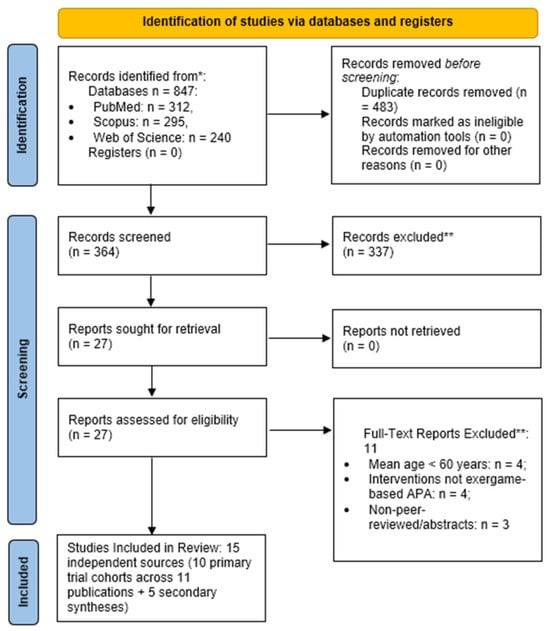
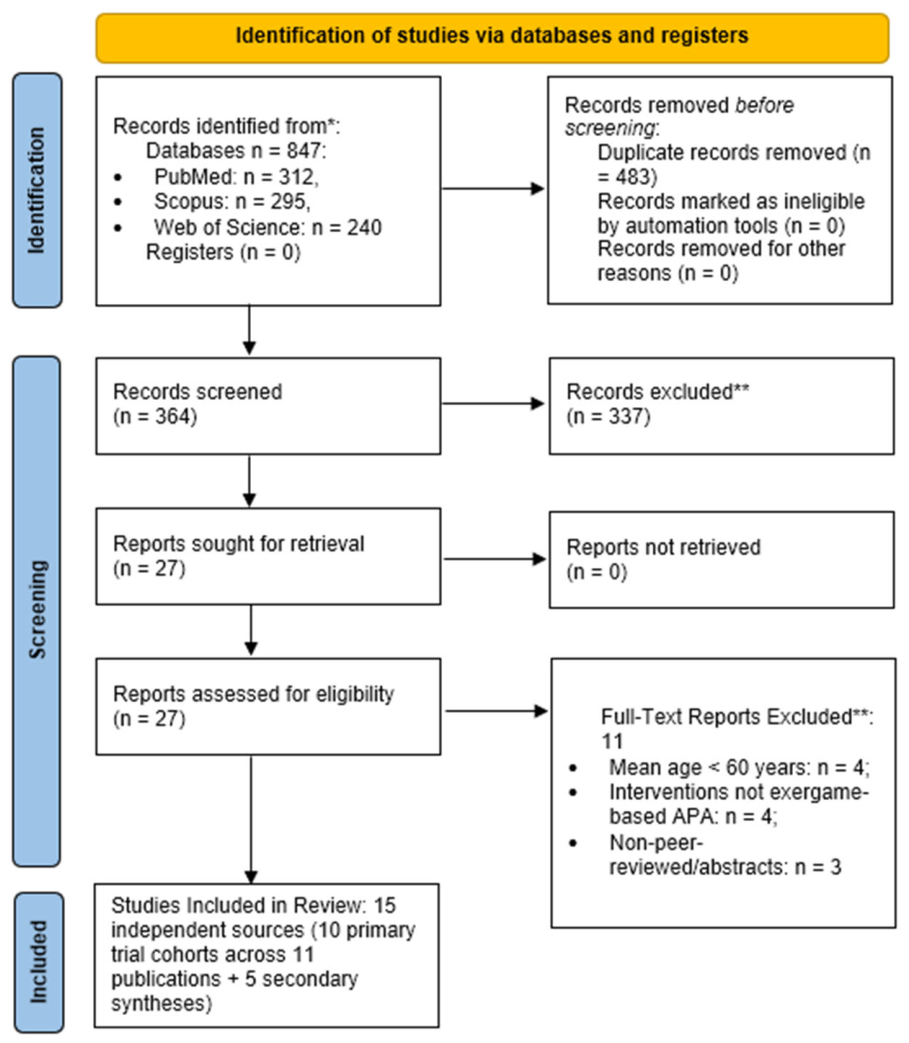
An initial systematic search conducted on 15 June 2026 across three electronic databases yielded a total of 847 records (PubMed: n = 312, Scopus: n = 295, Web of Science: n = 240) (the complete executable search strings are presented in Table 2; search execution dates and database yields are provided in Supplementary Material File S1, and the completed PRISMA-ScR checklist in File S2). Following the removal of 483 duplicate records, two independent reviewers screened 364 unique titles and abstracts against the predefined eligibility criteria. Of these, 337 records were excluded as non-relevant. The remaining 27 full-text articles were retrieved and thoroughly evaluated for eligibility. Eleven articles were subsequently excluded with documented reasons: mean participant age under 60 years (n = 4), interventions not focused on exergame-based physical activity (n = 4), and non-peer-reviewed publications or conference abstracts (n = 3) (the full list of excluded full-text articles with specific reasons is provided in Supplementary Material File S3). Regarding the application of eligibility criteria across settings, we clarify that clinical settings (rehabilitation centers, nursing homes, sheltered housing facilities) were fully eligible under the Context element of our PCC framework. No study was excluded on the basis of its delivery setting. All exclusions were based exclusively on three grounds: participant mean age below 60 years, absence of a structured exergame-based intervention protocol, or non-peer-reviewed publication status. Studies conducted in clinical or rehabilitation settings were retained when they met the exergame-based APA protocol criteria (e.g., Shamsoddini et al. [44], conducted in a clinical rehabilitation setting, was included). Exclusions in clinical settings occurred only when the intervention lacked explicit APA customization parameters (e.g., progressive difficulty adjustment, individualized speed settings, or task-oriented progression), regardless of the delivery environment. This consistent application is documented in Supplementary File S3. Ultimately, 15 independent sources, comprising 10 primary empirical trial cohorts across 11 publications and 5 secondary syntheses, met all inclusion criteria and were included in the final synthesis. The complete selection process and flow of records are illustrated in Figure 1, adapted from the PRISMA 2020 flow diagram template [47] (template available at https://www.prisma-statement.org, accessed on 20 October 2026).
Figure 1.
PRISMA-ScR flow diagram of the study selection process. (created by authors). Note: APA = Adapted Physical Activity. * Date and language limits were applied within the search syntax; the 30 June 2026 cut-off was verified at screening. No additional interface filters were used. ** Excluded during title and abstract screening.
3.3. Characteristics of the Studies
Five included articles were secondary evidence syntheses, comprising three systematic reviews [34,35,40] one systematic review and meta-analysis [39], and one overview of systematic reviews with meta-analyses [31]. The remaining 10 independent primary empirical trial cohorts were reported across 11 publications [41,42,43,44,45,46,48,49,50,51,52] (with Nurdin et al., [42], and Rahmawati et al., [43], representing secondary outcome analyses of the exact same trial cohort).
The primary empirical studies originated from seven distinct geographical regions: two publications from Taiwan [48,51], two from Indonesia [42,43] (same cohort), one from Hong Kong [49], one from Singapore [46], one from the Netherlands [52], one from Germany [41], one from the United Kingdom [45], one from Iran [44], and one from Chile [50]. The five secondary syntheses originated from the USA (n = 2) [34,35], China (n = 1) [40], Spain (n = 1) [39], and Chile (n = 1) [31].
3.4. Results of the Synthesis
To provide a comprehensive and methodologically rigorous mapping of the literature while safeguarding against data double-counting bias, the eligible evidence base (15 independent sources, comprising 10 primary empirical trial cohorts across 11 publications and 5 unique secondary syntheses) was organized into a two-tiered analytical framework.
Primary empirical trials were analyzed to extract granular intervention parameters, dosage characteristics, participant demographics, and specific quantitative outcome metrics. A detailed overview of these primary studies, encompassing study design, sample size, sex distribution, setting, intervention protocol, comparator, outcome tools, and refined main findings, is presented in Table 3
Table 3.
Overview of primary empirical studies on exergame-based APA interventions for older adults.
Conversely, secondary evidence syntheses (systematic reviews and meta-analyses) were mapped within a distinct overview framework to contextualize macro-level evidence trends and broad systematic conclusions. The structural characteristics, covered literature scope, primary outcome domains, and synthesized conclusions of these secondary syntheses are detailed in Table 4.
Table 4.
Overview of secondary evidence syntheses (systematic reviews and meta-analyses) on exergaming in older adults.
To facilitate a transparent overview of the mapped evidence and to allow readers to trace each outcome domain to its underlying source type, Table 5 presents a cross-tabulated evidence map. This map summarizes which outcome domains were addressed by primary empirical trials and which were covered by secondary evidence syntheses, thereby illustrating the distribution and volume of the available literature across functional, cognitive, psychosocial, and implementation domains. It should be noted that these categories describe the quantity of mapped research, not its methodological quality or certainty.
Table 5.
Evidence map: outcome domains by source type.
3.4.1. Quality of Life, Motivation, Cognitive, and Psychosocial Exergaming
The impact of scientific and technological progress on our daily lives is profound and indisputable. Nonetheless, limited availability of these resources could threaten the autonomy of elderly adults. Employing exergames has been recommended as a technique to support mental health and social participation in older adults, while also offering a new avenue for fostering physical activity and healthy aging. Zheng et al. [46] investigated the impact of exergames on the emotional well-being (both positive and negative) of older adults and determined factors that affect this impact. A 6-week study involving 319 older adult participants (mean age = 73 years) from Singapore employed a 2 (pre-test/post-test) x 3 (alone/peers/youths) mixed-model ANOVA to analyze the impact of the play condition. Results indicated a correlation between exergame use and an increase in positive emotions and a decrease in negative emotions. No statistically significant variation in positive affect was observed between the groups. Analysis of six weeks of exergame usage demonstrated a mediating effect of sociability on the relationship between attitudes toward exergames and two affective states.
The impact of exergames on older adults’ health-related quality of life was the purpose of the study of Cacciata et al. [34]. Nine studies, published between 2007 and 2017, included a total of 614 older adult participants (mean age 73 years). The sample consisted of 67% female participants and 33% male participants. The Nintendo Wii Fit platform offered a variety of exergames, including soccer, skiing, ski jumping, slalom skiing, balance exercises, strength-building activities, yoga, running and other activities designed to enhance balance. Participants used their upper body limbs. Participants in Nintendo’s Wii Sports engaged in bowling, tennis, boxing, golf, and baseball. The Microsoft Xbox 360 Kinect provided a diverse range of active pursuits and sporting options, encompassing soccer, tennis, table tennis, skiing, golf, volleyball, and bowling [53]. The “Kitchen Table Exercise Program” utilized non-commercial video equipment to deliver a muscle-strengthening and balance-focused program, incorporating six exercise types across various difficulty levels [54]. In the “Move It to Improve It” program, participants replicated the movements demonstrated in the video. Game sessions ranged from 20 to 100 min in duration, and player participation spanned two to seven days per week. Durations ranged from a minimum of three weeks to a maximum of twelve weeks. Exergame engagement was evaluated through the use of a daily participant log. Residential homes, rehabilitation centers, and hospitals served as locations for engagement activities. Nevertheless, the study yielded no statistically significant improvements in health-related quality of life measures associated with exergame use.
Furthermore, the [48] study developed five interactive exergames to facilitate successful aging and enhance well-being among residents of Taiwan’s Chang Gung Silver Village. A variety of computer-based technologies in the village facilitated both physical and cognitive games. Thirty-nine older adults (15 males, 24 females, mean age 79.5 ± 17.5 years) participated in the exergame trials. After completing the trials, a Technology Acceptance Model 2 (TAM2) questionnaire was administered to participants. Results indicated a significant correlation between perceived enjoyment/usefulness of exergames (physical and cognitive) and user behavior/future use intentions. A clear correlation between game performance and user intent emerged only when considering cognitive exergames. Significantly, physical exergames exhibited a greater influence of social factors on both the intention to utilize and the frequency of use. In summary, older adults’ acceptance of exergames hinges less on perceived enjoyment and more on the perceived usefulness of the physical and cognitive benefits.
The mixed-methods study by Stanmore et al. [45] also involved randomizing participants across two sheltered housing facilities: one received an intervention (n = 1 home, 12 participants), the other standard care (n = 1 home, 12 participants) group. A six-week supervised exergaming program (three weekly sessions) supplemented standard care (physiotherapy, exercises, falls advice) for the intervention group only. Feasibility, usability, and acceptability were evaluated after six weeks. Focus groups and staff interviews helped determine usability and acceptability by identifying the facilitators and barriers involved. Compared to controls (10.6 to 14.1 min), the intervention group showed a larger increase in average weekly exercise time (9.6 to 36.8 min). All study procedures and measures seemed achievable. Seventy-two percent of invitees participated at baseline, and 92% of those participants were retained at the six-week follow-up assessment. System Usability Scale (SUS) results indicated a mean score of 70 out of 100, reflecting good perceived usability among participants. A majority (90%) found the system easy to use, and 50% expressed interest in frequent exergame use. However, 40% of participants found the initial learning process demanding. Analysis of qualitative data revealed positive reception of exergames, noting their motivational and social aspects. Staff viewed exergaming as a supplement to traditional care methods. Conclusively, exergames proved appropriate for community sheltered housing fall prevention programs for older adults.
The dual cognitive-physical outcomes of exergame boxing were evaluated within a single trial cohort. Specifically, cognitive function was assessed as a secondary outcome domain alongside physical performance. Evaluated within a single 8-week randomized trial cohort of 30 older women (mean age > 60 years; n = 15 intervention group receiving exergame boxing 3 days/week plus light aerobic exercise; n = 15 control group receiving light aerobic exercise alone), two secondary publications examined distinct clinical outcomes [42,43]. Specifically, Rahmawati et al. [43] evaluated cognitive outcomes using the Indonesian version of the Montreal Cognitive Assessment (MoCA-Ina), reporting significant within-group cognitive improvements for both the exergame and control groups (p = 0.003 and p = 0.028, respectively), though the exergame group demonstrated a larger effect size (d = 1.07 vs. d = 0.60). Assessing physical performance within the same underlying trial cohort, Nurdin et al. [42] evaluated upper limb endurance via the arm curl test, demonstrating that adding exergame boxing to low-intensity aerobic exercise produced significantly greater gains in upper body muscular endurance than aerobic exercise alone. Together, these findings from the same study population highlight the dual cognitive and physical benefits of exergame boxing for older women in institutional care settings.
3.4.2. Balance, Physical Performance, and Cognitive-Physical Outcomes
Falls are a common problem for older individuals worldwide. The impact of falls includes reduced mobility, health complications, fall-related anxiety, and restricted activities. A well-balanced musculoskeletal system is facilitated by the ability to balance [55]. Furthermore, exercise programs help the elderly maintain balance, thus preventing falls. Lai et al. [51] investigated how an interactive video game affected balance training in older adults. A total of 30 participants (13 males, 17 females) above the age of 65 years (mean age = 72 years) participated in this study. Participants were randomly divided into two groups. Over twelve weeks, a group of fifteen participants (seven males, eight females) completed six weeks of exergame practice and six weeks without intervention. For six weeks, a second group of six males and nine females did not engage in intervention, followed by six weeks of training. The Xavix Measured Step System was used; exercise was performed for 30 min, 3 times/week for six weeks. Following the exergame intervention, both groups showed improved balance scores on subsequent testing. The study’s findings indicated that a six-week period of exergame training resulted in sustained improvements in balance.
The systematic review by Yang et al. [40] aimed to explore the benefits and underlying neurophysiological mechanisms of exergames in improving cognitive function among older adults. The authors reviewed several databases for articles published from 2005 through April 2021. Eligible studies needed to focus on individuals aged 60 years or older and incorporate a stringent exercise protocol based on exergames for the experimental cohort. The literature review followed a three-stage process: an initial screening of titles and abstracts, removal of duplicate records, and a comprehensive full-text review by two researchers to determine final eligibility. The authors completed a total of 16 articles, with participant numbers varying from 6 to 79 per study, all aged 60 years and above. The authors concluded that exergames serve as a highly recommended intervention for safeguarding the physical and mental health of elderly individuals. They additionally recommended that forthcoming studies implement personalized exergaming protocols to further investigate effects on cognitive functions and quantifiable alterations in brain structure.
In another study, Choi et al. [35] conducted a literature review of 25 studies on the use of exergame technology for exercise/therapy in populations of older adults. Nintendo Wii (Wii Fit, Wii Sports) was used most in the studies, followed by Xbox Kinect, Sens Balance Fitness Board, and Dance Video games. The most popular exercises in most studies, such as balance training and sports (soccer, skiing, hiking, bowling), reportedly used applications and intervention protocols. The exergame protocol called for 15 to 60 min sessions, with a 30 min average. Participants attended sessions 2–5 times weekly, typically 2–3 times weekly. While most studies used a 6–8 week engagement period, the overall range was 3–20 weeks (mean of 7 weeks). Almost all researchers (24/25) observed significant improvement in at least one area (balance, mobility) following exergame intervention.
Playing golf can boost balance, aerobic fitness, and overall health for seniors. Hong Kong’s senior population faces significant challenges in accessing golf facilities. Exergames, such as cyber golf, offer a home-based exercise alternative [52]. The study by Chow & Mann [49] examined the influence of cyber golf on the balance abilities of older adults in Hong Kong. Twenty older adults, aged 65–78 years (MO = 69) (13 females, 7 males) participated in the study. All participants had no health problems, could walk unaided, and had no previous experience with exergames. They were divided into two groups. The first group consisted of 10 participants, who played exergames for 2 weeks. The control group played traditional board games. For online golf, the Xbox 360 Kinect (Microsoft Corporation, Redmond, WA, USA) was used. The exercise ‘Tiger Woods PGA Tour 13’ was integrated into the training sessions. Participants were required to complete every session; each lasted between 30 and 45 min. To conclude, the experimental group showed improved static balance, likely mirroring real-world golfing effects.
Exergames are becoming a popular way to help older adults improve their balance. However, a few can be used at home. Van Diest et al. [52] investigated the effects of six weeks of exercise on balance. Ten healthy older adults (mean age 76; 5 males, 5 females) participated in a study involving home-based ice-skating exercises (endurance and coordination). Over six weeks, participants played for 30 min, three times weekly. Balance was assessed at baseline, after the intervention, and at the 2–4 week follow-up. Findings suggested that exergames promote independent living among older adults. Exergames positively impacted balance when used at home.
Anxiety can worsen balance problems and the fear of falling, potentially reducing treatment effectiveness. The study of Shamsoddini et al. [44] examined the effect of exergaming on fear of falling and balance in anxious and non-anxious older adults. A group of twenty older adults, half anxious and half non-anxious, completed a six-week balance-oriented games program. The Falls Efficacy Scale and Activities-Specific Balance Confidence Scale were employed to evaluate participants’ fear of falling. The Berg Balance Scale was the instrument used for balance measurement. The Timed Up and Go Test was administered at three time points: pre-intervention, immediately post-intervention, and six weeks following the intervention. Significant and lasting improvements in balance and mobility were observed in both groups during the study. However, improvements in fear of falling and balance confidence were only significant for the non-anxiety group. Anxiety was associated with decreased enjoyment, lower perception of effectiveness, and increased tension during the intervention. Therefore, exergaming improved balance in healthy older adults. These benefits, however, might be diminished by anxiety. Adjusting treatments to target anxiety might improve patient outcomes.
Exergames improve physical and cognitive skills, and studies show they help older adults avoid falls. Nevertheless, research on exergame playing habits, the impact of game settings on gameplay, and resulting training benefits is limited. Müller et al. [41] investigated how repeated exergaming sessions, across different difficulty levels and speeds, affected older adults’ gameplay performance, physical activity, and exertion over four weeks. For this purpose, 28 independently living older adults (mean age 74.47 years; 14 males, 14 females) played two different exergames (Puzzle and Fox) at two difficulty levels 3× per week for 4 weeks. Data collection at sessions 1, 2, 3, 6, 9, and 12 included lower-back accelerometer readings, exergaming scores, and self-reported physical and cognitive exertion levels. Results indicated that for the Puzzle game, performance and physical activity increased significantly across the 12 training sessions. In the Fox game, higher speeds led to improved performance metrics, increased physical activity, and higher exertion levels. Higher difficulty incorporating cognitive elements in exergaming resulted in lower physical activity and performance levels. Therefore, customizable difficulty and game speed are essential. Understanding the relationship between game design and player experience is vital for interpreting exergaming interventions, as highlighted by this study, which provides key information on their effectiveness.
According to Hernandez-Martínez et al. [50], an intervention using Xbox Kinect Sports yielded notable enhancements in physical performance in the elderly Chilean population. The aim of this study was to examine the effects of 8-week active exergames training on physical functional performance of older females. Participants (n = 25) were randomly assigned to either a control group that remained sedentary or an experimental group that trained three times per week using Xbox Kinect exergames (athletics, bowling and table tennis). Results indicated a statistically significant difference between the experimental and control groups in all measurements (4 m walking speed, static balance, timed up-and-go and 5-repetition sit-to-stand tests). Consequently, the study highlights active exergames as an efficient and economical approach for community centers and health facilities to improve physical capabilities and encourage active aging among older women.
4. Discussion
Empirical evidence suggests that game-based technology can support balance and mobility improvements in older adults [27,31,38]. Interactive exercise platforms are increasingly integrated into physical therapy and APA programs to promote mobility, motor control, and cognitive function [27,35]. The following synthesis integrates evidence from the fifteen included independent sources across key functional, psychosocial, and intervention-related domains, organized thematically rather than study-by-study.
Methodological Integration and Avoidance of Double-Counting: To maintain methodological consistency with our dual-synthesis framework and safeguard against double-counting bias, primary empirical trials and secondary evidence syntheses are integrated across the discussion according to their distinct analytical functions. Standalone primary empirical studies, e.g., Ref. [50] serve as the exclusive source for granular intervention protocols, specific exercise parameters, and direct quantitative outcome metrics. Conversely, included systematic reviews and meta-analyses, e.g., Refs. [31,34,35,39] are referenced strictly as macro-level overview evidence to contextualize findings within broader systematic trends. Crucially, quantitative outcomes and participant cohorts from primary trials were never pooled or double-counted alongside secondary review estimates, thereby preserving data independence across the synthesized narrative.
4.1. Physical Outcomes: Postural Balance, Mobility, and Motor Function
A primary finding across the reviewed literature is the potential benefit of exergaming interventions in supporting static balance, dynamic balance, and functional mobility in older adults [31,35,39]. Interventions utilizing platforms such as Nintendo Wii Fit, Xbox Kinect, and custom systems frequently reported positive trends in postural control and balance performance [31,34,35,50]. For instance, structured programs ranging from 6 to 12 weeks demonstrated improvements in balance scores and lower-limb muscle strength [31,51]. Specific activities, such as cyber-golfing and home-based simulated ice-skating, appeared helpful in improving static balance, coordination, and overall gait stability [49,52]. When compared to traditional or passive controls, exergame-based rehabilitation showed promising outcomes in functional gait and walking capacity; authors hypothesized these effects may be attributed to mechanisms such as higher participant engagement and real-time visual-proprioceptive feedback, though these mechanisms were not directly tested [39,50]. Furthermore, targeted upper-limb exergame protocols (e.g., exergame boxing) demonstrated gains in upper-body muscular endurance in older women [42]. Collectively, these motor improvements highlight exergaming as a promising supplementary modality for addressing fall risk factors and maintaining functionality in community-dwelling and institutionalized older populations [35,45].
4.2. Cognitive, Emotional, and Psychosocial Benefits
Beyond physical performance, exergame interventions demonstrate multi-domain benefits, particularly in cognitive function and psychosocial well-being [40,46]. Dual-task exergames that combine physical movement with cognitive processing (e.g., exergame boxing) led to significant improvements in global cognitive function compared to light aerobic exercise alone [40,43]. Regarding emotional outcomes, long-term exergame participation significantly increases positive affect while reducing negative affect [46]. However, evidence regarding overall health-related quality of life (HRQoL) remains mixed. Systematic evaluations indicated that while positive trends exist, statistically significant HRQoL improvements are inconsistently reported across trial cohorts [34]. Social interaction and game context act as mediating variables; user enjoyment and perceived usefulness are key determinants of long-term technology adoption and physical activity adherence [45,48]. Notably, regarding emotional affect, solo players showed a greater decline in negative affect than those playing in peer or intergenerational groups, suggesting that social play is not universally required to achieve emotional benefits [46].
4.3. Intervention Characteristics, Game Parameters, and Compliance Drivers
The therapeutic efficacy of exergames is highly sensitive to system parameters and individual participant characteristic [41,44]. Tailoring game settings, specifically speed and difficulty, directly modulates physical activity volume and perceived exertion [41]. While increasing game speed increases physical output and exertion, excessively high cognitive difficulty can inadvertently reduce physical movement performance [41]. Participant psychological status also significantly influences outcomes. Baseline anxiety negatively impacts the benefits of exergaming; anxious older adults report reduced enjoyment, heightened tension, and lower gains in fall-related self-efficacy compared to non-anxious peers [44]. Consequently, successful clinical implementation requires customizable game difficulty, adaptive progression algorithms, and anxiety-mitigating supportive environments [41,44].
4.4. Identification of Research Gaps (Gap Analysis)
Despite the expanding body of literature on exergame-based APA for older adults, several critical research gaps remain. Primarily, there is a distinct lack of standardized intervention protocols and dosage guidelines, characterized by substantial inconsistency across studies regarding optimal session duration (ranging from 30 to 45 min per session in primary trials [41,44,49,50,51,52], and 15 to 100 min as reported in secondary syntheses [34,35,39]), frequency (2 to 5 days per week), and total intervention length (2 to 12 weeks in primary trials, and 2 to 24 weeks across secondary syntheses [34,35,39]). Dose ranges reported in secondary syntheses are presented here as contextual benchmarks; primary trial-specific doses are detailed in Table 3. Consequently, clear dose–response relationships for specific clinical outcomes, such as fall incidence versus cognitive maintenance, have yet to be established. Furthermore, an absence of long-term follow-up evaluation persists across the literature. The majority of included studies evaluated outcomes immediately post-intervention, with few exceptions assessing short-term retention [44,51,52], highlighting a critical lack of longitudinal research investigating the long-term retention of physical and cognitive gains as well as compliance after formal supervision ends. Additionally, psychological mediators remain under-researched; while motor and cognitive outcomes are widely measured, the modulating effect of psychological traits, such as baseline anxiety, technology fear, and self-efficacy, on gameplay performance and therapeutic outcomes remains undertested [44,48]. Finally, widespread heterogeneity in measurement tools and delivery platforms, evidenced by a fragmented array of outcome measures including the Berg Balance Scale, TUG, MoCA, and varied HRQoL metrics, alongside proprietary hardware, prevents quantitative meta-analytic pooling and cross-study comparisons [34].
4.5. Limitations
Several limitations inherent to this scoping review must be acknowledged. In accordance with standard methodological frameworks for scoping reviews [36] and PRISMA-ScR guidelines [56], formal critical appraisal and risk-of-bias assessments of individual primary studies were not conducted. Additionally, the search was restricted to English-language peer-reviewed literature published between 2013 and 2026 across three electronic databases (PubMed, Scopus, and Web of Science), potentially introducing publication or language bias. The authors acknowledge that additional sources (e.g., CINAHL, SPORTDiscus, the Cochrane Library) and grey literature searches may have identified further eligible studies; however, the three selected databases collectively cover the majority of peer-reviewed biomedical, health sciences, and sports science literature relevant to the review question. The substantial methodological heterogeneity across included studies, comprising diverse intervention modalities ranging from commercial to custom exergames, unstandardized dosages, varying supervision levels, and disparate outcome measurement tools, limits the direct comparability of findings and precludes definitive clinical dosing recommendations. Furthermore, the commercial platforms most frequently utilized in the included literature, such as the Nintendo Wii and Microsoft Kinect, are no longer manufactured, which limits the direct transferability of these specific hardware interventions to current clinical practice. Finally, crucial clinical and implementation factors, such as the incidence of adverse events during gameplay, general safety protocols, and the impact of older adults’ digital literacy, were inconsistently reported or largely absent from the primary studies, highlighting an important gap in the current evidence base.
4.6. Implications for Clinical Practice and Future Research
Based on the synthesized evidence, several actionable guidelines emerge to inform clinical application and guide future research directions in exergame-based APA for older adults. Regarding clinical practice, clinicians and exercise specialists must tailor game characteristics, specifically game speed, structural difficulty, and cognitive load, to align with individual physical and cognitive baseline capacities, introducing high cognitive load progressively to avoid compromising physical performance and user engagement. Furthermore, based on preliminary evidence from a single pilot study (N = 20) [44], clinicians may consider screening older adults for baseline anxiety and fear of falling prior to initiating exergame protocols, as elevated anxiety was associated with attenuated improvements in balance confidence and reduced intervention enjoyment. Targeted psychological support or anxiety-reduction strategies may therefore be considered alongside exergaming sessions; however, this recommendation requires confirmation in larger controlled trials. Additionally, exergames should be utilized as an engaging, task-oriented supplement to traditional APA and physical therapy modalities rather than a standalone replacement, particularly when comprehensive cardiorespiratory fitness and systemic muscle strength gains are required. Finally, preliminary findings from a single-arm pilot study (N = 10) suggest that unsupervised home-based exergaming may be feasible for maintaining balance among healthy older adults [52]; however, confirmation in adequately powered controlled trials is warranted before clinical recommendations can be made.
In terms of future research directions, upcoming investigations should prioritize adequately powered randomized controlled trials with larger sample sizes, standardized intervention dosages regarding duration, frequency, and intensity, and harmonized outcome metrics, especially concerning health-related quality of life. Moreover, longitudinal studies with extended post-intervention follow-up periods exceeding six months are required to evaluate whether physical, cognitive, and motivational gains are sustained after formal supervision ends. Lastly, further research should explore the underlying neurobiological mechanisms of dual-task exergaming and evaluate its clinical efficacy across specific sub-populations, such as older adults with frailty, mild cognitive impairment, or specific neurodegenerative conditions.
5. Conclusions
This scoping review mapped the available evidence from 15 independent sources (10 primary empirical trial cohorts across 11 publications and 5 secondary syntheses) evaluating exergame-based APA interventions for older adults across community, clinical, and residential settings. The synthesized findings suggest that exergaming, utilizing both commercial platforms and custom-designed systems, represents a feasible, highly engaging, and adaptable intervention for promoting physical and cognitive activity. Primary trials and overview syntheses consistently reported positive trends in static and dynamic balance, functional mobility, lower limb strength, and upper body endurance. Furthermore, interactive gaming demonstrated potential for supporting cognitive engagement and positive emotional affect, thereby addressing psychological barriers to physical activity adherence.
However, these findings must be interpreted with caution. The included primary evidence base relies heavily on small pilot and feasibility designs (nine of ten trial cohorts enrolled 10–39 participants; one large mixed-design trial enrolled N = 319), short intervention durations (2–12 weeks), and predominantly female samples, without direct evaluation of fall incidence, long-term gain retention, or formal cost-effectiveness. Additionally, key surrogate outcomes, such as balance confidence and fear of falling, are attenuated in individuals with elevated baseline anxiety. Rather than serving as a direct replacement for comprehensive exercise programs, exergame-based APA is best conceptualized as an engaging, task-oriented supplement. To transition from preliminary feasibility to robust clinical translation, future research must prioritize adequately powered randomized controlled trials with standardized dosing protocols, formal quality appraisal, and long-term longitudinal evaluations.
Supplementary Materials
The following supporting information can be downloaded at https://www.mdpi.com/article/10.3390/healthcare14223965/s1, File S1: Search Execution Dates, Database Yields, and Deduplication Log; File S2: PRISMA-ScR Checklist; File S3: List of Excluded Full-Text Articles with Reasons.
Author Contributions
Conceptualization, C.P. and G.Y.; methodology, C.P. and G.Y.; validation, C.P. and G.Y.; formal analysis, C.P. and G.Y.; investigation, C.P., I.T. and G.Y.; resources, E.S., C.P. and G.Y.; data curation, C.P. and G.Y.; writing—original draft preparation, I.T., C.P. and G.Y.; writing—review and editing, E.S., C.P. and G.Y.; visualization, I.T., C.P. and G.Y.; supervision, C.P. and G.Y.; project administration, C.P. and G.Y.; All authors have read and agreed to the published version of the manuscript.
Funding
This research received no external funding.
Institutional Review Board Statement
Not applicable.
Informed Consent Statement
Not applicable.
Data Availability Statement
No new primary data were created or analyzed in this study. All data analyzed are derived from previously published peer-reviewed studies. The search execution dates and database yields (File S1), the PRISMA-ScR checklist (File S2), the list of excluded full-text articles with reasons (File S3), are available as Supplementary Materials.
Conflicts of Interest
The authors declare no conflicts of interest.
Abbreviations
The following abbreviations are used in this manuscript:
| FES-I | Falls Efficacy Scale-International |
| HRQoL | Health-Related Quality of Life |
| MoCA-Ina | Montreal Cognitive Assessment (Indonesian version) |
| PANAS | Positive and Negative Affect Schedule |
| PCC | Person, Concept, and Context |
| RPE | Rating of Perceived Exertion |
| SBT | Static Balance Test |
| SUS | System Usability Scale |
| TAM2 | Technology Acceptance Model 2 |
| TUG | Timed Up and Go Test |
References
- World Health Organization. Engage-TB. Training of Community Health Workers and Community Volunteers: Facilitator’s Guide; World Health Organization: Geneva, Switzerland, 2015.
- Govaerts, J.; Yang, Z.; Visser, M.; Huisman, M.; Francois-Lavet, V.; van Schoor, N.M.; Schaap, L.A. The Relationship between Intrinsic Capacity and Functional Ability—Identifying Key Environmental Features to Support Healthy Ageing. Exp. Gerontol. 2026, 220, 113171. [Google Scholar] [CrossRef] [Scilit] [PubMed]
- Rudnicka, E.; Napierała, P.; Podfigurna, A.; Męczekalski, B.; Smolarczyk, R.; Grymowicz, M. The World Health Organization (WHO) Approach to Healthy Ageing. Maturitas 2020, 139, 6–11. [Google Scholar] [CrossRef] [Scilit] [PubMed]
- El Assar, M.; Álvarez-Bustos, A.; Sosa, P.; Angulo, J.; Rodríguez-Mañas, L. Effect of Physical Activity/Exercise on Oxidative Stress and Inflammation in Muscle and Vascular Aging. Int. J. Mol. Sci. 2022, 23, 8713. [Google Scholar] [CrossRef] [Scilit] [PubMed]
- González-Ballesteros, L.M.; Mojica, L.E.; Riveros, S.; Zamora, V.V.; Gómez, A.; Otero Rueda, M.d.P.; Chaves Matiz, F.; Jaimes Velásquez, M.A.; López, V.; Ramírez, L.; et al. Evidence-Based Interventions for Promoting Healthy Aging: A Scoping Review. J. Nutr. Health Aging 2026, 30, 100834. [Google Scholar] [CrossRef] [Scilit] [PubMed]
- Li, M.; Budhathoki, C.; Han, H.-R.; Szanton, S.L.; Schrack, J.A.; Li, J. Social Factors, Wearable Activity Tracker Use Frequency, and Physical Activity Patterns among U.S. Older Adults: Findings from a National Cross-Sectional Survey. BMC Geriatr. 2026, 26, 813. [Google Scholar] [CrossRef] [Scilit] [PubMed]
- Yuan, Y.; Wang, S.; Zhou, C.; Zhang, A.; Zhang, S.; Wang, Y. Effects of Exercise Interventions on Cognition, Physical Function and Quality of Life among Older Adults with Cognitive Frailty: A Systematic Review and Meta-Analysis. Geriatr. Nurs. 2025, 62, 96–107. [Google Scholar] [CrossRef] [Scilit] [PubMed]
- Aithal, S.; Visaria, A.; Malhotra, R. Prevalence, Sociodemographic, and Health Correlates of Insufficient Physical Activity and High Sedentary Behavior Among Older Adults in Singapore. J. Aging Phys. Act. 2022, 30, 922–935. [Google Scholar] [CrossRef] [Scilit] [PubMed]
- Son, J.Y.; Woo, S.; Struble, L.M.; Marriott, D.J.; Chen, W.; Larson, J.L. Objectively Measured Physical Activity and Sedentary Behaviors Among Older Adults in Assisted Living Facilities: A Scoping Review. J. Appl. Gerontol. 2024, 43, 1544–1559. [Google Scholar] [CrossRef] [Scilit] [PubMed]
- Yang, Y.; Gao, Y.; An, R.; Wan, Q. Barriers and Facilitators to Exercise Adherence in Community-Dwelling Older Adults: A Mixed-Methods Systematic Review Using the COM-B Model and Theoretical Domains Framework. Int. J. Nurs. Stud. 2024, 157, 104808. [Google Scholar] [CrossRef] [Scilit] [PubMed]
- Royse, L.A.; Baker, B.S.; Warne-Griggs, M.D.; Miller, K.; Weitzel, K.J.; Ball, S.D.; Duren, D.L. “It’s Not Time for Us to Sit down yet”: How Group Exercise Programs Can Motivate Physical Activity and Overcome Barriers in Inactive Older Adults. Int. J. Qual. Stud. Health Well-Being 2023, 18, 2216034. [Google Scholar] [CrossRef] [Scilit] [PubMed]
- Hwang, S.; Yi, E.-S. Breaking Barriers, Building Habits: Psychological Analysis of the Relationship Between Perceived Barriers, Financial Burden, and Social Support on Exercise Adherence Among Adults Aged 50 and Older in South Korea. Healthcare 2025, 13, 1469. [Google Scholar] [CrossRef] [Scilit] [PubMed]
- Wei, J.; Wang, H. Motivation and Behavioral Mechanisms of Physical Activity in Community-Dwelling Elderly Populations. Front. Psychol. 2026, 17, 1767861. [Google Scholar] [CrossRef] [Scilit] [PubMed]
- Coletta, G.; Noguchi, K.S.; Beaudoin, K.; McQuarrie, A.; Tang, A.; Ganann, R.; Phillips, S.M.; Griffin, M. Older Adults’ Perspectives on Participating in a Synchronous Online Exercise Program: Qualitative Study. JMIR Aging 2025, 8, e66473. [Google Scholar] [CrossRef] [Scilit] [PubMed]
- Liang, I.J.; Perkin, O.J.; McGuigan, P.M.; Spellanzon, B.; Robb, M.; Liu, C.-Y.; Lin, L.L.; Thompson, D.; Western, M.J. The Effectiveness of Unsupervised Home-Based Exercise for Improving Lower Extremity Physical Function in Older Adults in Western and Eastern Cultures: A Systematic Review and Meta-Analysis. BMC Geriatr. 2024, 24, 800. [Google Scholar] [CrossRef] [Scilit] [PubMed]
- Eggert, E.E.; Palmer, W.; Shanjani, L.I.; Gretebeck, K.; Mahoney, J.E. Outcomes Associated with Translating Evidence-Based Research into Practice: The Physical Activity for Lifelong Success Program. J. Phys. Act. Health 2023, 20, 1162–1174. [Google Scholar] [CrossRef] [Scilit] [PubMed]
- Yang, Y.; van Schooten, K.S.; Komisar, V.; McKay, H.A.; Sims-Gould, J.; Cheong, D.; Robinovitch, S.N. Effects of the Mobility-Fit Physical Activity Program on Strength and Mobility in Older Adults in Assisted Living: A Feasibility Study. Int. J. Environ. Res. Public Health 2022, 19, 5453. [Google Scholar] [CrossRef] [Scilit] [PubMed]
- Mehrabi, S.; Drisdelle, S.; Dutt, H.R.; Middleton, L.E. Defying Distance: Exercise Providers’ Perspectives on Remote Physical Activity Supports for Older Adults: A Mixed-Methods Study. Front. Public Health 2025, 13, 1643477. [Google Scholar] [CrossRef] [Scilit] [PubMed]
- Lamoureux, N.R.; Lansing, J.; Welk, G.J. An Observational Pilot Evaluation of the Walk with Ease Program for Reducing Fall Risk among Older Adults. Arch. Public Health 2023, 81, 203. [Google Scholar] [CrossRef] [Scilit] [PubMed]
- Zeng, Z.; Ho, C.; Sit, C.H.; Wong, S.H.; Liao, J.; Yang, Y. Effectiveness of Exercise Intervention on Mobility, Postural Control, and Falls for Older Adults with Mild Cognitive Impairment: A Systematic Review and Network Meta-Analysis. Arch. Phys. Med. Rehabil. 2025, 106, 781–800. [Google Scholar] [CrossRef] [Scilit] [PubMed]
- Del Gener, A.; Sanz, C.; Iglesias, L. Exergames: Proposal for a Gamepad to Sense Player Movements. J. Comput. Sci. Technol. 2023, 23, e10. [Google Scholar] [CrossRef] [Scilit]
- Moller, A.C.; Sousa, C.V.; Lee, K.J.; Alon, D.; Lu, A.S. Active Video Game Interventions Targeting Physical Activity Behaviors: Systematic Review and Meta-Analysis. J. Med. Internet Res. 2023, 25, e45243. [Google Scholar] [CrossRef] [Scilit] [PubMed]
- Koulouris, D.; Menychtas, A.; Maglogiannis, I. An IoT-Enabled Platform for the Assessment of Physical and Mental Activities Utilizing Augmented Reality Exergaming. Sensors 2022, 22, 3181. [Google Scholar] [CrossRef] [Scilit] [PubMed]
- Lampropoulos, G.; Anastasiadis, T.; Garzón, J. Augmented Reality and Virtual Reality in Exergaming. Future Internet 2025, 17, 332. [Google Scholar] [CrossRef] [Scilit]
- Schumacher, T.; Geisen, M.; Klatt, S. Exergames Revisited: A Narrative Review and Classification Framework for Application-Specific Design. Psychol. Sport Exerc. 2026, 86, 103200. [Google Scholar] [CrossRef] [Scilit] [PubMed]
- Béraud-Peigné, N.; Maillot, P.; Perrot, A. The Effects of a New Immersive Multidomain Training on Cognitive, Dual-Task and Physical Functions in Older Adults. GeroScience 2023, 46, 1825–1841. [Google Scholar] [CrossRef] [Scilit] [PubMed]
- Skjæret, N.; Nawaz, A.; Morat, T.; Schoene, D.; Helbostad, J.L.; Vereijken, B. Exercise and Rehabilitation Delivered through Exergames in Older Adults: An Integrative Review of Technologies, Safety and Efficacy. Int. J. Med. Inform. 2016, 85, 1–16. [Google Scholar] [CrossRef] [Scilit] [PubMed]
- Freed, S.A.; Sprague, B.N.; Stephan, A.T.; Doyle, C.E.; Tian, J.; Phillips, C.B.; Ross, L.A. Feasibility and Enjoyment of Exercise Video Games in Older Adults. Front. Public Health 2021, 9, 751289. [Google Scholar] [CrossRef] [Scilit] [PubMed]
- Lapierre, N.; Um Din, N.; Belmin, J.; Lafuente-Lafuente, C. Exergame-Assisted Rehabilitation for Preventing Falls in Older Adults at Risk: A Systematic Review and Meta-Analysis. Gerontology 2023, 69, 757–767. [Google Scholar] [CrossRef] [Scilit] [PubMed]
- Lee, K. Home-Based Exergame Program to Improve Physical Function, Fall Efficacy, Depression and Quality of Life in Community-Dwelling Older Adults: A Randomized Controlled Trial. Healthcare 2023, 11, 1109. [Google Scholar] [CrossRef] [Scilit] [PubMed]
- Hernandez-Martinez, J.; Ramos-Espinoza, F.; Muñoz-Vásquez, C.; Guzman-Muñoz, E.; Herrera-Valenzuela, T.; Branco, B.H.M.; Castillo-Cerda, M.; Valdés-Badilla, P. Effects of Active Exergames on Physical Performance in Older People: An Overview of Systematic Reviews and Meta-Analysis. Front. Public Health 2024, 12, 1250299. [Google Scholar] [CrossRef] [Scilit] [PubMed]
- Yoong, S.Q.; Wu, V.X.; Chen, C.; Lee, P.Y.; Wee, K.S.L.; Teo, J.; Chua, M.C.H.; Jiang, Y. Dance Exergames for Older Adults: A Systematic Review and Meta-Analysis with Narrative Synthesis. J. Gerontol. Ser. A Biol. Sci. Med. Sci. 2024, 79, glae035. [Google Scholar] [CrossRef] [Scilit] [PubMed]
- Peters, M.D.J.; Godfrey, C.M.; Khalil, H.; McInerney, P.; Parker, D.; Soares, C.B. Guidance for Conducting Systematic Scoping Reviews. Int. J. Evid.-Based Healthc. 2015, 13, 141–146. [Google Scholar] [CrossRef] [Scilit] [PubMed]
- Cacciata, M.; Stromberg, A.; Lee, J.-A.; Sorkin, D.; Lombardo, D.; Clancy, S.; Nyamathi, A.; Evangelista, L.S. Effect of Exergaming on Health-Related Quality of Life in Older Adults: A Systematic Review. Int. J. Nurs. Stud. 2019, 93, 30–40. [Google Scholar] [CrossRef] [Scilit] [PubMed]
- Choi, S.D.; Guo, L.; Kang, D.; Xiong, S. Exergame Technology and Interactive Interventions for Elderly Fall Prevention: A Systematic Literature Review. Appl. Ergon. 2017, 65, 570–581. [Google Scholar] [CrossRef] [Scilit] [PubMed]
- Arksey, H.; O’Malley, L. Scoping Studies: Towards a Methodological Framework. Int. J. Soc. Res. Methodol. 2005, 8, 19–32. [Google Scholar] [CrossRef] [Scilit]
- Tricco, A.C.; Lillie, E.; Zarin, W.; O’Brien, K.; Colquhoun, H.; Kastner, M.; Levac, D.; Ng, C.; Sharpe, J.P.; Wilson, K.; et al. A Scoping Review on the Conduct and Reporting of Scoping Reviews. BMC Med. Res. Methodol. 2016, 16, 15. [Google Scholar] [CrossRef] [Scilit] [PubMed]
- Jorgensen, M.G.; Laessoe, U.; Hendriksen, C.; Nielsen, O.B.F.; Aagaard, P. Efficacy of Nintendo Wii Training on Mechanical Leg Muscle Function and Postural Balance in Community-Dwelling Older Adults: A Randomized Controlled Trial. J. Gerontol. Ser. A Biol. Sci. Med. Sci. 2013, 68, 845–852. [Google Scholar] [CrossRef] [Scilit] [PubMed]
- Corregidor-Sánchez, A.I.; Segura-Fragoso, A.; Rodríguez-Hernández, M.; Criado-Alvarez, J.J.; González-Gonzalez, J.; Polonio-López, B. Can Exergames Contribute to Improving Walking Capacity in Older Adults? A Systematic Review and Meta-Analysis. Maturitas 2020, 132, 40–48. [Google Scholar] [CrossRef] [Scilit] [PubMed]
- Yang, Y.; Wang, K.; Liu, S.; Liu, H.; Zhang, T.; Luo, J. Exergames Improve Cognitive Function in Older Adults and Their Possible Mechanisms: A Systematic Review. J. Glob. Health 2023, 13, 04177. [Google Scholar] [CrossRef] [Scilit] [PubMed]
- Müller, H.; Skjæret-Maroni, N.; Bardal, E.M.; Vereijken, B.; Baumeister, J. Exergaming Interventions for Older Adults: The Effect of Game Characteristics on Gameplay. Exp. Gerontol. 2024, 197, 112610. [Google Scholar] [CrossRef] [Scilit] [PubMed]
- Nurdin, F.; Wardhani, I.L.; Narasinta, I.; Utomo, B. Upper Limb Endurance in Elderly Women Following 8 Weeks of Exergame Boxing: A Randomized Controlled Trial. J. Med. Pharm. Chem. Res. 2025, 7, 608–617. [Google Scholar] [CrossRef]
- Rahmawati, N.R.; Tinduh, D.; Prawitri, Y.D.; Utomo, B. Effect of Boxing Exergame Addition on Cognitive Function of Elderly Women. Rom. J. Neurol. 2025, 23, 154–159. [Google Scholar] [CrossRef]
- Shamsoddini, A.; Cheraghifard, M.; Hollisaz, M.T.; Sobhani, V. The Effects of Exergaming on Fear of Falling and the Balance Function in Anxious and Non-Anxious Older Adults: A Pilot Study. Clin. Gerontol. 2026, 49, 35–46. [Google Scholar] [CrossRef] [Scilit] [PubMed]
- Stanmore, E.; Eost-Telling, C.; Meekes, W.; Banham, K.; Chillala, J.; Roy, B.; Firth, J. Exergames for Falls Prevention in Sheltered Homes: A Feasibility Study. Front. Public Health 2024, 12, 1344019. [Google Scholar] [CrossRef] [Scilit] [PubMed]
- Zheng, H.; Li, J.; Salmon, C.T.; Theng, Y.-L. The Effects of Exergames on Emotional Well-Being of Older Adults. Comput. Hum. Behav. 2020, 110, 106383. [Google Scholar] [CrossRef] [Scilit]
- Page, M.J.; McKenzie, J.E.; Bossuyt, P.M.; Boutron, I.; Hoffmann, T.C.; Mulrow, C.D.; Shamseer, L.; Tetzlaff, J.M.; Akl, E.A.; Brennan, S.E.; et al. The PRISMA 2020 Statement: An Updated Guideline for Reporting Systematic Reviews. BMJ 2021, 372, n71. [Google Scholar] [CrossRef] [Scilit] [PubMed]
- Chen, C.-K.; Tsai, T.-H.; Lin, Y.-C.; Lin, C.-C.; Hsu, S.-C.; Chung, C.-Y.; Pei, Y.-C.; Wong, A.M.K. Acceptance of Different Design Exergames in Elders. PLoS ONE 2018, 13, e0200185. [Google Scholar] [CrossRef] [Scilit] [PubMed]
- Chow, D.H.K.; Mann, S.K.F. Effect of Cyber-Golfing on Balance Amongst the Elderly in Hong Kong: A Pilot Randomised Trial. Hong Kong J. Occup. Ther. 2015, 26, 9–13. [Google Scholar] [CrossRef] [Scilit]
- Hernandez-Martínez, J.; Ramirez-Campillo, R.; Álvarez, C.; Valdés-Badilla, P.A.; Moran, J.; Izquierdo, M. Effects of Active Exergames Training on Physical Functional Performance in Older Females (Efectos Del Entrenamiento de Exergames Activos Sobre El Rendimiento Físico Funcional En Mujeres Mayores). Cult. Cienc. Y Deport. 2022, 17, 77–84. [Google Scholar] [CrossRef] [Scilit]
- Lai, C.-H.; Peng, C.-W.; Chen, Y.-L.; Huang, C.-P.; Hsiao, Y.-L.; Chen, S.-C. Effects of Interactive Video-Game Based System Exercise on the Balance of the Elderly. Gait Posture 2013, 37, 511–515. [Google Scholar] [CrossRef] [Scilit] [PubMed]
- van Diest, M.; Stegenga, J.; Wörtche, H.J.; Verkerke, G.J.; Postema, K.; Lamoth, C.J.C. Exergames for Unsupervised Balance Training at Home: A Pilot Study in Healthy Older Adults. Gait Posture 2016, 44, 161–167. [Google Scholar] [CrossRef] [Scilit] [PubMed]
- Karahan, A.Y.; Tok, F.; Taşkın, H.; Küçüksaraç, S.; Başaran, A.; Yıldırım, P. Effects of Exergames on Balance, Functional Mobility, and Quality of Life of Geriatrics Versus Home Exercise Programme: Randomized Controlled Study. Cent. Eur. J. Public Health 2015, 23, S14–S18. [Google Scholar] [CrossRef] [Scilit] [PubMed]
- Haines, T.P.; Russell, T.; Brauer, S.G.; Erwin, S.; Lane, P.; Urry, S.; Jasiewicz, J.; Condie, P. Effectiveness of a Video-Based Exercise Programme to Reduce Falls and Improve Health-Related Quality of Life Among Older Adults Discharged from Hospital: A Pilot Randomized Controlled Trial. Clin. Rehabil. 2009, 23, 973–985. [Google Scholar] [CrossRef] [Scilit] [PubMed]
- Davis, J.C.; Donaldson, M.G.; Ashe, M.C.; Khan, K.M. The Role of Balance and Agility Training in Fall Reduction: A Comprehensive Review. Eur. J. Phys. Rehabil. Med. 2004, 40, 211. [Google Scholar]
- Tricco, A.C.; Lillie, E.; Zarin, W.; O’Brien, K.K.; Colquhoun, H.; Levac, D.; Moher, D.; Peters, M.D.J.; Horsley, T.; Weeks, L.; et al. PRISMA Extension for Scoping Reviews (PRISMA-ScR): Checklist and Explanation. Ann. Intern. Med. 2018, 169, 467–473. [Google Scholar] [CrossRef] [Scilit] [PubMed]

Disclaimer/Publisher’s Note: The statements, opinions and data contained in all publications are solely those of the individual author(s) and contributor(s) and not of MDPI and/or the editor(s). MDPI and/or the editor(s) disclaim responsibility for any injury to people or property resulting from any ideas, methods, instructions or products referred to in the content. |
© 2026 by the authors. Licensee MDPI, Basel, Switzerland. This article is an open access article distributed under the terms and conditions of the Creative Commons Attribution (CC BY) license.