


Highlights
What are the main findings?
- This protocol presents a home–school–hospital collaborative care workflow delivered via a digital health platform for hospital-recruited adolescents with already diagnosed mild-to-moderate AIS; school-based population screening is not evaluated and requires separate external validation.
- In this assessor-blinded RCT, platform-supported individualized conservative care is compared with routine guideline-based care, using 4-month Cobb-angle change as the primary outcome and adherence, mental health status, expenditure, and participant–guardian satisfaction as secondary outcomes.
What are the implications of the main findings?
- If proven effective, this model may reduce fragmented care and improve treatment continuity for AIS adolescents, providing real-world evidence for digital health rehabilitation strategies in China.
- This design can inform future RCTs of digital interventions for pediatric musculoskeletal disorders.
Abstract
Background/Objectives: Adolescent idiopathic scoliosis (AIS) brings substantial physical and psychological burden for affected teenagers. Current conservative follow-up management is fragmented under routine clinical settings. This study aims to assess the effectiveness of a multimodal health-management-platform-assisted care pathway for adolescents with idiopathic scoliosis receiving conservative treatment. Methods: This is a single-center, superiority, parallel-group, 1:1 randomized controlled trial with assessor-blinded outcome evaluation. A total of 76 eligible adolescent participants will be randomly allocated into either the control group receiving routine guideline-based conservative care or the intervention group receiving clinician-supervised platform-supported collaborative care. Participants will complete assessments at baseline and at 4 months (primary endpoint), 8 months, and 12 months of follow-up. The primary outcome is the change in Cobb angle from baseline to 4 months. Secondary outcomes include treatment adherence, mental health status, medical expenditure, participant and guardian satisfaction, and safety outcomes. The primary analysis will follow the intention-to-treat principle. This manuscript describes the trial protocol. The first participant was enrolled on 26 March 2025; to date, 35 out of the target 76 participants have been recruited. No primary endpoint outcome data have been unlocked or analyzed at the time of this protocol version. Conclusions: This trial will evaluate whether a clinician-supervised, platform-supported collaborative care pathway improves Cobb-angle outcomes and care-process measures compared with routine guideline-based conservative care in adolescents with idiopathic scoliosis. This trial will generate comparative evidence regarding clinical effectiveness and the care-process value of platform-supported collaborative care for conservatively managed AIS adolescents.
1. Introduction
Scoliosis is defined as a three-dimensional spinal deformity with a Cobb angle exceeding 10°, often accompanied by vertebral rotation [1]. While it encompasses congenital and neuromuscular types, adolescent idiopathic scoliosis (AIS) remains the most prevalent form, affecting 2% to 4% of the global teenage population [2]. In China, a 2024 systematic review and modeling study estimated that the prevalence of idiopathic scoliosis among Chinese children aged 5–18 years was 0.79% in 2020, corresponding to approximately 1.81 million affected children [3]. AIS represents an important public health concern among children and adolescents in China [4]. This trend is closely linked to unique lifestyle risk factors, including intense academic pressure, sedentary behavior, and excessive use of electronic devices [5].
Despite its high prevalence, large-scale implementation of effective early intervention services is hampered by major practical barriers within current screening-to-care pathways. Traditional school-based screening relies on the Adam’s Forward Bend Test (FBT) and scoliometer measurements. Although non-invasive, these manual approaches suffer from substantial inter-observer variability and high false-positive rates, leading to frequent and often unnecessary clinical referrals [6]. For screen-positive students, gold-standard X-ray radiography is required to confirm a Cobb angle ≥ 10° [2]. Nevertheless, logistical burdens and high costs associated with mobile radiography services, together with high loss-to-follow-up among students referred to distant hospitals, constitute critical obstacles for timely early diagnosis across China’s large adolescent population [7].
Digital technologies are increasingly being applied to conservative scoliosis care through remotely supported exercise, adherence support, and wearable monitoring. A randomized clinical trial in Chinese patients with AIS found that digitally supported home-based PSSE improved training engagement and Cobb-angle outcomes compared with usual care [8]. Sensor-based monitoring can provide objective information on brace wear and may support adherence management [9]. However, a recent systematic review concluded that the evidence across digital rehabilitation technologies remains heterogeneous and of generally low certainty [10].
Most existing studies have evaluated individual digital functions rather than an integrated, clinician-supervised care pathway. Evidence therefore remains limited for models that combine clinical decision support, treatment coordination, adherence monitoring, health education, follow-up, and communication across home, school, and hospital settings. The present trial evaluates such an integrated pathway for the conservative management and follow-up of adolescents with established AIS. Although screening bottlenecks remain an important public health challenge in China, the present RCT focuses on evaluating follow-up and conservative management rather than population-based screening.
There remains an unmet need for practical digital health solutions to bridge fragmented follow-up and conservative management pathways for patients already diagnosed with AIS. A comprehensive health management platform could support standardized assessment, risk evaluation, adherence monitoring, and coordinated follow-up within a unified service workflow, addressing gaps in the efficiency and continuity of post-diagnosis conservative care. This study protocol aims to fill this knowledge gap by describing a multi-module health management platform and its prospective randomized controlled validation, with the ultimate goal of establishing a complete clinician-supervised home–school–hospital collaborative care workflow for adolescent idiopathic scoliosis.
2. Methods
2.1. Platform Development and Multimodal Analytical Framework
This study employs a multidisciplinary approach to translate investigative and clinical research into practical applications via a digital health management platform. Drawing on our preliminary behavioral survey data, the present study integrates several modifiable behavioral factors identified as significant correlates of early AIS development. First, it addresses Physical Activity and Sedentary Behavior: daily walking duration (<10 min) and prolonged sedentary time. It also addresses Environmental and Lifestyle Factors: infrequent seat rotation in classrooms, excessive extracurricular near-work activities, unrestricted electronic device usage, and inadequate sleep duration.
The platform development phase was completed prior to participant enrollment for the clinical trial, and the underlying analytical model will be fully finalized before launching the RCT to avoid analytical drift during clinical validation. Drawing on the preliminary social survey reports, we independently developed a comprehensive software platform (version V1.2; developed in-house by our research team, with no commercial manufacturer or distributor) tasked with the assessment, prevention, and corrective management of scoliosis. By leveraging big data and Internet of Things (IoT) technologies, the platform integrates medical data management with real-time monitoring to establish a holistic healthcare ecosystem. The platform architecture is designed to optimize clinical workflows through nine integrated modules: creation of electronic health records, automated disease risk early warning, health intervention and promotion, standardized health education, follow-up management, system administration, data quality control and review, data analysis and utilization, and visual data display. The platform contains three access terminals: patient interface, physician interface, and management backend.
Multimodal Analytical Framework
This platform adopts a cloud-hosted multimodal analytical framework. It combines full-spine radiographic imaging with multi-source clinical data including BMI and lifestyle-related variables for spinal landmark identification, quantitative Cobb-angle estimation [11], and patient-specific risk stratification. Genetic marker variables were used only during offline model development within the historical multicenter development dataset; genetic data will NOT be collected from participants enrolled within the present RCT.
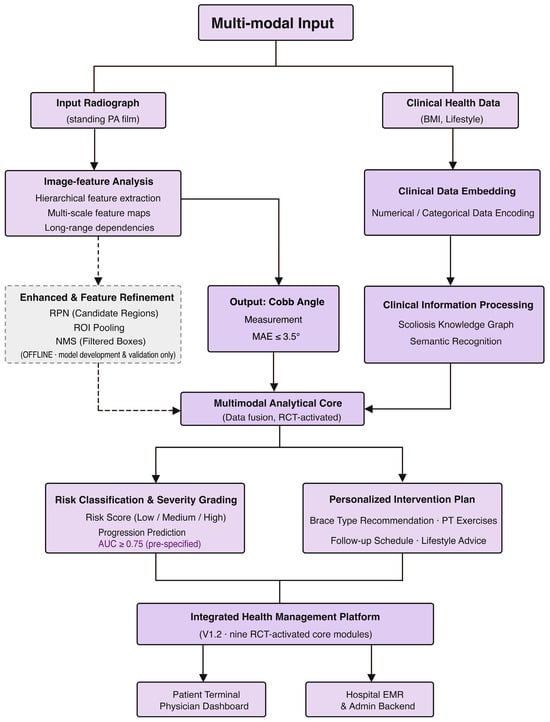
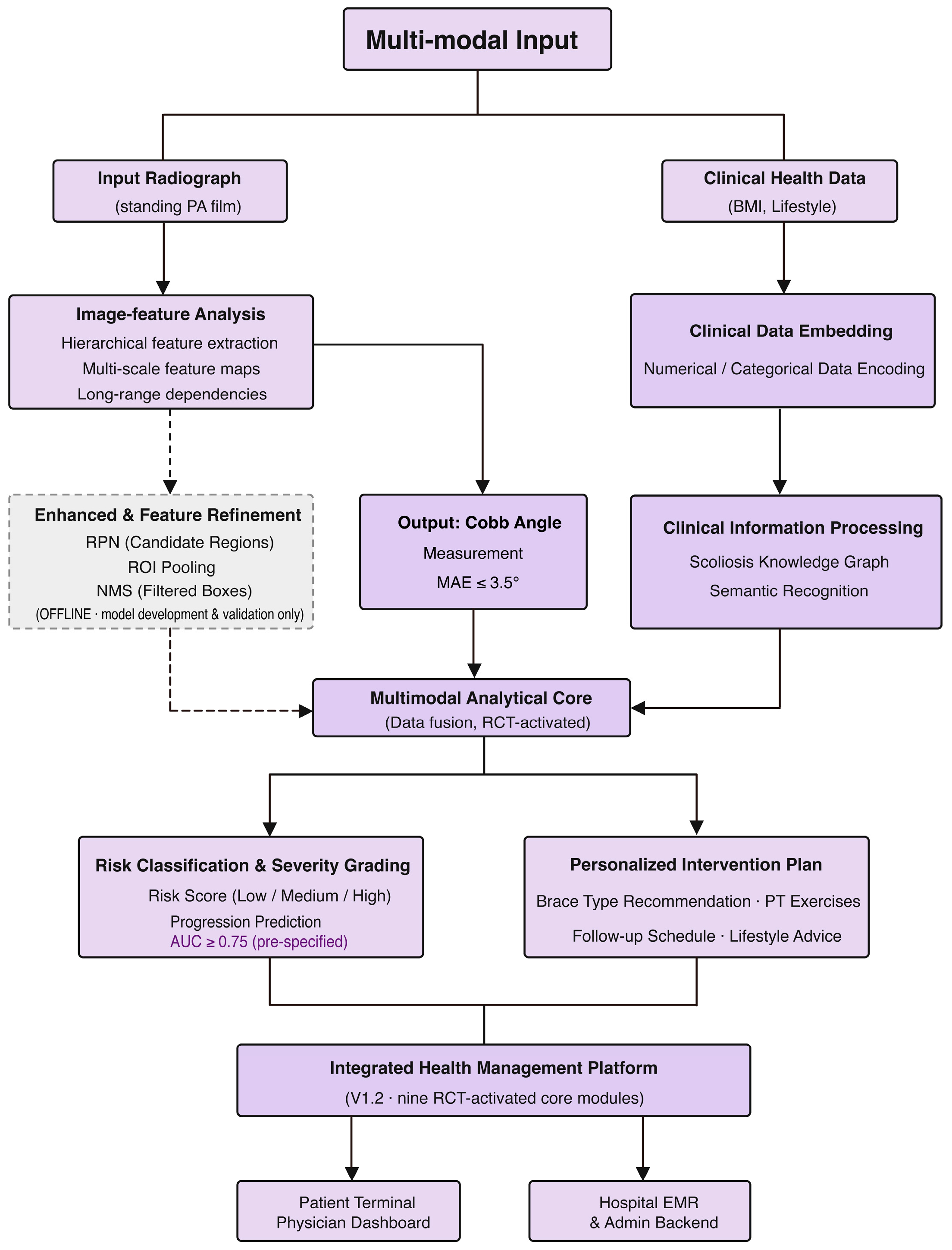
Embedded analytical functions support clinical information extraction and semantic reasoning to assist care planning. Importantly, this system serves solely as a clinical decision-support tool and cannot generate automatic clinical prescriptions. All suggested treatment recommendations produced by the platform must be manually reviewed, adjusted, and formally confirmed by licensed clinicians before being shared with patients. Built-in logical constraints ensure that all outputs align with the SOSORT 2016 guidelines to minimize unreliable outputs. The overall workflow of this multimodal data-driven platform is illustrated in Figure 1.
Figure 1.
Workflow of the multimodal data-driven decision-support system within the comprehensive health management platform. Abbreviations: RPN = Region Proposal Network; ROI = Region of Interest; NMS = Non-Maximum Suppression. Solid-colored blocks indicate functional modules activated during this RCT; grey dashed-box components represent offline analytical modules only used for technical validation and are not executed during the clinical trial. Solid arrows denote the workflow pathway that is executed during the RCT, whereas dashed arrows denote the offline refinement pathway used only for model development and technical validation, which is not activated in the trial.
The platform deployed for this RCT will be version V1.2. Only nine core modules described will be activated for trial participants. Whenever clinicians modify, partially accept, or fully reject platform-generated suggestions, all revision notes, final clinical decision, and reasons for deviation from platform outputs are mandatorily recorded within the platform backend audit log. This audit trail will be exported for secondary process analysis after trial completion.
2.2. Randomized Controlled Trial for Clinical Evaluation
Prior to the initiation of participant enrollment, the multimodal analytical framework satisfied pre-specified performance thresholds on internal and external test datasets: mean absolute Cobb-angle measurement error ≤ 3.5° and AUC for curve progression risk prediction ≥ 0.75. These performance criteria were fully achieved before the first participant was enrolled. Internal and external validation results will be reported in a separate technical manuscript. No genetic samples are being collected for trial participants. We strictly prevented data leakage during model building: patients appearing simultaneously across training, internal validation, and external test datasets were fully excluded.
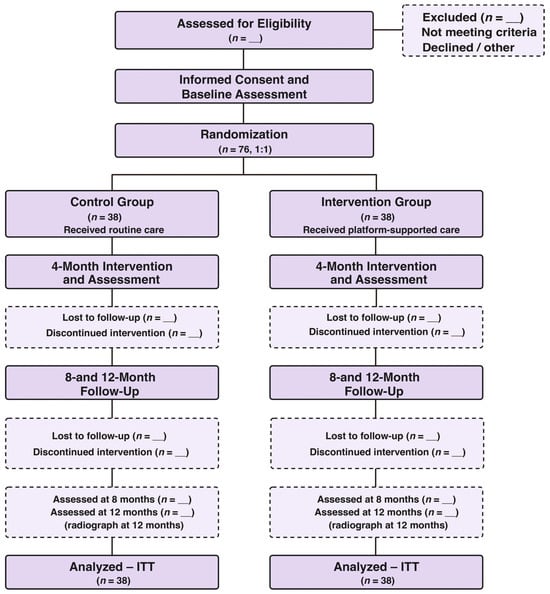
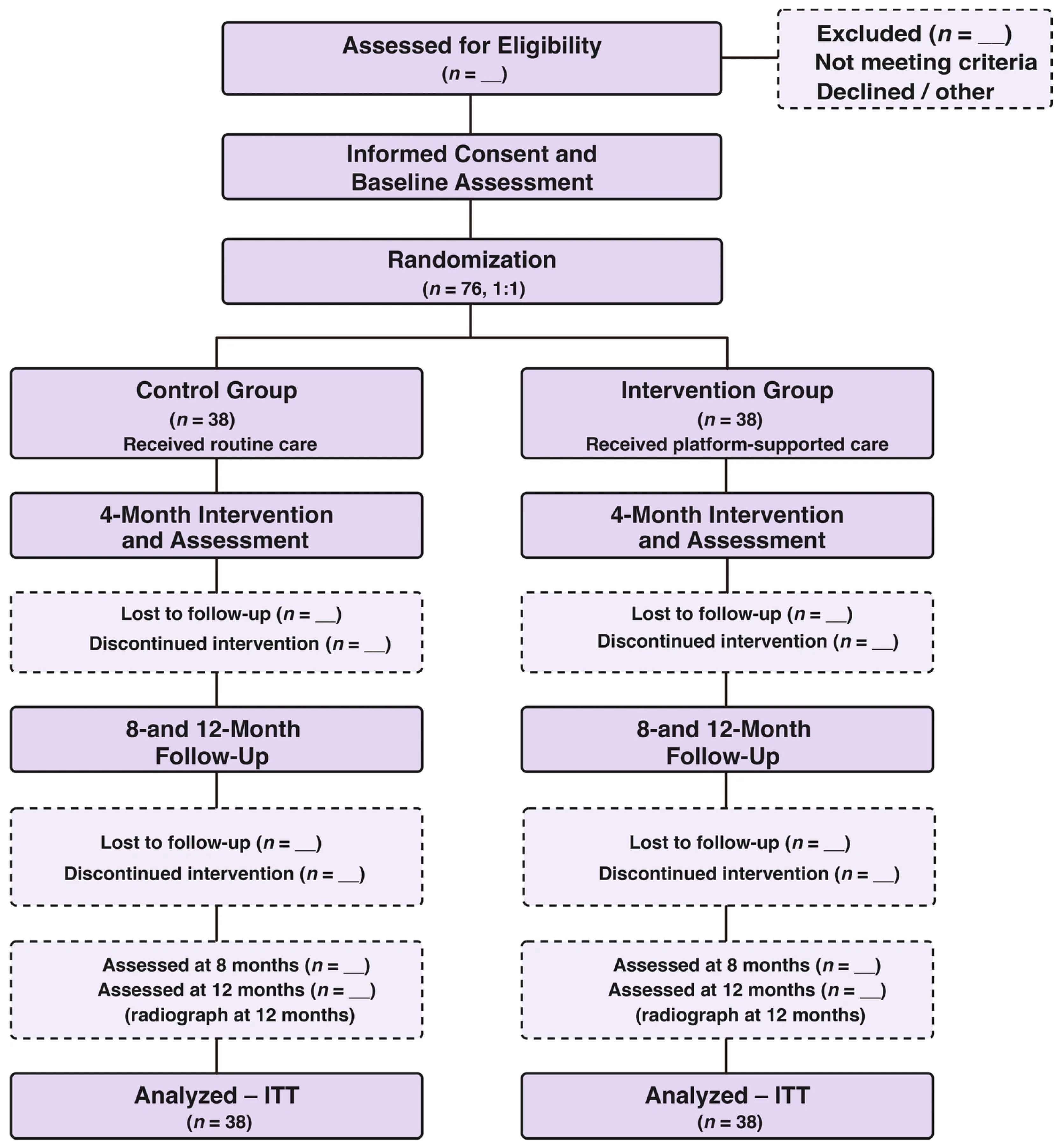
Following completion of platform development and technical validation of the analytical framework, a prospective, parallel-group, assessor-blinded superiority randomized controlled trial (RCT) will be conducted to evaluate the clinical effectiveness of the platform-supported management pathway. The trial will compare platform-supported individualized conservative management with routine guideline-based conservative care (Figure 2). The protocol was developed in accordance with the SPIRIT 2025 statement [12] (Supplementary Materials), and the final trial results will be reported in accordance with the CONSORT guidelines [13].
Figure 2.
CONSORT-style participant flowchart for this superiority randomized controlled trial. Placeholder boxes are embedded within the figure graphic to record numbers of participants lost to follow-up or withdrawn during trial execution; n values will be populated upon trial completion. Solid frames denote participants proceeding through the randomized trial workflow, whereas dashed frames denote participants excluded before randomization, participants lost to follow-up or discontinuing the intervention, and the follow-up assessment checkpoints. ITT = intention-to-treat analysis.
The study protocol was approved by the Institutional Review Board of the Affiliated People’s Hospital of Hangzhou Medical College (approval number: KT2024017). The trial was registered with ClinicalTrials.gov (NCT06314594). The overall study period extends from 1 April 2024 to 31 December 2026. The current ethically approved protocol is V1.0 (KT2024017); the manuscript revision V2.1 (dated 24 October 2026) is prepared for peer review. The first participant was enrolled on 26 March 2025; up to the date of this protocol version, 35 of the target total 76 participants have been recruited.
Each participant will receive the assigned intervention for 4 months and will be followed for a total of 12 months. All registry entries will be cross-checked against this manuscript to maintain consistency for primary endpoint, sample size and assessment time-points.
The protocol amendment history is as follows.
V1.0 (initial version) is the original study protocol submitted for initial ethics review, with ethics approval number KT2024017.
Note 1: An update was submitted and published within ClinicalTrials.gov (NCT06314594) on 20 February 2026. This update was limited to descriptive text clarification on the registry webpage. No substantive trial-related elements (eligibility criteria, sample size, primary/secondary outcomes, randomization, intervention procedures) were altered.
Note 2: V2.1 (dated 24 October 2026) is the revised manuscript prepared exclusively for journal peer-review purposes. All revisions in V2.1 are limited to descriptive clarifications, supplementary methodological explanations, and newly organized summary tables of existing trial workflows. No substantive modifications to trial conduct, eligibility, outcomes, sample size, randomization or intervention modalities have been made.
2.2.1. Participant Recruitment
Participants will be recruited from the Rehabilitation Department of the Affiliated People’s Hospital of Hangzhou Medical College. Study recruitment information will be disseminated via hospital WeChat official accounts, local newspapers, on-site hospital banners, and printed brochures. Eligible candidates can contact research investigators by telephone, message, email or WeChat for screening assessment. Written informed guardian consent will be obtained from legal guardians, and written participant assent will be obtained from all eligible adolescent participants.
Regarding patient and public involvement, no formal patient or public stakeholder consultation was performed for the design of this trial protocol. Participant feedback will be collected during trial implementation to inform future platform optimization.
2.2.2. Sample Size, Randomization and Masking
The sample-size calculation was based on the primary outcome, defined as the change in Cobb angle from baseline to the 4-month intervention endpoint. The hypothesized between-group difference in Cobb-angle change was 4.2°, with a pooled standard deviation of 5.8° for Cobb-angle change scores derived from our single-center pilot observational cohort (pilot n = 29 AIS patients under conservative management). Cohen’s d = 4.2 / 5.8 ≈ 0.72. We note that the minimal clinically important difference (MCID) for the Cobb angle in adolescent idiopathic scoliosis remains debated in the existing literature; a difference of 4–5° is often considered potentially clinically relevant for conservative management trials, though measurement error of the Cobb angle is approximately ±3–5°.
The calculation settings in G*Power 3.1.9.7 are as follows: test family = t test; statistical test = means: difference between two independent means (two groups); two-tailed α = 0.05; power = 0.80; effect size d = 0.72. This yielded 32 evaluable participants per group. Allowing for an anticipated dropout rate of 15%, target sample size increased to 38 participants per group, with the total sample n = 76. Although sample size was computed based on the two-sample t-test for change scores, our primary planned analysis employs an analysis of covariance (ANCOVA) adjusting for the baseline Cobb angle. Published simulation studies indicate that ANCOVA provides higher statistical power than a t-test given an identical sample size; therefore, our sample-size estimate remains conservative for the ANCOVA primary analysis.
The random allocation sequence will be generated using a computer-generated randomization schedule by an independent statistician who is not involved in participant recruitment, intervention delivery, or outcome assessment. Group assignments will be concealed from the investigators responsible for recruitment and baseline assessment. Allocation will be released by the independent statistician only after participant eligibility has been confirmed, written guardian consent and adolescent participant assent have been obtained, and all baseline assessments have been completed.
The hypothesized 4.2° between-group difference was derived from our pilot observational cohort (n = 29) and sits at the boundary of the acknowledged Cobb-angle measurement error (approximately ±3–5°). We therefore acknowledge that part of the observed difference could reflect measurement variability rather than true structural change. To address this, the trial adopts three safeguards: (1) standardized blinded measurement with third-assessor arbitration for disagreements > 3°; (2) interpretation of the primary result will be framed around the estimated treatment effect and its 95% confidence interval in relation to both the measurement-error range and the debated MCID, rather than relying on statistical significance alone; (3) the 12-month radiograph will be used to evaluate whether any early difference is maintained or reflects only transient postural correction.
This study is designed as a superiority trial to determine whether platform-supported individualized conservative management produces better clinical outcomes than routine guideline-based conservative care. Because participants and treating physiotherapists will be aware of the assigned treatment, they cannot be blinded to group allocation. However, outcome assessors responsible for clinical evaluations and Cobb-angle measurements will remain blinded to group allocation. Statistical analysts will analyze groups using masked labels and will remain unaware of the allocation code until completion of the pre-specified primary analysis and database lock.
2.2.3. Eligibility Criteria
The inclusion criteria are as follows:
1. Clinical diagnosis: a confirmed diagnosis of mild-to-moderate adolescent idiopathic scoliosis (AIS), characterized by a Cobb angle of 10° ≤ Cobb angle < 45°.
2. Age range: patients aged between 12 and 16 years, a window that targets adolescents in the active pubertal growth phase, in whom conservative management (PSSE and bracing) is clinically prioritized. Skeletal maturity is an exclusion-related condition: participants with Risser grade 5 or Sanders stage 8 (complete skeletal maturity) are not eligible. Eligible participants must have open triradiate/iliac growth potential consistent with Risser 0–4 or Sanders 1–7.
3. Cognitive and communicative ability: participants must have sufficient cognitive and communicative ability to understand the study procedures and use the platform. Severe cognitive or psychiatric conditions that preclude informed assent or participation will constitute exclusion criteria.
4. Informed consent and assent: voluntary participation confirmed by signed guardian consent and adolescent participant assent.
5. Baseline data collection: Risser sign/Sanders skeletal maturity classification, curve pattern, index major Cobb curve, and history of prior conservative treatments (PSSE/bracing) will be systematically documented for all participants. Randomization will be stratified by two key prognostic factors: baseline Cobb-angle strata (10–24°; 25–44°) and skeletal maturity (Risser 0–2 versus Risser 3–4) to mitigate baseline imbalance across groups. Participants with Risser grade 5 are excluded from enrollment and will therefore not enter randomization.
Participants with prior conservative treatment (PSSE or bracing) are permitted to enroll, provided their treatment regimen has been stable for ≥3 months prior to baseline assessment. For participants presenting multiple spinal curves, the major index curve (the curve with a maximum baseline Cobb angle) will be selected for primary outcome analysis.
Exclusion criteria are as follows:
1. Secondary scoliosis: a history of scoliosis caused by identifiable causes such as spinal trauma or prior spinal surgery.
2. Systemic pathologies: clinically significant severe functional impairment of heart, liver or kidney organ function, defined as grade 3 or higher organ dysfunction according to the Common Terminology Criteria for Adverse Events (CTCAE v5.0).
3. Other severe conditions: malignant tumors, autoimmune diseases, or other critical systemic illnesses that may interfere with trial outcomes.
4. Severe cognitive or psychiatric conditions: diagnosed intellectual disability, psychotic disorders or major depressive disorder under active psychiatric intervention that prevents obtaining valid assent or completing study assessments.
2.2.4. Trial Interventions
Both groups will have access to the same guideline-based conservative treatment options, including observation, physiotherapeutic scoliosis-specific exercises, specialized inpatient rehabilitation, and bracing. The principal between-group difference lies in the service model supporting treatment selection, delivery, adherence monitoring, and ongoing follow-up. The control group will receive routine clinician-directed care, whereas the intervention group will receive clinician-supervised care delivered with support from the comprehensive health management platform. All participants receive standard care following standard operating procedures (SOPs) and the 2016 SOSORT guidelines. Interventions are delivered by physical therapists certified by the Barcelona Scoliosis Physical Therapy School (BSPTS) with at least five years of clinical experience.
Control group (routine treatment)
Participants in the control group receive conventional management according to 2016 SOSORT guidelines:
- -
- Observation: regular clinical follow-up assessments with intervals of 3–8 months determined by clinical condition.
- -
- Physiotherapeutic scoliosis-specific exercises (PSSEs): 2–7 sessions per week, including 3D auto-correction, activities of daily living training, respiratory exercises (e.g., Schroth breathing), and spinal stabilization training [14].
- -
- Special inpatient rehabilitation (SIR): a 4-week intensive rehabilitation program (1 h/day, 5 days per week) for participants with large curve magnitude or high progression risk.
- -
- Bracing: prescribed according to skeletal maturity and curve severity, including Nighttime Rigid Bracing (NTRB, 8 h/day), Part-Time Rigid Bracing (PTRB, 15 h/day), and Full-Time Rigid Bracing (FTRB, 20 h/day) [15].
Intervention group (clinician-supervised, platform-assisted conservative management)
Participants assigned to the intervention group will receive individualized conservative management supported by the comprehensive health management platform. Drawing on clinical characteristics, radiographic findings, and lifestyle-related risk factors, the platform generates decision-support recommendations for observation, physiotherapeutic scoliosis-specific exercises (PSSEs), specialized inpatient rehabilitation (SIR), or bracing. During follow-up, real-world treatment-adherence data can further inform clinical treatment adjustments. Critically, all platform-generated recommendations must be reviewed, modified as needed, and formally approved by a licensed clinician prior to implementation; the platform cannot issue autonomous clinical prescriptions or override clinical judgement.
Throughout the intervention and follow-up phases, the platform delivers practical functions including treatment reminders, standardized health education, follow-up scheduling, and cross-party communication linking participants, families, schools, and healthcare providers to realize the home–school–hospital collaborative care model. Platform engagement will be evaluated using patient-interface login frequency and usage duration. Exercise adherence will be assessed using completion records for assigned PSSE sessions, exercise logs, and periodic video uploads. Brace adherence will be assessed using wear-time data obtained from wearable sensors, when available, or standardized daily self-report logs [16]. Clinicians review all collected information and implement clinically necessary treatment adjustments in strict accordance with the 2016 SOSORT guidelines. Family guardians are responsible for supervising daily home exercise and brace wearing; schools only receive aggregated health education reminders and take no individual clinical decision roles.
To enable unbiased between-group comparison of treatment adherence, completion of prescribed PSSE sessions and brace wear time will be assessed in both groups using identical definitions and assessment intervals. Platform login frequency and usage duration will be analyzed only as process indicators for the intervention group and will not be incorporated into the primary between-group adherence comparison.
Mechanistic pathway linking the platform to the primary outcome
The platform does not directly modify spinal morphology. Its expected effect on Cobb-angle outcomes operates through an intermediate pathway: (1) standardized digital education and automatic reminders increase adherence to prescribed PSSE sessions and brace wear regimens; (2) secure home–school–hospital communication improves the early identification and resolution of treatment-related problems; (3) structured follow-up scheduling reduces missed visits and care gaps. Improved treatment adherence and continuity of care are the hypothesized mediators that may translate into measurable Cobb-angle changes within the 4-month observation window, with 12-month radiography assessing longer-term curve evolution. Platform use continues throughout the entire 12-month follow-up period for the intervention group (reminders, follow-up scheduling, adherence entry and communication remain active), although the pre-specified intensity of the active intervention phase is the first 4 months.
Distinction between study arms and contamination control
In the control group, routine outpatient-based care, including face-to-face consultation, paper-based education materials, and clinic-driven follow-up appointment reminders via telephone/SMS will take place. There will be no access to the digital health management platform.
In the intervention group, all clinical treatment decisions are clinician-led; the platform adds standardized digital education modules, automatic treatment reminders, exercise/brace adherence self-report entry channels, a secure home–school–hospital message communication module, and automated follow-up scheduling. The platform does not alter clinical treatment selection criteria for observation, PSSEs, inpatient rehabilitation or bracing; treatment selection rules strictly follow SOSORT 2016 in both groups.
Participants are prohibited from initiating new external scoliosis-related rehabilitation treatments outside of study-assigned care during trial participation; any additional co-interventions sought by participants will be fully recorded within the CRFs. To minimize clinician-driven cross-contamination, physiotherapists delivering direct patient care are assigned exclusively either to control group patients OR intervention group patients; they will not manage participants from both trial arms simultaneously.
Regarding the 4-month primary endpoint, we acknowledge that a 4-month observation is relatively short for large structural permanent spinal curve modification, and observed Cobb-angle changes may partially reflect measurement noise or temporary postural correction. The 4-month time-point was selected because we aim primarily to evaluate whether platform-supported care can produce early measurable changes under conservative management. Twelve-month radiograph assessment will capture longer-term curve evolution. These limitations are further addressed within the Section 3.
Regarding therapist-effect documentation, the number of participating physiotherapists, the number of participants managed by each therapist, and therapist allocation to trial arms will be systematically recorded. Given that therapists are assigned exclusively to one trial arm, potential therapist-related clustering will be examined in a sensitivity analysis (e.g., adding therapist as a random effect or fixed covariate) to assess whether results are robust to therapist-level variation.
A detailed comparison of care-delivery components for the control and intervention groups is presented in Table 1. This trial evaluates the overall integrated care-package effect rather than isolating the independent contribution of individual platform analytical modules.
Table 1.
Comparison of care components between the control and intervention groups.
2.2.5. Outcome Measures
Outcome assessments will be conducted at baseline and at 4, 8, and 12 months, as summarized in Table 2. Cobb-angle radiographs are obtained at baseline, 4 and 12 months only; mental health status and safety outcomes are assessed at all four time points.
Table 2.
Study assessment schedule.
The primary outcome is the change in Cobb angle from baseline to the 4-month endpoint (baseline Cobb angle minus 4-month Cobb angle; positive value represents curve improvement).
The Cobb angle will be measured on standing posteroanterior full-spine radiographs by two independent outcome assessors blinded to group allocation, patient identity and assessment time sequence. Both assessors are board-certified spine rehabilitation physicians following SRS measurement protocols. When disagreement exceeds 3°, a third senior spine specialist arbitrates to achieve final consensus value. Before radiography for follow-up visits, patients wearing braces are required to remove braces for at least 24 h before X-ray acquisition to avoid transient postural correction artefacts on Cobb-angle readings.
To prevent unblinding, all radiograph images are de-identified; brace hardware annotations and platform-related notes are stripped from image metadata. Assessors cannot access any other trial data (adherence log, clinical notes). We will conduct periodic blinding-integrity checks after database lock to document any accidental unblinding events.
Regarding radiation protection, radiographs are only acquired at pre-specified time-points (baseline, 4 months, 12 months); no extra radiographs will be ordered for trial purposes. Low-dose pediatric spinal X-ray protocols are applied for all participants to reduce cumulative radiation exposure for adolescents.
The primary analysis uses ANCOVA with the month-4 Cobb angle as the dependent variable, adjusted for baseline Cobb angle and the pre-specified stratification covariates (baseline Cobb-angle stratum: 10–24°/25–44°; skeletal maturity stratum: Risser 0–2/3–4), with treatment group as a fixed effect. This is equivalent to a baseline-adjusted comparison of Cobb-angle change. A lower adjusted mean month-4 Cobb angle in the intervention group indicates greater curve improvement. The adjusted between-group mean difference and its 95% confidence interval will be reported.
Secondary outcomes are as follows.
1. Treatment adherence will be assessed as follows.
For participants prescribed PSSE, exercise adherence = number of completed prescribed PSSE sessions/total number of prescribed sessions × 100%.
For participants prescribed bracing, brace wear adherence = actual wear-time/prescribed daily wear-time × 100%.
For participants under observation only (no PSSE/no bracing assigned), adherence outcome will be coded as “not-applicable” and excluded from adherence comparative analysis.
For participants receiving both PSSE and bracing, two separate adherence indices will be computed respectively.
To guarantee measurement equivalence across trial arms, in both the control and intervention groups, exercise completion relies on standardized patient self-report logs plus periodic short exercise video upload review; brace wear time will use the patient daily logbook for all subjects (wearable-sensor data are only optionally available in the intervention group and will not serve as a primary adherence source for between-group comparison). Platform login frequency and usage duration will be analyzed only as intervention-group process measures and will not be included in the between-group adherence outcome comparison.
2. Mental-health status will be assessed using the 17-item Hamilton Depression Rating Scale (HAMD-17) at baseline and at 4, 8, and 12 months. The HAMD-17 has been widely used to quantify depressive symptom severity in adolescent samples; its age-specific psychometric properties are less extensively established than in adults. To mitigate this limitation, all HAMD-17 interviews will be conducted face-to-face by trained research investigators blinded to group allocation, using standardized anchor descriptions, and the same rater will not necessarily assess the same participant across visits to reduce rater-related bias.
3. Regarding medical expenditure, cumulative direct out-of-pocket medical expenses related to scoliosis management will be recorded at 4 and 12 months from the family/guardian out-of-pocket perspective (direct medical expenses only). Indirect costs and productivity losses are not captured in this trial.
4. Participant and guardian medical satisfaction will be evaluated using a custom standardized satisfaction questionnaire covering satisfaction with treatment process, platform usability (intervention group only), and overall care experience.
Safety outcomes will be analyzed as follows.
Safety monitoring will include vital-sign measurements and systematic documentation of adverse events related to PSSEs, bracing, or other study interventions. Adverse events will be recorded throughout the intervention and follow-up periods. Serious adverse events will be promptly evaluated, managed according to institutional procedures, and reported to the ethics committee within the required timeframe.
Regarding treatment-prescription recording, for every participant, the type of treatment (observation/PSSE/SIR/bracing), prescribed dose (sessions per week for PSSE; hours per day for bracing), planned duration, and all subsequent treatment changes (including reasons and dates) will be recorded in the case report form. These data will be used to describe the actual treatment received and to support exploratory analyses of treatment-type effects.
Regarding the handling of missing adherence data, a given week’s exercise or brace adherence will be treated as missing if more than 3 consecutive days of logbook entries or the scheduled weekly video review are missing without documented justification. Participants with more than 30% missing adherence weeks during the 4-month intervention will be flagged; the primary adherence analysis will use available data, and sensitivity analyses will be repeated after excluding flagged participants to assess robustness. Logbook entries will be cross-checked against periodic video reviews where available.
2.2.6. Data Monitoring
The research team takes full responsibility for data management to guarantee authenticity, completeness and participant privacy. Case report forms (CRFs) are filled out by principal investigators or authorized qualified researchers; only medically qualified personnel can input original clinical assessment and safety data. Any data modification must record the researcher’s name, revision date and reason for change, together with their signature. Standard operating procedures are followed for trial quality control and quality assurance.
All trial observations will be verified to guarantee data reliability. Quality control measures will be implemented throughout data processing. Interventions in this trial may produce mild adverse events including pain, numbness or bruising. Serious adverse events must be reported immediately. When serious adverse events occur, immediate clinical treatment and safety evaluation will be performed according to institutional SOP. Experiencing SAE does not automatically trigger full withdrawal from the study. Depending on clinical judgement, participants may discontinue trial intervention but continue scheduled outcome follow-up assessments; all collected data will remain included within intention-to-treat analysis. Permanent full withdrawal from the trial will only occur when guardians/adolescents formally revoke written informed assent/consent. All adverse events are recorded on CRFs and notified to trial statisticians.
Regarding digital platform data access and privacy protection, all participant clinical data are pseudonymized before platform storage. Schools can only receive aggregated de-identified population-level health education reminders; schools cannot access individual-level patient clinical records, Cobb-angle results or personal mental health information. Individual-level data access is strictly limited to treating clinicians, research team members and ethics auditors. Legal guardians hold full access rights for their minor children’s platform records.
2.2.7. Statistical Analysis
Statistical analyses will be performed using SPSS version 22.0 (IBM Corp., Armonk, NY, USA). Data management and statistical analyses will be conducted by independent biostatisticians who will remain blinded to the group labels until completion of the pre-specified primary analysis. All statistical tests will be two-sided, and a p value < 0.05 will be considered statistically significant.
The primary analysis will follow the intention-to-treat principle and will include all randomized participants in the groups to which they were originally assigned, regardless of treatment adherence, protocol deviations, withdrawal, or loss to follow-up. A per-protocol analysis including participants who complete the intervention without major protocol violations will be conducted as a sensitivity analysis. Missing primary outcome data will be handled using multiple imputation under the missing-at-random assumption.
Continuous variables will be summarized as the mean and standard deviation when approximately normally distributed and as the median and interquartile range when non-normally distributed. Categorical variables will be summarized as frequencies and percentages. The distribution of continuous variables and model residuals will be assessed using graphical methods and the Shapiro–Wilk test, where appropriate.
The primary analysis will compare the Cobb angle at the 4-month endpoint between the intervention and control groups using analysis of covariance, with treatment group included as a fixed effect and baseline Cobb angle, Cobb-angle severity stratum (10–24°/25–44°) and skeletal maturity stratum (Risser 0–2/3–4) included as covariates. The stratified randomization factors are thereby accounted for in the primary adjusted model, consistent with the randomization design. The adjusted between-group mean difference and its 95% confidence interval will be reported. Model assumptions will be evaluated using residual diagnostics. If these assumptions are substantially violated, an appropriate robust or nonparametric analysis will be conducted as a sensitivity analysis.
For secondary outcomes measured repeatedly during follow-up, including HAMD scores (baseline and 4, 8, 12 months) and medical satisfaction scores (4, 12 months), linear mixed-effects models will be used to evaluate changes over time. Because radiographs are obtained at baseline and at 4 and 12 months only (no radiograph at month 8), Cobb-angle change over the 12-month period will be analyzed separately using a paired comparison of the 12-month radiograph against baseline and a between-group comparison of the 12-month change, rather than being included in the four-time-point mixed model. The models will include fixed effects for treatment group, time, and the group-by-time interaction, with a participant-specific random intercept to account for within-participant correlations. Estimated between-group differences at each assessment time point and their 95% confidence intervals will be reported.
Between-group differences in treatment adherence at the 4-month endpoint will be analyzed using an independent-samples t-test when the data are approximately normally distributed or a Mann–Whitney U test when the distributional assumption is not satisfied. Secondary outcome analyses will be considered exploratory. Multiple imputation assumes data are missing-at-random. As a sensitivity analysis, we will additionally conduct complete-case analysis and pattern-mixture-model-based sensitivity analyses to explore the robustness of conclusions under missing-not-at-random scenarios. Treatment-type and treatment-change variables will be explored as effect modifiers in exploratory subgroup analyses.
3. Discussion
Given the high prevalence of adolescent idiopathic scoliosis (AIS), together with practical bottlenecks including fragmented follow-up and limited care coordination after diagnosis among families, schools and hospitals, effective prevention and management of AIS remain a major challenge for clinical practice and public health [3,6,7]. This protocol describes a closed-loop, multi-dimensional care workflow underpinned by a “home–school–hospital” linkage model. Through integrated functional modules include electronic health file creation, disease risk early warning, health intervention promotion, health education, follow-up management, system administration, data quality control audit, data analysis, and visual display, the proposed comprehensive health management platform enables information sharing among patients, schools, and clinical providers.
It facilitates timely, guideline-based conservative intervention and is expected to advance personalized, systematic, digital-enabled prevention and management for adolescents living with AIS.
3.1. Expected Contributions of the Proposed Platform
Timely initiation and sustained delivery of conservative intervention are critical for AIS management, as missed therapeutic windows may lead to progressive spinal deformity. Conservative treatments dominated by corrective exercise and bracing are the mainstay for mild-to-moderate AIS [17,18]. Existing digital screening solutions mostly focus on radiographic measurement alone, lacking end-to-end management covering risk stratification, personalized intervention suggestion, and long-term follow-up. Our platform integrates multi-source clinical and lifestyle data to deliver clinical decision support and generate stratified prevention–treatment recommendations for adolescents with AIS. The “home–school–hospital” collaborative communication mode, initiated from hospital clinical care, may alleviate barriers associated with fragmented follow-up pathways after diagnosis. Schools in this model only receive aggregated health education reminders and do not perform clinical assessment or treatment for individual participants. This service-oriented model contributes toward building a sustainable and practical care system for the ongoing conservative management of adolescents already diagnosed with adolescent idiopathic scoliosis. It should be emphasized that evidence generated by this RCT applies to follow-up and conservative management for already diagnosed AIS patients recruited from hospital rehabilitation departments. This trial does not provide evidence supporting school-based population-level screening performance of this digital platform, which needs separate dedicated validation research.
3.2. Strengths of the Present RCT Design
The prospective randomized controlled trial in this study strictly follows the CONSORT reporting guidelines. We adopted an assessor-blinded design, in which outcome evaluators and statistical analysts remain blinded to group allocation to reduce detection bias. Both intention-to-treat (ITT) primary analysis and supplementary per-protocol (PP) sensitivity analysis will be performed to improve the robustness of clinical evidence. Multiple dimensions of outcomes are assessed in this trial: besides Cobb-angle change as the primary endpoint, we also evaluate treatment adherence, psychological status, medical-care expenditure, and patient–guardian satisfaction. Such multi-indicator assessment framework allows comprehensive evaluation of the real-world value of this digital health supported care pathway.
3.3. Anticipated Limitations
Several potential limitations of this study should be acknowledged in advance. First, the adherence-tracking module partially depends on patient self-reporting and self-initiated check-in records, which may introduce reporting bias. Second, participants will be recruited from a single-center hospital rehabilitation department, which may limit generalizability to community-screened adolescent populations. The “home–school–hospital” collaboration model is tested within hospital-initiated care pathways rather than pure community-led school-screening pathways. Third, the reliability of platform-generated decision-support outputs is constrained by the scope and diversity of underlying training datasets. Fourth, the primary 4-month endpoint may be affected by Cobb-angle measurement error and transient postural correction rather than purely permanent structural curve modification; 12-month radiograph assessment will capture longer-term spinal-curve progression outcomes. At the time of this protocol manuscript submission, 35 out of the planned 76 participants have been recruited. Although no outcome data have been unlocked for analysis, partial recruitment is ongoing, which introduces a theoretical risk for recruitment-related bias; strict adherence to pre-specified randomization, blinding, and statistical analysis plans will be followed to mitigate such risk.
3.4. Future Research Directions
Due to the individualized nature of online treatment plans formulated by clinicians, monitoring and evaluating real-world patient adherence remains challenging [19]. After completion of the present RCT, further evidence will be required to verify whether platform-supported personalized therapy improves exercise compliance, self-perception and mental health outcomes among adolescents with AIS. At present, high-quality comparative evidence for diverse conservative interventions (including massage therapy, posture guidance, and Schroth exercises) remains insufficient [20]. Further multi-center clinical trials and pooled analyses of retrospective real-world datasets are warranted to compare the effectiveness of different conservative modalities for adolescent idiopathic scoliosis.
4. Conclusions
This protocol describes a single-center, parallel-group, assessor-blinded superiority randomized controlled trial designed to determine whether a clinician-supervised, platform-supported collaborative care pathway can improve conservative management for adolescents with established mild-to-moderate AIS. Rather than replacing clinical judgement or evaluating population-level scoliosis screening, the intervention supplements guideline-based care with standardized health education, adherence monitoring, follow-up scheduling, and coordinated communication across home, school, and hospital settings. The trial will primarily evaluate the baseline-adjusted between-group difference in the Cobb angle at the 4-month endpoint, while 12-month follow-up will assess longer-term curve evolution. Secondary outcomes will examine treatment adherence, mental health status, medical expenditure, participant and guardian satisfaction, and safety. Pre-specified randomization, blinded outcome assessment, intention-to-treat analysis, and sensitivity analyses are intended to strengthen the validity of the findings. The results will clarify the clinical effectiveness and care-process value of this digitally supported management pathway within hospital-initiated conservative care. Given the single-center design and the absence of population-level screening validation, any favorable findings will require confirmation in multi-center studies and separate external validation before broader implementation.
Supplementary Materials
The following supporting information can be downloaded at https://www.mdpi.com/article/10.3390/healthcare14223947/s1, Supplementary File: SPIRIT 2025 checklist of items to address in a randomized trial protocol.
Author Contributions
Conceptualization, X.L.; methodology, Q.Z. and X.L.; software, X.L.; validation, R.H.; formal analysis, X.L.; investigation, Q.Z., Z.Y. and R.H.; resources, Z.Y. and X.L.; data curation, X.L.; writing—original draft preparation, Q.Z., L.Z. and R.H.; writing—review and editing, Q.Z. and R.H.; visualization, Q.Z. and R.H.; supervision, R.H.; project administration, Z.Y. and X.L.; funding acquisition, Z.Y. and X.L. All authors have read and agreed to the published version of the manuscript.
Funding
This research was funded by the Zhejiang Provincial Medical and Health Science and Technology Program, grant number 2024KY920.
Institutional Review Board Statement
The study will be conducted in accordance with the Declaration of Helsinki and was approved by the Institutional Review Board of the Affiliated People’s Hospital of Hangzhou Medical College (protocol code KT2024017, 9 February 2026).
Informed Consent Statement
Written informed consent will be obtained from the legal guardians of all participants before enrollment. Written assent will also be obtained from adolescent participants before enrollment.
Data Availability Statement
No new data were generated or analyzed for this protocol article. Following completion of the trial, de-identified aggregated data may be made available by the corresponding author upon reasonable request, subject to ethical approval, participant confidentiality requirements, and applicable institutional policies.
Acknowledgments
The Generative-AI tool ChatGPT (GPT-4, OpenAI, San Francisco, CA, USA) was used for language polishing and minor text-structure revision. All contents were fully reviewed, revised and approved by all authors, and the authors take full final responsibility for the manuscript. The trial was registered prospectively at ClinicalTrials.gov (NCT06314594). Registry entries have been kept updated in accordance with protocol version revisions. First participant enrollment date (as registered): 26 March 2025. We confirm that the ClinicalTrials.gov record (NCT06314594) is consistent with this protocol regarding the primary endpoint, target sample size (n = 76), randomization design, and assessment time points.
Conflicts of Interest
The authors declare no conflicts of interest.
References
- Cheng, J.C.; Castelein, R.M.; Chu, W.C.; Danielsson, A.J.; Dobbs, M.B.; Grivas, T.B.; Gurnett, C.A.; Luk, K.D.; Moreau, A.; Newton, P.O.; et al. Adolescent idiopathic scoliosis. Nat. Rev. Dis. Primers 2015, 1, 15030. [Google Scholar] [CrossRef] [Scilit]
- Horne, J.P.; Flannery, R.; Usman, S. Adolescent idiopathic scoliosis: Diagnosis and management. Am. Fam. Physician 2014, 89, 193–198. [Google Scholar]
- Cao, J.; Sun, W.; Zheng, Y.; Shan, S.; Liu, Y.; Huang, X.; Tang, K.; Zhu, Y.; Adeloye, D.; Rudan, I.; et al. Variations in the prevalence of scoliosis by age, sex, geographic region, and subtype among Chinese children: A systematic review and modelling study. J. Glob. Health 2024, 14, 04062. [Google Scholar] [CrossRef] [Scilit]
- Guan, Y.; Zhao, B.; Fan, Y.; Li, Y.; Wang, H. Protective and risk physical activities for adolescent idiopathic scoliosis: A systematic review identifying one-hour daily activity threshold and Chinese school-based prevention framework. Front. Sports Act. Living 2025, 7, 1644314. [Google Scholar] [CrossRef] [Scilit]
- Dou, Q.; Zhu, Z.; Zhu, L.; Wang, W.; Guo, L.; Ru, S.; Chen, X.; Yang, L.; Lu, C.; Yan, B. Academic-related factors and daily lifestyle habits associated with adolescent idiopathic scoliosis: A case-control study. Environ. Health Prev. Med. 2023, 28, 23. [Google Scholar] [CrossRef] [Scilit]
- Dunn, J.; Henrikson, N.B.; Morrison, C.C.; Blasi, P.R.; Nguyen, M.; Lin, J.S. Screening for adolescent idiopathic scoliosis: Evidence report and systematic review for the US Preventive Services Task Force. JAMA 2018, 319, 173–187. [Google Scholar] [CrossRef] [Scilit]
- Guo, Y.; Jiang, Q.; Tanimoto, T.; Kami, M.; Luo, C.; Leppold, C.; Nishimura, K.; He, Y.; Kato, S.; Ding, X. Low hospital referral rates of school scoliosis screening positives in an urban district of mainland China. Medicine 2017, 96, e6481. [Google Scholar] [CrossRef] [Scilit]
- Yuan, W.; Shi, W.; Chen, L.; Liu, D.; Lin, Y.; Li, Q.; Lu, J.; Zhang, H.; Feng, Q.; Zhang, H.; et al. Digital physiotherapeutic scoliosis-specific exercises for adolescent idiopathic scoliosis: A randomized clinical trial. JAMA Netw. Open 2025, 8, e2459929. [Google Scholar] [CrossRef] [Scilit]
- Cordani, C.; Malisano, L.; Febbo, F.; Giranio, G.; Del Furia, M.J.; Donzelli, S.; Negrini, S. Influence of specific interventions on bracing compliance in adolescents with idiopathic scoliosis—A systematic review of papers including sensors’ monitoring. Sensors 2023, 23, 7660. [Google Scholar] [CrossRef] [Scilit]
- Guan, Y.; Xu, J.; Liu, Z.; Qin, Q.; Wang, X.; An, C.; Wang, G.; Zhang, Z.; Gong, M.; Zhao, B. Application of digital health technologies in scoliosis rehabilitation: Systematic review based on the technology classification framework. J. Med. Internet Res. 2026, 28, e91461. [Google Scholar] [CrossRef] [Scilit]
- Goldman, S.N.; Hui, A.T.; Choi, S.; Mbamalu, E.K.; Tirabady, P.; Eleswarapu, A.S.; Gomez, J.A.; Alvandi, L.M.; Fornari, E.D. Applications of artificial intelligence for adolescent idiopathic scoliosis: Mapping the evidence. Spine Deform. 2024, 12, 1545–1570. [Google Scholar] [CrossRef] [Scilit]
- Chan, A.W.; Boutron, I.; Hopewell, S.; Moher, D.; Schulz, K.F.; Collins, G.S.; Tunn, R.; Aggarwal, R.; Berkwits, M.; Berlin, J.A.; et al. SPIRIT 2025 statement: Updated guideline for protocols of randomised trials. BMJ 2025, 389, e081477. [Google Scholar] [CrossRef] [Scilit]
- Hopewell, S.; Chan, A.W.; Collins, G.S.; Hróbjartsson, A.; Moher, D.; Schulz, K.F.; Tunn, R.; Aggarwal, R.; Berkwits, M.; Berlin, J.A.; et al. CONSORT 2025 statement: Updated guideline for reporting randomised trials. BMJ 2025, 389, e081123. [Google Scholar] [CrossRef] [Scilit]
- Akyurek, E.; Zengin Alpozgen, A.; Akgul, T. The preliminary results of physiotherapy scoliosis-specific exercises on spine joint position sense in adolescent idiopathic scoliosis: A randomized controlled trial. Prosthet. Orthot. Int. 2022, 46, 510–517. [Google Scholar] [CrossRef] [Scilit]
- Donzelli, S.; Fregna, G.; Zaina, F.; Livetti, G.; Reitano, M.C.; Negrini, S. Predictors of clinically meaningful results of bracing in a large cohort of adolescents with idiopathic scoliosis reaching the end of conservative treatment. Children 2023, 10, 719. [Google Scholar] [CrossRef] [Scilit]
- Fazeli Veisari, S.; Bidari, S.; Barati, K.; Atlasi, R.; Komeili, A. Wearable devices in scoliosis treatment: A scoping review of innovations and challenges. Bioengineering 2025, 12, 696. [Google Scholar] [CrossRef] [Scilit]
- Negrini, S.; Donzelli, S.; Aulisa, A.G.; Czaprowski, D.; Schreiber, S.; de Mauroy, J.C.; Diers, H.; Grivas, T.B.; Knott, P.; Kotwicki, T.; et al. 2016 SOSORT guidelines: Orthopaedic and rehabilitation treatment of idiopathic scoliosis during growth. Scoliosis Spinal Disord. 2018, 13, 3. [Google Scholar] [CrossRef] [Scilit]
- Romano, M.; Minozzi, S.; Bettany-Saltikov, J.; Zaina, F.; Chockalingam, N.; Kotwicki, T.; Maier-Hennes, A.; Arienti, C.; Negrini, S. Therapeutic exercises for idiopathic scoliosis in adolescents. Cochrane Database Syst. Rev. 2024, 2, CD007837. [Google Scholar] [CrossRef] [Scilit]
- Sykorova, K.; Mathew, A.; Pavel, N.; Gazerani, P.; Saidi, T.; Bakke Johnsen, M.; Lystad, J.U.; Bull, H.; Kvammen, M.F.; He, H.G.; et al. Exploring stakeholders’ perceptions of using digital health technologies to improve the conservative treatment of adolescent idiopathic scoliosis: Qualitative study. J. Med. Internet Res. 2025, 27, e69089. [Google Scholar] [CrossRef] [Scilit]
- Huang, B.; Jin, Y.; Ye, R.; Wang, Y.; Peng, S.; Tang, Q.; Ma, S. Efficacy of traditional Chinese massage therapy combined with Schroth therapy in patients with adolescent idiopathic scoliosis: A meta-analysis. Front. Pediatr. 2026, 14, 1638835. [Google Scholar] [CrossRef] [Scilit]

Disclaimer/Publisher’s Note: The statements, opinions and data contained in all publications are solely those of the individual author(s) and contributor(s) and not of MDPI and/or the editor(s). MDPI and/or the editor(s) disclaim responsibility for any injury to people or property resulting from any ideas, methods, instructions or products referred to in the content. |
© 2026 by the authors. Licensee MDPI, Basel, Switzerland. This article is an open access article distributed under the terms and conditions of the Creative Commons Attribution (CC BY) license.