


Abstract
Background: University students often face significant psychological challenges and lifestyle disruptions that may compromise their mental resources and health-related quality of life (HRQoL). Although associations between physical activity (PA) and mental health have been widely reported, few studies have integrated different PA intensities, sedentary behavior, and psychological resources jointly related in one analytical model. Objective: This study investigated the relationships among vigorous (VPA), moderate (MPA), and light (LPA) physical activity, sedentary behavior (SB), resilience (RES), self-esteem (SE), and HRQoL in a sample of Chinese university students. Methods: A cross-sectional survey included 1560 university students from six universities in China, with a mean age of 19.43 ± 1.15 years; the sample comprised 434 males (27.8%) and 1126 females (72.2%). Relationships among the variables were tested using path analysis within a structural equation modeling framework. Results: Greater PA engagement was related to higher RES, SE, and HRQoL, whereas SB was not significantly associated with RES. All three PA intensities were positively associated with RES, although the magnitude of these associations varied. In addition, RES was also related to higher SE and HRQoL, and SE was related to higher HRQoL. Conclusions: These findings suggest that PA is associated with psychological resources and HRQoL among university students. Longitudinal and intervention studies are needed to determine the directionality and mechanisms underlying these relationships.
1. Introduction
Psychological distress among university students has become an increasingly important public health concern, particularly due to the rising prevalence of anxiety and depressive symptoms reported in this population [1]. The university stage is often characterized by substantial emotional, behavioral, and social changes, which may increase students’ vulnerability to psychological difficulties [2]. Such challenges are particularly pronounced when adjusting to life away from home, managing academic tasks, navigating interpersonal relationships and establishing healthy lifestyle routines, with all of this coinciding with the ongoing development of self-regulation skills. The accumulation of these stressors may reduce participation in healthy behaviors and weaken psychological resources, which may compromise students’ health-related quality of life (HRQoL) [3,4].
Concerns regarding university students’ mental health and quality of life encourage greater attention to the psychological resources that may support adjustment during this developmental period. Resilience and self-esteem are particularly relevant in this context because they are closely related to the way in which students interpret stress and manage adversity, which, subsequently, contributes to improved HRQoL [5,6]. For example, students with stronger self-esteem tend to report more adaptive responses to academic pressure, greater feelings of self-worth and belonging, and lower loneliness, all of which are associated with better mental health and HRQoL [7]. Resilience is also important for students’ adaptation to university life. Emotional regulation, perceived social support, and a sense of fit with the university environment may help students manage academic stress and maintain subjective well-being [8,9]. In addition, resilience and self-esteem appear to be closely connected, suggesting that students with stronger resilience may also exhibit more stable self-appraisals and emotional functioning [10,11]. Together, these psychological resources may provide a useful foundation for understanding student well-being in higher education settings.
Beyond individual psychological traits, physical activity (PA) is increasingly recognized as a safe and effective non-pharmacological strategy for promoting the development and enhancement of psychological resources [12]. Previous research has indicated that regular PA is associated with lower stress reactivity, better physical and mental well-being, and more adaptive responses to stress [13,14]. Engagement in PA may additionally expose individuals to socially interactive and challenging environments that support the development of resilience. Sustained participation in demanding physical activities has been linked to attentional control, cognitive flexibility, and social skills, which are important capacities for adapting to changing environments and coping with psychological challenges [15].
Recent studies further indicate that the psychological benefits of PA may vary according to intensity. Some intervention studies have reported improvements in resilience following moderate-intensity aerobic exercise, high-intensity interval training, or moderate-intensity training [16,17]. Other cross-sectional evidence has suggested that vigorous PA may be more closely related to resilience than moderate-intensity activity in certain student samples [18]. Nevertheless, the psychological impact of the intensity of PA engagement remains inconclusive, highlighting the need for further comparative and integrative investigation.
Although PA, sedentary behavior, resilience, self-esteem, and HRQoL have been examined in previous studies, these variables have often been considered separately. Limited research has integrated multiple PA intensities, sedentary behavior, and psychological resources within a single analytical framework among university students. To address this gap, the present study investigated the relationships among vigorous PA (VPA), moderate PA (MPA), light PA (LPA), sedentary behavior (SB), resilience (RES), self-esteem (SE), and HRQoL in Chinese university students using path analysis within an SEM framework. The following hypotheses were developed from prior evidence:
(1) PA will be positively associated with RES;
(2) RES will be positively associated with SE and HRQoL;
(3) SB will show weaker or non-significant associations with RES.
2. Materials and Methods
2.1. Participants and Procedures
Data were collected in December 2024 through a cross-sectional online survey of undergraduate students enrolled at six comprehensive universities in Anhui Province, China. Before data collection, the research team reviewed the relevant literature to select appropriate measurement instruments. The questionnaire was then prepared using the Sojump online survey platform (Changsha Ranxing Information Technology Co., Ltd., Changsha, China; www.sojump.com, accessed on 1 December 2024). A digital recruitment poster containing brief study information and a QR code linking to the questionnaire was then prepared for online distribution.
During the formal data collection phase, 21 university instructors were invited to assist with survey dissemination. These instructors shared the digital poster with their students via group chats on QQ and WeChat (Tencent Holdings Ltd., Shenzhen, China), as well as through in-person communication channels. In order to minimize response bias, participants were not informed of the study’s specific hypotheses or expected relationships between variables. Prior to completing the survey, all participants provided informed consent, which emphasized the voluntary nature of participation and explained that all gathered data would be kept confidential and anonymous. Participants were also informed that they could withdraw at any time throughout the study process. No monetary or material incentives were offered for participation. The present study was conducted in accordance with the Declaration of Helsinki and was approved by the Ethics Review Committee of Southwest University (SWUETH20230912003).
In order to ensure data quality, four attention-check items were included in the questionnaire to detect inattentive or careless responding. During data cleaning, questionnaires were excluded if they contained logical inconsistencies, incomplete responses, or failed any of the verification items. After screening, 1560 valid responses were included in the final analysis, comprising 434 males and 1126 females. Detailed participant characteristics are presented in Table 1.
Table 1.
Demographic characteristics of the sample (n = 1560).
2.2. Instruments and Measurements
2.2.1. IPAQ-SF
PA was assessed using the International Physical Activity Questionnaire–Short Form (IPAQ-SF), a seven-item self-report tool for individuals aged 15–69 years. The questionnaire records the number of days and minutes spent walking and engaging in moderate- and vigorous-intensity activities during the previous seven days [19]. Standard MET coefficients were applied to each activity category: 3.3 for walking, 4.0 for moderate activity, and 8.0 for vigorous activity. Weekly PA was then calculated by multiplying MET value, frequency, and duration, and expressed as MET-minutes/week. Based on these values, participants are categorized as engaging in low, moderate, or high levels of PA [20]. The IPAQ-SF also captures average daily sitting time and has been validated for use with Chinese university students [21]. MET-min/week was used for group comparisons, whereas minutes of each PA intensity were entered into the path model.
2.2.2. The Connor-Davidson Resilience Scale
The Connor-Davidson Resilience Scale (CD-RISC) is a 25-item self-report instrument that assesses psychological resilience using a five-point Likert scale (0 = “Not at all” to 4 = “Most of the time”). The scale comprises five dimensions: (1) Persistence–Tenacity–Self-efficacy; (2) Control under pressure; (3) Adaptability and support networks; (4) Control and purpose; and (5) Spirituality [22]. Overall resilience scores are obtained by summing all individual subscale scores, with higher total scores indicating greater resilience. The scale has been validated for use with Chinese university students [23]. In this study, internal consistency was high (Cronbach’s α = 0.957).
2.2.3. The Rosenberg Self-Esteem Scale
Self-esteem was assessed using the 10-item Rosenberg Self-Esteem Scale (RSES), which includes both positively and negatively worded items [24]. Responses were scored on a four-point Likert scale. Positive items were scored from 4 (“Strongly agree”) to 1 (“Strongly disagree”), whereas negative items were reverse-coded. The RSES has been validated in Chinese university student samples [25]. In the present sample, the RSES demonstrated good internal consistency (Cronbach’s α = 0.896).
2.2.4. SF-36
The 36-Item Short Form Health Survey (SF-36) is a widely used instrument for assessing HRQoL. It comprises 36 items with scores ranging from 0 to 100. Overall HRQoL scores are calculated by summing individual item scores (taking into account previous reverse item conversion), with higher scores indicating better self-reported health. The SF-36 has been validated among Chinese university students [26]. In the present sample, the SF-36 demonstrated excellent internal consistency (Cronbach’s α = 0.903).
2.3. Data Analysis
Data were analyzed using IBM SPSS 26.0. Descriptive statistics are presented as means and standard deviations. Before conducting group comparisons, the distributions of the main variables were inspected using skewness and kurtosis. The values fell within commonly accepted ranges for the main variables, supporting the use of parametric analyses. Given the large sample size, these tests were considered appropriate for the present analyses [27]. Independent-sample t-tests were used for two-group comparisons, while one-way ANOVA followed by Tukey post hoc tests was applied for comparisons across three PA groups. Effect size was reported in line with Cohen’s d and interpreted as small (d = 0.2), moderate (d = 0.5) or large (d = 0.8) [28].
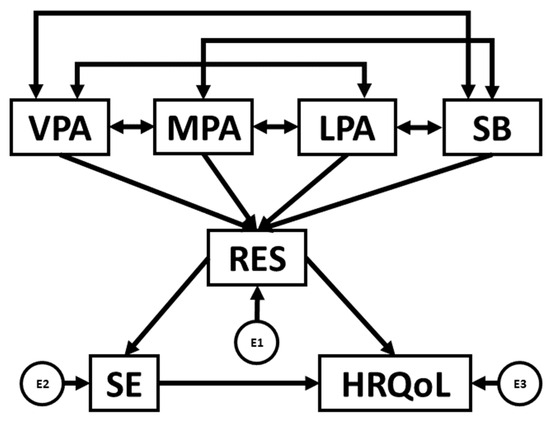
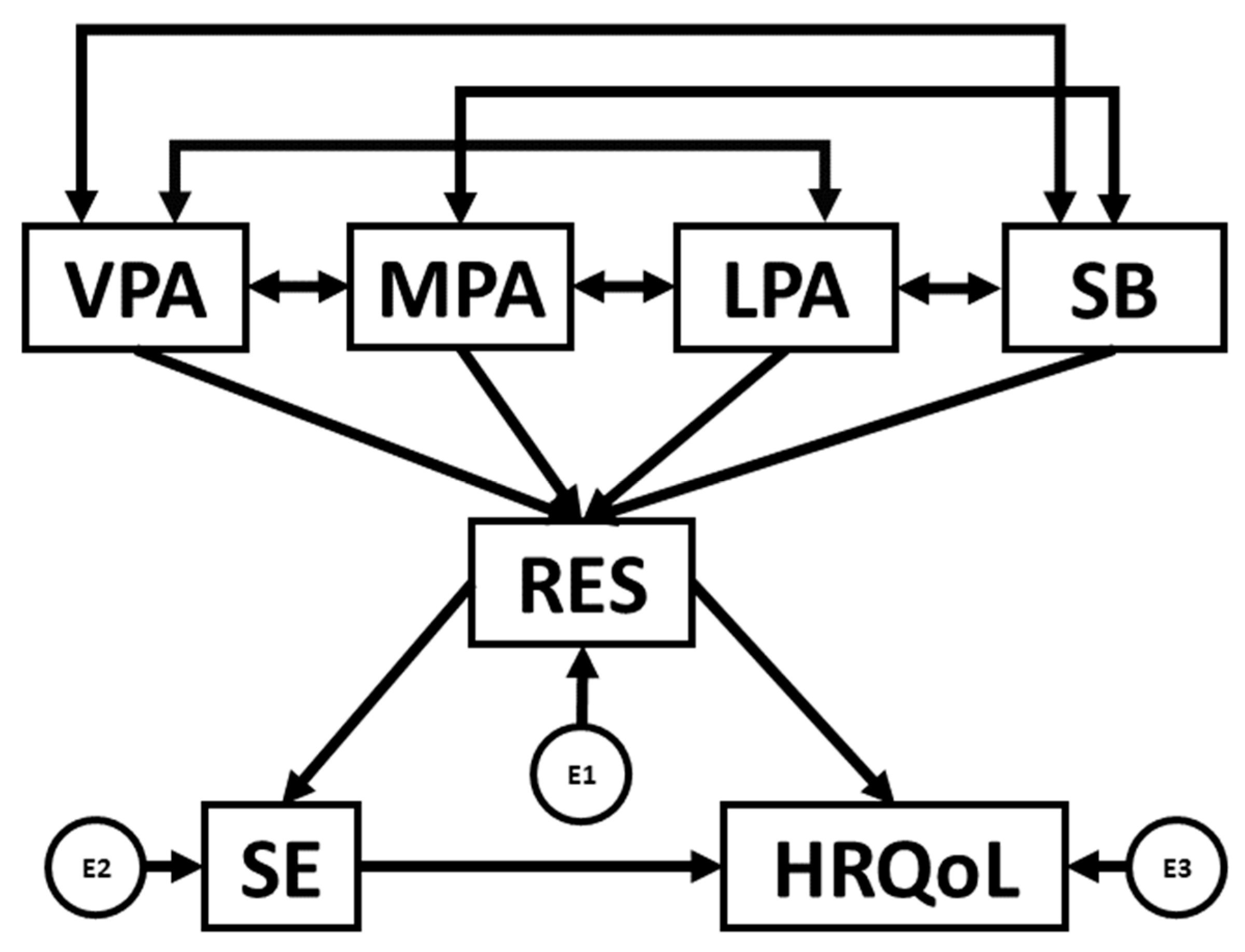
Path analysis within a structural equation modeling framework was performed in AMOS using seven observed variables: VPA, MPA, LPA, SB, RES, SE, and HRQoL. In the model, VPA, MPA, LPA, and SB were specified as exogenous variables, while RES, SE, and HRQoL were treated as endogenous variables (Figure 1). Given that the primary aim of this study was to examine structural relationships among variables rather than to test measurement models, composite scores were used instead of latent constructs.
Figure 1.
Structural equation model. VPA: vigorous physical activity; MPA: moderate physical activity; LPA: light physical activity; SB: sedentary behavior; RES: resilience; SE: self-esteem; HRQoL: health-related quality of life. E1–E3: error terms. ←: directional relationships between variables; ↔: correlation between two variables.
Model adequacy was assessed using several fit statistics, including χ2, CFI, IFI, NFI, TLI, and RMSEA. Values greater than 0.90 for CFI, IFI, NFI, and TLI were considered acceptable, and values above 0.95 indicated excellent fit. For RMSEA, values below 0.08 were interpreted as acceptable and values below 0.05 as a good fit [29].
3. Results
Descriptive characteristics of the study sample are presented in Table 2. Compared with women, men showed higher scores for PA, RES, SE, and HRQoL (all p < 0.001), with small-to-moderate effect sizes. Regarding sibling status, students with one or more siblings demonstrated significantly higher RES than those without siblings (p = 0.006; small effect size).
Table 2.
Group differences in PA, RES, SE, and HRQoL by sex and sibling status.
As shown in Table 3, significant differences were observed across PA groups for RES, SE, and HRQoL. Students in the high PA group reported significantly higher RES compared to both moderate and low PA groups (all p < 0.001), while the moderate group also showed higher RES than the low PA group (p = 0.002). A similar pattern was observed for SE, with both high and moderate PA groups reporting significantly higher scores than the low PA group (all p < 0.001). However, no significant difference was found between the moderate and high PA groups. For HRQoL, students in the high PA group reported significantly higher scores than those in the low and moderate PA groups (p < 0.001 and p = 0.006, respectively), whereas no significant difference was observed between the moderate and low PA groups.
Table 3.
Differences in RES, SE, and HRQoL according to PA levels.
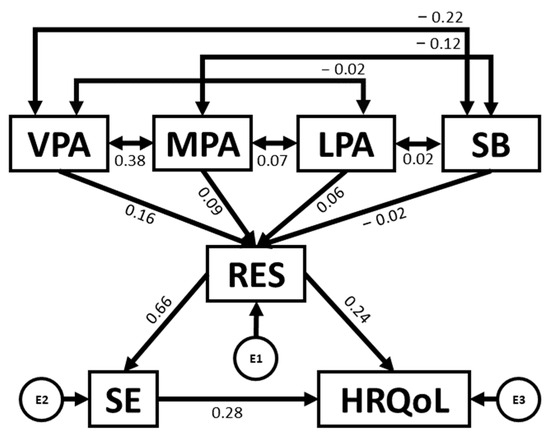
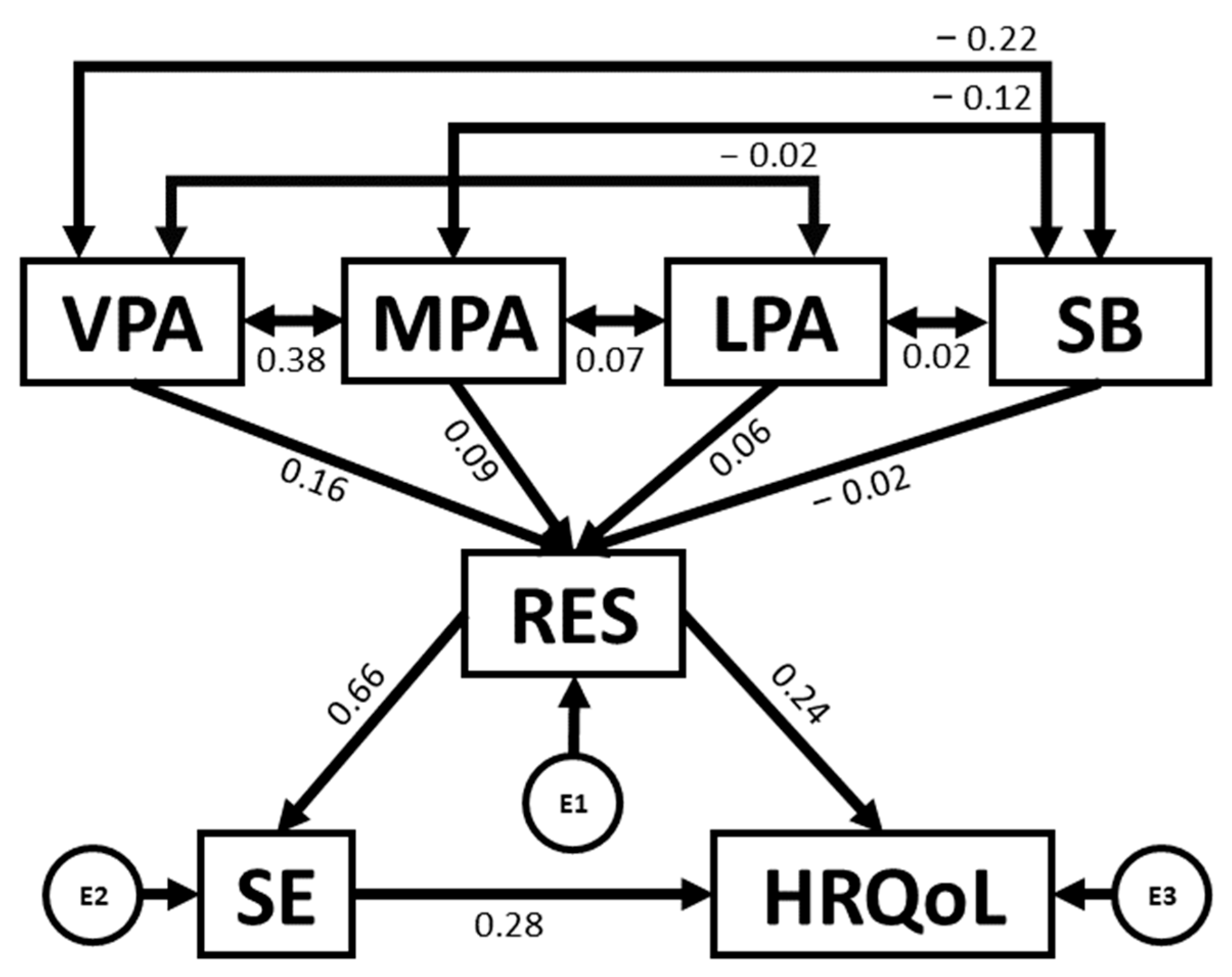
Path analysis results are shown in Table 4 and Figure 2. Overall model fit was good (χ2 = 21.4, df = 8, p = 0.006; CFI = 0.992; IFI = 0.992; TLI = 0.980; NFI = 0.988; RMSEA = 0.033). In terms of the relationships between PA variables, VPA was positively associated with MPA and negatively associated with SB (both p < 0.001), but was not significantly related to LPA. MPA showed a positive relationship with LPA and a negative relationship with SB (p < 0.01), while LPA was not significantly related to SB. With respect to the main pathways, VPA, MPA, and LPA were all positively associated with RES (all p < 0.05), whereas SB showed no significant relationship with RES. RES was related to higher SE and HRQoL (both p < 0.001), and SE was related to higher HRQoL (p < 0.001).
Table 4.
Regression weights for the overall sample.
Figure 2.
Structural equation model for the overall sample. Note. VPA: vigorous physical activity; MPA: moderate physical activity; LPA: light physical activity; SB: sedentary behavior; RES: resilience; SE: self-esteem; HRQoL: health-related quality of life; E1–E3: error terms. ←: directional relationships between variables; ↔: correlation between two variables.
4. Discussion
The present study examined the associations among PA, psychological resources, and health-related quality of life (HRQoL) in a sample of university students. Male students scored higher than female students on PA, RES, SE, and HRQoL. In addition, higher levels of PA engagement were associated with RES, SE, and HRQoL. With respect to the structural relationships, all three intensities of PA were positively associated with RES, although the magnitude of these associations varied across intensity levels. In contrast, sedentary behavior (SB) was not significantly related to resilience. Furthermore, RES was positively associated with both SE and HRQoL, while SE was also positively associated with HRQoL.
4.1. Sociodemographic Variations in PA, RES, SE and HRQoL
Sex-based differences were observed across several variables, with male students showing higher PA, RES, SE, and HRQoL scores. This result aligns with earlier evidence that male students generally report greater participation in moderate-to-vigorous PA than female students [30]. From the perspective of social role theory, men are often encouraged to display energy, competitiveness and adventurousness, whilst women are more frequently expected to be gentle and reserved [31]. Such gendered expectations may contribute to differences in exercise motivation and self-efficacy, which in turn may be associated with higher levels of PA participation among males [32].
Previous meta-analytical findings have similarly suggested gender-related differences in resilience, suggesting that men tend to score higher on measures related to stress management and emotional regulation. Greater PA engagement, particularly at higher intensities, may be linked to adaptive psychological responses [33,34]; however, this interpretation should be considered cautiously given the cross-sectional design.
Regarding SE and HRQoL, the present findings indicate higher scores among male students, although existing literature reports mixed evidence on gender differences in these variables [35,36]. These inconsistencies may reflect the combined influence of behavioral, psychological, and sociocultural factors. In contexts where males participate more actively in sports, they may receive more positive psychological feedback in terms of coping with academic stress, emotional regulation and life satisfaction, thereby contributing to elevated self-evaluations and perceived quality of life [7].
In addition to gender differences, students with siblings reported significantly higher RES than those without siblings. Earlier research has similarly indicated that sibling interactions during early development may be associated with the development of interpersonal skills, emotional regulation, and coping abilities, which are closely linked to resilience [37,38].
4.2. Associations Between PA Level, RES, SE and HRQoL
The present study also examined differences in RES, SE, and HRQoL across varying levels of PA. Overall, students with higher levels of PA tended to report more favorable outcomes across all three variables. Specifically, students in the high PA group reported higher levels of RES compared to those in the moderate and low PA groups. Comparable findings have been reported in previous research examining that engagement in PA, particularly at moderate-to-higher intensities, may be associated with improved emotional regulation and adaptive coping capacities [39]. However, given the cross-sectional design and the use of self-reported PA measures, these findings should be interpreted with caution.
A similar pattern was observed for SE, with both moderate and high PA groups showing higher levels than the low PA group. These findings may indicate that participation in PA is associated with more positive self-evaluations [40,41]. Notably, the moderate and high PA groups did not differ significantly, which may indicate that the association between PA and SE does not increase linearly across intensity levels.
With regard to HRQoL, students who engage in high amounts of PA reported significantly higher scores than those who engage in only moderate and low amounts. Greater PA engagement also corresponded to more favorable perceptions of physical functioning and overall well-being, possibly through links with emotional experience and psychological resources [40].
Overall, the present findings indicate that PA engagement is positively associated with psychological resources and HRQoL, although the magnitude of these associations may vary across different levels of activity.
4.3. Pathways Linking PA, RES, SE and HRQoL
In the structural path model, VPA, MPA and LPA were each positively associated with RES, whereas SB was not significantly related to RES. The absence of a significant SB–RES association is consistent with earlier findings [34] and may partly reflect the use of sitting time as a single indicator of SB, which may not adequately represent the different forms, domains and contexts of this behavior. From the perspective of the cross-stressor adaptation hypothesis, regular PA may be linked to physiological adaptation and lower reactivity to everyday stressors [42], providing a possible explanation for the association between PA and RES [43]. However, the observed differences across PA intensities should be interpreted cautiously, particularly because PA was assessed using self-report measures. Although previous studies have suggested that higher-intensity activity may be related to emotional regulation and coping capacity in stressful contexts [16,18], longitudinal and experimental studies are needed to determine whether such intensity-related patterns are stable and clinically meaningful.
The associations between RES, SE and HRQoL could also be interpreted within broader resilience and self-regulation frameworks. Resilience may support psychological stability by helping individuals mobilize cognitive, emotional and behavioral resources when facing stress or adversity [44]. This interpretation is compatible with the challenge model, which suggests that adaptive responses to adversity may develop through effective self-regulation processes [45]. Previous research has also indicated that resilience may be linked to lower stress vulnerability and better psychological functioning through several pathways, including buffering risk exposure, interrupting negative response patterns, strengthening psychological resources, and supporting adaptive coping [46,47]. In the present study, SE was also positively associated with HRQoL, suggesting that students with more favorable self-appraisals may perceive themselves to have better well-being. This finding is consistent with the risk-buffering model, which proposes that self-esteem may help reduce the psychological impact of negative experiences [48].
Finally, significant associations were observed among different PA intensities, particularly between VPA and MPA. This may indicate that students often engage in multiple forms of activity rather than participating in a single intensity category. Previous studies have similarly reported that combinations of moderate- and vigorous-intensity activity are commonly used to meet PA recommendations [34]. Thus, future research and university health promotion efforts may benefit from considering PA as a multidimensional behavior rather than focusing exclusively on a single intensity level.
4.4. Limitations and Future Directions
Although the present study contributes to understanding the associations among PA intensity, SB, RES, SE and HRQoL in university students, several limitations need to be considered. First, the cross-sectional design prevents conclusions about causality or temporal ordering. Longitudinal and experimental studies are needed to test the stability of these findings and to clarify the mechanisms underlying the observed associations. Second, all variables were collected through self-report questionnaires at a single time point. Thus, findings may be affected by recall, social desirability and common-method biases, which may have inflated the observed associations between variables. In addition, SB was assessed using only one indicator (i.e., sitting time), which may not fully capture the different domains, patterns and contexts that characterize sedentary behavior. Third, the path model was based on composite scores rather than latent constructs. As a result, measurement error could not be explicitly modeled, which may have reduced the precision of the estimated structural relationships. Future studies using latent-variable SEM could provide a more refined evaluation of both measurement and structural components. Fourth, participants were recruited from universities in central China, and the sample included a higher proportion of female students. These features may restrict the generalizability of the findings and should be considered when interpreting sex-related differences. Future studies should include samples from more diverse regions, cultural contexts and gender distributions. Fifth, several potentially important confounding variables, including body mass index (BMI), socioeconomic status, health status, field of study, sleep patterns, and academic stress, were not controlled for in the present study, which may have influenced the observed relationships. Future research should incorporate these factors and further explore the complexity of associations between PA and psychological outcomes, including potential non-linear patterns. In addition, the present study did not assess whether the proposed structural relationships are consistent across different subgroups (e.g., sex or academic year). Future studies employing multi-group structural equation modeling are warranted to evaluate the stability and generalizability of the model.
5. Conclusions
The present exploratory path analysis suggests that different intensities of PA are associated with psychological resources and HRQoL among university students. All three levels of PA engagement were positively associated with RES, which was, in turn, positively associated with both SE and HRQoL. These findings may provide preliminary support for considering PA within university-based health promotion and student well-being initiatives. However, further longitudinal and experimental studies are needed before practical recommendations regarding PA intensity can be established.
Author Contributions
The authors confirm that the following contributions were made to the paper: Conceptualization: Z.Y.; data curation: Z.Y., G.C.V. and J.J.M.; formal analysis: G.C.V. and J.J.M.; methodology: G.C.V. and J.J.M.; resources: Z.Y., J.Y., X.Z. and L.H.; validation: Z.Y., G.C.V., J.Y., X.Z., L.H. and J.J.M.; writing—original draft preparation, Z.Y. and G.C.V.; writing—review and editing, Z.Y. G.C.V., J.Y. and J.J.M.; visualization and supervision, J.J.M. All authors have read and agreed to the published version of the manuscript.
Funding
This research received no external funding.
Institutional Review Board Statement
This study was conducted in accordance with the Declaration of Helsinki and was approved by the Ethics Review Committee of Southwest University (SWUETH20230912003).
Informed Consent Statement
Informed consent was obtained from all subjects involved in the study.
Data Availability Statement
The data that support the findings of this study are available from the corresponding author upon reasonable request.
Acknowledgments
The authors would like to thank all university students for their participation in this study. The authors would like to especially thank Emily Knox for her assistance in reviewing the English version.
Conflicts of Interest
The authors declare no conflicts of interest.
Abbreviations
The following abbreviations are used in this manuscript:
| HRQoL | Health-related quality of life |
| PA | Physical activity |
| VPA | Vigorous physical activity |
| MPA | Moderate physical activity |
| LPA | Light physical activity |
| SB | Sedentary behavior |
| RES | Resilience |
| SE | Self-esteem |
| SEM | Structural equation modeling |
References
- Sheldon, E.; Simmonds-Buckley, M.; Bone, C.; Mascarenhas, T.; Chan, N.; Wincott, M.; Gleeson, H.; Sow, K.; Hind, D.; Barkham, M. Prevalence and risk factors for mental health problems in university undergraduate students: A systematic review with meta-analysis. J. Affect. Disord. 2021, 287, 282–292. [Google Scholar] [CrossRef] [Scilit]
- Li, J.; Luo, C.; Liu, L.; Huang, A.; Ma, Z.; Chen, Y.; Deng, Y.; Zhao, J. Depression, anxiety, and insomnia symptoms among Chinese college students: A network analysis across pandemic stages. J. Affect. Disord. 2024, 356, 54–63. [Google Scholar] [CrossRef] [Scilit]
- Senarath, M.; Thalwaththe, S.; Tennakoon, S. Evaluation of the quality of life among undergraduates of Faculty of Allied Health Sciences, University of Peradeniya. Int. J. Sci. Appl. Res. 2021, 8, 1–10. [Google Scholar]
- Zhang, N.; Hazarika, B.; Chen, K.; Shi, Y. A cross-national study on the excessive use of short-video applications among college students. Comput. Hum. Behav. 2023, 145, 107752. [Google Scholar] [CrossRef] [Scilit]
- Chuang, S.P.; Wu, J.Y.W.; Wang, C.S. Resilience and quality of life in people with mental illness: A systematic review and meta-analysis. Neuropsychiatr. Dis. Treat. 2023, 19, 507–514. [Google Scholar] [CrossRef] [Scilit]
- Ramón-Arbués, E.; Echániz-Serrano, E.; Martínez-Abadía, B.; Antón-Solanas, I.; Cobos-Rincón, A.; Santolalla-Arnedo, I.; Juárez-Vela, R.; Adam Jerue, B. Predictors of the quality of life of university students: A cross-sectional study. Int. J. Environ. Res. Public Health 2022, 19, 12043. [Google Scholar] [CrossRef] [Scilit]
- Çiçek, İ. Mediating role of self-esteem in the association between loneliness and psychological and subjective well-being in university students. Int. J. Contemp. Educ. Res. 2021, 8, 83–97. [Google Scholar] [CrossRef] [Scilit]
- Berdida, D.J.E.; Grande, R.A.N. Academic stress, COVID-19 anxiety, and quality of life among nursing students: The mediating role of resilience. Int. Nurs. Rev. 2023, 70, 34–42. [Google Scholar] [CrossRef] [Scilit]
- Fang, S.; Barker, E.; Arasaratnam, G.; Lane, V.; Rabinovich, D.; Panaccio, A.; O’Connor, R.M.; Nguyen, C.T.; Doucerain, M.M. Resilience, Stress, and Mental Health Among University Students: A Test of the Resilience Portfolio Model. Stress Health 2025, 41, e3508. [Google Scholar]
- Usán Supervía, P.; Salavera Bordás, C.; Quílez Robres, A. The mediating role of self-esteem in the relationship between resilience and satisfaction with life in adolescent students. Psychol. Res. Behav. Manag. 2022, 15, 1121–1129. [Google Scholar] [CrossRef] [Scilit]
- Wulandari, A. The effect of self-esteem and self-efficacy on the academic resilience of undergraduate students in Jakarta. IOP Conf. Ser. Earth Environ. Sci. 2021, 729, 012094. [Google Scholar] [CrossRef] [Scilit]
- Cai, M.; Bai, D.; Hou, D.; You, Q.; Wang, W.; Lu, X.; Gao, J. Effectiveness of nonpharmacological multi-component intervention on depressive symptoms in patients with mild cognitive impairment and dementia: A systematic review and meta-analysis. Int. J. Ment. Health Nurs. 2024, 33, 297–308. [Google Scholar] [CrossRef] [Scilit]
- Husain, H.; Samsudin, S.; Ayub, A.F.M.; Ahmad, M.F.; Afwan, N. A systematic literature review on the impact of participation in sport and physical activities on psychological resilience. Int. J. Public Health Sci. 2024, 13, 1727. [Google Scholar] [CrossRef] [Scilit]
- Kim, D.H.; Hu Kim, J.; Park, K.-J. The impact of regular exercise, competition experience, and physical self-efficacy on psychological resilience. Rev. Psicol. Deporte 2023, 32, 1. [Google Scholar]
- Cui, G.; Zhang, L. The influence of physical exercise on College Students’ negative emotions: The mediating and regulating role of psychological resilience. Rev. Psicol. Deporte 2022, 31, 21–28. [Google Scholar]
- Borrega-Mouquinho, Y.; Sánchez-Gómez, J.; Fuentes-García, J.P.; Collado-Mateo, D.; Villafaina, S. Effects of high-intensity interval training and moderate-intensity training on stress, depression, anxiety, and resilience in healthy adults during coronavirus disease 2019 confinement: A randomized controlled trial. Front. Psychol. 2021, 12, 643069. [Google Scholar] [CrossRef] [Scilit]
- Hu, Q. The Effect of increased intensity of physical exercises on mental health and resilience among college students. Chin. J. Sch. Health 2019, 40, 89–91. [Google Scholar]
- Dunston, E.R.; Messina, E.S.; Coelho, A.J.; Chriest, S.N.; Waldrip, M.P.; Vahk, A.; Taylor, K. Physical activity is associated with grit and resilience in college students: Is intensity the key to success? J. Am. Coll. Health 2022, 70, 216–222. [Google Scholar] [CrossRef] [Scilit]
- Craig, C.L.; Marshall, A.L.; Sjöström, M.; Bauman, A.E.; Booth, M.L.; Ainsworth, B.E.; Pratt, M.; Ekelund, U.; Yngve, A.; Sallis, J.F. International physical activity questionnaire: 12-country reliability and validity. Med. Sci. Sports Exerc. 2003, 35, 1381–1395. [Google Scholar] [CrossRef] [Scilit]
- Fan, M.; Lyu, J.; He, P. Chinese guidelines for data processing and analysis concerning the International Physical Activity Questionnaire. Zhonghua Liu Xing Bing Xue Za Zhi 2014, 35, 961–964. [Google Scholar]
- Macfarlane, D.J.; Lee, C.C.; Ho, E.Y.; Chan, K.L.; Chan, D.T. Reliability and validity of the Chinese version of IPAQ (short, last 7 days). J. Sci. Med. Sport 2007, 10, 45–51. [Google Scholar] [CrossRef] [Scilit]
- Connor, K.M.; Davidson, J.R. Development of a new resilience scale: The Connor-Davidson resilience scale (CD-RISC). Depress. Anxiety 2003, 18, 76–82. [Google Scholar] [CrossRef] [Scilit]
- Yu, X.; Zhang, J. Factor analysis and psychometric evaluation of the Connor-Davidson Resilience Scale (CD-RISC) with Chinese people. Soc. Behav. Personal. 2007, 35, 19–30. [Google Scholar] [CrossRef] [Scilit]
- Rosenberg, M.; Schooler, C.; Schoenbach, C.; Rosenberg, F. Global self-esteem and specific self-esteem: Different concepts, different outcomes. Am. Sociol. Rev. 1995, 60, 141–156. [Google Scholar] [CrossRef] [Scilit]
- Leung, S.-O.; Wong, P.-M. Validity and reliability of Chinese Rosenberg self-esteem scale. New Horiz. Educ. 2008, 56, 62–69. [Google Scholar]
- Lam, C.L.; Eileen, Y.; Gandek, B.; Fong, D.Y. The SF-36 summary scales were valid, reliable, and equivalent in a Chinese population. J. Clin. Epidemiol. 2005, 58, 815–822. [Google Scholar] [CrossRef] [Scilit]
- Field, A. Discovering Statistics Using IBM SPSS Statistics, 5th ed.; Sage: Thousand Oaks, CA, USA, 2018. [Google Scholar]
- Cohen, J. Statistical Power Analysis for the Behavioral Sciences, 2nd ed.; Routledge: Abingdon, UK, 1988. [Google Scholar]
- Byrne, B.M. Structural Equation Modeling with AMOS: Basic Concepts, Applications, and Programming, 3rd ed.; Routledge: Abingdon, UK, 2016. [Google Scholar]
- Seçer, E.; Yildizhan, Y.Ç. The relationship between physical activity levels and psychological resilience of university students. Rev. Tur. Estud. Práticas-RTEP/GEPLAT/UERN 2020, 4, 1–12. [Google Scholar] [CrossRef] [Scilit]
- Eagly, A.H.; Woo, W.; Diekman, A.B. Social role theory of sex differences and similarities: A current appraisal. In The Developmental Social Psychology of Gender; Psychology Press: Hove, UK, 2012; pp. 123–174. [Google Scholar]
- Wilson, O.W.A.; Papalia, Z.; Duffey, M.; Bopp, M. Differences in college students’ aerobic physical activity and muscle-strengthening activities based on gender, race, and sexual orientation. Prev. Med. Rep. 2019, 16, 100984. [Google Scholar] [CrossRef] [Scilit]
- Gök, A.; Koğar, E.Y. A meta-analysis study on gender differences in psychological resilience levels. Kıbrıs Türk. Psikiyatr. Psikol. Derg. 2021, 3, 132–143. [Google Scholar]
- Yu, J.J.; Ye, J.-c. Resilience is associated with physical activity and sedentary behaviour recommendations attainment in Chinese university students. Complement. Ther. Clin. Pract. 2023, 51, 101747. [Google Scholar] [CrossRef] [Scilit]
- Gao, W.; Luo, Y.; Cao, X.; Liu, X. Gender differences in the relationship between self-esteem and depression among college students: A cross-lagged study from China. J. Res. Personal. 2022, 97, 104202. [Google Scholar] [CrossRef] [Scilit]
- Li, H.-M.; Zhong, B.-L. Quality of life among college students and its associated factors: A narrative review. AME Med. J. 2022, 7, 1–11. [Google Scholar] [CrossRef] [Scilit]
- Gong, Z. Psychological Resilience Characteristics and Improvement Strategies of “Internet plus” Engineering Normal College Students. J. Phys. Conf. Ser. 2020, 1533, 042084. [Google Scholar] [CrossRef] [Scilit]
- Edels, R.; Naoufal, M.; Montreuil, T.C. The influence of sibling relationship quality on the social, emotional, and behavioral functioning of children and adolescents: A scoping review. J. Fam. Soc. Work 2024, 27, 1–29. [Google Scholar] [CrossRef] [Scilit]
- San Román-Mata, S.; Puertas-Molero, P.; Ubago-Jiménez, J.L.; González-Valero, G. Benefits of physical activity and its associations with resilience, emotional intelligence, and psychological distress in university students from southern Spain. Int. J. Environ. Res. Public Health 2020, 17, 4474. [Google Scholar] [CrossRef] [Scilit]
- Zayed, M.A.; Elshaer, I.A. Physical activities and learning experience of higher education students: Mediating role of quality of life and physical self-esteem. Int. J. Environ. Res. Public Health 2022, 19, 13417. [Google Scholar] [CrossRef] [Scilit]
- García-Pérez, L.; Padial-Ruz, R.; Cepero-González, M.; Ubago-Jiménez, J.L. Influence of Lifestyle Habits on Psychological Well-Being of University Students: A Quantitative Cross-Sectional Study. Healthcare 2025, 13, 1197. [Google Scholar] [CrossRef] [Scilit]
- Tsatsoulis, A.; Fountoulakis, S. The protective role of exercise on stress system dysregulation and comorbidities. Ann. N. Y. Acad. Sci. 2006, 1083, 196–213. [Google Scholar] [CrossRef] [Scilit]
- Mahindru, A.; Patil, P.; Agrawal, V. Role of physical activity on mental health and well-being: A review. Cureus 2023, 15, e33475. [Google Scholar] [CrossRef] [Scilit]
- Lines, R.L.; Ducker, K.J.; Ntoumanis, N.; Thøgersen-Ntoumani, C.; Fletcher, D.; Gucciardi, D.F. Stress, physical activity, sedentary behavior, and resilience—The effects of naturalistic periods of elevated stress: A measurement-burst study. Psychophysiology 2021, 58, e13846. [Google Scholar] [CrossRef] [Scilit]
- Ge, D. Resilience and online learning emotional engagement among college students in the digital age: A perspective based on self-regulated learning theory. BMC Psychol. 2025, 13, 326. [Google Scholar] [CrossRef] [Scilit] [PubMed]
- Udeh-Momoh, C.T.; Migeot, J.; Blackmon, K.; Mielke, M.M.; Melloni, M.; Cox, L.; Yaffe, K.; Santamaria-Garcia, H.; Stern, Y.; Ibanez, A. Resilience and brain health in global populations. Nat. Med. 2025, 31, 2518–2531. [Google Scholar] [CrossRef] [Scilit]
- Qiu, W.; Wang, X.; Cui, H.; Ma, W.; Xiao, H.; Qu, G.; Gao, R.; Zhou, F.; Nie, Y.; Liu, C. The Impact of Physical Exercise on College Students’ Physical Self-Efficacy: The Mediating Role of Psychological Resilience. Behav. Sci. 2025, 15, 541. [Google Scholar] [CrossRef] [Scilit] [PubMed]
- Orth, U.; Robins, R.W. Is high self-esteem beneficial? Revisiting a classic question. Am. Psychol. 2022, 77, 5. [Google Scholar] [CrossRef] [Scilit] [PubMed]

Disclaimer/Publisher’s Note: The statements, opinions and data contained in all publications are solely those of the individual author(s) and contributor(s) and not of MDPI and/or the editor(s). MDPI and/or the editor(s) disclaim responsibility for any injury to people or property resulting from any ideas, methods, instructions or products referred to in the content. |
© 2026 by the authors. Licensee MDPI, Basel, Switzerland. This article is an open access article distributed under the terms and conditions of the Creative Commons Attribution (CC BY) license.