


Abstract
Stroke is a cerebrovascular syndrome due to a sudden interruption of blood flow to the brain that causes transient or permanent damage. Despite advances in the field of medical science, stroke is still common and continues to have a significant effect on quality of life. Objective: The objective of the study was to analyze the prevalence of strokes in Spain, considering differences in sociodemographic factors, functional limitations, and access to rehabilitation, with special attention to sex-related disparities. Methodology: A cross-sectional study was conducted using data from the latest European Health Survey in Spain carried out between 2019 and 2020 on a total of 22,072 people. Individuals over 16 years of age with a medical diagnosis of stroke were selected for this study. Sociodemographic variables, self-perception of health, limitations in daily activities, level of physical activity, and access to rehabilitation treatment were analyzed. Descriptive measures and inferential tests were applied for statistical analysis. Results: The prevalence of strokes occurring in Spain was estimated at 2.02%, which is lower than European figures. Men tend to have strokes at younger ages (50% between 36 and 73 years), while women report a poorer quality of life after the incident. Most patients had not received rehabilitation services in the last year. Conclusions: Given the aging population, it is essential to reinforce prevention, early detection and rehabilitation therapies to improve quality of life and reduce the burden of care.
1. Introduction
A stroke (cerebrovascular accident) is defined as a clinical syndrome caused by a sudden disturbance in cerebral blood flow that leads to focal or global neurological impairment. According to the International Classification of Diseases (ICD-10), strokes are classified primarily as ischemic stroke (ICD-10 code I63), accounting for approximately 80% of cases, and hemorrhagic stroke (ICD-10 code I61), representing around 20% [1]. Ischemic stroke results from an obstruction of blood flow, typically due to thrombosis or embolism, while hemorrhagic stroke is caused by the rupture of a blood vessel, leading to intracerebral bleeding [2,3]. In Spain, approximately 120,000 people suffer a stroke and approximately 25,000 die as a consequence each year, where the incidence in recent years involving an increasingly younger population is worrying, with 25% occurring between the ages of 20 and 64, and becoming more frequent from the age of 65 [4].
Globally, the prevalence of stroke is also rising. According to the Global Burden of Disease Study, in 2021, there were more than 101 million people living with the consequences of stroke worldwide, with a global prevalence rate of approximately 1.26% [5]. However, some regions of Europe report significantly higher prevalence rates, reaching up to 9.2% in older populations [6].
In high-income countries, cerebrovascular diseases have a significant slowdown in mortality [7], and there is a correlation between educational level and stroke risk [8]. However, it does not improve adequate knowledge about stroke prevention and management [9]. This gap in awareness highlights the need to emphasize effective preventive strategies in public health campaigns. Among these strategies, physical activity plays a key role as a modifiable lifestyle factor that reduces the risk of stroke.
Women who engage in regular physical activity have a protective factor against stroke of up to 70% [10]. A significant correlation was found between functional independence and quality of life in stroke survivors [11]. On the other hand, depending on gender approaches to treatment and rehabilitation may be different [12]. At the hormonal level, natural estrogens specific to women have anti-atherogenic and neuroprotective effects during the female reproductive years, generating a protective effect against atherosclerosis before menopause and a higher incidence of these diseases after menopause [13]. These hormonal differences may contribute to the observed disparities in stroke incidence, age of onset, and recovery between men and women, which underscores the importance of analyzing sex-specific patterns in prevalence, limitations, and access to rehabilitation.
After a stroke, motor recovery of the lower limbs has a greater impact on quality of life than motor recovery of the upper limbs after 60 days of neurorehabilitation [14]. In addition, alterations in the perception of stimuli affect 70% of survivors, causing distress in the interpretation of emotions and tasks and a greater dependence on others to understand proposals [6]. Stroke is mainly caused by modifiable risk factors such as hypertension, diabetes, dyslipidemia, smoking, sedentary lifestyle, and cardiovascular conditions, which makes prevention strategies especially relevant [15]. Stroke leads to long-term disability in many survivors, causing a significant deterioration in physical, cognitive, and emotional functioning and increasing dependency. It also represents a considerable economic burden on healthcare systems due to the high costs of acute care, rehabilitation, and long-term support services [16,17].
Taking the above into consideration, it is essential to consider that similar rehabilitation challenges and therapies are shared with other neurological disorders such as multiple sclerosis (MS). In people suffering from MS, cognitive and motor rehabilitation has shown promising effects on autonomy, emotional well-being, and quality of life. These parallels suggest that comprehensive, interdisciplinary rehabilitation approaches may have had positive effects across neurological conditions, including stroke [18,19].
For all these reasons, knowing the state of health, limitations, professional follow-up, and possible differences by sex in patients who have suffered a stroke is essential to establish measures, not only for prevention but also for long-term action and follow-up treatment. Despite advances in acute stroke care, current rehabilitation programs in Spain present important gaps, especially in long-term follow-up, continuity of physiotherapy, and access to multidisciplinary services—particularly in rural or underserved areas. We hypothesized that sex and sociodemographic characteristics significantly influence access to rehabilitation and the presence of functional limitations among stroke survivors in Spain. Therefore, the aim of this study was to analyze the prevalence of stroke and explore disparities in rehabilitation and quality of life related to these factors.
2. Materials and Methods
A cross-sectional study of the data collected in Spain by the latest European Health Interview Survey (EHIS) was conducted between 2019 and 2020 and published by the National Institute of Statistics (INE), whose main objective is to obtain information on different aspects related to the health of the Spanish population. This survey is coordinated by Eurostat and regulated by Regulation (EC) 1338/2008 and Commission Regulation 141/2013 [20].
The methodological procedure carried out to select the sample and determine its size, as well as the inclusion and exclusion criteria in the European Health Interview Survey, are detailed in the survey protocol [21]. For this study, cases with a medical diagnosis of stroke (including cases of embolism, cerebral infarction, and cerebral hemorrhage) in patients over 16 years of age were selected, regardless of whether the stroke occurred within the last year or prior. For these cases, sociodemographic variables (age, sex, level of education, cohabitation, and occupation), self-perception of health, limitations in carrying out activities of daily life, level of physical activity and sedentary lifestyle, and attendance were studied during the last year to a specialist physiotherapist.
In order to meet the objectives of this study, qualitative variables were analyzed using absolute frequencies and percentages. Prevalence was calculated as the quotient between the number of stroke cases found and the number of individuals in the sample. Quantitative variables were assessed using the mean and standard deviation. Hypothesis tests based on the chi-square distribution were performed to compare qualitative variables. In the case of quantitative variables, the Student’s test was used. Confidence intervals were constructed assuming normality in the data given the sample size used. In all cases, a significance level of 5% was assumed. IBM SPSS v.26 was used. In addition, the Epidat 4.2 program was used to construct the population pyramid of stroke cases.
3. Results
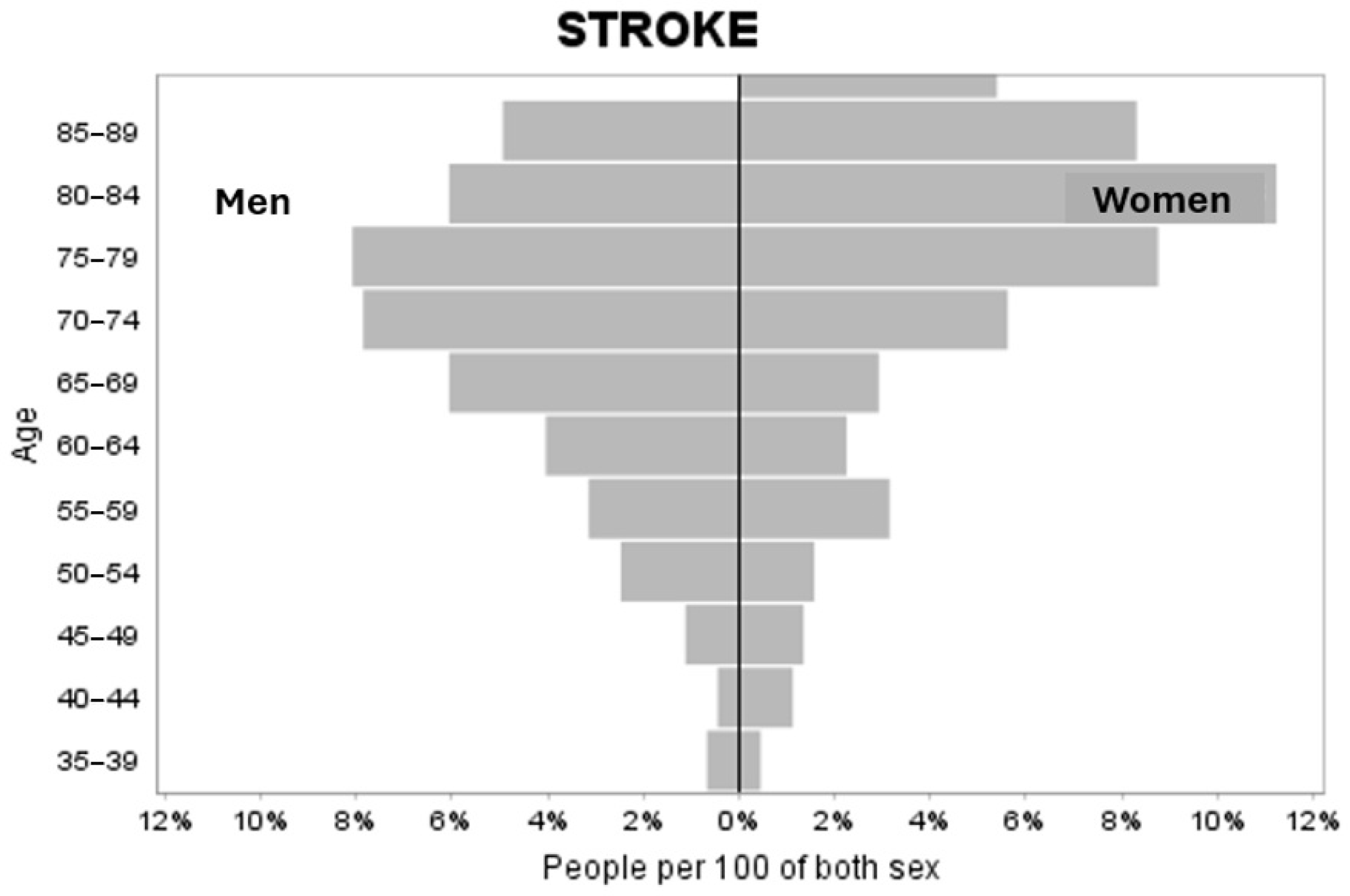
The EES was performed in Spain on a total of 22,072 people aged between 15 and 104 years, with a mean age of 54.57 years (SD 19.01). Of the participants, 47.1% were men, indicating a lower proportion of males compared to females. Of this, 445 people had suffered a stroke, which represents a prevalence of 2.02% (CI(95%) = (1.83%; 2.2%)). Of those who had suffered a stroke, 46.3% were men. No statistically significant differences exist in the gender representation of the reference population. The ages ranged from 35 to 98 years, with a mean age equal to 73.95 (S.D. 12.82 years). A total of 25% of the sample was under 66 years of age, and 50% was under 73 years of age. Differentiating by sex, men had a mean age of 71.28 years (S.D. 12.0), with the minimum age being 36 years and the maximum 97. In women, the mean age was 76.26 years (S.D. 13.1), with 35 years as the minimum age and 98 as the maximum age, with these age differences being significant with p < 0.001. Fifty percent of the men were under 73 years of age and, in the case of women, under 79 years of age. Figure 1 shows the distribution of stroke cases by sex and five-year age groups.
Figure 1.
Distribution of the percentage of stroke by sex and five-year age groups.
With regards to the perception of one’s state of health in the last 12 months, it is women who report worse health status and more limitations and difficulties in carrying out daily activities, showing significant differences by sex. There are significant differences in educational attainment between men and women; however, no such differences were found when analyzing occupational status. Although some respondents report limitations due to mental health problems, physical limitations are the most prevalent among both men and women. Most of those affected by stroke suffer from chronic or long-term diseases. Detailed information on physical limitations and their differences between men and women is given in Table 1.
Table 1.
Sociodemographic information, health perception, and limitations.
3.1. Physical Activity
Concerning the level of physical activity of patients who have suffered a stroke, 93.3% remained seated, performing their main activity or standing without making great movements or efforts. In addition, in their free time, most of the sample does not perform any type of physical activity. On average, men walk at least 10 min 4.21 days a week, while women walk at least 10 min 3.05 days a week. In addition, most of the respondents do not walk for more than 30 min, with only 14.1% of men walking for an hour or more and 12.1% of women walking for an hour or more. The average time a stroke victim spends sitting on any given day is between 9.09 and 10.98 h for men and women, respectively. In general, in terms of physical activity, no significant differences were found by sex. Detailed information on physical activity levels and their differences between men and women is provided in Table 2.
Table 2.
Level and frequency of physical activity.
Specialist Contacts and Limitations
During the 12 months prior to the survey, 83.6% of the people who had suffered a stroke did not have an appointment with a rehabilitation specialist (physiotherapist). Despite the fact that, as shown in the previous table, sedentary behavior is similar in men and women, Table 3 shows that when it comes to carrying out everyday activities (such as getting dressed, going to bed, going to the toilet, preparing food, using the telephone, shopping, or taking a shower), men and women who have suffered a stroke show great differences.
Table 3.
Main limitations in stroke survivors.
4. Discussion
This study reveals the prevalence of stroke in Spain, estimated at 2.02% of the general population, depicts a figure much lower than the European prevalence of 9.2% IC(95%) [6].
Although the prevalence of stroke was similar between men and women, relevant differences were identified according to sex in aspects such as level of education, type of cohabitation and quality or style of life. The level of education and income, being employed and being healthy are independent factors of an “adequate knowledge” of stroke, so it is recommended that educational campaigns should be carried out in simple language, with special interest at the most vulnerable societal target group [9,22]. If the symptoms of stroke are not recognized, and citizens do not know how to realize the urgency, care will be delayed in the pre-hospital phase [23].
A less healthy lifestyle prior to a stroke is associated with a poorer post-stroke quality of life [24]. This study reveals that a significant percentage of the sample has limitations in activities of daily living despite the fact that more than 50% are under 76 years of age. This finding shows the early onset of functional difficulties in a relatively young population within the group of older people, which points to the importance of implementing programs that promote healthy aging. Various studies have shown that regular physical activity plays a key role in maintaining cognitive function and quality of life, helping to prevent the risk of needing care and deterioration associated with aging [25,26]. Among the most recommended exercises after stroke, we find the treadmill (to work different speeds and stride widths) and walking outdoors at low intensity [27]. Treadmill exercise has therefore been found to affect pathways associated with blood clotting, cartilage formation, and fat metabolism after a stroke [28]. In any case, physical activity remains a modifiable lifestyle factor that should be included in stroke prevention strategies in both women and men [10]. Physical activity will reduce the patient’s chances of experiencing fatigue, improving their quality of life [11].
Regarding the age of stroke presentation, men tend to suffer strokes at younger ages, while women at older ages, as observed in this study. This could explain why women report a poorer quality of life after the event, possibly due to increased dependence and poorer baseline fitness. Comparing these findings with previous studies, we found that the overall risk of stroke in women compared to men was higher in women than in men younger than 30 years, lower in women compared to men in middle age, and similar in women and men ≥ 80 years old [29]. These differences may be related to specific physiological factors in male and female patients. In the case of women, specific natural estrogens have anti-atherogenic and neuroprotective effects [13]. However, cellular responses to cerebral ischemia also respond mechanically differently, which also suggests that the molecular signaling pathways activated by ischemia may differ in the brains of both sexes [30].
Another concerning outcome and finding in the results of this study is that most patients have not received care from a rehabilitation specialist in the last year despite the high prevalence of functional limitations. It is crucial to know the most critical reasons for the delay in pre-hospital phase care. As other authors argued, the most common cause for the delay in care in the pre-hospital phase is that the symptoms are not recognized as typical signs of stroke, and the affected person is not aware of how to assess the urgency; in many cases, waits for symptoms to disappear; does not request help; or if they do, it is too late. This may be more serious among the most vulnerable social classes in rural areas and older subjects, given the low degree of knowledge acquired about strokes [24]. It has been shown that people with more education and a higher income level tend to seek medical attention faster when faced with the symptoms of a stroke [31].
Although a considerable percentage of people do not report severe limitations in walking or performing basic activities, a very high percentage lead a sedentary life. This sedentary behavior may originate both before and after stroke, representing either a contributing risk factor or a post-stroke consequence linked to limited mobility, fatigue, or reduced access to rehabilitation. This underscores the need to promote physical exercise as a preventive measure in the general population and post-stroke patients. We found one study where the benefit of regular physical activity in women and in some populations was associated with a reduction in stroke risk of up to 70% [10]. One study shows lower tendencies for depression, greater resilience, and mobility when performing aerobic physical activity such as running or walking outdoors [27].
These conclusions support previous evidence indicating the persistence of functional limitations after stroke, particularly in younger segments of the older population. While innovative rehabilitation strategies are being explored in clinical settings, such as virtual reality and telerehabilitation, our data highlight a more urgent need: improving access to basic post-stroke care and long-term physiotherapy. The limited use of rehabilitation services reported by participants reinforces the importance of strengthening conventional support systems, especially in vulnerable populations. It is also paramount to note that socioeconomic status may act as a confounding factor in access to rehabilitation services. Individuals with lower income or educational levels may face greater barriers to receiving continuous care, which could partially explain the disparities observed. Future studies should consider adjusting for these factors to better isolate the impact of sex, age, or geographic location.
Given that life expectancy in Spain exceeds 84 years, the health system must prioritize strategies that promote healthy aging, with special attention to patients who have suffered a stroke. It is essential to increase access to physiotherapy and other long-term rehabilitation services, as well as to raise awareness among professionals and patients about the benefits of maintaining active follow-up after a stroke.
Limitations of the Study
The main limitation of this study is that it is a cross-sectional study that does not allow causal relationships to be established, although it does guide the search for these relationships in future research. On the other hand, we could assume a perception bias as some data are self-reported; however, we present a sufficiently large and representative sample of the general population that minimizes this bias subsequently. The questions related to limitations or health status in the last 12 months shows that despite the fact that most strokes occurred before the last year, the population has sequelae that must be taken into account to improve the continuous care of these people.
5. Conclusions
Stroke continues to be a relevant public health problem in Spain, with a marked incidence and impact that varies according to gender, which underlines the need for differential approaches in post-stroke care. At the same time, significant inequalities persist in access to information about stroke and specialized services, which influences the quality of the recovery process and equity in care. These challenges highlight the evident need for a comprehensive approach that combines prevention strategies, health education and equitable access to rehabilitation processes adapted to the needs of the entire population. In this context, strengthening health literacy and reducing socioeconomic barriers can significantly improve both stroke reaction time and long-term functional outcomes. Given the progressive aging of the population, it is a priority to guide future research towards the design of sustainable primary prevention strategies based on the community and adapted to the functional and social profile of each patient.
Author Contributions
Conceptualization, I.G.-C. and M.J.V.-G.; methodology, M.J.V.-G. and I.G.-C.; software, I.G.-C.; validation M.J.V.-G. and I.G.-C.; formal analysis, I.G.-C.; investigation, M.J.V.-G. and I.G.-C.; resources, I.G.-C.; data curation, I.G.-C.; writing—original draft preparation, I.G.-C. and M.J.V.-G.; writing—review and editing, I.G.-C.; visualization, I.G.-C.; supervision, I.G.-C. and M.J.V.-G. All authors have read and agreed to the published version of the manuscript.
Funding
This research received no external funding.
Institutional Review Board Statement
Ethical review and approval were waived for this study because it utilized publicly available, anonymized data from the European Health Interview Survey (EHIS) conducted by the National Institute of Statistics (INE), which did not involve direct human subject participation.
Informed Consent Statement
As the data used in this study were collected through the European Health Interview Survey (EHIS), which is a public survey conducted by the National Institute of Statistics (INE) in Spain, informed consent was obtained by the survey administrators at the time of data collection. The data are anonymized and available for public use, ensuring confidentiality and privacy.
Data Availability Statement
The data used in this study were obtained from the European Health Interview Survey (EHIS) conducted in Spain between 2019 and 2020 and published by the National Institute of Statistics (INE). The data are publicly available through the INE website at the following link: https://ine.es/dyngs/INEbase/es/operacion.htm?c=Estadistica_C&cid=1254736176784&idp=1254735573175 (accessed on 2 November 2024). The survey is coordinated by Eurostat and regulated by Regulation (EC) 1338/2008 and Commission Regulation 141/2013.
Conflicts of Interest
The authors declare no conflicts of interest.
References
- Grau García, M.; Pérez Bea, M.; Angulo Saiz, A.; Díez Fontaneda, V.; Cintora Leon, E. Actualización del código ictus en urgencias. Radiologia. Soc. Española Radiol. Médica 2023, 65, S3–S10. [Google Scholar] [CrossRef] [Scilit]
- Majumder, D. Ischemic Stroke: Pathophysiology and Evolving Treatment Approaches. In Neuroscience Insights; SAGE Publications Ltd.: Thousand Oaks, CA, USA, 2024; Volume 19. [Google Scholar] [CrossRef] [Scilit]
- Chen, J.; Zeng, Z.; Fang, Z.; Ma, F.; Lv, M.; Zhang, J. Risk factors for thrombolysis-related intracranial hemorrhage: A systematic review and meta-analysis. Thromb. J. 2023, 21, 1–8. [Google Scholar] [CrossRef] [Scilit] [PubMed]
- Ministerio de Sanidad. Ministerio de Sanidad y Comunidades Autónomas Aprueban la Actualización de la Estrategia del Ictus. 14 February 2023. Available online: https://www.sanidad.gob.es/gabinete/notasPrensa.do?id=6395 (accessed on 15 October 2024).
- Feigin, V.L.; Abate, M.D.; Abate, Y.H.; Abd ElHafeez, S.; Abd-Allah, F.; Abdelalim, A.; Abdelkader, A.; Abdelmasseh, M.; Abd-Elsalam, S.; Abdi, P.; et al. Global, regional, and national burden of stroke and its risk factors, 1990–2021: A systematic analysis for the Global Burden of Disease Study 2021. Lancet Neurol. 2024, 23, 973–1003. [Google Scholar] [CrossRef] [Scilit] [PubMed]
- Soto, A.; Guillén-Grima, F.; Morales, G.; Muñoz, S.; Aguinaga-Ontoso, I.; Fuentes-Aspe, R. Prevalence and incidence of ictus in Europe: Systematic review and meta-analysis. An. Del Sist. Sanit. Navar. 2022, 45, e0979. [Google Scholar] [CrossRef] [Scilit] [PubMed]
- Lopez, A.D.; Adair, T. Is the long-term decline in cardiovascular-disease mortality in high-income countries over? Evidence from national vital statistics. Int. J. Epidemiol. 2019, 48, 1815–1823. [Google Scholar] [CrossRef] [Scilit]
- Höhn, A.; Gampe, J.; Lindahl-Jacobsen, R.; Christensen, K.; Oksuyzan, A. Do men avoid seeking medical advice? A register-based analysis of gender-specific changes in primary healthcare use after first hospitalisation at ages 60+ in Denmark. J. Epidemiol. Community Health 2020, 74, 573–579. [Google Scholar] [CrossRef] [Scilit]
- Ramírez-Moreno, J.M.; Alonso-González, R.; Pacheco, D.P.; Millán-Nuñez, M.V.; Roa-Montero, A.; Constantino-Silva, A.B.; Aguirre-Sánchez, J.J. Impacto del nivel socioeconómico en el conocimiento del ictus de la población general: Un gradiente de desigualdad social. Neurologia 2016, 31, 24–32. [Google Scholar] [CrossRef] [Scilit]
- Madsen, T.E.; Samaei, M.; Pikula, A.; Yu, A.Y.; Carcel, C.; Millsaps, E.; Yalamanchili, R.S.; Bencie, N.; Dula, A.N.; Leppert, M.; et al. Sex Differences in Physical Activity and Incident Stroke: A Systematic Review. Clin. Ther. 2022, 44, 586–611. [Google Scholar] [CrossRef] [Scilit]
- Ogwumike, O.O.; Omoregie, A.A.; Dada, O.O.; Badaru, U.M. Quality of life of stroke survivors: A cross-sectional study of associa-tion with functional independence, self-reported fatigue and exercise self-efficacy. Chronic Illn. 2022, 18, 599–607. [Google Scholar] [CrossRef] [Scilit]
- Shi, Y.; Howe, T.H.; Halpin, P.F.; Hu, L.; Wu, B. Dyadic analysis of illness perceptions among individuals with stroke and their caregivers: Effects on activity engagement in community living. Disabil. Rehabil. 2024, 46, 3342–3354. [Google Scholar] [CrossRef] [Scilit]
- Egido, J.A.; Alonso De Leciñana, M. Peculiarities of stroke risk in women. Cerebrovasc. Dis. 2007, 24, 76–83. [Google Scholar] [CrossRef] [Scilit] [PubMed]
- Martino Cinnera, A.; Bonnì, S.; Pellicciari, M.C.; Giorgi, F.; Caltagirone, C.; Koch, G. Health-related quality of life (HRQoL) after stroke: Positive relationship between lower extremity and balance recovery. Top Stroke Rehabil. 2020, 27, 534–540. [Google Scholar] [CrossRef] [Scilit] [PubMed]
- Kaindl, L.; Hotz, J.F.; Ferrari, J. Cutting-edge stroke prevention strategies. eNeurologicalSci 2025, 39, 100561. [Google Scholar] [CrossRef] [Scilit] [PubMed]
- Kusec, A.; Milosevich, E.; Williams, O.A.; Chiu, E.G.; Watson, P.; Carrick, C.; Drozdowska, B.A.; Dillon, A.; Jennings, T.; Anderson, B.; et al. Long-term psychological outcomes following stroke: The OX-CHRONIC study. BMC Neurol. 2023, 23, 1–17. [Google Scholar] [CrossRef] [Scilit]
- Lucas-Noll, J.; Clua-Espuny, J.L.; Lleixà-Fortuño, M.; Gavaldà-Espelta, E.; Queralt-Tomas, L.; Panisello-Tafalla, A.; Carles-Lavila, M. The costs associated with stroke care continuum: A systematic review. Health Econ. Rev. 2023, 13, 1–18. [Google Scholar] [CrossRef] [Scilit]
- Tramontano, M.; Argento, O.; Manocchio, N.; Piacentini, C.; Orejel Bustos, A.S.; De Angelis, S.; Bossa, M.; Nocentini, U. Dynamic Cognitive–Motor Training versus Cognitive Computer-Based Training in People with Multiple Sclerosis: A Preliminary Randomized Controlled Trial with 2-Month Follow-Up. J. Clin. Med. 2024, 13, 2664. [Google Scholar] [CrossRef] [Scilit]
- Bossa, M.; Manocchio, N.; Argento, O. Non-Pharmacological Treatments of Cognitive Impairment in Multiple Sclerosis: A Review. NeuroSci 2022, 3, 476–493. [Google Scholar] [CrossRef] [Scilit]
- Regulation-141/2013-EN-EUR-Lex. Available online: https://eur-lex.europa.eu/eli/reg/2013/141/oj (accessed on 2 November 2024).
- EUROSTAT. European Health Interview Survey-Microdata-Eurostat. EUROSTAT. 2020. Available online: https://ec.europa.eu/eurostat/web/microdata/european-health-interview-survey (accessed on 2 November 2024).
- López Espuela, F.; Portilla Cuenca, J.C.; Leno Díaz, C.; Párraga Sánchez, J.M.; Gamez-Leyva, G.; Casado Naranjo, I. Diferencias de género en la calidad de vida a largo plazo tras un ictus: Influencia del estado funcional y el estado de ánimo. Neurología 2020, 35, 470–478. [Google Scholar] [CrossRef] [Scilit]
- Teuschl, Y.; Brainin, M. Stroke education: Discrepancies among factors influencing prehospital delay and stroke knowledge. Int. J. Stroke 2010, 5, 187–208. [Google Scholar] [CrossRef] [Scilit]
- Kowalczyk, B.; Zawadzka, B. Lifestyle and Quality of Life in Working-Age People after Stroke. Acta Clin. Croat. 2020, 59, 30–36. [Google Scholar] [CrossRef] [Scilit]
- Heredia, N.M.; Rodríguez, E.S.; Rodríguez-García, A.M. Beneficios de la actividad física para la promoción de un envejecimiento activo en personas mayores. Revisión bibliográfica. Retos 2021, 39, 829–834. [Google Scholar] [CrossRef] [Scilit]
- Panagiotou, M.; Michel, S.; Meijer, J.H.; Deboer, T. The aging brain: Sleep, the circadian clock and exercise. Biochem. Pharmacol. 2021, 191, 114563. [Google Scholar] [CrossRef] [Scilit] [PubMed]
- Aguiar, L.T.; Nadeau, S.; Britto, R.R.; Teixeira-Salmela, L.F.; Martins, J.C.; Samora, G.A.; da Silva Junior, J.A.; Faria, C.D. Effects of aerobic training on physical activity in people with stroke: A randomized controlled trial. NeuroRehabilitation 2020, 46, 391–401. [Google Scholar] [CrossRef] [Scilit] [PubMed]
- Serra, M.C.; Accardi, C.J.; Ma, C.; Park, Y.; Tran, V.; Jones, D.P.; Hafer-Macko, C.E.; Ryan, A.S. Metabolomics of Aerobic Exercise in Chronic Stroke Survivors: A Pilot Study. J. Stroke Cerebrovasc. Dis. 2019, 28, 104453. [Google Scholar] [CrossRef] [Scilit]
- Vyas, M.V.; Silver, F.L.; Austin, P.C.; Yu, A.Y.; Pequeno, P.; Fang, J.; Laupacis, A.; Kapral, M.K. Stroke Incidence by Sex Across the Lifespan. Stroke 2021, 52, 447–451. [Google Scholar] [CrossRef] [Scilit]
- Li, H.; Pin, S.; Zeng, Z.; Wang, M.M.; Andreasson, K.A.; McCullough, L.D. Sex differences in cell death. Ann. Neurol. 2005, 58, 317–321. [Google Scholar] [CrossRef] [Scilit]
- Howard, V.J.; Lackland, D.T.; Lichtman, J.H.; McClure, L.A.; Howard, G.; Wagner, L.; Pulley, L.; Gomez, C.R. Care seeking after stroke symptoms. Ann. Neurol. 2008, 63, 466–472. [Google Scholar] [CrossRef] [Scilit]

Disclaimer/Publisher’s Note: The statements, opinions and data contained in all publications are solely those of the individual author(s) and contributor(s) and not of MDPI and/or the editor(s). MDPI and/or the editor(s) disclaim responsibility for any injury to people or property resulting from any ideas, methods, instructions or products referred to in the content. |
© 2025 by the authors. Licensee MDPI, Basel, Switzerland. This article is an open access article distributed under the terms and conditions of the Creative Commons Attribution (CC BY) license (https://creativecommons.org/licenses/by/4.0/).