


Abstract
In this paper, effective oscillation criteria for third-order delay differential equations of the form, ensuring that any nonoscillatory solution tends to zero asymptotically, are established. The results become sharp when applied to a Euler-type delay differential equation and, to the best of our knowledge, improve all existing results from the literature. Examples are provided to illustrate the importance of the main results.
1. Introduction
In this article, we consider linear third-order delay differential equations of the form
where , , is a fixed constant such that , , does not vanish eventually, , and .
By a solution of Equation (1), we mean a nontrivial function y with the property for and a certain , which satisfies (1) on . Our attention is restricted to proper solutions of (1), which exist on some half-line and satisfy the condition
The oscillatory nature of the solutions is understood in the usual way, that is, a proper solution is termed oscillatory or nonoscillatory according to whether it does or does not have infinitely many zeros.
Following classical results of Kondrat’ev and Kiguradze, see, e.g., [1], we say that Equation (1) has property A if any solution y of (1) is either oscillatory or tends to zero as . By a proper modification of the well-known result of Kiguradze [1] (Lemma 1), one can easily classify the possible nonoscillatory solutions of (1). As a matter of fact, assuming (2) shows that (1) has only two types of nonoscillatory, positive solutions
for t large enough, see, e.g., [2] (Lemma 2) or [3] (Lemma 1). Solutions belonging to the class are called Kneser solutions. Clearly, (1) has property A if and any Kneser solution of (1) tends to zero asymptotically.
The oscillation theory of third-order differential equations with variable coefficients has been attracting considerable attention over the last decades, which is evidenced by a large number of published studies in the area, most of which have been collected and presented in the monographs [4,5].
In particular, various criteria for property A of (1) have been presented in the literature, see [3,6,7,8,9,10,11,12,13,14,15,16,17] and the references cited therein. The methodology in these articles has been mainly based on the use of the so-called Riccati technique or suitable comparison principles with lower-order delay differential inequalities. In [3], the authors point out that the proofs essentially use the estimates relating a solution of (1) with its first and second quasi-derivatives and “despite the differences in the proofs of the cited works, the resulting criteria have in common that their strength depends on the sharpness of these estimates”. Here, it is worth noting that in order to test the strength of the oscillation criteria derived by different methods, Euler-type differential equations are mostly used.
For our comparison purposes, let us consider a particular case of (1)—the third-order Euler differential equation with proportional delay of the form
where , , , and . It is easy to verify by a direct substitution that (3) has a nonoscillatory solution belonging to the class , when is a root of the characteristic equation
where
or equivalently, if
For a special case of (3) with and , i.e., for the linear third-order Euler differential equation
condition (5) for the existence of a solution from the class reduces to
which is sharp in the sense that if
then .
We stress that there is no result so far in the literature on the property A of (1), which would be sharp for (3). The main purpose of the paper is to positively answer this open problem. Following the direction initiated in [3], we present new asymptotic properties of solutions belonging to the class . Our approach differs from that applied in [3] and allows us to relax the assumption of the monotonicity of the delay function , which is generally required in previous works. As a consequence, we establish efficient criteria for detecting property A for Equation (1), which are unimprovable in the sense that they give a necessary and sufficient condition for the delay Euler Equation (3) to have property A. Our motivation comes from the recent papers [18,19,20], where a similar technique leads to obtaining sharp oscillation results for second-order half-linear differential equations with deviating arguments. Such an idea was successfully adopted for the third-order Equation (1) with in a recent work [21]. However, it turns out that the general functions require a carefully modified the approach.
The organization of the paper is as follows. In Section 2, we introduce the basic notations and assumptions. In Section 3, we state the main results of the paper. In particular, we present a single condition criteria for property A of (1) in case when the functions and are of the same type (see Definition 1 and condition (15) below). In Section 4, we illustrate the importance of the main results by means of a couple of examples.
2. Preliminaries
In this section, we will introduce a set of assumptions and notation used in the paper. To start with, we define
and
As the limit inferior triple , , and is defined on an extended range of real , in our proofs, we will rather make use of real constants , and defined by , , and , respectively, for the particular cases that can occur depending on the delay function .
- Since is increasing and , clearly . Then, for
- (a)
- if ;
- (b)
- any if ;
- (c)
- any arbitrarily large if ,
there exists such that - For any , there exists such that
- For , it follows from the increasing nature of that . Then, for
- (a)
- if ;
- (b)
- any if ;
- (c)
- any arbitrarily large if ,
there exists , such that
For our purposes, we also need to define, for , , the following sequence (as far as it exists):
where satisfies
Clearly, exists if and for . In such a case, we have
and
i.e.,
By induction on n, it is easy to show that
where
with
It is useful to note that there are two situations when the impact of the delay would not influence the value of in the sequence (11): or , . Below, we point out that the second one cannot occur in a particular case, when coefficients and are of the same type, e.g., either or and likewise. With this aim, we use a concept of asymptotically similar functions.
Definition 1.
We say that the functions f and g are asymptotically similar () if there exists a positive constant ℓ such that
As a special case of (1), we will consider the case when
Lemma 1.
Proof.
Now, we give an interesting property of the sequence under the similarity assumption (15).
Lemma 2.
Let (15) hold, and , . Then,
Proof.
Using l’Hôspital’s rule, it is easily seen that
Taking into account the fact that is increasing and (16) holds, we have, for any ,
The proof is complete. □
Corollary 1.
Let , and , . Then,
Proof.
It is simple to compute the limit (18) when ; hence, we omit the details. □
For the sake of convenience, we assume here that all functional inequalities hold eventually, that is, they are satisfied for all t that are large enough. As usual and without loss of generality, we can assume from now on that nonoscillatory solutions of (1) are eventually positive.
3. Main Results
3.1. Nonexistence of Solutions from the Class
In this section, we give a series of lemmas about the asymptotic properties of solutions belonging to the class , which will play a crucial role in proving our main oscillation results stated in Section 3.3.
Lemma 3.
Assume and let y be an eventually positive solution of (1) belonging to the class . Then, for a t that is sufficiently large:
- (i)
- (ii)
- and is decreasing;
- (iii)
- and is decreasing.
Proof.
Let and choose such that and satisfies (9) for .
(i) Since is a positive decreasing function, clearly
If , then and so for any , we have
Using this in (1), we have
Integrating from to t, we obtain
which is a contradiction. Hence, . Applying l’Hôspital’s rule, we see that (i) holds.
(ii) Again, using the fact that is positive and decreasing, it follows that
In view of (i), there is a , such that
Thus,
and consequently,
which proves (ii).
(iii) In view of the fact that is a decreasing function tending to zero, we have
for for some . Therefore,
which proves (iii). The proof is complete. □
The next lemma provides some additional properties of solutions from the class .
Lemma 4.
Assume and let y be an eventually positive solution of (1) belonging to . Then, for k defined by (10) and for a t that is sufficiently large:
- (a0)
- and decrease;
- (b0)
- ;
- (c0)
- and decreases.
Proof.
Let with satisfy the conclusion of Lemma 3 for and choose fixed but arbitrarily large and satisfying (9) and (10), respectively, for .
Since
there exist constants and such that
(a) Define the function
which is clearly positive by (ii). Differentiating z and using (1) and (9), we see that
By virtue of (iii), we have
for for some . Integrating from to t and using the fact that is decreasing and tends to zero asymptotically (see (i) and (ii)), there exists such that
Then,
and
It follows directly from (23) and the fact that is increasing that . Using this in (22) and taking (19) into account, we find that there is such that
which implies
and
The conclusion of this is in the following.
(b) Clearly, (24) also implies that as , since otherwise
which is a contradiction.
(c) Using the fact that by (a) and (b), is a decreasing function tending to zero, we have
Therefore,
The proof is complete. □
Corollary 2.
Assume . Then, .
Proof.
This follows directly from (a) and the fact that is positive. □
Corollary 3.
Assume and . Then, .
Proof.
Let with satisfy conclusions of Lemma 4 for for some and choose fixed but arbitrarily large , and , satisfying (9), (10) and (8), respectively, for . Using (c) and the definition of in (21), we have
Integrating the latter inequality from to t and using that as a decreasing function tending to zero, we obtain
i.e.,
Since can be arbitrarily large, we can set , which contradicts the positivity of . The proof is complete. □
Corollary 4.
Assume and . Then, .
Proof.
Using the fact that k can be arbitrarily large, the proof follows the lines of Corollary 3, and so we omit it. □
In what follows, we can assume without loss of generality that are well defined, and , , and . Now, we will show how the results from Lemma 4 can be improved iteratively.
Lemma 5.
Assume and let y be an eventually positive solution of (1) belonging to . Then, for any , and defined by (11) and (12), respectively, and for a t that is sufficiently large:
- (an)
- and decrease;
- (bn)
- (cn)
- and is decreasing for any .
Proof.
Let with satisfy the conclusion of Lemma 3 for and choose fixed but arbitrarily large and , satisfying (9) and (10), respectively, for . We will proceed by induction on n. For , the conclusion follows from Lemma 4 with . Next, assume that (a)–(c) hold for for . We need to show that they each hold for .
(a) Using (c) in (21), we obtain
Integrating the above inequality from to t and using (a) and (b),
where
and
Using the above monotonicity in (27), we find that there exists that is sufficiently large such that
Then,
and
from which the conclusion follows.
(b) Clearly, (30) also implies that as , since otherwise
which is a contradiction.
(c) Using that by (a) and (b), is a decreasing function tending to zero, we have, for any ,
and
The proof is complete. □
Corollary 5.
Assume that for and . Then, .
In view of the above corollary and (13), the sequence defined by (11) is increasing and bounded from the above, i.e., there exists a limit
satisfying the equation
where
Then, the following crucial result on the nonexistence of -type solutions is immediate.
Lemma 6.
Assume and (32) does not possess a root on . Then, .
Corollary 6.
Assume . If
then .
3.2. Convergence to Zero of Kneser Solutions
In this section, we state some results ensuring that any Kneser solution converges to zero asymptotically. We start by pointing out the useful fact that
is necessary for the existence of an unbounded nonoscillatory solution. For the reader’s convenience, we state its one-line proof.
Lemma 7.
Assume
Then, (1) has property A.
Proof.
Proof.
Use and choose such that on . Clearly, there exists a finite number such that . Assume that . Then, there exists such that for .
Using the positivity of which we always require in our results for the nonexistence of -type solutions, it is possible to simplify condition (39) or even omit it when and are of the same type. We will use this knowledge to formulate a single-condition criterion for property A of (1) in Section 3.3.
Proof.
By interchanging the order of integration, we rewrite (39) as follows:
On the other hand, by using l’Hôspital’s rule,
Therefore,
In view of Lemma 8, the conclusion follows directly. □
3.3. Property A of (1)
Combining the results from previous two sections, we are prepared to state the main results of this paper in three cases: for general functions and , for the same-type functions and satisfying (15), and for the same functions , respectively.
Theorem 3.
Assume . If and , then (1) has property A.
Theorem 5.
Assume . If and , then (1) has property A.
Theorem 6.
4. Examples and Discussion
We illustrate the worth of the obtained results on the examples. Firstly and most importantly, we show that that condition (5) is necessary and sufficient for property A of the Euler Equation (3).
Example 1.
Let us consider the Euler Equation (3). Clearly, (15) holds and from straightforward computation, we see that
Consequently, condition (33), which in view of Theorem 4 ensures that (3) has property A, reduces to -4.6cm0cm
If we set
then (43) becomes
where is defined by (4). Hence, condition (5) is not only sufficient, but also necessary for the existence of an -type solution and so (43) is sharp for (3) to have property A.
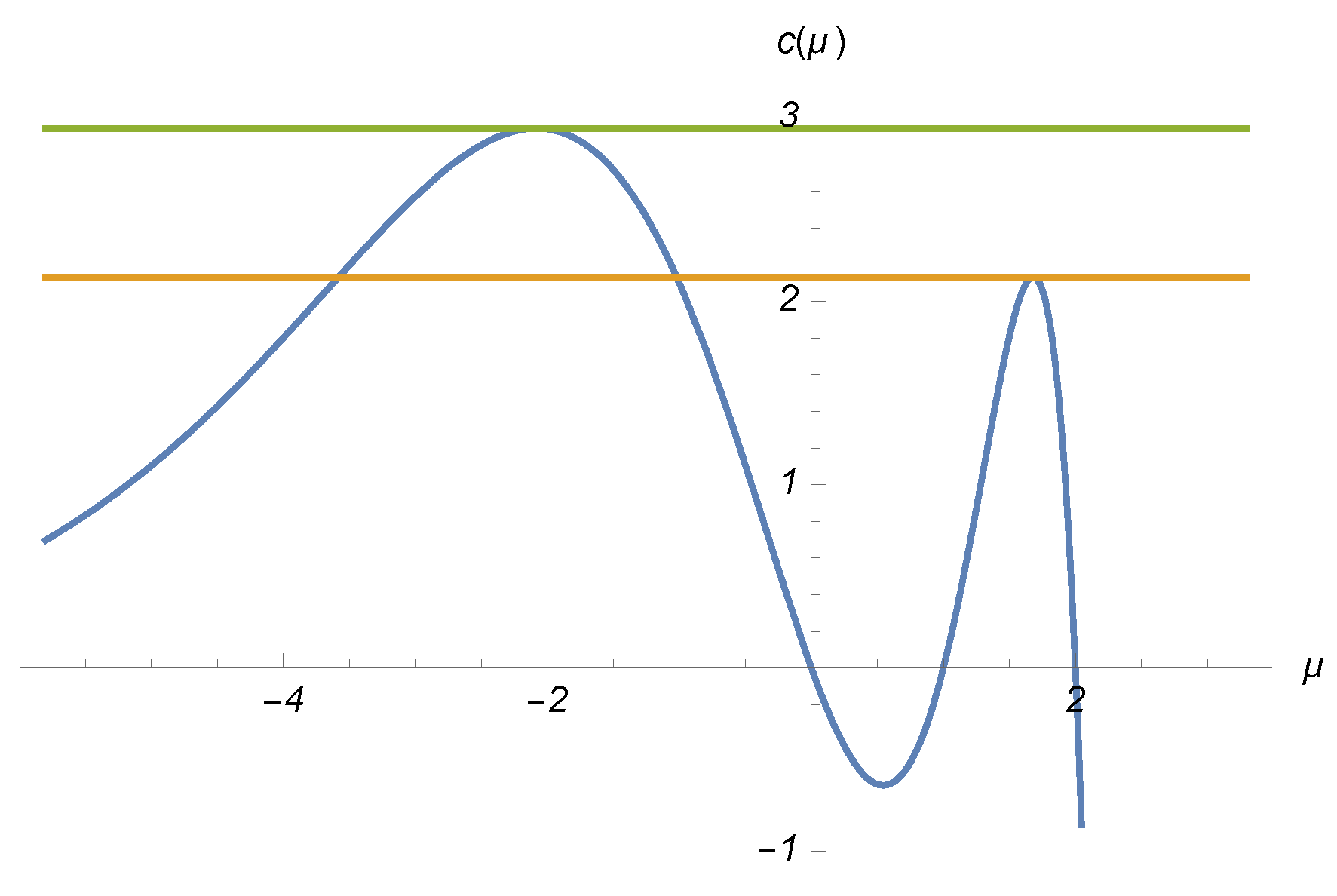
For example, set and . By virtue of (44), we conclude that (5) has property A, if
which is depicted in Figure 1—see the orange line. We can also observe from Figure 1 (see the green line) that if
then (5) has a couple of Kneser solutions tending to zero asymptotically.
Figure 1.
Graph of for and .
Next, we consider the situation when and are not of same type.
Example 2.
Consider the third-order delay differential equation
It is easy to verify that
Then,
and
Clearly, a positive implies that the integral (37) is divergent, i.e.,
Finally, we illustrate the case with non-proportional delay argument.
Example 3.
Consider the third-order delay differential equation
It is easy to verify that
and
Hence, all assumptions of Theorem 6 are satisfied and Equation (47) has property A, that is, any nonoscillatory solution tends to zero asymptotically. One such solution is .
Remark 1.
In the paper, we suggested new oscillation criteria for property A of a class of general third-order delay differential equations by employing a novel iterative technique. In a particular case when the functions are of the same type, a single condition guarantees property A of (1), see Theorems 3 and 4. We stress that our criteria remove a restrictive condition that is a nondecreasing function, they are also applicable in the ordinary case and, most importantly, they are sharp when applied to general third-order delay Euler-type differential equations, see Example 1.
Remark 2.
It is well-known, see, e.g., [3], that the delay argument can cause the oscillation of all solutions of (1). However, the problem of obtaining conditions for the nonexistence of Kneser solutions of (1) which would be sharp for the Euler Equation (3) is nontrivial and we leave this question open for future research. How to extend the sharp results of the paper to the class of neutral third-order differential equations also remains open at the moment.
Author Contributions
Conceptualization, I.J.; methodology, I.J.; investigation, I.J., G.E.C., S.R.G. and J.D.; writing—original draft preparation, I.J.; writing—review and editing, I.J., G.E.C., S.R.G. and J.D. All authors have read and agreed to the published version of the manuscript.
Funding
This research has been supported by the Slovak Research and Development Agency under contracts No. APVV-19-0590 and No. APVV-18-0373.
Institutional Review Board Statement
Not applicable.
Informed Consent Statement
Not applicable.
Data Availability Statement
Not applicable.
Acknowledgments
The authors would like to thank the referees for their valuable comments which helped to improve the manuscript.
Conflicts of Interest
The authors declare no conflict of interest.
References
- Kiguradze, I.T.; Chanturia, T.A. Asymptotic properties of solutions of nonautonomous ordinary differential equations. In Mathematics and its Applications (Soviet Series); Kluwer Academic Publishers Group: Dordrecht, The Netherlands, 1993; Volume 89, p. xiv+331. [Google Scholar] [CrossRef]
- Kusano, T.; Naito, M. Comparison theorems for functional-differential equations with deviating arguments. J. Math. Soc. Jpn. 1981, 33, 509–532. [Google Scholar] [CrossRef]
- Chatzarakis, G.E.; Grace, S.R.; Jadlovská, I. Oscillation criteria for third-order delay differential equations. Adv. Differ. Equ. 2017, 2017, 330. [Google Scholar] [CrossRef] [Green Version]
- Saker, S. Oscillation Theory of Delay Differential and Difference Equations: Second and Third-Orders; LAP Lambert Academic Publishing: Riga, Latvia, 2010. [Google Scholar]
- Padhi, S.; Pati, S. Theory of Third-Order Differential Equations; Springer: New Delhi, India, 2014; p. xvi+507. [Google Scholar] [CrossRef]
- Agarwal, R.P.; Aktas, M.F.; Tiryaki, A. On oscillation criteria for third-order nonlinear delay differential equations. Arch. Math. 2009, 45, 1–18. [Google Scholar]
- Agarwal, R.; Bohner, M.; Li, T.; Zhang, C. Oscillation of third-order nonlinear delay differential equations. Taiwan. J. Math. 2013, 17, 545–558. [Google Scholar] [CrossRef]
- Aktaş, M.; Tiryaki, A.; Zafer, A. Oscillation criteria for third-order nonlinear functional differential equations. Appl. Math. Lett. 2010, 23, 756–762. [Google Scholar] [CrossRef] [Green Version]
- Baculíková, B.; Elabbasy, E.M.; Saker, S.H.; Džurina, J. Oscillation criteria for third-order nonlinear differential equations. Math. Slovaca 2008, 58, 201–220. [Google Scholar] [CrossRef]
- Cecchi, M.; Došlá, Z.; Marini, M. Disconjugate operators and related differential equations. In Proceedings of the 6th Colloquium on the Qualitative Theory of Differential Equations, Szeged, Hungary, 10–14 August 1999; Volume 4, p. 17. [Google Scholar]
- Cecchi, M.; Došlá, Z.; Marini, M. Some properties of third-order differential operators. Czechoslov. Math. J. 1997, 47, 729–748. [Google Scholar] [CrossRef] [Green Version]
- Baculíková, B.; Džurina, J. Oscillation of third-order functional differential equations. Electron. J. Qual. Theory Differ. Equ. 2010, 43, 1–10. [Google Scholar] [CrossRef]
- Bohner, M.; Grace, S.R.; Jadlovská, I. Oscillation criteria for third-order functional differential equations with damping. Electron. J. Differ. Equ. 2016, 215, 15. [Google Scholar]
- Candan, T.; Dahiya, R.S. Oscillation of third-order functional differential equations with delay. In Proceedings of the Fifth Mississippi State Conference on Differential Equations and Computational Simulations, Mississippi State, MS, USA, 18–19 May 2001; Volume 10, pp. 79–88. [Google Scholar]
- Elabbasy, E.M.; Hassan, T.S.; Elmatary, B.M. Oscillation criteria for third-order delay nonlinear differential equations. Electron. J. Qual. Theory Differ. Equ. 2012, 5, 11. [Google Scholar] [CrossRef]
- Grace, S.R.; Agarwal, R.P.; Pavani, R.; Thandapani, E. On the oscillation of certain third-order nonlinear functional differential equations. Appl. Math. Comput. 2008, 202, 102–112. [Google Scholar] [CrossRef]
- Saker, S.H.; Džurina, J. On the oscillation of certain class of third-order nonlinear delay differential equations. Math. Bohem. 2010, 135, 225–237. [Google Scholar] [CrossRef]
- Jadlovská, I.; Džurina, J. Kneser-type oscillation criteria for second-order half-linear delay differential equations. Appl. Math. Comput. 2020, 380, 125289. [Google Scholar] [CrossRef]
- Jadlovská, I. Oscillation criteria of Kneser-type for second-order half-linear advanced differential equations. Appl. Math. Lett. 2020, 106, 106354. [Google Scholar] [CrossRef]
- Džurina, J.; Jadlovská, I. A sharp oscillation result for second-order half-linear noncanonical delay differential equations. Electron. J. Qual. Theory Differ. Equ. 2020, 46, 1–14. [Google Scholar] [CrossRef]
- Graef, J.R.; Jadlovská, I.; Tunç, E. Sharp asymptotic results for third-order linear delay differential equations. J. Appl. Anal. Comput. Appear 2021. [Google Scholar] [CrossRef]
Publisher’s Note: MDPI stays neutral with regard to jurisdictional claims in published maps and institutional affiliations. |
© 2021 by the authors. Licensee MDPI, Basel, Switzerland. This article is an open access article distributed under the terms and conditions of the Creative Commons Attribution (CC BY) license (https://creativecommons.org/licenses/by/4.0/).

