


Highlights
What are the main findings?
- A collaborative scheduling strategy based on asymmetric Nash bargaining is proposed for electric–thermal–hydrogen multi-microgrids under wind–solar uncertainty.
- A scenario reduction method combining temporally correlated Latin hypercube sampling and Wasserstein distance effectively captures renewable energy stochasticity.
- Compared with independent operation, the total operating cost is reduced by 36.85%, while the fairness of transactions is guaranteed.
- The approach balances overall economic efficiency and inter-microgrid transaction fairness in a distributed energy system.
- The uncertainty handling scheme achieves high accuracy with moderate computational effort, suitable for practical scheduling.
- It facilitates cross-regional surplus renewable energy utilization, supporting low-carbon and cost-effective operation.
Abstract
This paper proposes a collaborative optimal scheduling strategy based on asymmetric Nash bargaining for the integrated electricity–heat–hydrogen multi-microgrid system, which can minimize the overall system operation cost while guaranteeing the dynamic fairness of multi-microgrids energy transactions with full consideration of wind–solar uncertainty. First, a scenario generation method based on temporally correlated Latin hypercube sampling and Wasserstein probability distance-based scenario reduction is adopted to construct representative wind–solar uncertainty scenarios, which effectively mitigates the operational risks arising from wind and solar power output fluctuations in the coordinated dispatch of multi-microgrids. Then, an asymmetric Nash bargaining-based cooperative game model for energy trading is established, with each microgrid’s optimal independent operation cost as the negotiation breakdown point. The alternating direction method of multipliers is used for a distributed solution to obtain the optimal scheme that balances total system cost and trading fairness. Simulation results verify that the proposed strategy can effectively suppress operation risks from renewable uncertainty, significantly cut total system cost by 36.85%, and fully ensure trading fairness among multi-microgrid entities, with favorable engineering application value.
Keywords:
Nash bargaining; electric–thermal–hydrogen multi-microgrids; cooperative dispatch; distributed optimization; wind–solar uncertainty MSC:
91A12
1. Introduction
Driven by the global energy transition and China’s Dual-Carbon strategy, the penetration rate of renewable energy has witnessed a sustained increase. While this has greatly facilitated the low-carbon transformation of power systems, the inherent stochasticity and intermittency of renewable energy have posed severe challenges to the operation, power balance, and power supply reliability of standalone microgrids. Multi-microgrid (MMG) systems have thus emerged as the optimal framework for addressing the complexity of distributed power networks, owing to their superior scalability, disturbance rejection capability, and operational flexibility. Compared with standalone microgrids, MMG systems break the limitations of isolated operation through the interconnection and coordinated operation of multiple microgrids. They enable the interactive sharing of energy and ancillary services, effectively mitigate the volatility of renewable energy, and substantially improve energy utilization efficiency and overall system reliability, delivering performance that far outperforms that of independently operated microgrids [1].
However, conventional MMG systems still face formidable challenges in coping with long-timescale energy fluctuations and achieving deep decarbonization targets. As an ideal carrier for long-duration, large-scale energy storage, hydrogen energy can convert surplus renewable electricity into hydrogen via water electrolysis technology for storage. During peak energy demand periods, hydrogen can be utilized for the combined supply of electricity, heat, and natural gas through fuel cell power generation, direct combustion, and other technical approaches, thereby significantly enhancing the zero-carbon energy supply capacity, long-term operational regulation flexibility, and multi-energy complementation potential of MMG systems [2]. The collaborative scheduling of electricity–heat–hydrogen-integrated multi-microgrids achieves the coordination and unification of the benefits of individual microgrids and the whole system through global optimization. While preserving the autonomous operation right of each microgrid, it realizes a comprehensive improvement in the economy, reliability, environmental friendliness, and flexibility of the regional energy system. Accordingly, it has become a core technical approach for constructing a safe, efficient, clean and low-carbon new-type power system, as well as facilitating the achievement of the Dual-Carbon goals [3].
A body of research studies has focused primarily on reducing the total operational cost of MMG systems. Among them, Refs. [4,5,6] designed novel energy storage sharing mechanisms and internal pricing or cost allocation approaches, which reduced overall operational costs by facilitating efficient energy exchange among microgrids. Refs. [7,8] tapped into the complementary potential among microgrids in depth by optimizing the coupling mode of multi-energy flows, which reduced dependence on the external power grid and electricity purchase costs and further decreased the overall system operational cost. Refs. [9,10] proposed a bilevel optimization model, which demonstrated remarkable potential in improving system economy and renewable energy accommodation capacity through the collaborative iteration of upper-layer capacity configuration and lower-layer operational dispatching. Ref. [11] presented a distributed dynamic economic dispatching method for a biogas–wind–solar–hydrogen multi-microgrid system considering individual selfishness and established a dynamic economic dispatching model for such a system, which effectively reduced the total operational cost. Ref. [12] proposed a LEOSat-aided over-the-air computation federated reinforcement learning approach to achieve coordinated economic operation of pelagic island microgrids under constrained terrestrial communication. Ref. [13] enhanced the scheduling performance of hydrogen-based integrated energy systems through multi-dimensional improvements to the multi-agent deep reinforcement learning algorithm. Ref. [14] proposed an interpretable attention-based multi-agent approach to realize coordinated voltage regulation and economic optimization of hydrogen-integrated distribution networks.
Nevertheless, these studies all lack a reasonable profit distribution mechanism, which results in some microgrids being trapped in disadvantageous profit positions for a long time, weakens the collaborative initiative among microgrids, and restricts the large-scale development of electric–thermal–hydrogen multi-microgrids (EHT-MMGs). To address this issue, Ref. [15] adopted the symmetric Nash bargaining theory as a theoretical underpinning and integrated multi-dimensional optimization models involving shared hydrogen purification, transportation time delays, and multi-agent coordination for wind–hydrogen–thermal systems, thereby cutting down system operational costs while ensuring equitable profit distribution across all microgrids. Ref. [16] introduced the asymmetric Nash bargaining theory, correlated the bargaining power factor with the energy trading volume and contribution degree of microgrids, and balanced the profit distribution among multiple integrated energy systems and multi-energy multi-microgrids, thereby achieving the dual goals of cost reduction and carbon abatement. Ref. [17] integrated the double-auction mechanism with the Lyapunov optimization algorithm, determined energy pricing and trading prices from the perspective of market-oriented bidding, and ensured the transparency and fairness of transactions. Ref. [18] constructed an electricity–methanol joint trading model based on the Nash negotiation mechanism, quantified the comprehensive contribution rate of each microgrid, and solved the interest equilibrium problem in complex multi-energy flow-coupling scenarios.
In general, Refs. [4,5,6,7,8,9,10,11,12,13,14] mainly focus on the economic performance of a system with the core objective of minimizing the total cost, while Refs. [15,16,17,18] further achieve the collaborative optimization of system economy and transaction fairness among MMGs. However, stochastic fluctuations in wind speed and solar irradiance will induce violent variations in wind and PV power outputs, leading to grid frequency instability, voltage sags, and threats to terminal voltage stability, which ultimately disrupt the normal scheduling and operation of MMGs. To address this issue, existing studies mainly adopt two approaches to handle the uncertainty in renewable power outputs: Monte Carlo combined with K-means scenario reduction and interval robust optimization [19,20]. Specifically, the Monte Carlo–K-means-based scenario method suffers from overly restrictive distribution assumptions, loss of extreme scenario information, and neglect of the temporal and spatial correlations of renewable outputs. The interval robust optimization method completely discards probability distribution information, resulting in excessively conservative solutions.
To address the above challenges, this paper proposes a novel coordinated optimal scheduling strategy for EHT-MMGs comprising industrial, residential and commercial microgrids, which achieves the collaborative optimization of system economy and inter-microgrid transaction fairness under the uncertainty in wind and PV power outputs. The specific contributions of this paper are as follows:
- (1)
- A scenario reduction algorithm integrating temporally correlated LHS and Wasserstein distance is adopted to generate wind and photovoltaic uncertainty scenarios. This scheme effectively characterizes stochastic fluctuations in wind and PV outputs and overcomes the common limitations of insufficient temporal authenticity and poor statistical representativeness in existing methods.
- (2)
- An asymmetric Nash bargaining-based energy trading mechanism is constructed to realize the joint optimization of electricity price and energy flow, which enhances the fairness of inter-microgrid cooperation and the overall revenue of the system.
- (3)
- The proposed optimal scheduling strategy for the EHT-MMG system exhibits superior performance in reducing system operation cost compared with the independent scheduling mode. Meanwhile, this strategy can significantly enhance the willingness of collaborative operation among microgrids, with uncertainties in wind and PV power output fully taken into account.
The structure of this paper is arranged as follows: Section 2 presents the system architecture and mathematical models of equipment for the electro–thermal–hydrogen multi-microgrid system with consideration of wind and photovoltaics power uncertainties; Section 3 constructs the optimal scheduling model based on asymmetric Nash bargaining, formulates system operation constraints, and elaborates the Alternating Direction Method of Multipliers (ADMM) solving algorithm; Section 4 conducts simulation verification and performance evaluation of the proposed strategy; and Section 5 summarizes the full work and proposes future research directions.
2. System Framework of EHT-MMG Systems Considering Wind–Solar Uncertainty
2.1. System Architecture
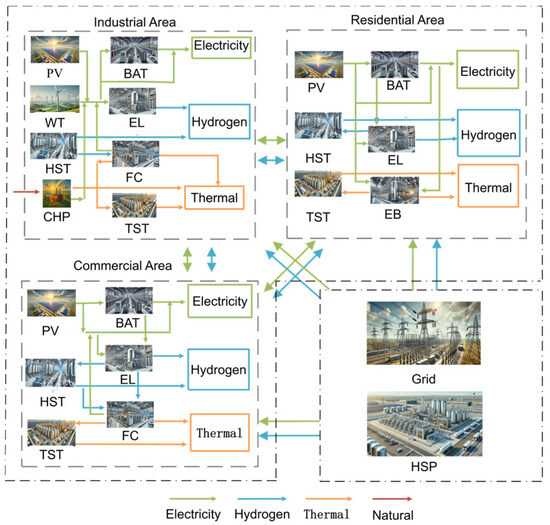
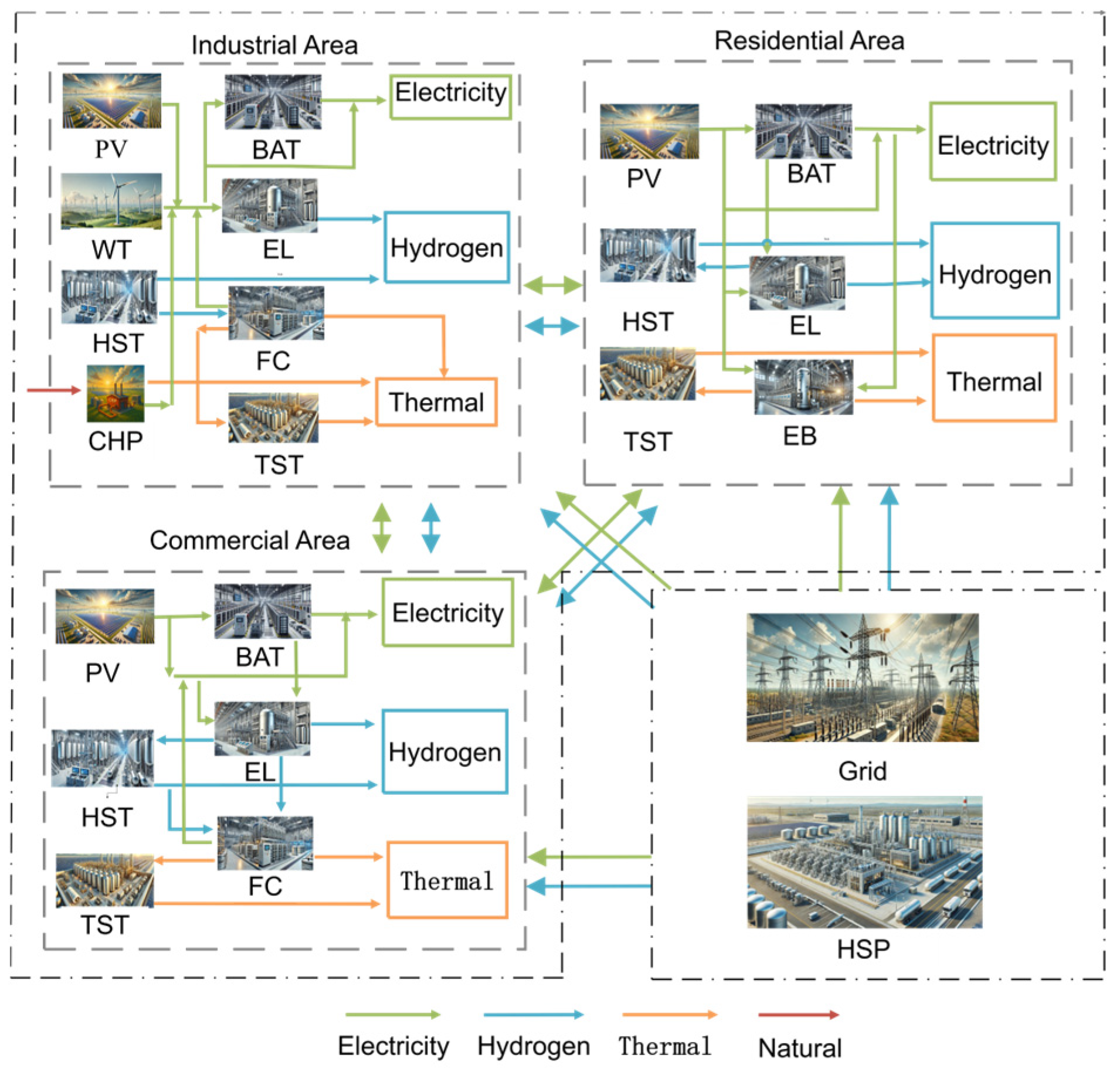
This study proposes a distributed EHT-MMG system architecture, as illustrated in Figure 1. The system comprises three microgrids: industrial, residential, and commercial. The industrial microgrid incorporates wind turbine (WT) generation equipment, PV generation equipment, a fuel cell (FC), and a combined heat and power (CHP) system. An electrolyzer (EL) is configured for hydrogen production, while the FCs supply both electricity and thermal loads. Additionally, the system incorporates energy storage devices including a battery (BAT), a hydrogen storage tank (HST) and a thermal storage tank (TST). The residential microgrid is equipped with PV, an EL, and an electric boiler (EB), combined with multiple energy storage units to meet the electrical and heating demands of residents. The commercial microgrid integrates PV, a FC, and an electrolytic hydrogen production system.
Figure 1.
System architecture diagram.
2.2. System Model Considering Wind–Solar Uncertainty
2.2.1. Model of Multi-Uncertainty
In the practical operation of the electric–thermal–hydrogen multi-microgrid system, both solar irradiance and wind speed, which determine the wind and solar power output, have strong stochastic uncertainty. The system model constructed based only on deterministic forecast values is difficult to adapt to actual engineering operating conditions. Therefore, this paper adopts the scenario analysis method to simulate typical daily scenarios that can reflect the stochastic characteristics of wind and solar power output. As a widely utilized approach for addressing uncertainty in the operation of energy systems [21,22,23], the scenario analysis method comprises two core procedures in its implementation, namely, scenario generation and scenario reduction.
- (1)
- Scenario Generation.
LHS has been widely adopted for uncertainty scenario generation. As an efficient uncertainty sampling method, it conducts enforced stratified processing on probability distributions to ensure that the samples uniformly cover both high and low probability intervals, thereby significantly improving the solution reliability of subsequent stochastic optimization [24]. However, wind energy exhibits temporal correlation at each time instant, and the same holds for solar energy; this characteristic leads to deviations between the scenarios directly generated by LHS and the actual operation of multi-microgrid systems. To remedy this deficiency, temporal correlation characteristics need to be incorporated into the initial scenarios generated by LHS, and the detailed scenario generation procedure is as follows:
(a) Marginal Distribution Fitting.
To accurately characterize the probabilistic characteristics of solar irradiance, this paper employs the Beta distribution to fit its probability distribution [25]:
where is the distribution of solar irradiance; is the normalized solar irradiance; is the gamma function; and are the two shape parameters of the Beta probability distribution; and and are the mean and standard deviation of solar irradiance, respectively.
Correspondingly, the Weibull distribution is used to model the probabilistic behavior of wind speed [25]:
where is the distribution of wind speed; is the real-time wind speed; and are respectively the shape and scale parameters of the Weibull distribution; and and are respectively the mean value and standard deviation of wind speed samples.
(b) LHS.
First, a discretization method is employed to transform the continuous probability density distributions of the above-mentioned wind speed and solar irradiance into a set of discrete point data with embedded probability information [26]. Subsequently, the LHS approach is adopted to sample these discrete data points for the purpose of generating hourly operational scenarios throughout a single scheduling cycle. The specific implementation procedures involve stratified sampling, probability sampling, random sample permutation and inverse probability sampling [27]. The scenarios derived from the LHS method are designated as the initially generated scenarios.
(c) Temporal Correlation Analysis.
In this paper, a temporal resolution of 1 h is employed, which means data acquisition or simulation iteration is conducted once per hour, yielding a total of 24 samplings in a single day. The temporal correlation matrix is constructed as follows.
where denotes the correlation matrix and is the temporal correlation coefficient of wind speed or solar irradiance between the time and . The expression is given as follows:
where denotes the value of wind speed or solar irradiance at time and represents the mean value of wind speed or solar irradiance.
To embed the temporal autocorrelation structure into the initial independent scenarios, this study employs the Cholesky decomposition method to decompose matrix :
where is the product of a lower triangular matrix and is the transpose of . Correlation injection is then achieved via the following linear transformation:
where denotes the matrix obtained by standardizing the initial scenario matrix generated by LHS.
The core principle of this transformation is that after the standardized matrix is transformed by , its covariance matrix will be equivalent to the target autocorrelation matrix , thus enabling the generated scenarios to possess both marginal distribution characteristics and temporal correlation. Finally, inverse standardization is performed on to obtain the final initial scenario set .
- (2)
- Scenario Reduction Based on Wasserstein.
This paper adopts the scenario reduction optimization model based on the minimum Wasserstein probabilistic distance (WPD) to generate representative scenarios. The minimum WPD between a Classical Scenario Set (CS) and an Initial Scenario Set (IS) is as follows [28]:
where is the probability of the initial scenario ; is the Euclidean distance between the initial scenario and the classic scenario ; is a binary variable with a value of 0 or 1; and represents the scenario assigned to scenario. Conversely, means the initial scenario is not assigned to the classical scenario .
Meanwhile, the model must satisfy the following constraints:
where represents the number of classical scenarios; is a binary variable with a value of 0 or 1; denotes that scenario is selected as a classical scenario; and means scenario is not selected as a classical scenario. The first constraint indicates that classical scenarios are finally selected by this method, the second constraint requires that each initial scenario be uniquely assigned to one classical scenario, and the third constraint ensures that each initial scenario is exclusively assigned to a selected representative scenario.
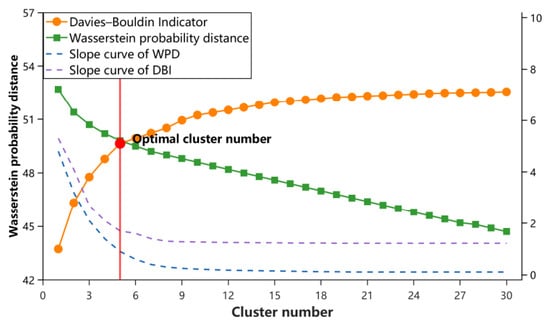
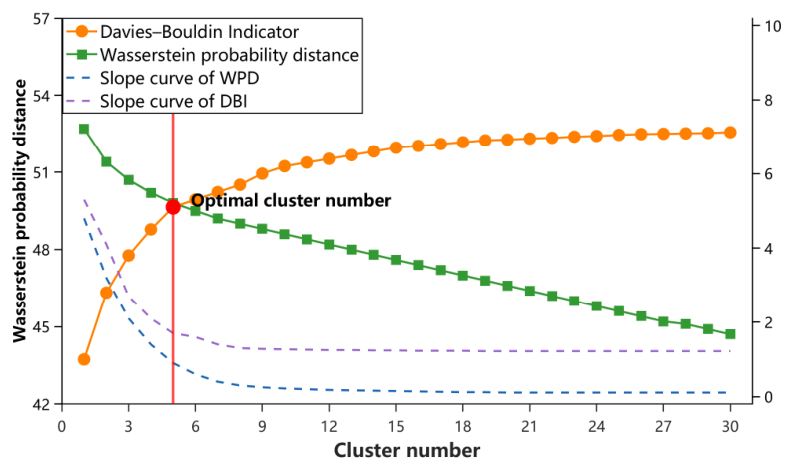
This paper adopts the WPD and the Davies–Bouldin Index (DBI) to evaluate the effectiveness of scenario reduction under different cluster counts. The calculation formula of the DBI is shown as follows:
where is the intra-cluster average distance of cluster ; denotes the centroid of cluster ; and denotes the inter-cluster distance between the centroids and .
The WPD quantifies the discrepancy in the probability distribution between the reduced scenario set and the original scenario set, where a smaller WPD value denotes a better performance of scenario reduction. The DBI assesses the compactness and separability of clustering by calculating the ratio of the average intra-cluster distance to the inter-cluster distance, with a smaller DBI value corresponding to a more favorable clustering effect. In this paper, the improved elbow method [24] is adopted to determine the optimal number of scenarios by selecting the inflection point where both the decrease in WPD and the increase in DBI tend to flatten out.
Once the optimal number of scenarios is determined, the Gurobi solver is invoked to solve the optimization model formulated in Equation (9), yielding the corresponding number of optimal representative scenarios and their respective occurrence probabilities:
2.2.2. System Model
In microgrid systems, energy equipment is classified into four core modules based on functional disparities: power generation modules, heat production modules, hydrogen production modules, and energy storage modules. This study employs a static functional modeling approach for the aforementioned energy conversion devices, focusing solely on their power input–output mapping and macroscopic energy conversion characteristics while disregarding internal thermodynamic processes, control implementation details, and dynamic response features.
- (1)
- Photovoltaic Equipment Model.
The output power of photovoltaic equipment is affected by solar irradiance and photovoltaic panel area. The output electrical power model of photovoltaic equipment is established as follows [29]:
where is the output power of the photovoltaic system in microgrid at time under classic scenario ; is the energy conversion efficiency of the photovoltaic panel; is the area of the photovoltaic panel; and is the solar irradiance at time under classic scenario , which can be obtained from the aforementioned generated typical PV scenarios.
- (2)
- Wind Turbine Model.
The output power of wind turbines is mainly affected by wind speed. The output electrical power model of wind turbines is established as follows [29]:
where is the output power of the wind turbine in microgrid at time under classic scenario ; is the rated output power of the wind turbine; is the wind speed at time under classic scenario ; and , and are the cut-in wind speed, cut-out wind speed, and rated wind speed of the wind turbine, respectively.
- (3)
- Combined Heat and Power System Model.
The CHP system generates electrical energy and thermal energy by burning natural gas. The output electrical power and thermal power models of the CHP system are established as follows [30]:
where and are the output electrical power and thermal power of the CHP system in microgrid at time under classic scenario ; is the fuel input at time ; and are the electrical generation efficiency and thermal generation efficiency of the CHP system, respectively; and is the thermal–electric ratio of the CHP system.
- (4)
- Electrolyzer Model.
Electrolyzers produce hydrogen by electrolyzing water to supply hydrogen energy to each microgrid region. The hydrogen production model of the electrolyzer is established as follows [30]:
where is the hydrogen mass output by the electrolyzer in microgrid at time under classic scenario ; is the electrical power input to the electrolyzer in microgrid at time under classic scenario ; is the energy conversion efficiency of the electrolyzer; and is the conversion coefficient between hydrogen mass and energy.
- (5)
- Electric Boiler Model.
Electric boilers generate thermal energy by consuming electrical energy. The output thermal power model of the electric boiler is established as follows [30]:
where is the electrical power input to the electric boiler in microgrid at time under classic scenario ; is the thermal power output of the electric boiler at time under classic scenario ; and is the electro-thermal conversion efficiency.
- (6)
- Fuel Cell Model.
Fuel cells generate electrical energy and thermal energy by consuming hydrogen. The output electrical power and thermal power models of fuel cells are established as follows [31]:
where is the output electrical power of the fuel cell in microgrid at time under classic scenario ; is the output thermal power of the fuel cell at time under classic scenario ; is the hydrogen input mass of the fuel cell in microgrid at time t under classic scenario ; is the electrical conversion efficiency of the fuel cell; and is the thermal conversion efficiency of the fuel cell.
- (7)
- Energy Storage Device Model
The energy storage equipment under consideration consists of three types: BAT, HST, and TST. The energy storage capacity is dictated by its charge–discharge power, and the corresponding energy storage model is developed as follows [32]:
where ; denotes the capacity of the energy storage devices under classic scenario ; and are the charging power and discharging power of the energy storage devices in microgrid at time under classic scenario , respectively; and and denote the charging efficiency and discharging efficiency, respectively. The key equipment parameters and operation constraint configurations of EHT-MMGs are detailed in Table 1.
Table 1.
Key equipment parameters and operation constraint configuration of EHT-MMGs.
3. Optimal Scheduling Strategy of EHT-MMG Systems Considering Wind–Solar Uncertainty
3.1. Asymmetric Nash Bargaining Model
In this paper, an asymmetric Nash bargaining model is developed to determine the fair cost allocation among individual microgrids in collaborative operation. Based on the principle of the Weighted Nash Bargaining Solution, this method aims to achieve optimal and equitable benefit distribution among cooperating parties by maximizing the weighted product of all parties’ benefits, ensuring the substantive fairness of transactions [33,34]. The asymmetric Nash bargaining model for EHT-MMG systems proposed in this paper is formulated as follows:
where n is the number of microgrids in the multi-microgrid system; is the scheduling cost of microgrid in the autonomous optimization mode under classic scenario ; and is the dispatch cost of microgrid in the coordinated operation mode under classic scenario . denotes the bargaining weight of the microgrid, satisfying the normalization condition . Considering that in actual electricity markets, dispersed residential users have low demand elasticity and are often at a disadvantage in peer-to-peer energy trading, while industrial parks with abundant distributed generation resources possess stronger bargaining power, this paper sets the bargaining weight for residential areas at 2.0 and those for industrial and commercial areas at 1.0 each. After normalization, the respective weights become 0.5, 0.25, and 0.25.
For simplicity, this study neglects both tie-line transmission capacity constraints and line transmission losses. Accordingly, the cost model of microgrid under classic scenario is formulated as follows:
where is the energy production cost of equipment in microgrid under classic scenario ; is the energy storage cost of energy in microgrid under classic scenario ; is the net transaction cost between microgrid and other microgrids under classic scenario ; and is the energy purchase cost of microgrid from the power grid and hydrogen supply plant under classic scenario . The detailed formulation is as follows:
where is the production cost of equipment in microgrid ; is the energy production power output of equipment in microgrid at time under classic scenario ; and are the charging cost and discharging cost of the energy storage device for energy , respectively; and are the charging power and discharging power of the energy storage device for energy at time under classic scenario , respectively; and are the selling prices of electrical energy and hydrogen energy from microgrid to microgrid under classic scenario ; and are the interaction quantities of electrical energy and hydrogen energy between region and region at time ; , , and are the decision variables in the asymmetric Nash bargaining model; and are the energy purchase prices of microgrid from the power grid and hydrogen supply plant at time , respectively; and and are the energy purchase powers of microgrid from the power grid and hydrogen supply plant at time under classic scenario , respectively.
The asymmetric Nash bargaining model is a nonconvex and nonlinear optimization problem, which makes it hard to obtain effective solutions with current algorithms. To simplify the analysis, the problem is decomposed into two sequential subproblems: the subproblem of minimizing the total cost of coordinated operation of multiple microgrids (P1) and the subproblem of cost allocation among individual microgrids (P2). The equivalence proof is presented as follows:
According to the arithmetic mean–geometric mean, inequality (21) meets the following:
Therefore, one way to solve (20) is to find the solution of the following first:
Since values are constants and values offset each other, the original problem is equivalent to minimizing the total cooperation cost, which is defined as subproblem P1:
In this subproblem, the multi-microgrid energy system is treated as a coalition, with the objective of minimizing the total cost of the coalition. By solving (29), the optimal traded electricity volume and optimal traded hydrogen volume can be obtained so that the optima are , and .
Then, the asymmetric Nash bargaining model (21) can be transformed into the problem of the Bargaining Profit Distribution, as follows:
By taking the natural logarithm of (30), the original problem is equivalent to subproblem P2:
Thus, the proof is completed.
3.2. Constraints
Under the coordination model, the interaction power between different microgrids and the energy purchase power from the power grid and hydrogen supply plants must satisfy the balance constraints. The supply–demand balance constraints for electrical energy, hydrogen energy, and thermal energy in the industrial zone are as follows:
Under the collaborative optimization model, the supply–demand balance constraints for electrical energy, hydrogen energy, and thermal energy in the residential area are as follows:
Under the collaborative optimization model, the supply–demand balance constraints for electrical energy, hydrogen energy, and thermal energy in the commercial area are as follows:
where , and are respectively the power changes of the energy storage devices for energy in the industrial zone, residential area, and commercial area under classic scenario and , and are respectively the electrical, hydrogen, and thermal load demands of users in Sub-network .
Meanwhile, the electrical energy and hydrogen energy transactions between different microgrids are real-time equal:
where ; and are the transmission volume of electrical and hydrogen energy from region to region ; and and are the transmission volume of electrical and hydrogen energy from region to region .
3.3. Adaptive ADMM
The particle swarm optimization and genetic algorithms are typical centralized stochastic search optimization algorithms. When adopted for the scheduling of multi-microgrid systems, they operate on the principle that a central controller uniformly collects the global information of all microgrids and centrally completes the joint solution of all decision variables within a unified optimization framework. However, the computational burden increases rapidly with the scaling up of multi-microgrid and multi-energy flow systems, leading to slow convergence. This is attributed to the repeated population iterative search required in the high-dimensional and complex solution space. Meanwhile, such centralized methods cannot guarantee information privacy among different microgrids. In comparison, ADMM exhibits prominent advantages: it can decompose the original overall optimization problem into several independent local subproblems, which greatly accelerates the solution efficiency of optimal scheduling and fulfills the privacy protection requirements of multi-microgrid collaborative operation. Accordingly, this paper employs ADMM to solve the two aforementioned subproblems and further obtain the optimal solution of the original problem [35].
3.3.1. Subproblem P1 Solution
By introducing the Lagrange multipliers and into Equation (29), the augmented Lagrangian function model is further established:
where is a two-dimensional column vector composed of the scalar components and ; denotes the penalty factor.
According to the principle of ADMM, microgrid sequentially updates its decision variables via Equation (44).
The iteration number is updated as k = k + 1. If the condition in Equation (45) is satisfied, the iteration terminates.
where is the primal residual; is the dual residual; and and are the convergence thresholds of the dual residual and the primal residual, respectively.
The penalty parameters are updated based on the following to achieve rapid convergence:
where is the adjustment factor, which is used to dynamically adjust the change rate of the penalty parameter.
3.3.2. Subproblem P2 Solution
By introducing the Lagrange multipliers and into Equation (31), the augmented Lagrangian function model is further established.
where is a two-dimensional column vector composed of the scalar components and ; denotes the penalty factor.
According to the principle of ADMM, microgrid sequentially updates its decision variables via Equation (48).
The iteration number is updated as k = k + 1. If the condition in Equation (49) is satisfied, the iteration terminates.
where is the primal residual; is the dual residual; and and are the convergence thresholds of the dual residual and the primal residual, respectively.
The penalty parameters are updated based on the following to achieve rapid convergence:
where is the adjustment factor, which is used to dynamically adjust the change rate of the penalty parameter.
Application of the aforementioned two-step ADMM-based solution framework to various typical scenarios yields the optimal transaction volumes and prices among multi-microgrids under each scenario and further enables the derivation of the operating cost of each individual microgrid for the corresponding scenario. By performing a weighted summation of the operating costs of all scenarios using the respective probabilities specified in Equation (12), the cooperative operating cost of each microgrid under wind and solar energy uncertainty can be obtained as follows:
4. Simulation
In this section, an electricity–heat–hydrogen-integrated multi-microgrid system composed of three typical types of users—industrial zones, commercial zones, and residential zones—is adopted as the simulation case study. First, a differentiated load demand analysis is conducted according to the energy consumption characteristics of different functional areas, so as to clarify the research boundaries and energy use features of each microgrid. Second, uncertainty scenarios of renewable energy generation are established based on the probability distribution characteristics of wind speed and solar irradiance. On this basis, a multi-scenario stochastic optimal dispatch model is constructed, and the globally optimal energy dispatch scheme of the system is obtained through solution. Finally, from the perspective of total system operating cost, the economic performance of the multi-microgrid coordinated dispatch mode is compared with that of the independent operation mode of each microgrid, so as to verify the superiority of the proposed coordinated optimal dispatch strategy.
4.1. User Requirement Analysis
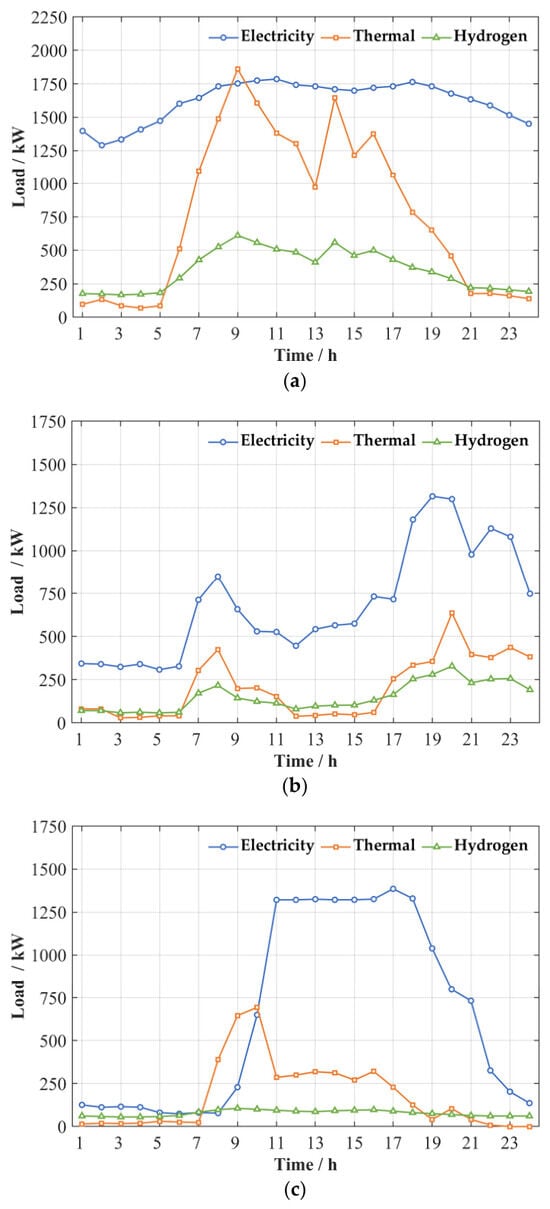
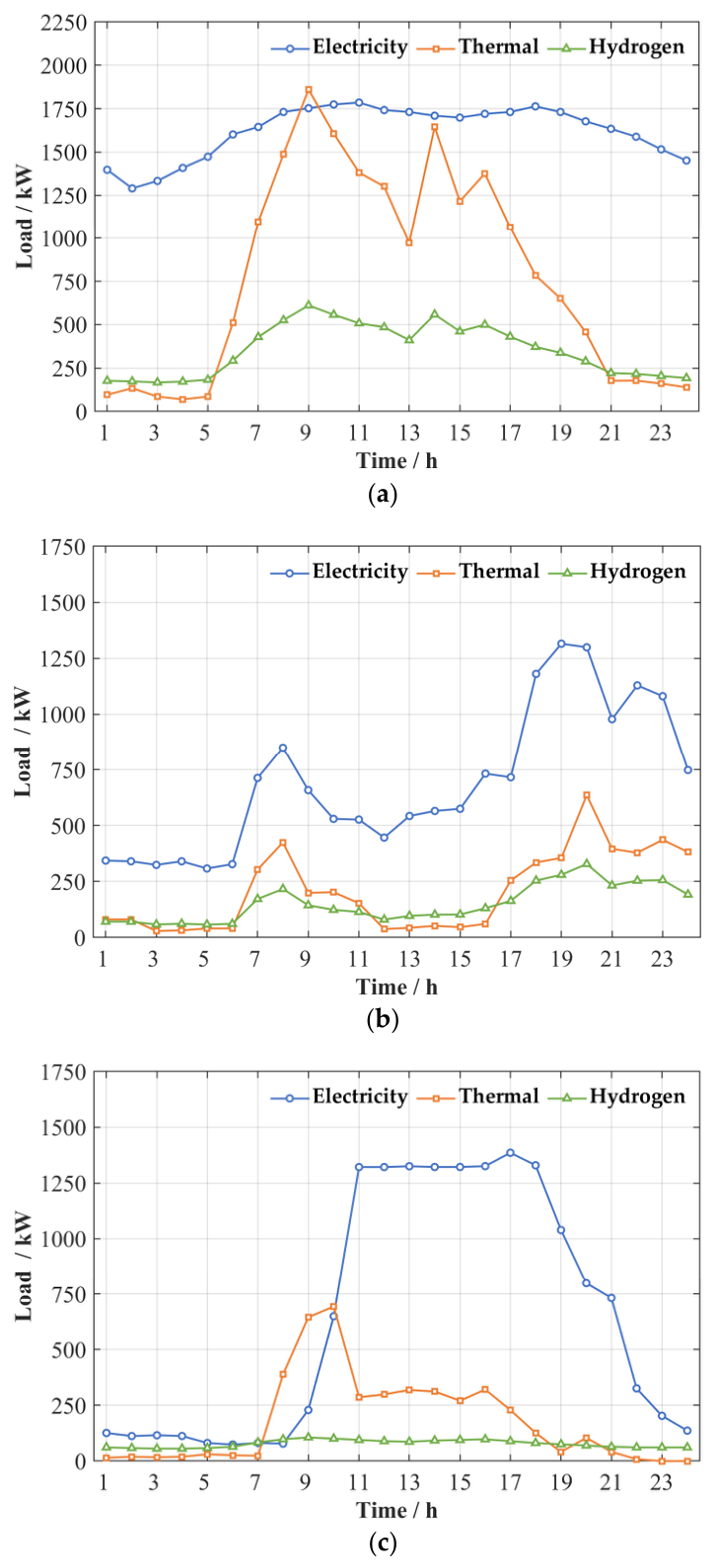
In the simulation case of this study, the diversified load demands of users in each microgrid adopt the user data from reference [36], as shown in Figure 2.
Figure 2.
Load demands of users: (a) industrial zone, (b) residential zone and (c) commercial zone.
The load demand of the industrial zone is shown in Figure 2a. The energy demand of the industrial zone is characterized by all-day and high-intensity consumption. The electric load maintains a stable, high level throughout the day with small fluctuations, matching continuous industrial production. Both thermal and hydrogen loads exhibit a distinct diurnal pattern characterized by high demand during the daytime and low demand at night, demonstrating strong multi-energy coupling properties.
The load demand of the residential zone is shown in Figure 2b. Energy demand is closely coupled with residents’ daily routines. Electric, thermal and hydrogen load all have obvious morning and evening peaks, with the evening peak higher and longer-lasting, matching the morning and evening centralized energy use of residents.
The load demand of the commercial zone is shown in Figure 2c. Energy consumption is highly synchronized with business hours, showing a “daytime high and night low” single-peak pattern. Electric and thermal loads rise sharply at the start of business, maintain a high level during the day, and fall back to near zero at night. The hydrogen load is stable throughout the day with no obvious peak–valley difference.
4.2. Renewable Energy Scenario Simulation Results
In this section, typical scenarios are generated based on historical meteorological data obtained from the ECMWF ERA5-Land global land reanalysis dataset [37].
Figure 3 presents the calculated performance variation as the number of typical scenarios ranges from one to 30. The results show that the DBI increases rapidly with the growing number of typical scenarios: when the number rises to five, the DBI increases by 71.4%, followed by a marked slowdown in its growth rate. Conversely, the number of typical scenarios has an opposite effect on the WPD: the WPD decreases consistently as the number of typical scenarios increases, with a more dramatic decline observed when the number of scenarios is small. The optimal number of typical scenarios is finally determined as five by balancing the two evaluation indicators.
Figure 3.
Variation in performance with the number of classic scenarios.
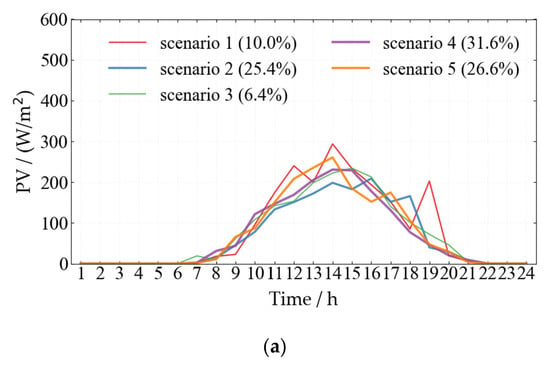
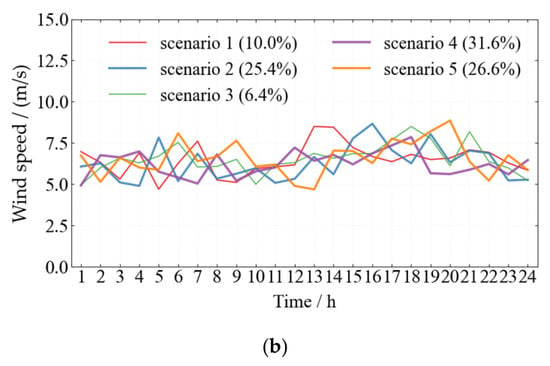
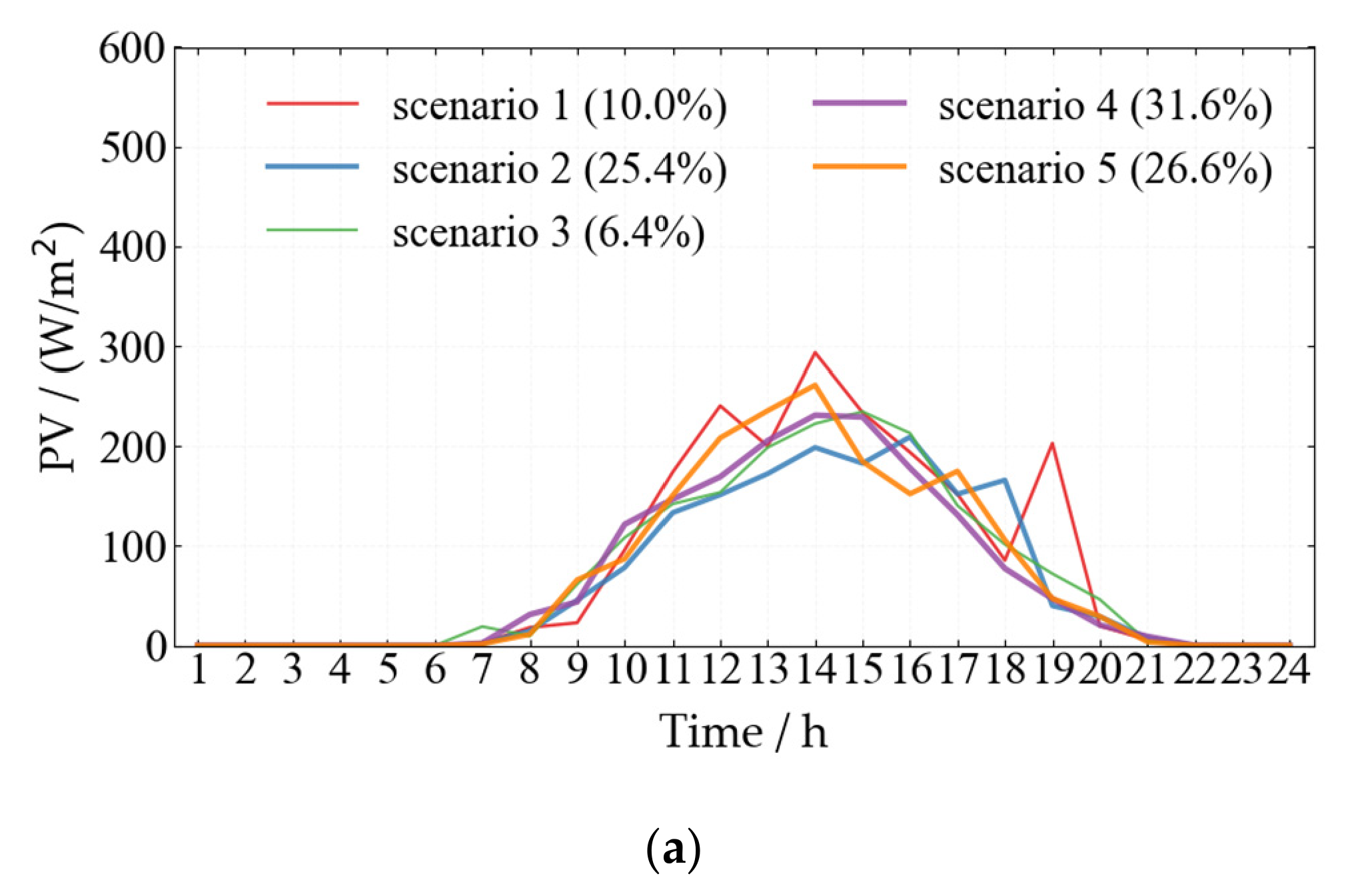
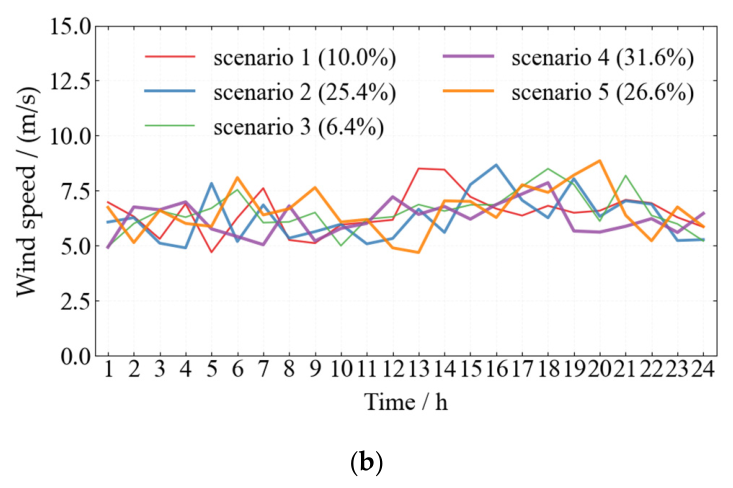
This paper generates 500 initial scenarios using LHS and then reduces them to five typical scenarios via the 0–1 reduction algorithm based on the WPD; the corresponding PV and wind speed curves are shown in Figure 4. The occurrence probabilities of the five representative scenarios are 10.0%, 25.4%, 6.4%, 31.6% and 26.6%, respectively. The selected scenarios span the full range of operating conditions from ideal to extreme. Scenario 1 is the baseline case with high PV output and limited wind generation. Scenario 2 achieves ideal wind–solar complementarity, with highly coordinated resources that effectively flatten the total renewable output. Scenario 3 represents an extreme unbalanced case with a “high PV, low wind” profile, which aggravates the intraday supply–demand mismatch. Scenario 4 is wind-dominated, where abundant wind power provides stable base-load supply for the system. Scenario 5 is the most extreme adverse case, with severely scarce wind and solar resources creating the greatest challenge to system energy supply.
Figure 4.
Typical scenarios: (a) PV scenario and (b) wind speed scenario.
4.3. Analysis of Scheduling Results
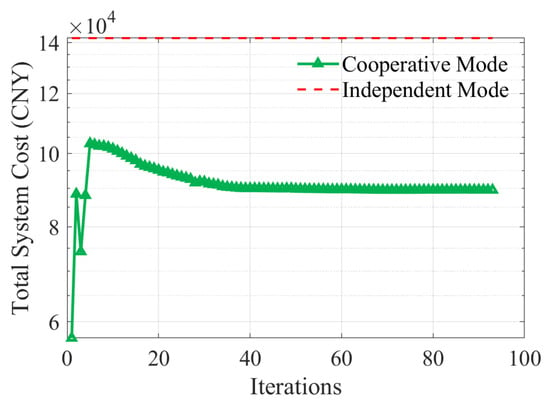
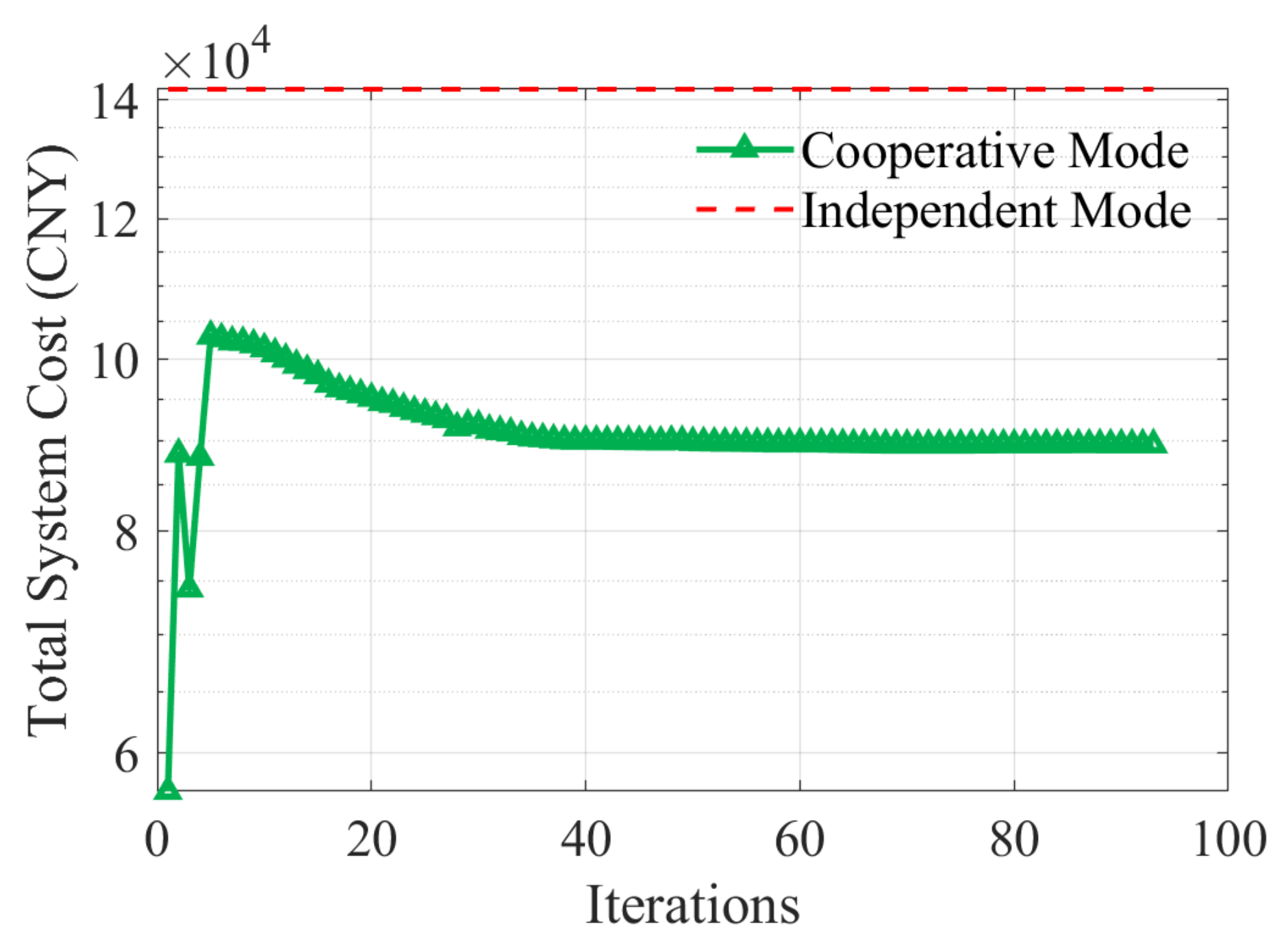
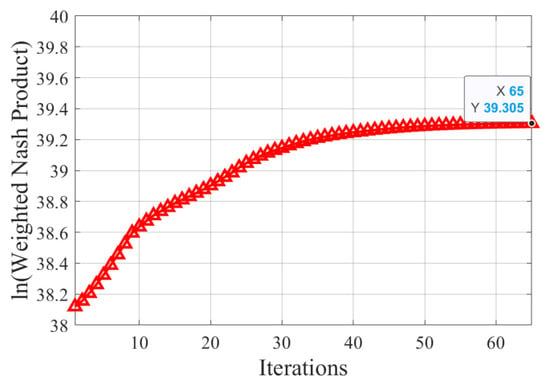
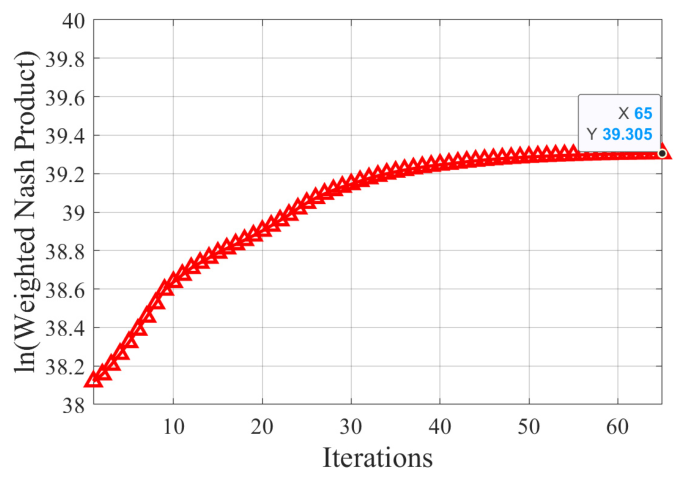
The proposed asymmetric Nash bargaining-based collaborative scheduling model is solved using the Gurobi solver. The relevant parameter settings of the ADMM algorithm are presented in Table 2. This section presents the scheduling results for typical scenario 1. Figure 5 depicts the convergence curve of the total system cost for subproblem P1 solved by ADMM, while Figure 6 illustrates the convergence curve of the weighted Nash product for subproblem P2 solved by ADMM.
Table 2.
ADMM algorithm parameters.
Figure 5.
Convergence curve of the total system cost for P1 solved by the ADMM algorithm.
Figure 6.
Convergence curve of the logarithmically weighted Nash product for P2 solved by the ADMM algorithm.
As shown in Figure 5, the total system cost under the cooperative mode undergoes minor fluctuations in the initial iterations and converges stably to the optimal value around the 40th iteration. The cooperative mode achieves a remarkable cost reduction relative to the independent mode. As shown in Figure 6, the logarithmically weighted Nash product increases monotonically and converges to the maximum value of 39.305 around the 65th iteration. This demonstrates that the ADMM algorithm efficiently solves the asymmetric Nash bargaining-based fair allocation subproblem. In summary, the proposed ADMM algorithm minimizes the total operating cost of the system while ensuring the fairness of cost allocation among multiple microgrids.
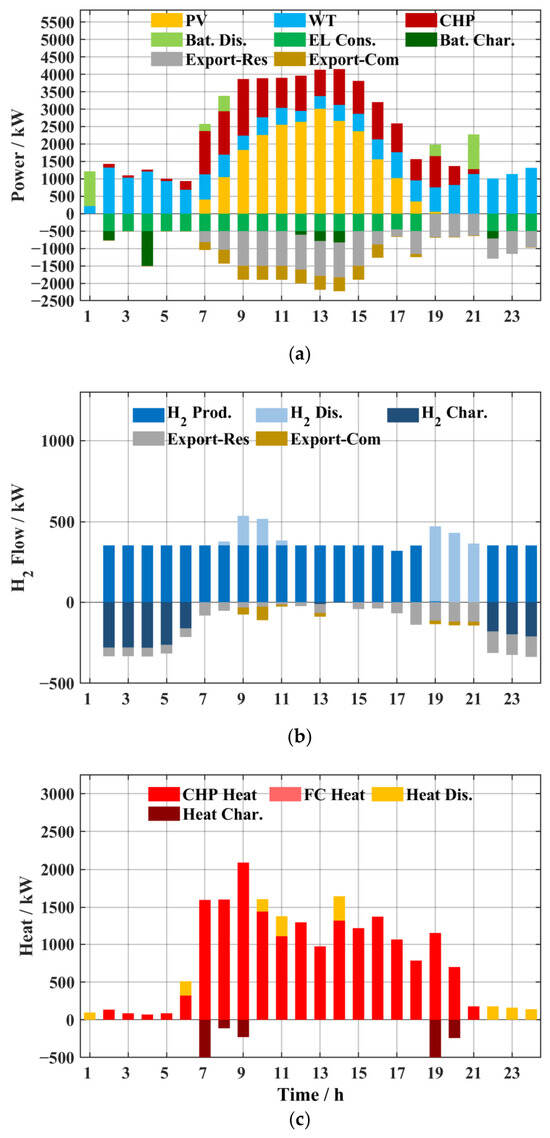
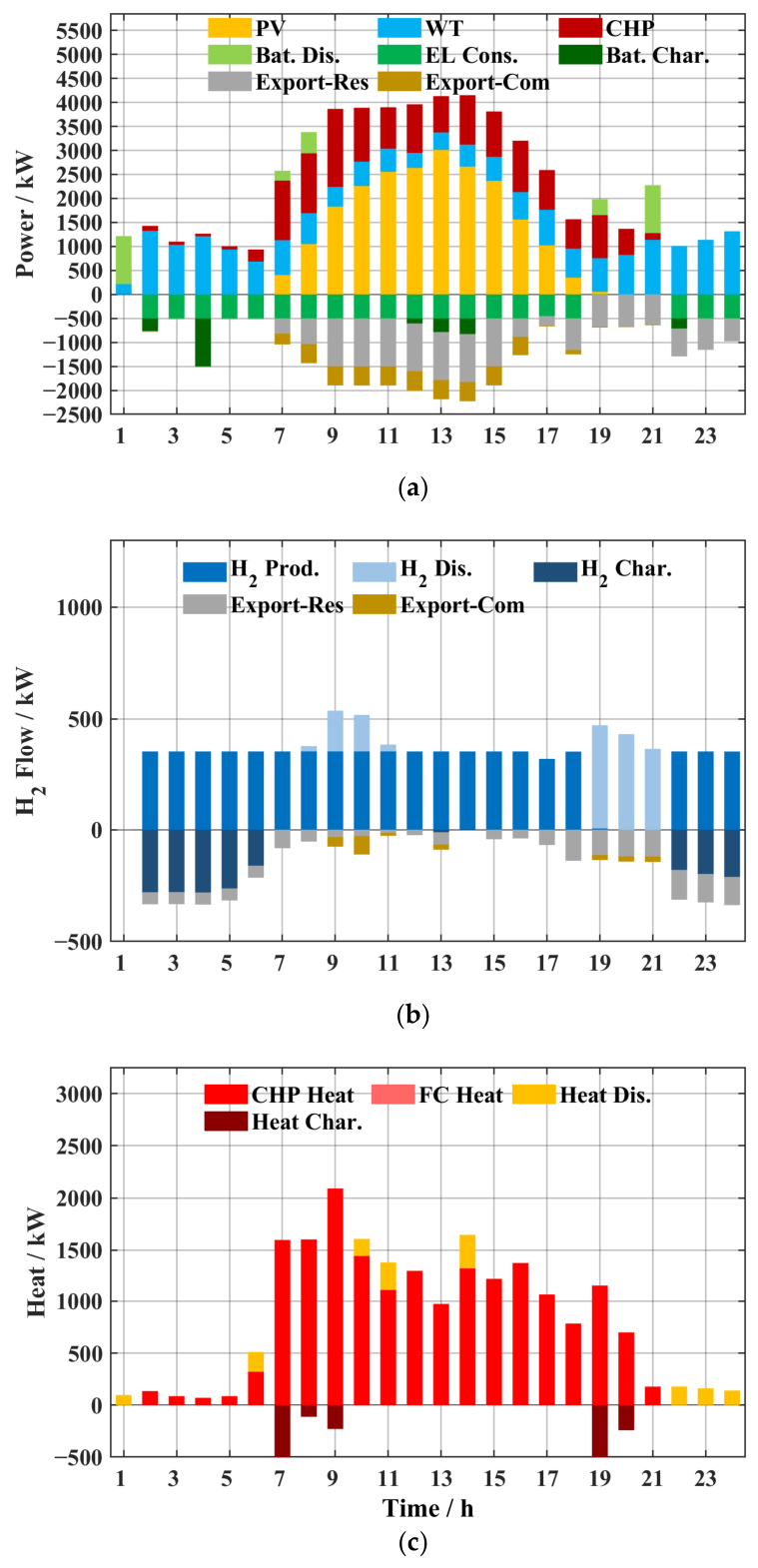
First, the scheduling results of each device in the industrial zone are presented in Figure 7. As shown in Figure 7a, in the electricity scheduling process, the CHP unit operates continuously at a stable high power level throughout the day, providing a reliable base load for the system. Driven by daytime PV generation and nighttime wind power output, the system generates a significant power surplus in multiple periods. As a flexible load, the electrolyzer responds rapidly, converting surplus electricity into hydrogen for storage during peak renewable energy output periods, which promotes the system’s transformation from the “source follows load” mode to the “load follows source” mode. Meanwhile, part of the surplus electricity is transmitted to the commercial and residential zones via tie lines to alleviate the overall energy supply pressure.
Figure 7.
Energy scheduling results of the industrial area: (a) electricity energy, (b) hydrogen energy and (c) thermal energy.
As shown in Figure 7b, hydrogen energy scheduling exhibits a high degree of coordination with electricity scheduling. The hydrogen production periods of the electrolyzer are basically consistent with the wind and solar surplus periods, which verifies the effectiveness of renewable electricity-based green hydrogen production in smoothing renewable energy fluctuations. Hydrogen energy achieves diversified utilization: one portion is fed to fuel cell combined heat and power units to fill short-term power deficits; another portion is stored in hydrogen storage devices to realize energy time-shifting; and the rest is supplied to other zones as clean fuel through pipelines or market transactions, completing the cross-zone optimal allocation of hydrogen energy.
As shown in Figure 7c, thermal energy scheduling is dominated by CHP units, exhibiting significant thermoelectric coupling characteristics. Constrained by power supply requirements and optimal operation constraints, the heat output of the CHP unit cannot fully match the heat load profile. The thermal storage device plays a thermal buffering role through peak shaving and valley filling, which effectively decouples the rigid “heat follows electricity” constraint and ensures continuous and stable industrial heat supply.
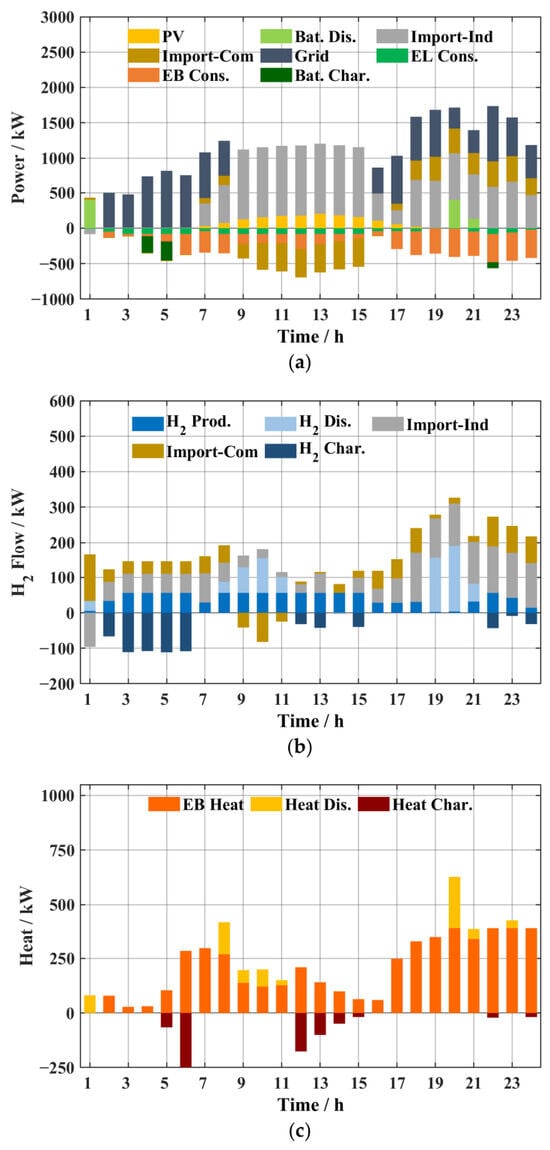
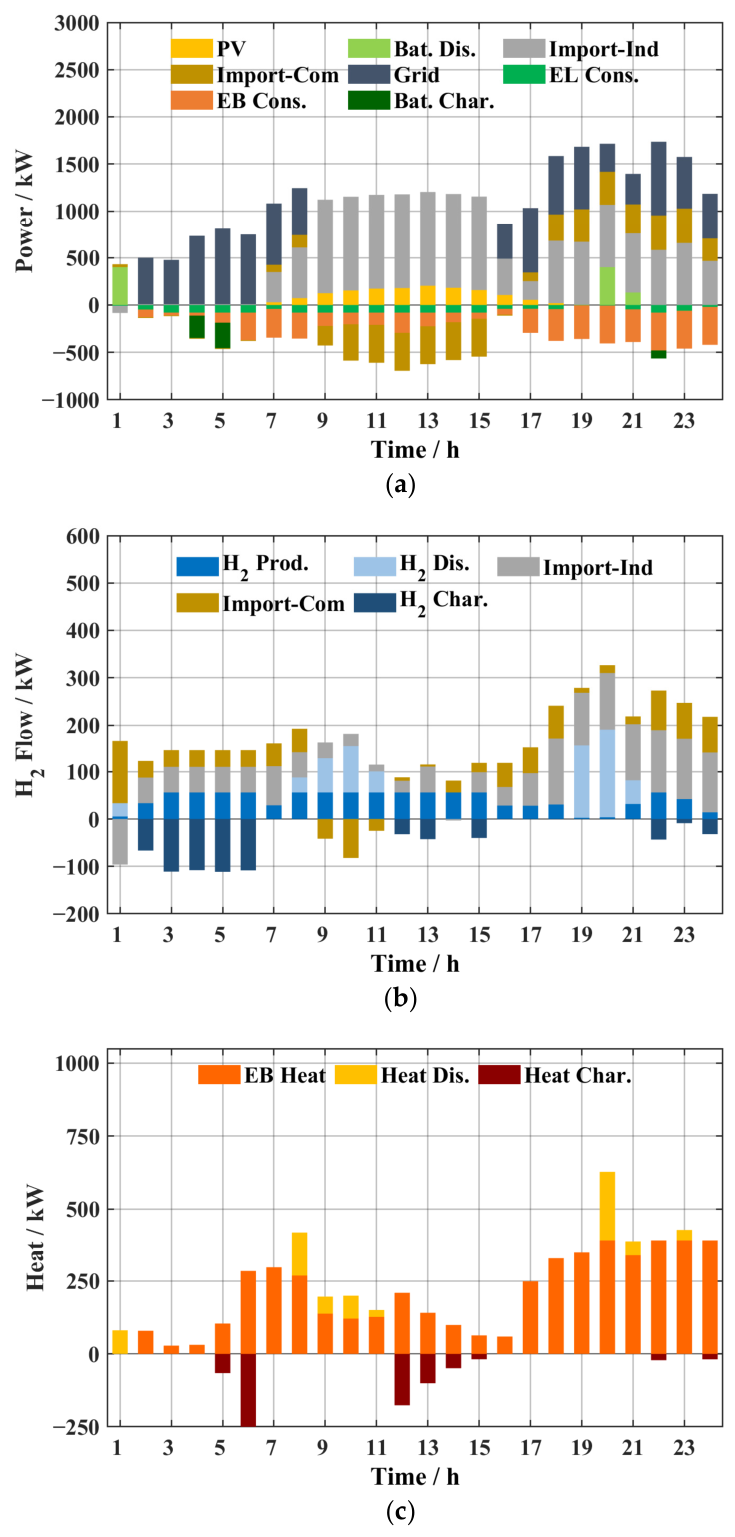
Subsequently, the scheduling results of each device in the residential zone are presented in Figure 8. For the electricity dispatch shown in Figure 8a, PV generation in the residential zone only covers part of the daytime base load, leading to a power deficit in most daily periods. To fill this gap, the system prioritizes purchasing low-cost surplus electricity from the industrial zone via tie lines, which not only reduces dependence on high-priced main grid power but also promotes local renewable energy consumption in the industrial zone. Meanwhile, the battery energy storage system adopts a valley-charging and peak-discharging strategy, charging during off-peak price or PV surplus periods and discharging at the evening demand peak, playing a significant peak shaving and valley filling role.
Figure 8.
Energy scheduling results of the residential area: (a) electricity energy, (b) hydrogen energy and (c) thermal energy.
As shown in Figure 8b, the residential zone’s hydrogen dispatch exhibits “energy storage buffering + market interaction” operating characteristics. Despite no large-scale hydrogen load in the zone, it is configured with an electrolyzer and hydrogen storage equipment. Scheduling results show that the residential zone can convert low-cost electricity into hydrogen via the electrolyzer or purchase external hydrogen for storage. It can then export hydrogen to participate in regional hydrogen trading at appropriate times, obtaining economic benefits through arbitrage or surplus hydrogen delivery, which reflects the flexible regulation value of distributed hydrogen storage in MMG systems.
The thermal dispatch shown in Figure 8c is the core component of residential demand response. Different from the CHP-based heat supply in the industrial zone, the residential zone adopts a full electricity-to-heat conversion mode, with electric boilers as the main heat source. The electric boiler’s output is not strictly tied to heat load fluctuations but is highly correlated with electricity prices and external power purchase strategies. With the thermal buffering of thermal storage devices, the system can increase the boiler’s output for heat storage at low electricity prices or a sufficient power supply and release heat during load peaks. This realizes the decoupling between heat supply and real-time electricity prices and significantly improves the system’s comprehensive energy efficiency.
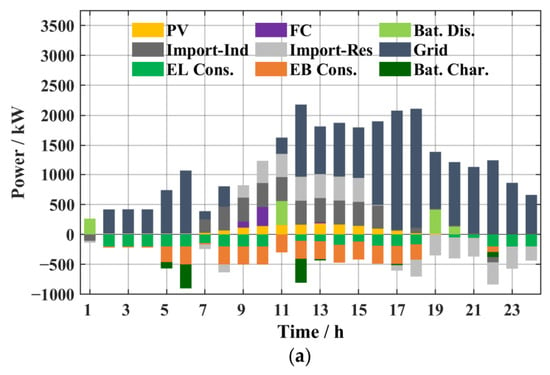
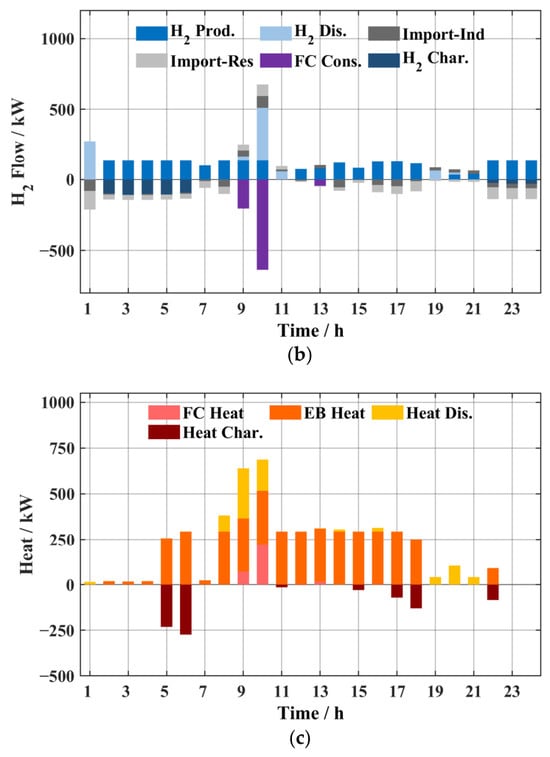
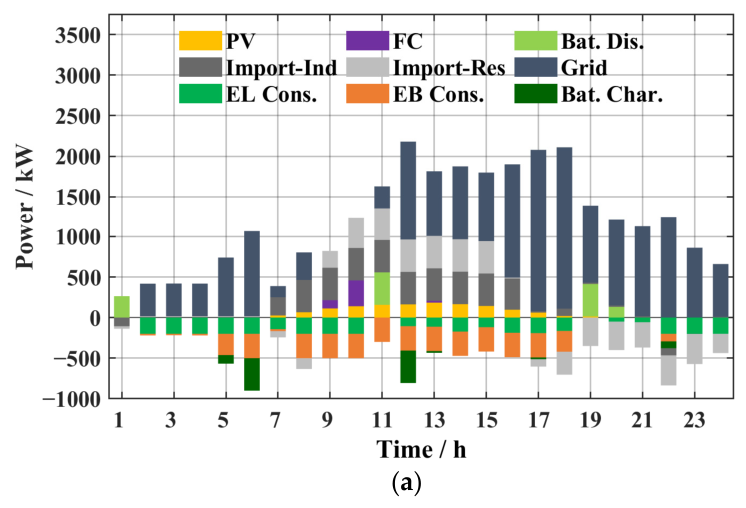
Finally, the scheduling results of each device in the commercial zone are presented in Figure 9. For the electricity dispatch shown in Figure 9a, the commercial zone has a high dependence on external power purchase but is equipped with abundant regulation means. Limited by PV installed capacity, the main grid power purchase is its primary power source, especially during nighttime and mid-peak periods. During the 09:00–11:00 morning peak with high electricity prices, the FC is rapidly put into operation at high power, effectively replacing high-priced grid power and achieving a significant peak shaving effect. Meanwhile, the commercial zone actively participates in peer-to-peer (P2P) energy trading, purchasing low-cost electricity from the industrial and residential zones to further reduce comprehensive energy costs.
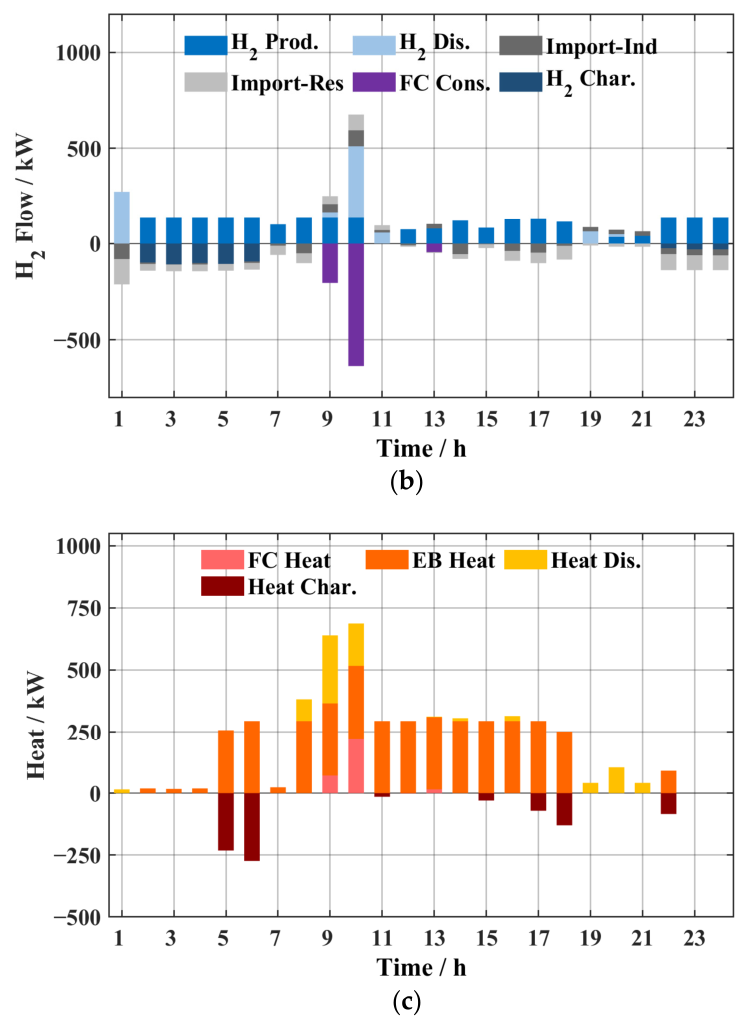
Figure 9.
Energy scheduling results of the commercial area: (a) electricity energy, (b) hydrogen energy and (c) thermal energy.
As shown in Figure 9b, hydrogen dispatch results show that the commercial zone serves as the main hydrogen consumption node in the system. The FC consumes a large amount of hydrogen during peak periods, with its hydrogen consumption profile highly consistent with its power output profile. Due to its limited on-site electrolytic hydrogen production capacity, the commercial zone cannot meet the FC’s hydrogen demand, so it mainly purchases hydrogen from the industrial zone, with surplus hydrogen production via inter-zone tie lines. This cross-regional “industrial hydrogen production–commercial power generation” mode not only relieves the renewable energy consumption pressure of the industrial zone but also provides a low-carbon, economical peak power source for the commercial zone.
The thermal dispatch shown in Figure 9c reflects the optimized characteristics of thermoelectric coordination and cascade utilization. The heat load is jointly supplied by the electric boiler and FC waste heat: the electric boiler acts as the main heat source to track heat load changes in conventional periods; during FC peak output periods, the recovered high-temperature waste heat covers a large share of heating demand, significantly reducing the electric boiler’s power consumption. Combined with the buffering regulation of thermal storage devices, the commercial zone achieves deep coupling and collaborative optimization of electricity, hydrogen and thermal energy in both the temporal and spatial dimensions.
In standalone operation mode, each microgrid is constrained by its resource endowments and load characteristics and faces the challenge of temporal–spatial source–load mismatch, which causes economic losses, including wind and solar curtailment and high-cost energy purchase.
In contrast, under the asymmetric Nash bargaining-based multi-microgrid collaborative optimization framework, the industrial, residential and commercial zones break physical and information barriers to establish a P2P energy trading mechanism. Leveraging diverse load profiles and complementary distributed energy resources, each stakeholder dynamically adjusts electricity and hydrogen flow directions and volumes across periods, realizing system-wide cascade energy utilization and optimal resource allocation.
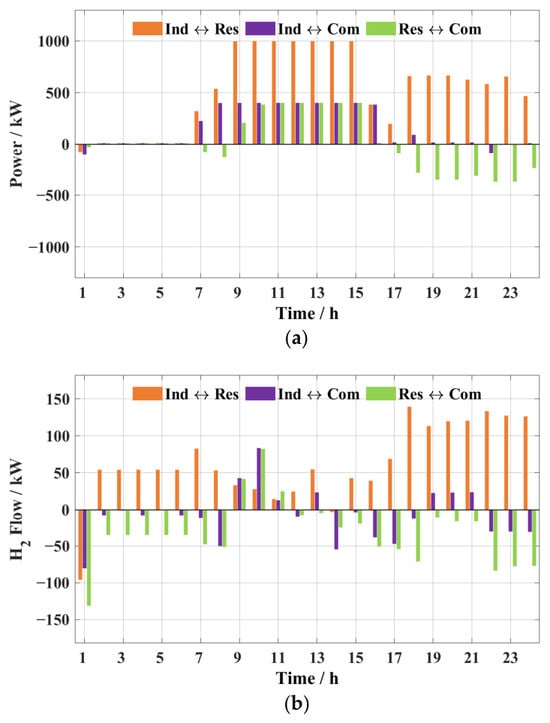
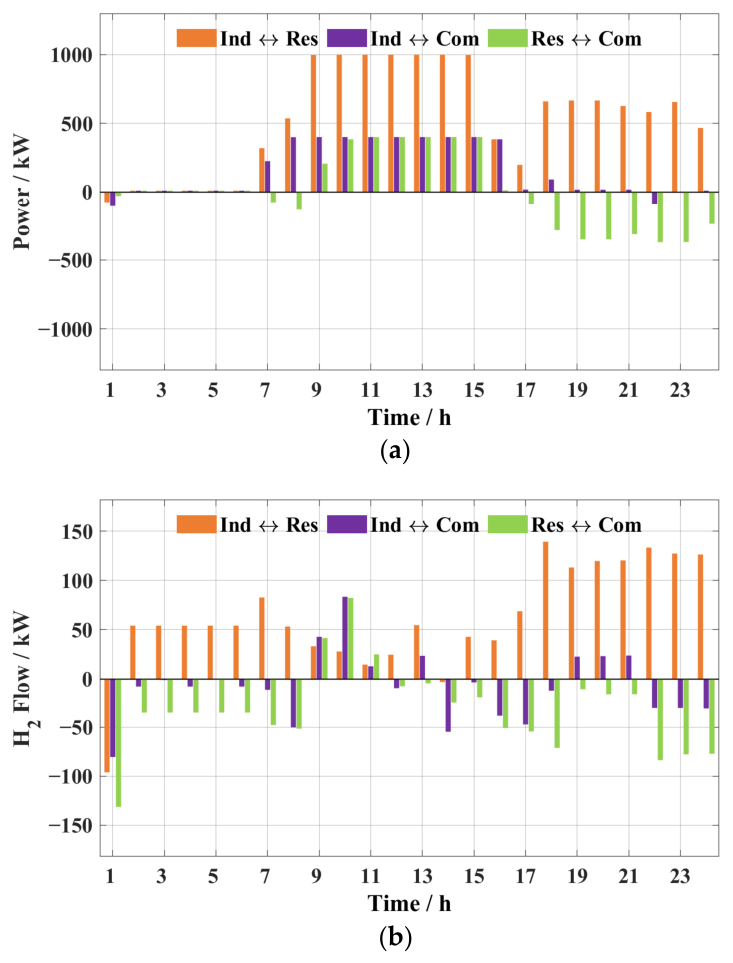
Figure 10 presents the net P2P electricity and hydrogen interaction power profiles of the three regional microgrids over a typical day, where positive values denote forward flow and negative values reverse flow. The results intuitively reveal the multi-microgrid system’s coordinated mutual support mechanism across different time scales.
Figure 10.
Energy interaction among microgrids: (a) electricity energy and (b) hydrogen energy.
As shown in Figure 10a, inter-regional electricity interaction is concentrated mainly at night and during the evening peak, exhibiting an overall unidirectional radiation pattern centered on the industrial zone. In contrast to electricity interaction, Figure 10b illustrates that hydrogen interaction is more widely distributed and frequent across time scales, highlighting the flexibility advantage of hydrogen as a long-duration energy storage carrier.
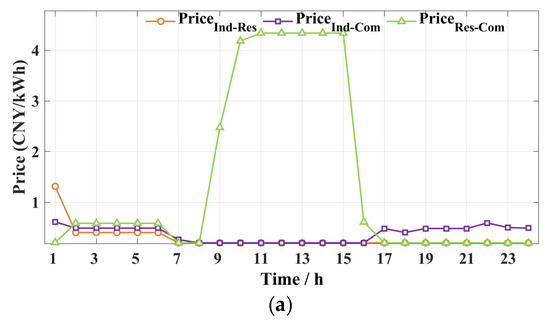
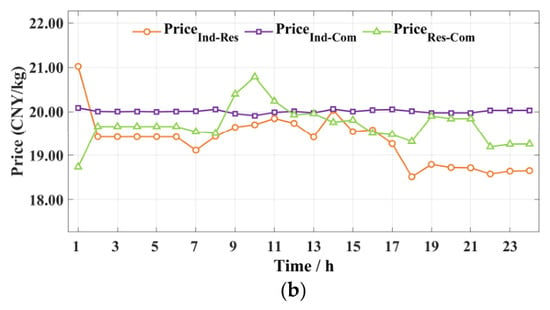
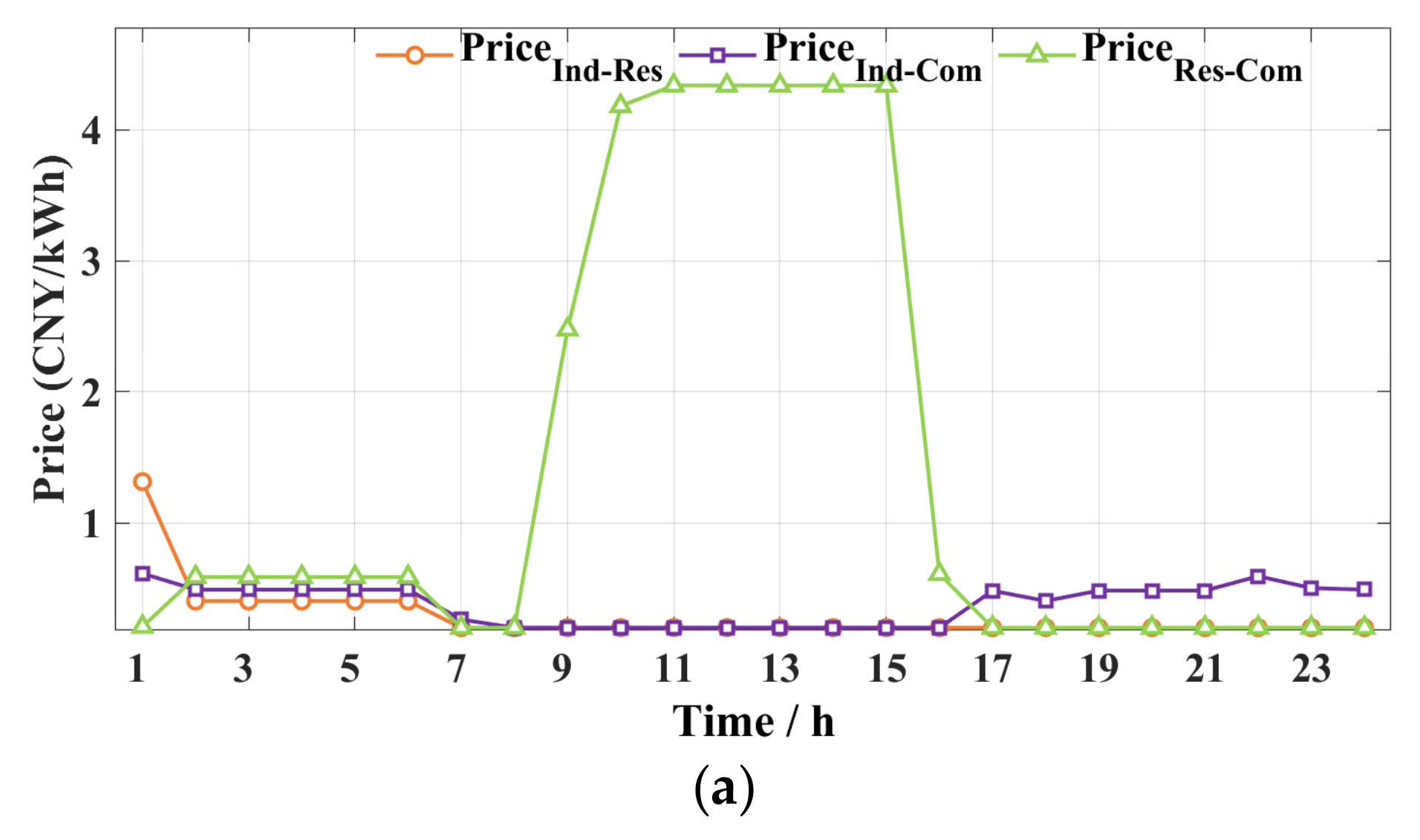
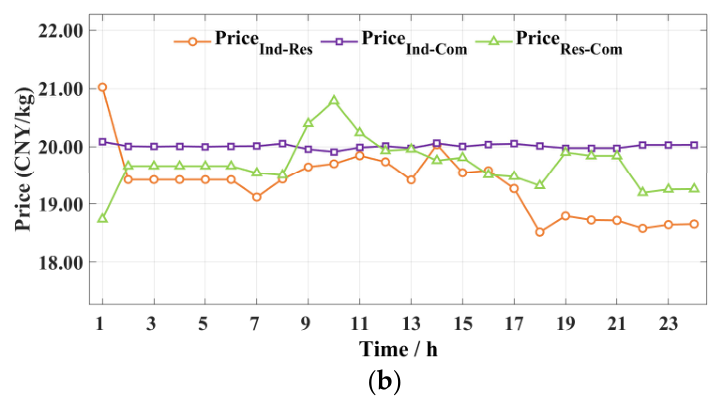
Figure 11 illustrates the variation in interaction prices with the introduction of the asymmetric Nash bargaining mechanism. After adopting the bargaining scheme, the transaction prices can be dynamically adjusted in accordance with the marginal benefit of each microgrid. Rather than being unilaterally set by the external market, this price represents an endogenous unified clearing price formed by all participants through multi-round game negotiation, based on their own supply–demand scarcity, marginal energy cost, and external market price signals.
Figure 11.
Energy interaction prices: (a) electricity energy and (b) hydrogen energy.
4.4. Cost Comparison and Fairness Analysis
From the dispatch results of typical scenario 1 presented in Figure 7, Figure 8, Figure 9, Figure 10 and Figure 11, including the output power of each device and the optimal trading volume and transaction price of each microgrid, the operational costs of the microgrids under cooperative operation are obtained and presented in the second row of Table 3. Therefore, the total system cost for scenario 1 is 89,512 Chinese Yuan (CNY). Similarly, the corresponding costs for all other typical scenarios are derived from their respective dispatch results and are shown in rows 3 through 6 of Table 3.
Table 3.
Operating costs of alone and joint modes under various typical scenarios.
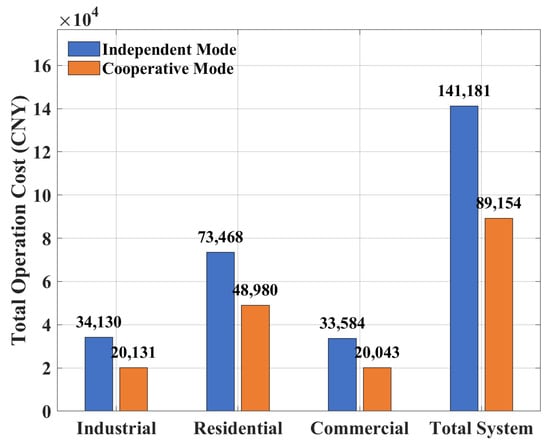
Based on the cost data of each microgrid within the system under all typical scenarios presented in Table 3 and Equation (51), the operating cost for each microgrid under wind–solar uncertainty can be derived. Figure 12 clearly shows the cost comparison of the multi-microgrid system under wind–solar uncertainty between the independent and cooperative operation modes, showing that its total operational cost decreases substantially from 141,181 CNY under independent mode to 89,154 CNY under cooperative mode, achieving a total cost saving of 52,027 CNY and an overall reduction of 36.85%.
Figure 12.
Operating cost comparison of multi-microgrids under wind–solar uncertainty: independent operation vs. cooperative operation.
To quantitatively evaluate the fairness of the proposed strategy, this paper adopts the discrete Gini coefficient to measure the equilibrium of cooperative surplus distribution:
where is the Gini coefficient and is the cumulative proportion of each sorted benefit to the total cooperative surplus:
where denotes the difference between and . is sorted in ascending order as .
From the cost data in Figure 12 and Equation (52), the Gini coefficient under the cooperative operation mode is 0.1402, which is entirely within the universally recognized high fairness threshold (G < 0.2). Specifically, even the residential microgrid with the highest operational cost attains a cost saving rate of 33.3%, while the industrial and commercial microgrids achieve saving rates of 41.0% and 40.3%, respectively. These outcomes strictly satisfy the fundamental individual rationality constraints required for cooperative negotiation. The proposed asymmetric Nash bargaining-based benefit distribution scheme not only achieves the minimization of the total system operational cost, but also ensures equitable and reasonable allocation of cooperative benefits among multiple microgrids.
4.5. Statistical Test
To validate the robustness of the proposed multi-microgrid collaborative scheduling method for energy dispatch under varying load conditions, this study introduces random fluctuations of ±10% into the user demand profiles of the industrial, residential, and commercial zones, thereby generating 30 distinct load situations. Simulations were performed across these 30 load situations, and the robustness of the algorithm was validated by the cost reduction rate and t-test.
The cost reduction rate between the two operating modes is defined as:
where is the scheduling cost of microgrid in the autonomous optimization mode under situation ; is the dispatch cost of microgrid in the coordinated operation mode under situation ; and is the cost reduction rate under situation .
A paired -test is employed for statistical analysis, calculated as:
where and represent the mean and standard deviation of the collected paired samples, respectively, and is the number of valid samples.
The average cost reduction rate of the collaborative scheduling mode relative to the islanded scheduling mode reaches , indicating that the proposed method can consistently achieve significant and stable economic benefits. In addition, the paired -test yields , with . Since the -value is extremely large and the corresponding -value is far below 0.05, the observed cost difference between the two operating modes is highly unlikely to have arisen from random fluctuations alone. Overall, the proposed method exhibits strong robustness under fluctuating operating conditions.
5. Conclusions
This study constructs an integrated energy system architecture for EHT-MMGs. Aiming to address the key challenge that existing scheduling methods fail to simultaneously balance operation cost optimization, inter-microgrid transaction fairness, and the uncertainty in wind and PV outputs, this paper proposes an asymmetric Nash bargaining-based collaborative optimal scheduling strategy. The main conclusions verified by simulation experiments are as follows:
(1) The scenario reduction algorithm integrating temporally correlated LHS and Wasserstein distance can accurately characterize the output characteristics of wind and PV power while balancing computational efficiency. The five typical scenarios screened by this method effectively overcome the limitations of traditional uncertainty processing methods, such as cumbersome calculation processes or overly conservative results.
(2) The proposed asymmetric Nash bargaining-based collaborative scheduling model can realize the collaborative optimization of the global economic efficiency of the system and the transaction fairness among microgrids. Compared with the standalone operation mode of microgrids, this model achieves a 36.85% reduction in the total system operation cost, which drops from 141,181 CNY to 89,154 CNY, significantly improving the operational economy of the system.
(3) The proposed strategy strictly guarantees the individual rationality and transaction fairness of multi-microgrid cooperation. Specifically, the operation cost of each participating entity is lower than the corresponding cost at the bargaining breakdown point. The calculated Gini coefficient under cooperative operation is 0.1402, which falls well within the high fairness range. The strategy achieves the minimization of overall system cost and simultaneously guarantees transaction fairness across multiple microgrids.
In practical engineering applications, carbon emission policies and carbon prices exhibit dynamic fluctuations, which impose a considerable influence on system operational performance. Future research will explicitly integrate the carbon trading mechanism and dynamic emission limits into the cooperative distributed model. In addition, to narrow the gap between ideal cooperative solutions and practical engineering implementations, follow-up studies may consider line capacity constraints and transmission losses while including transmission costs in the cost formulation.
Author Contributions
Conceptualization, W.Y.; methodology, W.Y. and T.W.; software, T.W.; validation, J.H.; formal analysis, W.Y., T.W., X.W. and J.H.; investigation, W.Y.; data curation, T.W.; writing—original draft preparation, W.Y.; writing—review and editing, W.Y. and X.W.; visualization, W.Y. and T.W.; supervision, X.W. and J.H.; project administration, X.W. All authors have read and agreed to the published version of the manuscript.
Funding
This work presented in this paper was financially supported by The International Science and Technology Innovation Cooperation Project of Sichuan Science and Technology Department (No. 2025YFHZ0134).
Data Availability Statement
The data presented in this study are available on request from the corresponding author. The data are not publicly available due to project confidentiality restrictions.
Conflicts of Interest
The authors declare that no conflicts of interest exist in this paper.
References
- Sun, H.; Zou, H.; Jia, J.; Shen, Q.; Duan, Z.; Tang, X. Master–Slave Game Optimization Scheduling of Multi-Microgrid Integrated Energy System Considering Comprehensive Demand Response and Wind and Storage Combination. Energies 2024, 17, 5762. [Google Scholar] [CrossRef] [Scilit]
- Liu, Y.; Xie, L.; Bian, Y.; Song, W.; Hu, C. Bi-Level Optimization Dispatching of Hydrogen-Containing Integrated Energy System Considering Electric Vehicles and Demand Response. Mathematics 2026, 14, 956. [Google Scholar] [CrossRef] [Scilit]
- Fu, K.; Guo, Y.; Qiu, W. Optimization of Microgrid Scheduling Based on Adaptive Collaborative Secretary Bird Optimization Algorithm. Mathematics 2026, 14, 622. [Google Scholar] [CrossRef] [Scilit]
- Mohammad-Shafie, M.; Assili, M.; Shivaie, M. A Flexible Load-Reliant Cost-Driven Framework for Peer-to-Peer Decentralized Energy Trading of a Hydrogen/Battery-Enabled Industrial Town in the Presence of Multiple Microgrids. Appl. Energy 2024, 373, 123919. [Google Scholar] [CrossRef] [Scilit]
- Pan, Y.; Yang, Z. Optimization Scheduling of Shared Hydrogen Energy Storage among Multi-Microgrids and Its Comprehensive Evaluation of Utilization Benefits. J. Energy Storage 2025, 126, 116945. [Google Scholar] [CrossRef] [Scilit]
- Li, Q.; Xiao, X.; Pu, Y.; Luo, S.; Liu, H.; Chen, W. Hierarchical Optimal Scheduling Method for Regional Integrated Energy Systems Considering Electricity-Hydrogen Shared Energy. Appl. Energy 2023, 349, 121670. [Google Scholar] [CrossRef] [Scilit]
- Xu, C.; Abdalla, A.N.; Awad, O.I. A Chaos-Guided Slime Mould Algorithm for Multi-Energy Dispatch in Hydrogen–Ammonia Integrated Multi-Microgrid Systems under Dual Trading Constraints. Energy 2025, 341, 139568. [Google Scholar] [CrossRef] [Scilit]
- Liu, N.; Yan, J.; Tan, L.; Li, X.; Chen, Y.; Zhang, K. A Low-Carbon Trading Strategy of Multi-Microgrid System Considering Electricity-Hydrogen-Carbon Coupling Characteristics. Energy 2025, 327, 136420. [Google Scholar] [CrossRef] [Scilit]
- Yang, D.; Pan, G.; Zhang, J.; He, J.; Zhang, Y.; Xiao, C. Double-Layer Optimal Configuration of Wind–Solar-Storage for Multi-Microgrid with Electricity–Hydrogen Coupling. Processes 2025, 13, 3263. [Google Scholar] [CrossRef] [Scilit]
- Li, L.; Zhou, X.; Chen, S.; Bi, G.; Zhu, Z.; Fan, Y. Bi-Level Optimization of Configurations and Scheduling for the Multi-Microgrid System (MMS) Considering Shared Hybrid Electric-Hydrogen Energy Storage Service. Glob. Energy Interconnect. 2026, 9, 51–67. [Google Scholar] [CrossRef] [Scilit]
- Hu, P.; Qian, L.; Li, Z.; Yu, Y.; Wang, D. Distributed Dynamic Economic Dispatch of Biogas-Wind-Solar-Hydrogen Multi-Microgrid System Considering Individual Selfishness. Energy Convers. Manag. X 2024, 24, 100761. [Google Scholar] [CrossRef] [Scilit]
- Xia, Q.; Ye, J.; Wang, Q.; Zou, Y.; Lei, C.; Chi, Y.; Zhou, N.; Guerrero, J.M.; Martínez-García, H. Economic Autonomous Operation of Microgrids on Islands with Renewable Energy Interactions: A Satellite-Aided over-the-Air Federated Reinforcement Learning Approach. Appl. Energy 2026, 406, 12732. [Google Scholar] [CrossRef] [Scilit]
- Zhang, L.; He, Y.; Hatziargyriou, N.D.; Wu, H.; Han, P. An Optimization Scheduling Strategy for Hydrogen-Based Integrated Energy Systems Using Multi-Agent Deep Reinforcement Learning. Energy Convers. Manag. 2025, 326, 119483. [Google Scholar] [CrossRef] [Scilit]
- Liu, H.; Hao, E.; Cui, J.; He, L.; Duan, W.; Sun, S.; Huang, J. Novel Cooperative Voltage Regulation and Economic Operation for Hydrogen-Containing Distribution Networks. In Proceedings of the 2024 4th International Conference on New Energy and Power Engineering (ICNEPE), Guangzhou, China, 8–10 November 2024; IEEE: New York, NY, USA, 2024; pp. 904–908. [Google Scholar]
- Bo, Y.; Xia, Y.; Wei, W.; Li, Z.; Zhou, Y. Peer-to-Peer Electricity-Hydrogen Energy Trading for Multi-Microgrids Based on Purification Sharing Mechanism. Int. J. Electr. Power Energy Syst. 2023, 150, 109113. [Google Scholar] [CrossRef] [Scilit]
- Zhong, S.; Tang, H. Peer-to-Peer Energy-Carbon Trading Strategy for MIES Based on Electric Hydrogen Production and Shared Energy Storage Mechanism. Int. J. Hydrogen Energy 2025, 138, 843–858. [Google Scholar] [CrossRef] [Scilit]
- Zhu, D.; Yang, B.; Liu, Q.; Ma, K.; Zhu, S.; Ma, C.; Guan, X. Energy Trading in Microgrids for Synergies among Electricity, Hydrogen and Heat Networks. Appl. Energy 2020, 272, 115225. [Google Scholar] [CrossRef] [Scilit]
- Li, J.; Yang, B.; Zhou, Y.; Shu, H.; Li, H.; Gao, D.; Jiang, L. Coordinated Low-Carbon Economic Scheduling of Integrated Electricity-Heat-Gas-Hydrogen-Methanol Multi-Microgrids Considering Electricity-Methanol Transaction. Expert Syst. Appl. 2026, 298, 129701. [Google Scholar] [CrossRef] [Scilit]
- Ma, T.; Pei, W.; Deng, W.; Xiao, H.; Yang, Y.; Tang, C. A Nash Bargaining-Based Cooperative Planning and Operation Method for Wind-Hydrogen-Heat Multi-Agent Energy System. Energy 2022, 239, 122435. [Google Scholar] [CrossRef] [Scilit]
- Wang, H.; Wu, Q.; Guo, H. Low-Carbon Optimal Operation Strategy of Multi-Energy Multi-Microgrid Electricity–Hydrogen Sharing Based on Asymmetric Nash Bargaining. Sustainability 2025, 17, 4703. [Google Scholar] [CrossRef] [Scilit]
- Cao, W.; Yu, J.; Xu, M. Optimization Scheduling of Virtual Power Plants Considering Source-Load Coordinated Operation and Wind–Solar Uncertainty. Processes 2023, 12, 11. [Google Scholar] [CrossRef] [Scilit]
- Kim, J.; Shah, A.U.A.; Kang, H.G. Dynamic Risk Assessment with Bayesian Network and Clustering Analysis. Reliab. Eng. Syst. Saf. 2020, 201, 106959. [Google Scholar] [CrossRef] [Scilit]
- Uwineza, L.; Kim, H.-G.; Kim, C.K. Feasibility Study of Integrating the Renewable Energy System in Popova Island Using the Monte Carlo Model and HOMER. Energy Strategy Rev. 2021, 33, 100607. [Google Scholar] [CrossRef] [Scilit]
- Wang, J.; Huo, S.; Yan, R.; Cui, Z. Leveraging Heat Accumulation of District Heating Network to Improve Performances of Integrated Energy System under Source-Load Uncertainties. Energy 2022, 252, 124002. [Google Scholar] [CrossRef] [Scilit]
- Manohar, M.; Koley, E.; Ghosh, S. Microgrid Protection under Weather Uncertainty Using Joint Probabilistic Modeling of Solar Irradiance and Wind Speed. Comput. Electr. Eng. 2020, 86, 106684. [Google Scholar] [CrossRef] [Scilit]
- Yan, R.; Lu, Z.; Wang, J.; Chen, H.; Wang, J.; Yang, Y.; Huang, D. Stochastic Multi-Scenario Optimization for a Hybrid Combined Cooling, Heating and Power System Considering Multi-Criteria. Energy Convers. Manag. 2021, 233, 113911. [Google Scholar] [CrossRef] [Scilit]
- Ahmadi, S.E.; Sadeghi, D.; Marzband, M.; Abusorrah, A.; Sedraoui, K. Decentralized Bi-Level Stochastic Optimization Approach for Multi-Agent Multi-Energy Networked Micro-Grids with Multi-Energy Storage Technologies. Energy 2022, 245, 123223. [Google Scholar] [CrossRef] [Scilit]
- Chen, C.; Xing, J.; Li, Q.; Liu, S.; Ma, J.; Chen, J.; Han, L.; Qiu, W.; Lin, Z.; Yang, L. Wasserstein Distance-Based Distributionally Robust Optimal Scheduling in Rural Microgrid Considering the Coordinated Interaction among Source-Grid-Load-Storage. Energy Rep. 2021, 7, 60–66. [Google Scholar] [CrossRef] [Scilit]
- Ju, L.; Tan, Z.; Yuan, J.; Tan, Q.; Li, H.; Dong, F. A Bi-Level Stochastic Scheduling Optimization Model for a Virtual Power Plant Connected to a Wind–Photovoltaic–Energy Storage System Considering the Uncertainty and Demand Response. Appl. Energy 2016, 171, 184–199. [Google Scholar] [CrossRef] [Scilit]
- Ding, J.; Gao, C.; Song, M.; Yan, X.; Chen, T. Optimal Operation of Multi-Agent Electricity-Heat-Hydrogen Sharing in Integrated Energy System Based on Nash Bargaining. Int. J. Electr. Power Energy Syst. 2023, 148, 108930. [Google Scholar] [CrossRef] [Scilit]
- Wang, M.; Wang, M.; Wang, R.; Zhao, Q.; Zheng, X.; Gao, H. Optimization Scheduling for Low-Carbon Operation of Building Integrated Energy Systems Considering Source-Load Uncertainty and User Comfort. Energy Build. 2024, 318, 114423. [Google Scholar] [CrossRef] [Scilit]
- Gao, C.; Lu, H.; Chen, M.; Chang, X.; Zheng, C. A Low-Carbon Optimization of Integrated Energy System Dispatch under Multi-System Coupling of Electricity-Heat-Gas-Hydrogen Based on Stepwise Carbon Trading. Int. J. Hydrogen Energy 2025, 97, 362–376. [Google Scholar] [CrossRef] [Scilit]
- Fan, S.; Ai, Q.; Piao, L. Bargaining-Based Cooperative Energy Trading for Distribution Company and Demand Response. Appl. Energy 2018, 226, 469–482. [Google Scholar] [CrossRef] [Scilit]
- Wang, Z.; Chen, G.; Li, H. An Efficient Distributed Algorithm for Economic Dispatch Considering Communication Asynchrony and Time Delays. Energy Convers. Econ. 2022, 3, 214–226. [Google Scholar] [CrossRef] [Scilit]
- Cui, Z.; Chang, X.; Xue, Y.; Yi, Z.; Li, Z.; Sun, H. Distributed Peer-to-Peer Electricity-Heat-Carbon Trading for Multi-Energy Virtual Power Plants Considering Copula-CVaR Theory and Trading Preference. Int. J. Electr. Power Energy Syst. 2024, 162, 110231. [Google Scholar] [CrossRef] [Scilit]
- Zhang, Y.; Wu, Q.; Ren, H.; Li, Q.; Zhou, W. Optimal Operation of Multi-Microgrid Systems Considering Multi-Level Energy-Certificate-Carbon Coupling Trading. Renew. Energy 2024, 227, 120505. [Google Scholar] [CrossRef] [Scilit]
- Muñoz Sabater, J. ERA5-Land Hourly Data from 1950 to Present. Copernicus Climate Change Service, Climate Data Store. 2019. Available online: https://cds.climate.copernicus.eu/datasets/reanalysis-era5-land?tab=overview (accessed on 20 October 2025).

Disclaimer/Publisher’s Note: The statements, opinions and data contained in all publications are solely those of the individual author(s) and contributor(s) and not of MDPI and/or the editor(s). MDPI and/or the editor(s) disclaim responsibility for any injury to people or property resulting from any ideas, methods, instructions or products referred to in the content. |
© 2026 by the authors. Licensee MDPI, Basel, Switzerland. This article is an open access article distributed under the terms and conditions of the Creative Commons Attribution (CC BY) license.