


Abstract
This study examines the bending of cross-ply laminated composite nanoplates coupled to a piezoelectric fiber-reinforced composite layer via the nonlocal strain gradient theory. The aim is to accurately capture size-dependent impacts and electromechanical interaction in nanoscale composite structures. The mechanical response is modeled utilizing a refined four-variable shear deformation theory, with the governing equilibrium equations developed using the virtual work assumption. The nanoplate is examined under simply supported boundary conditions exposed to both mechanical loading and applied electric voltage. A detailed parametric investigation is done to assess the contribution of non-local and strain gradient factors, imposed voltage, and geometric ratios on the bending behavior. The results show that the nonlocal parameter generates a softening result, increasing deflection, whereas the strain gradient parameter raises stiffness and minimizes deformation. Moreover, the applied voltage successfully controls the bending response by electromechanical actuation, underlining the potential of PFRC-integrated nanoplates in smart nanoscale systems.
Keywords:
nanotechnology; cross-ply laminated nanocomposite; PFRC actuators; electromechanical loadings; nonlocal strain gradient theory; nanoplate bending MSC:
74K20; 74B05; 74F15; 35Q74
1. Introduction
Composite nanoplates have attracted considerable interest over the past decade owing to their distinct mechanical, thermal, and electrical qualities. These materials are frequently distinguished by their nanoscale thickness and layered structure, combining the advantages of nanomaterials and composites. The endurance of composite materials could decrease the need for replacements, which helps to promote sustainability. Continued research and development in these areas are essential for increasing the overall sustainability of composite materials in engineering applications.
Bending analysis in composite nanoplates has arisen as an important field of study in materials science and engineering, especially as nanocomposites are increasingly used in structural and aeronautical engineering. The incorporation of piezoelectric actuator layers within plate structures has numerous potential applications in smart materials and structures. These systems rely on the unique features of piezoelectric materials, which convert mechanical energy to electrical energy and vice versa.
Unlike conventional piezoelectric materials, piezoelectric fiber-reinforced composites (PFRCs) exhibit enhanced directional electromechanical coupling due to the alignment of piezoelectric fibers along preferred orientations. This leads to improved actuation efficiency and pronounced anisotropic behavior, making them particularly suitable for tailored smart structural applications. These qualities make PFRC-based systems an important component in smart structures, providing enhanced sensing, actuation, and adaptive functions in engineering applications.
PFRCs are typically made of a polymer matrix reinforced with fibers and piezoelectric components, like lead zirconate titanate. The addition of piezoelectric fibers not only increases mechanical performance but also improves the potential to turn mechanical stress into electrical current and vice versa. According to studies, the volume fraction of piezoelectric fibers has a substantial impact on the electromechanical properties of the composite [1].
Many theoretical frameworks have been developed to analyze the mechanical behavior of composite plates. Reddy [2] provided a thorough investigation of the mechanics of composite laminated materials, particularly for shells and plates. Different loading conditions have been assessed. Zenkour et al. [3] and Zenkour et al. [4] evaluated the bending of cross-ply laminates during thermal and hygrothermal environments. Further relevant studies on the elastic properties of laminated composite plates, beams, and shells have been extensively examined [5,6,7,8,9].
Composite structures have also been widely investigated under various mechanical and multiphysical loading conditions, highlighting their versatility and advanced performance in engineering applications [10,11,12]. Singh and Kumar [13] examined the nonlinear dynamic response of a carbon nanotube fiber-reinforced laminated composite plate through the application of a higher-order shear deformation theory and nonlinear kinematics. Numerous studies have investigated composite and nanostructured materials, including layered nanocomposites and nanoscale systems, and these studies represent well-established contributions in this field. In addition, foundational studies on size-dependent behavior have been extensively developed through various continuum models, including nonlocal elasticity, couple stress, and strain gradient theories, to capture the scale-dependent features of nanostructures [14,15,16,17,18,19,20,21,22]. Aghababaei and Reddy [23] implemented nonlocal elasticity equations to explore nanoplate vibration and bending. Bacciocchi and Tarantino [24] built a nonlocal simulation leveraging the strain gradient concept to look into the critical buckling and free vibrations of laminated nanoplates. Cornacchia et al. [25] leveraged strain gradient theory to develop closed-form solutions for bending cross-angle-ply laminated nanoplates.
Lim et al. [26] created the nonlocal strain gradient theory (NSGT), which incorporates intrinsic length-scale parameters. Monaco et al. [27] assessed the buckling and vibration behavior of laminated composite nanoplates in a hygrothermal atmosphere with NSGT. Alghanmi [28,29] researched the static response of FG nanoplates through NSGT.
Several investigations have been conducted to analyze smart structures that incorporate piezoelectric layers [30,31,32,33,34,35,36,37,38,39]. A number of investigations have focused on incorporating PFRC layers into composite structures [40,41,42,43,44]. Joshan et al. [45] offered a novel non-polynomial higher-order theory via five components to model the bending response of composite plates containing piezoelectric layers. Liu et al. [46] evaluated the vibration of laminated nanoplates containing piezo-magnetic layers adopting the NSGT.
Although many studies have investigated the bending characteristics of laminated composite plates implementing refined plate theories, most of these works have been limited to classical continuum models or have treated nonlocal elasticity and strain gradient effects separately. Few studies have extended these analyses to the nanoscale while accounting for combined size-dependent effects. Furthermore, although piezoelectric actuators have been widely studied, the application of PFRC to cross-ply laminated nanoplates remains largely unexplored. From this perspective, a closed-form solution is proposed herein to examine the bending response of cross-ply laminated composite nanoplates with a surface-mounted PFRC actuator utilizing a four-variable refined plate theory.
This approach enables capturing both softening and stiffening size-dependent effects while incorporating PFRC-based electromechanical actuation. To the best of the author’s knowledge, no analytical study has been done addressing this specific configuration within a nonlocal strain gradient framework.
2. Analytical Formulation
2.1. Cross-Ply Laminated Composite Nanoplates with a PFRC Layer
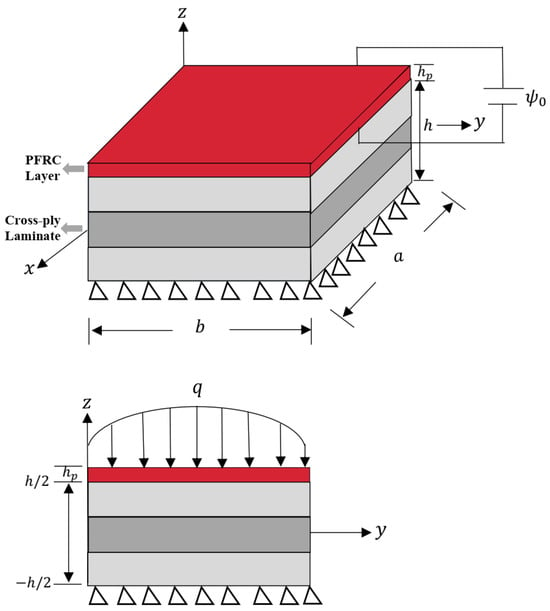
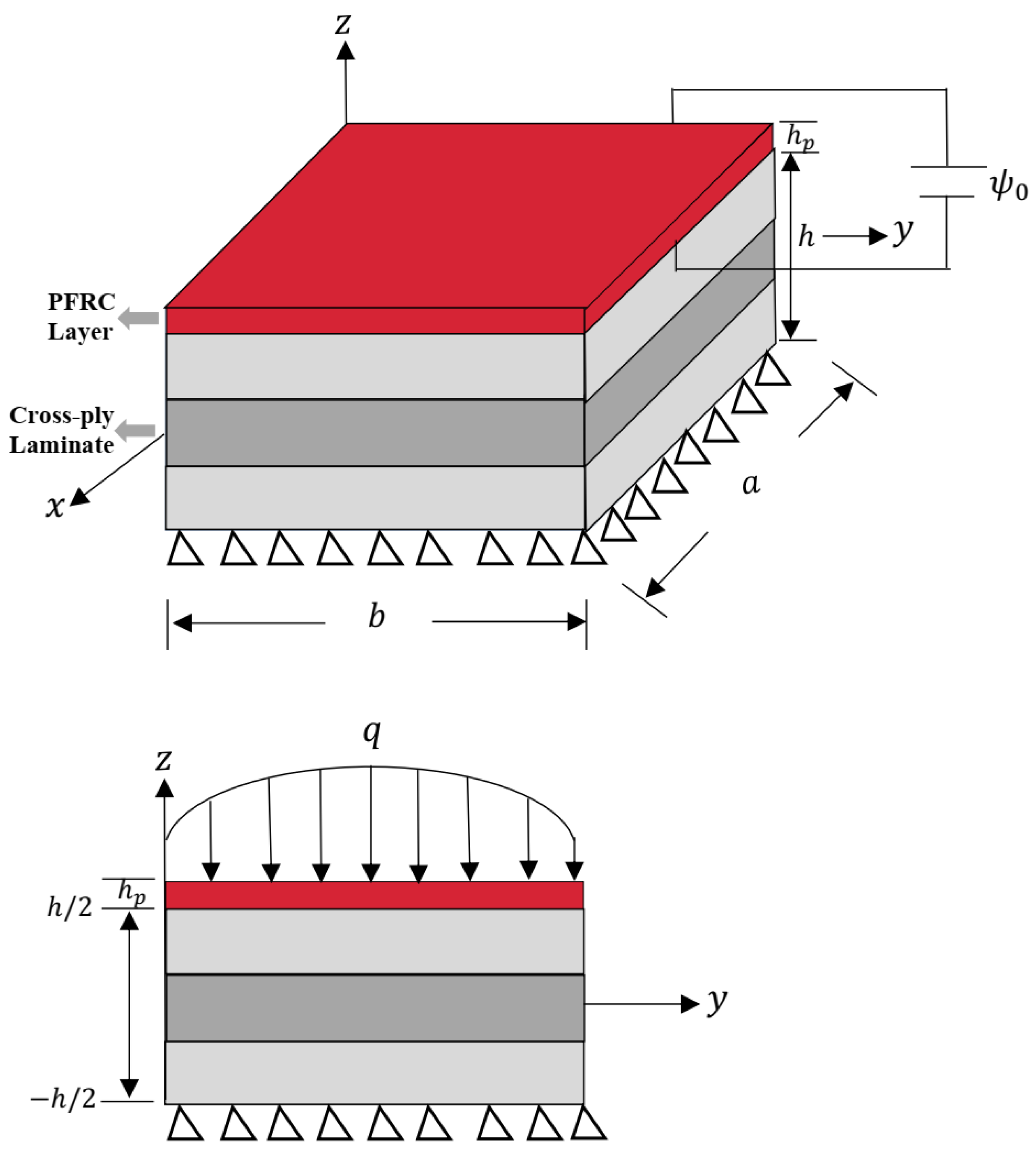
Consider a cross-ply laminated nanoplate that is bonded to a PFRC layer on the top face, as displayed in Figure 1. The resulting hybrid plate extends over length in the direction and in the direction. The elastic substrate with thickness lies between and along the -axis. The attached PFRC actuator has a thickness . This composite nanoplate undergoes both mechanical and electrical loads.
Figure 1.
Depictive illustration of cross-ply laminated nanoplates with the PFRC layer.
2.2. Electrical Loading Conditions
The PFRC layer is tightly connected to the top face of the nanoplate, with its bottom face perfectly grounded. The piezoelectric response of the layer is activated by applying an electric voltage to its top surface [47]
2.3. Nonlocal Strain Gradient Relations
The nonlocal strain gradient theory describes size-dependent behavior of nanostructures through the inclusion of both nonlocal and strain gradient length-scale parameters [26]. On the basis of this hypothesis, the governing partial differential equations characterizing the constitutive relations of cross-ply laminated composite nanoplates coupled with a PFRC layer are formulated as follows [48]:
where denotes the Laplacian operator. , , and measure the stress, strain, and the electric displacement, respectively. , , and denote the stiffness coefficients, piezoelectric, and dielectric values, respectively. and describe the characteristic length-scale parameters linked to nonlocal elasticity and strain gradient mechanisms, respectively, and are given in nm2. Their values range from 0 to 5 nm2 to assess size-dependent behavior, where induces a softening influence and leads to a stiffening influence. denotes the electric field components.
The following assumption is adopted in the present formulation.
Although the electric displacement vector appears in the general coupled constitutive equations, it is not explicitly included in the present mechanical formulation. This is because the electric field induced by stress variations (i.e., the direct piezoelectric effect) is presumed to be negligible in comparison to the externally applied electric field. Accordingly, the contribution of is excluded from the governing equations. This assumption is valid when the structure is primarily driven by an externally applied electric potential, such that the induced electric field due to mechanical deformation remains negligible. It has been widely adopted in the literature to reduce model complexity while maintaining modeling accuracy [40,41,42,43,44]. Under plane stress conditions, the constitutive formulas for the PFRC layer are written in matrix form as [48]
in which corresponds to the reduced stiffness coefficients of the PFRC layer, which are specified as [45]
where represents the elastic constants of the PFRC layer. The transformed piezoelectric moduli are defined as [45]
For PFRCs, the piezoelectric constant along the fiber direction () dominates the remaining constants, allowing the latter to be neglected. Since the fibers in the PFRC layer are aligned along the -direction, the angle in Equation (5) is taken as zero. The electric field terms are related to the gradient of the electric potential
By neglecting the electric field in Equation (3), the constitutive formulas for the -th layer of the laminated composite nanoplate take the form
where denotes the layer index and represents the transformed elastic stiffness coefficients of the composite nanoplate, which are calculated as [45]
where and denotes the orientation angle among the material primary axes of every layer and the global coordinate plane of the laminated nanoplate. The stiffness coefficients can be denoted in terms of Young’s moduli , Poisson’s ratio , and shear moduli as
2.4. Refined Shear Deformation Theory
The displacement field is established within the framework of the refined plate theory [49] as
where and denote the transverse displacements associated with shear and bending deformations, respectively, while and correspond to the in-plane displacements. The shear deformation is characterized by the following function [50]:
Based on the displacement expressions given in Equation (11), the corresponding strain components can be derived as follows:
The formulation is based on the physical configuration illustrated in Figure 1, which includes the geometric parameters , and , as well as the underlying assumptions and the electromechanical coupling introduced through the PFRC layer.
3. Equilibrium Equations
Hamilton’s law is implemented to obtain the governing equations and boundary conditions.
specifies the transverse loading. By substituting the displacement field, strain–displacement relations, and constitutive equations (Equations (1), (6), and (13)) into Hamilton’s principle (Equation (14)), the governing equations are obtained as follows
in above equation and take the following form
After performing integration by parts on Equation (15) and recognizing that the variations and are arbitrary, the resulting governing equations can be expressed as
Accounting for the nonlocal strain gradient theory (Equations (3)–(7)), the stress resultants in Equation (16) can be represented as
In which
4. Solution Procedure
In this study, a simply supported cross-ply laminated nanoplate with an attached PFRC layer is considered. Due to the cross-ply stacking sequence, the coupling stiffness components vanish, i.e., .
The electric potential is taken to vanish across all boundaries of the nanoplate. The exact solution of Equation (17) is thus determined by imposing the following mechanical and electrical boundary conditions:
The solution is derived from the Navier approach, which is well designed for these kinds of boundary conditions. Extending the present framework to more general boundary conditions requires alternative solution techniques, including the Ritz method or finite element methods.
Accordingly, both the mechanical load and applied voltage are expressed in forms that fulfill the simply supported boundary conditions
in which and . and denote the load and voltage amplitudes at the center of the nanoplate. The displacements can be stated as
, , , and are unknown coefficients. By putting stress resultants (Equation (18)), the assumed displacement fields (Equation (22)), and the loading formulas (Equation (21)) in the governing equations (Equation (17)), and constructing the derived expressions depending on the simulated trigonometric forms, the next system of algebraic equations is established:
in which and indicate
and are the elements of the matrix , which are given as
Vector components can be stated as
5. Numerical Investigations
The mathematical findings reported in this part are intended to highlight how the applied electrical voltage, characteristic length scale, and nonlocal parameters affect the bending performance of a cross-ply laminated nanoplate connected with a PFRC actuator.
The laminated nanoplate has a dimension of nm, while the PFRC layer has a thickness of h. The laminated nanoplate materials characteristics are presumed as [44]
The PFRC layer’s elastic and piezoelectric characteristics are as follows [45]:
5.1. Validation of the Present Formulation
The reliability and effectiveness of the current formulation are assessed through comparing it to accessible data in the literature. To the best of the author’s knowledge, no published research has addressed cross-ply laminated nanoplates—connected to a PFRC actuator. Therefore, the validation is carried out using the closest available configurations reported in the literature.
First, a comparison with existing theories (FEM [41], HSDT12 [44], Exact [40]) is presented in Table 1, considering the cross-ply laminated plate linked to a PFRC actuator without the effect of nanoscale. The comparison of the current theory, which uses just four unknowns, to the HSDT12 (12 unknowns) and FEM models demonstrates that it is more efficient and accurate. The current model yields results that agree well with the reference solution and show improved accuracy compared with the HSDT12 theory, particularly in displacement and stress predictions. Furthermore, it exceeds the FEM technique in terms of accuracy for this particular problem.
Table 1.
The transverse displacement, axial stress, and in-plane stress of the cross-ply laminated plates with the PFRC layer.
Then, Table 2 extends the validation to the nanoscale by comparing the current results with several well-established studies on laminated nanoplates. The present results for simply supported cross-ply (0°/90°/90°/0°) laminated nanoplates are compared with those of Reddy [51] and Pagano [52] in the case of . References for and are sourced from Thai et al. [53] and Le et al. [54]. The material properties adopted in the current calculations are and . The dimensionless displacement and stresses for this model are defined as:
Table 2.
The dimensionless transverse displacement and stresses of the cross-ply laminated nanoplates (a = 10 nm, a/h = 100).
The obtained results exhibit close agreement with previously reported solutions, particularly in terms of transverse displacement and in-plane stresses. Transverse shear stresses differ slightly due to variances in kinematic assumptions and numerical implementations. These differences are to be expected, given that shear stresses are extremely sensitive to through-thickness distributions and higher-order effects. However, the overall patterns and magnitudes remain constant, supporting the validity of the proposed concept. Finally, Table 3 presents additional validation for isotropic functionally graded (FG) nanoplate through comparison with the results provided by Karami et al. [55]. The material properties are considered to vary exponentially across thickness, where the elastic constants are expressed as in which determines the material gradation throughout the thickness. The material properties are evaluated employing the rule of mixtures with constituent properties , , and Poisson’s ratio . The dimensionless displacement and stresses used in this model are:
Table 3.
The dimensionless stresses of the simply supported FG isotropic square nanoplate ( nm, ).
The results demonstrate good agreement for all stress components, indicating that the present formulation provides reliable predictions of size-dependent behavior in nanoplates.
5.2. Parametric Study
This section investigates the impact of key parameters on the bending behavior of a symmetric cross-ply laminated nanoplate with a PFRC actuator. These parameters include the nonlocal and strain gradient parameters, the applied electric potential, the length-to-thickness ratio, and the length-to-width ratio. The dimensionless displacement and stresses utilized in the current findings are
The mechanical load used in computations is The geometric parameters ), , and will be considered. Table 4 illustrates the influence of the nonlocal parameter on the nondimensional displacement and stresses at different thickness ratios and voltages. Increasing from 0 to 2 results in bigger displacements and higher stress magnitudes. This behavior is credited to the nonlocal parameter , which creates a softening impact. This impact is more noticeable in thicker plates and gradually decreases as increases. Voltage remains the most important component in determining displacement direction and magnitude; positive voltage causes upward bending, while negative voltage causes downward bending. Nonlocality improves the flexibility of nanoplates, as evidenced by a rise in shear stresses with . Table 5 depicts the impacts of the length-scale parameter λ, which presents the strain gradient stiffening. Unlike the nonlocal parameter, increasing λ decreases the displacement and stress values, indicating a stiffening trend. This trend is due to the strain gradient parameter λ, which enhances the structural stiffness (stiffening effect). This behavior is consistent across all voltage cases and thickness ratios. The displacement decreases as λ increases. The results show that strain gradient elasticity suppresses bending deformation while maintaining the expected voltage response characteristics.
Table 4.
The transverse displacement and stresses of the cross-ply laminated nanoplates with the PFRC layer ().
Table 5.
The transverse displacement and stresses of the cross-ply laminated nanoplates with the PFRC layer ().
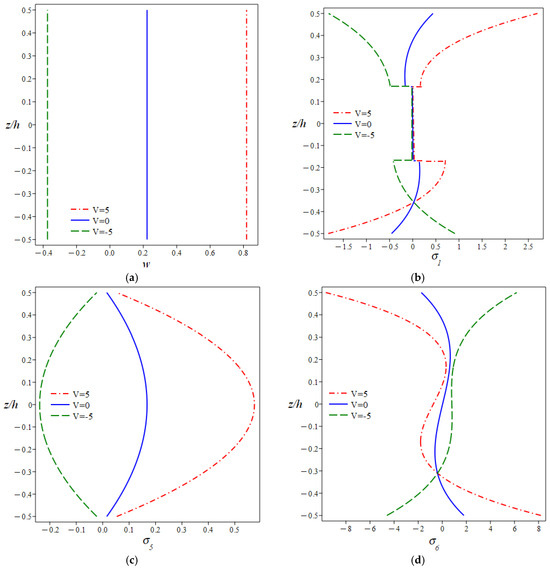
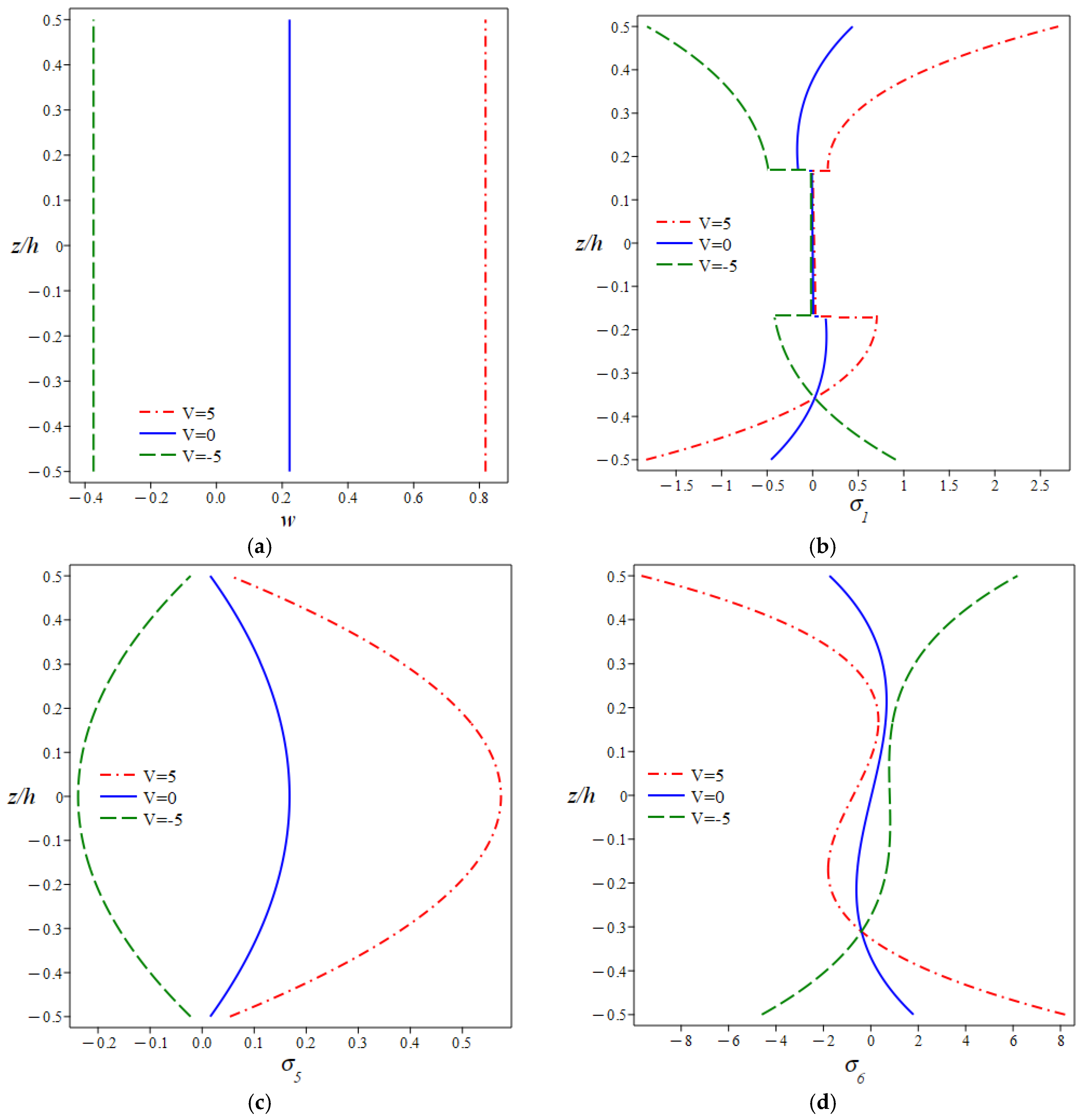
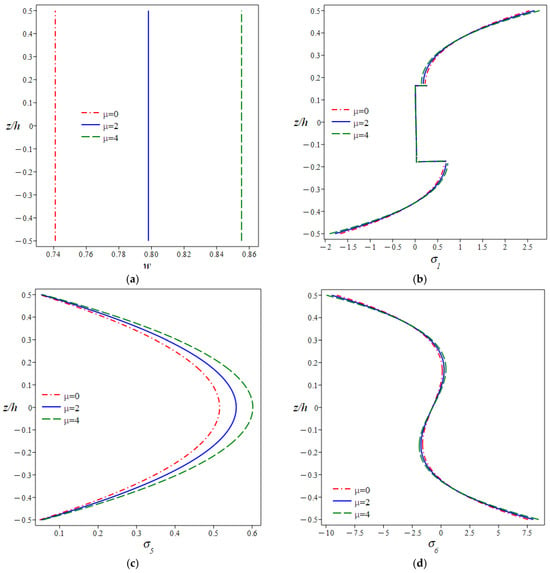
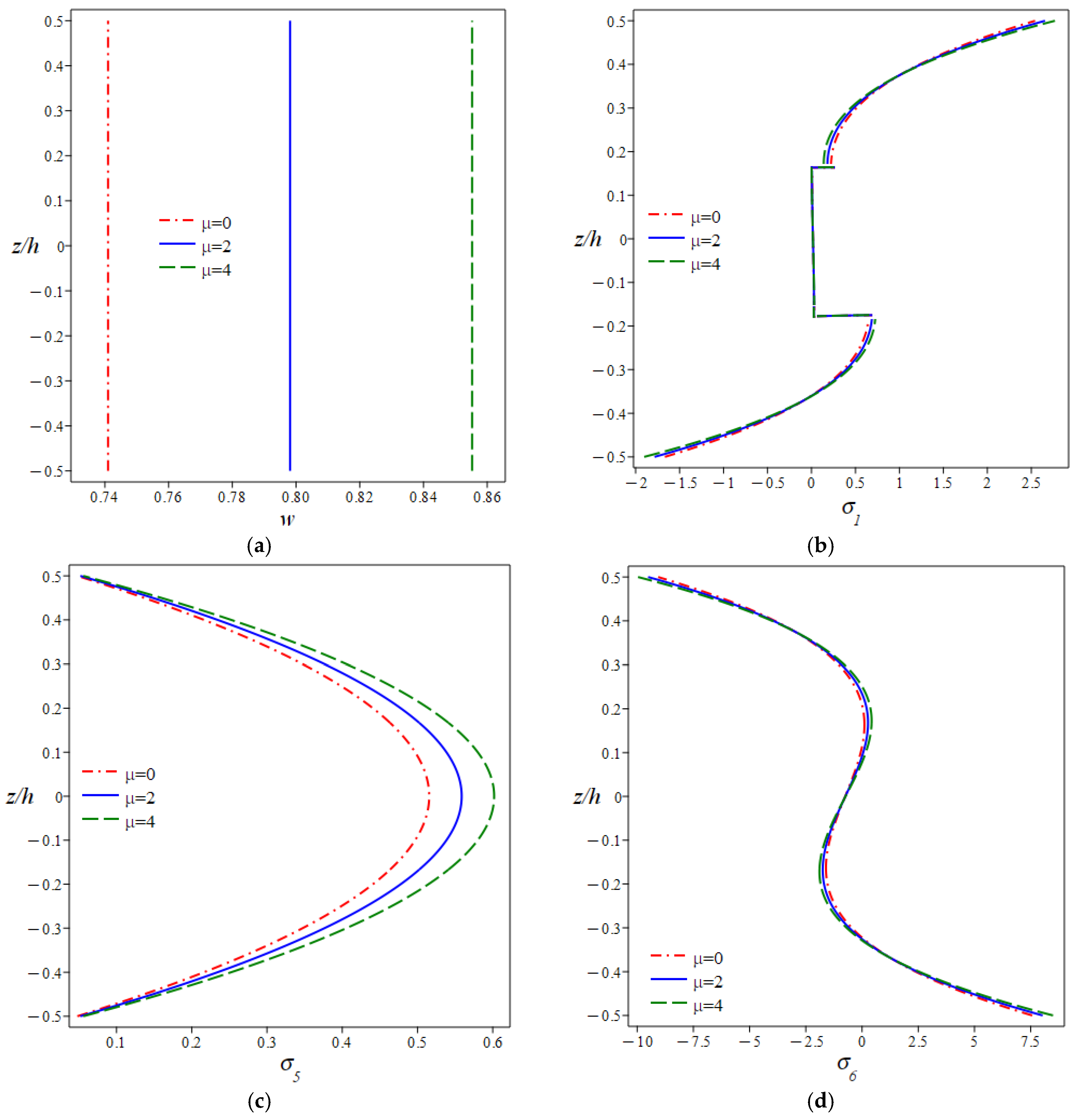
Figure 2 depicts how altering the applied voltage affects the displacement and stresses through the laminated nanoplate thickness. Increasing the applied voltage increases the magnitude of deformation and stresses, whereas reversing the voltage results in a response of opposite sign, indicating a reversal in the direction of deformation and stress. This behavior corresponds to the electromechanical coupling of the PFRC layer, in which the applied electric potential causes mechanical deformation through the piezoelectric effect. In Figure 2a, the transverse displacement varies smoothly and symmetrically across the thickness, demonstrating the bending caused by the PFRC actuation. The axial stress, seen in Figure 2b, follows the voltage trend but has a notable discontinuity at the layer interfaces, which is a natural result of the divergence in material stiffness between plies. Figure 2c depicts the transverse shear stress varying smoothly throughout the thickness, with its magnitude increasing under positive voltage, decreasing under negative voltage, and, as expected, approaching zero at the free surfaces with no discontinuities. Figure 2d shows that the in-plane shear stresses change gradually from the mid-plane toward the surface without jumps, consistent with shear continuity in laminate behavior.
Figure 2.
Variation of transverse displacement and stresses along the thickness of the laminated nanoplates with the PFRC layer in terms of ( = 1). (a) , (b) , (c) , (d) .
Figure 3 reveals that increasing the nonlocal parameter amplifies displacement and stress levels through the thickness. In Figure 3a, the transverse displacement grows smoothly with larger , reflecting the softening impact of nonlocality. It can be noted in Figure 3b that the axial stresses have discontinuous behavior at the layer interfaces. The interface layers vary smoothly and correctly drop to zero at the free surfaces, with their magnitude increasing with , as shown in Figure 3c. Figure 3d displays the in-plane shear stress, which also remains continuous across the thickness, increasing moderately with .
Figure 3.
Variation of transverse displacement and stresses along the thickness of the laminated nanoplates with the PFRC layer in terms of ( = 5). (a) , (b) , (c) , (d) .
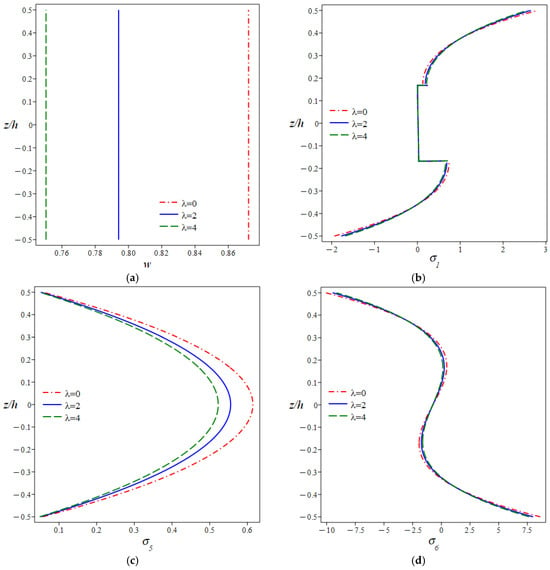
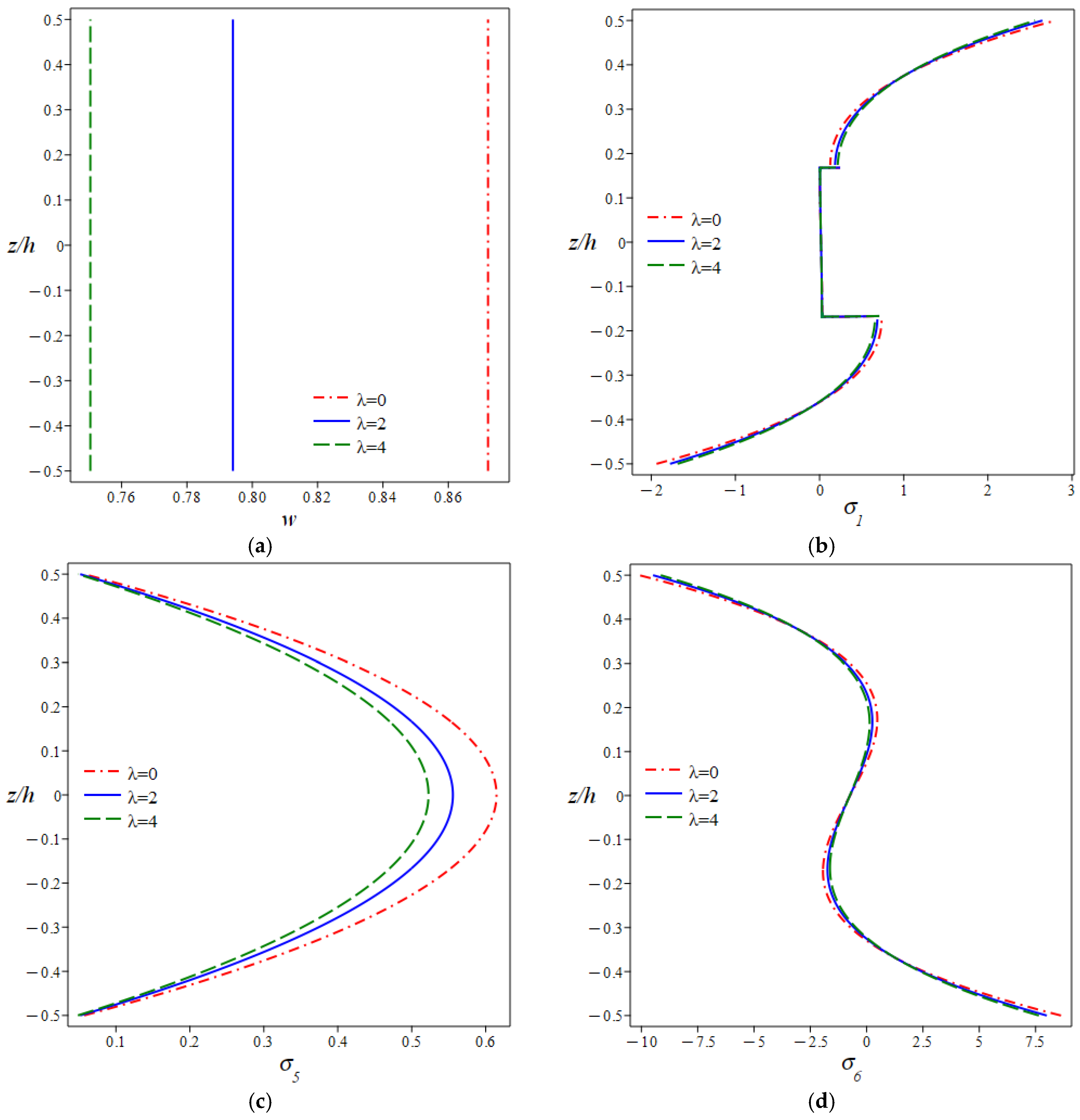
Figure 4 introduces the influences of on the distribution of displacement and stresses in the thickness direction of the laminated nanoplate. Figure 4a shows that the transverse displacement decreases smoothly as increases due to the stiffening effect of λ. Figure 4b presents the axial stress, and as expected, the discontinuity at the layer interfaces remains visible; however, the overall stress magnitude becomes smaller at higher . In Figure 4c, the transverse shear stress has a smooth, continuous profile that goes down to zero at free surfaces. Figure 4d shows that the in-plane stress reduces in magnitude as grows.
Figure 4.
Variation of transverse displacement and stresses along the thickness of the laminated nanoplates with the PFRC layer in terms of (). (a) , (b) , (c) , (d) .
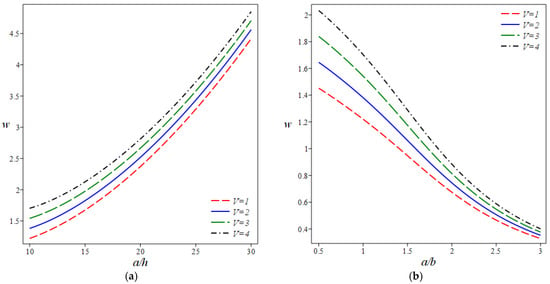
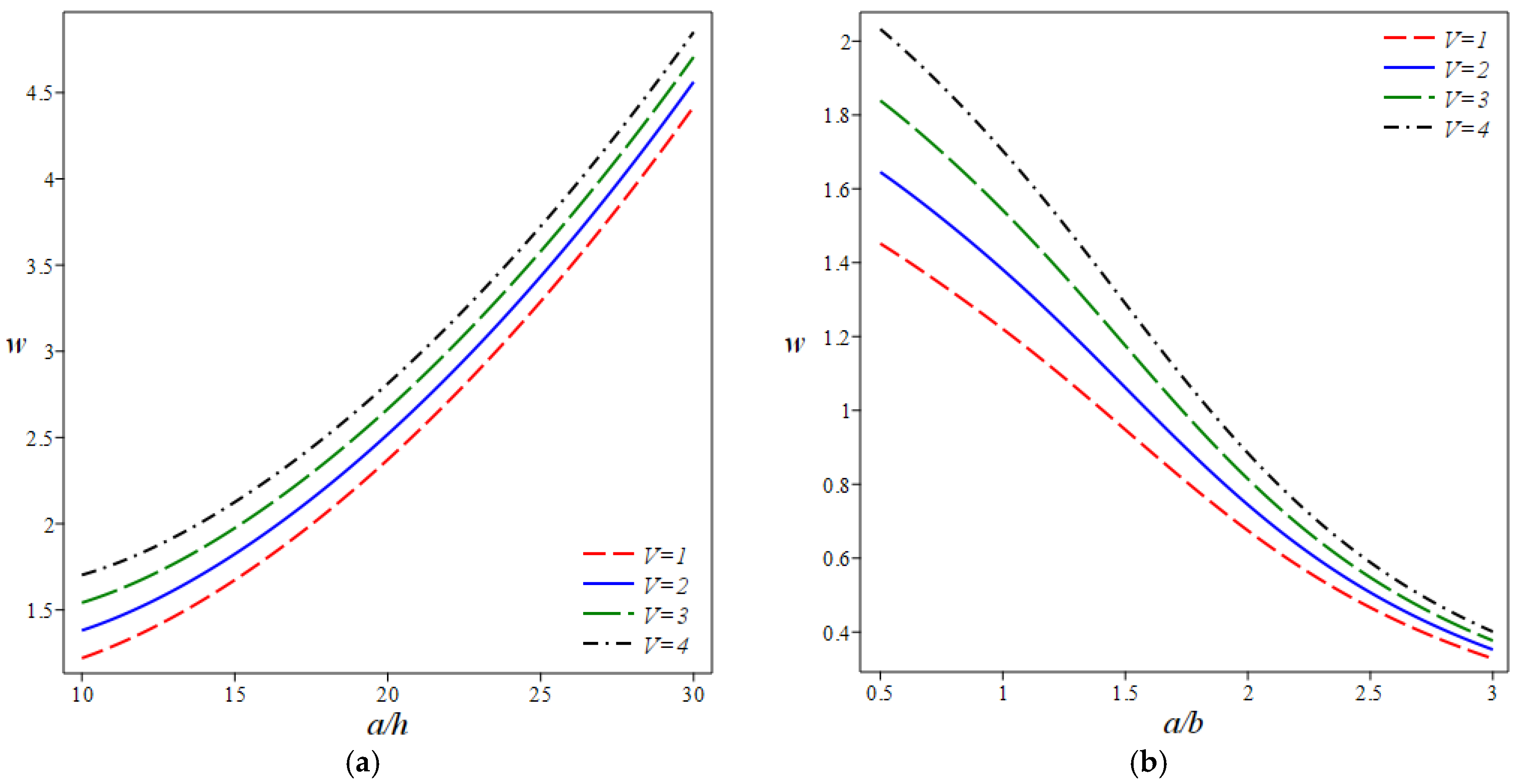
Figure 5a,b indicate that the transverse displacement of the laminated nanoplate increases with increasing and decreases with increasing at various voltages. As increases, the nanoplate becomes thinner and more flexible, leading the electromechanical action of the PFRC layer to cause greater bending deformation. On the other hand, as increases, the nanoplate becomes more elongated, which enhances its in-plane stiffness and, therefore, reduces its ability to undergo transverse deflection.
Figure 5.
Variation of transverse displacement of the laminated nanoplates with the PFRC layer in terms of ( = 1) as a function of (a) and (b) .
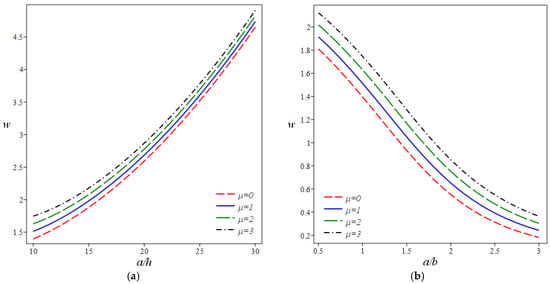
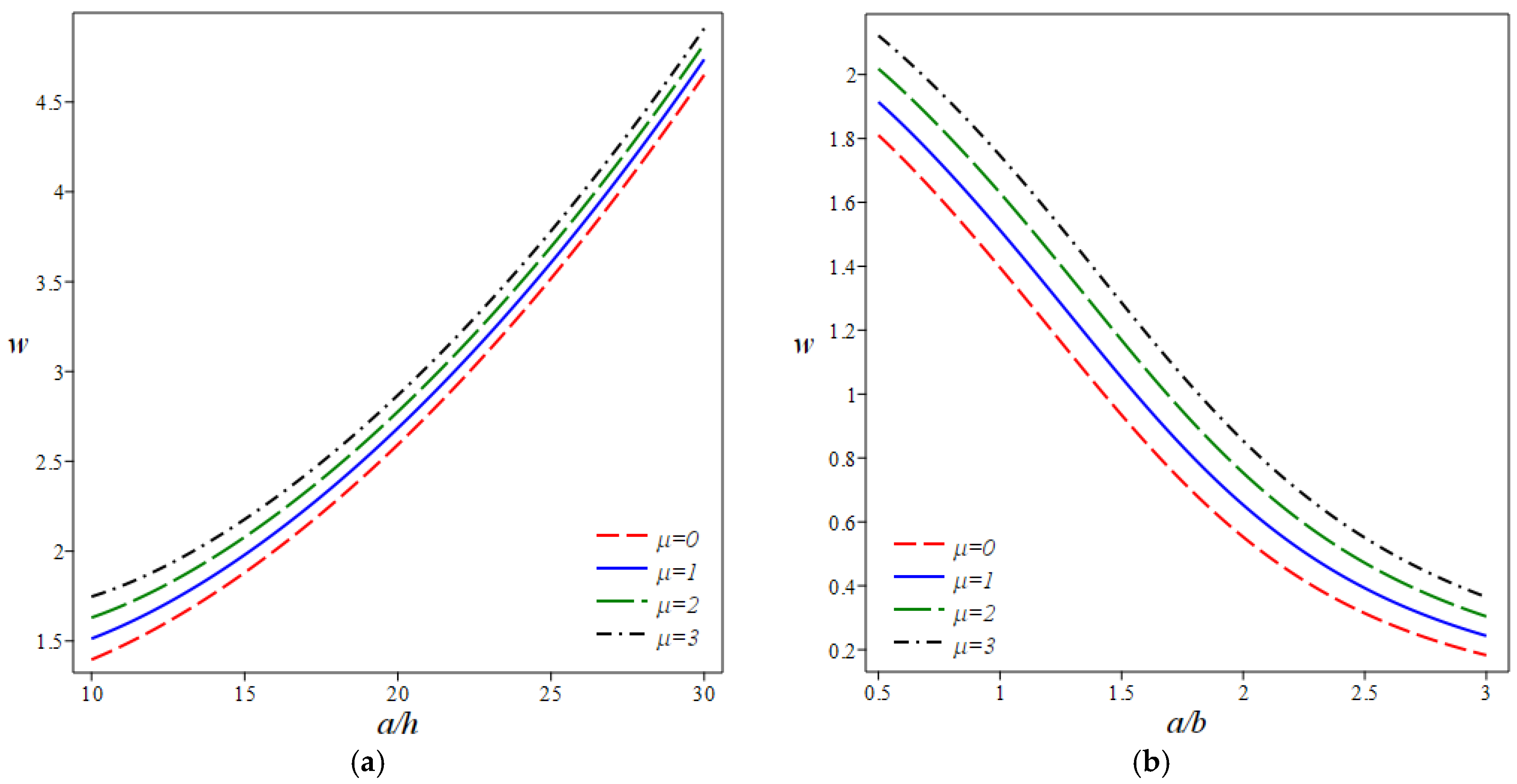
Figure 6 shows how the nonlocal parameter influences the transverse displacement under two geometric conditions. In Figure 6a, the displacement increases smoothly with larger for all thickness ratios . The influence is stronger in thicker plates and gradually decreases as the plate thins. Figure 6b reveals that increasing raises the displacement; however, the overall magnitude decreases as the aspect ratio becomes larger. Despite the geometric reduction, the upward shift created by is consistent across all aspect ratios, indicating that nonlocality promotes flexibility regardless of plate dimensions due to its softening effect.
Figure 6.
Variation of transverse displacement of the laminated nanoplates with the PFRC layer in terms of ( = 1) as a function of (a) and (b) .
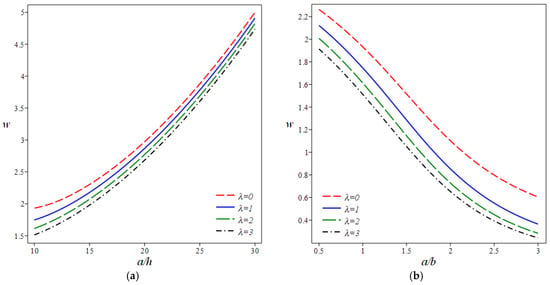
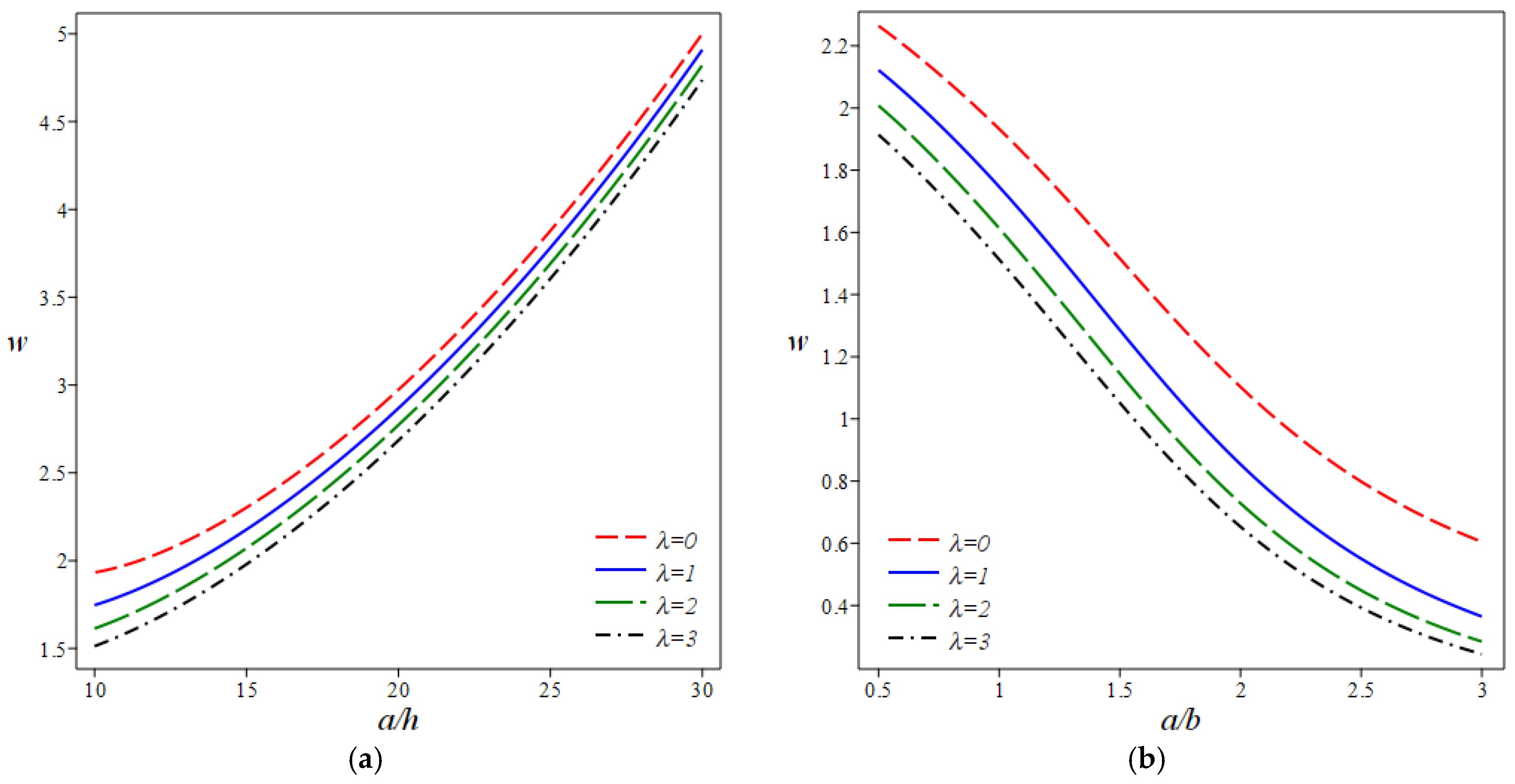
The influence of on the transverse displacement is demonstrated in Figure 7 for different geometric configurations. Figure 7a shows that the displacement decreases as increases for all thickness ratios due to the stiffening impact of strain gradient elasticity. Figure 7b illustrates that the displacement decreases with higher , and also decreases as the aspect ratio increases, indicating that the nanoplate becomes stiffer when it extends in the a-direction. The influence of remains consistent for all aspect ratios; larger always causes smaller displacement, indicating that the strain gradient factor affects flexibility independent of plate dimensions.
Figure 7.
Variation of transverse displacement of the laminated nanoplates with the PFRC layer in terms of ( = 3) as a function of (a) and (b) .
From a physical standpoint, the nonlocal parameter reflects the long-range interatomic interactions, which tend to decrease the structural stiffness, resulting in a softening effect. Conversely, the strain gradient parameter describes the influence of the material microstructure and internal length scales, which improve the structural stiffness and result in a stiffening impact.
6. Conclusions
This article proposes a nonlocal strain gradient approach for investigating the bending of a cross-ply laminated nanoplate coupled to a PFRC actuator. A four-variable shear deformation theory is implemented to simulate the laminated nanoplate. The equilibrium equations are generated from Navier’s process and the virtual work concept, which is addressed in detail. A complete parametric examination is conducted to look into the consequences of the strain gradient and nonlocal variables, the externally applied electric power, and the length-to-thickness ratio. The comparative results are presented to facilitate evaluation. These are the primary findings.
- Transverse displacement is strongly influenced by the length-scale parameter , nonlocal parameter , and applied voltage .
- Higher nonlocal length-scale values reduce structural stiffness, leading to larger deflections and noticeable changes in the stress field.
- Increasing the strain gradient values increases the effective stiffness of the nanoplate, causing smaller deflections and smoother stress distributions, which is opposite to the softening effect caused by increasing the nonlocal parameter.
- External voltage V provides effective mechanical actuation through the PFRC layer:
- ▪
- Positive voltage increases upward bending.
- ▪
- Negative voltage induces downward bending.
- The actuation effect becomes stronger in thinner nanoplates and when nonlocal effects are more dominant.
- Stress components show clear sensitivity to both nonlocal parameters and voltage level, confirming strong electromechanical coupling.
- Varying , and offers an effective strategy for tuning and controlling bending behavior in PFRC-reinforced laminated nanoplates.
- The findings support the potential use of these nanoplates in smart structures, micro-actuators, and adaptive nanoscale systems requiring controllable deformation.
Future work will focus on expanding the current formulation to general boundary conditions, utilizing more advanced numerical approaches.
Funding
This research received no external funding.
Data Availability Statement
All data generated or analyzed during this study are included in this published article.
Acknowledgments
The project was funded by the KAU Endowment (WAQF) at King Abdulaziz University, Jeddah, Saudi Arabia. The author, therefore, acknowledge with thanks WAQF and the Deanship of Scientific Research (DSR) for technical and financial support.
Conflicts of Interest
The author declares no conflicts of interest.
References
- Mallik, N.; Ray, M.C. Effective coefficients of piezoelectric fiber-reinforced composites. AIAA J. 2003, 41, 704–710. [Google Scholar] [CrossRef] [Scilit]
- Reddy, J.N. Mechanics of Laminated Composite Plates and Shells: Theory and Analysis; CRC Press: Boca Raton, FL, USA, 2004. [Google Scholar]
- Zenkour, A.M.; Allam, M.N.M.; Radwan, A.F. Bending of cross-ply laminated plates resting on elastic foundations under thermo-mechanical loading. Int. J. Mech. Mater. Des. 2013, 9, 239–251. [Google Scholar] [CrossRef] [Scilit]
- Zenkour, A.M.; Mashat, D.S.; Alghanmi, R.A. Hygrothermal analysis of antisymmetric cross-ply laminates using a refined plate theory. Int. J. Mech. Mater. Des. 2014, 10, 213–226. [Google Scholar] [CrossRef] [Scilit]
- Filippi, M.; Pagani, A.; Petrolo, M.; Colonna, G.; Carrera, E. Static and free vibration analysis of laminated beams by refined theory based on Chebyshev polynomials. Compos. Struct. 2015, 132, 1248–1259. [Google Scholar] [CrossRef] [Scilit]
- D’Ottavio, M.; Dozio, L.; Vescovini, R.; Polit, O. Bending analysis of composite laminated and sandwich structures using sublaminate variable-kinematic Ritz models. Compos. Struct. 2016, 155, 45–62. [Google Scholar] [CrossRef] [Scilit]
- Bacciocchi, M.; Eisenberger, M.; Fantuzzi, N.; Tornabene, F.; Viola, E. Vibration analysis of variable thickness plates and shells by the generalized differential quadrature method. Compos. Struct. 2016, 156, 218–237. [Google Scholar] [CrossRef] [Scilit]
- Sayyad, A.S.; Ghugal, Y.M. Bending, buckling and free vibration of laminated composite and sandwich beams: A critical review of literature. Compos. Struct. 2017, 171, 486–504. [Google Scholar] [CrossRef] [Scilit]
- Zhang, H.; Gao, Y.; He, D.; Yang, W. Free vibration and buckling analysis of composite laminated shells using the refined zigzag theory. J. Theor. Appl. Mech. 2022, 60, 435–448. [Google Scholar] [CrossRef] [Scilit] [PubMed]
- Liu, Y.; Qin, Z.; Chu, F. Investigation of magneto-electro-thermo-mechanical loads on nonlinear forced vibrations of composite cylindrical shells. Commun. Nonlinear Sci. Numer. Simul. 2022, 107, 106146. [Google Scholar] [CrossRef] [Scilit]
- Bojja, N.; Liu, Y.; Wang, P.; Zhu, R.; Qin, Z.; Chu, F. Vibration analysis of laminated composite beams with acoustic black hole profile under general boundary conditions. Int. J. Appl. Mech. 2025, 17, 2550118. [Google Scholar] [CrossRef] [Scilit]
- Huang, Z.; Su, S.; Wang, X.; Chu, F. Stress analysis and stiffness degradation of open cracks composite laminates subjected to external loads. Biomimetics 2025, 10, 177. [Google Scholar] [CrossRef] [Scilit]
- Singh, V.; Kumar, R. A semi-analytical framework for non-linear dynamic response of multi-phase laminated composite plate under transverse patch and in-plane pulse localized loadings. Mech. Adv. Mater. Struct. 2023, 30, 3937–3964. [Google Scholar] [CrossRef] [Scilit]
- Eringen, A.C. On differential equations of nonlocal elasticity and solutions of screw dislocation and surface waves. J. Appl. Phys. 1983, 54, 4703–4710. [Google Scholar] [CrossRef] [Scilit]
- Eringen, A.C.; Edelen, D. On nonlocal elasticity. Int. J. Eng. Sci. 1972, 10, 233–248. [Google Scholar] [CrossRef] [Scilit]
- Yang, F.; Chong, A.C.M.; Lam, D.C.C.; Tong, P. Couple stress based strain gradient theory for elasticity. Int. J. Solids Struct. 2002, 39, 2731–2743. [Google Scholar] [CrossRef] [Scilit]
- Thai, H.T.; Vo, T.P. A nonlocal sinusoidal shear deformation beam theory with application to bending, buckling, and vibration of nanobeams. Int. J. Eng. Sci. 2012, 54, 58–66. [Google Scholar] [CrossRef] [Scilit]
- Lou, J.; He, L.; Du, J.; Wu, H. Buckling and post-buckling analyses of piezoelectric hybrid microplates subject to thermo–electro-mechanical loads based on the modified couple stress theory. Compos. Struct. 2016, 153, 332–344. [Google Scholar] [CrossRef] [Scilit]
- Farajpour, A.; Howard, C.Q.; Robertson, W.S. On size-dependent mechanics of nanoplates. Int. J. Eng. Sci. 2020, 156, 10336. [Google Scholar] [CrossRef] [Scilit]
- Barretta, R.; Faghidian, S.A.; Marotti de Sciarra, F. Stress-driven nonlocal integral elasticity for axisymmetric nano-plates. Int. J. Eng. Sci. 2019, 136, 38–52. [Google Scholar] [CrossRef] [Scilit]
- Lu, L.; Guo, X.; Zhao, J. A unified size-dependent plate model based on nonlocal strain gradient theory including surface effects. Appl. Math. Model. 2019, 68, 583–602. [Google Scholar] [CrossRef] [Scilit]
- Thanh, C.-L.; Tran, L.V.; Vu-Huu, T.; Nguyen-Xuan, H.; Abdel-Wahab, M. Size-dependent nonlinear analysis and damping responses of FG-CNTRC micro-plates. Comput. Methods Appl. Mech. Eng. 2019, 353, 253–276. [Google Scholar] [CrossRef] [Scilit]
- Aghababaei, R.; Reddy, J.N. Nonlocal third-order shear deformation plate theory with application to bending and vibration of plates. J. Sound Vib. 2009, 326, 277–289. [Google Scholar] [CrossRef] [Scilit]
- Bacciocchi, M.; Tarantino, A.M. Analytical solutions for vibrations and buckling analysis of laminated composite nanoplates based on third-order theory and strain gradient approach. Compos. Struct. 2021, 272, 114083. [Google Scholar] [CrossRef] [Scilit]
- Cornacchia, F.; Fantuzzi, N.; Luciano, R.; Penna, R. Solution for cross- and angle-ply laminated Kirchhoff nanoplates in bending using strain gradient theory. Compos. Part B Eng. 2019, 173, 107006. [Google Scholar] [CrossRef] [Scilit]
- Lim, C.W.; Zhang, G.; Reddy, J.N. A higher-order nonlocal elasticity and strain gradient theory and its applications in wave propagation. J. Mech. Phys. Solids 2015, 78, 298–313. [Google Scholar] [CrossRef] [Scilit]
- Monaco, G.T.; Fantuzzi, N.; Fabbrocino, F.; Luciano, R. Hygro-thermal vibrations and buckling of laminated nanoplates via nonlocal strain gradient theory. Compos. Struct. 2021, 262, 113337. [Google Scholar] [CrossRef] [Scilit]
- Alghanmi, R.A. Nonlocal strain gradient theory for the bending of functionally graded porous nanoplates. Materials 2022, 15, 8601. [Google Scholar] [CrossRef] [Scilit]
- Alghanmi, R.A. Hygrothermal bending analysis of sandwich nanoplates with FG porous core and piezomagnetic faces via nonlocal strain gradient theory. Nanotechnol. Rev. 2023, 12, 20230123. [Google Scholar] [CrossRef] [Scilit]
- Kapuria, S.; Kumari, P.; Nath, J.K. Analytical piezoelasticity solution for vibration of piezoelectric laminated angle-ply circular cylindrical panels. J. Sound Vib. 2009, 324, 832–849. [Google Scholar] [CrossRef] [Scilit]
- Her, S.C.; Lin, C.S. Deflection of cross-ply composite laminates induced by piezoelectric actuators. Sensors 2010, 10, 719–733. [Google Scholar] [CrossRef] [Scilit]
- Kang, W.B.; Li, Y.D.; Chen, W.; Wang, X.; Fang, C.Q. Interlaminar stresses in piezoelectric laminated composite shells under electric, thermal and mechanical loads. Eur. J. Mech. A Solids 2015, 54, 198–208. [Google Scholar] [CrossRef] [Scilit]
- Araújo, A.L.; Carvalho, V.S.; Soares, C.M.M.; Belinha, J.; Ferreira, A.J.M. Vibration analysis of laminated soft core sandwich plates with piezoelectric sensors and actuators. Compos. Struct. 2016, 151, 91–98. [Google Scholar] [CrossRef] [Scilit]
- Jiang, H.J.; Liang, L.H.; Ma, L.; Guo, J.; Dai, H.L.; Wang, X.G. An analytical solution of three-dimensional steady thermodynamic analysis for a piezoelectric laminated plate using refined plate theory. Compos. Struct. 2017, 162, 194–209. [Google Scholar] [CrossRef] [Scilit]
- Li, C.; Li, P.; Zhang, Z.; Wen, B. Optimal locations of discontinuous piezoelectric laminated cylindrical shell with point-supported elastic boundary conditions for vibration control. Compos. Struct. 2020, 233, 111575. [Google Scholar] [CrossRef] [Scilit]
- Zhao, X.; Ilegaink, F.J.N.; Zhu, W.D.; Li, Y.H. Coupled thermo-electro-elastic forced vibrations of piezoelectric laminated beams by means of Green’s functions. Int. J. Mech. Sci. 2019, 156, 355–369. [Google Scholar] [CrossRef] [Scilit]
- Ninh, D.G.; Bich, D.H. Characteristics of nonlinear vibration of nanocomposite cylindrical shells with piezoelectric actuators under thermo-mechanical loads. Aerosp. Sci. Technol. 2018, 77, 595–609. [Google Scholar] [CrossRef] [Scilit]
- Yang, W.D.; Fang, C.Q.; Wang, X. Nonlinear dynamic characteristics of FGCNT-reinforced microbeam with piezoelectric layer based on unifying stress–strain gradient framework. Compos. Part B Eng. 2017, 111, 372–386. [Google Scholar] [CrossRef] [Scilit]
- Zhu, C.S.; Fang, X.Q.; Liu, J.X.; Li, H.Y. Surface energy effect on nonlinear free vibration behavior of orthotropic piezoelectric cylindrical nano-shells. Eur. J. Mech. A Solids 2017, 66, 423–432. [Google Scholar]
- Mallik, N.; Ray, M.C. Exact solutions for the analysis of piezoelectric fiber-reinforced composites as distributed actuators for smart composite plates. Int. J. Mech. Mater. Des. 2004, 1, 347–364. [Google Scholar] [CrossRef] [Scilit]
- Ray, M.C.; Mallik, N. Finite element analysis of smart structures containing piezoelectric fiber-reinforced composite actuator. AIAA J. 2004, 42, 1398–1405. [Google Scholar] [CrossRef] [Scilit]
- Ray, M.C.; Sachade, M. Exact solutions for the functionally graded plates integrated with a layer of piezoelectric fiber-reinforced composite. J. Appl. Mech. 2006, 73, 622–632. [Google Scholar] [CrossRef] [Scilit]
- Panda, S.; Ray, M.C. Nonlinear finite element analysis of functionally graded plates integrated with patches of piezoelectric fiber-reinforced composite. Finite Elem. Anal. Des. 2008, 44, 493–504. [Google Scholar] [CrossRef] [Scilit]
- Shiyekar, S.M.; Kant, T. Higher-order shear deformation effects on analysis of laminates with piezoelectric fibre-reinforced composite actuators. Compos. Struct. 2011, 93, 3252–3261. [Google Scholar] [CrossRef] [Scilit]
- Joshan, Y.S.; Santapuri, S.; Grover, N. Analysis of laminated piezoelectric composite plates using an inverse hyperbolic coupled plate theory. Appl. Math. Model. 2020, 82, 359–378. [Google Scholar] [CrossRef] [Scilit]
- Liu, H.; Zhang, Q.; Yang, X.; Ma, J. Size-dependent vibration of laminated composite nanoplate with piezo-magnetic face sheets. Eng. Comput. 2022, 38, 3007–3023. [Google Scholar] [CrossRef] [Scilit]
- Ray, M.C.; Sachade, H.M. Finite element analysis of smart functionally graded plates. Int. J. Solids Struct. 2006, 43, 5468–5484. [Google Scholar] [CrossRef] [Scilit]
- Malikan, M.; Nguyen, V.B. Buckling analysis of piezo-magnetoelectric nanoplates in hygrothermal environment based on a novel one-variable plate theory combining with higher-order nonlocal strain gradient theory. Phys. E 2018, 102, 8–28. [Google Scholar] [CrossRef] [Scilit]
- Shimpi, R.P.; Patel, H.G. A two-variable refined plate theory for orthotropic plate analysis. Int. J. Solids Struct. 2006, 43, 6783–6799. [Google Scholar] [CrossRef] [Scilit]
- Thai, H.T.; Kim, S.E. Analytical solution of a two-variable refined plate theory for bending analysis of orthotropic Levy-type plates. Int. J. Mech. Sci. 2012, 54, 269–276. [Google Scholar] [CrossRef] [Scilit]
- Reddy, J.N. A simple higher-order theory for laminated composite plates. J. Appl. Mech. 1984, 51, 745–752. [Google Scholar] [CrossRef] [Scilit]
- Pagano, N.J. Exact solutions for rectangular bidirectional composites and sandwich plates. J. Compos. Mater. 1970, 4, 20–34. [Google Scholar] [CrossRef] [Scilit]
- Thai, C.H.; Nguyen-Xuan, H.; Phung-Van, P. A size-dependent isogeometric analysis of laminated composite plates based on the nonlocal strain gradient theory. Eng. Comput. 2023, 39, 331–345. [Google Scholar] [CrossRef] [Scilit]
- Le, H.Q.; Khatir, S.; Cuong-Le, T. NURBS-based isogeometric analysis for layerwise local behavior of nano-laminated plates based on refined zigzag and nonlocal strain gradient theories. Compos. Struct. 2025, 354, 118766. [Google Scholar] [CrossRef] [Scilit]
- Karami, B.; Janghorban, M.; Rabczuk, T. Static analysis of functionally graded anisotropic nanoplates using nonlocal strain gradient theory. Compos. Struct. 2019, 227, 111249. [Google Scholar] [CrossRef] [Scilit]

Disclaimer/Publisher’s Note: The statements, opinions and data contained in all publications are solely those of the individual author(s) and contributor(s) and not of MDPI and/or the editor(s). MDPI and/or the editor(s) disclaim responsibility for any injury to people or property resulting from any ideas, methods, instructions or products referred to in the content. |
© 2026 by the author. Licensee MDPI, Basel, Switzerland. This article is an open access article distributed under the terms and conditions of the Creative Commons Attribution (CC BY) license.