


Abstract
Mobile robot path planning in complex environments remains challenging due to obstacle constraints, high-dimensional search space, and the need to balance path optimality and safety. To address these challenges, this paper proposes an improved Red-Billed Blue Magpie Optimizer (IRBMO) with multi-strategy cooperation. Specifically, a territorial awareness mechanism enhances global exploration to avoid premature path convergence, a representative individual learning strategy improves exploitation to refine path quality, and a random subpopulation diffusion strategy helps escape local optima in complex obstacle environments. The proposed method is applied to grid-based path planning problems with different map sizes and obstacle densities. Experimental results show that IRBMO significantly reduces path length compared with other algorithms, while achieving faster convergence and better stability. Parameter sensitivity analysis, ablation study, and convergence analysis further verify the effectiveness of the proposed strategies. In addition, benchmark tests on CEC2017 and CEC2022 functions against 19 competitors further confirm its optimization capability. Overall, IRBMO provides an effective and robust solution for robot path planning problems.
Keywords:
red-billed blue magpie optimizer; robot path planning; metaheuristic; mobile robot; territorial awareness mechanism; representative individual learning mechanism MSC:
68T20; 90C59; 68T40
1. Introduction
Mobile robot path planning is one of the key problems in the field of intelligent robotics. It is widely used in many areas, such as autonomous driving, warehouse logistics, multi-UAV cooperation, and service robots [1,2]. The main goal is to find a collision-free path from the start point to the target point in a complex environment. At the same time, the path should optimize factors such as length, energy consumption, and safety.
In real applications, the environment is often complex and uncertain. For example, obstacles may be densely distributed, the space may have high dimensions, and the environment may change over time. Because of these factors, the path planning problem is usually a high-dimensional, nonlinear, and multi-constraint optimization problem [3,4]. Therefore, it is important to design efficient and robust path planning methods, both in theory and in practice.
Existing path planning methods can be roughly divided into two types: classical methods and intelligent optimization methods. Traditional methods, such as Dijkstra’s algorithm (1959) [5,6], A-star (1968) [7,8], and the Artificial Potential Field (APF, 1989) [9,10], work well in simple environments. However, in complex or high-dimensional environments, they may produce paths that are not smooth or get trapped in local optima.
In recent years, with the development of swarm intelligence optimization algorithms, more and more studies have applied them to path planning problems. For example, Particle Swarm Optimization (PSO, 1995) [11], Genetic Algorithms (GA) [12], Grey Wolf Optimizer (GWO) [13], and Whale Optimization Algorithm (WOA) [14] have been widely used. These algorithms and their variants simulate natural behaviors and show good ability in global search. Li et al. [15] proposed a new knowledge-based genetic algorithm to generate collision-free paths in complex environments. Amr et al. [16] applied improved particle swarm optimization (IPSO) and improved genetic algorithm (IGA) to mobile robot path planning, and experiments showed their effectiveness in obstacle detection and avoidance. Nayeem et al. [17] proposed a Q-learning-based GWO algorithm (QGWO) and applied it to path planning. Simulation results showed that QGWO can generate paths with lower cost and faster convergence compared to other algorithms. Shao et al. [18] proposed an improved whale optimization algorithm (RQWOA), which combines refraction opposition-based learning and quantum behavior, for multi-robot path planning. Experimental results showed that RQWOA performs well in terms of path length and stability.
However, existing approaches still face several challenges, such as insufficient balance between exploration and exploitation, susceptibility to local optima, and the generation of suboptimal paths in complex obstacle environments. These limitations motivate the development of more robust optimization strategies for robot path planning [19,20].
Red-Billed Blue Magpie Optimizer (RBMO) [21] is a recently proposed swarm intelligence optimization algorithm that simulates the foraging and social behaviors of red-billed blue magpies to achieve efficient exploration of the search space. Owing to its simple structure and promising exploration capability, RBMO has demonstrated considerable potential in various engineering optimization problems [22,23,24,25]. However, it is common that there are still deficiencies and problems with systematic optimization improvements for the algorithm’s search properties. Therefore, some inherent defects of the original RBMO have not been improved. Specifically, RBMO has: (1) a limited ability to explore in the initial stage, restricting the coverage of the search space; (2) a quick loss of population diversity during evolution, causing premature convergence; and (3) no mechanism to escape local optima in the latter part. Therefore, these problems restrict the overall optimization effect of path planning in complex environments with obstacle constraints.
In light of the above problems, this paper presents a multi-strategy improved RBMO (IRBMO) based on swarm behavior modeling. To improve the performance of the algorithm in path planning tasks, three mechanisms are introduced: (1) a territorial awareness mechanism is designed to expand the search range and strengthen global exploration in the early stage by guiding individuals to explore diverse regions and avoid premature convergence in environments with complex obstacles; (2) a representative individual learning mechanism is introduced by selecting the individual with the greatest potential for improvement to guide the population toward promising regions, thereby improving convergence accuracy and enhancing path quality; (3) a random subpopulation diffusion strategy is incorporated to increase population diversity and strengthen the ability to escape local optima, especially in later stages of the search process.
Through the cooperation of these strategies, the proposed IRBMO achieves a better balance between exploration and exploitation, enabling it to generate shorter and more efficient paths in complex environments.
To validate the effectiveness of the proposed method, extensive experiments are conducted on grid-based robot path planning problems with different map sizes and obstacle densities. The results demonstrate that IRBMO can effectively generate collision-free paths with shorter lengths and better convergence performance compared with existing algorithms.
In addition, benchmark tests on CEC2017 and CEC2022 functions are performed to further verify the general optimization capability of the proposed method.
The main contributions of this paper can be summarized as follows:
- A multi-strategy improved RBMO (IRBMO) is proposed to enhance the balance between exploration and exploitation in complex environments;
- The proposed method is applied to robot path planning and formulated as a constrained optimization problem to generate collision-free and shorter paths;
- Extensive experiments in different path planning environments demonstrate that IRBMO achieves superior performance in terms of path length and convergence behavior;
- Tests conducted on CEC2017 and CEC2022 benchmark suites further verify the general optimization capability of the proposed method.
The rest of this paper is organized as follows. Section 2 presents the basic rules for RBMO algorithm. Section 3 presents the proposed improved RBMO (IRBMO) in detail, including its core strategies and implementation process. The entire parameter sensitivity analysis of IRBMO in Section 4 will be conducted to evaluate the impact of key parameters on algorithm performance. Section 5 performs many benchmark experiments to examine the optimization performance of IRBMO relative to 19 other algorithms at present. Section 6 uses the proposed method for the robot path planning problem in complex environments and analyzes its performance. Finally, Section 7 concludes this paper and points out the direction for further study.
2. Preliminaries and Problem Formulation
2.1. Red-Billed Blue Magpie Optimizer (RBMO)
The red-billed blue magpie is a flexible predator. It obtains and stores food in different ways. At the same time, it shows social and cooperative behavior during hunting. Inspired by this, the authors propose a new metaheuristic algorithm called RBMO.
2.1.1. Population Initialization
The population initialization of the red-billed blue magpie can be described as follows:
where is the position of the th search agent in the th dimension; is a random number in the range [0, 1]; and and are the upper and lower bounds of the problem, respectively.
The positions of the search agents generated by Equation (1) can be expressed as
where is the population size and is the dimension of the problem.
2.1.2. Food Searching
During food searching, red-billed blue magpies usually move in small groups (2 to 5 birds) or large flocks (more than 10 birds) to improve search efficiency. They use different techniques, such as hopping or walking on the ground, or searching in trees for food. This adaptability and flexibility allow the magpies to adopt multiple hunting strategies depending on the environment and available resources, ensuring sufficient food supply.
When a small group searches for food, the position update formula is as follows:
where is the current iteration, is the new position of the th search agent, is the number of magpies randomly selected from 2 to 5 individuals, is the th randomly chosen individual, is the th individual, and is a randomly selected search agent in the current iteration.
When a large flock searches for food, the iteration uses the following formula:
where is the number of agents in the flock during food searching, ranging from 10 to . They are also randomly selected from the entire population.
2.1.3. Prey Attack
Red-billed blue magpies show high hunting skill and cooperation when attacking prey. They use tactics such as quick pecking, hopping to catch prey, or flying to capture insects. In small group hunting, the main targets are usually small prey or plants. The corresponding mathematical model is
where is the position of the food, and is a random number from the standard normal distribution with mean 0 and standard deviation 1.
When magpies hunt in large flocks, they can target large prey, such as big insects or small vertebrates. This behavior is expressed mathematically as
This predatory hunting behavior highlights the multiple strategies and skills of the red-billed blue magpie, making it a versatile predator capable of successfully obtaining food in various situations.
With a probability (), the search agent updates its position using Equation (3) or Equation (4); otherwise, Equation (5) or Equation (7) is employed.
2.1.4. Food Storage
Besides searching for and attacking food, red-billed blue magpies also store extra food in tree holes or other hidden places for future use. This ensures a stable food supply during shortages. This process preserves information about good solutions, helping individuals find the global optimum. The mathematical model is
where and represent the fitness values of the th magpie before and after the position update, respectively.
2.2. Path Planning Model
Robot path planning aims to determine a feasible path from a given start point to a target point in an environment with obstacles. In grid-based environments, the workspace is discretized into two-dimensional grids. Each grid cell represents either free space or an obstacle [26,27].
A path is composed of a series of continuous nodes, and their coordinates are , where the start point and the target point are the first and last nodes of the path.
The objective of the path planning problem is to find a collision-free path with minimum length. The path length is defined as the sum of the Euclidean distances between adjacent nodes [28], that is:
where is the coordinate of the th node, is the number of adjacent node pairs, and is the total path length from the start point to the target point.
The path planning problem is subject to the following constraints: (1) the path must start from the initial point and reach the target point; (2) the path must not pass through obstacle regions; and (3) all path nodes must lie within the feasible grid space.
Therefore, the path planning problem can be formulated as a constrained optimization problem, where the goal is to find the shortest path while satisfying obstacle avoidance constraints.
3. Improved Red-Billed Blue Magpie Optimizer (IRBMO)
In this study, each individual in the population represents a candidate solution to the robot path planning problem. Specifically, the position of an individual encodes a sequence of path nodes, forming a feasible path from the start point to the target point. The fitness value of each individual corresponds to the total path length, as defined in Section 2.2.
Based on this formulation, the proposed IRBMO algorithm iteratively updates the population to search for shorter and collision-free paths under given constraints.
However, when directly applying the original RBMO algorithm to robot path planning, several limitations can be observed. First, as iterations progress, the population tends to gradually concentrate in certain promising regions of the search space, which reduces diversity and increases the risk of being trapped in local optima. In robot path planning, this may lead to premature convergence to suboptimal paths, especially in environments with complex obstacle distributions. Second, the use of information among individuals is limited, resulting in insufficient exploitation ability of the algorithm. This weak exploitation performance makes it difficult to effectively refine candidate paths, especially in the later stages of the search. In addition, when the algorithm falls into a local optimum, it lacks an effective mechanism to reactivate global search ability. This may prevent the discovery of alternative feasible paths and reduce the overall robustness in path planning tasks.
To address these problems, we propose three improvement strategies for RBMO. These strategies work together to enhance global search ability, convergence performance, and stability in solving complex optimization problems. The three strategies are
- Territorial Awareness Mechanism—expands the search range of individuals in the early stage, allowing the algorithm to explore diverse feasible paths and avoid premature convergence caused by complex obstacle environments.
- Representative Individual Learning Mechanism—selects individuals with high improvement potential (typically those with the worst fitness) and guides them to learn from high-quality candidate paths, thereby accelerating their improvement and enhancing overall path quality.
- Random Subpopulation Diffusion—randomly disperses part of the population to increase diversity, helping the algorithm escape local optima and explore alternative feasible routes.
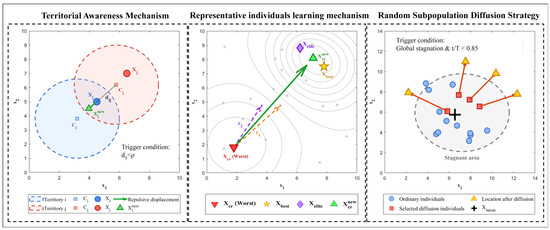
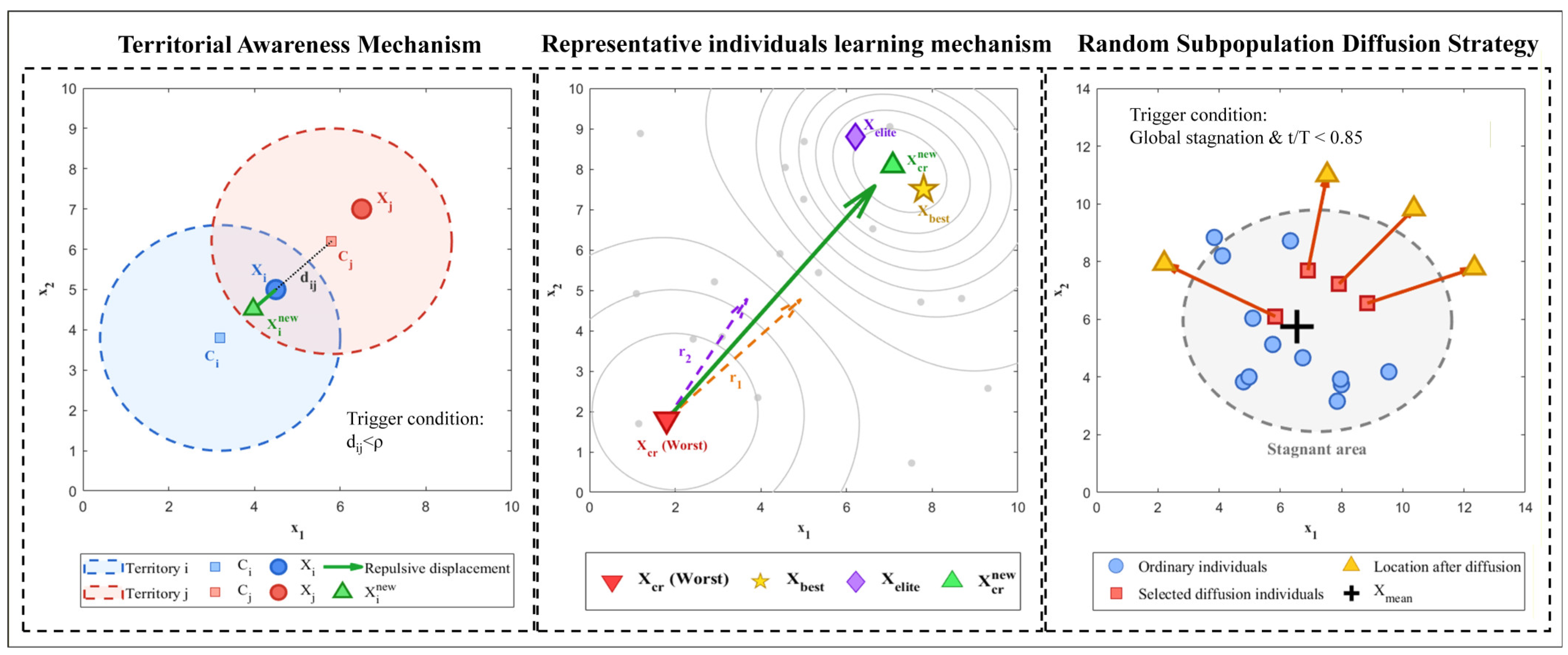
The schematic diagram illustrating the overall principle of the IRBMO is shown in Figure 1.
Figure 1.
Schematic diagram illustrating the principle of IRBMO.
3.1. Territorial Awareness Mechanism
Red-billed blue magpies have a strong sense of territory. When population density is high or resources are scarce, they adjust their activity range to avoid ineffective competition. In contrast, in the original RBMO, the population mean guides the search and promotes cooperation, but it does not actively adjust the spatial distribution of the population. As the search progresses, individuals tend to gather, causing redundant search, reduced diversity, and possible premature convergence to local optima caused by complex obstacle distributions. Therefore, the proposed territorial mechanism adjusts spatial overlap based on historical region occupancy.
3.1.1. Territorial Memory Center
To track the historical activity of each individual, a dynamic territorial memory center is maintained for each individual . Its update uses exponential smoothing:
where is the memory decay factor. A larger makes the territorial center change slowly, retaining long-term regional information and helping maintain stable cooperation.
3.1.2. Territorial Overlap Detection and Repulsion
After updating positions, the territorial overlap between individuals is checked. The overlap is measured by the distance between the position of individual and the territorial center of another individual , :
The territorial radius is defined as , where is the radius coefficient. When , individual is considered to have entered the territory of individual , triggering a repulsion adjustment:
The repulsion strength decays adaptively with the search progress. It is strong in the early stage to maintain population diversity and weakens in the later stage to avoid interfering with convergence:
where is the initial repulsion strength, is the current iteration, and is the maximum number of iterations.
3.2. Representative Individuals Learning Mechanism
Red-billed blue magpies are typical social birds. Foraging and environmental exploration exhibit obvious grouping behavior that share information and learn socially. Some red-billed blue magpies in the group are unable to obtain food for a longer period of time, so they will observe those who can get food easily and learn from them. Following or learning from these successful individuals allows them to increase their own foraging success.
According to the above biological mechanism, a typical individual learning strategy can be applied to the RBMO algorithm. In each generation, the strategy selects a representative individual with the largest improvement potential (usually the worst fitness individual) and guides it to learn search experience from high-quality candidate paths, thereby improving convergence performance and path quality.
3.2.1. Representative Individuals Selection
The core of the strategy is to identify and guide lagging individuals. At the end of each iteration, the individual with the worst fitness is selected as the representative convergent individual:
where is the representative individual in generation , is the fitness of individual , and selects the individual with the largest fitness value, i.e., the worst individual.
3.2.2. Position Update Guided by Elites
After selecting , it is guided to learn from successful individuals. By combining global best information and elite experience, the position is updated to move quickly toward more promising regions [29]:
where is the current global historical best solution, is randomly selected from the elite pool (the top proportion of the population), and are independent uniform random numbers.
To ensure effective updates, a greedy selection is used. The new position is accepted only if it improves fitness:
In the context of robot path planning, this mechanism helps improve low-quality candidate paths, thereby reducing the likelihood of generating inefficient or suboptimal routes.
3.3. Random Subpopulation Diffusion Strategy
In nature, when food is scarce, bird groups often temporarily split into smaller groups to search over a larger area. After finding new food regions, they regroup.
Similarly, in the algorithm, when the population stagnates and , part of the population is dispersed from the population center to increase diversity, enabling the algorithm to escape suboptimal paths and explore alternative feasible routes.
The population center is calculated as
A proportion of the population is randomly selected to perform subpopulation diffusion. Their positions are updated as
where and are the diffusion coefficient and initial diffusion coefficient, and is the population center.
3.4. Pseudocode and Flowchart of IRBMO
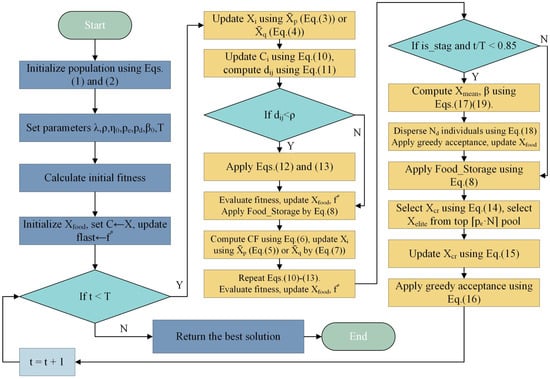
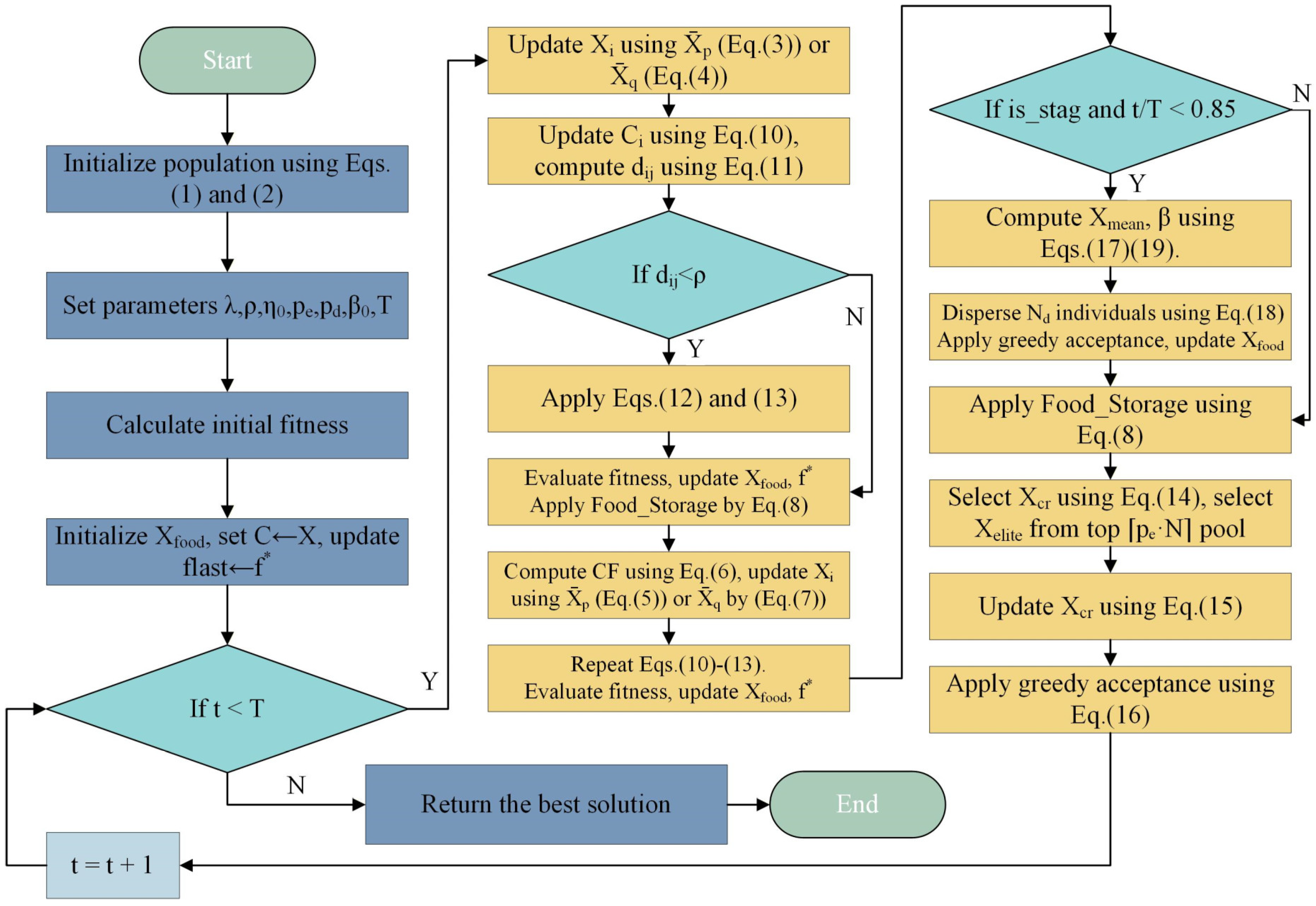
The IRBMO algorithm, which integrates the territorial mechanism, representative learning strategy, and random subpopulation diffusion, has its time complexity provided in Appendix A.1. Its flowchart is shown in Figure 2, and Algorithm 1 as follows:
| Algorithm 1 Pseudocode for IRBMO |
| Input: Population size , max iterations , bounds & , dimension , objective function |
| Output: Best solution , best fitness |
| Variables: |
| : Stagnation counter |
| The global optimal fitness value at the end of the previous iteration |
| 1: initialize population using random sampling and evaluate fitness. |
| 2: ; ; |
| 3: set parameters: , , , , , , |
| 4: for = 1 to do 5: if then |
| 6: += 1. |
| 7: else |
| 8: |
| 9: end if |
| 10: |
| 11: for each individual = 1 to do //Exploration phase |
| 12: sample small group large group random reference |
| 13: with probability , update using (Equation (3)), otherwise using (Equation (4)) |
| 14: end for |
| 15: for each individual = 1 to do |
| 16: update territorial center using Equation (10). |
| 17: for each |
| 18: compute using Equation (11) |
| 19: if then |
| 20: Apply repulsion to using Equations (12) and (13). |
| 21: end if |
| 22: end for |
| 23: wvaluate fitness, update , apply Food_Storage using Equation (8). |
| 24: xompute using Equation (6). |
| 25: for each individual = 1 to do //Exploitation phase |
| 26: aample , , (same as line 12). |
| 27: qith probability , update toward using (Equation (5)), otherwise using (Equation (7)) |
| 28: end for |
| 29: apply TA repulsion (same as lines 14–20), evaluate fitness; update , |
| 30: if and then |
| 31: compute using Equation (17) and using Equation (19) |
| 32: |
| 33: randomly select individuals 34: for each |
| 35: update using Equation (18), apply greedy acceptance, update if improved. |
| 36: end for |
| 37: end if |
| 38: apply Food_Storage using Equation (8). |
| 39: select worst individual using Equation (14), select from top pool. |
| 40: update using Equation (15). |
| 41: replace in via greedy acceptance using Equation (16) if |
| 42: update , if . |
| 43: end for |
| 44: return |
Figure 2.
IRBMO flowchart.
4. Parameter Sensitivity Analysis of IRBMO
4.1. Optimal Parameter Selection Analysis
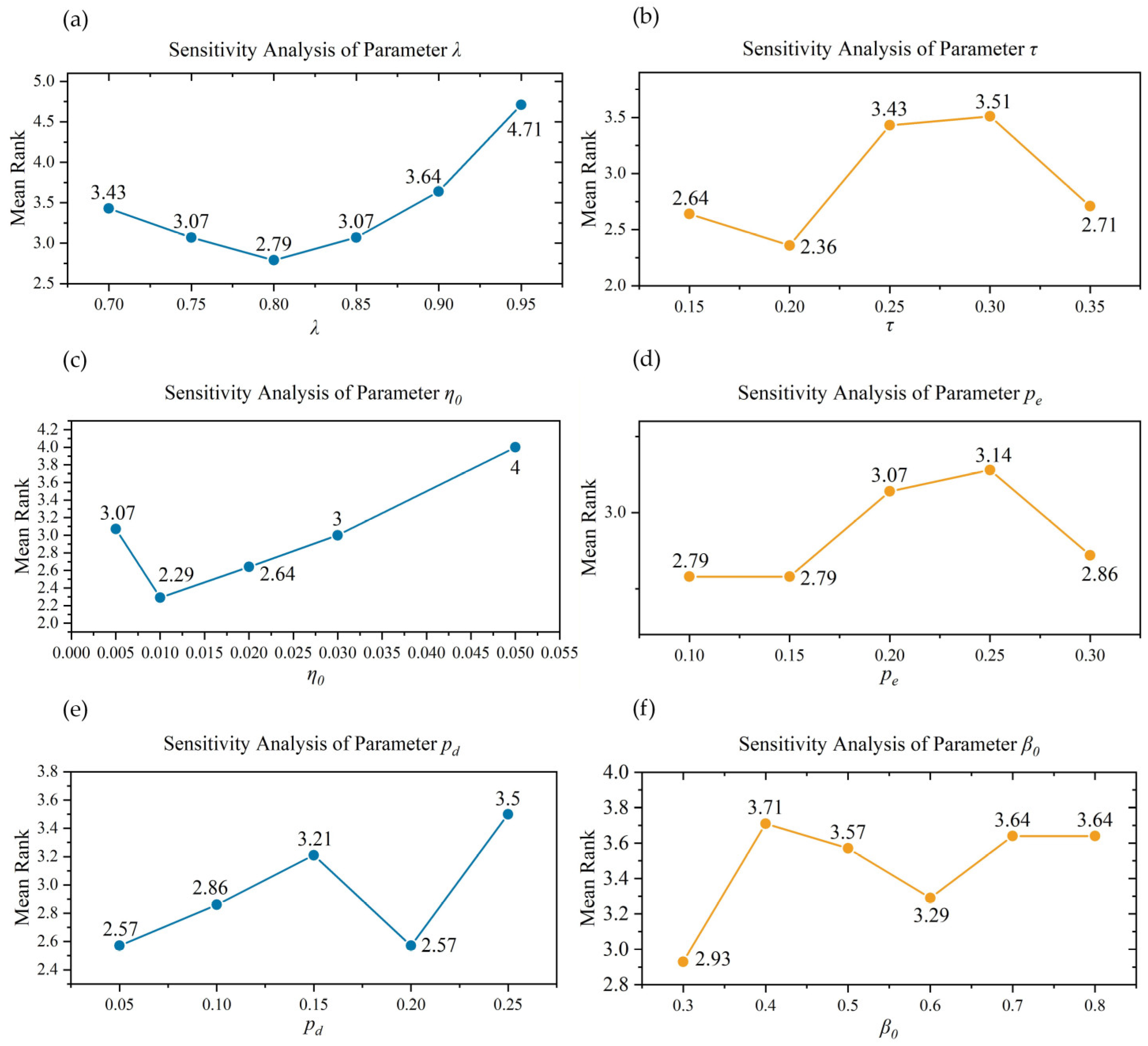
In designing metaheuristic algorithms, parameter settings are key to balancing global exploration and local exploitation. The proposed IRBMO algorithm introduces six core parameters: memory decay factor , territorial radius coefficient , initial repulsion strength , proportion of elite individuals , proportion of population for subpopulation diffusion , and initial diffusion coefficient .
To find appropriate values of these parameters, several test runs were performed on the CEC2017 suite of benchmark functions: F1, F5, F7, F8, F10, F13, F16, F17, F19, F20, F22, F26, F27, and F29. Each function is run 30 times to obtain the optimal value, mean, and standard deviation of that parameter combination to evaluate the accuracy and stability of the algorithm. Friedman’s rank sum test was also used to order the experimental results. Although the parameter sensitivity analysis is conducted using benchmark functions, the results reflect the influence of parameters on the convergence behavior of the algorithm, which directly affects path quality in robot path planning.
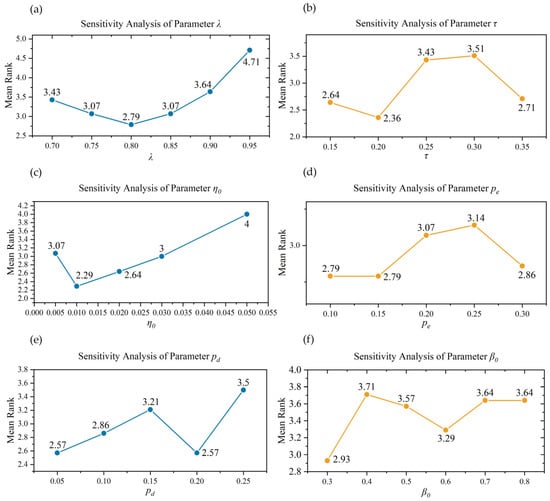
Figure 3 shows the average Friedman ranking values of different parameter settings on these 14 functions. Detailed data can be found in Table A3, Table A4, Table A5, Table A6, Table A7 and Table A8 in Appendix A.2. Based on the results, the best-performing parameters were selected for subsequent experiments: , , .
Figure 3.
Average Friedman ranks from the parameter sensitivity analysis of IRBMO on selected CEC2017 benchmark functions: (a) , (b) , (c) , (d) , (e) , (f) .
4.2. Robustness Analysis of Parameters
To further evaluate the robustness of the proposed IRBMO, a parameter sensitivity analysis was conducted on a subset of representative functions from the CEC2017 benchmark suite, including F4, F7, F11, F15, F18, F26, F29, and F30, which cover different categories of optimization problems.
Based on the optimal parameter values obtained from the previous sensitivity analysis, these values were taken as baseline settings. Three key parameters of IRBMO, namely the memory decay factor , the territorial radius coefficient , and the initial diffusion coefficient were selected for analysis. Each parameter was varied individually within a range of ±20% around its baseline value, while keeping the other parameters fixed.
For each parameter configuration, the algorithm was independently executed 30 times on each benchmark function, and the average fitness values were recorded to ensure statistical reliability. The experimental results are summarized in Table 1.
Table 1.
Results of robustness and sensitivity analysis on selected CEC2017 benchmark functions.
As observed from the results, when any single parameter varies within ±20% of its baseline value, the corresponding variation in fitness values remains very small (within 6%). This indicates that the performance of IRBMO is not overly sensitive to moderate parameter changes and demonstrates good robustness and stability. Furthermore, it suggests that the algorithm does not rely on highly precise parameter tuning, which enhances its practical applicability.
5. Performance Evaluation of IRBMO
5.1. Experimental Configuration
The selected evaluation criteria are both from the CEC2017 and CEC2022 suites. CEC2017 has 29 test functions, and CEC2022 has only 12. These include various optimization scenarios, such as unimodal, multimodal, hybrid, and composite functions. See Table A1 and Table A2 in Appendix A.2 for detailed information.
To fully test the IRBMO’s performance, 19 algorithms are chosen to be compared, including: (1) classical optimization algorithms; (2) the newly developed advanced optimization algorithms; and (3) the original RBMO algorithm. All comparison algorithms use the parameter settings of their original references to ensure fairness, and detailed parameter values are shown in Table 2.
Table 2.
Selected comparison algorithms and their parameter settings.
The experiments mainly consist of the following three parts. Their results can validate the optimization capability, which is essential for solving path planning problem:
- Ablation experiment based on CEC2022 functions to analyze the contribution of each improvement strategy to algorithm performance.
- Convergence analysis through exploration and exploitation behavior of IRBMO, search history distribution, individual search trajectories and convergence curves.
- Performance comparison of IRBMO with 19 other algorithms on multiple benchmark sets (12 representative algorithms are selected from each suite). The best value, mean, and standard deviation are used as evaluation metrics, and statistical significance is analyzed using the Friedman test and Wilcoxon rank-sum test.
For experimental parameter settings, the population size is fixed at . For convergence behavior analysis, the maximum number of iterations is set to 500, which is commonly used in convergence analysis and ensures sufficient convergence without excessive computation. For all other experiments, the maximum number of function evaluations is used as the stopping criterion, set to 1000 × Dim. To ensure statistical reliability, each algorithm is independently run 30 times on each test function. All experiments are performed on MATLAB R2021b.
5.2. Ablation Experiment
The superiority of IRBMO comes from the synergistic effect of the territorial mechanism, representative learning strategy, and random subpopulation diffusion strategy. To analyze the contribution of each improvement strategy to algorithm performance, systematic ablation experiments were conducted using the CEC2022 benchmark suite.
The original RBMO was combined individually with each of the three strategies to construct three algorithm variants:
- RBMO_T: RBMO with the territorial awareness mechanism.
- RBMO_TR: RBMO_T with the representative learning strategy.
- RBMO_TS: RBMO_T with the random subpopulation diffusion strategy.
Under the same parameter settings and running conditions, the best value, mean, and standard deviation of each algorithm were recorded, and the Friedman rank test was used for overall performance comparison. Ablation experiments clearly reveal the contribution of each strategy to performance improvement, verifying the effectiveness and necessity of the proposed multi-strategy synergy.
The experimental results are shown in Table 3, where the best values are highlighted in bold and underlined. From the table, RBMO_T with the territorial mechanism performs better than the original RBMO, indicating that this mechanism effectively balances exploration and exploitation and helps obtain better solutions.
Table 3.
Ablation experiment results.
Based on this, RBMO_TR and RBMO_TS were added with a representative learning strategy or random sub-population diffusion respectively, but they did not achieve significant improvements over RBMO. On the contrary, IRBMO that incorporates the three strategies performs best and obtains the best result in most test functions, ranking first overall. This shows that each of the representative learning strategies and the random subpopulation diffusion have smalls effect alone, but when combined with the territorial awareness mechanism, their strengths are fully leveraged to achieve better algorithms. The three strategies are interrelated and work together effectively.
5.3. Convergence Behavior Analysis
Other than the last optimization result, whether the algorithm performs well during the search process is also essential for assessing its quality. This depends on whether a proper balance between exploration and exploitation is achieved, that is, whether the algorithm can effectively avoid being trapped in local optima during the search process.
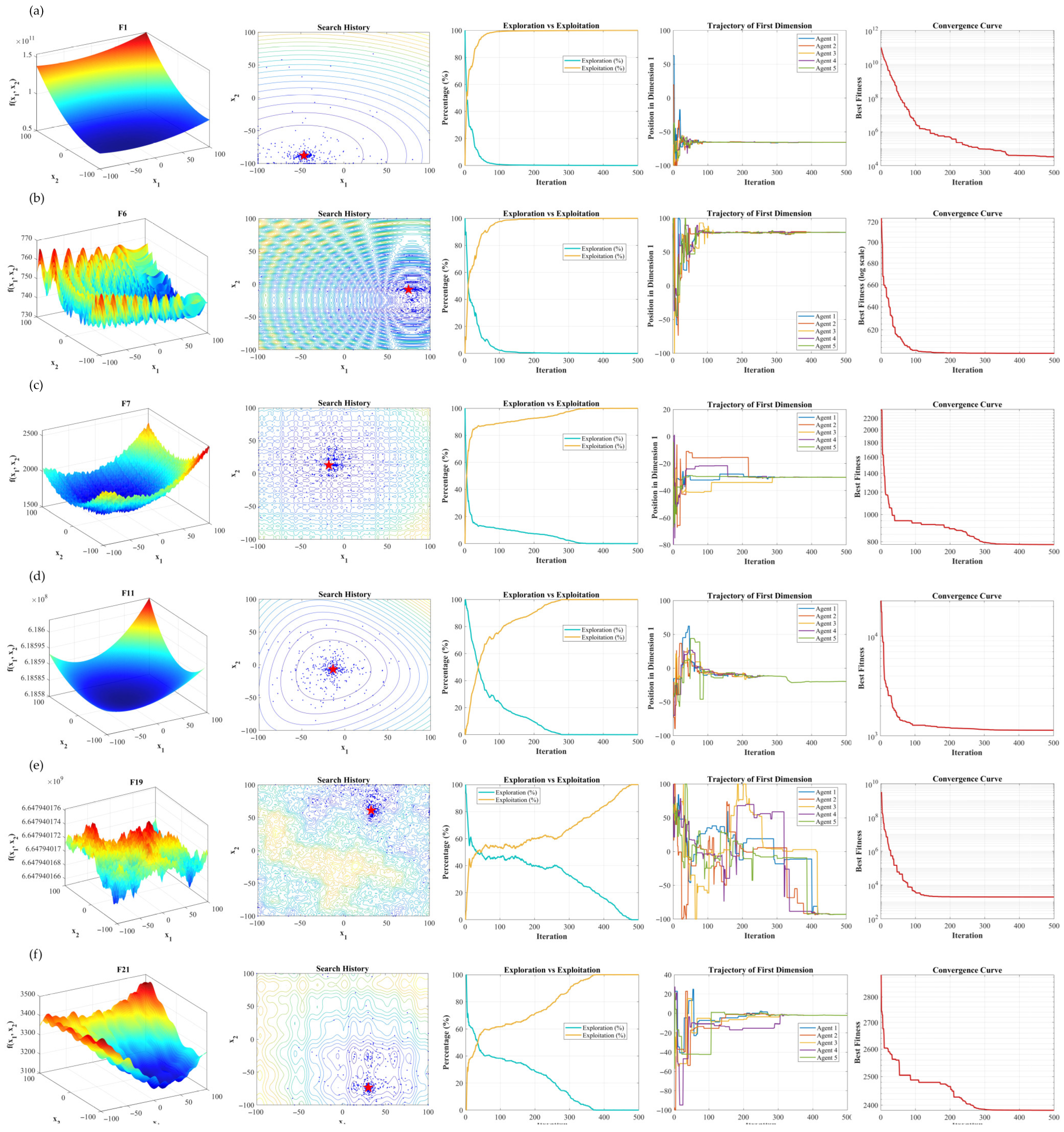
Therefore, the convergence behavior of the IRBMO algorithm is analyzed in systematic ways in this paper. Based on the CEC2017 test suite, some typical functions are selected to form a total of six test functions. These are used to illustrate the search dynamics of IRBMO from different perspectives: search history, individual movement behavior, changes in population diversity, and convergence trend of the optimal solution. The convergence curve of the global optimal value per iteration is plotted to analyze the convergence rate of the algorithm. The trajectory changes in some search individuals in the first dimension to display the characteristics of individual search behavior are tracked. At the same time, the Population Dimension Diversity Index [46] is applied to quantitatively evaluate the algorithm’s ability to explore and exploit at various stages. The index can well reveal changes in population distribution over time to verify that the proposed improvements have helped maintain diversity and promote convergence. The formula for the population dimensions’ diversity index is
where represents the maximum value of the population dimension diversity; is the position of the th individual in the th dimension; and is the median of the positions of all individuals in the th dimension.
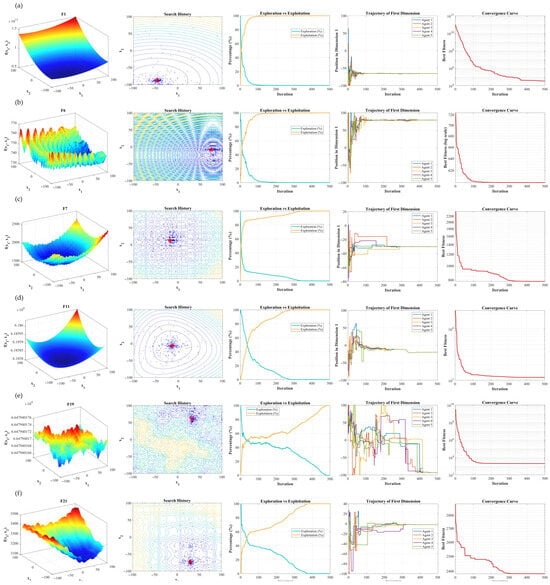
As can be seen from Figure 4, the second column of figure shows the search history of the algorithm, and the red star indicates the location of the global optimum. Based on the distribution of the search agents, it can be observed that at the beginning of the search, they are widely distributed throughout the entire search space and have a strong global exploration capability. With more iterations, the agents are increasingly likely to be close to the global optimum; thus, this algorithm is capable of transitioning from exploration to exploitation. The third column shows the exploration and exploitation curve of the algorithm. These results also verify the previous conclusion: At first, the algorithm is more likely to explore, and then it begins to exploit. In this way, a finer search can be performed near the optimal region. The fourth column shows the trajectory change in the five search agents in the first dimension. Judging from this, the initial range of motion for each agent is relatively large. However, after numerous iterations have been conducted, these ranges of movement have decreased more or less over time and are approaching a converged state. The fifth column shows the convergence curve of the optimal individual per iteration. The fitness value is in a declining state step by step and has eventually reached stability, and it shows that the algorithm can reach a nearby optimal solution efficiently.
Figure 4.
Convergence behavior analysis results on selected CEC2017 benchmark functions: (a) F1, (b) F6, (c) F7, (d) F11, (e) F19, (f) F21.
5.4. Testing and Analysis on CEC2017
Among the 19 comparison algorithms, 12 representative algorithms were selected, covering classical algorithms, advanced algorithms proposed in recent years, and the original RBMO, to conduct comparative experiments with IRBMO on the CEC2017 benchmark functions under 30-dimensional, 50-dimensional, and 100-dimensional conditions. Each algorithm was run independently 30 times on each test function, and the best value, mean value, and standard deviation were recorded. In addition, the Wilcoxon rank-sum test was used for statistical significance analysis, and the Friedman average rank was calculated for comprehensive performance evaluation.
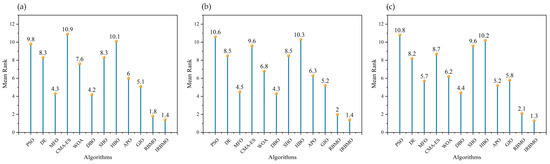
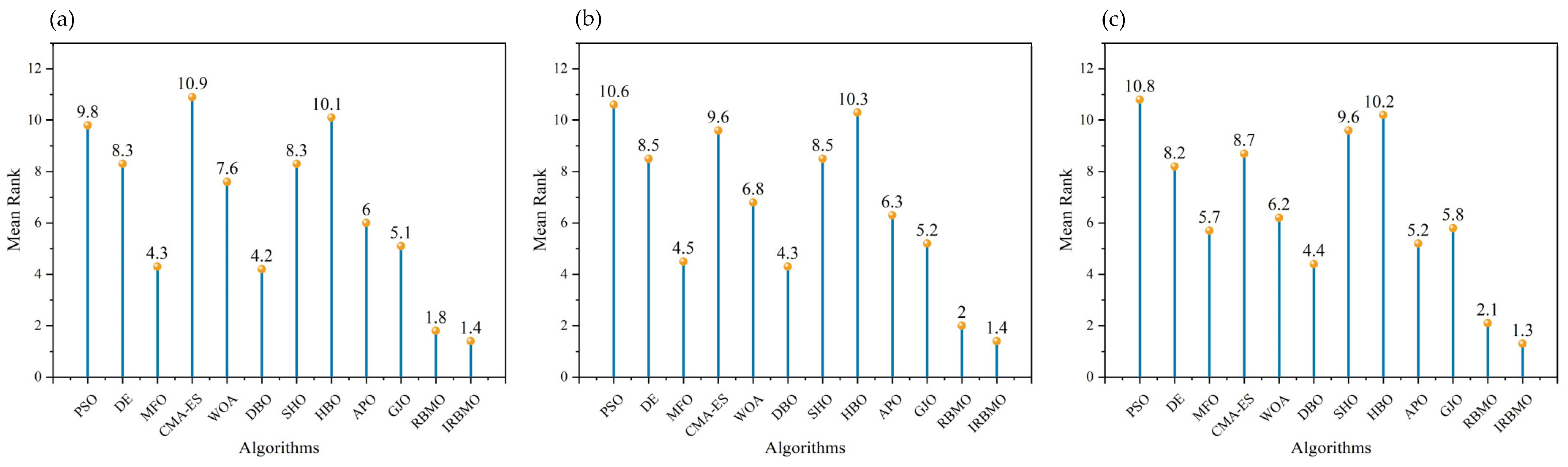
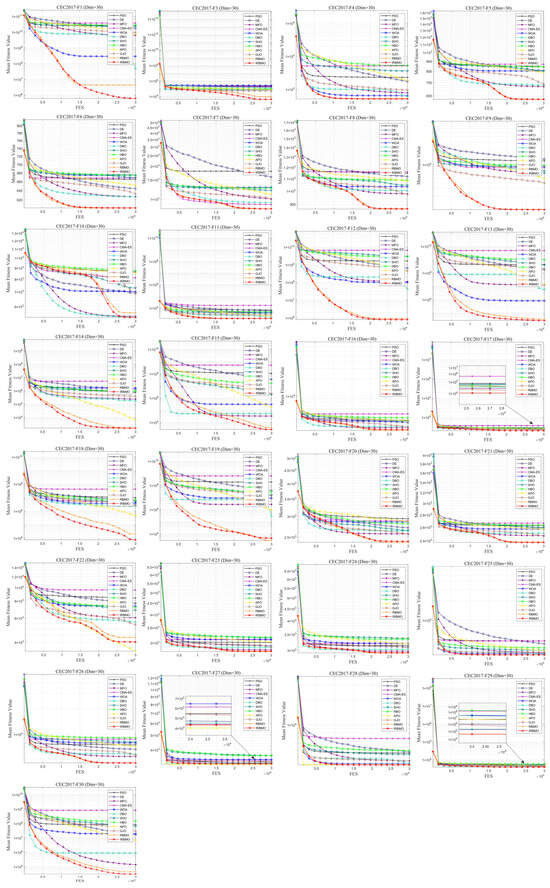
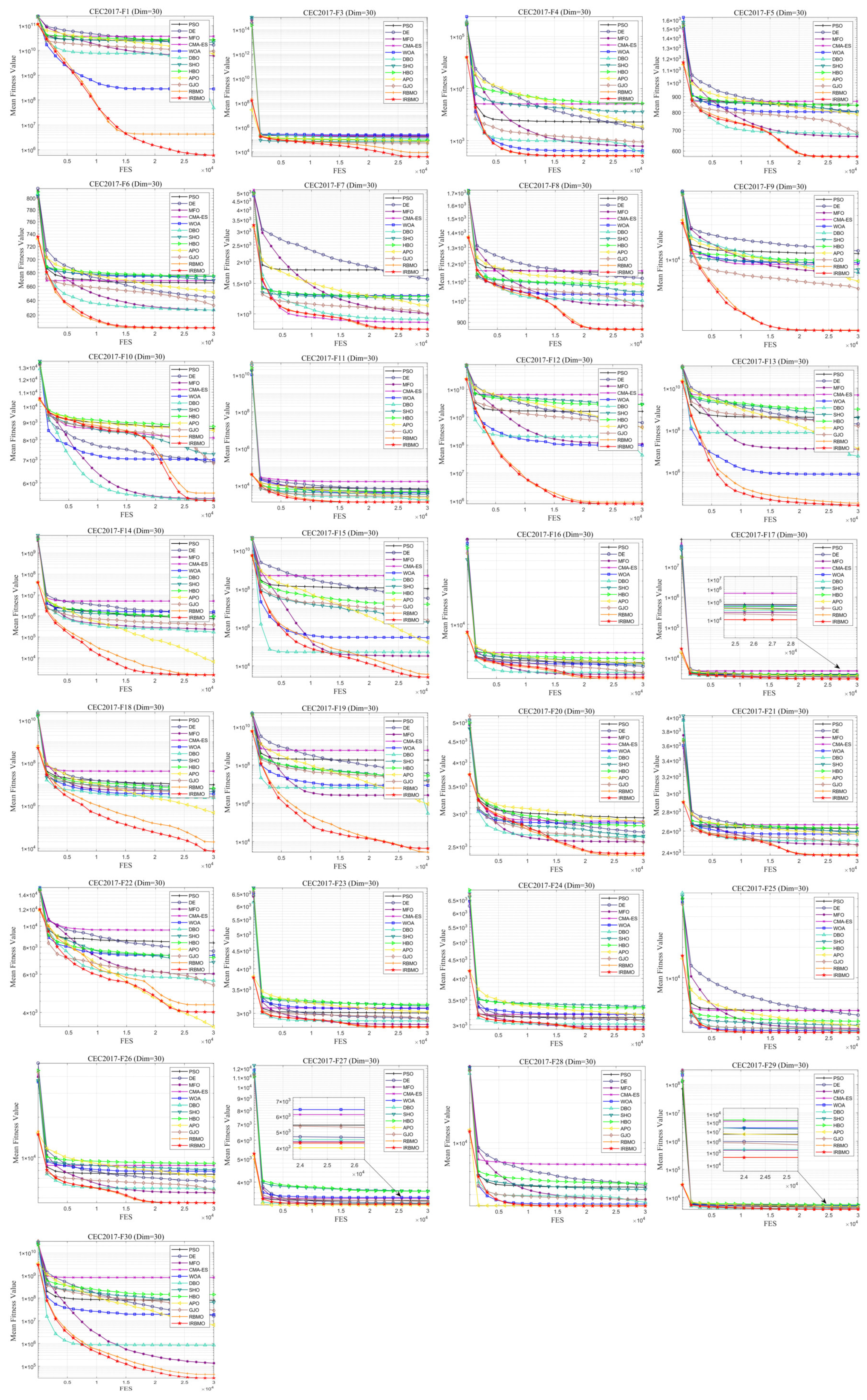
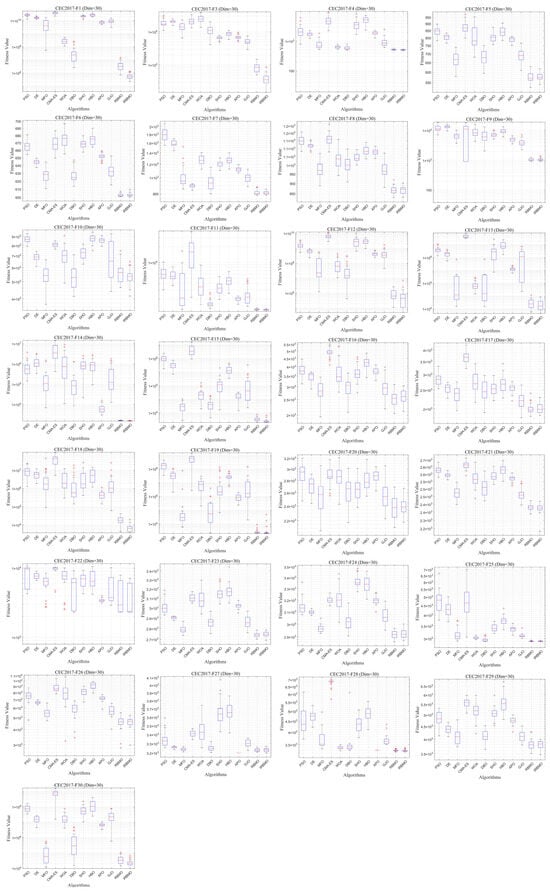
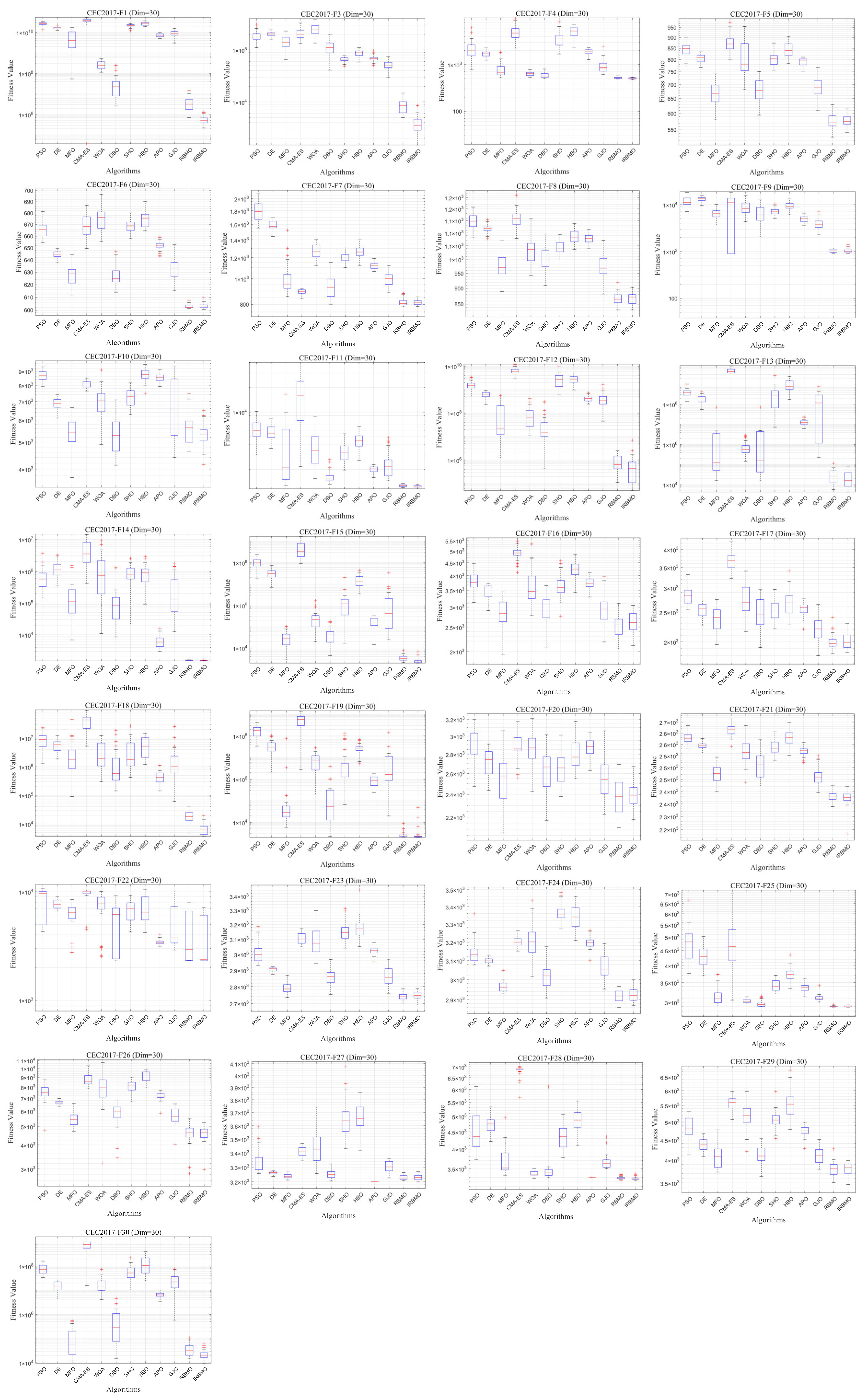
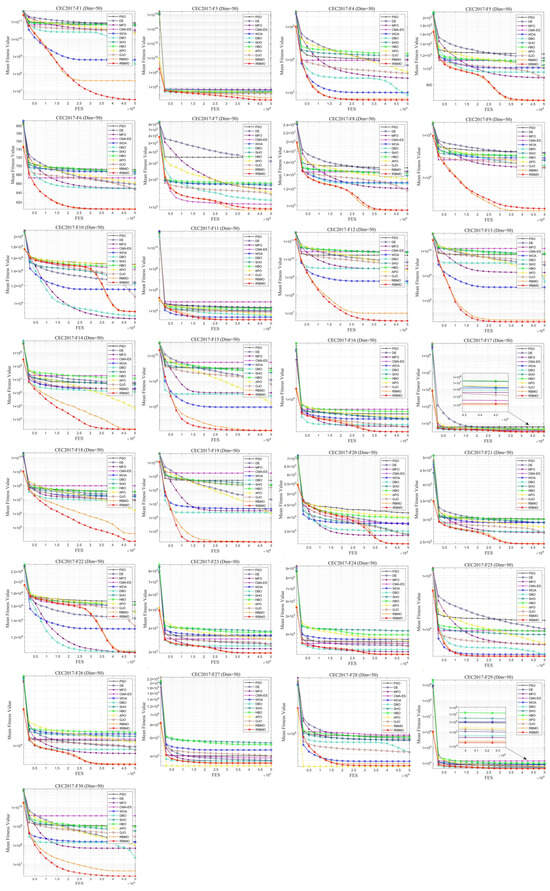
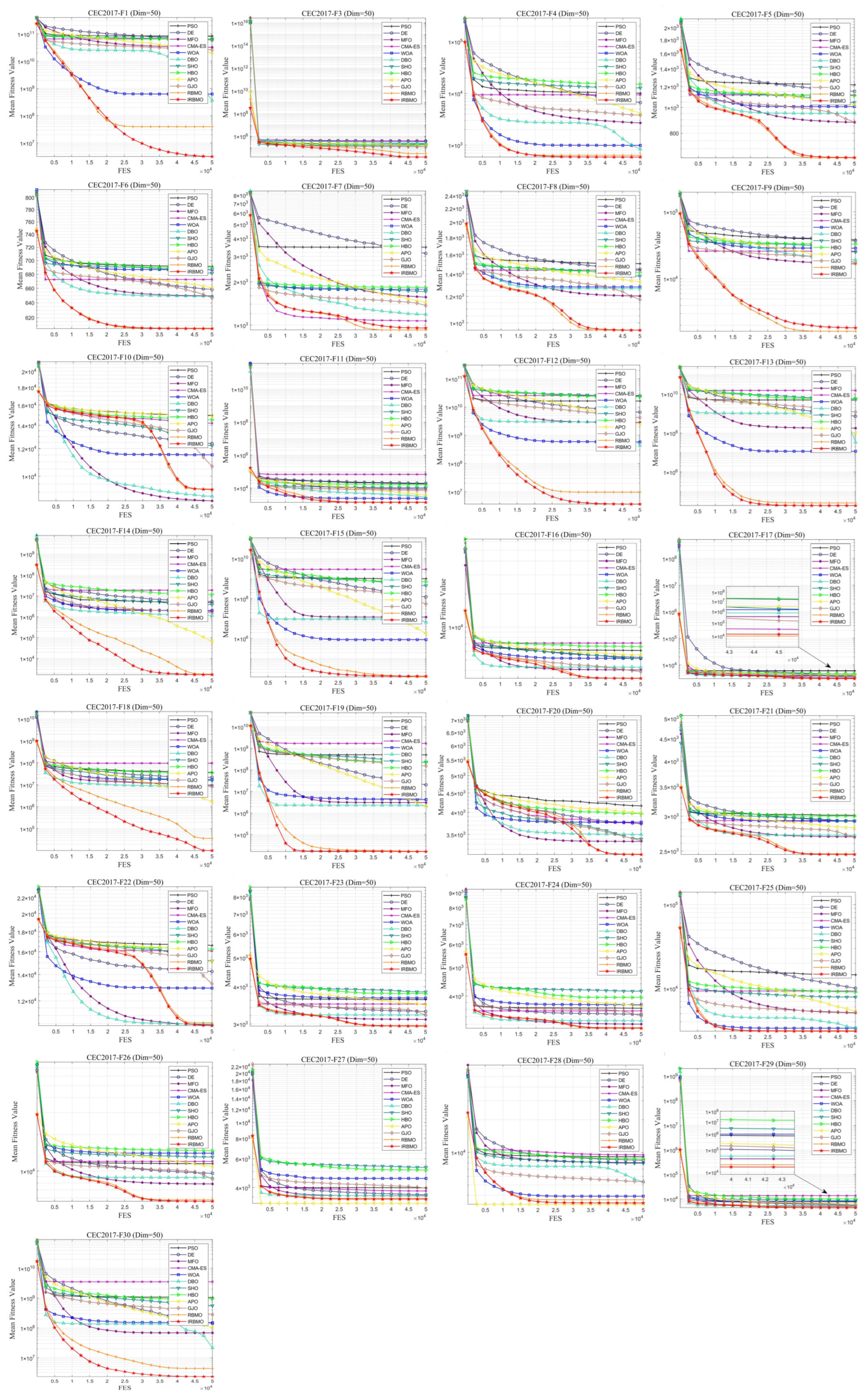
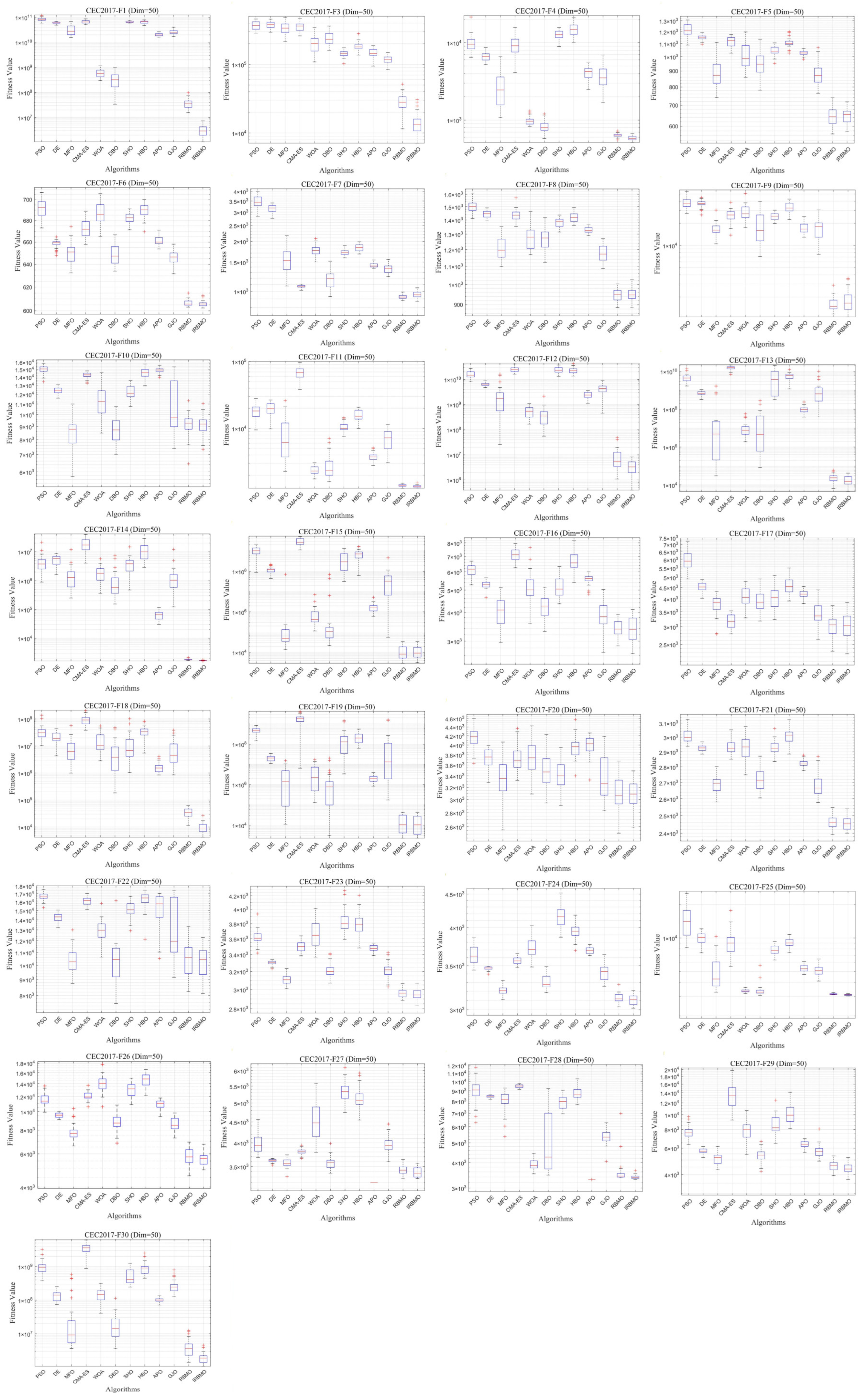
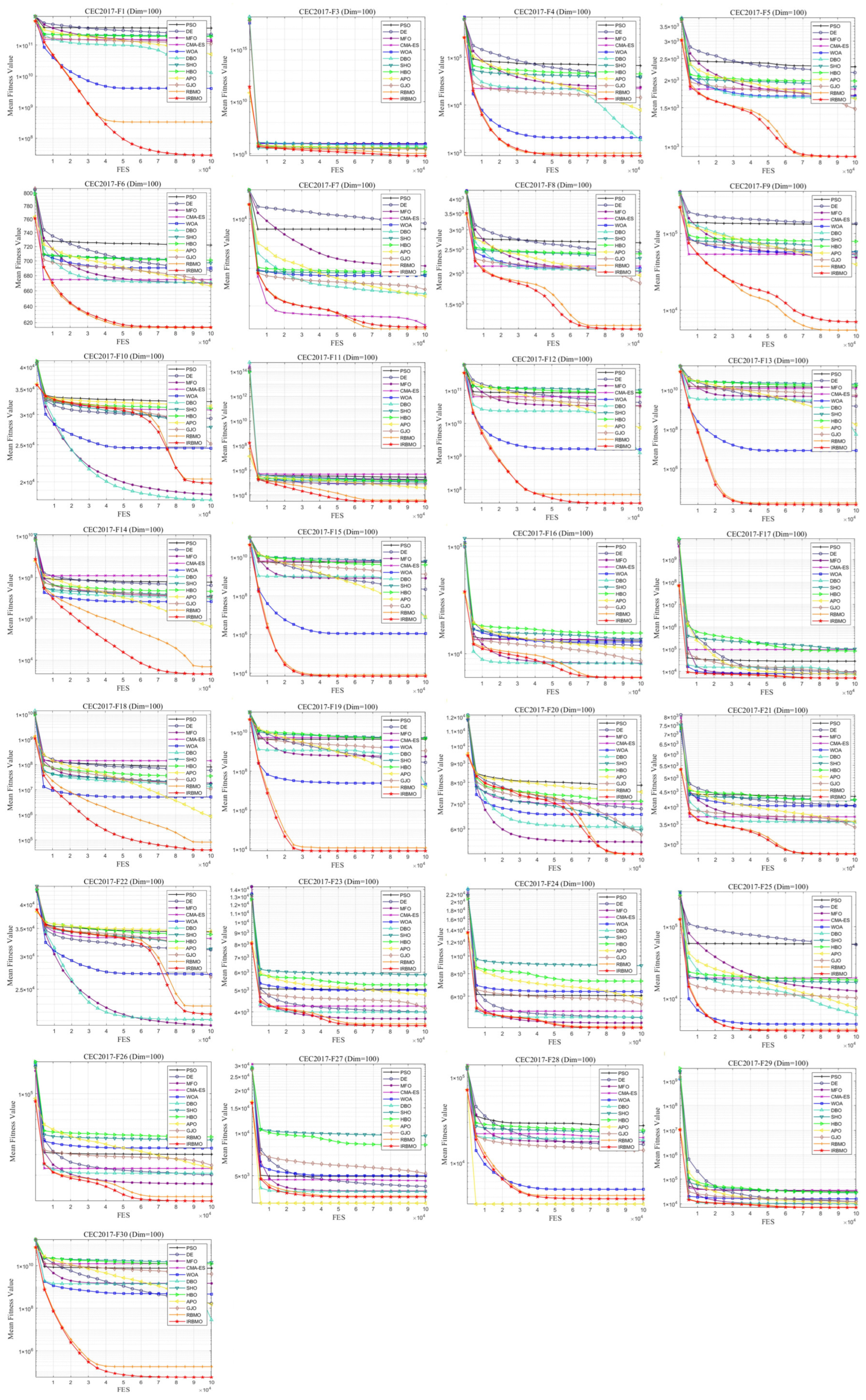
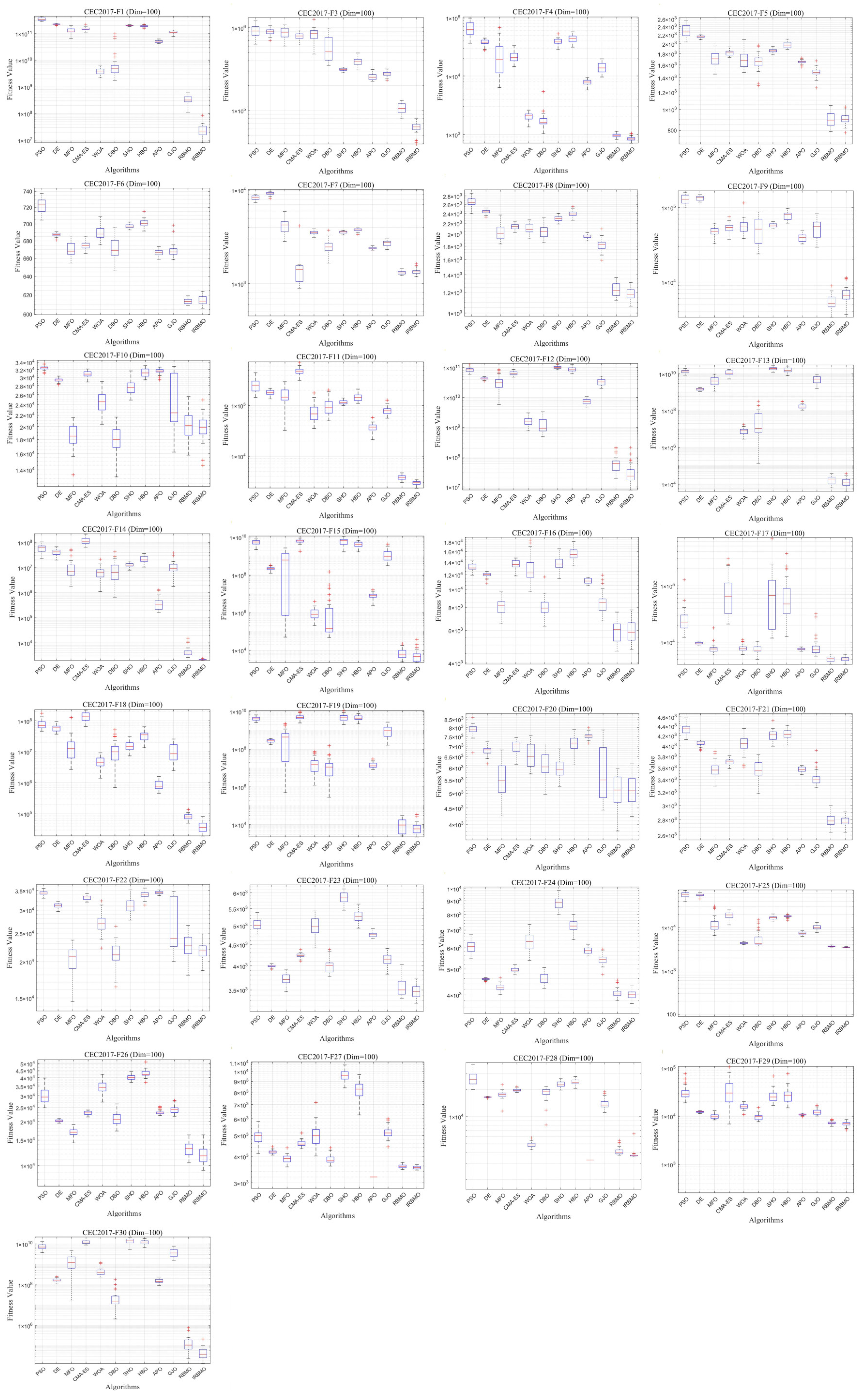
To improve the readability of the results, Figure 5 summarizes the Friedman average ranks of all algorithms under the three dimensions. Detailed experimental data are listed in Table A9, Table A10 and Table A11 in Appendix A.2, where the best values are marked in bold and underlined, and “+/=/−” indicate that IRBMO is better than, equal to, or worse than other algorithms, respectively. Figure 6, Figure 7, Figure 8, Figure 9, Figure 10 and Figure 11 show the average fitness convergence curves and box plots under 30-dimensional, 50-dimensional, and 100-dimensional conditions, respectively.
Figure 5.
Average Friedman ranks of IRBMO and other algorithms on CEC2017: (a) Dim = 30, (b) Dim = 50, (c) Dim = 100.
Figure 6.
Average iteration curves of IRBMO and other algorithms on CEC2017 (Dim = 30).
Figure 7.
Box plots of IRBMO and other algorithms on CEC2017 (Dim = 30).
Figure 8.
Average iteration curves of IRBMO and other algorithms on CEC2017 (Dim = 50).
Figure 9.
Box plots of IRBMO and other algorithms on CEC2017 (Dim = 50).
Figure 10.
Average iteration curves of IRBMO and other algorithms on CEC2017 (Dim = 100).
Figure 11.
Box plots of IRBMO and other algorithms on CEC2017 (Dim = 100).
From Table A9 to Table A11 (The best values in the table are highlighted in bold and underlined), it can be seen that among a total of 87 evaluation metrics across 30, 50, and 100 dimensions, IRBMO achieved 44, 48, and 53 best results, respectively, with Friedman average ranks of 1.4, 1.4, and 1.3, all ranking first among all algorithms. It can also be observed that as the problem dimension increases, the performance advantage of IRBMO becomes more pronounced, demonstrating strong high-dimensional optimization capability.
As shown in Figure 6, Figure 8 and Figure 10, the average convergence curves of IRBMO on the CEC2017 test functions (30D, 50D, and 100D) indicate that its convergence rate is faster than that of the original RBMO and most other algorithms for the majority of functions. IRBMO is able to reach lower fitness values within fewer iterations, demonstrating its strong optimization capability.
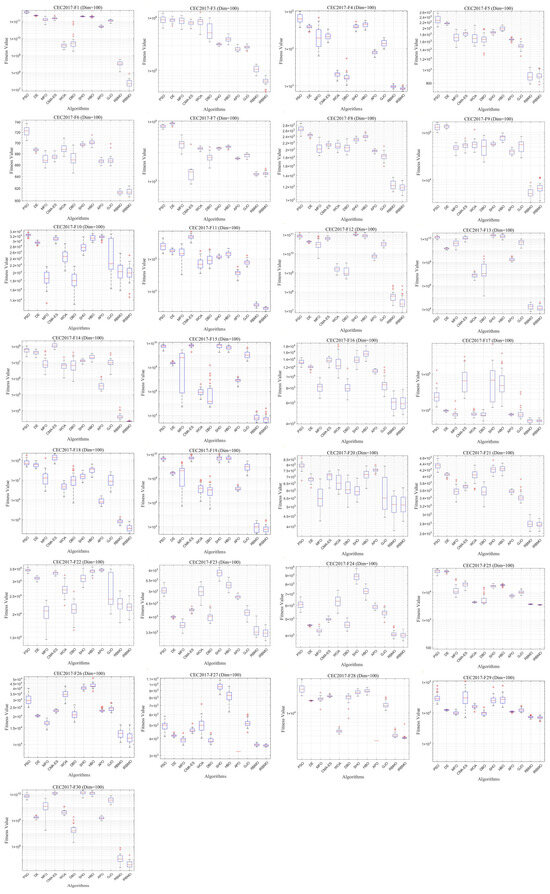
In addition, the box plots presented in Figure 7, Figure 9 and Figure 11 further confirm the robustness of IRBMO. The distribution of results is more concentrated, with smaller interquartile ranges and fewer extreme values, indicating that the algorithm maintains stable performance across multiple runs.
5.5. Testing and Analysis on CEC2022
As mentioned in Section 5.4, this paper also verified IRBMO by testing it on the CEC2022 standard function test set under 10-dimension and 20-dimension conditions to demonstrate its generalization ability and optimization effect at different test sites. Experiments were still carried out using the 12 representative comparison algorithms, and their parameters are set as described in Section 5.4. Each algorithm was run independently 30 times. The best value, mean and standard deviation were taken as evaluation indicators, and a combination of Wilcoxon rank-sum tests and Friedman average rankings were statistically processed.
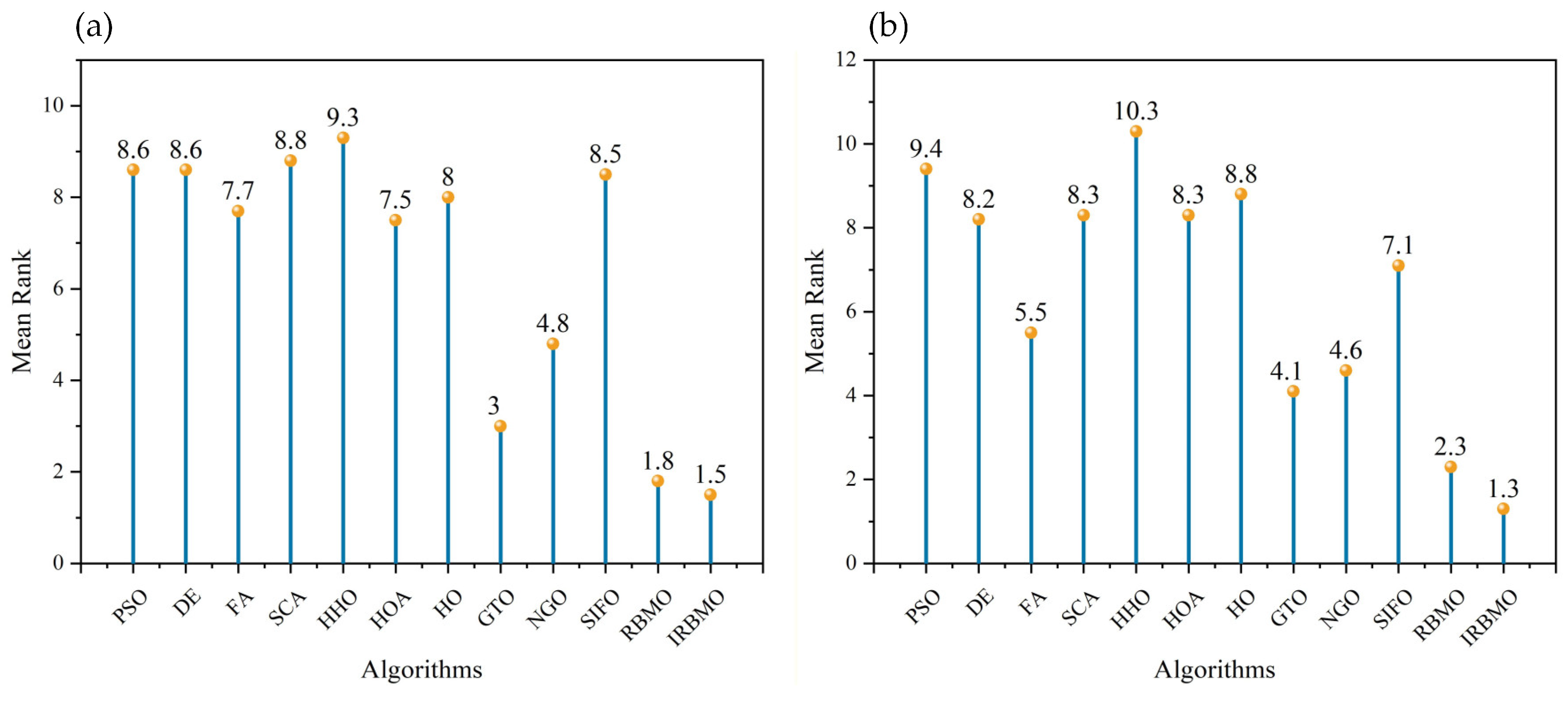
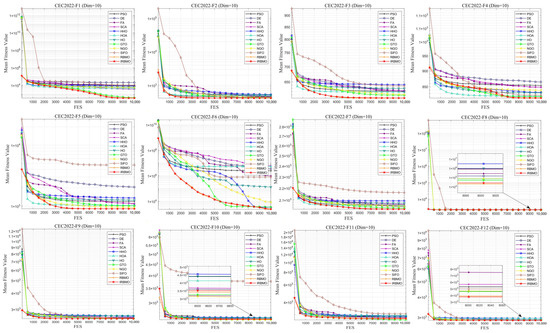
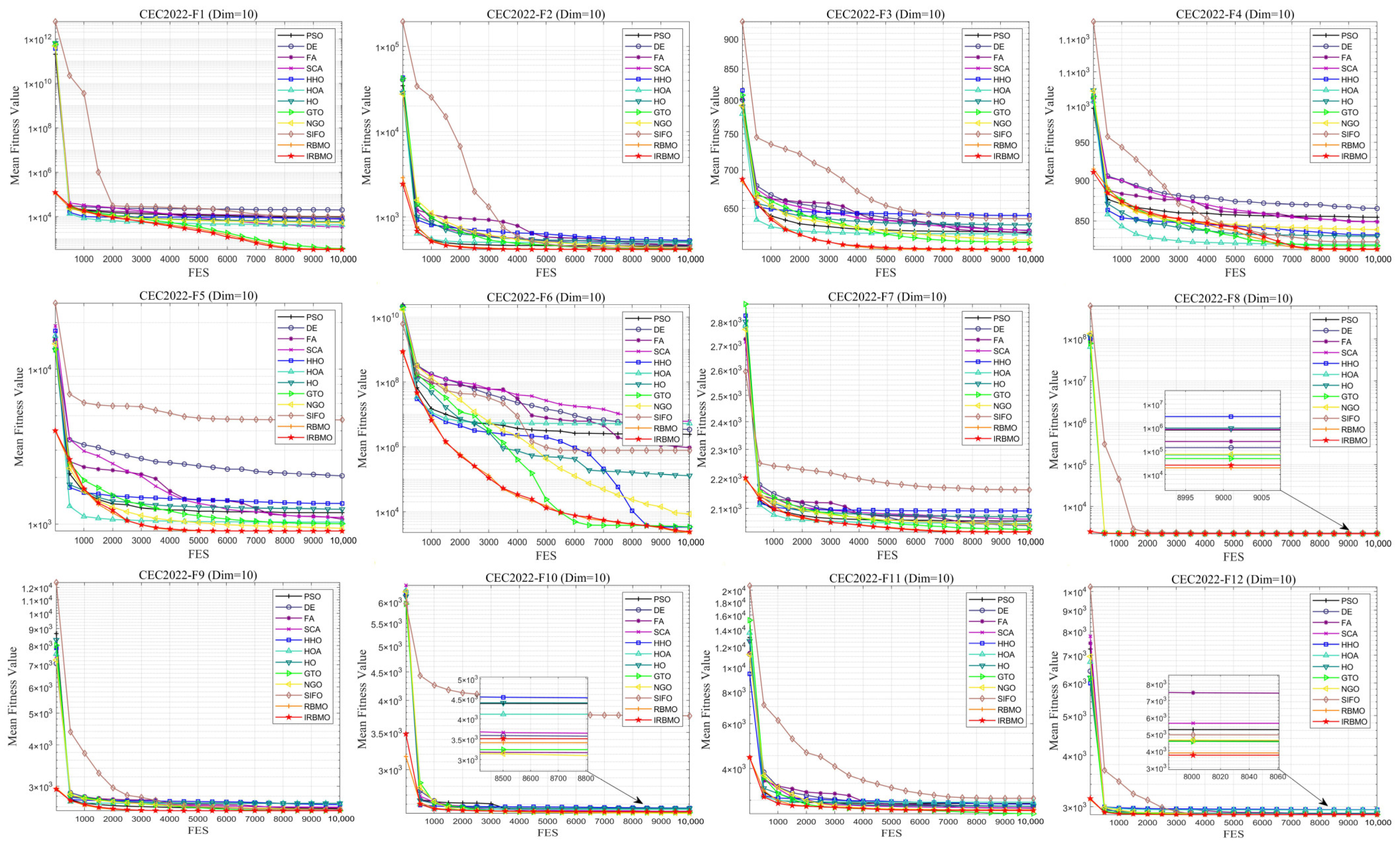
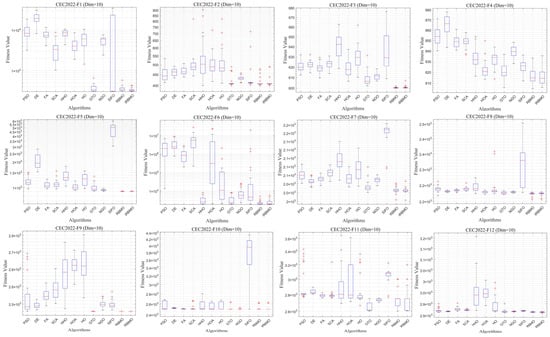
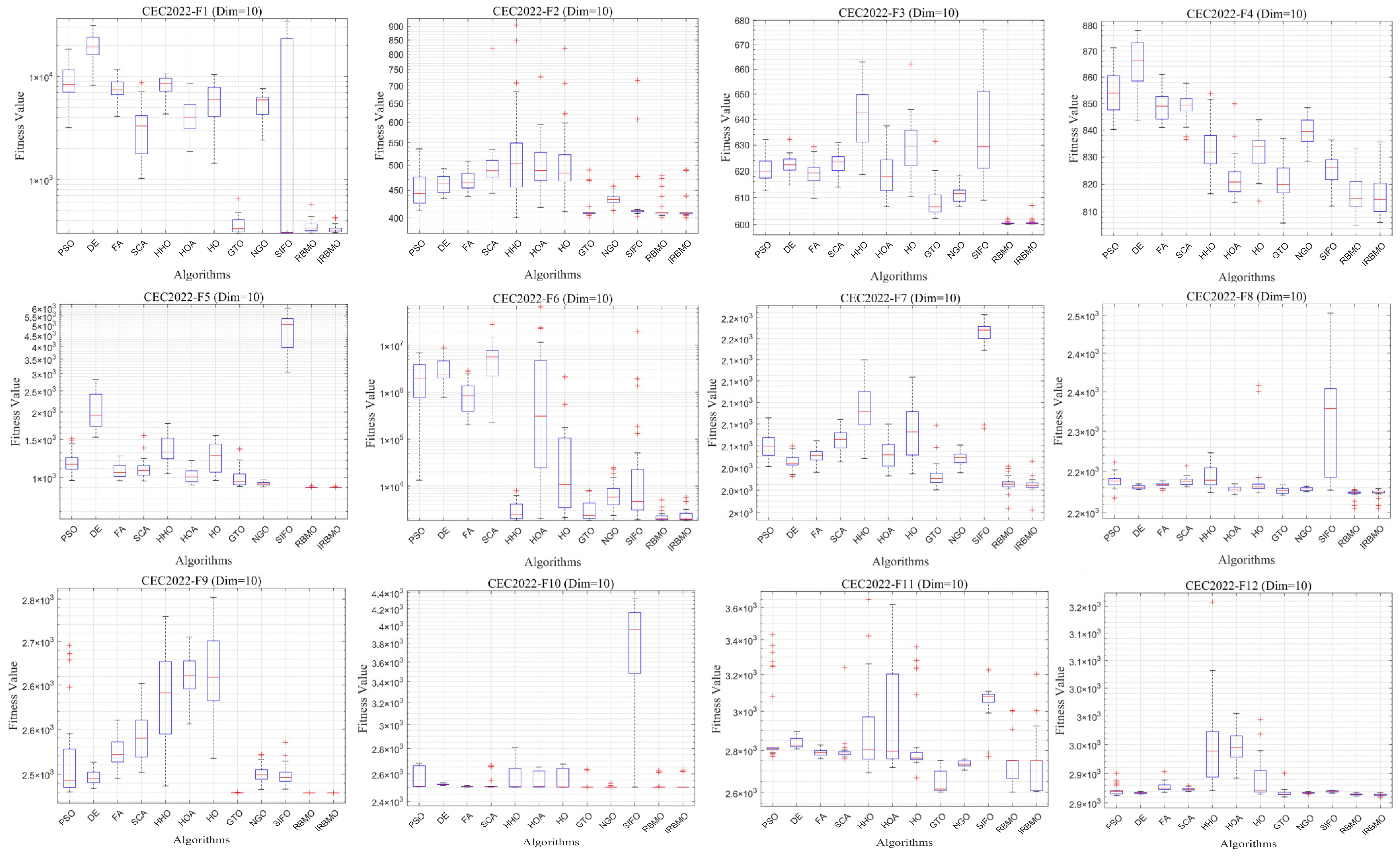
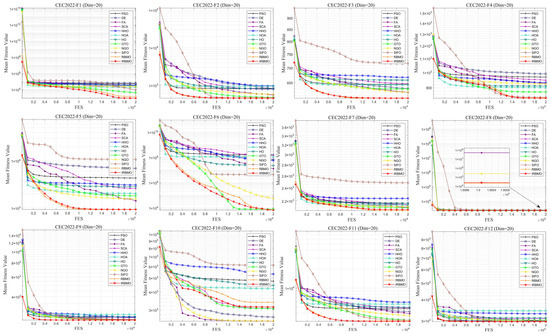
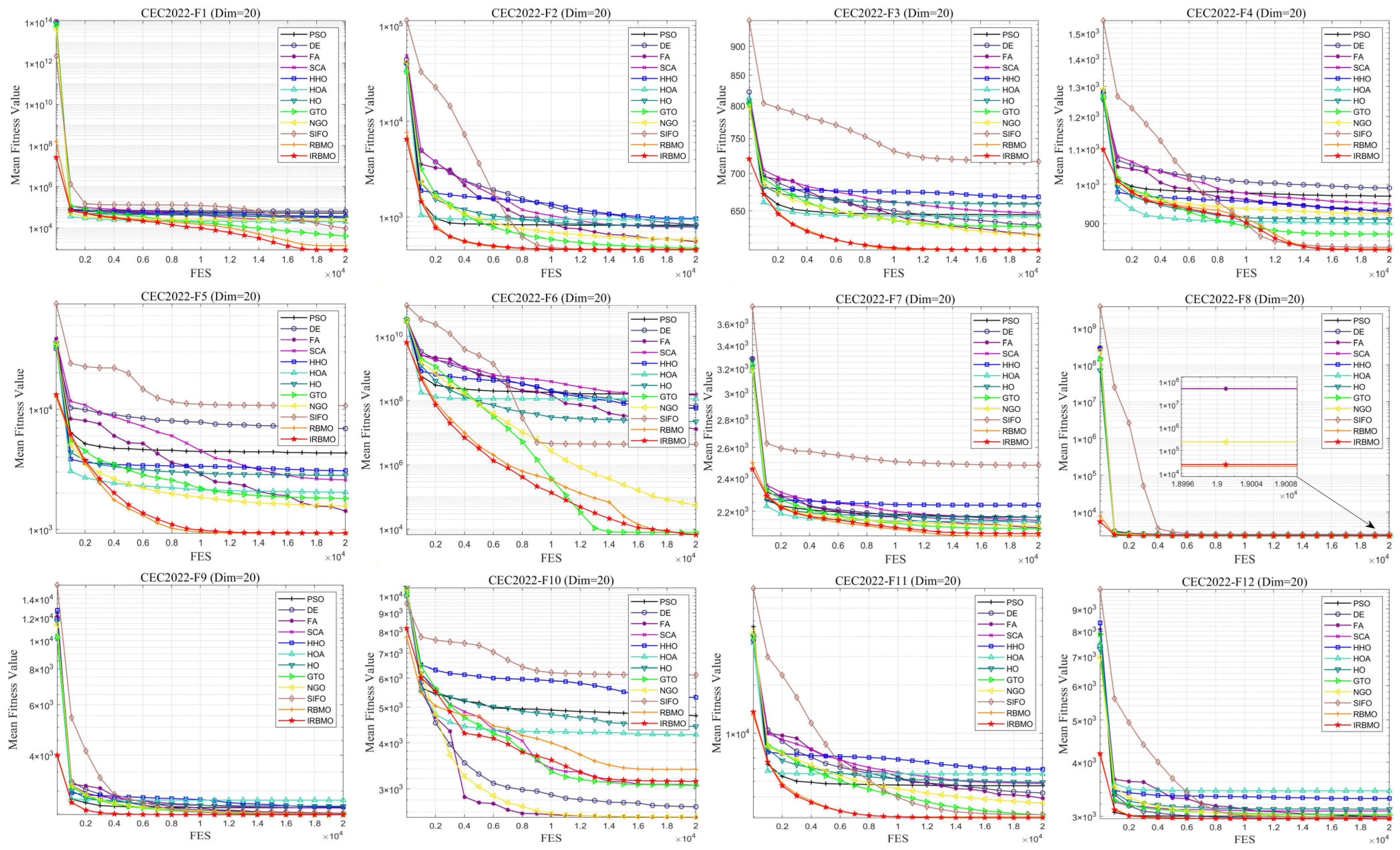
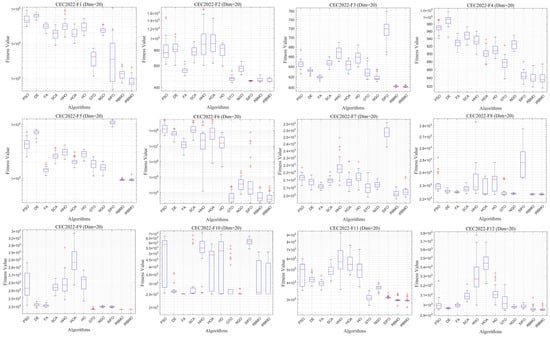
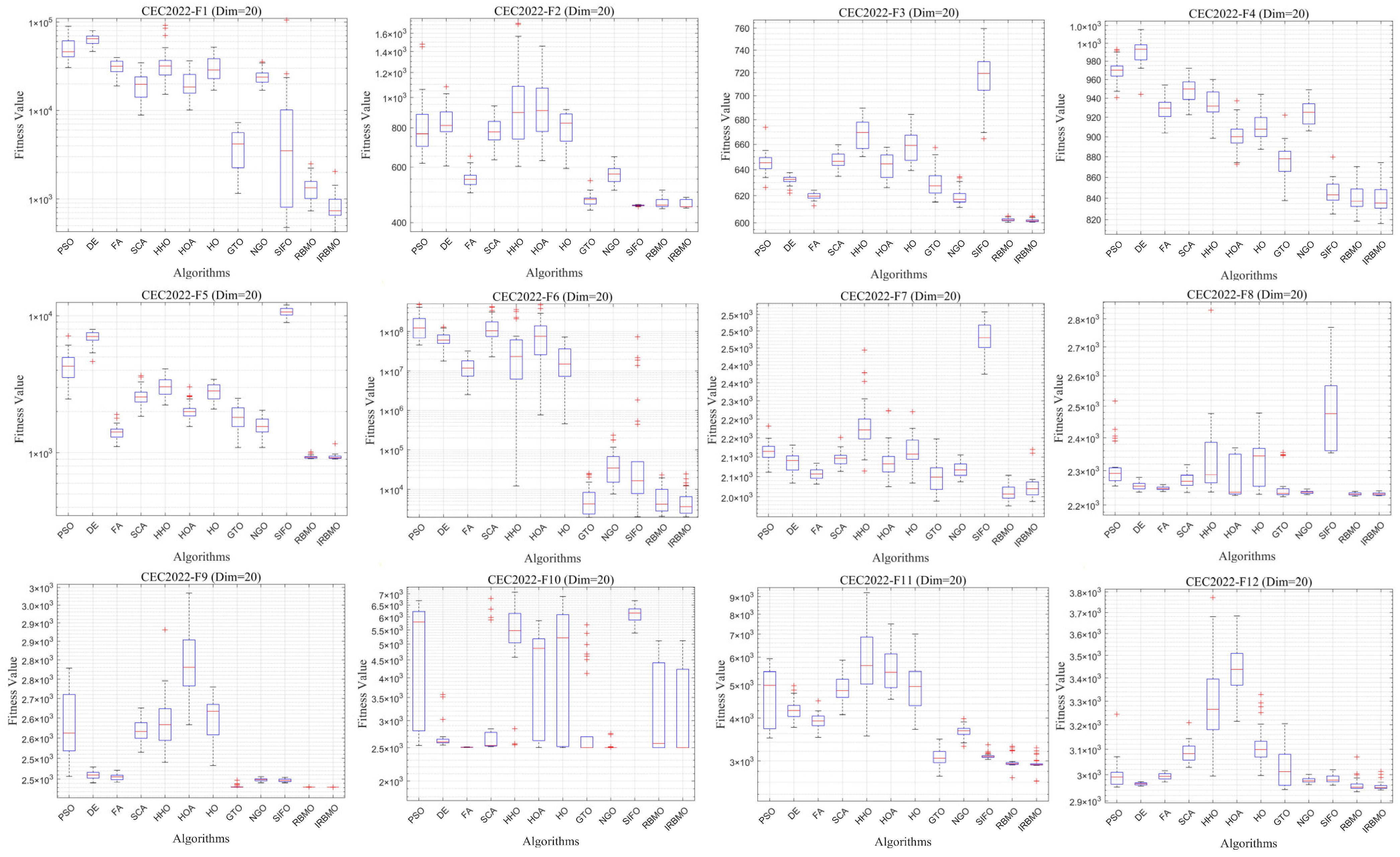
In order to enhance the readability of the results, Figure 12 presents the Friedman average ranks of all algorithms for the two aspects. Detailed experimental results are listed in Table A12 and Table A13 of Appendix A.2, and the best values have been marked in bold and underlined; “+”, “=”, and “−” represent that IRBMO is better than, equivalent to, or worse than other algorithms, respectively. Figure 13, Figure 14, Figure 15 and Figure 16 show the convergence curves and box plots for both the 10D and 20D cases.
Figure 12.
Average Friedman ranks of IRBMO and other algorithms on CEC2022: (a) Dim = 10, (b) Dim = 20.
Figure 13.
Average iteration curves of IRBMO and other algorithms on CEC2022 (Dim = 10).
Figure 14.
Box plots of IRBMO and other algorithms on CEC2022 (Dim = 10).
Figure 15.
Average iteration curves of IRBMO and other algorithms on CEC2022 (Dim = 20).
Figure 16.
Box plots of IRBMO and other algorithms on CEC2022 (Dim = 20).
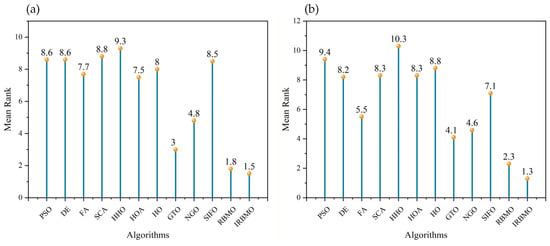
Referring to Table A12 and Table A13 (The best values in the table are highlighted in bold and underlined), among the 36 evaluation indicators of the two-dimensional problems (10D and 20D), IRBMO obtained 17 and 16 optimal results, respectively; its Friedman’s average rank was 1.5 and 1.3 separately, ranking first among various algorithms, thereby further validating its strong optimization ability.
As shown in Figure 13 and Figure 15, the average convergence curves of IRBMO on the CEC2022 benchmark functions (10D and 20D) demonstrate that the proposed algorithm achieves fast and stable convergence in low-dimensional optimization problems. This indicates its strong exploitation capability in fine-grained search.
Furthermore, the box plots presented in Figure 14 and Figure 16 show that IRBMO produces more consistent results across multiple runs. The distributions are more concentrated with fewer outliers, suggesting that the algorithm maintains high stability and robustness in low-dimensional optimization tasks.
6. Robot Path Planning
Compared with the tests of benchmark functions, the path planning problem is closer to actual applications. Therefore, it has higher demands on the global search ability, convergence performance and stability. A series of experiments are conducted on grid maps with various scale sizes and obstacle density distribution patterns to examine the general adaptability of the IRBMO path planning algorithm in complex environments.
6.1. Experimental Configuration for Path Planning
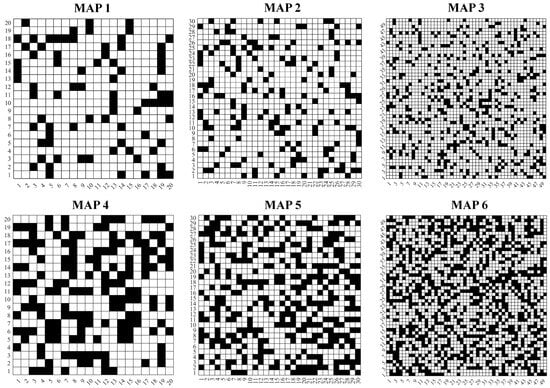
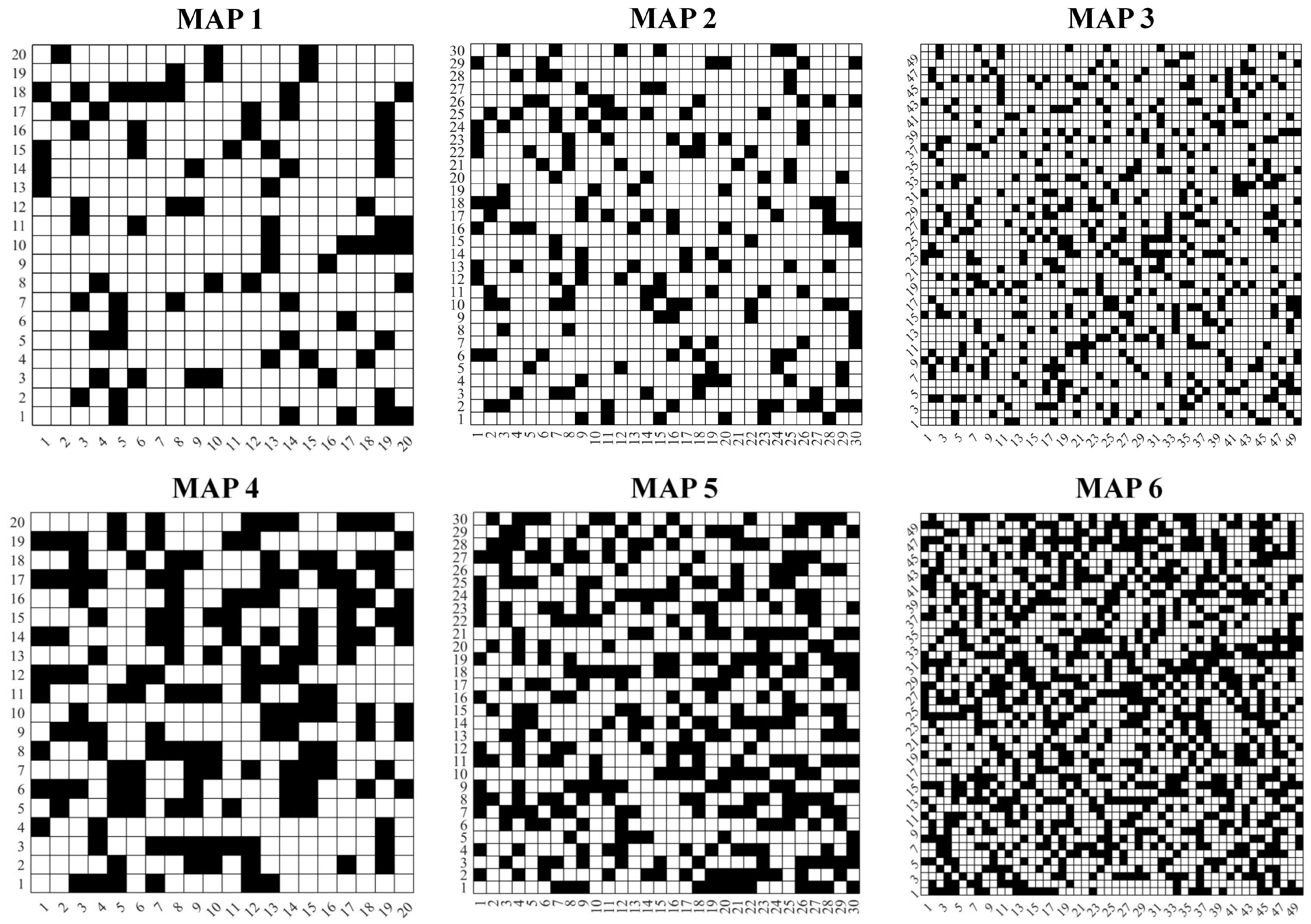
In this study, six grid-based maps with different configurations are constructed, consisting of three map sizes (20 × 20, 30 × 30, and 50 × 50) and two obstacle densities (20% and 40%). For each map size, obstacles are randomly distributed to generate environments with different complexity levels, resulting in six test scenarios in total. Among them, Maps 1–3 represent relatively simple environments, while Maps 4–6 correspond to more complex environments with higher obstacle density. The specific map layouts are illustrated in Figure 17.
Figure 17.
Map environments for the path planning experiments.
To verify the performance of IRBMO, six representative algorithms are selected for comparison. These include the classical algorithms PSO and WOA, as well as DBO, HBO, and APO, which performed well in Section 5. The original RBMO is also included as a baseline method. All parameter settings of the comparison algorithms are the same as those in Section 5 to ensure fairness.
During the experiments, each algorithm is independently run 30 times on each map. The performance is evaluated using the following metrics:
- Path length (corresponding to fitness value);
- Convergence performance (average best fitness curve);
- Path feasibility (collision-free constraint satisfaction);
- Stability (mean and variance over multiple runs);
- Friedman test (statistical ranking of overall performance).
6.2. Results and Analysis
6.2.1. Path Planning in Simple Environments
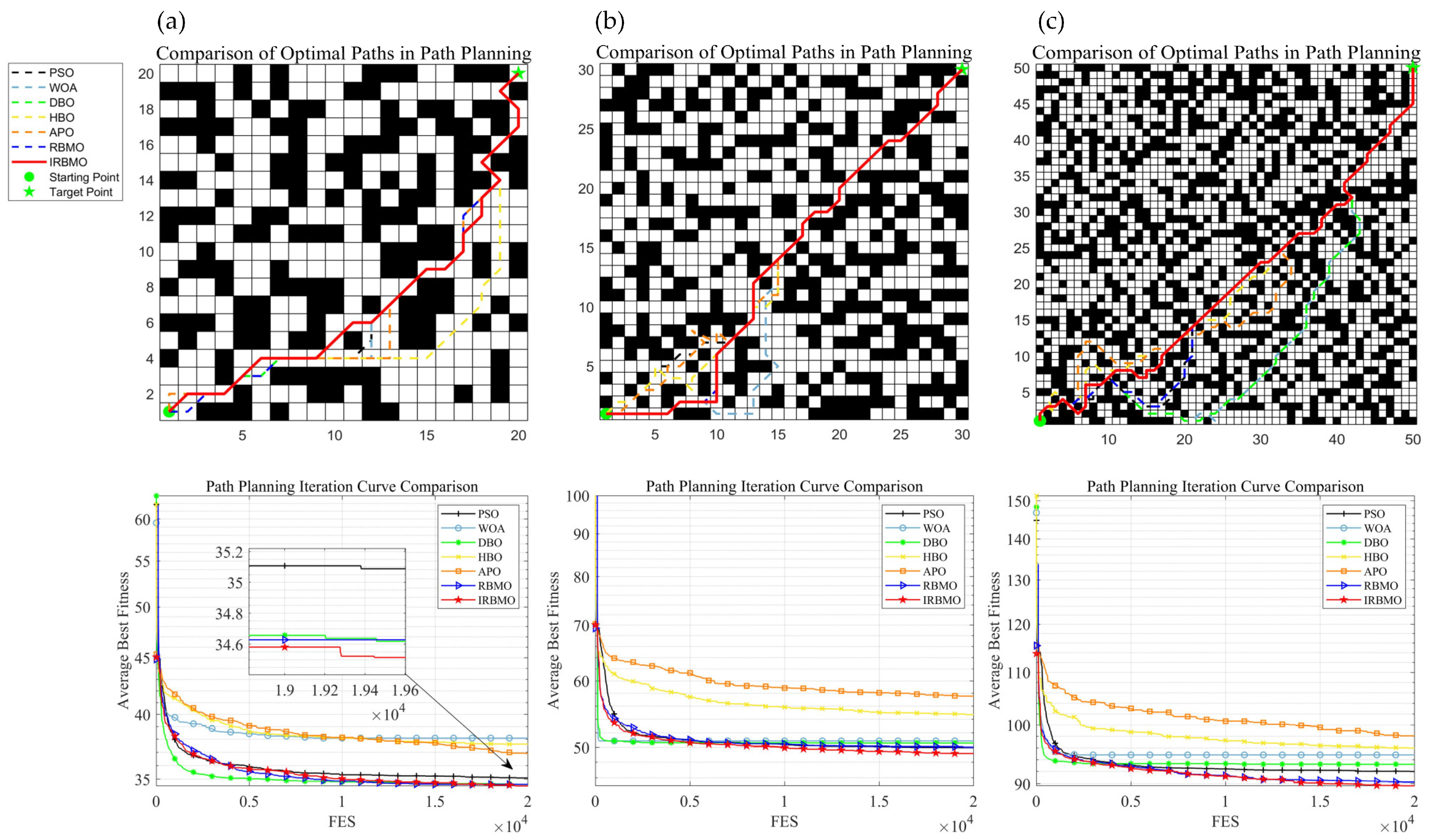
The experimental results are shown in Table 4, where the best values are highlighted in bold and underlined. Since the fitness value directly represents the path length, lower values indicate shorter paths. In the three simple map environments with different sizes, IRBMO achieves the best results in terms of both the best and mean path length values. Among all compared algorithms, it demonstrates the best overall performance and exhibits strong path search capability in low-obstacle-density environments.
Table 4.
Path planning results in simple environments.
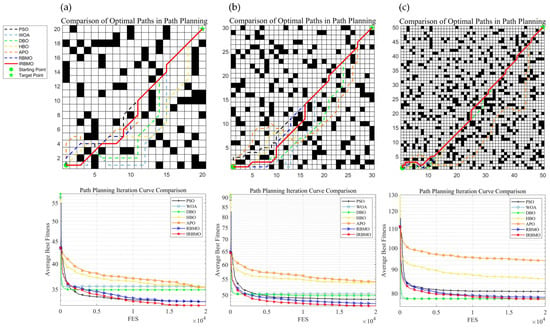
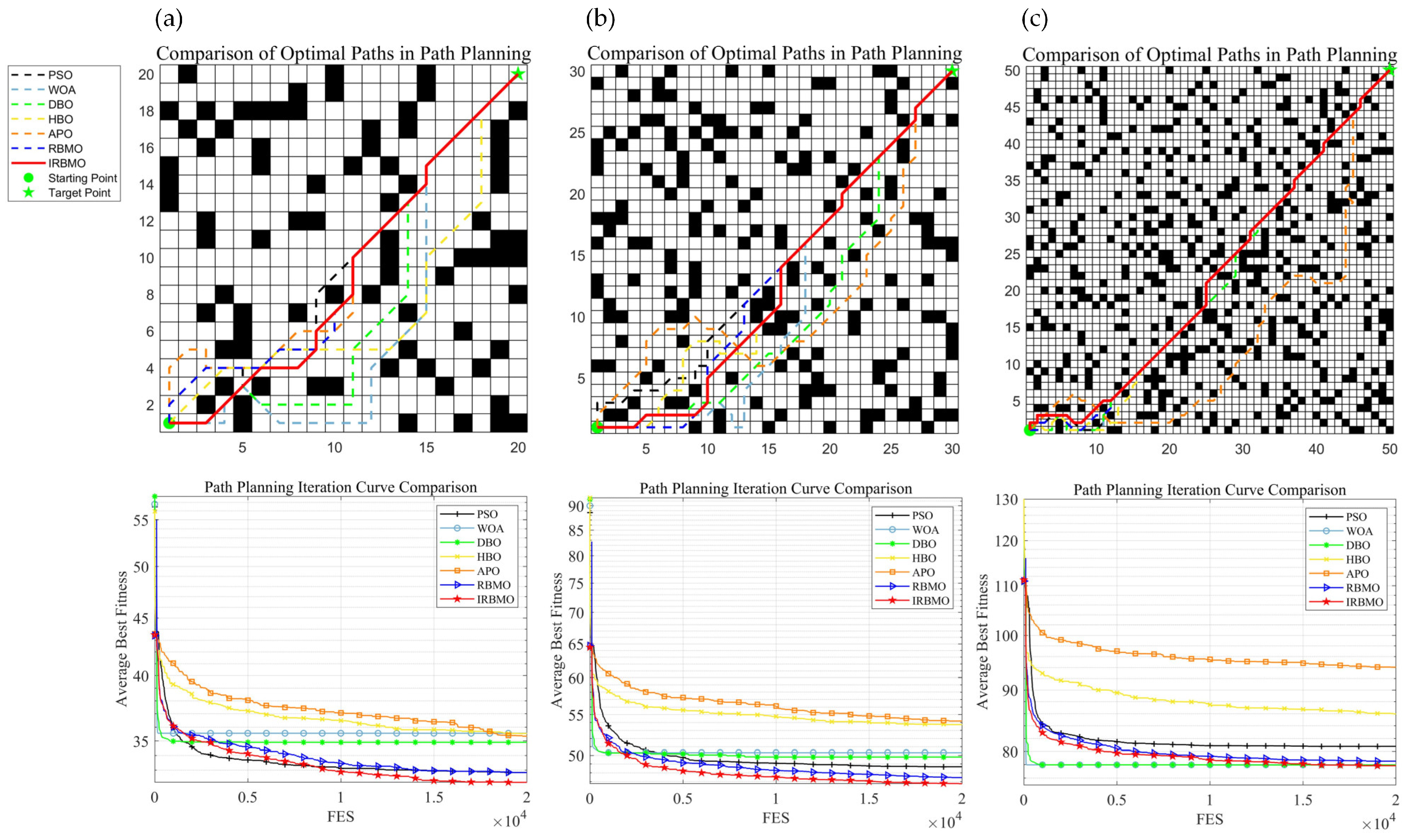
The optimal paths and average best convergence curves of all algorithms are shown in Figure 18. From the obtained paths, IRBMO can generate a relatively smooth optimal path and successfully avoids obstacles, thereby reducing the total travel distance. In terms of convergence behavior, IRBMO achieves rapid convergence in the early stage while maintaining high solution accuracy in later iterations. Compared with the original RBMO, it demonstrates significantly improved optimization performance.
Figure 18.
Optimal paths and average iteration curves for IRBMO and other algorithms in simple environments: (a) MAP 1, (b) MAP 2, (c) MAP 3.
6.2.2. Path Planning in Complex Environments
The experimental results are shown in Table 5, where the best values are highlighted in bold and underlined. It can be observed from the three complex map environment instances with different scales that IRBMO has achieved a relatively shorter average path length. Its overall performance is still ranked first among all the compared algorithms. Therefore, it has strong robustness and stability under high obstacle density and complex constraints.
Table 5.
Path planning results in complex environments.
The optimal paths and average best convergence curves for all algorithms are shown in Figure 19. Based on the obtained paths results, even if the obstacles are denser, IRBMO can still produce smooth paths and avoid them properly. It can avoid redundant detour paths and local-oscillation phenomena, with good global search ability.
Figure 19.
Optimal paths and average iteration curves for IRBMO and other algorithms in complex environments: (a) MAP 4, (b) MAP 5, (c) MAP 6.
Based on the convergence curve, IRBMO is both quickly convergent and has high precision under complicated circumstances. Compared to the original RBMO, it has shown better optimization performance.
6.2.3. Discussion on Path Characteristics
It should be noted that the current study focuses on minimizing path length as the primary objective. As a result, the generated paths may contain more turning points and are not always the smoothest. This is because path smoothness is not explicitly included in the objective function. Nevertheless, the proposed IRBMO demonstrates strong capability in finding shorter feasible paths, which is the primary goal of this study.
In future work, incorporating path smoothness as an additional objective will be considered to achieve a better balance between path optimality and path quality.
7. Conclusions
A multi-strategy improved Red-Billed Blue Magpie Optimizer (IRBMO) is presented in this paper to enhance the performance of the original RBMO algorithm. Through the introduction of a territorial awareness mechanism, the representative individual learning strategy, and the random subpopulation diffusion strategy, this method can achieve a better balance of exploration–exploitation, faster convergence speed, and stronger escape ability from the local optimum.
Extensive benchmark experiments on CEC2017 and CEC2022 test suites demonstrate that IRBMO exhibits superior optimization performance compared with 19 state-of-the-art algorithms in terms of convergence accuracy, convergence speed, and robustness. The ablation study further verifies the effectiveness of each proposed strategy, while the convergence analysis shows that IRBMO can maintain population diversity in the early stage and perform efficient exploitation in the later stage.
More importantly, the proposed IRBMO is successfully applied to robot path planning problems. Experimental results in grid-based environments with different map sizes and obstacle densities demonstrate that IRBMO can effectively generate collision-free paths with shorter lengths and faster convergence. The results indicate that the proposed method is capable of addressing key challenges in robot path planning, such as avoiding local optima in complex environments and improving path quality.
Despite its effectiveness, the proposed IRBMO still has some limitations. For example, the introduction of multiple control parameters increases the difficulty of parameter tuning. In addition, the current study focuses on single-objective path planning, where only path length is considered, without explicitly optimizing path smoothness or other practical factors.
In future work, adaptive parameter adjustment mechanisms will be investigated to improve usability. Furthermore, the proposed method can be extended to more complex scenarios, such as multi-objective path planning (e.g., considering both path length and smoothness), dynamic environments, and multi-robot cooperative path planning.
Author Contributions
Conceptualization, X.T.; methodology, X.T. and Z.H.; software, X.T.; validation, C.J. and P.Q.; data curation, C.J. and Z.H.; writing—original draft preparation, X.T.; writing—review and editing, X.T. and Z.H.; visualization, Y.G.; funding acquisition, X.T. and P.Q. All authors have read and agreed to the published version of the manuscript.
Funding
This research was funded by the National Natural Science Foundation of China (No. 52565031), the Science and Technology Program Projects of Meishan Municipal Science and Technology Bureau (No. 2024KJZD162), and Guizhou Provincial Department of Science and Technology Projects (No. [2023] G094, No. [2023] G125 and No. [2024] K154).
Data Availability Statement
The data used to support the findings of this study are included in the article.
Conflicts of Interest
The authors declare no conflicts of interest.
Appendix A
Appendix A.1
Time Complexity of IRBMO:
The time complexity of the base RBMO algorithm is ), where is the maximum iteration count, is the population size, is the problem dimensionality, and denotes the cost of a single fitness evaluation.
The extra overhead added by IRBMO is
- Population initialization: O(Ndim), occurs only once prior to the main loop and is therefore negligible.
- Territorial awareness mechanism: Applied twice per iteration (after the exploration phase and after the exploitation phase). Each application requires updating territorial memory centers at and performing pairwise repulsion checks at . Thus the per-iteration overhead of this mechanism is . In practice, the repulsion condition is satisfied only for nearby pairs, so the effective constant is considerably smaller than the worst case.
- Representative individuals learning mechanism: Executed once per iteration. It requires sorting fitness values to identify the worst individual and elite pool at , one position update at O(dim), and one additional fitness evaluation at . Overall, , which is negligible relative to the main loop.
- Random subpopulation diffusion strategy: Conditionally triggered when global stagnation is detected and . Stagnation detection requires per iteration. When triggered, individuals are dispersed (), each incurring cost, giving . Since this strategy fires only intermittently, its amortized cost is negligible.
- Food_storage archiving: per call, invoked twice per iteration. This is and is absorbed into the main-loop term.
Therefore, the overall time complexity of IRBMO is
Compared with RBMO, whose complexity is O(TN(dim+f())), IRBMO introduces an additional term of arising from the pairwise territorial repulsion checks in the territorial awareness mechanism. When the population size is moderate (e.g., ) and is set to exclude most distant pairs, this overhead remains manageable, and the improvements in solution quality and diversity brought by the three strategies justify the marginal increase in computational cost.
Appendix A.2
Table A1.
CEC2017 benchmark functions.
Table A2.
CEC2022 benchmark functions.
Table A3.
Sensitivity analysis results for parameter on selected CEC2017 benchmark functions.
Table A4.
Sensitivity analysis results for parameter on selected CEC2017 benchmark functions.
Table A5.
Sensitivity analysis results for parameter on selected CEC2017 benchmark functions.
Table A6.
Sensitivity analysis results for parameter on selected CEC2017 benchmark functions.
Table A7.
Sensitivity analysis results for parameter on selected CEC2017 benchmark functions.
Table A8.
Sensitivity analysis results for parameter on selected CEC2017 benchmark functions.
Table A9.
Comparison results of IRMBO with other algorithms on CEC2017 (Dim = 30).
Table A10.
Comparison results of IRMBO with other algorithms on CEC2017 (Dim = 50).
Table A11.
Comparison results of IRMBO with other algorithms on CEC2017 (Dim = 100).
Table A12.
Comparison results of IRMBO with other algorithms on CEC2022 (Dim = 10).
Table A13.
Comparison results of IRMBO with other algorithms on CEC2022 (Dim = 20).
References
- Liu, L.; Wang, X.; Yang, X.; Liu, H.; Li, J.; Wang, P. Path planning techniques for mobile robots: Review and prospect. Expert Syst. Appl. 2023, 227, 120254. [Google Scholar] [CrossRef] [Scilit]
- Sánchez-Ibáñez, J.R.; Pérez-del-Pulgar, C.J.; García-Cerezo, A. Path planning for autonomous mobile robots: A review. Sensors 2021, 21, 7898. [Google Scholar] [CrossRef] [Scilit] [PubMed]
- Abdulsaheb, J.A.; Kadhim, D.J. Classical and heuristic approaches for mobile robot path planning: A survey. Robotics 2023, 12, 93. [Google Scholar] [CrossRef] [Scilit]
- Wu, L.; Huang, X.; Cui, J.; Liu, C.; Xiao, W. Modified adaptive ant colony optimization algorithm and its application for solving path planning of mobile robot. Expert Syst. Appl. 2023, 215, 119410. [Google Scholar] [CrossRef] [Scilit]
- Wayahdi, M.R.; Ginting, S.H.N.; Syahputra, D. Greedy, A-Star, and Dijkstra’s algorithms in finding shortest path. Int. J. Adv. Data Inf. Syst. 2021, 2, 45–52. [Google Scholar] [CrossRef] [Scilit]
- Miyombo, M.E.; Liu, Y.-K.; Mulenga, C.M.; Siamulonga, A.; Kabanda, M.C.; Shaba, P.; Xi, C.; Ayodeji, A. Optimal path planning in a real-world radioactive environment: A comparative study of A-star and Dijkstra algorithms. Nucl. Eng. Des. 2024, 420, 113039. [Google Scholar] [CrossRef] [Scilit]
- Hart, P.E.; Nilsson, N.J.; Raphael, B. A formal basis for the heuristic determination of minimum cost paths. IEEE Trans. Syst. Sci. Cybern. 1968, 4, 100–107. [Google Scholar] [CrossRef] [Scilit]
- Yang, T.Y.; Zou, L.; Wu, Z.X.; Chen, W.M. An improved A-star algorithm coupled with graph division and AIS data for ship path planning. Ocean Eng. 2025, 330, 121234. [Google Scholar] [CrossRef] [Scilit]
- Warren, C.W. Global path planning using artificial potential fields. In Proceedings, 1989 International Conference on Robotics and Automation; IEEE: New York, NY, USA, 1989; pp. 316–321. [Google Scholar] [CrossRef] [Scilit]
- Lin, H.I.; Shodiq, M.A.F.; Hsieh, M.F. Robot path planning based on three-dimensional artificial potential field. Eng. Appl. Artif. Intell. 2025, 144, 110127. [Google Scholar] [CrossRef] [Scilit]
- Kennedy, J.; Eberhart, R. Particle swarm optimization. In Proceedings of ICNN’95-International Conference on Neural Networks; IEEE: New York, NY, USA, 1995; Volume 4, pp. 1942–1948. [Google Scholar] [CrossRef] [Scilit]
- Holland, J.H. Genetic algorithms. Sci. Am. 1992, 267, 66–73. [Google Scholar] [CrossRef] [Scilit]
- Mirjalili, S.; Mirjalili, S.M.; Lewis, A. Grey wolf optimizer. Adv. Eng. Softw. 2014, 69, 46–61. [Google Scholar] [CrossRef] [Scilit]
- Mirjalili, S.; Lewis, A. The whale optimization algorithm. Adv. Eng. Softw. 2016, 95, 51–67. [Google Scholar] [CrossRef] [Scilit]
- Li, J.; Hu, Y.; Yang, S.X. A novel knowledge-based genetic algorithm for robot path planning in complex environments. IEEE Trans. Evol. Comput. 2025, 29, 375–389. [Google Scholar] [CrossRef] [Scilit]
- Amr, M.; Bahgat, A.; Rashad, H.; Ibrahim, A.; Youssef, A. Optimizing Navigation in Mobile Robots: Modified Particle Swarm Optimization and Genetic Algorithms for Effective Path Planning. Algorithms 2025, 18, 719. [Google Scholar] [CrossRef] [Scilit]
- Nayeem, G.M.; Fan, M.; Daiyan, G.M. Adaptive Q-learning grey wolf optimizer for UAV path planning. Drones 2025, 9, 246. [Google Scholar] [CrossRef] [Scilit]
- Shao, Y.; Zhu, L.; Su, C.; Wang, J. An improved whale optimization algorithm for multi-robot path planning. Eng. Optim. 2025, 57, 1615–1641. [Google Scholar] [CrossRef] [Scilit]
- Xu, H.; Xiang, X.; Yan, C.; Li, Z.; Zhou, H.; Wang, N. Grey wolf optimization enhanced collaborative path planning for UUV swarms. Ocean Eng. 2025, 329, 121082. [Google Scholar] [CrossRef] [Scilit]
- Wu, J.; Sun, Y.; Bi, J.; Chen, C. A novel hybrid enhanced particle swarm optimization for UAV path planning. IEEE Trans. Veh. Technol. 2025, 74, 11806–11819. [Google Scholar] [CrossRef] [Scilit]
- Fu, S.; Li, K.; Huang, H.; Ma, C.; Fan, Q.; Zhu, Y. Red-billed blue magpie optimizer: A novel metaheuristic algorithm for 2D/3D UAV path planning and engineering design problems. Artif. Intell. Rev. 2024, 57, 134. [Google Scholar] [CrossRef] [Scilit]
- Zhu, C.; Wang, Z.; Peng, Y.; Xiao, W. An improved red-billed blue magpie feature selection algorithm for medical data processing. PLoS ONE 2025, 20, e0324866. [Google Scholar] [CrossRef] [Scilit]
- Wang, Q.; Zhang, M.; Li, L.; Yan, W.; Liu, B.; Xia, Z.; Tseng, M.L. Optimal capacity configuration of coupled photovoltaic and energy storage system: Multi-objective red-billed blue-magpie optimizer. J. Ind. Prod. Eng. 2025, 42, 495–515. [Google Scholar] [CrossRef] [Scilit]
- Lu, B.; Xie, Z.; Wei, J.; Gu, Y.; Yan, Y.; Li, Z.; Pan, S.; Cheong, N.; Chen, Y.; Zhou, R. MRBMO: An enhanced red-billed blue magpie optimization algorithm for solving numerical optimization challenges. Symmetry 2025, 17, 1295. [Google Scholar] [CrossRef] [Scilit]
- Ouyang, K.; Wei, D.; Fu, S.; Gu, S.; Sha, X.; Yu, J.; Yu, J.; Heidar, A.A.; Cai, Z.; Chen, H. Multi-objective red-billed blue magpie optimizer: A novel algorithm for multi-objective UAV path planning. Results Eng. 2025, 27, 106785. [Google Scholar] [CrossRef] [Scilit]
- Li, Z.; Du, M.; Qin, J.; Chen, X. Research on robot path planning based on multi-strategy genetic ant colony optimization algorithm. Inf. Sci. 2025, 718, 122407. [Google Scholar] [CrossRef] [Scilit]
- Zhang, C.; Yang, Y.; Chen, W. Multi-strategy ensemble wind driven optimization algorithm for robot path planning. Math. Comput. Simul. 2025, 231, 144–159. [Google Scholar] [CrossRef] [Scilit]
- Tang, X.; Qu, P.; He, Z.; Jia, C.; Zhang, Q. A Dynamic Multi-Niche Biogeography-Based Optimization Algorithm and Its Application to Robot Path Planning. Biomimetics 2026, 11, 221. [Google Scholar] [CrossRef] [Scilit]
- Liu, S.; Wang, Z.J.; Kou, Z.; Zhan, Z.H.; Kwong, S.; Zhang, J. Less is more: A small-scale learning particle swarm optimization for large-scale optimization. IEEE Trans. Cybern. 2025, 56, 523–536. [Google Scholar] [CrossRef] [Scilit]
- Storn, R.; Price, K. Differential evolution–a simple and efficient heuristic for global optimization over continuous spaces. J. Glob. Optim. 1997, 11, 341–359. [Google Scholar] [CrossRef] [Scilit]
- Yang, X.S. Firefly algorithms for multimodal optimization. In International Symposium on Stochastic Algorithms; Springer: Berlin/Heidelberg, Germany, 2009; pp. 169–178. [Google Scholar] [CrossRef] [Scilit]
- Mirjalili, S. Moth-flame optimization algorithm: A novel nature-inspired heuristic paradigm. Knowl. Based Syst. 2015, 89, 228–249. [Google Scholar] [CrossRef] [Scilit]
- Hansen, N.; Müller, S.D.; Koumoutsakos, P. Reducing the time complexity of the derandomized evolution strategy with covariance matrix adaptation (CMA-ES). Evol. Comput. 2003, 11, 1–18. [Google Scholar] [CrossRef] [Scilit]
- Mirjalili, S. SCA: A sine cosine algorithm for solving optimization problems. Knowl.-Based Syst. 2016, 96, 120–133. [Google Scholar] [CrossRef] [Scilit]
- Heidari, A.A.; Mirjalili, S.; Faris, H.; Aljarah, I.; Mafarja, M.; Chen, H. Harris hawks optimization: Algorithm and applications. Future Gener. Comput. Syst. 2019, 97, 849–872. [Google Scholar] [CrossRef] [Scilit]
- Abdollahzadeh, B.; Soleimanian Gharehchopogh, F.; Mirjalili, S. Artificial gorilla troops optimizer: A new nature-inspired metaheuristic algorithm for global optimization problems. Int. J. Intell. Syst. 2021, 36, 5887–5958. [Google Scholar] [CrossRef] [Scilit]
- Xue, J.; Shen, B. Dung beetle optimizer: A new meta-heuristic algorithm for global optimization. J. Supercomput. 2023, 79, 7305–7336. [Google Scholar] [CrossRef] [Scilit]
- Zhao, S.; Zhang, T.; Ma, S.; Wang, M. Sea-horse optimizer: A novel nature-inspired meta-heuristic for global optimization problems. Appl. Intell. 2023, 53, 11833–11860. [Google Scholar] [CrossRef] [Scilit]
- Dehghani, M.; Hubálovský, Š.; Trojovský, P. Northern goshawk optimization: A new swarm-based algorithm for solving optimization problems. IEEE Access 2021, 9, 162059–162080. [Google Scholar] [CrossRef] [Scilit]
- Chopra, N.; Ansari, M.M. Golden jackal optimization: A novel nature-inspired optimizer for engineering applications. Expert Syst. Appl. 2022, 198, 116924. [Google Scholar] [CrossRef] [Scilit]
- Amiri, M.H.; Mehrabi Hashjin, N.; Montazeri, M.; Mirjalili, S.; Khodadadi, N. Hippopotamus optimization algorithm: A novel nature-inspired optimization algorithm. Sci. Rep. 2024, 14, 5032. [Google Scholar] [CrossRef] [Scilit]
- Wang, W.C.; Tian, W.C.; Xu, D.M.; Zang, H.F. Arctic puffin optimization: A bio-inspired metaheuristic algorithm for solving engineering design optimization. Adv. Eng. Softw. 2024, 195, 103694. [Google Scholar] [CrossRef] [Scilit]
- Oladejo, S.O.; Ekwe, S.O.; Mirjalili, S. The Hiking Optimization Algorithm: A novel human-based metaheuristic approach. Knowl.-Based Syst. 2024, 296, 111880. [Google Scholar] [CrossRef] [Scilit]
- Yu, Z.; Du, J.; Li, G. A memory-saving metaheuristic algorithm for real-world onboard optimization problems: Solitary Inchworm Foraging Optimizer. Appl. Math. Model. 2025, 151, 116423. [Google Scholar] [CrossRef] [Scilit]
- Ouertani, M.W.; Manita, G.; Korbaa, O. Hannibal Barca optimizer: The power of the pincer movement for global optimization and multilevel image thresholding. Clust. Comput. 2025, 28, 482. [Google Scholar] [CrossRef] [Scilit]
- Zhu, F.; Li, G.; Tang, H.; Li, Y.; Lv, X.; Wang, X. Population diversity maintenance in brain storm optimization algorithm. J. Artif. Intell. Soft Comput. Res. 2014, 4, 83–97. [Google Scholar] [CrossRef] [Scilit]

Disclaimer/Publisher’s Note: The statements, opinions and data contained in all publications are solely those of the individual author(s) and contributor(s) and not of MDPI and/or the editor(s). MDPI and/or the editor(s) disclaim responsibility for any injury to people or property resulting from any ideas, methods, instructions or products referred to in the content. |
© 2026 by the authors. Licensee MDPI, Basel, Switzerland. This article is an open access article distributed under the terms and conditions of the Creative Commons Attribution (CC BY) license.