


Abstract
Through a detailed study of nondestructive controlled quantum teleportation (NCQT) with two outputs in three-dimensional and high-dimensional Hilbert spaces, we propose an NCQT scheme that synchronously and probabilistically teleports N arbitrary unknown d-dimensional single-particle states from one sender to N different receivers under the supervision of a controller, by using a d-dimensional partially entangled -particle state as the quantum channel. The protocol succeeds if and only if all receivers recover their respective target states, and the optimal success probability of the N-output NCQT is determined by the minimum superposition coefficient of each product two-qudit state in the partially entangled channel. In our scheme, each receiver introduces an auxiliary qubit to assist in the local recovery test. When the auxiliary-qubit measurement outcome is , the receiver can restore the target state; when the outcome is , the corresponding unknown original state is retained by the sender. Accordingly, the N-output controlled teleportation process can be repeated as many times as additional quantum channels are available after a failed attempt. The results show that weakly entangled channels can still realize N-output controlled teleportation through sufficiently many repetitions, whereas strongly entangled channels require only a small number of repetitions to achieve the same goal.
Keywords:
controlled quantum teleportation; multi-output teleportation; single-qudit state; partially entangled (2N + 1)-qudit state; local unitary operation; probability MSC:
81P45; 81P48
1. Introduction
Over the past several decades, quantum communication has developed into a broad research field that includes quantum teleportation and networked transmission [1,2,3,4,5,6,7], quantum cryptography and secure direct communication [8,9,10,11]. Among these directions, quantum teleportation (QT) is one of the most representative applications of quantum entanglement [12,13]. First proposed by Bennett et al. [1], QT enables the transfer of an unknown single-qubit state from a sender to a distant receiver by exploiting a pre-shared Einstein–Podolsky–Rosen channel together with classical communication and local operations. Since then, QT has developed rapidly in both theoretical [5,14,15,16,17,18,19] and experimental [2,20,21,22,23,24,25,26] directions. Most early QT protocols were deterministic and relied on maximally entangled channels [27,28,29,30].
In the standard formulation of QT, the information carrier is a qubit, i.e., a quantum system described in a two-dimensional Hilbert space. Its high-dimensional generalization is a qudit, which is defined on a d-dimensional Hilbert space; the qutrit considered in this paper corresponds to the special case . Compared with qubit-based encoding, qudit-based encoding can offer larger information capacity per carrier, richer entanglement structures, and improved robustness in several high-dimensional quantum communication tasks. These features make qudit teleportation and controlled qudit teleportation particularly attractive for scalable quantum communication and high-dimensional quantum information processing [19,31,32,33,34,35].
In realistic teleportation scenarios, unavoidable coupling between the quantum system and its environment can degrade a maximally entangled channel into a partially entangled one. In this setting, Li et al. [36] first proposed a probabilistic protocol for teleporting an arbitrary unknown single-qubit state through a partially entangled channel, whose success probability is below 100%. Subsequently, a variety of probabilistic QT schemes were developed based on Bell states [37], GHZ states [38], cluster states [6], and mixed states [39]. For example, Chen et al. [40] proposed a probabilistic teleportation scheme for an unknown multi-particle GHZ state and employed a positive operator-valued measurement (POVM) [7,26,41,42] to improve operational feasibility. Choudhury et al. [43] later studied probabilistic teleportation of an arbitrary unknown two-qubit state by using two partially entangled GHZ-like states. More recently, Peng et al. [19] reported a probabilistic scheme for teleporting a shared three-dimensional quantum secret and generalized it to the shared d-dimensional case. Javed et al. [44] showed that repeated generalized Bell-state measurements can realize high-success standard QT, while Aisan et al. [45] presented conclusive bidirectional QT schemes for arbitrary unknown single-qubit and single-qutrit states in amplitude-damping channels. Since probabilistic teleportation through non-maximally entangled states may fail, an important question is how to preserve the original state when recovery is unsuccessful. To address this issue, researchers introduced auxiliary particles to assist in state transmission and to realize probabilistic teleportation without information loss [46,47,48,49,50,51]. For instance, Roa and Groiseau [47] proposed a protocol for probabilistically teleporting an unknown single-qubit state without destroying the original information, thereby allowing repeated attempts when additional channels are available. Subsequently, Fu et al. [50] proposed a multi-hop nondestructive teleportation scheme in which the receiver performs a suitable modulation unitary so that the information can be restored when teleportation fails.
As a variant of QT, controlled quantum teleportation (CQT) was proposed by Karlsson and Bourennane in 1998 [52], which allows the sender to teleport an arbitrary unknown single-qubit state to the receiver through a three-qubit entangled state as the quantum channel under a third-party controller. This CQT scheme not only enhances security by introducing a controller into QT, but also extends the QT protocol [1] to multi-party or multi-particle quantum states. In 2004, Yang et al. [53] suggested a multi-party controlled teleportation protocol to teleport multi-qubit quantum information. In 2005, Deng et al. [54] introduced a symmetric multi-party controlled teleportation scheme for an arbitrary two-particle entangled state. In 2008, Dai et al. [55] investigated a remote state preparation scheme of an entangled two-qubit state with three parties from a sender to either of two receivers, where, however, the receivers could not obtain the quantum state to be prepared simultaneously. Li et al. [56] presented a CQT scheme of a three-qubit state by using a five-qubit cluster state. In 2024, Peng et al. [57] proposed a controlled scheme for cyclic quantum teleportation of unknown single-qutrit states, and two years later, Maihemuti et al. [58] put forward a CQT scheme of double-direction cyclic quantum communication of arbitrary two-particle states. In 2024, Liu et al. [59] proposed a controlled bidirectional scheme for remote implementations of partially unknown quantum operations, and the same year, Maihemuti et al. [60] also presented a controlled scheme for assisted cloning of arbitrary unknown states via maximal slice states.
Quantum information processing in high-dimensional quantum systems is also an active research topic because it offers enhanced information capacity, improved eavesdropping security, and stronger noise resistance in many settings [31,32]. The manipulation of high-dimensional quantum states has become experimentally feasible on several platforms, such as orbital-angular-momentum states of photons [33], time-bin encoding [34], and multiple degrees of freedom of single particles [35], thereby paving the way for more sophisticated quantum communication protocols. Broadcast encryption involves a sender and multiple receivers [61]; the sender first encrypts the content and then broadcasts it to a dynamically changing privileged set of users, while unauthorized users cannot recover the protected information. In this broader context, Yu et al. [62] proposed theoretical schemes for quantum broadcast communication and multi-output quantum teleportation via a four-qubit cluster state, and later extended the multi-output idea to the symmetric transmission of arbitrary m- and -qubit GHZ-class states [63]. Peng et al. [64] studied quantum multicast and multi-output protocols of quantum state sharing and quantum operation sharing via a six-particle cluster state. Aisan et al. [65] presented bidirectional multi-output quantum communication of single-qubit states, and Peng et al. [66] proposed a multi-type-output assisted cloning scheme for unknown single-qubit states. These developments further demonstrate the continuing expansion of secure quantum communication tasks.
Despite some significant progress, the extension of multi-output probabilistic controlled teleportation to high-dimensional quantum systems remains largely unexplored. High-dimensional quantum teleportation presents unique challenges [67,68,69,70], including the complexity of designing appropriate measurement bases for high-dimensional states [69], and the difficulty in maintaining high-dimensional entanglement in noisy channels [70]. Moreover, the implementation of controlled teleportation in high dimensions requires novel approaches to ensure that the controller’s supervision remains effective while maintaining the protocol’s efficiency and security. Recent semi-quantum private comparison protocols based on high-dimensional entangled states further highlight the broader demand for secure multi-party communication in high-dimensional settings [71,72].
This paper addresses these challenges by proposing a comprehensive scheme for multi-output probabilistic controlled teleportation of arbitrary unknown single-qudit states. First, by using a partially entangled five-qutrit state as the quantum channel, we construct a two-output NCQT protocol that allows repeated attempts without loss of the original quantum information. We then generalize this idea to the teleportation of two unknown single-qudit states through a partially entangled five-qudit channel. Finally, based on these two-output constructions, we present a general NCQT protocol in which one sender teleports N unknown single-qudit states to N receivers, respectively, via a partially entangled -qudit channel under the supervision of a controller. For convenience, Table 1 summarizes the main symbols used throughout the manuscript.
Table 1.
Summary of the main symbols used in the manuscript.
2. Two-Output Teleportation of Two Unknown Single-Qutrit States
Let us start with two-output teleportation of two qutrits (a three-level quantum system). Suppose that the sender Alice wants to simultaneously teleport two arbitrary unknown single-qutrit states and to two receivers Bob1 and Bob2, separately, under the control of the supervisor Charlie, where these two single-qutrit states can be written as
where (; ) are complex numbers and satisfy the normalization conditions for all . The participants pre-share a five-qutrit entangled state as a quantum channel,
where is the triple root, and (; ) are the channel parameters that satisfy the relationships for any . Without loss of generality, we assume that the Schmidt coefficients are non-negative real numbers, (). Here, the five qutrits are identified by the subscripts and C; qutrits and are in the hands of Alice; qutrits and belong to Bob1 and Bob2, respectively; and qutrit C belongs to Charlie.
In the beginning, the receivers Bob1 and Bob2 introduce auxiliary qubits and in their initial states and , respectively. The state of the entire initial system can be represented as
In order to directly teleport two unknown single-qutrit states and from sender Alice to receivers Bob1 and Bob2, respectively, our scheme is divided into five steps as follows.
Step 1: Alice applies three-dimensional controlled-NOT gates on qutrit pairs and respectively, and then performs three-dimensional Hadamard gates on qutrits and respectively, where the three-dimensional controlled-NOT gate and three-dimensional Hadamard gate are respectively defined as follows:
and
After the and operations, the state shown in Equation (3) becomes
Step 2: Bob1 executes a unitary transformation on his two particles and given by
and at the same time, Bob2 also performs a unitary transformation on his two particles and given by
After the operations of Bob1 and Bob2, the entire nine-particle system shown in Equation (6) is transformed into
Bob1 (Bob2) performs a von Neumann measurement on his auxiliary qubit () with the basis , and there are two possible outcomes: or ( or ). If the measurement results of Bob1 and Bob2 are and , respectively, step 5 will be executed to restore the original unknown states and on qutrits and by receivers Bob1 and Bob2, respectively, after Charlie performs measurement on qudit C in step 3 and Alice performs measurement on qudit pairs and in step 4. Otherwise, the teleportation will fail, and step will be performed to preserve the original information on Alice’s location.
Obviously, step 1 and step 2 can be executed independently by sender Alice and receivers Bob1 and Bob2, and so they could be performed simultaneously.
Step 3: If supervisor Charlie is willing to collaborate with Alice, Bob1 and Bob2, he should measure his qutrit C in the computational basis , and then announce his measurement result () to other participants through classical communication.
Step 4: If Charlie’s measurement result is , and Bob1 and Bob2’s outcomes are and , the state of qutrits , , , , and will collapse into
From Equation (10), it can be seen that Alice’s qutrits and are still entangled with Bob1’s qutrit , and Alice’s particles and are also entangled with Bob2’s qutrit . In order for the recipients Bob1 and Bob2 to reconstruct their respective target states, Alice needs to measure her qutrits to disentangle qutrit from qutrits and , as well as disentangle qutrit from qutrits and . So, we rewrite the state as
Alice performs the projective measurements on qutrit pairs and separately with the orthogonal computational basis , and then informs Bob1 and Bob2 of the corresponding measurement results via classical channels, separately. Generally, if Alice’s measurement results are and , then the states of qutrits and will collapse into
Step 5: According to Alice’s measurement results and as well as Charlie’s outcome , Bob1 and Bob2 respectively perform local unitary operations and on qutrits and to recover their respective target states, where and are given by
for any . After and are performed, the state shown in Equation (12) becomes
Comparing Equation (14) with the original states given by Equation (1), the initial unknown single-qutrit states and in Equation (1) are respectively reconstructed by the receivers Bob1 and Bob2.
Step 5’: If one of Bob1 and Bob2’s measurement results is or , and Charlie’s outcome is , then quantum teleportation fails, and so the state of qutrits and or the state of qutrits and becomes
or
Under the circumstances, Alice executes the inverse gate operation on her qutrit or and then carries out the inverse gate operation on her qutrit pair or , where is given by
and is defined as
After Alice performs and , the state or shown in Equations (15) and (16) becomes
or
From Equations (19) and (20), it is obvious that the unknown state or is preserved. The teleportation fails if Bob1 obtains outcome or Bob2 obtains outcome ; Alice could recover the original state or via executing the and operations, thus maintaining the integrity of the unknown state or .
All in all, we propose the scheme of two-output nondestructive and controlled teleportation, where with the control of supervisor Charlie, two unknown single-qutrit states can be recovered by the two receivers Bob1 and Bob2, respectively, or at least one can be preserved by Alice according to Bob1 and Bob2’s measurement outcomes of their auxiliary qubits.
3. Two-Output Teleportation of Two Unknown Single-Qudit States
Now, we turn to the general scheme for teleporting two qudits (d-level quantum systems) through a partially entangled five-qudit quantum channel. Since it is direct to extend the above scheme to d-level systems, we present the following results in compact general formulae in this part. Let two initial unknown d-dimensional single-qudit states be
where () are complex numbers satisfying the normalization conditions for all . The sender Alice intends to teleport the states and to the receivers Bob1 and Bob2, respectively, under the control of supervisor Charlie. In addition, Alice, Bob1, Bob2 and Charlie share a d-dimensional five-qudit partially entangled state as the quantum channel in advance, which can be generally written in the form of the Schmidt disposition as
where , and real coefficients and () satisfy the conditions and . Without loss of generality, we assume that and () are non-negative real numbers and for all . Alice possesses qudits and , while qudits and C belong to Bob1, Bob2 and Charlie, respectively.
In the beginning, Bob1 and Bob2 introduce two auxiliary qubits and with the initial states and , respectively. The state of the entire initial system can be represented as
To directly teleport two unknown single-qudit states and from sender Alice to receivers Bob1 and Bob2, respectively, our scheme is also divided into five steps as follows.
Step 1: Alice performs the d-dimensional controlled-NOT gate operations on her own qudit pairs and , respectively, and then carries out the d-dimensional Hadamard gate operations on her qudits and , respectively, where can be defined as
and can be expressed as
After the and operations, the state shown in Equation (23) becomes
Step 2: Bob1 and Bob2 carry out the unitary operations and on the qudit pairs and , respectively, which are given by
After implementing and operations by Bob1 and Bob2, respectively, the state shown in Equation (26) is transformed to
Bob1 and Bob2 measure their respective auxiliary qubits and with the basis . There are four possible measurement outcomes: or or or . If Bob1 and Bob2’s measurement result is , step 5 will be executed to recover the original unknown single-qudit states by receivers Bob1 and Bob2 after supervisor Charlie’s local operation in step 3 and Alice’s measurements in step 4. Otherwise, step will be implemented to preserve the original information on Alice’s location.
It is worth mentioning that steps 1 and 2 can be independently executed by the sender and receivers, so they could be performed synchronously.
Step 3: If supervisor Charlie agrees to assist other participants, he measures his qudit C in the computational basis , and publishes his measurement result () to the receivers via classical communication. Then, the state of the left qudits may collapse into
Step 4: If Charlie’s outcome is , and Bob1 and Bob2’s output is , then the state of qudits and will collapse into
Alice executes the projective measurements on her qudit pairs and in the orthogonal basis of , and then informs Bob1 and Bob2 of her measurement results and , respectively, through classical communication. Then, the corresponding collapsed state of the remaining qudits and is
Step 5: Based on the measurement information from Alice and Charlie, Bob1 performs local operation
on his qudit to restore the initial unknown d-dimensional single-qudit state. At the same time, Bob2 also carries out local operation
on his qudit to restore the initial unknown d-dimensional single-qudit state. As a result,
which means that Bob1 and Bob2 have successfully reconstructed their respective target states, thus achieving quantum teleportation in d-dimensional space.
Step 5’: If one of Bob1 and Bob2’s measurement outputs is or and Charlie’s outcome is , then the teleportation fails, and so the state of qudits and B collapses into
or
In this situation, Alice carries out an inverse gate operation on her qudit or , and then performs an inverse gate operation on her qudit pair and . can be written as
and is defined as
After and are performed by Alice, the state shown in Equation (35) or (36) becomes
or
From Equation (39) or (40), it is obvious that the unknown single-qudit state or is preserved in qubit or . The controlled teleportation fails if one of Bob1 and Bob2’s measurement results is or ; Alice could restore the corresponding original state or , via executing an and operation, thus maintaining the integrity of the unknown singe-qudit state or , no matter what Charlie’s measurement result is.
In a word, we present the nondestructive and controlled scheme for two-output teleportation, in which with the permission of controller Charlie, two unknown single-qudit states are either restored by Bob1 and Bob2, respectively, or at least one of these unknown states is preserved by Alice according to Bob1 and Bob2’s measurement outcomes of their respective auxiliary qubits. In fact, for any measurement result of auxiliary qubit (), its corresponding original unknown state is preserved by Alice, while for any measurement result of auxiliary qubit (), Bobj can successfully reconstruct the original unknown single-qudit state on his qudit by using an appropriate local operation on his qudit .
4. Multi-Output Teleportation of Unknown -Dimensional Single-Qudit States
This section further promotes the scheme in Section 2. Assume that Alice has the following N unknown d-dimensional single-qudit states:
where N is a positive integer greater than 2, and complex coefficients satisfy the normalization condition for all . Alice wants to teleport the k-th state to the k-th receiver Bobk for any , under the control of supervisor Charlie. Sender Alice; receivers Bob1, Bob2, ⋯, BobN; and supervisor Charlie share a d-dimensional -qudit channel in advance, which can be represented as
where real number (; ) is the channel parameters that satisfy the relationship for any . Without loss of generality, we assume that for any . Alice possesses qudit groups and , while Bob1, Bob2, ⋯, BobN and Charlie possess qudits and C, respectively.
In the beginning, each Bobn () introduces an auxiliary qubit with the initial state . The state of the entire initial system can be written as
To complete the quantum task, one needs to go through the following five steps in sequence.
Step 1: Alice applies the d-dimensional controlled-NOT gate operations shown in Equation (24) on her qudit pairs , , ⋯, , separately, and then performs the d-dimensional Hadamard gate operations shown in Equation (25) on her qudits , respectively. Then, the state shown in Equation (43) becomes
Step 2: Each Bobn () executes a unitary operation on his two qudits and given by
where . After all Bob operations, the entire -qudit state shown in Equation (44) is transformed to
Each Bobn () measures his auxiliary qubit in the basis of . There are a total of possible measurement outputs. The teleportation is considered successful as a whole only when all measurement outputs are . Otherwise, the teleportation will be considered a failure. When the teleportation is successful, step 5 will be implemented for reconstructing N original unknown states by their respective corresponding receivers after Charlie’s operation in step 3 and Alice’s measurements in step 4. If the teleportation fails, among these measurement outputs, there may be q measurement outputs that are all , and measurement outputs that are all . Each receiver with a measurement result can reconstruct his desired original unknown state; Alice can preserve the original unknown states corresponding to the measurement results all being for the recipients.
Step 3: Charlie agrees to cooperate with the recipients; he measures his qudit C with the computational basis and publicly informs the recipients of his measurement result via classical communication. Then, the state of the left particles collapses into
Step 4: If all Bob’s measurement results are and Charlie’s outcome is , the state of the left qudits will become
Alice performs the projective measurements on her qudit pairs , , ⋯, , respectively, in the orthogonal basis , and informs Bobn of her measurement result for any . Then, the state of qudits will collapse into
Step 5: According to Alice’s measurement outcome and Charlie’s outcome , for any , each Bobn performs local unitary operation on her qudit to recover his target state, where is given by
After all () are executed, the state of qubits , , ⋯, becomes
Comparing Equation (51) with the original states given by Equation (41), the initial unknown states , , ⋯, in Equation (41) are recovered by receivers Bob1, Bob2, ⋯, BobN, respectively.
Step 5’: If there is a receiver, say Bobn, whose measurement result on qubit is , then the state of qudits , and is
Now, Alice performs a unitary operation shown in Equation (37) on her qudit , and then applies a unitary operation shown in Equation (38) on her two qudits and . Then, the state shown in Equation (52) becomes
From Equation (53), it is obvious that the unknown d-dimensional single-qudit state is preserved in qudit . If there are other Bobs whose measurement outputs on their respective auxiliary qubits are , then the original unknown states corresponding to these Bobs can also be preserved by Alice through the above analysis method. Any receiver whose measurement result for auxiliary qubit is among the receivers can reconstruct the target state by performing appropriate local operation on his own qudit.
5. Discussion and Conclusions
A key component of deterministic controlled quantum teleportation is the quantum channel connecting the sender, receiver, and controller, which should be a maximally entangled pure state. In the real world, however, quantum channels are always inevitably affected by mutual coupling with the surrounding environment, e.g., different types of decoherence, dephasing, and dissipation mechanisms can reduce the purity and entanglement of the channel. Therefore, the sender, receiver, and controller often share the partially entangled state instead of sharing the maximum entangled state. For this reason, probabilistic controlled QT is more general and practical in the laboratory.
From the security viewpoint, the proposed NCQT protocol is inherently controlled and distributed. No receiver can reconstruct a target state from local channel particles alone, because successful recovery requires Alice’s joint-measurement outcomes, Charlie’s control result, and the receiver’s own auxiliary-qubit outcome. If any part of this classical or quantum side information is missing, the appropriate correction operation cannot be completed and the target state cannot be recovered faithfully. In addition, when a recovery attempt fails, the corresponding unknown state is retained at the sender’s side rather than leaked to an unauthorized party. Therefore, the controller authorization mechanism and the distributed dependence on measurement information together provide the basic security foundation of the scheme.
Compared with conventional destructive QT [1,36], standard controlled QT [52,53,54], and recent competitive protocols such as double-direction cyclic controlled QT [17], high-dimensional teleportation via arbitrary entangled states [18], shared high-dimensional secret teleportation [19], and bidirectional multi-output quantum communication [65], the present scheme has four distinctive features. It simultaneously combines high-dimensional transmission, multiple outputs, controller authorization, and partially entangled channels within a unified -qudit framework. Each receiver only needs one auxiliary qubit and a local unitary correction device to determine whether the corresponding target state can be recovered locally. Most importantly, a failed attempt does not irreversibly destroy all of the sender’s original unknown states; instead, the unrecovered states remain available at the sender’s side, which makes repeated attempts possible when additional partially entangled channels are available. For clarity, Table 2 summarizes the main differences between representative destructive and controlled teleportation settings and the protocol proposed in this work, while Table 3 further positions our method relative to recent related schemes.
Table 2.
Systematic comparison between representative teleportation settings and the protocol proposed in this work.
Table 3.
Comparison with recent related high-dimensional, controlled, or multi-output protocols.
To further clarify the position of the present work, Table 3 compares the proposed protocol with several recent related schemes.
The protocol can in principle be simulated or partially implemented on existing quantum platforms for reduced-size instances. For qubit-encoded proof-of-principle circuits, the sequence of entangling gates, conditional unitary corrections, projective measurements, and classical feed-forward is compatible with existing superconducting or trapped-ion architectures; related multi-output teleportation demonstrations on IBM Quantum have already been reported [63]. For the genuinely high-dimensional versions considered here, photonic orbital-angular-momentum systems, time-bin encodings, and other high-dimensional carriers provide natural experimental candidates [31,33,34]. Nevertheless, a full platform-level implementation of the general -qudit protocol remains experimentally demanding because it requires high-dimensional entangled-state preparation, synchronized multi-party control, and low-noise feed-forward. We therefore regard detailed hardware simulation and implementation as important directions for future work.
In addition, our controlled N-output scheme in Section 4 differs from controlled single-output QT via partially entangled -particle channels. The former performs synchronous transmission of N unknown single-qudit states under a single controller and requires one partially entangled -qudit channel, whereas the latter concerns asynchronous single-output transmission and typically requires repeated control and multiple channel uses.
The existing probabilistic N-output QT is destructive and usually requires N auxiliary particles together with local unitary operations after the sender’s Bell-state measurements. Its success probability cannot reach 1 in a single attempt, and once teleportation fails, at least one transmitted state is destroyed, so the process cannot be repeated directly, because of the quantum no-cloning principle. In contrast, in our scheme the teleported single-qudit states that are not successfully recovered by the receivers can be retained by the sender when the controlled N-output QT process fails. Therefore, although the scheme does not increase the single-trial success probability, it provides the possibility of repeating the process until success, provided that additional quantum channels are available. Equation (48) in Section 4 shows that, under the condition that all receivers obtain the auxiliary-qubit outcome , the probability that Alice obtains the outcome is , and thus the probability associated with a full set of qudit-pair outcomes is . Because Alice’s measurement has possible outcomes, the success probability of the QT is . Hence, the N-output controlled QT can be regarded as a Bernoulli experiment. After M attempts, the probability of observing k successful events follows the binomial distribution , where is the number of combinations of choosing k elements from M elements. Therefore, the total success probability is given by
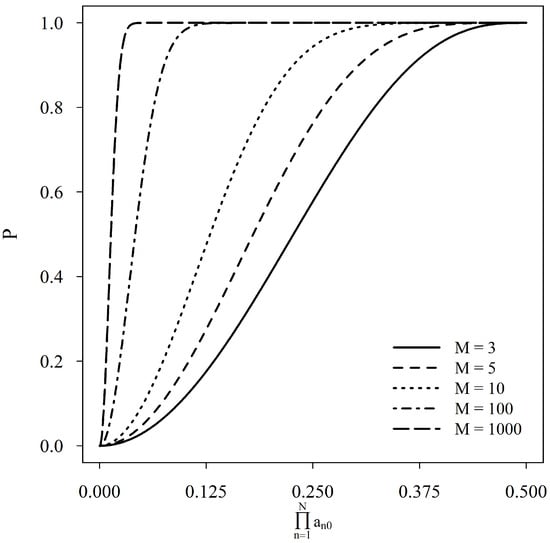
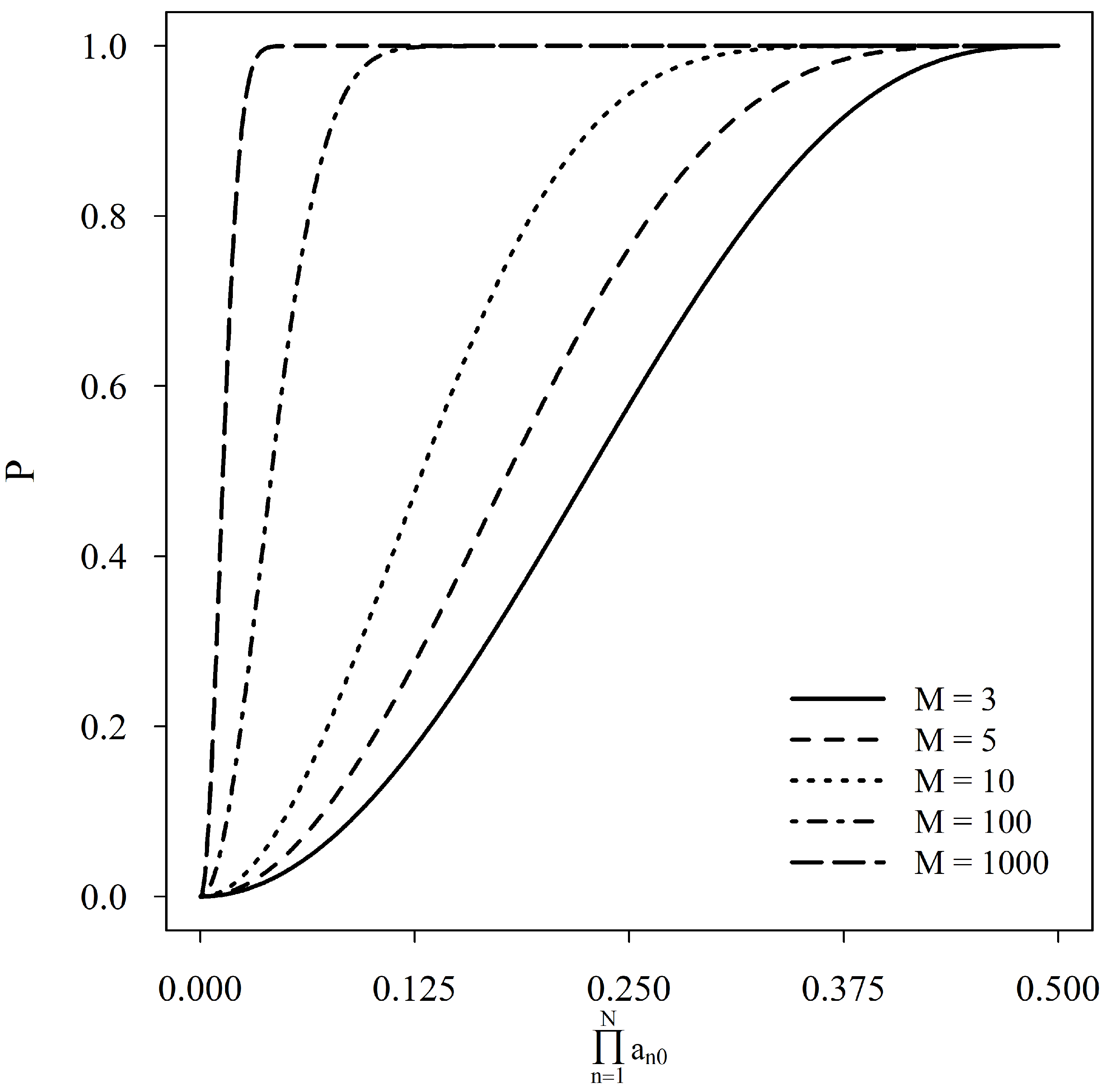
Figure 1 illustrates the behavior of P as a function of for different values of M. As noted in the caption, this plot is drawn for the representative case (equivalently, ), so that the maximally entangled channel corresponds to . More generally, because a maximally entangled pair satisfies , the admissible range in the general d-dimensional case is . Therefore, Figure 1 is intended to provide an illustrative visualization of the monotonic dependence of P on and M, while the analytical expression in Equation (50) remains valid for arbitrary d. The factor in Equation (42) is the minimum Schmidt coefficient of the partially entangled pair and therefore quantifies the weakest entanglement resource relevant to receiver-side recovery. Equation (50) shows that the overall success probability after M attempts is completely determined by the single-trial success probability and the number of repetitions M. Hence, for fixed M, stronger entanglement yields larger P, whereas for fixed channel parameters, repeated nondestructive attempts monotonically increase P. This provides a direct theoretical explanation of the trends observed in Figure 1. Accordingly, we draw the following conclusions:
Figure 1.
The total success probability P as a function of for different values of M, plotted for the representative case (equivalently, in this parameterization). Under this condition, the admissible range is .
- (a)
- When for all and , the quantum channel in Equation (42) becomes maximally entangled. In this case, the success probability of the N-output controlled QT is , and the scheme becomes deterministic. Therefore, our protocol reduces to the corresponding deterministic controlled multi-output QT scheme.
- (b)
- For any fixed and , there always exists a positive integer M such that the total success probability becomes arbitrarily close to one. Hence, our scheme provides a way to simultaneously teleport N different unknown single-qudit states successfully even through weakly entangled channels, which demonstrates its resumable nature.
- (c)
- The success probability of the N-output controlled QT process increases significantly when repeated attempts are allowed ().
- (d)
- When the entanglement is weak, more repetitions are required to make the success probability close to one. Consequently, the efficiency is relatively low under these circumstances, and improving the practical efficiency remains an interesting direction for future work.
On the other hand, we note that there are possible outcomes in the joint measurement process of Alice and Charlie. Therefore, transmitting the measurement results to the N receivers Bob1, Bob2, ⋯, BobN requires classical bits in one-way classical communication. It is interesting that when N-output controlled teleportation fails in a trial, there may be k () receivers whose measurement results for each auxiliary qubit are all , while the measurement results of the remaining receivers regarding their respective auxiliary qubits must all be . In the former case, the receivers can recover their respective target states, while in the latter case, sender Alice can retain these corresponding initial states.
In summary, following the approach from special to general, this article first considers the two-output QT in three-dimensional Hilbert space, then extends it to the two-output case in high-dimensional Hilbert space, and finally generalizes it to the multi-output case in high-dimensional Hilbert space. The specific contributions are as follows:
- (i)
- By using a three-dimensional partially entangled five-qutrit state as the quantum channel, we present a nondestructive scheme to teleport two arbitrary unknown single-qutrit states simultaneously and separately to distant receivers under the permission of the supervisor. In our scheme, each of the two receivers needs to introduce an auxiliary qubit, perform a special unitary transformation on the qutrit in his/her hand and the auxiliary qubit, and measure the auxiliary qubit with the Z-basis. After the sender’s series of operations and the controller’s measurement, both original unknown states are reconstructed by the receivers, or one is reconstructed by the receiver and the other is retained by the sender, or both are retained by the sender. The former achieves successful teleportation, while the latter two lead to the failure of quantum teleportation, providing the opportunity to repeat the teleportation process until successful teleportation.
- (ii)
- By replacing the quantum channel with a high-dimensional partially entangled five-qudit state, we extend the two-output NCQT to the case of teleporting two arbitrary unknown single-qudit states in a d-dimensional Hilbert space and obtain analogous conclusions.
- (iii)
- We further extend the two-output NCQT scheme in (ii) to the general case of N outputs and analyze the corresponding success probability.
Author Contributions
Conceptualization, M.L. and Z.Z.; Methodology, M.L. and J.P.; Formal Analysis, M.L. and J.T.; Investigation, M.L., Z.Z. and J.T.; Validation, Z.Z. and J.P.; Writing—Original Draft Preparation, M.L. and Z.Z.; Writing—Review and Editing, Z.Z. and J.P.; Visualization, Z.Z.; Supervision, J.P.; Project Administration, J.P.; Funding Acquisition, M.L. All authors have read and agreed to the published version of the manuscript.
Funding
This research was funded by the Special project of Yili Normal University to improve comprehensive strength of disciplines, grant number No. 22XKZZ18; Natural Science Foundation of Xinjiang Uygur Autonomous Region, grant number No. 2024D01C199; and Yili Normal University scientific research innovation team plan project, grant number No. CXZK2021015.
Data Availability Statement
The original contributions presented in this study are included in the article. Further inquiries can be directed to the corresponding author.
Acknowledgments
The authors would like to express their sincere gratitude to the anonymous reviewers for their constructive comments and valuable suggestions, which have significantly improved the quality of this manuscript.
Conflicts of Interest
The authors declare no known competing financial interests or personal relationships that could have appeared to influence the work reported in this paper.
References
- Bennett, C.H.; Brassard, G.; Crépeau, C.; Jozsa, R.; Peres, A.; Wootters, W.K. Teleporting an Unknown Quantum State via Dual Classical and Einstein-Podolsky-Rosen Channels. Phys. Rev. Lett. 1993, 70, 1895–1899. [Google Scholar] [CrossRef] [Scilit]
- Bouwmeester, D.; Pan, J.W.; Mattle, K.; Eibl, M.; Weinfurter, H.; Zeilinger, A. Experimental quantum teleportation. Nature 1997, 390, 575–579. [Google Scholar] [CrossRef] [Scilit]
- Cheng, S.T.; Wang, C.Y.; Tao, M.H. Quantum Communication for Wireless Wide-Area Networks. IEEE J. Sel. Areas Commun. 2005, 23, 1424–1432. [Google Scholar] [CrossRef] [Scilit]
- Nguyen, H.V.; Babar, Z.; Alanis, D.; Botsinis, P.; Chandra, D.; Izhar, M.A.M.; Ng, S.X.; Hanzo, L. Towards the Quantum Internet: Generalised Quantum Network Coding for Large-Scale Quantum Communication Networks. IEEE Access 2017, 5, 17288–17308. [Google Scholar] [CrossRef] [Scilit]
- Fonseca, A. High-Dimensional Quantum Teleportation under Noisy Environments. Phys. Rev. A 2019, 100, 062311. [Google Scholar] [CrossRef] [Scilit]
- Tan, X.Q.; Zhang, X.Q.; Fang, J.B. Perfect Quantum Teleportation by Four-Particle Cluster State. Inform. Process. Lett. 2016, 116, 347–350. [Google Scholar] [CrossRef] [Scilit]
- Chen, L.B.; Jin, R.B.; Peng, T.; Lu, H. Realizing Open-Destination and Controlled Teleportation of a Rotation Using Partially Entangled Pairs. Int. J. Mod. Phys. B 2011, 25, 2853–2862. [Google Scholar] [CrossRef] [Scilit]
- Bennett, C.H.; Brassard, G. Quantum Cryptography: Public Key Distribution and Coin Tossing. Theor. Comput. Sci. 2014, 560, 7–11. [Google Scholar] [CrossRef] [Scilit]
- Sasaki, M. Quantum Key Distribution and Its Applications. IEEE Secur. Priv. 2018, 16, 42–48. [Google Scholar] [CrossRef] [Scilit]
- Farouk, A.; Zakaria, M.; Megahed, A.; Omara, F.A. A Generalized Architecture of Quantum Secure Direct Communication for N Disjointed Users with Authentication. Sci. Rep. 2015, 5, 16080. [Google Scholar] [CrossRef] [Scilit]
- Zhu, F.; Zhang, W.; Sheng, Y.B.; Huang, Y.D. Experimental Long-Distance Quantum Secure Direct Communication. Sci. Bull. 2017, 62, 1519–1524. [Google Scholar] [CrossRef] [Scilit]
- Horodecki, R.; Horodecki, P.; Horodecki, M.; Horodecki, K. Quantum Entanglement. Rev. Mod. Phys. 2009, 81, 865–942. [Google Scholar] [CrossRef] [Scilit]
- Brunner, N.; Cavalcanti, D.; Pironio, S.; Scarani, V.; Wehner, S. Bell Nonlocality. Rev. Mod. Phys. 2014, 86, 419–478. [Google Scholar] [CrossRef] [Scilit]
- Agrawal, P.; Pati, A.K. Probabilistic Quantum Teleportation. Phys. Lett. A 2002, 305, 12–17. [Google Scholar] [CrossRef] [Scilit]
- Verstraete, F.; Verschelde, H. Optimal Teleportation with a Mixed State of Two Qubits. Phys. Rev. Lett. 2003, 90, 097901. [Google Scholar] [CrossRef] [Scilit] [PubMed]
- Banaszek, K. Optimal Quantum Teleportation with an Arbitrary Pure State. Phys. Rev. A 2000, 62, 024301. [Google Scholar] [CrossRef] [Scilit]
- Peng, J.Y.; Liu, M.; Tang, J.G.; Yang, Z.; Lei, H.X. Double-direction cyclic controlled quantum teleportation of arbitrary unknown single-qutrit states. Int. J. Quantum Inf. 2025, 23, 2450021. [Google Scholar] [CrossRef] [Scilit]
- Lei, H.R.; Tang, J.G.; Peng, J.Y. Quantum Teleportation of an Arbitrary Unknown Two-qubit State via Arbitrary High-dimensional Entangled States. Int. J. Theor. Phys. 2025, 64, 244. [Google Scholar] [CrossRef] [Scilit]
- Peng, J.Y.; Maihemuti, N.; Aisan, Y.; Yang, Z. Quantum Teleportation of Shared High-Dimensional Quantum Secret. Phys. Scr. 2024, 99, 085125. [Google Scholar] [CrossRef] [Scilit]
- Furusawa, A.; Sørensen, J.L.; Braunstein, S.L.; Fuchs, C.A.; Kimble, H.J.; Polzik, E.S. Unconditional Quantum Teleportation. Science 1998, 282, 706–709. [Google Scholar] [CrossRef] [Scilit]
- Sherson, J.F.; Krauter, H.; Olsson, R.K.; Julsgaard, B.; Hammerer, K.; Cirac, L.; Polzik, E.S. Quantum Teleportation between Light and Matter. Nature 2006, 443, 557–560. [Google Scholar] [CrossRef] [Scilit] [PubMed]
- Pfaff, W.; Hensen, B.; Bernien, H.; van Dam, S.B.; Blok, M.S.; Taminiau, T.H.; Tiggelman, M.J.; Schouten, R.N.; Markham, M.; Twitchen, D.J.; et al. Unconditional Quantum Teleportation between Distant Solid-State Quantum Bits. Science 2014, 345, 532–535. [Google Scholar] [CrossRef] [Scilit] [PubMed]
- Nölleke, C.; Neuzner, A.; Reiserer, A.; Hahn, C.; Rempe, G.; Ritter, S. Efficient Teleportation between Remote Single-Atom Quantum Memories. Phys. Rev. Lett. 2013, 110, 140403. [Google Scholar] [CrossRef] [Scilit]
- Torres, J.M.; Bernád, J.Z.; Alber, G. Quantum teleportation and entanglement swapping of matter qubits with coherent multiphoton states. Phys. Rev. A 2014, 90, 012304. [Google Scholar] [CrossRef] [Scilit]
- Kondo, Y. Quantum Teleportation without Irreversible Detection: NMR-Experiment. J. Phys. Soc. Jpn. 2007, 76, 104004. [Google Scholar] [CrossRef] [Scilit]
- Jin, X.-M.; Ren, J.-G.; Yang, B.; Yi, Z.-H.; Zhou, F.; Xu, X.-F.; Wang, S.-K.; Yang, D.; Hu, Y.-F.; Jiang, S.; et al. Experimental free-space quantum teleportation. Nat. Photon. 2010, 4, 376–381. [Google Scholar] [CrossRef] [Scilit]
- Zhang, B.; Liu, Y. Economic and Deterministic Quantum Teleportation of Arbitrary Bipartite Pure and Mixed State with Shared Cluster Entanglement. Int. J. Theor. Phys. 2009, 48, 2644–2651. [Google Scholar] [CrossRef] [Scilit]
- Wang, K.; Yu, X.T.; Lu, S.L.; Gong, Y.X. Quantum wireless multihop communication based on arbitrary Bell pairs and teleportation. Phys. Rev. A 2014, 89, 022329. [Google Scholar] [CrossRef] [Scilit]
- Krauter, H.; Salart, D.; Muschik, C.A.; Petersen, J.M.; Shen, H.; Fernholz, T.; Polzik, E.S. Deterministic Quantum Teleportation between Distant Atomic Objects. Nat. Phys. 2013, 9, 400–404. [Google Scholar] [CrossRef] [Scilit]
- Marshall, K.; James, D.F.V. High-fidelity teleportation of continuous-variable quantum states with discrete-variable resource. J. Opt. Soc. Am. B 2014, 31, 423–428. [Google Scholar] [CrossRef] [Scilit]
- Hu, X.M.; Zhang, C.; Liu, B.H.; Cai, Y.; Ye, X.J.; Guo, Y.; Xing, W.B.; Huang, C.X.; Huang, Y.F.; Li, C.F.; et al. Experimental High-Dimensional Quantum Teleportation. Phys. Rev. Lett. 2020, 125, 230501. [Google Scholar] [CrossRef] [Scilit]
- Wang, X.-L.; Cai, X.-D.; Su, Z.-E.; Chen, M.-C.; Wu, D.; Li, L.; Liu, N.-L.; Lu, C.-Y.; Pan, J.-W. Quantum teleportation of multiple degrees of freedom of a single photon. Nature 2015, 518, 516–519. [Google Scholar] [CrossRef] [Scilit]
- Cerf, N.J.; Bourennane, M.; Karlsson, A.; Gisin, N. Security of Quantum Key Distribution Using d-Level Systems. Phys. Rev. Lett. 2002, 88, 127902. [Google Scholar]
- Mirhosseini, M.; Magaña-Loaiza, O.S.; O’Sullivan, M.N.; Rodenburg, B.; Malik, M.; Lavery, M.P.J.; Padgett, M.J.; Gauthier, D.J.; Boyd, R.W. High-Dimensional Quantum Cryptography with Twisted Light. New J. Phys. 2015, 17, 033033. [Google Scholar] [CrossRef] [Scilit]
- Ralph, T.C.; Lam, P.K. Teleportation with Bright Squeezed Light. Phys. Rev. Lett. 1998, 81, 5668–5671. [Google Scholar] [CrossRef] [Scilit]
- Li, W.L.; Li, C.F.; Guo, G.C. Probabilistic teleportation and entanglement matching. Phys. Rev. A 2000, 61, 034301. [Google Scholar] [CrossRef] [Scilit]
- Gou, Y.T.; Shi, H.L.; Wang, X.H.; Liu, S.Y. Probabilistic resumable bidirectional quantum teleportation. Quantum Inf. Process. 2017, 16, 278. [Google Scholar] [CrossRef] [Scilit]
- Yan, F.L.; Wang, D. Probabilistic and controlled teleportation of unknown quantum states. Phys. Lett. A 2003, 316, 297–303. [Google Scholar] [CrossRef] [Scilit]
- Li, D.C.; Shi, Z.K. Probabilistic teleportation via entanglement. Int. J. Theor. Phys. 2008, 47, 2645–2654. [Google Scholar] [CrossRef] [Scilit]
- Chen, X.B.; Du, J.Z.; Wen, Q.Y.; Zhu, F.C. Probabilistic Teleportation of Multi-Particle Partially Entangled State. Chin. Phys. B 2008, 17, 771–777. [Google Scholar] [CrossRef] [Scilit]
- Yan, F.L.; Gao, T.; Li, Y.C. An Implementation of a Positive Operator Valued Measure. Chin. Phys. Lett. 2007, 24, 322–325. [Google Scholar] [CrossRef] [Scilit]
- Xu, H.F.; Han, L.F. Probabilistically Controlled Teleportation of an Arbitrary Two-Qubit State via Positive Operator-Valued Measure. Commun. Theor. Phys. 2013, 59, 554–558. [Google Scholar] [CrossRef] [Scilit]
- Choudhury, B.S.; Arpan, D. Probabilistically teleporting arbitrary two-qubit states. Quantum Inf. Process. 2016, 15, 5063–5071. [Google Scholar] [CrossRef] [Scilit]
- Javed, S.; Prakash, R.; Prakash, H. High success perfect transmission of 1-qubit information using purposefully delayed sharing of non-maximally entangled 2-qubit resource and repeated generalized Bell-state measurements. Int. J. Quantum Inf. 2021, 19, 2150015. [Google Scholar] [CrossRef] [Scilit]
- Aisan, Y.; Maihemuti, N.; Peng, J.Y.; Tang, J.G. Conclusive bidirectional quantum teleportation of arbitrary unknown single-particle states in amplitude-damping channel. Int. J. Quantum Inf. 2025, 23, 2550008. [Google Scholar] [CrossRef] [Scilit]
- Jiang, M.; Li, H.; Zhang, Z.K.; Zeng, J. Faithful teleportation via multi-particle quantum states in a network with many agents. Quantum Inf. Process. 2012, 11, 23–40. [Google Scholar] [CrossRef] [Scilit]
- Roa, L.; Groiseau, C. Probabilistic teleportation without loss of information. Phys. Rev. A 2015, 91, 012344. [Google Scholar] [CrossRef] [Scilit]
- Chen, X.; Zhang, J.H.; Zhang, F.L. Probabilistic resumable quantum teleportation in high dimensions. Chin. Phys. B 2022, 31, 030302. [Google Scholar] [CrossRef] [Scilit]
- Wang, Z.Y.; Gou, Y.T.; Hou, J.X.; Cao, L.K.; Wang, X.H. Probabilistic resumable quantum teleportation of a two-qubit entangled state. Entropy 2019, 21, 352. [Google Scholar] [CrossRef] [Scilit] [PubMed]
- Fu, F.X.; Jiang, M. Multihop nondestructive teleportation via different nonmaximally entangled channels. J. Opt. Soc. Am. B 2020, 37, 233–243. [Google Scholar] [CrossRef] [Scilit]
- Fu, F.X.; Li, H.; Xue, S.; Jiang, M. Multi-Hop Nondestructive Teleportation between Terminal Nodes Equipped with Limited Technology. J. Opt. Soc. Am. B 2020, 37, 1896–1905. [Google Scholar] [CrossRef] [Scilit]
- Karlsson, A.; Bourennane, M. Quantum teleportation using three-particle entanglement. Phys. Rev. A 1998, 58, 4394–4400. [Google Scholar] [CrossRef] [Scilit]
- Yang, C.P.; Chu, S.I.; Han, S. Efficient many-party controlled teleportation of multi-qubit quantum information via entanglement. Phys. Rev. A 2004, 70, 022329. [Google Scholar] [CrossRef] [Scilit]
- Deng, F.G.; Li, C.Y.; Li, Y.S.; Zhou, H.Y.; Wang, Y. Symmetric multiparty-controlled teleportation of an arbitrary two-particle entanglement. Phys. Rev. A 2005, 72, 022338. [Google Scholar] [CrossRef] [Scilit]
- Dai, H.Y.; Chen, P.X.; Zhang, M.; Li, C.Z. Remote preparation of an entangled two-qubit state with three parties. Chin. Phys. B 2008, 17, 27–33. [Google Scholar] [CrossRef] [Scilit]
- Li, Y.H.; Qiao, Y.; Sang, M.H.; Nie, Y.Y. Controlled teleportation of a three-qubit state by using a five-qubit cluster state. Int. J. Theor. Phys. 2020, 59, 502–506. [Google Scholar] [CrossRef] [Scilit]
- Peng, J.Y.; Liu, M.; Tang, J.G. Controlled cyclic quantum teleportation of unknown single-qutrit states. Int. J. Quantum Inf. 2024, 22, 2350045. [Google Scholar] [CrossRef] [Scilit]
- Maihemuti, N.; Chen, Z.H.; Peng, J.Y.; Aisan, Y.; Tang, J.G. Controlled Double-Direction Cyclic Quantum Communication of Arbitrary Two-Particle States. Entropy 2025, 27, 292. [Google Scholar] [CrossRef] [Scilit] [PubMed]
- Liu, M.; Maihemuti, N.; Peng, J.Y. Controlled Bidirectional Remote Implementations of Partially Unknown Quantum Operations. Phys. Scr. 2024, 99, 045109. [Google Scholar] [CrossRef] [Scilit]
- Maihemuti, N.; Peng, J.Y.; Yang, Z.; Zhai, D.X.; Tang, J.G. Controlled and Assisted Cloning of an Arbitrary Unknown States via Maximal Slice States. Int. J. Theor. Phys. 2024, 63, 18. [Google Scholar] [CrossRef] [Scilit]
- Stinson, D.R. Advances in Cryptology—CRYPTO’93. In Proceedings of the 13th Annual International Cryptology Conference, Santa Barbara, CA, USA, 22–26 August 1993; Lecture Notes in Computer Science; Springer: Berlin/Heidelberg, Germany, 1994; Volume 773. [Google Scholar]
- Yu, Y.; Zha, X.W.; Li, W. Quantum Broadcast Scheme and Multi-Output Quantum Teleportation via Four-Qubit Cluster State. Quantum Inf. Process. 2017, 16, 41. [Google Scholar] [CrossRef] [Scilit]
- Yu, Y.; Zhao, N.; Pei, C.X.; Li, W. Multi-Output Quantum Teleportation of Different Quantum Information with an IBM Quantum Experience. Commun. Theor. Phys. 2021, 73, 085103. [Google Scholar] [CrossRef] [Scilit]
- Peng, J.Y.; Wu, F.; Tang, J.G.; Tang, L. Quantum Multicast, Multi-Output Protocols of Quantum State Sharing and Quantum Operation Sharing via Six-Particle Cluster State. Quantum Inf. Process. 2023, 22, 424. [Google Scholar] [CrossRef] [Scilit]
- Aisan, Y.; Maihemuti, N.; Peng, J.Y.; Tang, J.G. Bidirectional Multi-Output Quantum Communication of Single-Qubit States. Eur. Phys. J. Plus 2025, 140, 506. [Google Scholar] [CrossRef] [Scilit]
- Peng, J.Y.; Lei, H.X.; Tang, J.G. Multi-type-output assisted cloning of unknown single-qubit states. Int. J. Theor. Phys. 2024, 63, 7. [Google Scholar] [CrossRef] [Scilit]
- Erhard, M.; Krenn, M.; Zeilinger, A. Advances in High-Dimensional Quantum Entanglement. Nat. Rev. Phys. 2020, 2, 365–381. [Google Scholar] [CrossRef] [Scilit]
- Malik, M.; Erhard, M.; Huber, M.; Krenn, M.; Fickler, R.; Zeilinger, A. Multi-Photon Entanglement in High Dimensions. Nat. Photon. 2016, 10, 248–252. [Google Scholar] [CrossRef] [Scilit]
- Dada, A.C.; Leach, J.; Buller, G.S.; Padgett, M.J.; Andersson, E. Experimental High-Dimensional Two-Photon Entanglement and Violations of Generalized Bell Inequalities. Nat. Phys. 2011, 7, 677–680. [Google Scholar] [CrossRef] [Scilit]
- Solís-Prosser, M.A.; Jiménez, O.; Neves, L.; Delgado, A. Quantum Teleportation via Quantum Channels with Non-Maximal Schmidt Rank. Phys. Scr. 2013, T153, 014058. [Google Scholar] [CrossRef] [Scilit]
- Zhou, N.R.; Chen, Z.; Liu, Y.; Gong, L.H. Multi-Party Semi-Quantum Private Comparison Protocol of Size Relation with d-Level GHZ States. Adv. Quantum Technol. 2025, 8, 2400530. [Google Scholar] [CrossRef] [Scilit]
- Huang, J.H.; Li, M.L.; Liu, Y.Y.; Qin, L.G.; Gong, L.H. Efficient semi-quantum private comparison protocol of size relation based on high-dimensional Bell states. Chin. Phys. B 2025, in press. [Google Scholar] [CrossRef] [Scilit]

Disclaimer/Publisher’s Note: The statements, opinions and data contained in all publications are solely those of the individual author(s) and contributor(s) and not of MDPI and/or the editor(s). MDPI and/or the editor(s) disclaim responsibility for any injury to people or property resulting from any ideas, methods, instructions or products referred to in the content. |
© 2026 by the authors. Licensee MDPI, Basel, Switzerland. This article is an open access article distributed under the terms and conditions of the Creative Commons Attribution (CC BY) license.