


Abstract
This study addresses the existence of solutions for a class of coupled fractional differential inclusions subject to coupled boundary conditions. The analysis is developed within the framework of nonlinear functional analysis by employing Carathéodory-type assumptions, the Leray–Schauder nonlinear alternative, and the Covitz–Nadler fixed-point theorem for multivalued mappings. The proposed approach accommodates both convex and non-convex set-valued nonlinearities, thereby broadening the scope of the results. Under suitable restrictions on the problem parameters, several corollaries are established as direct consequences of the main findings. An example is included to demonstrate the practical applicability and validity of the theoretical results.
MSC:
34A05; 34B15; 47H10
1. Introduction
Fractional differential equations (FDEs) provide an effective framework for modeling systems with memory and hereditary effects, with wide applications in science and engineering. Their nonlocal nature makes them suitable for studying existence, uniqueness, and stability under various boundary conditions [1,2,3,4]. Coupled systems of FDEs further extend this framework by describing interacting processes, though they introduce significant analytical challenges, particularly under nonlinear and nonlocal boundary conditions [5,6,7,8,9].
A natural generalization is given by fractional differential inclusions, which incorporate set-valued mappings to model uncertainty and multivalued dynamics. Existence results for such problems have been widely studied using multivalued fixed-point techniques [10,11,12,13,14]. In particular, coupled fractional differential inclusions have been investigated under various boundary conditions [15,16,17,18]. Recently, sequential fractional differential equations and inclusions have gained attention due to their ability to capture higher-order memory effects. Although several studies address their solvability [19,20], analysis of coupled sequential fractional differential inclusions with nonlocal multipoint boundary conditions is required. More recently, attention has been directed toward sequential fractional differential equations and inclusions, which involve compositions of fractional operators and provide enhanced flexibility in describing complex dynamical behavior [20,21,22,23]. Motivated by the above developments, we consider the coupled system of fractional differential inclusions
subject to nonlocal coupled boundary conditions
where and denote the right Caputo fractional derivatives of orders and , respectively. The multifunctions are given set-valued maps, where denotes the family of all non-empty subsets of . The constants are real parameters, while are arbitrary points in the interval.
The boundary conditions (2) represent nonlocal multipoint constraints, where the values of the unknown functions and their derivatives at the right endpoint are expressed as linear combinations of their values at several interior points of the interval. Such conditions significantly generalize classical two-point boundary conditions and provide a more flexible framework for modeling real-world phenomena involving memory and spatial interactions. This nonlocal structure plays a crucial role in capturing complex dynamical behavior within the context of fractional differential inclusions.
The main objective of this paper is to establish existence results for the above system under suitable assumptions on the multivalued maps. The analysis is carried out using techniques from nonlinear functional analysis, including the Leray–Schauder nonlinear alternative and the Covitz–Nadler fixed-point theorem for multivalued operators. The obtained results cover both convex and non-convex valued multifunctions, thereby extending several existing results in the literature.
The paper is organized as follows. In Section 2, we recall some basic definitions and preliminary results from fractional calculus and multivalued analysis. Section 3 is devoted to the main results, which are established using fixed-point techniques for multivalued operators. In Section 4, illustrative examples are presented to demonstrate the applicability of the theoretical findings. Finally, concluding remarks are provided in the last section.
2. Preliminaries
In this section, we recall some basic concepts from multivalued analysis [1,2,3].
Let be a normed space. Denote
A multivalued map is said to be:
- (i)
- Convex (closed) valued if is convex (closed) for all ;
- (ii)
- Upper semicontinuous (u.s.c.) on X if for each , is a non-empty closed subset of X, and for every open set N containing , there exists a neighborhood U of such that ;
- (iii)
- Lower semicontinuous (l.s.c.) if for every open set , the setis open in X;
- (iv)
- Completely continuous if is relatively compact for every bounded set .
Remark 1
([24,25]). If the multivalued map G is completely continuous with non-empty compact values, then G is u.s.c. if and only if G has a closed graph; i.e., , , imply ; the set
defines the graph of G.
Definition 1
([26,27]). A multivalued map is said to be measurable if the function
is measurable for every .
Definition 2
([24,27,28]). A multivalued map is said to be Carathéodory if:
- 1.
- is measurable for all ;
- 2.
- is upper semicontinuous for almost all .
Definition 3
([24,28]). A Carathéodory multifunction F is called -Carathéodory if for each , there exists such that
for all with and for a.e. .
Definition 4
([2]). Let and be a measurable function. The Riemann–Liouville fractional integral of order is defined by
provided the integral exists. Here, the Gamma function is given by
Definition 5
([2]). Let with , . The Riemann–Liouville fractional derivative of order is defined by
provided that the right-hand side exists.
Definition 6
([2]). Let with . The Caputo fractional derivative of order is defined by
whenever .
Definition 7.
Lemma 1
(Proposition 1.2 in [24]). Let be upper semicontinuous. Then, is a closed subset of ; i.e., for every sequence with and , we have . Conversely, if G is completely continuous and has compact values, then it is upper semicontinuous.
Lemma 2.
Let X be a separable Banach space. Let be an -Carathéodory multivalued map, and let χ be a linear continuous mapping from to . Then the operator
defined by , is a closed graph operator in .
Lemma 3
(Nonlinear alternative of Kakutani map [25]). Let be a closed convex subset of a Banach space E, and let U be an open subset of E with . Suppose that is an upper semicontinuous compact map. Then either:
- (i)
- F has a fixed point in ;
- (ii)
- There exist and such that .
Definition 8.
A multivalued operator is called (i) -Lipschitz if and only if there exists such that
and (ii) a contraction if and only if it is γ-Lipschitz with .
Lemma 4
(Covitz and Nadler [29]). Let be a complete metric space. If is a contraction, then the set of fixed points of is not empty.
Auxiliary Results
This section examines a system of linear fractional differential equations, analyzing their solutions, boundary conditions, and existence-uniqueness properties,
supplemented with the boundary conditions (2), with . We denote this by
and
3. Main Results
Let be given and denote by the Banach space of all continuous functions defined on with values in , equipped with the supremum norm.
Define the spaces
endowed with the norms
It is well known that and are Banach spaces.
Consequently, the product space is also a Banach space when equipped with the norm
For each pair , we define the set of selections for the functions and by
which describe the sets of selections for each .
By implementing Lemma 5, the following operators are given by
For the sake of computational convenience, we set
3.1. The Carathéodory Case
Our first result dealing with convex values and is proved via the Leray–Schauder nonlinear alternative for multivalued maps [25]
- The maps are -Carathéodory and have convex values;
- There exist continuous nondecreasing functions and functions , such thatand
- There exists a positive number such thatwhere are defined by (15).
- are such that and are measurable for each .
- where ∀ and with and , ∀.
Theorem 1.
Proof.
Consider defined by (11) and (3). From the assumption , it follows that the sets and are non-empty for each . Then, for , for , we have
where , and similarly, we get , and so .
We will establish that the operator satisfies the Leray–Schauder nonlinear alternative through a series of steps. Initially, we will demonstrate that exhibits a convex valued property. Let , . Then ∃, , , ∋ for each , and we achieve
and
Let . Then, for each , we arrive at
and since are convex valued, we deduce that and are convex valued. Obviously, , , and hence .
Now we show that maps bounded sets into bounded sets in . For a non-negative number r, let be a bounded set in . Then, there exist , , and we obtain
and similarly, we get the value of
Thus,
and
Hence, we obtain
Next, we show that is equi-continuous. Let with . Then there exists , such that
we deduce that , as . Similarly, we conclude that as .
We deduce that and are equi-continuous operators and so the operator g is also equi-continuous. From the foregoing arguments, it follows that the operator is equi-continuous, and so completely by the Ascoli–Arzelá theorem.
In our next step, we show that the operator can be classified as a completely continuous operator. Let , and ; then, we need to show .
Observe that implies that there exist and such that
and
Let us consider the continuous linear operators given by
From [30], we know that is a closed graph operator.
Furthermore, we have for all n. Since , , it follows that and such that
and
that is, .
Finally, we discuss a priori solutions. Let for . Then ∃, such that
and for each , we obtain
and
following the same arguments as in the second step.
Thus
which implies that
According to , exists such that . Let us set
Note that the operator is completely continuous and upper semicontinuous. From the choice of , there is no such that for some . Consequently, by the nonlinear alternative of Leray–Schauder type [25], we deduce that has a fixed point , which is a solution of the problem (2). This completes the proof. □
3.2. The Lipschitz Case
This subsection is concerned with the case when the multivalued maps in the system (1) have non-convex values. Let us first recall some auxiliary material.
Let be a metric space induced from the normed space and let be defined by
where
Then is a metric space and is a generalized metric space (see [28]).
In the forthcoming result, we make use of the fixed-point theorem for multivalued maps due to Convitz and Nadler [29].
Theorem 2.
Proof.
Assuming condition , where the sets and are non-empty for each , and that and have measurable selections (as established in Theorem III.6 in [31]), we now proceed to demonstrate that the operator satisfies the conditions of the Covitz and Nadler theorem [29].
First, we illustrate that for each . Let such that in . Then and ∃ and .
and
Since both and have compact values, we consider subsequences (which we denote as sequences) such that and converge to and , respectively, in the space . Thus and for each and that
and
Hence, , which implies that is closed. Next, we show that there exists such that
Let and . Then there exists and such that, for each , we have
and
Utilizing , we have
So, ∃ and such that
Define by
Since the multivalued operators and are measurable (Proposition III.4 in [31]), there exist functions for , which are measurable selections for and , and , such that ∀. We have
Thus,
Similarly, we can define that
Therefore
Likewise, by interchanging the positions of and , we can acquire
4. An Application
In this section, we illustrate the applicability of the obtained theoretical results through concrete examples.
Example 1.
Consider the coupled system of fractional differential inclusions
where the parameters are chosen as
The multivalued mappings are defined by
It is straightforward to verify that the multifunctions and satisfy the required Lipschitz-type conditions. Moreover,
Hence, all the assumptions of Theorem 2 are satisfied. Therefore, the system (26) admits at least one solution on .
Remark 2.
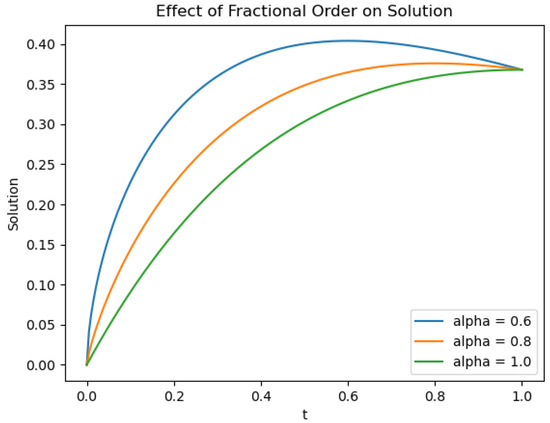
The nonlinear structure of the multivalued mappings illustrates the combined influence of fractional operators and nonlinear terms, where memory effects and oscillatory behavior coexist (Figure 1).
Figure 1.
Fractional order effect on the solution behavior.
Example 2.
Consider the multivalued mappings satisfying
where for all .
Then
Let
Thus,
Using the constants (same as Example 1):
we compute
Hence,
Therefore, condition is satisfied.
Since all assumptions of Theorem 1 are fulfilled, the system defined in Example 1 admits at least one solution on .
Remark 3.
This example demonstrates that the boundedness of the multivalued maps, together with suitably chosen control functions and parameters, ensures the applicability of the fixed-point theorem. The small constant plays a crucial role in satisfying the key inequality in .
5. Conclusions
In this paper, we have investigated the existence of solutions for a class of coupled fractional differential inclusions subject to coupled boundary conditions. The analysis was carried out within the framework of nonlinear functional analysis, employing tools such as the Leray–Schauder nonlinear alternative and the Covitz–Nadler fixed-point theorem for multivalued operators.
The proposed results cover both convex and non-convex valued multifunctions, thereby extending several existing works in the literature. The formulation allows for a broad class of nonlinearities and boundary conditions, making the results applicable to a wide range of problems arising in applied sciences.
Furthermore, suitable growth conditions were established to guarantee the existence of solutions. The theoretical findings were supported by illustrative examples, which demonstrate the effectiveness of the obtained results and highlight the role of fractional operators in capturing memory and hereditary properties of dynamical systems.
Overall, the developed approach provides a flexible and robust framework for analyzing coupled fractional inclusion systems. Future work may focus on the investigation of uniqueness, stability analysis, and the development of numerical schemes for solving such problems, as well as extending the results to more general fractional operators and higher-dimensional systems.
Author Contributions
Conceptualization: M.M.; Methodology: M.M.; Software: M.M. and S.E.; Validation: M.R. and M.M.; Formal analysis: E.K., S.S. and S.E.; Investigation: M.R. and E.K.; Writing—original draft preparation: M.M.; Writing—review and editing: S.S. and S.E.; Supervision: M.R.; Project administration: M.R. All authors have read and agreed to the published version of the manuscript.
Funding
Mohamed Rhaima extends his appreciation to the Ongoing Research Funding Program (ORF-2026-683), King Saud University, Riyadh, Saudi Arabia.
Data Availability Statement
The original contributions presented in this study are included in the article. Further inquiries can be directed to the corresponding authors.
Acknowledgments
Mohamed Rhaima extends his appreciation to the Ongoing Research Funding Program (ORF-2026-683), King Saud University, Riyadh, Saudi Arabia. The first author, M. Manigandan, would like to thank the SRM TRP Engineering College, India, for their financial support, vide number SRM/TRP/RI/005. The second author, S. Shanmugam, would like to thank Easwari Engineering College, India, for their financial support, vide number SRM/EEC/RI/006.
Conflicts of Interest
The authors declare no conflicts of interest.
References
- Podlubny, I. Fractional Differential Equations: An Introduction to Fractional Derivatives, Fractional Differential Equations, to Methods of Their Solution and Some of Their Applications; Elsevier: Amsterdam, The Netherlands, 1998; Volume 198. [Google Scholar]
- Kilbas, A.A.; Srivastava, H.M.; Trujillo, J.J. Theory and Applications of Fractional Differential Equations; Elsevier: Amsterdam, The Netherlands, 2006; Volume 204. [Google Scholar]
- Abbas, S.; Ahmad, B.; Benchohra, M.; Salim, A. Fractional Difference, Differential Equations, and Inclusions: Analysis and Stability; Elsevier: Amsterdam, The Netherlands, 2024. [Google Scholar]
- Ahmad, B.; Ntouyas, S.K.; Alsaedi, A. On a coupled system of fractional differential equations with coupled nonlocal and integral boundary conditions. Chaos Solitons Fractals 2016, 83, 234–241. [Google Scholar] [CrossRef] [Scilit]
- Aljoudi, S.; Ahmad, B.; Nieto, J.J.; Alsaedi, A. A coupled system of Hadamard type sequential fractional differential equations with coupled strip conditions. Chaos Solitons Fractals 2016, 91, 39–46. [Google Scholar] [CrossRef] [Scilit]
- Raja, M.M.; Han, C.H.; Veluvolu, K.C. Existence and approximate controllability for higher-order Hilfer fractional evolution equations via fixed-point and sequence approaches. Mathematics 2025, 13, 3810. [Google Scholar]
- Murugesan, M.; Aldosary, S.F.; Gündoğdu, H. Nonlinear Sequential Caputo Fractional Differential Systems: Existence and Hyers–Ulam Stability Under Coupled Mixed Boundary Constraints. Fractal Fract. 2026, 10, 165. [Google Scholar] [CrossRef] [Scilit]
- Raja, M.M.; Vijayakumar, V.; Tsai, C.-W.; Veluvolu, K.C. Optimal control strategies and continuous dependence for stochastic Hilfer fractional systems with delay: A Volterra–Fredholm integro-differential approach. Optim. Control Appl. Methods 2025, 46, 2708–2726. [Google Scholar] [CrossRef] [Scilit]
- Nain, A.; Vats, R.; Kumar, A. Coupled fractional differential equations involving Caputo–Hadamard derivative with nonlocal boundary conditions. Math. Methods Appl. Sci. 2021, 44, 4192–4204. [Google Scholar] [CrossRef] [Scilit]
- Ahmad, B.; Otero-Espinar, V. Existence of solutions for fractional differential inclusions with antiperiodic boundary conditions. Bound. Value Probl. 2009, 2009, 625347. [Google Scholar] [CrossRef] [Scilit]
- Castaing, C.; Godet-Thobie, C.; Phung, P.D.; Truong, L.X. On fractional differential inclusions with nonlocal boundary conditions. Fract. Calc. Appl. Anal. 2019, 22, 444–478. [Google Scholar] [CrossRef] [Scilit]
- Ntouyas, S.K.; Etemad, S.; Tariboon, J. Existence of solutions for fractional differential inclusions with integral boundary conditions. Bound. Value Probl. 2015, 2015, 92. [Google Scholar] [CrossRef] [Scilit]
- Tudorache, A.; Luca, R. On a system of sequential Caputo fractional differential equations with nonlocal boundary conditions. Fractal Fract. 2023, 7, 181. [Google Scholar] [CrossRef] [Scilit]
- Awadalla, M.; Murugesan, M.; Kannan, M.; Alahmadi, J.; Aladsani, F. Utilizing Schaefer’s fixed point theorem in nonlinear Caputo sequential fractional differential equation systems. AIMS Math. 2024, 9, 14130–14157. [Google Scholar] [CrossRef] [Scilit]
- Liu, X.; Liu, Z. Existence results for fractional differential inclusions with multivalued term depending on lower-order derivative. Abstr. Appl. Anal. 2012, 2012, 423796. [Google Scholar] [CrossRef] [Scilit]
- Ahmad, B.; Ntouyas, S.K.; Alsaedi, A. Coupled systems of fractional differential inclusions with coupled boundary conditions. Electron. J. Differ. Equ. 2019, 2019, 1–21. [Google Scholar]
- Manigandan, M.; Manikandan, K.; Hammad, H.A.; la Sen, M.D. Applying fixed point techniques to solve fractional differential inclusions under new boundary conditions. AIMS Math. 2024, 9, 15505–15542. [Google Scholar] [CrossRef] [Scilit]
- Manigandan, M.; Shanmugam, S.; Rhaima, M.; Sekar, E. Existence of solutions for Caputo sequential fractional differential inclusions with nonlocal generalized Riemann–Liouville boundary conditions. Fractal Fract. 2024, 8, 441. [Google Scholar] [CrossRef] [Scilit]
- Erkan, F.; Hamal, N.A.; Ntouyas, S.K.; Ahmad, B. Existence theory for (k,ψ)-Caputo fractional differential inclusions with multi-point closed fractional boundary conditions. Math. Open 2026. [Google Scholar] [CrossRef] [Scilit]
- Ntouyas, S.K.; Al-Sulami, H.H. A study of coupled systems of mixed order fractional differential equations and inclusions with coupled integral fractional boundary conditions. Adv. Differ. Equ. 2020, 2020, 73. [Google Scholar] [CrossRef] [Scilit]
- Sitho, S.; Ntouyas, S.K.; Samadi, A.; Tariboon, J. Boundary value problems for ψ-Hilfer type sequential fractional differential equations and inclusions with integral multi-point boundary conditions. Mathematics 2021, 9, 1001. [Google Scholar] [CrossRef] [Scilit]
- Nuchpong, C.; Ntouyas, S.K.; Samadi, A.; Tariboon, J. Boundary value problems for Hilfer type sequential fractional differential equations and inclusions involving Riemann–Stieltjes integral multi-strip boundary conditions. Adv. Differ. Equ. 2021, 2021, 268. [Google Scholar] [CrossRef] [Scilit]
- Subramanian, M.; Manigandan, M.; Tunç, C.; Gopal, T.N.; Alzabut, J. On system of nonlinear coupled differential equations and inclusions involving Caputo-type sequential derivatives of fractional order. J. Taibah Univ. Sci. 2022, 16, 1–23. [Google Scholar] [CrossRef] [Scilit]
- Deimling, K. Multivalued Differential Equations; Walter de Gruyter: Berlin, Germany, 1992. [Google Scholar]
- Granas, A.; Dugundji, J. Fixed Point Theory; Springer: New York, NY, USA, 2003. [Google Scholar]
- Hu, S.; Papageorgiou, N.S. Handbook of Multivalued Analysis, Volume I: Theory; Kluwer Academic Publishers: Dordrecht, The Netherlands, 1997. [Google Scholar]
- Aubin, J.-P.; Cellina, A. Differential Inclusions: Set-Valued Maps Viability Theory; Springer: Berlin/Heidelberg, Germany, 1984. [Google Scholar]
- Kisielewicz, M. Differential Inclusions and Optimal Control; Kluwer Academic Publishers: Dordrecht, The Netherlands, 1991. [Google Scholar]
- Covitz, H.; Nadler, S.B., Jr. Multivalued contraction mappings in generalized metric spaces. Isr. J. Math. 1970, 8, 5–11. [Google Scholar] [CrossRef] [Scilit]
- Lasota, A.; Opial, Z. An application of the Kakutani–Ky Fan theorem in the theory of ordinary differential equations. Bull. Acad. Pol. Sci. Ser. Sci. Math. Astron. Phys. 1965, 13, 781–786. [Google Scholar]
- Castaing, C.; Valadier, M. Convex Analysis and Measurable Multifunctions; Lecture Notes in Mathematics; Springer: Berlin/Heidelberg, Germany, 1977; Volume 580. [Google Scholar]
Disclaimer/Publisher’s Note: The statements, opinions and data contained in all publications are solely those of the individual author(s) and contributor(s) and not of MDPI and/or the editor(s). MDPI and/or the editor(s) disclaim responsibility for any injury to people or property resulting from any ideas, methods, instructions or products referred to in the content. |
© 2026 by the authors. Licensee MDPI, Basel, Switzerland. This article is an open access article distributed under the terms and conditions of the Creative Commons Attribution (CC BY) license.