Article

CA-GFNet: A Cross-Modal Adaptive Gated Fusion Network for Facial Emotion Recognition

Department of Biomedical Engineering, Keimyung University, Daegu 42601, Republic of Korea
*
Author to whom correspondence should be addressed.
Mathematics 2026, 14(6), 1068; https://doi.org/10.3390/math14061068
Submission received: 9 February 2026 / Revised: 15 March 2026 / Accepted: 20 March 2026 / Published: 21 March 2026
(This article belongs to the Special Issue Advanced Algorithms in Multimodal Affective Computing)

Abstract

Facial emotion recognition (FER) plays an important role in healthcare, human–computer interaction, and intelligent security systems. However, despite recent advances, many state-of-the-art FER methods depend on computationally intensive CNN or transformer backbones and large-scale annotated datasets while suffering noticeable performance degradation under cross-dataset evaluation because of domain shift. These limitations hinder practical usage in resource-constrained and real-world environments. To address this issue, we propose Cross-Adaptive Gated Fusion Network (CA-GFNet), a lightweight dual-stream FER framework that explicitly combines shallow structural features with deep semantic representations. The proposed architecture integrates domain-robust gradient-based descriptors with compact deep features extracted from a VGG-based backbone. After face detection and normalization, the structural stream captures fine-grained local appearance cues, whereas the semantic stream encodes high-level facial configurations. The two feature streams are projected into a shared latent space and adaptively fused using a gated fusion mechanism that learns sample-specific weights, allowing the model to prioritize the more reliable feature source under dataset shift. Extensive experiments on KDEF along with zero-shot cross-dataset evaluation on CK+ using a strict train-on-KDEF/test-on-CK+ protocol with subject-independent splits demonstrate the effectiveness of the proposed method. CA-GFNet achieves 99.30% accuracy on KDEF and 98.98% on CK+ while requiring significantly fewer parameters than conventional deep FER models. These results confirm that adaptive gated fusion of shallow and deep features can deliver both high recognition accuracy and strong cross-dataset robustness.

1. Introduction

Facial Emotion Recognition (FER) is a fundamental task in affective computing that maps changes in facial appearance to discrete emotional categories [1]. FER supports emotion-aware systems in human–computer interaction [2], cognitive health, and digital health monitoring systems [3], where timely emotion recognition can improve health outcomes and enhance overall intervention workflows [4]. In this context, FER has emerged as a key technology providing natural, universal, and non-intrusive cues for human affect. Compared with other modalities such as Biometric Expression Recognition (BER) and Speech Emotion Recognition (SER), FER offers real-time accessibility and strong applicability in practical environments, making it indispensable for building intelligent and emotion-aware interactive systems [5]. However, despite strong benchmark results, a critical impediment to real-world deployment remains in the form of limited cross-database generalization. Models trained on a source dataset often degrade substantially when evaluated on a different dataset, even when the emotion classes are identical [6]. This degradation is primarily driven by domain shift arising from variations in lighting conditions, emotion intensity, and annotation protocols across datasets. As a result, supervised FER models tend to use dataset-specific statistical features rather than learning emotion-invariant cues, which has motivated recent research on cross-domain and cross-database FER [7,8].
Traditional FER approaches based on hand-crafted descriptors such as LBP, PCA subspaces, and Gabor responses are computationally efficient and can offer partial robustness to local appearance variations. However, their representational capacity is limited, and they often fail to capture higher-level semantics required to handle complex intra-class variation and inter-class similarity. In contrast, deep Convolutional Neural Network (CNN) [9] models learn rich hierarchical representations and achieve high accuracy under train–test conditions; however, they require large labeled data and are prone to overfitting. While recent studies have attempted to improve the robustness and FER systems, several critical limitations remain. López-Echeverry et al. [10] proposed EmotiCloud, a cloud-based FER system for patient monitoring, demonstrating the feasibility of deploying FER in real workflows. Nevertheless, the system relies on a single deep feature representation and was evaluated under matched data conditions, leaving its robustness under cross-database domain shift largely unexplored. Likewise, Cui et al. [11] presented a comprehensive system-level analysis of digital healthcare frameworks that incorporate affective computing components. While their study highlighted the importance of emotion-aware systems for human-centered healthcare applications, the underlying FER components were treated as black-box modules without addressing feature-level robustness or dataset bias. Currently, many existing methods adopt late fusion approaches [12] in which the two streams are trained largely independently and combined only at the classifier. This design limits cross-stream interaction during feature learning.
To address these limitations, we propose Cross-Adaptive Gated Fusion Network (CA-GFNet), a hybrid dual-stream FER framework designed to improve robustness under domain shift. Specifically, CA-GFNet couples a structural stream that extracts low-level gradient cues with a semantic stream that extracts VGG-based deep features. Unlike conventional late-fusion methods, the proposed framework enables early and continuous interaction between the two streams through cross-attention during representation learning. In addition, an adaptive gated fusion module dynamically assigns input-dependent fusion weights, allowing the network to emphasize the more reliable feature source for each sample. This design improves robustness and supports stronger generalization across datasets. In this work, we target cross-database robustness using two controlled FER datasets, Karolinska Directed Emotional Faces (KDEF) [13] and Extended Cohn–Kanade (CK+) [14], under a train-on-KDEF/test-on-CK+ protocol. We further provide comprehensive ablation studies and comparative experiments to quantify the individual contributions of cross-attention coupling and adaptive gated fusion to cross-database generalization.
The following are the key contributions of the proposed study:
  • We move beyond conventional late-fusion designs by proposing CA-GFNet, a cross-adaptive based dual-stream FER architecture that enables bidirectional interaction between deep semantic features and shallow structural features during feature learning.
  • We establish a cross-dataset evaluation protocol using a train-on-KDEF and test-on-CK+ setting, ensuring no target domain leakage and enabling a fair assessment of cross-database generalization performance.
  • We introduce an adaptive gated fusion module that learns input-dependent fusion weights to dynamically combine semantic and structural cues, improving robustness to domain shifts that affect feature modalities differently.
  • We conduct extensive experimental evaluations, including ablation studies and cross-dataset comparisons, to quantify the contribution of cross-attention interaction and gated fusion to generalization performance.
The remainder of this paper is organized as follows: Section 2 reviews recent advances in facial emotion recognition; Section 3 presents the proposed CA-GFNet framework; Section 4 reports the experimental results; Section 5 presents the discussion and finally, Section 6 concludes the paper.

2. Literature Review

This section critically reviews existing FER approaches, highlighting their strengths and limitations. We first discuss the evolution of deep learning architectures for FER, followed by recent advances based on attention mechanisms and hybrid models. Finally, we summarize the key research gaps that motivate the proposed CA-GFNet.

2.1. Evolution of Deep Learning Architectures for FER

The field of facial emotion recognition has evolved significantly from early convolutional neural networks to more advanced and hybrid deep learning architectures. Elsheikh et al. [15] introduced the Anti-Aliased Deep Convolution Network (AA-DCN) to address aliasing artifacts caused by downsampling operations in conventional CNNs. By incorporating anti-aliasing filters and enforcing shift invariance, AA-DCN improves spatial feature preservation and achieves strong performance on controlled datasets such as JAFFE. However, the increased training cost and limited scalability restrict its applicability in real-time and unconstrained settings. Huang et al. [16] explored channel-wise feature recalibration using squeeze-and-excitation blocks integrated with residual networks (SE-ResNet). Their approach highlighted the importance of channel dependencies for emotion discrimination and achieved competitive performance on AffectNet and RAF-DB. Nevertheless, the reliance on a single visual modality and a high parameter count limits deployment in resource-constrained environments.
To provide systematic insights into architectural tradeoffs, Qian et al. [17] conducted a comprehensive comparison of ten deep learning architectures on FER2013, including VGG, ResNet, DenseNet, GoogLeNet, MobileNet, EfficientNet, ShuffleNet, and RepVGG. Their study showed that while VGG and ResNet achieve higher accuracy, lightweight architectures suffer notable performance degradation for challenging emotions such as fear and disgust. This analysis clearly exposes the persistent accuracy–efficiency tradeoff in FER systems.

2.2. Advanced Transformer-Based Mechanisms

Vision Transformers (ViTs) have recently gained traction in FER by modeling long-range dependencies and global facial context. Tian et al. [18] proposed a dual-stream global–local fusion architecture that combines CNN-based hybrid local attention with a ViT branch. While this design improves robustness to occlusion and head pose variation, its increased model complexity and reliance on reliable local features limit performance on low-resolution or highly noisy inputs. To address computational constraints, Li et al. [19] introduced a lightweight hybrid ViT using multi-scale attention and patch dropping. Although the model achieved good efficiency and performed well on RAF-DB, its lower accuracy on FER2013 highlights persistent generalization issues. Moreover, aggressive patch dropping risks discarding subtle facial cues that are essential for recognizing fine-grained emotions.
Hybrid CNN–transformer architectures further attempt to exploit complementary strengths. Song and Liu [20] proposed HFE-Net, which integrates convolutional and self-attention mechanisms with multiple specialized modules. Despite improved performance over single-paradigm models, its large number of components increases architectural complexity and susceptibility to background noise. Similarly, Tagmatova et al. [21] presented FERONet, a multimodal transformer combining RGB, optical flow, and depth information. While highly accurate on controlled datasets, its substantial computational and memory requirements hinder lightweight deployment. Other attention-based models incorporate auxiliary information. Nemati et al. [22] integrated facial landmark geometry with Efficient-Net, improving recognition of subtle expressions but introducing dependency on reliable landmark detection. Duongthang et al. [23] proposed FARNet, achieving perfect accuracy on CK+ and OuluCASIA with low parameter count; however, performance dropped sharply on in-the-wild datasets, exposing limited cross-dataset robustness. Similar limitations have been observed in EfficientNet-CBAM models [24], which face GPU memory constraints and moderate real-time performance.
More recent works have explicitly addressed the issue of domain shift. Ma et al. [25] proposed FER-VMamba, leveraging global compact attention and hierarchical feature interaction to handle occlusion and pose variation. Nevertheless, reliance on complex attention and state-space modeling limits the efficiency and cross-dataset scalability of this approach. Shu et al. [26] introduced MDFEF, a multi-domain fusion framework combining semantic, spatial, and frequency branches. While effective under controlled conditions, dependence on multiple deep feature streams without lightweight structural cues constrains its robustness under severe domain shift. Zhu et al. [6] presented FER-DAS, employing active sample selection and domain alignment; however, its iterative adaptation strategy increases training complexity and departs from source-only evaluation settings.
Despite notable progress, several challenges remain unresolved. Cross-dataset generalization is still limited, the accuracy–efficiency tradeoff persists, and shallow structural features such as gradients and textures remain underutilized. Finally, most approaches rely on static training paradigms without adaptive feature fusion tailored to dataset shift. Our proposed CA-GFNet addresses these limitations through a dual-stream design that integrates shallow structural with deep semantic features. By employing adaptive gated fusion, CA-GFNet achieves strong cross-dataset robustness while maintaining computational efficiency.

3. Proposed Method: CA-GFNet

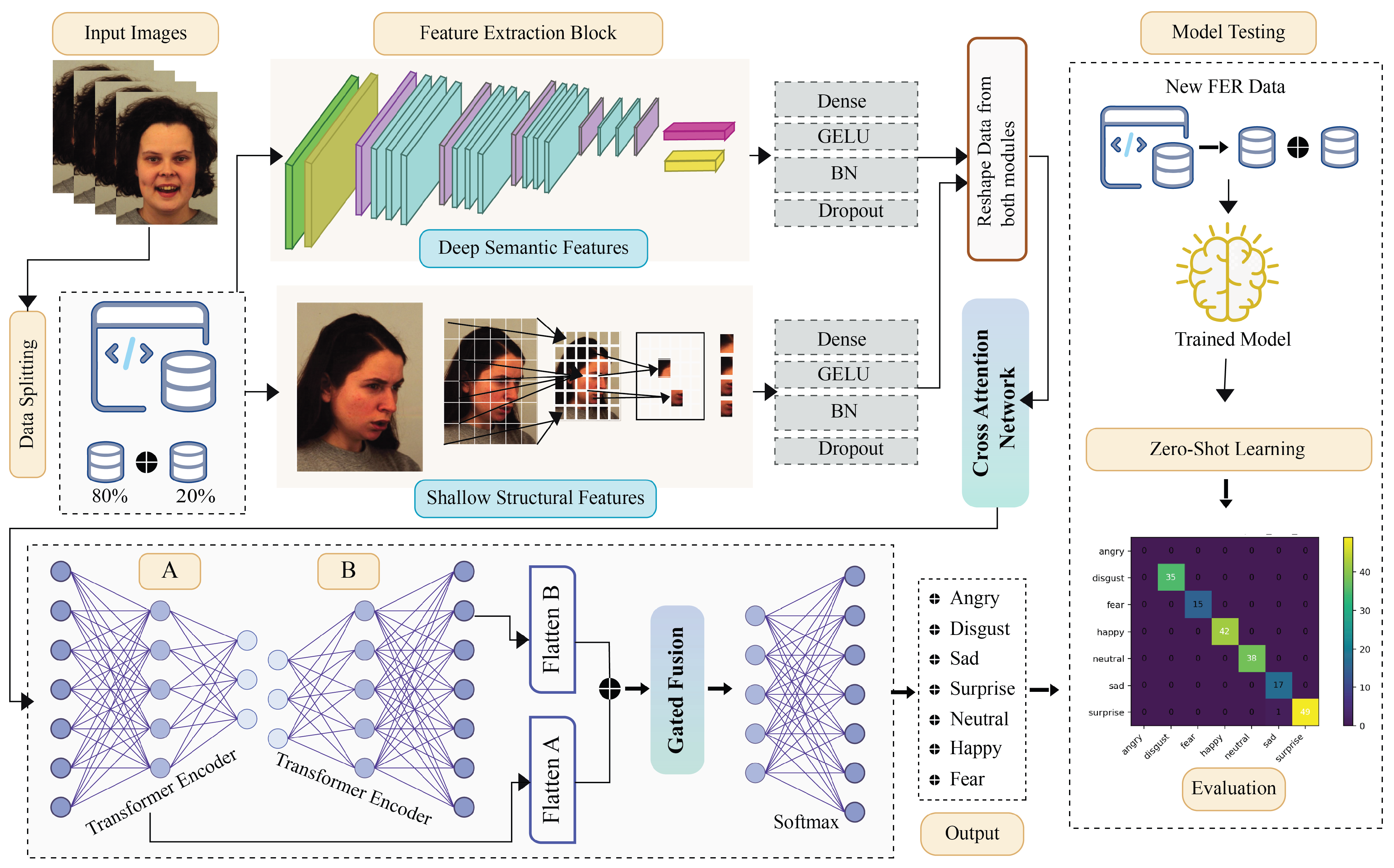
This section presents the architecture and processing pipeline of Cross-Adpative Gated Fusion Network (CA-GFNet), a lightweight dual-stream framework designed for robust facial emotion recognition under cross-dataset domain shift. CA-GFNet integrates shallow structural texture cues with deep semantic representations extracted from a pretrained VGG16 backbone. These complementary features are adaptively fused through a gated mechanism and further refined using a transformer encoder prior to final classification. An overview of the proposed architecture is illustrated in Figure 1.

3.1. Data Preprocessing

Given a raw facial image I R H × W × C , a unified preprocessing pipeline is applied to reduce dataset-specific variability between KDEF and CK+. All images are resized to a fixed spatial resolution and normalized to zero mean and unit variance. During training, lightweight augmentations including horizontal flipping, small rotations, and mild brightness and contrast adjustments are applied to improve robustness to pose and illumination variations. The normalized images are then forwarded to two parallel branches, a deep semantic branch based on VGG16 and a structural branch based on HOG descriptors, to enable complementary feature extraction.

3.1.1. Deep Semantic Features Extraction

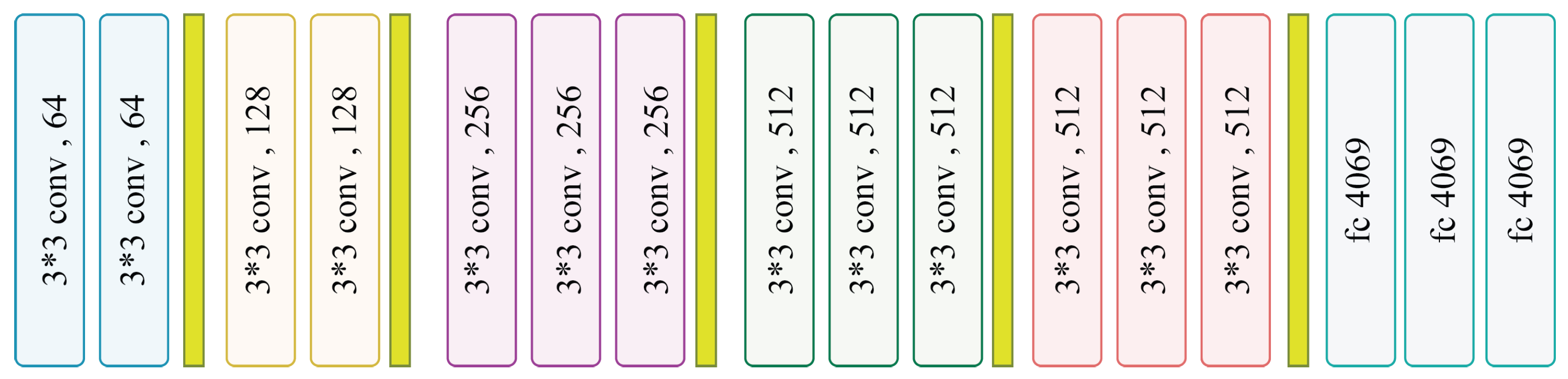
Each input image is resized to 224 × 224 pixels in order to match the input specification of VGG16, then preprocessed using the standard preprocess_input function. As the deep semantic feature extractor, we employ a VGG16 network pretrained on ImageNet with the classification layers removed. Figure 2 shows a graphical representation of the baseline VGG-16 framework. Global average pooling is applied to the final convolutional block to obtain a compact semantic representation:
v raw = VGG 16 ( I )
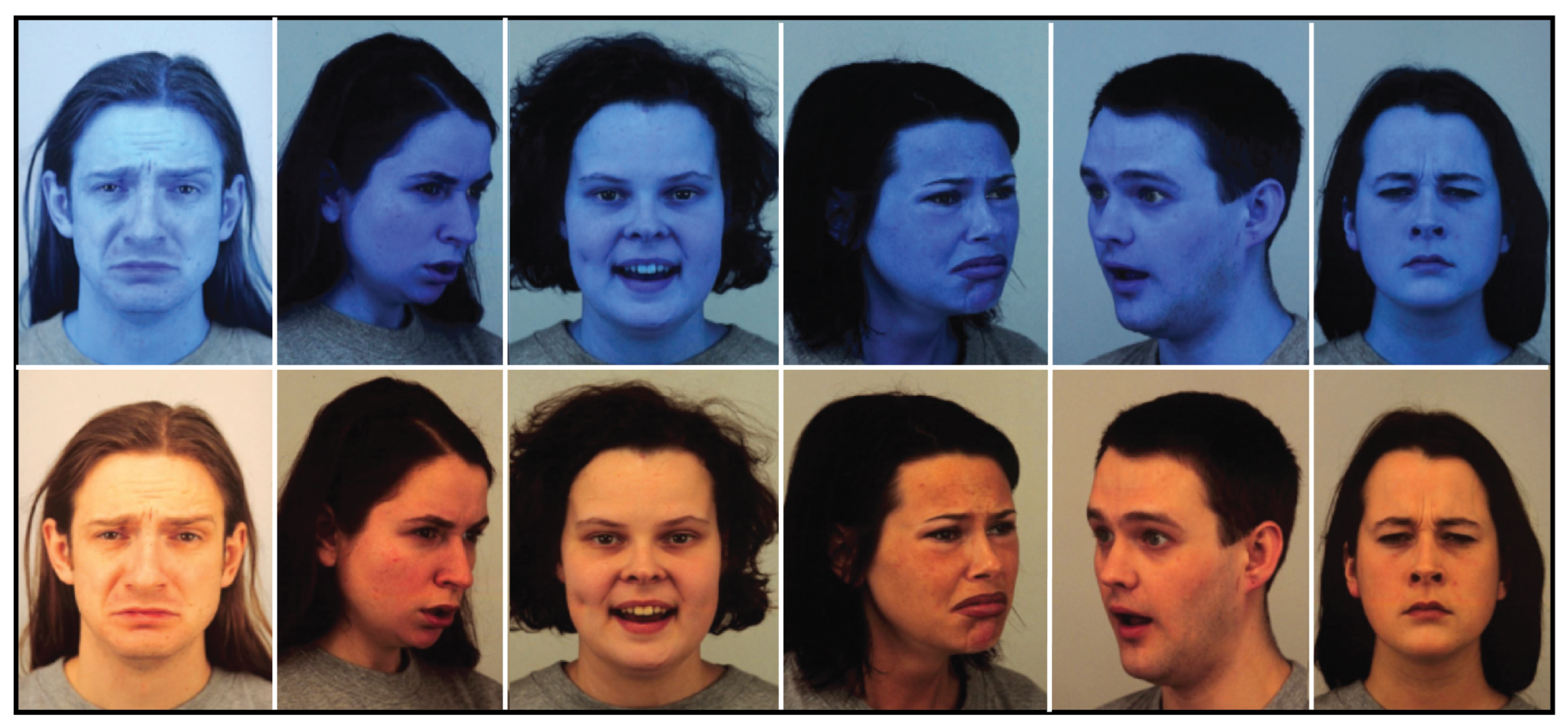
where v raw R D v , in which D v = 512 denotes the dimensionality of the extracted semantic feature vector. Pretraining on the large-scale ImageNet dataset enables VGG16 to capture high-level facial semantics that are relevant for emotion recognition, providing a strong prior for modeling discriminative expression-related patterns. Representative examples of VGG-based feature preprocessing are shown in Figure 3.

3.1.2. Extraction of Shallow Structural Features

To complement deep semantic representations, the Histogram of Oriented Gradients (HOG) descriptor is employed to capture local structural patterns induced by facial muscle movements. The input image is first converted to grayscale, divided into cells, and represented using normalized histograms of gradient orientations, producing a structural descriptor:
h raw = HOG ( I gray ) .
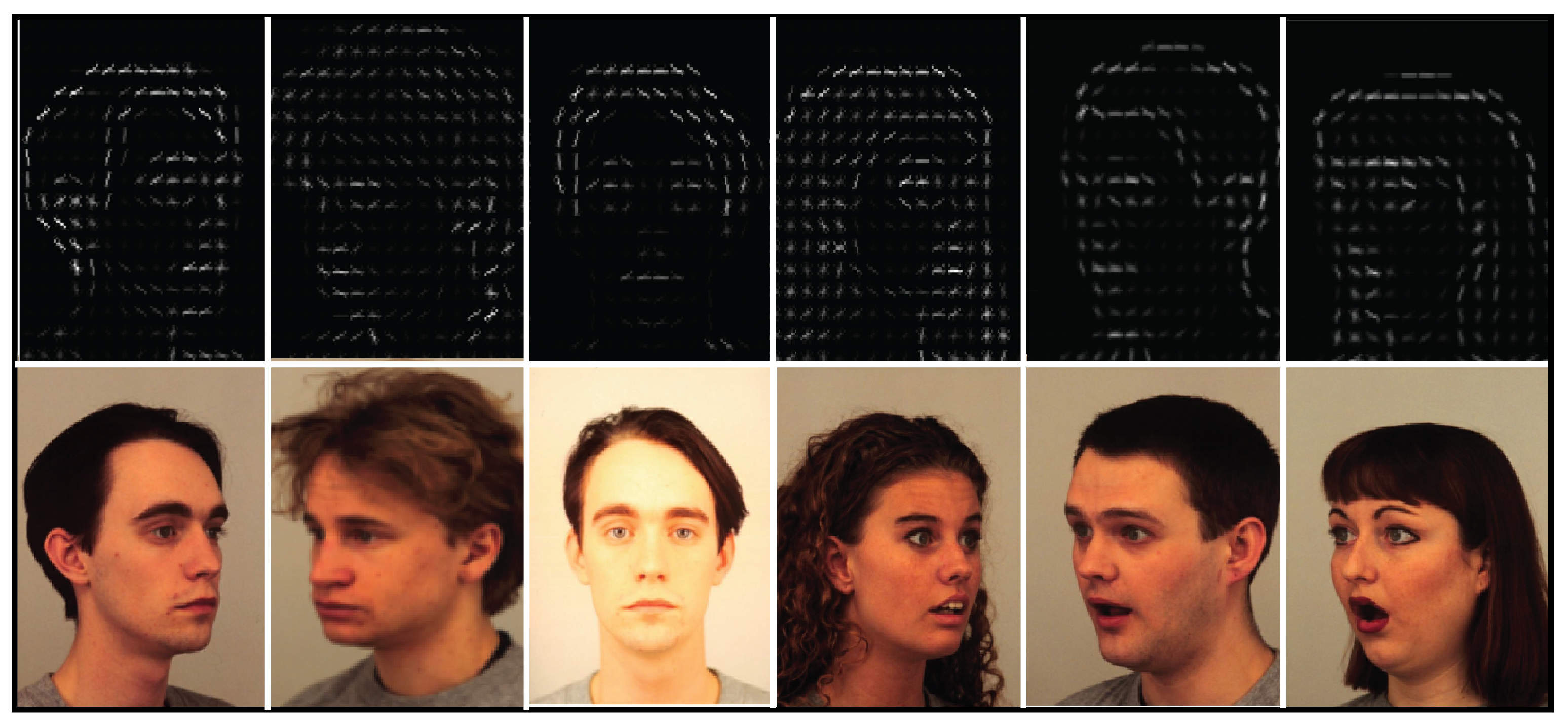
This process yields a feature vector h raw R D h that represents the local structural texture of the emotional expression. HOG features are inherently robust to illumination variations and provide fine-grained geometric information that is often overlooked by deep networks. Sample structural feature visualizations are shown in Figure 4. Both semantic and structural features are standardized to ensure stable optimization during training.

3.2. Cross-Modal Processing and Adaptive Gated Fusion

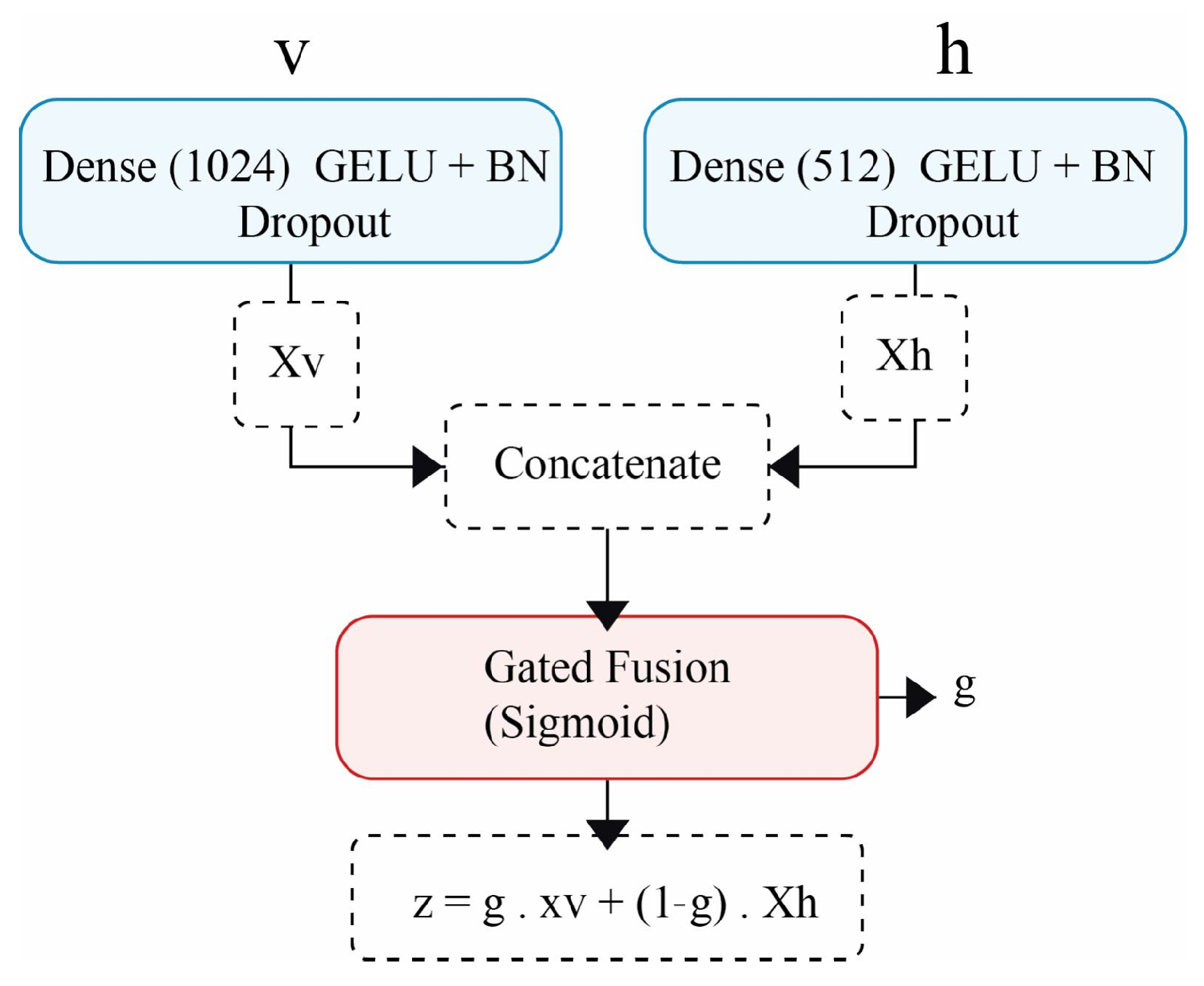
Since VGG-based semantic features and HOG-based structural features reside in heterogeneous representational spaces, direct concatenation may lead to suboptimal fusion. To address this issue, each feature stream is projected into a shared latent space of dimension D m = 512 using modality-specific fully connected layers with GELU activation, batch normalization, dropout, and layer normalization:
x v = P v ( v raw ) , x h = P h ( h raw ) .
An adaptive gated fusion mechanism dynamically balances the contribution of each modality on a per-sample basis. A gating value g [ 0 ,   1 ] is computed as follows:
g = σ W g x v x h + b g
and the fused representation is obtained by
z = g · x v + ( 1 g ) · x h .
This formulation enables CA-GFNet to adaptively emphasize semantic or structural cues depending on the input context, improving robustness under dataset shift. Figure 5 shows the gated fusion concept graphically.

Feature Projection to a Common Latent Space

To enable effective fusion, both feature vectors are nonlinearly projected into a shared latent space of the same dimensionality ( D m = 512 ) . This projection allows the model to learn a transformed representation of each modality that is more amenable to combination. Each path uses a dedicated subnetwork comprising dense layers, GELU activation (chosen for its smooth nonlinearity), batch normalization (for stable training), and dropout (for regularization). The final LayerNorm produces the projected features x v and x h :
x v ( 1 ) = GELU W v ( 1 ) v + b v ( 1 )
x v ( 2 ) = BatchNorm x v ( 1 )
x v ( 3 ) = Dropout x v ( 2 ) , rate = 0.4
x v = LayerNorm W v ( 2 ) x v ( 3 ) + b v ( 2 )
where W v ( 1 ) R 1024 × D v , W v ( 2 ) R D m × 1024 , and GELU denotes the Gaussian Error Linear Unit activation function. Figure 5 shows this concept in detail.

3.3. Adaptive Gated Fusion Under Domain Shift

When a model is trained on a source domain and evaluated on a target domain, each feature stream experiences a different magnitude of noise due to domain shift. HOG descriptors capture local gradient orientations that are inherently robust to illumination variation and dataset-specific imaging conditions [27], making them relatively stable under domain shift. By contrast, deep VGG16 semantic features encode high-level appearance patterns that may partially overfit to source-domain statistics (i.e., posed studio-lit KDEF images), potentially suffering greater distributional shift when applied to spontaneous CK+ expressions.
Furthermore, not all emotions are equally discernible from both modalities; “anger” may be strongly signaled by deep furrows that are well-captured by HOG gradients, while “disgust” may be better identified by the overall nose and lip configuration encoded by VGG16 semantics. Static late-fusion strategies which assign fixed combination weights to each stream cannot adapt to this asymmetric per-sample degradation. An adaptive gated fusion mechanism addresses this limitation by dynamically emphasizing the less-degraded stream on a per-sample basis [6,28].

Gating Mechanism

Let x v R D m and x h R D m denote the projected VGG and HOG feature vectors, respectively, where D m = 512 . The two projected representations are concatenated and passed through a single sigmoid neuron to produce a per-sample scalar gate:
g = σ W g x v x h + b g , g [ 0 ,   1 ] ,
where W g R 1 × 2 D m , b g R , and σ ( · ) denotes the sigmoid activation. The fused representation is then computed as the convex combination:
z = g · x v + ( 1 g ) · x h .
When g 1 , the model relies predominantly on the deep semantic stream, while when g 0 it prioritizes the structural HOG stream. This formulation is a special scalar gate case of the Gated Multimodal Unit [28], adapted here for computational efficiency in a dual-stream setting.

3.4. Transformer Encoder Head

The fused feature vector z is passed through a post-fusion dense layer and then prepared for sequence processing. Although the fused representation z is a single vector, the transformer encoder block is employed as a post-fusion refinement module in which the primary computational benefit comes from the FFN sublayer with residual connections and layer normalization. This sublayer performs deep nonlinear feature refinement. The MHSA component acts as a learned linear self-projection in this single-token setting, consistent with its use in CLS-token classification architectures.
z = Dropout GELU W p z + b p , rate = 0.3
To leverage contextual self-attention, z is treated as a single-token sequence and fed into a transformer encoder layer. The encoder employs Multi-Head Self-Attention (MHSA) and Feed-Forward Networks (FFNs) with residual connections and layer normalization:
z 0 = z + PE ,
z l = MHSA LayerNorm ( z l 1 ) + z l 1 ,
z l = FFN LayerNorm ( z l ) + z l .
where PE is the positional encoding (trivial here for a single token) and l is the layer index. The output z L of the transformer encoder is is passed to the final classification layer, which uses a softmax activation to predict the emotion class y ^ from C possible classes:
p = softmax W c z L + b c ,
y ^ = arg   max ( p ) ,
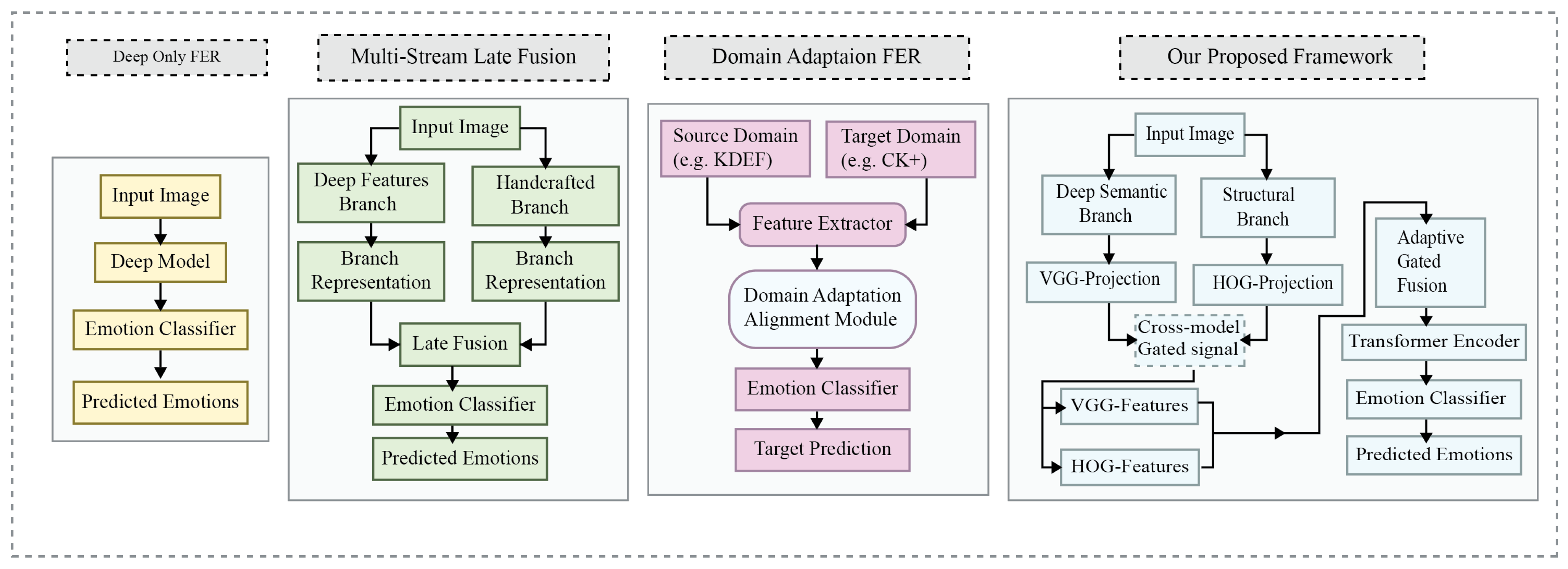
where W c R C × D m . For better understandings of the findings, Figure 6 shows an architectural comparison between deep-only, late-fusion, domain adaptation, and the proposed framework.

4. Experimentation and Results

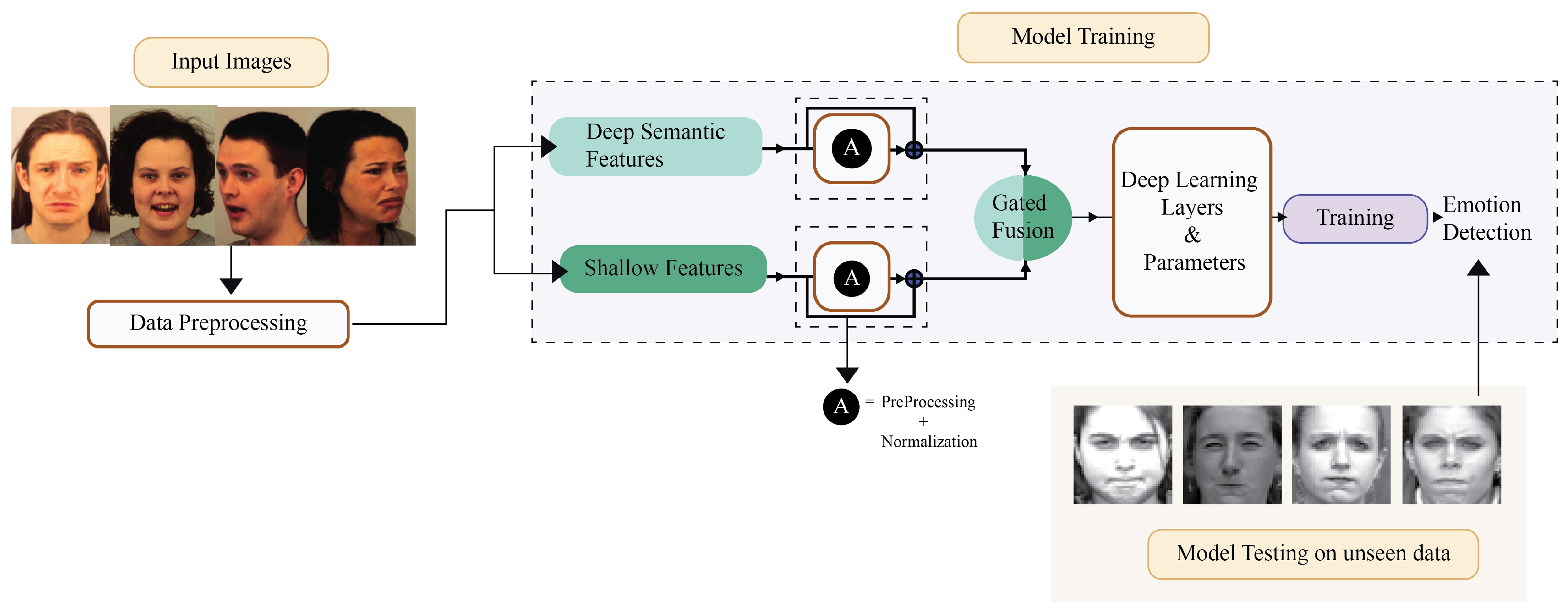
This section describes the experimental protocol, datasets, evaluation metrics, and quantitative results used to validate the proposed CA-GFNet framework. The overall experimental workflow is illustrated in Figure 7, highlighting the sequential stages from dataset selection and preprocessing to supervised training on KDEF and zero-shot cross-dataset evaluation on CK+.

4.1. Dataset

Two widely adopted benchmark datasets were employed to evaluate both in-domain performance and cross-dataset generalization: the Karolinska Directed Emotional Faces (KDEF) dataset [13], and the Extended Cohn–Kanade (CK+) dataset [14].
The KDEF dataset consists of facial images from 70 actors (35 male and 35 female), each displaying seven basic emotions: anger, disgust, fear, happiness, sadness, surprise, and neutral. Each expression is captured from five camera viewpoints. In this study, KDEF was used exclusively as the source dataset for supervised training and in-domain evaluation.
The CK+ dataset contains 396 image sequences from 123 subjects, captured under controlled laboratory conditions; each sequence begins with a neutral expression and ends at the peak emotional expression. The same seven emotion categories as KDEF were considered. CK+ was used solely for zero-shot cross-dataset evaluation where models trained on KDEF were directly tested on CK+ without any parameter updates, allowing for strict assessment of generalization under domain shift.
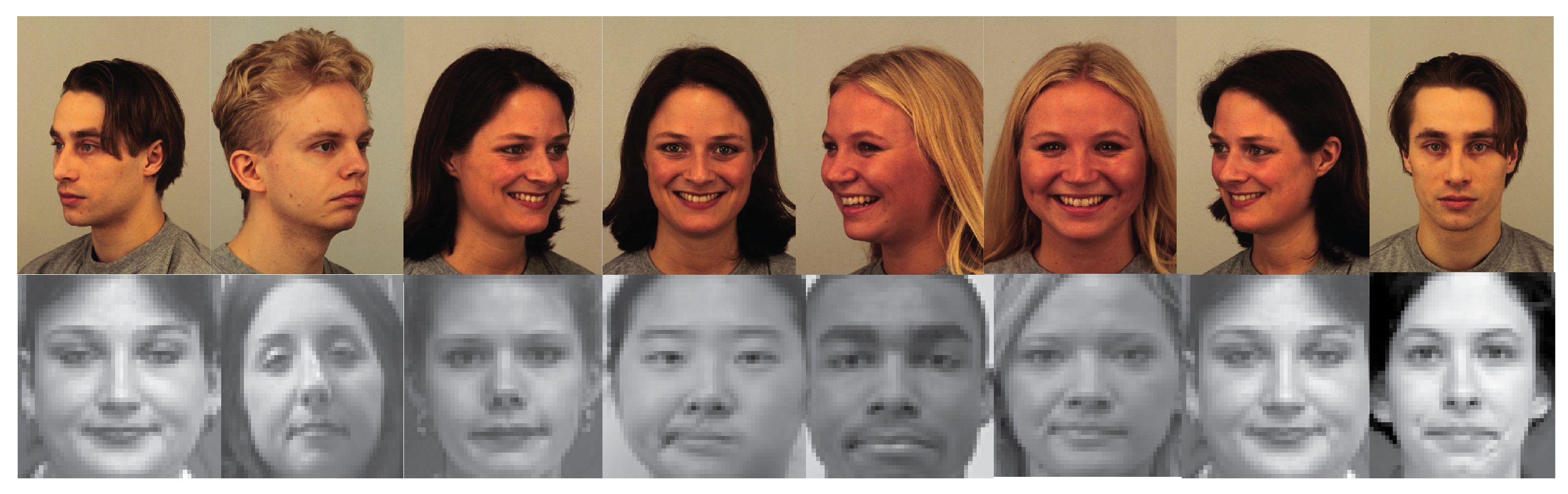
Sample images and dataset statistics are illustrated in Figure 8 and summarized in Table 1. Table 2 shows the per-class perfromance of the propsoed study.

4.2. Experimental Setup

All models were first trained on the KDEF dataset using a supervised learning setup. Training was performed for up to 40 epochs with a batch size of 32. The Adam optimizer was used with an initial learning rate of 1 × 10 3 , β 1 = 0.9 , β 2 = 0.999 , and ϵ = 1 × 10 7 . To improve generalization and reduce overconfidence, label smoothing with factor 0.1 was applied to the sparse categorical cross-entropy loss. Class weights were computed from the training data to mitigate minor class imbalance. A held-out validation split was used for model selection, and the checkpoint with the highest validation accuracy was retained.
To improve robustness to pose and illumination variation, augmentation was applied to the KDEF training subset only, comprising horizontal flipping ( p = 0.5 ), random rotation ( ± 10 ° ), and brightness and contrast adjustments (factor range [ 0.8 ,   1.2 ] ). No augmentation was applied during validation or cross-dataset evaluation. The complete preprocessing and hyperparameter configuration is summarized in Table 3.
To evaluate cross-dataset generalization, zero-shot testing was performed on the CK+ dataset. Models trained on KDEF were directly applied to CK+ without any parameter updates or domain adaptation. CK+ images were processed using the same preprocessing pipeline as KDEF, including face cropping, resizing, and normalization. This protocol isolates the effect of dataset shift by evaluating the model exclusively on knowledge learned from the source domain. For both datasets, performance was reported using accuracy, precision, recall, and F1-score.

4.3. Results and Discussion

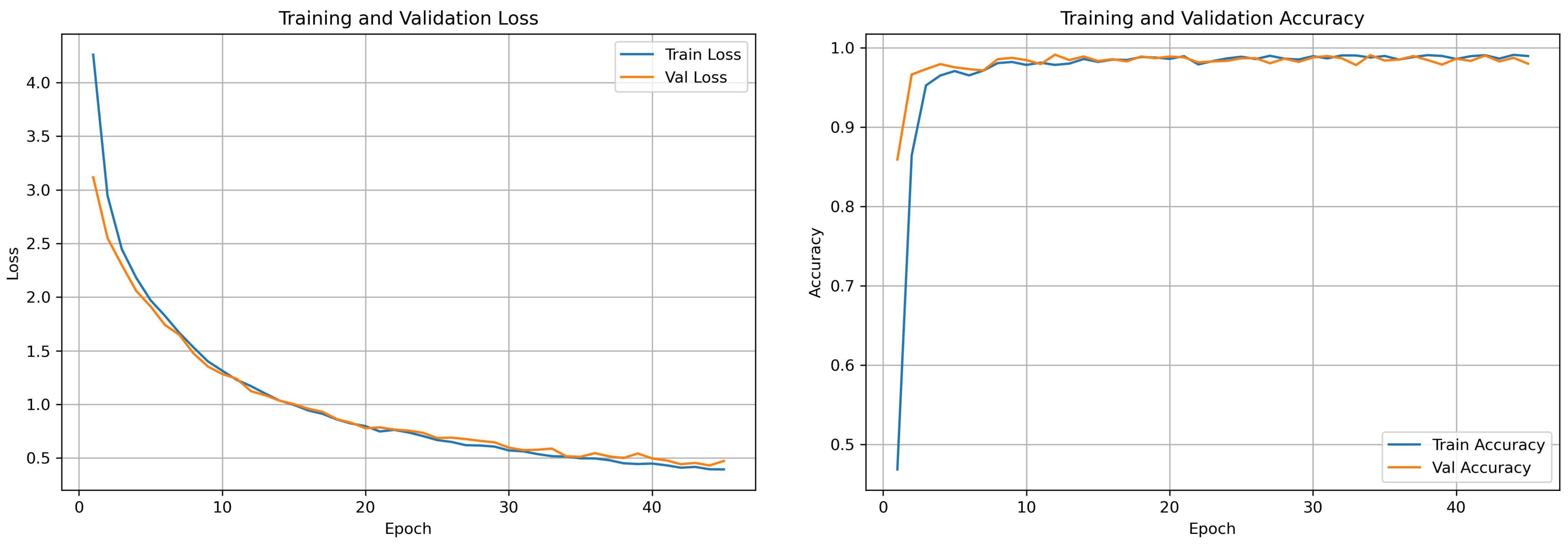
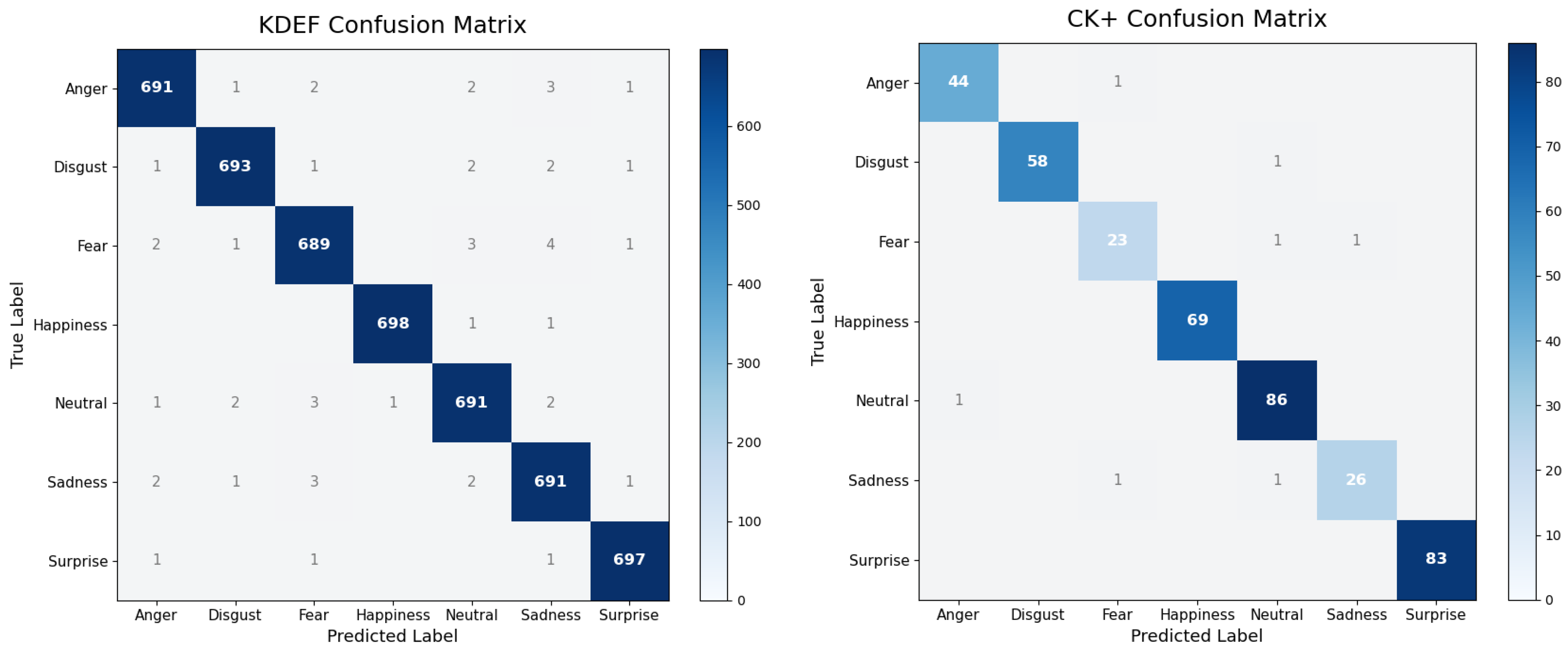
The proposed CA-GFNet was first evaluated on the KDEF dataset to assess the effectiveness of adaptive feature fusion. Compared to single-modality baselines, the fused HOG+VGG model achieved superior and more stable performance. Specifically, CA-GFNet achieved an accuracy of 97.72% with macro-precision of 97.83%, recall of 97.72%, and F1-score of 97.16%. These results indicate that adaptive gated fusion improves class balance and robustness beyond what is achievable using individual feature streams. The training and validation loss and accuracy curves for KDEF are shown in Figure 9, demonstrating smooth convergence across epochs. Figure 10 shows the confusion matrices of both the datasets.
Zero-shot evaluation on the CK+ dataset further highlights the generalization capability of CA-GFNet. Without any retraining, the fusion model consistently outperforms single-modality baselines and exhibits stable inference behavior. Compared to the zero-shot baseline, CA-GFNet achieves an improvement of approximately 1% in classification accuracy, confirming that adaptive fusion effectively exploits complementary geometric and semantic cues under domain shift.
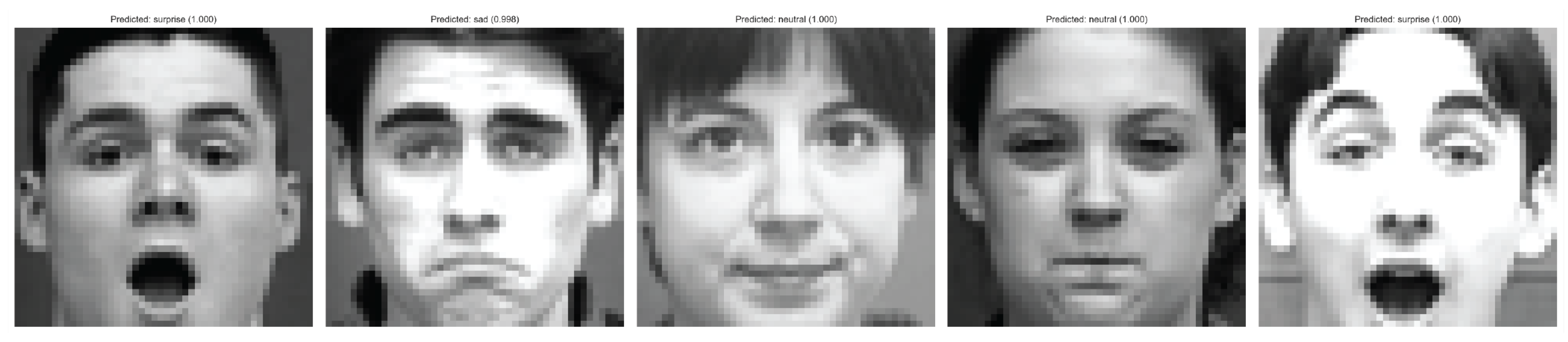
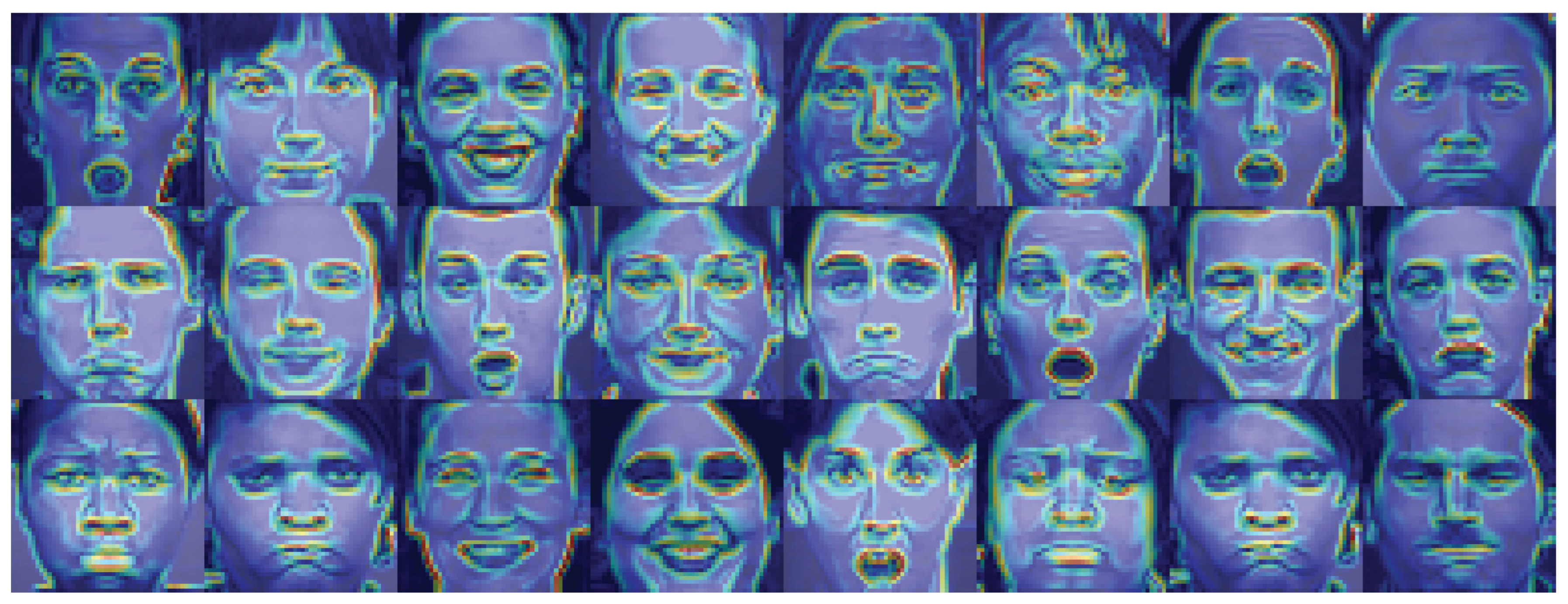
Figure 11 shows qualitative prediction results of the proposed model on the CK+ test dataset. Each sample shows the input facial expression image with ground truth emotion label and model prediction with confidence percentage. Correctly classified samples demonstrate the model’s ability to generalize across datasets. Figure 12 shows the visualized results, demonstrating that the proposed network effectively localizes the face region, especially in complex data. These results validate the efficacy and reliability of the proposed CA-GFNet for facial emotion classification, particularly when handling complex data.

4.4. Ablation Study

An ablation study was conducted to quantify the contribution of individual feature modalities and assess the effectiveness of their fusion under a zero-shot cross-dataset protocol (Table 4). All variants were trained on KDEF and evaluated on both KDEF and CK+. Three configurations were examined: a HOG-only model, a VGG-only model, and the proposed CA-GFNet with adaptive gated fusion.
On KDEF, the HOG-only model achieves 97.72% accuracy, outperforming the VGG-only model (95.92%). This indicates that structural features remain highly discriminative in controlled settings. CA-GFNet delivers the best performance, reaching 98.61% accuracy with consistently higher precision, recall, and F1-score, demonstrating the benefit of integrating complementary shallow and deep representations. Under zero-shot evaluation on CK+, both single-stream baselines generalize reasonably (96.98% accuracy), while CA-GFNet further improves performance to 97.97%, achieving the highest precision and recall. These results confirm that adaptive fusion effectively exploits complementary information and enhances robustness under dataset shift, yielding superior performance in both in-distribution and cross-dataset scenarios.

Model Variants

To isolate the contribution of each feature stream and their interaction, the following model variants were evaluated:
  • HOG-only: Uses only Histogram of Oriented Gradients (HOG) descriptors as input to the classifier. The VGG branch and fusion module are disabled, yielding a purely structural-feature baseline.
  • VGG-only: Uses only deep features extracted from the final convolutional block of a VGG-16 network. The HOG branch is removed, resulting in a purely deep-semantic baseline.
  • HOG–VGG Gated Fusion (Proposed): Activates both feature streams. HOG and VGG features are projected into a shared latent space and adaptively combined using the gated fusion module to produce a unified representation for classification.
All variants share the same classifier head, training protocol, and hyperparameters; only the feature extraction and fusion components differ.

4.5. Comparative Analysis of Accuracy

This section compares the classification accuracy CA-GFNet to recent state-of-the-art FER methods on the KDEF and CK+ datasets. Table 5 reports the most recent CNN- and transformer-based approaches on KDEF, typically achieving accuracy results between 93.5% and 98.0% [15,18,23,24,29]. In contrast, our proposed CA-GFNet attains 99.30% accuracy on KDEF, surpassing all competing methods and improving upon the best prior result by a clear margin despite relying on lightweight structural features. Where many deep models report near-saturated accuracy results on CK+ under controlled conditions, CA-GFNet achieves 98.98%, remaining within approximately 1% of the best-reported results while using substantially fewer parameters and lower computational complexity. Overall, this comparison demonstrates that CA-GFNet establishes a new state of the art on KDEF and remains highly competitive on CK+, confirming that carefully designed gradient-based structural representations can rival or exceed much heavier deep architectures.

4.6. Comparative Analysis of Precision, Recall, and F1-Score

This section compares CA-GFNet with recent state-of-the-art FER methods in terms of precision, recall, and F1-score on the KDEF and CK+ datasets. On KDEF, most CNN- and transformer-based approaches achieve balanced F1-scores in the range of 0.92–0.96 [15,23,24,29]. In contrast, CA-GFNet attains the highest overall balance, achieving a precision of 0.97, recall of 0.98, and F1-score of 0.97, indicating superior class-wise consistency despite its lightweight design. On CK+, several deep models report near-saturated metrics under controlled conditions; CA-GFNet achieves 0.95 precision, recall, and F1-score, remaining competitive while requiring substantially fewer parameters and lower computational cost than transformer- or NAS-based methods [31,33]. Table 6 demonstrates that CA-GFNet offers a favorable tradeoff between robustness, efficiency, and generalization, making it suitable for practical FER deployment.

5. Discussion

The results summarized in Table 7 and Table 8 confirm the main contributions of this study. Table 7 shows that many existing FER models achieve strong accuracy but often require high computational cost, large parameter counts, or slower inference, which limits their practicality. In contrast, our proposed CA-GFNet is designed to provide a better balance between efficiency and recognition performance. Table 8 further shows that the proposed method maintains strong cross-database performance under the strict train-on-KDEF/test-on-CK+ protocol, with only a small performance drop when compared to in-domain accuracy. This is important because KDEF and CK+ differ in subjects, image characteristics, and expression patterns, making cross-dataset testing more challenging than matched evaluation. Overall, these findings indicate that combining structural gradient-based cues with deep semantic features through cross-attention and adaptive gated fusion can improve robustness to domain shift while keeping the framework lightweight and practical. Therefore, the proposed CA-GFNet provides an effective and efficient solution for cross-database facial emotion recognition.

6. Conclusions

This study presents a lightweight yet competitive FER framework centered on discriminative HOG features and a compact classifier, with additional analysis of deep VGG features and their adaptive gated fusion within CA-GFNet. Under a strict train-on-KDEF/test-on-CK+ protocol, the proposed model achieves state-of-the-art performance on KDEF (99.30% accuracy) and highly competitive results on CK+ (98.98%) while also attaining the best balance of precision, recall, and F1-score on the source dataset. These results demonstrate that when combined with principled fusion mechanisms, carefully designed shallow structural descriptors can rival or surpass substantially heavier CNN- and transformer-based models while offering superior efficiency, interpretability, and deployability. Ablation studies further confirm that adaptive gated fusion is critical, as naïve feature combination does not consistently improve cross-dataset robustness. Although the current evaluation was limited to controlled laboratory datasets and basic emotion categories, our proposed approach establishes a strong and efficient baseline for FER and highlights the continued relevance of shallow features. Future work will extend this framework to in-the-wild datasets and explore stronger cross-attention and domain alignment strategies to further improve robustness under real-world conditions.

Author Contributions

S.A.: conceptualization, methodology, software, formal analysis, investigation, data curation, visualization, writing—original draft preparation; J.-H.L.: supervision, project administration, funding acquisition, writing—review and editing. All authors have read and agreed to the published version of the manuscript.

Funding

This research was supported by a grant of the Korea Health Technology R&D Project through the Korea Health Industry Development Institute (KHIDI), funded by the Ministry of Health & Welfare, Republic of Korea (grant number: HI23C0942, RS-2024-00433896), Korea Basic Science Institute (National research Facilities and Equipment Center) grant funded by the Ministry of Education (grant no. 2020R1A6C101B189), Digital Innovation Hub project supervised by the Daegu Digital Innovation Promotion Agency (DIP) grant funded by the Korea government (MSIT and Daegu Metropolitan City) in 2023(25DIH-17) and Regional Innovation System & Education (RISE) program through the Daegu RISE Center, funded by the Ministry of Education (MOE) and the Daegu, Republic of Korea (2025-RISE-03-002).

Data Availability Statement

All data were derived from publicly available resources. The datasets used in this study are available through the Kaggle database: the CK+ dataset at CK+ Dataset, https://www.kaggle.com/datasets/davilsena/ckdataset (accessed on 10 March 2026) and the KDEF dataset at KDEF Database, https://www.kaggle.com/datasets/chenrich/kdef-database (accessed on 10 March 2026) corresponding to Refs. [13,14], respectively. These datasets were obtained from public-domain resources and accessed through the above Kaggle repository pages.

Conflicts of Interest

The authors declare no conflicts of interest.

Abbreviations

The following abbreviations are used in this manuscript:
CA-GFNETCross-Attention Gated Fusion Network
FERFacial Emotion Recognition
HCIHuman–Computer Interaction
CNNConvolutional Neural Network
HOGHistogram of Oriented Gradients
PCAPrincipal Component Analysis
CAChannel Attention
KDEFKarolinska Directed Emotional Faces
CK+Extended Cohn–Kanade dataset

References

  1. Wang, H.; Xu, L.; Ding, W.; Xu, Y. Sliced Wasserstein Weighted Multimodal MambaVision for Emotion Recognition. Knowl.-Based Syst. 2025, 327, 114182. [Google Scholar] [CrossRef]
  2. Lim, J.S.; Hong, N.; Schneider, E. How warm-versus competent-toned AI apologies affect trust and forgiveness through emotions and perceived sincerity. Comput. Hum. Behav. 2025, 172, 108761. [Google Scholar] [CrossRef]
  3. Ocal, A. Cinematic Narratives as Socio-Technical Systems: Emotion Mining and Script–Audience Emotional Fidelity. Systems 2025, 13, 994. [Google Scholar] [CrossRef]
  4. Fu, L.; Wan, Y.; Zou, G. Agent-Poster: A Multi-Scale Feature Fusion Emotion Recognition Model Based on an Agent Attention Mechanism. Information 2025, 16, 982. [Google Scholar] [CrossRef]
  5. Li, Y.; Wang, M.; Gong, M.; Lu, Y.; Liu, L. Fer-former: Multimodal transformer for facial expression recognition. IEEE Trans. Multimed. 2024, 27, 2412–2422. [Google Scholar] [CrossRef]
  6. Zhu, Y.; Ai, J.; Xue, W.; Wu, M.; Yang, S.; Jia, W.; Hu, M. Cross-domain facial expression recognition: Bi-Directional Fusion of Active and Stable Information. Eng. Appl. Artif. Intell. 2025, 149, 110357. [Google Scholar] [CrossRef]
  7. Mao, J.; Xu, R.; Yin, X.; Chang, Y.; Nie, B.; Huang, A.; Wang, Y. POSTER++: A Simpler and Stronger Facial Expression Recognition Network. Pattern Recognit. 2025, 157, 110951. [Google Scholar] [CrossRef]
  8. Wang, S.; Liu, Q. Unsupervised Cross-Domain Facial Expression Recognition via Class Adaptive Self-Training. IEEE Trans. Affect. Comput. 2025, 16, 1618–1630. [Google Scholar] [CrossRef]
  9. Nawaz, U.; Saeed, Z.; Atif, K. A Novel Transformer-Based Approach for Adult’s Facial Emotion Recognition. IEEE Access 2025, 13, 56485–56508. [Google Scholar] [CrossRef]
  10. López-Echeverry, A.M.; López-Flórez, S.; Bedoya-Guapacha, J.; De-La-Prieta, F. EmotiCloud: Cloud System to Monitor Patients Using AI Facial Emotion Recognition. Systems 2025, 13, 750. [Google Scholar] [CrossRef]
  11. Cui, M.X.; He, K.H.; Wang, F.; Paik, J.K. Human Digital Healthcare Engineering for Enhancing the Health and Well-Being of Seafarers and Offshore Workers: A Comprehensive Review. Systems 2025, 13, 335. [Google Scholar] [CrossRef]
  12. Li, H.; Yang, H.; Huang, D. CoupleFER: Dynamic Cross-Modal Fusion via Prompt Learning for Improved 2D+3D FER. IEEE Trans. Affect. Comput. 2025, 16, 3154–3168. [Google Scholar] [CrossRef]
  13. Lundqvist, D.; Flykt, A.; Öhman, A. The Karolinska Directed Emotional Faces (KDEF); CD ROM; Karolinska Institute, Department of Clinical Neuroscience, Psychology Section: Stockholm, Sweden, 1998; ISBN 91-630-7164-9. [Google Scholar]
  14. Lucey, P.; Cohn, J.F.; Kanade, T.; Saragih, J.; Ambadar, Z.; Matthews, I. The Extended Cohn-Kanade (CK+) Dataset: A complete dataset for action unit and emotion-specified expression. In Proceedings of the IEEE Conference on Computer Vision and Pattern Recognition Workshops (CVPRW); IEEE: New York, NY, USA, 2010; pp. 94–101. [Google Scholar] [CrossRef]
  15. Elsheikh, R.A.; Mohamed, M.A.; Abou-Taleb, A.M.; Ata, M.M. Improved facial emotion recognition model based on a novel deep convolutional structure. Sci. Rep. 2024, 14, 29050. [Google Scholar] [CrossRef]
  16. Huang, Z.-Y.; Chiang, C.-C.; Chen, J.-H.; Chen, Y.-C.; Chung, H.-L.; Cai, Y.-P.; Hsu, H.-C. A Study on Computer Vision for Facial Emotion Recognition. Sci. Rep. 2023, 13, 8425. [Google Scholar] [CrossRef]
  17. Qian, C.; Lobo Marques, J.A.; de Alexandria, A.R.; Fong, S.J. Application of Multiple Deep Learning Architectures for Emotion Classification Based on Facial Expressions. Sensors 2025, 25, 1478. [Google Scholar] [CrossRef]
  18. Tian, Y.; Zhu, J.; Yao, H.; Chen, D. Facial Expression Recognition Based on Vision Transformer with Hybrid Local Attention. Appl. Sci. 2024, 14, 6471. [Google Scholar] [CrossRef]
  19. Li, N.; Huang, Y.; Wang, Z.; Fan, Z.; Li, X.; Xiao, Z. Enhanced Hybrid Vision Transformer with Multi-Scale Feature Integration and Patch Dropping for Facial Expression Recognition. Sensors 2024, 24, 4153. [Google Scholar] [CrossRef] [PubMed]
  20. Song, D.; Liu, C. A Facial Expression Recognition Network Using Hybrid Feature Extraction. PLoS ONE 2025, 20, e0312359. [Google Scholar] [CrossRef] [PubMed]
  21. Tagmatova, Z.; Umirzakova, S.; Kutlimuratov, A.; Abdusalomov, A.; Im Cho, Y. A Hyper-Attentive Multimodal Transformer for Real-Time and Robust Facial Expression Recognition. Appl. Sci. 2025, 15, 7100. [Google Scholar] [CrossRef]
  22. Nemati, R.; Shirini, K.; Gharehveran, S.S. FER-HA: A hybrid attention model for facial emotion recognition. J. Supercomput. 2025, 81, 1485. [Google Scholar] [CrossRef]
  23. Duongthang, L. Driver facial emotion tracking using an enhanced residual network with weighted fusion of channel and spatial attention. Sci. Rep. 2025, 15, 12675. [Google Scholar] [CrossRef] [PubMed]
  24. Yalçin, N.; Alisawi, M. Introducing a novel dataset for facial emotion recognition and demonstrating significant enhancements in deep learning performance through pre-processing techniques. Heliyon 2024, 10, e38913. [Google Scholar] [CrossRef] [PubMed]
  25. Ma, H.; Lei, S.; Li, H.C.; Celik, T. FER-VMamba: A robust facial expression recognition framework with global compact attention and hierarchical feature interaction. Inf. Fusion 2025, 124, 103371. [Google Scholar] [CrossRef]
  26. Shu, K.L.; Wang, M.-J.-S. Multi-Domain Feature Enhancement and Fusion Transformer with Bilateral Facial Structure Awareness for Robust and Cross-Domain Facial Expression Recognition. Preprints 2025. [Google Scholar] [CrossRef]
  27. Dalal, N.; Triggs, B. Histograms of Oriented Gradients for Human Detection. In Proceedings of the IEEE Conference on Computer Vision and Pattern Recognition (CVPR); IEEE: New York, NY, USA, 2005; pp. 886–893. [Google Scholar] [CrossRef]
  28. Arevalo, J.; Solorio, T.; Montes-y Gómez, M.; González, F.A. Gated Gated multimodal networks. Neural Comput. Appl. 2020, 32, 10209–10228. [Google Scholar] [CrossRef]
  29. Aly, M. Revolutionizing online education: Advanced facial expression recognition for real-time student progress tracking via deep learning model. Multimed. Tools Appl. 2025, 84, 12575–12614. [Google Scholar] [CrossRef]
  30. Chen, J.; Chen, N. A framework for facial expression recognition combining contextual information and attention mechanism (VGGNet16-CBAM). J. Inf. Process. Syst. 2024, 20, 535–549. [Google Scholar] [CrossRef]
  31. Yousafzai, S.N.; Nasir, I.M.; Saidani, O.; Ghodhbani, R.; Gu, Y.; Syafrudin, M.; Fitriyani, N.L. A multi-scale simplicial transformer with graph attention for facial emotion recognition. Ain Shams Eng. J. 2025, 16, 103584. [Google Scholar] [CrossRef]
  32. Liu, J.W.; Lin, X.Y.; Ji, P.F.; Chen, J.M.; Zhang, J. Multiscale wavelet attention convolutional network for facial expression recognition. Sci. Rep. 2025, 15, 22219. [Google Scholar] [CrossRef]
  33. Fan, J.; Deng, S.; Song, X.; Liu, J.; Sun, Y. A gradient-based lightweight network automated design method for facial expression recognition. Expert Syst. Appl. 2025, 296, 129130. [Google Scholar] [CrossRef]
  34. Kumar, R.; Corvisieri, G.; Fici, T.F.; Hussain, S.I.; Tegolo, D.; Valenti, C. Transfer Learning for Facial Expression. Information 2025, 16, 320. [Google Scholar] [CrossRef]
  35. Singh, E.; Nand, P. Enhancing emotion recognition in controlled environments with YoLoNetv8. J. Integr. Sci. Technol. 2025, 13, 1010. [Google Scholar] [CrossRef]
  36. Ramirez-Quintana, J.A.; Muñoz-Pacheco, J.J.; Ramirez-Alonso, G.; Medrano-Hermosillo, J.A.; Corral-Saenz, A.D. Lightweight Convolutional Neural Network with Efficient Channel Attention Mechanism for Real-Time Facial Emotion Recognition in Embedded Systems. Sensors 2025, 25, 7264. [Google Scholar] [CrossRef]
  37. Xu, X.; Liu, C.; Cao, S.; Lu, L. A High-Performance and Lightweight Framework for Real-Time Facial Expression Recognition. IET Image Process. 2023, 17, 3500–3509. [Google Scholar] [CrossRef]
  38. Kalsum, T.; Mehmood, Z. A Novel Lightweight Deep Convolutional Neural Network Model for Human Emotions Recognition in Diverse Environments. J. Sens. 2023, 2023, 6987708. [Google Scholar] [CrossRef]
  39. Tammina, S. Transfer learning using vgg-16 with deep convolutional neural network for classifying images. Int. J. Sci. Res. Publ. IJSRP 2019, 9, 143–150. [Google Scholar] [CrossRef]
  40. Koonce, B. ResNet 50. In Convolutional Neural Networks with Swift for Tensorflow: Image Recognition and Dataset Categorization; Apress: Berkeley, CA, USA, 2021; pp. 63–72. [Google Scholar]
  41. Tan, M.; Le, Q. Efficientnet: Rethinking model scaling for convolutional neural networks. In Proceedings of the International Conference on Machine Learning, Long Beach, CA, USA, 9–15 June 2019; pp. 6105–6114. [Google Scholar]
  42. Aly, M.; Alotaibi, N.S. A Comprehensive Deep Learning Framework for Real Time Emotion Detection in Online Learning Using Hybrid Models. Sci. Rep. 2025, 15, 42012. [Google Scholar] [CrossRef]
  43. Alzahrani, A.O.; Alghamdi, A.M.; Ashraf, M.U.; Ilyas, I.; Sarwar, N.; Alzahrani, A.; Alarood, A.A.S. A Novel Facial Expression Recognition Framework Using Deep Learning Based Dynamic Cross-Domain Dual Attention Network. PeerJ Comput. Sci. 2025, 11, e2866. [Google Scholar] [CrossRef]
  44. Guo, Z.; Wei, B.; Liu, J.; Liu, X.; Zhang, Z.; Wang, Y. USTST: Unsupervised Self-Training Similarity Transfer for Cross-Domain Facial Expression Recognition. Multimed. Tools Appl. 2024, 83, 41703–41723. [Google Scholar] [CrossRef]
  45. Guo, Z.; Wei, B.; Cai, Q.; Liu, J.; Wang, Y. POST: Prototype-Oriented Similarity Transfer Framework for Cross-Domain Facial Expression Recognition. Comput. Animat. Virtual Worlds 2024, 35, e2260. [Google Scholar] [CrossRef]
  46. Debnath, T.; Reza, M.M.; Rahman, A.; Beheshti, A.; Band, S.S.; Alinejad-Rokny, H. Four-layer ConvNet to Facial Emotion Recognition with Minimal Epochs and the Significance of Data Diversity. Sci. Rep. 2022, 12, 6991. [Google Scholar] [CrossRef] [PubMed]
  47. Ghaedi, R.; BabaAhmadi, A.; Zwiggelaar, R.; Fan, X.; Alam, N. Graph-Attention Network with Adversarial Domain Alignment for Robust Cross-Domain Facial Expression Recognition. arXiv 2025, arXiv:2512.00641. [Google Scholar]
  48. Zavarez, M.V.; Berriel, R.F.; Oliveira-Santos, T. Cross-Database Facial Expression Recognition Based on Fine-Tuned Deep Convolutional Network. In Proceedings of the 2017 30th SIBGRAPI Conference on Graphics, Patterns and Images (SIBGRAPI); IEEE: New York, NY, USA, 2017; pp. 405–412. [Google Scholar] [CrossRef]
Figure 1. Overall graphical representation of the proposed study.
Mathematics 14 01068 g001
Figure 2. Graphical representation of VGG16 network.
Mathematics 14 01068 g002
Figure 3. Example facial images from the KDEF dataset. Top row: VGG-based samples. Bottom row: original RGB images.
Mathematics 14 01068 g003
Figure 4. Sample images from the HOG-KDEF dataset. The bottom row shows original RGB images, while the top row shows the sample of shallow-features.
Mathematics 14 01068 g004
Figure 5. Gated fusion module combining features.
Mathematics 14 01068 g005
Figure 6. Architectural comparison of the deep-only, late-fusion, domain adaptation, and proposed FER frameworks.
Mathematics 14 01068 g006
Figure 7. Overall experimental workflow of the proposed CA-GFNet framework.
Mathematics 14 01068 g007
Figure 8. Sample images from the dataset. Top Row: KDEF. Bottom Row: CK+ datasets.
Mathematics 14 01068 g008
Figure 9. Training and validation loss curves for the proposed model on the KDEF dataset.
Mathematics 14 01068 g009
Figure 10. Confusion matrices of the proposed model for the KDEF and CK+ datasets.
Mathematics 14 01068 g010
Figure 11. Prediction results of the proposed model on the CK+ test dataset.
Mathematics 14 01068 g011
Figure 12. Grad-CAM visualization of the CK+ test data.
Mathematics 14 01068 g012
Table 1. Dataset statistics for KDEF and CK+.
Emotion ClassKDEFCK+
Samples Total Images
Anger700490045
Disgust700 59
Fear700 25
Happiness700 69
Neutral700 87
Sadness700 28
Surprise700 83
Table 2. Per-class precision, recall, and F1-score for the fused HOG+VGG model on the KDEF and CK+ datasets.
Emotion ClassKDEF (Training)CK+ (Cross-Dataset Test)
Precision (%) Recall (%) F1 (%) Precision (%) Recall (%) F1 (%)
Anger99.0098.7198.8697.7897.7897.78
Disgust99.2899.0099.14100.0098.3199.15
Fear98.5798.4398.5092.0092.0092.00
Happiness99.8699.7199.79100.00100.00100.00
Neutral98.5798.7198.6496.6398.8597.73
Sadness98.1598.7198.4396.3092.8694.55
Surprise99.4399.5799.50100.00100.00100.00
Macro Average98.9898.9898.9897.5397.1197.32
Table 3. Complete implementation and hyperparameter summary for reproducibility.
ParameterValue
Preprocessing
Image resize 224 × 224
Face detectionNone (controlled laboratory datasets)
Landmark alignmentNone
CroppingNone (full image used)
HOG configuration
Orientation bins9
Pixels per cell 8 × 8
Cells per block 2 × 2
Block normalisationL2-Hys
imageGrayscale, 224 × 224 px
Feature dimension26,244
VGG16
Pre-trainingImageNet
Top layersRemoved
PoolingGlobal average pooling
Output dimension512
Weights frozenYes
Training KDEF
OptimiserAdam
β 1 , β 2 0.9, 0.999
ϵ 1 × 10 7 (framework default)
Learning rate 1 × 10 3
Batch size32
Max epochs40
Data splitStratified 80:20, random seed = 42
Loss functionSparse categorical cross-entropy
Early stoppingPatience = 10 (monitored: val. accuracy)
LR reductionFactor = 0.5, patience = 5 epochs
Model selectionBest validation accuracy checkpoint
Augmentation (KDEF training only)
Horizontal flip p = 0.5
Rotation range ± 10 °
Brightness factor [ 0.8 ,   1.2 ]
Contrast factor [ 0.8 ,   1.2 ]
Applied to val/testNo
Cross-dataset evaluation—CK+
ProtocolZero-shot (no parameter updates)
PreprocessingIdentical pipeline to KDEF
Normalisation statsFrom KDEF training subset only
Table 4. Ablation study comparing HOG-only, VGG-only, and fused HOG+VGG configurations on the KDEF and CK+ datasets. ✓ indicates the use of the feature.
DatasetHOGVGGAccuracyPrecisionRecallF1-Score
KDEF 0.97720.97340.97720.9698
KDEF 0.95920.94900.95920.9504
KDEF0.98610.98650.98610.9764
CK+ 0.96980.94510.94590.9454
CK+ 0.96980.95550.94030.9446
CK+0.97970.94720.94910.9324
Table 5. Accuracy comparison of recent FER methods on the KDEF and CK+ datasets.
No.MethodYearKDEF (%)CK+ (%)
1AA-DCN [15]202496.0099.26
2HLA-ViT [18]202496.5098.50
3ResNet50+CBAM+TCN [29]202497.0895.85
4FARNet [23]202597.50100.00
5EfficientNet-XGBoost [24]202498.00100.00
6VGGNet16-CBAM [30]202494.0098.66
7Multi-Scale Simplicial Transformer [31]202596.0098.54
8Hybrid Vision Transformer [19]202495.5098.00
9CA-MCNN [32]202596.8096.50
10GLA-FERNet [33]202595.0097.00
11VGG-19 + ResNet-152 [34]202593.5096.00
12YOLOv8-based FER [35]202594.0095.50
Proposed CA-GFNet202699.3098.98
Table 6. Comparison of recent FER methods on the KDEF and CK+ datasets in terms of precision, recall, and F1-score.
No.MethodYearKDEFCK+
Prec. Rec. F1 Prec. Rec. F1
1AA-DCN [15]20240.950.940.950.990.980.99
2ResNet50+CBAM+TCN [29]20240.940.950.940.940.930.94
3VGGNet16-CBAM [30]20240.920.910.920.970.960.97
4HLA-ViT [18]20240.940.930.940.970.960.97
5FARNet [23]20250.960.950.960.990.990.99
6Multi-Scale Simplicial Transformer [31]20250.930.930.940.970.970.97
7EfficientNet-XGBoost [24]20240.950.960.950.990.990.99
8Hybrid Vision Transformer [19]20240.930.920.930.960.960.96
9CA-MCNN [32]20250.940.940.940.950.940.95
Proposed CA-GFNet20260.990.990.980.950.950.93
Table 7. Comparison of model complexity, inference efficiency, and KDEF performance.
MethodParamFLOPsInferenceKDEF (%)
LiExNet [36]42 K (0.04 M)86 MFLOPs>530 FPS (Jetson TX2)88.2
RepVGG + MobileViT + CapsNet [37]0.95 M294.6 MFLOPsReal-time97.53
Lightweight DCNN (GZS-ConvNet) [38]ReportedReduced FLOPs reportedN/A99.25
FARNet [23]∼3.05 MNot reportedN/A97.5
VGG16 [39]138.34 M30.94Slow96.0
ResNet50 [40]25.6 M4.1 GFLOPs∼30 ms GPU∼96–97
EfficientNet-B0 [41]5.3 M390 MFLOPs∼8 ms GPU96.05%
Our Proposed5.7 M4.0 M11–14 GPU99.30%
Table 8. Cross-domain facial expression recognition studies (source, targets, and reported performance).
No.ResearchMethodSource DataTarget DataIn-Domain AccuracyCross-Domain AccuracyDrop
1Elsheikh et al. [15]AA-DCN (Anti-Alias Deep CNN)CK+JAFFE/RAF-DB99.26%98.00%1.26%
2Aly et al. [42]ResNet50 + 3D CNN (DCNN)KDEFCK+98.53%97.29%1.24%
3Alzahrani et al. [43]DCD-DANFERPlusRAF-DB
AffectNet
ExpW
SFEW 2.0
JAFFE
92.37%RAF-DB: 93%
AffectNet: 73%
ExpW: 78%
SFEW 2.0: 64%
JAFFE: 62%
−0.81%
18%
14%
27%
29%
4Guo et al. [44]USTSTRAF-DBCK+87.79%79.60%8.19%
5Guo et al. [45]POSTRAF-DBCK+88.00%87.00%1.00%
6Debnath et al. [46]Four-layer ConvNetFER2013CK+
JAFFE
91.00%CK+: 98.13%
JAFFE: 92.05%
−7.13%
−1.05%
7Ghaedi et al. [47]GAT-ADARAF-DBFER201382.00%98.00%−16.00%
8Zavarez et al. [48]VGG-Face fine-tuned deep CNNMulti-sourceCross-database protocol-CK+: 88.58%
MMI: 67.03%
RaFD: 85.97%
KDEF: 72.55%
JAFFE: 48.67%
-
9Our ProposedCA-GFNetKDEFCK+99.00%98.00%1.00%
Disclaimer/Publisher’s Note: The statements, opinions and data contained in all publications are solely those of the individual author(s) and contributor(s) and not of MDPI and/or the editor(s). MDPI and/or the editor(s) disclaim responsibility for any injury to people or property resulting from any ideas, methods, instructions or products referred to in the content.