1. Introduction
Special functions constitute a central component of modern complex analysis and play an essential role in many areas of pure and applied mathematics. They frequently arise in the solution of differential and integral equations and provide powerful analytical tools for mathematical modeling in physics, engineering, and statistical sciences. In recent years, the growing interest in fractional calculus, integral transforms, and generalized operators has further increased the relevance of special function theory in both theoretical investigations and practical applications [
1,
2].
Among the classical special functions, the Euler Beta function occupies a prominent position due to its rich analytical structure and wide applicability. For complex parameters
and
with positive real parts, it is defined by the integral representation [
3]
Remarkably, the Beta function is closely connected to the Gamma function through the identity [
1]
where the Gamma function is given by
These fundamental relations highlight the importance of the Beta function in analytic theory and in probability and statistics, particularly in connection with Beta-type distributions.
The systematic study of extensions of the Euler Beta function was initiated by Chaudhry et al. [
3] in 1994. In their work, they introduced a generalized form of the Gamma function defined by
which extends the classical Gamma function by incorporating an additional parameter
. Associated with the generalized Gamma function in (4), Chaudhry et al. [
3] also defined the Pochhammer symbol, or shifted factorial, by
where
and
.
Subsequently, in 1997, Choudhary et al. [
4] proposed an extension of the Euler Beta function based on this generalized framework. Their extended Beta function is defined by
This formulation generalizes the classical Euler Beta function and has been shown to be useful in various analytical and statistical applications.
The Wright function is one of the important special functions that plays a significant role in the analysis of linear fractional partial differential equations. It was first investigated in connection with problems in number theory related to the asymptotic behavior of certain partitions of natural numbers [
5,
6]. Since then, this function has attracted considerable attention and has been extensively studied in the context of fractional-order differential equations.
In particular, the Wright function naturally arises in boundary value problems associated with fractional diffusion–wave equations. These equations are obtained from the classical diffusion or wave equations by replacing the first- or second-order time derivatives with fractional derivatives of order α, where 0 < α < 2. It has been shown that the corresponding Green’s functions for such problems can be expressed in terms of the Wright function.
Moreover, by extending Lie group methods to fractional partial differential equations, several authors have demonstrated that certain group-invariant solutions can be represented using the Wright and generalized Wright functions [
7]. This further highlights the analytical importance of this function in the study of fractional systems.
A comprehensive collection of formulas, properties, and applications of the Wright function can be found in the Bateman Project handbook by Erdélyi et al. [
8,
9,
10] and in subsequent works [
7,
11,
12,
13,
14,
15,
16,
17].
In this context, the theory of the Wright function plays a fundamental role in the construction of new classes of special functions. It is defined by [
5]:
The Wright function is an entire function and is sometimes referred to as the generalized Bessel or Bessel–Maitland function [
18,
19]. It admits two important auxiliary functions, given by
and
The function
is commonly known as the Mainardi function [
20,
21] and plays a key role in fractional diffusion processes.
Furthermore, a generalized form of the Wright function was investigated in [
22]. For real α and complex parameters
;
,
, it is defined for
, by
Motivated by the analytical flexibility of the Wright function, several authors have employed it to construct new extensions of the Euler Beta function [
23,
24]. For instance, Ata [
25] introduced in 2018 the following Wright-based extension:
Later, Ijaz [
26] proposed in 2023 another generalized Beta function involving two Wright kernels, defined by
In the same year, Moureh and Al-Janaby [
27] introduced another extension of the Beta function
, defined by
These formulations illustrate the effectiveness of Wright-type kernels in generating flexible and analytically tractable extensions of the classical Euler Beta function.
In 2024, Ghanim et al. [
28] introduced a new extension of the Euler Beta function, referred to as the Euler Beta–Mittag-Leffler–Kummer function, which is defined by
Subsequently, in 2025, Abdulnabi et al. [
29] proposed another extension of the Euler Beta function given by
where
These extensions further demonstrate the flexibility of kernel-based approaches in constructing generalized Beta-type functions.
Remark 1. For suitable choices of the involved parameters, the generalized Beta functions defined in Equations (10)–(14) reduce to the classical Euler Beta function. In particular, the following special cases hold:
For and in (9), it yields Equation (1), For = 1
and in (10), it reduces to Equation (1), For = 0
and in (11), it reduces to Equation (1) For = 0
and in (12), it reduces to Equation (1), For = 1
and in (13), it reduces to Equation (1),
These reductions confirm the consistency of the generalized formulations with the classical theory.
In addition, Moureh and Al-Janaby [27] introduced in 2023 the following generalized special function:which is convergent in the open unit disk This function has been shown to be useful in constructing generalized integral operators and extended special functions.
2. Proposed Generalized R-Function
In this section, we introduce a new generalized Wright-type function constructed by combining the generalized Wright function
defined in (9) with the function
in (15). This new function is denoted by
and is defined through the product of the corresponding power series as follows:
Using the series representations of
and
This representation defines a new class of generalized Wright-type functions depending on the parameters and
Remark 2. For suitable choices of the parameters
and , the generalized function written in (16) reduces to several well-known functions.
In particular, the following special cases hold:
For , , , we obtain For , the function reduces to the classical Wright function:as given in (6). For , the generalized Wright function is recovered:as defined in (10).
These reductions confirm that the proposed function generalizes several existing special functions and preserves their fundamental structures.
3. Imposed Extended Euler-Beta Function
In this subsection, we introduce a new extension of the Euler Beta function by employing the generalized Wright-type function defined in (16).
Definition 1. For
and
, the extended Euler-Beta function
is given aswhere is the special function written in (16). The function defined in (16) is referred to as the extended Euler Beta function associated with the generalized Wright kernel. For appropriate parameter choices, the function in (17) reduces to several known Beta-type functions. In particular, the following special cases hold:
For
,
, and
, we obtainwhich coincides with the classical Euler Beta function defined in (1). For
and
, the function reduces to the extension given in (8):
These reductions confirm the consistency of the proposed extension with previously established results.
In the following subsections, several analytical properties of the extended Euler Beta function in (17) are investigated. In particular, we derive functional relations, integral representations, derivative formulas, and associated Beta-type distributions, highlighting the analytical richness and applicability of the proposed formulation.
Theorem 1 (Convergence of the Extended Euler-Beta function). If , ∈ C; | | < M (where M is a positive number), then the extended Euler-Beta function in Equation (16) is convergent.
Proof. We can write (16) as follows:
Case 1. Consider the function
It is well known that
Hence, under these conditions, the integral kernel is integrable on
Moreover, since for we have
Case 2. Convergence of the series. Let the general term of the series be
We apply the ratio test. We obtain
Using the Classical asymptotic relation, we obtain
hence,
If
then
□
Theorem 2 (Symmetric Relation). For , and , then the extended Euler-Beta function in (16) attains the symmetric relation Proof. From Equation (17), we acquire
By setting
, in the above equation, it leads to
where 0
Therefore, by Equation (17), we gain
□
Theorem 3 (Functional Relation). For , and , then the extended Euler-Beta function in (17) achieves the functional relation. Proof. By utilizing Equation (17) and the right of Equation (19), we yield
□
Theorem 4 (Second Symmetric Relation). For
,
and
, then the extended Euler-Beta function
in (17) attains the summation relation. Proof. From Equation (17) and
,
, we yield
□
Theorem 5 (First Symmetric Relation). For
,
and
, then the extended Euler-Beta function
in (17) obtains the summation relation Proof. From Equation (17) and binomial expansion
,
, we gain
□
Theorem 6. For ,
and
, then the extended Euler-Beta function
in (17) is related to the Euler-Beta function stated in (5). Proof. From Equation (16), the alternative
to (17), we acquire
Then, from the Euler-Beta function, we obtain our desired result
□
Theorem 7. For ,
and
, then the Mellin Transform of the extended Euler-Beta function
in (16) is provided by
where
.
Proof. Multiplying Equation (17) by
and the path of integration relates
from the limit
to
, we yield
Considering
we acquire
Then, from the Euler-Beta function, we obtain our desired result:
□
Theorem 8. , then the extended Euler-Beta function
in (17) has the integral representation. Proof. Putting
and
in the above equation, we attain
□
Theorem 9. For ,
and
, then the extended Euler-Beta function
in (16) achieves the following relation Proof. From Equation (19), we attain
By employing (19) in the above equation, we acquire
Theorem 10. For ,
,
,
and
, then the derivative formulas of the extended Euler-Beta function
in (17) are provided byand
Proof. By differentiating
-time for (17) with respect to
we gain
We also notice that
; hence,
By the analogous technique, we gain
Obviously,
then,
In the same manner, we produce the last part. □
Theorem 11. For
,
and
, then the derivative formulas for the extended Euler-Beta function
in (24) are Proof. By differentiating (17) with respect to
we attain
Note that
; thus,
□
4. Associated Distributions of
One important application of the proposed extension arises in Statistical Distribution Theory (SDT) through a new extension of the classical Beta distribution. In particular, the conventional Beta distribution, which is defined in terms of the standard Beta function, can be generalized by replacing it with the extended Beta function introduced in Equation (17). This construction leads to a new family of Beta-type distributions whose normalization constant is determined by the proposed function, thereby allowing the parameters
and
to be considered over a broader range, providing greater flexibility for modeling random variables in statistical applications. The new extended distribution is used, and the study revolves around its variance, mean, cumulative distribution function, and moment-generating function. We define the Euler-Beta distribution of the new extended Euler-Beta function as follows:
The extended Euler-Beta distribution with parameters
and
will be used on a random variable
with a Probability Density Function (PDF) stated by
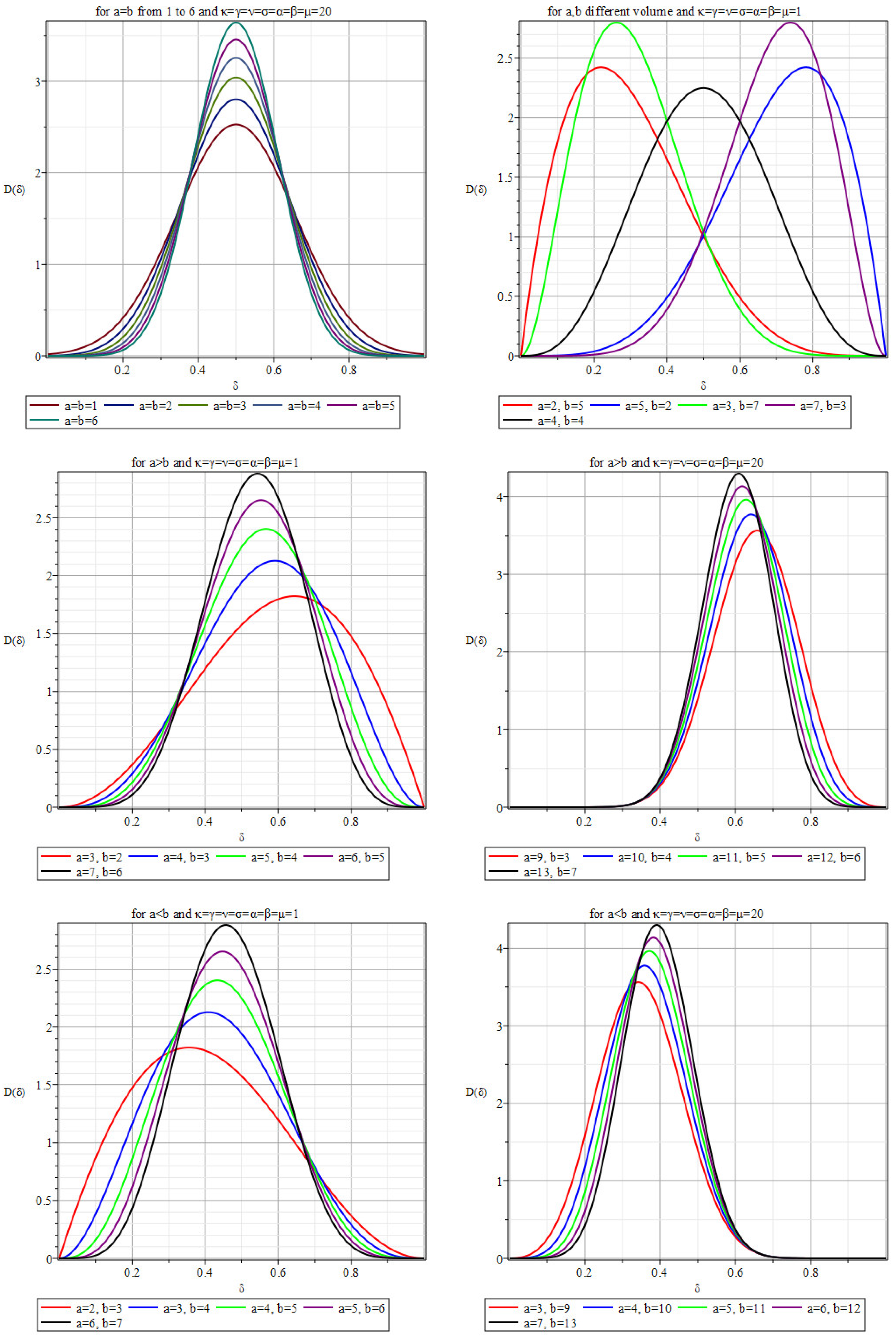
(29). In addition, we investigate some graphs of the Euler-Beta distribution for different parameter values, as shown in
Figure 1 below.
By substituting values into the Euler distribution in
Figure 1, we conclude that each plot has a different description. When
a >
b, the distribution tends toward 1; when
b >
a, the distribution tends toward 0; and when
a =
b, the distribution is uniform. For
, we have
Particularly, for
, the mean of the distribution is
Therefore, the variance of the distribution is
The Moment Generating Function (MGF) of the distribution is
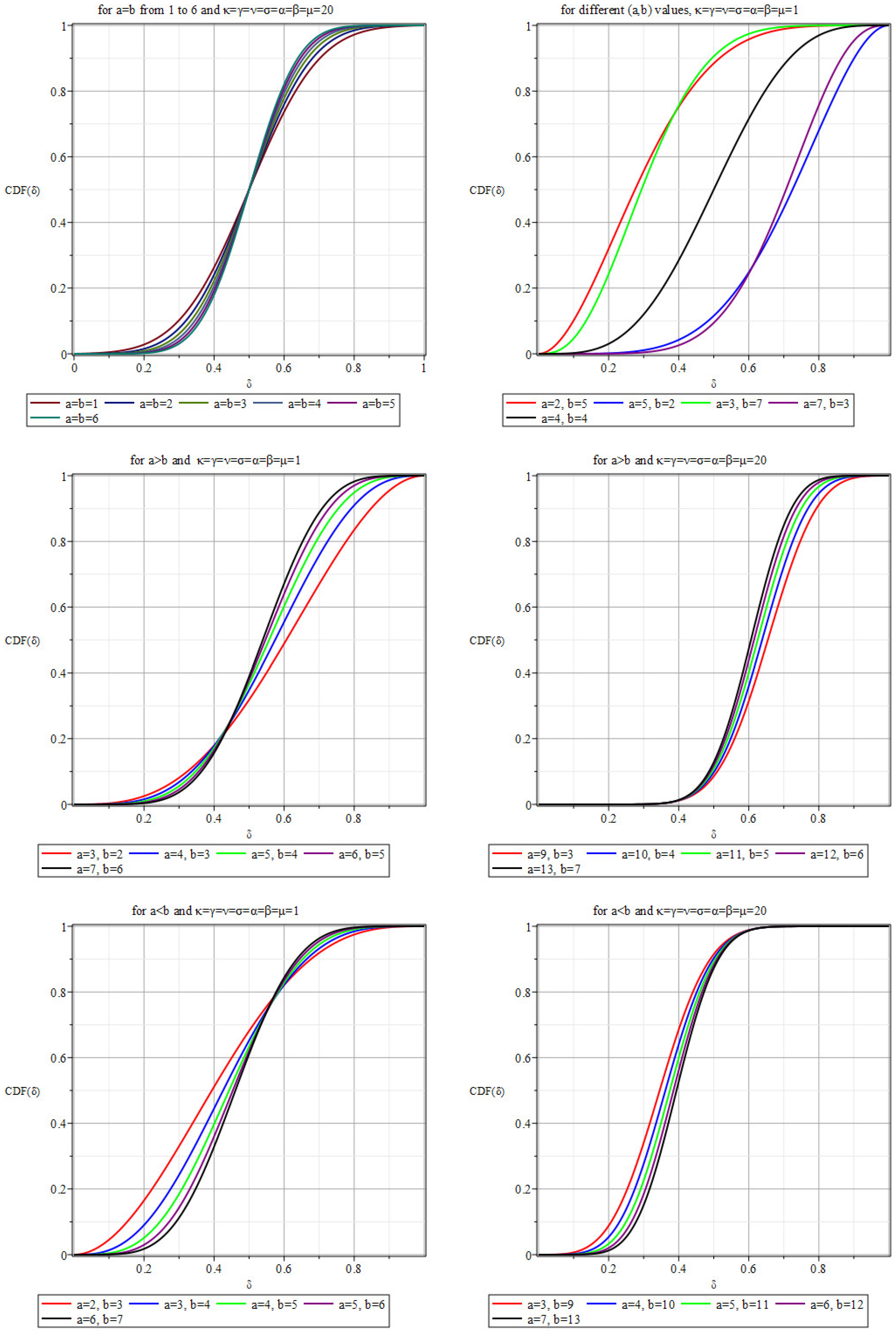
The Cumulative Distribution Function (CDF) of
(28) is considered as
where
is the new extended incomplete Euler-Beta function. For
,
and
, Equation (29) converges and
, where
is the incomplete Euler-Beta function [
30] given as
Figure 1 above illustrates the Probability Density Function (PDF). The same parameter values are used for the corresponding illustration of the Cumulative Distribution Function (CDF) in
Figure 2.
This leads to the observation that the problem of formulating related to certain special functions stays open. This distribution may be advantageous for extending the statistical properties of variables that are strictly positive to those that can arbitrarily take large negative values.