


Abstract
The center of distances of a metric space is the set of all for which the equation has a solution for each . We prove that the equalities or hold if is an ultrametric space generated by labeled trees. The necessary and sufficient conditions under which are found.
MSC:
54E35
1. Introduction
Ultrametric spaces generated by non-negative vertex labelings on arbitrary trees were introduced in [1] and subsequently studied in [2,3]. A characterization of totally bounded ultrametric spaces generated by labeled almost rays was provided in [4]. Furthermore, [5] contains a metric characterization of ultrametric spaces generated by labeled star graphs.
It was shown in [6] that the compact ultrametric spaces generated by labeled star graphs are the completions of totally bounded ultrametric space generated by decreasingly labeled rays.
In the present paper, we investigate the class of all ultrametric spaces that are isometric to spaces generated by labeled trees. The main goal of the paper is the characterization of the center of distances of -spaces . The notion of center of distances was introduced in paper [7] and used for a generalization of John von Neumann Theorem on permutations of two sequences with the same set of cluster points [8]. At the moment, the authors are not aware of any results describing the structure of the center of distances in the case of ultrametric spaces.
The paper is organized as follows. The next section contains some definitions and facts from the theory of ultrametric spaces and graph theory. The main results of the paper are proven in Section 3, Section 4 and Section 5.
Theorem 4 of Section 3 shows that the center of distances of an arbitrary -space satisfies either the equality
or the equality
In Section 4, we introduce the concept of centered spheres and use it in Theorem 5 to describe the geometry of -spaces that satisfy (1). Theorem 6 of this section gives a necessary and sufficient condition under which each open ball of a given -space is a centered sphere in this space. Theorem 7 of Section 4 shows that an ultrametric space is equidistant if and only if each centered sphere of is an open ball of .
Theorem 8 of Section 5 shows that equality (1) holds for -space if and only if the diametrical graph of has a spanning star subgraph. Corollary 4 of Theorem 1 shows that equality (2) holds for -space with if and only if is weakly similar to an unbounded ultrametric space.
The final Section 6 contains some conjectures related to results of the paper.
2. Preliminaries
In what follows, we will use the symbol to denote the set .
Definition 1.
Let X be a non-empty set. A metric on X is a symmetric function satisfying the equality for each , the inequality for all distinct , and the triangle inequality
for all x, y, .
A metric space is called an ultrametric space if the strong triangle inequality
holds for all x, y, . The function d is called an ultrametric on X.
Following [9] (p. 46), we say that a metric is equidistant if there is a constant such that
whenever x and y are distinct points of X.
Definition 2.
Let and be metric spaces. A bijective mapping is said to be an isometry if
holds for all . The metric spaces are isometric if there is an isometry of these spaces.
Let be a metric space. In what follows, we will denote by the distance set of the space ,
Definition 3.
Let be a metric space. The center of distances of is the set defined as
Example 1 (The p-adic ultrametric).
Let be a prime number, be the set of rational numbers, and be the set of integers. The p-adic valuation of is defined as
where is the unique such that
and m, n are coprime to p. The p-adic valuation satisfies the inequality
for all . This implies that the mapping
is an ultrametric on . (See Formula (1.10) in Chapter 1 of [10].) It directly follows from (6) that the mapping
is a self-isometry of the space for every , which gives us the equalities
in accordance with Formulas (3)–(6).
Let A be a non-empty subset of a metric space . The quantity
is the diameter of A. If the inequality holds, then we say that A is a bounded subset of .
The next concept was introduced in [11] as a generalization of the concept of similarity for general semimetric spaces.
Definition 4.
Let , be metric spaces, and let , be the distance sets of , , respectively. A bijective mapping is a weak similarity if there is a strictly increasing bijection such that
for all .
We will say that metric spaces and are weakly similar if there is a weak similarity .
The next theorem is a reformulation of Theorem 3.22 from [12].
Theorem 1.
Let be an ultrametric space with Then the following statements are equivalent:
- (i)
- is weakly similar to an unbounded ultrametric space.
- (ii)
- The distance set does not contain ,
Lemma 1.
Let A be a non-empty subset of an ultrametric space . Then, the equality
holds for each .
Proof.
Remark 1.
Equality (9) is known, see, for example, equality (1.3) in [13], but the authors cannot give here an exact reference to standard books on ultrametric spaces.
Let be a metric space. The open ball with a radius and a center is the set
Let us denote by the set of all open balls of metric space .
The next proposition is a part of Proposition 18.4 from [14].
Proposition 1.
Let be an ultrametric space. Then, for every ball and every , we have
Now, we recall the concepts of compactness and total boundedness.
A standard definition of compactness is usually formulated as the following: a metric space is compact if every open cover of X has a finite subcover.
Definition 5.
A metric space is totally bounded if, for every , there is a finite set such that
It follows directly from Definition 5 that every compact metric space is totally bounded.
The next proposition is a corollary of Theorem 3.6 from paper [15].
Proposition 2.
Let be an infinite totally bounded ultrametric space, and let be the distance set of the space . Then, there is a strictly decreasing sequence of points of such that
holds and the equivalence
is valid for every .
Furthermore, let us recall some definitions and facts from graph theory.
A graph is a pair consisting of a non-empty set V and a set E whose elements are unordered pairs of different points . For a graph , the sets and are called the set of vertices and the set of edges, respectively. A graph G is finite if is a finite set. If , then the vertices x and y are ends of and called adjacent. In what follows, we will always assume that . A graph G is empty if .
The following concept is well-known for finite graphs (see, for example, [16] (p. 17)).
Definition 6.
Let G be a graph and let be a cardinal number. The graph G is complete k-partite if the vertex set can be partitioned into k non-empty disjoint parts in such a way that no edge has both ends in the same part and any two vertices in different parts are adjacent.
We say that G is a complete multipartite graph if G is complete k-partite for some k.
The next concept was introduced in [17] for characterization of finite ultrametric spaces for which the Gomory–Hu inequality [18] turns to equality.
Definition 7.
Let be a metric space. Denote by a graph such that and, for ,
We call the diametrical graph of .
Remark 2.
It directly follows from (11) that is empty if and only if X is a singleton or .
The following theorem is a direct consequence of Theorems 3.1 and 3.2 from [19].
Theorem 2.
Let be an ultrametric space with . Then, the following statements are equivalent:
- (i)
- The diametrical graph is non-empty.
- (ii)
- The diametrical graph is complete multipartite.
Let G be a graph. A graph is a subgraph of G if
In this case, we will write .
A path is a finite graph P whose vertices can be numbered without repetitions so that
with . We will write or if P is a path satisfying (12) and say that P is a path joining and . A graph G is connected if, for every two distinct vertices of G, there is a path joining these vertices.
A finite graph C is a cycle if there exists an enumeration of its vertices without repetitions such that and
Definition 8.
A connected graph T without cycles is called a tree.
Let us recall the concept of star graphs.
Definition 9.
A tree T is a star graph if there exists a vertex such that
A subtree T of a connected graph G is called a spanning tree of G if the equality holds.
Let us introduce the concept of labeled trees.
Definition 10.
A labeled tree is a pair where T is a tree and l is a mapping defined on .
If is a labeled tree, then we write instead of . Moreover, in what follows, we will consider only the non-negative real-valued labelings .
Following [1], for arbitrary labeled tree , we define a mapping as
where is a path joining u and v in T.
Theorem 3.
Let be a labeled tree. The mapping is an ultrametric on the set if and only if the inequality
holds for every .
A proof of Theorem 3 can be obtained by simple modification of the proof of Proposition 3.2 in [1].
The following lemma will be used in the next section of the paper.
Lemma 2.
Let be a labeled tree with a non-degenerate labeling , and let be the distance set of the ultrametric space . Then, there exists a non-degenerate labeling such that
and the equality
holds.
Proof.
Let us define a labeling as
Equalities (15) and (16) evidently hold if . Suppose that , and consider an arbitrary edge . Using (13), we obtain
and consequently,
Membership relation (19) and Formula (17) imply the equality
The last equality and Formula (17) show that is a non-degenerate labeling of because is non-degenerate. Thus, is an ultrametric space by Theorem 3.
Let us prove equality (15). Let x and y be two distinct vertices of T, and let be the path joining x and y. Then, using (13), (18), and (20), we obtain
Thus, equality (15) holds.
To prove equality (16), it suffices to note that equality (13) with implies the inclusion
and that the converse inclusion
follows from (17).
The proof is completed. □
In what follows, we will denote by the class of all ultrametric spaces that are isometric to the space generated by labeled trees with non-degenerate vertex labelings.
The main goal of the present paper is to describe the structure of centers of distances for .
3. Center of Distances of UT-Spaces
Let be a metric space, let , and let be a subset of the distance set , defined as
Proposition 3.
Let be a metric space, and let be the center of distances of . Then, the equality
holds.
Proof.
Proposition 4.
Let be a metric space, and let be the center of distances of . Then, contains the point 0.
Proof.
Since we have for every , equality (21) implies
for all . Hence,
holds. The last membership relation and Proposition 3 imply as required. □
Remark 3.
Propositions 3 and 4 are known, see, for example, [7,20].
Lemma 1 and Proposition 3 imply the following corollary.
Corollary 1.
Let be an ultrametric space, be the distance set of , and be the centers of distances of . If belongs to ,
then also belongs to ,
Lemma 3.
Let be a labeled tree with a non-degenerate labeling satisfying the equality
Then,
holds whenever
Proof.
The next theorem completely describes the center of distances for ultrametric spaces .
Theorem 4.
Let have at least two points, let be the distance set of , and let be the center of distances of . Then, we have either
or
and moreover, the last equality holds if and only if
Proof.
Suppose now that we have (29). Then, Corollary 1 implies Proposition 4 gives us Consequently, the inclusion
is valid. Since belongs to the class , there exists a labeled tree such that and are isometric. By Lemma 2, we can also suppose that
Then, using Lemma 3, we obtain Since and are isometric, the last inclusion gives the inclusion
Equality (28) follows from (30) and (32). Thus, the equivalence (28) ⇔ (29) is valid.
Let us now assume that equality (28) does not hold. Then, as was shown above, the formula
is valid. Let be a labeled tree such that and are isometric and equality (31) holds. Then, using Proposition 4, Lemma 3, and (33), we see that
Since and are isometric, (27) follows from (34).
The proof is completed. □
Remark 4.
Example 2 (The Delhommé–Laflamme–Pouzet–Sauer ultrametric).
Let us define a mapping as
Then, is an ultrametric on , and the inequality
holds whenever . The last inequality and Theorem 2.1 from [5] imply the existence of a labeled star graph such that and , where is an ultrametric defined by (13) with . Thus, is an UT-space. Since the ultrametric space is unbounded, Theorem 4 implies that the center of distances of contains the unique point 0,
Remark 5.
The ultrametric on was introduced by Delhommé, Laflamme, Pouzet, and Sauer in [21].
4. Center of Distances and Centered Spheres
The next concept was introduced in [3].
Definition 11.
Let be a metric space. A set is a centered sphere in if there exist , the center of S, and , the radius of S, such that
If , then (35) gives the equality . Hence, the following proposition holds.
Proposition 5.
Let be a metric space. Then, the singleton is a centered sphere in for every .
Theorem 5.
Let have at least two points, and let be the center of distances of . Then, the equality
holds if and only if X is a centered sphere in and is the radius of this sphere.
Proof.
Let X be a centered sphere in . Then, by Definition 11, there are and such that
The last equality and the strong triangle inequality imply
for all . Consequently, we have and where is the distance set of . Hence, (36) follows from Theorem 4.
Now we must show that (36) implies (37). Let us do it. Since holds, there is a labeled tree such that and are isometric. Consequently, we have the equalities
and can rewrite equality (36) as
By Lemma 2, we may also suppose that
It follows from (38) that the membership relation
holds, and consequently, by (39), there exists such that
for each .
Using Formulas (13) and (40), it is easy to prove that
holds for each The last statement implies (37) with and where is the image of the point under some isometry of the spaces and .
The proof is completed. □
Our next goal is to describe some conditions under which every open ball of a space is a centered sphere in this space.
The following lemma is a reformulation of Lemma 4.3 from [2].
Lemma 4.
Let and let be a labeled tree such that and are isometric. Then, for every , there is a subtree of T such that and are isometric, where is the restriction of the labeling on the set .
We will also use the next lemma.
Lemma 5.
Let be an ultrametric space, and let B be an open ball in . Then, B is a centered sphere in if and only if this ball is a centered sphere in .
Proof.
By Definition 11, a ball is a centered sphere in if and only if the equality
holds for some and Similarly, B is a centered sphere in if and only if the equality
holds for some and .
Let (41) hold. It follows from that
If the last inclusion is strict, then there is satisfying
which contradicts (41). Hence, (41) implies the equality
which gives us (42) with and . Thus, if B is a centered sphere in , then B also is a centered sphere in .
Suppose now that equality (42) holds. We claim that the equality
is satisfied.
Similar to (43), we have the inclusion
Consequently, equality (44) holds if we have
Equality (42) implies . Hence, by Proposition 1, we may assume
for some . Equalities (42) and (46) imply the inequality which together with (46) gives us
Inclusion (45) follows from (42) and (47).
The proof is completed. □
If a subset S of an ultrametric space is a centered sphere in itself, but S is not a singleton or an open ball in , then S may not be a centered sphere in .
Example 3.
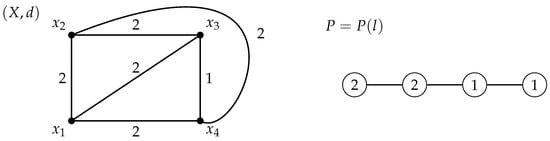
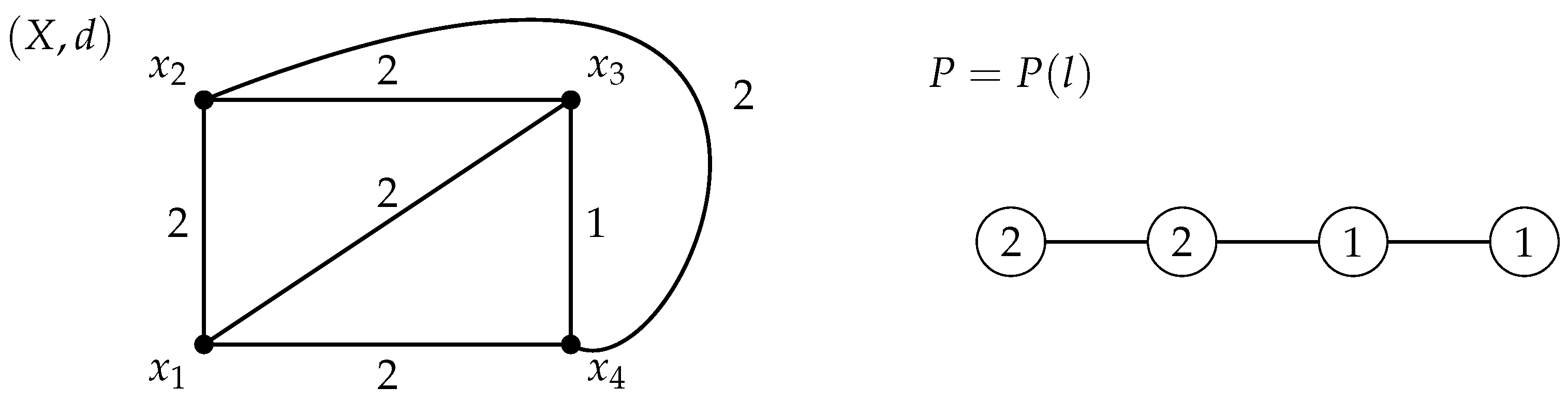
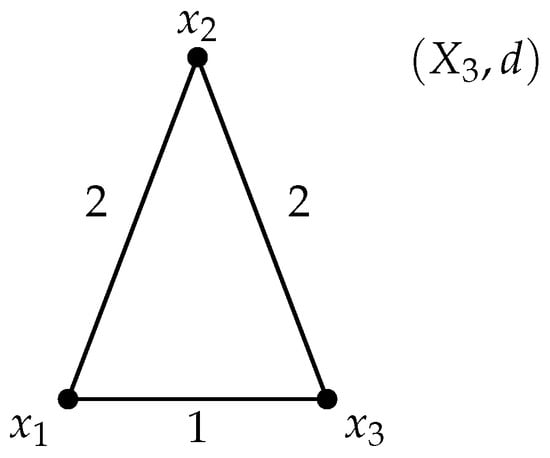
Let us consider the ultrametric space depicted by Figure 1. Then, , and the set is a centered sphere in itself, but this set is not a centered sphere in . Indeed, the equality and the definition of give us the equalities
Figure 1.
The space is isometric to the ultrametric space generated by labeled path .
In what follows, we denote the set of all centered spheres of an ultrametric space .
Theorem 6.
Let be an ultrametric space, and let
for each . If the inclusion
holds, then the set has the greatest element for all and . Moreover, if and the set has the greatest element for all and , then inclusion (49) holds.
Proof.
Let inclusion (49) hold, let p be an arbitrary point of X, and let . We must show that the set has the greatest element.
Let us consider the open ball
By inclusion (49), the ball B is a centered sphere in , i.e., the equality
holds with some and . The last equality and the Lemma 1 with and imply
where is the distance set of . Consequently, the diametrical graph of is non-empty. Theorem 2 implies that is a complete multipartite graph. Hence, by Definition 6, there is a point such that
Using (48), (50), and Formula (8) with , we see that is the greatest element of the set as required.
Let , and let the set contain the greatest element for all and . Let us consider an arbitrary open ball with a center and a radius ,
To prove inclusion (49), we must show that is a centered sphere in .
If is a singleton, then holds by Proposition 5.
Suppose now that contains at least two points. Since is an -space, Lemma 4 implies the existence of a labeled tree such that and are isometric. Hence the ultrametric space also belongs to the class .
By Theorem 5, the membership implies if and only if
where is the center of distances of . By Theorem 4, equality (52) is equivalent to
where is the distance set of the space . The space is a subspace of . Hence, the inclusion
holds. Let be the set defined by (48) with , where is the center of the ball . By supposition, the set has the greatest element . Thus, we have
Lemma 1 and (51) imply . Thus, (53) holds, and consequently, we have
by Theorems 4 and 5. Using Lemma 5, we may rewrite (54) as
Thus, (55) holds for each . Inclusion (49) follows.
The proof is completed. □
Corollary 2.
Let be totally bounded. Then, the inclusion
holds.
Proof.
Let p be a point of X, let
and let . The existence of the greatest element in the set follows from Proposition 2. Hence, the inclusion holds by Theorem 6. □
Since every compact metric space is totally bounded, Corollary 2 implies the following.
Corollary 3.
Let be compact. Then, the inclusion
holds.
The following example shows that the condition cannot be omitted in Theorem 6 in the general case.
Example 4 (The p-adic ultrametric).
Let be isometric to , where is the p-adic ultrametric defined in Example 1, and let
for . Then, using Formula (7), it is easy to see that the set contains the greatest element for all and . Since the space does not contain isolated points, there are no open balls in that are centered spheres in this space. Thus, the inclusion is false. It should be noted that singletons are centered spheres by Proposition 5, but such sets cannot be open balls if the space does not contain isolated points.
It is interesting to compare Theorem 6 with the following result.
Theorem 7.
Let be an ultrametric space. Then the following statements are equivalent:
- (i)
- The inclusion holds.
- (ii)
- The ultrametric d is equidistant.
- (iii)
- The equality holds.
For the proof of Theorem 7, see Theorem 4.9 from [2].
Example 5.
Let be an equidistant metric space. Then, each non-empty subset A of X is a centered sphere in , but any centered sphere in is either a singleton or coincides with the set X.
5. Center of Distances, Diametrical Graphs, and Weak Similarities
Using the concepts of diametrical graphs and star graphs, we also can give the necessary and sufficient conditions under which the equality
holds for -spaces .
Theorem 8.
Let have at least two points, and let be the diametrical graph of . Then, the following statements are equivalent:
- (i)
- The equalityholds.
- (ii)
- is a complete multipartite graph such that at least one of its parts is a singleton.
- (iii)
- has a spanning star subgraph.
Proof.
. Let (56) hold. Then, the membership relation
is valid, because is a subset of .
Definition 7 and membership relation (57) imply that the graph is non-empty. Consequently, this graph is complete multipartite by Theorem 2. By Theorem 5, equality (56) holds if and only if X is a centered sphere in and is the radius of this sphere.
Let c be the center of the centered sphere X. Then, using (35) with and , we obtain the equality
for each . Hence, by Definition 7, we have
for each . Thus, the singleton is a part of by Definition 6. Consequently, the implication is valid.
. Let hold. Then, is a complete multipartite graph and, consequently, is non-empty by Definition 6. Hence, we can find two distinct points such that
By Definition 7, membership (58) implies the equality
Thus, we have
which implies statement by Theorem 4.
. Let a singleton be a part of the complete multipartite graph . Then, the membership relation
holds for all by Definition 6. Let be a subgraph of such that
and
Then, is a star graph by Definition 9, and moreover, is a spanning subtree of by (59). Thus, is a valid implication.
. Let be a spanning star subgraph of the diametrical graph . Then, (59) holds. Since contains at least two points, is non-empty by Definition 9. Thus, also is non-empty by inclusion . Consequently, is complete multipartite by Theorem 2. Definition 9 and equality (59) imply that there is such that (60) holds for each Consequently, the singleton is a part of the complete multipartite graph . Thus, implies .
The proof is completed. □
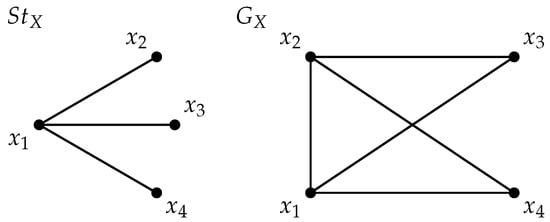
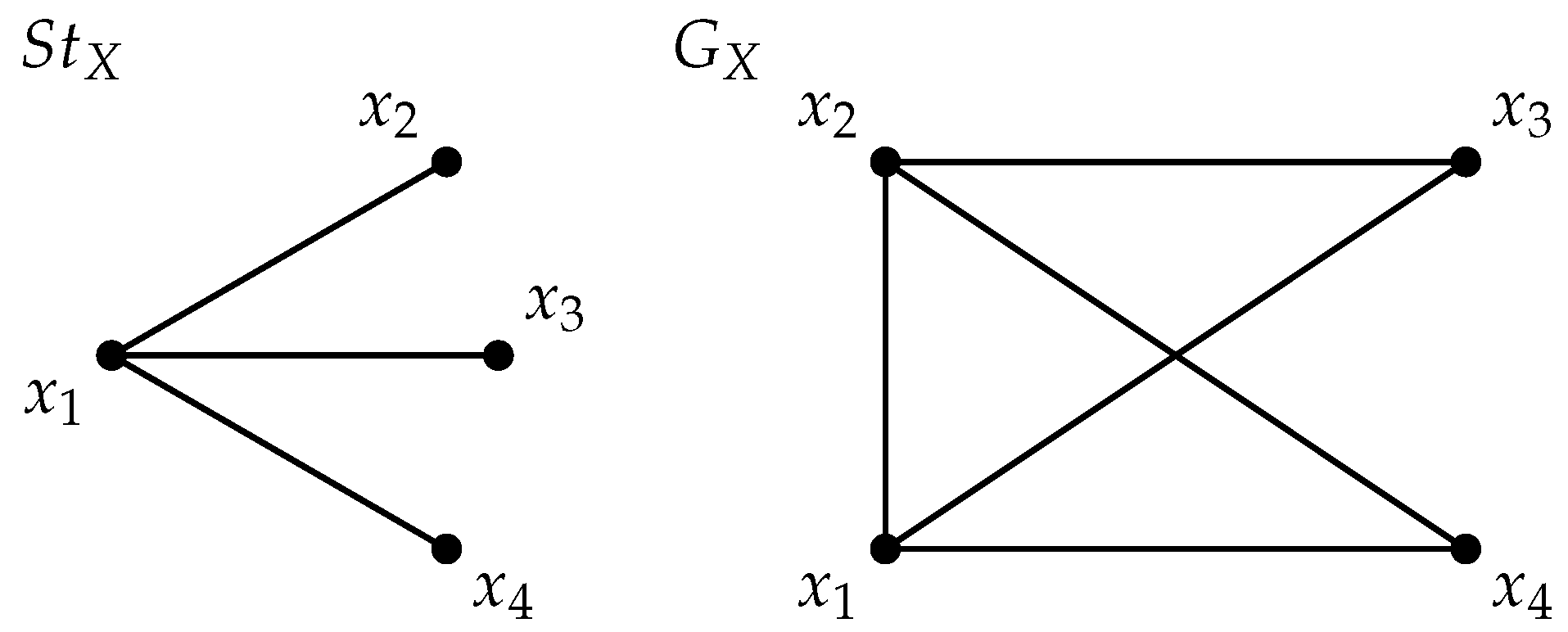
Figure 2 below gives us an example of the space which satisfies Theorem 8.
Figure 2.
A spanning star graph of the diametrical graph of the space depicted by Figure 1.
Remark 6.
Analyzing the proof of Theorem 8, we can see that the equivalence is valid for arbitrary complete multipartite graph G. Consequently, Theorem 8 gives us necessary and sufficient conditions under which complete multipartite graphs have spanning star subgraphs. In connection with this result, we note that all connected graphs have spanning subtrees. See, for example, Proposition 14 in Chapter 1 of book [22].
Theorems 1 and 4 give us the following.
Corollary 4.
Let have at least two points, and let be the center of distances of . Then, the equality
holds if and only if is weakly similar to an unbounded ultrametric space.
Proof.
Let be the distance set of . Then, by Theorem 4, equality (61) holds if
It implies the desired result by Theorem 1. □
Remark 7.
Example 1 shows that equality (61) may not hold if .
6. Conclusions—Expected Results
Let be a metric space. A closed ball in is a subset of the set X defined as
where and .
Let us denote by the set of all closed balls of .
The following conjecture is a counterpart of Theorem 6.
Conjecture 1.
Let be an ultrametric space, and let
for each . If the inclusion
holds, then the set has the greatest element for all and . Moreover, if , and the set has the greatest element for all and , then inclusion (62) holds.
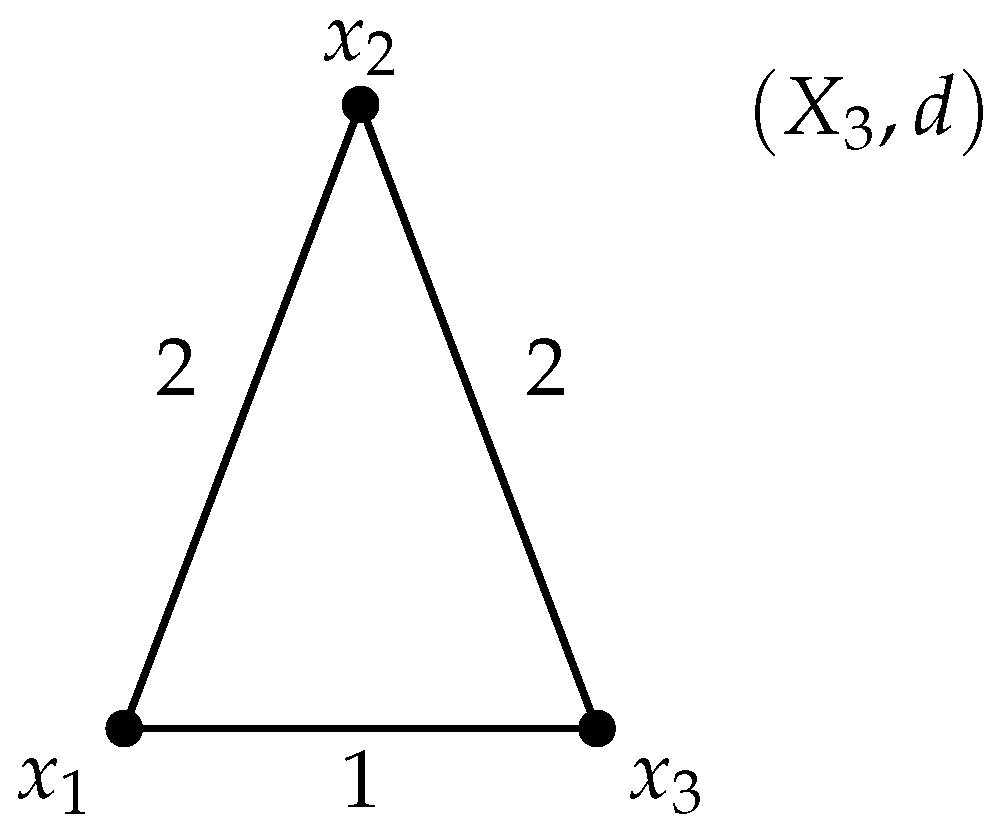
Let be the three-point ultrametric space depicted in Figure 3 below.
Figure 3.
A non-equidistant three-point ultrametric space .
Then, it is easy to show that every non-empty subset of is a centered sphere in .
Conjecture 2.
Let be an ultrametric space such that . Then, the following statements are equivalent:
- (i)
- Each non-empty subset of the set Y is a centered sphere in .
- (ii)
- The set Y contains exactly three points, and is weakly similar to .
The following conjecture was motivated by some calculations with p-adic ultrametric with (see Example 1).
Conjecture 3.
Let be an integer number, let be the binary logarithm of n, and let be the integer part of . Then, the inequality
holds for each ultrametric space with . Moreover, there exists an ultrametric space such that and
To see why a binary logarithm bound is expected in Conjecture 3, we only note that the following simple statement is valid.
Let be a partition of a finite set X on disjoint subsets with . Then, there is a partition of X such that
Author Contributions
Conceptualization, O.D.; writing—original draft preparation, O.D.; methodology, O.D.; formal analysis, O.R.; writing—review and editing, O.R.; investigation, O.D.; resources, O.R. All authors have read and agreed to the published version of the manuscript.
Funding
The first author was supported by grant 367319 of the Research Council of Finland.
Data Availability Statement
The original contributions presented in this study are included in the article. Further inquiries can be directed to the corresponding author.
Acknowledgments
The authors are grateful to the reviewers for their constructive comments and suggestions, which significantly improved the manuscript.
Conflicts of Interest
The authors declare no conflicts of interest.
References
- Dovgoshey, O. Isomorphism of trees and isometry of ultrametric spaces. Theory Appl. Graphs 2020, 7, 3. [Google Scholar] [CrossRef] [Scilit]
- Dovgoshey, O.; Kostikov, A. Locally finite ultrametric spaces and labeled trees. J. Math. Sci. 2023, 276, 614–637. [Google Scholar] [CrossRef] [Scilit]
- Dovgoshey, O.; Küçükaslan, M. Labeled trees generating complete, compact, and discrete ultrametric spaces. Ann. Comb. 2022, 26, 613–642. [Google Scholar] [CrossRef] [Scilit]
- Dovgoshey, O.; Vito, V. Totally bounded ultrametric spaces generated by labeled rays. Appl. Gen. Topol. 2025, 26, 163–182. [Google Scholar] [CrossRef] [Scilit]
- Dovgoshey, O.; Rovenska, O. Ultrametric spaces generated by labeled star graphs. J. Math. Sci. 2025, 228, 182–198. [Google Scholar] [CrossRef] [Scilit]
- Dovgoshey, O.; Cantor, O.; Rovenska, O. Compact ultrametric spaces generated by labeled star graphs. Online J. Anal. Comb. 2025, 20, 1–20. [Google Scholar] [CrossRef] [Scilit]
- Bielas, W.; Plewik, S.; Walczyńska, M. On the center of distances. Eur. J. Math. 2018, 4, 687–698. [Google Scholar] [CrossRef] [Scilit]
- von Neumann, J. Charakterisierung des Spektrums Eines Integraloperators; Hermann: Paris, France, 1935. [Google Scholar]
- Deza, M.M.; Deza, E. Encyclopedia of Distances, 4th ed.; Springer: Berlin/Heidelberg, Germany, 2016. [Google Scholar] [CrossRef] [Scilit]
- Bachman, G. Introduction to p-Adic Numbers and Valuation Theory; Academic Press: New York, NY, USA; London, UK, 1964. [Google Scholar]
- Dovgoshey, O.; Petrov, E. Weak similarities of metric and semimetric spaces. Acta Math. Hung. 2013, 141, 301–319. [Google Scholar] [CrossRef] [Scilit]
- Bilet, V.; Dovgoshey, O.; Kononov, Y. Ultrametrics and Complete Multipartite Graphs. Theory Appl. Graphs 2022, 9, 8. [Google Scholar] [CrossRef] [Scilit]
- Dovgoshey, O. Finite ultrametric balls. p-adic Numbers Ultrametr. Anal. Appl. 2019, 11, 177–191. [Google Scholar] [CrossRef] [Scilit]
- Schikhof, W.H. Ultrametric Calculus. An Introduction to p-Adic Analysis; Cambridge University Press: Cambridge, UK, 1985. [Google Scholar]
- Dovgoshey, O.; Shcherbak, V. The range of ultrametrics, compactness, and separability. Topol. Its Appl. 2022, 305, 107899. [Google Scholar] [CrossRef] [Scilit]
- Diestel, R. Graph Theory, 3rd ed.; Graduate Texts in Mathematics; Springer: Berlin/Heidelberg, Germany, 2005; Volume 173. [Google Scholar]
- Petrov, E.; Dovgoshey, A. On the Gomory-Hu inequality. J. Math. Sci. 2014, 198, 392–411. [Google Scholar] [CrossRef] [Scilit]
- Gomory, R.E.; Hu, T.C. Multi-terminal network flows. J. Soc. Ind. Appl. Math. 1961, 9, 551–570. [Google Scholar] [CrossRef] [Scilit]
- Dordovskyi, D.; Dovgoshey, O.; Petrov, E. Diameter and diametrical pairs of points in ultrametric spaces. p-Adic Numbers Ultrametric Anal. Appl. 2011, 3, 253–262. [Google Scholar] [CrossRef] [Scilit]
- Nowakowski, P.; Prus-Wiśniowski, F.; Turoboś, F. Spectre operator, achievement sets and sets of P-sums in a hyperspace of compact sets. arXiv 2025, arXiv:2512.11803. https://arxiv.org/abs/2512.11803.
- Delhommé, C.; Laflamme, C.; Pouzet, M.; Sauer, N. Indivisible ultrametric spaces. Topol. Its Appl. 2008, 155, 1462–1478. [Google Scholar] [CrossRef] [Scilit]
- Serre, J.P. Trees; Springer: Berlin/Heidelberg, Germany, 1980. [Google Scholar]
Disclaimer/Publisher’s Note: The statements, opinions and data contained in all publications are solely those of the individual author(s) and contributor(s) and not of MDPI and/or the editor(s). MDPI and/or the editor(s) disclaim responsibility for any injury to people or property resulting from any ideas, methods, instructions or products referred to in the content. |
© 2026 by the authors. Licensee MDPI, Basel, Switzerland. This article is an open access article distributed under the terms and conditions of the Creative Commons Attribution (CC BY) license.