


Abstract
Parameter estimation of the three-parameter Weibull distribution is an important problem in reliability analysis and statistical modeling. Random right-censored data are widely encountered in engineering practice. Conventional least squares (LS) methods usually construct the empirical cumulative distribution function (CDF) based on rank statistics. However, this empirical assumption cannot adequately capture the nonlinear variation in failure probability with time in the Weibull distribution. To address this limitation, an iterative conditional probability based on conditional failure probability (ICP-CDF) is proposed. The method uses the parameter estimates obtained from the conventional LS approach as initial values, adjusts the ranks of failure data according to conditional failure probabilities, and updates the empirical CDF accordingly. Within a unified least squares estimation framework, an ICP-CDF-LS parameter estimation method is developed, in which both the CDF and distribution parameters are updated iteratively. Simulation studies and case analyses demonstrate that, compared with the LS and MLE methods, the proposed approach achieves superior overall performance in terms of estimation accuracy and stability, making it more suitable for practical engineering applications.
Keywords:
three-parameter Weibull distribution; random right-censored data; empirical cumulative distribution function; conditional failure probability; least squares estimation; Iterative methods MSC:
62-08; 62F10
1. Introduction
Reliability analysis and lifetime assessment are fundamental issues in aerospace, energy, and mechanical engineering. In practical engineering applications, the failure processes of materials or structures are inherently stochastic. Owing to its flexibility and clear physical interpretation, the Weibull distribution has been extensively employed in lifetime modeling, reliability analysis, and failure mechanism studies [1,2,3]. In particular, the three-parameter Weibull distribution, by introducing a location parameter, is capable of describing situations in which no failure occurs during an initial operating period, making it especially suitable for engineering test data analysis [4,5,6].
In practical testing, constraints such as test duration, cost, safety considerations, and equipment limitations often prevent the observation of all failures. As a result, censored data are ubiquitous in experimental datasets. Under censoring conditions, the construction of an appropriate empirical CDF and the subsequent estimation of distribution parameters constitute a critical challenge in reliability statistics [7,8,9,10].
1.1. Overview of Weibull Parameter Estimation Methods
A variety of statistical methods have been developed for Weibull parameter estimation, which can be broadly classified into probability-model-based methods and empirical-distribution-based methods.
Among probability-model-based approaches, maximum likelihood estimation (MLE) is one of the most widely used techniques. When the sample size is sufficiently large and the model assumptions are satisfied, MLE possesses desirable statistical properties such as consistency and asymptotic efficiency [10,11,12]. However, for the three-parameter Weibull distribution, the likelihood function is non-regular, since the support of the distribution depends on the location parameter γ, which violates the regularity conditions required by classical maximum likelihood theory; moreover, as γ approaches the minimum observed failure time, the likelihood function may become unbounded, implying that the MLE may not exist or may be numerically unstable. Under such circumstances, the standard asymptotic properties of MLE cannot be rigorously guaranteed. In addition, the likelihood function of the three-parameter Weibull distribution is typically highly nonlinear. In the presence of random right-censored data or small sample sizes, the information related to the location parameter is mainly concentrated in a limited number of early failure observations. The censoring mechanism further weakens this information, making the parameter estimates highly sensitive to initial values and causing numerical optimization procedures to suffer from convergence difficulties or to be trapped in local optima [13,14,15].
By contrast, empirical CDF-based estimation methods are widely adopted in engineering practice due to their simplicity and intuitive physical interpretation. These methods typically construct an empirical CDF using rank-based techniques and then estimate Weibull parameters via LS [16,17,18], correlation coefficient method (CCM) [19], or minimum distance method (MDM) [20,21]. Rank-based methods have a solid statistical foundation for Weibull distributions and represent one of the most used nonparametric tools in engineering reliability analysis [22].
Under complete failure data conditions, commonly used rank definitions include natural rank, mean rank, and median rank. Among these, the median rank method exhibits favorable unbiasedness and stability for Weibull distributions and is therefore frequently employed in the initial stage of parameter estimation [23].
1.2. Rank-Based Empirical CDF Estimation with Censored Data
When right-censored data are present, directly applying traditional rank definitions to construct an empirical CDF leads to systematic bias. This is because censored samples have not failed, yet their presence alters the statistical structure of the risk set, thereby affecting the plotting positions of failed samples.
Under censoring conditions, empirical CDF estimation is commonly performed using rank-based nonparametric methods. Representative approaches include the Johnson method, the Kaplan–Meier (KM) estimator, and the Dodson method [24,25,26,27]. These methods are distribution-free and belong to the class of nonparametric estimators, and they have been widely used in reliability engineering and life data analysis.
In engineering practice, the combination of Dodson-adjusted ranks with the median rank formula, followed by stepwise Weibull parameter estimation, has gained widespread acceptance due to its computational clarity, ease of implementation, and practical applicability.
However, existing rank-based methods typically rely on an implicit assumption: the contribution of censored samples to subsequent failure samples is uniformly distributed. Although this assumption is statistically reasonable to some extent, it does not fully account for the nonlinear time-dependent nature of failure probability in Weibull distributions. When the shape parameter differs from unity, the conditional failure probabilities associated with censored samples vary significantly across different failure intervals. Consequently, uniform allocation of censored-sample contributions may introduce systematic bias, thereby affecting the construction of the empirical CDF and the accuracy of parameter estimation.
1.3. Main Contributions to This Study
To address the above issues, this study focuses on Weibull parameter estimation under random right-censored data, with the main contributions summarized as follows:
- The fundamental principles and inherent limitations of rank-based empirical CDF construction and Weibull parameter estimation under random right-censoring are systematically analyzed.
- Based on Dodson-adjusted ranks and median-rank empirical CDF, an iterative correction strategy incorporating conditional failure probabilities is introduced.
- A unified least squares estimation framework is established, and a clear computational procedure is presented.
- Numerical case studies are conducted to evaluate and analyze the applicability and estimation performance of the proposed method under random right-censoring conditions.
2. Materials and Methods
This chapter addresses the problem of parameter estimation for the three-parameter Weibull distribution under random right-censored data. The Weibull distribution model, the empirical CDF construction based on the Dodson method [28], and the proposed empirical CDF construction based on conditional failure probability is introduced sequentially. On this basis, a unified least squares parameter estimation framework is presented. Finally, the complete computational procedure and stopping criterion of the iterative conditional probability-based CDF method (ICP-CDF-LS) are explicitly specified.
2.1. Three-Parameter Weibull Distribution
The probability density function (PDF) of the three-parameter Weibull distribution is given by:
The corresponding CDF is:
where is the shape parameter, is the scale parameter, and is the location parameter. When , the distribution reduces to the two-parameter Weibull distribution.
In reliability engineering, the three-parameter Weibull distribution is widely used to describe systems exhibiting a failure-free period at the initial stage, and it is therefore well suited for life testing and reliability analysis. For samples subject to random right censoring, a proper construction of the empirical CDF is critical for accurate parameter estimation.
2.2. Empirical CDF Estimation Based on the Dodson Method
Under censored data conditions, empirical CDF are commonly constructed using rank-based nonparametric methods. Owing to its clear recursive formulation and ease of implementation, the Dodson method has been extensively applied in reliability engineering.
Let the total number of test samples be . All observed samples are sorted in ascending order with respect to time, and CDF values are assigned only to failure observations. Denote the adjusted order of the -th failure observation by . The Dodson method computes this adjusted order recursively as
where the increment is defined as
After obtaining the adjusted order , the empirical CDF can be estimated using the median rank formula:
By recursively allocating the “order space,” the Dodson method statistically accounts for the influence of censored samples on subsequent failure observations, yielding a more reasonable empirical CDF than that obtained using natural ranks or simple median ranks. However, this method implicitly assumes that the contribution of censored samples to subsequent failures is evenly distributed, an assumption that does not reflect the nonlinear evolution of failure probability inherent in the Weibull distribution.
2.3. Empirical CDF Construction Based on Conditional Failure Probability (CP-CDF)
To overcome the limitation of the Dodson method associated with the equal allocation of censored contributions, an empirical CDF construction method based on conditional failure probability, referred to as CP-CDF, is proposed.
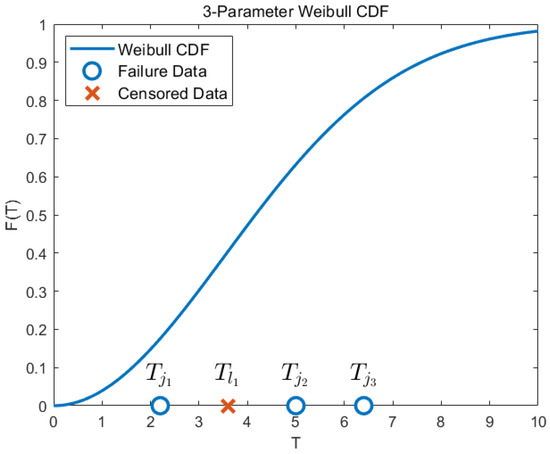
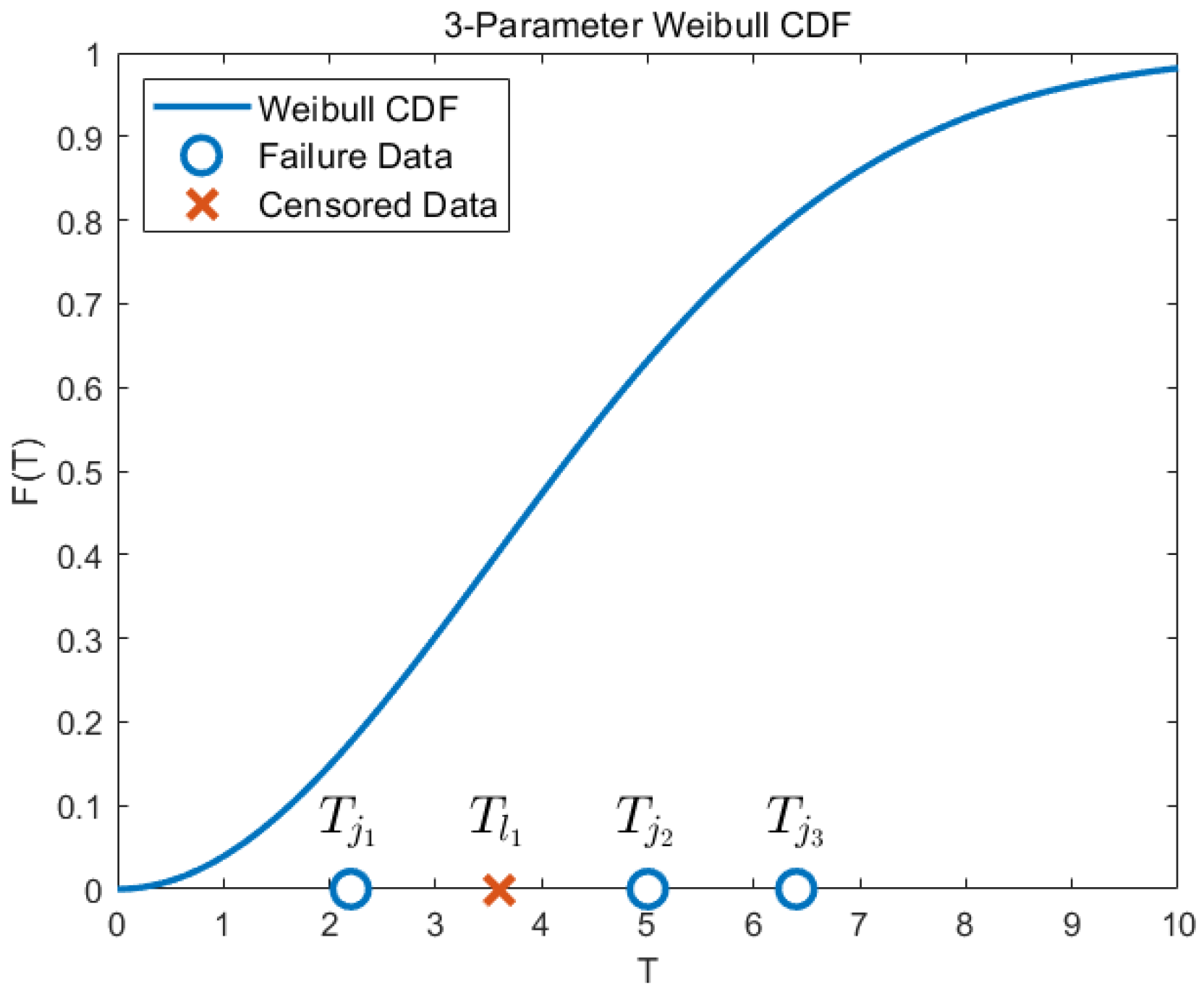
As shown in Figure 1, , , and are failure data, while is censored data. Due to the presence of the censored data , the ranks of and are affected, causing them to increase accordingly. Specifically, the incremental effect of on the rank of equals the conditional probability of failure for within the interval , which can be calculated as . Similarly, the incremental effect of on the rank of equals the conditional probability of failure for within the interval , which is .
Figure 1.
Illustration of the 3-parameter Weibull CDF.
Let the -th failure occur at time , and let a censored observation be censored at time . For a given set of Weibull parameters , the conditional probability that this censored observation fails within the interval is expressed as
By summing the conditional failure probabilities of all censored observations satisfying , the conditional failure probability increment corresponding to the -th failure point is obtained. The adjusted order can then be constructed as
The empirical CDF is subsequently estimated using the median rank formula:
Compared with the Dodson method, the CP-CDF approach assigns censored contributions in a non-uniform manner according to the Weibull distribution characteristics, resulting in an empirical CDF that is more consistent with the statistical mechanism of random right-censored data.
2.4. Least Squares Estimation and the ICP-CDF-LS Method
2.4.1. LS Parameter Estimation
Once the empirical CDF is obtained, LS method is adopted to estimate the parameters of the three-parameter Weibull distribution. By applying a logarithmic transformation to the Weibull CDF, the following linearized relationship is obtained:
Given the empirical CDF values , the parameters are re-estimated by minimizing the following objective function:
where denotes the time of the -th failure observation, and is the number of failures. When the empirical CDF is constructed using the Dodson method, this procedure corresponds to the conventional LS parameter estimation approach.
2.4.2. ICP-CDF-LS Method: Complete Procedure and Stopping Criterion
Within the least squares estimation framework, the ICP-CDF-LS method iteratively updates the empirical CDF and model parameters, enabling an adaptive allocation of censored sample contributions. The computational procedure is summarized as follows.
Step 1: Initial estimation using the conventional LS method.
An empirical CDF is first constructed using the Dodson method combined with the median rank formula. Substituting this CDF into the LS objective function yields the initial parameter estimates which serve as the initial values for the ICP-CDF-LS iteration.
Step 2: Construction of the CP-CDF based on conditional failure probabilities.
At the -th iteration, the current parameter vector is used to compute the conditional failure probabilities for all censored observations and failure intervals. The adjusted order is updated as
and the empirical CDF is reconstructed as
Step 3: Parameter update via least squares estimation.
The updated empirical CDF is substituted into the LS objective function to obtain a new set of parameter estimates:
Step 4: Iteration stopping criterion.
A stopping criterion based on the convergence of the parameter vector is adopted. Let denote the parameter estimates obtained at the -th iteration. The iteration is terminated when
where is a prescribed tolerance and denotes the Euclidean norm. If this condition is not satisfied within the maximum number of iterations , the results from the final iteration are taken as the output.
Due to the inclusion of the location parameter γ in the three-parameter Weibull distribution, the least squares problems defined by Equations (10) and (13) constitute nonlinear optimization problems with parameter constraints, for which closed-form solutions are generally unavailable. In this study, the resulting nonlinear least squares problem is solved numerically using the lsqnonlin function in MATLAB 2018b.
During the optimization process, physical constraints are imposed on the Weibull parameters, namely > 0, > 0, and < min (T). When bound constraints are present, lsqnonlin automatically employs the trust-region-reflective algorithm, which ensures numerical stability and physically meaningful parameter estimates.
3. Simulation Study
In this chapter, Monte Carlo simulations are conducted to evaluate the parameter estimation performance of the proposed ICP-CDF-LS method under random right-censored data, and comparisons are made with LS method and MLE method.
3.1. Simulation Settings and Evaluation Metrics
To systematically assess the estimation performance, Monte Carlo simulations are performed to generate three-parameter Weibull samples with random right censoring. The true distribution parameters are set as follows: shape parameter , scale parameter , and location parameter . The sample sizes are chosen as , and the random right-censoring ratios are set to . For each parameter combination, 500 independent samples are generated. The selected sample sizes are intended to reflect practical data conditions commonly encountered in aerospace and other high-reliability engineering applications, where available failure data are often limited. The number of Monte Carlo replications is chosen to ensure sufficient statistical stability for the simulation results while maintaining reasonable computational efficiency.
To quantitatively compare the estimation performance, the following statistical measures are computed for each estimated parameter:
Mean of estimates:
Bias of estimates:
Root mean square error (RMSE) of estimates:
where denotes the true value of the corresponding parameter.
3.2. Simulation Results and Discussion
3.2.1. Estimation Results for the Location Parameter
In the three-parameter Weibull distribution, high-reliability analysis essentially focuses on the lifetime region before failures begin to occur. In this region, reliability results are primarily governed by the lower bound of the distribution support; therefore, the location parameter plays a decisive role in high-reliability life estimation and reliability prediction. Even a small estimation bias in may be significantly amplified during high-reliability extrapolation and directly propagated to engineering conclusions.
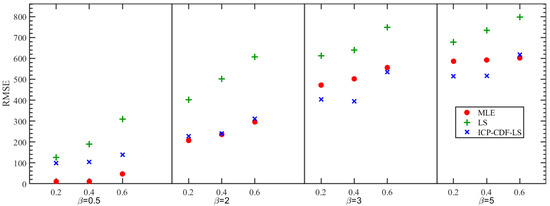
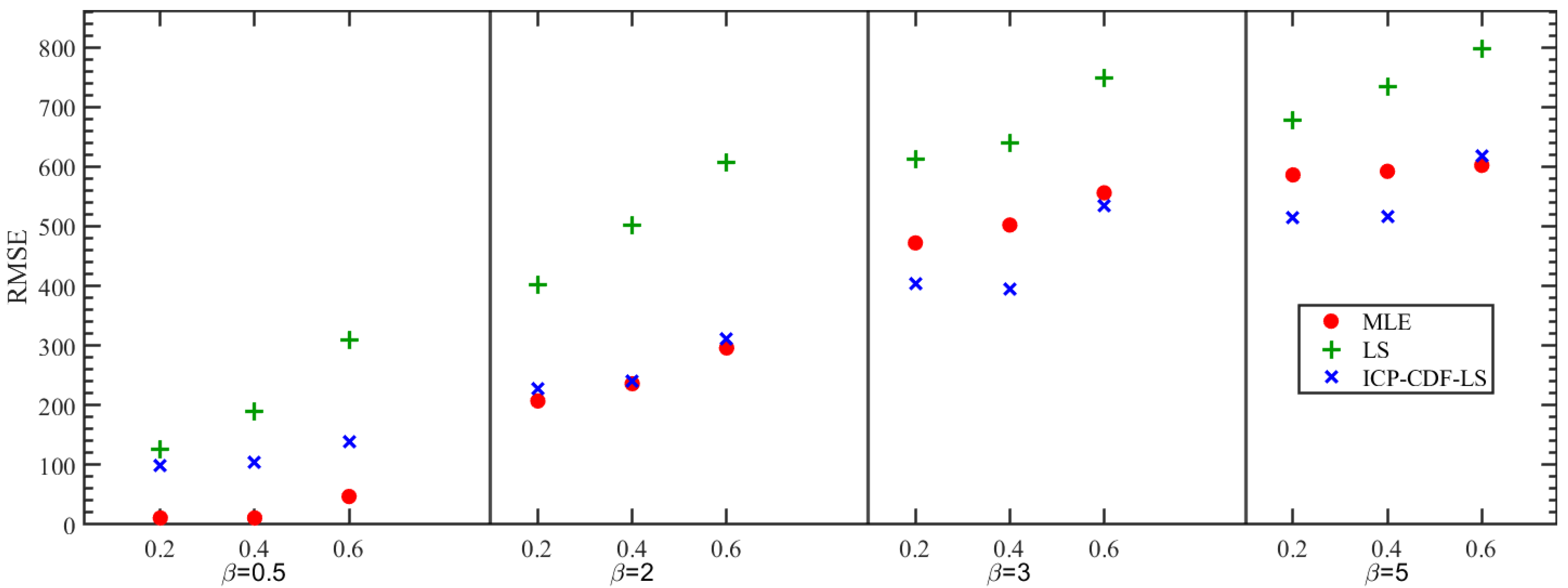
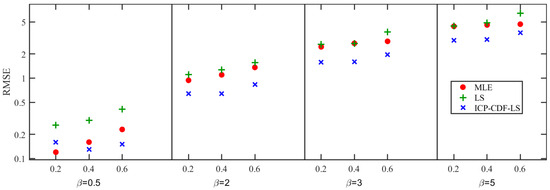
The estimation results for the location parameter are summarized in Table A1. For a sample size of 20, the RMSE of the estimation results for each method is shown in Figure 2.
Figure 2.
RMSE of estimates (sample size = 20).
Overall, the proposed method consistently outperforms the LS method in estimating the location parameter. As the censoring ratio increases, the bias and RMSE of the LS method increase markedly, whereas the proposed method maintains high estimation accuracy, demonstrating superior robustness.
Moreover, the LS method is sensitive to the value of the shape parameter ; its estimation performance for deteriorates noticeably as increases. In contrast, the proposed method exhibits only weak dependence on and provides stable and reliable estimates across different values.
Compared with the MLE method, when the shape parameter β is small, MLE yields a smaller RMSE in estimating the location parameter γ. However, as β increases, the proposed method gradually exhibits superior estimation accuracy, with noticeably lower RMSE than that of the MLE method.
It is worth emphasizing that the MLE method tends to produce estimates of the location parameter γ that are larger than the true value. In high-reliability analysis, such overestimation of γ effectively delays the inferred onset of failures, leading to systematic overestimation of high-reliability life and reliability levels. This behavior poses a potentially serious risk in engineering reliability assessments.
3.2.2. Estimation Results for the Shape Parameter
The shape parameter mainly characterizes the temporal evolution of the failure rate. Variations in are often associated with transitions in failure mechanisms, such as the evolution from early-life failure–dominated behavior to wear-dominated failure. Consequently, carries important physical significance in failure mechanism identification and failure mode classification.
The estimation results for the location parameter are summarized in Table A2. For a sample size of 20, the RMSE of the estimation results for each method is shown in Figure 3.
Figure 3.
RMSE of estimates (sample size = 20).
Overall, the LS method consistently yields estimates of the shape parameter that are larger than the true value, whereas the estimates obtained by the proposed method may be either larger or smaller than the true value. Nevertheless, the proposed method exhibits smaller absolute bias and lower RMSE for the estimation of , indicating that it consistently outperforms the LS method.
Compared with the MLE method, the proposed method yields smaller RMSE in estimating the location parameter in most cases, demonstrating superior overall estimation performance.
As the sample size increases, the estimation stability of three methods improves. In addition, smaller values of the shape parameter lead to better estimation performance.
3.2.3. Estimation Results for the Scale Parameter
The scale parameter primarily reflects the overall stretching or compression of the lifetime distribution along the time axis. It affects the magnitude of the life level but neither alters the underlying failure mechanism nor determines the location of the high-reliability region. Therefore, the uncertainty in has a relatively limited impact on high-reliability assessment results and is generally regarded as a comparatively secondary parameter in the three-parameter Weibull distribution.
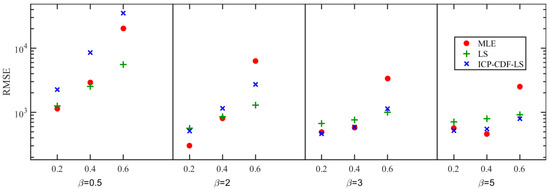
The estimation results for the scale parameter are summarized in Table A3. For a sample size of 20, the RMSE of the estimation results for each method is shown in Figure 4.
Figure 4.
RMSE of estimates (sample size = 20).
Overall, the estimation accuracy and stability of three methods improve with increasing sample size, but deteriorate as the censoring ratio and the shape parameter increase. When is small, the LS method exhibits a certain advantage in estimating the scale parameter. However, as increases, the proposed method gradually demonstrates superior performance in terms of estimation accuracy and stability.
Additional Monte Carlo simulations with different scale parameter values (e.g., η = 500 and η = 1500) were also conducted, and the results exhibited trends fully consistent with those reported in this section, indicating that the comparative performance of the considered methods is not sensitive to the specific choice of the scale parameter within a reasonable range.
3.3. Convergence Verification
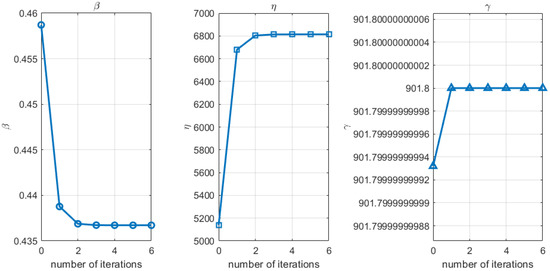
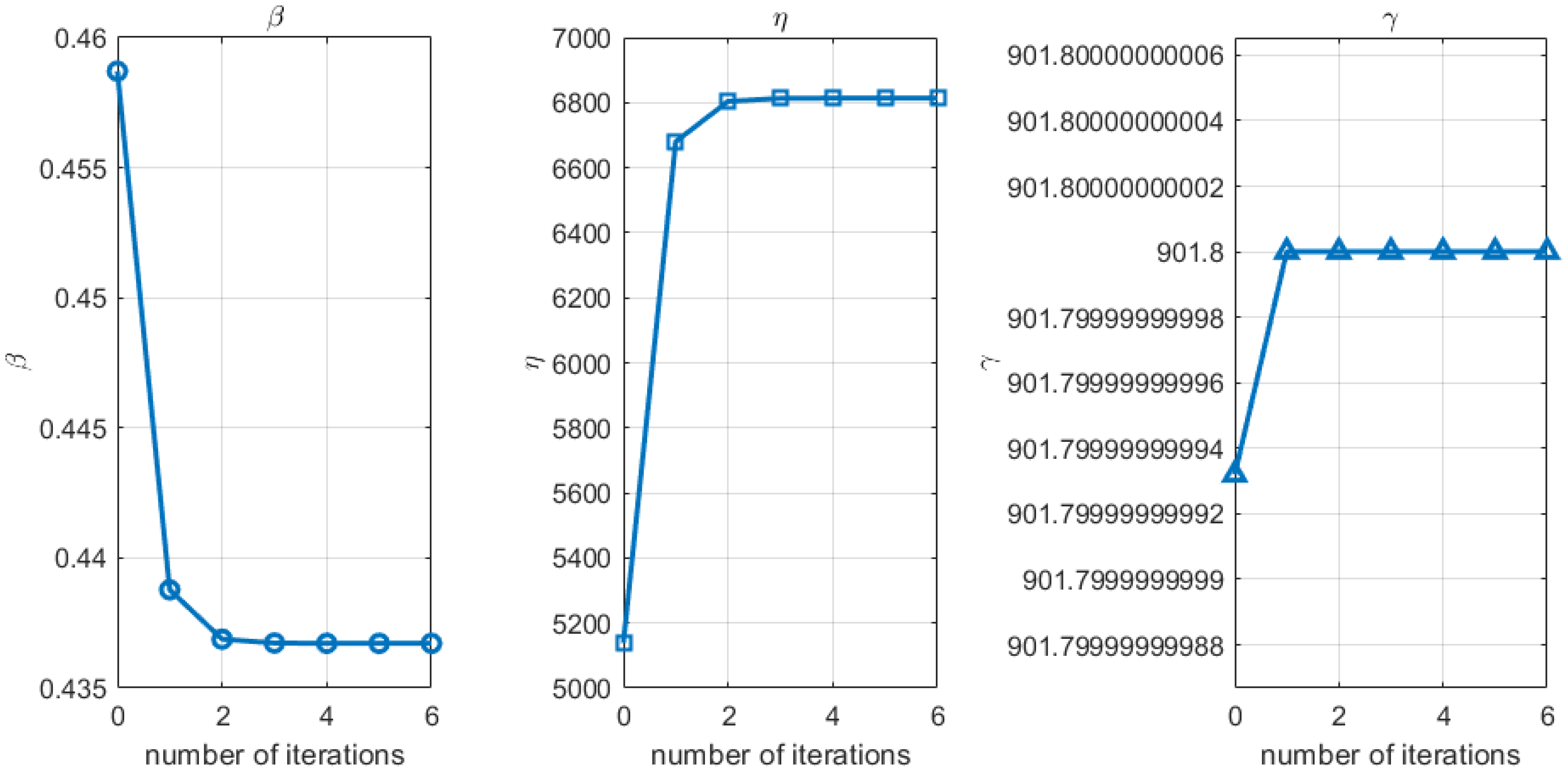
To verify the convergence of the proposed ICP-CDF-LS method, the evolution of the parameter estimates during the iterative process is investigated. Numerical results indicate that the ICP-CDF-LS method typically converges within several tens of iterations.
As a representative example, a three-parameter Weibull distribution is considered. The first sample set, with a sample size of 10 and a censoring ratio of 0.4, is selected to illustrate the convergence behavior. The corresponding convergence histories of the parameter estimates are shown in Figure 5. It can be observed that the shape, scale, and location parameters exhibit noticeable variations in the early iterations and then gradually stabilize, eventually reaching convergence within a finite number of iterations.
Figure 5.
RMSE of estimates (sample size = 20).
These results demonstrate that, even under typical small-sample conditions with random right-censoring, the proposed ICP-CDF-LS method maintains good numerical stability and convergence performance.
3.4. Case Study
Table 1 presents the wear test data of polyimide bushings used in the stator vane of an aero-engine variable stator vane (VSV) assembly structure. The data are expressed in terms of number of cycles, where a data status of 1 indicates failure and 0 denotes right-censoring. Based on this dataset, parameter estimation is carried out using the MLE method, LS method, and the ICP-CDF-LS method for comparison.
Table 1.
Bushing experimental data.
The parameter estimation results are summarized in Table 2. For the estimation of the location parameter γ, the MLE method yields the largest estimate, while the results obtained by the LS method and the proposed method are relatively close. In contrast, the estimates of the shape parameter β differ significantly among the three methods. According to the simulation results presented earlier, the proposed method exhibits clear advantages in estimating the shape parameter; therefore, the corresponding shape parameter estimate obtained by this method is more reliable. This case study further demonstrates the effectiveness of the proposed method in practical engineering applications.
Table 2.
Parameter estimation results.
4. Conclusions and Outlook
4.1. Conclusions
This study investigates parameter estimation for the three-parameter Weibull distribution under random right-censored data. An ICP-CDF-LS framework is developed, in which the empirical CDF and model parameters are updated iteratively within a unified LS scheme.
Simulation results and case analyses show that the ICP-CDF-LS method is able to construct an empirical CDF that is more consistent with the Weibull distribution under random right censoring, leading to improved stability and consistency of parameter estimation. By reallocating the contributions of censored observations based on conditional failure probabilities, the method avoids overly simplified treatments of censored data and yields a statistically more reasonable empirical distribution.
In terms of parameter estimation performance, the proposed method exhibits good robustness in estimating the location parameter γ and the shape parameter β. Compared with the LS and MLE methods, ICP-CDF-LS provides more consistent estimation results across different scenarios, indicating its applicability for modeling incomplete lifetime data in engineering practice.
For the scale parameter η, the estimation error is mainly caused by the loss of right-tail failure information induced by random right censoring. The compression of empirical information in the large-time region affects the estimation of η for all considered methods, reflecting an inherent identifiability limitation imposed by the data structure rather than deficiencies of a specific estimation approach.
Overall, the ICP-CDF-LS method offers a statistically reasonable alternative for parameter estimation of the three-parameter Weibull distribution with random right-censored data, with improved robustness for key parameters and clear practical relevance for reliability analysis involving incomplete observations.
4.2. Innovations
The main innovations of this study are summarized as follows:
An empirical CDF construction method based on conditional failure probability is proposed, which revises the traditional rank-based assumption of uniformly allocating the contributions of censored samples from a distributional perspective.
Within a unified least squares estimation framework, the ICP-CDF-LS method is developed, enabling an iterative coupling between empirical CDF construction and parameter estimation.
The estimation characteristics of different parameters in the three-parameter Weibull distribution under random right censoring are systematically analyzed, revealing that the location and shape parameters are more sensitive to the quality of empirical CDF construction, whereas the scale parameter relies more heavily on right-tail failure information.
4.3. Outlook
Although the proposed method demonstrates favorable performance under random right censoring, several directions merit further investigation:
- Extension to other estimation frameworks
Incorporating the CP-CDF concept into MDM, CCM, or other parameter estimation frameworks may further enhance estimation accuracy.
- 2.
- Optimization of convergence criteria and computational efficiency
Developing adaptive stopping criteria tailored to different sample sizes and censoring levels could reduce computational cost while maintaining estimation precision.
- 3.
- Extension to more complex censoring and failure mechanisms
Future work may generalize the proposed approach to mixed censoring schemes, multiple censoring mechanisms, or competing failure risks, thereby broadening its applicability to complex engineering reliability problems.
- 4.
- Improving the estimation accuracy of the scale parameter
Given that the scale parameter is highly sensitive to right-tail failure information, future research may focus on improving the utilization of tail data, introducing more targeted weighting strategies, or incorporating distribution-specific characteristics to apply dedicated corrections to the right-tail region of the empirical CDF. These efforts are expected to further enhance the accuracy and stability of scale parameter estimation under high censoring conditions.
Author Contributions
Conceptualization, X.H.; Methodology, S.L.; Software, S.L.; Validation, X.Z.; Data curation, X.H.; Writing—original draft, S.L.; Writing—review and editing, B.Z. and L.X.; Supervision, B.Z. All authors have read and agreed to the published version of the manuscript.
Funding
This research received no external funding.
Data Availability Statement
The raw data supporting the conclusions of this article will be made available by the authors on request.
Conflicts of Interest
Author Xuan Han was employed by the company CRRC Changchun Railway Vehicles Co., Ltd. The remaining authors declare that the research was conducted in the absence of any commercial or financial relationships that could be construed as a potential conflict of interest.
Appendix A
Table A1.
Mean, bias, and RMSE of estimates for two methods.
Table A2.
Mean, bias, and RMSE of estimates for two methods.
Table A3.
Mean, bias, and RMSE of estimates for two methods.
References
- Li, G.; Teng, Y.; Wang, Z.; Ding, S. Reliability Parameter Estimation Method for Aviation Piston Engine High-Pressure Pump Based on Modified Grey-Three-Parameter Weibull Distribution Model. In Proceedings of the Computational and Experimental Simulations in Engineering, ICCES 2024, Volume 1; Zhou, K., Ed.; Springer: Singapore, 2024; Volume 168, pp. 524–539. [Google Scholar]
- Lee, C.; Gong, D.; Shin, S. Application of Weibull Parameter Estimation Methods for Fatigue Evaluation of Composite Materials Scatter. Int. J. Aeronaut. Space Sci. 2021, 22, 318–327. [Google Scholar] [CrossRef] [Scilit]
- Hua, X.; Liu, Y.; Xu, Y.; Yan, Y.; Jiang, X. A Preventive Maintenance Strategy for Aviation Cables Based on Lifetime Prediction Under Variable Operating Conditions. IEEE Trans. Instrum. Meas. 2025, 74, 3560111. [Google Scholar] [CrossRef] [Scilit]
- Jiang, D.; Han, Y.; Cui, W.; Wan, F.; Yu, T.; Song, B. An Improved Modified Weibull Distribution Applied to Predict the Reliability Evolution of an Aircraft Lock Mechanism. Probab. Eng. Eng. Mech. 2023, 72, 103449. [Google Scholar] [CrossRef] [Scilit]
- Pascovici, D.S.; Kyprianidis, K.G.; Colmenares, F.; Ogaji, S.O.T.; Pilidis, P. Weibull Distributions Applied to Cost and Risk Analysis for Aero Engines. In Proceedings of the ASME Turbo Expo 2008, Volume 2; American Society of Mechanical Engineers: Berlin, Germany, 2008; pp. 681–690. [Google Scholar]
- AlGarni, A.Z.; Sahin, A.Z.; AlFarayedhi, A.A. A Reliability Study of Fokker F-27 Airplane Brakes. Reliab. Eng. Syst. Saf. 1997, 56, 143–150. [Google Scholar] [CrossRef] [Scilit]
- El-Saeed, A.R.; Obulezi, O.J.; Abd El-Raouf, M.M. Type II Heavy Tailed Family with Applications to Engineering, Radiation Biology and Aviation Data. J. Radiat. Res. Appl. Sci. 2025, 18, 101547. [Google Scholar] [CrossRef] [Scilit]
- Sharifdoust, M. On the Parameter Estimation of Hybrid Censored Data for Cubic Transmuted Weibull Distribution. Commun. Stat.-Simul. Comput. 2025, 1–16. [Google Scholar] [CrossRef] [Scilit]
- El-Morshedy, M.; El-Dawoody, M.; El-Faheem, A.A. Symmetric and Asymmetric Expansion of the Weibull Distribution: Features and Applications to Complete, Upper Record, and Type-II Right-Censored Data. Symmetry 2025, 17, 131. [Google Scholar] [CrossRef] [Scilit]
- Makalic, E.; Schmidt, D.F. Minimum Message Length Inference of the Weibull Distribution with Complete and Censored Data. In Proceedings of the Advances in Artificial Intelligence, AI 2023, Part I; Liu, T., Yue, L., Webb, G., Wang, D., Eds.; Springer: Singapore; University of Queensland: Brisbane, Australia, 2024; Volume 14471, pp. 291–303. [Google Scholar]
- Przystupa, W.; Kurasinski, P.; Leszczynski, N. Symmetry and Skewness in Weibull Modeling: Optimal Grouping for Parameter Estimation in Fertilizer Granule Strength. Symmetry 2025, 17, 1566. [Google Scholar] [CrossRef] [Scilit]
- Basit, H.; Abdelwahab, M.M.; Bashir, S.; Sanaullah, A.; Abdelkawy, M.A.; Hasaballah, M.M. A Novel Poisson-Weibull Model for Stress-Strength Reliability Analysis in Industrial Systems: Bayesian and Classical Approaches. Axioms 2025, 14, 653. [Google Scholar] [CrossRef] [Scilit]
- Ikram, M.; Amir, M.W.; Nazir, H.Z.; Akhtar, N.; Ramzan, Q. Efficient Failure Detection in Industrial Applications: Enhanced Monitoring Framework for Modified Weibull Model. Trans. Inst. Meas. Control 2025, 1–15. [Google Scholar] [CrossRef] [Scilit]
- Prakash, A.; Maurya, R.K.; Alsadat, N.; Obulezi, O.J. Parameter Estimation for Reduced Type-I Heavy-Tailed Weibull Distribution under Progressive Type-II Censoring Scheme. Alex. Eng. J. 2024, 109, 935–949. [Google Scholar] [CrossRef] [Scilit]
- Bulut, A.; Bingol, O. Weibull Parameter Estimation Methods on Wind Energy Applications—A Review of Recent Developments. Theor. Appl. Climatol. 2024, 155, 9157–9184. [Google Scholar] [CrossRef] [Scilit]
- Davies, I.J. Confidence Limits for Weibull Parameters Estimated Using Linear Least Squares Analysis. J. Eur. Ceram. Soc. 2017, 37, 5057–5064. [Google Scholar] [CrossRef] [Scilit]
- Davies, I.J. Unbiased Estimation of Weibull Modulus Using Linear Least Squares Analysis-A Systematic Approach. J. Eur. Ceram. Soc. 2017, 37, 369–380. [Google Scholar] [CrossRef] [Scilit]
- Jia, X. A Comparison of Different Least-Squares Methods for Reliability of Weibull Distribution Based on Right Censored Data. J. Stat. Comput. Simul. 2021, 91, 976–999. [Google Scholar] [CrossRef] [Scilit]
- Park, C. Weibullness Test and Parameter Estimation of the Three-Parameter Weibull Model Using the Sample Correlation Coefficient. Int. J. Ind. Eng.-Theory Appl. Pract. 2017, 24, 376–391. [Google Scholar]
- Xie, L.; Wu, N.; Yang, X. A Minimum Discrepancy Method for Weibull Distribution Parameter Estimation. Int. J. Struct. Stab. Dyn. 2023, 23, 2350085. [Google Scholar] [CrossRef] [Scilit]
- Yang, X.; Xie, L.; Yang, Y.; Zhao, B.; Li, Y. A Comparative Study for Parameter Estimation of the Weibull Distribution in a Small Sample Size: An Application to Spring Fatigue Failure Data. Qual. Eng. 2023, 35, 553–565. [Google Scholar] [CrossRef] [Scilit]
- Benard, A.; Bos-Levenbach, E.C. Het Uitzetten van Waarnemingen Op Waarschijnlijkheids-papier1. Stat. Neerl. 1953, 7, 163–173. [Google Scholar] [CrossRef] [Scilit]
- Genschel, U.; Meeker, W.Q. A Comparison of Maximum Likelihood and Median-Rank Regression for Weibull Estimation. Qual. Eng. 2010, 22, 236–255. [Google Scholar] [CrossRef] [Scilit]
- Wu, Y.; Kolassa, J.; Dong, N. Restricted Mean Survival Time Based on Wu-Kolassa Estimator Compared to Kaplan-Meier Estimator. Contemp. Clin. Trials 2025, 152, 107877. [Google Scholar] [CrossRef] [Scilit]
- Qin, Y.; Sasinowska, H.; Leemis, L.M. Bias in the Kaplan-Meier Estimator for Small Samples. J. Qual. Technol. 2025, 57, 476–486. [Google Scholar] [CrossRef] [Scilit]
- Hackmann, T.; Thomassen, D.; Stiggelbout, A.M.; le Cessie, S.; Putter, H.; de Wreede, L.C.; Steyerberg, E.W. Effective Sample Size for the Kaplan-Meier Estimator: A Valuable Measure of Uncertainty? Am. Stat. 2025, 1–9. [Google Scholar] [CrossRef] [Scilit]
- Rinne, H. The Weibull Distribution, 1st ed.; Chapman and Hall/CRC: Boca Raton, FL, USA, 2008. [Google Scholar]
- Dodson, B. Weibull Analysis; ASQC Quality Press: Milwaukee, WI, USA, 1994. [Google Scholar]

Disclaimer/Publisher’s Note: The statements, opinions and data contained in all publications are solely those of the individual author(s) and contributor(s) and not of MDPI and/or the editor(s). MDPI and/or the editor(s) disclaim responsibility for any injury to people or property resulting from any ideas, methods, instructions or products referred to in the content. |
© 2026 by the authors. Licensee MDPI, Basel, Switzerland. This article is an open access article distributed under the terms and conditions of the Creative Commons Attribution (CC BY) license.