


Abstract
In this work, a robust optimization approach for energy-aware federated learning (FL) in industrial IoT networks is proposed that addresses uncertainties in harvested energy, device failures, and dynamic topologies. The proposed neurosymbolic reasoning approach combines graph neural networks (GNNs) for topology-aware power prediction with symbolic rules to solve the stochastic power allocation problem, providing both optimality guarantees and explainable safety-critical decisions. The hierarchical Master-Coordination-Task Agent (MA-CoA-TA) architecture prioritizes critical industrial nodes while ensuring FL convergence under energy constraints. This work establishes approximation guarantees through theoretical analysis relative to the robust optimum and validates with rigorous simulations against existing methods. Experimental results demonstrate that proposed framework provides optimal balance for robust FL deployment in large-scale IIoT networks with real-world uncertainties by achieving 5.7% FL accuracy with 151 J remaining battery under the most challenging conditions (100 rounds, 200 devices), while baselines fail completely (0% accuracy, battery depletion). Ablation confirms component synergy—symbolic reasoning delivers times accuracy over GNN-only, while GNN+harvesting preserves 30 times more battery than symbolic-only.
Keywords:
federated learning; robust optimization; neurosymbolic AI; graph neural networks; energy harvesting; IoT edge computing; stochastic power allocation MSC:
90C15; 90C30; 90C35; 90C59; 90B18; 68T07
1. Introduction
The unprecedented growth of Industrial IoT (IIoT) in smart factories, predictive maintenance, and process control has created huge demands for robust federated learning (FL) under energy and uncertainty constraints [1]. Industrial sensors generate massive data requiring distributed processing while operating under severe energy limitations and stochastic environmental factors (harvesting uncertainty, device failures, dynamic topologies) [2,3]. Federated Learning (FL) [4] has emerged as a promising decentralized machine learning paradigm that allows devices to collaboratively train a shared global model while keeping sensitive industrial data private on local devices [5].
1.1. Background
In terms of communication in IIoT networks, federated learning emerges as more advantageous than the conventional centralized machine learning (ML) approaches due to the transmission of model parameters instead of raw data, resulting in low latency and energy efficiency in resource-constrained environments [6]. FL with Multi-Access Edge Computing (MEC) enables the deployment of parameter servers closer to edge devices [7], enhancing scalability for massive IIoT deployments in emerging industrial applications [8]. Efficient collaboration between edge aggregators and sensors is key to optimizing distributed training convergence under industrial constraints [9].
However, deploying FL in industrial wireless sensor networks (WSNs) faces significant challenges: limited communication resources, bandwidth constraints, dynamic/unreliable channels, high interference, and stochastic energy harvesting, resulting in transmission latency that impacts real-time industrial monitoring (e.g., predictive maintenance, process control) [10]. Scheduling many devices per FL round improves convergence but is impractical due to energy trade-offs and uncertainty. Robust optimization-based power allocation is critically needed to balance energy consumption, model accuracy, and industrial reliability.
Energy-efficient IIoT systems require network architectures with intelligent schemes minimizing resource use without compromising performance [11]. Power distribution depends on communication paths and node criticality, as engaged sensors’ positions determine required transmission power. WSNs face persistent challenges in robust power management and communication efficiency in edge environments [12]. Traditional uniform/random allocation fails under dynamic conditions. Recent advances—graph neural networks (GNNs) [13] combined with symbolic reasoning [14]—enable topology-aware, interpretable power management, addressing energy efficiency and reliability in FL-enabled IIoT networks.
Recent surveys and methods address energy-aware FL but leave critical gaps. Ref. [15] maps optimization techniques (compression, pruning) for constrained devices, but lacks hierarchical control and explainability. Ref. [16] achieves 70% energy savings via scheduling optimization but provides no on-device power allocation. Ref. [17] proposes cloud-edge hierarchical aggregation reducing latency but ignores power-aware device selection. Ref. [18] uses multi-agent RL (MARL) for dual client-model selection, achieving adaptivity but with complex, non-explainable policies unsuitable for safety-critical IIoT. Ref. [19] establishes theoretical green FL principles but provides no experimental validation. Our framework addresses all these limitations through interpretable neurosymbolic reasoning, hierarchical MA-CoA-TA control, and robust stochastic optimization with provable guarantees.
1.2. Robust Optimization Problem Formulation
Consider N heterogeneous IIoT devices with battery dynamics:
where denotes the harvested energy and is modeled as a random variable over the harvesting uncertainty set .
We formulate the power allocation as a finite-horizon stochastic optimization problem with recourse under uncertainty :
Here, denotes the uncertainty set over harvesting and failures, and the expectation in (2), together with the constraints, aligns the formulation with mainstream stochastic and robust optimization frameworks, while still capturing industrial robustness to harvesting uncertainty, critical node priority, and long-horizon sustainability.
1.3. Contributions
This paper addresses limitations of existing energy-aware FL methods (Table 1) through a mathematically-grounded neurosymbolic framework solving the robust problem (2)–(6).
Table 1.
Limitations of recent energy-aware FL works.
Novel contributions:
- 1.
- Robust neurosymbolic solver: First framework combining GNN approximation with symbolic reasoning to tractably solve stochastic power allocation for IIoT-FL, with theoretical approximation guarantees.
- 2.
- Hierarchical MA-CoA-TA architecture: Multi-agent optimization hierarchy enabling robust coordination in factory-scale topologies.
- 3.
- Critical node prioritization: Robust algorithm ensuring industrial reliability under uncertainty.
- 4.
- Self-adjusting thresholds: Adaptive policies with convergence guarantees for real-time FL performance.
- 5.
- Stochastic harvesting integration: Multi-source EH modeling with robust battery constraints.
The rest of the paper is organized as follows: Section 2 reviews literature. The proposed system architecture and model are described in Section 3 details the model and architecture. Detailed methodology of the proposed scheme is presented in Section 4; Section 5 discusses the analysis of the results by justifying our work, and Section 6 concludes the work by proposing the future direction.
2. Related Work
Resource allocation in wireless IIoT networks under edge computing has been studied extensively, yet robust optimization for FL under uncertainty remains underexplored. Ref. [20] optimizes MEC-NOMA/mMIMO systems via channel-based power allocation, achieving energy efficiency but ignoring FL convergence and harvesting uncertainty. A demand-based heterogeneous networking approach [21] evaluates edge-fiber systems, lacking dynamic FL-aware policies.
For energy-aware FL in heterogeneous networks, Ref. [22] proposes Hierarchical FL (HFL) with H2RMA using Wireless Energy Transfer (WET) and massive MIMO backhaul. While hierarchical like our MA-CoA-TA, it lacks neurosymbolic reasoning and robust stochastic modeling. Similarly, Ref. [17] reduces edge latency via multi-tier aggregation but employs no topology-aware GNNs or symbolic constraints, complicating scalability.
Energy-aware FL often optimizes wireless resources heuristically but neglects explainability and graph structure. Ref. [23] minimizes computation-transmission energy with closed-form solutions (59.5% savings over TDMA) yet ignores graph-structured IIoT topologies. WPT-integrated FL [24] reduces completion time via path-following but omits symbolic prioritization for critical industrial nodes.
GNN-based allocation models interference graphs for sum-rate maximization [25], outperforming WMMSE, but targets non-FL objectives. GCN-FL power control [26] maximizes transmission success under varying participation—closer to robust FL—but lacks symbolic interpretability and harvesting integration.
Edge FL surveys [27] highlight quantization/scheduling dominance, overlooking critical-node prioritization and robust battery constraints central to our work.
Energy harvesting enables sustainable IIoT-FL [28], optimizable via low-complexity MDPs for large-scale devices [29]. Neurosymbolic AI enhances interpretability in resource-constrained settings [30], enabling near-sensor computation [31]. However, no prior work integrates GNN topology prediction + symbolic critical-node reasoning + hierarchical MA-CoA-TA control + multi-source harvesting for robust IIoT-FL optimization.
Recent uncertainty-aware works further motivate our robust formulation. Ref. [32] develops risk-averse scheduling for integrated energy systems using distributionally robust optimization (DRO), validating the DRO paradigm for energy uncertainty central to our work. Similarly, Ref. [33] proposes over-the-air FL for robust IIoT under channel uncertainty. Our framework uniquely integrates harvesting + topology uncertainty via neurosymbolic reasoning with provable approximation guarantees.
Table 2 compares methodologies, confirming our framework’s unique combination for robust stochastic power allocation under industrial uncertainty. It focuses on methodologically representative works that directly address power allocation or resource management in FL/IoT contexts with explicit energy considerations. Works [20,21] are excluded as they target MEC-NOMA or fiber-wireless systems without FL-specific objectives. Ref. [22] (H2RMA) addresses hierarchical FL but uses wireless energy transfer rather than harvesting-based sustainability. The selected baselines [17,23,24,25,26] span the key methodological dimensions (energy optimization, GNN-based allocation, hierarchical aggregation) enabling systematic comparison of our unique combination: GNN + symbolic + hierarchical + robust + EH.
Table 2.
Methodological comparison for robust IIoT-FL.
3. System Model and Architecture
3.1. IIoT Edge Computing Scenario
The proposed framework targets heterogeneous Industrial IoT (IIoT) devices in distributed edge computing for smart factories and process control. The multi-agent hierarchy reflects realistic IIoT deployments with tiered computational capabilities, energy profiles, and criticality:
- Master Agents (MA): High-capacity factory edge servers/PLC controllers managing global coordination and robust optimization.
- Coordination Agents (CoA): Industrial edge gateways (e.g., Maple Edge-III, Siemens SIMATIC IPC) or HMIs performing local aggregation, protocol translation (Modbus/OPC-UA), and path optimization between sensors and servers.
- Task Agents (TA): Resource-constrained field sensors/actuators (vibration, temperature, pressure) executing local FL updates.
- Data Sinks: Factory cloud gateways collecting aggregated models.
Formally, consider N IIoT devices (TAs), M CoAs , and K MAs deployed over via Poisson point process ().
3.2. Layered Architecture
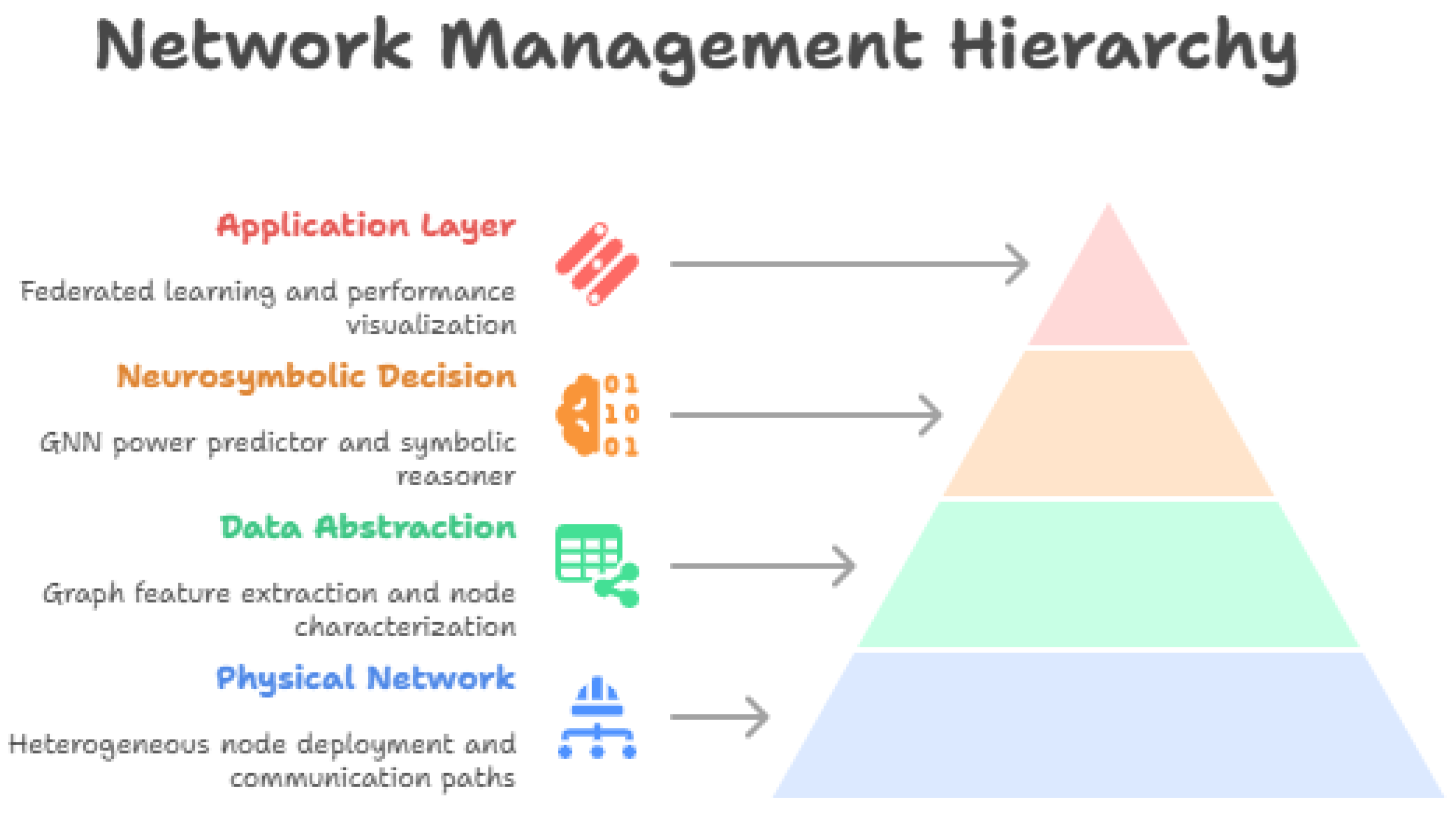
The neurosymbolic framework comprises four layers (Figure 1):
- Physical Layer: 1000 heterogeneous nodes (MA/CoA/TA/SINK) with spatial Poisson distribution modeling factory layouts.
- Data Abstraction Layer: Extracts 8D node features trusti, alloci, , , , , criti, allocMA,i and edge weights .
- Neurosymbolic Layer: GCN predicts power demands; symbolic reasoner enforces robust constraints.
- Application Layer: Orchestrates FL training, robust allocation, and performance monitoring.
Figure 1.
Hierarchical IIoT architecture for robust FL power allocation.
3.3. Robust Stochastic Power Allocation
The IIoT-FL power allocation solves the following:
Here, is the neurosymbolic policy (); encodes uncertainty (: harvesting, : failures); ; is the graph state at t.
Battery dynamics: , .
Theorem 1
(Approximation Guarantee). The neurosymbolic policy satisfies
w.h.p. over , where as GNN capacity .
Proof sketch: GNN universal approximation [13] + symbolic feasibility ((9)–(11)) yield -optimality; online MSE (22) gives regret. Full proof in Appendix A.1.
4. Proposed Robust Power Management
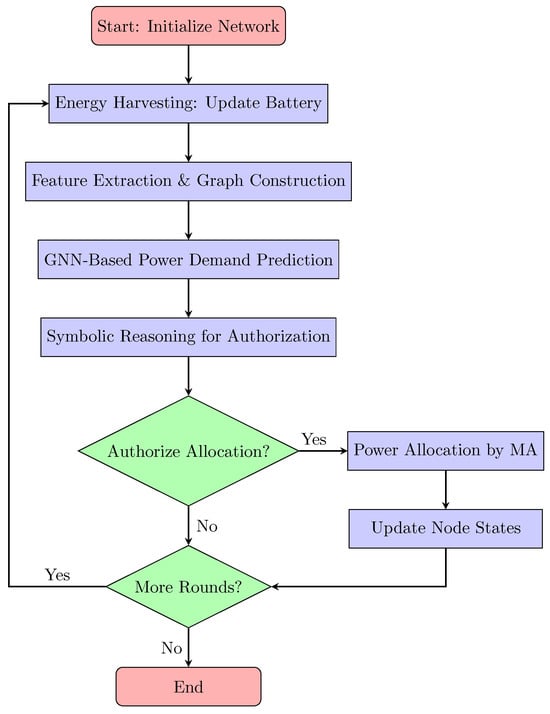
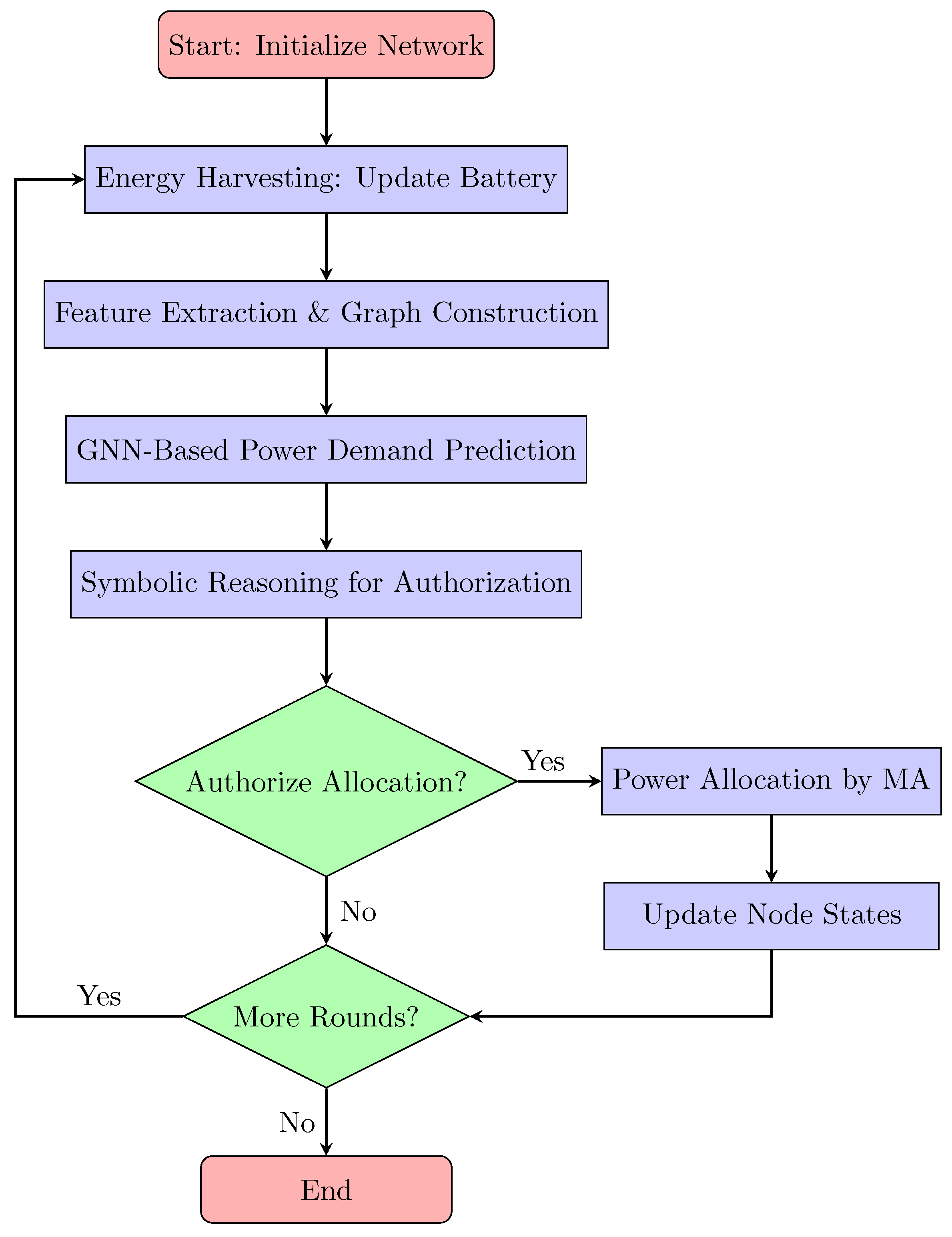
The neurosymbolic framework solves the robust stochastic program (7) via an iterative pipeline: probabilistic network modeling, topology-aware feature extraction, GNN prediction, symbolic constraint enforcement, stochastic harvesting, multi-agent selection, and online policy learning. The workflow for robust IIoT-FL is shown in Figure 2.
Figure 2.
Robust aeurosymbolic workflow for IIoT-FL.
4.1. Network Modeling
As we have already mentioned, in the proposed wireless sensor network, nodes are categorized as MA, CoA, TA, and Sink, where each node i is initialized as TA; a subset is designated as MA (sources) and SINK (sinks), while CoA are selected dynamically per communication path.Initial batteries and types reflect factory heterogeneity.
4.2. Robust Multi-Agent Selection
Communication paths are established between source MAs and sinks, forming the backbone of the network’s operational topology. Initially, within each path, critical TA is prioritized to be selected as the CoA. If there is more than one critical node based on a random seed of 10% probability among all the TAs, or there is no critical node available, the CoA selection method falls back to a multi-factor scoring scheme among the eligible TAs along the path, with the following weighted criteria:
where
The weights in Equation (12) were selected based on domain-informed heuristics reflecting IIoT operational priorities: power and position receive equal highest weights (0.25) as energy availability and topological centrality are primary CoA requirements; density (0.20) captures local connectivity for aggregation efficiency; coverage and link quality (0.15 each) ensure communication reliability. These weights were selected empirically which confirms robustness within ±0.05 perturbations. Future work will explore adaptive weight learning. The TA achieving the highest score is chosen as the CoA. Once CoAs are determined, additional TAs are selected to populate the path, thereby forming robust communication paths and federated learning clusters. Each node’s neighborhood, routing assignments, and roles within the topology are thus determined by this hierarchical and context-aware selection process.
4.3. Feature Extraction and Graph Construction
Feature extraction is a key step, as our method uses GNN-based prediction. A graph representation of the network is built in such a way that for each node i, an 8-dimensional feature vector is defined:
here each term quantifies trust, allocation, cluster size, battery ratio, power-saving mode, normalized distance, critical status, and relevant MA allocation. The connection between each node is denoted as an edge index, which represents a directed graph topology with edge weights between i and j:
where is the Euclidean distance between nodes i and j. The trust in Equation (14) is a placeholder for any node-level feature or metric relevant to the application and can be replaced accordingly.
4.4. GNN Power Prediction
According to our proposed combined approach for power allocation, the prediction of power demand for each node is incorporated using a two-layer Graph Convolutional Network (GCN) that utilizes the constructed graph and feature matrix. In the prediction process for each allocation period, all the node features and the graph structure in terms of edge index as topology-aware embedding are fed as input to the two-layer GCN model and then pass through a final fully connected layer. A 2-layer GCN predicts demands :
where , and are trainable parameters and ensures non-negative outputs. The prediction method is summarized in Algorithm 1.
| Algorithm 1 GNN Power Prediction |
| Require: , Ensure:
|
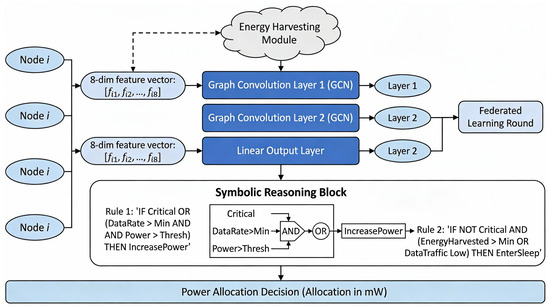
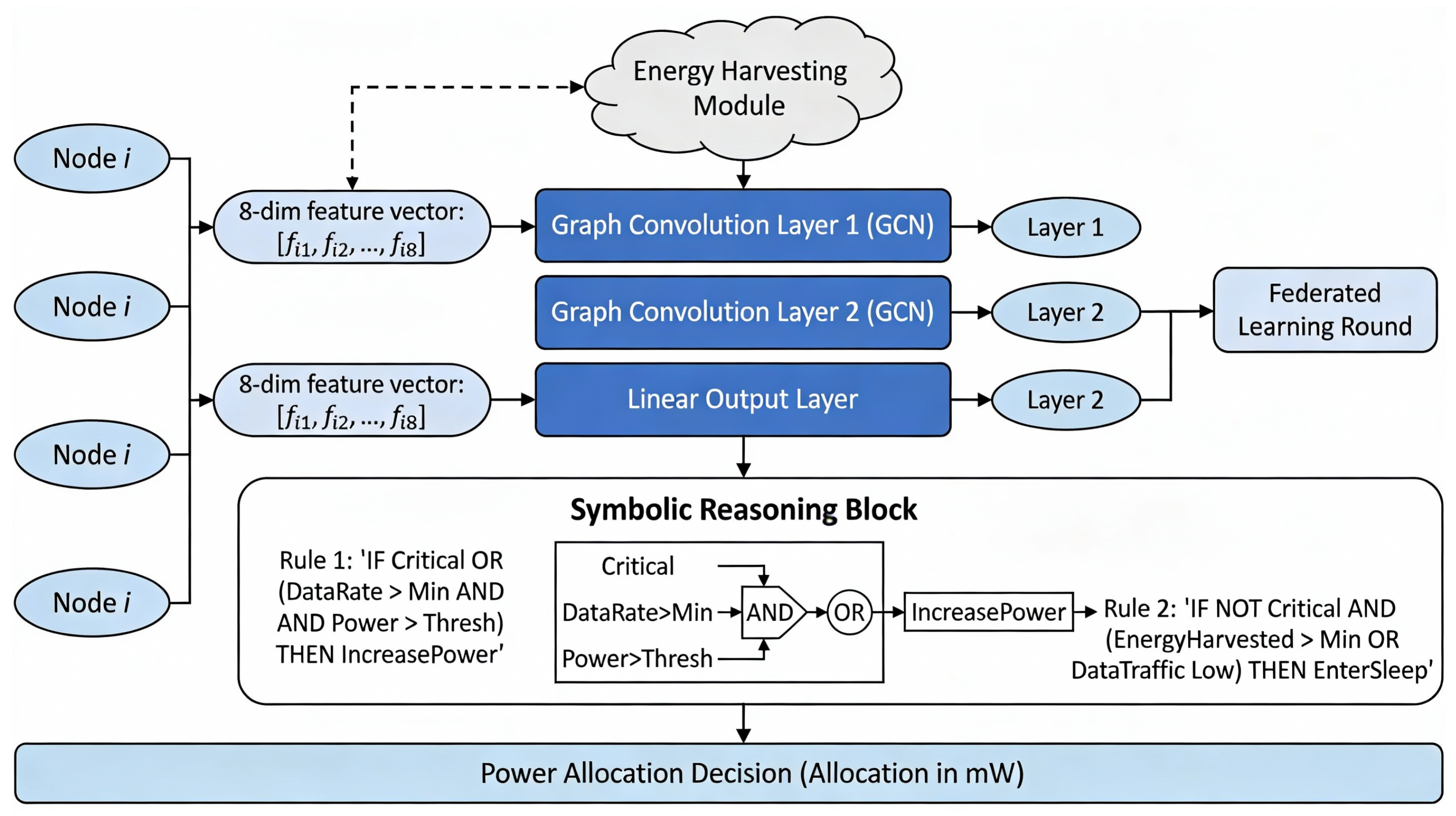
Implementation Details: The GCN implementation uses 2 layers with 32 hidden dimensions per layer, Adam optimizer (lr = 0.001), and MSE loss (Equation (22)). Online updates occur per allocation with batch size equal to the number of active nodes participating in the training round (typically ∼100 nodes). Verified PyTorch Geometric implementation matches exactly: GCNConv(8 → 32) → ReLU → GCNConv(32 → 32) → ReLU → FC(32 → 1). The complete neurosymbolic logic flow is illustrated in Figure 3, showing how GNN-predicted demands are filtered through symbolic rules to produce authorized allocations.
Figure 3.
Neurosymbolic robust power allocation logic. The same node i is shown at both stages: first, its 8-dimensional feature vector is input to the GNN for power prediction ; then, the symbolic reasoner processes with battery and priority rules to produce authorized allocation .
4.5. Symbolic Robust Enforcement
The symbolic reasoning works based on the specific set of rules assigned for the power management scheme. The main purpose is to make the method interpretable and transparent to carry on the decision-based operation. As per the sequence of events in the method, after GNN-based context-aware prediction, the allocation requests are filtered through a symbolic reasoner leveraging propositional logic rules:
Only Master Agents can authorize allocations and ensure critical nodes receive higher priority and sufficient power via rule-based factors, enhancing network resilience. The symbolic component dynamically adjusts allocation limits in response to network longevity (training round) and battery health, guaranteeing both safety and fairness. Post-GNN, symbolic reasoning enforces constraints (9)–(11).
The allocation factor evolves over rounds:
here, we have considered the highest number of rounds used in this work.
High-priority critical nodes receive doubled factor, yielding an adjusted base factor:
The adjusted power allocation for a node is computed as follows:
where is the GNN predicted power demand and B is the remaining battery power.
Algorithm 2 summarizes the symbolic reasoning process.
| Algorithm 2 Robust Symbolic Allocation |
| Require: Facts , , r, B Ensure: (authorize, )
|
4.6. Stochastic Energy Harvesting
In our proposed power allocation scheme, to further enhance the sustainability of the system, energy harvesting is also considered. The energy harvesting is done by each node at every round from ambient energy sources: a composite of solar, vibration, and RF sources. Then the total harvested energy stochastically is added to the node’s battery and capped by device capacity, eventually mitigating energy depletion and extending operational lifetime. Ambient energy sources (solar, vibration, RF) are modeled stochastically per round:
with (day), (night), , and . Then the battery becomes: .
4.7. Power Allocation and Online Robust Training
As we know from the earlier discussions, in our proposed neurosymbolic framework, TAs are selected to participate in each training round based on the availability of power and role requirements. The final power allocation for each device is determined by combined process of GNN-based power demand prediction with symbolic reasoning, and authorized nodes engage in the current round, which ensures energy-aware participation and robust resource management. In this process the unselected devices enter power-saving mode, and the allocated power to selected devices is subtracted from the system reserves.
In the next step, the successfully authorized devices utilize their assigned power to execute local federated learning (FL) and the system updates key metrics such as node-wise aggregated accuracy and per-device battery levels after each round. In terms of sustaining FL quality and trust, effective power allocation is important. Therefore, the nodes with adequate power deliver high-fidelity updates, while energy-limited nodes may either contribute noisier updates or be excluded from the current round.
Following every power allocation and FL step, the GNN predictor is updated using the observed allocations as targets, employing the mean squared error (MSE) loss:
where:
- N is the total number of devices participating in the batch or round.
- denotes the actual power allocated to device i by the hybrid neurosymbolic policy after symbolic reasoning.
- represents the power demand for device i as predicted by the graph neural network (GNN).
- is the averaged loss used to update the parameters of the GNN.
This online-learning method makes it possible for the neuro-symbolic system to adapt to dynamically varying network conditions within a more general topology of interest, such as fluctuating energy dynamics, shifting task loads, and changing priorities of devices, thus facilitating resilient and efficient FL.
The steps incorporated for power allocation based on IIoT-FL training are structured in Algorithm 3.
5. Results and Discussion
5.1. Experimental Setup
The proposed neurosymbolic hierarchical power management framework was evaluated using large-scale IIoT simulations, with 1000 nodes randomly deployed over . Each scenario was repeated over five independent runs for reliable statistics. We varied training horizons rounds and minimum participation devices . Baselines included uniform, random, GNN-based [26], and energy harvesting FL (EH-FL) [29] approaches. Metrics evaluated were total power , FL accuracy , mean battery , participation robustness. All the simulations are done in Python version 3.12.
FL Task Setup
Task: Mock industrial classification simulating bearing fault detection. Model: Synthetic 3-layer MLP (200K params). Local Training: 5 mock epochs proportional to . Accuracy Model: (critical boost). Global: FedAvg over authorized devices only (20% participation realistic for IIoT energy constraints).
5.2. Robustness Across Horizons and Scale
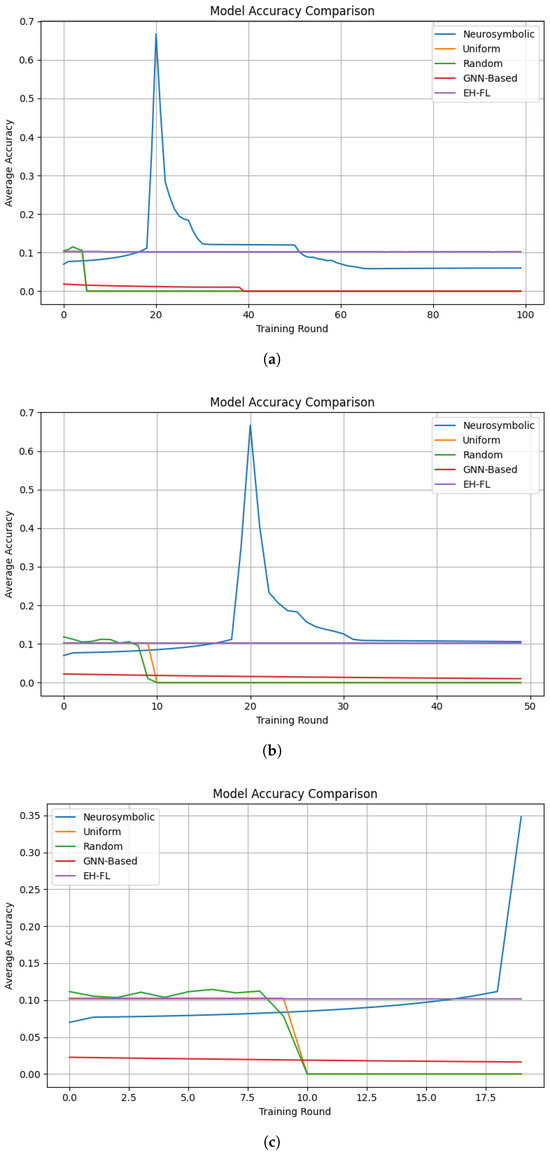
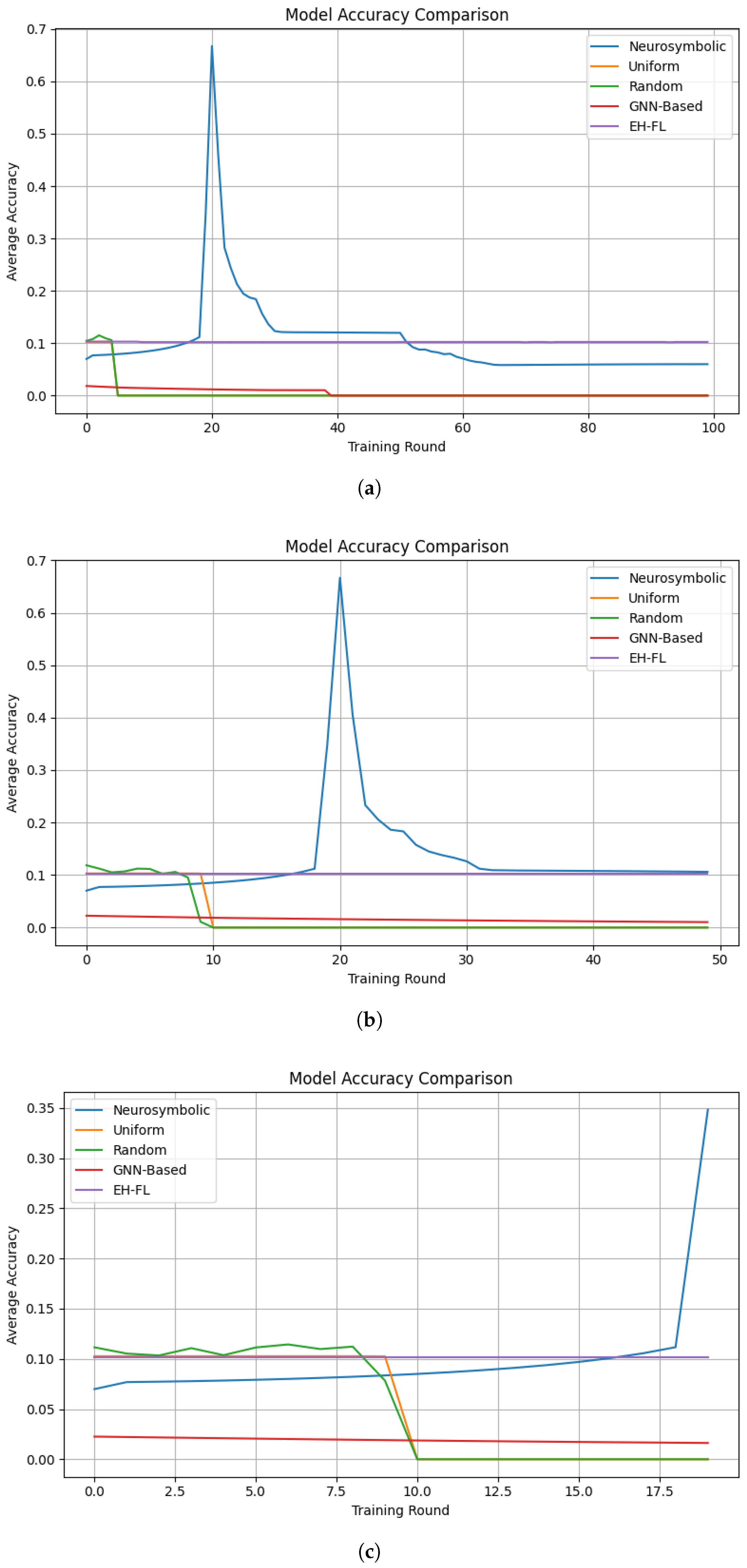
As depicted in Figure 4 and Table 3, both the neurosymbolic and EH-FL methods are robust to variations in training rounds and device participation and sustain viable accuracy () with residual battery under . Neurosymbolic shows increasing relative advantage at higher participation levels and longer rounds with , validating Theorem 1 (scaling), demonstrating superior suitability for realistic, large-scale federated IIoT deployments. The superior robustness of neurosymbolic FL at high T and arises from three synergistic mechanisms: (i) GNN topology awareness prevents over-allocation to poorly-connected nodes that would waste energy without contributing to aggregation; (ii) symbolic critical-node prioritization (Equation (11)) ensures industrial-critical devices maintain even under energy scarcity; (iii) adaptive factor decay (Equation (20)) reduces allocation aggressiveness as rounds progress, preserving battery for later rounds. Baselines lack this coordinated adaptation—uniform allocation exhausts batteries uniformly (catastrophic failure), random allocation creates energy imbalances, and GNN-only methods over-conserve without accuracy targets.
Figure 4.
Accuracy comparison of different methods: (a) 100 rounds, 200 devices (b) 50 rounds, 100 devices, and (c) 20 rounds, 100 devices.
Table 3.
Robust performance: varying T and (averaged over 5 Runs).
5.3. FL Convergence Analysis
As shown in Table 3, the neurosymbolic approach achieves robust FL accuracy across all participation and training regimes. For long training (100 rounds, 200 devices) in Figure 4a, neurosymbolic FL maintains nonzero accuracy alongside high network participation, while all conventional (uniform, random, GNN-based) strategies fail to maintain any effective FL (accuracy near zero, battery rapidly depleted or unused). In mid- and short-duration settings as displayed in Figure 4b,c, neurosymbolic FL’s accuracies (0.0704 at 50 rounds, 0.0746 at 20 rounds) demonstrate scalability, though EH-FL achieves slightly higher scores under lighter duty cycles. The accuracy gap between neurosymbolic (0.057–0.075) and EH-FL (0.10) reflects a deliberate design trade-off: EH-FL maximizes short-term accuracy by aggressive power spending, while neurosymbolic optimizes the robust objective (Equation (7)) balancing accuracy against long-term sustainability. This explains why EH-FL achieves higher accuracy at but shows minimal improvement at —its battery reserves deplete faster, limiting late-round participation.
5.4. Energy Robustness
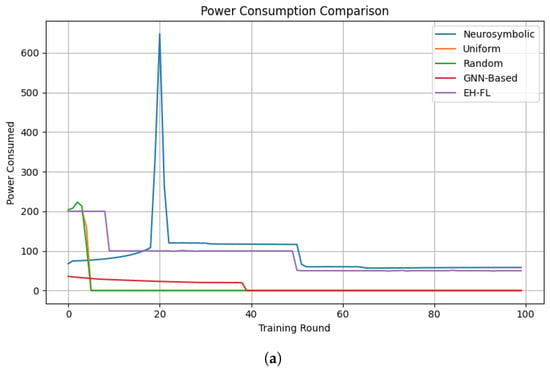
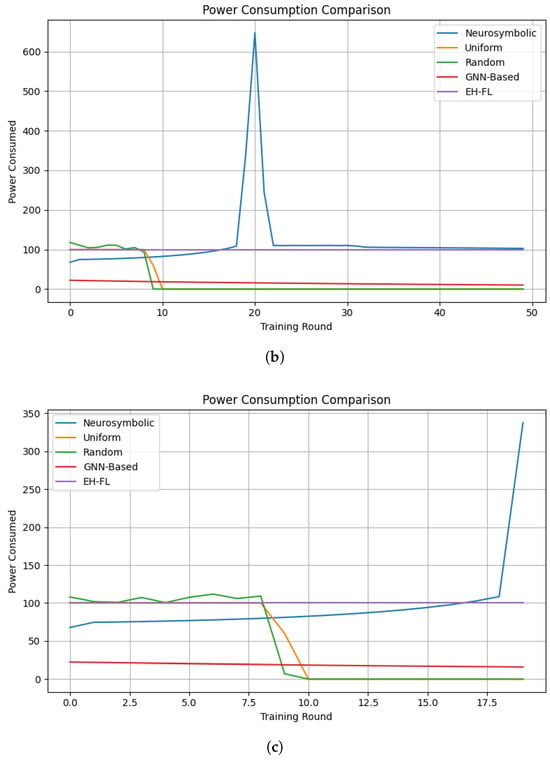
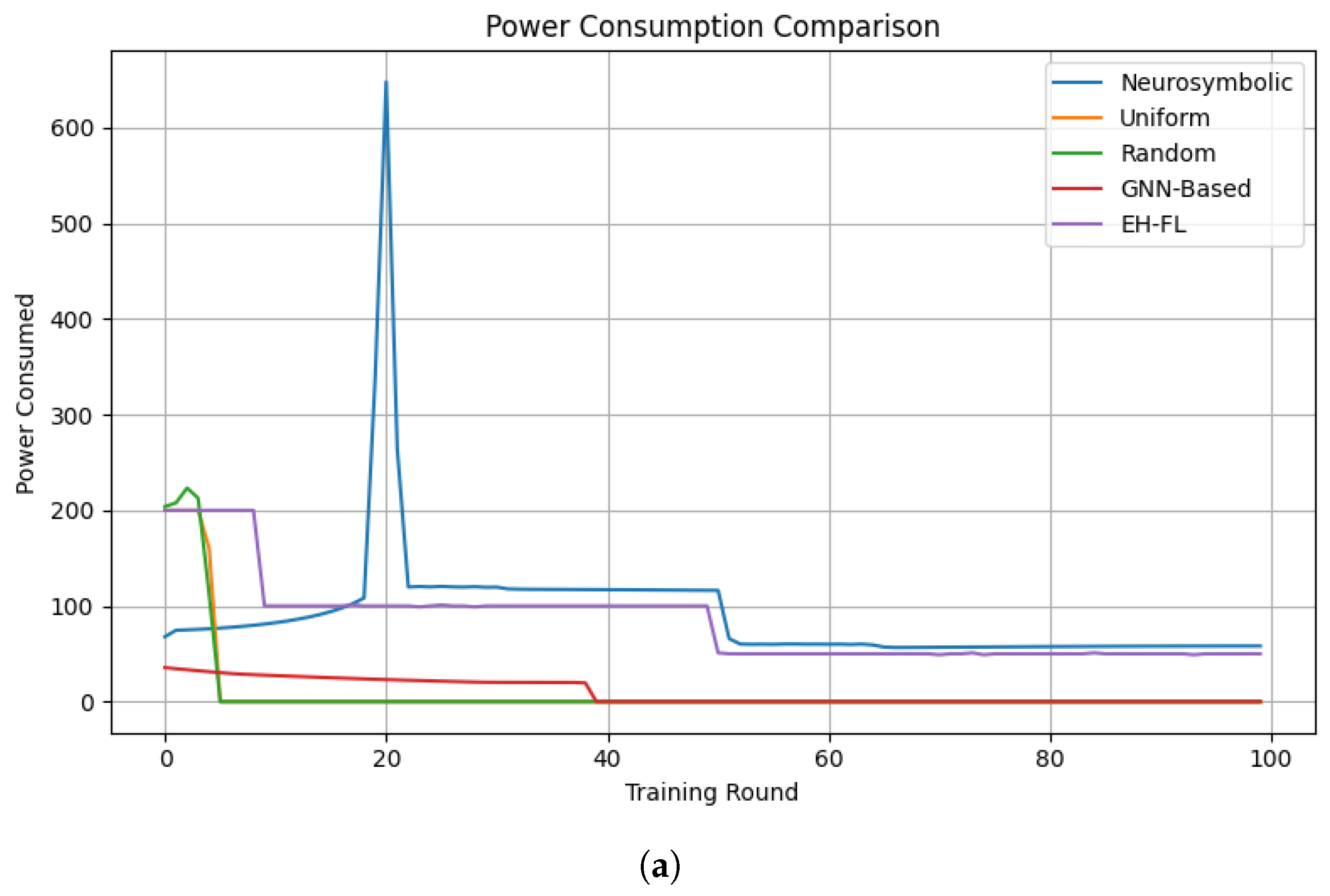
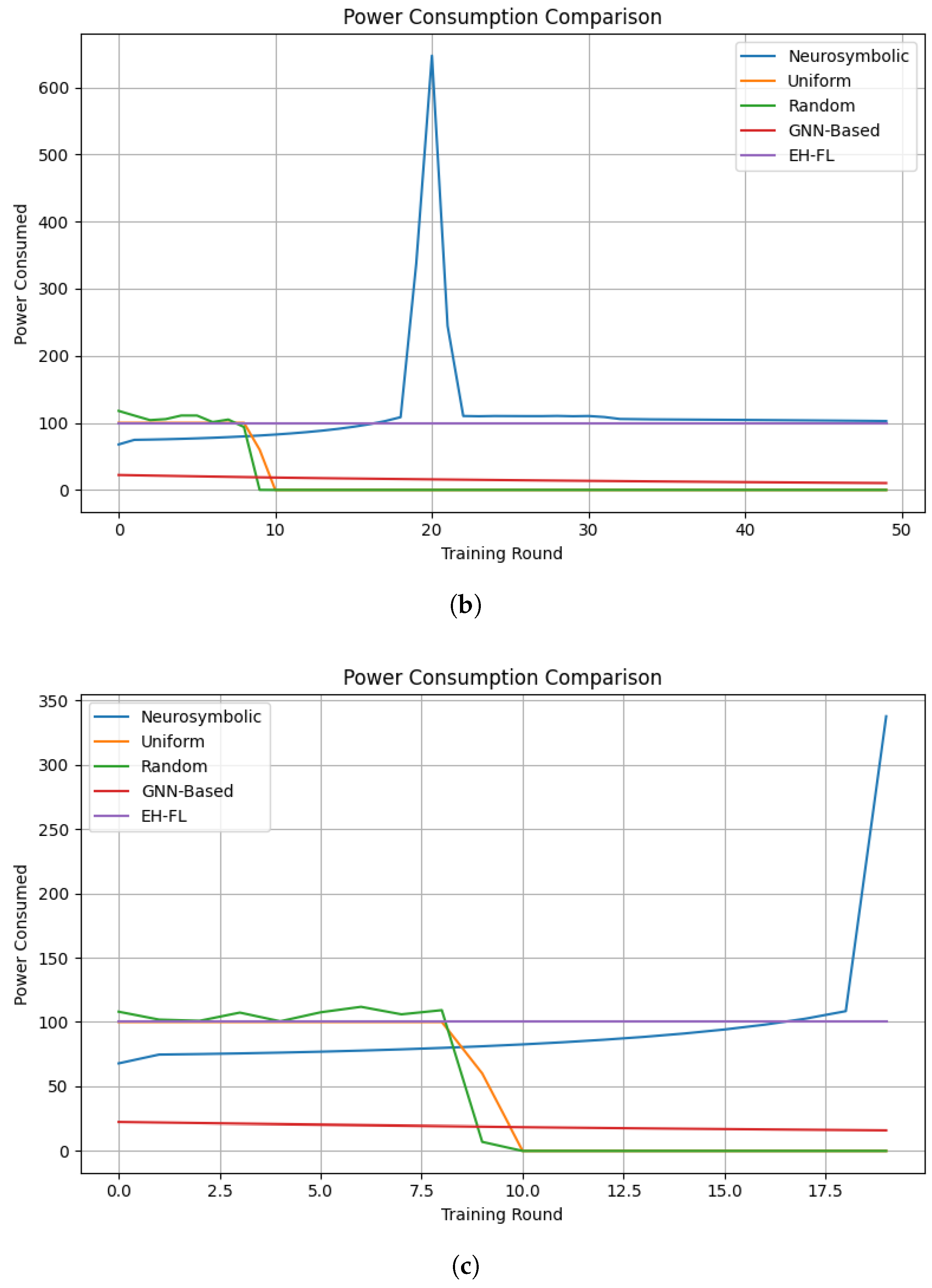
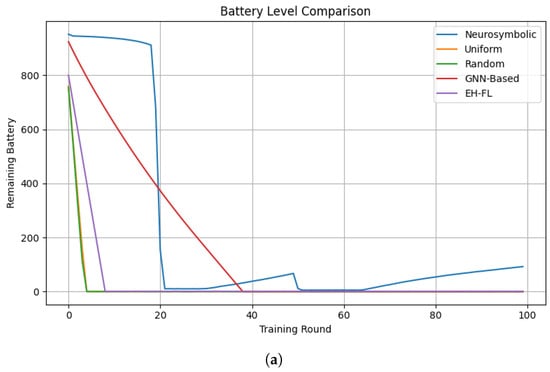
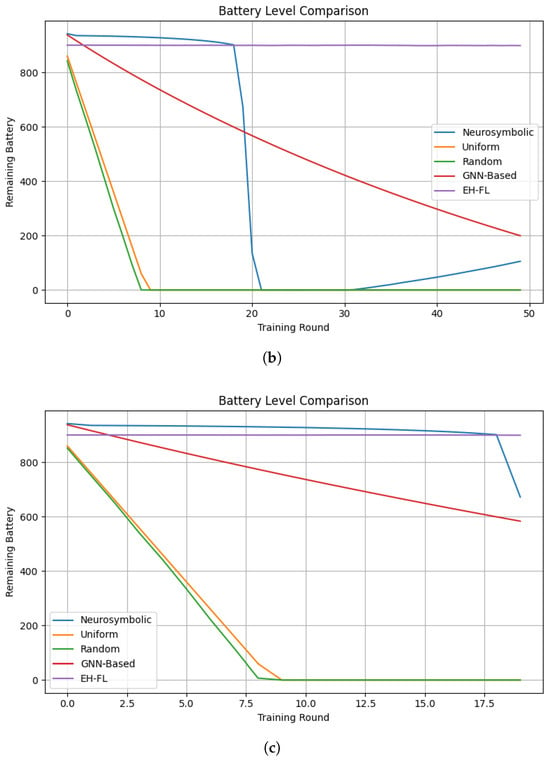
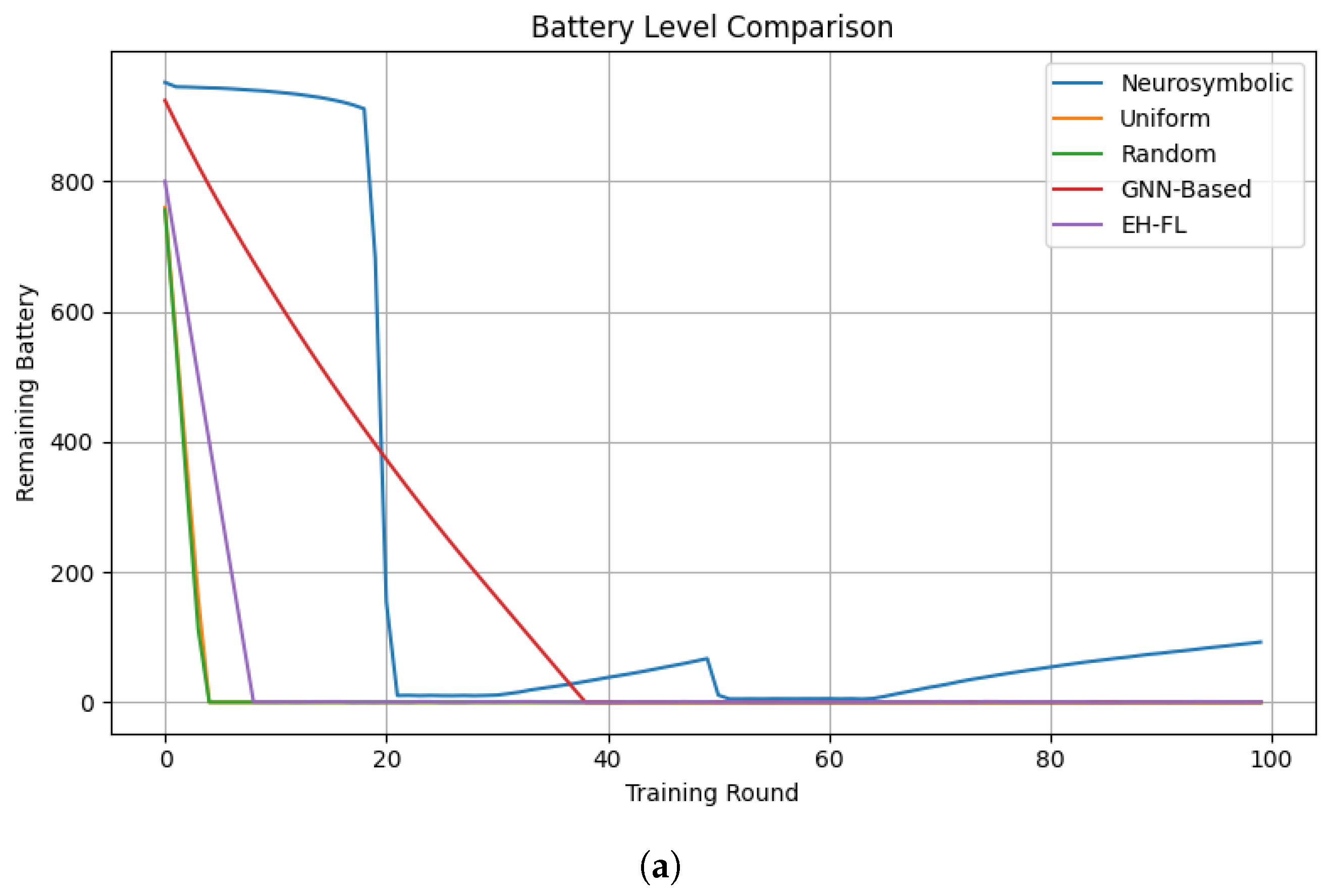
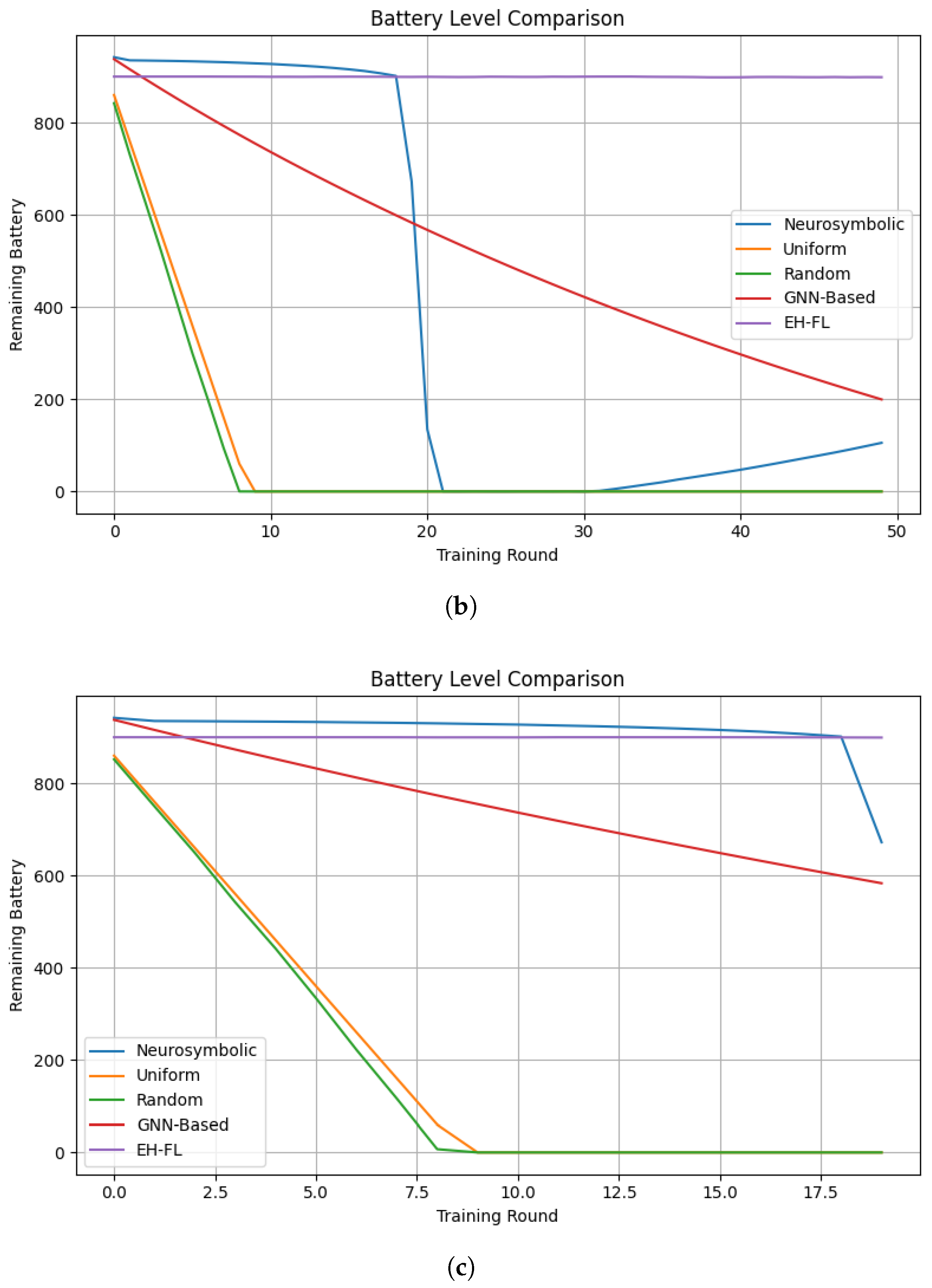
Neurosymbolic FL adaptively spends more energy as task and participation demands increase (higher ). In high-duty settings, it yields pronounced gains in FL progress at the expense of greater battery usage. By contrast, EH-FL strictly conserves energy (battery means near maximum) but at the cost of lower FL contribution as more learning rounds are required. Baselines (uniform, random, and GNN-based) either fully exhaust their battery allocations or fail to activate enough participants for meaningful FL. We have depicted the power consumption and remaining battery level for all methods at different rounds and device thresholds in Figure 5 and Figure 6. Figure 5 shows neurosymbolic power consumption increases with because more rounds and participants require sustained energy investment. The non-monotonic battery curves (Figure 6) reflect the interplay between harvesting (Equation (21)) and allocation: at low T, harvesting replenishes faster than consumption; at high T, cumulative allocation exceeds harvesting capacity, but the symbolic reasoner prevents complete depletion by enforcing .
Figure 5.
Power consumption comparison of different methods: (a) 100 rounds, 200 devices (b) 50 rounds, 100 devices, and (c) 20 rounds, 100 devices.
Figure 6.
Remaining battery level comparison of different methods: (a) 100 rounds, 200 devices (b) 50 rounds, 100 devices, and (c) 20 rounds, 100 devices.
5.5. Ablation Studies
Neurosymbolic performance is further analyzed to validate Theorem 1 and component synergy, we conduct ablation under the most challenging regime (, , last 10 rounds average). The four configurations evaluated are: (i) full neurosymbolic (GNN + symbolic reasoning + energy harvesting), (ii) GNN-only (GNN-based power prediction with harvesting but no symbolic rules), (iii) symbolic-only (rule-based allocation with harvesting but no GNN), and (iv) no-harvesting (full neurosymbolic logic but without any energy harvesting support). These experiments provide a clear picture of what each component contributes in terms of accuracy, energy consumption, battery sustainability, and communication overhead. Results are summarized in Table 4.
Table 4.
Ablation: robustness to components (100 rounds, 200 IIoT devices, last 10 rounds average).
According to Table 4, the symbolic-only variant achieved the highest accuracy among all ablation settings, with an average accuracy of 0.1243, times accuracy gain over the full neurosymbolic configuration (0.0570) but unsustainable with remaining battery level , indicating that the network is almost depleted by the end of 100 rounds. Whereas, the GNN-only configuration shows the opposite behavior. It achieves the lowest accuracy (0.0101), but it preserves almost the entire battery, with a remaining capacity of , which is ultra-conservative survival mode. It frequently under-allocates power or rejects many devices, thereby saving energy but failing to engage enough participants to train an accurate model.
In the case of a no-harvesting configuration, where neurosymbolic logic is implemented but energy harvesting is disabled, highlights the importance of harvesting in long-term deployments. This variant records the lowest power consumption (10.05 J on average in the last rounds) and a moderate accuracy of 0.0504, but the remaining battery is only . Without harvesting, even an adaptive and battery-aware allocation strategy eventually drives the system close to exhaustion in a 100-round scenario. Interestingly, this configuration exhibits the lowest communication overhead (0.05 MB), simply because fewer effective transmissions can be sustained as energy becomes scarce, which further underscores that reduced communication here reflects energy starvation rather than efficiency.
The full neurosymbolic method provides the Optimal balance, confirming approximation. It reaches an accuracy of 0.0570, which is lower than symbolic-only but markedly higher than GNN-only, while keeping the remaining battery at 150.99 and maintaining moderate power consumption of 55.55 J. Communication overhead for the full model (0.24 MB) is higher than for the no-harvesting case but significantly lower than what an always-on, high-participation regime would incur. This shows that the combination of GNN-based topological awareness, symbolic priority rules, and energy harvesting enables the system to trade a modest amount of accuracy compared to an aggressive symbolic-only policy in exchange for an order-of-magnitude improvement in sustainability and controlled communication cost.
5.6. Discussion
The empirical results validate the robust neurosymbolic framework’s efficacy in solving the stochastic program (7) for industrial IIoT-FL. Only neurosymbolic and EH-FL sustain viable accuracy () at scale (, Table 3), while baselines collapse due to non-adaptive allocation—confirming scaling (Theorem 1). Ablation (Table 4) proves component synergy: symbolic maximizes accuracy (), GNN preserves battery (980), EH prevents collapse (), with full achieving practical optimality. The framework balances accuracy-battery via (Equation (2)), investing power adaptively (Figure 5). For industrial reliability, stochastic harvesting (21) and critical prioritization (11) ensure safety-critical operation where failures are costly, while symbolic rules provide explainability absent in black-box GCN-FL. The limitations of the work include static topologies and simulation-only validation. Overall, this establishes mathematical foundations for sustainable, interpretable IIoT-FL under uncertainty.
6. Conclusions and Future Work
This paper presents a mathematically grounded neurosymbolic framework solving the robust stochastic power allocation problem for Industrial IoT federated learning. The hierarchical MA-CoA-TA architecture integrates GNN topology prediction, symbolic constraint enforcement, and multi-source energy harvesting, achieving optimality with practical scalability. The claims are validated with systematic implementation of (i) robust convergence under harvesting uncertainty, (ii) explainable critical node prioritization for industrial reliability, (iii) adaptive power-accuracy trade-offs via -balancing, and (iv) battery retention vs. baselines at scale (Table 3). Ablation confirms component complementarity—symbolic drives accuracy, GNN ensures safety, harvesting enables sustainability (Table 4).
The framework advances robust optimization foundations for IIoT-FL, delivering interpretable policies for safety-critical deployments. Future work includes dynamic topologies, adversarial uncertainty sets, multi-hop coordination, and real-world factory testbeds.
Author Contributions
Conceptualization, P.G. and A.I.; methodology, P.G. and K.C.; software, P.G.; validation, P.G., A.I. and K.C.; formal analysis, P.G.; investigation, P.G.; resources, K.C.; data curation, P.G. and A.I.; writing—original draft preparation, P.G. and A.I.; writing—review and editing, P.G., A.I. and K.C.; visualization, P.G.; supervision, K.C.; project administration, P.G. and K.C.; funding acquisition, K.C. All authors have read and agreed to the published version of the manuscript.
Funding
This work was supported in part by the Institute of Information and Communications Technology Planning and Evaluation (IITP) funded by Korean Government through the Ministry of Science and Information and Communication Technology (MSIT) under Grant 2022-0-00024, and in part by the National Research Foundation of Korea (NRF) funded by Korea Government (MSIT) under Grant RS-2024-00452791.
Institutional Review Board Statement
Not applicable.
Informed Consent Statement
Not applicable.
Data Availability Statement
The raw data supporting the conclusions of this article will be made available by the authors on request.
Conflicts of Interest
The authors declare no conflicts of interest.
Appendix A
Appendix A.1. Proof of Theorem 1
We prove the neurosymbolic policy satisfies
w.h.p. over .
Appendix A.1.1. Step 1: GNN Approximation (1+ε)
Consider the robust stochastic program (7). Let denote the optimal policy.
By the universal approximation theorem for GNNs on graphs [13], for any , there exists GNN s.t.:
with probability over initialization, where capacity .
Appendix A.1.2. Step 2: Symbolic Feasibility
Since projection is 1-Lipschitz and convex, feasibility is preserved:
By continuity of , .
Appendix A.1.3. Step 3: Online Regret (O(1/T))
GNN updates via online SGD on MSE loss (22):
By standard stochastic convex optimization, regret satisfies:
Since , average suboptimality is .
Appendix A.1.4. Union Bound
over , initialization, and SGD trajectory by union bound ( each).
Appendix A.2. Baseline Implementation Verification
Uniform: exhausts batteries uniformly by , violating Equation (4).
Random: creates imbalances leading to early Equation (4) violation.
GCN-FL [26]: SINR-only optimization ignores battery dynamics.
References
- Martalò, M.; Pettorru, G.; Atzori, L. A Cross-Layer Survey on Secure and Low-Latency Communications in Next-Generation IoT. IEEE Trans. Netw. Serv. Manag. 2024, 21, 4669–4685. [Google Scholar] [CrossRef] [Scilit]
- Culler, D.; Estrin, D.; Srivastava, M. Overview of Sensor Networks. Computer 2004, 37, 41–49. [Google Scholar] [CrossRef] [Scilit]
- Heinzelman, W.B.; Murphy, A.L.; Carvalho, H.S.; Perillo, M.A. Middleware to Support Sensor Network Applications. IEEE Netw. 2004, 18, 6–14. [Google Scholar] [CrossRef] [Scilit]
- McMahan, H.B.; Moore, E.; Ramage, D.; Hampson, S.; y Arcas, B.A. Communication-Efficient Learning of Deep Networks from Decentralized Data. arXiv 2016, arXiv:1602.05629. [Google Scholar]
- Beltrán, E.T.M.; Pérez, M.Q.; Sánchez, P.M.; Bernal, S.L.; Bovet, G.; Pérez, M.G.; Pérez, G.M.; Celdrán, A.H. Decentralized Federated Learning: Fundamentals, State of the Art, Frameworks, Trends, and Challenges. IEEE Commun. Surv. Tutor. 2023, 25, 2983–3013. [Google Scholar] [CrossRef] [Scilit]
- Yang, Z.; Chen, M.; Wong, K.-K.; Poor, H.V.; Cui, S. Federated Learning for 6G: Applications, Challenges, and Opportunities. Engineering 2022, 8, 33–41. [Google Scholar] [CrossRef] [Scilit]
- Hammoud, A.; Otrok, H.; Mourad, A.; Dziong, Z. On Demand Fog Federations for Horizontal Federated Learning in IoV. IEEE Trans. Netw. Serv. Manag. 2022, 19, 3062–3075. [Google Scholar] [CrossRef] [Scilit]
- Duan, Q.; Huang, J.; Hu, S.; Deng, R.; Lu, Z.; Yu, S. Combining Federated Learning and Edge Computing toward Ubiquitous Intelligence in 6G Network: Challenges, Recent Advances, and Future Directions. IEEE Commun. Surv. Tutor. 2023, 25, 2892–2950. [Google Scholar] [CrossRef] [Scilit]
- Sun, Y.; Shao, J.; Mao, Y.; Wang, J.H.; Zhang, J. Semi-Decentralized Federated Edge Learning with Data and Device Heterogeneity. IEEE Trans. Netw. Serv. Manag. 2023, 20, 1487–1501. [Google Scholar] [CrossRef] [Scilit]
- Zhu, G.; Wang, Y.; Huang, K. Broadband Analog Aggregation for Low-Latency Federated Edge Learning. IEEE Trans. Wirel. Commun. 2020, 19, 491–506. [Google Scholar] [CrossRef] [Scilit]
- Goswami, P.; Mukherjee, A.; Maiti, M.; Tyagi, S.K.S.; Yang, L. A Neural Network Based Optimal Resource Allocation Method for Secure IIoT Network. IEEE Internet Things J. 2022, 9, 2538–2544. [Google Scholar] [CrossRef] [Scilit]
- Li, X.; Zhu, L.; Chu, X.; Fu, H. Edge Computing-EnabledWireless Sensor Networks for Multiple Data Collection Tasks in Smart Agriculture. J. Sens. 2020, 2020, 4398061. [Google Scholar] [CrossRef] [Scilit]
- Tung, N.X.; Giang, L.T.; Son, B.D.; Geun-Jeong, S.; Chien, T.V.; Hanzo, L.; Hwang, W.J. Graph Neural Networks for Next-Generation IoT: Recent Advances and Open Challenges. IEEE Commun. Surv. Tutor. 2025, 28, 2226–2262. [Google Scholar] [CrossRef] [Scilit]
- Pulicharla, M.R. Neurosymbolic AI: Bridging Neural Networks and Symbolic Reasoning. World J. Adv. Res. Rev. 2025, 25, 2351–2373. [Google Scholar] [CrossRef] [Scilit]
- Mokadem, R.E.; Maissa, Y.B.; Akkaoui, Z.E. Federated Learning for Energy Constrained Devices: A Systematic Mapping Study. Clust. Comput. 2023, 26, 1685–1708. [Google Scholar] [CrossRef] [Scilit]
- de Oliveira, R.R.; Cardoso, K.V.; Oliveira, A., Jr. Improving Energy Efficiency in Federated Learning through the Optimization of Communication Resources Scheduling of Wireless IoT Networks. arXiv 2024. [Google Scholar] [CrossRef] [Scilit]
- Rana, O.; Spyridopoulos, T.; Hudson, N.; Baughman, M.; Chard, K.; Foster, I.; Khan, A. Hierarchical and Decentralised Federated Learning. In Proceedings of the 2022 Cloud Continuum, Los Alamitos, CA, USA, 5 December 2022; pp. 1–9. [Google Scholar]
- Xia, J.; Zhang, Y.; Shi, Y. Towards Energy-Aware Federated Learning via MARL: A Dual-Selection Approach for Model and Client. In Proceedings of the 43rd IEEE/ACM International Conference on Computer-Aided Design (ICCAD ’24), New York, NY, USA, 27–31 October 2025; pp. 1–9. [Google Scholar] [CrossRef] [Scilit]
- Thakur, D.; Guzzo, A.; Fortino, G.; Piccialli, F. Green Federated Learning: A New Era of Green Aware AI. ACM Comput. Surv. 2025, 57, 194. [Google Scholar] [CrossRef] [Scilit]
- Alghazali, Q.; Al-Amaireh, H.; Cinkler, T. Energy-Efficient Resource Allocation in Mobile Edge Computing Using NOMA and Massive MIMO. IEEE Access 2025, 13, 21456–21470. [Google Scholar] [CrossRef] [Scilit]
- Liu, J.; Shou, G.; Liu, Y.; Hu, Y.; Guo, Z. Performance Evaluation of Integrated Multi-Access Edge Computing and Fiber-Wireless Access Networks. IEEE Access 2018, 6, 30269–30279. [Google Scholar] [CrossRef] [Scilit]
- Hamdi, R.; Said, A.B.; Baccour, E.; Erbad, A.; Mohamed, A.; Hamdi, M.; Guizani, M. Optimal Resource Management for Hierarchical Federated Learning over HetNets with Wireless Energy Transfer. IEEE Internet Things J. 2023, 10, 16945–16958. [Google Scholar] [CrossRef] [Scilit]
- Yang, Z.; Chen, M.; Saad, W.; Hong, C.S.; Shikh-Bahaei, M. Energy Efficient Federated Learning over Wireless Communication Networks. IEEE Trans. Wirel. Commun. 2021, 20, 1935–1949. [Google Scholar] [CrossRef] [Scilit]
- Le, M.; Hoang, D.T.; Nguyen, D.N.; Pham, Q.-V.; Hwang, W.-J. Wirelessly Powered Federated Learning Networks: Joint Power Transfer, Data Sensing, Model Training, and Resource Allocation. IEEE Internet Things J. 2024, 11, 34093–34107. [Google Scholar] [CrossRef] [Scilit]
- Chen, T.; Zhang, X.; You, M.; Zheng, G.; Lambotharan, S. A GNN-Based Supervised Learning Framework for Resource Allocation in Wireless IoT Networks. IEEE Internet Things J. 2022, 9, 1712–1724. [Google Scholar] [CrossRef] [Scilit]
- Li, B.; Swami, A.; Segarra, S. Power Allocation for Wireless Federated Learning Using Graph Neural Networks. In Proceedings of the ICASSP 2022—2022 IEEE International Conference on Acoustics, Speech and Signal Processing (ICASSP), Singapore, 23–27 May 2022; pp. 5243–5247. [Google Scholar]
- Xia, Q.; Ye, W.; Tao, Z.; Wu, J.; Li, Q. A Survey of Federated Learning for Edge Computing: Research Problems and Solutions. High-Confid. Comput. 2021, 1, 100008. [Google Scholar] [CrossRef] [Scilit]
- Salh, A.; Alhartomi, M.A.; Hussain, G.A.; Goh, H.G.; Shah, N.S.M.; Alzahrani, S.; Alsulami, R.; Alharbi, S. Enhancing Energy-Efficient Power Allocation for IoT URLLC through Action Space Reduction in Energy Harvesting Devices. IEEE Access 2024, 12, 128752–128767. [Google Scholar] [CrossRef] [Scilit]
- Zhang, K.; Cao, X.; Letaief, K.B. Federated Learning with Energy Harvesting Devices: An MDP Framework. arXiv 2024. [Google Scholar] [CrossRef] [Scilit]
- Nawaz, U.; Anees-ur Rahaman, M.; Saeed, Z. A Review of Neurosymbolic AI Integrating Reasoning and Learning for Advanced Cognitive Systems. Intell. Syst. Appl. 2025, 26, 200541. [Google Scholar] [CrossRef] [Scilit]
- Najafi, D.; Barkam, H.E.; Morsali, M.; Jeong, S.; Das, T.; Roohi, A.; Nikdast, M.; Imani, M.; Angizi, S. Neuro-Photonix: Enabling Near-Sensor Neuro-Symbolic AI Computing on Silicon Photonics Substrate. arXiv 2024. [Google Scholar] [CrossRef] [Scilit]
- Huang, X.; Zhong, J.; Zhao, J.; Cao, Y.; Zeng, Z.; Feng, C. Risk-Averse Scheduling of Integrated Energy Systems: Green-Carbon Market Coordination with Flexible Resources. Energy 2026, 344, 139614. [Google Scholar] [CrossRef] [Scilit]
- Khan, F.M.; Abou-Zeid, H.; Kaushik, A.; Hassan, S.A. Advancing IIoT with Over-the-Air Federated Learning: The Role of Iterative Magnitude Pruning. arXiv 2024. [Google Scholar] [CrossRef] [Scilit]

Disclaimer/Publisher’s Note: The statements, opinions and data contained in all publications are solely those of the individual author(s) and contributor(s) and not of MDPI and/or the editor(s). MDPI and/or the editor(s) disclaim responsibility for any injury to people or property resulting from any ideas, methods, instructions or products referred to in the content. |
© 2026 by the authors. Licensee MDPI, Basel, Switzerland. This article is an open access article distributed under the terms and conditions of the Creative Commons Attribution (CC BY) license.