


Abstract
Filters and congruences are fundamental concepts in residuated lattices for characterizing their structure. In this paper, using a complete lattice L as the truth-value set and based on a triangular norm T and its induced operator , we investigate new operational properties of -fuzzy filters and -fuzzy congruences. We first define the and -operations on L-fuzzy sets and study their effects on -fuzzy filters. Next, we examine the congruence-preserving properties and operational rules of -fuzzy congruences under and -compositions. Finally, leveraging the correspondence between -fuzzy filters and -fuzzy congruences, we explore the interplay and internal relationships among their respective operations.
MSC:
03G25; 03B52; 08A72
1. Introduction
The genesis of residuated lattices is deeply intertwined with the foundational inquiries into logic and algebra in the early 20th century. They emerged not as an isolated construct, but as a natural algebraic counterpart to non-classical logical systems, particularly substructural logics, which lack some of the structural rules of classical logic, such as contraction or weakening. The primary motivation was to provide a robust algebraic semantics for the implication connective in these logics. In this study, the key aim was to abstract the essential properties of the interaction between conjunction and implication. Specifically, the fundamental residuation property, if and only if , formally captures the adjoint relationship between a monoidal multiplication (modeling logical conjunction) and a residuum (modeling logical implication). This principle was first systematically investigated in the context of ideal theory in rings by M. Ward and R.P. Dilworth [1] in the 1930s. Since then, residuated lattices have evolved into a central unifying framework, generalizing a spectrum of well-known algebraic structures including Boolean algebras [2], -algebras [3], Heyting algebras [4], and -algebras [5] providing the cornerstone for the algebraic study of fuzzy logics, linear logic, and many other non-classical reasoning paradigms.
As we all know, filters and congruences play fundamental and interconnected roles in the algebraic study of residuated lattices [6,7]. Filters, specifically the lattice filters that are closed under the monoidal operation, serve as the primary algebraic tool for capturing logical truth and consequence. They are pivotal for defining a deductive system and for constructing quotient algebras. Congruences, on the other hand, provide the structural framework for factorization by identifying elements that are to be considered equivalent. The profound connection lies in the fact that in a residuated lattice, there is a natural one-to-one correspondence between certain filters (e.g., implicative filters) and congruences. This duality means that every such filter uniquely determines a congruence relation, and vice versa, allowing the formation of a quotient structure that itself remains a residuated lattice. Consequently, this interplay is indispensable for algebraic representation theorems, completeness proofs for fuzzy logic and many-valued logic, and the systematic analysis of the structure of residuated lattices.
As fuzzy mathematics evolves, the study of fuzzy filters and fuzzy congruences in residuated lattices and related logical algebras has attracted considerable attention from scholars. For example, the concepts of fuzzy filters, fuzzy prime filters, and cosets of a fuzzy filter in BL-algebras were first introduced by Liu and Li [8], who also explored several corresponding properties. Y.B. Jun et al. [9] provided some equivalent characterizations of fuzzy filters in -algebras and established the induced relationship between these fuzzy filters and fuzzy congruences. Zhu and Xu [10] extended some particular types of filters and fuzzy filters in -algebras and -algebras naturally to general residuated lattices, and provided characterizations of certain special residuated lattices based on filters and fuzzy filters. Gao et al. [11] proposed the notion of fuzzy extended filters and investigated their related properties. They proved that all fuzzy extended filters on a residuated lattice form a complete Heyting algebra under specific operations. Previous research in this area has largely been valued in the unit interval [0, 1]. However, driven by the extensive use of L-fuzzy sets [12], researchers have progressively extended the theories of fuzzy filters and fuzzy congruences to more universal frameworks. This has resulted in the introduction of -fuzzy filters and -congruences, where L denotes an arbitrary complete lattice and T is a triangular norm defined on it. It is noteworthy that Wang [13] was the first to examine the fundamental properties of -fuzzy filters within residuated lattices and provided a formulation for generating -fuzzy filters from L-fuzzy sets. Meanwhile, R.A. Borzooei and M. Bakhshi [14] established some equivalent characterizations of -fuzzy filters in -algebras. Furthermore, they established that there is a bijective correspondence between -fuzzy filters and -fuzzy congruences in -algebras under the condition that the triangular norm T is idempotent. Building on the work of [14], Liu et al. [15] established the quotient structure and homomorphism theorems of residuated lattices via -fuzzy congruences. A.A. Ramadan [16] investigated the profound connections between L-fuzzy filters, L-fuzzy topological spaces, and L-fuzzy pre-proximity spaces in complete residuated lattices from a categorical perspective. Recently, An and Pang [17] investigated problems related to L-fuzzy filters in effect algebras by employing the idea of degree, and proved that the degree of fuzzy filters in effect algebras can induce an L-fuzzy convex structure. Based on the one-to-one correspondence between fuzzy filters and fuzzy congruences, Zhou and Dong [18] studied the relevant properties of fuzzy rough sets based on fuzzy filters within the framework of residuated lattices, thereby providing a new approach for research on residuated lattices, fuzzy rough sets, and fuzzy convex structures. Related work on fuzzy filters and fuzzy congruences in other logical algebras can be found in references [19,20,21,22,23,24,25,26].
As indicated by the above introduction, although research on fuzzy filters and fuzzy congruences in residuated lattices and other logical algebras has made progress in equivalent characterizations, mutual generation, and induced quotient structures, there are significant gaps: the existing studies focus on “static properties” and rarely explore their “dynamic operational properties” based on the intrinsic operations of residuated lattices (e.g., intersection, union, adjoint operation, etc.), which is crucial for revealing the essence and improving the theory. There are two key unresolved issues: first, whether the composition of different congruence relations can preserve congruence (directly affecting the analysis of quotient structures); and second, the deep operational correlation between such composition and fuzzy substructures (e.g., filters, ideals, etc.), whose clarification is the core of establishing a unified operational framework. These gaps limit theoretical expansion and fail to meet application needs, thus possessing research value. Based on this, this paper breaks through the limitation of “static characterization” to systematically study the operational properties of -fuzzy filters and the composition of -fuzzy congruences in residuated lattices, exploring their correlations and rules under two types of key operations. This research can fill the gaps, clarify congruence preservation and deep correlations, improve the operational theory of residuated lattice fuzzy algebras, and provide key operational basis for the application in complex logical reasoning.
The basic structure of this paper can be summarized as follows. Basic concepts and properties related to residuated lattices, triangular norms, fuzzy filters, and fuzzy binary relations are laid out in Section 2. In Section 3, we define the -operation and -operation of L-fuzzy sets and discuss the relevant properties of -fuzzy filters in residuated lattices. In Section 4, based on -composition and -composition operations, we emphasize the study of the congruence-preserving properties and operational rules of -fuzzy congruences. In Section 5, we further investigate some new operational association properties of -fuzzy filters and -fuzzy congruences in residuated lattices.
2. Preliminaries
In this section, we will recall some essential concepts and results on residuated lattices, triangular norms, L-fuzzy sets, L-fuzzy relations, and L-fuzzy filters that are foundational to this work. For concepts not defined in this paper, the reader can refer to [6,7,10,12].
A residuated lattice, which is endowed with an order structure, a variety of algebraic operations, and an adjoint implication operation, often constitutes the truth-value lattice for multivalued logical reasoning within fuzzy mathematics and associated fields. As a fundamental logical algebra, the internal structure and properties of residuated lattices have themselves been the subject of extensive study. Although the noncommutative version was introduced by Ward and Dilworth [1], our discussion will be confined to the commutative setting.
Definition 1
([7]). An algebraic structure of type (2,2,2,2) is defined to be a residuated lattice provided that it meets the following requirements:
- (R1)
- is a bounded lattice equipped with the top element and the bottom element ;
- (R2)
- is a commutative monoid with identity ;
- (R3)
- if and only if for any .
Formally, a residuated lattice is termed a complete residuated lattice if its underlying lattice X is complete. In a complete residuated lattice X, Condition is equivalent to , for all and .
Next, we will recall the relevant definitions of triangular norms on complete lattices, which plays a crucial role in our subsequent discussion of the properties of -fuzzy filters in residuated lattices.
Definition 2
([6]). Let L be a complete lattice. A triangular norm on L refers to a mapping that fulfills the subsequent conditions: for each
- (T1)
- ;
- (T2)
- ;
- (T3)
- implies ;
- (T4)
- .
If for all and , then T is called a left continuous triangular norm. For any left continuous triangular norm T, consider the subsequent binary operation over L defined as follows:
This operation shall be termed the implication operator induced by T.
Remark 1.
For a triangular norm T on a complete lattice L, it follows from Conditions and in Definition 2 that the triple is a commutative monoid with identity . Furthermore, as a direct consequence of Condition , the left continuity of T implies that is a complete residuated lattice.
There are many canonical examples of complete residuated lattices in lattice theory and logic, for example the complete Heyting algebra and the unit interval equipped with a left continuous triangular norm. Here, we give two special examples which will be used in the subsequent discussion.
Example 1.
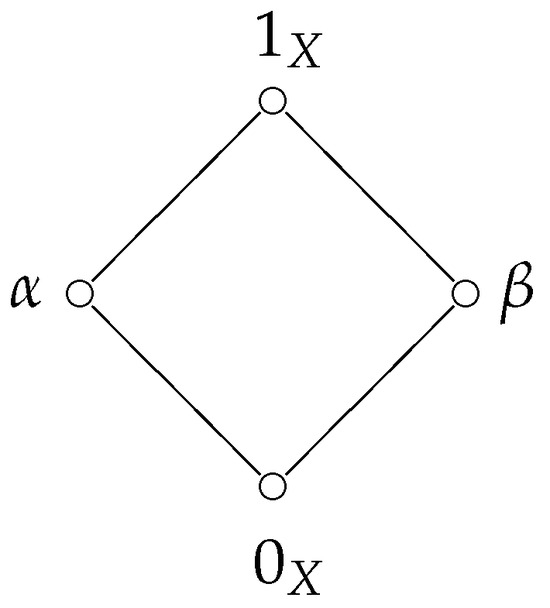
Let be a lattice whose Hasse diagram is below (see Figure 1).
Figure 1.
The Hasse diagram of X.
For each , we define two binary operations ⊗ and → on X as follows:
It is easy to verify that is a complete residuated lattice. More precisely, it is a complete Heyting algebra.
Example 2.
Let X be the real unit interval with lattice operations and .
- (1)
- If the operations on X are defined as follows:where . Then, the algebraic structure is called the Gödel residuated lattice on the real unit interval.
- (2)
- If the operations on X are defined as follows:for all . Then, the algebraic structure is called the Łukasiewicz residuated lattice on the real unit interval.
- (3)
- If the operations on X are defined as follows:where . Then, the algebraic structure is called the Goguen residuated lattice on the real unit interval.
The subsequent properties are satisfied by complete residuated lattices.
Proposition 1
([6,7]). Let X be a complete residuated lattice. For each and each of the two families and of X, the following statements hold:
- (1)
- if and only ;
- (2)
- and ;
- (3)
- implies and ;
- (4)
- ;
- (5)
- ;
- (6)
- ;
- (7)
- ;
- (8)
- ;
- (9)
- .
From Remark 1, it follows that is a complete residuated lattice when T is a left continuous triangular norm on the complete lattice L. This indicates that also satisfies the properties of Proposition 1.
For the sake of convenience in writing, in this paper, we always use to denote a complete residuated lattice, abbreviated as X. It is particularly important to note that the object of study in this paper is a complete residuated lattice, and the lattice-valued setting considered is a left continuous triangular norm on a complete lattice L. According to Remark 1, the lattice-valued setting itself is also a complete residuated lattice. These are two distinct residuated lattices, and this distinction should be kept in mind.
Generalizing Zadeh’s fuzzy sets [27], Goguen [12] first introduced the concept of L-fuzzy sets. An L-fuzzy set A on X is defined as a mapping . We denote the collection of all L-fuzzy sets over X by , and the partial order on L can be extended to in a pointwise manner. That is, for each for all .
A mapping is referred to as an L-fuzzy relation on X, i.e., . In what follows, we elaborate on two composition operations for L-fuzzy relations.
Definition 3
([6]). Let R and S be L-fuzzy relations on X and T be a left continuous triangular of L. The -composition and -composition of R and S are defined as follows:
and
for all .
Definition 4
([13]). An L-fuzzy set A of X is termed a -fuzzy filter if it fulfills the subsequent conditions: for each
- (1)
- ;
- (2)
- implies ;
- (3)
- .
Remark 2.
The second statement in the above definition essentially indicates that A is an order-preserving mapping. In fact, an L-fuzzy set that satisfies the order-preserving property is also termed an L-upper set.
Although many researchers call the above definition an L-fuzzy filter, we adopt Wang’s [13] nomenclature of a -fuzzy filter to emphasize the role of the triangular norm T.
According to the results in [18], Conditions (2) and (3) in Definition 4 are equivalent to the condition “”, and thus can be replaced by it.
In the discussion that follows, we present some examples of a -fuzzy filter in the general case of a residuated lattice.
Example 3.
Let be a linearly ordered set such that . Define the lattice operations ∧ and ∨ on X by
Furthermore, define the operations ⊗ and → by
Then is a linearly ordered Heyting algebra and, in particular, a complete residuated lattice.
Suppose that , the power set of ), ordered by set inclusion. Then is a complete Boolean algebra. Define the operations T and on L by
where denotes the complement of H in . Then is a complete residuated lattice. Define the L-fuzzy set A on X by
It is straightforward to verify that A is a -fuzzy filter on X.
Let be the Łukasiewicz residuated lattice in Example 2(2). Define the L-fuzzy set B on X by
It is easy to verify that B is a -fuzzy filter on X.
Let L be the complete residuated lattice in . Define the L-fuzzy set C on X by
It is easy to verify that C satisfies Conditions (1) and (3) in Definition 4, but fails to satisfy Condition (2). Hence, it is not a -fuzzy filter on X.
3. Operations of and on -Fuzzy Filters
In this section, building on the triangular norm T and its associated induced implication operator , we formally define two novel binary operations on L-fuzzy sets within the framework of residuated lattices. These operations are designated as the -operation and the -operation, respectively. With these two fundamental operations in place, we proceed to investigate and discuss the relevant structural and operational properties of -fuzzy filters under their action. To lay a solid foundation for the subsequent analysis, we first present the following key definition.
Definition 5.
and
for all .
Let . Define and as follows:
In [15], the authors provided some different equivalent characterizations of -fuzzy filters in residuated lattices. Based on the operation, we present a new characterization of -fuzzy filters.
Theorem 1.
Let X be a residuated lattice and L be a complete lattice. Then, A is a -fuzzy filter if and only if and .
Proof.
“⇒”. Let A be a -fuzzy filter of X. Then, we obtain and
for all . This means that .
Furthermore, by , we obtain
for all . This implies that . Hence, .
“⇐”. If and , let , then we obtain
Moreover, since , we obtain
This thus verifies that A constitutes a -fuzzy filter of X. □
Next, we will consider the properties related to the and operations of -fuzzy filters. With this goal in mind, we first formulate the subsequent lemma.
Lemma 1.
Let and . If A and C are L-upper sets, then if and only if .
Proof.
“⇒”. Let . Then, we obtain , for all . We proceed to demonstrate that
In fact, for each , by virtue of the fact that A is an L-upper set, we deduce that . It is worth noting that , so we can infer that
This implies that . Thus, we obtain that
for all . Hence, .
“⇐”. Let . Then we obtain , for all . We need to prove that
In fact, for each , by virtue of the fact that C is an L-upper set, we deduce that .
Notice that the inequality holds, whence we obtain that
We thus obtain the inequality , for all . Thus, we can deduce that
for all . Therefore, . □
Proposition 2.
If A and B are -fuzzy filters of X, then is the smallest -fuzzy filter of X such that .
Proof.
Let A and B be two -fuzzy filters of X. Then, we obtain
This implies that .
For each with , we obtain
Consequently, based on the assertions in Remark 2(3), we can establish that is a -fuzzy filter of X.
Furthermore, since , we obtain
This implies that .
In what follows, we establish that C is the smallest -fuzzy filter fulfilling the condition . In fact, if is a -fuzzy filter with , then we thus deduce from Lemma 1 that . The proof is completed. □
Lemma 2.
Let . If B is a -fuzzy filter with , then .
Proof.
Let B be a -fuzzy filter. In view of the fact that , we deduce from Definition 5 that
Notice that B is a -fuzzy filter and , so we obtain
This implies that . It follows that
Hence, . □
Proposition 3.
Let A and B be two -fuzzy filters of X. If , then is the largest -fuzzy filter of X such that .
Proof.
Let A and B be -fuzzy filters with . On the basis of Lemma 2, it can be concluded that . Then we obtain This means that .
Let . For each , we obtain . From Definition 5, it holds that
Since B is a -fuzzy filter of X, we obtain that holds, for all . In view of the fact that , we deduce that
We obtain . This enables us to infer that
Hence, is a -fuzzy filter of X.
Furthermore, we demonstrate that D is the largest -fuzzy filter satisfying the condition . In fact, if is a -fuzzy filter with , then by virtue of Lemma 1, we deduce that . The proof is completed. □
Remark 3.
The two propositions above indicate that -fuzzy filters are closed under the -operation and the -operation (the latter requires two -fuzzy filters to satisfy an order relation). These properties will play a significant role in the research of Section 5.
4. The -Composition and -Composition of -Fuzzy Congruences
In this section, we focus on the composition properties of two specific types of -fuzzy congruence relations on residuated lattices, termed -composition and -composition, respectively. Based on these two composition operations, we will systematically investigate their congruence-preserving properties and corresponding operational laws. A crucial part of our analysis involves examining how these compositions maintain or alter the defining characteristics of -fuzzy congruences, such as reflexivity, symmetry, transitivity, and compatibility with the algebraic operations of the residuated lattice. To establish a clear foundation for this study, we first introduce the formal definition and essential properties of -fuzzy congruences in the context of residuated lattices.
Definition 6.
An L-fuzzy relation R over X is termed a -fuzzy congruence if it fulfills the subsequent conditions: for each
- (FC1)
- ;
- (FC2)
- ;
- (FC3)
- ;
- (FC4)
- ;
- (FC5)
- .
Remark 4. An L-fuzzy relation R is termed fuzzy reflexive, fuzzy symmetric, and T-fuzzy transitive if it fulfills conditions , , and in turn. Additionally, if R simultaneously satisfies , , and , it is referred to as -fuzzy equivalence.
The condition in Definition 6 can be replaced by . That is, R is T-fuzzy transitive if and only if holds. Moreover, if R is a fuzzy reflexive and T-fuzzy transitive relation of X, then .
The above definition of -fuzzy congruences differs from the notion of T-congruence presented in [13]. Specifically, Condition in Definition 6 is formulated based on the triangular norm T, whereas the corresponding condition in [13] is independent of any triangular norm. In particular, when T is taken as the Gödel triangular norm, the two definitions become equivalent. Therefore, the definition of -fuzzy congruences on residuated lattices proposed in this paper is novel.
Example 4.
Let be the residuated lattice as in Example 1 and . The triangular norm T on L is defined by
The L-fuzzy relation on X is given in Table 1.
Table 1.
The definition of , where .
It is easy to verify that satisfies Conditions – in Definition 6, but it does not satisfy Condition . In fact, if , then
Thus, we obtain
This shows that is a -fuzzy equivalence relation, but not a -fuzzy congruence.
The L-fuzzy relation on X is given in Table 2.
Table 2.
The definition of , where .
It is easy to verify that satisfies Conditions – and in Definition 6, but it does not satisfy Condition . In fact, if , then
This indicates that is a -fuzzy equivalence relation, rather than a -fuzzy congruence.
The L-fuzzy relation on X is given by Table 3.
Table 3.
The definition of , where .
One can easily verify that satisfies Conditions – in Definition 6. This means that is a -fuzzy congruence on X.
The L-fuzzy set A of X is defined as follows:
Obviously, A is a -fuzzy filter of X. If we define the L-fuzzy relation as follows:
then we can represent using Table 4.
Table 4.
The definition of , where .
After verification, the L-fuzzy relation is a -fuzzy congruence. We call the -fuzzy congruence induced by the -fuzzy filter A.
The following proposition investigate the properties related to T-fuzzy transitivity and -fuzzy equivalence from the definitions of -composition, respectively.
Proposition 4.
Let R be an L-fuzzy relation on X.
- (1)
- If R is fuzzy symmetric, then R is T-fuzzy transitive if and only if ;
- (2)
- If R is -fuzzy equivalence, then .
Proof.
for all . This means that R is T-fuzzy transitive.
(1) Let R be an L-fuzzy symmetric relation. Since R is T-fuzzy transitive, we obtain for all . Thus,
Relying on Proposition 1(1), we obtain the result that . Hence, .
For the converse direction, since , we obtain
This implies that .
Notice that R is fuzzy symmetric, so we obtain
(2) Let R be a -fuzzy equivalence relation. Then, it follows from (1) that . Notice that R is fuzzy reflexive, so we obtain
This implies that . Therefore, . □
In the following, we will examine the operational properties of the -composition and -composition of fuzzy congruences in residuated lattices. For the convenience of subsequent discussions, the following lemma is provided.
Lemma 3.
Let R and S be two -fuzzy equivalence relations on X. Then, we obtain the following statements:
- (1)
- If , then is a -fuzzy equivalence relation on X;
- (2)
- If , then is a -fuzzy equivalence relation on X.
Proof.
(1) Since R and S are fuzzy reflexive, we obtain
This implies that is fuzzy reflexive.
Notice that the composition of two -fuzzy equivalence relations is not guaranteed to be a -fuzzy equivalence relation in general. This is because the symmetry of the composition relies critically on the commutativity condition.
Since R and S are fuzzy symmetric and , it follows that
This shows that is fuzzy symmetric.
Moreover, since R and S are T-fuzzy transitive, it follows from Remark 2(2) that
This means that is T-fuzzy transitive. Hence, is a -fuzzy equivalence relation on X.
(2) Since S is fuzzy symmetric and , we obtain
for all . This shows that is fuzzy reflexive.
Let . Then,
Notice that S is T-fuzzy transitive and , so we obtain
This implies . Thus, , for all .
In view of the arbitrariness of m, we deduce that
Analogously, we can demonstrate that . It follows that . This shows that is fuzzy symmetric.
Furthermore, by the fuzzy reflexivity of R, we deduce that
Notice that S is T-fuzzy transitive, so we obtain
Thus,
Consequently, we deduce that
This verifies the fact that
Thus, we obtain
This indicates that is T-fuzzy transitive. The proof is thereby completed. □
Remark 5.
In general, the -composition and -composition of two L-fuzzy equivalence relations are not closed, because symmetry is not preserved under these composition operations. Therefore, the conditions and in the above lemma are indispensable.
Next, we will discuss the relevant properties of the -composition and -composition operations for -fuzzy congruences.
Proposition 5.
Let R and S be two -fuzzy congruences on X. If , then is a -fuzzy congruence on X.
Proof.
Since R and S are -fuzzy congruences on X and satisfy the commutative property , it can be concluded from Lemma 3(1) that is a -fuzzy equivalence relation on X.
We need to verify that satisfies Conditions (FC4) and (FC5) in Definition 6. In reality, for every , notice that R and S are -fuzzy congruences, so we deduce that
Taking the arbitrariness of m into account, we have that
Furthermore, we obtain that
for every .
By the arbitrariness of p, we obtain
This leads to the conclusion that
Hence, is a -fuzzy congruence on X. □
Proposition 6.
Let R and S be two -fuzzy congruences on X. If , then is a -fuzzy congruence on X.
Proof.
In view of the fact that R and S are -fuzzy congruences on X and holds, we conclude by Lemma 3(2) that is a -fuzzy equivalence relation on X.
We need to verify that satisfies Conditions (FC4) and (FC5) in Definition 6. Actually, for each , notice that S is T-fuzzy transitive, so we obtain
which means . It follows that
Thus, . This implies that .
Moreover, by Proposition 4(2), we obtain that . It can be deduced that
Thus,
This means
Hence, is a -fuzzy congruence on X. □
Remark 6.
The above two propositions, respectively, demonstrate that -fuzzy congruences are closed under the -operation and the -operation. The former requires the L-fuzzy relation to satisfy commutativity with respect to the -operation, while the latter requires two fuzzy congruences to satisfy an order relation. These properties will play a significant role in further studying the interrelations between -fuzzy filters and -fuzzy congruences.
Proposition 7.
Let R and S be two -fuzzy congruences on X. If , then is the smallest -fuzzy congruence on X such that .
Proof.
it follows that
for all . Thus, we obtain
Since R, S are -fuzzy congruences and the commutativity holds, we deduce from Proposition 5 that is a -fuzzy congruence on X. For each , we obtain
This implies that
Thus, we obtain
This shows that .
Let be a -fuzzy congruence on X with . We aim to prove that . In fact, since
This implies that
This establishes the fact that . □
Proposition 8.
Let R and S be two -fuzzy congruences on X. If , then is the largest -fuzzy congruence on X such that .
Proof.
we obtain
for all . As a result, we conclude that
Since R and S are -fuzzy congruences and holds, we deduce from Proposition 6 that is a -fuzzy congruence on X. For every , we establish , which implies
for all . In view of the arbitrariness of , we deduce that
This shows that .
Suppose that is a -fuzzy congruence on X such that . We shall demonstrate that . In fact, since
This shows that . □
5. The Operational Correlation Between TL-Fuzzy Filters and TL-Fuzzy Congruences
Filters and congruences are two fundamental and important concepts in residuated lattices, and they can induce each other. This intrinsic connection has been extended to the fuzzy setting, where the interplay between -fuzzy filters and -fuzzy congruences forms a rich area of study. In [13], Wang systematically investigated this relationship within residuated lattices, establishing foundational correspondences. Building upon this work, the present section will further explore two specific types of operational properties for these structures. Our primary focus is to deepen the investigation into the operational correlations between -fuzzy filters and -fuzzy congruences, analyzing how operations defined on one structure translate or relate to operations on the other. As a necessary prelude to this analysis, we first introduce the two key propositions stated below, which serve as the starting point for our discussion.
Proposition 9.
Assume that A is a -fuzzy filter of X. Then the L-fuzzy relation which is defined by the formula
is a -fuzzy congruence on X.
Proof.
The proof is analogous to that of Theorem 6.2 in [13], and thus is omitted here. □
Proposition 10.
Let R be a -fuzzy congruence on X. If the L-fuzzy set satisfies , for all , then forms a -fuzzy filter of X.
Proof.
The proof is analogous to that of Theorem 6.1 in [13], and thus is omitted here. □
Remark 7.
It should be noted that Wang [13] merely presented the method of mutual induction between -fuzzy filters and -fuzzy congruences on a residuated lattice, without proving that there is a one-to-one correspondence between them. In [14], the authors established that a bijective correspondence holds between -fuzzy filters and -fuzzy congruences in -algebras under the condition that the triangular norm T is idempotent. In fact, this result also holds in residuated lattices when T satisfies the idempotent property.
Based on Propositions 9 and 10, we are able to derive the subsequent properties.
Proposition 11.
Suppose that A and B are two -fuzzy filters of X. Then, we obtain
- (1)
- ;
- (2)
- implies .
Proof.
and
(1) Let A and B be -fuzzy filters of X. Then, relying on Proposition 2, it can be established that is a -fuzzy filter. Since , we obtain
This implies that .
For each , it is readily derived from Proposition 9 that
Analogously, we have .
This means that and . It follows that
Notice that is a -fuzzy congruence of X, Proposition 4 allows us to derive
Therefore, .
Next, we intend to demonstrate that . For each with
we obtain that
Let . Then, . This thereby entails that . Similarly, we deduce that . Notice that
so we obtain . Similarly, it holds that . On the grounds that A and B are -fuzzy filters, we are able to conclude that
This means that . Hence, .
(2) Let A and B be -fuzzy filters of X. Consequently, and are -fuzzy congruences. Since , we deduce from Lemma 2 and Proposition 3 that and forms a -fuzzy filter. This implies that .
For each , we obtain
This means that .
Next, we need to show that . In fact, for each , we obtain
It can be deduced that
By the arbitrariness of , we obtain
This implies that . Hence, . The proof is completed. □
Proposition 12.
Suppose that R and S are -fuzzy congruences on X. Then, we obtain
- (1)
- implies ;
- (2)
- implies .
Proof.
(1) Let R and S be -fuzzy congruences on X. Since the commutativity holds, we deduce from Proposition 5 that is a -fuzzy congruence. Proposition 10 allows us to derive is a -fuzzy filter of X. For each , we obtain
and
In order to establish the validity of , it is necessary to prove that
In fact, since R is a -fuzzy congruence, we establish from Definition 6 that
It is worth noting that for all , the relation holds, so we can infer that
This implies that
for all . Hence, .
Next, we need to show that . In fact, since
This means that . Similarly, it can be shown that .
Notice that is a -fuzzy filter of X, so we can deduce that
This implies that . Therefore, .
(2) Let R and S be -fuzzy congruences on X. Since , it follows from Propositions 6 and 10 that is a -fuzzy congruence and is a -fuzzy filter.
Notice that are -fuzzy filters and , so we obtain
from Lemma 1.
For any , since
This means that . Hence, we obtain .
Next, we need to prove that
In fact, since R is -fuzzy congruence, it follows from Definition 6 that
for all .
Thus,
Notice that , for all , so we can deduce that
It holds that . This means that
for all . Hence, . The proof is completed. □
6. Conclusions
As we all know, filters and congruences play vital roles in residuated lattices, as many of their important properties are built upon these two concepts. Currently, research on fuzzy filters and fuzzy congruences in residuated lattices primarily focuses on their equivalent characterizations, mutual induction, quotient structures induced by fuzzy congruences, and homomorphism theorems, with few researchers addressing their operational properties. In this paper, we mainly investigate the properties of -fuzzy filters and -fuzzy congruences on residuated lattices under two types of operations. Firstly, based on a left-continuous triangular norm on a complete lattice, we define the -operation and -operation for two L-fuzzy sets on a residuated lattice and study the relevant properties of -fuzzy filters under these two operations. Secondly, we discuss the preservation of congruence properties under the -composition and -composition operations for -fuzzy congruences on residuated lattices, along with their operational laws. Finally, leveraging the characteristic that -fuzzy filters and -fuzzy congruences can mutually induce each other, we explore the operational properties between the -operation of -fuzzy filters and the -composition of fuzzy congruences, as well as between the -operation of -fuzzy filters and the -composition of -fuzzy congruences, respectively. These results not only further refine the theory of fuzzy filters and fuzzy congruences in residuated lattices but also provide a new perspective for the study of residuated lattices and other logical algebras. Thanks to the results presented in this paper, we will consider the following problems in the future.
- (1)
- Homomorphisms are powerful tools for investigating the properties of algebraic structures. This paper primarily focuses on two types of operational properties of -fuzzy filters and -fuzzy congruences, with no consideration given to their properties related to homomorphisms. Residuated lattices possess a rich set of operations, and thus the subsequent study of the homomorphic properties of -fuzzy filters and -fuzzy congruences will be of great significance.
- (2)
- As a special class of residuated lattices, -algebras serve as the core models for fuzzy logic and non-classical logical algebras. Ideals and congruences are important substructures for describing and characterizing -algebras. In our future work, we will investigate the relevant operational properties of L-fuzzy ideals and L-fuzzy congruences in -algebras, including their homomorphic properties.
- (3)
- In [18], by integrating the theories of residuated lattices and fuzzy rough sets, the authors investigated the basic properties of fuzzy rough approximation operators based on L-fuzzy filters. However, this work lacks further in-depth discussion. In our future research, we will apply the results obtained in this paper to the relevant studies on fuzzy rough approximation operators.
Author Contributions
X.Z. was responsible for writing the original draft and funding acquisition; Y.A. performed review and editing. All authors have read and agreed to the published version of the manuscript.
Funding
This project is funded by the University-level Scientific Research Project of Wuhan Polytechnic University (WHPU2024Y26).
Data Availability Statement
No new data were created or analyzed in this study. Data sharing is not applicable to this article.
Acknowledgments
The authors would like to thank the handling editor and reviewers for their meticulous reading and constructive suggestions during the review process; these inputs have significantly enhanced the rigor and presentation of this paper.
Conflicts of Interest
The authors declare no conflicts of interest.
References
- Ward, M.; Dilworth, R.P. Noncommutative residuated lattices. Trans. Am. Math. Soc. 1939, 46, 426–444. [Google Scholar] [PubMed]
- Qi, G.L.; Liu, W.R. Rough operations on Boolean algebras. Inf. Sci. 2005, 173, 49–63. [Google Scholar] [CrossRef] [Scilit]
- Belluce, L.P. Generalized fuzzy connectives on MV-algebras. J. Math. Anal. Appl. 1997, 205, 485–499. [Google Scholar] [CrossRef] [Scilit]
- Martin, H.J.S. Principal congruences in weak Heyting algebras. Algebra Univers. 2016, 75, 405–418. [Google Scholar] [CrossRef] [Scilit]
- Turunen, E. Boolean deductive systems of BL-algebras. Arch. Math. Log. 2001, 40, 467–473. [Google Scholar] [CrossRef] [Scilit]
- Bělohlávek, R. Fuzzy Relational Systems: Foundations and Principles; Plenum Publishers: New York, NY, USA; Kluwer Academic Publishers: New York, NY, USA, 2002. [Google Scholar]
- Galatos, N.; Jipsen, P.; Kowalski, T. Residuated Lattices: An Algebraic Glimpse at Substructural Logics; Elsevier: Amsterdam, The Netherlands, 2007. [Google Scholar]
- Liu, L.Z.; Li, K.T. Fuzzy filters of BL-algebras. Inf. Sci. 2005, 173, 141–154. [Google Scholar] [CrossRef] [Scilit]
- Jun, Y.B.; Xu, Y.; Zhang, X.H. Fuzzy filters of MTL-algebras. Inf. Sci. 2005, 175, 120–138. [Google Scholar] [CrossRef] [Scilit]
- Zhu, Y.Q.; Xu, Y. On filter theory of residuated lattices. Inf. Sci. 2010, 180, 3614–3632. [Google Scholar] [CrossRef] [Scilit]
- Gao, N.H.; Li, Q.G.; Zhou, X.N. Fuzzy extended filters on residuated lattices. Soft Comput. 2018, 22, 2321–2328. [Google Scholar] [CrossRef] [Scilit]
- Goguen, J.A. L-fuzzy sets. J. Math. Anal. Appl. 1967, 18, 145–174. [Google Scholar] [CrossRef] [Scilit]
- Wang, Z.D. TL-filters of integral residuated l-monoids. Inf. Sci. 2007, 177, 887–896. [Google Scholar] [CrossRef] [Scilit]
- Borzooei, R.A.; Bakhshi, M. T-fuzzy congruences and T-fuzzy filters of a BL-algebra. Iran. J. Fuzzy Syst. 2009, 6, 37–47. [Google Scholar] [CrossRef] [Scilit]
- Liu, Y.; Xu, Y.; Qin, X.Y.; Qin, Y. TL-filters and TL-congruences of residuated lattices. J. Shandong Univ. Nat. Sci. 2012, 47, 98–103. [Google Scholar]
- Ramadan, A.A. L-fuzzy filters on complete residuated lattices. Soft Comput. 2023, 27, 15497–15507. [Google Scholar] [CrossRef] [Scilit]
- An, Y.; Pang, B. A degree approach to L-fuzzy filters in effect algebras. Comput. Appl. Math. 2025, 44, 88. [Google Scholar] [CrossRef] [Scilit]
- Zhou, X.W.; Dong, Y.Y. L-fuzzy rough approximation operators and L-convex structures in residuated lattices. Comput. Appl. Math. 2026, 45, 170. [Google Scholar] [CrossRef] [Scilit]
- Addis, G.M. L-fuzzy congruence classes in universal algebras. Int. J. Intell. Syst. 2022, 37, 384–423. [Google Scholar] [CrossRef] [Scilit]
- Dong, Y.Y.; Shi, F.-G. L-fuzzy sub-effect algebras. Mathematics 2021, 9, 1596. [Google Scholar] [CrossRef] [Scilit]
- Huang, X.K.; Li, Q.G.; Guo, L.K. The TL-fuzzy rough approximation operators on a lattice. Soft Comput. 2018, 22, 17–29. [Google Scholar] [CrossRef] [Scilit]
- Li, Y.J.; Wang, J.T. On TL-fuzzy ideals and their L-fuzzy roughness in lattices. Ital. J. Pure Appl. Math. 2019, 42, 208–222. [Google Scholar] [CrossRef]
- Norahun, W.Z.; Addis, G.M.; Engidaw, D.A.; Boku, D.K.; Degefa, T.A.; Demrew, H.B. L-fuzzy congruence relations on C-algebras. Res. Math. 2025, 12, 2482309. [Google Scholar] [CrossRef] [Scilit]
- Shi, J.Q.; Zhao, B. Prefilters and fuzzy prefilters on pseudo EQ-algebras. Int. J. Mach. Learn. Cyber. 2024, 15, 2457–2479. [Google Scholar] [CrossRef] [Scilit]
- Shoar, S.K.; Saeid, A.B. On fuzzy congruence relation in residuated lattices. Proyecc. J. Math. 2023, 42, 1335–1353. [Google Scholar] [CrossRef] [Scilit]
- Zhan, Q.Y.; Wang, J.; Luan, W.; Yang, Y.C. Fuzziness in L-algebras. Fuzzy Sets Syst. 2021, 425, 157–168. [Google Scholar] [CrossRef] [Scilit]
- Zadeh, L.A. Fuzzy sets. Inform. Control 1965, 8, 338–353. [Google Scholar] [CrossRef] [Scilit]

Disclaimer/Publisher’s Note: The statements, opinions and data contained in all publications are solely those of the individual author(s) and contributor(s) and not of MDPI and/or the editor(s). MDPI and/or the editor(s) disclaim responsibility for any injury to people or property resulting from any ideas, methods, instructions or products referred to in the content. |
© 2026 by the authors. Licensee MDPI, Basel, Switzerland. This article is an open access article distributed under the terms and conditions of the Creative Commons Attribution (CC BY) license.