


Abstract
Secure real-time data interaction between vehicles and transportation infrastructure, such as RSUs (V2R), can achieve intelligent and safe driving, as well as efficient travel services, in Internet of Vehicles (IoV), a secure and efficient V2R authentication protocol, which plays an important role. Recently, scholars have proposed a two-factor V2R authentication protocol for the IoV. However, subsequent research has shown that this protocol is vulnerable to insider and ephemeral secret leakage attacks, and cannot achieve perfect forward secrecy. To address these security flaws, an improved scheme was further proposed. Nevertheless, this paper points out that the improved scheme still has shortcomings: it cannot provide anonymity and perfect forward secrecy, exhibits insufficient session key secrecy, and remains vulnerable to password guessing attacks, RSU capture attacks, and suffers from inappropriate pseudo-identity update mechanisms. Therefore, a novel Physical Unclonable Function-based Lightweight V2R Authentication (PUF-LA) scheme is proposed, which uses Elliptic Curve Cryptography (ECC) to achieve perfect forward secrecy, uses PUF to resist devices captured attacks, and achieves two-factor secrecy protection against password guessing attacks. The security performance of PUF-LA is theoretically proved by leveraging the random oracle model. In contrast with relevant authentication schemes, PUF-LA is more secure and has low computation costs.
MSC:
68M12; 94A62; 94A60
1. Introduction
The Internet of Vehicles (IoV) integrates advanced technologies from Vehicular Ad-hoc Networks (VANETs) and the Internet of Things (IoT) [1]. This integration enables vehicles to communicate with other IoV devices and access vast amounts of information via the internet. Within the broad domain of IoV, vehicles are capable of executing numerous tasks such as autonomous driving, multimedia service delivery, traffic flow management, and battery optimization [2]. Real-time data processing is achieved through On-Board Units (OBUs), which support intelligent decision-making and enhance both safety and operational efficiency [3]. OBUs collect traffic data and transmit them to nearby Roadside Units (RSUs). RSUs then relay this information, including data about surrounding vehicles and pedestrians, to a Trusted Authority (TA). The rise of connected vehicles has led researchers to propose offloading data processing tasks to Roadside Units (RSUs), as a means to alleviate the load on Traffic Authorities (TAs). This edge computing strategy enhances the system efficiency by distributing computational work across the Internet of Vehicles (IoV) infrastructure, enabling advanced features like emergency vehicle prioritization, intelligent traffic control, and collision avoidance systems. Nevertheless, the open nature of wireless communication poses significant security risks in IoV. Sensitive data, such as vehicle status, location, routes, and identities, can be intercepted, altered, or replayed by malicious entities, leading to issues like identity theft and unauthorized tracking. Attackers may also leverage intercepted information to execute replay and Man-in-the-Middle attacks [4]. To address these vulnerabilities, mutual authentication and secure communication channels between vehicles and RSUs are imperative. Moreover, adversaries can disrupt operations by spreading false information, congesting the network. Researchers have suggested various conditional privacy-preserving authentication schemes, primarily utilizing public cryptography [5]. While these methods are secure, they require considerable computational resources, resulting in increased latency that can hinder the real-time responsiveness crucial for emergency situations. Given the high vehicle mobility, lightweight authentication schemes are critical for enabling rapid interactions with RSUs. Effective authentication mechanisms ensure prompt data exchange and system responsiveness in the dynamic IoV landscape [6].
Although many V2R authentication protocols have been proposed for IoV, achieving both strong security/privacy guarantees and low latency remains challenging. In particular, recently improved two-factor V2R schemes still suffer from critical weaknesses under realistic adversarial settings, such as the lack of identity anonymity and unlinkability, the failure to guarantee session key secrecy and perfect forward secrecy, vulnerability to offline password guessing and RSU capture attacks, and even improper pseudo-identity updates that may break subsequent authentication.
Motivation and Contributions: In IoV, authentication protocols serve as the first line of defense for ensuring communication security. However, due to high-speed vehicle movement, dynamic network topologies, and stringent privacy requirements, their design and implementation face numerous unique challenges, including the adoption of lightweight authentication protocols, dynamic pseudonym mechanisms, and safeguarding key security. Through careful analysis of Kim et al.’s scheme [6], we found that there are some security vulnerabilities. To address these issues, this work proposes a security enhanced privacy-preserving authentication scheme for IoV. The main contributions of our work are condensed as follows:
- (1)
- This work demonstrates that Kim et al.’s scheme is vulnerable to password guessing attacks and RSU capture attacks and has no anonymity, no session key secrecy, and no perfect forward secrecy, and the pseudonym update is unreasonable.
- (2)
- A novel lightweight authentication scheme for IoV is proposed, which can fix all the security flaws of Kim et al.’s scheme. In our scheme, the secret parameters of vehicles and TA are protected by the PUF, and dynamic pseudonym mechanisms are used to protect their privacy.
- (3)
- The semantic security of the proposed protocol is formally proved under the random oracle model. The comparative analysis shows that our protocol has a low computation cost.
The rest of this paper is organized as follows. Section 3 introduces the preliminaries. Kim et al.’s scheme is briefly reviewed in Section 4. Section 5 clarifies the vulnerabilities of their scheme. Our proposed scheme is presented in Section 6, while Section 7 provides the formal security proof under the random oracle model and informal security analysis, respectively. In Section 8, this work compares and analyzes the performance of the proposed scheme and related schemes. Section 9 concludes this work.
2. Related Works
V2V Broadcast Authentication Schemes: The Internet of Vehicles (IoV) has evolved into a highly complex and dynamic network, prompting researchers to propose comprehensive strategies to address critical challenges such as high mobility, scalability, and reliability [7]. Several authentication protocols have been developed in this context. For instance, Yadav, Nath, and Choudhury [8] and Vijayakumar [9] proposed authentication schemes where a Trusted Authority (TA) maintains a verification table for identity validation, respectively. Qureshi et al. [10] introduced an IoV network model designed to ensure essential services, such as vehicle connectivity, while highlighting the increasing security vulnerabilities, as IoV networks scale. Taslimasa et al. [11] examined the application of IoV while identifying key threats such as modification attacks. Sharma et al. [12] emphasized the necessity of authentication, data integrity, and real-time communication to establish trustworthy vehicular networks. To ensure secure communication among IoV entities, Public Key Infrastructure (PKI) has been widely used to regulate entity authentication and secure communication mechanisms, particularly under the IEEE 1609.2 standard [13]. Some researchers [14] proposed a PKI-based message broadcasting authentication protocol to secure VANET communications.
Conditional Privacy-Preserving Authentication (CPPA) Schemes: In response to growing privacy concerns, numerous researchers have proposed Conditional Privacy-Preserving Authentication (CPPA) schemes [15] for IoV networks. Over the past decade, various CPPA protocols have been introduced. For example, Xu et al. [16] proposed a scheme, where the TA maintains session tuples to resist desynchronization attacks. Kumar et.al. [17] pointed out that Xu’s scheme lacks perfect forward secrecy and remains vulnerable to several attacks. To address these problems, Kumar et al. proposed a hash-based desynchronization-resistant CPPA scheme employing symmetric key cryptography to enhance privacy protection. However, Xie et al. [18] demonstrate that their scheme cannot achieve perfect forward secrecy and session key secrecy, and it is vulnerable to impersonation attacks, identity guessing attacks, and RSU capture attacks. Despite these advancements, existing CPPA schemes still exhibit vulnerabilities and fail to meet certain critical security properties, particularly in open and dynamic vehicular environments. To mitigate these issues, researchers have explored more robust approaches based on public key cryptography. For instance, Zhong et al. [19] proposed a practical ID-based CPPA scheme utilizing Elliptic Curve Cryptography (ECC), which significantly enhances security in VANETs while maintaining computational efficiency.
V2I/V2R Authentication and Key Agreement: In 2024, Sibahee et al. [20] proposed a two-factor V2R authentication protocol for IoV. However, Kim et al. [6] and Liu et al. [21] pointed out that their protocol is vulnerable to insider and ephemeral secret leakage attacks and does not achieve perfect forward secrecy, respectively. Then, they proposed a security enhanced scheme to fix these security flaws, respectively. Moreover, Liu et al. [21] conducted cryptanalysis on a recent two-factor privacy-preserving IoV authentication protocol, showing that it fails to achieve perfect forward secrecy and remains vulnerable under realistic adversarial settings, which highlights the necessity of provably secure and capture-resilient lightweight V2R authentication schemes. Zheng et al. [22] proposed a blockchain-assisted V2R authentication protocol, which addresses the secure authentication problem in scenarios where Roadside Units (RSUs) are semi-trusted. The summary of the relevant lightweight V2R authentication schemes is shown in Table 1.
Table 1.
Summary of related lightweight schemes.
3. Preliminaries
3.1. Elliptic Curve Cryptography
Let be a finite field, and let denote a large prime number representing the order of the group. An elliptic curve is defined by the equation , where are constants. There exists a multiplicative cyclic group of order , where serves as the generator point of this group.
Definition 1.
Elliptic Curve Scalar Multiplication. For , the scalar multiplication is defined as . Given two random points , such that , it is computationally difficult to determine from within probabilistic polynomial time. This is the Elliptic Curve Discrete Logarithm Problem (ECDLP).
Definition 2.
Given the values , where , it is infeasible for any probabilistic polynomial-time algorithm to compute . This is the Elliptic Curve Computational Diffie–Hellman Problem (ECCDH).
3.2. Physical Unclonable Function (PUF)
A PUF is a hardware-based security primitive implemented as a circuit that leverages the unique and random characteristics inherent to a chip’s manufacturing process. By utilizing unavoidable process variations, it establishes a unique and secure mapping between challenge and response signals. Unlike conventional security technologies, PUFs are resistant to reverse engineering; any attempt to analyze the chip alters the PUF’s response, by making it impossible to retrieve encrypted information. Operations involving PUFs are conducted at the hardware level, ensuring robust security features.
In the design, evaluation, and application of PUFs, environmental sensitivity curves are used to quantify and visualize how the responses (outputs) of a PUF vary with changes in voltage, temperature, and aging over time. These curves are essential for assessing PUF reliability and serve as a core reference for designing stable PUF systems. They directly determine the required strength of the error correction codes, the final cost and complexity of the system, and guide the design of optimal PUF structures.
In practice, PUF responses are not perfectly stable, due to noise, aging, and environmental variations (temperature and voltage fluctuations). These factors may cause intra-device Hamming distance variations, potentially affecting the authentication reliability. To address this issue, practical PUF-based systems usually incorporate fuzzy extractors (FE) or error correction codes to reconstruct stable keys from noisy PUF outputs. In our scheme, this work assumes that the PUF module is deployed together with lightweight helper-data-based error correction, which is consistent with widely adopted secure PUF implementations (e.g., SRAM PUF with FE). This assumption ensures that the derived key remains stable while not leaking sufficient information to an attacker. We note that selecting FE parameters should consider the expected noise levels and system lifetime.
3.3. System Model
This section presents detailed descriptions of our system model. The proposed system model comprises the Trusted Authority (TA), Roadside Units (RSUs), and vehicles. The description of the entities is as follows:
- (1)
- TA. The TA is a fully trusted authority, which is responsible for selecting system parameters, as well as registering RSUs and vehicles, and tracking the true identity of vehicles in case of disputes.
- (2)
- RSU. Each RSU possesses a unique identity and collects traffic messages while accurately performing their designated functions. They are equipped with adequate capabilities for wireless communication with vehicles, enabling the dissemination of traffic-related information and facilitating mutual authentication processes.
- (3)
- Vehicles. Vehicles gather valuable information through sensors and interact with other components in IoV networks. They rely on On-Board Units (OBUs) to exchange messages with RSUs. While OBUs facilitate wireless communication over an open channel, they are limited in terms of computational resources and secure communication.
The working mode of the proposed system model is as follows: Firstly, the TA selects system parameters, including its private and public keys. Then, the RSU and the vehicle register with the TA to obtain relevant authentication parameters and secret parameters, while securely storing the secret parameters using PUF. The registration process is transmitted over secure channels. During the authentication and key agreement phase, the driver first logs into the vehicle and generates and sends authentication credentials to the RSU. After receiving the authentication parameters from the vehicle, the RSU generates the relevant authentication parameters and sends them to the TA along with the authentication credentials of the vehicle. The TA verifies the identity of the RSU and the vehicle and then sends the newly generated verification credentials of the RSU and the vehicle to the RSU. After verifying the identity of the TA, the RSU generates a session key shared with the vehicle and its verification credentials and sends them to the vehicle along with the information generated by the TA. To verify the identity of the RSU, the vehicle generates and verifies a session key shared with the RSU and restores and updates the pseudonym identity. At this phase, the main goal is to achieve mutual authentication between the RSU and the vehicle, negotiate the session key, and update the pseudonym identity of the vehicle; all messages are transmitted on public channels.
3.4. Adversarial Model
Based on the Dolev–Yao threat model [23] and recent security surveys on Vehicular Ad Hoc Networks (VANETs) [12,13], the threat model is defined as follows:
The adversary is assumed to have full control over the public communication channels, meaning they can eavesdrop, intercept, modify, or delete any transmitted messages. The attacker may act as a malicious insider, such as a compromised registered vehicle, or an external adversary attempting to disrupt the system. Furthermore, the adversary is capable of launching side-channel attacks on OBU and RSU, thereby gaining unauthorized access to sensitive data or cryptographic material.
4. Review of Kim et al.’s Authentication Scheme
Kim et al.’s scheme consists of four phases: the registration, the login and authentication, the user password update, and the revocation phase. This section only introduces the first two phases, where the TA chooses K_TA and ID_TA as its secret key and identity. The notations used in this paper are described in Table 2.
Table 2.
Notation and definitions.
4.1. System Registration Phase
In this section, vehicle and register onto the TA.
Vehicle Registration: To authenticate with an RSU, has to be registered at the TA. So, for a vehicle , it must first complete the registration process with the TA. The TA generates a pseudonymous identifier for , which is stored in place of the actual identity to ensure anonymity.
Step 1: The owner of vehicle inputs identity and password . and sends to the TA through a secure channel.
Step 2: TA generates random numbers and and computes , , , and . Then, the TA stores with in its database and sends to .
Step 3: Upon receiving the message, computes , , , and . Finally, stores in the OBU’s memory.
Registration: sends its identity to the TA via a secure channel.
The TA generates a random number computes stores alongside in its database, and sends back to .
stores in its repository.
4.2. Login and Authentication Phase
The login phase of a vehicle must be completed before initiating the authentication phase via the RSU. Then, after successful login, can mutually authenticate and establish a session key with through the assistance of the TA. The following steps outline this process.
Step 1: The owner of vehicle inputs the identity and password , and computes , and With these parameters, verifies whether If not, the login process is terminated. Otherwise, generates a random nonce , obtains a timestamp , and then computes and Finally, the message is sent to over a public channel.
Step 2: Upon receiving the message , checks the revocation list using and verifies the freshness of . After that, generates a timestamp , calculates , and sends to the TA via a public channel.
Step 3: The TA validates the freshness of the timestamp and retrieves and from and , respectively. Then, it derives and Following this, the TA computes
The TA verifies whether the equality of = . If not, the authentication phase is terminated. If yes, the TA selects a random nonce and a timestamp and calculates
Finally, the TA sends to .
Step 4: checks the freshness of the timestamp , derives , and verifies whether the equality is correct. If yes, generates a random nonce , selects a timestamp , and computes the session key and Then, sends to over a public channel.
Step 5: checks the freshness of timestamp . computes the session key and . verifies the equality, . If yes, successfully authenticates and establishes the session key with .
Step 6: Upon successful authentication, both and the TA update their parameters. computes
and updates to . Meanwhile, the TA computes , and and updates to .
5. Security Analysis of Kim et al.’s Scheme
This section demonstrates that Kim et al.’s scheme is insecure.
5.1. No Anonymity and Password Guessing Attack
In Kim et al.’s scheme, once a legitimate registered user obtains the information stored in another vehicle , and the authentication message from the public channel, can obtain the identity of and launch a password guessing attack. The details are as follows.
extracts from its own vehicle, inputs their own password and identity , and computes , , , . Because , , if the output length of the hash function (e.g., SHA-256) is 256 bits. The length of and the output value of are both 256 bits; so, the output value of excluding the last 256 bits is the value of . Therefore, can calculate , , and can obtain the identity of vehicle . Because the vehicle obtains and , it can compute guess , and from can get , thus being able to compute and verify whether is right or not. If yes, the guessed password , is correct. Otherwise, it can re-do it again.
5.2. No Session Key Secrecy
Once the successfully gets the identity and password of , it can calculate , , and and can get from the open channels. Then, the can compute ,
Therefore, the can know the session key shared between .
5.3. RSU Capture Attack
Once the attacker captures the , they can extract and , allowing them to calculate , , from the intercepted , which enables the attacker to compute all session key for all communications with . The attacker can also masquerade as a fake and communicate with any vehicle.
5.4. No Perfected Forward Secrecy
Since the session key is calculated as , the attacker who manages to obtain the long-term key can compute the session key .
5.5. Inappropriate Pseudo-Identity Update
Since,
But
This causes to be unable to log in and the TA to be unable to authenticate later on.
6. The Proposed PUF-LA Scheme
To address the security weakness of Kim et al.’s scheme, this work proposes a base on the PUF-LA authentication scheme. PUF-LA is designed under the adversarial model in Section 3.4 to achieve mutual authentication, session key secrecy, anonymity/unlinkability, and perfect forward secrecy (PFS) with low latency for V2R communications. The design follows three principles: (1) long-term secrets on vehicles/RSUs are protected by a physical unclonable function (PUF) to mitigate physical capture and side-channel extraction; (2) the session key is derived from ephemeral elliptic-curve Diffie–Hellman values to guarantee PFS; and (3) each session updates a dynamic pseudo-identity to provide anonymity and unlikability. The proposed scheme comprises following phases: System Initialization, Vehicle and RSU registration, and Authentication and Session Key Agreement.
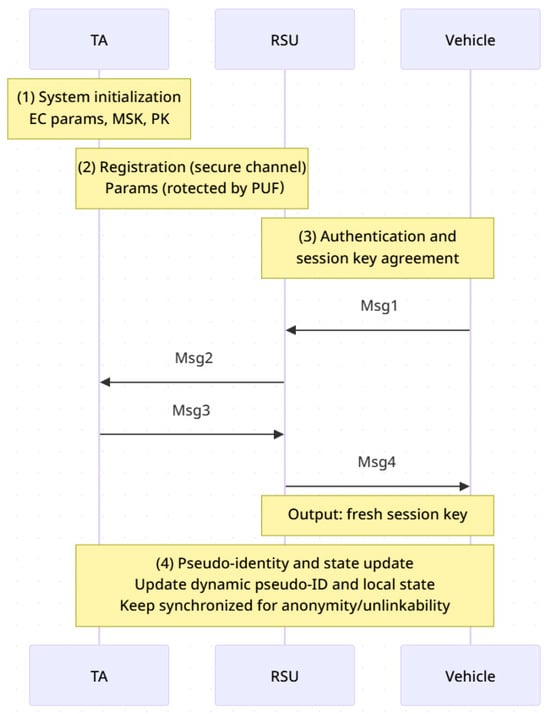
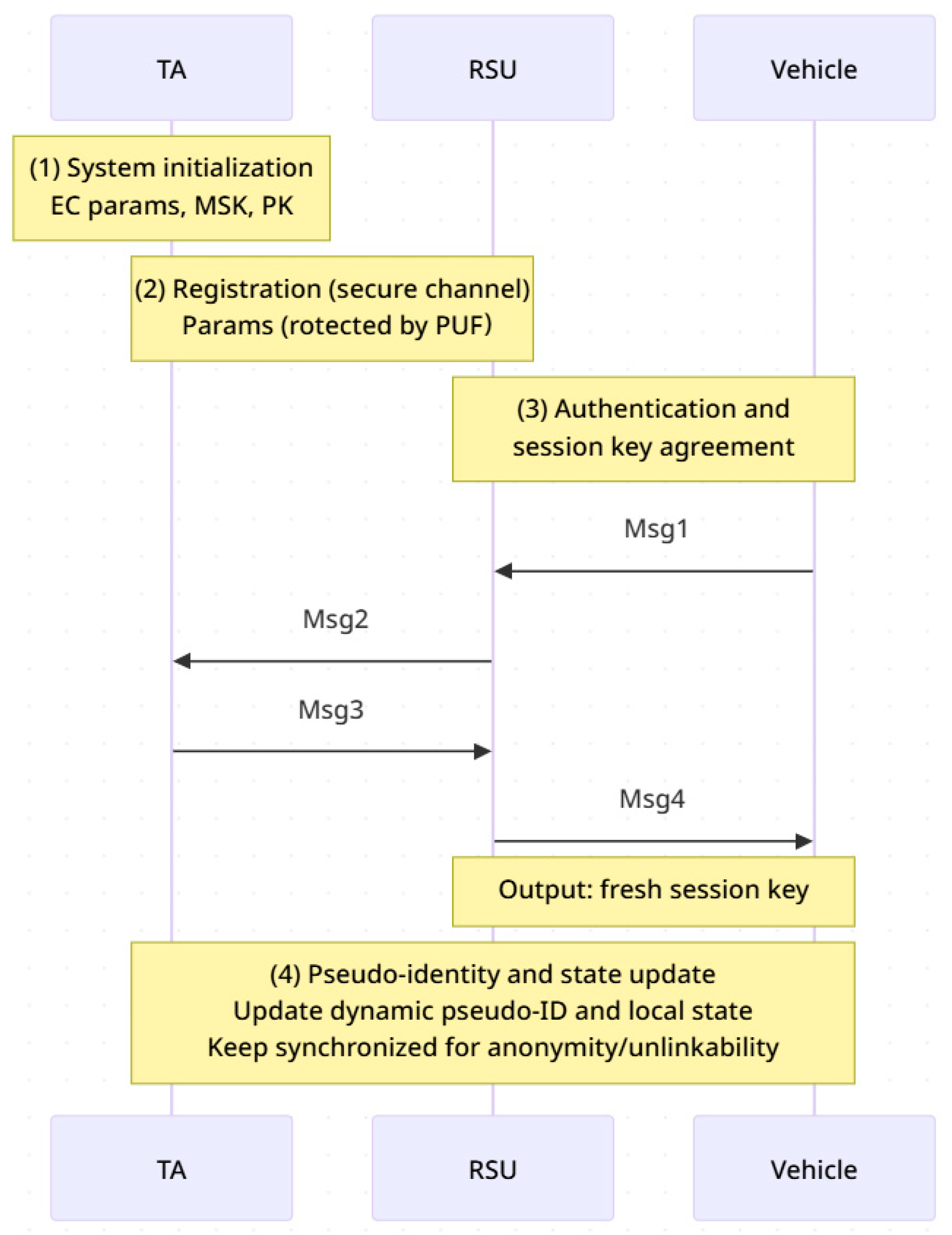
To make the proposed protocol easier to follow, we present in Figure 1 a high-level overview of the main phases in PUF-LA. The protocol is executed in four steps.
Figure 1.
High-level flow of the proposed PUF-LA protocol (system initialization → registration → authentication and session key agreement → pseudo-identity/state update).
(1) System initialization. The trusted authority (TA) sets up the elliptic-curve parameters, selects its master secret key, and publishes the corresponding public key. (2) Registration. Each vehicle and RSU registers once with the TA over a secure channel to obtain its long-term authentication parameters protected by the on-board PUF module. (3) Authentication and session key agreement. Whenever a vehicle enters the coverage of an RSU, the vehicle, the RSU, and the TA run a four-message authenticated key agreement protocol. At the end of this phase, the vehicle and the RSU share a fresh session key. (4) Pseudo-identity and state update. After a successful run, the vehicle and the TA/RSU update the dynamic pseudo-identity and local state, so that future sessions offer anonymity and unlinkability while remaining synchronized.
6.1. System Initialization
The selects an elliptic curve , a base point , a secure hash function , and a secret key , computes public key , and publishes .
6.2. Vehicle Registration
The driver inputs , into the (OBU), and the sends to the . The TA chooses a random number , calculates , and sends to . Then, calculates mod , where and , and stores . This process is shown in Table 3.
Table 3.
Vehicle registration phase of the proposed PUF-LA scheme.
6.3. RSU Registration
The TA selects , computes , and sends {}to . calculates and and stores . This is the registration phase of the proposed PUF-LA scheme. This process is shown in Table 4.
Table 4.
RSU registration of PUF-LA scheme.
6.4. Authentication and Session Key Agreement
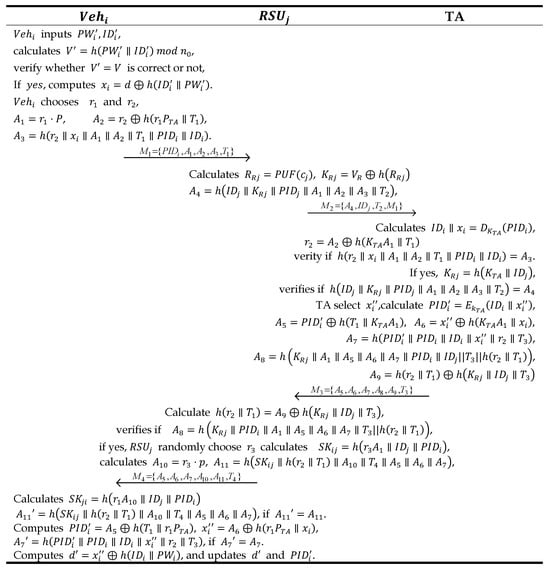
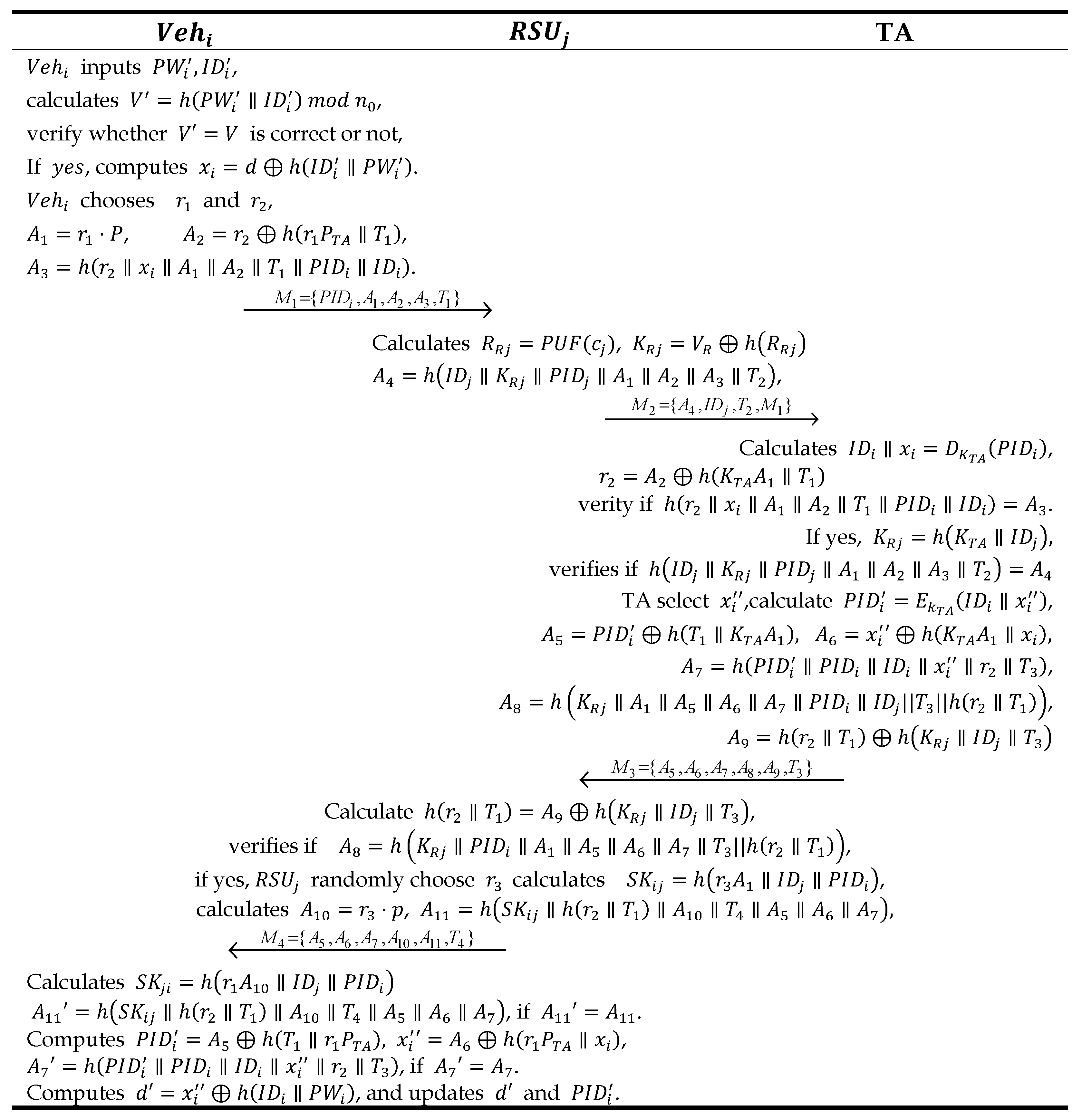
Figure 2 shows the process of authentication and key agreement. In Step 1, the vehicle generates a fresh timestamp () and authentication parameters and sends the request message () to the RSU. In Step 2, the RSU checks the freshness and validity of (); if valid, it constructs () and forwards it to the trusted authority (TA). In Step 3, the TA authenticates the request and computes the corresponding response parameters and key parameters, then returns () to the RSU. In Step 4, after verifying (), the RSU derives the session key material and sends the final response message () to the vehicle. In Step 5, the vehicle verifies (), and both the vehicle and RSU compute the same session key (, thereby completing mutual authentication and establishing secure communication.
Figure 2.
The process of authentication and key agreement.
Step 1 (Vehicle login): The driver inputs into the (OBU), and (OBU) calculates and verifies whether is correct or not. If no, it retypes ; if , the driver’s legitimate identity has been verified. computes . For , , chooses two random numbers and , , , where T1 is current timestamp,
where is used to verify the accuracy of parameters . Then, sends the authentication request message to .
Step 2 (RSU processing): checks the freshness of the timestamp and calculates Then, sends both its own and the ’s authentication request messages to the TA, where is used to verify the accuracy of parameters .
Step 3 (TA authentication): TA checks the freshness of the timestamp , calculates , , and verifies whether . If yes, is authenticated. The TA computes , and verifies whether is right. If yes, is authenticated. Then, the TA selects and calculates , and , where is used to restore , and and are used to verify the accuracy of parameters and (). Then, the TA sends a reply message to .
Step 4 (RSU derives the session key): calculates and verifies whether . If yes, the TA is authenticated. randomly chooses a nonce , calculates , , and and sends to .
Step 5 (Vehicle verification, session key confirmation, and pseudo-identity update): first checks the freshness of the timestamp , then calculates and , and verifies whether . If yes, it demonstrates that the mutual authentication and key agreement process between and has been completed. computes , and and checks whether . If so, the accuracy of the updated pseudo-identity and parameters has been verified. computes and updates and .
Table 5 lists the messages’ direction, main fields (at a high level), and purposes in the protocol.
Table 5.
Summary of protocol messages in the PUF-LA scheme.
In one successful session, both the vehicle and the RSU derive the same session key, because they compute consistent ephemeral elliptic-curve Diffie—Hellman components from their fresh nonces and public points and then apply the same hashing rule to the same transcript. The TA assists only in verifying the legitimacy and providing authenticated data needed for validation, but it does not learn the final session key if the key is derived solely from the vehicle—RSU ephemeral secrets. The pseudo-identity update is bound to the accepted transcript so that both the vehicle and TA/RSU update to the same next-state, preventing desynchronization.
6.5. Illustrative Example with Simple Parameters
To further clarify how keys and pseudo-identities are generated and updated, we provide a small numerical example. All parameters in this example are intentionally small and do not represent secure choices; they are used purely for illustration.
Assume that the TA selects a toy elliptic-curve group of prime order q = 101 with base point P. The TA chooses a master secret key and publishes the corresponding public key . , , and .
Vehicle registration. Consider a vehicle V with identity and password . The TA chooses a random registration nonce and computes a registration tag: , , ,
For illustration, suppose that the hash output is such that The TA embeds into the data that will later be protected by the vehicle’s PUF. During personalization, the OBU samples its PUF and, together with helper data, derives a stable key . The OBU stores a masked value instead of itself, so that an attacker who steals the device cannot directly obtain . The TA also derives an initial pseudo-identity for the vehicle as Only is used over the public channel; the real identity never appears uncoded.
One authentication session. Later, when V wants to authenticate to an RSU, the driver inputs into the OBU. The OBU reconstructs from the PUF and helper data and recovers
It verifies the local login equation derived from . If the check passes, the OBU chooses a fresh nonce and computes , The OBU sets timestamp T1 = 100 and computes its authentication tag , It then sends to the RSU.
The RSU chooses its own nonce , computes and sets timestamp T2 = 105, computes its tag Auth_R, and forwards M2 to the TA together with both and .
The TA authenticates V and the RSU as described in Section 6.4. Suppose the TA decides to update the vehicle’s pseudo-identity according to with timestamp T3 = 110. For illustration, assume The TA sends and its tags to the RSU in message M3.
Session key derivation. The RSU computes the Diffie–Hellman value in the group of order 101, since 108 is congruent to 7 (mod 101). The vehicle computes the same value Both parties then derive the same session key
Finally, the vehicle verifies the RSU’s key-confirmation tag computed from SK and updates its stored pseudo-identity from to .
This example demonstrates concretely how the PUF-protected registration information, pseudo-identities, and ephemeral Diffie–Hellman values are combined in PUF-LA to achieve mutual authentication, session key agreement, and dynamic pseudo-identity update.
7. Security Analysis
This section provides a formal security proof of the proposed authentication and key agreement protocol under the extended Random Oracle Model (ROM) [24] and a CK-style authenticated key exchange (AKE) security model. The goal is to show that the established session key is indistinguishable from a uniformly random string for any probabilistic polynomial-time (PPT) adversary, except with negligible probability.
7.1. Security Proof
Our scheme is denoted as and contain three entities in this model. They are
- (1)
- A vehicle with identity and password ;
- (2)
- A roadside unit with ;
- (3)
- A Thrust Authorization TA with .
At time , the participants are denoted as , , and , respectively. The participants have three possible states by attacker: (1) accepted; (2) rejected; and (3) null.
We reduce the security issues of attacks to problems that cannot be solved by an adversary in PPT. In the framework of formal security analysis, oracle instances establish relations with a challenger and an adversary . We prove the security of the proposed scheme through a challenge–response game between adversary and the challenger in the . The variety of attacks of is simulated through inquiring to in a polynomial-time game. The goal is to show the advantage of any polynomial-time adversary in distinguishing the real protocol by inquiring to .
Proof overview: Starting from the real execution game G0, we gradually transform the experiment through a sequence of games to isolate all events that may help the adversary distinguish the real session key from a random string. The main changes account for (i) random-oracle collisions, (ii) offline password guessing, (iii) compromise attempts against the RSU long-term key protected by the PUF, and (iv) reduction to the elliptic-curve computational Diffie–Hellman (CDH) assumption for the remaining case. Combining the game transitions yields the bound in Theorem 1.
The list of the queries are as follows.
Hash : In this query, the challenger maintains an initially empty list, denoted as . The challenger is updated by receiving the tuple , when the adversary inputs , and the challenger returns an output . If the tuple exists within , it is updated in . Otherwise, selects a random element , transmits to , and subsequently inserts the tuple into to ensure consistency.
Execute ): It is executed in the authentication process in . When an adversary eavesdrops and asks challenger to execute this query, computes the messages according to the steps in and returns the results to .
Send . In this query, the adversary can attack actively. When executes the query with the message , challenger checks out . If is valid, calculates and returns some results; otherwise, ignores this query.
Reveal : in this query, returns the current session key of .
Corrupt ( r): In this query, challenger outputs different results as follows. Once a legitimate registered vehicle obtains the information stored in another vehicle user’s , i.e., , the can launch a password guessing attack. Once the adversary captures the , they can extract , allowing them to calculate , . Since the session key is calculated as , an adversary who obtains the long-term key can compute the session key .
Test : During this query, challenger generates a random bit . If b = 1, provides adversary with the correct session key. Conversely, if b = 0, randomly generates a number with the identical length of the session key and returns it to .
Freshness: A session is called fresh if all the following conditions hold:
- (1)
- The adversary has not issued Reveal() to obtain the session key;
- (2)
- The adversary has not corrupted long-term secrets required to compute SK;
- (3)
- The adversary has not obtained the ephemeral secrets of both partnered sessions.
Definition 3
(AKN-Secure). The represents the authenticated key negotiation. is denoted as the success probability of an adversary to breach Scheme . If executes the query and guesses a correct bit , we say that breaches the semantic security of Scheme . Then, the advantage of to breach the semantic security of Scheme is denoted as . Our Scheme achieves semantic if is negligible for any adversary .
Theorem 1.
Let and be the regression parameters of the password space. Let
be the maximum advantage of any PPT adversary in predicting the PUF-derived secret under the employed PUF security assumption (unpredictability). We assume that
denotes the number of queries that
executes and sends, with hash . Then, we have
where
represents the simulation time.
denotes the maximum success probability of any PPT algorithm solving the CDH problem in group (G) within PPT.
Proof of Theorem 1.
We define a sequence of games where each game incrementally modifies the adversary’s capabilities. These games prove the security of the session key in Scheme by executing the following games. Let refer to the event in which tries to breach the secrecy of the session key agreement in each game. We assume that an event may happen when executes Scheme , such that the event is independent of and can be detected by. It is noteworthy that and are indistinguishable, except when occurs. Therefore,
Game 0 (Real Attack Game): The challenger initializes system parameters. In this game, the simulation of breaching the semantic security of Scheme by the random oracle model (ROM) obtains
Game 1 (Random Oracle Simulation): In this game, the challenger simulates all random oracles by maintaining a list and returning consistent uniformly random outputs. By the standard birthday bound in a -bit random oracle:
Game 2 (Corruption Simulation): executes Corrupt(,r) to obtain the secret information stored in the RSU on the condition that the device is lost or stolen. simulates this as follows:
(a) executes a Corrupt (,2) query to guess the password of from password space within a number of send queries. According to Zipf’s law [25], the probability of guessing the password is less than , where and are the regression parameters of the password space.
(b) The challenger replaces the PUF-derived secret used in each honest session by a uniformly random value of the same length, while simulating all protocol outputs consistently. Under the assumed PUF unpredictability, no PPT adversary can distinguish the real PUF-derived secret from random except with advantage .
Game 3 (Long-term Key Security): To breach the security of mutual authentication, executes the queries of send , send , Reveal (), , Reveal(), , and Test (),
(i) Sent (start, ) query: the registration selects two random numbers and calculates
Then, the query answers .
(ii) Reveal () query: The captures the RSU, while it extracts . Then, intercepts and calculates the random numbers and . When the random number , all the session keys can be calculated for with the RSU that communicates, and sen to the TA.
Calculate , ,
Verify . If equal , then, from , find , and verify . If equal A4, the TA selects , calculates
Compute . calculates . For , verify whether is valid and calculate the session . If , terminates the session; otherwise, .
(iii) Sent query. Compute Afterwards, the query responds with . Assume that the adversary tries to generate the false value . This is indistinguishable from the previous , except when refuses a valid or refuses a . Therefore, we have
Game 4 (Session Key Security): In this game, we replace the Diffie–Hellman-related value used in the computation of the session key and authentication tags with a uniformly random group element. Let denote the event in which the adversary queries the random oracle (H) on the correct tuple containing the real CDH value.
To simulate the game, the challenger B embeds a CDH instance into a randomly selected session among all sessions and guesses the index of the corresponding hash query among at most random-oracle queries. If either guess fails, B aborts. Hence,
If the adversary employs a private oracle , then seeks the valid value in and conveys it to . Otherwise, the challenger sends a random bit string , tries to guess a bit , and the probability of successfully guessing is not more than . Therefore, we obtain
□
7.2. Informal Security Analysis
This subsection shows that our proposed scheme can resist various known attacks.
- (1)
- Anonymity and unlinkability
In our scheme, the identity of vehicle is included in pseudo-identity and the authentication request message , which is protected by symmetric encryption algorithm and hash function, respectively. Therefore, an adversary cannot compute from and . On the other hand, for pseudo-identity during each round of authentication, the pseudo-identity of the vehicle will be updated. So, our protocol achieves anonymity and unlinkability.
- (2)
- Password guessing attacks
Even if an adversary knows V and d stored in vehicle , guesses , computes , and checks whether , because there are candidates of the pair to satisfy when [23], the adversary cannot know which pair is correct. Then, the adversary computes and to check whether
However, the adversary does not know random number , So, the adversary cannot guess the password successfully.
- (3)
- Two-factory secrecy
According to the above analysis, if an adversary can get the information stored in vehicle , they still cannot guess the correct password. On the other hand, if an adversary knows the password and does not know d stored in vehicle , they cannot compute . So, our protocol is two-factor secrecy.
- (4)
- Perfect forward secrecy/Known key secrecy
In our scheme, the session key , which is composed of random numbers and . According to the computational Diffie–Hellman problem, even if the adversary knows the long-term secret key , they still cannot compute from and without knowing and . On the other hand, even if the adversary knows the session key , they cannot know any secret information, and they cannot also know the previous or subsequent session keys. Therefore, our scheme has known key secrecy and perfect forward secrecy.
- (5)
- Session key secrecy
Since the session key is , which is based on two random numbers and , according to the Elliptic Curve Discrete Logarithm Problem, the adversary cannot compute and from and ; hence, our scheme has session key secrecy.
- (6)
- Replay attacks
In our scheme, all authentication messages sent by the public channels contain random numbers and timestamps to resist replay attacks.
- (7)
- Forgery attacks/ impersonation attacks
If an adversary wants to impersonate the vehicle to generate the authentication message, they cannot compute the correct to pass through the authentication by the TA, because the adversary cannot compute without knowing . On the other hand, the adversary also cannot counterfeit the RSU and TA to generate fake response information without knowing and .
- (8)
- RSU capture attacks
An adversary can capture RSU and get the stored in it, but they cannot obtain , according to the characteristics of the PUF, and they also cannot compute . Therefore, even if the RSU is compromised by an adversary, the adversary still cannot obtain any secret parameters that could compromise the security of the protocol. That is, our protocol can withstand RSU capture attacks.
- (9)
- Appropriate Pseudo-Identity Update
After the TA verifies the identity of the vehicle and RSU, it updates the pseudo-identity of the vehicle. Because the pseudo-identity of the vehicle does not need to be stored in the TA, whether the vehicle updates the pseudo-identity or not does not affect subsequent authentication.
8. Comprehensive Performance Evaluation
This section conducts a comparative analysis of the performance of the proposed protocol against related protocols [6,14,15,17,20,21].
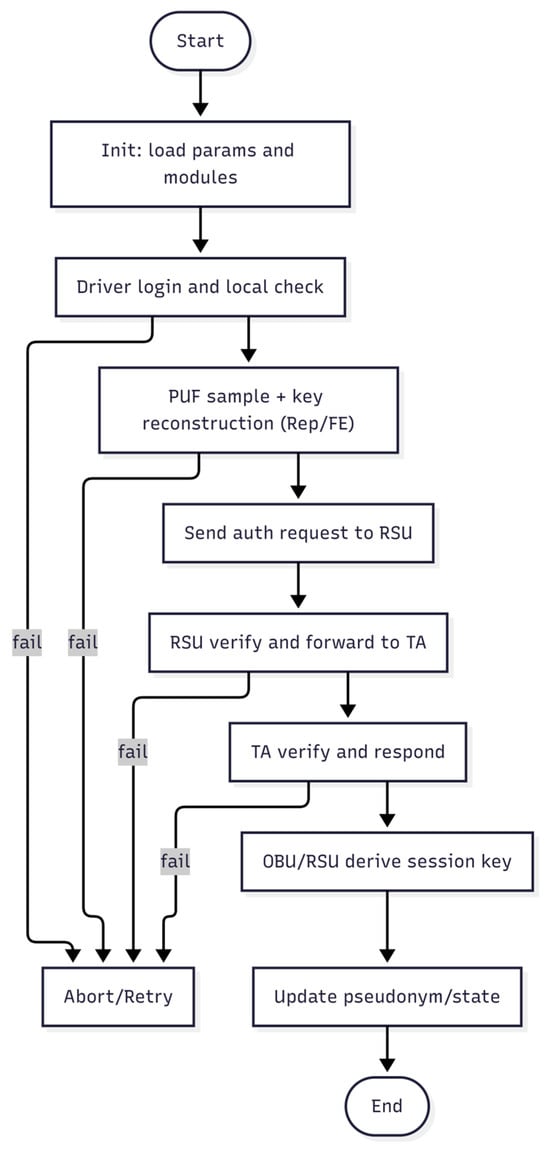
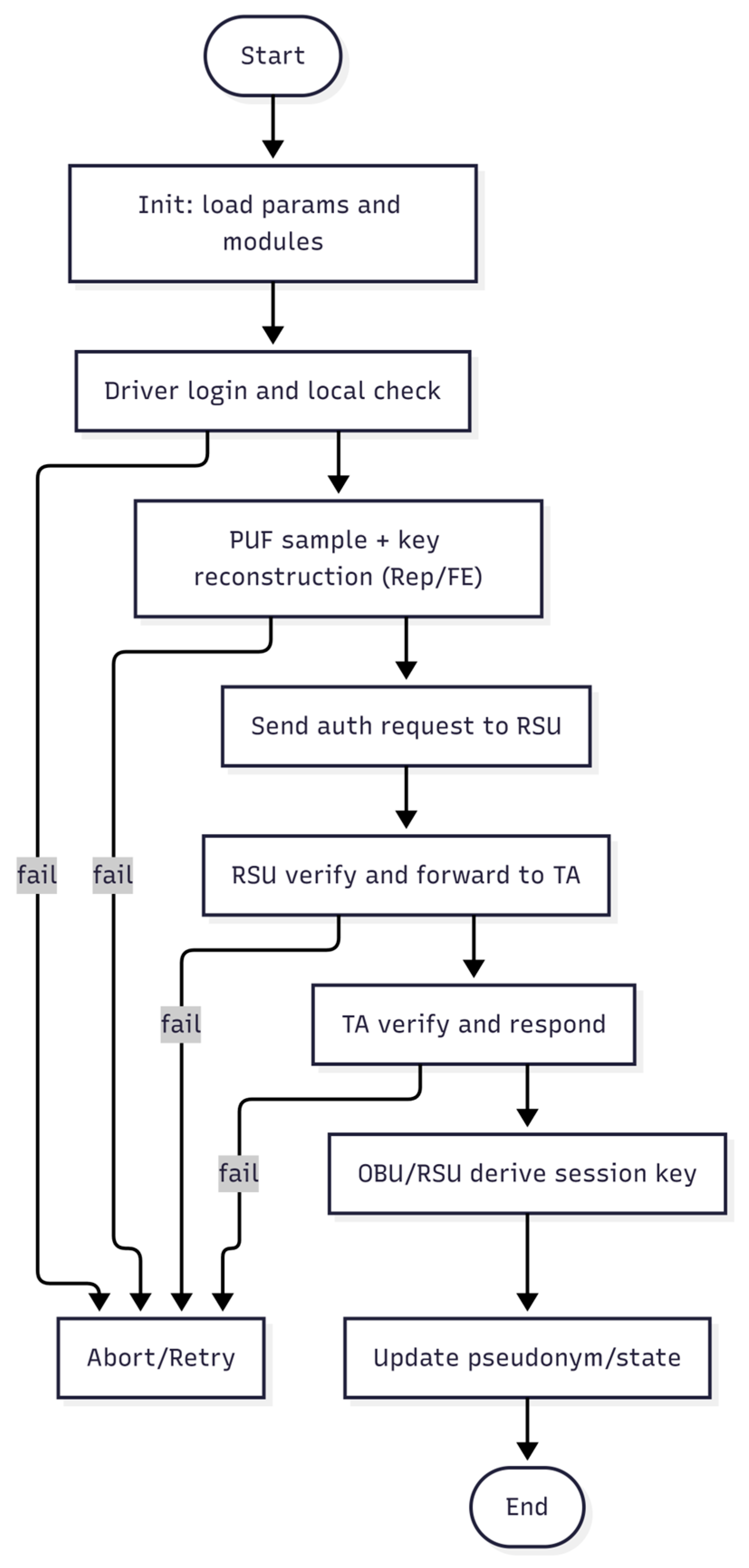
To better illustrate how the proposed protocol is executed on the implemented hardware platform, this section provides a system-operation flowchart, shown in Figure 3. During each authentication session, the driver first completes a local login on the OBU. The OBU then samples a noisy PUF response and reconstructs a stable key using helper-data-based error correction (fuzzy extractor/ error correction codes reconstruction). Using the reconstructed key and fresh ephemeral randomness, the OBU generates the authentication request and transmits it to the RSU. The RSU verifies the message freshness, forwards the required information to the TA, and receives the TA’s validation result. Finally, the RSU and the OBU derive the session key and update the dynamic pseudo-identity/state. Any verification failure (e.g., expired timestamps, invalid tags, or unsuccessful key reconstruction) triggers an abort or a re-sampling retry as shown in Figure 3.
Figure 3.
System operation flowchart.
The security properties of schemes [6,14,15,17,20,21] are summarized from their original descriptions and claims, and they are additionally cross-checked under the adversarial model in Section 3.4. The evaluation results for schemes [6,17,20,21] are derived from (i) the security claims and threat models explicitly stated in the corresponding original papers, (ii) subsequent cryptanalysis results reported in follow-up works, and (iii) our analysis in Section 5 and Section 7.2. Table 6 shows the security properties comparison.
Table 6.
Comparison of security properties (baseline evaluations based on the security claims in [6,14,15,17,20,21] and the analyses in [6,21] and Section 5).
Table 7, Table 8 and Table 9 show that computational and communication efficiency, as well as the storage capacity between the proposed scheme and some schemes [6,17,20,21], where n is the number of registered vehicles, and m is the number of registered RSUs. The output sizes for the various cryptographic operations are as follows: the SHA-256 hash is 256 bits, AES-128 symmetric encryption is 128 bits, an ECC point is 160 bits, and a random number is 256 bits. Additionally, the lengths for the identity, password, counter, and timestamp are all 16 bits. Generating a stable 256-bit key requires approximately 512 bits of non-volatile memory to store PUF helper data.
Table 7.
Comparison of computational costs.
Table 8.
Comparison of communication costs.
Table 9.
Comparison of storage capacity.
We measure the running time of the cryptographic primitives used in the protocols, including one-way hash computation (), symmetric encryption/decryption (), and one elliptic-curve scalar multiplication (). The benchmarks are executed on a Raspberry Pi 4B platform (Broadcom BCM2711, 1.5 GHz CPU, 4 GB RAM) running a 64-bit Linux OS. The primitives are implemented using standard libraries (SHA-256 for , AES-128 for via OpenSSL, and a 160-bit ECC group for via an ECC library). Each primitive is executed for 1000 iterations, and the reported values are the mean over all iterations. The timing is measured using a high-resolution monotonic timer to reduce the measurement noise. For each protocol, the total computational cost is computed by counting the number of primitive operations executed by each entity (vehicle, RSU, and TA) during one successful authentication session and then multiplying by the corresponding primitive running times.
We simulated the computational cost and obtained, , and , where , , and are the computation time of one hash, one point multiplication on elliptic curve, and one symmetric encryption or decryption, respectively. Table 9 shows that our solution has a higher storage efficiency than other schemes. Table 7 shows that the computation cost of our scheme is 11.938 ms, which is more efficient than [20,21], although less efficient than [6,17]. Table 8 shows that the communication cost of our scheme is 4416 bits, which is more efficient than [17] and less efficient than [6,20,21]. However, according to Table 6, we know that the schemes of [6,20] cannot resist impersonation attacks and device captured attacks and cannot achieve anonymity and perfect forward secrecy. On the other hand, all the schemes of [6,20,21] cannot resist device captured attacks and cannot achieve perfect forward secrecy. Therefore, our scheme is secure and retains high efficiency.
Our solution is safer than these schemes [6,17,20,21], because, during the design process, we performed modulo operation on the verification expression of the driver’s login to the vehicle, making it difficult for attackers to verify whether the guessed password and identity are correct, thus protecting the secret information of the vehicle and RSU with PUFs to resist side channel attacks and device capture attacks. We used the Diffie–Hellman value to generate a session key, ensure the session key secrecy, and achieve perfect forward secrecy and a dynamic anonymity strategy to obtain identity anonymity and unlinkability.
Our scheme primarily employs lightweight algorithms including hash functions, AES, ECC, and PUF, while avoiding computationally intensive operations such as modular exponentiation and bilinear pairings. According to the simulation results, the execution time of our protocol is 11.938 milliseconds. On the other hand, the vehicle transmits the data set to with a total data volume of 816 bits; the forwards the data set to the TA with a total data volume of 1104 bits; the TA returns the data set to the with a total data volume of 1296 bits; finally, the RSU relays the data set to the with a total data volume of 1200 bits. For currently widely deployed 5G networks [26], transmitting messages with each not exceeding 1KB in size is considered very minimal. The total storage of our scheme is 2112 bits. Therefore, our solution is lightweight and efficient in terms of computational load, storage requirements, and transmission overhead.
In the IoV/VANET authentication literature, lightweight primarily refers to a low computational overhead and practical latency on OBUs/RSUs, and a moderate increase in communication cost is acceptable when it enables stronger security properties (e.g., PFS and unlinkability). Our protocol is lightweight and efficient, completing a single authentication process in just 11.938 milliseconds, with each transmitted message not exceeding 2 KB and the total storage capacity remaining under 2 KB. In the widely deployed 5G-based Internet of Vehicles system, it can accommodate simultaneous authentication requests from a large number of vehicles. On the other hand, upon receiving messages, our protocol leverages the freshness of timestamps and the authenticity of vehicle identities to resist attackers attempting to initiate authentication with a multitude of forged identities. Therefore, the proposed protocol meets the demands of network stress testing in terms of performance, resource consumption, and resilience.
9. Conclusions
This work first pointed out that Kim et al.’s authentication scheme is vulnerable to password guessing attacks and RSU capture attacks, and it has no session key secrecy, anonymity, or perfected forward secrecy, as well as an inadequate pseudo-identity update. Then, we proposed a lightweight and anonymous V2R authentication protocol for IoV. The proposed scheme is provably secure. Compared with related schemes, our scheme can not only resist various known attacks but also maintain a low computational load, which can be applied to the Internet of Vehicles.
Author Contributions
Y.S. writing—original draft, formal analysis, and funding acquisition; Q.X. conceptualization, methodology, validation, writing—review and editing, and funding acquisition. All authors have read and agreed to the published version of the manuscript.
Funding
This research was supported by the Hangzhou Joint Fund of the Zhejiang Provincial Natural Science Foundation of China (Grant No. LHZSZ24F020002), the National Natural Science Foundation of China (Grant No. U21A20466), the China University Industry Academia Research Innovation Fund Heterogeneous Intelligent Computing Special Project (Grant No. 2024-HY-004), and the Qinghai Province Hainan Prefecture Sustainable Development Agenda Innovation Demonstration Zone Science & Technology Innovation Platform Project (Grant No. 2024-HN-P04).
Data Availability Statement
The original contributions presented in this study are included in the article. Further inquiries can be directed to the corresponding author.
Conflicts of Interest
The authors declare no conflicts of interest.
References
- Xie, Q.; Ding, Z.; Zheng, P. Provably Secure and Anonymous V2I and V2V authentication Protocol for VANETs. IEEE Trans. Intell. Transp. Syst. 2023, 24, 7318–7327. [Google Scholar] [CrossRef] [Scilit]
- Moni, S.; Manivannan, D. A scalable distributed architecture for secure and privacy-preserving authentication; message dissemination in VANETs. Internet Things 2021, 13, 100350. [Google Scholar] [CrossRef] [Scilit]
- Aman, M.N.; Javaid, U.; Sikdar, B. A privacy-preserving; scalable authentication protocol for the Internet of Vehicles. IEEE Internet Things J. 2021, 8, 1123–1139. [Google Scholar] [CrossRef] [Scilit]
- Cui, J.; Wei, L.; Zhang, J.; Xu, Y.; Zhong, H. An efficient message-authentication scheme based on edge computing for vehicular ad hoc networks. IEEE Trans. Intell. Transp. Syst. 2018, 20, 1621–1632. [Google Scholar] [CrossRef] [Scilit]
- Joshi, A.; Gaonkar, P.; Bapat, J. A reliable and secure approach for efficient car-to-car communication in intelligent transportation systems. In Proceedings of the 2017 International Conference on Wireless Communications, Signal Processing and Networking (WiSPNET), Chennai, India, 22–24 March 2017; IEEE: New York, NY, USA; pp. 1617–1620.
- Kim, C.; Kwon, D.; Son, S.; Yu, S.; Park, Y. An Anonymous and Efficient Authentication Scheme with Conditional Privacy Preservation in Internet of Vehicles Networks. Mathematics 2024, 12, 3756. [Google Scholar] [CrossRef] [Scilit]
- Li, X.; Han, Y.; Gao, J.; Niu, J. Secure hierarchical authentic cation protocol in VANET. IET Inf. Secur. 2020, 14, 99–110. [Google Scholar] [CrossRef] [Scilit]
- Nath, H.; Choudhury, H.H. A privacy-preserving mutual authentication scheme for group communication in VANET. Comput. Netw. 2022, 192, 357–372. [Google Scholar] [CrossRef] [Scilit]
- Yadav, K.A.; Vijayakumar, P. LPPSA: An efficient lightweight privacy-preserving signature-based authentication protocol for vehicular ad hoc networks. Ann. Telecommun. 2022, 77, 473–489. [Google Scholar] [CrossRef] [Scilit]
- Qureshi, K.N.; Din, S.; Jeon, G.; Piccialli, F. Internet of vehicles: Key technologies, network model, solutions and challenges with future aspects. IEEE Trans. Intell. Transp. Syst. 2020, 22, 1777–1786. [Google Scholar] [CrossRef] [Scilit]
- Taslimasa, H.; Dadkhah, S.; Neto, E.C.P.; Xiong, P.; Ray, S.; Ghorbani, A.A. Security issues in Internet of Vehicles (IoV): A comprehensive survey. Internet Things 2023, 22, 100809. [Google Scholar] [CrossRef] [Scilit]
- Sharma, N.; Chauhan, N.; Chand, N. Security challenges in Internet of Vehicles (IoV) environment. In Proceedings of the First International Conference on Secure Cyber Computing; Communication (ICSCCC), Jalandhar, India, 15–17 December 2018; IEEE: New York, NY, USA; pp. 203–207.
- Qu, F.; Wu, Z.; Wang, F.Y.; Cho, W. A security and privacy review of VANETs. IEEE Trans. Intell. Transp. Syst. 2015, 16, 2985–2996. [Google Scholar] [CrossRef] [Scilit]
- Xie, Q.; Ding, Z.; Tang, W.; He, D.; Tan, X. Provable secure and lightweight blockchain-based V2I handover authentication and V2V broadcast protocol for VANETs. IEEE Trans. Veh. Technol. 2023, 72, 15200–15212. [Google Scholar]
- Cui, J.; Zhang, X.; Zhong, H.; Zhang, J.; Liu, L. Extensible Conditional Privacy Protection Authentication Scheme for Secure Vehicular Networks in a Multi-Cloud Environment. IEEE Trans. Inf. Forensics Secur. 2019, 15, 1654–1667. [Google Scholar] [CrossRef] [Scilit]
- Xu, Z.; Li, X.; Xu, J.; Liang, W.; Choo, K.K.R. A secure and computationally efficient authentication and key agreement scheme for internet of vehicles. Comput. Electr. Eng. 2021, 95, 107409. [Google Scholar] [CrossRef] [Scilit]
- Kumar, P.; Om, H. A conditional privacy-preserving and desynchronization-resistant authentication protocol for vehicular ad hoc network. J. Supercomput. 2022, 78, 17657–17688. [Google Scholar] [CrossRef] [Scilit]
- Xie, Q.; Huang, J.J. Improvement of a Conditional Privacy-Preserving and Desynchronization-Resistant Authentication Protocol for IoV. Appl. Sci. 2024, 14, 24–51. [Google Scholar] [CrossRef] [Scilit]
- Zhong, H.; Huang, B.; Cui, J.; Xu, Y.; Liu, L. Conditional privacy-preserving authentication using registration list in vehicular ad hoc networks. IEEE Access 2017, 6, 2241–2250. [Google Scholar] [CrossRef] [Scilit]
- Al Sibahee, M.A.; Nyangaresi, V.O.; Abduljabbar, Z.A.; Luo, C.; Zhang, J.; Ma, J. Two-Factor Privacy Preserving Protocol for Efficient Authentication in Internet of Vehicles Networks. IEEE Internet Things J. 2024, 11, 14253–14266. [Google Scholar] [CrossRef] [Scilit]
- Liu, S.; Wang, Z. Security Analysis on a Two-Factor Privacy-Preserving Protocol for Efficient Authentication in Internet of Vehicles Networks. IEEE Internet Things J. 2025, 12, 34623–34632. [Google Scholar] [CrossRef] [Scilit]
- Zheng, L.; Feng, T.; Su, C. BAKP: A Blockchain-Assisted Anonymous Authentication and Key Agreement Protocol for Secure Internet of Vehicle. IEEE Trans. Veh. Technol. 2025. early access. [Google Scholar] [CrossRef] [Scilit]
- Dolev, D.; Yao, A.C. On the security of public key protocols. IEEE Trans. Inf. Theory 1983, IT-29, 198–208. [Google Scholar] [CrossRef] [Scilit]
- Xie, Q.; Wong, D.S.; Wang, G.; Tan, X.; Chen, K.; Fang, L. Provably Secure Dynamic ID-based Anonymous Two-factor Authenticated Key Exchange Protocol with Extended Security Model. IEEE Trans. Inf. Forensics Secur. 2017, 12, 1382–1392. [Google Scholar]
- Wang, D.; Wang, P. Two Birds with One Stone: Two-Factor Authentication with Security Beyond Conventional Bound. IEEE Trans. Depend. Secur. Comput. 2018, 15, 708–722. [Google Scholar]
- Al-Shareeda, M.A.; Gaber, T.; Alqarni, M.A.; Alkinani, M.H.; Almazroey, A.A.; Almazroi, A.A. Chebyshev polynomial-based emergency conditions with an authentication scheme for 5G-assisted vehicular fog computing. IEEE Trans. Depend. Secur. Comput. 2025, 22, 4795–4812. [Google Scholar] [CrossRef] [Scilit]

Disclaimer/Publisher’s Note: The statements, opinions and data contained in all publications are solely those of the individual author(s) and contributor(s) and not of MDPI and/or the editor(s). MDPI and/or the editor(s) disclaim responsibility for any injury to people or property resulting from any ideas, methods, instructions or products referred to in the content. |
© 2026 by the authors. Licensee MDPI, Basel, Switzerland. This article is an open access article distributed under the terms and conditions of the Creative Commons Attribution (CC BY) license.