


Abstract
E-commerce orders frequently contain items stored in distinct zones or even separate facilities, necessitating the coordination of multiple pickers, which often results in additional waiting time. This research investigates the joint order picking and packaging optimization problem for a multi-zone e-commerce warehouse. We formulate the integrated batching, picker assignment, sequencing, and packaging decisions as a mixed-integer nonlinear programming (MINLP) model and further reformulate the nonlinear relationships into a solvable mixed-integer linear programming (MILP) model for exact-solver validation. Due to the computational intractability of large-scale instances, we introduce a two-stage heuristic framework that combines spatial-first and temporal-first batching rules with an RP-VNS improvement procedure. Computational experiments compare the proposed algorithms with Gurobi on small-scale instances and with two greedy benchmarks and an ALNS-based metaheuristic on large-scale instances. The results show that the spatial-first heuristic (SFH) consistently achieves the lowest total cost, while the temporal-first heuristic (TFH) also improves upon ALNS in most settings. Relative to ALNS, SFH and TFH reduce total operational costs by up to 28.85% and 20.93%, respectively. Additional VNS ablation and routing-policy experiments further demonstrate the contribution of VNS on the tested instances and the robustness of the proposed framework under alternative routing assumptions.
MSC:
90B05
1. Introduction
The rise of e-commerce and the e-retailer paradigm has shifted market focus from a price-based competition to a service-based tournament, where same-day or even within-the-hour delivery is the new standard. The domain of warehouse intralogistics is currently undergoing a structural transformation driven by the service tournament within e-retailing. Central to this transformation is the order picking problem (OPP), which has become increasingly complex due to the nature of multi-item e-commerce orders. In this environment, a single order often comprises multiple items stored in distinct zones or even separate facilities, necessitating the coordination of multiple pickers. To minimize packaging and delivery costs, managers typically aim to consolidate all items into a single shipment, even when they are picked by different pickers. However, this operation frequently results in synchronization delays, thereby reducing overall warehouse efficiency. Consequently, it is important to minimize the completion time variance of items belonging to the same order to optimize operational performance.
In the area of pick-to-part order picking research, strategies such as order splitting (see [1,2]) and order batching (see [3,4]) are frequently considered to improve operational efficiency. Order splitting enables a single order to be fulfilled by multiple pickers, whereas order batching allows a single picker to retrieve items for multiple orders simultaneously. By assigning items stored in proximal locations, these methods significantly reduce travel time and routing costs. However, splitting and batching operations increase the complexity of the optimization problem.
In multi-zone warehouses, pickers are restricted to specific operational areas to reduce routing costs and maintain operational proficiency. Once an order contains items in different zones, it requires the cooperation of multiple pickers. The order is completed only when all cooperating pickers have completed the picking process. To improve effectiveness, the order is allowed to be split into several sub-orders, each of which includes all items in one zone and can be delivered individually. Delivering each sub-order can reduce the time cost of order picking but increases the packaging and delivery costs. The resulting packaging decision links the timing of zone-specific picking operations with the cost of consolidated or split shipments.
To address this complex optimization problem, we formulate the integrated batching, picker assignment, sequencing, and packaging decisions as a mixed-integer nonlinear programming (MINLP) model and derive a mixed-integer linear programming (MILP) reformulation for exact-solver validation. We then decompose the problem into order batching and batch assignment subproblems within a two-stage heuristic framework. The main contributions of this research are threefold. First, we study a multi-zone e-warehouse setting in which both order splitting and order batching are allowed and the choice between consolidated packaging and separate shipment of zone-specific sub-orders is optimized jointly with picking operations. Second, we provide the MINLP formulation and its MILP reformulation to characterize the integrated problem and enable small-scale exact-solver validation. Third, we develop spatial-first and temporal-first batching heuristics together with an RP-VNS improvement procedure, and evaluate them against Gurobi incumbents on small-scale instances, greedy benchmarks, and an ALNS-based metaheuristic.
The remainder of the paper is organized as follows. Section 2 reviews the related literature. Section 3 describes the research problem, assumptions, and mathematical formulations. Section 4 presents the two-stage heuristic framework and benchmark algorithms. Section 5 reports the computational settings and results. Section 6 concludes the paper, and Section 7 provides the declaration of AI assistance.
2. Literature Review
The academic discourse on order picking has evolved significantly, transitioning from elementary order scheduling to holistic frameworks that integrate batching, zone picking, and distribution. This research specifically addresses the joint order picking and packaging problem within multi-zone environments, where split orders necessitate the synchronization of multiple pickers. Therefore, this review categorizes the literature into three streams: the order picking problem, the order batching problem, and the multiple-warehouse problem.
2.1. Order Picking Problem
Order picking problems are fundamentally categorized into two operational paradigms: picker-to-parts and parts-to-picker. This research concentrates on the picker-to-parts configuration, where the picker traverses the storage area to retrieve SKUs specified by customer orders. In this area, ref. [5] address the order scheduling problem and propose a greedy search algorithm to minimize the total completion time. Similarly, ref. [6] considers the distributed permutation flow shop problem and introduces the improved iterated greedy algorithm to minimize makespan. Ref. [7] investigates an integrated optimization problem on the three main types of equipment used in a new design of a multi-tier automated warehouse: automated guided vehicles, lifts, and shuttles.
Traditional literature typically assumes that customer orders must remain intact during picking to streamline operations, as splitting orders substantially increases the operational complexity. Ref. [1] argue that this constraint can be relaxed in smart warehouses, since the manual picker is replaced by automated devices. They propose a heuristic-based column generation algorithm to minimize the total tardiness of orders. Ref. [2] investigate the integrated order splitting and distribution routing problem, and propose the branch-price-and-cut algorithm to minimize the overall distribution cost.
2.2. Order Batching Problem
Literature on order picking effectiveness predominantly focuses on batching algorithms driven by location-based clustering. Ref. [8] contribute a rigorous mathematical approach to the joint batching and routing problem. A novel exact algorithm is introduced to find minimum-cost closed walks where each picker visits all locations required to pick all products from their assigned orders. Ref. [9] devise a large-scale order batching in parallel-aisle picking systems. The heuristic algorithm is introduced to reduce the total travel distance of pickers. Ref. [10] investigate order picking, batch assignment, and routing problems under the mixed-shelves storage strategy. A heuristic method is introduced to improve order picking effectiveness in e-warehouses.
Recent studies also integrate picking and packing decisions. Ref. [11] jointly consider order batching, batch assignment, and sequencing for picking and packing. They formulate a MINLP model and use warehouse data to evaluate the benefits of integration. Ref. [12] study integrated batching for picking and packing to reduce labor costs, and develop statistical approximation models combined with a pair-swapping heuristic. These studies demonstrate the benefits of coordinating picking and packing operations. The present study considers the related decision of whether to consolidate zone-specific sub-orders into one package or package and ship them separately.
The order batching problem is frequently addressed within the context of multi-zone warehouse environments. Ref. [13] develop an approximation model based on queuing network theory to analyze the impact of order batching and picking area zoning on the mean order throughput time. Ref. [14] introduce a new zone-picking network to improve order-picking performance. Ref. [15] investigate the background of within-the-hour fresh food deliveries, and study the joint order batching and zone-picking problem. They devise a two-stage heuristic algorithm specifically aiming to minimize the total number of task releases.
Synchronization among zone-specific sub-orders also affects downstream operations. Ref. [16] jointly optimize zone-picking schedules and vehicle routes under limited intermediate storage capacity. In their setting, sub-orders are processed individually within each zone, and a store order is dispatched in a single delivery only after all its sub-orders are ready. The present study additionally considers batching within each zone and allows zone-specific sub-orders to be dispatched separately, accounting for the associated packaging and delivery costs.
2.3. Multiple-Warehouse Problem
In practice, the heterogeneity of item characteristics, such as volume and weight, often necessitates storage across distinct zones or separate warehouses. Addressing this distributed inventory context, ref. [17] study multi-warehouse delivery systems, where all warehouses share drones. They formulate a closed queueing network and propose a heuristic to improve the drone assignment decision. Ref. [18] study the joint order batching, batch assignment, and picker routing problems in a multi-warehouse. They formulate a bi-objective mathematical model solved via Benders decomposition to minimize both delivery latency and operational costs. Ref. [19] propose a meta-learning-based algorithm to study the order scheduling problem in a multiple-zone warehouse.
Ref. [20] study the order picking and vehicle routing problem in the front warehouse mode. A two-stage iterated search algorithm is introduced to minimize the operational cost under the time-window constraint. Ref. [21] propose a hybrid algorithm by alternating between the large neighborhood search and local search to minimize the order-splitting and replenishment costs. Ref. [22] consider an order picking problem where robots are used in cellular warehousing systems.
At the fulfillment-network level, ref. [23] jointly determine fulfillment locations and carriers under delivery-time uncertainty. An order may be assigned to multiple location–carrier combinations. Their model provides shipping discounts for consolidation within the same combination and imposes penalties for early and late deliveries, thereby linking order fragmentation and consolidation to cost and delivery performance. The present study considers shipment decisions within a single multi-zone warehouse, where sub-order availability is determined by the picking schedule.
For readers seeking a more comprehensive analysis of the domain, several seminal reviews are available. Ref. [24] focuses on the order picking problem, specifically reviewing operational planning problems that are effectively addressed using state-of-the-art metaheuristics. Ref. [25] chronicle the evolution of warehousing operations research spanning the last 50 years. Furthermore, refs. [26,27] contextualize their reviews within the e-commerce fulfillment landscape, synthesizing literature on advanced order-picking strategies and future directions for efficiency optimization.
The above studies address integrated picking and packing, cross-zone coordination, and shipment consolidation. This research considers these decisions jointly in a warehouse with fixed zones and zone-specific pickers. Order batching, assignment, and sequencing determine the completion times of sub-orders. For each order, the packaging decision then selects either a single consolidated package, released after all sub-orders are completed, or separate packages for all zone-specific sub-orders. Thus, splitting an order during picking does not necessarily require separate shipments. The proposed formulation integrates this shipment decision with the picking schedule through a weighted objective that accounts for time and packaging and delivery costs.
3. Problem Description and Formulation
This research investigates the picker-to-parts order picking problem within a multi-zone e-commerce warehouse environment. We assume a zonal picking constraint where each picker is assigned exclusively to a specific zone. Consequently, a single customer order containing items stored across distinct zones requires the coordination of multiple pickers. The manager faces a critical packaging decision: consolidate all items from a single order into one package or dispatch zone-specific partial shipments. While the latter approach accelerates processing, it generates multiple packages per order, thereby incurring additional packaging and delivery costs. In this optimization problem, managers decide on order batching, assignment, and packaging decisions to minimize both time and delivery costs. The objective is to minimize a weighted sum of the average order time measure and the average packaging and delivery cost per order.
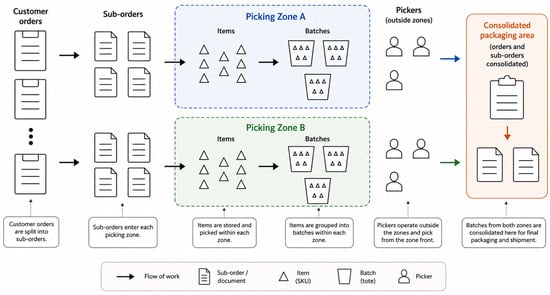
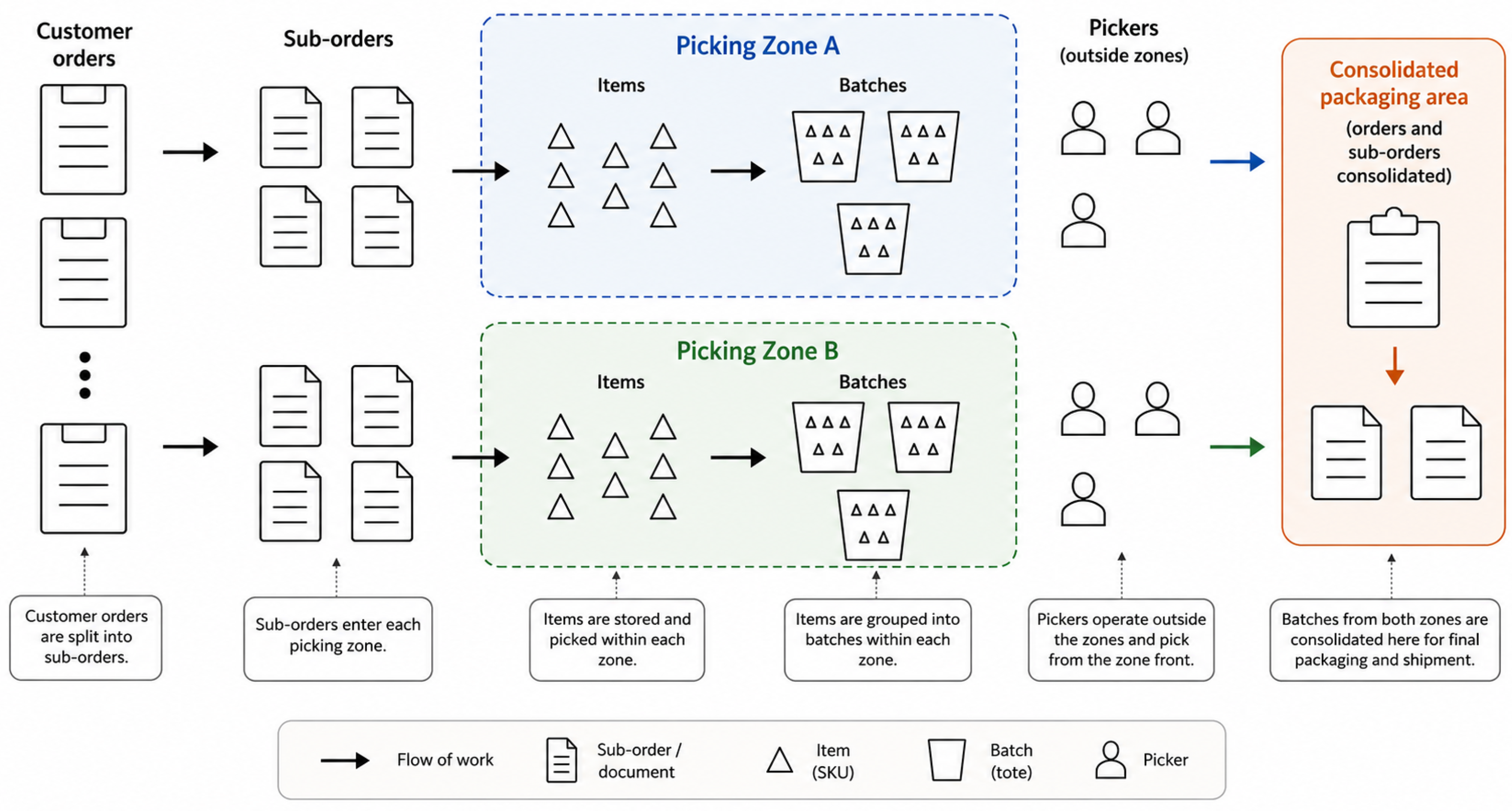
The order picking process is described in Figure 1. The customer orders are divided into several sub-order groups, each of which contains items in the same zone. In each zone, items are batched and then assigned to a specific picker. The sub-order is completed if all requested items are picked, and the order is completed if all divided sub-orders are completed. However, each sub-order is allowed to be packaged and delivered individually.
Figure 1.
The framework of order picking in the e-warehouse.
3.1. The MINLP Model
Suppose the warehouse contains K distinct zones, each with pickers, where . There are I customer orders, each of which can be divided into several sub-orders. Let be the set of all sub-orders, and let be the indicator variable such that if order i is the original order of sub-order j. There are N items stored in the e-warehouse, and each picker processes a batch of items in the same zone. Let if item n in sub-order j is assigned to batch , where is the set of all batches, and otherwise.
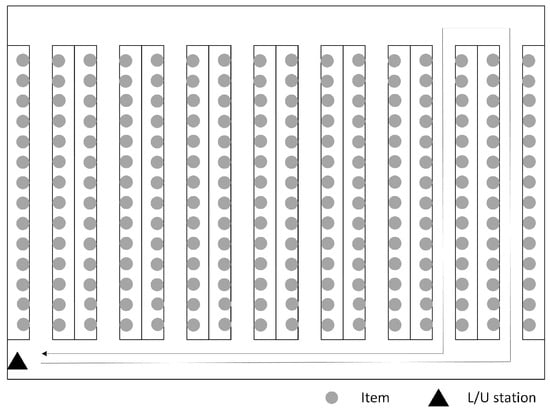
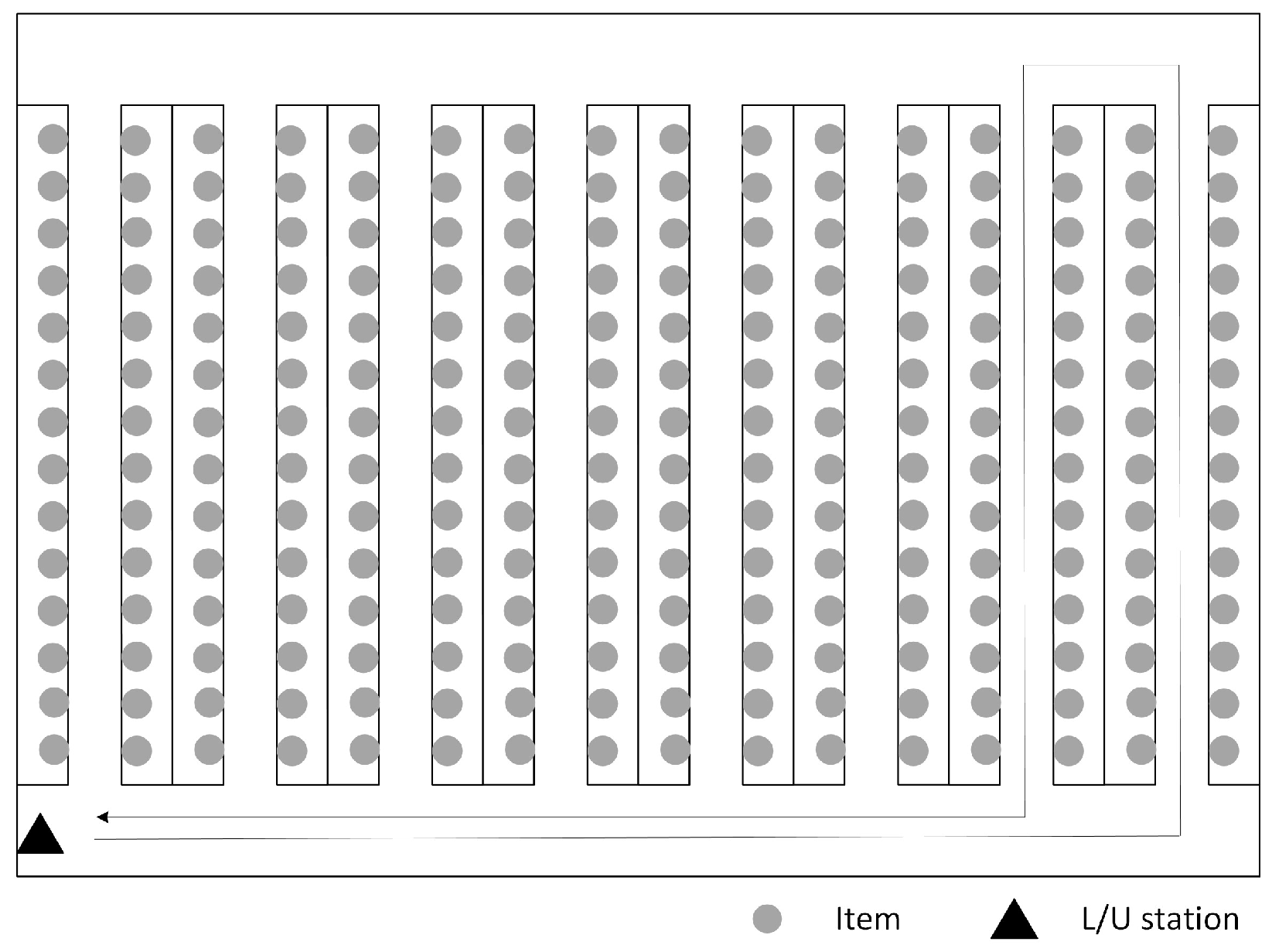
Our study focuses on the joint order batching, assignment, and packaging optimization problem. In order to reduce the computational complexity, it is assumed that the order picker follows an S-shaped route in each zone, which is widely adopted in applications and academic research. As shown in Figure 2, a pick starts from the L/U station, collects all requested items in the batch, and then returns to the original L/U station. The picker cannot turn around in the aisle due to the narrow aisle.
Figure 2.
An example for e-warehouse layout.
This assumption provides a highly effective routing approach and reduces the computational complexity. Specifically, the transverse traveling distance of the S-shape route depends on the farthest aisle in the visiting list. The elongated traveling distance of the S-shape route is due to the increased number of aisles to visit. We formulate the traveling distance of batch b following [1], which is given by
where if batch b contains item n, and otherwise. is the distance between the L/U station and item n, and is the length of the aisle.
In order to define the batch picking sequence, it is assumed that there is a dummy batch, i.e., , which has zero processing time and is processed first by the picker. Let denote that batch is processed immediately after batch b by picker p, and otherwise. The completion time of sub-order j is denoted by . Let if sub-orders in order i are packaged and delivered individually, and otherwise. Each sub-order will result in the packaging and delivery cost if it is packaged and delivered individually. Let be the packaging and delivery cost of one consolidated package for order i, and let weight the order time measure relative to packaging and delivery cost. Let denote the packaging and delivery cost for order i. Table 1 summarizes the notation used in the mathematical formulation. It includes the main sets and parameters, the decision variables, and the auxiliary notation introduced for linearization.
Table 1.
Notation in the mathematical formulation.
Based on the above formula, the MINLP model is given by the following.
where the objective function (2) is to minimize a weighted sum of the average order time measure and the average packaging and delivery cost per order. Constraint (3) ensures each item n in sub-order j is assigned to one batch. Constraint (4) defines the capacity constraint that the number of items is less than or equal to the batch capacity. Constraints (5) and (6) define the sequence of batches, so that each batch will be picked by only one picker. Specifically, constraint (5) ensures that each batch will be picked, and constraint (6) demonstrates that at most one batch is picked immediately after another one. Equations (7) and (8) define the processing time and completion time of each batch b. Then, constraint (9) defines the completion time of each sub-order j, which is equal to the maximal completion time of batches that contain the item in sub-order j. Constraint (10) defines the completion time (or average completion time) of each order i. If , the order completion time equals the maximum completion time of the divided sub-orders, whereas if , it equals their arithmetic mean. Constraint (11) defines the packaging and delivery cost . Constraints (12) and (13) define the number of aisles that batch b actually needs to visit, where M is a sufficiently large value. Then constraint (14) calculates the total traveling distance of batch b.
In the model, constraint (9) can be written as
where , , and are decision variables. Therefore, constraint (9) contains a cubic term of decision variables. Similarly, (10) contains a fourth-degree term of decision variables. The model is intractable due to the cubic and fourth-degree terms of the decision variables in the constraints.
3.2. Model Reformulation
The nonlinear terms in are mainly induced by the interaction between the sequencing decisions, batching decisions, and completion-time variables. To obtain a tractable formulation, we reformulate these nonlinear relationships as linear implications. This reformulation preserves the logical structure of the original model while eliminating the cubic and fourth-degree terms, thereby converting the original mixed-integer nonlinear formulation into a mixed-integer linear model.
The completion time of batch b is determined by the batch processed immediately before it on the same picker. Thus, constraint (8) can be replaced by the following linear precedence constraints:
The objective is nondecreasing in completion times for , so reducing batch completion times to their earliest feasible values cannot worsen it. Therefore, constraint (8) can be reformulated to (15), which implies that the completion time of batch b is greater than or equal to the sum of its processing time and the completion time of the batch processed immediately before it on the same picker. Then, the Big-M linearization is introduced to linearize the quadratic term of the decision variable in (16).
The completion time of sub-order j is determined by the maximal completion time of batch b in the sub-order j. Constraint (9) can be replaced by the following linear precedence constraints:
In constraint (17), the completion time of sub-order j is greater than or equal to the completion time of batch b in sub-order j. Then, the quadratic term is linearized via the McCormick envelopes. The new binary variable is constrained as follows:
Constraint (10) links the order completion time with the packaging decision. This constraint can be rewritten as the following linear constraints:
In constraint (23), the Big-M linearization is introduced to linearize the quadratic term . The continuous auxiliary variable is constrained as follows, using an upper bound M on :
Finally, the model is reformulated as a solvable MILP model, which is given as follows:
4. Algorithm
The problem is divided into two separate subproblems: the order batching problem and the batch assignment problem. In the order batching problem, a heuristic method is proposed to generate order batches. Hence, the decision variables , , and processing time are given in the batch assignment problem. Then, another MINLP model is introduced to formulate the batch assignment problem, and a heuristic-based search algorithm is proposed to solve this problem.
4.1. Order Batching Algorithm
In the order batching problem, the main objective is to provide a well-designed batch to reduce the time component of the weighted objective in the problem. We will introduce two approaches to achieve this objective: reducing travel distance and waiting time. However, these two approaches are often incompatible. To reduce the traveling distance, items stored on the same shelf tend to be batched. As a batch contains more items from different orders, it is more likely to increase the waiting time. In contrast, batching items in the same order can reduce waiting time, but increase travel distance when items are stored on different shelves. Now, we will introduce the spatial-first heuristic (SFH) and temporal-first heuristic (TFH).
Spatial-first heuristic. Here, we focus on the warehouse with a single block, and the shelves are arranged in parallel. As shown in Figure 2, the picker starts from the L/U station and collects the target items along the way until returning to the original L/U station. It is observed that the number of visited aisles is odd, which means the picker visits at least two aisles. Moreover, the batch’s travel distance depends on the farthest item and the number of visited shelves. Hence, this heuristic should first decide the set of aisles the picker will visit when picking the items in the batch.
Lemma 1.
In the optimal solution to the order batching problem, the items are batched with the shelf from back to front if each order only contains one item.
Proof.
Consider a warehouse zone where the picker employs an S-shape routing policy. In this context, the travel distance for a batch is determined by the location of the farthest shelf visited. Given the assumption that each order consists of a single item, the problem reduces to pairing shelf locations to minimize the sum of the maximum distances in each batch.
Assume that there exists a batch pairing shelves at locations X and , where X is the farthest shelf and is not a closer shelf. The second batch contains intermediate items at shelves and , where . Therefore, assigning items on shelf rather than shelf to the batch can reduce the total travel distance. Hence, the items are batched with the shelf from back to front in the optimal solution to the order batching problem. □
Lemma 1 proposes an approach to minimize the travel distance when batching the items. However, batching the items in the same order can reduce the future waiting time. To balance the travel distance and waiting time, we propose the spatial-first heuristic.
- Step 1. Generate the initial item set , and calculate the number of items in each shelf .
- Step 2. Choose the farthest two shelves f and that . Calculate the number of items that are stored on shelves f and .
- Step 3. If the batch has remaining capacity, add the items to the batch in decreasing order of ; otherwise, create a new batch. Repeat this step until or .
- Step 4. Repeat Steps 2 and 3 until all items are assigned to a batch.
The spatial-first heuristic consolidates items located in adjacent shelves to minimize total travel distance. Simultaneously, the algorithm prioritizes orders with a higher pick density in these zones to reduce expected waiting time. Notably, in scenarios where orders consist exclusively of items stored in contiguous shelves, this heuristic yields the optimal solution for the problem.
The spatial-first heuristic obtains the optimal batching decision for the problem if each order only contains one item. However, this approach risks excessive order fragmentation when orders consist of items stored in non-adjacent locations. Consequently, we introduce an alternative heuristic framework specifically engineered to consolidate orders with items located across non-adjacent shelves.
Temporal-first heuristic. The primary objective of the temporal-first heuristic is to minimize the potential waiting time. Consequently, the batching process gives precedence to consolidating items that belong to the same customer order. Operationally, the heuristic iteratively selects a reference shelf, traversing the layout from back to front, and clusters it with additional shelves that maximize SKU commonality for the active orders. The detailed procedure is delineated below.
- Step 1. Generate the initial item set , and calculate the number of items in each shelf .
- Step 2. Choose the farthest shelf f that . Let be the subset of orders that contain items stored on shelf f. Select another shelf that contains the largest number of items belonging to the order set .
- Step 3. If the batch has remaining capacity, add the items to the batch in decreasing order of ; otherwise, create a new batch. Repeat this step until or .
- Step 4. Repeat Steps 2 and 3 until all items are assigned to a batch.
It is expected that the temporal-first heuristic is advantageous when orders consist of items stored in non-adjacent locations. By enforcing the collection of an order’s items into the same batch, it effectively avoids excessive splitting. However, this constraint inherently inflates the travel cost. For instance, it is assumed that there are two orders and , where the travel distances of items are , and the batch capacity is 2. In the spatial-first heuristic, items and are batched, and the total travel distance is 12. However, in the temporal-first heuristic, items and are batched and the total travel distance is 15.
4.2. Batch Assignment Algorithm
The subsequent batch assignment phase is formulated as a scheduling problem that incorporates the packaging decision. In this sub-problem, the batch composition variables and the associated batch processing times are treated as fixed parameters derived from the preceding stage. The MINLP model for the batch assignment problem is as follows.
where if batch b contains sub-order j; these values are treated as fixed parameters derived from the preceding stage. In , constraint (10) contains the quadratic term of decision variables, which is computationally intractable.
We propose a heuristic-based algorithm to search for high-quality solutions to the batch assignment problem. To obtain the initial solution, we first relax the binary constraints in , and then propose a rounding algorithm. The linear relaxation model is given by
Upon obtaining the solution to the linear relaxation of , we derive an initial feasible solution by rounding the fractional values to satisfy integrality constraints. Alternatively, we can find the initial solution via the greedy algorithm. Adopting the longest processing time (LPT, see [28]) rule, this approach iteratively assigns the batch with the maximum processing duration to the picker exhibiting the minimum makespan.
Subsequently, a heuristic-based search procedure is applied to explore the neighborhood for high-quality solutions. To guide this process, we first introduce two specific search rules designed to identify high-quality candidates. Finally, a variable neighborhood search (VNS) algorithm is employed to further intensify the search through batch interchanges. The overall framework of this approach is illustrated below.
- Step 1. Solve and obtain the optimal solution .
- Step 2. For each , find and with maximal , then let if and ; and let otherwise.
- Step 3. For each i, let if ; otherwise, let . Then we have a starting-point solution and .
- Step 4. A. For each batch, assign the batch to the picker with the lowest completion time, if its start time is larger than the completion time. B. For each picker, change the schedule of two batches if the prior batch has a larger processing time.
- Step 5. The VNS algorithm is employed to find a better solution. Specifically, we utilize an interchange operator that swaps the assignment order of two distinct batches. If a swap yields a reduction in the weighted objective value compared to the current best solution, the modification is retained. Each unordered pair of batches within a zone is examined once. The procedure terminates after this scan, without a guarantee of local optimality.
Alternatively, the initialization Steps 1–3 can be substituted with a greedy constructive heuristic. While this alternative may yield an initial solution of marginally lower quality, it significantly enhances computational efficiency by bypassing the overhead associated with solving the linear relaxation (). The framework for this alternative is given below.
- Step 1. Let denote the cumulative workload of picker p, initialized as for all pickers. Sort the set of batches in non-increasing order of their processing times .
- Step 2. Iteratively assign the next unassigned batch b to the picker with the minimum current workload, i.e., . Update the workload: . Repeat this step until all batches are assigned.
4.3. Benchmark Algorithm
To evaluate the performance of the proposed method, we introduce two greedy-based benchmark algorithms and an ALNS-based metaheuristic benchmark for comparative analysis. BM1 assigns each zone-specific sub-order to a single batch without splitting it. This avoids synchronization across batches within a sub-order, although consolidation across zones may still require waiting. All batches satisfy the zonal and capacity restrictions. In the batch assignment problem, the batch with the largest processing time is serviced first.
The second benchmark algorithm (BM2 operates under a relaxed policy where order splitting is permitted. Consequently, items are batched with the objective of minimizing total travel distance. Specifically, the batching heuristic follows a greedy strategy: items are sequenced in ascending order of their associated travel distances. For the batch assignment problem, the batch with the largest processing time is serviced first.
In the RP-VNS procedure used by SFH and TFH, batch composition remains fixed after the batching stage. The LPT rule provides the initial picker assignments within each zone. The procedure then examines every unordered pair of batches once by exchanging their picker assignments and sequence positions and recalculating the affected schedules. A swap is accepted only if it strictly reduces the objective value; otherwise, the previous assignments and sequence positions are restored. The search terminates after this single scan, without a restart or a separate time limit, and involves no random sampling.
To provide a stronger metaheuristic benchmark, we further implement an adaptive large neighborhood search (ALNS) algorithm. The ALNS solution representation contains zone-specific batches and the sequence of batches assigned to each picker. For each candidate schedule, the packaging decision is updated for each order by selecting the consolidated or separate option with the lower weighted objective value. Ties are resolved in favor of consolidation. Starting from the best initial solution obtained from its spatial, temporal, and order-based construction procedures, each followed by LPT assignment, ALNS iteratively applies destroy and repair operators to partially remove and reinsert item lines or batches. The destroy operators are designed to diversify the search by removing random, high-cost, spatially related, inefficient, or critical-picker assignments, whereas the repair operators reconstruct feasible solutions through greedy, regret-based, spatial, temporal, and load-balanced insertion rules. After each repair step, a short local improvement procedure refines batching, picker assignment, and sequencing. Operator weights are updated adaptively according to their historical performance, and a simulated-annealing acceptance rule is used to accept non-improving moves with a decreasing probability. The objective value of each candidate solution is evaluated using the same completion-time and packaging-cost logic as the mathematical model, which makes ALNS a stronger benchmark for assessing the proposed SFH and TFH algorithms.
At each ALNS iteration, a destroy operator and a repair operator are selected with probabilities proportional to their current weights. The local search considers sequence swaps, picker reassignment, item relocation, batch merging, and batch splitting. Under the default configuration, it performs a single round and stops at the first neighborhood that yields an improvement. The search is limited to 60 iterations and 1800 s after initialization, with the stopping conditions checked between iterations. Operator weights are updated every 10 iterations using a reaction factor of 0.20, and the temperature is multiplied by 0.995 at each iteration. No automatic parameter tuning is performed. The parameter settings and the seed procedure used for the reported experiments are given in Section 5.1.
5. Experiment
In this subsection, we present a series of computational experiments to test the performance of our algorithms: SFH and TFH. All algorithms were implemented in Python 3.11. The MILP reformulation is solved by Gurobi 10.01 for exact-solver validation. The experiments are performed on a PC with a 2.3-GHz CPU and 32 GB of memory.
5.1. Experiment Setting
We consider two warehouse sizes with 2 and 4 zones, respectively. In each zone, there are 10 shelves, each storing 20 items. It is assumed that each item can only be stored in one position. In each zone, we vary the number of pickers over , and these pickers only serve this zone. There are orders, each containing at least one item. The number of items per order follows a discrete uniform distribution. We vary the maximum number of items in each order over .
There is no doubt that the item-location distribution will affect the algorithm’s performance. For instance, the spatial-first heuristic can obtain a high-performance solution to the order batching problem if each order only requests the items on the same shelf. To analyze the impact of the item-location distribution, we vary the maximum number of zones over , and the maximum number of shelves over . Each experiment was repeated ten times for each setting.
For each scenario, the prescribed number of customer orders is generated. The number of item-demand lines in each order is drawn uniformly from , where is the maximum number of items per order (default 5; tested values 2, 5, and 10). The sizes of the candidate zone and shelf sets are drawn independently from the discrete uniform distributions on and , respectively. Here, Z is the number of warehouse zones (default 2; tested values 2 and 4), and is the maximum number of candidate shelves per order (default 2; tested values 2 and 5). The candidate zones and shelf indices are then selected uniformly without replacement from all Z zones and the 10 shelf indices, respectively. Each demand line independently selects a zone and a shelf from these order-specific sets and an item-location index uniformly from . Sampling across demand lines allows repetition, so multiple lines may refer to the same location. Consequently, the numbers of zones and shelves actually visited may be smaller than the corresponding candidate-set sizes.
The synthetic settings provide a controlled basis for objectively comparing algorithm performance, but they are not calibrated to a particular warehouse. They do not capture operational exceptions such as stockouts, damaged items, or abrupt demand surges during promotional periods. Varying order volumes in static test instances do not represent the full operational impact of such events. The results should therefore be interpreted within the tested settings. Applying the algorithms to a real warehouse may require adjustments to the model and algorithm design to reflect problem-specific conditions, together with validation using operational data.
The default parameter settings are as follows. The shelf-spacing coefficient, aisle length, and picker speed are set to 1, 10, and 1, respectively, in the corresponding distance and time units. The packaging and delivery cost is 10 cost units per split sub-order. The objective parameters are set to and . The batch capacity is 5 items; in the experiment varying the maximum number of items per order, it is set to the larger of 5 and that maximum. No additional fixed batch-handling time is included. Gurobi is run with a time limit of 1800 s and a relative MIP-gap tolerance of 0.01.
For both SFH and TFH, RP-VNS uses the LPT assignment as the initial solution and examines each unordered pair of batches within a zone once. A swap is accepted only if it strictly reduces the objective value. The search terminates after this scan, without a restart or a separate time limit.
ALNS is subject to a limit of 60 iterations and a search-time limit of 1800 s. Search time is measured after the initial solution has been constructed and is checked before each iteration. The total runtime may therefore exceed this limit because it also includes initialization and completion of the final iteration. The stagnation criterion terminates the search after 80 iterations without a new best solution and thus cannot be triggered within the default budget of 60 iterations. At each iteration, the requested removal size is drawn uniformly from 1 to , where n is the number of item-demand lines. All destroy and repair operator weights are initialized to 1 and updated every 10 iterations using a reaction factor of 0.20. The reward is 8 for a new best solution, 4 for an improvement over the current solution, and 1 for any other accepted solution. The initial annealing temperature is chosen to give an acceptance probability of 0.80 for an objective increase equal to 5% of the absolute initial objective value, with a minimum increase of . The temperature is then multiplied by 0.995 after each iteration. Regret insertion uses . Local search is performed for one round, with at most 20 candidate moves sampled in each neighborhood subject to this limit. These parameter values are fixed defaults of the implementation; no automatic parameter tuning is performed by the experiment driver. In its default configuration, the driver specifies neither the order-generation seed nor the ALNS seed.
For the reported large-scale experiments, however, the execution scripts use the base seed 20260920 and generate the seed for case c and repetition r as , where c is the recorded case index and r is the zero-based repetition index. The same is supplied to order generation and ALNS, and all methods use the same input instance within each repetition. This prescribed seed sequence was used without performance-based seed selection. Repeating the experiments under the same distributions and parameter settings is expected to yield similar average performance, subject to random variation.
To compare the performance of different methods in the large-scale analysis, the improvement percentage is calculated relative to the ALNS benchmark based on the objective value. All reported objective values are rounded to four significant figures, whereas improvement percentages are calculated from the unrounded values. The formula is given by:
5.2. Small-Scale Experiment Result
Before evaluating large-scale instances, we first tested the algorithms on small-scale cases and compared them with Gurobi under the 1800s time limit. Here, SFH and TFH are the proposed heuristic algorithms, while Gurobi represents a classical exact optimization approach and reports the best incumbent solution found within the time limit. In the first small-scale experiment, we varied the order volume over and the number of pickers over . As detailed in Table 2, SFH and TFH generated solutions in less than 0.3 s, whereas Gurobi reached the 1800s limit in every setting. SFH and TFH are competitive with the time-limited Gurobi incumbents, and both improve upon the incumbent found by Gurobi when and . This comparison concerns incumbent objective values and running times; the reported MIP gaps, which reach 63.47%, do not establish proximity to the optimal solution.
Table 2.
Small-scale impact of order scale on algorithm performance.
The results indicate that even these small-scale order instances are challenging for the exact solver under the imposed time limit. Gurobi provides a useful benchmark for solution quality, but its computational burden is much higher than that of the proposed heuristics. SFH and TFH therefore offer a favorable balance between solution quality and running time, while also consistently outperforming the two basic benchmarks.
In the second small-scale experiment, we analyzed the impact of order complexity by varying the maximum number of items per order over . As shown in Table 3, Gurobi was the strongest competitor in terms of objective value in several small cases, but again required the full 1800 s time budget in five of the six settings, with a running time of 29.10 s when and . By contrast, SFH and TFH obtained solutions competitive with the Gurobi incumbents within fractions of a second, and SFH improved upon the time-limited Gurobi incumbent in both settings with , while TFH did so when and . This comparison indicates competitive performance relative to the Gurobi incumbents at a lower computational cost; it does not establish closeness to the optimum.
Table 3.
Small-scale impact of item density on algorithm performance.
The experimental data reveal that increasing item density does not weaken the relative advantage of the proposed algorithms over the basic benchmarks. Gurobi obtained the lowest objective value in several small cases, but it reached the time limit in five of the six settings, whereas SFH and TFH completed almost immediately. These findings support comparison with Gurobi incumbents on small-scale instances and motivate the heuristic comparison for larger instances.
5.3. Large-Scale Experiment Result
In the first large-scale experiment, we evaluated the performance of the proposed algorithms across diverse warehouse configurations, defined by the number of zones and pickers . All objective values in Table 2, Table 3, Table 4, Table 5, Table 6, Table 7 and Table 8 are reported without additional scaling and rounded to four significant figures. As detailed in Table 4, the proposed SFH algorithm demonstrated a distinct advantage, particularly in scenarios with two picking zones. Relative to ALNS, SFH and TFH achieved maximum objective reductions of 20.37% and 17.66%, respectively, under , with for SFH and for TFH, thereby validating the proposed heuristic framework.
Table 4.
Comparison of algorithm performance under varying numbers of zones and pickers.
Table 5.
Impact of order scale on algorithm performance.
Table 6.
Impact of item density on algorithm performance.
Table 7.
Impact of shelf distribution on algorithm performance.
Table 8.
Impact of routing method.
Experimental results indicate that the efficacy of SFH is highly sensitive to the number of picking zones. While ALNS improved upon the basic benchmarks in every configuration, SFH obtained lower objective values across all zone-picker combinations. This implies that SFH is particularly adept at coordinating concurrent operations, with its relative advantage over ALNS greater under two zones than under four zones.
In the second large-scale experiment, we examined the scalability of the algorithms by varying the order volume to compare different static workload levels. As shown in Table 5, the SFH algorithm maintained superior performance regardless of the system load, while TFH outperformed ALNS except when and , where its objective value was 3.50% higher. Relative to ALNS, SFH and TFH achieved maximum objective reductions of 25.33% and 18.27%, respectively, under , with for SFH and for TFH.
The results highlight a non-linear growth in costs as order volume increases, yet SFH effectively mitigates the congestion effects. Notably, even under the highest workload (), SFH retained a clear advantage over ALNS and the two basic benchmarks. This indicates that the proposed spatial heuristic is highly scalable, preventing the drastic cost escalations observed in standard batching approaches when the system is saturated.
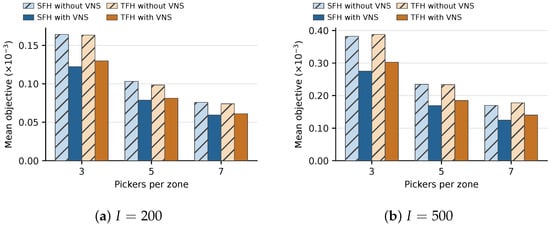
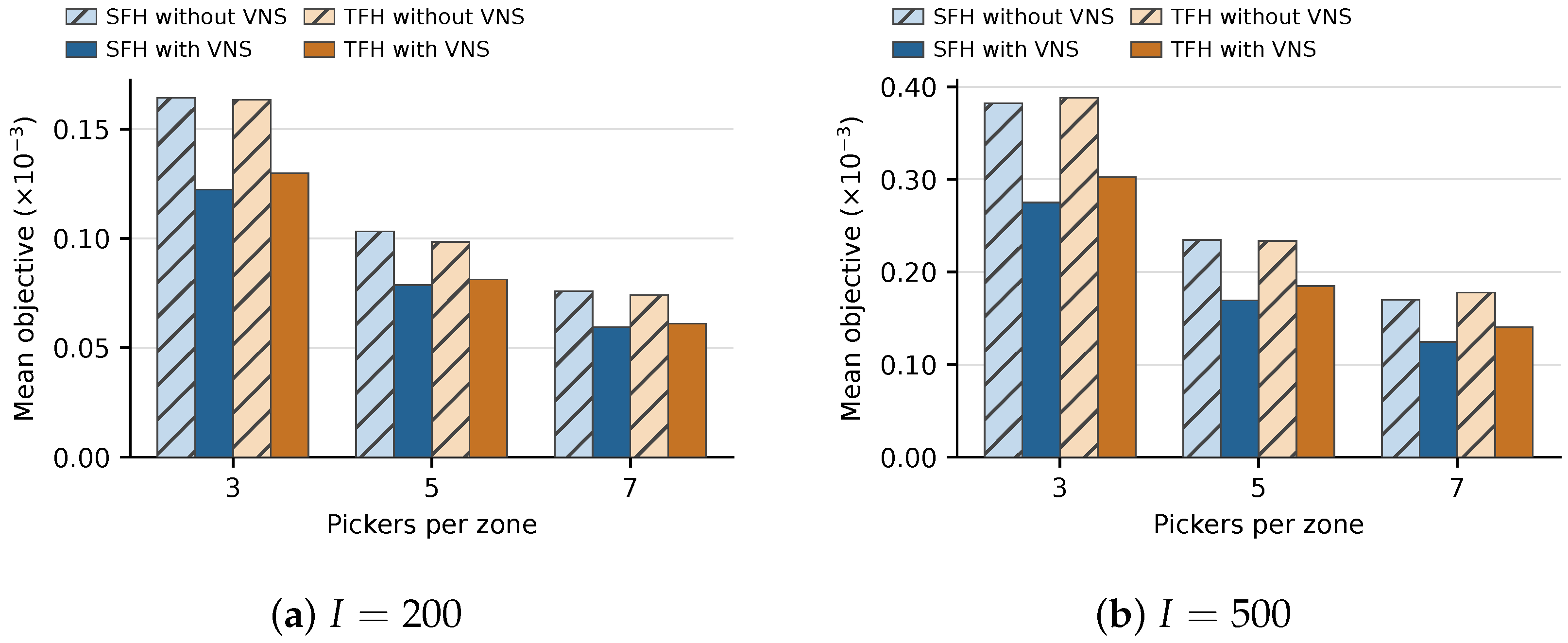
To isolate the contribution of VNS, we conducted a paired ablation experiment with and , using randomly generated instances and the default values of the other parameters. SFH and TFH were each evaluated with and without VNS on the same instances. Each pair uses identical batches and LPT assignments; the no-VNS variant stops after initialization, whereas the VNS variant performs one neighborhood scan. Both variants evaluate packaging decisions under the same weighted objective.
Figure 3 shows lower mean objective values with VNS in all six settings for both heuristics. Relative to the corresponding no-VNS means, reductions range from 21.57% to 28.01% for SFH and from 17.45% to 22.02% for TFH. These paired results quantify the contribution of VNS on the tested instances.
Figure 3.
Ablation comparison of SFH and TFH with and without VNS (mean objective values).
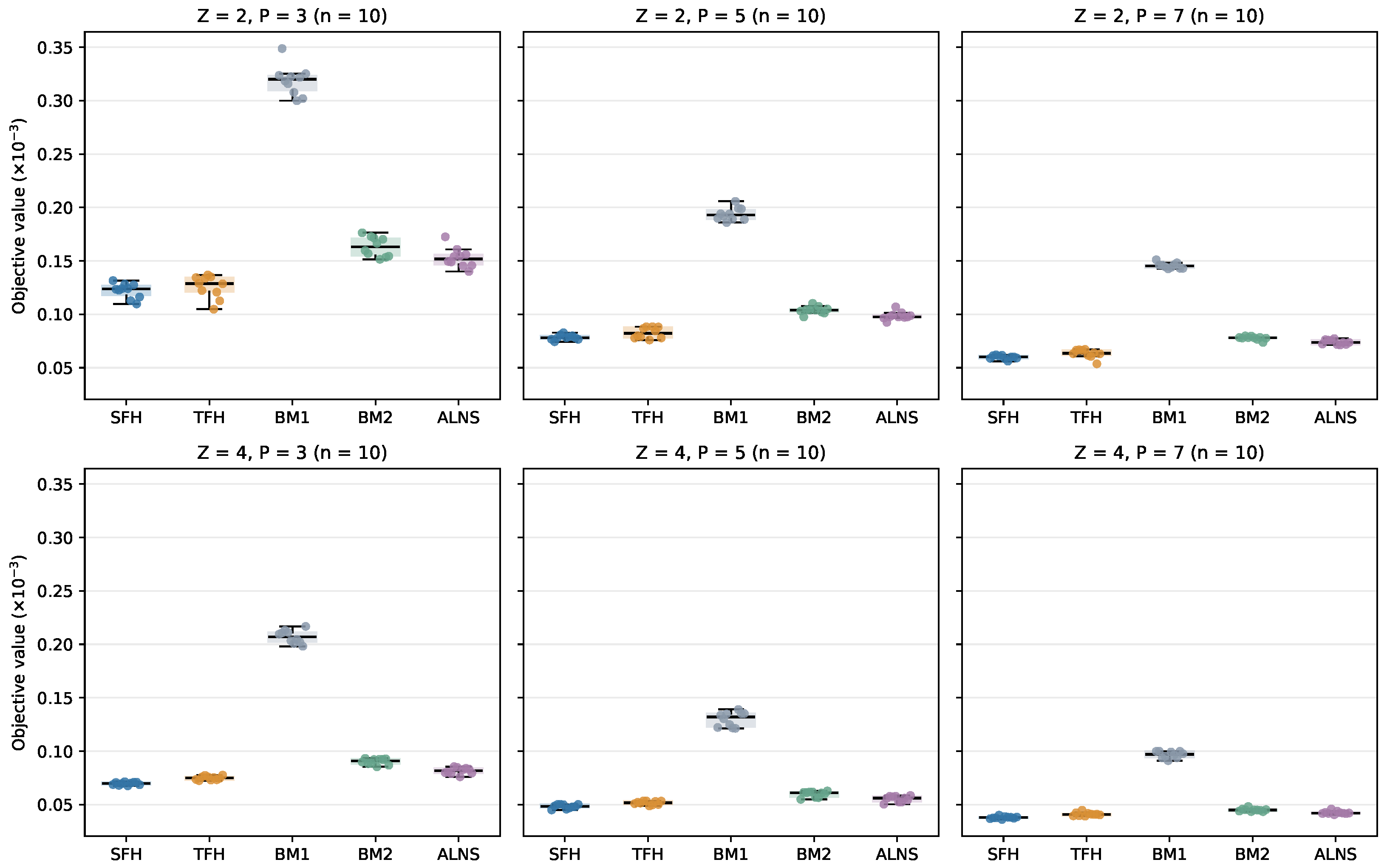
We further examined variation across instances in the zone–picker experiment of Table 4. All five methods use the same input instance within each repetition, with the original algorithm parameters unchanged. Table 4 reports the corresponding mean objective values.
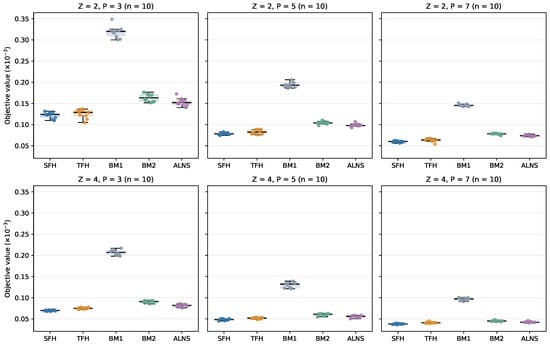
Figure 4 complements the mean comparisons with the distribution of objective values. SFH has a lower median objective than ALNS in 6 of the six settings; its median reduction relative to ALNS ranges from 9.93% to 19.99%. Its interquartile range is smaller than that of ALNS in 4 settings. TFH has a lower median objective than ALNS in 6 of the six settings; its median reduction relative to ALNS ranges from 2.75% to 15.82%. Its interquartile range is smaller than that of ALNS in 2 settings. These distributions describe variation across randomly generated instances, rather than isolating search randomness on a fixed instance. These results provide descriptive evidence and do not by themselves establish statistical significance.
Figure 4.
Objective-value distributions for each zone–picker setting. Boxes show the first and third quartiles, central lines show medians, whiskers extend to the most extreme observations within 1.5 interquartile ranges, and points show all observations.
In the third large-scale experiment, we analyzed the impact of order complexity by varying the maximum number of items per order . As detailed in Table 6, the proposed SFH algorithm consistently outperformed the benchmarks. Relative to ALNS, SFH reached a maximum objective reduction of 23.04% under and , while TFH reached a maximum reduction of 20.93% under and .
The experimental data reveal that SFH is particularly advantageous for orders containing more items. Although ALNS provides a much stronger benchmark than BM1 and BM2, SFH still achieves the lowest total cost for all item-density settings. This implies that SFH is highly effective in e-warehouse environments characterized by orders with higher item counts.
Finally, we evaluated the sensitivity of the algorithms to item dispersion by varying the maximum number of shelves per order . As presented in Table 7, SFH exhibited consistent superiority. Relative to ALNS, SFH and TFH achieved maximum objective reductions of 21.57% and 17.09%, respectively, both under and .
A key finding from this experiment is the robustness of the proposed algorithms to item scattering. The performance gap between SFH and ALNS was larger when items were concentrated (max shelves = 2) than when they were dispersed (max shelves = 5), while SFH remained superior to all benchmarks in both cases. This suggests that SFH’s routing logic effectively mitigates the travel penalties associated with scattered inventory, making it well-suited for mixed-shelves storage environments.
Finally, we examined the sensitivity of the algorithms to the routing policy by comparing the S-shape and Mid-point routing methods under different order volumes. As shown in Table 8, SFH consistently achieved the lowest objective value under both routing policies. Relative to ALNS, SFH and TFH achieved maximum objective reductions of 28.85% and 14.85%, respectively, both under the S-shape routing policy with , indicating that the proposed algorithms are not dependent on a single routing assumption.
The results further show that the routing policy mainly affects the absolute cost level rather than the relative ranking of the algorithms. Although Mid-point routing improves several benchmark results at larger order scales, it does not close the performance gap with SFH. This suggests that the spatial clustering logic of SFH remains effective when the route evaluation rule changes, while TFH also retains stable performance across the two routing policies. Therefore, the proposed heuristic framework is robust to alternative routing assumptions.
The experimental results validate the efficacy of the proposed algorithms, SFH and TFH, compared to the benchmark algorithms. Across all large-scale test instances, SFH consistently achieved the lowest total cost, i.e., objective value, demonstrating its superiority in optimizing warehouse operations. TFH followed as the second-best performer in 29 of the 30 main experiment settings, while ALNS substantially improved upon the two basic benchmarks but required much longer running times. Overall, SFH and TFH outperformed ALNS by up to 25.33% and 20.93%, respectively, with the SFH maximum occurring in the order-scale experiment under and , and the TFH maximum in the item-density experiment under and .
6. Conclusions
This research investigates the joint order picking and packaging optimization problem within a multi-zone e-commerce warehouse. A MINLP model is formulated to describe the integrated batching, picker assignment, sequencing, and packaging decisions, and the nonlinear relationships are further reformulated as a solvable MILP model for exact-solver validation. Due to the computational intractability of large-scale instances, we introduce a two-stage heuristic framework to solve the problem efficiently. In the order batching stage, SFH and TFH are designed to exploit spatial and temporal characteristics of customer orders, respectively. In the batch assignment stage, an initial solution is generated by the relaxed model or the LPT-based heuristic and is further improved through the RP-VNS procedure.
The computational experiments confirm the effectiveness and scalability of the proposed framework. In the small-scale experiments, SFH and TFH produce solutions competitive with the time-limited Gurobi incumbents within seconds. Gurobi reaches the 1800 s time limit in most settings, and the reported MIP gaps prevent conclusions about proximity to the optimum. In large-scale experiments, the proposed algorithms are compared with two greedy benchmarks and the ALNS-based metaheuristic benchmark. SFH consistently achieves the lowest total cost across the main test settings, while TFH also improves upon ALNS in most settings. Relative to ALNS, SFH and TFH reduce total operational costs by up to 28.85% and 20.93%, respectively. The paired ablation experiment shows that adding VNS reduces the mean objective value of both SFH and TFH across the tested order scales and picker settings. In addition, the routing-method experiment demonstrates that the relative advantage of the proposed algorithms remains stable under both S-shape and Mid-point routing policies. Future research directions include integrating storage location assignment, dynamic order arrivals, and more detailed picker routing decisions to further improve operational efficiency in multi-zone e-commerce warehouses.
7. Declaration of AI Assistance
During the preparation of this manuscript, AI-assisted tools were used for spelling and grammar proofreading, notation consistency checking, and LaTeX formatting, as well as revision drafting. The authors reviewed and edited all AI-assisted outputs and take full responsibility for the content of the manuscript.
Author Contributions
Conceptualization, Y.L.; methodology, M.W. and J.W.; software, J.W.; validation, M.W. and Y.L.; formal analysis, M.W.; investigation, J.W.; resources, M.W.; data curation, J.W.; writing—original draft preparation, M.W. and J.W.; writing—review and editing, M.W.; visualization, M.W.; supervision, Y.L.; project administration, J.W.; funding acquisition, Y.L. All authors have read and agreed to the published version of the manuscript.
Funding
This research received no external funding.
Data Availability Statement
The original contributions presented in this study are included in the article. Further inquiries can be directed to the corresponding author.
Conflicts of Interest
The authors declare no conflicts of interest.
References
- Jiang, Z.Z.; Wan, M.; Pei, Z.; Qin, X. Spatial and temporal optimization for smart warehouses with fast turnover. Comput. Oper. Res. 2021, 125, 105091. [Google Scholar] [CrossRef] [Scilit]
- Tang, J.; Qi, C.; Wang, H. Integrated optimization of order splitting and distribution routing for the front warehouse mode e-retailing. Int. J. Prod. Res. 2024, 62, 1715–1736. [Google Scholar] [CrossRef] [Scilit]
- Wahlen, J.; Gschwind, T. Branch-price-and-cut-based solution of order batching problems. Transp. Sci. 2023, 57, 756–777. [Google Scholar] [CrossRef] [Scilit]
- Raj, G.; Roy, D.; de Koster, R.; Bansal, V. Stochastic modeling of integrated order fulfillment processes with delivery time promise: Order picking, batching, and last-mile delivery. Eur. J. Oper. Res. 2024, 316, 1114–1128. [Google Scholar] [CrossRef] [Scilit]
- Framinan, J.M.; Perez-Gonzalez, P. New approximate algorithms for the customer order scheduling problem with total completion time objective. Comput. Oper. Res. 2017, 78, 181–192. [Google Scholar] [CrossRef] [Scilit]
- Li, W.; Chen, X.; Li, J.; Sang, H.; Han, Y.; Du, S. An improved iterated greedy algorithm for distributed robotic flowshop scheduling with order constraints. Comput. Ind. Eng. 2022, 164, 107907. [Google Scholar] [CrossRef] [Scilit]
- Zhen, L.; Wu, J.; Li, H.; Tan, Z.; Yuan, Y. Scheduling multiple types of equipment in an automated warehouse. Ann. Oper. Res. 2023, 322, 1119–1141. [Google Scholar] [CrossRef] [Scilit]
- Valle, C.A.; Beasley, J.E.; Da Cunha, A.S. Optimally solving the joint order batching and picker routing problem. Eur. J. Oper. Res. 2017, 262, 817–834. [Google Scholar] [CrossRef] [Scilit]
- Hong, S.; Johnson, A.L.; Peters, B.A. Large-scale order batching in parallel-aisle picking systems. IIE Trans. 2012, 44, 88–106. [Google Scholar] [CrossRef] [Scilit]
- Rasmi, S.A.B.; Wang, Y.; Charkhgard, H. Wave order picking under the mixed-shelves storage strategy: A solution method and advantages. Comput. Oper. Res. 2022, 137, 105556. [Google Scholar] [CrossRef] [Scilit]
- Zhong, S.; Giannikas, V.; Merino, J.; McFarlane, D.; Cheng, J.; Shao, W. Evaluating the benefits of picking and packing planning integration in e-commerce warehouses. Eur. J. Oper. Res. 2022, 301, 67–81. [Google Scholar] [CrossRef] [Scilit]
- Xue, S.; Gao, C. Use statistical analysis to approximate integrated order batching problem. Int. J. Prod. Res. 2024, 62, 4349–4371. [Google Scholar] [CrossRef] [Scilit]
- Yu, M.; De Koster, R.B.M. The impact of order batching and picking area zoning on order picking system performance. Eur. J. Oper. Res. 2009, 198, 480–490. [Google Scholar] [CrossRef] [Scilit]
- Ho, Y.C.; Lin, J.W. Improving order-picking performance by converting a sequential zone-picking line into a zone-picking network. Comput. Ind. Eng. 2017, 113, 241–255. [Google Scholar] [CrossRef] [Scilit]
- Zhang, X.; Guo, P.; Xin, J.; D’Ariano, A.; Wang, Y. Enabling within-the-hour fresh food deliveries: Integrated order batching and zone-picking through overhead conveyors. Transp. Res. Part E Logist. Transp. Rev. 2025, 199, 104133. [Google Scholar] [CrossRef] [Scilit]
- Ostermeier, M.; Holzapfel, A.; Kuhn, H.; Schubert, D. Integrated zone picking and vehicle routing operations with restricted intermediate storage. OR Spectr. 2022, 44, 795–832. [Google Scholar] [CrossRef] [Scilit]
- Shen, Y.; Xu, X.; Zou, B.; Wang, H. Operating policies in multi-warehouse drone delivery systems. Int. J. Prod. Res. 2021, 59, 2140–2156. [Google Scholar] [CrossRef] [Scilit]
- Nikkhoo, F.; Husseinzadeh Kashan, A.; Nikbakhsh, E.; Ostadi, B. A bi-objective multi-warehouse multi-period order picking system under uncertainty: A Benders decomposition approach. Soft Comput. 2025, 29, 2047–2074. [Google Scholar] [CrossRef] [Scilit]
- Zhang, H.; Chen, J.; Ren, J.; Zhao, Y.; Wang, Y.; Chen, J.; Gao, B. A meta-learning framework for cross-domain order scheduling in intelligent warehouses. Int. J. Prod. Res. 2025, 64, 1–22. [Google Scholar] [CrossRef] [Scilit]
- Chen, W.; Zhang, Y.; Zhou, Y. Integrated scheduling of zone picking and vehicle routing problem with time windows in the front warehouse mode. Comput. Ind. Eng. 2022, 163, 107823. [Google Scholar] [CrossRef] [Scilit]
- Wang, Z.; Xu, W.; Hu, X.; Wang, Y. Inventory allocation to robotic mobile-rack and picker-to-part warehouses at minimum order-splitting and replenishment costs. Ann. Oper. Res. 2022, 316, 467–491. [Google Scholar] [CrossRef] [Scilit]
- Ma, B.J.; Pan, S.; Zou, B.; Kuo, Y.H.; Huang, G.Q. Operating policies for robotic cellular warehousing systems. Transp. Res. Part E Logist. Transp. Rev. 2025, 194, 103875. [Google Scholar] [CrossRef] [Scilit]
- Ye, T.; Cheng, S.; Hijazi, A.; Van Hentenryck, P. Contextual stochastic optimization for omnichannel multicourier order fulfillment under delivery time uncertainty. Manuf. Serv. Oper. Manag. 2026, 28, 1068–1090. [Google Scholar] [CrossRef] [Scilit]
- Van Gils, T.; Ramaekers, K.; Caris, A.; De Koster, R.B.M. Designing efficient order picking systems by combining planning problems: State-of-the-art classification and review. Eur. J. Oper. Res. 2018, 267, 1–15. [Google Scholar] [CrossRef] [Scilit]
- Boysen, N.; De Koster, R. 50 years of warehousing research—An operations research perspective. Eur. J. Oper. Res. 2025, 320, 449–464. [Google Scholar] [CrossRef] [Scilit]
- Boysen, N.; De Koster, R.; Weidinger, F. Warehousing in the e-commerce era: A survey. Eur. J. Oper. Res. 2019, 277, 396–411. [Google Scholar] [CrossRef] [Scilit]
- Li, Y.; Zhang, R.; Jiang, D. Order-picking efficiency in e-commerce warehouses: A literature review. J. Theor. Appl. Electron. Commer. Res. 2022, 17, 1812–1830. [Google Scholar] [CrossRef] [Scilit]
- Graham, R.L. Bounds on multiprocessing timing anomalies. SIAM J. Appl. Math. 1969, 17, 416–429. [Google Scholar] [CrossRef] [Scilit]

Disclaimer/Publisher’s Note: The statements, opinions and data contained in all publications are solely those of the individual author(s) and contributor(s) and not of MDPI and/or the editor(s). MDPI and/or the editor(s) disclaim responsibility for any injury to people or property resulting from any ideas, methods, instructions or products referred to in the content. |
© 2026 by the authors. Licensee MDPI, Basel, Switzerland. This article is an open access article distributed under the terms and conditions of the Creative Commons Attribution (CC BY) license.