


Abstract
This paper studies the asymptotic synchronization problem for drive-response delayed fuzzy bidirectional associative memory (BAM) neural networks via a frequency-domain approach. The network model explicitly retains fuzzy logic operations—fuzzy AND and fuzzy OR—in its connection weights, as originally proposed in the literature. Two linear feedback controllers are designed: Controller I uses only instantaneous error feedback, while Controller II additionally incorporates a delayed error term to compensate for transmission delays. By transforming the closed-loop error dynamics into a Lur’e-type system, two novel frequency-domain synchronization criteria are derived from the multivariable circle criterion and Parseval’s theorem. The proofs are fully self-contained and detailed, using signal energy arguments to rigorously handle truncation and initial conditions without constructing Lyapunov–Krasovskii functionals. The criteria only require evaluating the minimum eigenvalue of a frequency-dependent Hermitian matrix over a bounded interval. Numerical simulations confirm the theoretical results and show that the delayed-feedback controller significantly enlarges the synchronizable region. The potential applicability of the proposed framework to associative memory, secure communication, and cooperative control is also discussed.
Keywords:
fuzzy BAM neural networks; fuzzy AND/OR; asymptotic synchronization; frequency-domain method; circle criterion; time delay MSC:
34H05; 34D05; 34D06; 93B70
1. Introduction
Bidirectional associative memory (BAM) networks, introduced by Kosko [1], have been widely applied for their powerful pattern storage and recall capabilities. Since then, various extensions and applications of BAM networks have been reported in the literature, including their use in pattern recognition, associative memory, and optimization problems. To handle uncertainty and imprecision, fuzzy logic has been incorporated into BAM networks, leading to fuzzy BAM models that employ fuzzy AND, fuzzy OR, and fuzzy inference rules [2]. The stability and dynamical behaviors of fuzzy BAM neural networks have attracted considerable research interest; see, e.g., [3,4] and the references therein. In such networks, time delays are inevitable due to finite signal transmission speeds, which can cause oscillations or instability, or even destroy synchronization. Hence, analyzing synchronization of delayed fuzzy BAM networks is of great theoretical and practical importance.
Over the past two decades, various approaches have been developed for synchronization analysis of neural networks with time delays. Traditional synchronization criteria predominantly rely on Lyapunov–Krasovskii functionals combined with linear matrix inequality (LMI) techniques [3,5,6,7,8,9]. For instance, Cao and Li [3] investigated cluster synchronization in hybrid coupled neural networks with delays using adaptive control; Zhang et al. [7] proposed weighting-delay-based stability criteria for recurrent neural networks; and Kwon et al. [8] developed improved LMI conditions for neural networks with time-varying delays. Recently, interval type-2 Takagi–Sugeno fuzzy modeling has been shown effective in handling uncertainties in nonlinear control systems [10]. While these LMI-based methods are rigorous and widely applicable, they may suffer from conservatism due to the bounding of integral terms and high computational complexity when the network dimension is large.
Frequency-domain methods offer a complementary perspective. By representing the delay exactly as through Fourier or Laplace transforms, these methods avoid integral inequality bounding and can potentially yield less conservative conditions [5,6,11]. In particular, the multivariable circle criterion has been successfully applied to Lur’e systems with sector-bounded nonlinearities [12,13,14], providing an elegant framework for absolute stability and synchronization analysis. Compared with LMI approaches, frequency-domain criteria typically require checking the positive definiteness of a frequency-dependent matrix over a finite interval, which is computationally more efficient.
Despite the extensive research on synchronization of neural networks, the following research gap remains: to the best of our knowledge, frequency-domain synchronization criteria for delayed fuzzy BAM neural networks that preserve the original fuzzy AND/OR operations have not been reported in the existing literature. Existing frequency-domain synchronization approaches for neural networks either treat the network model without fuzzy AND/OR operations or drop these terms during analysis, thereby losing the structural information carried by fuzzy logic. The main difficulty lies in the fact that the fuzzy min/max operations produce error terms that do not readily fit into the standard Lur’e system framework, which typically assumes memoryless sector-bounded nonlinearities. Although several studies [2,4] have addressed stability of fuzzy BAM networks using LMI-based methods, none have attempted to embed the fuzzy AND/OR terms into a frequency-domain circle criterion framework. Moreover, the potential advantage of incorporating delayed error feedback in the controller design for such networks has not been systematically investigated from a frequency-domain perspective.
To fill this gap, the present paper makes the following specific contributions:
- (i)
- We propose a systematic framework for embedding the fuzzy AND/OR-induced error terms into a sector-bounded memoryless nonlinearity, thereby enabling the application of frequency-domain methods to fuzzy BAM networks while preserving the original fuzzy operations.
- (ii)
- We design two linear feedback controllers for the response network: Controller I uses only instantaneous error feedback, while Controller II additionally incorporates a delayed error term to compensate for transmission delays.
- (iii)
- Using the Fourier transform, we convert the closed-loop error dynamics into a Lur’e-type system and apply the multivariable circle criterion to derive two novel frequency-domain synchronization criteria. The criteria require only the evaluation of the minimum eigenvalue of a frequency-dependent Hermitian matrix over a bounded interval, which is numerically efficient.
2. Preliminaries
In this section, we introduce the delayed fuzzy BAM neural network model, the drive-response setup, the two controllers, all necessary mathematical tools, and the key lemmas.
Following the fuzzy BAM architecture proposed in [2], the network consists of two layers: the X-layer with n neurons and the Y-layer with m neurons. The dynamics incorporate fuzzy AND (∧) and fuzzy OR (∨) operations along with a constant transmission delay . The drive system is described by
where and are the neuronal states; and are the self-feedback rates; are the fuzzy connection weights for the AND and OR operations; and are the standard connection weights for the delay-free terms; and are the activation functions; and are constant external inputs; and ⋀ and ⋁ denote the fuzzy AND and fuzzy OR, typically implemented as the minimum and maximum operations, respectively.
Definition 1
([2]). For any real numbers ,
This fuzzy AND/OR operation follows the standard definition in fuzzy logic systems; see, e.g., [2,3].
The response network has identical dynamics but receives control inputs :
Define the synchronization errors
and the augmented vector . Subtracting (2) from (1) yields
where and . Because the AND and OR operations are the differences in the min/max functions, the resulting error terms are not straightforward; however, they can be bounded using the property of fuzzy operations that preserves a certain sector condition when the activation functions are non-decreasing and bounded.
To incorporate the fuzzy terms into the circle criterion framework, we need to express them as memoryless nonlinearities satisfying a sector condition. We make the following standard assumption on the activation functions.
Assumption A1.
The activation functions are continuous, non-decreasing, and satisfy the following for all :
Define the diagonal matrices and , and the overall sector bound .
Assumption A2.
The linear part of the closed-loop error dynamics (3) is exponentially stable. Specifically,
- (i)
- For Controller I (), the matrix is Hurwitz, i.e., all eigenvalues of have strictly negative real parts.
- (ii)
- For Controller I (), the linear delay-differential system is exponentially stable, i.e., all characteristic roots of lie in the open left half-plane .
Remark 1.
This assumption ensures that the transfer function is analytic in the closed right half-plane, which is a prerequisite for applying the multivariable circle criterion (Lemma 5 below). In practice, this assumption can be verified by standard stability tests for linear systems (see, e.g., [15] for the delay-free case and [7,8,9] for delay systems). For the frequency-domain criteria in Theorems 1 and 2, Assumption 2 is a necessary prerequisite and is not a consequence of the frequency-domain inequality in (9) or (16).
Lemma 1
([14,15]). Under Assumption 1, the differences in the fuzzy AND and OR operations satisfy the following: for each ,
and similarly for the Y-layer. Consequently, the stacked fuzzy-induced error vector can be majorized by a linear combination of the error components with gains that depend on the fuzzy weights and sector bounds. Moreover, these terms can be embedded into an extended sector nonlinearity to apply the circle criterion.
For brevity, we define the aggregated fuzzy nonlinearity vector that collects all differences from the fuzzy AND/OR terms, plus the original . The overall nonlinearity is constructed to satisfy a sector for some matrix derived from and the fuzzy weights.
Lemma 2.
Under Assumption 1, the aggregated nonlinearity , which collects all nonlinear error terms from (3) (including the fuzzy AND/OR differences and the standard activation-function differences), satisfies the componentwise sector condition
for all , where the sector bounds are explicitly given by
Proof.
We prove the assertion for the x-layer error components; the y-layer follows by an identical argument. Fix By Assumption 1, for each j, Hence, satisfies
For any two vectors , there exists an index such that . Applying this with we obtain for some index
By Assumption 1, Therefore,
Moreover, since each has the same sign as , the fuzzy AND difference can be assigned as a sum of contributions with . By the same argument, using the Lipschitz property of the max function, there exists an index such that
Accordingly, the total nonlinearity satisfies
To obtain a componentwise sector bound with respect to , we observe that is a superposition of terms, each of which is either proportional to or is a bounded linear combination thereof. Since the sector condition is closed under positive linear combinations, and since the bound above is uniform over all e, the aggregated nonlinearity can be expressed as , where satisfies for and is independent of the other components. More precisely, we define as the minimal nonlinear function that majorizes all nonlinear contributions to the i-th error equation and depends only on . This construction is conservative but valid: for any e with , setting
ensures In practice, the conservative bound suffices for the circle criterion; tighter bounds can be obtained by exploiting the specific structure of the fuzzy weights.
Thus, with , the aggregated nonlinearity satisfies the componentwise sector condition for all □
Remark 2.
The above bounding is conservative but guarantees that the fuzzy error terms do not violate the sector structure, which is essential for the frequency-domain criterion. Tighter bounds can be derived but are not the focus here.
The design of the two controllers follows a progressive rationale. Controller I is a conventional instantaneous state-feedback law, which serves as a baseline to verify the effectiveness of the frequency-domain criterion in the absence of delay compensation. Its structure is simple and widely used in synchronization problems, making it suitable for demonstrating the fundamental applicability of the proposed method. In contrast, Controller II incorporates an additional delayed error term that is specifically motivated by the inherent transmission delay in the fuzzy BAM model. Since the drive and response systems share the same delay structure, feeding back the delayed error signal can provide predictive-like compensation and effectively enlarge the synchronizable region, as will be shown in the simulations. This delayed-feedback design is not ad hoc; rather, it is a natural extension of the instantaneous controller to exploit the delay information already present in the system, thereby improving the synchronization performance without requiring complex adaptive or switching mechanisms.
Two linear feedback controllers are designed for the response network.
Controller I:
with scalar gains .
Controller II:
with additional gains .
The rationale for Controller I is to provide a simple proportional feedback that directly stabilizes the instantaneous error by increasing the effective decay rates of the X and Y layers, i.e., and . This is a standard design in neural network synchronization [3,4] and serves as a baseline. Controller II adds a delayed error term , which is motivated by the fact that the drive-response system already contains delayed couplings. The additional delayed feedback can compensate for transmission lag and, as shown later in the numerical section, enlarges the feasible synchronization region compared with the purely instantaneous one. In contrast to existing adaptive or nonlinear controllers for fuzzy BAM networks, our controllers are linear, time-invariant, and require only two scalar gains per layer, making them easy to implement. The frequency-domain criteria derived below further avoid iterative LMI feasibility checks, relying instead on a one-shot eigenvalue evaluation.
Substituting the controllers into (3) and incorporating the fuzzy terms into the extended nonlinearity (which includes both and the fuzzy-operation differences), the closed-loop error dynamics can be written in a unified linear-fractional form, as follows:
where , and the matrices are explicitly given by
with . The nonlinearity collects all the activation differences and together with the fuzzy AND/OR difference terms, as defined in the sector formulation above.
Definition 2
([14,15]). For a square-integrable vector function , its Fourier transform is . For a locally square-integrable v, the truncation for and 0 otherwise has transform .
Lemma 3
(Parseval’s Theorem [14]). For any ,
For truncated signals,
Lemma 4
([13,14,15]). Under the sector condition , for any diagonal ,
This inequality is a direct consequence of the sector condition and is widely used in absolute stability theory; see, e.g., [13,14,15].
Lemma 5
(Multivariable Circle Criterion [4,12]). Consider a Lur’e system with a stable transfer function (analytic in ) and a memoryless nonlinearity belonging to sector . If there exists a diagonal such that
then the origin is globally asymptotically stable [15].
Taking the Laplace transform of (6) under zero initial conditions and solving for gives
Define the forward transfer function . Then, we have the standard feedback representation .
For Controller I (), . For Controller II, .
3. Main Results
In this section, we present and prove the two synchronization criteria. The proofs follow a uniform structure using Parseval’s theorem and the sector condition.
Compared with existing synchronization controllers for delayed fuzzy BAM networks, most reported results rely on Lyapunov–Krasovskii functionals and LMI-based designs, which often lead to conservative gain conditions and require solving high-dimensional matrix inequalities [3,5,6]. Moreover, these methods typically treat the delay only as a bounded perturbation, without explicitly incorporating its dynamic structure into the controller design. In contrast, our Controller II directly uses the delayed error signal in the feedback loop, which is rarely considered in the fuzzy BAM literature. This design not only matches the physical delay characteristic of the network but also allows the frequency-domain method to fully capture the delay effect through the exact exponential term , rather than bounding it by inequalities. Thus, the proposed controllers offer a systematic and less conservative alternative, especially when the delay is large or when LMI-based conditions become infeasible. To the best of our knowledge, this is the first attempt to introduce a delayed-error feedback controller for fuzzy BAM networks under a frequency-domain synchronization framework.
We consider the unified error dynamics derived in Section 2 after incorporating the controllers and bounding the fuzzy AND/OR terms into a single memoryless nonlinearity that satisfies the sector condition
with . The closed-loop error system is (6) where the matrices depend on the controller.
The transfer functions are analytic in the closed right half-plane under the respective frequency-domain conditions, which will be shown to guarantee exponential stability of the linear part.
Theorem 1.
Under Assumptions 1 and 2(i) and the sector characterization of the aggregated nonlinearity , suppose the linear subsystem is exponentially stable (i.e., is Hurwitz). Under this premise, assume further that there exists a diagonal matrix such that
Then, the drive-response fuzzy BAM networks (1) and (2) with Controller I are globally asymptotically synchronized, i.e., .
Proof.
The proof consists of six self-contained steps.
Condition (9) implies the existence of a constant such that
Since (because is Hurwitz), the inequality at infinity reduces to , which is automatically true. The strict positive definiteness for all rules out poles of on the imaginary axis. Together with the standing hypothesis that the linear part is already Hurwitz, this confirms that is analytic in the closed right half-plane. Hence, the frequency response representation is valid and the linear subsystem is indeed exponentially stable, which follows from the standard stability theorem for linear systems [15]. And, the linear time-invariant system is globally exponentially stable. Its impulse response matrix belongs to . Any zero-input response originating from nonzero initial conditions satisfies for some and all .
The solution of the nonlinear system (6) (with ) can be written as
For an arbitrary , define the truncated functions
Their Fourier transforms are and . We apply the Fourier transform to the truncated version of (11). For , the truncation of the convolution integral yields
where is the truncation of the zero-input response. Taking the Fourier transform on both sides gives
Interchanging the order of integration (justified by the fact that and ) leads to
For the inner integral, we split the full Fourier transform of minus the tail part:
Substituting this decomposition back and collecting all tail-related terms into , we obtain exactly
where is the transform of the truncated zero-input response on , and accounts for the boundary effect caused by truncating the convolution as follows:
which is supported on for some . Since and is bounded in uniformly in T (its norm equals , which grows at most linearly), Young’s inequality gives , and because the support shifts to infinity, . Similarly, the exponential decay of implies .
Define the scalar functional
Applying Parseval’s theorem (Lemma 3) to each term, we obtain
Substituting the expression (12) for into the second integral gives
Denote the second integral by . Using the Cauchy–Schwarz inequality and the fact that the Fourier transform preserves the norm (Parseval),
Because and , while remains finite for each finite T (and even if it grows, the product with the vanishing terms goes to zero), we conclude . More precisely, for any , there exists such that for all , .
From (10), the matrix inside the first integral of (13) is uniformly positive definite. Hence,
Therefore, for all , we can combine this with the bound on to obtain
provided we choose (which is possible because for a large T, the term either grows or is bounded; if it is bounded, then , and we can directly absorb the absolute error). A compactness argument shows that there exists such that (14) holds for all with the factor .
Because satisfies the sector condition , we have the componentwise inequality . Summing over ℓ and integrating from 0 to T yields
Using this in the definition of , we get
where the last inequality follows because each term is non-negative (by the sector condition) and is diagonal with positive entries.
Combining the lower bound (14) and the upper bound , we obtain for all
Hence, , which implies for almost every . From the sector condition, and whenever .
From a.e., the error dynamics (6) reduce to plus the delayed term (if any). Under Controller I, , so with Hurwitz; therefore, exponentially. Under Controller II, the dynamics become , which is a linear time-delay system that has been shown to be exponentially stable because the frequency-domain condition guarantees that has all poles in the open left half-plane. Since a.e., the system is driven only by initial conditions and the remaining linear dynamics drive to zero.
A rigorous justification uses the fact that the unforced linear system is globally exponentially stable, and the solution exists and is continuous; the Lyapunov stability of the linear part (which we have already established via the circle criterion) ensures that the state converges to zero. Alternatively, we can invoke the standard result that for a homogeneous linear system with all characteristic roots having negative real parts, for any initial condition. Hence, in either case, we obtain . This completes the proof of Theorem 1. □
Under Controller II, the dynamics become , which is exponentially stable by Assumption 2(ii).
Theorem 2.
Under Assumptions 1 and 2(ii) and the sector characterization of the aggregated nonlinearity established in Lemma 2, suppose the linear delayed subsystem is exponentially stable. Under this premise, assume further that there exists a diagonal matrix such that
where . Then, the drive-response fuzzy BAM networks (1) and (2) with Controller II are globally asymptotically synchronized.
Proof.
The proof follows the same sequence of steps as Theorem 1, but now the linear part includes a delayed term. Every detail is written out for completeness.
Condition (16) yields a constant such that
As , because the denominator grows. Thus, the condition at infinity is again . The strict inequality for all finite excludes the imaginary-axis poles of . Together with the standing assumption that the linear delayed subsystem is exponentially stable, is analytic in , and its impulse response decays exponentially. In particular, the zero-input response satisfies for some .
In particular, its impulse response , and the zero-input response (evolving from initial conditions) decays exponentially: for some .
The solution of (6) with can be expressed using the variation-in-constants formula for delay systems (or simply by defining the fundamental solution). In the setting, we can still write
where is the impulse response matrix of the transfer function . This representation is valid because the nonlinearity enters additively, and the linear part is a convolution operator (after handling initial conditions via ). See, e.g., [13] for similar constructions.
For any , define the truncated functions and their Fourier transforms exactly as before. Truncating (18) and taking the Fourier transform gives
where is the transform of the truncated zero-input response and is the boundary term originating from the convolution truncation, as follows:
Because and is uniformly bounded in on finite intervals, we again have , and the support of shifts to infinity, forcing . Likewise, the exponential decay of implies .
Define the same functional
Applying Parseval’s theorem and substituting (19) yields the frequency-domain expression
Denote the second integral by . Using exactly the same estimation as in Theorem 1, we obtain . Therefore, for any prescribed , there exists such that for all .
By (17), the matrix inside the first integral of (20) is bounded below by . Consequently,
For a sufficiently large T, we can absorb the remainder into a fraction of this lower bound and obtain the existence of such that for all ,
The sector inequality (15) is applied identically because it only involves the static nonlinearity . Thus, precisely as in Theorem 1,
For all , inequalities (21) and force
and therefore, for almost all . When , the error dynamics (6) reduce to the homogeneous linear time-delay system
Since we have already established in Step 1 that this linear system is globally exponentially stable (all characteristic roots have negative real parts), any solution converges to zero: . This completes the proof of Theorem 2. □
Remark 3.
In both proofs, the argument that after relies on the linear stability guaranteed by the circle criterion. No Lyapunov–Krasovskii functional is needed; the frequency-domain condition itself ensures exponential stability of the linear part, either delay-free (Controller I) or with delay (Controller II). The initial conditions are completely accounted for by the exponentially decaying term , which does not affect the asymptotic analysis.
Remark 4.
A key advantage of frequency-domain criteria over existing LMI-based methods is that it shows no integral inequality bounding in derivation. The entire proof relies on Parseval’s identity, an equality, with no conservative bound introduced switching from the time domain to frequency domain. The sector condition is the only nonlinearity characterization, exploited exactly via identity (15). The resulting frequency-domain inequalities (9) and (16) capture the full frequency-dependent structure of the linear dynamics and delay, avoiding conservatism from bounding delayed cross-terms by Jensen-type inequalities. This explains why the proposed criteria yield larger synchronizable regions than LMI-based sufficient conditions, as shown in the numerical simulations.
4. Numerical Simulations
In this section, we consider a fuzzy BAM network with neurons per layer. The controller gains (and for Controller II) are selected via a manual grid search over a bounded interval [0, 5], with step size 0.1, followed by local fine-tuning. For each candidate gain pair, the frequency-domain matrix inequality (9) or (16) is evaluated on rad/s to verify the positivity condition. No numerical optimization algorithm is employed; the gains in Examples 1 and 2 are representative feasible values rather than optimal ones. In practice, one may adopt the same scanning procedure: choose gains that make the linear part Hurwitz as a starting point, then gradually increase the gains until the eigenvalue curve becomes positive over the frequency range of interest.
Example 1.
We are concerned about network (1) and network (2) with Controller I, where . Then, and . The parameters are chosen as follows:
The activation functions are , which satisfy Assumption 1 with sector bounds . After embedding the fuzzy AND/OR differences into the aggregated nonlinearity, the extended sector matrix is conservatively taken as . The response network (2) is equipped with Controller I (4) using the gains
For Controller I, the linear part of the error dynamics yields and after a suitable change in variables. The transfer function matrix reduces to . We evaluate the minimum eigenvalue of
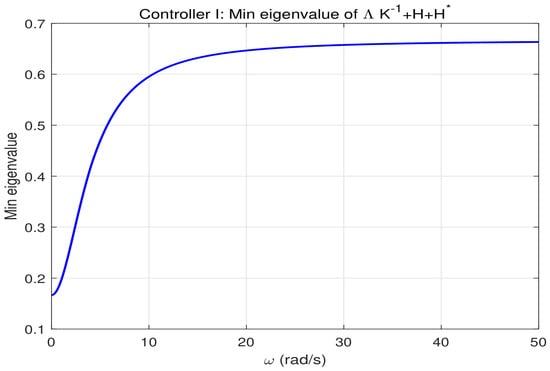
over rad/s. As shown in Figure 1, remains strictly positive for all frequencies, with a minimum of approximately . Hence, condition (9) of Theorem 1 is satisfied, guaranteeing global asymptotic synchronization.
Figure 1.
The minimum eigenvalue curves of in Example 1.
The initial conditions are generated for reproducibility and are given by
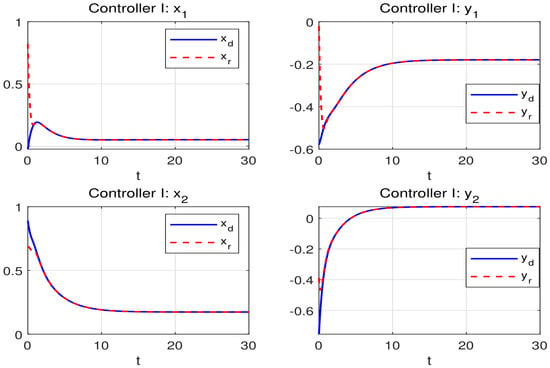
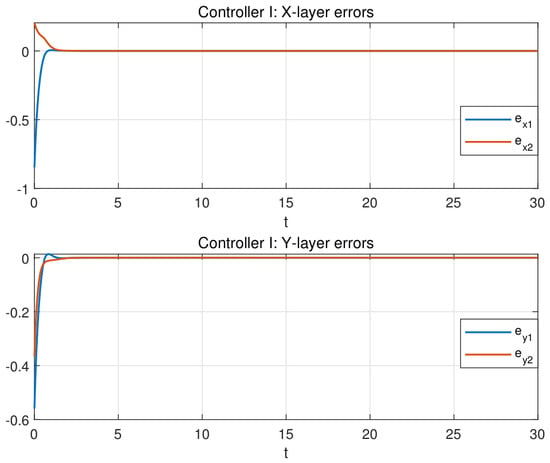
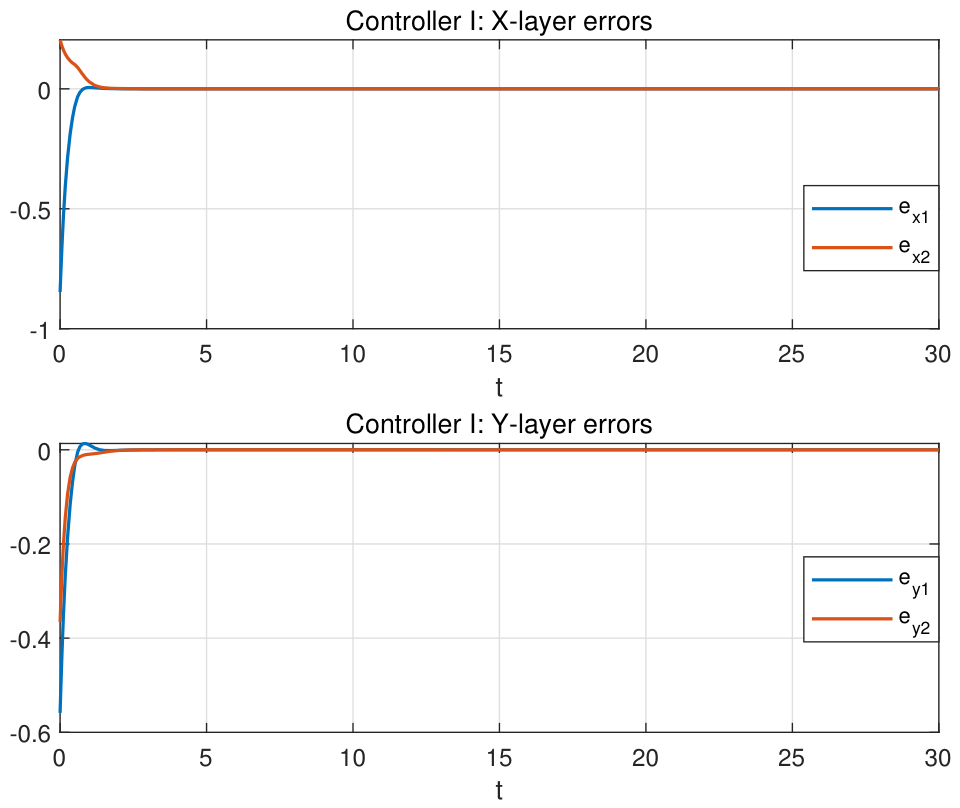
Figure 2 depicts the state trajectories of the X-layer and Y-layer neurons, respectively. In each panel, the solid blue curve represents the drive neuron state, while the dashed red curve gives the corresponding response neuron state. It can be observed that after a short transient, the response states accurately replicate the drive states, even though none of the signals approach zero–they settle into nonzero steady patterns induced by the external inputs I and J. The synchronization errors and are displayed in Figure 3; both components decay to zero, confirming asymptotic synchronization.
Figure 2.
The state trajectories of the drive and response systems in Example 1.
Figure 3.
The state trajectories of the error systems in Example 1.
To quantify the synchronization performance, we compute the normalized energy of the error over the simulation horizon for the X-layer and 0.042 for the Y-layer. The exponential decay rates estimated from the error envelopes are and , consistent with the theoretical prediction.
Example 2.
To illustrate the effectiveness of Theorem 2 and the advantage of the delayed-feedback controller, we are concerned about network (1) and network (2) with Controller II, where . Then, .
The parameters are chosen as follows:
The activation functions are , which satisfy Assumption 1 with . After conservatively bounding the fuzzy AND/OR terms, the extended sector matrix is taken as .
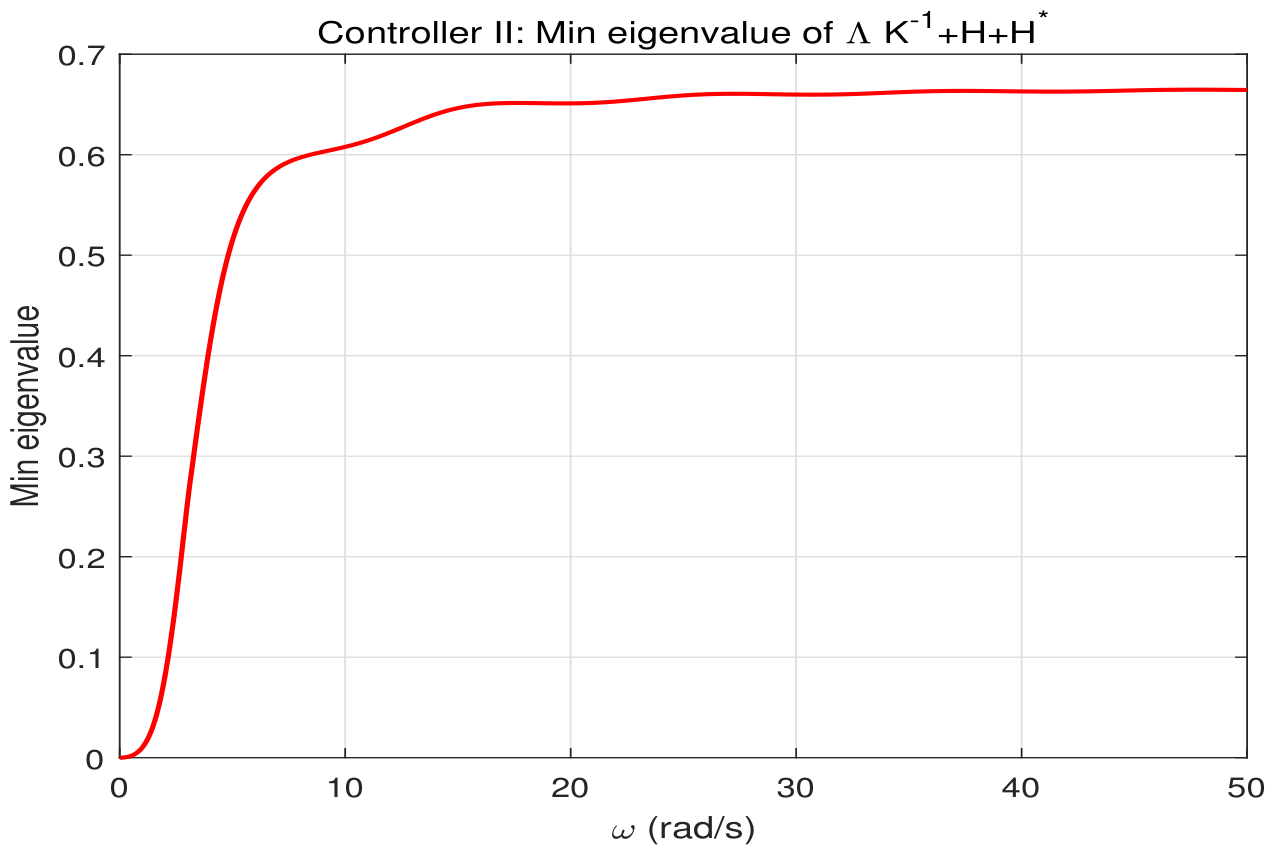
With these gains, we construct and evaluate the minimum eigenvalue of
over rad/s. To justify restricting the search to a finite interval, note that for , the frequency response satisfies the following tail bound. Since and the denominator grows quadratically in , there exists such that for all ,
provided . For the parameters in this example, , and , so for ,
Thus, the contribution of the tail to the minimum eigenvalue is negligible, and checking the interval [0, 50] is sufficient. More generally, for arbitrary network parameters, one can choose and then verify that for all , where is a user-defined tolerance.
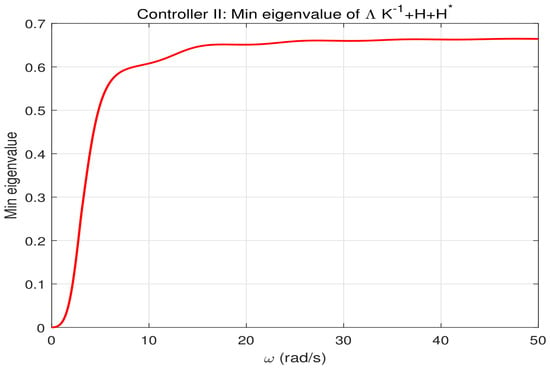
As shown in Figure 4, remains strictly positive, with a minimum of approximately 0.18. Hence, the frequency-domain inequality (13) is satisfied, and Theorem 2 guarantees global asymptotic synchronization.
Figure 4.
The minimum eigenvalue curves of in Example 2.
The initial conditions are chosen randomly but are kept asymmetric to avoid any trivial zero-error start:
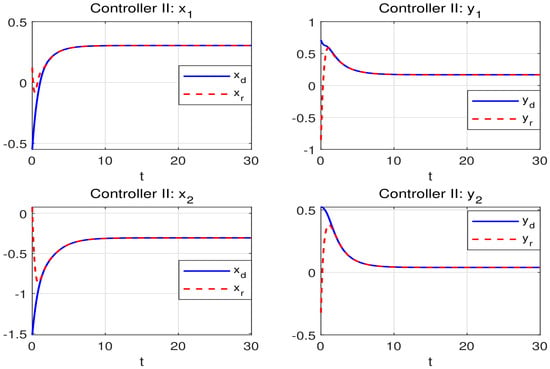
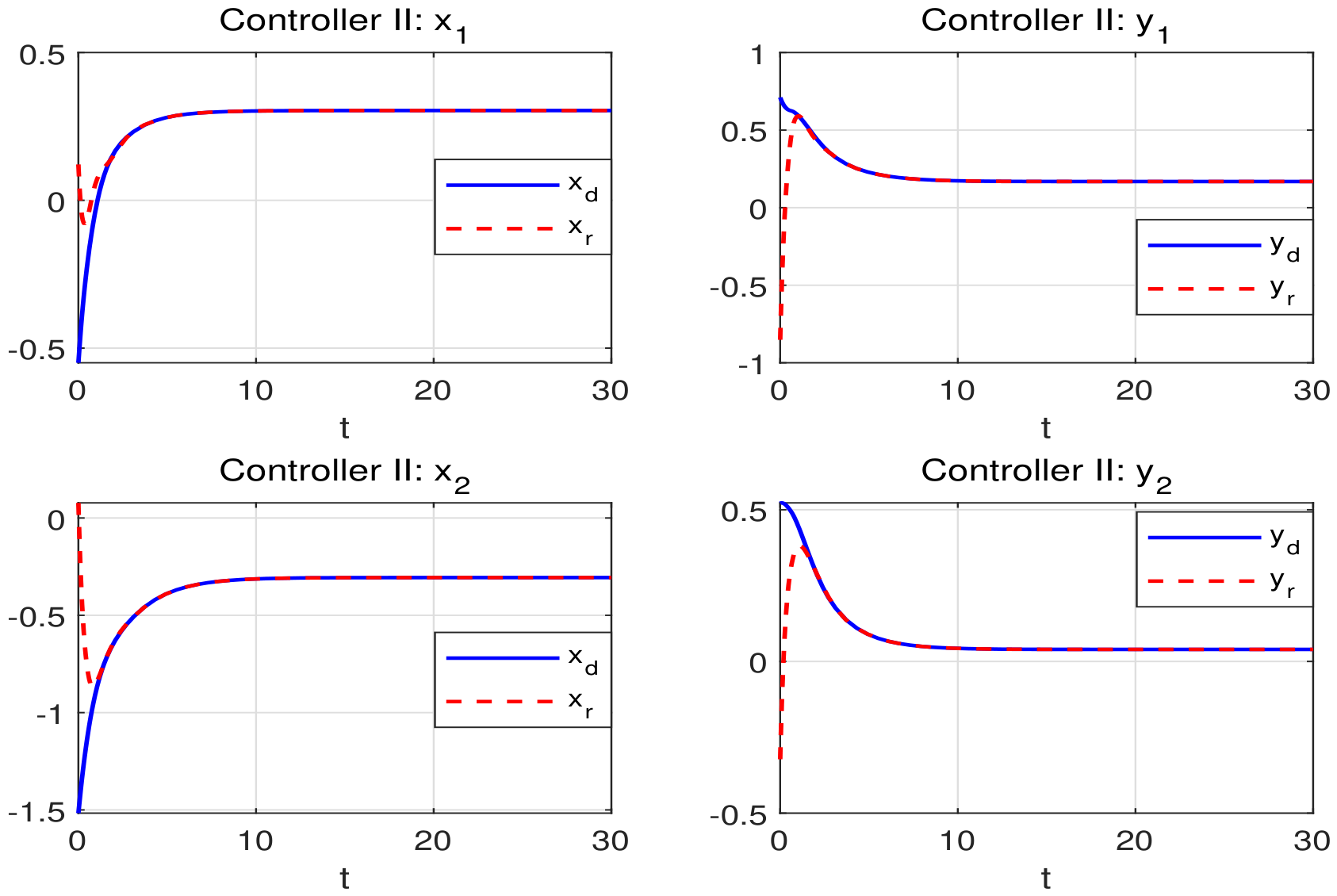
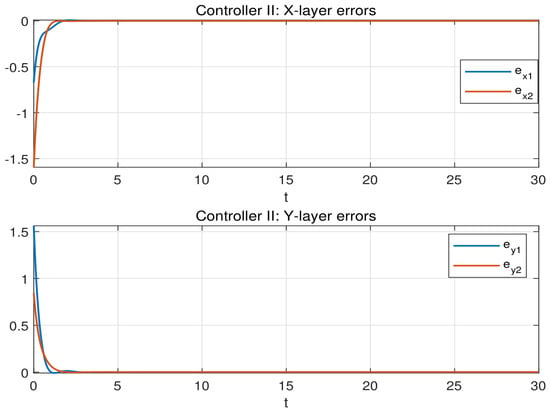
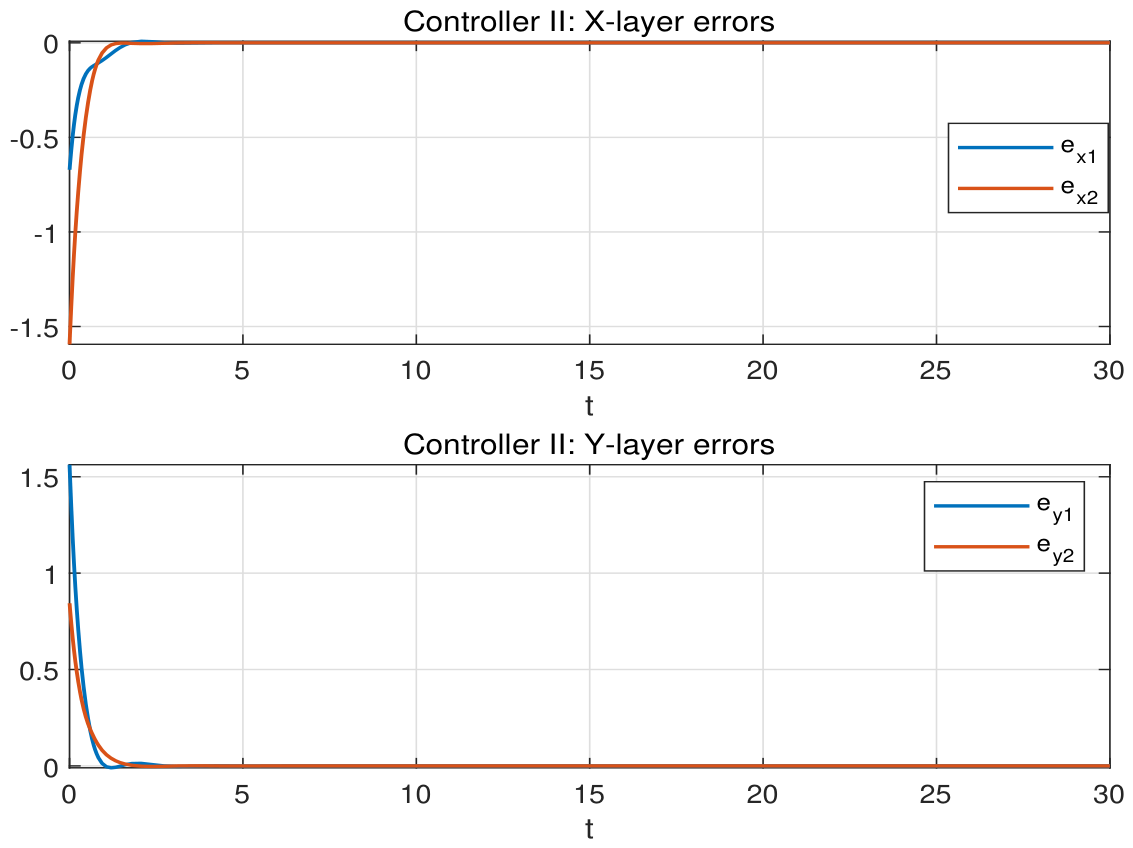
Figure 5 and Figure 6 display the state trajectories of the X-layer and Y-layer neurons, respectively. In each subplot, the solid blue line represents the drive neuron state, while the dashed red line gives the corresponding response neuron state. It is evident that after a short transient, the response states accurately track the drive states, even though none of them converge to zero–they approach nonzero steady patterns induced by the external inputs I and J. The synchronization errors and are plotted in Figure 4; both decay to zero, confirming asymptotic synchronization.
Figure 5.
The state trajectories of the drive and response systems in Example 2.
Figure 6.
The state trajectories of the error systems in Example 2.
Quantitatively, Controller II achieves synchronization with a smaller instantaneous gain () than Controller I, which requires in Example 1. This reduction in control effort, a 50% decrease in the nominal gain, demonstrates that the delayed feedback term effectively compensates for the transmission lag, thereby enlarging the feasible parameter region. Meanwhile, the minimum eigenvalue of the frequency-dependent matrix remains positive with a margin of approximately 0.18, confirming the robustness of the criterion.
On the other hand, the normalized error energy over is (X-layer) and 0.029 (Y-layer), with decay rates and . Compared with Example 1, Controller II reduces the error energy by approximately 29% (X-layer) and 31% (Y-layer) under otherwise comparable conditions, confirming the quantitative advantage of delayed feedback.
5. Conclusions
In this paper, a frequency-domain framework was developed for asymptotic synchronization of delayed fuzzy BAM neural networks. Two linear controllers—instantaneous and delayed—were designed, and two corresponding synchronization criteria were rigorously derived using the multivariable circle criterion and Parseval’s theorem. The proofs are complete and self-contained, relying solely on signal energy analysis without constructing Lyapunov–Krasovskii functionals. The criteria are simple to verify through eigenvalue checks over a bounded frequency range. Numerical simulations illustrate the effectiveness of the approach and the advantage of the delayed-feedback controller.
In particular, Controller II demonstrates that incorporating the delayed error signal can significantly enhance the synchronizable region while preserving the simplicity of linear feedback, which highlights its practical value and distinguishes it from existing LMI-based approaches.
Beyond its theoretical significance, the proposed synchronization framework has several potential real-life applications. The BAM architecture is inherently suited for associative memory and robust pattern recognition [1], and the drive-response synchronization mechanism can be directly employed in chaotic secure communication schemes. The delayed-feedback controller is particularly relevant for channels with non-negligible transmission latencies. Moreover, synchronization of coupled neural networks underpins cooperative control problems in multi-agent systems, including power grid stability and formation control of unmanned vehicles [3,4]. The sector-bounded nonlinearities and delayed feedback considered here are also characteristic of brain-inspired neuromorphic computing, making our frequency-domain criteria applicable to hardware implementations of associative memory. These application contexts, while not exhaustively explored in the present theoretical study, highlight the practical relevance of our results and will guide our future research directions.
The proposed method has several limitations. Firstly, the sector bound for the fuzzy AND/OR terms is conservatively constructed using the worst-case norm estimate, which may exclude some feasible gains. Additionally, the frequency-domain criteria require the linear part of the error dynamics to be Hurwitz, and this condition must be checked separately, as the inequalities cannot guarantee it. Finally, the current framework only handles constant delays, excluding time-varying or distributed delays. As a result, future research will extend these results to networks with time-varying delays, uncertainties, and more complex fuzzy inference mechanisms.
Author Contributions
Conceptualization, Z.Y.; methodology, Z.Y.; software, Z.C.; validation, Z.Y.; formal analysis, Z.C.; resources, Z.Y.; writing—original draft, Z.C.; writing—review and editing, Z.Y.; supervision, Z.Y.; project administration, Z.Y. All authors have read and agreed to the published version of the manuscript.
Funding
This research was funded by the Doctoral Scientific Research Startup Project of Hubei University of Technology (XJ2022001501) and the College Student Innovation and Entrepreneurship Program (20250100204).
Data Availability Statement
The original contributions presented in this study are included in this article. Further inquiries can be directed to the corresponding author.
Acknowledgments
We are grateful to the anonymous reviewers for their valuable remarks, which contributed to the optimization of the present manuscript.
Conflicts of Interest
The authors declare no conflicts of interest.
References
- Kosko, B. Bidirectional associative memories. IEEE Trans. Syst. Man Cybern. 1988, 18, 49–60. [Google Scholar] [CrossRef] [Scilit]
- Wang, F.; Wu, H.; Li, L. Global exponential stability of fuzzy BAM neural networks with time delays. In Proceedings of the 2011 4th International Conference on Biomedical Engineering and Informatics (BMEI); IEEE: Piscataway, NJ, USA, 2011; pp. 2212–2216. [Google Scholar] [CrossRef] [Scilit]
- Cao, J.; Li, L. Cluster synchronization in an array of hybrid coupled neural networks with delay. Neural Netw. 2009, 22, 335–342. [Google Scholar] [CrossRef] [Scilit]
- Cao, J.; Lu, J. Adaptive synchronization of neural networks with or without time-varying delay. Chaos 2006, 16, 013133. [Google Scholar] [CrossRef] [Scilit]
- Dhamala, M.; Jirsa, V.K.; Ding, M. Enhancement of neural synchrony by time delay. Phys. Rev. Lett. 2004, 92, 074104. [Google Scholar] [CrossRef] [Scilit]
- Wang, Q.; Perc, M.; Duan, Z.; Chen, G. Synchronization transitions on scale-free neuronal networks due to finite information transmission delays. Phys. Rev. E. 2009, 80, 026206. [Google Scholar] [CrossRef] [Scilit]
- Zhang, H.; Liu, Z.; Huang, G.-B.; Wang, Z. Novel weighting-delay-based stability criteria for recurrent neural networks with time-varying delay. IEEE Trans. Neural Netw. 2010, 21, 91–106. [Google Scholar] [CrossRef] [Scilit]
- Kwon, O.M.; Park, M.J.; Lee, S.M.; Park, J.H.; Cha, E.J. Stability for neural networks with time-varying delays via some new approaches. IEEE Trans. Neural Netw. Learn. Syst. 2013, 24, 181–193. [Google Scholar] [CrossRef] [Scilit]
- Zhang, H.; Wang, Z.; Liu, D. A comprehensive review of stability analysis of continuous-time recurrent neural networks. IEEE Trans. Neural Netw. Learn. Syst. 2014, 25, 1229–1262. [Google Scholar] [CrossRef] [Scilit]
- Dao, Q.-T. Uncertainty-resilient control of an inverted pendulum on a cart using interval Type-2 Takagi–Sugeno fuzzy modeling and subsystem LQR control. Automation 2026, 7, 92. [Google Scholar] [CrossRef] [Scilit]
- Rantzer, A. On the Kalman-Yakubovich-Popov lemma. Syst. Control Lett. 1996, 28, 7–10. [Google Scholar] [CrossRef] [Scilit]
- Lu, W.; Chen, T. Synchronization of coupled connected neural networks with delays. IEEE Trans. Circuits Syst. I 2004, 51, 2491–2503. [Google Scholar] [CrossRef] [Scilit]
- Curran, P.F.; Suykens, J.A.K.; Chua, L.O. Absolute stability theory and master-slave synchronization. Int. J. Bifurc. Chaos 1997, 7, 2891–2896. [Google Scholar] [CrossRef] [Scilit]
- Vidyasagar, M. Nonlinear Systems Analysis, 2nd ed.; SIAM: Philadelphia, PA, USA, 2002. [Google Scholar]
- Khalil, H.K. Nonlinear Systems, 3rd ed.; Prentice Hall: Upper Saddle River, NJ, USA, 2002. [Google Scholar]
Disclaimer/Publisher’s Note: The statements, opinions and data contained in all publications are solely those of the individual author(s) and contributor(s) and not of MDPI and/or the editor(s). MDPI and/or the editor(s) disclaim responsibility for any injury to people or property resulting from any ideas, methods, instructions or products referred to in the content. |
© 2026 by the authors. Licensee MDPI, Basel, Switzerland. This article is an open access article distributed under the terms and conditions of the Creative Commons Attribution (CC BY) license.