


Abstract
Fixed-priority schedulability analysis for uniprocessor real-time systems is computationally difficult, and exact Rate Monotonic (RM) analysis is weakly NP-complete. This paper develops an exact lattice-theoretic formulation for the family of weighted feasibility problems induced by the exact RM schedulability test. For each candidate period, the corresponding weighted feasibility instance is mapped to a lattice embedding in which feasible values correspond to unique canonical lattice vectors, feasibility is characterized exactly by membership in an explicit constrained region, and candidate interactions satisfy exact carry/borrow correction identities. A determinant-based normalization of the embedding scale is also derived. The results provide an exact structural description of the RM weighted feasibility family together with an empirically informative candidate mechanism.
MSC:
68M20
1. Introduction
Fixed-priority scheduling remains one of the standard approaches for uniprocessor real-time systems because of its implementation simplicity [1,2] and relatively low run-time overhead. For periodic task sets with deadlines equal to periods, Rate Monotonic (RM) scheduling is optimal among fixed-priority policies [3]. However, exact schedulability analysis for fixed-priority scheduling is computationally difficult. Classical exact methods include time-demand analysis and worst-case response-time analysis, while a large body of work has developed sufficient conditions to reduce computational cost at the expense of pessimism. The general complexity barrier is also well known: the schedulability of fixed-priority scheduling with arbitrary utilization is shown to be NP-complete in the weak sense, even though each task has its deadline equal to its period [4]. Because of the high complexity of exact schedulability analysis, much previous work has focused on more efficient but conservative sufficient tests. Ref. [5] provides a broad comparison of schedulability tests for uniprocessor RM scheduling, Ref. [6] studies accelerated simply periodic task sets for RM scheduling, and [7] develops an efficient RM schedulability test. At the same time, exact formulations remain important because they determine the mathematical structure on which both exact and conservative tests are based.
Exact schedulability analysis has been studied from several different viewpoints. Pseudo-polynomial methods based on the necessary and sufficient RM condition and exact tests based on worst-case response time are classic examples. In [8], a necessary and sufficient condition for RM schedulability was established, leading to a pseudo-polynomial schedulability test. Exact response-time-based conditions were developed in [9,10], and another exact test with complexity exponential in the number of tasks but independent of the maximum period was developed in [2]. The response-time computation problem was later shown to be NP-hard in [11]. Later, the fixed-priority schedulability problem with arbitrary utilization was shown to be weakly NP-complete in [4].
Other recent work has approached exact fixed-priority schedulability from optimization and arithmetic viewpoints. Lisper and Mellgren [12] expressed classical fixed-priority response-time equations with ceiling terms as integer linear programming problems, and Deppert and Jansen [13] later connected fixed-priority uniprocessor response-time computation to integer programming and the mixing-set viewpoint. In our previous work [14], the RM schedulability problem was studied from the viewpoint of continued fractions. That approach showed that exact analysis can be expressed in terms of rational approximation of a period ratio, and it led to an exact schedulability test based on convergents and semi-convergents. At the same time, it also made clear that the continued-fraction method is inherently tied to one-dimensional rational approximation and does not directly resolve the corresponding simultaneous approximation structure. These optimization-based and arithmetic viewpoints are complementary rather than interchangeable. Integer programming and mixing-set formulations provide exact optimization descriptions of ceiling-based response-time or schedulability analysis, while the continued-fraction approach applies exact one-dimensional rational approximation to a restricted arithmetic structure.
In this paper, the family of weighted feasibility problems underlying the exact RM schedulability test is formulated in exact lattice-theoretic terms. The motivation for this viewpoint is that the ceiling-driven and inherently one-sided residual structure of the RM weighted feasibility condition is not captured directly by standard simultaneous Diophantine approximation formulations. In particular, the directed residuals enter the feasibility condition itself, whereas optimization-based and continued-fraction-based approaches do not provide an exact lattice characterization in which each candidate value has a unique canonical representative and feasibility becomes exact region membership.
For each candidate period , the exact RM condition reduces to a weighted feasibility problem over an integer variable q. The contribution of the paper is primarily structural. First, it gives an exact lattice embedding for this weighted feasibility family and shows that feasible values correspond to unique canonical lattice vectors. Second, it proves that feasibility is characterized exactly by membership in an explicit constrained region and establishes exact arithmetic identities describing candidate interactions through carry/borrow correction terms. Third, it discusses a determinant-based normalization of the embedding scale and reports numerical evidence that the resulting lattice representation exposes a small but informative candidate set, especially when small signed combinations of row-derived candidates are included. The value of the formulation is therefore not only that it rewrites the RM weighted feasibility family in lattice form, but also that it makes explicit three exact structural features that are not directly exposed in previous approaches: unique canonical representatives, exact region-membership characterization, and exact carry/borrow identities for candidate interactions.
It is important to distinguish exact characterization from candidate generation. The exact correspondence between feasible values and canonical lattice points is established independently of lattice reduction. The LLL algorithm enters only as a practical reduced-basis mechanism for extracting a small set of row-derived candidate first coordinates and their small signed combinations, which are then checked exactly through the original feasibility function. In this sense, the paper does not claim a new asymptotically faster exact RM schedulability algorithm. Its contribution is instead an exact lattice-theoretic reformulation of the weighted feasibility family together with an empirically informative candidate mechanism.
The remainder of the paper is organized as follows. Section 2 reviews the RM schedulability condition, its reduction to a weighted directed approximation problem, and the lattice-reduction background used in the paper. Section 3 develops the exact lattice formulation, the canonical vectors, the exact arithmetic identities, the geometric characterization of feasibility, and the role of the embedding scale. Section 4 presents numerical observations. Section 5 concludes the paper with a summary of the main findings, current limitations, and directions for future work.
2. Rate Monotonic Schedulability and Directed Approximation
2.1. System Model
This subsection summarizes the task model and notational assumptions used throughout the paper. We consider preemptive uniprocessor Rate Monotonic scheduling for independent periodic tasks. Each task is represented by , where is the period and is the worst-case execution time. It is assumed that the relative deadline of each task is equal to its period. A task is schedulable if every job of that task completes no later than the release of the next job.
We denote the utilization of task by , and the total utilization of the task set by . Without loss of generality, tasks are indexed in non-decreasing order of periods; that is, if then . Under RM scheduling, this implies that has higher priority than whenever . We write for the subset of tasks with higher priority than .
The system contains a single processor, scheduling overhead is ignored, there is no release jitter, and tasks are independent. These assumptions are standard in exact RM schedulability analysis and are sufficient for the directed approximation formulation.
2.2. Rate Monotonic Schedulability
The following theorem of Lehoczky et al. [8] gives a necessary and sufficient schedulability condition for RM scheduling.
Theorem 1.
Given a task set τ, a task always meets its deadline by RM scheduling if and only if there exists a time such that
The left-hand side of Equation (1) represents the processor demand generated by tasks of priority at least that of when all such tasks are released simultaneously. Defining
for , the value is the time demand of the task set . Equation (2) represents the cumulative processor demand, as defined in [8], made by the tasks over the interval . Theorem 1 requires checking whether there exists such that . It was observed in [8] that it is sufficient to examine the condition only at points in the set of Equation (3), which leads to a pseudo-polynomial schedulability test.
Theorem 1 gives the classical exact RM schedulability condition for task . Equation (1) is the condition itself: it asks whether there exists at least one time instant t with at which the cumulative processor demand generated by and all higher-priority tasks does not exceed the available processor time t. In other words, schedulability is characterized by the existence of a testing instant within the interval at which the total demand is no larger than the interval length. Equation (2) does not introduce a different condition. It simply defines the left-hand side of Equation (1) as a function. With this notation, the question posed by Equation (1) becomes whether there exists such that . Thus, Equation (1) is the exact schedulability criterion, while Equation (2) is a convenient definition of the corresponding time-demand function used to express that criterion more compactly.
Another exact viewpoint was introduced by Joseph and Pandya [10], who characterized schedulability through the worst-case response time. In that formulation, the worst-case response time satisfies
and the task set is schedulable if and only if for all i. The response-time computation problem was shown in [11] to be related to simultaneous Diophantine approximation. In particular, a directed variant of simultaneous approximation was introduced there.
Directed simultaneous Diophantine approximation (DDA). Given rational numbers and a rational number ϵ, find the smallest integer k such that there exists an integer with
It was shown in [11] that the solution of DDA yields a 2-approximation of the response-time computation problem, and that DDA itself is NP-hard.
2.3. From RM Schedulability to a Weighted Directed Approximation Problem
For a task to be schedulable by RM, Theorem 1 must hold. Since for , Equation (1) may be rewritten as
By Equation (3), the schedulability question is equivalent to determining whether there exist a period with and an integer
such that
Thus, for each fixed candidate period , the RM schedulability condition reduces to an arithmetic feasibility problem over the integer variable q. The full exact RM schedulability test is obtained by considering this condition over the relevant values of k.
Assume that the total utilization satisfies . Subtracting from both sides and dividing by yields
If we define
then Equation (7) becomes
where . This is a weighted directed Diophantine approximation problem. For each candidate period , one obtains such a weighted feasibility problem, and the full RM schedulability test is recovered by considering the resulting family over the relevant values of k. The present paper develops the lattice formulation for this family through the generic weighted feasibility problem.
For comparison, when , the problem reduces to a one-dimensional rational approximation task, which is exactly the case where continued fractions are effective. When , however, the directed residuals for different ratios generally cannot be minimized simultaneously by a single rational approximation. This is the point at which a multidimensional viewpoint becomes necessary.
2.4. Lattices and Lattice-Reduction Background
Equations (9)–(14) summarize standard lattice notions, Gram–Schmidt orthogonalization, and the LLL reducedness conditions; see [15,16]. Let , and let be a basis of . The lattice generated by this basis is
If is the basis matrix with rows , then the determinant of the lattice is
For any linearly independent basis , the Gram–Schmidt process yields an orthogonal basis defined inductively by
where
A basis is called reduced if for and
for . Since the Gram–Schmidt vectors are orthogonal, this is equivalent to
The LLL algorithm produces a reduced basis in a number of steps polynomial in the lattice dimension.
The following standard facts were established in [15].
Proposition 1.
If is a reduced basis of the lattice , and is its Gram–Schmidt orthogonalization, then:
- (a)
- for ;
- (b)
- ;
- (c)
- .
For a general discussion of the LLL algorithm and lattice basis reduction, see [16]. Although lattice reduction is classical in simultaneous Diophantine approximation, the present schedulability problem is not a standard simultaneous approximation instance. The relevant quantities are the directed residuals
which enter the feasibility condition itself. The main technical issue is therefore not the use of LLL per se, but the construction of a lattice formulation that represents this one-sided ceiling structure exactly.
3. Lattice Formulation of the Weighted Feasibility Problem
3.1. Overview of the Approach
Throughout this section, we study the generic weighted feasibility problem associated with a candidate period in the exact RM condition. Since the full RM schedulability test is obtained by ranging over the relevant values of k, the formulation developed below applies to the entire RM schedulability test through this family of candidate-period instances. The following hypothesis collects the abstract parameters used in the formulation.
Hypothesis 1.
and let be a fixed embedding parameter.
In the RM setting, these quantities are obtained from a fixed candidate period by
where . Thus, for each fixed k, the RM schedulability condition gives a weighted feasibility problem over the variable q; taken together over the relevant values of k, these problems recover the full exact RM schedulability test. Throughout this section, denotes a fixed embedding parameter. The exact statements proved in Section 3.1, Section 3.2, Section 3.3, Section 3.4, Section 3.5 and Section 3.6 hold for every such choice.
For each candidate period , the target problem is to determine the minimum value,
The full RM schedulability test is recovered by considering this problem over the relevant values of k. The subsection proceeds from the embedding itself to canonical vectors, exact arithmetic identities, and finally the lattice-region characterization and exact-recovery theorem.
3.2. Weighted Feasibility Problem and Lattice Embedding
We now state the weighted feasibility problem in the form used by the lattice formulation.
Problem 1
(Weighted feasibility problem). For , define
The objective is to determine
provided that the feasible set is nonempty.
Equation (15) defines the feasibility deficit at the candidate value q. The first term is the weighted sum of the directed ceiling residuals, while the second term is the linear allowance . Hence means that q satisfies the weighted feasibility condition.
Before introducing the embedding, it is useful to clarify why a direct appeal to the classical simultaneous Diophantine approximation framework is not sufficient. In standard lattice formulations for simultaneous approximation, one usually works with symmetric residual quantities or with approximation errors that are not intrinsically one-sided. By contrast, the present problem depends on the directed terms
and these quantities enter the feasibility condition itself. Thus the issue is not merely to approximate several values simultaneously, but to encode a ceiling-induced directed structure in a way that remains exact at the level of feasibility. The embedding introduced below is designed precisely for this purpose: its canonical vectors record the ceiling residuals directly, and the characterization theorem later in the section shows that these directed residuals are represented without loss in the lattice formulation.
Definition 1.
Define the matrix
The associated row lattice is
The structure of Equation (17) is deliberate: the first row encodes the common candidate value q together with the negative weighted ratios , while the remaining rows provide integer correction directions in each weighted residual coordinate. This is the mechanism that allows the canonical residual vectors to be represented exactly as lattice points.
Remark 1.
Because all entries of X are rational by Hypothesis 1, the set is a full-rank lattice in after an optional common-denominator scaling.
3.3. Canonical Lattice Vectors and Basic Geometry
We now associate each integer q with canonical vectors in the lattice. One of them records ceiling residuals, and the other records the corresponding floor companion. The ceiling version will eventually encode feasibility, while the floor version is useful for measuring the geometric correction gap at the same value of q.
Definition 2.
For each and each , define
and
The canonical ceiling vector and canonical floor companion are defined by
and
We also write when no confusion is possible.
Equations (19) and (20) define the directed ceiling and floor residuals associated with the same candidate value q. Equations (21) and (22) then package these residuals into canonical lattice vectors sharing the same first coordinate . The ceiling version is the one that encodes feasibility, while the floor version is useful for quantifying same-q correction gaps.
The first basic fact is that these vectors actually belong to the lattice L. This provides the bridge between the original feasibility problem and the lattice-theoretic formulation.
Proposition 2.
For every ,
Proof.
Let denote the first row of X, and let denote the -st row of X for . Then
where occupies the -st coordinate.
By Equation (19),
Since the coefficients are integers, .
Similarly, by Equation (20),
and therefore . □
Once the embedding is fixed, its determinant is immediate from the triangular form of X. This quantity will later serve as the natural lattice scale against which short-vector phenomena are measured.
Proposition 3.
The determinant of L is
Proof.
The next result explains the geometric meaning of feasibility. If q is feasible, then the weighted residual sum is bounded by , and this immediately yields a Euclidean upper bound for the canonical vector.
Property 1.
If satisfies , then
Proof.
While is the canonical vector associated with feasibility, the floor companion remains useful because it measures how far two natural representatives at the same value of q can differ.
Proposition 4.
Let
Then, for every ,
Proof.
The first coordinates of and are both equal to , so their difference has first coordinate 0. For each , the -st coordinate of is
If , then , and this coordinate is 0. If , then
so the coordinate is . Hence each nonzero coordinate of is exactly , and therefore
Taking square roots proves Equation (26). □
The results of this subsection establish the basic geometric objects that will be used throughout the remainder of the paper. The canonical vectors lie in the lattice, feasibility forces them to be short, and same-q companions remain uniformly close.
3.4. Arithmetic Identities for Candidate Combinations
The geometric characterization developed in the next subsection identifies where feasible values lie in the lattice formulation. In parallel, it is useful to record the exact arithmetic mechanism by which candidate values interact under addition and subtraction. For
the relevant correction term is induced by the carry/borrow effect in the ceiling residuals.
For an integer coefficient vector and positive integers , define
Assume that . For each i, let
and define the weighted correction term
Theorem 2.
Let , and let be such that . Then
where
Proof.
Since
we have
Also,
Subtracting these expressions gives
which yields the identity. □
The two most important special cases are addition and subtraction.
Corollary 1.
For ,
where
In particular,
Proof.
Apply Theorem 2 with , , , and . □
Corollary 2.
For with ,
where
In particular,
Proof.
Apply Theorem 2 with , , , , and . The resulting correction term is written in the form so that the subtraction identity takes the sign convention stated above. □
Remark 2.
The correction terms in Corollaries 1 and 2 admit a direct carry/borrow interpretation. For each coordinate i,
and exactly when the two residuals create one carry in the ith coordinate. Likewise,
and exactly when subtracting r from p produces one borrow in the ith coordinate. Thus and are weighted sums of coordinatewise carry and borrow indicators.
Theorem 2 shows that the deficit of a signed combination is determined exactly by a weighted correction term. Corollaries 1 and 2 make this mechanism explicit in the two cases most relevant to the numerical candidate construction studied later: addition and subtraction of row-derived candidates.
3.5. Exact Geometric Characterization of Feasibility
We now combine the preceding ingredients to obtain the geometric characterization of feasibility. Feasible values are represented exactly by canonical lattice points lying in an explicit constrained region.
Definition 3
(Feasibility region). For a fixed integer , define
The region itself is defined directly from the residual box constraints and the weighted feasibility inequality. The nontrivial content of the formulation does not lie in this coordinate description alone. Rather, Proposition 2 shows that the canonical vectors belong to the lattice exactly, Lemma 1 proves that each fiber
contains exactly one such canonical lattice point, and Theorem 3 converts these two facts into an exact correspondence between feasible integers and lattice points in . In this sense, the formulation is not only an exact rewriting of the feasibility inequality, but also a canonicalization of the search space.
Lemma 1.
Let . Then the set
contains exactly one lattice point, namely .
Proof.
By Proposition 2, the canonical vector belongs to L. By Definition 2,
and each residual satisfies , so
Hence belongs to the set in Equation (28).
It remains to prove uniqueness. Suppose that
both satisfy
Then , and its first coordinate is 0. Since L is the row lattice generated by X, every lattice vector with first coordinate 0 must be an integer combination of the last n rows of X. Therefore
for some .
On the other hand, for each i,
Thus . Since and , this implies for every i. Hence , so . Therefore, the set in Equation (28) contains exactly one lattice point, namely . □
In Lemma 1, Equation (28) combines three constraints: positivity and range of the first coordinate, coordinatewise residual box constraints , and the weighted feasibility inequality itself. Thus the region is exactly the geometric domain in which feasible canonical vectors must lie.
Theorem 3.
Let , and let . Then
Proof.
Since the first coordinate of is , this is equivalent to
Hence , so .
Conversely, suppose that . By Definition 3,
with
Because is the canonical vector, , and therefore
By Equation (15), this means , so q is feasible. □
Corollary 3.
For every ,
Proof.
By Theorem 3, each feasible gives a lattice point . By Lemma 1, this correspondence is injective.
Conversely, let . Since and every lattice point in L has first coordinate an integer multiple of E, there exists such that . Because for all i, Lemma 1 implies that . Then Theorem 3 shows that q is feasible. Thus every lattice point in arises from exactly one feasible q, and Equation (30) follows. □
For the target problem, however, the main quantity of interest is not only the feasible set but its minimum element . The next theorem shows that is recovered exactly by minimizing the first coordinate over the lattice points in .
Theorem 4.
Assume that the feasible set
is nonempty, and let
Then
Equivalently,
Proof.
Now let
By the proof of Corollary 3, there exists a unique feasible such that
and hence . Thus the set
is exactly . Taking minima gives Equation (31). □
Corollary 4.
Under the assumptions of Theorem 4,
Theorems 3 and 4 have two consequences. First, the feasible set is exactly the first-coordinate projection of the canonical lattice-point set . Second, the target value is recovered by minimizing the first coordinate over that same set. Thus, the original ceiling-based search over integers is converted into a canonical lattice-point search with unique representatives. Since the full RM schedulability test is obtained by ranging over the relevant values of k, the formulation applies to the complete RM schedulability test through this family of candidate-period problems. The numerical observations of Section 4 then examine how this exact characterization interacts with lattice-guided candidate generation.
The following example illustrates how the classical RM condition yields a weighted feasibility instance and how the corresponding canonical lattice vectors encode exact feasibility via region membership. The example is intentionally small, but it makes explicit the full chain from the exact RM condition to the canonical lattice-point characterization used in Theorems 3 and 4.
Example 1.
Consider the tasks
with . To test the schedulability of , first try the candidate period . The corresponding weighted feasibility instance is determined by
and
For simplicity, choose the embedding scale . Then
For , the directed residuals are
Hence
and
Thus is infeasible. Equivalently,
so .
For , the directed residuals become
Therefore
and
Thus is feasible, and indeed
Hence, the minimum feasible value is
This example shows concretely how the classical RM condition, the weighted feasibility formulation, the canonical lattice vector, and the exact region-membership criterion fit together in a single instance.
To make the operational use of the formulation explicit, it is helpful to summarize the resulting procedure. Algorithm 1 separates the exact feasibility check from the lattice-guided candidate stage. The candidate stage is optional: if it is omitted, the procedure reduces to the exact search over admissible values of q. When it is included, reduced-basis row-derived candidates and their small signed combinations are tested first, and exactness is preserved because every candidate is verified through the original feasibility function.
For a fixed prefix and candidate period, the fallback stage guarantees exactness because it checks the original feasibility function over the entire admissible range if the lattice-guided candidate set is insufficient. The role of the candidate stage is therefore heuristic and practical, whereas exactness comes from the feasibility condition itself and from the characterization developed above.
It is also useful to relate the region to the short-vector observation from the previous subsection.
Proposition 5.
Define
Then
where denotes the closed Euclidean ball of radius centered at the origin.
| Algorithm 1 Exact search for RM weighted feasibility with a lattice-guided candidate stage |
|
Proof.
Let . By Corollary 3, there exists a feasible such that . By Property 1,
Hence . □
In summary, the substantive point is not merely that the feasibility inequality can be written in coordinates. Proposition 2, Lemma 1, and Theorem 3 show that each candidate integer has a unique canonical lattice representative, and Theorem 4 turns the target problem into first-coordinate minimization over the corresponding canonical lattice-point set. Proposition 5 further places that set inside a finite Euclidean search region.
3.6. Discussion of the Embedding Scale and Limitations
This subsection is intended as a heuristic normalization discussion motivating the embedding scale, rather than as an additional exact structural theorem. The exact characterization above holds for every fixed choice of the embedding parameter . From the viewpoint of lattice use, however, the choice of E is not neutral: it controls the relative scale between the first coordinate and the residual coordinates in the embedding, and hence whether the lattice formulation is geometrically balanced or degenerate.
To make this dependence explicit, it is convenient to normalize E relative to the feasibility scale C by writing
Under this normalization, the first coordinate of the canonical vector is measured in units of C, and the influence of E is reduced to the single dimensionless parameter . The resulting quantities may then be compared as follows:
- If q is feasible, then
- The determinant of the embedding lattice is
- If denotes the first vector of an LLL-reduced basis of L, then the standard LLL short-vector estimate gives
The quantity is not a rigorous upper bound on . Rather, it is a determinant-based comparison scale that emerges when the LLL short-vector estimate is compared with the norm bound satisfied by feasible canonical vectors. It therefore provides a principled way to discuss how the geometric balance of the embedding depends on the choice of E.
To identify a determinant-based balancing normalization, define
Since differs from only by multiplicative constants independent of , it is enough to maximize . Writing
and differentiating yields
Setting this derivative equal to zero gives
Therefore the unique critical point is
Since as and as , this critical point is the unique global maximizer. Consequently, a determinant-based balancing normalization is
This analysis does not say that is required for the exact characterization, nor does it yield a rigorous upper bound for . What it shows is that, within the normalized family , this choice maximizes the determinant-based comparison between the feasible-vector scale and the LLL short-vector scale. In this sense, it is best interpreted as a determinant-based balancing normalization for the embedding.
A related comparison concerns the same-q correction scale. Let
By Proposition 4,
for every . Under the balanced choice in Equation (40), this implies
This threshold is not a recovery theorem for , but it indicates the scale at which same-q lattice representatives become comparable to the first-coordinate scale of the embedding.
The discussion above clarifies the role of E in the present paper. The characterization of this section is valid for every fixed , but the geometric behavior of the embedding depends strongly on this choice. The parameter E determines the relative scaling between the first coordinate and the residual coordinates, affects the determinant of the embedding lattice, and influences how the formulation is interpreted from the viewpoint of short vectors and LLL-reduced structure.
4. Numerical Observations
This section examines the practical meaning of the lattice representation developed in Section 3. The purpose of the numerical study is not to claim an end-to-end run-time improvement over existing exact RM schedulability tests. Rather, the goal is to evaluate whether the lattice formulation exposes a small but informative set of candidate values for the exact weighted feasibility problem. In particular, the experiments study candidate concentration and exact-recovery behavior: that is, how often row-derived lattice candidates and their small signed combinations contain the exact minimizer .
This distinction is important for interpreting the role of lattice reduction in the paper. The exact characterization of feasibility proved in Section 3 does not depend on LLL reduction. In the numerical study, LLL is used only as a practical reduced-basis mechanism for extracting candidate first coordinates, which are then checked exactly through the original feasibility function . Accordingly, the present experiments should be interpreted as evidence about the candidate structure revealed by the exact formulation, not as a complete benchmarking study against full exact schedulability-analysis procedures.
Random periodic task sets were generated under the classical preemptive uniprocessor RM model with implicit deadlines. For each task , the parameters were chosen so that
To avoid trivial low-utilization instances, the total utilization was restricted to the range . For each , 100 task sets were generated. Periods were sampled uniformly without replacement from and then sorted increasingly. Execution times were obtained by sampling provisional utilizations on , scaling them to a target total utilization in , and setting
For each task prefix and each candidate period with , we constructed the corresponding weighted feasibility instance
with
where . Thus each reported data point aggregates a family of candidate-period subproblems rather than independent task-set samples.
The primary lattice-guided methods are the row-only candidates extracted from reduced-basis first coordinates and the signed-combination candidates generated from the seeds with -budget . Here coincides with the row-only baseline. To assess whether the lattice-guided candidates are informative beyond internal comparisons, we also evaluate two equal-size comparison methods:
- random-B: The same number of candidates chosen uniformly at random from ;
- smallq-B: The same number of smallest admissible candidates .
In addition to subproblem-level hit rates, we report task-set-level bootstrap confidence intervals obtained by resampling task sets as clusters, thereby accounting for the dependence among subproblems induced by common prefixes and candidate periods. In all experiments reported below, the embedding scale was chosen as , where i denotes the current prefix size.
We begin with all feasible candidate-period subproblems. In Table 1, “# inst.” denotes the number of feasible candidate-period subproblems, and “Avg. Q” denotes the average upper search bound over those feasible subproblems. “Row cand.” and “ cand.” denote the average numbers of row-only and signed-combination candidates, respectively, while “Row exact ” and “ exact ” report the percentages of feasible subproblems for which the candidate set contains the exact minimizer . The last column reports the task-set-level bootstrap confidence interval for the exact -recovery rate of the method.
Table 1.
Results over all feasible subproblems under .
Across all feasible subproblems, the average value of Q remains modest, so these data should be read mainly as a baseline picture. Even in this case, however, the signed-combination mechanism remains substantially stronger than the row-only baseline. The exact -recovery rate falls from to for row-only as n increases from 10 to 50, whereas the corresponding rate falls from to . Thus the lattice-guided candidate mechanism remains highly informative even when many feasible subproblems have relatively small Q.
The more informative case is the subset of nontrivial subproblems with . Since a full comparison across all methods and all values of n would be too wide for a single table, we report representative cases in Table 2. For each selected value of n, the table shows the number of feasible nontrivial subproblems, the average value of Q, the average number of candidates, the exact -recovery rate, and the task-set-level bootstrap confidence interval for exact recovery. Here, row denotes reduced-basis first-coordinate seeds, combo- denotes the signed-combination candidate set with -budget 3, random- denotes the equal-size random comparison set, and smallq- denotes the equal-size comparison set consisting of the smallest admissible q-values.
Table 2.
Representative comparisons on the feasible nontrivial subset under .
Two different phenomena are visible in Table 2. First, the lattice-guided signed-combination candidates are much stronger than the row-only baseline on the genuinely nontrivial subproblems. For example, at , exact -recovery improves from for row-only to for combo-B3. Second, the comparison methods clarify two different effects. The random candidate set is clearly weaker at recovering the exact minimizer , whereas the small-q candidate set is considerably more competitive, especially when tends to be small. This suggests that part of the observed recovery performance is associated with the tendency of to occur near the beginning of the admissible range. Even so, combo-B3 remains consistently stronger than smallq-B3 in the representative cases shown here.
The competitiveness of the small-q baseline indicates that part of the observed recovery performance is indeed explained by the tendency of to occur near the beginning of the admissible range. This effect is genuine and should be taken into account when interpreting the candidate-recovery rates. At the same time, it does not fully explain the observed advantage of the lattice-guided signed-combination candidates. In the representative nontrivial cases reported here, combo-B3 remains consistently stronger than the equal-size small-q baseline, which suggests that the lattice representation captures additional candidate structure beyond a generic preference for small admissible values. The numerical observations should therefore be interpreted as supporting the informativeness of the lattice-guided structure, while not eliminating the influence of the small-q effect.
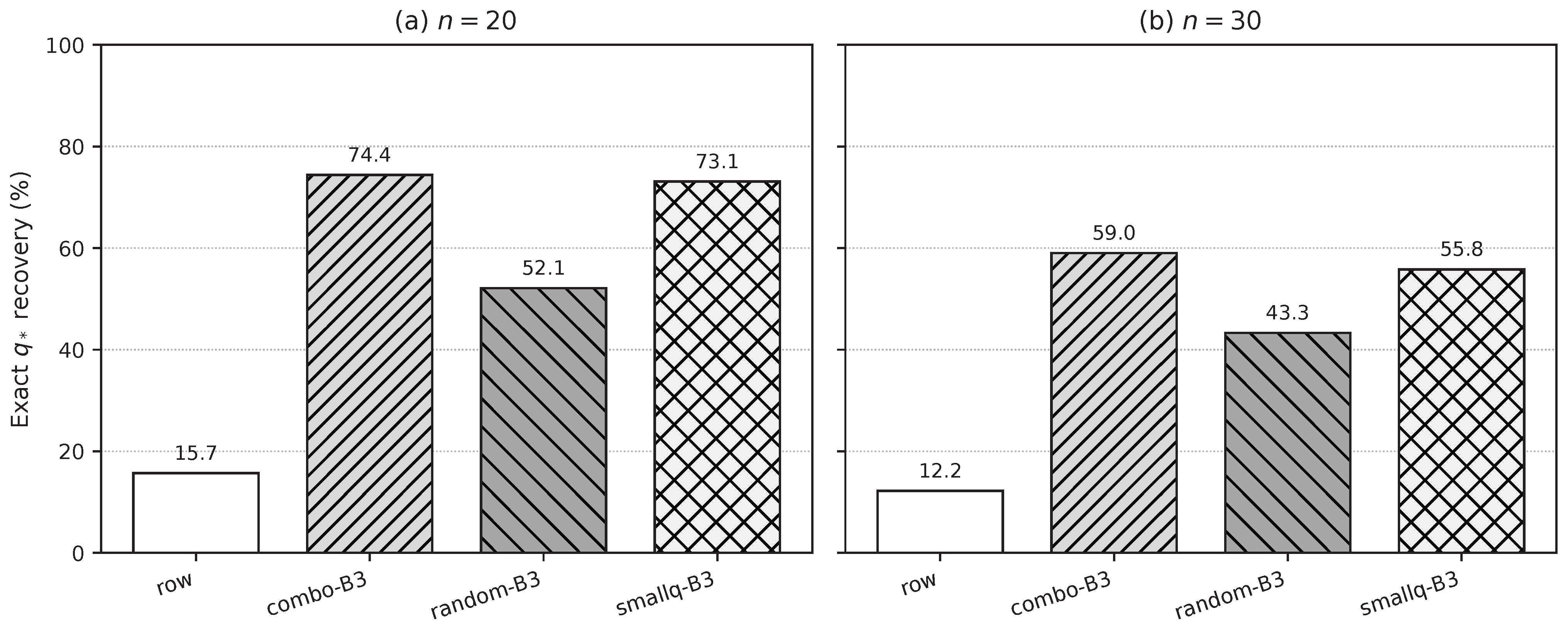
Figure 1 provides a visual summary of the representative nontrivial comparisons reported in Table 2. The advantage of the lattice-guided signed-combination candidates is clear in both representative cases. At , combo-B3 recovers the exact minimizer much more often than the row-only baseline and the equal-size random comparison set, and it also remains slightly stronger than the equal-size small-q baseline. The same pattern remains visible at . This supports the interpretation that the observed candidate quality is not explained solely by random selection or by the general tendency of to occur near the beginning of the admissible range.
Figure 1.
Exact -recovery rates on representative feasible nontrivial subproblems with under the embedding normalization .
The role of the combination budget can be read from the full results on the nontrivial subset. For , the exact -recovery rate increases from at to at , and then to above at . For larger n, the same monotone pattern remains visible, although the overall recovery level decreases: at , the exact recovery rises from roughly at to about at , while the average number of candidates grows from about to about . Thus, increasing the budget enlarges the candidate set, but it also yields a systematic improvement in recovery. This is why the main experiments focus on : it is not a theoretically optimal choice, but it provides a practical trade-off between candidate count and recovery quality.
Taken together, the numerical observations support three conclusions. First, the lattice-guided candidate mechanism is substantially stronger than the row-only baseline on the nontrivial subproblems where exact search is most informative. Second, the comparison methods clarify two different effects. The random baseline is clearly weaker at recovering the exact minimizer , whereas the small-q baseline is considerably more competitive. This indicates that part of the observed performance is associated with the tendency of to be relatively small. Even after accounting for that effect, however, the lattice-guided signed combinations remain consistently stronger than the corresponding small-q baseline in the representative cases reported here. Third, the numerical study should be interpreted as evidence about candidate concentration and exact-recovery behavior within the exact weighted feasibility family, rather than as a full end-to-end run-time comparison among complete schedulability-analysis procedures.
5. Conclusions
This paper has presented an exact lattice-theoretic formulation for the family of weighted feasibility problems in Rate Monotonic schedulability analysis. For each candidate period , the exact RM schedulability condition induces a weighted feasibility problem over an integer variable q, and the paper shows that this family admits an exact lattice embedding in which feasible values correspond to unique canonical lattice vectors. Feasibility is characterized exactly by membership in an explicit constrained region, and the target value is recovered by minimizing the first coordinate over the corresponding canonical lattice-point set.
The main contribution of the paper is structural rather than merely notational. The formulation shows that the weighted feasibility family underlying the exact RM schedulability test admits unique canonical lattice representatives, exact feasibility characterization by region membership, and exact carry/borrow identities for candidate interactions. These features are not directly exposed in previous optimization-based or arithmetic formulations and provide a more explicit geometric and arithmetic description of the ceiling-driven residual structure in the RM test.
A further contribution of the paper is to distinguish clearly between exact characterization and lattice-guided candidate generation. The exact results do not depend on LLL reduction. Rather, LLL is used only as a practical reduced-basis device for extracting row-derived candidate first coordinates and their small signed combinations, which are then verified exactly through the original feasibility function.
The lattice correspondence does more than re-encode feasibility: it induces a canonical decomposition of the search space into fibers with unique representatives. This reduces representational redundancy in the candidate space and exposes a structured set of representative points that can be systematically explored. In particular, it enables candidate-generation strategies, such as small signed combinations, that are not naturally visible in the original time-demand formulation.
A current limitation is that the paper does not yet provide a complete end-to-end exact solver with a demonstrated run-time advantage over classical exact RM tests. The numerical section is therefore intended to show that the exact lattice formulation exposes an informative candidate structure, not to claim solver-level superiority over established exact schedulability-analysis procedures. Future work should investigate how the lattice-guided candidate mechanism can be integrated into full exact solvers, how its behavior changes across broader instance classes, and whether stronger recovery guarantees can be obtained for restricted task-set families or certificate-based variants.
Funding
This work was supported by the Incheon National University Research Grant in 2023.
Data Availability Statement
The original contributions presented in this study are included in the article. Further inquiries can be directed to the author.
Conflicts of Interest
The author declares no conflicts of interest.
References
- Bini, E.; Buttazzo, G.C.; Buttazzo, G.M. Rate Monotonic Analysis: The Hyperbolic Bound. IEEE Trans. Comput. 2003, 52, 933–942. [Google Scholar] [CrossRef] [Scilit]
- Bini, E.; Buttazzo, G. The Space of Rate Monotonic Schedulability. In Proceedings of the 23rd IEEE Real-Time Systems Symposium, Austin, TX, USA, 3–5 December 2002; pp. 169–178. [Google Scholar]
- Liu, C.; Layland, J. Scheduling Algorithms for Multiprogramming in a Hard Real-Time Environment. J. ACM 1973, 20, 46–61. [Google Scholar] [CrossRef] [Scilit]
- Ekberg, P.; Yi, W. Fixed-Priority Schedulability of Sporadic Tasks on Uniprocessors is NP-hard. In Proceedings of the IEEE Real-Time Systems Symposium, Paris, France, 5–8 December 2017; pp. 139–146. [Google Scholar]
- Díaz-Ramíres, A.; Mejía-Alvarez, P.; del Foyo, L.E.L. Comprehensive Comparison of Schedulability Tests for Uniprocessor Rate-Monotonic Scheduling; Technical Report; CINVESTAV-IPN: Ciudad de Mexico, Mexico, 2010. [Google Scholar]
- Müller, D. Accelerated Simply Periodic Task Sets for RM Scheduling. In Proceedings of the Embedded Real Time Software & Systems, Toulouse, France, 19–21 May 2010; p. 46. [Google Scholar]
- Park, M.; Park, H. An Efficient Test Method for Rate Monotonic Schedulability. IEEE Trans. Comput. 2014, 63, 1309–1315. [Google Scholar] [CrossRef] [Scilit]
- Lehoczky, J.P.; Sha, L.; Ding, Y. The Rate Monotonic Scheduling Algorithm: Exact Characterization and Average Case Behaviour. Proceedings of IEEE Real-Time Systems Symposium, Santa Monica, CA, USA, 5–7 December 1989; pp. 166–171. [Google Scholar]
- Audsley, N.C.; Burns, A.; Richardson, M.; Tindell, K.; Wellings, A. Applying New Scheduling Theory to Static Priority Pre-emptive Scheduling. Softw. Eng. J. 1993, 8, 284–292. [Google Scholar] [CrossRef] [Scilit]
- Joseph, M.; Pandya, P. Finding Response Times in a Real-Time system. Br. Comput. Soc. Comput. J. 1986, 29, 36–45. [Google Scholar] [CrossRef] [Scilit]
- Eisenbrand, F.; Rothvoss, T. Static-Priority Real-Time Scheduling: Response Time Computation is NP-Hard. In Proceedings of the 29th IEEE Real-Time Systems Symposium, Barcelona, Spain, 30 November–3 December 2008; pp. 397–406. [Google Scholar]
- Lisper, B.; Mellgren, P. Response-time Calculation and Priority Assignment with Integer Programming Methods. In Proceedings of the Work-in-Progress and Industrial Sessions, 13th Euromicro Conference on Real-Time Systems, Delft, The Netherlands, 13–15 June 2001; pp. 13–16. [Google Scholar]
- Deppert, M.A.; Jansen, K. The Power of Duality: Response Time Analysis meets Integer Programming. In Proceedings of the 32nd International Conference on Real-Time Networks and Systems, Porto, Portugal, 6–8 November 2024; pp. 37–47. [Google Scholar]
- Park, M.; Baek, H. Determining Rate Monotonic Schedulability of Real-Time Periodic Tasks Using Continued Fractions. Inf. Process. Lett. 2023, 179, 296. [Google Scholar] [CrossRef] [Scilit]
- Lenstra, A.K.; Lenstra, H.W.; Lovász, L. Factoring Polynomials with Rational Coefficients. Math. Ann. 1982, 261, 515–534. [Google Scholar] [CrossRef] [Scilit]
- Bremner, M.R. Lattice Basis Reduction: An Introduction to the LLL Algorithm and Its Applications; CRC Press: Boca Raton, FL, USA, 2012. [Google Scholar]

Disclaimer/Publisher’s Note: The statements, opinions and data contained in all publications are solely those of the individual author(s) and contributor(s) and not of MDPI and/or the editor(s). MDPI and/or the editor(s) disclaim responsibility for any injury to people or property resulting from any ideas, methods, instructions or products referred to in the content. |
© 2026 by the author. Licensee MDPI, Basel, Switzerland. This article is an open access article distributed under the terms and conditions of the Creative Commons Attribution (CC BY) license.