


Abstract
Uncertainty exists in reality decision-making problems. Therefore, fuzzy theories, fuzzy intervals, intuitionistic fuzzy, and Z-numbers have been proposed and successfully applied to multi-criteria decision-making (MCDM). However, since the information presented in the Z-numbers method is the subjective opinion of the decision-maker, the problem of overestimating or underestimating the reliability of the information may occur in both individual and group decision-making. The Extended Z-numbers (ZE-numbers) method was proposed in 2021 to solve this problem; hence, the decision-making process no longer relies on subjective opinions only but seeks external experts related to the problem to further vote on the evaluation value given by the internal decision-maker, in order to modify the information’s reliability, and thus to obtain a more realistic result. This paper combines the ZE-numbers method with the improved Elimination et Choix Traduisant la Realite II (ELECTRE II) proposed in 2022 and proposes a new MCDM method based on ZE-numbers, named ZE-ELECTRE II. The green supplier selection problem was used as an illustrative example. Meanwhile, the close analysis in this paper examines two primary dimensions of variability: (1) simulation of external expert voting situations to analyze the variations in information reliability and decision-making results and to cross-compare them with other MCDM methods; (2) investigation of the impact of internal preferences, as reflected through systematic adjustments to the weights of the evaluation criteria. The results show that uncertainty of information, reliability, and the perspectives of different decision-makers and expert groups can be considered through ZE-numbers. The proposed ZE-ELECTRE II is applicable to group decision-making, validates the robustness of the process, and is suitable for dynamic decision-making under varying decision-maker preferences. Furthermore, using the ZE-numbers along with the MCDM method can obtain more flexibility and more reliable results.
Keywords:
improved ELECTRE II; Z-numbers; extend Z-numbers; ZE–ELECTRE II; decision science; green supplier selection MSC:
90B50
1. Introduction
Multi-criteria decision-making (MCDM) can be classified into classical crisp MCDM and classical fuzzy MCDM (fuzzy number) according to the data type. In reality, there are many situations where lack of complete information or the subjective judgment of the decision-maker results in uncertainty. Therefore, the fuzzy theory proposed by Zadeh [1] has been widely used in decision-making problems. In the development of fuzzy sets, Zadeh [2] introduced type II fuzzy sets with fuzzy affiliation. Atanassov [3] developed intuitionistic fuzzy sets and added the concept of hesitation to fuzzy theory. However, Zadeh believed that none of the above fuzzy sets considered information reliability. Hence, Zadeh [4] proposed Z-numbers to describe decision-making problems in reality using fuzzy restriction and fuzzy reliability. Tian et al. [5] believed that the information represented by Z-numbers derives from the personal subjective views of individuals. In individual decision-making problems, there may be an overestimation or underestimation of the reliability of information. In group decision-making problems, the opinions of a few experts may be opposed, which means that the information of these experts is unreliable or very unreliable. Therefore, an extended Z-numbers method has been proposed by Tian et al. [5], which is more objective than the previous Z-numbers method and is expressed as ZE-numbers.
The difference between ZE-numbers and Z-numbers is that Tian et al. [5] believe that the reliability of information given by a company’s internal decision-makers is not always correct. Therefore, external experts are approached to evaluate the opinion given by the decision-makers within the company from a third perspective. These external experts vote for, against, or be hesitant about the information reliability provided by the internal decision-makers within the company. The ZE-numbers are then converted to Z-numbers using the adjustment index Rij defined by Tian et al. [5].
A number of scholars have combined Z-numbers with MCDM methods to solve decision-making problems in various fields. Azadeh et al. [6] proposed a Z-numbers combined with the analytic hierarchy process (AHP) (Z–AHP) decision-making method to evaluate the best private educational institutions in India. Yaakob and Gegov [7] combined Z-numbers with technique for order preference by similarity to ideal solution (TOPSIS) (Z–TOPSIS) and used stock selection as a case study. They compared the decision-making results of Z–TOPSIS with Type I TOPSIS and interval Type II TOPSIS. Azadeh and Kokabi [8] developed a Z-numbers combined with data envelopment analysis (Z–DEA) evaluation method to better describe ambiguous and incomplete data. They verified the feasibility of Z–DEA with a portfolio case study. Aboutorab et al. [9] combined Z-numbers and the less effective method to introduce a novel decision-making method, Z–BWM, with supplier selection as a case study. Shen and Wang [10] extended VIseKriterijumska Optimizacija I Kompromisno Resenje (VIKOR) to an unreliable information environment with Z-numbers (Z-VIKOR). They used the selection of a regional circular economy development plan as a case study. Fan et al. [11] combined Z-numbers and multi-attributive border approximation area comparison (MABAC) to propose Z–MABAC, with an example of supplier selection. Fan et al. compared the results with MABAC, TOPSIS, and Z–TOPSIS. Unsal et al. [12] utilized the geographic information system and the fuzzy logarithm additive weights methodology with Z-numbers to investigate the site selection for solar power plants in Turkey. Ashraf et al. [13] proposed spherical fuzzy Z-numbers to facilitate quick pairwise comparisons of decision alternatives. Using Russia, China, Brazil, and the United Kingdom as case studies, they explored the question of which country faced the greatest impact from environmental issues. Gottwald et al. [14] proposed the Z-numbers-based alternative ranking order method, accounting for two-step normalization (AROMAN) for talent selection. The proposed method was compared with the weighted product model, simple additive weighting, and TOPSIS to validate its effectiveness.
In addition, a few scholars have combined ZE-numbers with the MCDM method since ZE-numbers was proposed in 2021. Haseli et al. [15] developed ZE–BWM (best worst method) to determine criteria weights and ZE–CoCoSo (combined compromise solution) to solve the problem of sustainability partner selection. They compared the results of ZE–CoCoSo with those of the two versions of CoCoSo, namely, Z–CoCoSo and Fuzzy CoCoSo. In addition, Haseli et al. [15] compared the computed criterion weights using ZE–BWM, Z–BWM, and fuzzy BWM. Haseli et al. [16] proposed a group decision-making framework combining ZE-numbers with the base-criterion method (ZE–BCM) and measurement of alternatives and ranking according to compromise solution (ZE–MARCOS) to evaluate smart jewelry. Haseli et al. [17] proposed a group decision-making framework combining ZE-numbers with BCM (ZE–BCM) and CoCoSo (ZE–CoCoSo) to evaluate potential traffic crisis for the 2026 World Cup. Haseli et al. [18] used the logarithmic methodology of additive weights (LMAW) to determine criteria weights and MARCOS to rank land use alternatives under the fuzzy environment of ZE-numbers. Ecer et al. [19] developed a framework for ZE-numbers decision modeling based on LMAW and TOPSIS. The selection problem of a sustainable cold chain supplier was used as a case study.
Since Zadeh introduced the concept of Z-numbers, it has been widely used in various fields. ZE-numbers, proposed in 2021, represent a significant new development in decision science. Instead of subjective evaluation, the decision-making process will be based on voting by experts related to the decision-making problem in order to correct the reliability of the information, which will lead to a more realistic decision-making result. Lin et al. [20] proposed improved ELECTRE II to develop a framework for decision-making. Sustainability assessments of groundwater remediation and power generation technologies validate the rationality and objectivity of the methodology. However, the improved ELECTRE II has not yet been extended to ZE-numbers. Therefore, the aim of this paper is to develop a new MCDM method framework under a fuzzy environment, which combines ZE-numbers with the improved ELECTRE II, and to validate the methodology with a supplier selection decision problem.
The remaining parts of this paper are organized as follows. Section 2 describes Z-numbers and the associated arithmetical operations, ZE-numbers, and the improved ELECTRE II. Section 3 introduces the proposed ZE-ELECTRE II. Section 4 presents an illustrative example. Section 5 conducts a sensitivity analysis based on the criteria weights and different expert voting scenarios. The results of our findings are discussed and analyzed in Section 6. Finally, conclusions is drawn in Section 7.
2. Preliminaries
2.1. Z-Numbers
The concept of Z-numbers was introduced by Zadeh [4], who mentioned that “decisions are based on information; in order to be effective, the information must be reliable”. However, information in reality is always uncertain; hence, Z-numbers focus on dealing with uncertainty. The Z-numbers can be expressed as where is a fuzzy set, which represents a constraint on the value of an uncertain variable (a real-valued uncertain variable); is a fuzzy restriction on the probability measure of the reliability of . is or , and is called Z-valuation. Examples of Z-valuation are as follows.
- (1)
- (Population of Taiwan, about 23 million, very sure)
- (2)
- (The price of houses, plummets 30–50%, not sure)
Z-evaluation is regarded as a generalized restriction of , as in Equation (1):
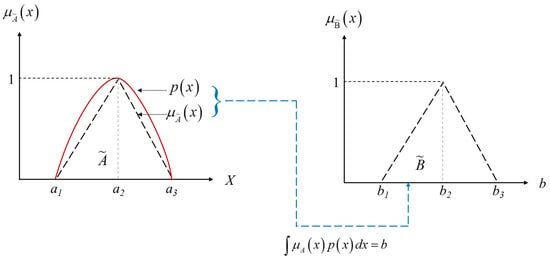
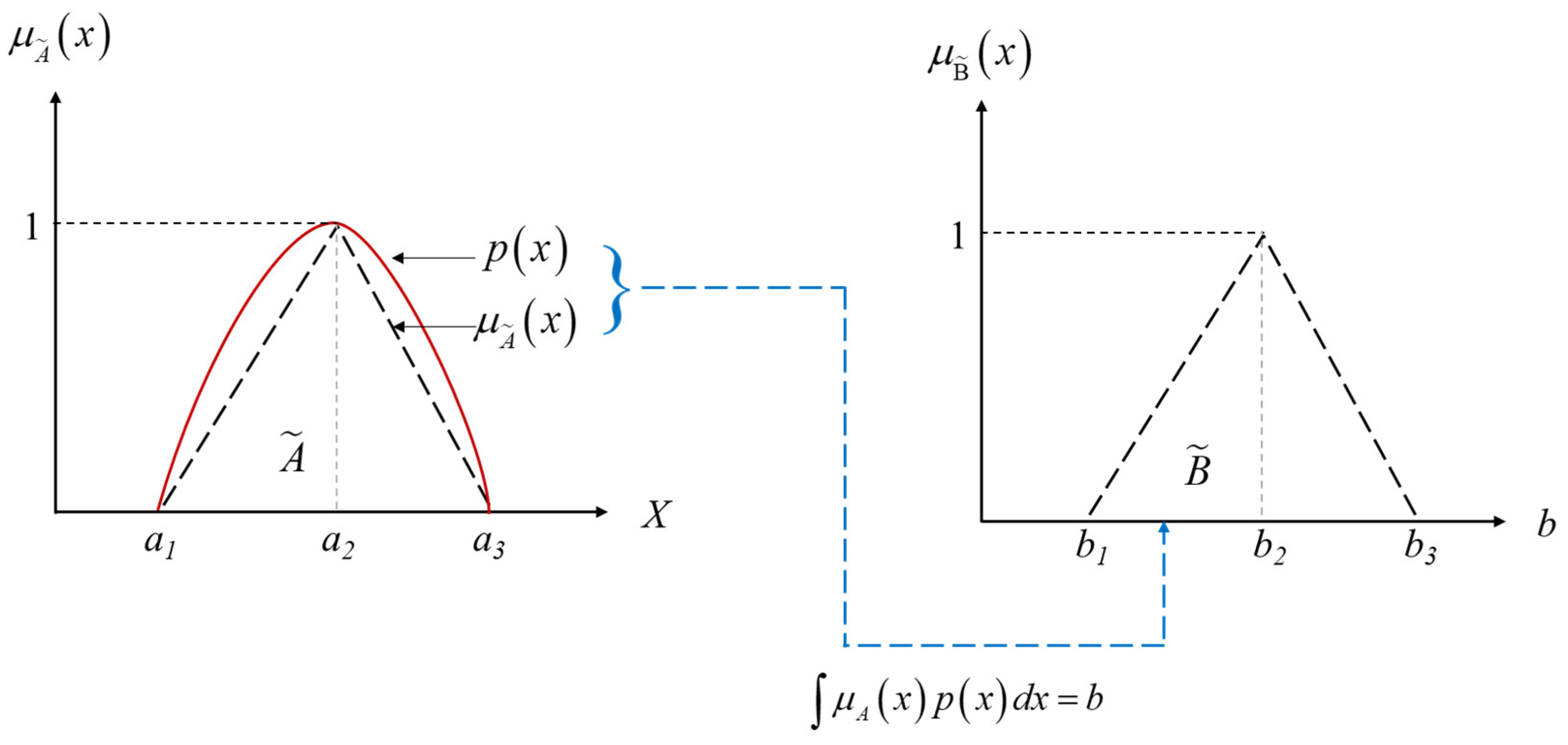
where is the membership function of the fuzzy set and represents the probability distribution function of the random variable to the fuzzy set . . x and R are the real value domain. The membership function of the fuzzy set is denoted as , . In addition, is B and thus the membership degree of the Z-numbers is . A graphical representation of Z-numbers is shown in Figure 1.
Figure 1.
Graphical representation of Z-numbers.
2.2. Arithmetical Operations of Discrete Z-Numbers
Let A1 and A2 be the discrete fuzzy numbers. The addition is the discrete fuzzy number whose α-cut is defined as Equation (2):
where ;
;
.
The membership function of A12 is defined as Equation (3):
The following introduces the arithmetical operations of discrete Z-numbers [21,22,23]. The Z-numbers and describe the random variables X1 and X2. The probability density functions of random variables X1 and X2 are p1 and p2, as shown in Equation (4):
where and .
The addition of two discrete Z-numbers Z1 and Z2 is denoted as in Equation (5):
where A12 is defined by Equations (2) and (3). The probability density function of Z12 is denoted as p12, which is shown in Equation (6):
The fuzzy restrictions B1 and B2 of A1 and A2 are denoted as Equation (7):
The fuzzy sets of probability distribution p1 and p2 induce the fuzzy set of convolutions p12s (), with the membership function defined as Equation (8):
where is the minimax operation.
The is a fuzzy set B12 with the membership function , which is defined as Equation (9):
2.3. ZE-Numbers
Z-numbers describe an event with the classical fuzzy number A in addition to a second fuzzy number B, which describes the reliability of the information for the fuzzy number A. Both fuzzy numbers A and B are evaluated by internal decision-makers. However, Tian et al. [5] believed that information reliability B is defined by the internal decision maker, which can cause excessive subjectivity. Therefore, Tian et al. [5] proposed ZE-numbers, which are used to vote for, against, or express hesitation on the information reliability given by the internal decision-maker, via external experts. The voting results further modify the information reliability to achieve a decision-making process that considers both subjective and objective opinions.
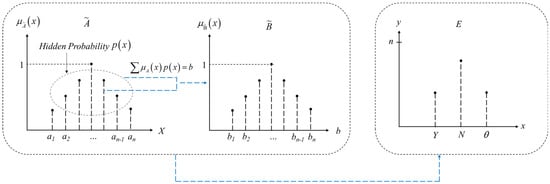
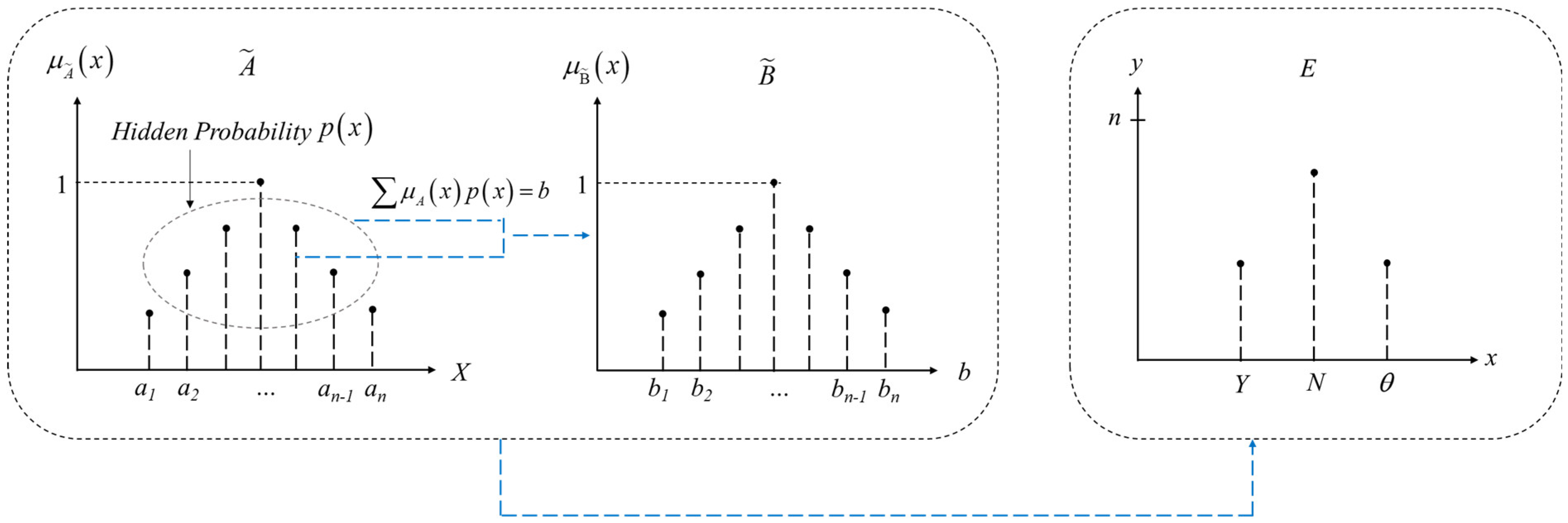
The ZE-numbers are defined as . A and B are the Z-numbers based on the original information; E are the evaluation numbers, which represent the credibility of the information for the original Z (A, B), and is evaluated through external expert group voting. E is interpretable as the group evaluation of an individual’s opinion, which can be viewed as a constraint on Z (A, B). E is denoted as , where Y is the number of approvals from group voting; N is the number against from group voting; and is the number of hesitations from group voting. A graphical representation of ZE-numbers is shown as Figure 2.
Figure 2.
Graphical representation of ZE-numbers (Tian et al. [5]).
ZE-numbers can be converted into Z-numbers by Equations (10)–(12):
where bij is the b of B of Z-numbers for the criteria Cj of the alternative Ai; is the adjusted value of bij for the criteria Cj of alternative Ai; Rij is the modified index for the criteria Cj of alternative Ai; Yij is the number of approvals from the group voting for the criteria Cj of alternative Ai; Nij is the number voting against, from group voting, for the criteria Cj of alternative Ai; is the number of hesitations from group voting for the criteria Cj of alternative Ai; n is the total number of votes.
If the adjustment index Rij is greater than 0, the information reliability will be increased; if the adjustment index Rij is less than 0, the information reliability will be decreased; if the adjustment index Rij is equal to 0, the information reliability given by the decision-makers within the company will be maintained.
2.4. Improved ELECTRE II
Elimination et Choix Traduisant la Realite II (ELECTRE II) was proposed by Benayoun et al. [24]. Lin et al. [20] believed that the concordance and concordance indices are under different units and are unreasonable. Therefore, Lin et al. redefined the concordance and discordance indices to propose an improved ELECTRE II. The following is the evaluation analysis process for the improved ELECTRE II method.
- Step 1. Establish a decision matrix
The three most important elements in the decision matrix are alternatives, criteria and weights. Alternatives are all the options that the decision-makers consider regarding the decision problem. Criteria are the directions for comparing each alternative. Weights are the importance of each criterion for the decision problem. The decision matrix is shown in Table 1.
Table 1.
Decision matrix.
- Step 2. Normalize the decision matrix.
The criteria are classified into benefit type and cost type, which can only be compared in the same direction, and therefore have to be normalized. The normalization for benefit-based criteria is calculated as Equation (13). The normalization for cost-based criteria is calculated as Equation (14):
- Step 3. Calculate concordance and discordance indices
It is necessary to divide the evaluation into three subsets for the concordance and discordance indices. Under criterion Cj, if the alternative Ax evaluation is superior to the alternative Ay, the criterion Cj is classified into set I+, as in Equation (15); if the alternative Ax evaluation is equal to the alternative Ay, the criterion Cj is classified into set I=, as in Equation (16); if the alternative Ax evaluation is inferior to the alternative Ay, the criterion Cj is classified into set I−, as in Equation (17):
- Step 3.1. Calculate the concordance index
The concordance index is the level of satisfaction of the decision-maker with the alternative when two alternatives are compared. The equation of the concordance index is shown in Equations (18)–(21):
- Step 3.2. Calculate the discordance index
The discordance index is the level of dissatisfaction of the decision-maker with the alternative when two alternatives are compared. The equation for the discordance index is shown as Equation (22):
- Step 4. Calculate the credibility degree
The discordance matrix needs to be subtracted from the concordance matrix before calculating the credibility, as shown in Equation (23):
where IRL first calculates . The numbers are shifted from the smallest to the largest, L is removed from the maximum value, and the remaining values are placed in set . Credibility is determined as follows in Equation (24):
where denotes the alternative Ax credibility in the L order; m is the alternatives’ number; and is a modification factor to ensure that no zero value occurs. The credibility matrix is shown in Equation (25):
where S is the credibility degree matrix.
- Step 5. Rank the alternatives
Starting from the degree of credibility , assume that alternative Ap has the most credibility (i.e., ). The alternative can be consideration of the best alternative (i.e., ). Then, remove alternative Ap from the credibility matrix, starting from the degree of credibility , assuming that alternative Aq has the most credibility (i.e., ). Alternative Aq is considered the second-best selection (i.e., ). Then, remove alternative Aq from the credibility matrix and so on.
3. Proposed ZE-ELECTRE II
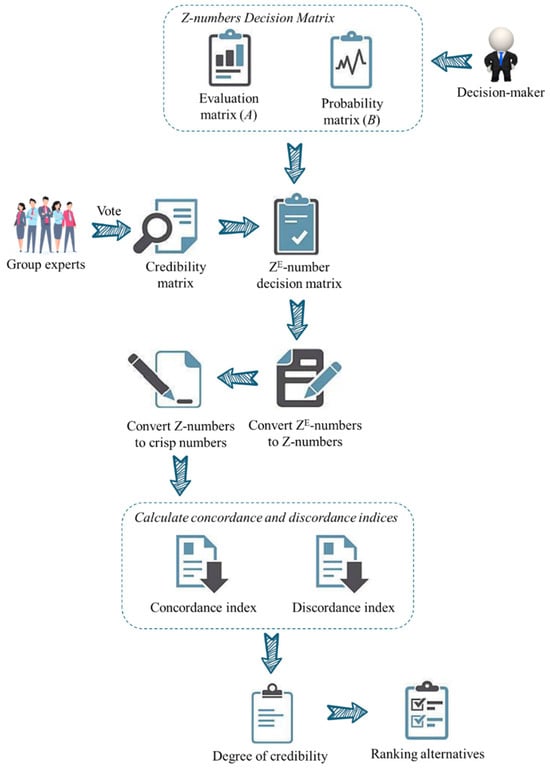
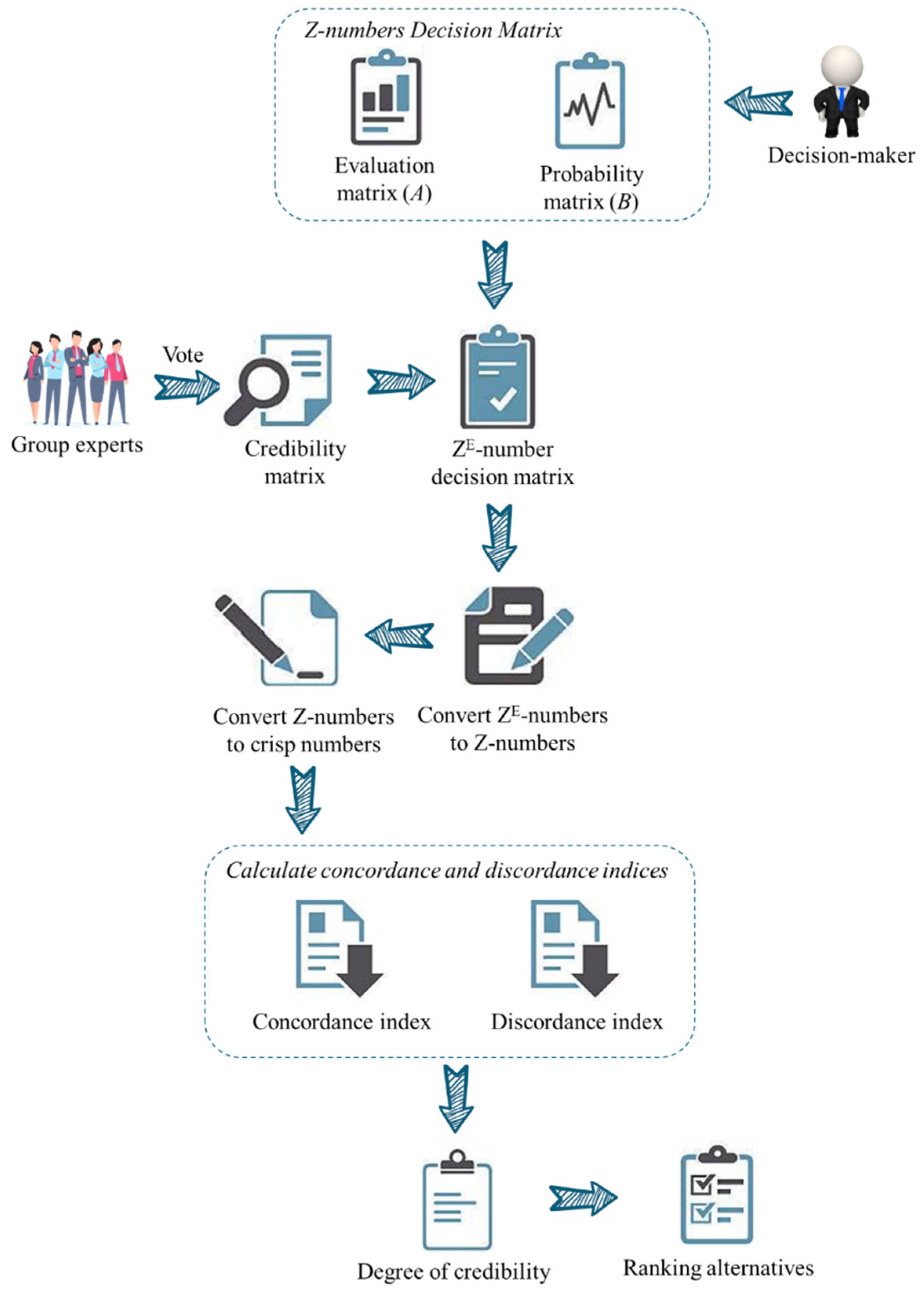
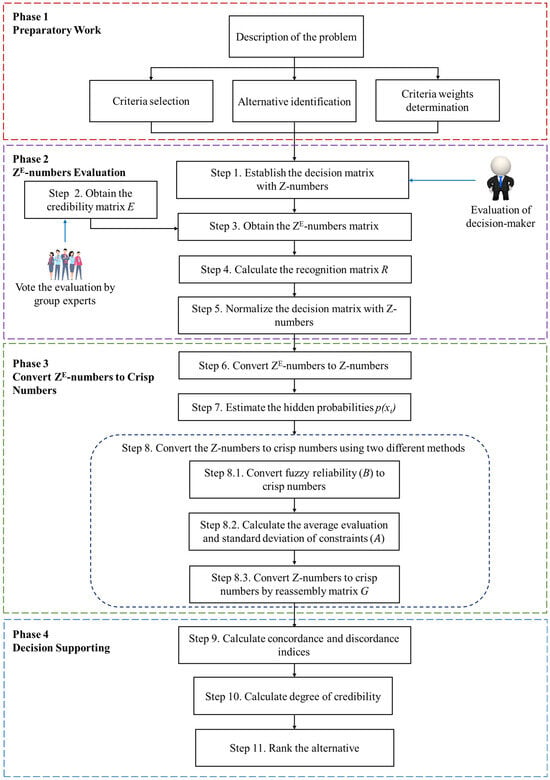
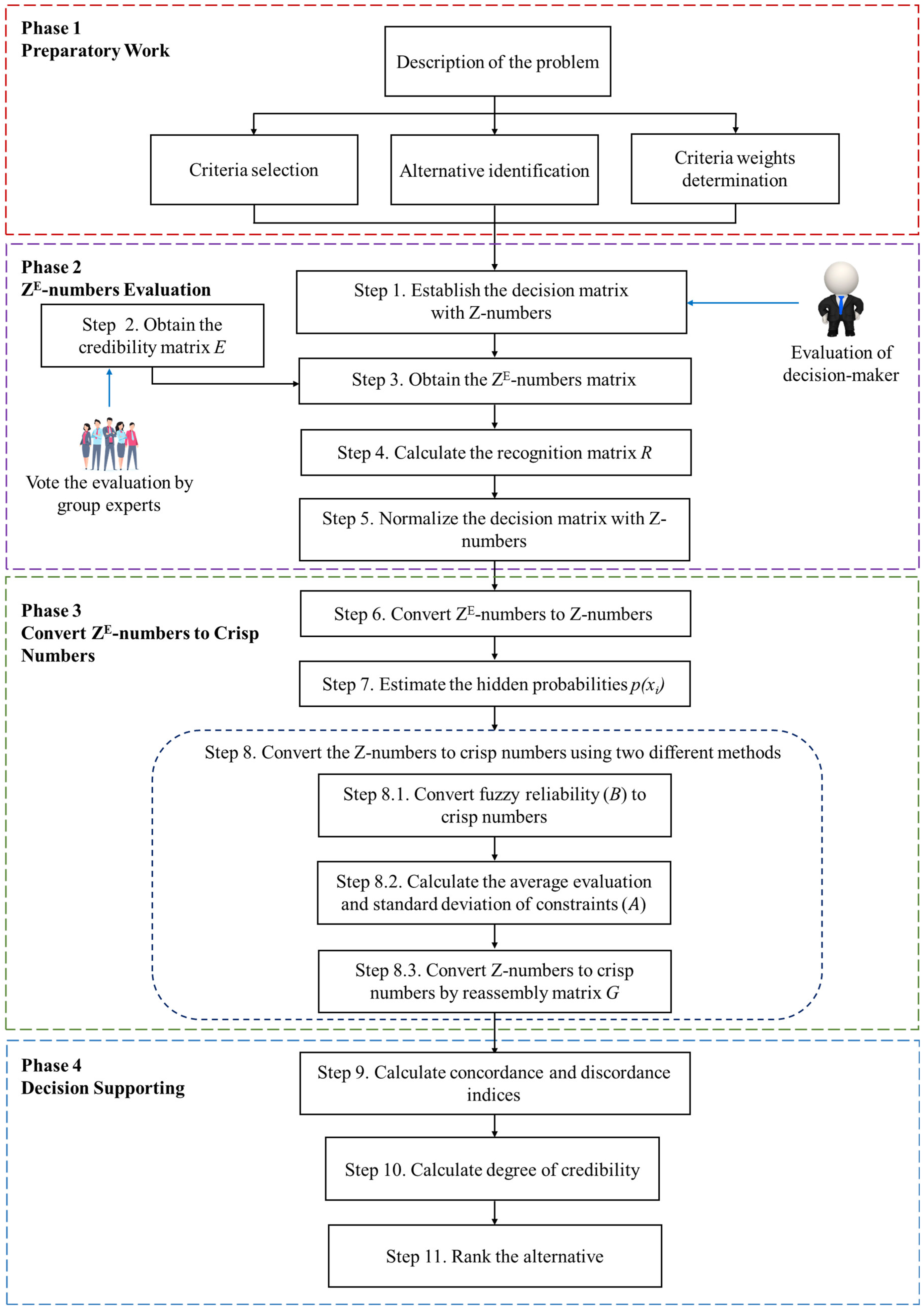
The most crucial advantage of ZE-numbers is that external experts can further examine the information reliability given by the internal decision-makers to ensure that subjective as well as objective information is taken into account in decision-making. In addition, this paper extends the ZE-numbers to the improved ELECTRE II proposed by Lin et al. [20]. Developing a new MCDM method under fuzzy environments and considering information reliability, we have ZE-ELECTRE II. The comprehensive representation of the proposed ZE-ELECTRE II methodology is shown in Figure 3. The flowchart for the proposed framework of ZE-ELECTRE II is shown in Figure 4.
Figure 3.
A comprehensive representation of the proposed ZE-ELECTRE II methodology.
Figure 4.
Flowchart for the proposed framework of ZE-ELECTRE II.
As shown in Figure 4, this study divides the decision-making framework of ZE-ELECTRE II into four stages as follows:
- Phase 1: The first stage is preparatory work, which consists of a description of the decision problem, identification of criteria, and of alternative and criteria weight.
- Phase 2: The second stage is ZE-numbers evaluation. The internal decision-maker provides the Z-number evaluation for each alternative and the information reliability under different criteria. In addition, external experts vote on the information reliability given by the internal decision-maker to correct this further so that the decision information can be both subjective and objective.
- Phase 3: The third stage is to convert the ZE-numbers evaluation into crisp numbers before proceeding to the improved ELECTRE II.
- Phase 4: The fourth stage is that of decision supporting, which ranks the programs based on the improved ELECTRE II proposed by Lin et al. [20].
The procedures for the proposed ZE-ELECTRE method and relative detail descriptions are shown as follows:
- Step 1. Establish the decision matrix with Z-numbers
The decision matrix with Z-numbers determined by internal decision-makers is shown as follows.
where Z is the decision matrix with Z-numbers; Zmn is the evaluation of the criteria Cn of the alternative Am (); represents the fuzzy numbers of the information of the criteria Cn of the alternative Am; is a fuzzy restriction on the probability measure of the reliability of of the criteria Cn of the alternative Am; ; is the lower bound evaluation of the criteria Cn of the alternative Am; is the middle value evaluation of the criteria Cn of the alternative Am; is the upper bound evaluation of the criteria Cn of the alternative Am; is the lower bound of reliability of the information of the criteria Cn of the alternative Am; is the middle value of reliability of the information of the criteria Cn of the alternative Am; is the upper bound of reliability of the information of the criteria Cn of the alternative Am.
- Step 2. Obtain the credibility matrix E
When the external experts vote on the information reliability given by the internal decision-makers, the credibility matrix can be obtained as follows.
where E is the credibility matrix; Emn is the number of approval, against, and hesitation votes after voting by external experts of the criteria Cn of the alternative Am; where Ymn is the number of approvals from the group voting of the criteria Cn of the alternative Am; Nmn is the number of against from the group voting of the criteria Cn of the alternative Am; is the number of hesitations from the group voting of the criteria Cn of the alternative Am.
- Step 3. Obtain the ZE-numbers matrix
The ZE-numbers matrix can be obtained by combining the decision matrix with Z-numbers and credibility matrix, shown as follows.
where ZE is the decision matrix with Z-numbers and credibility matrix; is the ZE-numbers of the criteria Cn of the alternative Am.
- Step 4. Calculate the recognition matrix R
Once the voting results of the external experts are available, the adjustment index for each item of information reliability can be calculated using Equation (11):
where R is the recognition matrix; Rmn is the adjustment index for reliability of information for the criteria Cn of alternative Am.
- Step 5. Normalize the decision matrix with Z-numbers
The normalization of benefits criteria are shown in Equation (26). The normalization of cost criteria are shown in Equation (27):
where ; . is the normalized lower bound evaluation for the criteria Cn of alternative Am; is the normalized middle value evaluation for the criteria Cn of alternative Am; is the normalized upper bound evaluation for the criteria Cn of alternative Am.
- Step 6. Convert ZE-numbers to Z-numbers
This paper uses Equation (10) proposed by Tian et al. [5] to convert ZE-numbers to Z-numbers in order to adjust the information reliability:
- Step 7. Estimate the hidden probabilities p(xi)
Zadeh [4] indicated that the potential probability distribution (x) is unknown. The only certainty is the restriction on (x), which can be expressed as is B. For discrete Z-numbers, this restriction is expressed as Equation (28). In addition, the constraints for (x) are shown in Equations (29) and (30):
This paper refers to Tian et al. [5], who used a maximum entropy optimization model for estimation of hidden probability distributions based on a genetic algorithm, as shown in Equation (31).
- Step 8. Convert the Z-numbers to crisp numbers
This paper converts Z-numbers to crisp numbers before the decision-making stage using the defuzzification method, which directs the conversion of Z-numbers to crisp numbers, proposed by Ezadi et al. [22].
- Step 8.1. Convert fuzzy reliability () to crisp numbers
After obtaining the hidden probability p(xi), the new restriction on A is obtained using Equation (32). The first step is converting reliability () into crisp numbers, shown in Equation (33):
where is the reliability obtained from the hidden probability; and is the defuzzification number of reliability ().
- Step 8.2. Calculate the average evaluation and standard deviation of constraints (A)
The average evaluation of constraints (A) is defined as the mean value and convex combination, which is calculated as in Equation (34):
where X is the average evaluation matrix of constraints (A); amn is the average evaluation of constraints (A) for the criteria Cn of alternative Am; ; .
The standard deviation of constraints (A) is defined as the combination of the convex combination definition and standard deviation, which is calculated as in Equation (35):
where STD is the standard deviation matrix of constraints (A); and STDmn is the standard deviation of constraints (A) for criteria Cn of alternative Am.
- Step 8.3. Convert Z-numbers to crisp numbers by reassembly of matrix G
This step obtains the reassembly matrix using steps 8.1 and 8.2, which is a direct conversion of Z-numbers to crisp numbers, as shown in Equation (36):
where G is the reassembly matrix; Gmn is the crisp numbers evaluation of constraints (A) for the criteria Cn of alternative Am.
- Step 9. Calculate concordance and discordance indices
It is necessary to categorize the alternative evaluations into one of three subsets for both concordance and discordance indices. This step can follow Equations (15)–(17) in step 3 in Section 2.4.
- Step 9.1. Calculate the concordance index
This step can follow Equations (18)–(21) in step 3.1 in Section 2.4, in order to calculate the concordance index.
- Step 9.2. Calculate the discordance index
This step can follow Equation (22) in step 3.2 in Section 2.4, in order to calculate the discordance index.
- Step 10. Calculate degree of credibility
This step can follow Equations (23)–(25) in step 4 in Section 2.4, in order to obtain the degree of credibility.
- Step 11. Rank the alternative
This step can follow step 5 in Section 2.4, in order to obtain the ranking of alternatives.
4. Illustrative Examples
4.1. Background Description
This paper refers to the illustrative examples of Puska et al. [25], which evaluated the selection of green suppliers. A total of six suppliers were selected and each supplier was evaluated against ten criteria (for a detailed description, please refer to Puska et al. [25]).
4.2. Calculation for Supplier Selection
- Phase 1: Preparatory Work
This is a group decision problem, with three internal decision-makers evaluating six alternatives and ten criteria in Z-numbers. The ten criteria are benefit types, as presented in Table 2.
Table 2.
Criteria for selection of green suppliers.
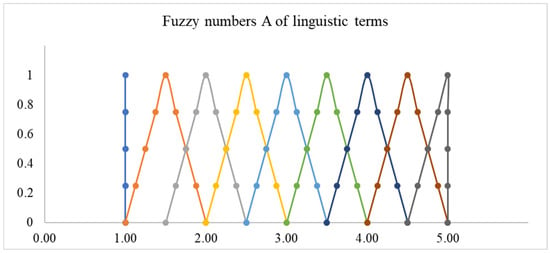
Three experts evaluated the performance of six suppliers based on ten criteria. These evaluations were measured using nine linguistic terms, from absolutely low (AL) to absolutely high (AH). There are nine points in each linguistic term, i.e., the fuzzy number A in Z-numbers. The linguistic terms for the fuzzy number A in Z-numbers are shown in Table 3 and Figure 5.
Table 3.
Linguistic terms for the fuzzy number A in Z-numbers.
Figure 5.
Linguistic terms for the fuzzy number A in Z-numbers.
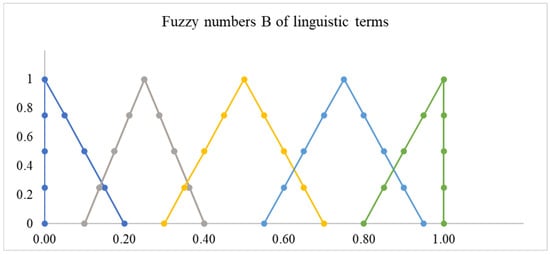
In order to understand the level of confidence of the three internal decision-makers in the given valuation, five linguistic terms from very small (VS) to very high (VH) are utilized to give the degree of reliability. There are nine points in each linguistic term, i.e., the fuzzy number B in Z-numbers. The linguistic terms for fuzzy number B in Z-numbers are shown in Table 4 and Figure 6.
Table 4.
Linguistic terms for fuzzy number B in Z-numbers.
Figure 6.
Linguistic terms for fuzzy number B in Z-numbers.
- Phase 2:ZE-numbers Evaluation
The internal decision-maker provides the Z-number evaluation for each alternative and the information reliability under different criteria. In addition, external experts vote on the information reliability given by the internal decision-makers to correct this further so that the decision information can be both subjective and objective. The steps are described below.
- Step 1. Establish the decision matrix with Z-numbers
Three internal decision-makers evaluated the performance of six green suppliers based on ten criteria using linguistic terms and further estimated the reliability of their evaluations. The results of the evaluation are shown in Table 5.
Table 5.
Evaluation results for three decision-makers using Z-numbers.
- Steps 2–3. Obtain the credibility matrix E and ZE-numbers’ matrix
The study of Puska et al. [25] is a decision-making problem for Z-numbers rather than ZE-numbers. Therefore, this paper assumes that 30 external experts will vote on the evaluation results of the three internal decision-makers to further revise the reliability of the decision information. Moreover, adopting the number of 30 external experts aims to mitigate the potential bias in the voting by outside experts. The votes of external experts on the evaluation of internal decision-makers can be categorized as approval (Y), against (N), and hesitation (θ). The study generates the voting results of 30 external experts using random numbers. The voting results are shown in Table 6.
Table 6.
Results of voting by 30 external experts.
- Step 4. Calculate the recognition matrix R
When the voting results of the external experts on the evaluation of the three internal decision makers are obtained, it is possible to determine whether the decision makers have overestimated or underestimated the evaluation of the given six alternatives under the ten criteria. Therefore, the adjustment index for each information reliability is calculated using Equation (13). The recognition matrix is shown in Table 7.
Table 7.
Recognition matrix.
- Step 5. Normalize the decision matrix with Z-numbers
Ten criteria in this case are of the benefit type, and the evaluations are normalized using Equation (14).
- Phase 3: Convert ZE-numbers Evaluation to Crisp Evaluation
ZE-numbers must be converted to crisp values before proceeding to the decision system stage. The detailed steps are as follows.
- Step 6. Convert ZE-numbers to Z-numbers
This paper uses Equation (10), proposed by Tian et al. [5], in order to adjust for information reliability. After the ZE-numbers of the three internal decision-makers were converted to Z-numbers, the evaluations and information reliability of three decision-makers were averaged to obtain the final Z-number evaluations and information reliability for the six alternatives under the ten criteria. The results of the transformed average Z-numbers are shown in Table 8.
Table 8.
Transformed average Z-number evaluations.
- Step 7. Estimate the hidden probabilities p(xi)
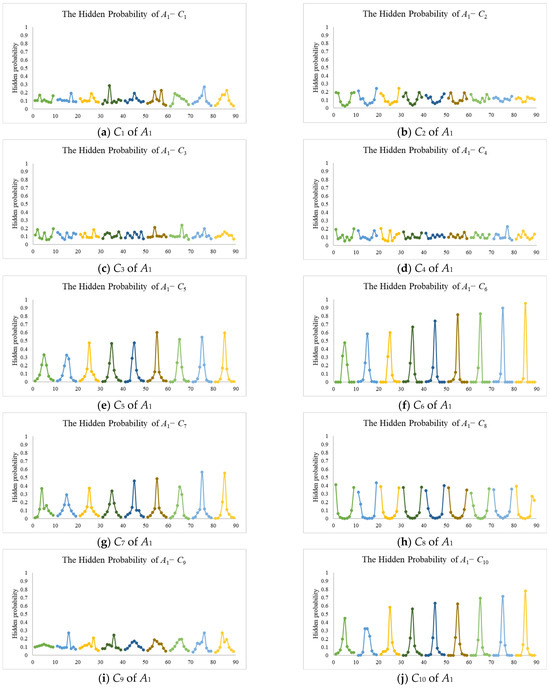
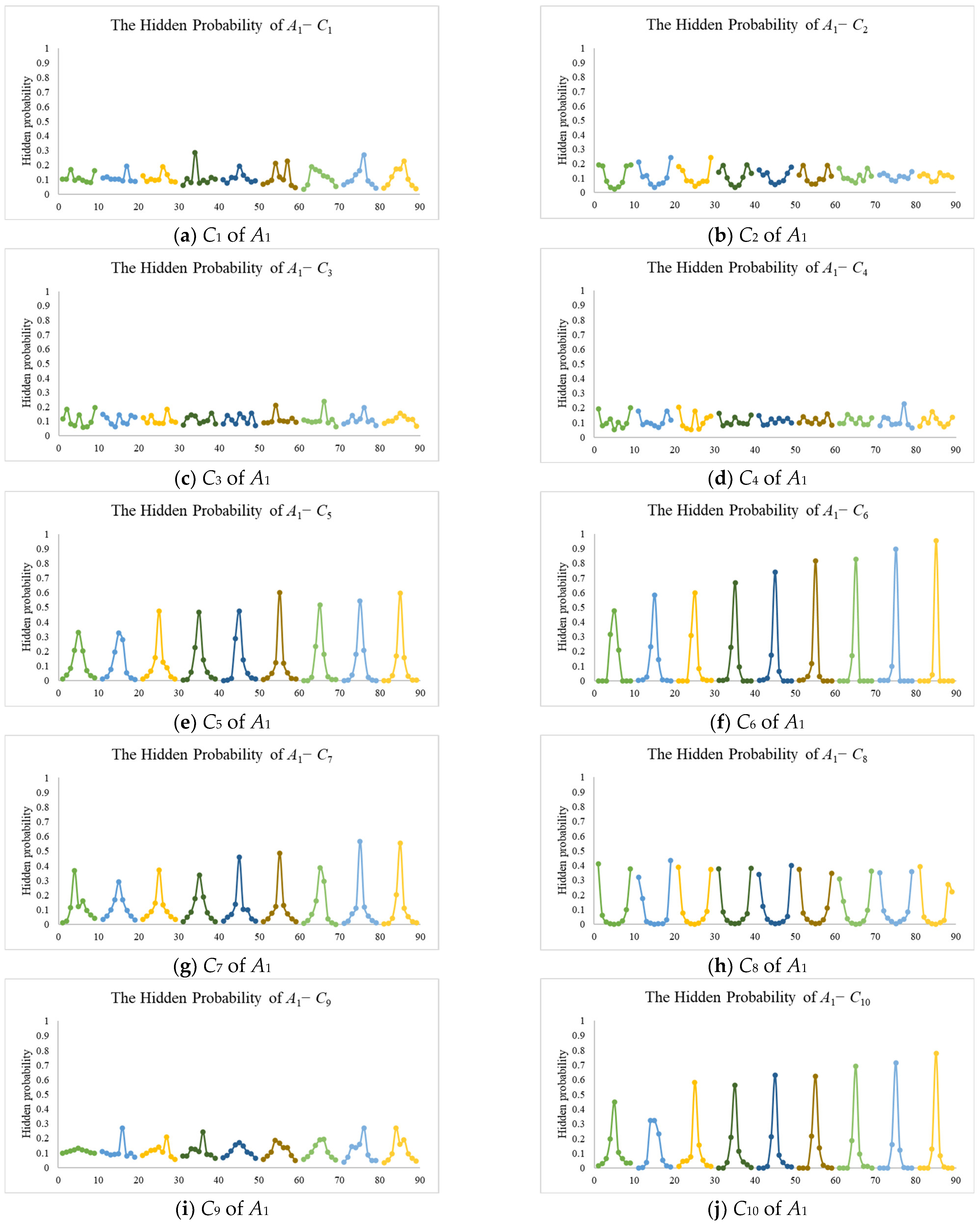
This paper refers to Tian et al. [5], who used a genetic algorithm-based maximum entropy optimization model to estimate the hidden probability distribution, as shown in Equations (28)–(31). Each alternative under each criterion has a set of hidden probabilities; each Z-number has its own hidden probability. In this case, six alternatives have ten criteria, making 60 hidden probability graphs. Due to the enormous amount, the study only shows the hidden probability graphs for C1 to C10 of A1. The hidden probability graphs are shown in Figure 7.
Figure 7.
Hidden probability of C1 to C10 of A1.
- Step 8. Convert the Z-numbers to crisp numbers
After obtaining the hidden probability p(xi), use Equations (32) and (33) to convert reliability () into crisp numbers. The information reliabilities with defuzzification are shown in Table 9. Use Equations (34) and (35) to calculate the average evaluation and standard deviation of constraints (A). The crisp numbers of Z-numbers are obtained using Equation (36), as shown in Table 10.
Table 9.
Information reliabilities with defuzzification.
Table 10.
Crisp numbers’ evaluation.
- Phase 4: Decision Supporting-Improved ELECTRE II
This paper follows the steps of the improved ELECTRE II, as seen in Section 2.4, to select the best green supplier.
- Step 9.1. Calculate concordance index
The concordance index is obtained using Equations (18)–(21) as follows:
- Step 9.2. Calculate the discordance index
Based on Equation (22), the discordance index can be computed as follows:
- Step 10. Calculate the credibility degree
The credibility degree is calculated using Equations (23) and (24) as follows:
- Step 11. Ranking of Alternatives
This paper uses a total number of 12 MCDM mtethods to solve this problem. In addition to the proposed ZE-ELECTRE II, this paper also uses traditional ELECTRE II [27], modified ELECTRE II [28], simple additive weighting (SAW) [29], TOPSIS [30], VIKOR [31], multi-objective optimization on the basis of ratio analysis (MOORA) [32], weighted aggregated sum product assessment (WASPAS) [33], MABAC [34], evaluation based on distance from average solution (EDAS) [35], CoCoSo [36], MARCOS [37]. The results are shown in Table 11.
Table 11.
Ranking of alternatives for green supplier selection.
5. Sensitivity Analysis
Sensitivity analysis was conducted to explore the robustness of the decision-making results under varying conditions. This section examines two primary dimensions of variability: external experts’ voting scenarios and criteria weight adjustments. The focus of Section 5.1 is on how different voting scenarios among external experts influence decision outcomes. By contrast, Section 5.2 investigates the impact of internal preferences, as reflected through systematic adjustments to the weights of the evaluation criteria. Together, these analyses provide complementary perspectives on the sensitivity of the decision-making process.
5.1. Impact of Voting Situations by External Experts
To understand the impact of external experts’ opinions on decision outcomes, we defined five distinct situations based on their voting patterns. In the original case study, votes were simulated randomly. Here, the five situations are:
- (1)
- Situation 1: More than 50% of votes are in approval.
- (2)
- Situation 2: More than 50% of votes are against.
- (3)
- Situation 3: More than 50% of votes are hesitant.
- (4)
- Situation 4: The ratio of approval to against votes is 2:1.
- (5)
- Situation 5: The ratio of approval to against votes is 1:2.
For each situation, the decision-making process was recalculated using the ZE-ELECTRE II framework. Results were analyzed to identify shifts in alternative rankings and assess the sensitivity of decision outcomes to variations in external expert opinions. Table 12 display the ranking results for the five situations.
Table 12.
Ranking of alternatives for green supplier selection with expert votes (situations 1–5).
5.2. Influence of Criteria Weight Adjustments
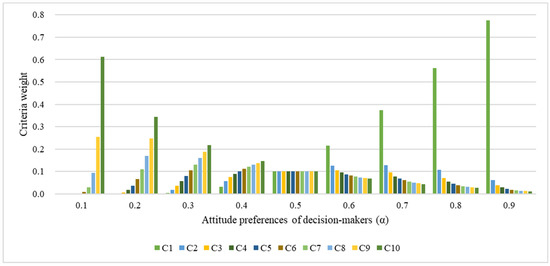
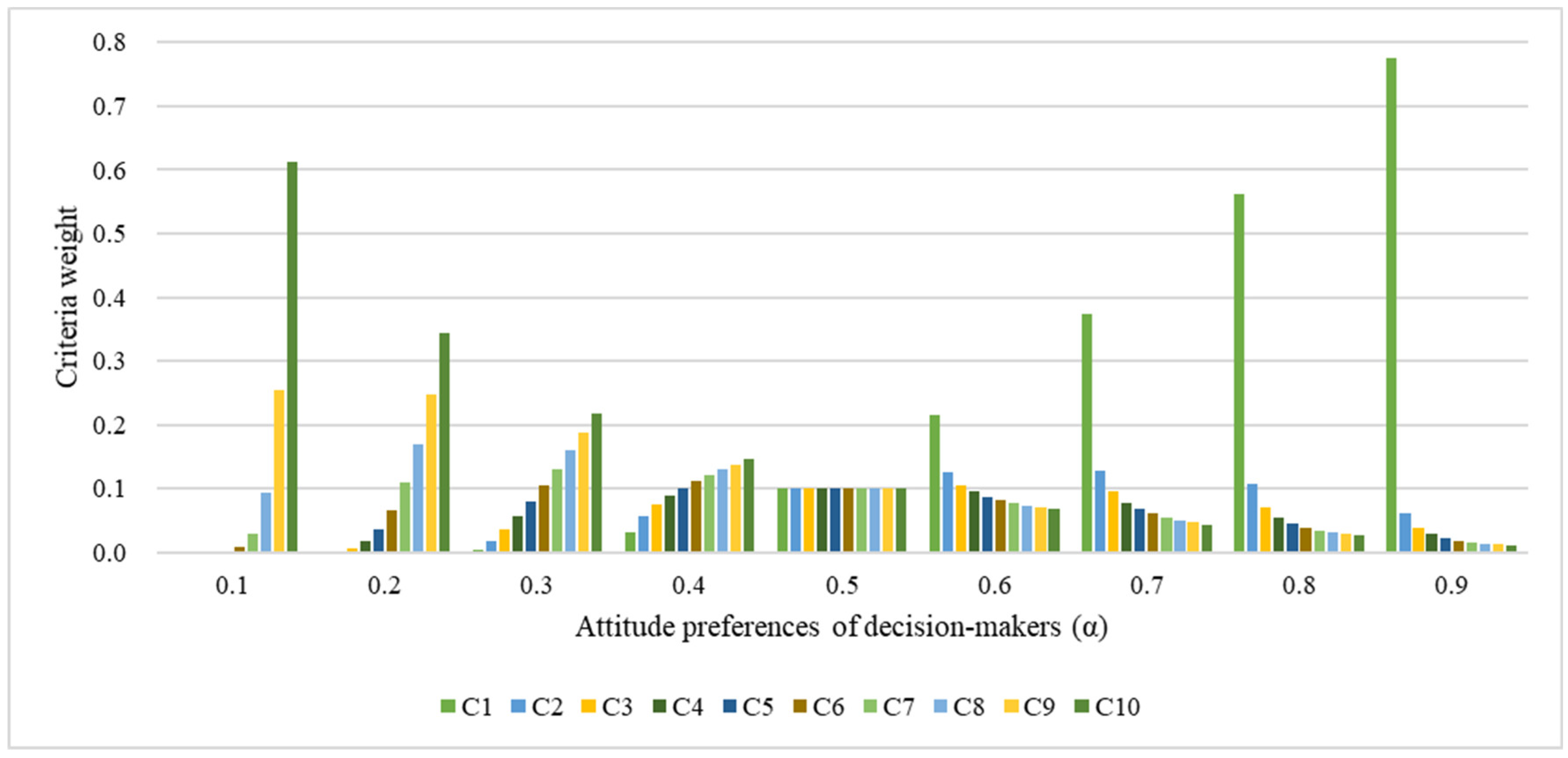
This subsection evaluates the sensitivity of rankings to changes in the relative importance of criteria. Decision-makers’ preferences were represented using ordered weighted averaging (OWA) weights, a concept proposed by Yager et al. [38]. The calculation formula is shown in Equation (37). Decision-maker preferences ranged from 0.1 to 0.9, covering nine distinct levels of preference intensity. Through this setup, nine sets of weights for the ten criteria were generated. For each preference level, we applied the six situations described in Section 5.1, resulting in 54 combinations of decision contexts.
where is the attitude preferences of decision-makers. For each preference level, we applied the random voting and five situations described in Section 5.1, resulting in 54 combinations of decision contexts.
Table 13.
OWA weights assigned to each attribute based on varying preferences.
Figure 8.
OWA weights with different attitude preferences of decision-makers.
Table 14 displays the ranking results for the random voting and five situations with OWA wights under different attitude preferences of decision-makers using ZE-ELECTRE II as proposed in this paper.
Table 14.
Ranking of alternatives for green supplier selection with OWA weights.
6. Results and Discussion
In this paper, the novel ZE-ELECTRE II is first proposed by combining Z-numbers with improved ELECTRE II. This paper uses a green supply chain decision-making problem in industrial engineering as an illustrative example based on ZE-numbers. This example of supplier selection is derived from Puska et al. [25], using a Z-numbers decision problem with a group decision of three decision makers. Therefore, this paper assumes that 30 external experts vote for each of the three evaluation values given by internal decision-makers. The following is an analysis of the results.
- (1)
- The issue of green supplier selection is a decision-making problem that is often used in practice. In the decision-making process, it is often impossible to give a crisp value in the face of multiple criteria, thus giving the opportunity for fuzzy number implantation. The proposed ZE-ELECTRE II method demonstrates strong applicability in addressing uncertainties commonly encountered in green supplier evaluation by utilizing ZE-numbers. These uncertainties, such as fluctuating environmental performance metrics or subjective assessments of sustainability practices, are systematically managed through a framework that combines both subjective and objective criteria. This integration ensures that decisions are not overly biased or arbitrary, thus enhancing the transparency and defensibility of supplier evaluations.
- (2)
- Furthermore, in the operation of this study example, in addition to the internal experts as the first level of evaluation, external experts (as the second level) are added to recheck the first level of scores. Thus, the entire evaluation process is more rigorous and the results are more trustworthy.
- (3)
- The sensitivity analysis provided by ZE-ELECTRE II further aids managers by anticipating potential decision shifts under different scenarios, thereby reducing the risks of selecting suppliers who may underperform environmentally or financially. Additionally, the use of OWA allows decision-makers to dynamically adjust weights based on varying stakeholder preferences, such as prioritizing sustainability over cost. This flexibility is essential for aligning supplier selection with organizational sustainability goals. By integrating these features, ZE-ELECTRE II not only supports environmentally responsible decision-making but also ensures robust and reliable outcomes in green supplier selection.
- (4)
- This paper assumes voting results using random numbers. As shown in Table 11, via the ZE-ELECTRE II proposed in this paper, the third supplier (A3) was chosen as the best green supplier. The result was supported by the other eleven previous methods [23,24,25,26,27,28,29,30,31,32,33]. The robustness of ZE-ELECTRE as proposed in this paper can thus be seen.
- (5)
- Figure 7 shows the hidden probabilities from C1 to C10 of A1. From the nine figures, it can be seen that some probability distributions show an inverted bell shape; some are pulled up, and some are lowered. For example, Figure 7e,f obviously increase the reliability of the information. As is known from the voting results of the external experts, there are more votes in approval than against, and the number of approval votes is more than half of the total number of votes. Figure 7h significantly decreases reliability and displays an inverted bell shape. From the voting results of the external experts, the number of votes against is more than the number of approval votes, and the number of votes against is more than half of the total number of votes cast. All the other figures slightly decrease the reliability of the information.
- (6)
- Impact of voting situations by external experts
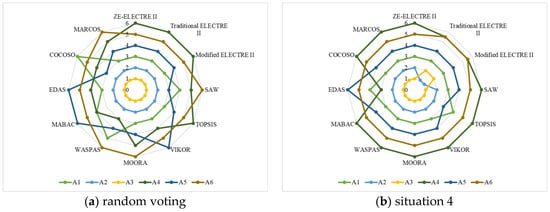
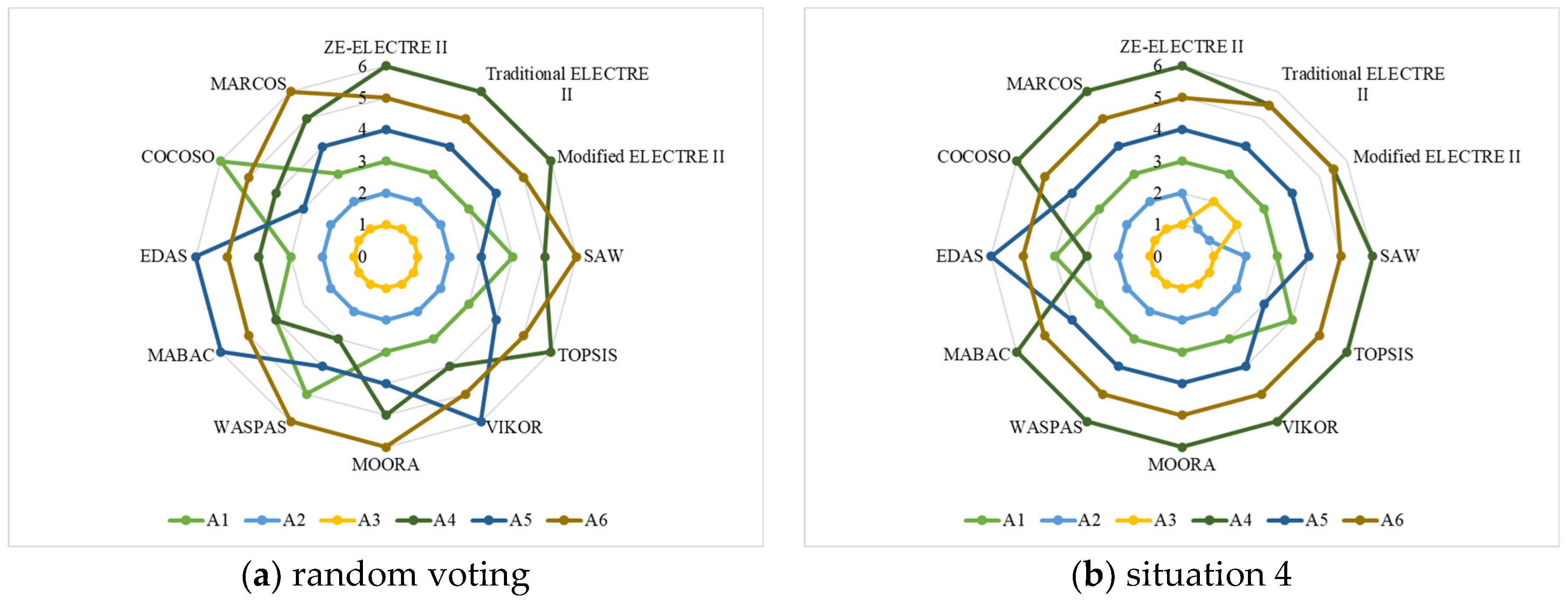
- From Figure 9a,b, it can be observed that, under the random voting situation, all methods selected A3 as the top-ranked alternative, demonstrating the stability of these methods. However, in the results for situation 4, it was found that the traditional ELECTRE II and ELECTRE II proposed by An et al. selected A2 as the top-ranked alternative, which differs from the selection made by ZE-ELECTRE II and other MCDM methods. This difference primarily arises because these two methods do not consider the magnitude of the differences between alternatives but rely solely on weight-based calculations, leading to this result. Additionally, these methods also struggle to differentiate between alternatives that are very similar.Figure 9. Sensitivity analysis of different voting situations.
- The ZE-ELECTRE II method consistently identified the same top-ranked alternative as other MCDM methods, demonstrating its reliability in selecting the best option.
- Traditional ELECTRE II [27] and modified ELECTRE II [28] were found to exhibit limitations in differentiating between similar alternatives, often leading to ties in the rankings. ZE-ELECTRE II’s ability to effectively distinguish between highly similar alternatives enhances its practical applicability, particularly in complex decision-making scenarios where alternatives have subtle differences.
- ZE-ELECTRE II demonstrated a balance between sensitivity and stability. While ranking results showed minor variations in hesitant-majority scenarios, the method consistently provided a clear decision direction.
- Patterns and trends in rankings revealed that, even under distinct voting distributions, such as a 2:1 or 1:2 ratio of approval to against votes, the overall ranking trends remained consistent, highlighting the method’s adaptability to different expert opinions.
- (7)
- Influence of criteria weight adjustments
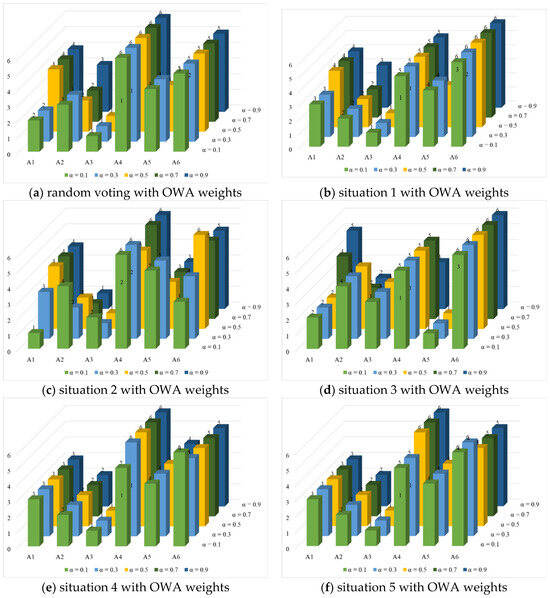
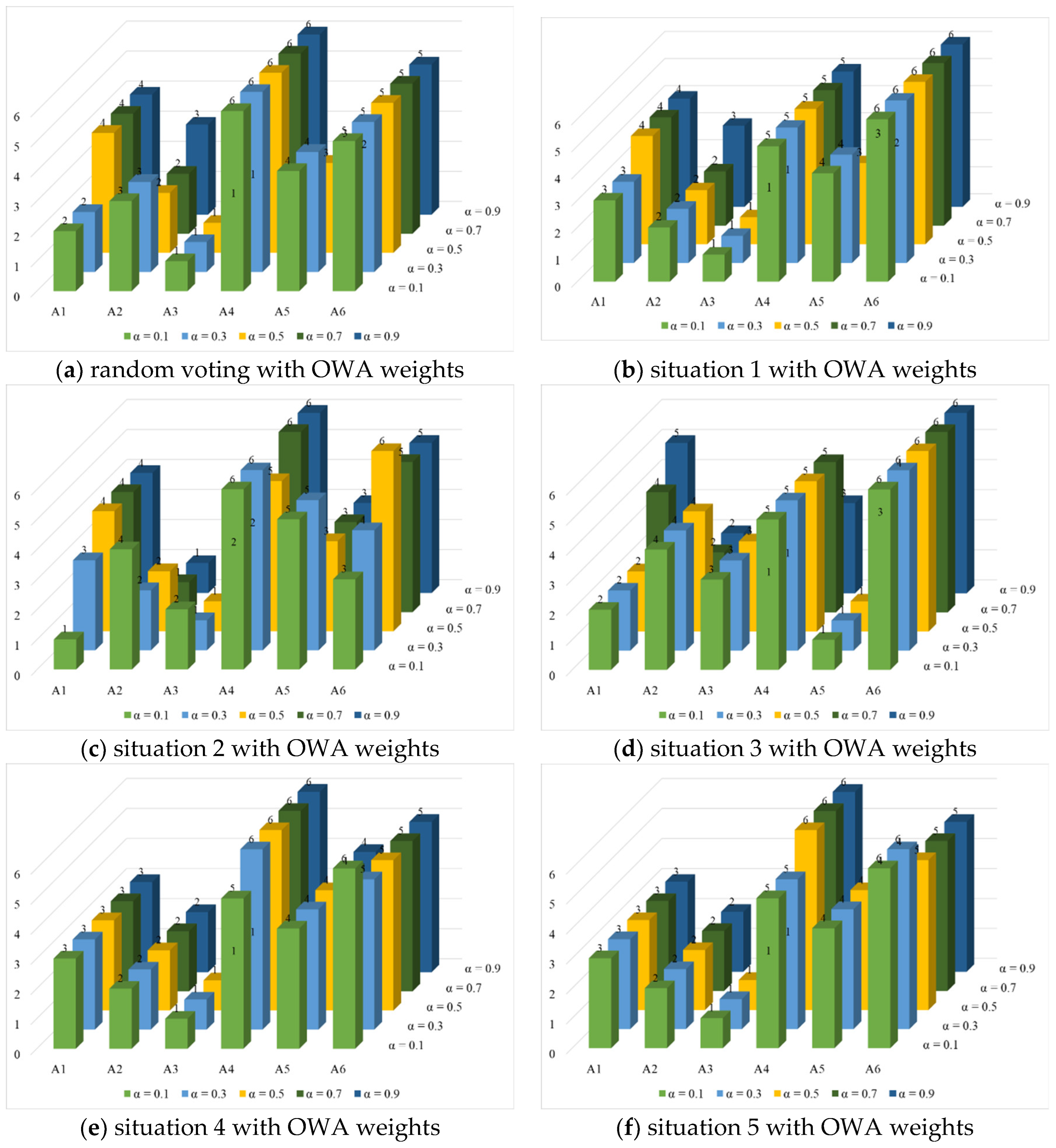
- From Table 14 and Figure 10a (random voting with OWA weights), A3 consistently ranks first across all decision-maker preferences (α = 0.1 to α = 0.9), demonstrating its strong competitiveness even under random voting conditions. A4, A5, and A6 remain consistently ranked lower, with minimal fluctuation, indicating their weaker performance in the evaluated criteria. The stability of rankings in a random scenario showcases ZE-ELECTRE II’s robustness in handling unstructured or arbitrary voting inputs.Figure 10. Sensitivity analysis of different voting situations with OWA weights.
- From Table 14 and Figure 10b (situation 1: majority approval with OWA weights), A3 maintains its dominance as the top-ranked option, reflecting its alignment with the majority approval perspective. A1 sees slight improvements in rankings at higher α values (α ≥ 0.5), indicating its growing competitiveness under more optimistic decision-maker preferences. Lower-ranked alternatives (A5 and A6) consistently remain at the bottom, unaffected by changes in α, suggesting their limited adaptability in this scenario.
- From Table 14 and Figure 10c (situation 2: majority against with OWA weights), A1 achieves the top rank at α = 0.1, reflecting its ability to align with more pessimistic decision-maker preferences. A3 regains its dominant position as α increases, underscoring its adaptability and resilience across varying preferences. A2, A4, A5, and A6 experience minor shifts, but their relative rankings remain largely consistent, indicating limited sensitivity to the majority against perspective.
- From Table 14 and Figure 10d (situation 3: hesitant majority with OWA weights), A5 emerges as the top-ranked option at α = 0.1 to α = 0.5, reflecting its competitiveness under more conservative decision-maker preferences. As α increases, A3 progressively takes over the top rank, demonstrating its ability to outperform in less hesitant contexts. A hesitant majority leads to greater variability in rankings compared to other scenarios, reflecting the complexity of aggregating indecisive inputs.
- From Table 14 and Figure 10e (situation 4: approval to against ratio 2:1 with OWA weights), A3 retains its dominance as the top-ranked alternative across all α values, reflecting its strong alignment with this favorable voting distribution. A2 and A1 show competitive performance but consistently trail behind A3, indicating their limited ability to outperform under this scenario. Lower-ranked alternatives (A5 and A6) remain unaffected by changes in α, highlighting their weaker adaptability.
- From Table 14 and Figure 10f (situation 5: approval to against ratio 1:2 with OWA weights), A3 consistently ranks first across all α values, showcasing its resilience even under less favorable voting distributions. A2 and A1 maintain their positions as close competitors, but they fail to surpass A3, highlighting its consistent strength. A4, A5, and A6 remain at the bottom, further confirming their limited competitiveness under this scenario.
- Across all situations and decision-maker preferences (α = 0.1 to α = 0.9), the top-ranked alternative remains stable for the majority of scenarios. This demonstrates the robustness and reliability of ZE-ELECTRE II in identifying the best alternative under varying conditions.
- Variations in rankings for specific alternatives (A5 and A6) show that ZE-ELECTRE II reflects the impact of decision-maker preferences. The method effectively captures shifts in rankings as preferences change from pessimistic (α = 0.1) to optimistic (α = 0.9) attitudes.
- Across all five structured voting scenarios, the rankings adapt well to different distributions of approval, hesitation, and opposition. This adaptability underscores ZE-ELECTRE II’s suitability for dynamic decision-making contexts.
- ZE-ELECTRE II consistently avoids ties between similar alternatives, even in hesitant or polarized scenarios (situation 3 or situation 5). This ability to provide clear rankings is a key advantage over traditional ELECTRE II and related methods.
7. Conclusions
This study proposes a ZE-ELECTRE II approach, a novel MCDM decision-making method based on ZE-numbers. Furthermore, this research illustrates the decision problem of green supplier selection and simulates the results of external experts under random voting scenarios. The voting results are used to modify the information reliability, combining internal subjective and external objective decision-making opinions to avoid the issue of internal decision-makers being excessively subjective. Additionally, the proposed ZE-ELECTRE II is applicable not only to individual decision-making problems but also to group decision-making scenarios.
Moreover, this study conducts a sensitivity analysis based on various voting results from external experts, which highlights the robustness of the proposed ZE-ELECTRE II method. The sensitivity analysis also demonstrates how the decision outcomes are influenced by the criteria weights set by internal decision-makers. By employing the OWA method, the study incorporates decision-makers’ preference attitudes, showcasing the effectiveness of dynamic decision-making. The findings confirm that ZE-numbers can be effectively integrated into MCDM problems in uncertain environments. Through the operation of ZE-numbers, an additional layer of review and evaluation by external experts is introduced, making the decision-making process more rigorous and reducing potential opportunity or financial losses caused by bias.
In the future research, we will pursue three directions: (1) We can direct the proposed framework, expanding ZE-numbers to other MCDM methods and analyzing and comparing with existing MCDM methods to provide practical applications in industry and providing references for other researchers; (2) It is also possible to explore probabilistic and interval versions of ZE-numbers for the solving of industrial engineering problems; (3) Integrating machine learning concepts with ZE-numbers, an intelligent decision support system for handling real-time decision problem will be developed.
Author Contributions
T.-Y.L.: Conceptualization, Methodology, Software, Validation, Formal analysis, Investigation, Resources, Data Curation, Writing—Original Draft preparation, Writing—Review and Editing, Visualization. K.-C.H.: Conceptualization, Methodology, Validation, Formal analysis, Investigation, Writing—Review and Editing, Visualization, Supervision, Project administration. J.J.: Writing—Review and Editing, Investigation, Validation. K.-P.L.: Writing—Review and Editing, Investigation, Validation. All authors have read and agreed to the published version of the manuscript.
Funding
This research received no external funding.
Data Availability Statement
The original contributions presented in this study are included in the article. Further inquiries can be directed to the corresponding author.
Acknowledgments
We greatly appreciate the financial support from Mathematics MDPI. This paper is supported by the National Science and Technology Council of the Republic of China, Taiwan (NSTC 113-2222-E-029-005).
Conflicts of Interest
The authors declare no conflicts of interest.
References
- Zadeh, L.A. Information and control. Fuzzy Sets 1965, 8, 338–353. [Google Scholar]
- Zadeh, L.A. The concept of a linguistic variable and its application to approximate reasoning—I. Inf. Sci. 1975, 8, 199–249. [Google Scholar] [CrossRef] [Scilit]
- Atanassov, K. Intuitionistic fuzzy sets. Fuzzy Sets Syst. 1986, 20, 87–96. [Google Scholar] [CrossRef] [Scilit]
- Zadeh, L.A. A Note on Z-numbers. Inf. Sci. 2011, 181, 2923–2932. [Google Scholar] [CrossRef] [Scilit]
- Tian, Y.; Mi, X.; Ji, Y.; Kang, B. ZE-numbers: A new extended Z-numbers and its application on multiple attribute group decision making. Eng. Appl. Artif. Intell. 2021, 101, 104225. [Google Scholar] [CrossRef] [Scilit]
- Azadeh, A.; Saberi, M.; Atashbar, N.Z.; Chang, E.; Pazhoheshfar, P. Z-AHP: A Z-number extension of fuzzy analytical hierarchy process. In Proceedings of the 2013 7th IEEE International Conference on Digital Ecosystems and Technologies (DEST), California, CA, USA, 24–26 July 2013. [Google Scholar]
- Yaakob, A.M.; Gegov, A. Interactive TOPSIS based group decision making methodology using Z-Numbers. Int. J. Comput. Intell. Syst. 2014, 9, 311–324. [Google Scholar] [CrossRef] [Scilit]
- Azadeh, A.; Kokabi, R. Z-number DEA: A new possibilistic DEA in the context of Z-numbers. Adv. Eng. Inform. 2016, 30, 604–617. [Google Scholar] [CrossRef] [Scilit]
- Aboutorab, H.; Saberi, M.; Asadabadi, M.R.; Hussain, O.; Chang, E. ZBWM: The Z-number extension of best worst method and its application for supplier development. Expert Syst. Appl. 2018, 107, 115–125. [Google Scholar] [CrossRef] [Scilit]
- Shen, K.W.; Wang, J.Q. Z-VIKOR method based on a new comprehensive weighted distance measure of Z-number and its application. IEEE Trans. Fuzzy Syst. 2018, 26, 3232–3245. [Google Scholar] [CrossRef] [Scilit]
- Fan, J.; Guan, R.; Wu, M. Z-MABAC method for the selection of third-party logistics suppliers in fuzzy environment. IEEE Access 2020, 8, 199111–199119. [Google Scholar] [CrossRef] [Scilit]
- Unsal, O.; Demir, G.; Karakus, C.B.; Pamucar, D. Application of Z-number based fuzzy MCDM in solar power plant location selection problem in Spatial planning. Energy Rep. 2024, 12, 4034–4054. [Google Scholar] [CrossRef] [Scilit]
- Ashraf, S.; Akram, M.; Jana, C.; Jin, L.; Pamucar, D. Multi-criteria assessment of climate change due to green house effect based on Sugeno Weber model under spherical fuzzy Z-numbers. Inf. Sci. 2024, 606, 120428. [Google Scholar] [CrossRef] [Scilit]
- Gottwald, D.; Chocholac, J.; Çodur, M.K.; Cubranic-Dobrodolac, M.; Yazir, K. Z-Numbers-Based MCDM Approach for Personnel Selection at Institutions of Higher Education for Transportation. Mathematics 2024, 12, 523. [Google Scholar] [CrossRef] [Scilit]
- Haseli, G.; Torkayesh, A.E.; Hakiaghaei-Keshteli, M.; Venghaus, S. Sustainable resilient recycling partner selection for urban waste management: Consolidating perspectives of decision-makers and experts. Appl. Soft Comput. 2023, 127, 110120. [Google Scholar] [CrossRef] [Scilit]
- Haseli, G.; Ogel, I.Y.; Ecer, F.; Hajiaghaei-Keshteli, M. Luxury in female technology (FemTech): Selection of smart jewelry for women through BCM-MARCOS group decision-making framework with fuzzy ZE-numbers. Technol. Forecast. Soc. Chang. 2023, 196, 122870. [Google Scholar] [CrossRef] [Scilit]
- Haseli, G.; Bonab, S.R.; Hajiaghaei-Keshteli, M.; Ghoushchi, S.J.; Deveci, M. Fuzzy ZE-numbers framework in group decision-making using the BCM and CoCoSo to address sustainable urban transportation. Inf. Sci. 2024, 653, 119809. [Google Scholar] [CrossRef] [Scilit]
- Haseli, G.; Deveci, M.; Isik, M.; Gokasar, I.; Pamucar, D.; Hakiaghaei-Keshteli, M. Providing climate change resilient land-use transport projects with green finance using Z extended numbers based decision-making model. Expert Syst. Appl. 2024, 243, 122858. [Google Scholar] [CrossRef] [Scilit]
- Ecer, F.; Haseli, G.; Krishankumar, R.; Hakiaghaei-Keshteli, M. Evaluation of sustainable cold chain suppliers using a combined multi-criteria group decision-making framework under fuzzy ZE-numbers. Expert Syst. Appl. 2024, 245, 123063. [Google Scholar] [CrossRef] [Scilit]
- Lin, T.Y.; Hung, K.C.; Lin, K.P.; Hon, J.S.; Chiu, A.S.F. Improved ELECTRE II sustainability assessment framework in power generation technological evaluation. J. Intell. Fuzzy Syst. 2022, 43, 6405–6418. [Google Scholar] [CrossRef] [Scilit]
- Aliev, R.A.; Alizadeh, A.V.; Huseynov, O.H. The arithmetic of discrete Z-numbers. Inf. Sci. 2015, 290, 134–155. [Google Scholar] [CrossRef] [Scilit]
- Ezadi, S.; Allahviranloo, T.; Mohammadi, S. Two new methods for ranking of Z-numbers based on sigmoid function and sign method. J. Intell. Fuzzy Syst. 2018, 33, 1476–1487. [Google Scholar] [CrossRef] [Scilit]
- Jiang, W.; Xie, C.; Luo, Y.; Tang, Y. Ranking Z-numbers with an improved ranking method for generalized fuzzy numbers. J. Intell. Fuzzy Syst. 2017, 32, 1931–1943. [Google Scholar] [CrossRef] [Scilit]
- Benayoun, R.; Roy, B.; Sussman, B. ELECTRE: Une methode pour guider le choix en presence de points de vue multiples. Note De Trav. 1966, 49, 2–120. [Google Scholar]
- Puska, A.; Bozanic, D.; Medeljkovic, M.; Janosevic, M. Green supplier selection in an uncertain environment in agriculture using a hybrid MCDM model: Z-Numbers–Fuzzy LMAW–Fuzzy CRADIS Model. Axioms 2022, 11, 417. [Google Scholar] [CrossRef] [Scilit]
- Environmental Management Systems—Requirements with Guidance for Use. International Organization for Standardization: Geneva, Switzerland, 2015.
- Roy, B.; Bertier, P. La method ELECTRE II. Note De Trav. 1971, 142, 25. [Google Scholar]
- An, D.; Xi, B.; Wang, Y.; Xu, D.; Tang, J.; Dong, L.; Ren, J.; Pang, C. A sustainability assessment methodology for prioritizing the technologies of groundwater contamination remediation. J. Clean. Prod. 2016, 112, 4647–4656. [Google Scholar] [CrossRef] [Scilit]
- Churchman, C.W.; Ackoff, R.L. An approximate measure of value. J. Oper. Res. Soc. Am. 1954, 2, 172–187. [Google Scholar] [CrossRef] [Scilit]
- Hwang, C.L.; Yoon, K. Multiple Attribute Decision Making Methods and Applications: A State of the Art Survey; Springer: Berlin/Heidelberg, Germany, 1981. [Google Scholar]
- Opricovic, S. Multicriteria Opitimization of Civil Engineering Systems; Faculty of Civil Engineering: Belgrade, Serbia, 1998. [Google Scholar]
- Brauers, W.K.; Zavadskas, E.K. The MOORA method and its application to privatization in a transition economy. Control Cybern. 2006, 35, 445–469. [Google Scholar]
- Zavadskas, E.K.; Turskis, Z.; Antucheviciene, J.; Zakare-vicius, A. Optimization of weighted aggregated sum product assessment. Elektron. Ir Elektrotechnika 2012, 122, 3–6. [Google Scholar] [CrossRef] [Scilit]
- Pamucar, D.; Cirovic, G. The selection of transport and handling resources in logistics centers using multi-attributive border approximation area comparison (MABAC). Expert Syst. Appl. 2015, 42, 3016–3028. [Google Scholar] [CrossRef] [Scilit]
- Ghorabaee, M.K.; Zavadskas, E.K.; Olfat, L.; Turskis, Z. Multi-criteria inventory classification using a new method of evaluation based on distance from average solution (EDAS). Informatica 2015, 26, 435–451. [Google Scholar] [CrossRef] [Scilit]
- Yazdani, M.; Zarate, P.; Zavadskas, E.K.; Turskis, Z. A combined compromise solution (CoCoSo) method for multi-criteria decision-making problems. Manage. Decis. 2019, 57, 2501–2519. [Google Scholar] [CrossRef] [Scilit]
- Stevic, Z.; Pamucar, D.; Puska, A.; Chatterjee, R. Sustainable supplier selection in healthcare industries using a new MCDM method: Measurement of alternatives and ranking according to compromise solution (MARCOS). Comput. Ind. Eng. 2020, 140, 106231. [Google Scholar] [CrossRef] [Scilit]
- Yager, R.R.; Elmore, P.; Petry, F. Soft likelihoof functions in combining evidence. Inf. Fusion 2017, 36, 185–190. [Google Scholar] [CrossRef] [Scilit]

Disclaimer/Publisher’s Note: The statements, opinions and data contained in all publications are solely those of the individual author(s) and contributor(s) and not of MDPI and/or the editor(s). MDPI and/or the editor(s) disclaim responsibility for any injury to people or property resulting from any ideas, methods, instructions or products referred to in the content. |
© 2025 by the authors. Licensee MDPI, Basel, Switzerland. This article is an open access article distributed under the terms and conditions of the Creative Commons Attribution (CC BY) license (https://creativecommons.org/licenses/by/4.0/).