


Abstract
A coalition in a graph G consists of two disjoint sets of vertices and , neither of which is a dominating set but whose union is a dominating set. A coalition partition in a graph G is a vertex partition such that every set is not a dominating set but forms a coalition with another set which is not a dominating set. The coalition number equals the maximum k of a coalition partition of G. In this paper, we study the coalition number of the dth power of the n-cycle , where and . We show that for or , and also provide some bounds of for the other cases. As a special case, we obtain the exact value of the coalition number of .
MSC:
05C69
1. Introduction
All graphs considered in this paper are finite and simple. Let be a graph with vertex set V and edge set E. The open neighborhood of a vertex is the set , and its closed neighborhood is the set . Each vertex is called a neighbor of v, and is the degree of v, denoted . In a graph G of order n, a vertex of degree is called a full or universal vertex, while a vertex of degree 0 is an isolate vertex. The minimum degree of G is denoted by and the maximum degree by . A subset is called a singleton set if or a non-singleton set if . A set is a dominating set of a graph G if every vertex in is adjacent to at least one vertex in S. For a set , its open neighborhood is the set , and its closed neighborhood is the set .
For two positive integers a and b with , we denote by the interval of integers . Note that when . By (), we denote the set of all even (odd) numbers in the interval .
Coalitions and coalition partitions were introduced by Haynes et al. [1] in 2020, where they defined the concepts in terms of general graph properties but focused on the property of being a dominating set. After reading the paper [1], we immediately thought that this could be a very good research direction. We know that in graph theory, the study of domination and related topics is one of the fascinating and fast-developing areas. So far, more than 2000 research papers on domination have been published in various journals.
A coalition in a graph G consists of two disjoint sets of vertices and , neither of which is a dominating set of G but whose union is a dominating set of G. We say that the sets and form a coalition and that they are coalition partners. A coalition partition, henceforth called a c-partition in a graph G is a vertex partition such that every set of is either a dominating set of G, or is not a dominating set of G but forms a coalition with another non-dominating set . The coalition number equals the maximum order k of a c-partition of G. The singleton partition of a graph G with vertex set is the partition , where for . To aid in discussion, we sometimes assign to each vertex a color and define the partition as , where is the set of vertices colored i.
In [1], Haynes et al. provided an example to illustrate these definitions. Consider the path . Let and for . See Figure 1. The partition is a c-partition of . No set of is a dominating set, but and form a coalition; and form a coalition; and form a coalition. Thus, every set forms a coalition with at least one other set, and follows. The only partition of of larger order is the singleton partition , where for . Since no dominating set of contains and one other vertex, i.e., the set does not form a coalition with any other set in , and therefore, the singleton partition of is not a c-partition. Hence, and is a -partition of .
Figure 1.
A c-partition of .
Let G be a graph with a c-partition . The coalition graph of G is the graph with vertex set , corresponding one-to-one with the sets of , and two vertices and are adjacent in if and only if the sets and are coalition partners in , that is, neither nor is a dominating set of G, but is a dominating set of G. A graph G is called a self-coalition graph if G is isomorphic to its coalition graph , where is the singleton partition of G.
In 2020, Haynes et al. [1] first introduced the concepts of coalition, coalition partition, and coalition number of a graph G, studied these properties, and provided some bounds about . In addition, they determined the exact values of and for , where and denote the path and cycle with n vertices, respectively. In 2021, Haynes et al. [2] showed that for any graph G and for a graph G with no full vertices and . In 2023, Davood Bakhshesh et al. [3] characterized all graphs G of order n with and . Moreover, they characterized all trees T of order n with . In 2024, Saeid Alikhani et al. [4] studied the coalition number of cubic graphs and provided the exact value of the coalition number of cubic graphs with at most 10 vertices. In the same year, Dobrynin and Golmohammadi [5] constructed an infinite family of cubic graphs satisfying .
In 2023, Haynes et al. [6] first studied the coalition graph and showed that every graph is a coalition graph. Then, they [7] studied and characterized self-coalition graphs. Shortly after, they [8] studied and characterized the coalition graphs of paths, cycles, and trees. In the same year, Davood Bakhshesh et al. [3] determined the number of coalition graphs that can be defined by all coalition partitions of a given path. In 2024, Dobrynin and Golmohammadi [9] showed that is the shortest cycle having the maximal number of coalition graphs.
After reading some papers, we found that it is not as simple as we thought, and we plan to start with some simple questions. We would like to extend these results related to and provided by Haynes et al. [6]. Firstly, we tried to study the power of a path and the power of a cycle. To our surprise, we obtained some results about the coalition number of these graphs. Then, we decided to study the general case. We studied the coalition numbers of the dth power of the n-path , denoted , obtained the exact values of for a sufficiently large n, and also provided some bounds of for the other cases. As a special case, we obtained exact values of except for . See [10].
2. The dth Power of the -Cycle
For any positive integers and , the dth power of the n-cycle , denoted , has the vertex set
and the edge set
where the index j for is taken as modulo n. For , and . Thus, in this paper, we only need to consider for .
Lemma 1
([1]). Let G be a graph with maximum degree , and let π be a -partition. If , then X is in, at most, coalitions.
Lemma 2
([2]). For any graph G with maximum degree ,
Since , it is easy to see that if , then for each vertex , there exists another vertex , such that is a dominating set of ; that is, and form a coalition of . Thus, we have the following result.
Proposition 1.
For any , if , then we have
Proposition 2.
For any , if , then we have
Proof.
Suppose that . Since for each vertex , we have , then any two vertices of cannot be a dominating set. Thus, we have . Suppose that and is a -partition of . Then, there is only one set in with two vertices, and the other sets in are all singleton sets. Without the loss of generality, we may assume that and for each . By Lemma 1, can form a coalition with at most singleton sets, respectively. So there are at least singleton sets in such that each of them cannot form a coalition with another set in , a contradiction to the fact that is a –partition of . Thus, we have,
Now we define a labeling of the vertices of as follows. Let,
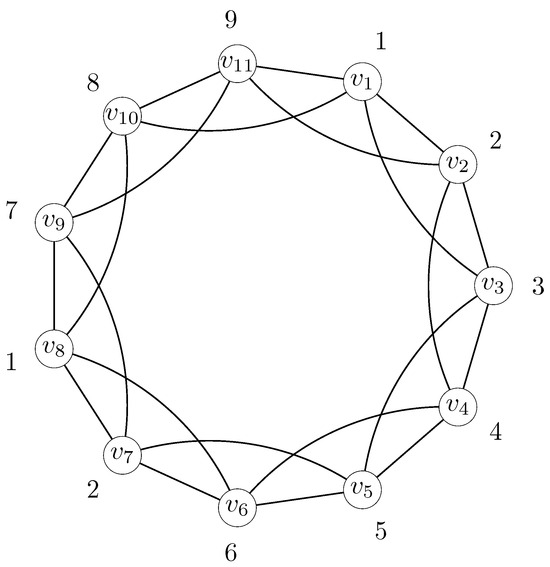
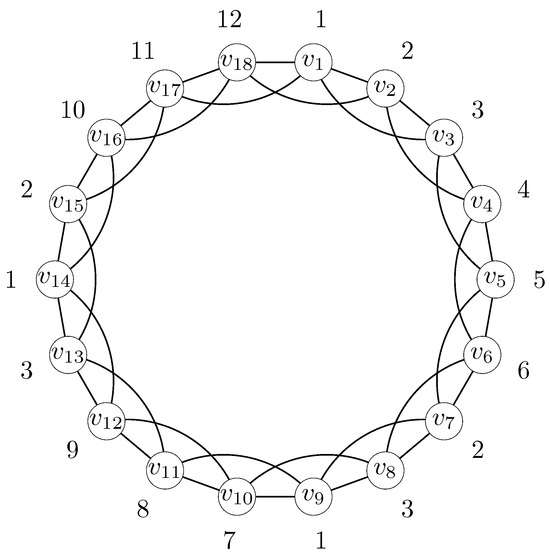
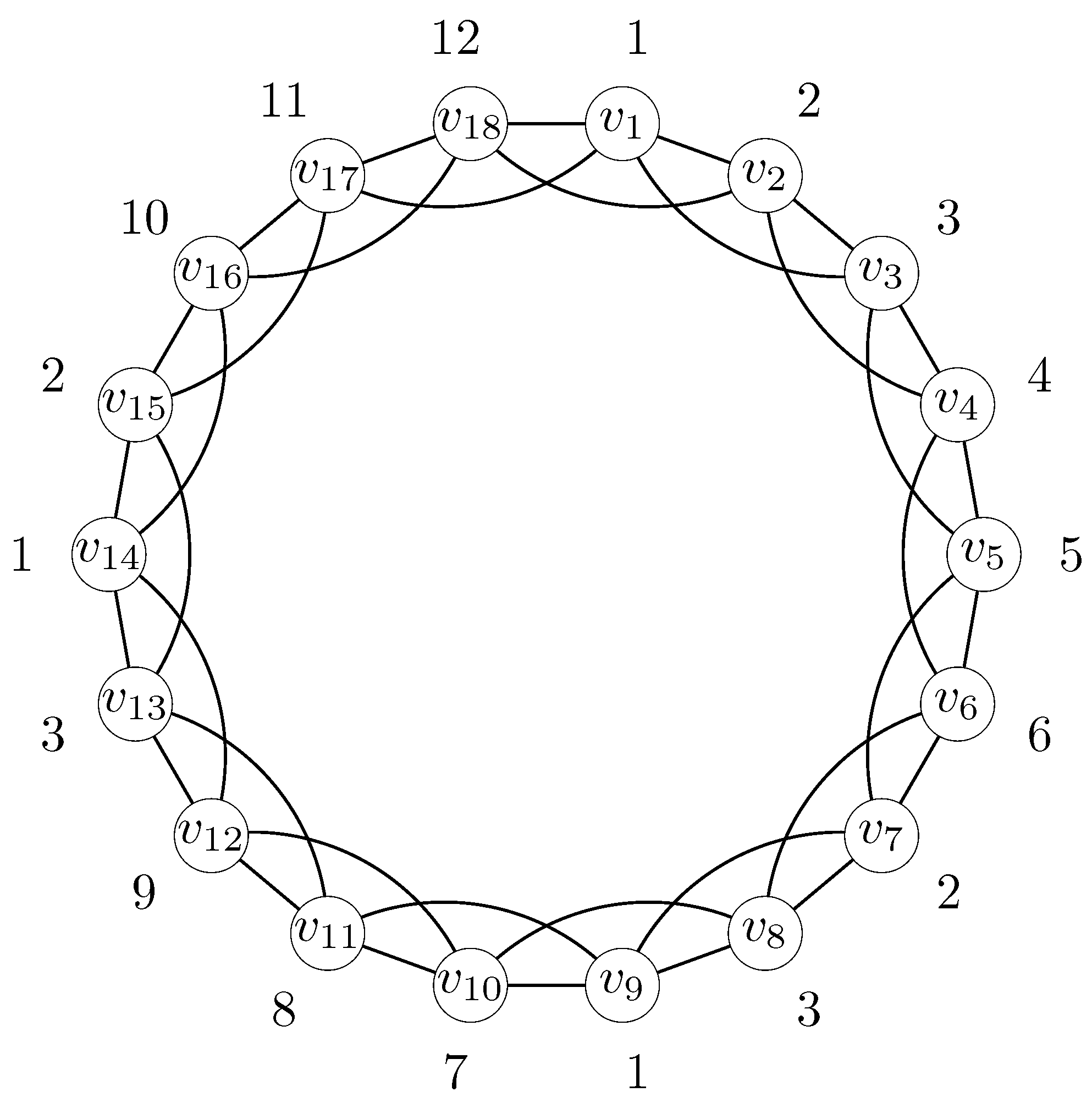
Let for . Then, we have , for , for , and for . See Figure 2 for an example. It is easy to check that, for each , and form a coalition; for each , and form a coalition, where . This means that is a c-partition. So we have
Figure 2.
A c-partition of .
Proposition 3.
For any , if , then we have
Proof.
Suppose that . Now we consider three cases.
Case 1. .
We define a labeling as follows. Let
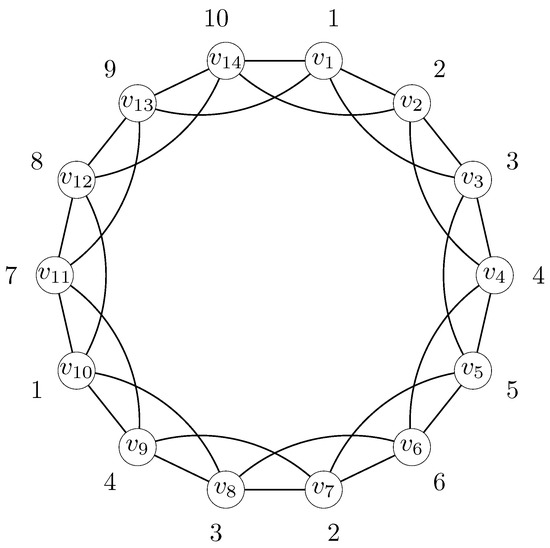
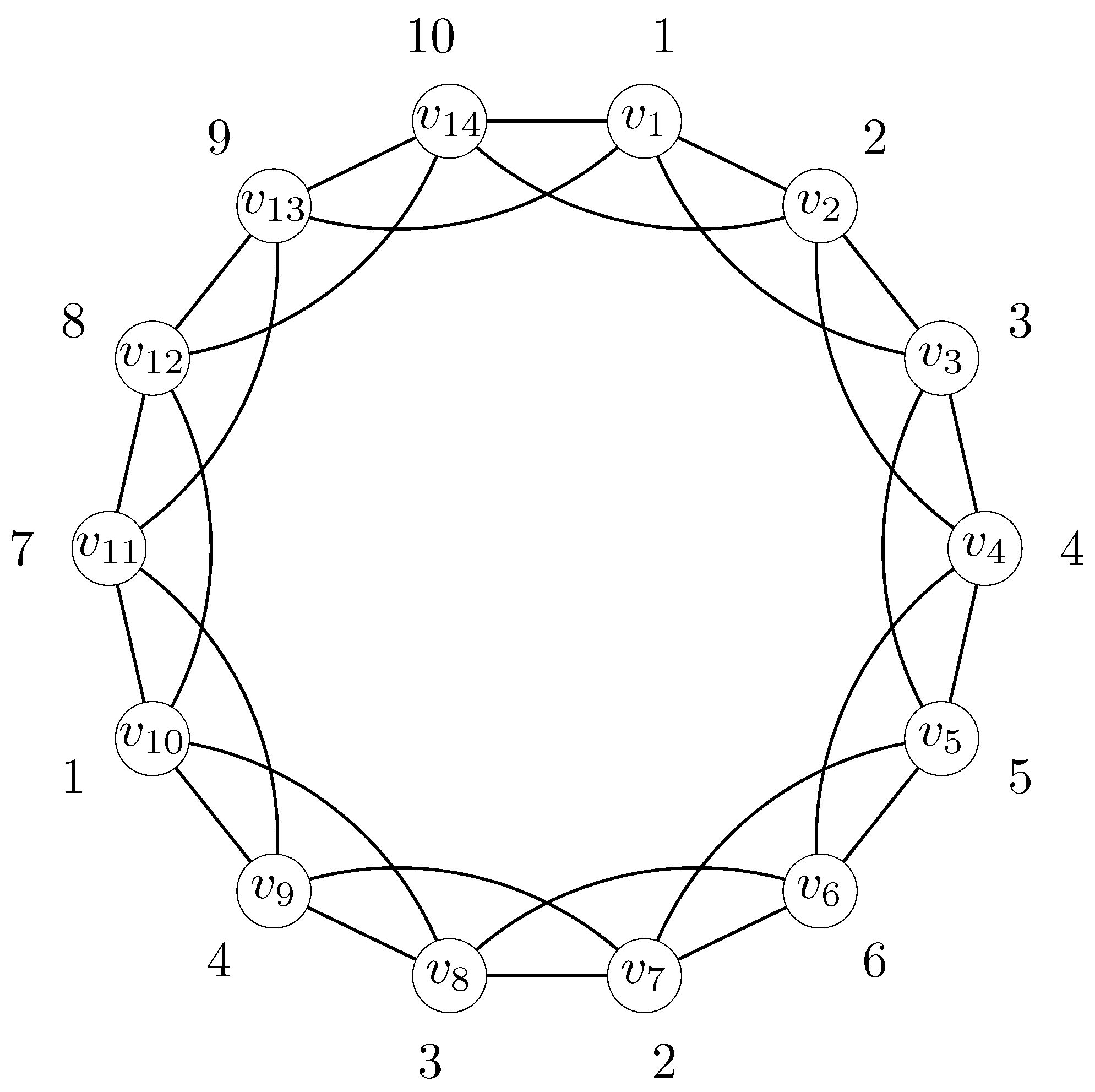
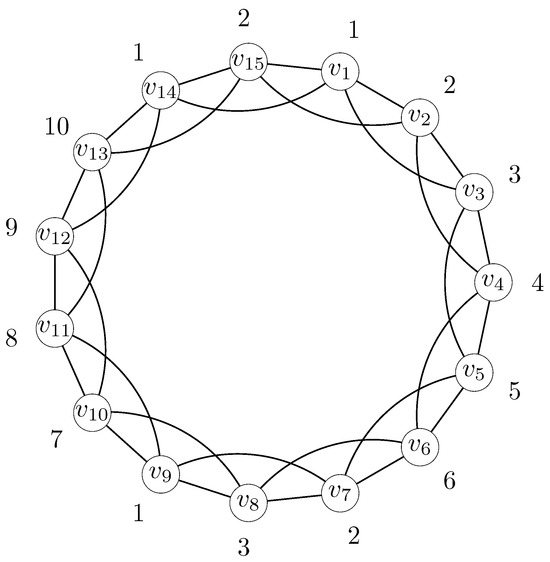
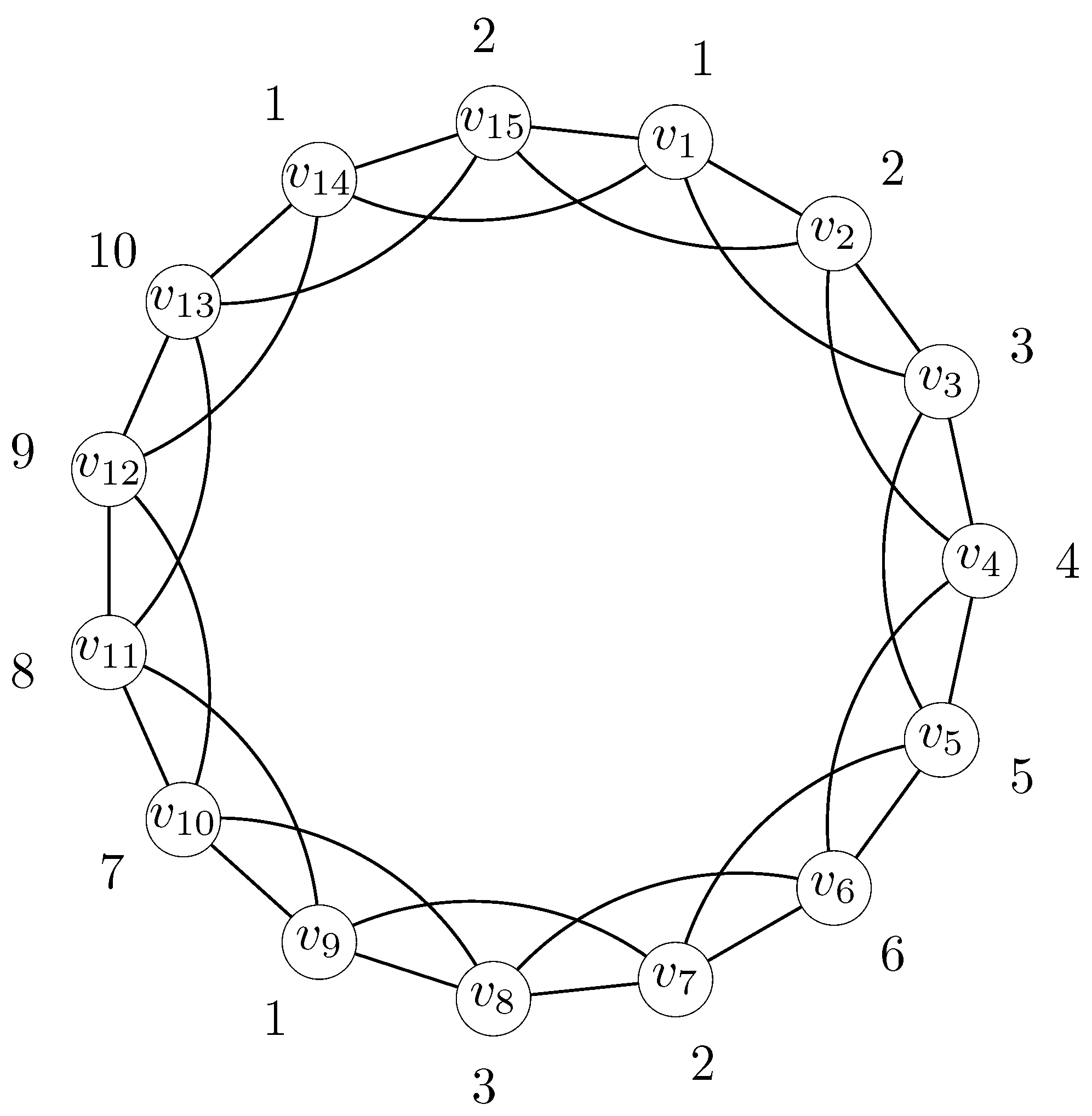
Let for . Then, we have , for , for , and for . See Figure 3 for an example. It is easy to check that, for each , and form a coalition; for each , and form a coalition, where . This means that is a c-partition. So we have
Figure 3.
A c-partition of .
Case 2. .
We define a labeling as follows. Let
Let for . Then, we have , for , for , and for . See Figure 4 for an example. It is easy to check that, for each , and form a coalition; for each , and form a coalition, where . This means that is a c-partition. So we have
Figure 4.
A c-partition of .
Case 3. .
We define a labeling as follows. Let
Let for . Then, we have , for , for , for , and for . See Figure 5 for an example. It is easy to check that, for each , and form a coalition; for each , and form a coalition, where ; for each , and form a coalition, where . This means that is a c-partition. So we have
Figure 5.
A c-partition of .
Combining Cases 1–3, we have for . □
Proposition 4.
For any , if or , then we have
Proof.
Suppose that or . Since , then by Lemma 2 we have
and then
In order to show that , in the following, we label the vertices of the graph with integers , define the set to consist of all vertices labeled i, and then show that is a c-partition of .
Let , in which . Define a labeling of the vertices of the graph as follows, let
where
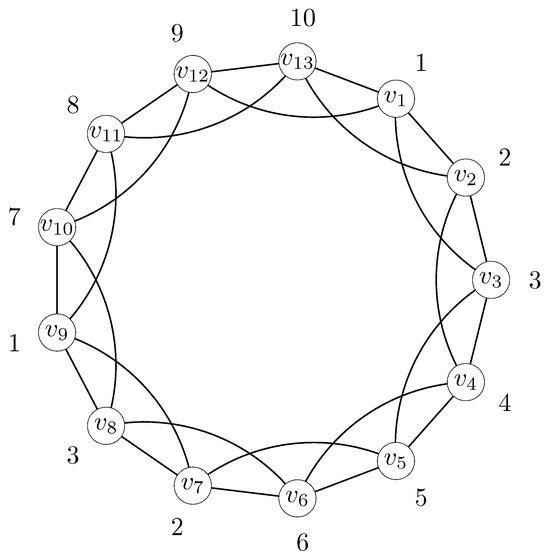
It is easy to see that for any , where and for any , where . Thus, we have for each . For any , let . See Figure 6 for an example. Note that for each , is not a dominating set of , and it is not difficult to check that for each , forms a coalition with , where . Then, is a c-partition of . Then, we have
Figure 6.
A c-partition of .
For or , by the above proof, we know that the subset of , defined in the proof of Proposition 4, is a c-partition of . Then, we have the following result.
Corollary 1.
For any , if or , then we have
Until now, the results of can be summarized in Table 1.
Table 1.
Values of , where and .
For the fixed value of , we have the relations between and n as follows (Table 2).
Table 2.
Values of , where and .
It is easy to see that the larger the value of d, the wider the range where cannot be determined. Determining the exact values of may be difficult.
Proposition 5.
Let be a c-partition of and , where and . For a set with vertices, if , then can form a coalition with at most one singleton set in π; if , then can form a coalition with at most singleton sets in π.
Proof.
Suppose that , , and . Suppose that a c-partition of includes a set with vertices. If no singleton set exists in , or there exist singleton sets in , but any one of these cannot form a coalition with , then there is nothing to prove. Suppose that there exists a singleton set in forming a coalition with . It is not difficult to see that the vertices in are consecutive. Otherwise, the singleton set that forms a coalition with cannot dominate the vertices in , which is a contradiction. Since the vertices in can be dominated by a singleton set in , the vertices in must be consecutive. Without loss of generality, we may assume that . Now we consider the following two cases.
Case 1. .
Since there exists a singleton set in forming a coalition with , we have and only can dominate the vertices in , i.e., only can form a coalition with .
Case 2. .
Since there exists a singleton set in forming a coalition with , we have , i.e., . It is easy to see that each vertex in can dominate the set , i.e., each vertex in as a singleton set can form a coalition with . Since , then we have and .
The proof is complete. □
3. The Power of the n-Cycle
As a special case, now we consider for and obtain the exact values of as follows. For convenience, without loss of generality, we may assume that for a c-partition of a graph G. By Proposition 5, as we have the following result.
Corollary 2.
Let be a c-partition of and , where . For a set with vertices, if , then can form a coalition with at most one singleton set in π; if , then can form a coalition with at most singleton sets in π.
Corollary 3.
For any , we have
Proof.
It is easy to see that, for , and . Suppose that is a positive integer. By Proposition 1, we have for . By Proposition 2, we have for . By Proposition 4, we have for or . By Proposition 3, we have for . By Corollary 1, we have for . In the following, we only need to show that for , for , and .
Claim A.
for .
Proof of Claim A.
By Lemma 2, for any . Now we show that for by contradiction. Now we consider the following four cases.
Case 1. .
Suppose that and is a c-partition of . Then we just need to consider the case: and . By Corollary 2, can form a coalition with each of, at most, 3 singleton sets in . Then, in , there are at least eight singleton sets in which each of them cannot form a coalition with any other set in , which is a contradiction. Therefore, we have .
Suppose that and is a c-partition of . Then, we need to consider the two cases as follows.
Subcase 1.1. and .
By Lemma 1, can form a coalition with each of, at most, five singleton sets in . Then, in , there are at least five singleton sets in which each of them cannot form a coalition with any other set in , which is a contradiction.
Subcase 1.2. and .
By Corollary 2, (, resp.) can form a coalition with each of, at most, three singleton sets in . Then, in , there are at least three singleton sets in which each of them cannot form a coalition with any other set in , which is a contradiction.
Combining Subcases 1.1 and 1.2, we have .
Case 2. .
Suppose that , and is a c-partition of . Then, we need to consider the two cases as follows.
Subcase 2.1. and .
The proof is similar to the proof of Subcase 1.1.
Subcase 2.2. , and .
The proof is similar to the proof of Subcase 1.2.
Combining Subcases 2.1 and 2.2, we have .
Suppose that , and is a c-partition of . Then, we need to consider the three cases as follows.
Subcase 2.3. , and .
The proof is similar to the proof of Subcase 1.1.
Subcase 2.4. , and .
By Lemma 1, can form a coalition with each of, at most, five singleton sets in . By Corollary 2, can form a coalition with each of, at most, two singleton sets in . Then, in , there are at least two singleton sets in which each of them cannot form a coalition with any other set in , which is a contradiction.
Subcase 2.5. , and .
The proof is similar to the proof of Subcase 1.2.
Combining Subcases 2.3–2.5, we have .
Case 3. .
Suppose that , and is a c-partition of . Then, we need to consider the three cases as follows.
Subcase 3.1. , and .
The proof is similar to the proof of Subcase 1.1.
Subcase 3.2. , and .
The proof is similar to the proof of Subcase 2.4.
Subcase 3.3. , and .
The proof is similar to the proof of Subcase 1.2.
Combining Subcases 3.1–3.3, we have .
Suppose that , and is a c-partition of . Then, we need to consider the five cases as follows.
Subcase 3.4. , and .
The proof is similar to the proof of Subcase 1.1.
Subcase 3.5. , and .
The proof is similar to the proof of Subcase 2.4.
Subcase 3.6. , and .
If and form a coalition, then by Lemma 1, (, resp.) can form a coalition with each of, at most, four singleton sets in . Therefore, in , there exist at least one singleton set which cannot form a coalition with any other set in , which is a contradiction.
If and do not form a coalition, then there exists a vertex . Thus, each set in forms a coalition with or must dominate . Since , then the number of the sets in that each can form a coalition with or is, at most, five, and there are at least five singleton sets in which each of them cannot form a coalition with any other set in , which is a contradiction.
Subcase 3.7. , and .
The proof is similar to the proof of Subcase 2.4.
Subcase 3.8. , and .
The proof is similar to the proof of Subcase 1.2.
Combining Subcases 3.4–3.8, we have .
Case 4. .
Suppose that , and is a c-partition of . Then, we need to consider the five cases as follows.
Subcase 4.1. , and .
The proof is similar to the proof of Subcase 1.1.
Subcase 4.2. , and .
By Lemma 1, can form a coalition, with each of, at most, five singleton sets in . cannot form a coalition with any singleton set in . Then, in , there are, at least, five singleton sets in which each of them cannot form a coalition with any other set in , which is a contradiction.
Subcase 4.3. , and .
The proof is similar to the proof of Subcase 3.6.
Subcase 4.4. , and .
The proof is similar to the proof of Subcase 4.2.
Subcase 4.5. , and .
It is not difficult to see that, in this case, each singleton set in cannot form a coalition with any other set in , a contradiction.
Combining Subcases 4.1–4.5, we have .
Suppose that , and is a c-partition of . Then, we need to consider the seven cases as follows.
Subcase 4.6. , and .
The proof is similar to the proof of Subcase 1.1.
Subcase 4.7. , and .
The proof is similar to the proof of Subcase 4.2.
Subcase 4.8. , and .
The proof is similar to the proof of Subcase 3.6.
Subcase 4.9. , and .
The proof is similar to the proof of Subcase 4.2.
Subcase 4.10. , and .
If and form a coalition, then by Lemma 1, (, resp.) can form a coalition with each of, at most, four sets in . Then, in , there exists at least one set that cannot form a coalition with any other set in , which is a contradiction.
If and do not form a coalition, then there exists a vertex . Then, each set in forming a coalition with or must dominate . Since , the number of sets in —each of which can form a coalition with or —is at most five, and at least three singleton sets in which each of them cannot form a coalition with any other set in , which is a contradiction.
Subcase 4.11. , and .
The proof is similar to the proof of Subcase 4.2.
Subcase 4.12. , and .
The proof is similar to the proof of Subcase 4.5.
Combining Subcases 4.6–4.12, we have .
Combining Cases 1–4, we have for .
The proof of Claim A is complete. □
Claim B.
for .
Proof of Claim B.
We consider the two cases as follows.
Case 1. .
Suppose that , and is a c-partition of . Then, we need to consider the seven subcases as follows.
Subcase 1.1. , and .
The proof is similar to the proof of Subcase 1.1 in Claim A.
Subcase 1.2. , and .
The proof is similar to the proof of Subcase 4.2 in Claim A.
Subcase 1.3. , and .
The proof is similar to the proof of Subcase 2.4 in Claim A.
Subcase 1.4. , and .
The proof is similar to the proof of Subcase 4.2 in Claim A.
Subcase 1.5. , and .
By Corollary 2, (, resp.) can form a coalition with each of, at most, four singleton sets in . cannot form a coalition with any singleton set in . Then, in , there is, at least, one singleton set which cannot form a coalition with any other set in , which is a contradiction.
Subcase 1.6. , and .
The proof is similar to the proof of Subcase 1.5 in Claim B.
Subcase 1.7. , and .
The proof is similar to the proof of Subcase 4.5 in Claim A.
Combining Subcases 1.1–1.7, we have .
Case 2. .
Suppose that , and is a c-partition of . Then, we need to consider the 22 subcases as follows.
Subcase 2.1. , and .
The proof is similar to the proof of Subcase 1.1 in Claim A.
Subcase 2.2. , and .
The proof is similar to the proof of Subcase 4.2 in Claim A.
Subcase 2.3. , and .
The proof is similar to the proof of Subcase 2.4 in Claim A.
Subcase 2.4. , and .
The proof is similar to the proof of Subcase 4.2 in Claim A.
Subcase 2.5. and .
The proof is similar to the proof of Subcase 3.6 in Claim A.
Subcase 2.6. , and .
By Lemma 1, can form a coalition with each of, at most, five singleton sets in . By Corollary 2, can form a coalition with, at most, one singleton set in . Since cannot form a coalition with any singleton set in . Then, in , there are, at least, three singleton sets in which each of them cannot form a coalition with any other set in , which is a contradiction.
Subcase 2.7. , and .
The proof is similar to the proof of Subcase 4.2 in Claim A.
Subcase 2.8. , and .
The proof is similar to the proof of Subcase 3.6 in Claim A.
Subcase 2.9. , and .
The proof is similar to the proof of Subcase 4.10 in Claim A.
Subcase 2.10. , and .
The proof is similar to the proof of Subcase 2.4 in Claim A.
Subcase 2.11. , and .
The proof is similar to the proof of Subcase 2.6 in Claim B.
Subcase 2.12. , and .
The proof is similar to the proof of Subcase 4.2 in Claim A.
Subcase 2.13. , and .
If any two of the three sets , and can form a coalition; then, by Lemma 1, (, resp.) in can form a coalition with each of, at most, three singleton sets in . By Corollary 2, can form a coalition with, at most, one singleton set in . Then, in , there are at least two singleton sets in which each of them cannot form a coalition with any other set in , which is a contradiction.
If and form a coalition, and (or and ) do not form a coalition. Then, there exists a vertex . Thus, each set in forming a coalition with or must dominate . Since , the number of sets in —each of which can form a coalition with or —is at most five. Since and form a coalition, then . Then, the number of singleton sets in that each of them can form a coalition with or is, at most, four. By Lemma 1, can form a coalition with each of, at most, four singleton sets in . Then, in , there exists, at least, one set which cannot form a coalition with any other set in , which is a contradiction.
If and do not form a coalition, then there exists a vertex . Then, each set in forming a coalition with or must dominate . Since . By Corollary 2, can form a coalition with, at most, one singleton set in . Then, in , there are at least three singleton sets in which each of them cannot form a coalition with any other set in , a contradiction.
Subcase 2.14. , and .
If and form a coalition, and there exist and , such that and form a coalition. Without loss of generality, we may assume that and form a coalition. Then, by Lemma 1, can form a coalition with each of, at most, three singleton sets in , and can form a coalition with each of, at most, four singleton sets in . Since (, resp.) cannot form a coalition with any singleton set in . Then, in , there exists at least one set which cannot form a coalition with any other set in , which is a contradiction.
If and form a coalition, and for each and , and cannot form a coalition. Since (, resp.) cannot form a coalition with any singleton set in , then and must form a coalition. Note that and do not form a coalition. Then there exists a vertex . Thus, each set in forming a coalition with or must dominate . Since , the number of sets in , each of which can form a coalition with or , is at most five. Since and form a coalition, then . Since and form a coalition, then . Then, the number of singleton sets in that each can form a coalition with or is, at most, three. By Lemma 1, can form a coalition with each of, at most, four singleton sets in . Then, in , there exists at least one set which cannot form a coalition with any other set in , which is a contradiction.
If and do not form a coalition, then there exists a vertex . Then, each set in forming a coalition with or must dominate . Since , the number of singleton sets in that each of them can form a coalition with or is, at most, five, and at least three singleton sets in which each of them cannot form a coalition with any other set in , which is a contradiction.
Subcase 2.15. , and .
The proof is similar to the proof of Subcase 2.6 in Claim B.
Subcase 2.16. , and .
The proof is similar to the proof of Subcase 2.6 in Claim B.
Subcase 2.17. , and .
The proof is similar to the proof of Subcase 4.2 in Claim A.
Subcase 2.18. , and .
The proof is similar to the proof of Subcase 1.2 in Claim A.
Subcase 2.19. , and .
The proof is similar to the proof of Subcase 1.5 in Claim B.
Subcase 2.20. , and .
The proof is similar to the proof of Subcase 1.5 in Claim B.
Subcase 2.21. , and .
The proof is similar to the proof of Subcase 1.5 in Claim B.
Subcase 2.22. , and .
The proof is similar to the proof of Subcase 4.5 in Claim A.
Combining Subcases 2.1–2.22, we have .
Combining Cases 1–2, we have for .
The proof of Claim B is complete. □
Claim C.
.
Proof of Claim C.
Let , in which , , , , , , , , , , . It is easy to check that can form a coalition with , , and ; can form a coalition with , , and ; and can form a coalition with and . Now we have .
Now we show that by contradiction. Suppose that , and is a c-partition of . Then, we need to consider the 15 cases as follows.
Case 1. , and .
The proof is similar to the proof of Subcase 1.1 in Claim A.
Case 2. , and .
The proof is similar to the proof of Subcase 4.2 in Claim A.
Case 3. , and .
The proof is similar to the proof of Subcase 2.4 in Claim A.
Case 4. , and .
The proof is similar to the proof of Subcase 4.2 in Claim A.
Case 5. , and .
The proof is similar to the proof of Subcase 3.6 in Claim A.
Case 6. , and .
The proof is similar to the proof of Subcase 2.6 in Claim B.
Case 7. , and .
The proof is similar to the proof of Subcase 4.2 in Claim A.
Case 8. , and .
The proof is similar to the proof of Subcase 4.10 in Claim A.
Case 9. , and .
If and form a coalition, then by Lemma 1, can form a coalition with each of, at most, four singleton sets in . By Corollary 2, (, resp.) can form a coalition with each of, at most, two singleton sets in . Then, in , there exists at least one set which cannot form a coalition with any other set in , which is a contradiction.
If and do not form a coalition, then there exists a vertex . So each set in forming a coalition with or must dominate . Since . By Corollary 2, can form a coalition with, at most, two singleton sets in . Then, in , there are at least two singleton sets in which each of them cannot form a coalition with any other set in , which is a contradiction.
Case 10. , and .
The proof is similar to the proof of Subcase 2.6 in Claim B.
Case 11. , and .
The proof is similar to the proof of Subcase 4.2 in Claim A.
Case 12. , and .
The proof is similar to the proof of Subcase 1.5 in Claim B.
Case 13. , and .
The proof is similar to the proof of Subcase 1.5 in Claim B.
Case 14. , and .
The proof is similar to the proof of Subcase 1.5 in Claim B.
Case 15. , and .
The proof is similar to the proof of Subcase 4.5 in Claim A.
Combining Cases 1–15, we have .
The proof of Claim C is complete. □
Combining Claims A, B, and C, the proof of the main result is complete. □
4. Conclusions
In this paper, we studied the coalition number of , which showed that
- (1)
- for ;
- (2)
- for ;
- (3)
- for ;
- (4)
- for or ; and
- (5)
- for or .
However, for , we did not get any better lower bounds of . For a special case, we obtain the exact value of for any . Thus, much hard work still needs to done in the future.
Since and are all regular graphs, for further research, it would be interesting to study the coalition number of regular graphs and other graphs with special structures. On the other hand, we have to admit that the method used to prove our main results is a bit tedious; thus, a proof with combinatorial techniques is very much expected.
Author Contributions
Formal analysis, investigation, writing—original draft, Q.J.; writing—review and editing, Q.J., W.Z. and Z.J.; polished the paper, W.Z., Z.J. and Y.Z.; devised the main ideas and proof outline, validation, supervision, Y.Z. All authors have read and approved the final version of the manuscript for publication.
Funding
This research received no external funding.
Data Availability Statement
The original contributions presented in this study are included in the article. Further inquiries can be directed to the corresponding author.
Acknowledgments
We would like to thank the anonymous referees for their valuable comments and useful suggestions.
Conflicts of Interest
The authors declare no conflicts of interest.
References
- Haynes, T.W.; Hedetniemi, J.T.; Hedetniemi, S.T.; McRae, A.A.; Mohan, R. Introduction to coalitions in graphs. AKCE Int. J. Graphs Comb. 2020, 17, 653–659. [Google Scholar] [CrossRef] [Scilit]
- Haynes, T.W.; Hedetniemi, J.T.; Hedetniemi, S.T.; McRae, A.A.; Mohan, R. Upper bounds on the coalition number. Australas. J. Comb. 2021, 80, 442–453. [Google Scholar]
- Bakhshesh, D.; Henning, M.A.; Pradhan, D. On the coalition number of trees. Bull. Malays. Math. Sci. Soc. 2023, 46, 95. [Google Scholar] [CrossRef] [Scilit]
- Alikhani, S.; Golmohammadi, H.; Konstantinova, E.V. Coalition of cubic graphs of order at most 10. Commun. Comb. Optim. 2024, 9, 437–450. [Google Scholar]
- Dobrynin, A.A.; Golmohammadi, H. On cubic graphs having the maximum coalition number. Sib. Electron. Math.-Rep.-Sib. Elektron. Mat. Izv. 2024, 21, 363–369. [Google Scholar]
- Haynes, T.W.; Hedetniemi, J.T.; Hedetniemi, S.T.; McRae, A.A.; Mohan, R. Coalition graphs. Commun. Comb. Optim. 2023, 8, 423–430. [Google Scholar]
- Haynes, T.W.; Hedetniemi, J.T.; Hedetniemi, S.T.; McRae, A.A.; Mohan, R. Self-coalition graphs. Opusc. Math. 2023, 43, 173–183. [Google Scholar] [CrossRef] [Scilit]
- Haynes, T.W.; Hedetniemi, J.T.; Hedetniemi, S.T.; McRae, A.A.; Mohan, R. Coalition graphs of paths, cycles and trees. Discuss. Math. Graph Theory 2023, 43, 931–946. [Google Scholar] [CrossRef] [Scilit]
- Dobrynin, A.A.; Golmohammadi, H. The shortest cycle having the maximal number of coalition graphs. Discret. Math. Lett. 2024, 14, 21–26. [Google Scholar]
- Jia, Q.; Zhao, W.; Jiang, Z.; Zhao, Y. Note on the coalition number of the dth power of the n-path. Open J. Discret. Math. 2025, 15, 31–38. [Google Scholar] [CrossRef]



Disclaimer/Publisher’s Note: The statements, opinions and data contained in all publications are solely those of the individual author(s) and contributor(s) and not of MDPI and/or the editor(s). MDPI and/or the editor(s) disclaim responsibility for any injury to people or property resulting from any ideas, methods, instructions or products referred to in the content. |
© 2025 by the authors. Licensee MDPI, Basel, Switzerland. This article is an open access article distributed under the terms and conditions of the Creative Commons Attribution (CC BY) license (https://creativecommons.org/licenses/by/4.0/).