Article

Robust Photovoltaic Power Forecasting Model Under Complex Meteorological Conditions

1
Institute of Systems Engineering and Collaborative Laboratory for Intelligent Science and Systems, Macau University of Science and Technology, Taipa, Macao 999078, China
2
IKAS Industries Co., Ltd., Beijing 100000, China
*
Author to whom correspondence should be addressed.
Mathematics 2025, 13(11), 1783; https://doi.org/10.3390/math13111783
Submission received: 17 April 2025 / Revised: 22 May 2025 / Accepted: 23 May 2025 / Published: 27 May 2025

Abstract

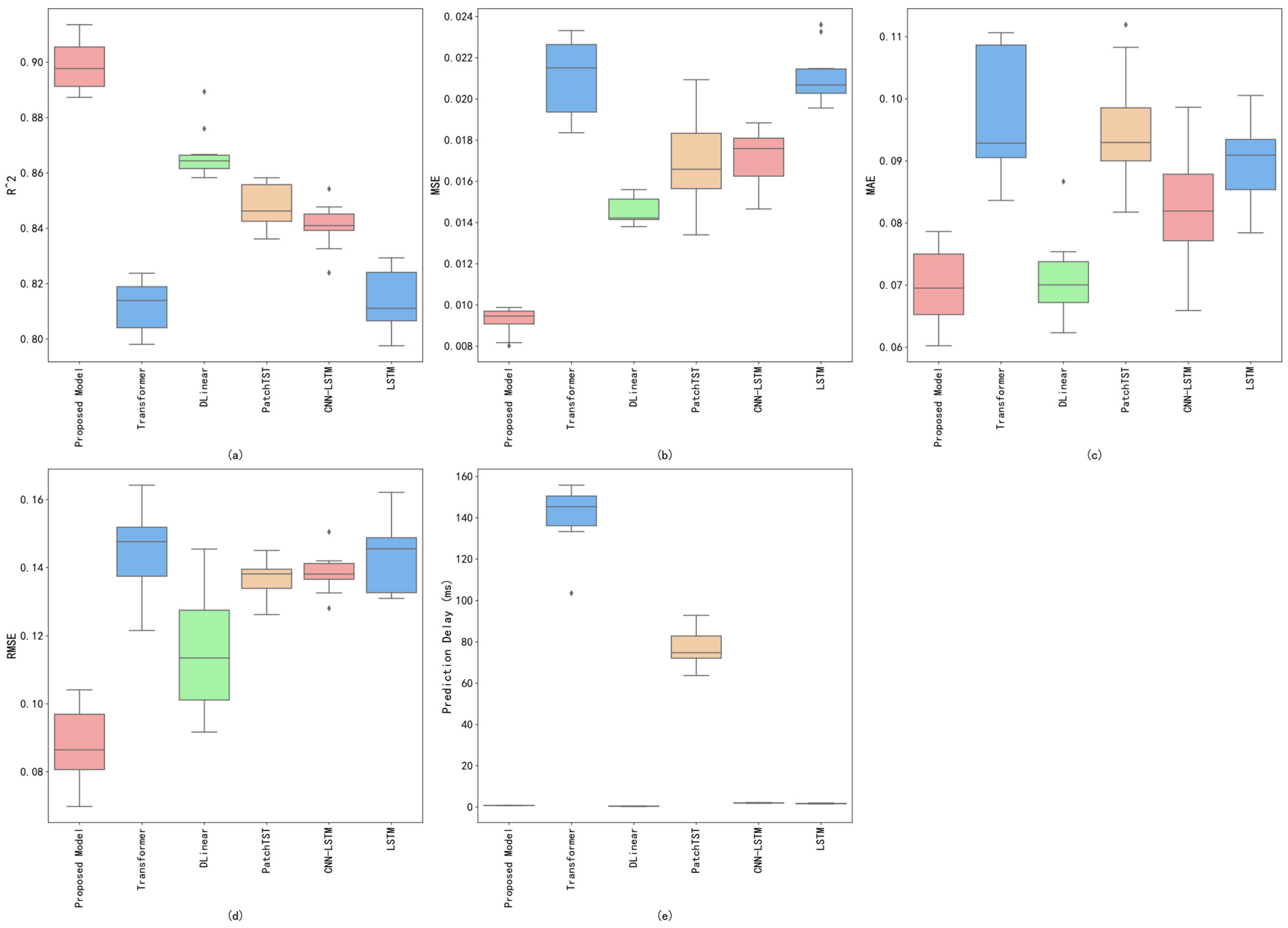
The rapid expansion of global photovoltaic (PV) capacity has imposed higher demands on forecast accuracy and timeliness in power dispatching. However, traditional PV power forecasting models designed for distributed PV power stations often struggle with accuracy due to unpredictable meteorological variations, data noise, non-stationary signals, and human-induced data collection errors. To effectively mitigate these limitations, this work proposes a dual-stage feature extraction method based on Variational Mode Decomposition (VMD) and Principal Component Analysis (PCA), enhancing multi-scale modeling and noise reduction capabilities. Additionally, the Whale Optimization Algorithm is adopted to efficiently optimize the hyperparameters of iTransformer for the framework, improving parameter adaptability and convergence efficiency. Based on VMD-PCA refined feature extraction, the iTransformer is then employed to perform continuous active power prediction across time steps, leveraging its strength in modeling long-range temporal dependencies under complex meteorological conditions. Experimental results demonstrate that the proposed model exhibits superior robustness across multiple evaluation metrics, including coefficient of determination, mean square error, mean absolute error, and root mean square error, with comparatively low latency. This research provides valuable model support for reliable PV system dispatch and its application in smart grids.
Keywords: PV power forecasting; variational mode decomposition; principal component analysis; whale optimization algorithm; iTransformer PV power forecasting; variational mode decomposition; principal component analysis; whale optimization algorithm; iTransformer