


Abstract
This paper proposes a second-order terminal sliding mode (2TSM) approach to the trajectory tracking of the differential drive mobile robot (DDMR). Within this cascaded control scheme, the 2TSM dynamic controller, at the innermost loop, tracks the robot’s velocity quantities while a kinematic controller, at the outermost loop, regulates the robot’s positions. In this manner, chattering is greatly attenuated, and finite-time convergence is guaranteed by the second-order TSM manifold, which involves higher-order derivatives of the state variables, resulting in an inherently robust as well as fast and better tracking precision. The simulation results demonstrate the merit of the proposed control methods.
Keywords:
nonlinear control systems; robust control; terminal sliding-mode control; uncertain systems MSC:
37N35
1. Introduction
Differential drive mobile robot (DDMR) trajectory tracking has been a popular research topic in recent years [1,2,3,4,5,6,7,8,9,10,11,12,13,14,15,16]. Practical approaches [1,2,4,5,8,9,10,11,12] consider the DDMR’s dynamics in addition to its kinematics in the control loop in order to attain tracking performance, especially in the presence of disturbances and unmodeled dynamics. These include actuator dynamics, the system’s intrinsic nonlinearities, changes in load, working surface/terrain, etc., which are commonly encountered in many industrial applications, such as automated guided vehicles (AGVs), automated forklift robots (AFRs) and so on.
Among these methods, sliding mode control [4,5,10,11,13,14,15,17,18] has emerged as an attractive alternative due to its simplicity in implementation; more importantly, it has a fast dynamic response as well as strong robustness to external disturbances and parameter variations. The conventional linear SMC method (LSM), however, poses serious drawbacks because of its instinctive chattering phenomenon, which makes it less likely to be efficient for use in the electro-mechanical system control scheme [19,20,21,22]. This motivates the further research and development of chattering-free SMC techniques, including the nonlinear terminal sliding mode (TSM), i.e., [19,20,21,22], as well as higher-order sliding mode control methods, i.e., [22,23,24,25].
The TSM method possesses superior properties in finite-time convergence, excellent tracking precision, and better chattering attenuation in comparison to conventional LSM control systems. Nonetheless, in this particular application, the first-order TSM-based controller would not be able to totally suppress chattering from the torque inputs generated by the robot’s dynamic models, making it less favorable to be employed in practical applications since the aforementioned “chattering” would cause severe damage to the robot’s actuating systems.
This paper proposes a second-order TSM control scheme (2TSM) for the DDMR’s trajectory tracking problem. Here, by dealing with derivatives of the state variables at a higher order incorporated within the nonlinear 2TSM manifold, the finite-time convergence of tracking errors (i.e., velocity quantities) to zero is guaranteed; singularities, such as those appearing in conventional first-order TSM (i.e., [19]) can be avoided; and the resulting control signals (torque’s commands) are continuous, enabling the proposed method to be directly applied in practical applications. This is the original motivation for this work.
The remainder of this paper is organized as follows. Section 2 describes both the kinematic and dynamic models of the DDMR system. The finite-time convergence characteristics of the 2TSM manifold are discussed in Section 3. One of the major contributions of the proposed work relies on the analytical calculation of convergence time, which is crucial and applied for the determination and selection of relevant parameters that govern the system’s dynamics when the sliding manifold is reached. The 2TSM-based controller design is presented in Section 4. The simulation results are documented in Section 5, illustrating the outstanding merits of the proposed 2TSM control scheme for DDMR’s trajectory tracking in comparison to the LSM and TSM methods. Finally, Section 6 concludes the paper.
2. DDMR’s Model
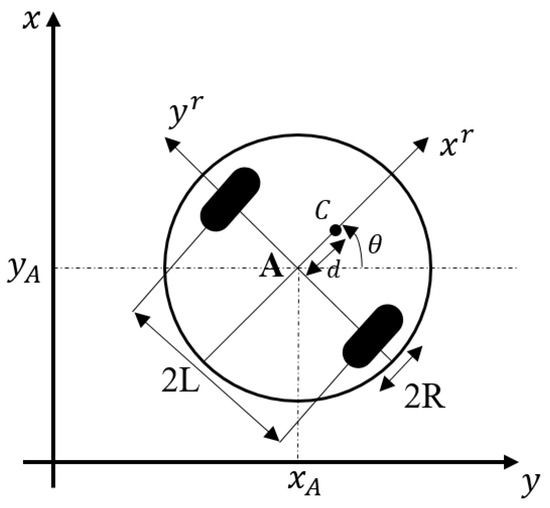
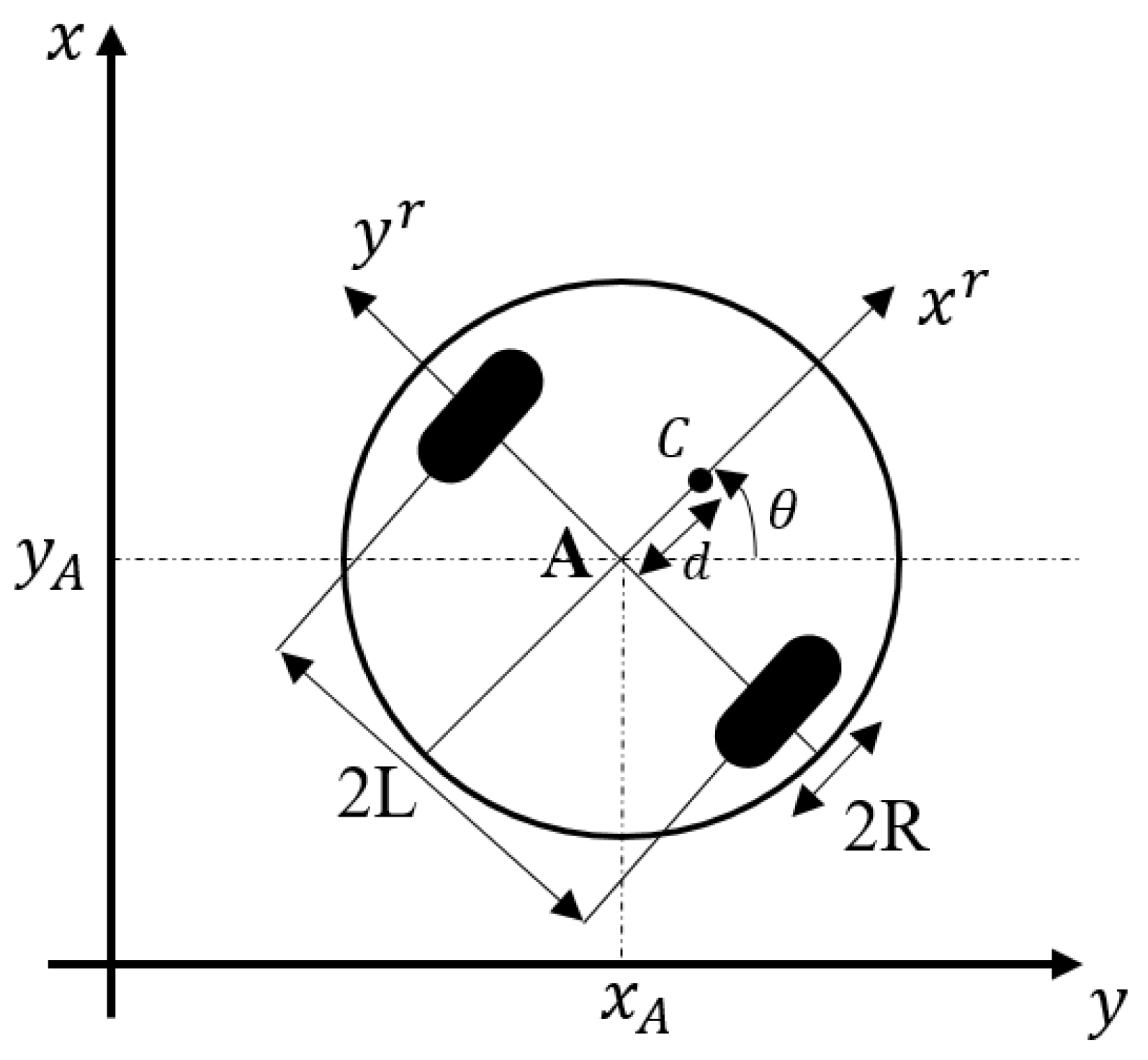
Figure 1 describes the DDMR’s position with respect to the following coordinates:
Figure 1.
DDMR’s coordinates.
- Global coordinate system: denoted as {} to define its exact position on the Descartes plane.
- Robot coordinate system: denoted as {,}, which refers to the relative local position with respect to the robot’s frame. Here, its origin is located at { (point A). The robot’s center of mass, denoted as point C, is assumed to be located along the axis at a distance d from point A.
Let represent the coordinate of point A on the global frame and robot frame, respectively
The definitions of and correspond to the velocities of DDMR in the global frame and robot frame, in which refers to the robot’s heading angle; thus, denotes its derivative with respect to time
The relationship of motion between the two frames is shown as follows:
where is the orthogonal rotation matrix
With the assumption of no lateral slip, as described in (3), this indicates that the wheels do not slide perpendicularly to their longitudinal axis, i.e.,
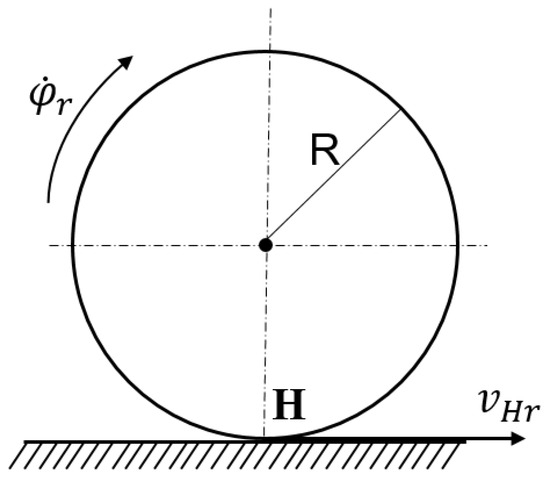
and pure rolling motion, which means the wheels rotate without any slipping or skidding along their contact points with the ground; the linear velocity of each wheel (the velocity of point H) (Figure 2) is expressed by the following equations:
Figure 2.
Right wheel of DDMR as an example to describe the velocity quantities of each wheel.
Here,
- −
- represent the linear velocities of point H on the right wheel and left wheel.
- −
- denote the linear velocities of the right wheel and left wheel.
- −
- are the respective angular velocities of the right wheel and left wheel.
2.1. Kinematic Model
Equation (5) formulizes the DDMR’s kinematic model [1]:
with as the linear velocity and as the angular velocity of DDMR in the robot frame.
As a result,
leading to the following expression
From (1), (5), (6), and (7), the following is obtained:
or
2.2. Dynamic Model
As discussed in [3], (10) formulizes DDMR’s respective dynamic model with the consideration of all relevant force components.
Here, the total equivalent inertia is calculated as follows:
with and as the mass of each wheel with and without its actuators, and as the DDMR’s total mass with and without its wheels and actuators, as the wheel’s moment of inertia, and as the left and right wheel’s actuator torques.
In the state space form, (10) is expressed as
3. Finite-Time Convergence Characteristics of 2TSM Manifold
The following theorem describes the finite-time convergence of relevant state variables once the 2TSM manifold is reached.
Theorem 1.
The state variable and its derivative satisfy the following:
where
, are odd positive integers; while . Given the set of initial conditions as and . and its derivative converge to zeros in finite-time .
Proof.
Let ; then, the following is obtained , and Equation (13) converts to the following form:
Let us solve the unforced response of (14)
is one solution of (15).
In the case of , dividing (15) by results in the following:
or
In the presence of a perturbation , the forced response, which describes the generalized solution of
takes the following form:
where is the function of x.
When substituting the following expressions:
into Equation (14), the following is obtained
This implies
- −
- would take the form of ; as a result, ;
- −
- ).
- −
- The below-mentioned equation is satisfied as follows:
Equation (19) indicates that , ; and it is easy to show as follows:
- −
- The minima of is located at ;
- −
- and is the only root of Equation (19).
As a result,
Consequently, the solution would be the following:
As seen in Equation (20), it is easy to show that the convergence time of the state variable and its derivative to zero is calculated using the following:
This completes the proof.
□
Remark 1.
The solution, as in Equation (20), satisfies the aforementioned initial conditions
Remark 2.
The theorem reconfirms that (20) is a unique solution of for the given set of initial values.
Remark 3.
With chosen to be odd positive integers, it is easy to see that , and .
Remark 4.
With the convergence time calculated as in (21), it is observed that is inversely proportional to . In the practice of 2TSM-based controller design to be discussed in Section 4, the selection of these relevant parameters can be accordingly selected for the delivery of efficient control performance and design criterion.
4. TSM-Based Controller Design
4.1. Kinematic Controller
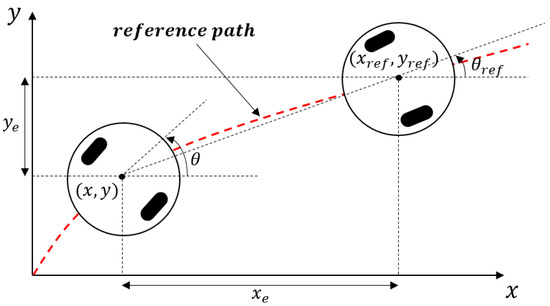
The trajectory tracking error is the difference between the actual posture of a robot, denoted as and the reference of the robot (illustrated in Figure 3), denoted as = , i.e.,
Figure 3.
Real robot in the trajectory tracking of the reference robot on Descartes coordinates {x,y}.
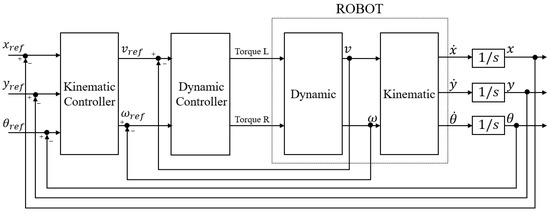
Within this cascaded control architecture (Figure 4), the kinematic controller at the outer-most loop relies on a simple P-type-only controller designed as
Figure 4.
DDMR’s trajectory cascaded control architecture.
Here, and refer to the reference angular velocities; and are proportional gains for angular and linear velocity controllers; and and = .
4.2. Dynamic Controller
With the integration of an unknown bounded disturbance into Equation (12), the following is obtained:
where
Let and the error calculated as
Then,
Here, a second-order terminal sliding mode control (2TSM) scheme is employed to realize the dynamic controller. In order to achieve good performances, such as fast convergences, chattering-free, and better tracking precision, a 2TSM manifold is designed as follows:
where are as specified in Theorem 1.
In this manner, the 2TSM’s dynamic controller is designed according to the following Theorem 2.
Theorem 2.
The velocity error can converge to zero in finite time if the 2TSM manifold is chosen as (27), and the control law is designed as follows:
where refers to the bounded disturbance and .
Proof.
Substituting the error dynamics (26) into the second-order TSM manifold (27) gives the following:
Substituting Equation (29) into the above yields
The following Lyapunov function candidate is considered:
Differentiating V with respect to time, t gives
i.e.,
for .
Therefore, according to the Lyapunov stability criterion, the second-order TSM manifold, as in (27), reaches zero from within a finite time or . Once the 2TSM manifold s is reached, and its derivative (which corresponds to the velocities’ error) converge to zero in finite time (Theorem 1), as given by
This concludes the proof. □
Remark 5.
As calculated according to Theorem 2, there is no singularity that exists in the 2TSM control law . In other words, the proposed approach is well regarded as a non-singular second-order terminal sliding mode (2NTSM) control scheme.
Remark 6.
is a continuous signal. This implies that the proposed 2TSM control scheme is chattering-free, indicating its suitability and effectiveness to be employed in practical electro-mechanical control systems.
5. Simulation Results
In order to demonstrate the effectiveness and advantages of the proposed second-order TSM, the simulation results are compared with the TSM (as in the previous work in [16]) and the LSM. The physical parameters of DDMR are shown in Table 1. The unknown bounded disturbance is , where n represents random noises with amplitudes of 0.1.
Table 1.
The physical parameters of DDMR used in this simulation study.
- LSM controller
The LSM manifold and control are designed as follows:
- TSM controller
The TSM manifold and control are designed as follows:
- Second-order TSM controller
The 2TSM manifold and control are designed as follows:
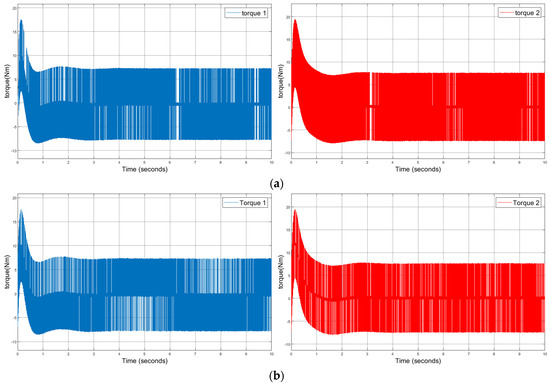
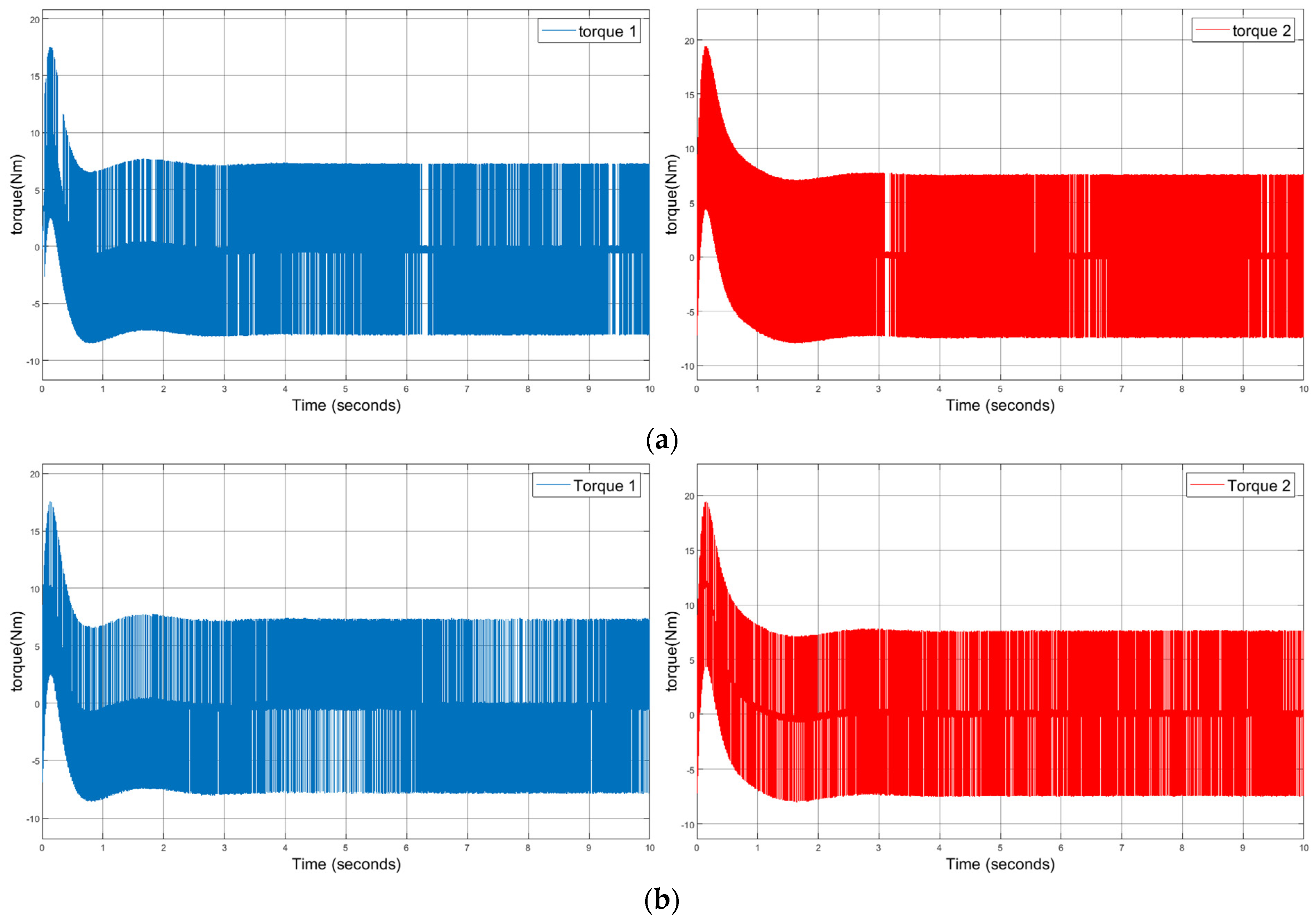
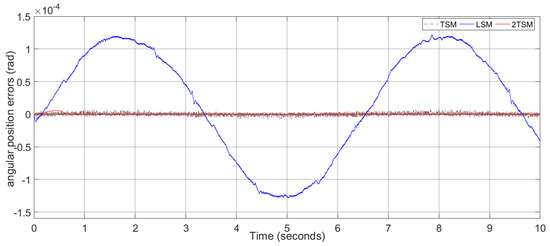
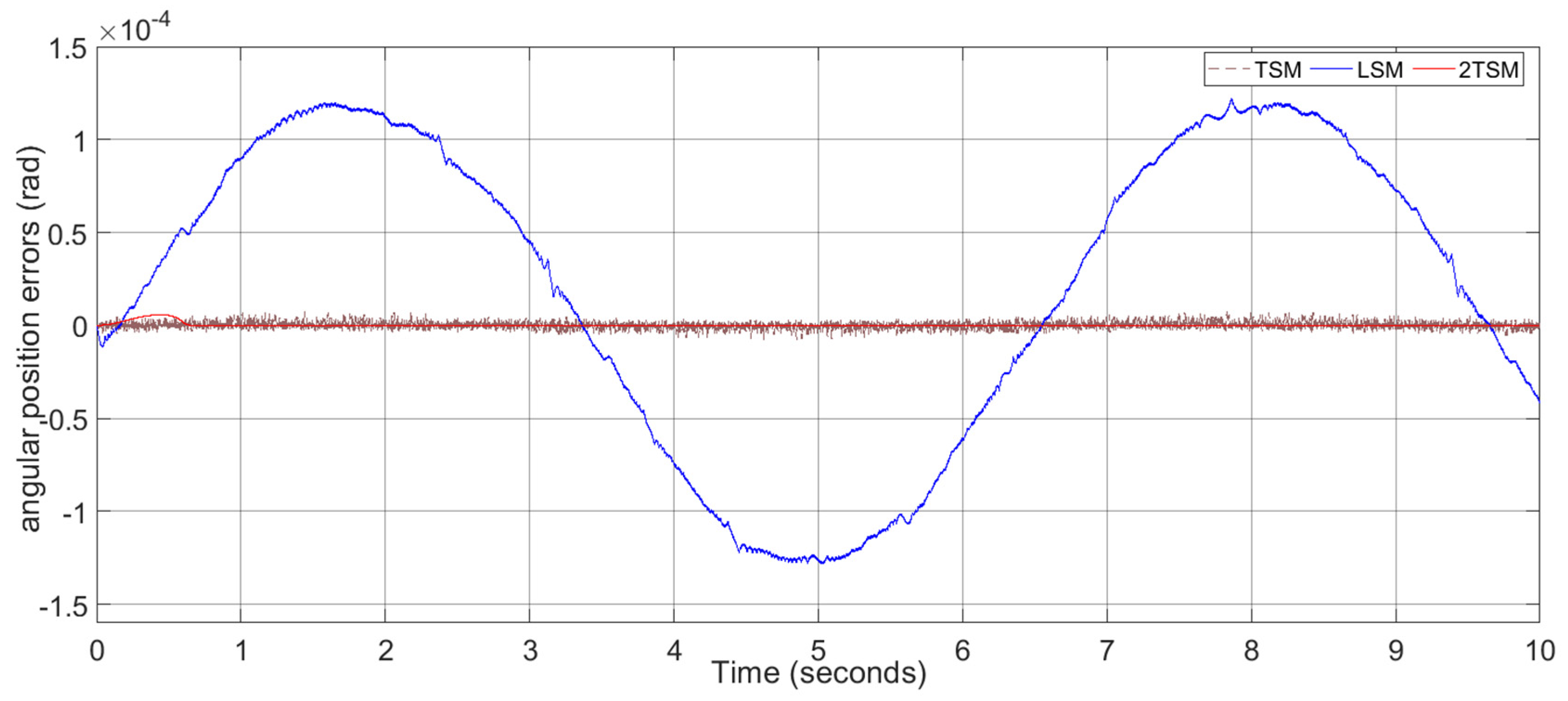
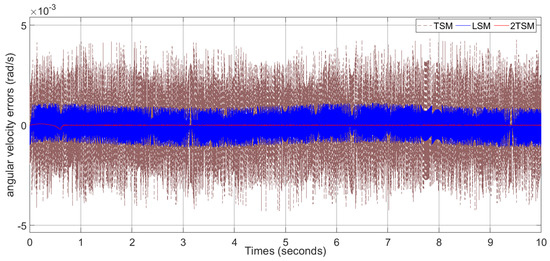
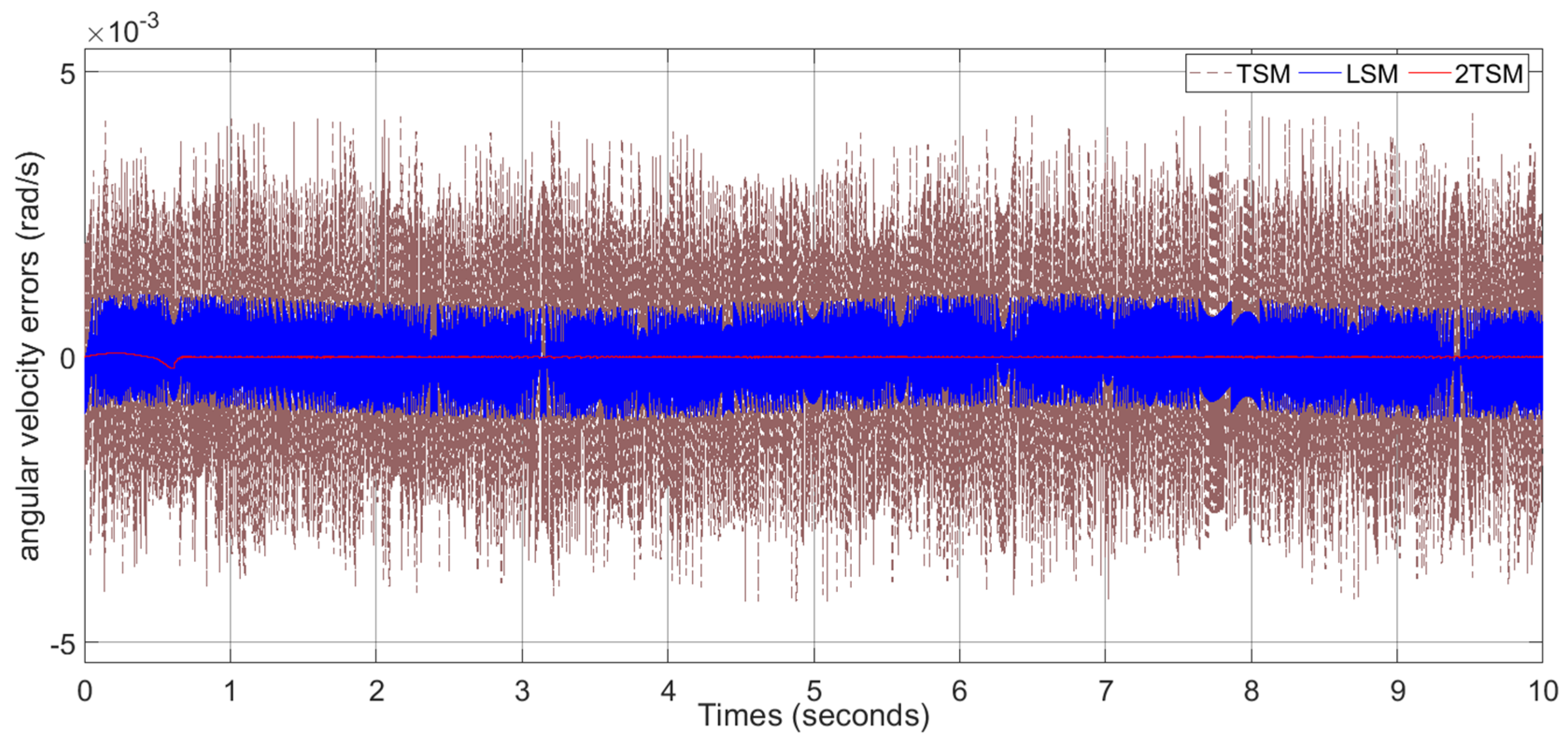
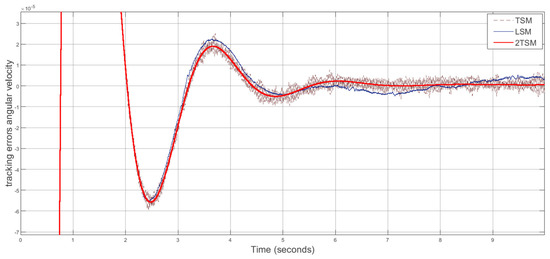
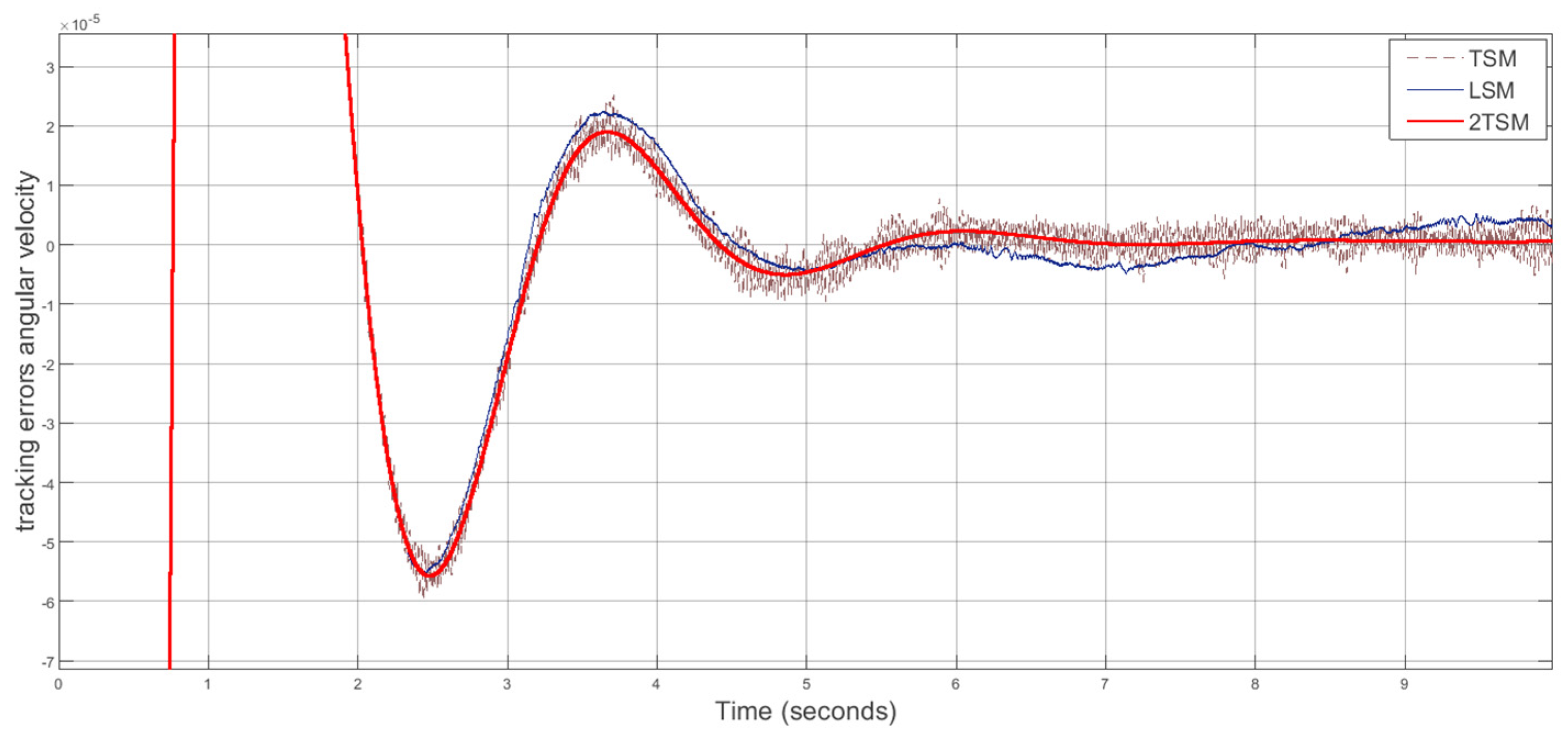
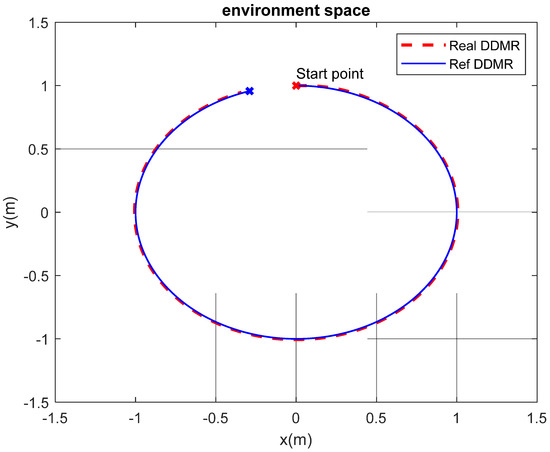
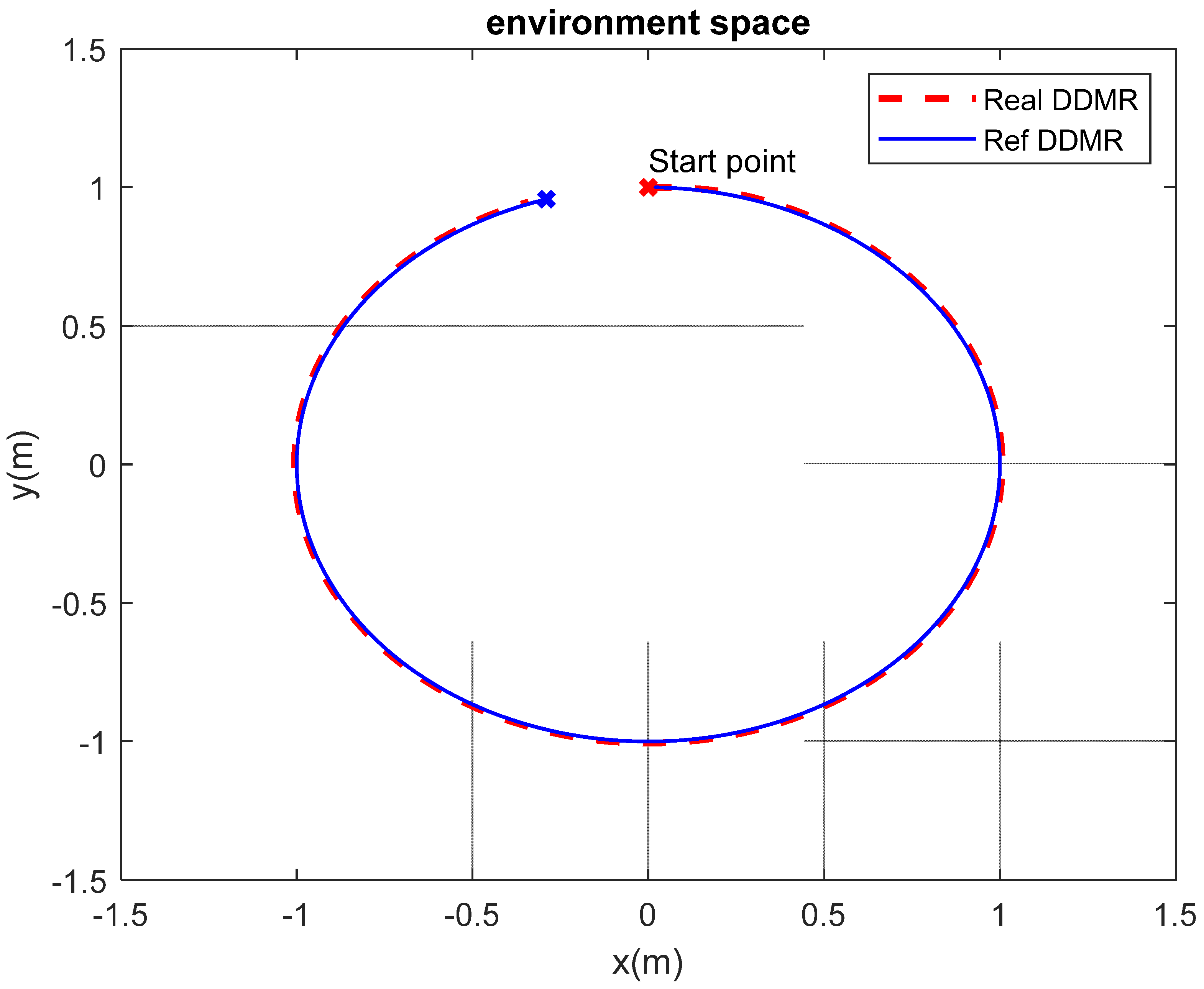
The simulation results are shown in Figure 5, Figure 6, Figure 7, Figure 8 and Figure 9. Figure 6, Figure 7 and Figure 8 depict the output tracking errors. Figure 5 shows the control input signals of two actuators (Torque 1—left actuator; Torque 2—right actuator).
Figure 5.
Control signals (Torque’s commands) of (a) LSM and (b) TSM. (c) Second-order TSM controllers.
Figure 6.
Angular positions’ tracking errors.
Figure 7.
Tracking errors of angular velocity (rad/s).
Figure 8.
Tracking errors of DDMR’s trajectory (distance to reference trajectory) of LSM, TSM, and 2TSM.
Figure 9.
Trajectory tracking performance of 2TSM-based controller on the Descartes coordinates {x,y} with units of meters (m).
It can be seen that the 2TSM controller outperforms conventional LSM and TSM counterparts in various measures, including faster response and better tracking precision as well as chattering-free, non-singular control signals, which make it suitable to directly apply in practical applications. Here, the finite-time convergence of 2TSM allows us to directly manipulate a variety of tuning parameters as in conventional first-order TSM approaches (i.e., [19,20]).
6. Conclusions
This paper proposes a second-order terminal sliding mode control scheme for the trajectory tracking of differential drive mobile robots. The main advantages of the presented 2TSM approach lie in the faster dynamic response and better tracking precision with chattering free control signals while avoiding singularities in the control law, as demonstrated. More importantly, this paper contributes to the converging characteristics of the analysis and calculation of the finite-time convergence of relevant state variables (velocity errors and angular position errors) to zero once the 2TSM sliding manifold is reached. This facilitates the direct manipulation of various tuning parameters of the 2TSM control scheme in a similar manner as that of conventional, well-known first-order TSM control methods (i.e., [19,20]).
Author Contributions
Methodology, B.T.P.; software, D.-L.V.; Formal analysis, N.T.N.; investigation, T.N.T.C.; supervision, N.-V.T. All authors have read and agreed to the published version of the manuscript.
Funding
This research was funded by Vietnam Academy of Science and Technology (VAST01.06/20-21).
Data Availability Statement
The data presented in this study is available on request from the corresponding authors, and the dataset was jointly completed by the team, so the data is not publicly available.
Conflicts of Interest
The authors declare no conflict of interest.
References
- Dudek, G.; Jenkin, M. Computational Principles of Mobile Robotics, 2nd ed.; Cambridge University Press: Cambridge, UK, 2010. [Google Scholar]
- Rached, H. Dynamic Modelling of Differential-Drive Mobile Robots using Lagrange and Newton-Euler Methodologies: A Unified Framework. Adv. Robot. Autom. 2013, 2, 107. [Google Scholar]
- Fukao, T.; Nakagawa, H.; Adachi, N. Adaptive tracking control of a nonholonomic mobile robot. IEEE Trans. Robot. Autom. 2000, 16, 609–615. [Google Scholar] [CrossRef] [Scilit]
- Yang, L.; Pan, S. A Sliding mode control method for trajectory tracking control of wheeled mobile robot. J. Phys. Conf. Ser. 2018, 1074, 26–28. [Google Scholar] [CrossRef] [Scilit]
- Lee, J.K.; Park, J.B.; Choi, Y.H. Tracking Control of Nonholonomic Wheeled Mobile Robot Based on New Sliding Surface with Approach Angle. IFAC Proc. Vol. 2013, 46, 38–43. [Google Scholar] [CrossRef] [Scilit]
- Sousa, R.L.S.; do Nascimento Forte, M.D.; Nogueira, F.G.; Torrico, B.C. Trajectory tracking control of a nonholonomic mobile robot with differential drive. In Proceedings of the 2016 IEEE Biennial Congress of Argentina (ARGENCON), Buenos Aires, Argentina, 15–17 June 2016; pp. 1–6. [Google Scholar]
- Kanayama, Y.; Kimura, Y.; Miyazaki, F.; Noguchi, T. A stable tracking control method for an autonomous mobile robot. In Proceedings of the IEEE International Conference on Robotics and Automation, Cincinnati, OH, USA, 13–18 May 1990; Volume 1, pp. 384–389. [Google Scholar]
- Sun, S. Designing approach on trajectory-tracking control of mobile robot. Robot. Comput.-Integr. Manuf. 2005, 21, 81–85. [Google Scholar] [CrossRef] [Scilit]
- Martins, F.N.; Celeste, W.C.; Carelli, R.; Silho, M.; Bastos, T. An adaptive dynamic controller for autonomous mobile robot trajectory tracking. Control Eng. Pract. 2008, 16, 1354–1363. [Google Scholar] [CrossRef] [Scilit]
- Solea, R.; Filipescu, A.; Nunes, U. Sliding-mode control for trajectory-tracking of a Wheeled Mobile Robot in presence of uncertainties. In Proceedings of the 2009 7th Asian Control Conference, Hong Kong, China, 27–29 August 2009; pp. 1701–1706. [Google Scholar]
- Cen, H.; Singh, B.K. Nonholonomic Wheeled Mobile Robot Trajectory Tracking Control Based on Improved Sliding Mode Variable Structure. Wirel. Commun. Mob. Comput. 2021, 2021, 2974839. [Google Scholar] [CrossRef] [Scilit]
- Huang, J.; Wen, C.; Wang, W.; Jiang, Z.P. Adaptive output feedback tracking control of a nonholonomic mobile robot. Automatica 2014, 50, 821–831. [Google Scholar] [CrossRef] [Scilit]
- Yang, J.; Kim, J. Sliding mode control for trajectory tracking of nonholonomic wheeled mobile robots. IEEE Trans. Robot. Autom. 1999, 15, 578–587. [Google Scholar] [CrossRef] [Scilit]
- Chwa, D. Sliding-mode tracking control of nonholonomic wheeled mobile robots in polar coordinates. IEEE Trans. Control Syst. Technol. 2004, 12, 637–644. [Google Scholar] [CrossRef] [Scilit]
- Zhai, J.Y.; Song, Z.B. Adaptive sliding mode trajectory tracking control for wheeled mobile robots. Int. J. Control. 2019, 92, 2255–2262. [Google Scholar] [CrossRef] [Scilit]
- Cao, T.; Pham, B.; Tran, H.; Gia, L.; Nguyen, N.; Truong, N. Non-singular terminal sliding mode control for trajectory tracking of a differential drive robot. E3S Web Conf. 2024, 496, 02005. [Google Scholar] [CrossRef] [Scilit]
- Zheng, J.; Wang, H.; Man, Z.; Jin, J.; Fu, M. Robust Motion Control of a Linear Motor Positioner Using Fast Non-singular Terminal Sliding Modet. IEEE/ASME Trans. Mechatron. 2015, 20, 1743–1752. [Google Scholar] [CrossRef] [Scilit]
- Sun, Z.; Xie, H.; Zheng, J.; Man, Z.; He, D. Path-following control of Mecanum-wheels omnidirectional mobile robots using nonsingular terminal sliding mode. Mech. Syst. Signal 2021, 147, 107128. [Google Scholar] [CrossRef] [Scilit]
- Feng, Y.; Yu, X.; Han, F. On nonsingular terminal sliding-mode control of nonlinear systems. Automatica 2013, 49, 1715–1722. [Google Scholar] [CrossRef] [Scilit]
- Feng, Y.; Zheng, J.; Yu, X.; Truong, N.V. Hybrid Terminal Sliding-Mode Observer Design Method for a Permanent-Magnet Synchronous Motor Control System. IEEE Trans. Ind. Electron. 2009, 56, 3424–3431. [Google Scholar] [CrossRef] [Scilit]
- Feng, Y.; Yu, X.; Man, Z. Non-singular terminal sliding mode control of rigid manipulators. Automatica 2002, 38, 2159–2167. [Google Scholar] [CrossRef] [Scilit]
- Feng, Y.; Han, X.; Wang, Y. Second-order terminal sliding mode control of uncertain multivariable systems. Int. J. Control 2007, 80, 856–862. [Google Scholar] [CrossRef] [Scilit]
- Feng, Y.; Zhou, M.; Yu, X.; Han, F. Full-order sliding mode control of rigid robotics manipulators. Asian Control J. 2019, 21, 1228–1236. [Google Scholar] [CrossRef] [Scilit]
- Nguyen, N.; Pham, B.; Hoang, T.; Nguyen, T.; Nguyen, L.; Truong, N. Efficient sensorless speed estimation of electrical servo drives using a full order nonsingular terminal sliding mode observer. Math. Probl. Eng. 2021, 2021, 8175848. [Google Scholar] [CrossRef] [Scilit]
- Shi, H.; Feng, Y. High order terminal sliding mode flux observer for induction motors. Acta Autom. Sin. 2012, 38, 288–294. [Google Scholar] [CrossRef] [Scilit]

Disclaimer/Publisher’s Note: The statements, opinions and data contained in all publications are solely those of the individual author(s) and contributor(s) and not of MDPI and/or the editor(s). MDPI and/or the editor(s) disclaim responsibility for any injury to people or property resulting from any ideas, methods, instructions or products referred to in the content. |
© 2024 by the authors. Licensee MDPI, Basel, Switzerland. This article is an open access article distributed under the terms and conditions of the Creative Commons Attribution (CC BY) license (https://creativecommons.org/licenses/by/4.0/).