Article

Cloze-Style Data Augmentation for Few-Shot Intent Recognition

Science and Technology on Information Systems Engineering Laboratory, National University of Defense and Technology, No. 109 Deya Street, Changsha 410073, China
*
Author to whom correspondence should be addressed.
These authors contributed equally to this work.
Mathematics 2022, 10(18), 3358; https://doi.org/10.3390/math10183358
Submission received: 14 July 2022 / Revised: 18 August 2022 / Accepted: 18 August 2022 / Published: 16 September 2022
(This article belongs to the Section E1: Mathematics and Computer Science)

Abstract

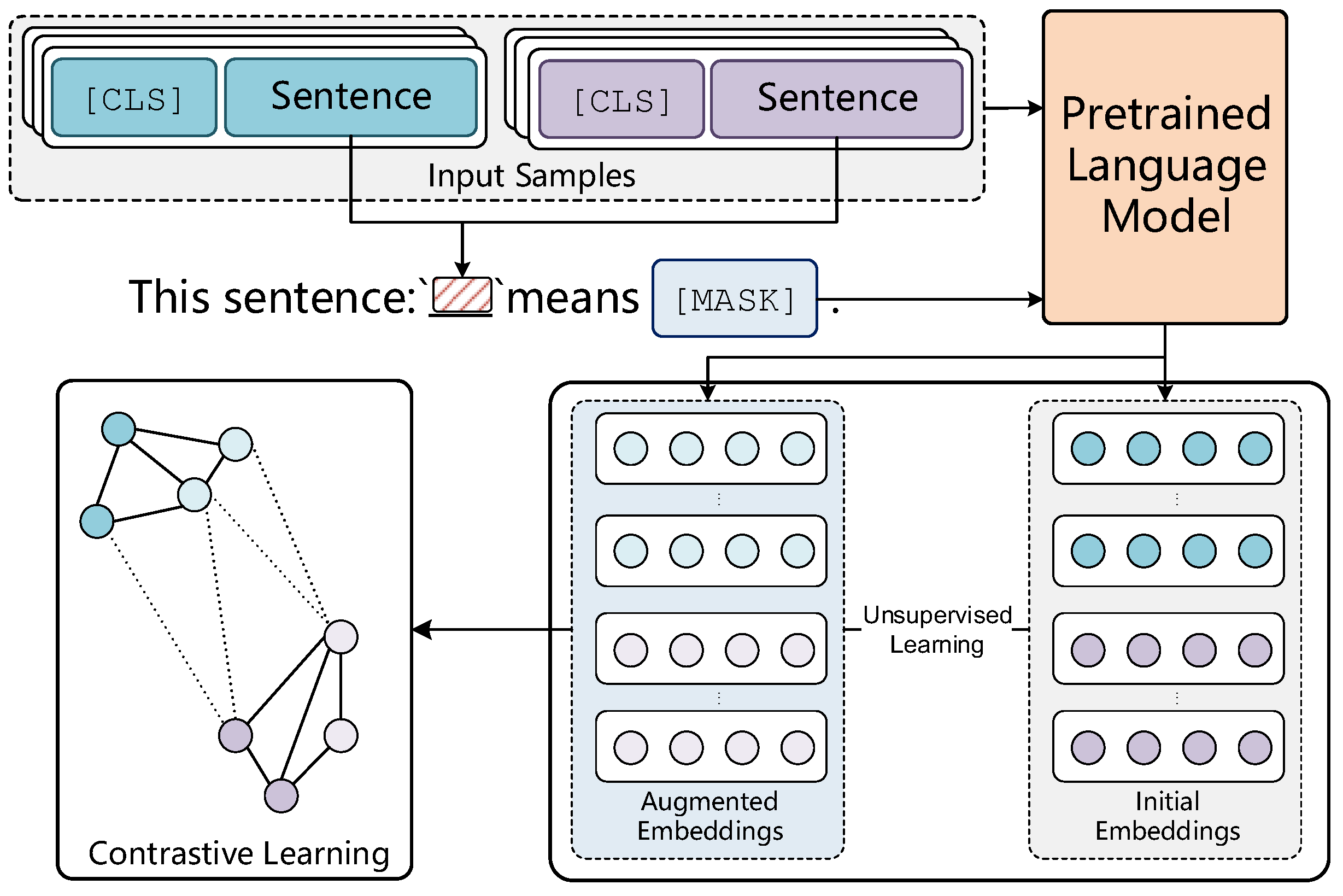
Intent recognition aims to identify users’ potential intents from their utterances, which is a key component in task-oriented dialog systems. A real challenge, however, is that the number of intent categories has grown faster than human-annotated data, resulting in only a small amount of data being available for many new intent categories. This lack of data leads to the overfitting of traditional deep neural networks on a small amount of training data, which seriously affects practical applications. Hence, some researchers have proposed few-shot learning should address the data-scarcity issue. One of the efficient methods is text augmentation, which always generates noisy or meaningless data. To address these issues, we propose leveraging the knowledge in pre-trained language models and constructed the cloze-style data augmentation (CDA) model. We employ unsupervised learning to force the augmented data to be semantically similar to the initial input sentences and contrastive learning to enhance the uniqueness of each category. Experimental results on CLINC-150 and BANKING-77 datasets show the effectiveness of our proposal by its beating of the competitive baselines. In addition, we conducted an ablation study to verify the function of each module in our models, and the results illustrate that the contrastive learning module plays the most important role in improving the recognition accuracy.
Keywords: few-shot learning; intent recognition; data augmentation; pretrained language model few-shot learning; intent recognition; data augmentation; pretrained language model