


Abstract
Background: Persistence under refrigeration is an important feature of Listeria monocytogenes, yet the molecular basis underlying lineage-specific differences in adaptation to these conditions remains poorly understood. In this study, we investigated proteomic differences between two L. monocytogenes strains belonging to epidemiologically distinct clonal complexes (CCs), CC9 and CC1, which represent a food-associated, hypovirulent lineage and a hypervirulent, human-associated lineage, respectively. Methods: Cultures of the two L. monocytogenes strains were grown at 10 °C and analysed by label-free quantitative (LFQ) mass spectrometry. Identified proteins were subjected to in silico prediction of antigenic and virulence-associated properties, subcellular analysis, and functional annotation using KEGG pathways. Results: A total of 915 proteins were identified, of which 703 were predicted in silico to be antigenic and/or virulence-associated. Among these, 165 were detected only in the CC9 strain, 49 only in the CC1 strain, and 489 were shared by both strains. The shared protein complement included FlgE, Lmo0723, Dps, PrfA, and RecA, reflecting conserved functions related to motility, stress response, virulence regulation, and genome maintenance. Functional annotation assigned a larger number of proteins to metabolic and cellular pathways in the CC9 strain, largely reflecting the higher number of proteins detected only in this strain, whereas in the CC1 strain carbohydrate metabolism accounted for a larger proportion of the annotated proteins. Quantitative analysis further identified 19 proteins with increased abundance and 66 with decreased abundance in CC1 relative to CC9. Conclusions: These findings reveal distinct proteomic signatures in the CC1 and CC9 strains during growth at low temperature and suggest that their contrasting metabolic and stress-response profiles may be related to their different ecological and pathogenic characteristics. Validation in a larger panel of strains is required to establish whether these features are lineage-associated.
1. Introduction
Listeria monocytogenes is a psychrotrophic foodborne pathogen whose ability to grow at refrigeration temperatures, withstand multiple environmental stresses, and form biofilms makes it difficult to control in food-processing environments. Contamination of chilled and ready-to-eat (RTE) foods is common, leading to recurrent outbreaks and product recalls [1]. After entering the food chain from environmental reservoirs such as soil, water, and vegetation, the bacterium can persist for extended periods on food-contact surfaces and within food-processing facilities [2]. In addition, cold exposure alters the physicochemical properties of the cell envelope, increasing surface rigidity and modifying teichoic acid composition, which may increase resistance to disinfectants and environmental stressors [3].
Temperature is a major determinant of L. monocytogenes physiology. At moderate environmental temperatures (20–25 °C), the microorganism exhibits a predominantly saprophytic lifestyle, whereas at 37 °C it represses motility and activates the PrfA-regulated virulence programme [4]. Adaptation to low temperature involves multiple stages, including cold shock, acclimatisation, and long-term adaptation [5].
During the cold shock phase, membrane rigidification is accompanied by a rapid reduction in transcription, translation, and metabolic activity, together with the induction of cold shock proteins (Csps), including CspA, CspB, and CspD, which stabilise RNA and facilitate recovery at low temperature [6,7,8]. During acclimatisation, L. monocytogenes modifies membrane fatty acid composition, particularly increasing anteiso-branched forms, and accumulates compatible solutes such as glycine betaine and carnitine, which contribute to protection against cold-induced stress [9,10,11]. These solutes, commonly present in foods—carnitine in meat and dairy products and glycine betaine in plant and marine environments—are imported via BetL, Gbu, and OpuC transport systems regulated by the alternative sigma factor (σB) [12,13]. Long-term adaptation to low temperature is thought to contribute to persistence in food-processing environments by supporting metabolic states compatible with prolonged environmental stress and nutrient limitation.
Prolonged exposure to low temperature reshapes both the proteome and central metabolic pathways, reflecting an integrated adaptive response. Chaperones and proteases, including GroEL, DnaK, ClpP, and ClpC, are induced, while pathways associated with energy production, carbohydrate metabolism, and stress resistance are reconfigured [14]. These responses are coordinated by global regulator systems including LisRK, PgpH, and σB, which integrate osmotic, oxidative, and energetic signals [15,16]. Although PrfA activity is generally reduced at low temperature, extensive regulatory crosstalk exists between stress-response networks and virulence-associated pathways [17,18,19]. In addition, cold-induced modulation of regulatory RNAs and RNA-binding proteins introduces an additional layer of post-transcriptional control that fine-tunes metabolic and virulence-associated processes during prolonged refrigeration.
Under low-temperature conditions, L. monocytogenes adjusts central carbon and energy-generating pathways to maintain cellular energy and redox balance, while modulating amino acid and lipid metabolism to support survival [20].
Cold tolerance varies among L. monocytogenes strains. Hypervirulent lineage I clonal complexes (CCs), including CC1 and CC4, have been associated with enhanced stress tolerance and pathogenic potential, whereas food-associated CCs such as CC9 are frequently linked to environmental persistence and biofilm formation [21]. The molecular mechanisms underlying these differences remain incompletely understood, particularly at the proteomic level.
Although genomic and transcriptomic studies have advanced our understanding of cold adaptation, proteomic changes associated with low-temperature adaptation and their links to metabolism, stress response, and persistence remain insufficiently characterised, particularly when comparing strains with distinct epidemiological backgrounds. Proteomic approaches provide complementary information on protein abundance, stability, and post-transcriptional regulation that cannot be inferred from gene-centric analyses alone. Furthermore, the identification of proteins with putative antigenic and virulence-associated potential may provide additional information relevant to the detection and risk assessment of L. monocytogenes in refrigerated foods.
In this study, we performed a comparative proteomic analysis of two L. monocytogenes strains grown at 10 °C: a hypervirulent, human-derived CC1 strain and a hypovirulent CC9 strain isolated from raw pork liver sausage. The objectives were to: (i) characterise strain-specific proteomic responses to low temperature; (ii) identify functional pathways associated with stress, virulence, and metabolism; and (iii) detect proteins potentially involved in cold adaptation, environmental persistence, and pathogenic potential. This work provides new insights into how L. monocytogenes remodels its proteome under low-temperature conditions and highlights strain-level differences, potentially lineage-dependent, that may influence its behaviour in chilled food environments.
2. Materials and Methods
2.1. Bacterial Strains, Genomic Characterization and Growth Conditions
Two L. monocytogenes strains were selected from the Italian National Reference Laboratory for L. monocytogenes (LNR-Lm) at the Istituto Zooprofilattico Sperimentale dell’Abruzzo e del Molise (IZSAM, Teramo, Italy). Specifically, strain F was isolated from pork sausage, whereas strain H was recovered from the blood of an infected patient.
The two strains were previously characterised by whole genome sequencing (WGS), as reported by Centorotola et al. [22], using the Illumina platform (Illumina, San Diego, CA, USA). Multilocus sequence typing (MLST) was performed according to the Pasteur Institute reference schemes [https://bigsdb.pasteur.fr/ (accessed on 28 May 2025)] to define CCs. Moreover, the two L. monocytogenes strains were further characterised in silico using the BIGSdb-Lm database tools (accessed on 28 May 2025) for the presence of genes associated with “virulence”, “metal and disinfectant resistance”, and “Stress Islands”. Genomic data are available under BioProject PRJNA1267817.
Key strain features are summarised in Table 1.
Table 1.
Main features of the L. monocytogenes strains used in this study, including virulence-associated loci (inlA, LIPI-1, and LIPI-3), SSI-1 (stress-survival islet; “complete” or “partial” indicates the presence of all or some constituent genes), isolation source, and BioSample accession numbers.
Bacteria were cultured in Brain Heart Infusion (BHI) broth (Oxoid, Thermo Fisher Scientific, Rodano, Italy), supplemented with 0.5% NaCl (Sigma-Aldrich, Saint Louis, MO, USA) and adjusted to pH 7.0. Overnight cultures were diluted 1:100 in fresh BHI and incubated with shaking at either 10 °C (low-temperature condition) or 37 °C (control condition) until reaching the mid-exponential phase (OD600 0.6).
The mid-exponential phase was reached after approximately 48 ± 2 h at 10 °C and 6 ± 2 h at 37 °C. These incubation times were consistent with previously reported growth kinetics and methodological approaches for L. monocytogenes [23,24,25]. The attainment of the mid-exponential phase was verified by monitoring OD600 at regular intervals and comparing the observed growth profiles with previously established growth curves for each strain at both temperatures. Cells were collected by centrifugation (4500× g for 15 min at 4 °C), washed three times with ice-cold 0.01 M phosphate-buffered saline (PBS; pH 7.0), and stored at −80 °C.
All experiments were performed using three independent biological replicates. Technical replicates for the LC-MS/MS analyses were not performed, as biological variability represents the primary source of variance.
2.2. Protein Extraction and Tryptic Digestion
Protein extraction was carried out using CelLytic B Cell Lysis Reagent and CelLytic IB Inclusion Body Solubilization Reagent (Sigma-Aldrich, Saint Louis, MO, USA), following the manufacturer’s instructions. After lysis, insoluble debris was removed by centrifugation, and total protein concentration was quantified using the Bradford assay (Bio-Rad, Hercules, CA, USA).
For tryptic digestion, 30 μg of each protein lysate were processed using a filter-aided sample preparation (FASP) protocol with Nanosep 10K centrifugal devices (Pall Corporation, Port Washington, NY, USA). Proteins were reduced and alkylated with 50 mM iodoacetamide (Sigma-Aldrich, Saint Louis, MO, USA) in 50 mM ammonium bicarbonate (LiChropur®, Merck, Darmstadt, Germany), followed by overnight digestion with sequencing-grade trypsin (Roche, Mannheim, Germany) at an enzyme-to-protein ratio of 1:50 at 37 °C. The reaction was quenched by adding 10% formic acid (Sigma-Aldrich, Saint Louis, MI, USA). Peptides were desalted using Pierce C18 Spin Columns (Thermo Scientific, Waltham, MA, USA), dried under vacuum, and stored at −20 °C until LC-MS/MS analysis.
2.3. Mass Spectrometry Analysis
Three biological replicates per condition were analysed by LC-MS/MS. Peptide extracts (5 μL) were injected into an Easy-nLC 1200 system (Thermo Fisher Scientific, Waltham, MA, USA) coupled to an Orbitrap Q-Exactive mass spectrometer (Thermo Fisher Scientific, Waltham, MA, USA). Peptides were initially loaded onto a PepMap C18 trap column [75 μm I.D., 2 cm; (Thermo Fisher Scientific, Waltham, MA, USA)], followed by separation on an Easy-Spray C18 analytical column [50 μm I.D., 15 cm; (Thermo Fisher Scientific, Waltham, MA, USA)] using a 97-min linear gradient. Full-scan MS spectra were acquired at a resolution of 70,000 using data-dependent acquisition (DDA; top-12 method).
Raw data files were processed using Proteome Discoverer v2.5 (Thermo Fisher Scientific, Waltham, MA, USA) and searched against the L. monocytogenes 1/2a ATCC BAA-679/EGD-e reference proteome available in UniProt (Proteome ID UP000000817; FASTA database containing 2859 protein sequences, imported into Proteome Discoverer on 25 July 2022). Carbamidomethylation of cysteine was set as a fixed modification, whereas methionine oxidation and N-terminal acetylation were set as variable modifications. Proteins were retained when identified with ≥2 unique peptides and passing the specified false discovery rate (FDR) thresholds. Peptide spectral matches (PSMs) were validated using Percolator with an FDR threshold of <1% at the peptide level (strict target FDR = 0.01; relaxed target FDR = 0.05), and protein identifications were accepted at a protein-level FDR of <1%. Only proteins detected in at least two out of three biological replicates were included in downstream analyses. Label-free quantitative (LFQ) analysis was performed using the Precursor Ions Quantifier node implemented in Proteome Discoverer v2.5. LFQ intensities were calculated from precursor ion signals and used to estimate relative protein abundance across biological samples. For comparative analysis, the food-associated strain F (CC9) was used as the reference, and protein abundance ratios for the human-associated strain H (CC1) were calculated relative to this baseline. Differential protein abundance between the two strains was assessed using the integrated ANOVA module in Proteome Discoverer v2.5, applying a significance threshold of p ≤ 0.05 and |log2 fold change| > 1. p-values were not adjusted for multiple testing; therefore, differentially abundant proteins should be regarded as candidates, and the possibility of false-positive results cannot be excluded.
2.4. Bioinformatic Analysis
Subcellular localisation was predicted using five complementary tools. LipoP 1.0 [26] was used to identify lipoprotein signal peptides typical of Gram-positive bacteria; TMHMM v2.0 [27] was used to predict transmembrane helices; SignalP 5.0 [28,29] was used for general signal peptide detection; PSORTb v3.0.2 [30] and CELLO v2.5 [31,32] were additionally employed to classify proteins into cytoplasmic, membrane-associated, or secreted categories.
Virulence-associated functions and antigenicity were predicted using VirulentPred and VaxiJen v2.0. VirulentPred relies on a two-layer Support Vector Machine model to predict putative bacterial virulence factors [33], whereas VaxiJen estimates antigenic potential based on physicochemical properties in an alignment-independent manner, with proteins scoring >0.4 considered probable antigens [34]. It should be noted that both tools provide computational predictions only; therefore, the antigenic and virulence-associated properties of the identified proteins were not experimentally validated in this study. Data extraction from the outputs of the online prediction servers was performed using in-house Python scripts. The scripts were used to parse raw outputs, normalise protein identifiers, and assemble final tables of cellular localization (LipoP, CELLO, TMHMM, SignalP, PSORTb, and BepiPred) and antigenicity/virulence predictions (VaxiJen and VirulentPred). The scripts are available as open-source code on GitHub (https://github.com/PCas95/protein_loc_organizer) (accessed on 18 December 2025).
2.5. Functional Annotation and Pathway Enrichment Analysis
Proteins detected only in CC1 or CC9 and predicted to be virulence-related (VirulentPred) and/or antigenic (VaxiJen), together with differentially abundant proteins identified by LFQ analysis, were functionally annotated using the KEGG Automatic Annotation Server (BlastKOALA). KEGG Orthology (KO) identifiers were used to classify proteins into functional categories and metabolic pathways associated with strain-specific and quantitative proteomic differences. KEGG annotation was used descriptively: results are reported as the number of proteins assigned to each KEGG category or pathway, and no statistical enrichment testing was performed. Because the number of proteins detected exclusively in strain F (n = 165) was higher than that detected exclusively in strain H (n = 49), KEGG category counts were also expressed as proportions of the proteins included in the analysis for each strain. Pathway assignments based on proteins detected in only one strain reflect protein detection and do not provide information on relative abundance or pathway activity.
Protein interaction networks and statistical functional enrichment analyses, including Gene Ontology (GO) classification, were conducted using the STRING database (v12.5; https://string-db.org/cgi/about, accessed on 18 December 2025), with L. monocytogenes as the reference organism.
2.6. Comparison of Differentially Abundant Proteins Between Temperatures
To assess differences in protein abundance between the human-associated strain (H) and the food-associated strain (F) under the two growth conditions, lists of differentially abundant proteins obtained at 37 °C [35] and 10 °C (this study) were analysed. Proteins more abundant and less abundant in H relative to F were considered separately, and the corresponding lists at the two temperatures were intersected using Venny 2.1.0, based on UniProt accession numbers, to identify proteins differentially abundant in the same direction at both temperatures and proteins specific to each temperature. As the 37 °C dataset was generated in a previous, independent experiment [35], this comparison was considered descriptive.
3. Results
3.1. Genomic and Proteomic Characterization of the L. monocytogenes Strains
MLST analysis identified strain F as CC9 and strain H as CC1. Regarding the virulence profile, strain F (CC9) carried 61 of 93 virulence-associated genes, whereas strain H (CC1) showed 66 of 93. Both strains harboured a complete Listeria Pathogenicity Island 1 (LIPI-1), while an additional complete LIPI-3 was present only in strain H. Furthermore, strain H carried a full-length inlA (encoding for internalin A) and inlB (encoding for internalin B), while strain F carried an inlA gene affected by a premature stop codon (PMSC) mutation.
Several resistance-associated features were detected in strain F, including a complete stress survival islet (SSI-1). Key strain features are summarised in Table 1.
A total of 915 proteins were identified by mass spectrometry (Supplementary Table S1). Protein identification and functional annotation were performed independently of the quantitative analysis. The identified proteins were first compared qualitatively between strains to define strain-specific proteomic signatures. Subcellular localisation was predicted using CELLO v2.5, LipoP 1.0, TMHMM v2.0, SignalP 5.0, and PSORTb v3.0.2. Of the identified proteins, 631 proteins were classified as cytosolic, whereas 284 were assigned to non-cytosolic compartments (Supplementary Table S2). Subsequently, LFQ analysis was performed on proteins quantified in both strains to identify differences in protein abundance.
3.2. Strain-Specific Proteomic Signatures
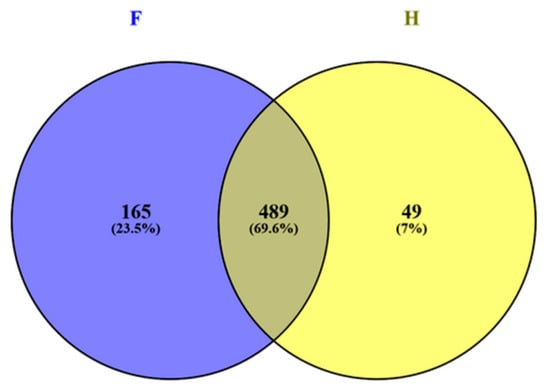
All identified proteins were screened for potential antigenic and virulence-associated properties using VaxiJen v2.0 and VirulentPred. This in silico analysis classified 703 proteins as putatively antigenic and/or virulence-associated. Among these, 165 were detected only in the food-associated strain F, whereas 49 were detected exclusively in the human-associated strain H (Supplementary Table S3). The remaining 489 proteins were shared by both strains (Figure 1). These findings indicate distinct strain-specific proteomic signatures under low-temperature conditions.
Figure 1.
Venn diagram showing the number and percentage of putatively antigenic and/or virulence-associated proteins detected in the food-associated, hypovirulent strain F (CC9) and the human-associated, hypervirulent strain H (CC1).
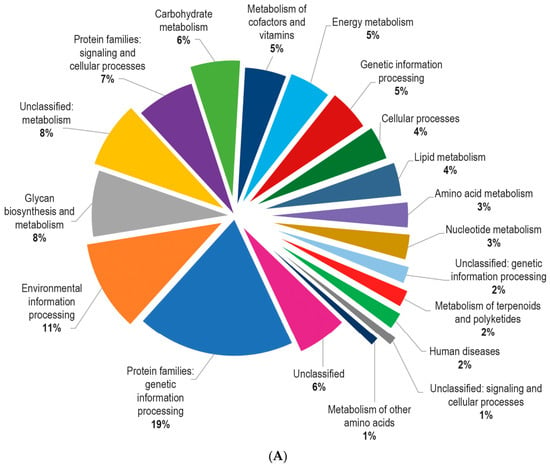
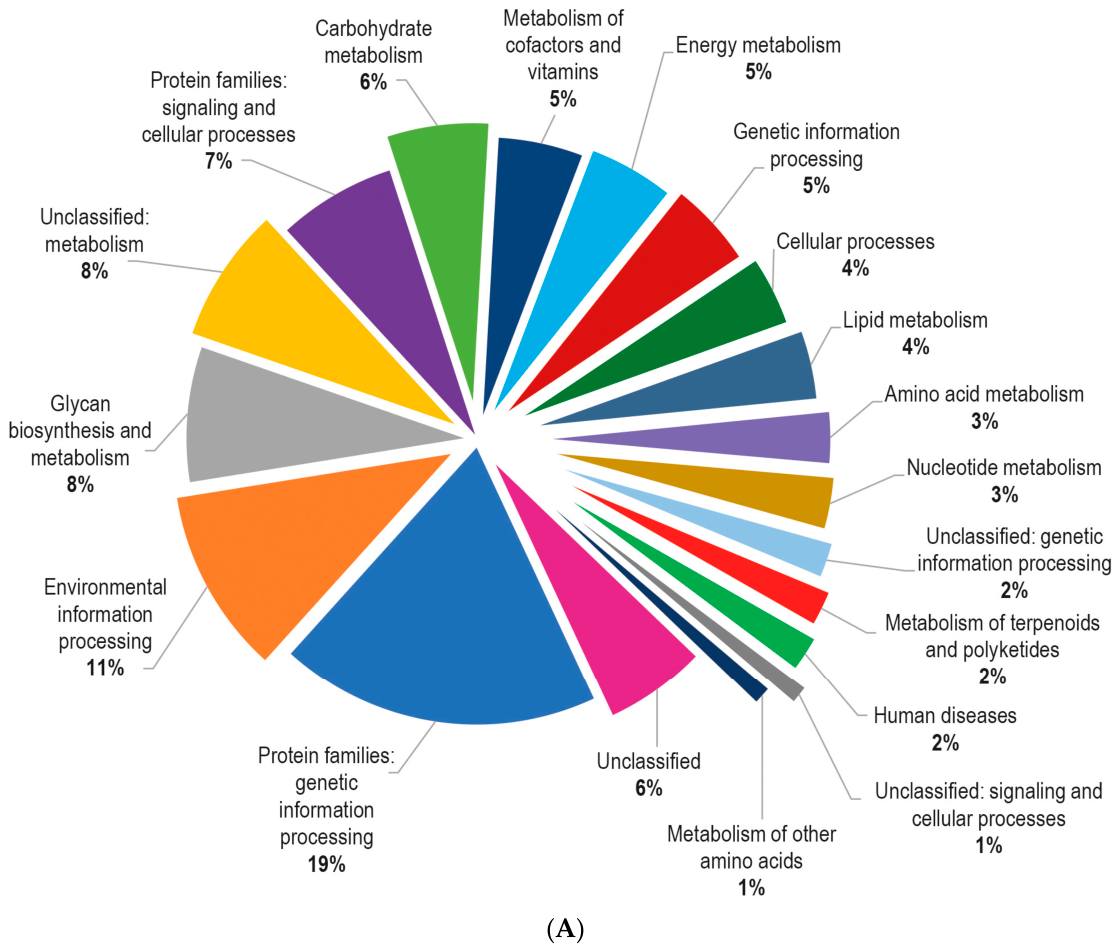
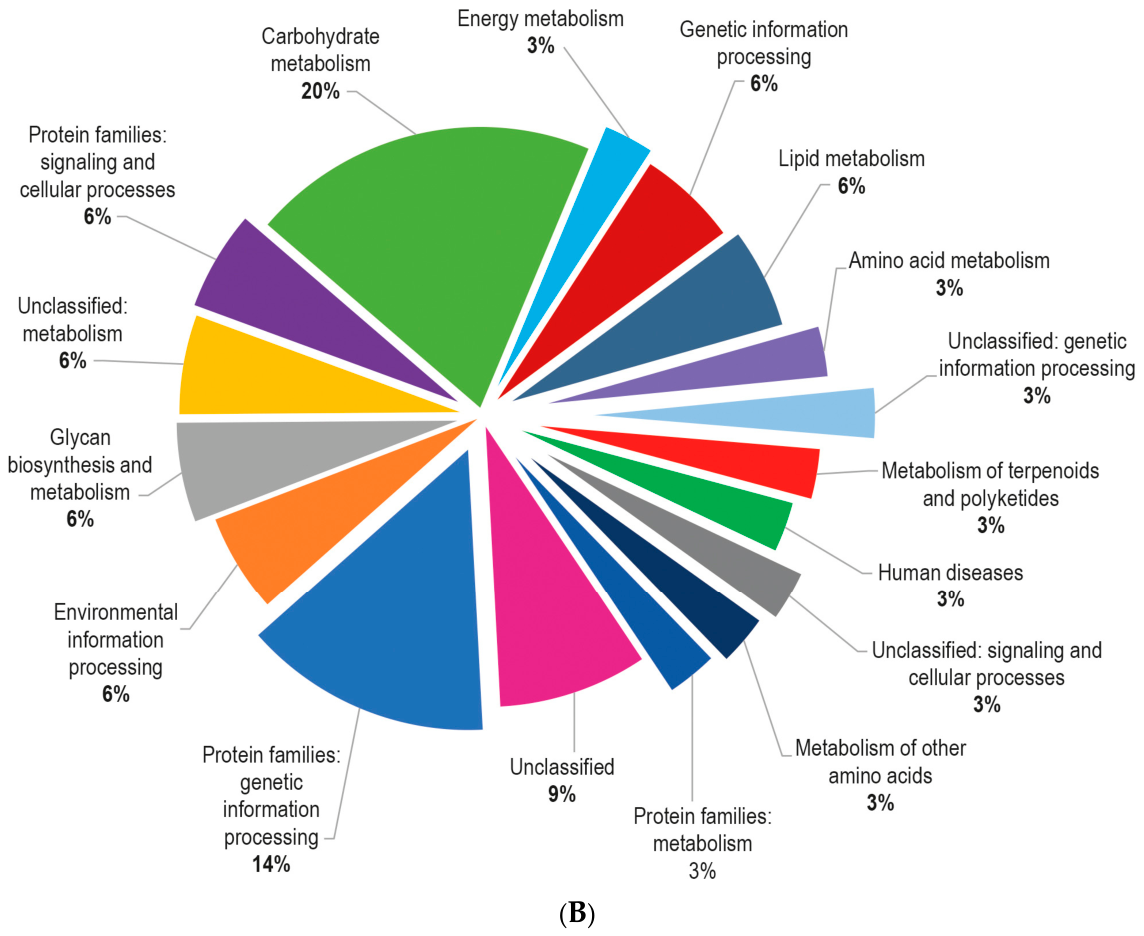
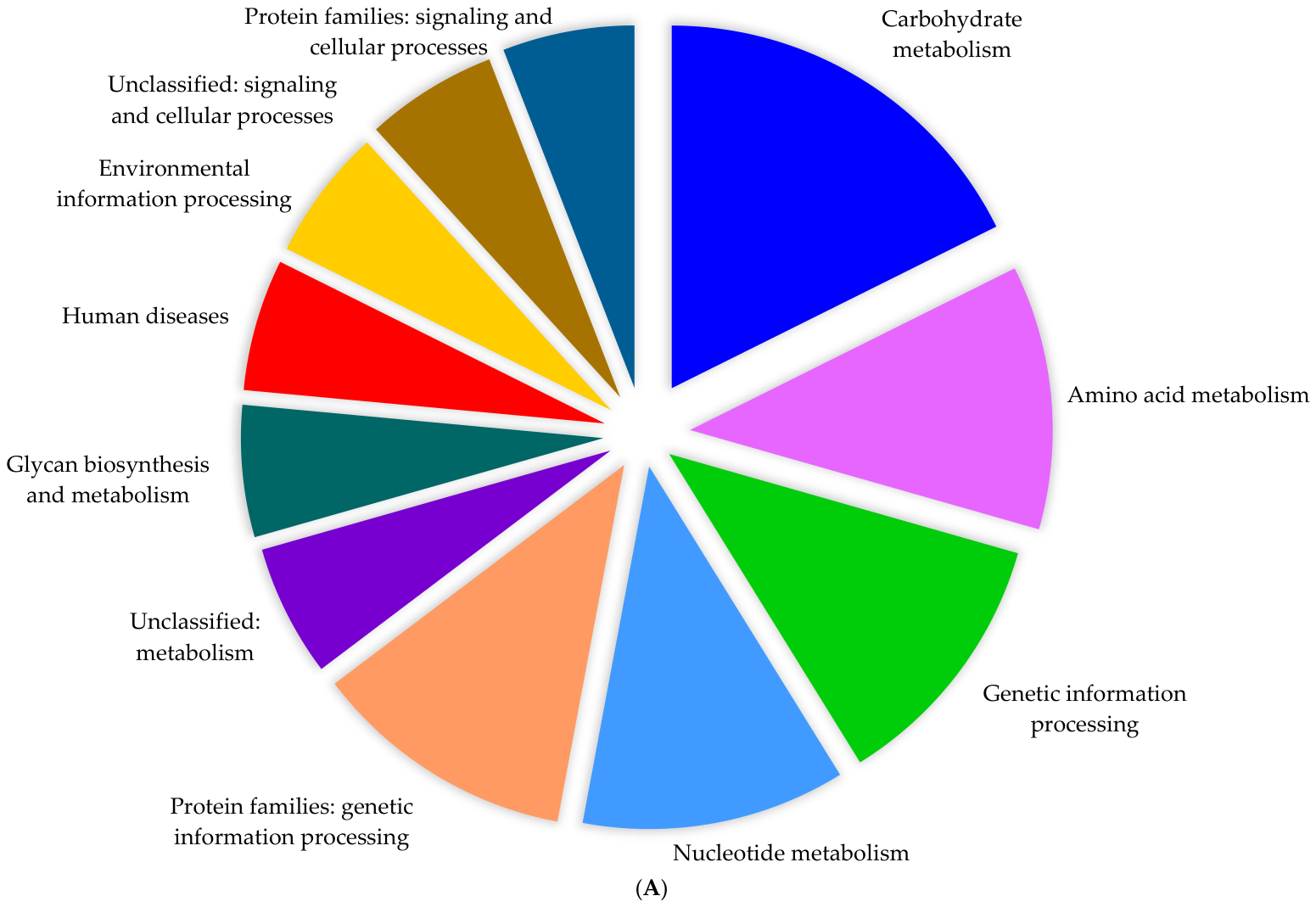
Functional annotation using BlastKOALA revealed that proteins detected only in strain F were primarily associated with genetic information processing (19 proteins), environmental information processing (11 proteins), and glycan biosynthesis and metabolism (8 proteins). Additional functional categories included carbohydrate metabolism (6 proteins), energy metabolism (5 proteins), and lipid metabolism (4 proteins), whereas six proteins remained unclassified.
In contrast, strain H exhibited a different functional profile. Carbohydrate metabolism was the most represented category (7 proteins), followed by genetic information processing (5 proteins) and signalling and cellular processes (2 proteins each). Three proteins could not be assigned to specific pathways (Figure 2; Table 2). The number of KEGG categories represented was similar between the two strains (18 in F and 16 in H, excluding unclassified proteins), with most categories represented in both strains (Table 2). Therefore, the higher number of annotated proteins in strain F mainly reflects the greater number of proteins detected exclusively in this strain (165 vs. 49), rather than a higher functional diversity. When counts were expressed as proportions of the proteins entering the analysis, carbohydrate metabolism accounted for 14.3% (7/49) of the proteins detected only in strain H, compared with 3.6% (6/165) in strain F.
Figure 2.
Pie charts showing the KEGG functional classification (number of proteins per category) of proteins detected only in the food-associated strain F (A) and the human-associated strain H (B) that were predicted to be antigenic and/or virulence-associated. Functional annotation was performed using BlastKOALA.
Table 2.
KEGG functional classification (number of proteins per category) of proteins detected only in the food-associated strain F and the human-associated strain H and predicted to be antigenic and/or virulence-associated, as determined by BlastKOALA.
BlastKOALA pathway assignment also showed differences in the carbohydrate metabolic pathways to which strain-specific proteins were assigned. Proteins detected only in strain F (CC9) were assigned to seven pathways, including glycolysis/gluconeogenesis, the tricarboxylic acid (TCA) cycle, pyruvate metabolism, and butanoate metabolism.
Conversely, proteins detected only in strain H (CC1) were assigned to five pathways, related to fructose, mannose, and sucrose metabolism, as well as the pentose phosphate pathway and galactose metabolism. Among the annotated proteins, fructokinase (K00847) and ribose-5-phosphate isomerase (K01808) were associated with carbohydrate metabolism and the pentose phosphate pathway, respectively (Table 3). These pathway assignments are based solely on protein detection, rather than on relative abundance or formal enrichment analysis. Therefore, they indicate which pathways are represented among strain-specific proteins but do not imply that these pathways are more active or upregulated in either strain. Moreover, the higher number of pathway assignments in strain F partly reflects the larger number of proteins detected exclusively in this strain.
Table 3.
Carbohydrate metabolic pathways identified by BlastKOALA among proteins detected only in the food-associated (CC9) and human-associated (CC1) L. monocytogenes strains and predicted to be antigenic and/or virulence-associated.
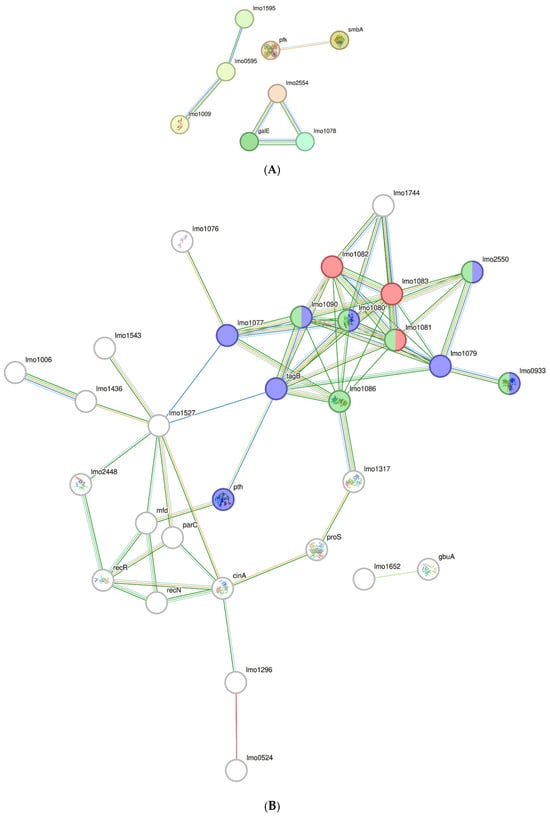
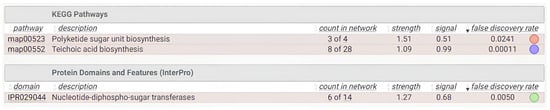
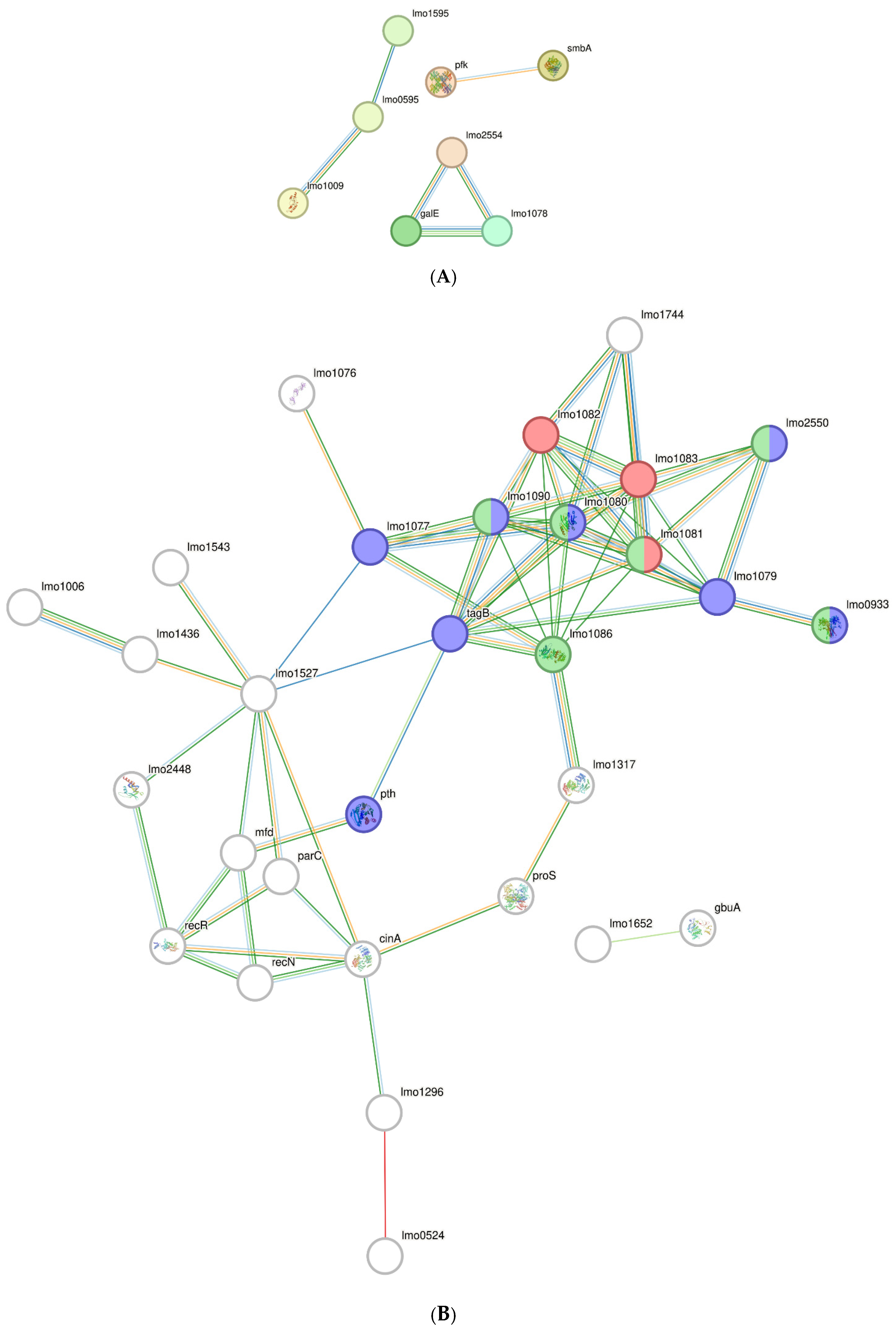
To gain further insight into the biological processes underlying the observed proteomic changes, protein–protein interaction networks were constructed using STRING separately for the proteins with increased and decreased abundance in strain H (Figure 3). For the proteins with decreased abundance, STRING analysis highlighted a network comprising 66 nodes and 65 edges. The cluster indicates that the proteins are biologically connected and involved in teichoic acid biosynthesis, and polyketide sugar unit biosynthesis. The same analysis performed on the proteins with increased abundance did not reveal any significantly enriched pathway or domain.
Figure 3.
STRING protein–protein interaction network analysis of differentially abundant proteins in L. monocytogenes strains H (CC1) and F (CC9) grown at 10 °C. Network of proteins with increased abundance in strain H, with no significant enrichment detected (A), and network of proteins with decreased abundance in strain H (B). Edge colours indicate the type of evidence: light blue, curated databases; magenta, experimentally determined; green, gene neighbourhood; red, gene fusion; dark blue, gene co-occurrence; yellow-green, text mining; black, co-expression; lavender, protein homology. In (B), node colours indicate the enriched terms listed below the network (red, KEGG map00523; purple, KEGG map00552; green, InterPro IPR029044); white nodes are not associated with any enriched term.
3.3. LFQ-Based Quantitative Proteomic Analysis of CC1 and CC9 Strains
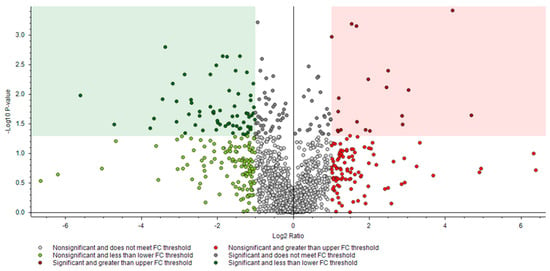
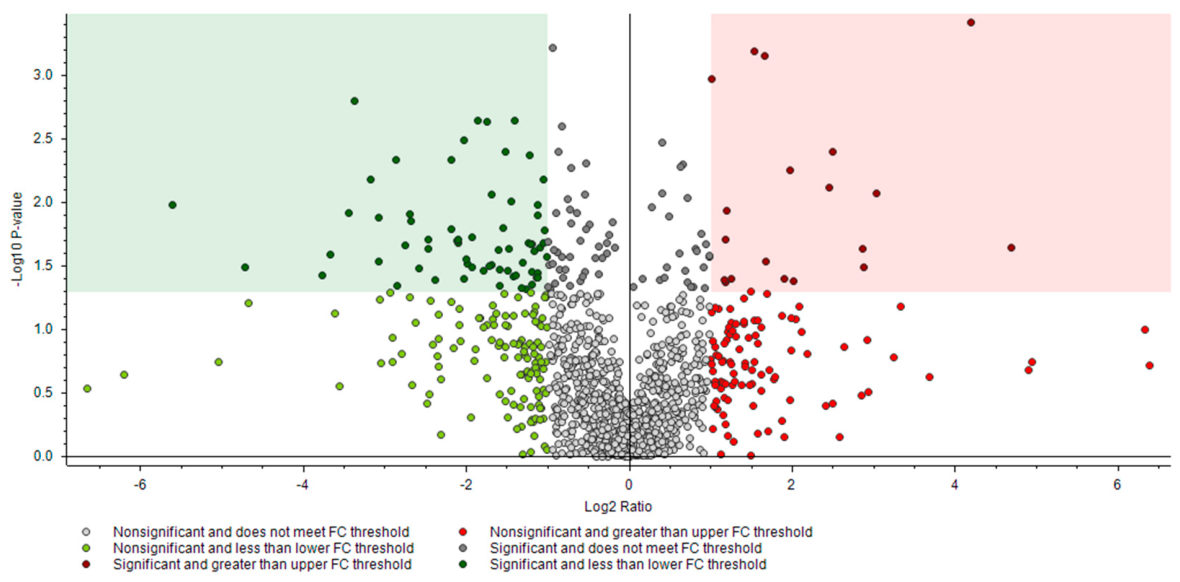
In contrast to the strain-specific qualitative differences observed among proteins detected only in one strain, LFQ analysis highlighted quantitative changes in proteins quantified in both strains. Using strain F (CC9) as the reference, LFQ analysis identified 19 proteins with significantly increased abundance and 66 proteins with significantly decreased abundance in strain H (CC1) under low-temperature conditions (10 °C), according to the applied criteria (|log2 fold change| > 1; p ≤ 0.05) (Figure 4; Supplementary Table S4).
Figure 4.
Volcano plot showing differentially abundant proteins between the food-associated strain F (CC9) and the human-associated strain H (CC1) grown at 10 °C. Each point represents a quantified protein, with the x-axis indicating log2 fold change and the y-axis representing statistical significance (−log10 p-value). Proteins showing significantly increased abundance in strain H are highlighted in red (n = 19), whereas proteins showing significantly higher abundance in strain F are shown in green (n = 66). Differentially abundant proteins were defined according to the LFQ statistical criteria (p ≤ 0.05 and |log2 fold change| > 1).
The distribution of differentially abundant proteins is shown in the volcano plot (Figure 4), which also shows that the differentially abundant proteins were skewed towards higher abundance in strain F (66 vs. 19 proteins). These quantitative differences indicate distinct proteomic responses between the two strains during growth at low temperature. Whereas strain-specific protein identification highlighted differences based on protein presence or absence, LFQ analysis revealed changes in protein abundance among proteins quantified in both strains.
3.4. Functional Characterization of Differentially Abundant Proteins
To further characterise the biological significance of the differentially abundant proteins identified by LFQ analysis, this subset of proteins was analysed using the same annotation pipeline, including VaxiJen v2.0, VirulentPred, and BlastKOALA.
Among the differentially abundant proteins, VaxiJen and VirulentPred analyses identified 13 proteins with increased abundance and 53 with decreased abundance in strain H (CC1) relative to strain F (CC9) as putative antigenic and/or virulence-associated candidates. Detailed prediction scores and classifications are provided in Supplementary Table S3B.
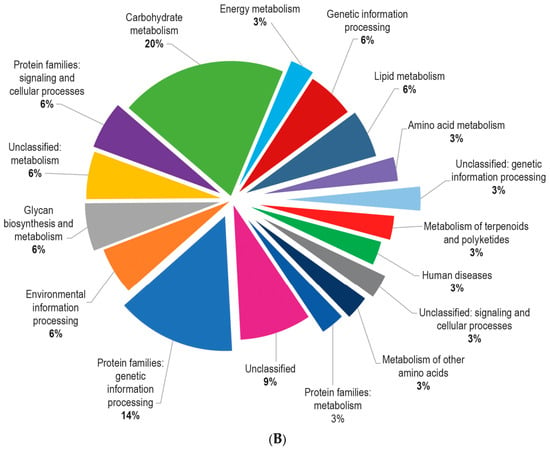
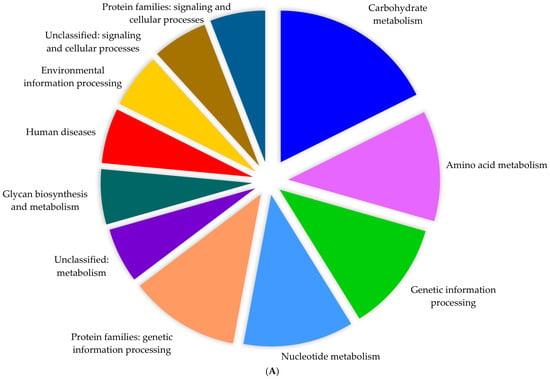
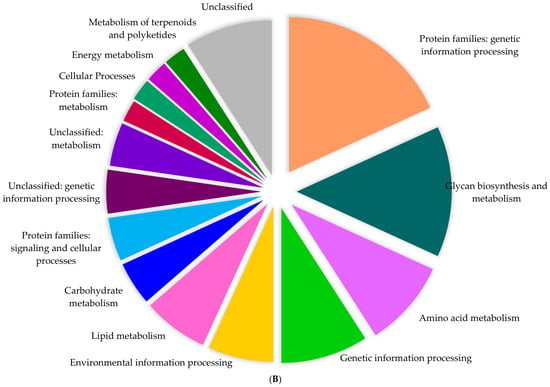
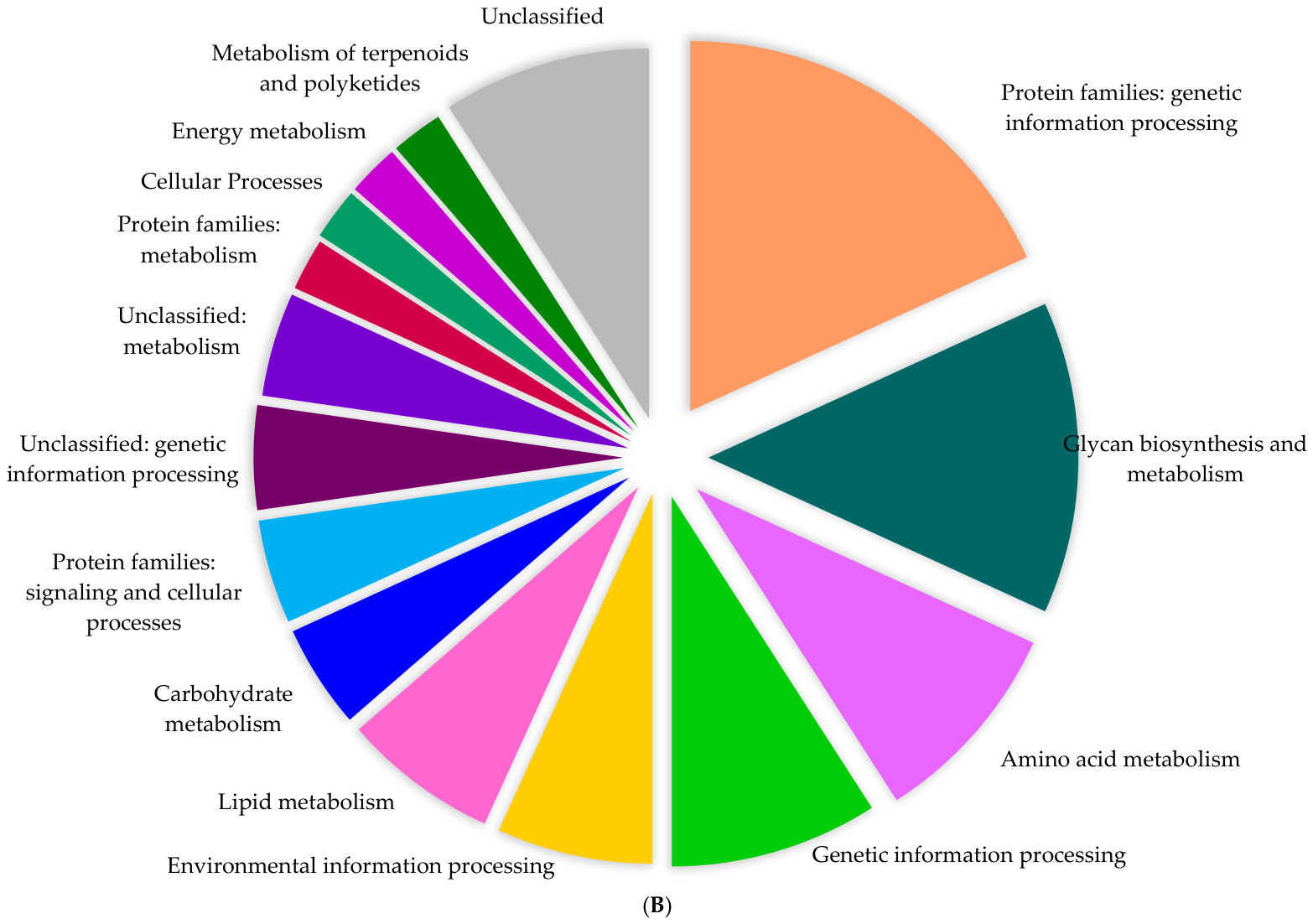
Functional annotation using BlastKOALA revealed distinct functional profiles between proteins with increased and decreased abundance identified by LFQ analysis (Figure 5). Proteins with increased abundance in strain H (CC1) were mainly assigned to carbohydrate metabolism (3 proteins), followed by amino acid metabolism, genetic information processing, nucleotide metabolism, and protein families related to genetic information processing (2 proteins each). Additional categories included glycan biosynthesis and metabolism, environmental information processing, and signalling and cellular processes, whereas one protein remained unclassified.
Figure 5.
KEGG functional classification of differentially abundant proteins identified by LFQ analysis. Pie charts represent the distribution of KEGG functional categories among proteins with (A) increased abundance and (B) decreased abundance proteins in the human-associated strain H (CC1) relative to the food-associated strain F (CC9). Functional categories were assigned using BlastKOALA based on KEGG Orthology (KO) identifiers.
Proteins with decreased abundance in strain H (CC1) were assigned to a larger number of functional categories, consistent with their higher number (66 vs. 19). The most represented categories were protein families related to genetic information processing (8 proteins), glycan biosynthesis and metabolism (6 proteins), amino acid metabolism (4 proteins), and genetic information processing (4 proteins). Other assigned categories included environmental information processing, lipid metabolism, carbohydrate metabolism, protein families related to signalling and cellular processes, energy metabolism, and metabolism of terpenoids and polyketides. Several proteins remained unclassified or could not be assigned to specific KEGG categories (Figure 5).
Overall, proteins with increased abundance in strain H were mainly associated with carbohydrate and other central metabolic functions, whereas the more numerous proteins with decreased abundance were distributed across more categories, involving genetic information processing, glycan metabolism, and diverse cellular pathways.
A granular examination of the proteins with increased abundance in strain H (CC1) through detailed functional annotation revealed differences in metabolic and regulatory processes. Within carbohydrate metabolism, the increased abundance of ATP-dependent 6-phosphofructokinase (PfkA, lmo1571), UDP-glucose 4-epimerase (GalE), and UTP-glucose-1-phosphate uridylytransferase (Lmo1078) suggests changes in carbohydrate utilisation and sugar-nucleotide metabolism, potentially contributing to cell envelope maintenance at low temperatures. Concurrently, proteins involved in translation and genetic information processing showed increased abundance, including the large ribosomal subunit protein uL24 (RplX, lmo2621), 16S rRNA methyltransferase RsmG (lmo2802), and ribonuclease HIII (RnhC, lmo1228). Furthermore, key regulatory elements—including the two-component response regulator LisR, the ferric uptake regulator Fur, and the stringent response mediator Lmo0967 (RelA/SpoT family)—showed increased abundance, which may reflect differences in regulatory processes potentially related to environmental and nutritional adaptation in the CC1 strain. Conversely, proteins exhibiting decreased abundance in strain H (CC1) were distributed across a larger number of functional categories, involving selected pathways related to glycan biosynthesis, alternative amino acid metabolism, and specific transport systems. This relative reduction may indicate a different allocation of cellular resources in the CC1 strain compared with the CC9 strain during growth at low temperature; however, this hypothesis requires functional validation.
3.5. Comparison of Differential Protein Abundance Patterns Between Temperatures
In a previous study [35], we investigated differences between the protein profiles of the human associated strain (H) and the food-associated strain (F) grown at 37 °C. In the present study, the same isolates were analysed at 10 °C, and the two datasets were compared to assess whether differences in protein abundance between H and F were shared between the two growth conditions or were specific to one condition (Figure 6). Because the two datasets were generated in independent experiments, the observed differences may reflect not only the effect of growth temperature but also other factors, such as sample processing, LC-MS/MS run batches, instrument performance, and data processing. Therefore, the comparison should be interpreted with caution.
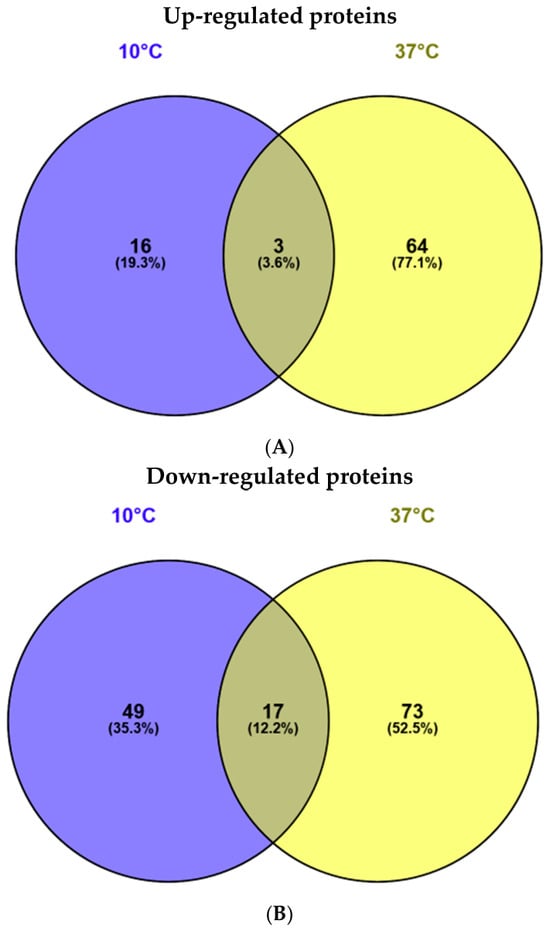
Figure 6.
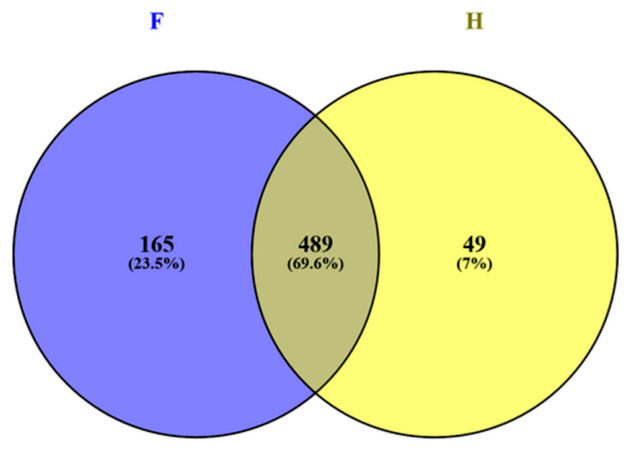
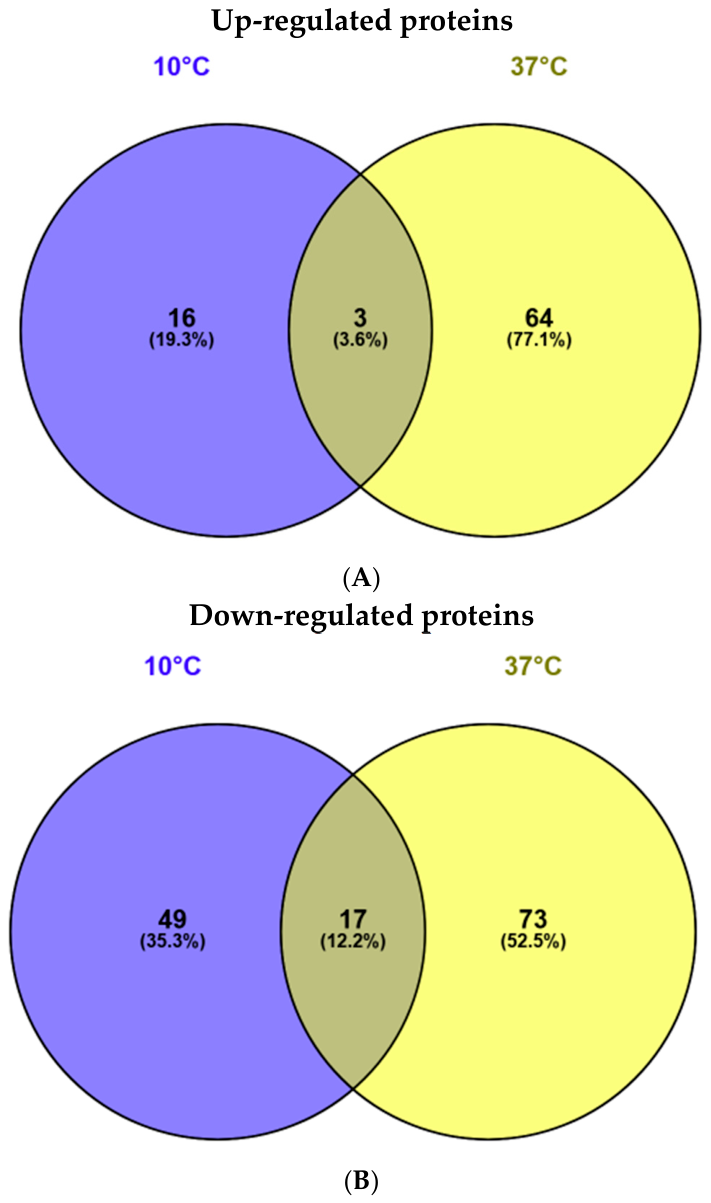
Venn diagrams showing differentially abundant proteins in the human-associated isolate H relative to the food-associated isolate (F) at 10 °C and 37 °C. Proteins with increased abundance in H (A); proteins with decreased abundance in H (B). Overlapping areas indicate proteins shared between the two growth conditions, whereas non-overlapping areas indicate proteins identified as differentially abundant at only one temperature. Percentages are calculated relative to the total number of unique proteins represented in each diagram (83 in (A) and 139 in (B)).
A total of 157 proteins were differentially abundant between the two isolates at 37 °C, compared with 85 at 10 °C, indicating that a larger number of differential protein abundance patterns was detected at 37 °C. However, only a subset of these proteins was shared between the two conditions. Among the proteins more abundant in H relative to F, three were shared between the two temperatures, whereas 64 were specific to 37 °C and 16 to 10 °C (Figure 6A). The three shared proteins were UDP-glucose 4-epimerase (GalE), UTP-glucose-1-phosphate uridylyltransferase (Lmo1078), and Lmo0129, suggesting that differences in the relative abundance of these proteins between the two isolates were maintained under both growth conditions. Among the proteins less abundant in H relative to F, 17 were shared between the two temperatures, whereas 73 were specific to 37 °C and 49 to 10 °C (Figure 6B).
Notably, nine of the 17 proteins that were less abundant in H at both temperatures are encoded by genes within the lmo1076-lmo1090 region. These include enzymes involved in the dTDP-rhamnose biosynthetic pathway (lmo1081, lmo1082, and lmo1083) and TarI (encoded by lmo1086), which is involved in wall teichoic acid biosynthesis [36]. The consistently lower abundance of these proteins in H relative to F at both temperatures suggests that differences in cell envelope-associated processes may distinguish the two isolates under both growth conditions. In contrast, TagB showed an opposite pattern between the two conditions, being more abundant in H at 37 °C but less abundant in H at 10 °C. This finding indicates that the direction of the relative abundance difference for TagB between the two isolates was not consistent across the two growth conditions. The complete lists of shared and temperature-specific proteins are provided in Supplementary Table S5.
4. Discussion
This study investigated the functional and proteomic differences between two L. monocytogenes strains belonging to distinct clonal complexes (CC1 and CC9), which are associated with different virulence potential, stress resistance, and ecological distribution.
The CC1 lineage is a clinically associated CC [37], characterised by the presence of full-length inlA and inlB genes, key determinants associated with virulence, as well as the LIPI-3, which has been linked to increased virulence potential within this lineage [38,39].
On the other hand, CC9 is a food-associated clone [37], typically carrying a truncated inlA gene and considered to exhibit reduced virulence potential compared with clinically associated lineages. This lineage also harbours the stress survival islet SSI-1, which is associated with enhanced tolerance to environmental stress conditions [21].
Comparative proteomic analysis indicated that, under low-temperature growth conditions, the two strains display distinct proteomic profiles that may have ecological relevance. However, since only one isolate per CC was analysed, these differences should be considered potentially isolate-specific until validated across a larger panel of strains.
Shared proteins revealed conserved mechanisms that may support both environmental resilience and pathogenic potential. Among these, FlgE (Lmo0697), a flagellar hook component, facilitates motility and may contribute to early host–surface interactions [40], while Lmo0723, an LPXTG-motif surface protein, has been associated with surface-associated functions, including adhesion and membrane association [41]. Their co-presence in strains with very different ecological backgrounds suggests that certain functional pillars of Listeria biology are deeply conserved, despite the evolutionary divergence observed across CCs.
Stress-response and virulence-regulatory proteins were also conserved between strains. Dps protects DNA from oxidative damage and contributes to tolerance to environmental stresses, including temperature stress [42]. It has also been implicated in the modulation of listeriolysin O (LLO) production, iron homeostasis, metabolic regulation, and biofilm formation [13,43,44,45]. Temperature strongly influences oxidative-stress responses: Manso et al. [16] showed better survival at 10 °C than at 37 °C under peroxide exposure, together with increased transcription of clpC and hly genes. Although LLO (encoded by hly) was not detected in our dataset, which may reflect an abundance below the detection limit rather than its absence, these findings highlight temperature-dependent modulation of oxidative-stress responses in L. monocytogenes. Consistently, PrfA activation enhances oxidative-stress resistance and links stress adaptation to virulence regulation [46], consistent with a possible cross-protection model in which stress responses reinforce pathogenic potential, although this was not assessed in the present study. Taken together, these observations suggest that survival in harsh environments and virulence-associated functions may involve partially overlapping molecular pathways.
PrfA was detected in both strains and is known to regulate key virulence-associated genes, including LLO and internalins, while also contributing to stress tolerance under adverse conditions [47,48,49]. RecA, also shared between the two strains, connects DNA repair with PrfA-dependent virulence regulation under stress [50]. Additional conserved proteins further illustrate this integration of stress responses and virulence. Ssb1, a single-stranded DNA-binding (SSB) protein, stabilises ssDNA intermediates during replication and repair and has been associated with heat and oxidative-stress tolerance, cell-wall biosynthesis, virulence, and antibiotic resistance [51].
Additional experimental context is provided by our previous proteomic investigation of the same isolates grown at 37 °C [35]. The identity of the strains analysed in the two studies is confirmed by their corresponding BioSample accession numbers, SAMN48730946 for H (CC1) and SAMN48730945 for F (CC9). In the previous study, proteins detected exclusively in strain F showed significant enrichment in terpenoid backbone biosynthesis and secondary metabolite biosynthesis (FDR = 0.0362 for both pathways), providing further evidence of a distinct metabolic profile in this isolate. That investigation also reported the detection of ActA in the clinical isolate at 37 °C, whereas this protein was not detected in the present dataset obtained at 10 °C. These observations provide a basis for discussing similarities and differences between the proteomic profiles obtained under the two growth conditions. However, comparisons between independently analysed datasets do not establish statistically significant temperature-dependent changes, and protein non-detection cannot be interpreted as evidence of absence or downregulation. Thus, the previous study provides complementary proteomic evidence rather than direct functional validation of cold adaptation, environmental persistence, or virulence.
MutS2, detected in both strains, supports genome maintenance and has also been implicated in genetic diversification, biofilm formation, and virulence [52]. Furthermore, certain limitations should be acknowledged. The peptide-based proteomics approach employed in this study does not allow for the full characterisation of distinct proteoforms, potentially masking critical post-translational modifications or processing events. Similarly, although classical virulence factors such as InlA and ActA were not detected, their non-detection does not necessarily indicate their absence, as it may result low protein abundance or technical limitations inherent to data-dependent acquisition. Despite these constraints, several molecular chaperones (DnaJ, DnaK, and ClpC) were consistently present. These proteins assist in protein folding and stress adaptation and may support the maintenance of virulence-associated functions under adverse conditions [53,54,55]. The cold-inducible pyrophosphatase PpaX, involved in pyrophosphate homeostasis and cellular adaptation to low temperature, further underscores the overlap between cold adaptation and genome-protection mechanisms [50]. Together, these shared proteins may be part of a network linking stress resilience, genome maintenance, and virulence-associated functions, which could contribute to persistence across diverse ecological niches; this hypothesis requires phenotypic confirmation.
Beyond these conserved traits, motility-associated proteins shared between strains may also be relevant to cold-associated physiology and virulence. FliM (Lmo0699), a flagellar motor-switch component, and OppD (Lmo2193), an oligopeptide transporter involved in nutrient acquisition and biofilm-associated processes, have both been linked to virulence and adaptation under environmental conditions [56,57,58]. Flagellar motility supports epithelial invasion during early infection rather than acting purely as an adhesin [59].
Notably, FlgK (Lmo0705), a hook-associated protein involved in flagellar assembly and motility, was detected only in the CC9 strain. Its presence may contribute to motility and surface-associated persistence in food-processing environments [60]. Several additional proteins detected only in the CC9 strain were associated with DNA repair and stress resilience, which may reflect selective pressures characteristic of food-processing settings. RadA, for example, participates in the repair of DNA damage arising from ionising radiation and other genotoxic insults and has also been associated with biofilm-related phenotypes and long-term persistence [61]. Although RecA was shared, the co-detection of RadA in CC9 may indicate a greater contribution of recombination-repair mechanisms under food-processing-associated stresses [62]. MutL, part of the mismatch repair system, complements MutS2 and supports genome integrity and adaptation to environmental stress [52]. AddA, part of the AddAB helicase-nuclease system, was also detected only in the CC9 strain; deletion of addA or addB has been reported to attenuate virulence in murine models [55,62]. The presence of these DNA-repair functions in CC9 may therefore be consistent with adaptation to environments characterised by repeated environmental stress, while potentially contributing to the maintenance of genome integrity and virulence-associated functions.
Overall, these features suggest that the CC9 strain may display a broader adaptive repertoire that could support survival in fluctuating and nutrient-variable food-associated environments.
In contrast, the CC1 strain exhibited proteomic features that may be compatible with adaptation to host-associated environments, including pathways related to carbohydrate metabolism and stress response. CC1 is responsible for a significant proportion of clinical listeriosis cases, particularly in vulnerable populations. Phylogenetic analyses reveal small genomic clusters, including some associated with foods, emphasizing the epidemiological connection between environmental exposure and infection [63]. These epidemiological observations are compatible with a possible adaptation of CC1 to host-associated and intracellular environments, although such adaptation cannot be inferred from proteomic data alone.
Several proteins were detected only in the CC1 strain—GalE, HemQ, GpsB, and Lmo2363. Although their non-detection in the CC9 strain does not necessarily indicate absence, they may represent strain-specific functions potentially relevant to host adaptation. GalE mediates UDP-galactose-dependent wall-teichoic-acid galactosylation and contributes to proper surface retention of InlB. Its deletion reduces epithelial invasion and attenuates virulence in vivo [64], highlighting the relevance of this protein in virulence-associated processes.
HemQ, the terminal coproheme decarboxylase in the heme-biosynthesis pathway, catalyses the conversion of coproheme to heme b [65]. Given the stringent iron and heme limitation within intracellular niches, HemQ may contribute to metabolic robustness by supporting heme availability for essential redox processes during infection.
GpsB, a key mediator of cell-wall stress adaptation, supports stress-induced peptidoglycan synthesis; its disruption increases β-lactam sensitivity and diminishes intracellular fitness [66]. Given the importance of cell-wall remodelling during stress adaptation and intracellular survival, the detection of GpsB only in the CC1 strain may contribute to physiological traits associated with host-adapted lineages. The GDAR-associated lmo2363 gene contributes to intracellular pH stabilisation within acidic niches such as phagosomes [67], supporting a possible role in adaptation to host-associated conditions.
The higher number of strain-specific proteins annotated in the CC9 strain largely reflects the larger number of proteins detected only in this strain, since the number of KEGG categories represented was similar in the two strains. The detection of proteins involved in carbohydrate transport and central carbon metabolism, as well as in transport, signaling, biofilm formation, chemotaxis, and flagellar assembly, may be compatible with the reported capacity of CC9 to persist under the heterogeneous conditions encountered in food-processing niches; however, these assignments reflect protein detection and do not indicate higher pathway activity.
Conversely, in the CC1 strain a significantly higher proportion of the strain-specific proteins was assigned to carbohydrate metabolism. The presence of proteins assigned to the pentose phosphate pathway, including ribose-5-phosphate isomerase B (K01808), may support NADPH generation and ribose-5-phosphate production, contributing to redox homeostasis and nucleotide biosynthesis [68,69]. Additional representation of fructose, mannose, sucrose, and galactose metabolism suggests a relevant contribution of carbohydrate utilisation to the CC1 proteomic profile. Differences in butanoate metabolism between strains may reflect substrate- or regulation-specific adaptation to distinct ecological conditions. The relatively higher proportion of carbohydrate-processing proteins in CC1 is also compatible with the known metabolic regulation of PrfA activity, as carbon source availability modulates the expression of virulence genes [70].
Overall, after accounting for the unequal number of strain-specific proteins, the main difference between the two strains was the higher relative representation of carbohydrate metabolism in the CC1 strain. This observation may be related to host adaptation; however, this hypothesis was not tested phenotypically in this study.
Beyond strain-specific protein repertoires, the two strains also differed in the relative abundance of shared proteins during growth at low temperature, indicating strain-dependent modulation of conserved cellular functions. Proteins increased in CC1 were mainly associated with central metabolism, carbohydrate utilisation, nucleotide metabolism, and regulatory processes. The increased abundance of ATP-dependent 6-phosphofructokinase (PfkA), together with UDP-glucose 4-epimerase (GalE), suggests a greater contribution of carbohydrate-processing pathways to CC1 physiology during growth at 10 °C. Glycolysis and carbohydrate uptake pathways are central to L. monocytogenes adaptation to different nutritional environments, and carbon metabolism is tightly connected with regulation of virulence through PrfA activity and carbon catabolite control [71,72].
In addition, increased levels of ribosome-associated proteins, including the large ribosomal subunit protein uL24 (RplX) and ribosomal RNA small subunit methyltransferase G (RsmG), may reflect altered ribosome biogenesis and RNA metabolism during growth at low temperature. Ribosome biogenesis and RNA modification pathways are important components of bacterial adaptation to environmental stress, including temperature shifts, as they contribute to maintaining translation efficiency under restrictive conditions [73,74].
The increased abundance of the Fur regulator and the LisR two-component response regulator further suggests a contribution of metal homeostasis, stress-response regulation, and signal transduction to the CC1 proteomic profile. Fur is a central regulator of iron homeostasis in L. monocytogenes and influences oxidative-stress resistance, metabolism, and the expression of virulence-associated functions [75].
Conversely, proteins reduced in abundance in CC1 were mainly associated with genetic information processing, glycan biosynthesis, membrane-associated processes, and diverse metabolic pathways. Several proteins reduced in abundance, including SecD, ParC, RecN, Mfd, and proteins involved in cell-envelope metabolism, are associated with protein export, DNA maintenance, and cellular stress management. Their reduced abundance in CC1 compared with CC9 may indicate differences in the allocation of cellular resources between the two lineages, with CC9 maintaining higher levels of proteins associated with functions potentially advantageous for persistence in external environments. Thus, LFQ analysis extends the qualitative proteomic findings by showing that lineage-specific differences are also reflected in the relative abundance of conserved cellular functions during growth at low temperature. Together, these results suggest that the CC1 strain shows a higher abundance of proteins involved in carbohydrate utilization and regulatory processes, whereas the CC9 strain maintains a broader representation of functions potentially associated with environmental persistence and stress tolerance.
Distinct quantitative proteomic profiles are therefore compatible with the hypothesis that the two strains employ different molecular strategies during growth under cold conditions. CC1 also possesses regulatory networks mediated by alternative σ factors that shape stress-response and virulence-associated gene expression. While σB activity varies across strains, σC appears limited to specific phylogenetic lineages, further supporting lineage-dependent specialisation [67]. These regulatory features may contribute to the adaptation of CC1 to the mammalian host environment while maintaining core stress-response functions shared with food-associated isolates.
An important consideration is that the present study used a bottom-up, LFQ proteomic approach, in which protein identities and abundances are inferred from the peptides detected by LC-MS/MS. Although this strategy provides broad proteome coverage and enables comparative analysis of protein abundance, it does not fully resolve proteoform complexity, including intact protein species, sequence variants, alternative processing, and post-translationally modified forms. Therefore, the differences observed between CC9 and CC1 should be interpreted within the context of the peptide-derived protein measurements obtained in this study rather than as a complete characterisation of the corresponding proteoform landscape. In addition, the study was based on a single isolate per CC and three biological replicates; the observed differences may therefore be isolate-specific, and the findings require validation using a larger panel of CC1 and CC9 strains to distinguish lineage-associated patterns from strain-specific features. Furthermore, the antigenic and virulence-associated properties discussed in this study are based on computational predictions and require experimental validation. p-values were not adjusted for multiple testing. Moreover, proteins not detected by mass spectrometry cannot be considered absent or downregulated, as their non-detection may reflect abundance levels below the detection limit. The comparison with the 37 °C dataset [35] also involved independently generated datasets; therefore, the observed differences may partly reflect experimental factors other than temperature. Finally, persistence, stress tolerance, and host adaptation were not directly assessed and were inferred solely from proteomic data. Future studies combining quantitative proteomics with top-down or complementary proteogenomic approaches could provide a more comprehensive characterisation of proteoforms and further clarify the molecular basis of strain-dependent adaptation to low-temperature conditions.
5. Conclusions
This study shows that, during growth at low temperature, the CC1 and CC9 L. monocytogenes strains analysed display distinct proteomic profiles, which may reflect different ecological strategies in food-associated and human-associated CCs. These differences involve proteins related to stress response, metabolism, and regulatory networks that may contribute to survival under low-temperature conditions.
Overall, the data are consistent with the hypothesis that environmental adaptation and virulence-associated functions are interconnected processes shaped by lineage-specific evolutionary pressures. This interplay may provide a possible basis for persistence in food-processing environments and successful host colonisation, with potential implications for improved monitoring and control strategies in food safety and public health. However, since only one strain per CC was analysed, these findings require validation in a larger panel of CC1 and CC9 strains before they can be generalised to the respective clonal complexes. In addition, the antigenic and virulence-associated properties described here are based on computational predictions, while persistence, stress tolerance, and host adaptation were not directly assessed. All these aspects therefore require experimental confirmation.
Supplementary Materials
The following supporting information can be downloaded at: https://www.mdpi.com/article/10.3390/proteomes14040058/s1, Table S1: Proteins identified by LC-MS/MS in strains F (CC9) and H (CC1); Table S2: Predicted subcellular localisation of the identified proteins; Table S3: Antigenicity and virulence predictions (VaxiJen and VirulentPred) of strain-specific proteins (S3A) and of differentially abundant proteins (S3B); Table S4: Differentially abundant proteins identified by LFQ analysis; Table S5: Shared and temperature-specific differentially abundant proteins at 10 °C and 37 °C.
Author Contributions
I.K. Writing—original draft, Methodology, Formal analysis, Data curation. M.S. Writing—review & editing, Writing—original draft, Supervision, Conceptualization. P.C. and F.P. (Fabrizia Perletta) Formal analysis, Visualization. K.R., C.D.P. and G.C. Methodology, Formal analysis, Data curation. A.D.P., M.T., G.B., V.P. and M.M. Formal analysis, Visualization. F.P. (Francesco Pomilio) and F.S. Visualization, Funding Acquisition. N.D. Visualization, Investigation. A.P. Visualization, Supervision. M.L. Writing—review & editing, Writing—original draft, Supervision, Methodology, Conceptualization. All authors have read and agreed to the published version of the manuscript.
Funding
This research received no external funding.
Informed Consent Statement
Not applicable.
Data Availability Statement
The mass spectrometry proteomics data have been deposited to the ProteomeXchange Consortium via the PRIDE partner repository with the Project accession: PXD083697 and Reviewer token: yWrJKhe4octy.
Acknowledgments
The authors declare that no generative artificial intelligence or large-language model tools were employed for drafting, data analysis or figure generation in this work.
Conflicts of Interest
The authors declare no conflicts of interest.
References
- Miladi, H.; Elabed, H.; Slama, R.; Rhim, A.; Bakhrouf, A. Molecular analysis of the role of osmolyte transporters opuCA and betL in Listeria monocytogenes after cold and freezing stress. Arch. Microbiol. 2017, 199, 259–265. [Google Scholar] [CrossRef] [Scilit] [PubMed]
- Rodriguez, C.; Taminiau, B.; García-Fuentes, E.; Daube, G.; Korsak, N. Listeria monocytogenes dissemination in farming and primary production: Sources, shedding and control measures. Food Control 2021, 120, 107540. [Google Scholar] [CrossRef] [Scilit]
- Muchaamba, F.; Wambui, J.; Stephan, R.; Tasara, T. Cold shock proteins promote nisin tolerance in Listeria monocytogenes through modulation of cell envelope modification responses. Front. Microbiol. 2021, 12, 811939. [Google Scholar] [CrossRef] [Scilit] [PubMed]
- Rajalingam, N.; Van Haute, S. Adaptive tolerance of Listeria monocytogenes to chemical oxidants: Comparative analysis of transcriptomic studies. Compr. Rev. Food Sci. Food Saf. 2025, 24, e70260. [Google Scholar] [CrossRef] [Scilit] [PubMed]
- Kocaman, N.; Sarimehmetoğlu, B. Stress responses of Listeria monocytogenes. Ank. Üniversitesi Vet. Fakültesi Derg. 2016, 63, 421–427. [Google Scholar] [CrossRef] [Scilit]
- Wemekamp-Kamphuis, H.H.; Karatzas, A.K.; Wouters, J.A.; Abee, T. Enhanced levels of cold shock proteins in Listeria monocytogenes LO28 upon exposure to low temperature and high hydrostatic pressure. Appl. Environ. Microbiol. 2002, 68, 456–463. [Google Scholar] [CrossRef] [Scilit] [PubMed]
- Schmid, B.; Klumpp, J.; Raimann, E.; Loessner, M.J.; Stephan, R.; Tasara, T. Role of cold shock proteins in growth of Listeria monocytogenes under cold and osmotic stress conditions. Appl. Environ. Microbiol. 2009, 75, 1621–1627. [Google Scholar] [CrossRef] [Scilit] [PubMed]
- Lee, J.H.; Jeong, K.W.; Kim, Y.M. Purification and structural characterization of cold shock protein from Listeria monocytogenes. Bull. Korean Chem. Soc. 2012, 33, 2508–2512. [Google Scholar] [CrossRef] [Scilit]
- Becker, L.A.; Evans, S.N.; Hutkins, R.W.; Benson, A.K. Role of sigma(B) in adaptation of Listeria monocytogenes to growth at low temperature. J. Bacteriol. 2000, 182, 7083–7087. [Google Scholar] [CrossRef] [Scilit] [PubMed]
- Tasara, T.; Stephan, R. Cold stress tolerance of Listeria monocytogenes: A review of molecular adaptive mechanisms and food safety implications. J. Food Prot. 2006, 69, 1473–1484. [Google Scholar] [CrossRef] [Scilit] [PubMed]
- Yoon, Y.; Lee, H.; Soomin, L.; Kima, S.; Kyoung-Hee, C. Membrane fluidity-related adaptive response mechanisms of foodborne bacterial pathogens under environmental stresses. Food Res. Int. 2015, 72, 25–36. [Google Scholar] [CrossRef] [Scilit]
- Angelidis, A.S.; Smith, G.M. Three transporters mediate uptake of glycine betaine and carnitine by Listeria monocytogenes in response to hyperosmotic stress. Appl. Environ. Microbiol. 2003, 69, 1013–1022. [Google Scholar] [CrossRef] [Scilit] [PubMed]
- Olsen, K.N.; Larsen, M.H.; Gahan, C.G.; Kallipolitis, B.; Wolf, X.A.; Rea, R.; Hill, C.; Ingmer, H. The Dps-like protein Fri of Listeria monocytogenes promotes stress tolerance and intracellular multiplication in macrophage-like cells. Microbiology 2005, 151, 925–933. [Google Scholar] [CrossRef] [Scilit] [PubMed]
- Bucur, F.I.; Grigore-Gurgu, L.; Crauwels, P.; Riedel, C.U.; Nicolau, A.I. Resistance of Listeria monocytogenes to stress conditions encountered in food and food processing environments. Front. Microbiol. 2018, 9, 2700. [Google Scholar] [CrossRef] [Scilit] [PubMed]
- Burall, L.S.; Laksanalamai, P.; Datta, A.R. Listeria monocytogenes mutants with altered growth phenotypes at refrigeration temperature and high salt concentrations. Appl. Environ. Microbiol. 2012, 78, 1265–1272. [Google Scholar] [CrossRef] [Scilit] [PubMed]
- Manso, B.; Melero, B.; Stessl, B.; Jaime, I.; Wagner, M.; Rovira, J.; Rodríguez-Lázaro, D. The response to oxidative stress in Listeria monocytogenes is temperature dependent. Microorganisms 2020, 8, 521. [Google Scholar] [CrossRef] [Scilit] [PubMed]
- Scortti, M.; Monzó, H.J.; Lacharme-Lora, L.; Lewis, D.A.; Vázquez-Boland, J.A. The PrfA virulence regulon. Microbes Infect. 2007, 9, 1196–1207. [Google Scholar] [CrossRef] [Scilit] [PubMed]
- Gaballa, A.; Guariglia-Oropeza, V.; Wiedmann, M.; Boor, K.J. Cross talk between SigB and PrfA in Listeria monocytogenes facilitates transitions between extra- and intracellular environments. Microbiol. Mol. Biol. Rev. 2019, 83, e00034-19. [Google Scholar] [CrossRef] [Scilit] [PubMed]
- Liu, Y.; Orsi, R.H.; Gaballa, A.; Wiedmann, M.; Boor, K.J.; Guariglia-Oropeza, V. Systematic review of the Listeria monocytogenes σB regulon supports a role in stress response, virulence and metabolism. Future Microbiol. 2019, 14, 801–828. [Google Scholar] [CrossRef] [Scilit] [PubMed]
- Wu, J.; Wang, C.; O’Byrne, C. Metabolic reprogramming in the food-borne pathogen Listeria monocytogenes as a critical defence against acid stress. FEMS Microbiol. Lett. 2024, 371, fnae060. [Google Scholar] [CrossRef] [Scilit] [PubMed]
- Maury, M.M.; Bracq-Dieye, H.; Huang, L.; Vales, G.; Lavina, M.; Thouvenot, P.; Disson, O.; Leclercq, A.; Brisse, S.; Lecuit, M. Hypervirulent L. monocytogenes clones’ adaptation to mammalian gut accounts for their association with dairy products. Nat. Commun. 2019, 10, 2488. [Google Scholar] [CrossRef] [Scilit] [PubMed]
- Centorotola, G.; Ziba, M.W.; Cornacchia, A.; Chiaverini, A.; Torresi, M.; Guidi, F.; Cammà, C.; Bowa, B.; Mtonga, S.; Magambwa, P.; et al. Listeria monocytogenes in ready to eat meat product from Zambia: Phenotypical and genomic characterization of isolates. Front. Microbiol. 2023, 14, 1228726. [Google Scholar] [CrossRef] [Scilit] [PubMed]
- Andrade, J.C.; Bernardo, R.; Barreto, A.S.; Nunes, T.; Henriques, A.R. Temperature effect on Listeria Monocytogenes planktonic growth and biofilm-forming ability. J. Vet. Med. Anim. Sci. 2020, 3, 1044. [Google Scholar] [CrossRef] [Scilit] [PubMed]
- ISO 20976-1:2019; Microbiology of the Food Chain—Requirements and Guidance for Conducting Challenge Tests of Food and Feed Products—Part 1: Challenge Tests to Study Growth Potential, Lag Time and Maximum Growth Rate. International Organization for Standardization: Geneva, Switzerland, 2019.
- Jones, G.S.; D’Orazio, S.E.F. Listeria monocytogenes: Cultivation and laboratory maintenance. Curr. Protoc. Microbiol. 2013, 31, 9B.2.1–9B.2.7. [Google Scholar] [CrossRef] [Scilit] [PubMed]
- Junker, A.S.; Willenbrock, H.; von Heijne, G.; Brunak, S.; Nielsen, H.; Krogh, A. Prediction of lipoprotein signal peptides in Gram-negative bacteria. Protein Sci. 2003, 12, 1652–1662. [Google Scholar] [CrossRef] [Scilit] [PubMed]
- Krogh, A.; Larsson, B.; von Heijne, G.; Sonnhammer, E.L.L. Predicting transmembrane protein topology with a hidden Markov model: Application to complete genomes. J. Mol. Biol. 2001, 305, 567–580. [Google Scholar] [CrossRef] [Scilit] [PubMed]
- Petersen, T.N.; Brunak, S.; von Heijne, G.; Nielsen, H. SignalP 4.0: Discriminating signal peptides from transmembrane regions. Nat. Methods 2011, 8, 785–786. [Google Scholar] [CrossRef] [Scilit] [PubMed]
- Hallgren, J.; Tsirigos, K.D.; Pedersen, M.D.; Armenteros, J.J.A.; Marcatili, P.; Nielsen, H.; Krogh, A.; Winther, O. DeepTMHMM predicts alpha and beta transmembrane protein using deep neural networks. bioRxiv 2022. [Google Scholar] [CrossRef] [Scilit]
- Yu, N.Y.; Wagner, J.R.; Laird, M.R.; Melli, G.; Rey, S.; Lo, R.; Dao, P.; Sahinalp, S.C.; Ester, M.; Foster, L.J.; et al. PSORTb 3.0: Improved protein subcellular localization prediction with refined localization subcategories and predictive capabilities for all prokaryotes. Bioinformatics 2010, 26, 1608–1615. [Google Scholar] [CrossRef] [Scilit] [PubMed]
- Yu, C.S.; Chen, Y.C.; Lu, C.H.; Hwang, J.K. Prediction of protein subcellular localization. Proteins 2006, 64, 643–651. [Google Scholar] [CrossRef] [Scilit] [PubMed]
- Yu, C.S.; Lin, C.J.; Hwang, J.K. Predicting subcellular localization of proteins for gram-negative bacteria by support vector machines based on n-peptide compositions. Protein Sci. 2009, 13, 1402–1406. [Google Scholar]
- Garg, A.; Gupta, D. VirulentPred: A SVM based prediction method for virulent proteins in bacterial pathogens. BMC Bioinform. 2008, 9, 62. [Google Scholar] [CrossRef] [Scilit] [PubMed]
- Doytchinova, I.A.; Flower, D.R. VaxiJen: A server for prediction of protective antigens, tumour antigens and subunit vaccines. BMC Bioinform. 2007, 8, 4. [Google Scholar] [CrossRef] [Scilit] [PubMed]
- Krasteva, I.; Schirone, M.; Di Pancrazio, C.; Manocchia, F.; D’Onofrio, F.; Maggetti, M.; Perletta, F.; Pomilio, F.; Bruno, G.; Torresi, M.; et al. Comparative proteomics of Listeria monocytogenes strains of food and clinical origin reveals strain-specific adaptation mechanisms. Front. Microbiol. 2025, 16, 1640990. [Google Scholar] [CrossRef] [Scilit] [PubMed]
- Park, M.; Kim, J.; Horn, L.; Haan, J.; Strickland, A.; Lappi, V.; Boxrud, D.; Hedberg, C.; Ryu, S.; Jeon, B. Sugar modification of wall teichoic acids determines serotype-dependent strong biofilm production in Listeria monocytogenes. Microbiol. Spectr. 2022, 10, e02769-22. [Google Scholar] [CrossRef] [Scilit] [PubMed]
- Maury, M.; Tsai, Y.-H.; Charlier, C.; Touchon, M.; Chenal-Francisque, V.; Leclerq, A.; Criscuolo, A.; Gaultier, C.; Roussel, S.; Brisabois, A.; et al. Uncovering Listeria monocytogenes hypervirulence by harnessing its biodiversity. Nat. Genet. 2016, 48, 308–313. [Google Scholar] [CrossRef] [Scilit] [PubMed]
- Su, X.; Cao, G.; Zhang, J.; Pan, H.; Zhang, D.; Kuang, D.; Yang, X.; Xu, X.; Shi, X.; Meng, J. Characterization of internalin genes in Listeria monocytogenes from food and humans, and their association with the invasion of Caco-2 cells. Gut Pathog. 2019, 11, 30. [Google Scholar] [CrossRef] [Scilit] [PubMed]
- Song, Y.; Gao, B.; Cai, H.; Qin, X.; Xia, X.; Dong, Q.; Hirata, T.; Li, Z. Comparative analysis of virulence in Listeria monocytogenes: Insights from genomic variations and in vitro cell-based studies. Int. J. Food Microbiol. 2025, 435, 111188. [Google Scholar] [CrossRef] [Scilit] [PubMed]
- Burg-Golani, T.; Pozniak, Y.; Rabinovich, L.; Sigal, N.; Nir Paz, R.; Herskovits, A.A. Membrane chaperone SecDF plays a role in the secretion of Listeria monocytogenes major virulence factors. J. Bacteriol. 2013, 195, 5262–5272. [Google Scholar] [CrossRef] [Scilit] [PubMed]
- Tiong, H.K.; Hartson, S.D.; Muriana, P.M. Comparison of surface proteomes of adherence variants of Listeria monocytogenes using LC-MS/MS for identification of potential surface adhesins. Pathogens 2016, 5, 40. [Google Scholar] [CrossRef] [Scilit] [PubMed]
- Polidoro, M.; De Biase, D.; Montagnini, B.; Guarrera, L.; Cavallo, S.; Valenti, P.; Stefanini, S.; Chiancone, E. The expression of the dodecameric ferritin in Listeria spp. is induced by iron limitation and stationary growth phase. Gene 2002, 296, 121–128. [Google Scholar] [CrossRef] [Scilit] [PubMed]
- Dussurget, O.; Dumas, E.; Archambaud, C.; Chafsey, I.; Chambon, C.; Hébraud, M.; Cossart, P. Listeria monocytogenes ferritin protects against multiple stresses and is required for virulence. FEMS Microbiol. Lett. 2005, 250, 253–261. [Google Scholar] [CrossRef] [Scilit] [PubMed]
- Bellapadrona, G.; Stefanini, S.; Zamparelli, C.; Theil, E.C.; Chiancone, E. Iron translocation into and out of Listeria innocua Dps and size distribution protein-enclosed nanomineral are modulated by the electrostatic gradient at the 3-fold “ferritin-like” pores. J. Biol. Chem. 2009, 284, 19101–19109. [Google Scholar] [CrossRef] [Scilit] [PubMed]
- Theoret, J.R.; Cooper, K.K.; Zekarias, B.; Roland, K.L.; Law, B.F.; Curtiss, R.; Joens, L.A. The Campylobacter jejuni Dps homologue is important for in vitro biofilm formation and cecal colonization of poultry and may serve as a protective antigen for vaccination. Clin. Vaccine Immunol. 2012, 19, 1426–1431. [Google Scholar] [CrossRef] [Scilit] [PubMed]
- Mains, D.R.; Eallonardo, S.J.; Freitag, N.E. Identification of Listeria monocytogenes genes contributing to oxidative stress resistance under conditions relevant to host infection. Infect. Immun. 2021, 89, e00700-20. [Google Scholar] [CrossRef] [Scilit] [PubMed]
- Freitag, N.E.; Rong, L.; Portnoy, D.A. Regulation of the prfA transcriptional activator of Listeria monocytogenes: Multiple promoter elements contribute to intracellular growth and cell-to-cell spread. Infect. Immun. 1993, 61, 2537–2544. [Google Scholar] [CrossRef] [Scilit] [PubMed]
- Kulén, M.; Lindgren, M.; Hansen, S.; Cairns, A.; Grundström, C.; Begum, A.; van der Lingen, I.; Brännström, K.; Hall, M.; Sauer, U.H.; et al. Structure-based design of inhibitors targeting PrfA, the master virulence regulator of Listeria monocytogenes. J. Med. Chem. 2018, 61, 4165–4175. [Google Scholar] [CrossRef] [Scilit] [PubMed]
- Tiensuu, T.; Guerreeiro, D.N.; Oliveira, A.H.; O’Byrne, C.; Johansson, J. Flick of a switch: Regulatory mechanisms allowing Listeria monocytogenes to transition from a saprophyte to a killer. Microbiology 2019, 165, 819–833. [Google Scholar] [CrossRef] [Scilit] [PubMed]
- Ojha, D.; Greeshma, M.V.; Patil, K.N. Expression, purification and biochemical characterization of Listeria monocytogenes single stranded DNA binding protein 1. Protein Expr. Purif. 2019, 161, 63–69. [Google Scholar] [CrossRef] [Scilit] [PubMed]
- Shereda, R.D.; Kozlov, A.G.; Lohman, T.M.; Cox, M.M.; Keck, J.L. SSB as an organizer/mobilizer of genome maintenance complexes. Crit. Rev. Biochem. Mol. Biol. 2008, 43, 289–318. [Google Scholar] [CrossRef] [Scilit] [PubMed]
- Mérino, D.; Réglier-Poupet, H.; Berche, P.; The European Listeria Genome Consortium; Charbit, A. A hypermutator phenotype attenuates the virulence of Listeria monocytogenes in a mouse model. Mol. Microbiol. 2002, 44, 877–887. [Google Scholar] [CrossRef] [Scilit] [PubMed]
- Chastanet, A.; Derre, I.; Nair, S.; Msadek, T. clpB, a novel member of the Listeria monocytogenes CtsR regulon, is involved in virulence but not in general stress tolerance. J. Bacteriol. 2004, 186, 1165–1174. [Google Scholar] [CrossRef] [Scilit] [PubMed]
- van der Veen, S.; Hain, T.; Wouters, J.A.; Hossain, H.; de Vos, W.M.; Abee, T.; Chakraborty, T.; Wells-Bennik, M.H.J. The heat-shock response of Listeria monocytogenes comprises genes involved in heat shock, cell division, cell wall synthesis, and the SOS response. Microbiology 2007, 153, 3593–3607. [Google Scholar] [CrossRef] [Scilit] [PubMed]
- Balogh, D.; Eckel, K.; Fetzer, C.; Sieber, S.A. Listeria monocytogenes utilizes the ClpP1/2 proteolytic machinery for fine-tuned substrate degradation at elevated temperatures. RSC Chem. Biol. 2022, 3, 955. [Google Scholar] [CrossRef] [Scilit] [PubMed]
- Way, S.S.; Thompson, L.L.; Lopes, J.E.; Hajjar, A.M.; Kollmann, T.R.; Freitag, N.E.; Wilson, C.B. Characterization of flagellin expression and its role in Listeria monocytogenes infection and immunity. Cell Microbiol. 2004, 6, 235–242. [Google Scholar] [CrossRef] [Scilit] [PubMed]
- Cheng, C.; Wang, H.; Ma, T.; Han, X.; Yang, Y.; Sun, J.; Chen, Z.; Yu, H.; Hang, Y.; Liu, F.; et al. Flagellar basal body structural proteins FlhB, FliM, and FliY are required for flagellar-associated protein expression in Listeria monocytogenes. Front. Microbiol. 2018, 9, 208. [Google Scholar] [CrossRef] [Scilit] [PubMed]
- Disson, O.; Moura, A.; Lecuit, M. Making sense of the biodiversity and virulence of Listeria monocytogenes. Trends Microbiol. 2021, 29, 811–822. [Google Scholar] [CrossRef] [Scilit] [PubMed]
- O’Neil, H.S.; Marquis, H. Listeria monocytogenes flagella are used for motility, not as adhesins, to increase host cell invasion. Infect. Immun. 2006, 74, 6675–6681. [Google Scholar] [CrossRef] [Scilit] [PubMed]
- Luciani, M.; Krasteva, I.; Schirone, M.; D’Onofrio, F.; Iannetti, L.; Torresi, M.; Di Pancrazio, C.; Perletta, F.; Valentinuzzi, S.; Tittarelli, M.; et al. Adaptive strategies of Listeria monocytogenes: An in-depth analysis of the virulent strain involved in an outbreak in Italy through quantitative proteomics. Int. J. Food Microbiol. 2025, 427, 110951. [Google Scholar] [CrossRef] [Scilit] [PubMed]
- Lenhart, J.S.; Schroeder, J.W.; Walsh, B.W.; Simmons, L.A. DNA repair and genome maintenance in Bacillus subtilis. Microbiol. Mol. Biol. Rev. 2012, 76, 530–564. [Google Scholar] [CrossRef] [Scilit] [PubMed]
- D’Onofrio, F.; Schirone, M.; Paparella, A.; Krasteva, I.; Tittarelli, M.; Pomilio, F.; Iannetti, L.; D’alterio, N.; Luciani, M. Stress adaptation responses of a Listeria monocytogenes 1/2a via proteome profiling. Foods 2023, 12, 2166. [Google Scholar] [CrossRef] [Scilit] [PubMed]
- Fotopoulou, E.T.; Jenkins, C.; Barker, C.R.; Painset, A.; Didelot, X.; Simbo, A.; Douglas, A.; Godbole, G.; Jorgensen, F.; Gharbia, S.; et al. Genomic epidemiology of the clinically dominant clonal complex 1 in the Listeria monocytogenes population in the UK. Microb. Genom. 2024, 10, 001155. [Google Scholar] [CrossRef] [Scilit] [PubMed]
- Fang, X.; Yuan, M.; Zheng, M.; Guo, Q.; Yang, Y.; Yang, Y.; Liang, X.; Liu, J.; Fang, C. Deletion of glycosyltransferase gale impairs the InlB anchoring and pathogenicity of Listeria monocytogenes. Virulence 2024, 15, 2422539. [Google Scholar] [CrossRef] [Scilit] [PubMed]
- Hofbauer, S.; Hagmuller, A.; Schaffner, I.; Mlynek, G.; Krutzler, M.; Stadlmayr, G.; Pirker, K.F.; Obinger, C.; Daims, H.; Djinović-Carugo, K.; et al. Structure and heme-binding properties of HemQ (chlorite dismutase-like protein) from Listeria monocytogenes. Arch. Biochem. Biophys. 2015, 574, 36–48. [Google Scholar] [CrossRef] [Scilit] [PubMed]
- Kelliher, J.L.; Daanen, M.E.; Sauer, J.-D. GpsB control of PASTA kinase activity in Listeria monocytogenes influences peptidoglycan synthesis during cell wall stress and cytosolic survival. bioRxiv 2023. [Google Scholar] [CrossRef] [Scilit]
- Chaturongakul, S.; Raengpradub, S.; Wiedmann, M.; Boor, K.J. Modulation of stress and virulence in Listeria monocytogenes. Trends Microbiol. 2008, 16, 388–396. [Google Scholar] [CrossRef] [Scilit] [PubMed]
- Crimmins, G.T.; Schelle, M.W.; Herskovits, A.A.; Ni, P.P.; Kline, B.C.; Meyer-Morse, N.; Iavarone, A.T.; Portnoy, D.A. Listeria monocytogenes 6-phosphogluconolactonase mutants induce increased activation of a host cytosolic surveillance pathway. Infect. Immun. 2009, 77, 3014–3022. [Google Scholar] [CrossRef] [Scilit] [PubMed]
- Abdelhamed, H.; Ramachandran, R.; Narayanan, L.; Islam, S.; Ozan, O.; Freitag, N.; Lawrence, M.L. Role of FruR transcriptional regulator in virulence of Listeria monocytogenes and identification of its regulon. PLoS ONE 2022, 17, e0274005. [Google Scholar] [CrossRef] [Scilit] [PubMed]
- Stoll, R.; Mertins, S.; Joseph, B.; Müller-Altrock, S.; Goebel, W. Modulation of PrfA activity on Listeria monocytogenes upon growth in different culture media. Microbiology 2008, 154, 3856–3876. [Google Scholar] [CrossRef] [Scilit] [PubMed]
- Görke, B.; Stülke, J. Carbon catabolite repression in bacteria: Many ways to make the most out of nutrients. Nat. Rev. Microbiol. 2008, 6, 613–624. [Google Scholar] [CrossRef] [Scilit] [PubMed]
- Joseph, B.; Przybilla, K.; Stühler, C.; Schauer, K.; Slaghuis, J.; Fuchs, T.M.; Goebel, W. Identification of Listeria monocytogenes genes contributing to intracellular replication by expression profiling and mutant screening. J. Bacteriol. 2006, 188, 556–568. [Google Scholar] [CrossRef] [Scilit] [PubMed]
- Liu, S.; Graham, J.E.; Bigelow, L.; Morse, P.D., 2nd; Wilkinson, B.J. Identification of Listeria monocytogenes genes expressed in response to growth at low temperature. Appl. Environ. Microbiol. 2002, 68, 1697–1705. [Google Scholar] [CrossRef] [Scilit] [PubMed]
- Chan, Y.C.; Raengpradub, S.; Boor, K.J.; Wiedmann, M. Microarray-based characterization of the Listeria monocytogenes cold regulon in log- and stationary-phase cells. Appl. Environ. Microbiol. 2007, 73, 6484–6498. [Google Scholar] [CrossRef] [Scilit] [PubMed]
- Newton, S.M.C.; Klebba, P.E.; Raynaud, C.; Shao, Y.; Jiang, X.; Dubail, I.; Archer, C.; Frehel, C.; Charbit, A. The svpA-srtB locus of Listeria monocytogenes: Fur-mediated iron regulation and effect on virulence. Mol. Microbiol. 2005, 55, 927–940. [Google Scholar] [CrossRef] [Scilit] [PubMed]


Disclaimer/Publisher’s Note: The statements, opinions and data contained in all publications are solely those of the individual author(s) and contributor(s) and not of MDPI and/or the editor(s). MDPI and/or the editor(s) disclaim responsibility for any injury to people or property resulting from any ideas, methods, instructions or products referred to in the content. |
© 2026 by the authors. Licensee MDPI, Basel, Switzerland. This article is an open access article distributed under the terms and conditions of the Creative Commons Attribution (CC BY) license.