


Abstract
Teachers in increasingly multilingual EFL classrooms must select tasks that align with language-learning evidence, learner diversity, and classroom feasibility. Yet we know comparatively little about the real-time criteria teachers use when choosing between task options that differ in multilingual pedagogical affordances. This exploratory qualitative study used concurrent think-aloud protocols to examine EFL teachers’ in-action reasoning during task selection. Ten secondary-school EFL teachers from southern Germany and Austria evaluated eight paired task scenarios, each presenting two options that differed in their potential to leverage learners’ multilingual repertoires, for example, through cross-linguistic comparison and support for form–meaning mapping. Transcripts were coded using an iterative scheme capturing methodological orientation, language-related considerations (learner repertoire, teacher language competence, and languages involved), perceived cognitive manageability, and feasibility concerns. Teachers’ selections were analysed as alignment with the option classified by the authors as higher in multilingual pedagogical affordances, rather than as objectively “correct” versus “incorrect” choices. Cross-case analyses indicate that decisions clustered around recurring constraints between perceived clarity and manageability, target-language-only norms, and openness to multilingual mediation. The findings contribute a process-orientated account of teacher decision-making in multilingual task selection and identify reasoning patterns that may constrain uptake of multilingual pedagogical opportunities in everyday EFL instruction. By applying concurrent think-alouds to scenario-based task selection, we identify three recurring influencing factors of decision-making (manageability filtering, target-language legitimacy norms, rule-first ‘teachability’ cues) that appeared to constrain multilingual task uptake in the present scenario-based protocols whose process-oriented account of teacher reasoning is the primary focus of the project, while the methodological and practical implications are secondary.
1. Introduction
Growing linguistic diversity in European classrooms, driven by globalisation and migration, has increased the demands placed on foreign language teachers when selecting and designing instructional tasks (Council of Europe, 2023; European Commission, 2018; Haukås, 2016). In multilingual classrooms, material selection is not only a matter of matching tasks to curricular goals but also a decision about whether and how learners’ full linguistic repertoires can be mobilised as learning resources. Because tasks structure what learners attend to, the languages they are allowed to use, and the type of cognitive processing required, task selection becomes the main point where multilingual pedagogy is either enacted or constrained. To meet this challenge, teachers must consider several influential factors. Their choice of teaching methodology should align with findings from language acquisition research. Furthermore, they need to account for learners’ diverse linguistic repertoires. Consequently, they must adopt pedagogical approaches that reflect language acquisition research, accommodate learners’ diverse linguistic repertoires (Angelovska & Hahn, 2014), and reflect on their own multilingual backgrounds (Angelovska & Schaipp, 2018).
Research on multilingual pedagogy and teacher cognition suggests that teachers’ choices are influenced by interacting factors, such as pedagogical beliefs, professional knowledge, perceived feasibility, and prior experiences as learners and teachers (De Angelis, 2011; Kubanyiova & Feryok, 2015; Murray & Christison, 2019). At the same time, many teacher education programmes remain influenced by monolingual norms that position the target language as the default and sometimes exclusive medium of learning (Cook, 2016; Otwinowska, 2017). This tension is visible in everyday decisions about materials, especially when tasks invite cross-linguistic comparison, mediation, or other forms of purposeful multilingual engagement (Cenoz & Gorter, 2013). Understanding what teachers prioritise in such decisions is therefore necessary for explaining why multilingual approaches are unevenly implemented across classrooms. Most existing work on multilingual beliefs and practices relies on questionnaires, interviews, or retrospective accounts, which can capture general orientations but less often reveal the real-time reasoning teachers use when evaluating concrete task options. Concurrent think-aloud protocols offer a complementary approach because they provide process data on what teachers notice, how they justify decisions, and which dilemmas/concerns they articulate while choosing between alternatives (Bowles, 2010; Leow & Morgan-Short, 2004). The present study applies this method to task selection in multilingual EFL classrooms. Specifically, we ask: (1) What types of reflections do EFL teachers verbalise when selecting between task options that differ in multilingual pedagogical affordances? and (2) Across scenarios, what recurring considerations and dilemmas/concerns guide teachers’ selections? We use concurrent think-aloud protocols to capture teachers’ reasoning while they evaluate eight task-based scenarios, each consisting of two pedagogically plausible options that differ in multilingual pedagogical affordances. Although think-aloud methods are well established in SLA research (Bowles, 2010; Leow & Morgan-Short, 2004), they have rarely been used to analyse teachers’ moment-to-moment decision-making during routine material selection in multilingual EFL contexts. Though the exploration of a new methodological instrument is not the focus of the research, it provides an innovative approach to study teacher cognition. By focusing on in-action, verbalised reasoning, the study aims to identify the criteria and concerns teachers express when choosing between task options with different multilingual potentials.
Methodologically, we use scenario-based paired choices as a controlled window into teacher cognition during materials evaluation. Although teachers in schools select tasks under additional constraints (for example, time pressure, textbook availability, and institutional norms), presenting all participants with the same task pairs enables direct comparison of what teachers attend to and how they justify their dilemmas and concerns (Charters, 2003; Bowles, 2010). In teacher cognition research, such standardised scenarios are widely used to elicit decision principles and professional heuristics that may remain implicit in interviews or broad questionnaires (Kim & Klassen, 2018; Kubanyiova & Feryok, 2015). We therefore treat the protocols as evidence of teachers’ reasoning tendencies during evaluation, not as a direct measure of classroom effectiveness or as a complete representation of routine practice. These reflections should offer further insights into the teachers’ reasoning during task selection and help approach the two central research questions focusing the teachers’ considerations while choosing tasks for their lessons.
In summary, rather than focusing solely on teachers’ general beliefs about multilingualism, this study examines how such beliefs are enacted in moment-to-moment pedagogical decision-making under the concrete constraints of task selection. Hence, the study provides primarily a process-oriented account of teacher reasoning, while the methodological and practical implications are secondary. In doing so, it provides insight into how multilingual competencies are activated, negotiated, and prioritized in situated instructional contexts.
2. State-of-the-Art Review
This review synthesises research relevant to teachers’ task selection in multilingual EFL classrooms, with a focus on (a) teacher competencies and beliefs in multilingual pedagogy and (b) the suitability of concurrent think-aloud protocols for capturing teachers’ in-action decision-making.
2.1. Teachers’ Challenges in Today’s Multilingual Classrooms
To leverage learners’ full linguistic repertoires in multilingual classrooms, teachers benefit from strong cross-linguistic and metalinguistic awareness, familiarity with research on multilingualism, and strategies for supporting multilingual development in day-to-day instruction (De Angelis, 2011; Haukås, 2016; Hufeisen, 2011; Otwinowska, 2017). In addition, multilingual pedagogy often requires coordination across language subjects, which presupposes collaboration with colleagues who teach other languages and an understanding of how learners’ languages interact across the curriculum.
Despite increasing recognition that multilingual competence is pedagogically relevant, teacher education programmes frequently remain influenced by monolingual assumptions, including the idea that the target language should be used in isolation and that the native speaker represents the ideal model (Cook, 2016; Otwinowska, 2017). These assumptions can limit teachers’ readiness to implement multilingual practices, even in classrooms where learners routinely use multiple languages. At the same time, research suggests that non-native speaker teachers may draw on heightened language awareness and experience with language learning to support explicit explanations, cross-linguistic comparison, and strategic language use, including code-switching and translanguaging (Calafato, 2019; Riordan, 2018). This raises the practical question of which teacher characteristics and perceptions are most influential when teachers evaluate multilingual task options.
Recent work in teacher cognition argues for approaches that capture the complexity of teachers’ professional lives and decision-making as situated activity (Kubanyiova & Feryok, 2015). In this perspective, teachers’ instructional choices are influenced by multiple interacting influences, including prior education, the number of languages spoken and perceived proficiency, exposure to multilingual input in everyday contexts, academic background, and study-abroad experience (Murray & Christison, 2019). Importantly, teachers’ self-perceptions of preparedness and competences have been shown to predict classroom behaviour, indicating that decision-making is linked not only to knowledge but also to perceived feasibility and professional confidence (Faez, 2012).
With a more specific focus on task evaluation, Révész and Gurzynski-Weiss (2016) showed that teachers’ judgements of task difficulty often prioritise linguistic demands, particularly vocabulary, while conceptual demands (for example, reasoning requirements and background knowledge) receive less attention. When asked how to increase difficulty, teachers tended to propose conceptual modifications, whereas suggestions to decrease difficulty targeted both linguistic and conceptual aspects. They also found that teachers attend to different features depending on the judgement. For example, instructions dominate when assessing difficulty, while images become more salient when planning to make a task harder. These findings are relevant for multilingual task selection because they suggest that teachers’ decisions may be guided by perceived linguistic demands and by manageability concerns that can compete with multilingual pedagogical affordances.
Similarly, Kim and Klassen (2018) reported differences in how novice and expert teachers process complex classroom scenarios, suggesting that experience shapes the organisation and accessibility of knowledge during on-the-spot decision-making. The qualitative data showed that expert teachers more frequently invoked general principles and drew on more integrated knowledge, leading to more flexible responses and contingency planning. Beginning and pre-service teachers, by comparison, articulated less elaborated reasoning, in line with higher cognitive load. This line of work motivates the present study’s attention to whether teacher background variables, such as experience and linguistic repertoire, are reflected in the reasoning teachers verbalise while selecting tasks for multilingual EFL classrooms.
Taken together, this literature indicates that language teachers in multilingual classrooms require competencies related to language learning processes, linguistic diversity, and the connections between first language acquisition and additional language learning (A. G. Benati & Angelovska, 2016). The present study examines whether such competencies, along with feasibility-related considerations, are explicitly invoked when teachers make task-selection decisions. In multilingual EFL contexts, this includes attention to learners’ repertoires (for example, multiple home languages and additional school languages; Angelovska & Hahn, 2014) and to teachers’ own multilingual biographies and language awareness (Angelovska & Schaipp, 2018), alongside methodological choices aligned with research evidence.
Against this background, the guiding research interest is how EFL teachers reason about task choice when scenarios differ in multilingual pedagogical affordances. We therefore investigated the question: What types of reflections do EFL teachers verbalise when making decisions in task-based scenarios for multilingual classrooms? To address this question, we used a qualitative design and elicited concurrent think-aloud protocols as teachers evaluated eight paired task scenarios. This study contributes by shifting from general beliefs about multilingualism to process data that show how multilingual pedagogy is enabled or blocked at the moment teachers evaluate concrete task options. In other words, building on teacher cognition research, the present study conceptualizes teachers’ verbalized reflections on task-based scenarios as a window into the knowledge, beliefs, and decision-making processes that shape pedagogical action in multilingual classrooms. While previous research on teacher cognition and multilingual pedagogy has documented the competencies required for multilingual teaching, less is known about how these competencies are mobilized during concrete task-selection decisions. By examining teachers’ online reasoning, this study extends research on multilingual pedagogy from identifying required competencies to investigating how they are activated and weighed in situated instructional decision-making.
2.2. Think-Aloud Protocols in Studying Cognition in SLA
To identify factors shaping task selection, we analysed teachers’ reasoning using concurrent think-aloud protocols (Bowles, 2010; Leow & Morgan-Short, 2004). This approach was chosen because it captures in-action verbalised reasoning during decision-making and can therefore illuminate how teachers’ beliefs and knowledge are instantiated when evaluating concrete pedagogical options.
Think-aloud protocols are verbal report methods used to elicit information about participants’ cognitive processing while they engage with a task. In research practice, the method includes several protocol types. A common distinction is between concurrent protocols, in which thoughts are verbalised while processing is ongoing, and retrospective protocols, in which participants report on cognitive processes after completing the task (Ericsson & Simon, 1980). A second distinction concerns whether verbalisation is metalinguistic, in which participants are asked to explain or justify specific aspects, or non-metalinguistic, in which they verbalise thoughts without targeted explanation prompts (Leow & Morgan-Short, 2004).
The timing distinction is often framed in terms of the interval between cognitive processing and verbal report (Ericsson & Simon, 1980). Concurrent protocols are typically valued for reducing reliance on memory and post hoc reconstruction, whereas retrospective protocols are more vulnerable to memory constraints and reconstructive processes (Leow & Morgan-Short, 2004). At the same time, concurrent protocols are frequently discussed in relation to potential reactivity, namely whether verbalising thoughts alters the cognitive processes being studied.
Evidence on reactivity suggests that effects are generally small and depend on task demands and protocol design. Bowles’ (2010) meta-analysis of 14 studies indicated that thinking aloud during task performance has only a small effect on post-task performance, although the risk varies by the extent to which verbalisation requires additional explanation beyond what the task itself elicits. In the present study, participants were explicitly asked to compare two task options and justify their preferences. Because justification is integral to the decision task, concurrent verbalisation is expected to reflect, rather than add to, the core cognitive work involved in the activity. Hence, reactivity is treated as a methodological consideration in interpreting the findings.
Although think-aloud protocols have a long tradition in psychology, cognitive science, and education, they have more often been used to study learners’ reading strategies and problem-solving than teachers’ pedagogical decision-making. Within applied linguistics, an example of qualitative work eliciting explicit reflections is Angelovska’s (2018) study on cross-linguistic awareness in adult L3 learners of English, which examined metalinguistic reflections and how tasks can prompt noticing and form–meaning attention. Angelovska (2018) used classroom-based qualitative data to explore how instructional activities can elicit metalinguistic reflection, and the findings underline the pedagogical value of tasks that promote attention to form–meaning relations. Data were gathered through a combination of classroom observations, learner tasks, and stimulated recall interviews, allowing for triangulation between learners’ demonstrated language use and their explicit reflections on linguistic features (Angelovska, 2018). The results indicated that young learners were able to demonstrate significant levels of metalinguistic awareness, particularly when instructional tasks explicitly drew attention to form-meaning relationships. Learners showed the capacity to articulate grammatical patterns and reflect on language use, even at an early stage of acquisition. The findings further revealed that tasks fostering noticing and reflection supported deeper language awareness, while purely communicative tasks without focus on form provided fewer opportunities for such awareness to emerge. Overall, the study highlights the importance of integrating form-focused, reflective activities into early EFL instruction to promote learners’ metalinguistic development (Angelovska, 2018). This task logic informs the design rationale behind the present study’s scenarios, which contrast options with different degrees of multilingual pedagogical affordances. Beyond learner-focused research, think-aloud protocols have also been used to investigate teachers’ cognition in complex scenarios (Kim & Klassen, 2018) and teachers’ reasoning about task difficulty (Révész & Gurzynski-Weiss, 2016). These studies informed the present methodological choice to elicit teachers’ in-action reasoning as they evaluate multilingual task options and can be seen as examples of the useful implementation of concurrent think-aloud protocols for the research on multilingual pedagogy and teacher cognition.
In conclusion, concurrent think-aloud protocols provide direct access to teachers’ in-the-moment cognitive processes during pedagogical decision-making, reducing reliance on retrospective recall and enabling researchers to examine how knowledge and beliefs are enacted in context. Although concurrent verbalisation may introduce some reactivity, evidence suggests that such effects are generally small, particularly when verbalising and justifying decisions is an integral part of the task itself.
3. Methodology
This study employed a qualitative design using concurrent think-aloud protocols to examine the criteria EFL teachers verbalise while selecting tasks for multilingual classrooms. The methodological aim was to capture teachers’ in-action reasoning during a concrete pedagogical decision, rather than relying on retrospective accounts or general self-report measures (Bowles, 2010; Leow & Morgan-Short, 2004). The following sections describe the participants and contexts, the task-scenario instrument, the data collection procedure, and the analytic approach.
3.1. Participants and Contexts
Written informed consent was obtained from all participants prior to participation, and all procedures were conducted in accordance with the Declaration of Helsinki. Data were collected from ten EFL teachers (eight female, two male) working at eight different upper secondary schools (German word: Gymnasium) in Southern Germany and one upper secondary school in Austria. All participants reported German as their first language, with English acquired either as a second or third language depending on individual acquisition trajectories. They began learning English as a foreign language in a formal classroom setting at an early age during secondary education. Subsequently, they completed university-level studies in Teaching English as a Foreign Language (Lehramt Gymnasium Englisch), culminating in the oral state examination (Staatsexamen). As a result, they developed a high level of English proficiency, further enhanced in some cases by a stay abroad. All participants were certified secondary-school EFL teachers. Participants had completed teacher education in English and reported high functional proficiency. Language proficiency was not formally assessed, as the study focuses on decision criteria rather than performance in English. In addition to the characteristics they share, the participants differ across several variables, including age, years of teaching experience, and the second subject they teach (see Appendix A Table A1). At the time of the data collection, all participants had a minimum of two years of teaching experience, although the total years varied considerably. Regarding their second teaching subject, five participants taught an additional foreign language (two Spanish and three French), while the other five were responsible for non-linguistic subjects such as Religious Education, Physical Education, Mathematics, Geography, or Economics. Furthermore, the participants’ multilingual profiles varied in terms of the number of L3s spoken and their proficiency levels. Participation was voluntary. Data were anonymised during transcription, and identifying information was destroyed.
3.2. Instruments
To address the research question, we developed eight paired task-based scenarios. Each scenario presented two pedagogically plausible task options that differed in multilingual pedagogical affordances, meaning the extent to which the task was designed to leverage learners’ multilingual repertoires through cross-linguistic comparison, metalinguistic reflection, mediation, or support for form–meaning mapping (A. Benati, 2017; A. G. Benati & Angelovska, 2016; Cenoz & Gorter, 2013). That is, the incorporated multilingual pedagogical affordances are shaped by the embodied degree of multilingual potential. Specifically, for each task pair, one option incorporates considerable multilingual potential—either by adopting innovative teaching methodologies or by explicitly integrating multiple languages—while the alternative is less beneficial for MCs, as it either adheres to more traditional instructional methods or limits itself to the exclusive use of the target language English. At this point it should be made clear that the multilingual pedagogical affordances are informed by the existing research on the topic and these insights were operationalized in the design of the task.
The paired design was intended to elicit explicit comparison and justification during think-aloud verbalisation.
Each scenario included a short contextual specification (domain focus, assumed learner language background based on schooling trajectories, lesson topic and objectives) and the task material together with instructions for learners. The choice of languages and the assumed status of these languages in learners’ school repertoires (in terms of chronological order of acquisition: L2, L3, L4) were aligned with typical foreign-language pathways in Bavarian and Austrian upper secondary education and with the curricular context referenced by the authors (Staatsinstitut für Schulqualität und Bildungsforschung; Bundesministerium Bildung, Wissenschaft und Forschung).
The scenarios targeted two linguistic domains, grammar and lexis, consistent with observations that non-native speaker teachers often draw on metalinguistic procedures in these areas (Calafato, 2019). Two grammatical targets were used as anchors for scenario design: adverbs in -ly and the simple past in -ed. These targets were selected because related forms exist across English, Spanish, French, and Italian, which are commonly taught school languages in Germany and Austria, while also differing in distribution and irregularities in ways that can support language awareness and transfer management (Angelovska & Schaipp, 2018). Across scenarios, the two options were designed to differ in multilingual pedagogical affordances, for example, by integrating cross-linguistic comparison or by restricting work to English.
Following the study’s conceptual rationale, the authors classified one option in each scenario as providing higher multilingual pedagogical affordances. This classification was grounded in the design logic summarised in Table A2, which links task properties to input-based and output-based instructional principles and to form–meaning mapping considerations in instructed acquisition (A. Benati, 2017; A. Benati & Batziou, 2017; A. Benati & Lee, 2015; VanPatten, 2003). Though the option with higher multilingual pedagogical affordances included cross-linguistic elements or principles aligned with multilingual pedagogy they should not be seen as objectively superior to other methodological approaches. Instead, they are the designed framework created by the research in order to address the research question. The paired scenarios therefore served both as an elicitation tool for teacher reasoning and as a structured basis for comparing how teachers justify their choices across identical stimuli (Charters, 2003). Each option pair was classified using the operational indicators in Table A3. Both authors independently rated each option for the presence of the four indicators and then classified, per scenario, which option offered higher multilingual pedagogical affordances. Disagreements were resolved through discussion with reference to the indicator definitions and the intended learning mechanism described in Table A2. This procedure was used to reduce the risk that the “higher-affordance” label reflects a single author’s preferences rather than a transparent classification based on pre-defined criteria.
Given the qualitative orientation and the depth of protocol data generated through concurrent verbal reports, the study was designed as exploratory. The sample size was chosen to support close analysis of decision criteria and challenges across multiple scenarios per participant, consistent with qualitative research guidance emphasising depth and analytic richness over statistical representativeness (Friedman, 2011).
Similar sample sizes were used in related studies. For example, Révész and Gurzynski-Weiss (2016) included 16 participants, and Kim and Klassen (2018) worked with 18, supporting the adequacy of the ten participants involved in the present study for a reliable analysis of the elicited data. These findings motivate our focus on how teachers articulate linguistic, conceptual, and feasibility-based criteria when evaluating multilingual task options in real time. The study therefore aims to identify patterns of reasoning that warrant further investigation rather than to estimate population-level effects.
3.3. Procedure
After finalising the scenario materials, participants were recruited from upper secondary schools in Bavaria and Austria. Individual online sessions were arranged via Zoom or Skype, and each think-aloud recording lasted approximately 20 to 40 min. Conducting sessions online represented a methodological adaptation associated with the COVID-19 period, while maintaining the core requirements of concurrent protocol elicitation. Each single sitting started with the informed consent process to explain to the participant that their anonymity will be maintained (Bowles, 2010).
All think-alouds were conducted in German, reflecting participants’ professional language in their school context. Scenario prompts and task materials were presented in the languages required by the options (English and, where applicable, additional school languages). Participants were free to switch languages while verbalising; however, the predominant verbal-report language was German. Participants received standardised instructions adapted from established verbal-report guidance (Bowles, 2010; Leow & Morgan-Short, 2004). They were told to (a) read each scenario, (b) compare both options, (c) choose the option they would be most likely to use, and (d) verbalise all considerations that informed the choice, including perceived benefits, risks, and classroom feasibility. A short practice item preceded the eight target scenarios. All participants completed the eight scenario pairs in the same order via screen sharing. Sessions lasted approximately 20–40 min, with scenario-level time varying by participant. The procedure was designed to elicit naturalistic “in-action” reasoning during evaluation, not to impose time pressure.
Sessions followed established guidelines for the think-aloud methodology (Bowles, 2010). Participants first received a brief introduction to the method, completed a practice example, and were then instructed to choose between the two options in each scenario while verbalising their reasoning. They were explicitly asked to articulate arguments for and against each option, including anticipated benefits and challenges for classroom use. The eight scenario pairs were presented via screen sharing in a PowerPoint presentation so that all participants evaluated the same stimuli in the same order and format, enabling cross-participant comparability (Charters, 2003).
In line with recommendations that emphasise minimal intervention during concurrent protocols, participants were not prompted to speak unless absolutely necessary (Charters, 2003; Leow & Morgan-Short, 2004; Sugirin, 1999). According to the dataset description, prompting was not required because participants verbalised their reasoning consistently. The first author stayed connected to handle any technical issues and keep the session format consistent. To reduce social pressure during verbalisation, she kept the video and microphone off.
All sessions were video-recorded beginning with the first target scenario. Recordings were transcribed using ELAN (Max Planck Institute for Psycholinguistics, 2025). The resulting transcripts constituted the primary dataset for coding and analysis.
3.4. Analysis
Transcripts were coded and analysed in ELAN. In order to maintain the participants’ anonymity, the transcripts were labelled with abbreviations consisting of two letters. Since no previous research on the topic has included think-aloud protocols so far, a theory-guided approach including deductive and inductive strategies was applied (Mayring, 2015). The first author developed the coding scheme through iterative categorisation following established qualitative analytic guidance (Flick, 2013). The codes were revised several times during the process, including by the first and the second researcher. The guiding analytic question was, ‘Which factors do teachers invoke when selecting or rejecting a specific task option in multilingual EFL scenarios? During the coding process, each transcript was read and annotated manually. Hence, the researcher could familiarise themselves with the content and identify preliminary themes. Coding targeted meaningful units of reasoning that ranged from single lexical items to multi-sentence segments, depending on how the participant formulated the decision rationale. For reporting, illustrative excerpts were translated from German into English. Translation aimed for conceptual equivalence rather than literal word-by-word rendering, preserving teachers’ evaluative stance and reasoning for decision-making. All excerpts were originally produced in German and translated into English for reporting. The translations were checked by the first author for conceptual equivalence with the German original. Where necessary, translations were adjusted to preserve the participants’ evaluative stance and decision rationale rather than literal word order. The passages were translated with the help of the online translator DeepL. Afterwards, the appropriateness of the conceptual equivalence was checked by the first author, who studied the English language at university level. Where excerpts included English technical terms or code-switching, these were retained.
The final codebook comprised 15 codes (Table A4). Each code included a label, an abbreviated form for annotation, a definition, and an illustrative example with an English translation. The code set captured, among other dimensions, lesson aims, learner language level, teacher language competence, languages involved in the task, methodological orientation, references to theoretical knowledge, reliance on rule-first routines characterised in the dataset as “Rule-first knowledge,” perceived task complexity, and feasibility constraints. The transcripts were coded by the first author. The second author did not act as an independent second coder for the purpose of calculating intercoder reliability. Instead, she served as a critical peer debriefer. This involved reviewing the codebook, discussing boundary cases, checking the plausibility of thematic interpretations, and challenging potentially ambiguous code applications. Ambiguous cases were resolved through discussion with reference to the code definitions and the surrounding transcript context.
To avoid inflating counts through repetition within a scenario, each code was applied at most once per participant per scenario, even if similar arguments were restated. In addition, when a participant mentioned a potentially relevant factor without Integrating it into their final choice, the code was marked with an awareness indicator (A) to distinguish explicit recognition from reasoning that determined the final decision.
For scenario-level summaries, the authors’ classification of one option as higher in multilingual pedagogical affordances (Table A2) was used as an analytic reference point. Teachers’ selections were therefore analysed as alignment with the multilingual-affordance option, rather than as objectively “correct” versus “incorrect” responses, because the classification reflects an explicit design rationale rather than an independently validated ground truth. Cases where teachers selected both options, expressed an unresolved tendency, or rejected both options were treated as distinct outcome types in descriptive summaries (Table A5). Coding followed an iterative process with memoing and repeated passes through the dataset to stabilise code definitions (Flick, 2013). Throughout analysis, the second author served as a critical peer debriefer, reviewing the codebook, the boundary cases for key codes (for example, legitimacy norms vs. feasibility concerns), and the interpretive summaries. That is, in a first step, the first author developed the codebook through deductive and inductive strategies, which was evaluated by the second author. After a critical discussion about and refinement of the established codes between the two authors, the coding was reviewed. In ambiguous cases, in which it was difficult to assign one single code to a reflection, it was often possible to split the participant’s reflective thought into two parts because certain aspects were repeated. Hence, both possible codes could be assigned. Disagreements about code application or theme interpretation were resolved through discussion with reference to the code definitions and the surrounding transcript context. This analytic process provides transparency about how interpretations were derived from the protocol data.
In this study, multilingual pedagogical affordances (see Table A3) refer to observable task features that are designed to mobilise learners’ multilingual repertoires for English learning purposes (Cenoz & Gorter, 2013; Haukås, 2016). We operationalised these affordances using four indicators derived from multilingual pedagogy and instructed acquisition research (A. Benati, 2017; A. G. Benati & Angelovska, 2016; VanPatten, 2003). A task option was considered higher in multilingual pedagogical affordances when it explicitly included at least two of the following features: (1) cross-linguistic comparison prompts (learners are instructed to compare forms or meanings across languages), (2) planned multilingual mediation (learners use another language strategically to support meaning-making, summarising, or reformulating), (3) structured support for form–meaning mapping (task design directs attention to meaning-bearing forms, including through structured input or guided noticing), and (4) transfer-management scaffolds (explicit cues, examples, or steps that help learners identify similarities and differences across languages to reduce negative transfer). By contrast, options were considered lower in multilingual pedagogical affordances when work was restricted to English without explicit cross-linguistic prompts or when additional languages appeared only incidentally (for example, as untranslated input) without instructional guidance.
4. Results
This section reports (a) teachers’ scenario-level selections relative to the option classified by the authors as higher in multilingual pedagogical affordances (Table A2), and (b) the decision criteria teachers verbalised while selecting between the paired task options. In addition to summarising scenario outcomes (Table A5), we present a cross-case thematic synthesis of the coded think-aloud data, followed by brief participant vignettes that contextualise individual reasoning patterns.
Table A5 summarises each participant’s selection for Tasks 1–8. The option classified by the authors as higher in multilingual pedagogical affordances is indicated in parentheses in the table header (for example, Task 1: option A). Entries containing A/B, bracketed tendencies, or explicit refusals indicate that some teachers did not reach a single, unambiguous decision for a scenario. For descriptive purposes, we treated dual selections and bracketed tendencies as undecided outcomes and “x” as an explicit rejection of both options.
Teachers differed widely in how often they chose the multilingual-affordance option. Two teachers selected the multilingual-affordance option in five scenarios (EH, SB). Three teachers selected it in four scenarios (BM, CL, KM). One teacher selected it in two scenarios and expressed indecision or rejection in others (SM). Two teachers selected it in only one scenario (JG, TR). One teacher did not select the multilingual-affordance option in any scenario and expressed indecision twice (AR). This dispersion indicates limited consensus about the author-classified higher-affordance option for multilingual EFL instruction and suggests that selection is influenced by competing criteria that become salient differently across teachers and scenarios.
To explain these outcome differences, we next report the major reasoning patterns that recurred across protocols. The thematic synthesis draws directly on the coding scheme in Table A4 and is illustrated with verbatim excerpts provided in the dataset (Transcripts 1–8). The themes are presented as decision criteria that teachers prioritised while evaluating task options, not as stable traits.
4.1. Cross-Case Themes in Teachers’ Task-Selection Reasoning
A recurring pattern was that several teachers evaluated task quality through a rule-first routines which are characterised by a presentation of a specific linguistic feature in example sentences, the explicit formulation of a grammatical rule and the implementation of exercises for practice. We use the term rule-first routines to describe teachers’ preference for tasks that begin with explicit rule presentation, followed by controlled practice. The term is used descriptively and does not imply a deficit-oriented evaluation of teachers’ pedagogical reasoning. In these cases, explicit rule articulation and controlled practice were treated as main indicators of learning. AR repeatedly endorsed a “classic three-step” sequence, moving from example sentences to rule derivation and then to exercises (Transcript 2). TR similarly evaluated options positively when the task displayed a visually salient rule box followed by practice and when it foregrounded “signal words” as cues for grammatical accuracy (Transcript 8). In these cases, teachers’ reasoning concentrated on instructional sequencing, explicitness, and practice format, whereas multilingual affordances were rarely articulated as learning mechanisms.
A second theme concerned explicit norms about what counts as legitimate English teaching. JG stated that it is important that learners “actually do something in English” and questioned the value of cross-language mediation for practising English (Transcript 4). OH expressed a stronger version of the same stance, stating that other languages “have no place” in English class and that mixing languages would “confuse” learners (Transcripts 5–6). In the protocols, these statements worked like hard rules, steering teachers away from multilingual task options even when they did not reject multilingualism as an educational aim.
Manageability considerations frequently operated as gatekeeping criteria, sometimes overriding multilingual pedagogical affordances. OH repeatedly framed multilingual options as potentially overwhelming for learners and evaluated mediation tasks as too difficult for the grade level (Transcript 5). TR similarly foregrounded task structure and clarity as decisive, favouring options that appeared orderly, segmented, and immediately teachable (Transcript 8). These patterns align with the high frequency of codes related to complexity, outline, comprehension, and realisability across participants and indicate that multilingual task uptake is filtered through perceived task characteristics (such as cognitive load and instructional clarity) as well as anticipated classroom control.
Teacher language competence emerged as a practical constraint in scenarios that incorporated languages the teacher did not command confidently. SB explicitly noted that limited French competence reduced her ability to judge or implement a multilingual option (“It’s a shame that I don’t know French”), while still attempting to infer equivalence based on perceived rule similarity (Transcript 7). Such comments show that multilingual task adoption can be constrained not only by methodological preference or target-language norms but also by perceived professional risk and feasibility when additional languages are involved.
In contrast to target-language-only and manageability-based rejections, some teachers explicitly integrated learners’ multilingual repertoires into their decision rationale. CL considered learners’ years of exposure to French and Spanish, evaluated the multilingual option as challenging but potentially useful for differentiation, and proposed sequencing (beginning with fewer languages before combining more) to build learners’ capacity for cross-linguistic analysis (Transcript 3). This repertoire-sensitive reasoning reflects an orientation in which multilingual pedagogy is treated as a teachable classroom practice that can be scaffolded rather than as an all-or-nothing intervention.
Overall, the protocols suggest that teachers’ task choices were guided by interacting criteria rather than a single dominant factor. Where the multilingual-affordance option was not selected, teachers’ reasoning most often foregrounded (a) rule-first routines as evidence of learning, (b) target-language-only legitimacy norms, or (c) anticipated learner overload and manageability. Where the multilingual-affordance option was selected, teachers more often articulated learner-repertoire considerations, sequencing and scaffolding, or the potential instructional function of cross-linguistic comparison. See Table A6 for cross-case themes with representative quotations.
4.2. Brief Participant Vignettes
Participant AR selected the lower multilingual-affordance option in most scenarios and expressed indecision in two. His reasoning was dominated by methodological sequencing and explicit rule-focused practice (Methodology: Knowledge), with minimal attention to learner language level or multilingual affordances (Transcripts 1–3).
Participant BM frequently balanced methodological considerations with perceived task complexity and showed awareness of multiple factors, including potential benefits of the non-selected option. She consistently valued tasks that get learners doing something and staying involved, pointing to a view of learning that relies on active participation and learner engagement.
Participant CL produced fewer verbalised reflections than most participants, but her protocol contained comparatively explicit integration of learner repertoire, language level, and sequencing. She treated multilingual analysis as feasible when scaffolded and linked it to differentiation between stronger and weaker learners (Transcript 3).
Participant EH showed relatively sparse coded content relative to utterance count, limiting the identification of stable decision patterns. Nevertheless, language-related considerations occurred across most scenarios, indicating recurrent attention to the linguistic dimension of tasks even when justifications remained brief.
Participant JG selected the multilingual-affordance option infrequently. Her protocol combined methodological comments with explicit target-language legitimacy statements, including concerns that language mediation or cross-language work reduces opportunities for English practice (Transcript 4).
Participant KM showed limited coded density but repeatedly referenced methodological aspects. Notably, scenarios in which she selected the multilingual-affordance option co-occurred with explicit language-related reflections, suggesting that attending to the linguistic dimension may have supported uptake of multilingual task affordances in her decision-making.
Participant OH articulated a broad range of considerations, but his selections were frequently constrained by manageability concerns and explicit resistance to mixing languages in English lessons. His reasoning repeatedly invoked anticipated confusion and excessive difficulty as reasons to reject tasks with multilingual affordances (Transcripts 5–6).
Participant SB achieved comparatively high alignment with the multilingual-affordance option and frequently referenced methodological design and theoretical considerations. Her protocol also demonstrates how limited competence in an additional language can shape feasibility judgements while not necessarily preventing multilingual-orientated reasoning (Transcript 7).
Participant SM produced brief responses and selected both options or neither option in multiple scenarios, suggesting an evaluation style orientated toward pragmatic sequencing (“first B then A”) rather than forced choice. This makes it harder to pin down stable priorities, but it also signals that some teachers do not experience the options as competing alternatives, instead viewing them as workable in combination.
Participant TR selected the multilingual-affordance option rarely. Her reasoning emphasised structured presentation, explicit rule boxes, signal words, and avoidance of mixing languages, suggesting strong prioritisation of clarity, control, and rule-focused instructional routines (Transcript 8).
In sum, the results show a great deal of variability in how EFL teachers justify task selection in multilingual classrooms. The most recurrent decision drivers were methodological routines, legitimacy norms regarding target-language use, and perceived cognitive manageability. Where teachers treated learner repertoires as an instructional resource and articulated sequencing or scaffolding, multilingual task affordances were more likely to be selected. These patterns provide a basis for the interpretive discussion of how multilingual pedagogy is enabled or constrained in everyday task selection.
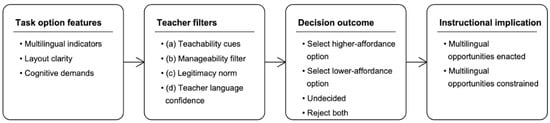
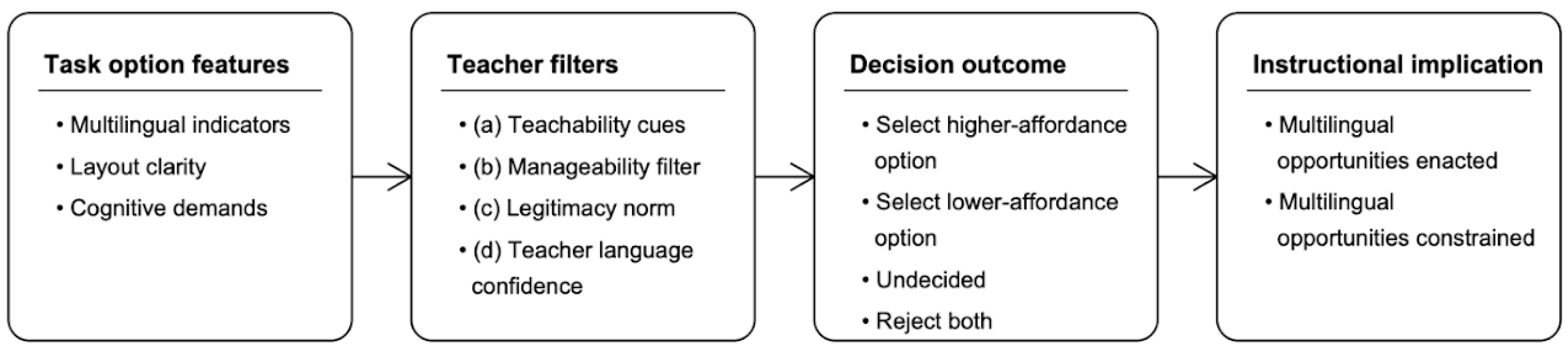
Figure 1 summarises the decision process evidenced in the protocols. Teachers rarely evaluated multilingual affordances in isolation. Instead, task features were filtered through (a) teachability cues associated with rule-first routines, (b) a manageability filter that prioritised clarity and classroom control, (c) legitimacy norms about English-only instruction, and (d) feasibility constraints linked to teachers’ confidence in the additional languages included. This model accounts for why multilingual-oriented options may be rejected even when teachers have positive general views towards multilingualism. Multilingual affordances matter only if teachers view them as doable and acceptable in their classroom context. Figure 1 should be understood as an interpretative synthesis of the qualitative findings rather than as a statistically validated model. It summarises the recurring decision filters identified across the think-aloud protocols and offers a heuristic account of how multilingual task affordances were evaluated by the participating teachers.
Figure 1.
A process model of multilingual task-selection reasoning.
5. Discussion
This study examined how secondary-school EFL teachers reason through task-selection decisions when presented with paired task options that differ in multilingual pedagogical affordances. Using concurrent think-aloud protocols, we captured teachers’ in-action criteria and concerns rather than general beliefs. Although the small, exploratory sample precludes broad generalisation, the patterns that emerged offer valuable insights into the factors shaping teachers’ decisions in multilingual EFL classrooms and provide a basis for further research. These tendencies require a more detailed discussion and evaluation. It is important to emphasise at the outset that the findings and conclusions presented here should be interpreted as indicative patterns rather than statistically generalisable results. This limitation is due to the relatively small sample size and the fact that participants reflected on only a limited number of task scenarios.
The findings indicate that task selection in multilingual EFL classrooms is not driven by a single factor. Instead, teachers weigh multilingual affordances against perceived instructional manageability, legitimacy norms about target-language use, and familiar methodological routines.
One clear takeaway is that teachers repeatedly treated manageability as the deciding filter. Across protocols, teachers repeatedly prioritised clarity, perceived cognitive load, and feasibility for a particular grade level, even when multilingual options were available (Transcripts 5 and 8). This indicates that multilingual pedagogy may falter in practice not only because teachers reject it, but also because multilingual task designs are assessed chiefly for their practical viability. In other words, multilingual affordances appear to be filtered through teachers’ anticipation of learner overload, lesson time constraints, and classroom control.
A second pattern concerns legitimacy judgements about language use in the EFL classroom. Several teachers verbalised a target-language-only norm, treating non-English languages as inappropriate for English lessons or as a source of confusion (Transcripts 4–6). This reasoning resonates with the well-documented persistence of monolingual orientations in language education, even in contexts where multilingualism is recognised as a societal reality (Cook, 2016; Otwinowska, 2017). Importantly, in the present data this norm did not remain an implicit background belief. It functioned as an explicit decision rule during concrete material selection, thereby constraining multilingual mediation and cross-linguistic comparison (Cenoz & Gorter, 2013).
A third pattern involves methodological routines as rule-first routines. Some teachers treated explicit rule extraction, signal-word cues, and immediate controlled practice as primary indicators of task quality (Transcripts 1–2 and 8). While the manuscript initially framed these statements as rule-first routines a more defensible interpretation is that they reflect stable classroom routines that are perceived as teachable, efficient, and controllable. This is consistent with the idea that teachers rely on established schemata—knowledge or even experience-ingrained beliefs—when faced with complex instructional decisions (Kim & Klassen, 2018). At the same time, such routines can conflict with research-informed approaches that prioritise meaningful input, form–meaning mapping, and structured processing before production (A. Benati, 2017; A. Benati & Angelovska, 2015; VanPatten, 2003).
These patterns should not be interpreted as deficits in teachers’ professional reasoning. Rather, they reflect the practical and normative constraints under which teachers evaluate tasks, including classroom manageability, perceived learner readiness, institutional expectations, and teachers’ own language confidence.
Relating these routines to the wider literature, several participants’ preferences align with assumptions often associated with presentation–practice–production sequencing (Ur, 1996, 2011). The present dataset cannot adjudicate instructional effectiveness directly, but it does show that rule-first cues are salient in teachers’ reasoning when judging task appropriateness. This is pedagogically consequential because research on input processing and structured input suggests that learning outcomes depend on how tasks direct attention to form–meaning relations in meaningful contexts (A. Benati, 2017; A. Benati & Lee, 2015). The protocols therefore highlight a practical bottleneck: if teachers evaluate tasks primarily through surface features that signal rule explanation and controlled practice, tasks designed to foster processing and multilingual comparison may be discounted as insufficiently “teachable” or insufficiently “English-focused”.
The data also show conditions under which multilingual-affordance options become more actionable. CL’s reasoning illustrates an approach in which multilingual comparison is linked to differentiation and scaffolded sequencing, starting with fewer languages and expanding as learners gain familiarity (Transcript 3). This suggests that multilingual pedagogy may be more readily adopted when teachers conceptualise it as a staged practice that can be introduced gradually rather than as a sudden increase in complexity. This is consistent with multilingual pedagogical approaches that aim to soften boundaries between languages while maintaining clear instructional goals (Cenoz & Gorter, 2013).
Another enabling and constraining factor concerns teacher confidence in languages included in tasks. SB’s protocol shows that limited competence in an additional language can reduce teachers’ willingness to evaluate or implement multilingual tasks, even when they are otherwise open to multilingual reasoning (Transcript 7). This aligns with work emphasising that teacher preparedness and perceived capacity predict what teachers do in classrooms (Faez, 2012). In the present study, teacher-language competence is not merely a background characteristic; it becomes a situational feasibility consideration during task selection.
Taken together, the findings help explain why multilingual pedagogy is unevenly implemented in multilingual EFL classrooms despite policy-level encouragement. Teachers’ decisions appear to be influenced by an interaction of (a) target-language legitimacy norms, (b) feasibility and manageability filters, and (c) reliance on familiar methodological routines. This interaction also helps interpret why teachers may endorse multilingual ideals yet avoid multilingual tasks in day-to-day instruction, particularly when tasks are perceived as complex, linguistically risky, or difficult to manage in mixed-ability classrooms (Haukås, 2016; De Angelis, 2011).
The study also has practical implications for teacher education and professional development. If multilingual task uptake is filtered through manageability concerns, multilingual tasks need to be designed with high instructional clarity and explicit scaffolding, including guidance on sequencing and differentiation. If target-language-only norms function as decision rules, professional development must address not only beliefs but also provide concrete classroom rationales and examples of how multilingual mediation can serve English learning goals (Cenoz & Gorter, 2013). Finally, if teachers rely on rule-first routines as indicators of learning, teacher education should explicitly connect research on processing, input, and form–meaning mapping to observable task features so that research-aligned tasks become recognisable as pedagogically legitimate (A. Benati, 2017; VanPatten, 2003).
6. Conclusions
This exploratory think-aloud study provides evidence about how EFL teachers justify task selection in multilingual classrooms. The data show variability across teachers and limited consensus about the task options aligned with the study’s affordance classification when multilingual pedagogical options are available. Across protocols, teachers’ verbalised decisions appeared to be shaped by methodological routines, target-language legitimacy norms, and perceived cognitive manageability.
Where teachers explicitly integrated learner repertoires, articulated sequencing and scaffolding, or treated cross-linguistic comparison as instructionally purposeful, multilingual-affordance task options were more likely to be selected. Conversely, when teachers prioritised rule-first routines, avoided mixing languages on principle, or anticipated learner overload, multilingual-affordance options were frequently rejected. These findings underline that the implementation of multilingual pedagogy depends not only on teachers’ general attitudes but also on moment-to-moment feasibility judgements and rule-first routines during material selection.
The study contributes a cautious, process-orientated account of how multilingual pedagogical affordances are evaluated during scenario-based task selection. Rather than showing how teachers behave in classrooms generally, the findings illuminate recurring reasoning patterns that may help explain why multilingual task options are sometimes taken up and sometimes rejected. The contribution lies in shifting attention from general beliefs about multilingualism to the moment-to-moment decision criteria teachers articulate when confronted with concrete pedagogical alternatives.
7. Limitations and Future Directions
The study is exploratory and qualitative, with a small sample (n = 10) and scenario-based elicitation. The results therefore identify patterns of reasoning rather than providing statistically generalisable estimates. The higher-affordance classification is grounded in the task-design rationale in Table A2, and it functions as our comparison frame, not as an objective validation of task superiority. For this reason, outcome summaries are best interpreted as alignment with the authors’ multilingual-affordance classification rather than as objective correctness.
Because the study was conducted in German and Austrian upper-secondary contexts, the findings should be transferred to other EFL settings with caution. Institutional language sequences, curricular expectations, teacher education traditions, and norms regarding target-language use may shape teachers’ reasoning about multilingual pedagogy. Future studies should therefore examine whether similar decision filters emerge in other educational systems.
A further limitation is that the paired task options likely differed not only in multilingual affordances but also in other design properties that teachers attended to, including clarity, layout, and perceived cognitive load. Because these properties are part of teachers’ reasoning, they are substantively important, but they also mean that some task rejections may reflect task presentation or anticipated manageability rather than multilingual stance. Future work could refine the scenario design to separate multilingual affordances from clarity and complexity features and could examine how targeted professional development influences teachers’ in-action reasoning during task selection.
Author Contributions
Conceptualization, K.S. and T.A.; methodology, T.A. and K.S.; software, K.S. and T.A.; validation, K.S. and T.A.; formal analysis, K.S. and T.A.; investigation, K.S. and T.A.; resources, K.S. and T.A.; data curation, K.S. and T.A.; writing—original draft preparation, K.S.; writing—review and editing, T.A.; visualization, K.S.; supervision, T.A.; project administration, K.S. All authors have read and agreed to the published version of the manuscript.
Funding
This research received no external funding.
Institutional Review Board Statement
Ethical approval was waived for this study due to the non-sensitive nature and full anonymization of the data.
Informed Consent Statement
Informed consent was obtained from all subjects involved in the study.
Data Availability Statement
No new data were created or analyzed in this study. Data sharing is not applicable to this article.
Conflicts of Interest
The authors declare no conflict of interest.
Appendix A. Tables
Table A1.
Participants with second subject and years of teaching experience.
Table A2.
Task option with higher multilingual potential and reasoning.
Table A3.
Operational indicators used to classify multilingual pedagogical affordances.
Table A4.
List of codes including name, abbreviation, definition and example plus translation.
Table A5.
Overview of participants’ choices for each task. Note. Italics = ambiguous (A/B) or missing. Parentheses reflect the transcript; scoring used the primary letter.
Table A6.
Cross-case themes.
Appendix B. Examples of Two Task Scenarios
Figure A1.
Task scenario 1.

Figure A2.
Task scenario 2.

References
- Angelovska, T. (2018). Cross-linguistic awareness of adult L3 learners of English: A focus on metalinguistic reflections and proficiency. Language Awareness, 27(1–2), 136–152. [Google Scholar] [CrossRef] [Scilit]
- Angelovska, T., & Hahn, A. (2014). Raising language awareness for learning and teaching L3 grammar. In A. G. Benati, C. Laval, & M. Arche (Eds.), The grammar dimension in instructed second language learning (pp. 185–207). Bloomsbury. [Google Scholar]
- Angelovska, T., & Schaipp, K. (2018). Heterogeneity in TEFL: A focus on teachers’ competencies for and in the multilingual classroom. In J. I. Liontas (Ed.), The TESOL encyclopedia of English language teaching (pp. 1–7). Wiley. [Google Scholar] [CrossRef] [Scilit]
- Benati, A. (2017). The role of input and output tasks in grammar instruction: Theoretical, empirical and pedagogical considerations. Studies in Second Language Learning and Teaching, 7(3), 377–396. [Google Scholar] [CrossRef] [Scilit]
- Benati, A., & Angelovska, T. (2015). The effects of processing instruction on the acquisition of English simple past tense: Age and cognitive task demands. International Review of Applied Linguistics in Language Teaching, 53(2), 249–269. [Google Scholar] [CrossRef] [Scilit]
- Benati, A., & Batziou, M. (2017). The relative effects of isolated and combined structured input and structured output on the acquisition of English causative forms. International Review of Applied Linguistics in Language Teaching. Advance online publication. [Google Scholar] [CrossRef] [Scilit]
- Benati, A., & Lee, J. (2015). Processing instruction: New insights after twenty years of theory, research and application [Special issue]. International Review of Applied Linguistics in Language Teaching, 53(2). [Google Scholar] [CrossRef] [Scilit]
- Benati, A. G., & Angelovska, T. (2016). Second language acquisition: A theoretical introduction to real world applications. Bloomsbury. [Google Scholar]
- Bowles, M. A. (2010). The think-aloud controversy in second language research. Routledge. [Google Scholar]
- Calafato, R. (2019). The non-native speaker teacher as proficient multilingual: A critical review of research from 2009–2018. Lingua, 227, 102700. [Google Scholar] [CrossRef] [Scilit]
- Cenoz, J., & Gorter, D. (2013). Towards a plurilingual approach in English language teaching: Softening the boundaries between languages. TESOL Quarterly, 47(3), 591–599. [Google Scholar] [CrossRef] [Scilit]
- Charters, E. (2003). The use of think-aloud methods in qualitative research. Brock Education Journal, 12(2), 79–82. [Google Scholar] [CrossRef] [Scilit]
- Cook, V. (2016). Where is the native speaker now? TESOL Quarterly, 50(1), 186–189. [Google Scholar] [CrossRef] [Scilit]
- Council of Europe. (2023). A guide to action-oriented, plurilingual and intercultural education. Council of Europe Publishing. Available online: https://www.coe.int/en/web/common-european-framework-reference-languages (accessed on 3 March 2026).
- De Angelis, G. D. (2011). Teachers’ beliefs about the role of prior language knowledge in learning and how these influence teaching practices. International Journal of Multilingualism, 8(3), 216–234. [Google Scholar] [CrossRef] [Scilit]
- Ericsson, K. A., & Simon, H. A. (1980). Verbal reports as data. Psychological Review, 87(3), 215–251. [Google Scholar] [CrossRef]
- European Commission. (2018). Proposal for a Council recommendation on a comprehensive approach to the teaching and learning of languages. Available online: https://eur-lex.europa.eu/legal-content/EN/TXT/?uri=COM%3A2018%3A272%3AFIN (accessed on 12 July 2026).
- Faez, F. (2012). Diverse teachers for diverse students: Internationally educated and Canadian-born teachers’ preparedness to teach English language learners. Canadian Journal of Education, 35(3), 64–84. [Google Scholar]
- Flick, U. (Ed.). (2013). The SAGE handbook of qualitative data analysis. SAGE. [Google Scholar]
- Friedman, D. A. (2011). How to collect and analyze qualitative data. In A. Mackey, & S. Gass (Eds.), Research methods in second language acquisition: A practical guide (pp. 180–200). Wiley-Blackwell. [Google Scholar]
- Haukås, Å. (2016). Teachers’ beliefs about multilingualism and a multilingual pedagogical approach. International Journal of Multilingualism, 13(1), 1–18. [Google Scholar] [CrossRef] [Scilit]
- Hufeisen, B. (2011). Gesamtsprachencurriculum: Weitere Überlegungen zu einem prototypischen Modell. In R. S. Baur, & B. Hufeisen (Eds.), Vieles ist sehr ähnlich: Individuelle und gesellschaftliche mehrsprachigkeit als bildungspolitische aufgabe (pp. 265–282). Schneider Hohengehren. [Google Scholar]
- Kim, L. E., & Klassen, R. M. (2018). Teachers’ cognitive processing of complex school-based scenarios: Differences across experience levels. Teaching and Teacher Education, 73, 215–226. [Google Scholar] [CrossRef] [Scilit]
- Kubanyiova, M., & Feryok, A. (2015). Language teacher cognition in applied linguistics research: Revisiting the territory, redrawing the boundaries, reclaiming the relevance. The Modern Language Journal, 99(3), 435–449. [Google Scholar] [CrossRef] [Scilit]
- Leow, R. P., & Morgan-Short, K. (2004). To think aloud or not to think aloud: The issue of reactivity in SLA research methodology. Studies in Second Language Acquisition, 26(1), 35–57. [Google Scholar] [CrossRef] [Scilit]
- Max Planck Institute for Psycholinguistics. (2025). ELAN (Version 7.0) [Computer software]. Max Planck Institute for Psycholinguistics, The Language Archive. Available online: https://archive.mpi.nl/tla/elan (accessed on 12 July 2026).
- Mayring, P. (2015). Titel, Qualitative Inhaltsanalyse. Grundlagen und Techniken. 12., überarb. Aufl. Quelle, Weinheim u.a.: Beltz. Available online: https://books.google.co.th/books?id=IdbKrQEACAAJ (accessed on 12 July 2026).
- Murray, D. E., & Christison, M. (2019). What English language teachers need to know, volume I: Understanding learning (2nd ed.). Routledge. [Google Scholar]
- Otwinowska, A. (2017). English teachers’ language awareness: Away with the monolingual bias? Language Awareness, 26(4), 304–324. [Google Scholar] [CrossRef] [Scilit]
- Révész, A., & Gurzynski-Weiss, L. (2016). Teachers’ perspectives on second language task difficulty: Insights from think-alouds and eye tracking. Annual Review of Applied Linguistics, 36, 182–204. [Google Scholar] [CrossRef] [Scilit]
- Riordan, E. (2018). The non-native speaker language teacher. In E. Riordan (Ed.), Language for teaching purposes (pp. 113–145). Springer. [Google Scholar] [CrossRef] [Scilit]
- Sugirin. (1999). Exploring the comprehension strategies of EFL readers: A multi-method study. (ERIC Document Reproduction Service). International Workshop on Written Language Processing, University of New South Wales. [Google Scholar]
- Ur, P. (1996). A course in language teaching: Practice and theory. Cambridge University Press. [Google Scholar]
- Ur, P. (2011). Grammar teaching: Research, theory, and practice. In E. Hinkel (Ed.), Handbook of research in second language teaching and learning (pp. 507–522). Routledge. [Google Scholar]
- VanPatten, B. (2003). From input to output: A teacher’s guide to second language acquisition. McGraw-Hill. [Google Scholar]
Disclaimer/Publisher’s Note: The statements, opinions and data contained in all publications are solely those of the individual author(s) and contributor(s) and not of MDPI and/or the editor(s). MDPI and/or the editor(s) disclaim responsibility for any injury to people or property resulting from any ideas, methods, instructions or products referred to in the content. |
© 2026 by the authors. Licensee MDPI, Basel, Switzerland. This article is an open access article distributed under the terms and conditions of the Creative Commons Attribution (CC BY) license.