


Abstract
The integration of AI into higher education provides new opportunities for supporting learning in interdisciplinary contexts and fostering entrepreneurial development. However, previous research has mainly focused on AI technology adoption, with limited attention paid to its broader educational outcomes. In particular, how AI-assisted learning contributes to students’ entrepreneurial intention within an interdisciplinary course context remains underexplored. This study develops an extended Unified Theory of Acceptance and Use of Technology (UTAUT) model by incorporating AI-assisted learning engagement as a mediating factor. A questionnaire survey was conducted among 300 undergraduate students enrolled in a food product development course within a food science and engineering program at a university in China. Using PLS-SEM, the results reveal that performance expectancy, effort expectancy, social influence, and facilitating conditions positively influence AI-assisted learning engagement and entrepreneurial intention. Furthermore, AI-assisted learning engagement significantly mediates the relationships between UTAUT factors and entrepreneurial intention. This study contributes to AI education and entrepreneurial learning research by demonstrating how AI-assisted learning within interdisciplinary contexts can promote students’ entrepreneurial intention through learning engagement.
1. Introduction
The rapid development and widespread adoption of AI have created both opportunities and challenges for higher education institutions worldwide. According to UNESCO (2023), AI has rapidly entered educational contexts, encouraging universities to reconsider how teaching, learning, and assessment practices can be redesigned in the AI era (X. Zhang et al., 2026). Unlike previous educational technologies that primarily focused on improving access to information and instructional efficiency, AI-powered tools provide interactive, adaptive, and personalized learning support, enabling students to engage in knowledge exploration, complex problem-solving, and creative activities through human-AI collaboration (Kasneci et al., 2023). Consequently, understanding how AI can generate meaningful educational outcomes beyond simple technology adoption has become an important research priority in higher education (Zawacki-Richter et al., 2019; Rodrigues, 2023).
Entrepreneurial intention, defined as an individual’s willingness and commitment to engage in entrepreneurial activities, has been widely recognized as one of the strongest predictors of future entrepreneurial behavior (Liñán & Chen, 2009). Previous research has demonstrated that entrepreneurship education can positively influence students’ entrepreneurial intention by enhancing entrepreneurial knowledge, self-efficacy, perceived feasibility, and motivation toward entrepreneurship (Bae et al., 2014; Nabi et al., 2017; Liu et al., 2025). Within higher education contexts, entrepreneurship education has therefore been regarded as an effective approach for preparing students to respond to innovation-driven economic and social challenges (Simmons, 2025). However, existing research has mostly focused on entrepreneurship-specific courses, business-related disciplines, or formal entrepreneurship training programs, while limited attention has been paid to whether entrepreneurship-related outcomes can also emerge within disciplinary courses whose primary educational objectives are not explicitly oriented toward entrepreneurship (Ahmed et al., 2020; Mei et al., 2020; Gao & Qin, 2022; Dar et al., 2024).
This limitation is particularly relevant in science and engineering education, where students often possess specialized disciplinary knowledge but may lack opportunities to connect technical expertise with market demands, user needs, and innovation processes (Shekhar & Huang-Saad, 2021). Entrepreneurial activities increasingly require the integration of knowledge from multiple domains, including technological expertise, market understanding, opportunity recognition, and value creation (Shane & Venkataraman, 2000; Nambisan, 2017; Simmons, 2025). The emergence of AI provides new possibilities for supporting interdisciplinary entrepreneurial learning within disciplinary courses. AI tools can assist students in generating ideas, searching and analyzing information, evaluating alternative solutions, and improving decision-making processes. Such innovation-oriented learning processes are important for cultivating creativity and generating novel solutions (Qi et al., 2025), which are fundamental capabilities for entrepreneurial development.
To explain how students engage with AI-assisted learning environments, this study adopts the Unified Theory of Acceptance and Use of Technology (UTAUT) as the theoretical foundation. UTAUT proposes that performance expectancy, effort expectancy, social influence, and facilitating conditions are important determinants of individuals’ technology acceptance and usage behaviors (Venkatesh et al., 2003) and provides a useful framework for understanding students’ perceptions of AI-assisted learning (Ke et al., 2025). However, technology acceptance alone does not fully explain how students’ perceptions of AI are translated into broader educational outcomes. In particular, the learning process through which technology-related perceptions may contribute to entrepreneurship-related outcomes in AI-assisted learning within interdisciplinary contexts remains insufficiently understood.
To address these gaps, drawing on learning engagement theory (Fredricks et al., 2004), this study develops an extended UTAUT model by incorporating AI-assisted learning engagement as a mediating mechanism and entrepreneurial intention as the educational outcome. Specifically, this study selects a food product development course within a food science and engineering program at a university in China as the research context to examine how AI-assisted learning experiences in an interdisciplinary educational environment influence students’ entrepreneurial intention through AI-assisted learning engagement. Therefore, this study aims to answer the following research questions:
RQ1: How do UTAUT factors influence students’ entrepreneurial intention?
RQ2: Does AI-assisted learning engagement mediate the relationship between UTAUT factors and students’ entrepreneurial intention within an interdisciplinary course context?
This study contributes to the literature in three ways. First, it extends existing AI adoption research by moving beyond technology acceptance and examining how AI-assisted learning processes contribute to entrepreneurial educational outcomes. Second, it expands research on entrepreneurial learning by demonstrating how entrepreneurial intention can be cultivated through AI-assisted learning in interdisciplinary course contexts. Third, it provides practical implications for educators seeking to integrate AI technologies into higher education curricula and design innovation-oriented learning experiences.
2. Literature Review
2.1. AI-Assisted Learning in Higher Education and Entrepreneurial Learning
Recent advances in AI have provided new opportunities for higher education by supporting personalized learning, knowledge exploration, and problem-solving activities. Previous studies have mainly examined AI applications from the perspectives of technology adoption, learning support, and educational outcomes (Zawacki-Richter et al., 2019; Kasneci et al., 2023; Crompton & Burke, 2023; Bond et al., 2024). Research on generative AI further suggests that AI tools can facilitate students’ creative thinking and knowledge construction through interactive human–AI collaboration (Lo, 2023; Tlili et al., 2023). The OECD (Organisation for Economic Co-operation and Development) Digital Education Outlook 2026 further emphasizes that the educational value of generative AI depends on its purposeful pedagogical integration. Although general-purpose generative AI may improve students’ task performance, such improvements do not necessarily translate into meaningful learning gains without appropriate pedagogical guidance; when intentionally integrated into teaching and learning, however, generative AI can support learning and foster capabilities such as critical thinking, creativity, and collaboration (OECD, 2026). This policy perspective further highlights the importance of examining not merely whether students adopt AI technologies, but how AI is integrated into learning processes and contributes to broader educational outcomes. However, existing AI education research has primarily focused on technology acceptance and general learning outcomes, while its role in fostering entrepreneurial development remains insufficiently explored.
Entrepreneurship education has been widely recognized as an important approach for cultivating students’ innovation capabilities and entrepreneurial potential. Entrepreneurship education generally refers to pedagogical courses, programs, and educational processes intentionally designed to develop or strengthen learners’ entrepreneurial knowledge, attitudes, skills, and competencies (Bae et al., 2014; Hahn et al., 2017). Entrepreneurial learning, by contrast, refers to the process through which individuals develop entrepreneurial knowledge, competencies, and ways of thinking through learning and experience (Politis, 2005). Previous studies have demonstrated that entrepreneurship education can enhance students’ entrepreneurial intention by improving entrepreneurial knowledge, self-efficacy, and perceived feasibility (Bae et al., 2014; Nabi et al., 2017; Lv et al., 2021). However, existing entrepreneurship education research has mainly focused on entrepreneurship-specific courses, business-related disciplines, and formal training programs (Ahmed et al., 2020; Mei et al., 2020). Recent studies have highlighted the importance of extending entrepreneurship education beyond traditional business contexts and integrating entrepreneurial learning into diverse disciplinary environments (Yi & Duval-Couetil, 2021; Shekhar & Huang-Saad, 2021; Crișan et al., 2024).
Against this background, this study focuses on entrepreneurial learning rather than entrepreneurship education as a formal educational intervention. More specifically, this study examines whether AI-assisted learning within interdisciplinary course contexts whose primary educational objectives are not explicitly oriented toward entrepreneurship can foster students’ entrepreneurial intention, what technology-related factors influence this process, and whether AI-assisted learning engagement serves as a mediating mechanism through which these factors contribute to entrepreneurial intention.
2.2. UTAUT in Entrepreneurial Learning Contexts
The Theory of Planned Behavior (TPB) provides an important foundation for explaining behavioral intention. According to Ajzen (1991), behavioral intention is shaped by attitudes toward the behavior, subjective norms, and perceived behavioral control. UTAUT was subsequently developed by integrating and extending several established theories and models of individual behavior and technology acceptance, including TPB and the combined TAM-TPB model (Venkatesh et al., 2003).
The Unified Theory of Acceptance and Use of Technology (UTAUT) has been widely adopted as a theoretical framework for explaining individuals’ acceptance and use of emerging technologies (Tamilmani et al., 2021; Ma, 2026). Developed by Venkatesh et al. (2003), UTAUT integrates several technology acceptance theories and proposes four key determinants of technology adoption: performance expectancy, effort expectancy, social influence, and facilitating conditions. These constructs explain how individuals’ perceptions of technological usefulness, ease of use, social support, and available resources influence their intention and behavior toward technology adoption.
Although TPB has been widely used to explain entrepreneurial intention, this study focuses specifically on how students’ perceptions of AI-assisted learning engagement and entrepreneurial intention. UTAUT was therefore selected as the primary theoretical framework because its core constructs more directly capture technology-related perceptions of usefulness, ease of use, social influence, and facilitating conditions in AI-assisted learning contexts.
In higher education, UTAUT has been extensively applied to examine students’ acceptance of digital learning technologies, including online learning platforms, mobile learning systems, and emerging AI-based educational tools (Chao, 2019; Strzelecki, 2024; Li et al., 2024; García de Blanes Sebastián et al., 2025). Previous studies have demonstrated that students’ perceptions of technology usefulness, usability, and social support play important roles in shaping their willingness to engage with technology-enhanced learning environments (Scherer et al., 2019; Granić & Marangunić, 2019). With the rapid development of generative AI, recent studies have further extended UTAUT to AI-assisted educational contexts and found that technology-related perceptions remain important factors influencing students’ acceptance and engagement with AI technologies (Ke et al., 2025). These findings suggest that UTAUT provides a suitable theoretical foundation for understanding students’ responses to AI-assisted learning environments.
2.3. Entrepreneurial Intention
Entrepreneurial intention refers to an individual’s willingness and planned commitment to engage in entrepreneurial activities and has become a central construct for explaining the emergence of entrepreneurial behavior (Liñán & Chen, 2009). Its theoretical foundations are closely associated with intention-based models of behavior. In particular, the Theory of Planned Behavior proposes that behavioral intention is shaped by attitudes toward the behavior, subjective norms, and perceived behavioral control, and serves as an important antecedent of subsequent behavior (Ajzen, 1991).
Entrepreneurial intention should be distinguished from related cognitive constructs such as entrepreneurial self-efficacy. Entrepreneurial self-efficacy reflects individuals’ beliefs in their capability to perform entrepreneurship-related tasks, whereas entrepreneurial intention concerns their willingness or planned commitment to pursue entrepreneurial activities. Entrepreneurial self-efficacy may therefore function as an antecedent or mechanism contributing to entrepreneurial intention rather than representing entrepreneurial intention itself (Taneja et al., 2025).
From the perspective of entrepreneurial learning, entrepreneurial intention can develop through learning experiences that enable individuals to acquire knowledge, explore opportunities, strengthen perceived capabilities, and connect existing expertise with potential value creation. Entrepreneurial learning therefore provides an important process through which individuals may gradually develop stronger entrepreneurial cognition and intention. Empirical studies have shown that experiential and entrepreneurial learning can contribute to entrepreneurial intention by influencing students’ knowledge, attitudes, perceived capabilities, and engagement with entrepreneurial tasks (Taneja et al., 2025).
3. Hypotheses Development and Model Framework
Building on the existing theoretical research and conceptual foundations presented in the Literature Review, this section develops the theoretical model and corresponding hypotheses. Specifically, UTAUT provides the basic framework of the model, with performance expectancy, effort expectancy, social influence, and facilitating conditions incorporated as the core independent variables. Drawing on learning engagement theory, AI-assisted learning engagement is further introduced as a mediating variable, while entrepreneurial intention is treated as the outcome variable, thereby forming the theoretical model of the present study. The hypotheses are developed by first examining the direct relationships among these constructs and then considering the mediating role of AI-assisted learning engagement in the relationships between the four core UTAUT factors and entrepreneurial intention.
3.1. Performance Expectancy
Performance expectancy refers to the extent to which individuals believe that using a particular technology can enhance their task performance and improve desired outcomes (Venkatesh et al., 2003). As a core construct of the UTAUT, performance expectancy represents users’ perceived usefulness of technology and has been consistently identified as one of the strongest predictors of technology adoption intentions across different contexts (Venkatesh et al., 2003; Granić & Marangunić, 2019).
In the context of AI-assisted learning within an interdisciplinary course, performance expectancy reflects students’ perceptions that AI tools can provide meaningful support for knowledge exploration, information processing, idea generation, and problem-solving. Unlike traditional educational technologies that mainly provide access to learning resources, AI-assisted learning environments enable students to interact with intelligent systems for personalized feedback, creative exploration, and the integration of knowledge from multiple disciplines (Ng et al., 2024; Venter et al., 2025; Vieriu & Petrea, 2025). Such perceived benefits may encourage students to actively participate in AI-assisted learning processes and invest greater effort in interdisciplinary learning activities. Therefore, students who perceive AI-assisted learning as valuable and effective are more likely to demonstrate higher levels of AI-assisted learning engagement.
Furthermore, performance expectancy may also contribute to students’ entrepreneurial intention. Entrepreneurial intention is closely associated with individuals’ perceptions of their ability to identify opportunities, develop innovative ideas, and create potential value (Wiramihardja et al., 2022; Adeel et al., 2023). Within the interdisciplinary course context, performance expectancy reflects not only whether AI is useful for completing coursework, but also whether it can support information exploration, idea generation, solution evaluation, and opportunity identification. Recent research has also shown that the perceived usefulness of AI can contribute to university students’ entrepreneurial attitudes and intentions (Zulfiqar et al., 2025). When students believe that AI technologies can enhance their creativity, decision-making, and innovation capabilities, they may develop stronger confidence and motivation toward entrepreneurial activities.
Based on the above arguments, this study proposes the following hypotheses:
H1a.
Performance expectancy positively influences students’ entrepreneurial intention.
H1b.
Performance expectancy positively influences AI-assisted learning engagement.
3.2. Effort Expectancy
Effort expectancy refers to the degree of ease associated with the use of a particular technology, reflecting individuals’ perceptions of whether a system is easy to learn and operate (Venkatesh et al., 2003). As one of the core constructs in the UTAUT framework, effort expectancy represents the cognitive effort required for technology adoption and has been widely recognized as an important factor influencing users’ technology acceptance behaviors (Venkatesh et al., 2003; Granić & Marangunić, 2019). In educational contexts, students are more likely to accept and engage with technology-supported learning environments when they perceive that digital tools are easy to understand, convenient to use, and require limited cognitive effort (Scherer et al., 2019; Lehmann et al., 2023; Strzelecki & ElArabawy, 2024).
In AI-assisted learning environments, effort expectancy reflects students’ perceptions of the accessibility and usability of AI tools during learning activities. Although AI technologies provide advanced functions such as information retrieval, idea generation, and personalized feedback, students’ willingness to actively interact with AI depends not only on the potential benefits of these tools but also on whether they can use them effectively without excessive learning barriers. Research on AI-assisted education suggests that usability and perceived ease of use remain important determinants of students’ acceptance and engagement with AI technologies (Albayati, 2024; Adams et al., 2024; Ke et al., 2025). When students perceive AI tools as easy to operate and integrate into learning activities, they may be more willing to explore AI-assisted resources, participate in learning tasks, and invest effort in knowledge construction. Therefore, effort expectancy is expected to positively influence students’ AI-assisted learning engagement.
Furthermore, entrepreneurial learning often requires students to explore unfamiliar problems, acquire new knowledge, and develop innovative solutions under uncertain conditions. When AI tools are perceived as easy to use, students may more effectively utilize AI capabilities for opportunity exploration, idea development, and problem-solving, thereby enhancing their confidence and motivation toward entrepreneurial activities. Previous research has demonstrated that the perceived ease of use of AI can contribute to university students’ entrepreneurial attitudes and intentions, while perceived capability, self-efficacy, and a greater sense of control over relevant tasks and resources are also important factors shaping entrepreneurial intention (Otache et al., 2024; Zulfiqar et al., 2025). Accordingly, easier interaction with AI technologies may facilitate students’ entrepreneurial cognition and strengthen their entrepreneurial intention.
Based on the above arguments, this study proposes the following hypotheses:
H2a.
Effort expectancy positively influences students’ entrepreneurial intention.
H2b.
Effort expectancy positively influences AI-assisted learning engagement.
3.3. Social Influence
Social influence refers to the extent to which individuals perceive that important others believe they should use a particular technology or engage in specific behaviors (Venkatesh et al., 2003). Within the UTAUT framework, social influence represents the role of social expectations, peer perceptions, and external encouragement in shaping individuals’ technology-related decisions. Previous research has demonstrated that individuals are more likely to adopt emerging technologies when they perceive support and approval from significant social groups, particularly in contexts where technology use involves uncertainty and continuous learning (Venkatesh et al., 2003; Dwivedi et al., 2019).
In AI-assisted learning environments, social influence may originate from teachers, classmates, and institutional support. Unlike traditional digital learning tools, the effective use of AI requires not only technical access but also appropriate guidance, social acceptance, and shared learning norms. Recent studies have suggested that teachers’ encouragement and peer interaction toward AI play important roles in shaping students’ willingness to engage with AI-assisted learning activities (Bond et al., 2024; Chiu et al., 2023). When students perceive that instructors and peers recognize the value of AI-assisted learning, they may develop more positive attitudes toward AI and become more willing to actively interact with AI tools during learning processes. Therefore, social influence is expected to enhance students’ AI-assisted learning engagement.
Furthermore, entrepreneurial activities are often influenced by social environments, including support from educators, peers, and surrounding communities. In higher education, students are more likely to develop entrepreneurial intention when they are exposed to supportive entrepreneurial norms and believe that entrepreneurship is valued within their learning environment (Schlaegel & Koenig, 2014; Song & Lu, 2024). Within the interdisciplinary course context, teachers’ encouragement and peer recognition of AI use may also reflect broader support for experimentation, idea development, and innovation-oriented activities. When students perceive that such activities are valued and supported by important others, they may feel greater social encouragement to explore innovative and potentially entrepreneurial opportunities. Accordingly, social influence may directly contribute to the formation of entrepreneurial intention.
Based on the above arguments, this study proposes the following hypotheses:
H3a.
Social influence positively influences students’ entrepreneurial intention.
H3b.
Social influence positively influences AI-assisted learning engagement.
3.4. Facilitating Conditions
Facilitating conditions refer to the extent to which individuals perceive that sufficient organizational and technical resources are available to support the use of a particular technology (Venkatesh et al., 2003). Within the UTAUT framework, facilitating conditions represent the external support environment that enables individuals to effectively adopt and utilize technologies. Unlike performance expectancy and effort expectancy, which primarily reflect individuals’ perceptions of technology itself, facilitating conditions emphasize the availability of necessary resources, infrastructure, guidance, and support systems that facilitate technology use (Venkatesh et al., 2003).
In AI-assisted learning environments, facilitating conditions include students’ access to AI tools, technological infrastructure, instructional guidance, and institutional support. Although AI technologies provide powerful learning capabilities, students’ effective engagement with AI-assisted learning depends not only on their willingness to use AI but also on whether appropriate learning environments and supporting conditions are available. Studies have highlighted that institutional support, digital infrastructure, and adequate guidance from educators are important factors influencing students’ successful integration of AI technologies into learning activities (Jeilani & Abubakar, 2025; Bond et al., 2024; Chiu et al., 2023). When students perceive sufficient support and resources for AI use, they may experience fewer barriers in interacting with AI tools and become more actively engaged in AI-assisted learning processes. Therefore, facilitating conditions are expected to positively influence AI-assisted learning engagement.
Furthermore, entrepreneurial intention is not only shaped by individual motivations but also influenced by contextual factors, including access to resources, educational support, and learning environments that encourage entrepreneurial exploration (Y. Zhang et al., 2014; Ponce et al., 2024). In AI-assisted entrepreneurial learning contexts, facilitating conditions reflect the availability of technological resources, instructional guidance, and institutional support that enable students to use AI effectively in learning activities (Venkatesh et al., 2003; Jeilani & Abubakar, 2025). Such supportive conditions may reduce practical barriers to opportunity exploration, idea development, and innovative problem-solving. Evidence also suggests that university support can directly contribute to students’ entrepreneurial intention (Song & Lu, 2024). Therefore, when students perceive that sufficient support is available, they may develop stronger entrepreneurial intention.
Based on these arguments, this study proposes the following hypotheses:
H4a.
Facilitating conditions positively influence students’ entrepreneurial intention.
H4b.
Facilitating conditions positively influence AI-assisted learning engagement.
3.5. AI-Assisted Learning Engagement
Drawing on learning engagement theory, this study introduces AI-assisted learning engagement as a mediating mechanism between technology acceptance factors and entrepreneurial intention. Fredricks et al. (2004) conceptualized learning engagement as a multidimensional construct consisting of behavioral, emotional, and cognitive engagement. Among these dimensions, behavioral engagement emphasizes students’ active participation, effort investment, and involvement in learning activities. Therefore, this study focuses on the behavioral dimension and defines AI-assisted learning engagement as students’ active participation and effort investment when interacting with AI-assisted learning activities.
AI-assisted learning environments can enhance students’ engagement by providing personalized support, interactive feedback, and opportunities for active knowledge construction (Kasneci et al., 2023; Han et al., 2025). Furthermore, meaningful and experiential learning experiences have been shown to contribute to students’ entrepreneurial development by promoting creativity, opportunity recognition, and innovative thinking (Lackéus, 2020). Therefore, students with higher levels of AI-assisted learning engagement are expected to be more likely to explore innovative opportunities and develop stronger entrepreneurial intention.
Based on the above arguments, this study proposes the following hypothesis:
H5.
AI-assisted learning engagement influences students’ entrepreneurial intention.
3.6. The Mediating Role of AI-Assisted Learning Engagement
In AI-assisted learning environments, students’ perceptions of AI usefulness, ease of use, social support, and available resources may encourage them to actively participate in AI-assisted learning activities (Adams et al., 2024). When students perceive AI technologies as valuable and accessible, they are more likely to invest effort in interacting with AI tools, exploring information, and completing learning tasks (An et al., 2026). Such behavioral engagement represents the process through which technology-related perceptions are translated into meaningful learning experiences (Reeve & Tseng, 2011; Bond et al., 2024). Through active engagement with AI-assisted learning activities, students may further develop innovation-related cognition, problem-solving abilities, and entrepreneurial motivation.
Accordingly, this study proposes that AI-assisted learning engagement mediates the relationships between UTAUT factors and students’ entrepreneurial intention. Specifically, students’ perceptions of performance expectancy, effort expectancy, social influence, and facilitating conditions may influence entrepreneurial intention indirectly by increasing their engagement with AI-assisted learning activities. Therefore, the following hypotheses are proposed:
H6a.
AI-assisted learning engagement significantly mediates the effect of performance expectancy on entrepreneurial intention.
H6b.
AI-assisted learning engagement significantly mediates the effect of effort expectancy on entrepreneurial intention.
H6c.
AI-assisted learning engagement significantly mediates the effect of social influence on entrepreneurial intention.
H6d.
AI-assisted learning engagement significantly mediates the effect of facilitating conditions on entrepreneurial intention.
3.7. Model Framework
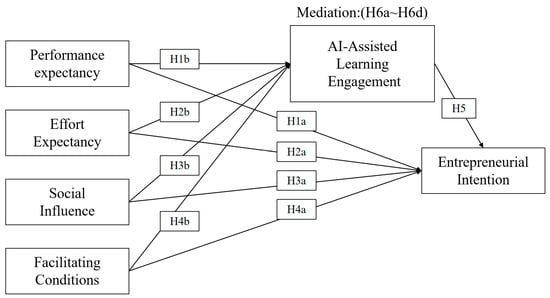
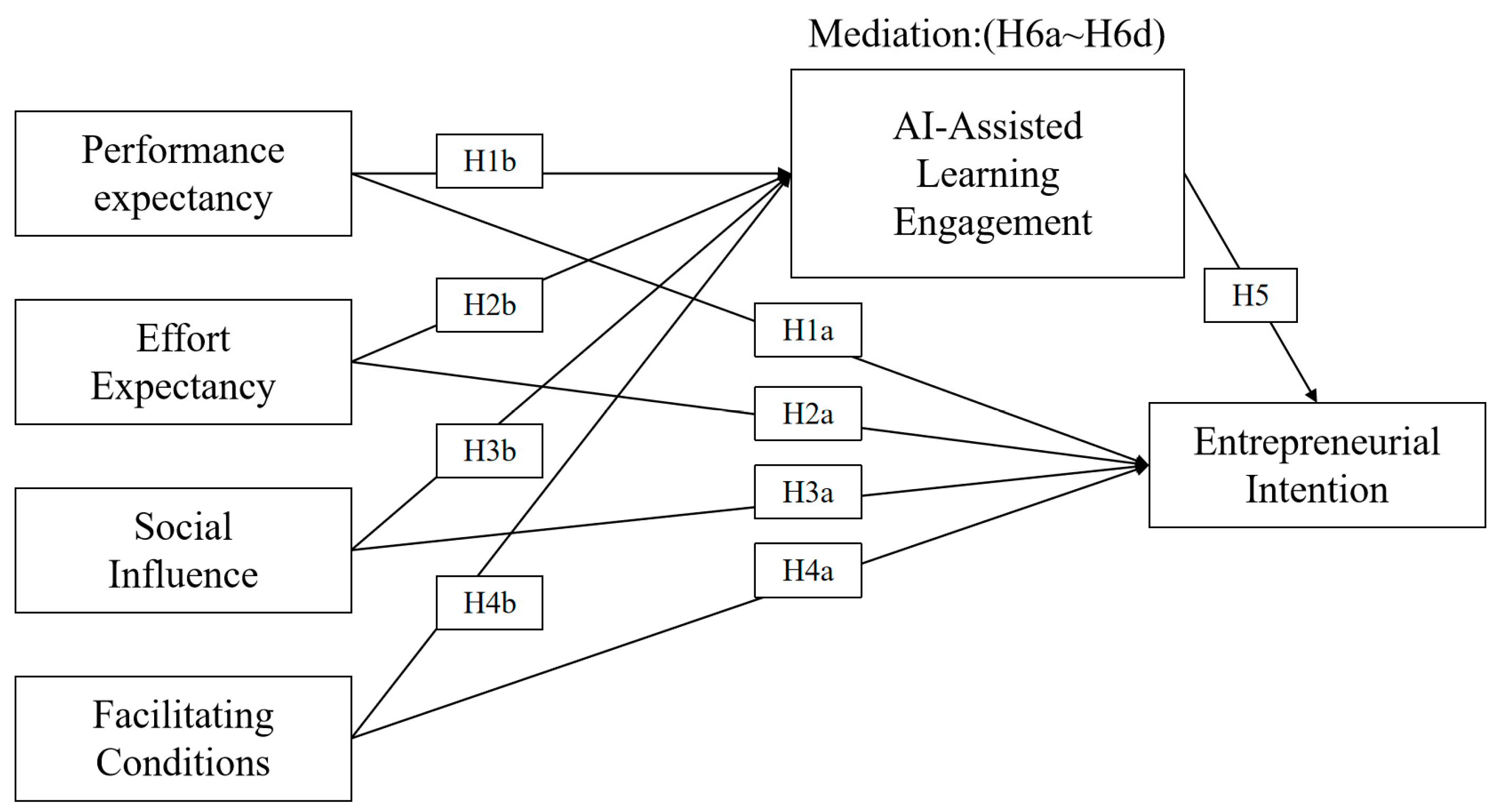
Based on the above theoretical discussions and hypothesis development, this study proposes an extended UTAUT model to examine how technology acceptance factors contribute to students’ entrepreneurial intention through AI-assisted learning engagement. The proposed research framework is shown in Figure 1.
Figure 1.
Model framework.
4. Research Design and Results
4.1. Data Collection Procedures
Data were collected from undergraduate students enrolled in a food product development course within a food science and engineering program at a university in China. The course is a disciplinary course rather than a course specifically designed for entrepreneurship education. The course aims to help students apply food science and engineering knowledge to the analysis, design, and development of food products, while strengthening their ability to integrate scientific knowledge with practical product-related considerations. Its learning content focuses on the development and refinement of food products. In addition to technical considerations, students are required to consider consumer needs, market demand, and potential product value when developing their solutions. As a result, the course requires students to integrate disciplinary knowledge with information from consumer, market, and application contexts.
During the course, students engage in activities such as investigating consumer needs, identifying potential product opportunities, developing food solutions, and refining product ideas in response to relevant information. AI-assisted learning tools are used to support information exploration, knowledge integration, idea generation, and solution refinement. The primary purpose of the course is to translate disciplinary knowledge in food science and engineering into practical product development, with an emphasis on the application of subject-specific knowledge. However, the development of food products also requires students to analyze consumer needs and consider the potential value of their solutions. Therefore, the course is not an entrepreneurship education course, but rather provides a disciplinary context in which entrepreneurial learning may occur. In particular, the processes of identifying needs and potential opportunities, connecting disciplinary knowledge with potential value creation, and considering the possible application or commercialization of food products are closely related to entrepreneurial learning processes involving opportunity exploration, knowledge integration, and value creation. Moreover, preliminary interviews with students enrolled in the course suggested that some students had developed entrepreneurial intentions concerning the potential commercialization of the food products developed during the course. Therefore, the course provides an appropriate empirical context for examining whether AI-assisted learning within an interdisciplinary course context can contribute to students’ entrepreneurial intention.
The course did not prescribe any specific AI tools. Students were free to select AI tools based on their prior experience and familiarity, with commonly used tools including ChatGPT, DeepSeek, Doubao, and other generative AI applications. AI-assisted learning was integrated throughout the entire course rather than being limited to a particular week or assignment. Students used these tools at different stages of the product development process, including information exploration, market and consumer analysis, knowledge integration, idea generation, product design, comparison of alternative solutions, and refinement of final product proposals.
Data were collected during the spring semesters of 2024, 2025, and 2026. The Food Product Development course was offered as a single course section in each semester, and all students enrolled in the course were invited to participate in the questionnaire survey. The survey was administered at the end of each semester after students had completed the relevant course activities. Across the three years, a total of 314 responses were collected. After excluding 14 invalid responses, 300 valid questionnaires were retained for subsequent analysis. The questionnaire survey was conducted at the end of the semester after students had completed the relevant course activities. Before completing the questionnaire, participants were informed of the research objectives, the voluntary nature of participation, and the confidentiality of their responses. After providing informed consent, students completed an anonymous questionnaire. Participation in the survey was entirely voluntary and was not linked to course grades, assessments, or any other academic evaluation.
After excluding invalid responses, a total of 300 valid questionnaires were retained for subsequent analysis. Among the respondents, 173 were male students (57.7%) and 127 were female students (42.3%). All participants were undergraduate students aged between 18 and 25 years. The questionnaire consisted of two sections: demographic information and measurement items for the constructs in the proposed model, including UTAUT-related factors, AI-assisted learning engagement, and entrepreneurial intention. All measurement items were assessed using a seven-point Likert scale ranging from 1 (“strongly disagree”) to 7 (“strongly agree”). The measurement items were adapted from previously validated scales, with detailed items and corresponding sources provided in Appendix A. The collected data were analyzed using partial least squares structural equation modeling (PLS-SEM).
4.2. Results
4.2.1. Measurement Model
The reliability and validity of the measurement model were first evaluated. As shown in Table 1, all standardized factor loadings of the measurement items were greater than 0.70, indicating satisfactory indicator reliability. In addition, the values of Cronbach’s alpha and composite reliability (CR) for all constructs exceeded 0.80, while the average variance extracted (AVE) values were above 0.50, confirming adequate internal consistency reliability and convergent validity.
Table 1.
Measurement model.
As shown in Table 2 and Table 3, discriminant validity was further assessed using the Fornell–Larcker criterion and the HTMT. The results showed that the square roots of AVE values were higher than the inter-construct correlations, and all HTMT values were below the recommended threshold. Therefore, the measurement model demonstrated satisfactory reliability, convergent validity, and discriminant validity.
Table 2.
Fornell–Larcker criterion.
Table 3.
Heterotrait–Monotrait Ratio (HTMT).
4.2.2. Structural Model and Hypothesis Testing
The structural model was evaluated by examining multicollinearity and testing the hypothesized relationships. The variance inflation factor (VIF) was first assessed to examine potential multicollinearity issues. The results showed that the VIF values ranged from 2.043 to 2.868, which were below the recommended threshold of 3 (Hair et al., 2019). This indicates that multicollinearity was not a concern in the structural model.
The hypotheses were tested using the bootstrapping procedure with 5000 resamples. As presented in Table 4, performance expectancy (β = 0.231, p < 0.001), effort expectancy (β = 0.135, p < 0.01), social influence (β = 0.150, p < 0.01), and facilitating conditions (β = 0.144, p < 0.01) significantly influenced students’ entrepreneurial intention, supporting H1a, H2a, H3a, and H4a. Furthermore, these four UTAUT-related factors also significantly influenced AI-assisted learning engagement, including performance expectancy (β = 0.285, p < 0.001), effort expectancy (β = 0.217, p < 0.001), social influence (β = 0.306, p < 0.001), and facilitating conditions (β = 0.193, p < 0.01), supporting H1b, H2b, H3b, and H4b. In addition, AI-assisted learning engagement showed a significant positive effect on entrepreneurial intention (β = 0.396, p < 0.001), providing support for H5.
Table 4.
Direct effects.
To further examine the mediating role of AI-assisted learning engagement, the indirect effects were assessed using the bootstrapping method. As shown in Table 5, AI-assisted learning engagement significantly mediated the relationships between performance expectancy and entrepreneurial intention (β = 0.113, p < 0.001), effort expectancy and entrepreneurial intention (β = 0.086, p < 0.01), social influence and entrepreneurial intention (β = 0.121, p < 0.001), and facilitating conditions and entrepreneurial intention (β = 0.076, p < 0.001). Therefore, H6a, H6b, H6c, and H6d were supported.
Table 5.
Indirect effects.
5. Discussion
5.1. Key Findings and Discussion
The present study extends previous research on AI-assisted education and entrepreneurial learning by demonstrating how students’ perceptions of AI technology are transformed into entrepreneurial intention through AI-assisted learning engagement within an interdisciplinary course context. While previous studies have primarily examined technology acceptance as an outcome in itself, this study highlights that the educational value of AI lies not only in students’ willingness to adopt AI tools but also in how students actively engage with AI-assisted learning processes and how such engagement is associated with stronger entrepreneurial intention.
First, the four UTAUT-related factors, including performance expectancy, effort expectancy, social influence, and facilitating conditions, were found to positively influence students’ entrepreneurial intention. These findings are broadly consistent with previous research showing that technology-related perceptions shape individuals’ responses to emerging technologies (Venkatesh et al., 2003; Granić & Marangunić, 2019). In the present context, students who perceive AI as useful, easy to use, socially supported, and sufficiently resourced tend to report higher levels of AI-assisted learning engagement and stronger entrepreneurial intention.
Similarly, effort expectancy was found to positively influence entrepreneurial intention. Previous studies have emphasized that perceived ease of use reduces cognitive barriers associated with technology adoption and encourages individuals to engage with technology-supported activities (Davis, 1989; Venkatesh et al., 2003). In the context of AI-assisted learning within an interdisciplinary course, students need to explore unfamiliar knowledge domains and integrate information from multiple disciplines. When AI tools are perceived as accessible and easy to operate, students may experience fewer barriers when using AI for information exploration, idea development, and solution refinement. Consequently, easier interaction with AI technologies may enhance students’ intention to undertake entrepreneurial-related activities.
The positive effect of social influence on entrepreneurial intention is also consistent with previous entrepreneurial learning research, which highlights the importance of social environments, peer support, and educational encouragement in shaping students’ entrepreneurial motivation (Schlaegel & Koenig, 2014; Nabi et al., 2017). Entrepreneurship is not solely an individual cognitive process but is also influenced by surrounding norms and expectations. In AI-assisted learning environments, teachers’ guidance and peer recognition may encourage students to engage more actively with AI-assisted learning activities and may also contribute to stronger entrepreneurial intention.
Furthermore, facilitating conditions significantly influenced entrepreneurial intention, indicating that adequate resources, technical support, and institutional environments remain important for cultivating AI-enabled entrepreneurial learning experiences. This finding aligns with UTAUT theory, which emphasizes that external support conditions facilitate technology utilization by reducing practical barriers (Venkatesh et al., 2003). In higher education, particularly within disciplinary courses such as food product development, students’ entrepreneurial development requires not only knowledge and motivation but also supportive learning infrastructures that enable students to engage effectively with AI-assisted learning activities.
It is noteworthy that effort expectancy showed weak negative correlations with facilitating conditions (r = −0.104) and social influence (r = −0.047). Although somewhat unexpected, these correlations were small and may reflect students’ prior familiarity with generative AI, which could reduce their dependence on external support or social encouragement. This interpretation is consistent with prior UTAUT research suggesting that the importance of effort expectancy and social influence may diminish with greater technology experience, and that experienced users may require less support or guidance when using relatively accessible technologies (Venkatesh et al., 2003; Barnett et al., 2015).
Second, AI-assisted learning engagement was identified as an important mediating mechanism linking UTAUT-related factors with entrepreneurial intention. This finding extends previous UTAUT-based research, which has often treated technology acceptance or usage intention as the final outcome. The present study shows that students’ perceptions of AI may contribute to broader educational outcomes through their active engagement in AI-assisted learning activities. In this sense, AI-assisted learning engagement functions as a learning mechanism through which technology-related perceptions are translated into entrepreneurial intention.
Third, this study extends entrepreneurial learning research by demonstrating that entrepreneurial intention can emerge from interdisciplinary learning experiences embedded within disciplinary courses. By examining students enrolled in a food product development course within food science and engineering education, this study shows that entrepreneurship-related outcomes do not necessarily need to be developed through formal entrepreneurship education programs or business-oriented courses. Instead, the findings indicate that students’ engagement with AI-assisted learning within a disciplinary course context is positively associated with entrepreneurial intention. This broadens the understanding of the educational contexts in which entrepreneurial intention may develop and highlights the potential role of AI-assisted learning within interdisciplinary course contexts in supporting entrepreneurial intention.
5.2. Theoretical Contribution
This study contributes to the existing literature in several ways. First, it extends the application of the UTAUT framework in AI-assisted educational contexts by moving beyond the traditional focus on technology acceptance and usage intention. Previous UTAUT-based studies have primarily examined whether individuals are willing to adopt emerging technologies, with behavioral intention or actual usage commonly treated as the ultimate outcome. However, such perspectives provide limited understanding of how technology acceptance is transformed into meaningful educational outcomes (Wang et al., 2025). By incorporating AI-assisted learning engagement as a mediating mechanism, this study extends UTAUT by revealing the learning process through which students’ perceptions of AI contribute to entrepreneurial development. This finding highlights that the educational value of AI is not only determined by students’ acceptance of technology but also by their active engagement with AI-assisted learning activities.
Second, this study contributes to AI in education research by shifting attention from technology adoption outcomes toward broader educational impacts. By demonstrating the mediating role of AI-assisted learning engagement, this study provides new insights into how students’ perceptions of AI technologies may be associated with entrepreneurial intention through their engagement in AI-assisted learning activities. Therefore, this study enriches AI education literature by positioning AI not merely as a technological tool, but as a learning resource whose educational relevance depends partly on students’ active engagement with AI-assisted learning activities.
Third, this study contributes to research on entrepreneurial learning by demonstrating that entrepreneurial intention can be fostered beyond traditional entrepreneurship courses and business-related disciplines. By examining students enrolled in a food product development course, this study shows that entrepreneurial intention can be associated with AI-assisted learning engagement within disciplinary courses that are not explicitly designed as entrepreneurship education. This broadens the understanding of the disciplinary contexts in which entrepreneurial intention may be supported and highlights the potential role of AI-assisted learning within interdisciplinary course contexts.
5.3. Practical Contribution
This study provides several practical implications for educators and higher education institutions seeking to promote entrepreneurial development in the AI era. First, the findings highlight the practical importance of fostering AI-assisted learning engagement as a key pathway through which students’ perceptions of AI technologies can be transformed into entrepreneurial intention. Therefore, educators should move beyond simply introducing AI tools into learning environments and focus on designing engaging AI-assisted learning activities that encourage students to actively explore information, refine ideas, and apply knowledge to solve problems. By promoting students’ active involvement in AI-assisted learning processes, educators can facilitate the transformation of AI use from a passive technological interaction into a meaningful learning experience that supports the development of entrepreneurial intention. Furthermore, this mechanism may be particularly valuable in interdisciplinary learning environments, where students are required to integrate knowledge from different domains and develop innovative solutions. Thus, educators can appropriately incorporate AI-assisted learning activities into interdisciplinary courses to stimulate students’ entrepreneurial intention.
Second, this study suggests that higher education institutions can enhance AI-assisted learning engagement by improving students’ perceptions of AI usefulness, ease of use, social support, and available resources. Specifically, educators should enhance students’ performance expectancy by demonstrating how AI can support innovation-oriented tasks; reduce barriers to AI use by providing appropriate guidance and AI literacy training; establish supportive norms through peer collaboration and instructor encouragement; and ensure sufficient facilitating conditions through technological infrastructure and institutional resources. Such efforts can strengthen students’ engagement with AI-assisted learning activities and ultimately contribute to the development of entrepreneurial intention.
5.4. Limitations and Future Research
Despite its contributions, this study has several limitations that provide directions for future research. First, the data were collected from students enrolled in a single food product development course at one university in China, which may limit the generalizability of the findings. Future studies could examine students from different disciplines, institutions, and cultural contexts to further validate the proposed model. Second, this study employed a cross-sectional survey design, which limits the ability to capture changes in students’ AI-assisted learning experiences and entrepreneurial intention over time. Future research could adopt longitudinal designs or experimental approaches to explore how AI-assisted learning experiences influence entrepreneurial development dynamically. Third, this study relied on self-reported questionnaire data. Future studies may combine survey responses with objective learning data, such as AI usage records, learning behaviors, or project outcomes, to provide a more comprehensive understanding of AI-assisted learning processes.
6. Conclusions
This study examined how AI-assisted learning contributes to students’ entrepreneurial intention by developing an extended UTAUT model with AI-assisted learning engagement as a mediating mechanism. The findings demonstrate that performance expectancy, effort expectancy, social influence, and facilitating conditions positively influence students’ entrepreneurial intention and AI-assisted learning engagement. Furthermore, AI-assisted learning engagement plays a significant mediating role, indicating that students’ active involvement in AI-assisted learning activities represents an important pathway through which technology acceptance is transformed into entrepreneurial outcomes.
By examining a food product development course within food science and engineering education, this study extends existing AI education and entrepreneurial learning research beyond traditional technology adoption and entrepreneurship-specific courses. The findings highlight that AI can serve not only as a technological tool but also as a learning facilitator that supports students’ active engagement in learning activities and is associated with stronger entrepreneurial intention. This study provides theoretical and practical insights for educators and institutions seeking to design AI-enhanced, innovation-oriented learning environments in higher education.
Author Contributions
Conceptualization, Y.L., X.L. and X.Q.; Methodology, Y.L., X.L. and X.Q.; Validation, Y.L.; Formal analysis, Y.L. and X.L.; Investigation, X.L. and X.Q.; Resources, X.Q.; Data curation, Y.L., X.L. and X.Q.; Writing—original draft, X.L.; Writing—review & editing, Y.L. and X.Q.; Visualization, Y.L. and X.L.; Supervision, Y.L.; Funding acquisition, X.Q. All authors have read and agreed to the published version of the manuscript.
Funding
This work was supported by the National Social Science Fund of China (23CGL008).
Institutional Review Board Statement
The study received ethics approval from the Research Review Committee of the School of Management, Ocean University of China (Approval No. 20230814EA) on 14 August 2023.
Informed Consent Statement
Informed consent was obtained from all subjects involved in the study.
Data Availability Statement
The datasets are available from the corresponding author on reasonable request.
Conflicts of Interest
The authors declare no conflicts of interest.
Abbreviations
The following abbreviations are used in this manuscript:
| AI | Artificial Intelligence |
| PLS-SEM | Partial Least Squares Structural Equation Modeling |
Appendix A. Measurement Items
| Construct | Corresponding Item and Its Description | Source |
| Performance expectancy | PE1: AI-assisted learning can help me better understand the knowledge covered in the course. | Venkatesh et al. (2003); Ma (2026) |
| PE2: AI-assisted learning can help me complete course-related learning tasks more effectively. | ||
| PE3: AI-assisted learning can improve my ability to generate innovative ideas. | ||
| Effort expectancy | EE1: Learning how to use AI tools for this course is easy for me. | Venkatesh et al. (2003) |
| EE2: I find it easy to interact with AI tools during course-related learning activities. | ||
| EE3: Using AI tools to support my learning in this course is clear and understandable. | ||
| Social influence | SI1: People who are important to me think that I should use AI tools to support my learning. | Venkatesh et al. (2003); Ma (2026) |
| SI2: My classmates or peers think that using AI tools for learning is valuable. | ||
| SI3: My teachers encourage students to use AI tools appropriately in learning activities. | ||
| Facilitating conditions | FC1: I have the necessary resources to use AI tools for learning. | Venkatesh et al. (2003) |
| FC2: I have the knowledge needed to use AI tools effectively in this course. | ||
| FC3: Support or guidance is available when I encounter problems using AI tools for learning. | ||
| AI-Assisted Learning Engagement | AILE1: I actively use AI tools to complete course-related learning tasks. | Fredricks et al. (2004) |
| AILE2: I spend effort interacting with AI tools during learning activities. | ||
| AILE3: I actively apply information or suggestions generated by AI tools to improve my learning outcomes. | ||
| Entrepreneurial Intention | EI1: I am interested in starting a business in the future. | Liñán and Chen (2009) |
| EI2: I intend to develop an entrepreneurial project or business idea in the future. | ||
| EI3: I will make efforts to pursue entrepreneurial opportunities related to my knowledge or professional background. |
References
- Adams, D., Chuah, K.-M., Devadason, E., & Azzis, M. S. A. (2024). From novice to navigator: Students’ academic help-seeking behaviour, readiness, and perceived usefulness of ChatGPT in learning. Education and Information Technologies, 29(11), 13617–13634. [Google Scholar] [CrossRef] [Scilit]
- Adeel, S., Daniel, A. D., & Botelho, A. (2023). The effect of entrepreneurship education on the determinants of entrepreneurial behaviour among higher education students: A multi-group analysis. Journal of Innovation & Knowledge, 8(1), 100324. [Google Scholar] [CrossRef] [Scilit]
- Ahmed, T., Chandran, V. G. R., Klobas, J. E., Liñán, F., & Kokkalis, P. (2020). Entrepreneurship education programmes: How learning, inspiration and resources affect intentions for new venture creation in a developing economy. The International Journal of Management Education, 18(1), 100327. [Google Scholar] [CrossRef] [Scilit]
- Ajzen, I. (1991). The theory of planned behavior. Organizational Behavior and Human Decision Processes, 50(2), 179–211. [Google Scholar] [CrossRef] [Scilit]
- Albayati, H. (2024). Investigating undergraduate students’ perceptions and awareness of using ChatGPT as a regular assistance tool: A user acceptance perspective study. Computers and Education: Artificial Intelligence, 6, 100203. [Google Scholar] [CrossRef] [Scilit]
- An, Q., Koh, J. H. L., & Liu, Q. (2026). Generative artificial intelligence in higher education: A systematic review of student use and learning outcomes. Australasian Journal of Educational Technology, 42(3), 62–82. [Google Scholar] [CrossRef] [Scilit]
- Bae, T. J., Qian, S., Miao, C., & Fiet, J. O. (2014). The relationship between entrepreneurship education and entrepreneurial intentions: A meta–analytic review. Entrepreneurship Theory and Practice, 38(2), 217–254. [Google Scholar] [CrossRef] [Scilit]
- Barnett, T., Pearson, A. W., Pearson, R., & Kellermanns, F. W. (2015). Five-factor model personality traits as predictors of perceived and actual usage of technology. European Journal of Information Systems, 24(4), 374–390. [Google Scholar] [CrossRef] [Scilit]
- Bond, M., Khosravi, H., De Laat, M., Bergdahl, N., Negrea, V., Oxley, E., Pham, P., Chong, S. W., & Siemens, G. (2024). A meta systematic review of artificial intelligence in higher education: A call for increased ethics, collaboration, and rigour. International Journal of Educational Technology in Higher Education, 21(1), 4. [Google Scholar] [CrossRef] [Scilit]
- Chao, C.-M. (2019). Factors determining the behavioral intention to use mobile learning: An application and extension of the UTAUT model. Frontiers in Psychology, 10, 1652. [Google Scholar] [CrossRef] [Scilit] [PubMed]
- Chiu, T. K. F., Xia, Q., Zhou, X., Chai, C. S., & Cheng, M. (2023). Systematic literature review on opportunities, challenges, and future research recommendations of artificial intelligence in education. Computers and Education: Artificial Intelligence, 4, 100118. [Google Scholar] [CrossRef] [Scilit]
- Crișan, E. L., Beleiu, I. N., Salanță, I.-I., Bordean, O. N., & Bunduchi, R. (2024). Embedding entrepreneurship education in non-business courses: A systematic review and guidelines for practice. Management Learning, 55(4), 553–575. [Google Scholar] [CrossRef] [Scilit]
- Crompton, H., & Burke, D. (2023). Artificial intelligence in higher education: The state of the field. International Journal of Educational Technology in Higher Education, 20(1), 22. [Google Scholar] [CrossRef] [Scilit]
- Dar, A. A., Hurrah, S. A., Hassan, A., Mansuri, B., & Saleem, A. (2024). Entrepreneurial intention of university students: A moderated approach using entrepreneurship education. Industry and Higher Education, 38(4), 350–362. [Google Scholar] [CrossRef] [Scilit]
- Davis, F. D. (1989). Perceived usefulness, perceived ease of use, and user acceptance of information technology. MIS Quarterly, 13(3), 319–340. [Google Scholar] [CrossRef] [Scilit] [PubMed]
- Dwivedi, Y. K., Rana, N. P., Jeyaraj, A., Clement, M., & Williams, M. D. (2019). Re-examining the unified theory of acceptance and use of technology (UTAUT): Towards a revised theoretical model. Information Systems Frontiers, 21(3), 719–734. [Google Scholar] [CrossRef] [Scilit]
- Fredricks, J. A., Blumenfeld, P. C., & Paris, A. H. (2004). School engagement: Potential of the concept, state of the evidence. Review of Educational Research, 74(1), 59–109. [Google Scholar] [CrossRef] [Scilit]
- Gao, Y., & Qin, X. (2022). Entrepreneurship education and entrepreneurial intention of Chinese college students: Evidence from a moderated multi-mediation model. Frontiers in Psychology, 13, 1049232. [Google Scholar] [CrossRef] [Scilit] [PubMed]
- García de Blanes Sebastián, M., Sarmiento Guede, J. R., Azuara Grande, A., & Filipe, A. F. (2025). UTAUT-2 predictors and satisfaction: Implications for mobile-learning adoption among university students. Education and Information Technologies, 30(3), 3201–3237. [Google Scholar] [CrossRef] [Scilit]
- Granić, A., & Marangunić, N. (2019). Technology acceptance model in educational context: A systematic literature review. British Journal of Educational Technology, 50(5), 2572–2593. [Google Scholar] [CrossRef] [Scilit]
- Hahn, D., Minola, T., Van Gils, A., & Huybrechts, J. (2017). Entrepreneurial education and learning at universities: Exploring multilevel contingencies. Entrepreneurship & Regional Development, 29(9–10), 945–974. [Google Scholar] [CrossRef] [Scilit]
- Hair, J. F., Risher, J. J., Sarstedt, M., & Ringle, C. M. (2019). When to use and how to report the results of PLS-SEM. European Business Review, 31(1), 2–24. [Google Scholar] [CrossRef] [Scilit]
- Han, J., Liu, G., & Xiang, S. (2025). To engage with AI or not: Learning engagement among rural junior high school students in an AI-powered adaptive learning environment. Humanities and Social Sciences Communications, 12(1), 1292. [Google Scholar] [CrossRef] [Scilit]
- Jeilani, A., & Abubakar, S. (2025). Perceived institutional support and its effects on student perceptions of AI learning in higher education: The role of mediating perceived learning outcomes and moderating technology self-efficacy. Frontiers in Education, 10, 1548900. [Google Scholar] [CrossRef] [Scilit]
- Kasneci, E., Sessler, K., Küchemann, S., Bannert, M., Dementieva, D., Fischer, F., Gasser, U., Groh, G., Günnemann, S., Hüllermeier, E., Krusche, S., Kutyniok, G., Michaeli, T., Nerdel, C., Pfeffer, J., Poquet, O., Sailer, M., Schmidt, A., Seidel, T., … Kasneci, G. (2023). ChatGPT for good? On opportunities and challenges of large language models for education. Learning and Individual Differences, 103, 102274. [Google Scholar] [CrossRef] [Scilit]
- Ke, Q., Gong, Y., & Ke, C. (2025). Bridging AI literacy and UTAUT constructs: Structural equation modeling of AI adoption among Chinese university students. Humanities and Social Sciences Communications, 12(1), 1452. [Google Scholar] [CrossRef] [Scilit]
- Lackéus, M. (2020). Comparing the impact of three different experiential approaches to entrepreneurship in education. International Journal of Entrepreneurial Behavior & Research, 26(5), 937–971. [Google Scholar] [CrossRef] [Scilit]
- Lehmann, T., Blumschein, P., & Seel, N. M. (2023). Accept it or forget it: Mandatory digital learning and technology acceptance in higher education. Journal of Computers in Education, 10(4), 797–817. [Google Scholar] [CrossRef] [Scilit]
- Li, N., Purwanto, E., Zhang, X., Cao, F., Wong, K. H., & Chen, X. (2024). Understanding the perceived pedagogical value of JazzQuiz in interactive hybrid learning among university students: A technology acceptance analysis. Interactive Learning Environments, 32(5), 1860–1876. [Google Scholar] [CrossRef] [Scilit]
- Liñán, F., & Chen, Y. (2009). Development and cross–cultural application of a specific instrument to measure entrepreneurial intentions. Entrepreneurship Theory and Practice, 33(3), 593–617. [Google Scholar] [CrossRef] [Scilit]
- Liu, Z., Zhang, M., Guo, Y., Mao, T., Deng, S., & Li, Y. (2025). Entrepreneurship education stimulates entrepreneurial intention of college students in China: A dual-pathway model. The International Journal of Management Education, 23(2), 101107. [Google Scholar] [CrossRef] [Scilit]
- Lo, C. K. (2023). What is the impact of ChatGPT on education? A rapid review of the literature. Education Sciences, 13(4), 410. [Google Scholar] [CrossRef] [Scilit]
- Lv, Y., Chen, Y., Sha, Y., Wang, J., An, L., Chen, T., Huang, X., Huang, Y., & Huang, L. (2021). How entrepreneurship education at universities influences entrepreneurial intention: Mediating effect based on entrepreneurial competence. Frontiers in Psychology, 12, 655868. [Google Scholar] [CrossRef] [Scilit] [PubMed]
- Ma, W. W. K. (2026). An integrated individual, social, and technology model for the sustainable adoption of generative AI in blended learning. Education Sciences, 16(1), 128. [Google Scholar] [CrossRef] [Scilit]
- Mei, H., Lee, C.-H., & Xiang, Y. (2020). Entrepreneurship education and students’ entrepreneurial intention in higher education. Education Sciences, 10(9), 257. [Google Scholar] [CrossRef] [Scilit]
- Nabi, G., Liñán, F., Fayolle, A., Krueger, N., & Walmsley, A. (2017). The impact of entrepreneurship education in higher education: A systematic review and research agenda. Academy of Management Learning & Education, 16(2), 277–299. [Google Scholar] [CrossRef] [Scilit]
- Nambisan, S. (2017). Digital entrepreneurship: Toward a digital technology perspective of entrepreneurship. Entrepreneurship Theory and Practice, 41(6), 1029–1055. [Google Scholar] [CrossRef] [Scilit]
- Ng, D. T. K., Tan, C. W., & Leung, J. K. L. (2024). Empowering student self-regulated learning and science education through ChatGPT: A pioneering pilot study. British Journal of Educational Technology, 55(4), 1328–1353. [Google Scholar] [CrossRef] [Scilit]
- Organisation for Economic Co-operation and Development (OECD). (2026). OECD digital education outlook 2026: Exploring effective uses of generative AI in education. OECD Publishing. [Google Scholar] [CrossRef] [Scilit]
- Otache, I., Edopkolor, J. E., Sani, I. A., & Umar, K. (2024). Entrepreneurship education and entrepreneurial intentions: Do entrepreneurial self-efficacy, alertness and opportunity recognition matter? The International Journal of Management Education, 22(1), 100917. [Google Scholar] [CrossRef] [Scilit]
- Politis, D. (2005). The process of entrepreneurial learning: A conceptual framework. Entrepreneurship Theory and Practice, 29(4), 399–424. [Google Scholar] [CrossRef] [Scilit]
- Ponce, L. H., Merino, A. M. M., Gutiérrez, P. I. R., & Gómez, M. M. O. (2024). Entrepreneurial university ecosystems: Does the country’s level of development differently affect the students entrepreneurial intention? A perspective from public universities in Spain and Mexico. International Journal of Education Economics and Development, 15(1/2), 145–170. [Google Scholar] [CrossRef] [Scilit]
- Qi, X., Liu, X., Zhang, X., Xia, Y., Liu, S., Lin, H., & Wang, Z. (2025). One requirement, multiple insights: The impact of innovation job requirement on employee radical and incremental creativity. Journal of Business Research, 195, 115395. [Google Scholar] [CrossRef] [Scilit]
- Reeve, J., & Tseng, C.-M. (2011). Agency as a fourth aspect of students’ engagement during learning activities. Contemporary Educational Psychology, 36(4), 257–267. [Google Scholar] [CrossRef] [Scilit]
- Rodrigues, A. L. (2023). Entrepreneurship education pedagogical approaches in higher education. Education Sciences, 13(9), 940. [Google Scholar] [CrossRef] [Scilit]
- Scherer, R., Siddiq, F., & Tondeur, J. (2019). The technology acceptance model (TAM): A meta-analytic structural equation modeling approach to explaining teachers’ adoption of digital technology in education. Computers & Education, 128, 13–35. [Google Scholar] [CrossRef] [Scilit]
- Schlaegel, C., & Koenig, M. (2014). Determinants of entrepreneurial intent: A meta–analytic test and integration of competing models. Entrepreneurship Theory and Practice, 38(2), 291–332. [Google Scholar] [CrossRef] [Scilit]
- Shane, S., & Venkataraman, S. (2000). The promise of entrepreneurship as a field of research. Academy of Management Review, 25(1), 217–226. [Google Scholar] [CrossRef] [Scilit]
- Shekhar, P., & Huang-Saad, A. (2021). Examining engineering students’ participation in entrepreneurship education programs: Implications for practice. International Journal of STEM Education, 8(1), 40. [Google Scholar] [CrossRef] [Scilit]
- Simmons, S. A. (2025). A transformative human-centered interdisciplinary design of entrepreneurship education for a technological future. Education Sciences, 15(12), 1703. [Google Scholar] [CrossRef] [Scilit]
- Song, Y., & Lu, G. (2024). The impact of university entrepreneurship support on college students’ entrepreneurial intention: A cognitive-affective perspective. The International Journal of Management Education, 22(3), 101087. [Google Scholar] [CrossRef] [Scilit]
- Strzelecki, A. (2024). Students’ acceptance of ChatGPT in higher education: An extended unified theory of acceptance and use of technology. Innovative Higher Education, 49(2), 223–245. [Google Scholar] [CrossRef] [Scilit]
- Strzelecki, A., & ElArabawy, S. (2024). Investigation of the moderation effect of gender and study level on the acceptance and use of generative AI by higher education students: Comparative evidence from Poland and Egypt. British Journal of Educational Technology, 55(3), 1209–1230. [Google Scholar] [CrossRef] [Scilit]
- Tamilmani, K., Rana, N. P., Wamba, S. F., & Dwivedi, R. (2021). The extended Unified Theory of Acceptance and Use of Technology (UTAUT2): A systematic literature review and theory evaluation. International Journal of Information Management, 57, 102269. [Google Scholar] [CrossRef] [Scilit]
- Taneja, M., Kiran, R., & Bose, S. C. (2025). Empowering entrepreneurs: A gender-sensitive examination of experiential learning’s impact on entrepreneurial intention through self-efficacy and attitude. The International Journal of Management Education, 23(3), 101192. [Google Scholar] [CrossRef] [Scilit]
- Tlili, A., Shehata, B., Adarkwah, M. A., Bozkurt, A., Hickey, D. T., Huang, R., & Agyemang, B. (2023). What if the devil is my guardian angel: ChatGPT as a case study of using chatbots in education. Smart Learning Environments, 10(1), 15. [Google Scholar] [CrossRef] [Scilit]
- UNESCO. (2023). Guidance for generative AI in education and research. UNESCO. [Google Scholar] [CrossRef] [Scilit]
- Venkatesh, V., Morris, M. G., Davis, G. B., & Davis, F. D. (2003). User acceptance of information technology: Toward a unified view. MIS Quarterly, 27(3), 425–478. [Google Scholar] [CrossRef] [Scilit]
- Venter, J., Coetzee, S. A., & Schmulian, A. (2025). Exploring the use of artificial intelligence (AI) in the delivery of effective feedback. Assessment & Evaluation in Higher Education, 50(4), 516–536. [Google Scholar] [CrossRef] [Scilit]
- Vieriu, A. M., & Petrea, G. (2025). The impact of artificial intelligence (AI) on students’ academic development. Education Sciences, 15(3), 343. [Google Scholar] [CrossRef] [Scilit]
- Wang, J., Lian, X., & Qi, X. (2025). Understanding consumers’ willingness to accept digital exhibitions in the metaverse: Evidence from China. Humanities and Social Sciences Communications, 12(1), 1427. [Google Scholar] [CrossRef] [Scilit]
- Wiramihardja, K., N’dary, V., Al Mamun, A., Munikrishnan, U. T., Yang, Q., Salamah, A. A., & Hayat, N. (2022). Sustainable economic development through entrepreneurship: A study on attitude, opportunity recognition, and entrepreneurial intention among university students in Malaysia. Frontiers in Psychology, 13, 866753. [Google Scholar] [CrossRef] [Scilit] [PubMed]
- Yi, S., & Duval-Couetil, N. (2021). Interdisciplinary entrepreneurship education: Exploring 10-year trends in student enrollment, interest and motivation. Entrepreneurship Education and Pedagogy, 4(2), 100–118. [Google Scholar] [CrossRef] [Scilit]
- Zawacki-Richter, O., Marín, V. I., Bond, M., & Gouverneur, F. (2019). Systematic review of research on artificial intelligence applications in higher education—Where are the educators? International Journal of Educational Technology in Higher Education, 16(1), 39. [Google Scholar] [CrossRef] [Scilit]
- Zhang, X., Li, N., & Lalli, G. S. (2026). From inherited learning to dual-stage learning: A conceptual perspective. European Journal of Education, 61(1), e70431. [Google Scholar] [CrossRef] [Scilit]
- Zhang, Y., Duysters, G., & Cloodt, M. (2014). The role of entrepreneurship education as a predictor of university students’ entrepreneurial intention. International Entrepreneurship and Management Journal, 10(3), 623–641. [Google Scholar] [CrossRef] [Scilit]
- Zulfiqar, S., Sarwar, B., Huo, C., Zhao, X., & ul Mahasbi, H. (2025). AI-powered education: Driving entrepreneurial spirit among university students. The International Journal of Management Education, 23(2), 101106. [Google Scholar] [CrossRef] [Scilit]

Disclaimer/Publisher’s Note: The statements, opinions and data contained in all publications are solely those of the individual author(s) and contributor(s) and not of MDPI and/or the editor(s). MDPI and/or the editor(s) disclaim responsibility for any injury to people or property resulting from any ideas, methods, instructions or products referred to in the content. |
© 2026 by the authors. Licensee MDPI, Basel, Switzerland. This article is an open access article distributed under the terms and conditions of the Creative Commons Attribution (CC BY) license.